
Showing 221 items matching "the thistle"
-
 Federation University Historical Collection
Book, George Robertson & Co, Ivanhoe: A Romance, 1898
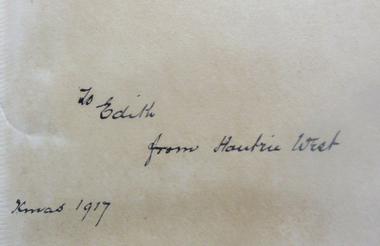
... This red cloth covered book has a front cover imprinted with a Scottish thistle and leaf design and a crest. The spine is impressed with a design and Victoria Edition and is also has printed in gold 'Ivanhoe', 'Scott' and G.Robertson & Co.'. ...1902 (There is a verse and a signiture which is difficult to read) This red cloth covered book has a front cover imprinted with a Scottish thistle and leaf design and a crest. The spine is impressed with a design and Victoria Edition and is also has printed in gold 'Ivanhoe', 'Scott' and G.Robertson & Co.'. ...This book is part of a collection of books, photos and memorabilia donated from the Chatham-Holmes family collection. Ivanhoe was written by Sir Walter Scott and this Victoria Edition was called the Australasian Issue.This red cloth covered book has a front cover imprinted with a Scottish thistle and leaf design and a crest. The spine is impressed with a design and Victoria Edition and is also has printed in gold 'Ivanhoe', 'Scott' and G.Robertson & Co.'. The book is 484 pages long.On inside cover in pen - To Edith from Hautric? West, Xmas 1917 On leaf in pen - To W.H.West Esq. You have Ivanhoe so haven't a notion? 1902 (There is a verse and a signiture which is difficult to read)chatham-holmes family collection, ivanhoe, sir walter scott, victoria edition australasian issue -
 Bendigo Historical Society Inc.
Document - ANCIENT ORDER OF FORESTERS NO 3770 COLLECTION: DOCTOR'S CERTIFICATE
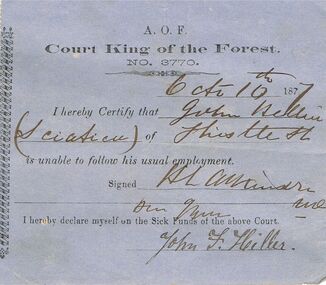
... Blue Doctor's Certificate dated Oct 10th 1877 certifying that John Hiller of Thistle St. was unable to follow his usual employment. ...SOCIETIES Aof correspondence Ancient Order of Foresters No 3770 Collection - Doctor's Certificate Court King of the Forest John F Hiller Blue Doctor's Certificate dated Oct 10th 1877 certifying that John Hiller of Thistle St. was unable to follow his usual employment. ...Blue Doctor's Certificate dated Oct 10th 1877 certifying that John Hiller of Thistle St. was unable to follow his usual employment. Signed by H. L. Atkinson. Signed at the end by John F. Hiller declaring himself on the Sick Funds.societies, aof, correspondence, ancient order of foresters no 3770 collection - doctor's certificate, court king of the forest, john f hiller -
 Bendigo Historical Society Inc.
Document - MALONE COLLECTION: GREETING CARDS
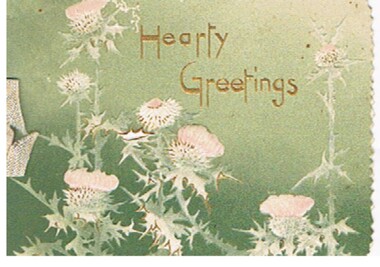
... Has embossed pink thistles on the front. Outlines of leaves and 'Hearty Greetings' in gold. ...Has embossed pink thistles on the front. Outlines of leaves and 'Hearty Greetings' in gold. ...Document. Greeting Cards. Green card, getting darker green as it nears the bottom. Has embossed pink thistles on the front. Outlines of leaves and 'Hearty Greetings' in gold. Ripple edges on card. Card & insert held together with a very pale green ribbon.person, greeting cards, malone collection, malone collection, greeting cards -
 Embroiderers Guild, Victoria
Functional Object - Buttons, Late 19th century
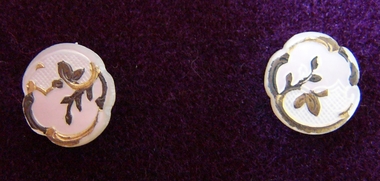
... B. 7 x small pearl buttons with incised thistle design coloured pink and green. 9 l.5 cm small round carved pearl buttons in Rococo style, gold and black colour. ...Buttons Late 19th century Diamente Mother of Pearl Metal/Cut steel B. 7 x small pearl buttons with incised thistle design coloured pink and green. 9 l.5 cm small round carved pearl buttons in Rococo style, gold and black colour. ...B. 7 x small pearl buttons with incised thistle design coloured pink and green. 9 l.5 cm small round carved pearl buttons in Rococo style, gold and black colour. Mounted on purple velvet by Norma Bain.buttons, late 19th century, diamente, mother of pearl, metal/cut steel -
 Glenelg Shire Council Cultural Collection
Souvenir - Souvenir Envelope, 1984
... Cream coloured, envelope, full colour design on front of envelope shows Edward Henty, view of township, thistle, pier and council logos. Reverse has shows 150th....Cream coloured, envelope, full colour design on front of envelope shows Edward Henty, view of township, thistle, pier and council logos. Reverse has shows 150th. ...Two Australia Post souvenir envelopes - Victoria's 150th anniversary (Portland. First settlement). Cream coloured, envelope, full colour design on front of envelope shows Edward Henty, view of township, thistle, pier and council logos. Reverse has shows 150th.australia post, souvenir, victoria 150th -
 Flagstaff Hill Maritime Museum and Village
Domestic object - Sewing Machine
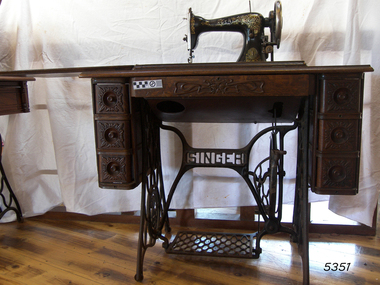
... Machine has 3 drawers down each side. and a pull out drawer across the front. Thistles are carved on the wooden ends....Machine has 3 drawers down each side. and a pull out drawer across the front. Thistles are carved on the wooden ends. Domestic object Sewing Machine ...Singer treadle sewing machine circa 1909 by The Singer Manufacturing Co. No F721292. Sewing machine folds down into body of machine. Machine has 3 drawers down each side. and a pull out drawer across the front. Thistles are carved on the wooden ends.flagstaff hill, warrnambool, shipwrecked-coast, flagstaff-hill, flagstaff-hill-maritime-museum, maritime-museum, shipwreck-coast, flagstaff-hill-maritime-village -
 Bendigo Historical Society Inc.
Document - H.A. & S.R. WILKINSON COLLECTION: CONDITION OF SALE
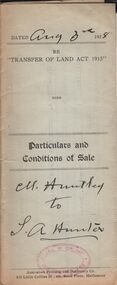
... Hunter for land at the corner of Creek and Thistle Streets, Bendigo held under miners right No. 6128 and being residence area No. 18124 for the price of 16 pounds and 10 shillings...Hunter for land at the corner of Creek and Thistle Streets, Bendigo held under miners right No. 6128 and being residence area No. 18124 for the price of 16 pounds and 10 shillings Document H.A. & S.R. ...BHS CollectionParticulars and conditions of sale dated 3rd. August, 1928 between M. Huntley and S. A. Hunter for land at the corner of Creek and Thistle Streets, Bendigo held under miners right No. 6128 and being residence area No. 18124 for the price of 16 pounds and 10 shillingsorganization, business, h.a. & s.r wilkinson real estate -
Clunes Museum
Book, HUTCHINSON & CO. (PUBLISHERS) LTD, WREATH FOR ARABELLA
... BLACK HARDCOVER BOOK, 349 PAGES WITH THE COVER PASSTED ONTO THE BACK OF THE BOOK, BLACK AND WHITE IMAGE OF A LADY DRESSED IN PERIOD CLOTHING, GREEN AND WHITE IMAGE OF A ROSE ON THE LEFT HAND SIDE OF THE COVER AND A GREEN AND WHITE THISTLE ON THE RIGHT HAND SIDE OF THE COVER....BOOK WAS IN WYNETTE LENDING LIBRARY, KEW AND THEN IN LES DAVIS'S CLUNES LIBRARY, WHICH WAS IN A ROOM BEHIND THE BARBER SHOP IN FRASER STREET. books novel books - novel WREATH FOR ARABELLA BIOGRAPHICAL NOVEL IN A STUDY OF LADY ARABELLA STUART, FIRST COUSIN TO JAMES 1, NEAR KINSWOMAN OF QUEEN ELIZABETH INSIDE COVER: RED STAMPED WYNETTE LENDING LIBRARY 106 DENMARK STREET KEW BLACK STAMPED LES DAVIS CLUNES LIBRARY 565 AND 289 BLACK HARDCOVER BOOK, 349 PAGES WITH THE COVER PASSTED ONTO THE BACK OF THE BOOK, BLACK AND WHITE IMAGE OF A LADY DRESSED IN PERIOD CLOTHING, GREEN AND WHITE IMAGE OF A ROSE ON THE LEFT HAND SIDE OF THE COVER AND A GREEN AND WHITE THISTLE ON THE RIGHT HAND SIDE OF THE COVER. ...BIOGRAPHICAL NOVEL IN A STUDY OF LADY ARABELLA STUART, FIRST COUSIN TO JAMES 1, NEAR KINSWOMAN OF QUEEN ELIZABETHBLACK HARDCOVER BOOK, 349 PAGES WITH THE COVER PASSTED ONTO THE BACK OF THE BOOK, BLACK AND WHITE IMAGE OF A LADY DRESSED IN PERIOD CLOTHING, GREEN AND WHITE IMAGE OF A ROSE ON THE LEFT HAND SIDE OF THE COVER AND A GREEN AND WHITE THISTLE ON THE RIGHT HAND SIDE OF THE COVER.non-fictionBIOGRAPHICAL NOVEL IN A STUDY OF LADY ARABELLA STUART, FIRST COUSIN TO JAMES 1, NEAR KINSWOMAN OF QUEEN ELIZABETH books, novel, books - novel, wreath for arabella -
 Dandenong/Cranbourne RSL Sub Branch
Badge - Cap Badge, Black Watch, 1902-1935
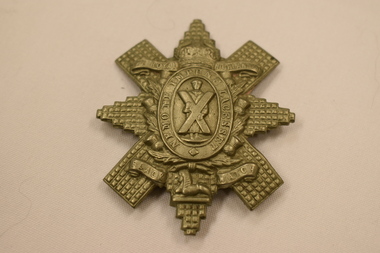
... Badge features a rayed and faceted star similar to the Star of the Order of Thistles. Upon the centre, within a wreath of thistles, an oval frosted circle bears the burnished motto: 'Nemo Me Impune Lacesset' ( Meaning no one attacks me with impunity) This is surmounted by a monarchial crown. ...Badge features a rayed and faceted star similar to the Star of the Order of Thistles. Upon the centre, within a wreath of thistles, an oval frosted circle bears the burnished motto: 'Nemo Me Impune Lacesset' ( Meaning no one attacks me with impunity) This is surmounted by a monarchial crown. ...Cap Badge ,Black Watch, Royal Highlanders 1902-1935. Badge features a rayed and faceted star similar to the Star of the Order of Thistles. Upon the centre, within a wreath of thistles, an oval frosted circle bears the burnished motto: 'Nemo Me Impune Lacesset' ( Meaning no one attacks me with impunity) This is surmounted by a monarchial crown. Within the circlet the figure of St Andrew is depicted holding his cross on a frosted ground On either side of the crown bears ' The Royal Highlanders' . On the bottom of the badge a scroll with the words 'Black Watch". refer https://collection.nam.ac.uk/detail.php?acc=1963-12-74-1See "Description" above. -
 Flagstaff Hill Maritime Museum and Village
Currency - Coin, 1826
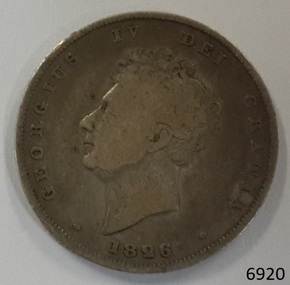
... Reverse; crowned lion; below, a large crown; below are a shamrock, rose and thistle united. Inscriptions on both sides of coin (denomination not inscribed)....Reverse; crowned lion; below, a large crown; below are a shamrock, rose and thistle united. Inscriptions on both sides of coin (denomination not inscribed). ...This Great Britain shilling is dated 1826. There were over 6 million of these coins minted during the reign of King George IV, 1820-1830 This coin’s denomination is not inscribed on the coin but it has been identified as a shilling from information about the King George III currency 1816-1820. - This Shilling is 24mm (the same size as this coin) British coins such as this one shilling were in circulation in the colony of Australia until 1910, when the Commonwealth of Australia began producing its own coinage. This coin was minted by the Royal Mint at Royal Mint Court, in Little Tower Hill, London, England. Coins for circulation in the Kingdom of England, Great Britain and most of the British Empire were produced here until the 1960’s when the Royal Mint shifted location to Wales. The obverse side of the coin’s inscription translation is “George IV by the Grace of God”. The engraver of the obverse image was William Wyon. The reverse side’s inscription on the coin is translated " King of The British territories, Defender of the Faith” The engraver of the reverse image was William Wyon. AUSTRALIAN CURRENCY The early settlers of Australia brought their own currency with them so a wide variety of coins, tokens and even ‘promissory’ notes (often called IOU’s) were used in the exchange of goods and services. In 1813 40,000 silver Spanish dollars, purchased by the English government, were delivered to Sydney to help resolve the currency problem reported by Governor Macquarie. The coins were converted for use by punching a hole in the centre of the coin. Both the outer ring, called the holey dollar, and the punched out ‘hole’, called the dump, were then used as the official currency. The holey dollars hold the place of being the first distinctively Australian coins. In 1825 the British Government passed the Sterling Silver Currency Act, making the British Pound the only legal form of currency in the Australian colonies. Not enough British currency was imported into the colony so other forms of currency were still used. In the mid 1800’s Australia entered the Gold Rush period when many made their fortunes. Gold was used for trading, often shaped into ingots, stamped with their weight and purity, and one pound tokens. In 1852 the Adelaide Assay Office, without British approval, made Australia’s first gold coin to meet the need for currency in South Australia after the Gold Rush began. In 1855 the official Australian Mint opened in Sydney, operating as a branch of the Royal Mint in London, and the gold was turned into coins called ‘sovereigns’. Other branches also opened in Melbourne and Perth. Up to the time of Australia becoming a federation in 1901 its currency included British copper and silver coins, Australian gold sovereigns, locally minted copper trade tokens, private banknotes, New South Wales and Queensland government treasury notes and Queensland government banknotes. After Federation the Australian government began to overwrite privately issued notes and prepared for the introduction of its own currency. In 1910 a National Australian Currency was formed, based on the British currency of ‘pounds, shillings and pence’ and the first Commonwealth coining was produced. In 1966, on February 14th, Australia changed over to the decimal currency system of dollars and cents. Australia did not have its own currency in the colonial times. Settlers brought money from other countries and they also traded goods such as grain when currency was scarce. For a long time there was no standardised value for the different currencies. In 1825 British currency became the only official currency in the colony of Australia and coins such as this silver shilling were imported into Australia to replace the mixture of foreign currency. Australia became a Federated nation on 1st January 1901. In 1910 National Australian Currency was formed and Australia produced its own currency, based on the British ‘pounds, shillings and pence’. The British currency was no longer valid. This silver shilling is of national significance as it represents the British currency used in Australia from 1825-1910. Coin, Great Britain shilling. 1826. Silver coin, round. Obverse; King George IV bare head, looking left. Reverse; crowned lion; below, a large crown; below are a shamrock, rose and thistle united. Inscriptions on both sides of coin (denomination not inscribed).Obverse “GEORGIUS IV DEI GRATIA” and “1826” Reverse “BRITANNIARUM REX FIDEI DEFENSOR” flagstaff hill, warrnambool, shipwrecked coast, flagstaff hill maritime museum, maritime museum, shipwreck coast, flagstaff hill maritime village, great ocean road, coin, currency, money, legal tender, australian currency history, royal mint, great britain shilling 1826, king george iv currency, colonial australia currency, william wyon, numismatics -
 Flagstaff Hill Maritime Museum and Village
Currency - Coin, 1826
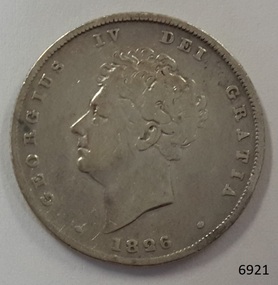
... Reverse; crowned lion; below, a large crown; below are a shamrock, rose and thistle united. Inscriptions on both sides of coin (denomination not inscribed)....Reverse; crowned lion; below, a large crown; below are a shamrock, rose and thistle united. Inscriptions on both sides of coin (denomination not inscribed). ...This Great Britain shilling is dated 1826. There were over 6 million of these coins minted during the reign of King George IV, 1820-1830 This coin’s denomination is not inscribed on the coin but it has been identified as a shilling from information about the King George III currency 1816-1820. - This Shilling is 24mm (the same size as this coin) British coins such as this one shilling were in circulation in the colony of Australia until 1910, when the Commonwealth of Australia began producing its own coinage. This coin was minted by the Royal Mint at Royal Mint Court, in Little Tower Hill, London, England. Coins for circulation in the Kingdom of England, Great Britain and most of the British Empire were produced here until the 1960’s when the Royal Mint shifted location to Wales. The obverse side of the coin’s inscription translation is “George IV by the Grace of God”. The engraver of the obverse image was William Wyon. The reverse side’s inscription on the coin is translated " King of The British territories, Defender of the Faith” The engraver of the reverse image was William Wyon. AUSTRALIAN CURRENCY The early settlers of Australia brought their own currency with them so a wide variety of coins, tokens and even ‘promissory’ notes (often called IOU’s) were used in the exchange of goods and services. In 1813 40,000 silver Spanish dollars, purchased by the English government, were delivered to Sydney to help resolve the currency problem reported by Governor Macquarie. The coins were converted for use by punching a hole in the centre of the coin. Both the outer ring, called the holey dollar, and the punched out ‘hole’, called the dump, were then used as the official currency. The holey dollars hold the place of being the first distinctively Australian coins. In 1825 the British Government passed the Sterling Silver Currency Act, making the British Pound the only legal form of currency in the Australian colonies. Not enough British currency was imported into the colony so other forms of currency were still used. In the mid 1800’s Australia entered the Gold Rush period when many made their fortunes. Gold was used for trading, often shaped into ingots, stamped with their weight and purity, and one pound tokens. In 1852 the Adelaide Assay Office, without British approval, made Australia’s first gold coin to meet the need for currency in South Australia after the Gold Rush began. In 1855 the official Australian Mint opened in Sydney, operating as a branch of the Royal Mint in London, and the gold was turned into coins called ‘sovereigns’. Other branches also opened in Melbourne and Perth. Up to the time of Australia becoming a federation in 1901 its currency included British copper and silver coins, Australian gold sovereigns, locally minted copper trade tokens, private banknotes, New South Wales and Queensland government treasury notes and Queensland government banknotes. After Federation the Australian government began to overwrite privately issued notes and prepared for the introduction of its own currency. In 1910 a National Australian Currency was formed, based on the British currency of ‘pounds, shillings and pence’ and the first Commonwealth coining was produced. In 1966, on February 14th, Australia changed over to the decimal currency system of dollars and cents. Australia did not have its own currency in the colonial times. Settlers brought money from other countries and they also traded goods such as grain when currency was scarce. For a long time there was no standardised value for the different currencies. In 1825 British currency became the only official currency in the colony of Australia and coins such as this silver shilling were imported into Australia to replace the mixture of foreign currency. Australia became a Federated nation on 1st January 1901. In 1910 National Australian Currency was formed and Australia produced its own currency, based on the British ‘pounds, shillings and pence’. The British currency was no longer valid. This silver shilling is of national significance as it represents the British currency used in Australia from 1825-1910. Coin, Great Britain shilling. 1826. Silver coin, round. Obverse; King George IV bare head, looking left. Reverse; crowned lion; below, a large crown; below are a shamrock, rose and thistle united. Inscriptions on both sides of coin (denomination not inscribed).Obverse “GEORGIUS IV DEI GRATIA” and “1826” Reverse “BRITANNIARUM REX FIDEI DEFENSOR” flagstaff hill, warrnambool, shipwrecked coast, flagstaff hill maritime museum, maritime museum, shipwreck coast, flagstaff hill maritime village, great ocean road, coin, currency, money, legal tender, australian currency history, royal mint, great britain shilling 1826, king george iv currency, colonial australia currency, william wyon, numismatics -
 Flagstaff Hill Maritime Museum and Village
Currency - Coin, 1826
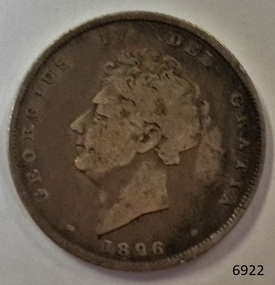
... Reverse; crowned lion; below, a large crown; below are a shamrock, rose and thistle united. Inscriptions on both sides of coin (denomination not inscribed)....Reverse; crowned lion; below, a large crown; below are a shamrock, rose and thistle united. Inscriptions on both sides of coin (denomination not inscribed). ...This Great Britain shilling is dated 1826. There were over 6 million of these coins minted during the reign of King George IV, 1820-1830 This coin’s denomination is not inscribed on the coin but it has been identified as a shilling from information about the King George III currency 1816-1820. - This Shilling is 24mm (the same size as this coin) British coins such as this one shilling were in circulation in the colony of Australia until 1910, when the Commonwealth of Australia began producing its own coinage. This coin was minted by the Royal Mint at Royal Mint Court, in Little Tower Hill, London, England. Coins for circulation in the Kingdom of England, Great Britain and most of the British Empire were produced here until the 1960’s when the Royal Mint shifted location to Wales. The obverse side of the coin’s inscription translation is “George IV by the Grace of God”. The engraver of the obverse image was William Wyon. The reverse side’s inscription on the coin is translated " King of The British territories, Defender of the Faith” The engraver of the reverse image was William Wyon. AUSTRALIAN CURRENCY The early settlers of Australia brought their own currency with them so a wide variety of coins, tokens and even ‘promissory’ notes (often called IOU’s) were used in the exchange of goods and services. In 1813 40,000 silver Spanish dollars, purchased by the English government, were delivered to Sydney to help resolve the currency problem reported by Governor Macquarie. The coins were converted for use by punching a hole in the centre of the coin. Both the outer ring, called the holey dollar, and the punched out ‘hole’, called the dump, were then used as the official currency. The holey dollars hold the place of being the first distinctively Australian coins. In 1825 the British Government passed the Sterling Silver Currency Act, making the British Pound the only legal form of currency in the Australian colonies. Not enough British currency was imported into the colony so other forms of currency were still used. In the mid 1800’s Australia entered the Gold Rush period when many made their fortunes. Gold was used for trading, often shaped into ingots, stamped with their weight and purity, and one pound tokens. In 1852 the Adelaide Assay Office, without British approval, made Australia’s first gold coin to meet the need for currency in South Australia after the Gold Rush began. In 1855 the official Australian Mint opened in Sydney, operating as a branch of the Royal Mint in London, and the gold was turned into coins called ‘sovereigns’. Other branches also opened in Melbourne and Perth. Up to the time of Australia becoming a federation in 1901 its currency included British copper and silver coins, Australian gold sovereigns, locally minted copper trade tokens, private banknotes, New South Wales and Queensland government treasury notes and Queensland government banknotes. After Federation the Australian government began to overwrite privately issued notes and prepared for the introduction of its own currency. In 1910 a National Australian Currency was formed, based on the British currency of ‘pounds, shillings and pence’ and the first Commonwealth coining was produced. In 1966, on February 14th, Australia changed over to the decimal currency system of dollars and cents. Australia did not have its own currency in the colonial times. Settlers brought money from other countries and they also traded goods such as grain when currency was scarce. For a long time there was no standardised value for the different currencies. In 1825 British currency became the only official currency in the colony of Australia and coins such as this silver shilling were imported into Australia to replace the mixture of foreign currency. Australia became a Federated nation on 1st January 1901. In 1910 National Australian Currency was formed and Australia produced its own currency, based on the British ‘pounds, shillings and pence’. The British currency was no longer valid. This silver shilling is of national significance as it represents the British currency used in Australia from 1825-1910. Coin, Great Britain shilling. 1826. Silver coin, round. Obverse; King George IV bare head, looking left. Reverse; crowned lion; below, a large crown; below are a shamrock, rose and thistle united. Inscriptions on both sides of coin (denomination not inscribed).Obverse “GEORGIUS IV DEI GRATIA” and “1826” Reverse “BRITANNIARUM REX FIDEI DEFENSOR” flagstaff hill, warrnambool, shipwrecked coast, flagstaff hill maritime museum, maritime museum, shipwreck coast, flagstaff hill maritime village, great ocean road, coin, currency, money, legal tender, australian currency history, royal mint, great britain shilling 1826, king george iv currency, colonial australia currency, william wyon, numismatics -
 Flagstaff Hill Maritime Museum and Village
Currency - Coin, 1826
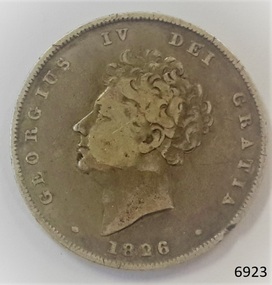
... Reverse; crowned lion; below, a large crown; below are a shamrock, rose and thistle united. Inscriptions on both sides of coin (denomination not inscribed)....Reverse; crowned lion; below, a large crown; below are a shamrock, rose and thistle united. Inscriptions on both sides of coin (denomination not inscribed). ...This Great Britain shilling is dated 1826. There were over 6 million of these coins minted during the reign of King George IV, 1820-1830 This coin’s denomination is not inscribed on the coin but it has been identified as a shilling from information about the King George III currency 1816-1820. - This Shilling is 24mm (the same size as this coin) British coins such as this one shilling were in circulation in the colony of Australia until 1910, when the Commonwealth of Australia began producing its own coinage. This coin was minted by the Royal Mint at Royal Mint Court, in Little Tower Hill, London, England. Coins for circulation in the Kingdom of England, Great Britain and most of the British Empire were produced here until the 1960’s when the Royal Mint shifted location to Wales. The obverse side of the coin’s inscription translation is “George IV by the Grace of God”. The engraver of the obverse image was William Wyon. The reverse side’s inscription on the coin is translated " King of The British territories, Defender of the Faith” The engraver of the reverse image was William Wyon. AUSTRALIAN CURRENCY The early settlers of Australia brought their own currency with them so a wide variety of coins, tokens and even ‘promissory’ notes (often called IOU’s) were used in the exchange of goods and services. In 1813 40,000 silver Spanish dollars, purchased by the English government, were delivered to Sydney to help resolve the currency problem reported by Governor Macquarie. The coins were converted for use by punching a hole in the centre of the coin. Both the outer ring, called the holey dollar, and the punched out ‘hole’, called the dump, were then used as the official currency. The holey dollars hold the place of being the first distinctively Australian coins. In 1825 the British Government passed the Sterling Silver Currency Act, making the British Pound the only legal form of currency in the Australian colonies. Not enough British currency was imported into the colony so other forms of currency were still used. In the mid 1800’s Australia entered the Gold Rush period when many made their fortunes. Gold was used for trading, often shaped into ingots, stamped with their weight and purity, and one pound tokens. In 1852 the Adelaide Assay Office, without British approval, made Australia’s first gold coin to meet the need for currency in South Australia after the Gold Rush began. In 1855 the official Australian Mint opened in Sydney, operating as a branch of the Royal Mint in London, and the gold was turned into coins called ‘sovereigns’. Other branches also opened in Melbourne and Perth. Up to the time of Australia becoming a federation in 1901 its currency included British copper and silver coins, Australian gold sovereigns, locally minted copper trade tokens, private banknotes, New South Wales and Queensland government treasury notes and Queensland government banknotes. After Federation the Australian government began to overwrite privately issued notes and prepared for the introduction of its own currency. In 1910 a National Australian Currency was formed, based on the British currency of ‘pounds, shillings and pence’ and the first Commonwealth coining was produced. In 1966, on February 14th, Australia changed over to the decimal currency system of dollars and cents. Australia did not have its own currency in the colonial times. Settlers brought money from other countries and they also traded goods such as grain when currency was scarce. For a long time there was no standardised value for the different currencies. In 1825 British currency became the only official currency in the colony of Australia and coins such as this silver shilling were imported into Australia to replace the mixture of foreign currency. Australia became a Federated nation on 1st January 1901. In 1910 National Australian Currency was formed and Australia produced its own currency, based on the British ‘pounds, shillings and pence’. The British currency was no longer valid. This silver shilling is of national significance as it represents the British currency used in Australia from 1825-1910. Coin, Great Britain shilling. 1826. Silver coin, round. Obverse; King George IV bare head, looking left. Reverse; crowned lion; below, a large crown; below are a shamrock, rose and thistle united. Inscriptions on both sides of coin (denomination not inscribed).Obverse “GEORGIUS IV DEI GRATIA” and “1826” Reverse “BRITANNIARUM REX FIDEI DEFENSOR” flagstaff hill, warrnambool, shipwrecked coast, flagstaff hill maritime museum, maritime museum, shipwreck coast, flagstaff hill maritime village, great ocean road, coin, currency, money, legal tender, australian currency history, royal mint, great britain shilling 1826, king george iv currency, colonial australia currency, william wyon, numismatics -
 Flagstaff Hill Maritime Museum and Village
Currency - Coin, 1826
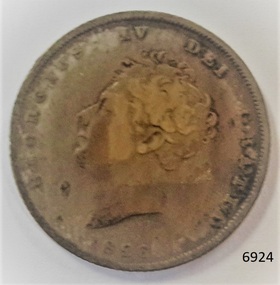
... Reverse; crowned lion; below, a large crown; below are a shamrock, rose and thistle united. Inscriptions on both sides of coin (denomination not inscribed)....Reverse; crowned lion; below, a large crown; below are a shamrock, rose and thistle united. Inscriptions on both sides of coin (denomination not inscribed). ...This Great Britain shilling is dated 1826. There were over 6 million of these coins minted during the reign of King George IV, 1820-1830 This coin’s denomination is not inscribed on the coin but it has been identified as a shilling from information about the King George III currency 1816-1820. - This Shilling is 24mm (the same size as this coin) British coins such as this one shilling were in circulation in the colony of Australia until 1910, when the Commonwealth of Australia began producing its own coinage. This coin was minted by the Royal Mint at Royal Mint Court, in Little Tower Hill, London, England. Coins for circulation in the Kingdom of England, Great Britain and most of the British Empire were produced here until the 1960’s when the Royal Mint shifted location to Wales. The obverse side of the coin’s inscription translation is “George IV by the Grace of God”. The engraver of the obverse image was William Wyon. The reverse side’s inscription on the coin is translated " King of The British territories, Defender of the Faith” The engraver of the reverse image was William Wyon. AUSTRALIAN CURRENCY The early settlers of Australia brought their own currency with them so a wide variety of coins, tokens and even ‘promissory’ notes (often called IOU’s) were used in the exchange of goods and services. In 1813 40,000 silver Spanish dollars, purchased by the English government, were delivered to Sydney to help resolve the currency problem reported by Governor Macquarie. The coins were converted for use by punching a hole in the centre of the coin. Both the outer ring, called the holey dollar, and the punched out ‘hole’, called the dump, were then used as the official currency. The holey dollars hold the place of being the first distinctively Australian coins. In 1825 the British Government passed the Sterling Silver Currency Act, making the British Pound the only legal form of currency in the Australian colonies. Not enough British currency was imported into the colony so other forms of currency were still used. In the mid 1800’s Australia entered the Gold Rush period when many made their fortunes. Gold was used for trading, often shaped into ingots, stamped with their weight and purity, and one pound tokens. In 1852 the Adelaide Assay Office, without British approval, made Australia’s first gold coin to meet the need for currency in South Australia after the Gold Rush began. In 1855 the official Australian Mint opened in Sydney, operating as a branch of the Royal Mint in London, and the gold was turned into coins called ‘sovereigns’. Other branches also opened in Melbourne and Perth. Up to the time of Australia becoming a federation in 1901 its currency included British copper and silver coins, Australian gold sovereigns, locally minted copper trade tokens, private banknotes, New South Wales and Queensland government treasury notes and Queensland government banknotes. After Federation the Australian government began to overwrite privately issued notes and prepared for the introduction of its own currency. In 1910 a National Australian Currency was formed, based on the British currency of ‘pounds, shillings and pence’ and the first Commonwealth coining was produced. In 1966, on February 14th, Australia changed over to the decimal currency system of dollars and cents. Australia did not have its own currency in the colonial times. Settlers brought money from other countries and they also traded goods such as grain when currency was scarce. For a long time there was no standardised value for the different currencies. In 1825 British currency became the only official currency in the colony of Australia and coins such as this silver shilling were imported into Australia to replace the mixture of foreign currency. Australia became a Federated nation on 1st January 1901. In 1910 National Australian Currency was formed and Australia produced its own currency, based on the British ‘pounds, shillings and pence’. The British currency was no longer valid. This silver shilling is of national significance as it represents the British currency used in Australia from 1825-1910. Coin, Great Britain shilling. 1826. Silver coin, round. Obverse; King George IV bare head, looking left. Reverse; crowned lion; below, a large crown; below are a shamrock, rose and thistle united. Inscriptions on both sides of coin (denomination not inscribed).Obverse “GEORGIUS IV DEI GRATIA” and “1826” Reverse “BRITANNIARUM REX FIDEI DEFENSOR” flagstaff hill, warrnambool, shipwrecked coast, flagstaff hill maritime museum, maritime museum, shipwreck coast, flagstaff hill maritime village, great ocean road, coin, currency, money, legal tender, australian currency history, royal mint, great britain shilling 1826, king george iv currency, colonial australia currency, william wyon, numismatics -
 St Kilda Historical Society
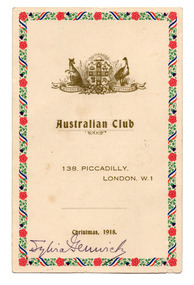
Ephemera - Seasonal card, Australian Club Christmas, 1918, 1918
... On the front, Australia's coat of arms and the text are printed in gold/brown, and they are surrounded by a border in green, red and blue (representing shamrocks, Scottish thistles, red roses and elements of the UK flag). ...On the front, Australia's coat of arms and the text are printed in gold/brown, and they are surrounded by a border in green, red and blue (representing shamrocks, Scottish thistles, red roses and elements of the UK flag). ...Also at same location, the Australasian Officers Club, established 1916Cream card that has discoloured with age. On the front, Australia's coat of arms and the text are printed in gold/brown, and they are surrounded by a border in green, red and blue (representing shamrocks, Scottish thistles, red roses and elements of the UK flag). Personnel of the Australia Club are listed on the back of the card in blue.Front signed by Sylvia Fenwickaustralian cub - london -
 Flagstaff Hill Maritime Museum and Village
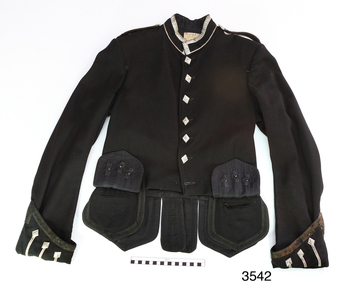
Uniform
... ...scottish thistle button...Silver daimond shaped, scotish thistle button on epaulettes, pocket flats, cuffs, between tail flaps (both missing). ...Silver daimond shaped, scotish thistle button on epaulettes, pocket flats, cuffs, between tail flaps (both missing). ...Uniform jacket, Black doublet style with silver braid around stand-up colar, fastened with 7 silver, diamond shaped, scotish thistle buttons (1 missing). Black braid around cuffs, and pocket and tail flaps. Black cord epaulettes on shoulders. 3 strieps of silver braid on sleeve cuffs, front pocket flaps (2), tail flaps (2). Silver daimond shaped, scotish thistle button on epaulettes, pocket flats, cuffs, between tail flaps (both missing). Black lining in body, white striped lining in sleeves, Padded shoulders, Label "David Lack Pty Ltd, uniform specialist Melbourne." Label "David Lack Pty Ltd, uniform specialist Melbourne." flagstaff hill, warrnambool, shipwrecked-coast, flagstaff-hill, flagstaff-hill-maritime-museum, maritime-museum, shipwreck-coast, flagstaff-hill-maritime-village, uniform, uniform maker, melbourne uniform, david lack pty ltd, scottish thistle button -
 Bendigo Historical Society Inc.
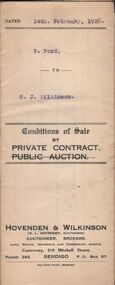
Document - H.A. & S.R. WILKINSON COLLECTION: CONDITION OF SALE
... Wilkinson for land situate in Thistle Street, Bendigo area No. 30459 together with workshop, wash house, stable, bath, copper and wash tube for the price of 7 pounds and 10 shillings...Wilkinson for land situate in Thistle Street, Bendigo area No. 30459 together with workshop, wash house, stable, bath, copper and wash tube for the price of 7 pounds and 10 shillings Document H.A. & S.R. ...BHS CollectionConditions of sale by private contract dated 14th. February, 1928 between F. Ford and G. J. Wilkinson for land situate in Thistle Street, Bendigo area No. 30459 together with workshop, wash house, stable, bath, copper and wash tube for the price of 7 pounds and 10 shillingsorganization, business, h.a. & s.r wilkinson real estate -
Federation University Historical Collection
Document, Graeme Tyrrell, The Gardens. School of Mines and Industries, Ballarat, 10/1988
... The report considered the following plants: Borage, Marigold, Fennel, thistle, Chamomile, Comfrey, Yarrow, Carroway, Asofoetida, Madder, Pennyroyal. ...The report considered the following plants: Borage, Marigold, Fennel, thistle, Chamomile, Comfrey, Yarrow, Carroway, Asofoetida, Madder, Pennyroyal. ballarat school of mines botanical gardens ballarat school of mines bob feary graeme tyrrell botanical garden materia medica botany Eight page report on white paper, stapled in the top left corner. ...The report was prepared by Graeme Tyrrell, headgroundsman/Gardener at the Ballarat School of Mines (SMB) for Bob Feary, Manager of Facilities at SMB. Its aim was to determine the feasibility of implementing recommendations of the Conservation Analysis report (Cat. No. 8516). The report considered the following plants: Borage, Marigold, Fennel, thistle, Chamomile, Comfrey, Yarrow, Carroway, Asofoetida, Madder, Pennyroyal. Eight page report on white paper, stapled in the top left corner. Contents include purpose of the report, analysis of plants, history of garden, works programme, plans of Ballarat School of Mines (1881 and 1988) and bibliography. ballarat school of mines botanical gardens, ballarat school of mines, bob feary, graeme tyrrell, botanical garden, materia medica, botany -
 Flagstaff Hill Maritime Museum and Village
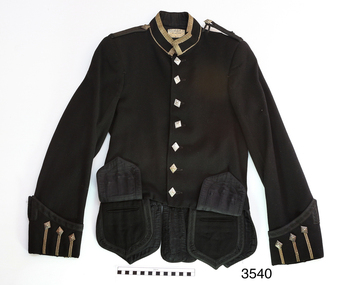
Uniform
... ...schttish thistle button...Gold, daimond shaped, scotch thistle button on epaulettes, pocket flats, cuffs, one between tail flaps (another is missing). ...Gold, daimond shaped, scotch thistle button on epaulettes, pocket flats, cuffs, one between tail flaps (another is missing). ...Uniform jacket, Black doublet style with gold braid around stand-up colar, fastened with 7 silver, diamond shaped, scotch thistle buttons. Black braid around cuffs, and pocket and tail flaps. Black cord epaulettes on shoulders, left has a cord lanyard loop. 3 strips of gold braid on sleeve cuffs, front pocket flaps (2), tail flaps (2). Gold, daimond shaped, scotch thistle button on epaulettes, pocket flats, cuffs, one between tail flaps (another is missing). Black lining in body, white striped lining in sleeves, Padded shoulders, Label "David Lack Pty Ltd, uniform specialist Melbourne."Label "David Lack Pty Ltd, uniform specialist Melbourne."flagstaff hill, warrnambool, shipwrecked-coast, flagstaff-hill, flagstaff-hill-maritime-museum, maritime-museum, shipwreck-coast, flagstaff-hill-maritime-village, uniform, historical uniform, melbourne clothing, schttish thistle button -
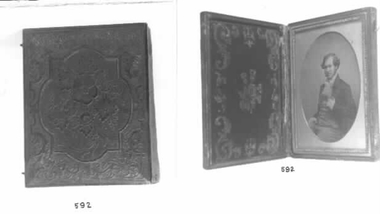 Whitehorse Historical Society Inc.
Functional object - Photo Case
... Padded velvet on let hand side with a cutaway pattern in the centre Scotch thistle, rose of England, Irish leaves. The photo surrounded by a gilt oval and edged by gilt raised pattern. ...Padded velvet on let hand side with a cutaway pattern in the centre Scotch thistle, rose of England, Irish leaves. The photo surrounded by a gilt oval and edged by gilt raised pattern. ...Daguerreotype of man in hinged tooled leather case. Photo on right hand side of case . Padded velvet on let hand side with a cutaway pattern in the centre Scotch thistle, rose of England, Irish leaves. The photo surrounded by a gilt oval and edged by gilt raised pattern. Horseshoe clips fasten the case.347 in inkphotography, photographs / slides / film -
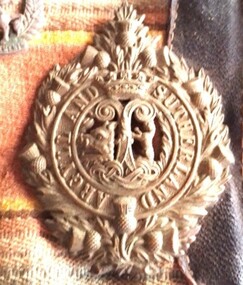 Warrnambool RSL Sub Branch
Uniform - Headdress Badge, Argyll and Sutherland Highlanders (Princess Louise's)
... Above the cypher and overlaying the top of the circlet is the Princess's coronet (a Royal Ducal coronet), all within a wreath of thistles. A pair of lugs to reverse....Above the cypher and overlaying the top of the circlet is the Princess's coronet (a Royal Ducal coronet), all within a wreath of thistles. A pair of lugs to reverse. Argyll and Sutherland Highlanders (Princess Louise's) Uniform Headdress Badge ...WW1. worn from 1882-1958A circlet inscribed ARGYLL AND SUTHERLAND. Within the circlet the cypher "L" of the late Princess Louise, interlaced and reversed. On the left of the cypher is a boar's head and on the right a cat-a-mountain (wild cat). Above the cypher and overlaying the top of the circlet is the Princess's coronet (a Royal Ducal coronet), all within a wreath of thistles. A pair of lugs to reverse. -
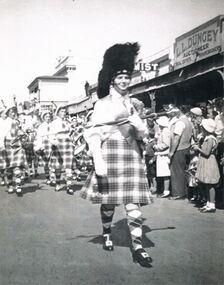 Bendigo Historical Society Inc.
Photograph - PHOTOGRAPH OF HEATHER REEVES (NEE PAIN) B&W, 1955
... The staff was made by Doug Pain (Heather's Father) out of a billiard cue, and an old silver bed head top with an amethyst on top in the shape of a thistle. Heather was the Pipe Major of the Bendigo Ladies Pipe Band. ...The staff was made by Doug Pain (Heather's Father) out of a billiard cue, and an old silver bed head top with an amethyst on top in the shape of a thistle. Heather was the Pipe Major of the Bendigo Ladies Pipe Band. ...Black and white photo of Heather Reeves (nee Pain). First Easter Fair march in 1955. The staff was made by Doug Pain (Heather's Father) out of a billiard cue, and an old silver bed head top with an amethyst on top in the shape of a thistle. Heather was the Pipe Major of the Bendigo Ladies Pipe Band. See 11400.966.photograph, person, heather reeves (nee pain) -
 Bendigo Historical Society Inc.
Book - THE SCHOOL PAPER: CLASSES VII AND VIII, 1914
... ...Thistle Street...Initials ‘‘D.M.'' are handwritten in ink on front of some copies; inside front cover a name has been erased (address us Thistle St, Bendigo with a date of 1911)....BENDIGO Education Thistle Street Bendigo The School Paper (Classes VII and VIII); 1914 - 12 copies. ...The School Paper (Classes VII and VIII); 1914 - 12 copies. Copies re hand-stitched into the covers of an exercise book with the normal pages removed. Initials ‘‘D.M.'' are handwritten in ink on front of some copies; inside front cover a name has been erased (address us Thistle St, Bendigo with a date of 1911).bendigo, education, thistle street, bendigo -
 Bendigo Historical Society Inc.
Document - MALONE COLLECTION: GREETING CARDS
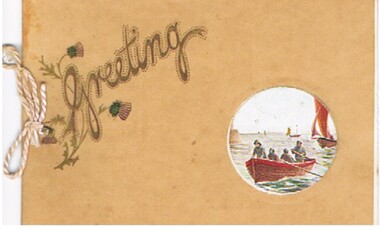
... On the right is 'Greeting' printed in Brown & gold. Some thistle flowers around the G. Card and insert held together with a mauve cord....On the right is 'Greeting' printed in Brown & gold. Some thistle flowers around the G. Card and insert held together with a mauve cord. ...Beige vellum card with white insert. Insert has 3.8mm coloured circular scene of 4 men in a red row boat with sailing boats in the background. The vallum outer has a cutout to show the scene. On the right is 'Greeting' printed in Brown & gold. Some thistle flowers around the G. Card and insert held together with a mauve cord.British Manufactureperson, greeting cards, malone collection, malone collection, greeting cards -
 Bendigo Historical Society Inc.
Document - MINING REPORTS - BENDIGO GOLDFIELD PRODUCTION
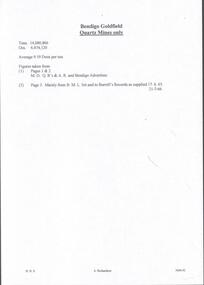
... Handwritten notes by Albert Richardson, (typed copy) detailing tons of ore and ounces of gold it produced for mines on the Hustlers, Paddy's Gully, Garden Gully, Deborah, Sheepshead, New Chum, Nell Gwynne, Napoleon, Lancashire, Thistle and Christmas Lines of Reef. Also the Napoleon Syncline and Mary McDonald Spurs. ...DOCUMENT Gold mining reports Mining Reports Bendigo Goldfield Production M D Q R & A R Bendigo Advertiser B M L Burrell's Records Handwritten notes by Albert Richardson, (typed copy) detailing tons of ore and ounces of gold it produced for mines on the Hustlers, Paddy's Gully, Garden Gully, Deborah, Sheepshead, New Chum, Nell Gwynne, Napoleon, Lancashire, Thistle and Christmas Lines of Reef. Also the Napoleon Syncline and Mary McDonald Spurs. ...Handwritten notes by Albert Richardson, (typed copy) detailing tons of ore and ounces of gold it produced for mines on the Hustlers, Paddy's Gully, Garden Gully, Deborah, Sheepshead, New Chum, Nell Gwynne, Napoleon, Lancashire, Thistle and Christmas Lines of Reef. Also the Napoleon Syncline and Mary McDonald Spurs. Also mentioned is the average per ton.document, gold, mining reports, mining reports, bendigo goldfield production, m d, q r & a r, bendigo advertiser, b m l, burrell's records -
 Buda Historic Home & Garden Castlemaine
Metalcraft - Silverware, Silver Mounted Emu Egg Goblet with Aboriginal, c 1855-1858
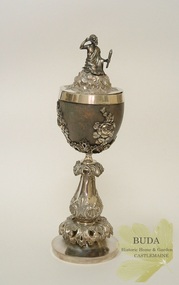
... Emu egg is mounted on a silver base with filigree acanthus leaf designwork on the stem, leading to four sprays on the egg surface with a rose, thistle and shamrock design. The inner egg is lined with a gold wash....Emu egg is mounted on a silver base with filigree acanthus leaf designwork on the stem, leading to four sprays on the egg surface with a rose, thistle and shamrock design. The inner egg is lined with a gold wash. ...Decorative object made by silversmith Ernest Leviny.Silver mounted emu egg goblet with detachable silver lid decorated with a kneeling Aboriginal figure holding weapons (spear is missing). Emu egg is mounted on a silver base with filigree acanthus leaf designwork on the stem, leading to four sprays on the egg surface with a rose, thistle and shamrock design. The inner egg is lined with a gold wash.Noneernest leviny, silversmithing, colonial silverware, castlemaine, emu egg goblet, buda, c 1859 -
Glenelg Shire Council Cultural Collection
Souvenir - Envelopes - Australia Post Portland's 150th Anniversary, Nov-84
... Cream, full colour illustration of Edward Henty superimposed over Portland Bay, small pier, 'Thistle', left hand side of envelope. reverse has printed explanation of event. a. has a 30c and 3c stamp postmarked 1985, date illegible b. not stamped...Cream, full colour illustration of Edward Henty superimposed over Portland Bay, small pier, 'Thistle', left hand side of envelope. reverse has printed explanation of event. a. has a 30c and 3c stamp postmarked 1985, date illegible b. not stamped Souvenir Envelopes - Australia Post Portland's 150th Anniversary Cover design: A.D. ...Two identical Australia Post souvenir envelopes, for Portland's/Vic's 150th Anniversary. Cream, full colour illustration of Edward Henty superimposed over Portland Bay, small pier, 'Thistle', left hand side of envelope. reverse has printed explanation of event. a. has a 30c and 3c stamp postmarked 1985, date illegible b. not stampedFront: a. 'Miss B. Vivian Box 103 Portland 3305' - handwritten, black biro b. 'Miss Betty Vivian 22 Otway St Portland 3305' - handwritten, blue biro -
 Parliament of Victoria
Portrait of Queen Victoria, Winterhalter, Franz Xaver (After), Queen Victoria, after Winterhalter, c.1859
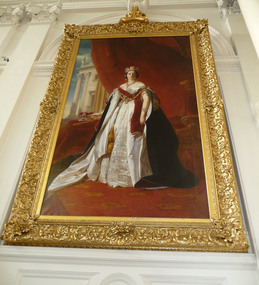
... There are rose, scotch thistle, clover leaf and Acanthus ornaments. ...There are rose, scotch thistle, clover leaf and Acanthus ornaments. ...Queen Victoria’s appreciation of German artist Franz Xaver Winterhalter (1805-1873) began after she saw portraits by him of other European monarchs. Accordingly, between 1842 and 1861 he made fifteen visits to England and painted over 100 portraits of Her Majesty, the royal family and other friends and dignitaries. In 1843 Winterhalter was commissioned to paint matching portraits of Queen Victoria and Albert, the Prince Consort. These originals hang in the Garter Throne Room at Windsor Castle and are part of the UK Royal Collection. Many legitimate copies of Winterhalter’s portrait were produced and presented to the Parliaments of the British Empire, including the Parliament of Victoria. Such copies are referred to as “After F. X. Winterhalter” and artists responsible include William Corden and John Prescott Knight. When creating copies, artists were not restricted by the size of the original portrait. Walterhalter’s original is 2.7m x 1.7m whereas copies can reach an impressive 4.5 metres in height. The portrait that hangs in Queens Hall at the Parliament of Victoria is not signed. Comparison with other copies of the work suggest that the Parliament’s painting may have been completed by William Corden. The Government Art Collection (United Kingdom), has a Queen Victoria copy in their collection and Parliament’s portrait has similar traits. A copy by John Prescott Knight which hangs in the Legislative Council in the Parliament of Tasmania is quite different, particularly with reference to the shape of the young Queen’s face, which is rounder in the Corden portraits.This portrait of Queen Victoria was presented as a gift by the British Government to the Parliament of Victoria in April 1860. Painted on fine linen supplied under Royal Warrant by the workshop Winsor and Newton, London, the frame has been embellished with elaborate wooden carvings. Framed portrait, oil on linen, of Queen Victoria. Victoria is posed in front of a curtain partially obscuring a building (possibly Buckingham Palace) in the background. Timber frame with a layer of gesso and decorative composition ornaments. There are rose, scotch thistle, clover leaf and Acanthus ornaments. A carved wood and composition element crown, resting on a tassled pillow sits on top of the frame.Canvas unsigned. Verso printed: ‘WINSOR AND NEWTON / Rathbone Place, London’. Embossed stamp into stretcher wood, stamped ‘Winsor and Newton’ in black ink.victoria queen of great britain, 1819-1901, winterhalter, franz xaver, 1805-1873, corden, william, queens hall, parliament of victoria -
 Romsey and Lancefield RSL Sub Branch
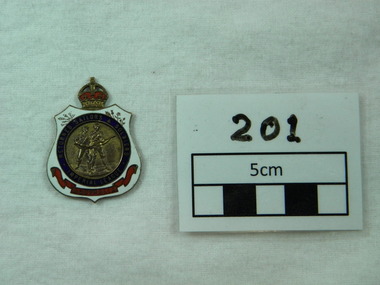
badge, c 1919
... The wattle is symbolic of Australia. The Leek, Rose, Thistle and Shamrock are symbolic of and represent the link with Wales, England, Scotland and Ireland. .A Crown is positioned on the top of the badge symbolizing loyalty to the Monarchy....The wattle is symbolic of Australia. The Leek, Rose, Thistle and Shamrock are symbolic of and represent the link with Wales, England, Scotland and Ireland. .A Crown is positioned on the top of the badge symbolizing loyalty to the Monarchy. rsl badge medallion crest rssaila Rear stamped number "96641" Bronze Metal. ...The Australian Returned Services League was designed in 1919 and has remained predominately the same since then. The white background stands for purity of motives, The blue indicates willingness to render service to a comrade anywhere beneath the blue sky. The red stands for the blood ties of war. The wattle is symbolic of Australia. The Leek, Rose, Thistle and Shamrock are symbolic of and represent the link with Wales, England, Scotland and Ireland. .A Crown is positioned on the top of the badge symbolizing loyalty to the Monarchy.Bronze Metal. Centre two figures in bronze surrounded by blue circle with words Returned Sailors and Soldiers Imperial League .Further surrounded by white enamel with red ribbon at base with words Australia in centre of ribbon. Edward VII Crown at top. 1919-1926.Rear stamped number "96641"rsl, badge, medallion, crest, rssaila -
 Wangaratta RSL Sub Branch
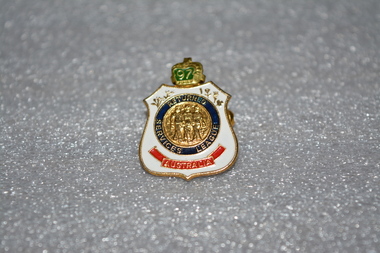
Badge, RSL
... The wattle represents Australia, with the leek, the rose, the thistle and the shamrock standing for Wales, England, Scotland and Ireland respectively....The wattle represents Australia, with the leek, the rose, the thistle and the shamrock standing for Wales, England, Scotland and Ireland respectively. ...The shield design is symbolic of the protection provided to those who wear it. Within the badge, red represents the blood ties of war that exist between comrades; white stands for the purity of the motives in joining the league – to render service without personal gain or ambition; and blue indicates a willingness to serve a comrade anywhere under the blue sky. The wattle represents Australia, with the leek, the rose, the thistle and the shamrock standing for Wales, England, Scotland and Ireland respectively.The League’s badge represents a readiness at all times to render service to Queen and country and to former comrades. It can’t be purchased and may only be worn by those who have served their country. Gold badge with white on outside, crown on top, blue circle in the middle with gold in centre, Has red banner at bottom.On front: 97 in crown. Returned Services League. Australia. On back: Badge remains property of League. Brim Melb. Vic. 18915australia, rsl, badge
