
Showing 195 items matching "cmf australia"
-
 Wangaratta RSL Sub Branch
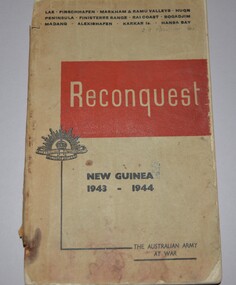
Book - Booklet, Director General of Public Relations Australian Army, Reconquest New Guinea 1943-1944, c1944
... CMF before joining the 2/14th Battalion at Caulfield in September 1940. He disembarked for the Middle East in November, 1940 and fought in the Syrian campaign in 1941. In 1942 the 2/14th Battalion returned to Australia...CMF before joining the 2/14th Battalion at Caulfield in September 1940. He disembarked for the Middle East in November, 1940 and fought in the Syrian campaign in 1941. In 1942 the 2/14th Battalion returned to Australia ...The Reconquest of New Guinea in 1943–1944 was a massive, grueling Allied offensive that shattered the Japanese Eighteenth Army through a combination of amphibious assaults, airborne operations, and brutal jungle warfare. Booklet belonged to Robert Francis ISKOV VX15237 born at Glenrowan served with the 59th Battalion CMF before joining the 2/14th Battalion at Caulfield in September 1940. He disembarked for the Middle East in November, 1940 and fought in the Syrian campaign in 1941. In 1942 the 2/14th Battalion returned to Australia and sent to Papua where he fought at the Battle of Isurava before the battalion was sent to Gona. On 1943 Bob returned to Australia to undertake officer training and in 1945 with the 2/23rd Battalion sailed to Morotai and served with the battalion on Tarakan. He returned to Australia in November, 1945 and discharged a month later.Soft cover booklet containing 160 pages including maps and photographs. Cover is cream colour cardboard with black print and rising sun crest.Front Cover - The Australian Army at War. Rear Cover - Overseas Edition Not For Public Sale ww2, new guinea, booklet, reconquest -
 Wangaratta RSL Sub Branch
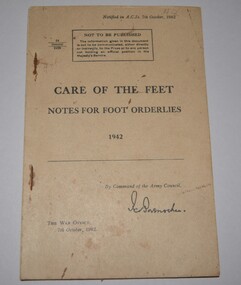
Booklet, J T Picken and Sons, Care of the Feet - Notes for Foot Orderlies, c1942
... CMF before joining the 2/14th Battalion at Caulfield in September 1940. He disembarked for the Middle East in November, 1940 and fought in the Syrian campaign in 1941. In 1942 the 2/14th Battalion returned to Australia...CMF before joining the 2/14th Battalion at Caulfield in September 1940. He disembarked for the Middle East in November, 1940 and fought in the Syrian campaign in 1941. In 1942 the 2/14th Battalion returned to Australia ...The 1942 "Care of the Feet" booklet refers to a restricted military pamphlet published by the British War Office on October 7, 1942, titled "Care of the Feet - Notes for Foot Orderlies". It was marked as a restricted document ("Not to be published") and issued by the Army Council. Booklet belonged to Robert Francis ISKOV VX15237 born at Glenrowan served with the 59th Battalion CMF before joining the 2/14th Battalion at Caulfield in September 1940. He disembarked for the Middle East in November, 1940 and fought in the Syrian campaign in 1941. In 1942 the 2/14th Battalion returned to Australia and sent to Papua where he fought at the Battle of Isurava before the battalion was sent to Gona. On 1943 Bob returned to Australia to undertake officer training and in 1945 with the 2/23rd Battalion sailed to Morotai and served with the battalion on Tarakan. He returned to Australia in November, 1945 and discharged a month later.Cream cardboard covered booklet containing 48 pages including diagrams. Not to be Publishedww2, new guinea, booklet, care of the feet - notes for foot orderlies, 1942 -
 Wangaratta RSL Sub Branch
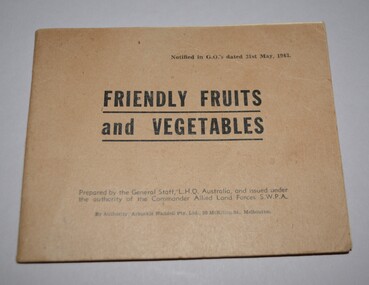
Booklet, Arbuckle Waddell Pty Ltd, Friendly Fruits and Vegetables, c1943
... CMF before joining the 2/14th Battalion at Caulfield in September 1940. He disembarked for the Middle East in November, 1940 and fought in the Syrian campaign in 1941. In 1942 the 2/14th Battalion returned to Australia...CMF before joining the 2/14th Battalion at Caulfield in September 1940. He disembarked for the Middle East in November, 1940 and fought in the Syrian campaign in 1941. In 1942 the 2/14th Battalion returned to Australia ..."Friendly Fruits and Vegetables" is a specific WWII-era jungle survival guide which served as a visual pamphlet to help downed aircrews identify edible jungle plants, avoid dangerous ones, and find survival resources Booklet belonged to Robert Francis ISKOV VX15237 born at Glenrowan served with the 59th Battalion CMF before joining the 2/14th Battalion at Caulfield in September 1940. He disembarked for the Middle East in November, 1940 and fought in the Syrian campaign in 1941. In 1942 the 2/14th Battalion returned to Australia and sent to Papua where he fought at the Battle of Isurava before the battalion was sent to Gona. On 1943 Bob returned to Australia to undertake officer training and in 1945 with the 2/23rd Battalion sailed to Morotai and served with the battalion on Tarakan. He returned to Australia in November, 1945 and discharged a month later.Cream cardboard covered booklet containing 71 pages including photographs. ww2, new guinea, booklet, 1943, friendly fruits and vegetables, aircrews -
 Wangaratta RSL Sub Branch
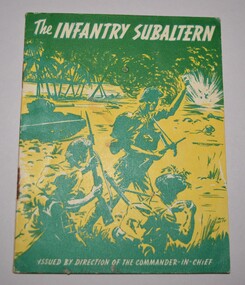
Booklet, LHQ Press, The Infantry Subaltern's Task, c1943
... "The Infantry Subaltern's Task," was an official tactical booklet issued by the Australian Army's Land Headquarters (South West Pacific Area) designed to instruct newly commissioned subalterns (platoon commanders) on jungle warfare, leadership, and operational realities in the Pacific. Booklet belonged to Robert Francis ISKOV VX15237 born at Glenrowan served with the 59th Battalion CMF..."The Infantry Subaltern's Task," was an official tactical booklet issued by the Australian Army's Land Headquarters (South West Pacific Area) designed to instruct newly commissioned subalterns (platoon commanders) on jungle warfare, leadership, and operational realities in the Pacific. Booklet belonged to Robert Francis ISKOV VX15237 born at Glenrowan served with the 59th Battalion CMF ..."The Infantry Subaltern's Task," was an official tactical booklet issued by the Australian Army's Land Headquarters (South West Pacific Area) designed to instruct newly commissioned subalterns (platoon commanders) on jungle warfare, leadership, and operational realities in the Pacific. Booklet belonged to Robert Francis ISKOV VX15237 born at Glenrowan served with the 59th Battalion CMF before joining the 2/14th Battalion at Caulfield in September 1940. He disembarked for the Middle East in November, 1940 and fought in the Syrian campaign in 1941. In 1942 the 2/14th Battalion returned to Australia and sent to Papua where he fought at the Battle of Isurava before the battalion was sent to Gona. On 1943 Bob returned to Australia to undertake officer training and in 1945 with the 2/23rd Battalion sailed to Morotai and served with the battalion on Tarakan. He returned to Australia in November, 1945 and discharged a month later.Green yellow and white soft cover booklet containing 20 pages. Front cover depicts three soldiers and a tank in foreground of river and palm trees. Issued by direction of the Commander in Chiefww2, new guinea, booklet, 1943, the infantry subaltern, swpa -
 Wangaratta RSL Sub Branch
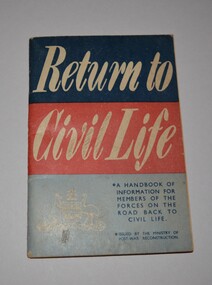
Booklet, Thomas Henry Tennant, Return to Civil Life - A handbook of information for members of the forces on the road back to civil life, 1/9/1945
... The Return to Civil Life booklet is a194 handbook issued by the Australian Ministry of Post-War Reconstruction to guide WWII service members returning to civilian life. Booklet belonged to Robert Francis ISKOV VX15237 born at Glenrowan served with the 59th Battalion CMF before joining the 2/14th Battalion at Caulfield in September 1940. ...The Return to Civil Life booklet is a194 handbook issued by the Australian Ministry of Post-War Reconstruction to guide WWII service members returning to civilian life. Booklet belonged to Robert Francis ISKOV VX15237 born at Glenrowan served with the 59th Battalion CMF before joining the 2/14th Battalion at Caulfield in September 1940. ...The Return to Civil Life booklet is a194 handbook issued by the Australian Ministry of Post-War Reconstruction to guide WWII service members returning to civilian life. Booklet belonged to Robert Francis ISKOV VX15237 born at Glenrowan served with the 59th Battalion CMF before joining the 2/14th Battalion at Caulfield in September 1940. He disembarked for the Middle East in November, 1940 and fought in the Syrian campaign in 1941. In 1942 the 2/14th Battalion returned to Australia and sent to Papua where he fought at the Battle of Isurava before the battalion was sent to Gona. On 1943 Bob returned to Australia to undertake officer training and in 1945 with the 2/23rd Battalion sailed to Morotai and served with the battalion on Tarakan. He returned to Australia in November, 1945 and discharged a month later. Tri colour soft cover booklet containing 55 pages Issued by the Ministry of Post War Reconstructionww2, new guinea, booklet, return to civil life, 1945 -
 Wangaratta RSL Sub Branch
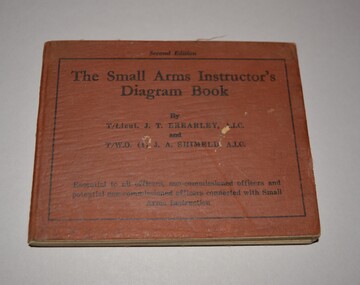
Book, Halstead Press Pty Limited, The Small Arms Instructor's Diagram Book, 1942
... CMF before joining the 2/14th Battalion at Caulfield in September 1940. He disembarked for the Middle East in November, 1940 and fought in the Syrian campaign in 1941. In 1942 the 2/14th Battalion returned to Australia...CMF before joining the 2/14th Battalion at Caulfield in September 1940. He disembarked for the Middle East in November, 1940 and fought in the Syrian campaign in 1941. In 1942 the 2/14th Battalion returned to Australia ...The Small Arms Instructor's Diagram Book (1942) is a military training aid containing visual illustrations, mechanism plates, and trajectory diagrams used by Commonwealth forces during World War II. Booklet belonged to Robert Francis ISKOV VX15237 born at Glenrowan served with the 59th Battalion CMF before joining the 2/14th Battalion at Caulfield in September 1940. He disembarked for the Middle East in November, 1940 and fought in the Syrian campaign in 1941. In 1942 the 2/14th Battalion returned to Australia and sent to Papua where he fought at the Battle of Isurava before the battalion was sent to Gona. On 1943 Bob returned to Australia to undertake officer training and in 1945 with the 2/23rd Battalion sailed to Morotai and served with the battalion on Tarakan. He returned to Australia in November, 1945 and discharged a month later.A monograph publication by T/Lieut. J. T Brearley and T/W.O (1) J.A.ShimeldBrown cloth covered hard cover book containing 92 pages mainly of diagrams.Second Editionww2, new guinea, 1942, instructor's diagram book, small arms, second edition -
 Wangaratta RSL Sub Branch
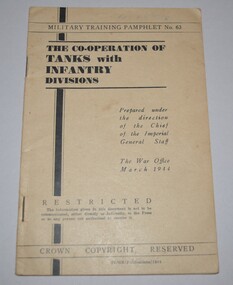
Pamphlet - Military Training Pamphlet No 63, The Co-operation of Tanks with Infantry Divisions, 1944
... CMF before joining the 2/14th Battalion at Caulfield in September 1940. He disembarked for the Middle East in November, 1940 and fought in the Syrian campaign in 1941. In 1942 the 2/14th Battalion returned to Australia...CMF before joining the 2/14th Battalion at Caulfield in September 1940. He disembarked for the Middle East in November, 1940 and fought in the Syrian campaign in 1941. In 1942 the 2/14th Battalion returned to Australia ...Military Training Pamphlet (MTP) No. 63, "The Co-Operation of Tanks with Infantry Divisions" is a World War II British Army publication issued by the War Office in 1944. It established the tactical framework for combined arms operations leading up to the invasion of North-West Europe. Booklet belonged to Robert Francis ISKOV VX15237 born at Glenrowan served with the 59th Battalion CMF before joining the 2/14th Battalion at Caulfield in September 1940. He disembarked for the Middle East in November, 1940 and fought in the Syrian campaign in 1941. In 1942 the 2/14th Battalion returned to Australia and sent to Papua where he fought at the Battle of Isurava before the battalion was sent to Gona. On 1943 Bob returned to Australia to undertake officer training and in 1945 with the 2/23rd Battalion sailed to Morotai and served with the battalion on Tarakan. He returned to Australia in November, 1945 and discharged a month later.Soft cover pamphlet with black lettering containing 30 pages Restricted Crown Copyright Reservedww2, 1944, war office, military training pamphlet -
 Wangaratta RSL Sub Branch
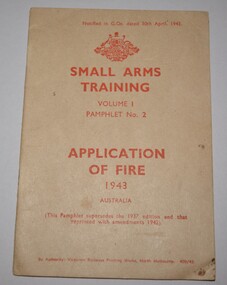
Pamphlet - Small Arms Training, Victorian Railways Printing Works, Application of Fire, 1943
... Australian Army manual focusing on the principles of effective rifle fire. Covering essential skills such as estimating distance, assessing wind effects, and understanding angles, this pamphlet provided soldiers with the knowledge needed for accurate marksmanship in combat. Booklet belonged to Robert Francis ISKOV VX15237 born at Glenrowan served with the 59th Battalion CMF...Australian Army manual focusing on the principles of effective rifle fire. Covering essential skills such as estimating distance, assessing wind effects, and understanding angles, this pamphlet provided soldiers with the knowledge needed for accurate marksmanship in combat. Booklet belonged to Robert Francis ISKOV VX15237 born at Glenrowan served with the 59th Battalion CMF ...Australian Army manual focusing on the principles of effective rifle fire. Covering essential skills such as estimating distance, assessing wind effects, and understanding angles, this pamphlet provided soldiers with the knowledge needed for accurate marksmanship in combat. Booklet belonged to Robert Francis ISKOV VX15237 born at Glenrowan served with the 59th Battalion CMF before joining the 2/14th Battalion at Caulfield in September 1940. He disembarked for the Middle East in November, 1940 and fought in the Syrian campaign in 1941. In 1942 the 2/14th Battalion returned to Australia and sent to Papua where he fought at the Battle of Isurava before the battalion was sent to Gona. On 1943 Bob returned to Australia to undertake officer training and in 1945 with the 2/23rd Battalion sailed to Morotai and served with the battalion on Tarakan. He returned to Australia in November, 1945 and discharged a month later.Soft cover pamphlet with red lettering containing 31 pages and diagramsVolume 1 Pamphlet 2 Pamphlet supersedes the 1937 edition and that reprinted with amendments 1942.ww2, military training pamphlet, small arms training, 1943 -
 Wangaratta RSL Sub Branch
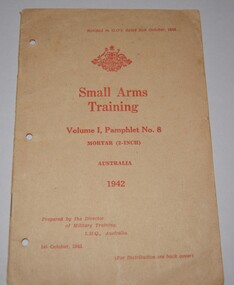
Pamphlet - Small Arms Training, Mortar (2 inch), 1/10/1942
... Australian Army manual focusing on the principles of mortar and bombs, covering essential skills to provide soldiers with the knowledge needed in combat. Booklet belonged to Robert Francis ISKOV VX15237 born at Glenrowan served with the 59th Battalion CMF before joining the 2/14th Battalion at Caulfield in September 1940. ...Australian Army manual focusing on the principles of mortar and bombs, covering essential skills to provide soldiers with the knowledge needed in combat. Booklet belonged to Robert Francis ISKOV VX15237 born at Glenrowan served with the 59th Battalion CMF before joining the 2/14th Battalion at Caulfield in September 1940. ...Australian Army manual focusing on the principles of mortar and bombs, covering essential skills to provide soldiers with the knowledge needed in combat. Booklet belonged to Robert Francis ISKOV VX15237 born at Glenrowan served with the 59th Battalion CMF before joining the 2/14th Battalion at Caulfield in September 1940. He disembarked for the Middle East in November, 1940 and fought in the Syrian campaign in 1941. In 1942 the 2/14th Battalion returned to Australia and sent to Papua where he fought at the Battle of Isurava before the battalion was sent to Gona. On 1943 Bob returned to Australia to undertake officer training and in 1945 with the 2/23rd Battalion sailed to Morotai and served with the battalion on Tarakan. He returned to Australia in November, 1945 and discharged a month later.Soft cover pamphlet with red lettering containing 18 pages including diagramsVolume 1 Pamphlet 8 1st October 1942.ww2, military training pamphlet, small arms training, 1942, mortar -
 Wangaratta RSL Sub Branch
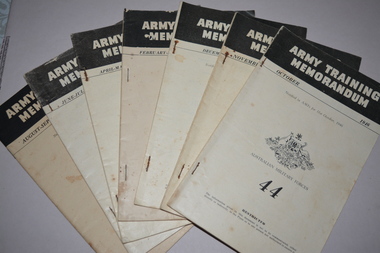
Pamphlet, WIlke & Co Pty Ltd, Army Training Memorandum, 1946
... Seven consecutively numbered 44-50 dated between October 1946 and August/September 1947 Australian Army Training Memorandum pamphlets featuring short articles. Booklet belonged to Robert Francis ISKOV VX15237 born at Glenrowan served with the 59th Battalion CMF before joining the 2/14th Battalion at Caulfield in September 1940. ...Seven consecutively numbered 44-50 dated between October 1946 and August/September 1947 Australian Army Training Memorandum pamphlets featuring short articles. Booklet belonged to Robert Francis ISKOV VX15237 born at Glenrowan served with the 59th Battalion CMF before joining the 2/14th Battalion at Caulfield in September 1940. ...Seven consecutively numbered 44-50 dated between October 1946 and August/September 1947 Australian Army Training Memorandum pamphlets featuring short articles. Booklet belonged to Robert Francis ISKOV VX15237 born at Glenrowan served with the 59th Battalion CMF before joining the 2/14th Battalion at Caulfield in September 1940. He disembarked for the Middle East in November, 1940 and fought in the Syrian campaign in 1941. In 1942 the 2/14th Battalion returned to Australia and sent to Papua where he fought at the Battle of Isurava before the battalion was sent to Gona. On 1943 Bob returned to Australia to undertake officer training and in 1945 with the 2/23rd Battalion sailed to Morotai and served with the battalion on Tarakan. He returned to Australia in November, 1945 and discharged a month laterSeries of seven soft cover pamphlets with black lettering containing short articles and diagramsVolume 44 -50 (October 1946 - August/September 1947) Restrictedww2, military training pamphlet, 1946-1947, australian army memorandum -
 Wangaratta RSL Sub Branch
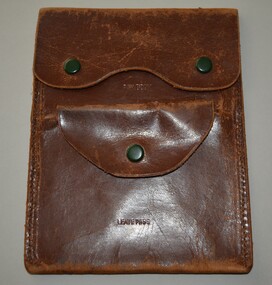
Accessory - Document pouch, C1940
... CMF before joining the 2/14th Battalion at Caulfield in September 1940. He disembarked for the Middle East in November, 1940 and fought in the Syrian campaign in 1941. In 1942 the 2/14th Battalion returned to Australia...CMF before joining the 2/14th Battalion at Caulfield in September 1940. He disembarked for the Middle East in November, 1940 and fought in the Syrian campaign in 1941. In 1942 the 2/14th Battalion returned to Australia ...Brown leather pouch made specifically to house a pay book and leave pass. No maker’s name or identification. Item belonged to Robert Francis ISKOV VX15237 served with the 59th Battalion/Hume Regiment CMF before joining the 2/14th Battalion at Caulfield in September 1940. He disembarked for the Middle East in November, 1940 and fought in the Syrian campaign in 1941. In 1942 the 2/14th Battalion returned to Australia and sent to Papua where he fought at the Battle of Isurava before the battalion was sent to Gona. On 1943 Bob returned to Australia to undertake officer training and in 1945 with the 2/23rd Battalion sailed to Morotai and served with the battalion on Tarakan. He returned to Australia in November, 1945 and discharged a month laterBrown leather pouch consisting of two separate compartments with front flaps affixed with metal press down studs.Pay Book Leave Passpouch, ww2, bob iskov -
 Wangaratta RSL Sub Branch
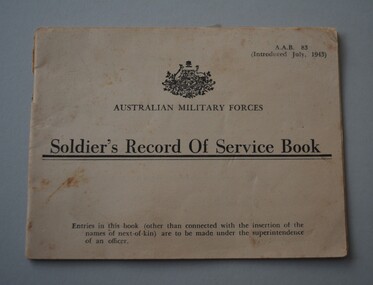
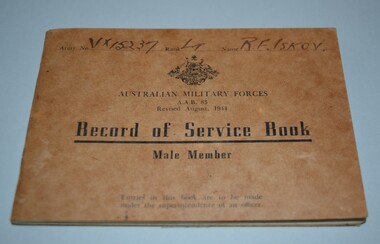
Booklet - Record of Service Book, The Specialty Press Pty Ltd, C1943
... Soldiers' Record of Service books such as the historical Australian Military Forces A.A.B. 83 were personal logs carried by service members to document enlistment, postings, courses, and medical history. Item belonged to Robert Francis ISKOV VX15237 served with the 59th Battalion/Hume Regiment CMF before joining the 2/14th Battalion at Caulfield in September 1940. ...Soldiers' Record of Service books such as the historical Australian Military Forces A.A.B. 83 were personal logs carried by service members to document enlistment, postings, courses, and medical history. Item belonged to Robert Francis ISKOV VX15237 served with the 59th Battalion/Hume Regiment CMF before joining the 2/14th Battalion at Caulfield in September 1940. ...Soldiers' Record of Service books such as the historical Australian Military Forces A.A.B. 83 were personal logs carried by service members to document enlistment, postings, courses, and medical history. Item belonged to Robert Francis ISKOV VX15237 served with the 59th Battalion/Hume Regiment CMF before joining the 2/14th Battalion at Caulfield in September 1940. He disembarked for the Middle East in November, 1940 and fought in the Syrian campaign in 1941. In 1942 the 2/14th Battalion returned to Australia and sent to Papua where he fought at the Battle of Isurava before the battalion was sent to Gona. On 1943 Bob returned to Australia to undertake officer training and in 1945 with the 2/23rd Battalion sailed to Morotai and served with the battalion on Tarakan. He returned to Australia in November, 1945 and discharged a month later Cream paper booklet with crest and lettering in black ink on front cover containing 20 pagesA.A.B 83 Introduced July 1943 Australian Military Forcesww2, bob iskov, soldier's record of service book -
 Wangaratta RSL Sub Branch
Booklet - Record of Service Book, The Specialty Press Pty Ltd, C1944
... Soldiers' Record of Service books such as the historical Australian Military Forces A.A.B. 83 were personal logs carried by service members to document enlistment, postings, courses, and medical history. Item belonged to Robert Francis ISKOV VX15237 served with the 59th Battalion/Hume Regiment CMF before joining the 2/14th Battalion at Caulfield in September 1940. ...Soldiers' Record of Service books such as the historical Australian Military Forces A.A.B. 83 were personal logs carried by service members to document enlistment, postings, courses, and medical history. Item belonged to Robert Francis ISKOV VX15237 served with the 59th Battalion/Hume Regiment CMF before joining the 2/14th Battalion at Caulfield in September 1940. ...Soldiers' Record of Service books such as the historical Australian Military Forces A.A.B. 83 were personal logs carried by service members to document enlistment, postings, courses, and medical history. Item belonged to Robert Francis ISKOV VX15237 served with the 59th Battalion/Hume Regiment CMF before joining the 2/14th Battalion at Caulfield in September 1940. He disembarked for the Middle East in November, 1940 and fought in the Syrian campaign in 1941. In 1942 the 2/14th Battalion returned to Australia and sent to Papua where he fought at the Battle of Isurava before the battalion was sent to Gona. On 1943 Bob returned to Australia to undertake officer training and in 1945 with the 2/23rd Battalion sailed to Morotai and served with the battalion on Tarakan. He returned to Australia in November, 1945 and discharged a month later Brown cardboard booklet with crest and lettering in black ink on front cover containing 40 pages VX15237 Lt R F ISKOV Australian Military Forcesww2, bob iskov, soldier's record of service book, amf -
 Wangaratta RSL Sub Branch
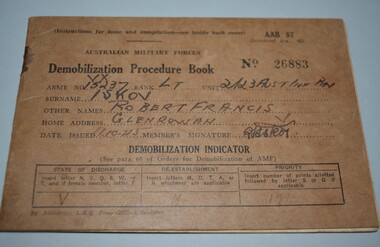
Booklet - Demobilization Procedure Book, LHQ Press, C1945
... Australian Military Forces (AMF) to service personnel at the end of World War II. It guided them through dispersal, rehabilitation, and discharge. Item belonged to Robert Francis ISKOV VX15237 served with the 59th Battalion/Hume Regiment CMF before joining the 2/14th Battalion at Caulfield in September 1940. ...Australian Military Forces (AMF) to service personnel at the end of World War II. It guided them through dispersal, rehabilitation, and discharge. Item belonged to Robert Francis ISKOV VX15237 served with the 59th Battalion/Hume Regiment CMF before joining the 2/14th Battalion at Caulfield in September 1940. ...The Demobilization Procedure Book (reference AAB 87) was an essential handbook issued by the Australian Military Forces (AMF) to service personnel at the end of World War II. It guided them through dispersal, rehabilitation, and discharge. Item belonged to Robert Francis ISKOV VX15237 served with the 59th Battalion/Hume Regiment CMF before joining the 2/14th Battalion at Caulfield in September 1940. He disembarked for the Middle East in November, 1940 and fought in the Syrian campaign in 1941. In 1942 the 2/14th Battalion returned to Australia and sent to Papua where he fought at the Battle of Isurava before the battalion was sent to Gona. On 1943 Bob returned to Australia to undertake officer training and in 1945 with the 2/23rd Battalion sailed to Morotai and served with the battalion on Tarakan. He returned to Australia in November, 1945 and discharged a month later Brown cardboard booklet with lettering in black ink on front cover containing 32 pagesNo 26883 VX15237 LT 2/23 Aust Inf Bn Robert Francis ISKOV Glenrowan Date issued 11.10.1945 ww2, bob iskov, demobilization procedure book, amf -
 Wangaratta RSL Sub Branch
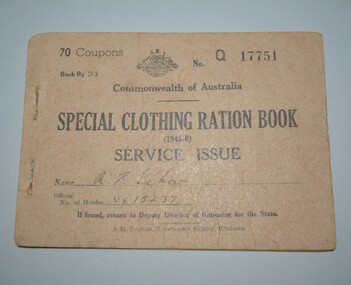
Booklet - Special Clothing Ration Book, A H Tucker, C1945
... Australia in June 1942 to manage extreme shortages of textiles and factory labor diverted to military uniforms. Citizens received an annual quota of coupons to ensure equitable sharing of clothes. Item belonged to Robert Francis ISKOV VX15237 served with the 59th Battalion/Hume Regiment CMF...Australia in June 1942 to manage extreme shortages of textiles and factory labor diverted to military uniforms. Citizens received an annual quota of coupons to ensure equitable sharing of clothes. Item belonged to Robert Francis ISKOV VX15237 served with the 59th Battalion/Hume Regiment CMF ...A special clothing ration book (or supplementary clothing card) refers to extra coupon booklets issued during WWII. These supplemented the standard annual coupon allowance for citizens needing extra garments World War II civilian "Service Issue" clothing ration books were special coupon booklets introduced in Australia in June 1942 to manage extreme shortages of textiles and factory labor diverted to military uniforms. Citizens received an annual quota of coupons to ensure equitable sharing of clothes. Item belonged to Robert Francis ISKOV VX15237 served with the 59th Battalion/Hume Regiment CMF before joining the 2/14th Battalion at Caulfield in September 1940. He disembarked for the Middle East in November, 1940 and fought in the Syrian campaign in 1941. In 1942 the 2/14th Battalion returned to Australia and sent to Papua where he fought at the Battle of Isurava before the battalion was sent to Gona. On 1943 Bob returned to Australia to undertake officer training and in 1945 with the 2/23rd Battalion sailed to Morotai and served with the battalion on Tarakan. He returned to Australia in November, 1945 and discharged a month later Brown cardboard booklet with lettering in black ink on front cover containing 2 half pagesQ17751 70 coupons R F ISKOV VX15237ww2, bob iskov, special clothing ration book, service issue -
 Wangaratta RSL Sub Branch
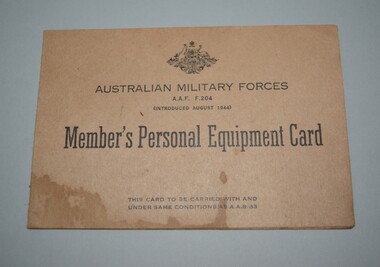
Card - Member's Personal Equipment Card, C1944
... Australia in June 1942 to manage extreme shortages of textiles and factory labor diverted to military uniforms. Citizens received an annual quota of coupons to ensure equitable sharing of clothes. Item belonged to Robert Francis ISKOV VX15237 served with the 59th Battalion/Hume Regiment CMF...Australia in June 1942 to manage extreme shortages of textiles and factory labor diverted to military uniforms. Citizens received an annual quota of coupons to ensure equitable sharing of clothes. Item belonged to Robert Francis ISKOV VX15237 served with the 59th Battalion/Hume Regiment CMF ...A special clothing ration book (or supplementary clothing card) refers to extra coupon booklets issued during WWII. These supplemented the standard annual coupon allowance for citizens needing extra garments World War II civilian "Service Issue" clothing ration books were special coupon booklets introduced in Australia in June 1942 to manage extreme shortages of textiles and factory labor diverted to military uniforms. Citizens received an annual quota of coupons to ensure equitable sharing of clothes. Item belonged to Robert Francis ISKOV VX15237 served with the 59th Battalion/Hume Regiment CMF before joining the 2/14th Battalion at Caulfield in September 1940. He disembarked for the Middle East in November, 1940 and fought in the Syrian campaign in 1941. In 1942 the 2/14th Battalion returned to Australia and sent to Papua where he fought at the Battle of Isurava before the battalion was sent to Gona. On 1943 Bob returned to Australia to undertake officer training and in 1945 with the 2/23rd Battalion sailed to Morotai and served with the battalion on Tarakan. He returned to Australia in November, 1945 and discharged a month laterCream cardboard card fold in half with crest and lettering in black ink on front cover AAF F204 Introduced August 1944 ww2, bob iskov, member's personal equipment card, amf -
 Wangaratta RSL Sub Branch
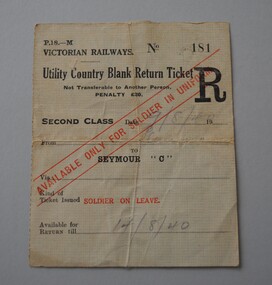
Ephemera - Rail Ticket, C1940
... CMF before joining the 2/14th Battalion at Caulfield in September 1940. He disembarked for the Middle East in November, 1940 and fought in the Syrian campaign in 1941. In 1942 the 2/14th Battalion returned to Australia...CMF before joining the 2/14th Battalion at Caulfield in September 1940. He disembarked for the Middle East in November, 1940 and fought in the Syrian campaign in 1941. In 1942 the 2/14th Battalion returned to Australia ...World War II-era military concession pass issued by the Victorian Railways for military personnel travelling within regional Victoria during 1940. "P.18-M" designates the specific accounting/ticket form code used by the Victorian Railways at the time for military utility tickets. "Available only for soldier in uniform" — was a strict wartime requirement in 1940 to prevent misuse of concessions and to ensure soldiers were identifiable for travel on restored country services. This ticket is dated 9/8/1940 and available for return till 14/8/1940 to Seymour. Item belonged to Robert Francis ISKOV VX15237 served with the 59th Battalion/Hume Regiment CMF before joining the 2/14th Battalion at Caulfield in September 1940. He disembarked for the Middle East in November, 1940 and fought in the Syrian campaign in 1941. In 1942 the 2/14th Battalion returned to Australia and sent to Papua where he fought at the Battle of Isurava before the battalion was sent to Gona. On 1943 Bob returned to Australia to undertake officer training and in 1945 with the 2/23rd Battalion sailed to Morotai and served with the battalion on Tarakan. He returned to Australia in November, 1945 and discharged a month laterSmall paper ticket with black and red letteringP.18 - M Victorian Railways No 181 ww2, bob iskov, amf, victorian railways return ticket, soldier on leave, 1940 -
 Wangaratta RSL Sub Branch
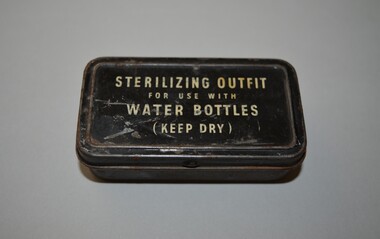
Container - Sterilizing Outfit, Tromax Limited, C1942-45
... Water Sterilization Outfit manufactured in Australia to sterilize water for use in the field by soldiers particularly deployed to Borneo and New Guinea/Kokoda Track Campaigns during WW2, where clean jungle drinking water was a matter of survival. Item belonged to Robert Francis ISKOV VX15237 served with the 59th Battalion/Hume Regiment CMF...Water Sterilization Outfit manufactured in Australia to sterilize water for use in the field by soldiers particularly deployed to Borneo and New Guinea/Kokoda Track Campaigns during WW2, where clean jungle drinking water was a matter of survival. Item belonged to Robert Francis ISKOV VX15237 served with the 59th Battalion/Hume Regiment CMF ...Water Sterilization Outfit manufactured in Australia to sterilize water for use in the field by soldiers particularly deployed to Borneo and New Guinea/Kokoda Track Campaigns during WW2, where clean jungle drinking water was a matter of survival. Item belonged to Robert Francis ISKOV VX15237 served with the 59th Battalion/Hume Regiment CMF before joining the 2/14th Battalion at Caulfield in September 1940. He disembarked for the Middle East in November, 1940 and fought in the Syrian campaign in 1941. In 1942 the 2/14th Battalion returned to Australia and sent to Papua where he fought at the Battle of Isurava before the battalion was sent to Gona. On 1943 Bob returned to Australia to undertake officer training and in 1945 with the 2/23rd Battalion sailed to Morotai and served with the battalion on Tarakan. He returned to Australia in November, 1945 and discharged a month laterRectangular tin with hinged lid containing two clear glass vials of water sterilization tablets. The tin is plain metal apart from the black lid with white lettering. The two vials are stoppered with cork. The thinner vial contains small round blue tablets, while the thicker vial contains a white substance and has a paper label titled '50 Sterilizing Tablets'.LID - 'STERILIZING OUTFIT / FOR USE WITH / WATER BOTTLES / (KEEP DRY) ww2, bob iskov, amf, sterilizing outfit, new guinea -
 Wangaratta RSL Sub Branch
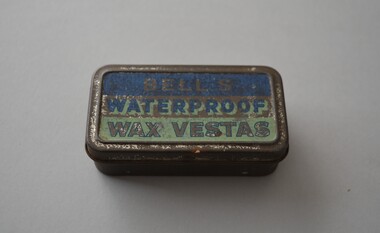
Container - Waterproof Wax Vestas, R Bell & Co, C1939-45
... Widely known for supplying troops during World War II (1939–1945), specifically utilized in Australian military emergency ration packs and by personnel on the Kokoda Track. Item belonged to Robert Francis ISKOV VX15237 served with the 59th Battalion/Hume Regiment CMF before joining the 2/14th Battalion at Caulfield in September 1940. ...Widely known for supplying troops during World War II (1939–1945), specifically utilized in Australian military emergency ration packs and by personnel on the Kokoda Track. Item belonged to Robert Francis ISKOV VX15237 served with the 59th Battalion/Hume Regiment CMF before joining the 2/14th Battalion at Caulfield in September 1940. ...Container of small wax coated matches designed to resist moisture. Widely known for supplying troops during World War II (1939–1945), specifically utilized in Australian military emergency ration packs and by personnel on the Kokoda Track. Item belonged to Robert Francis ISKOV VX15237 served with the 59th Battalion/Hume Regiment CMF before joining the 2/14th Battalion at Caulfield in September 1940. He disembarked for the Middle East in November, 1940 and fought in the Syrian campaign in 1941. In 1942 the 2/14th Battalion returned to Australia and sent to Papua where he fought at the Battle of Isurava before the battalion was sent to Gona. On 1943 Bob returned to Australia to undertake officer training and in 1945 with the 2/23rd Battalion sailed to Morotai and served with the battalion on Tarakan. He returned to Australia in November, 1945 and discharged a month laterRectangular tin with hinged lid containing small timber matches with wax heads. The tin is plain metal apart from two tone blue lid with lettering. Underneath is a serrated patch used to strike the match. Bell's Waterproof Wax Vestas ww2, bob iskov, amf, new guinea, vestas -
 Wangaratta RSL Sub Branch
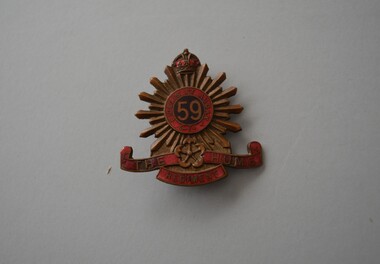
Badge - Hat and collar badges, C1939
... CMF before joining the 2/14th Battalion at Caulfield in September 1940. He disembarked for the Middle East in November, 1940 and fought in the Syrian campaign in 1941. In 1942 the 2/14th Battalion returned to Australia...CMF before joining the 2/14th Battalion at Caulfield in September 1940. He disembarked for the Middle East in November, 1940 and fought in the Syrian campaign in 1941. In 1942 the 2/14th Battalion returned to Australia ...Original Militia issue hat badge with smaller matching pair of collar badges worn by members of the Victorian based 59th Battalion. In 1939 the battalion underwent a name change, adopting the territorial title of the "Hume Regiment." Item belonged to Robert Francis ISKOV VX15237 served with the 59th Battalion/Hume Regiment CMF before joining the 2/14th Battalion at Caulfield in September 1940. He disembarked for the Middle East in November, 1940 and fought in the Syrian campaign in 1941. In 1942 the 2/14th Battalion returned to Australia and sent to Papua where he fought at the Battle of Isurava before the battalion was sent to Gona. On 1943 Bob returned to Australia to undertake officer training and in 1945 with the 2/23rd Battalion sailed to Morotai and served with the battalion on Tarakan. He returned to Australia in November, 1945 and discharged a month laterBrass badge features a central red enamel circle containing the raised numeral 59 circled by a motto with radiating design with crown on top and scroll underneathMotto - Fidelis Et Audax Scroll -The Hume Regimentww2, bob iskov, amf, new guinea, 59th battalion, hat and collar badges, hume regiment -
 Wangaratta RSL Sub Branch
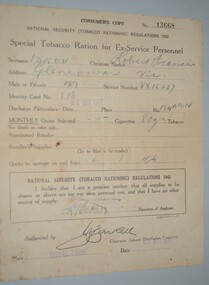
Ephemera - Consumer's Copy - Tobacco Ration, H E Daw, C1942
... CMF before joining the 2/14th Battalion at Caulfield in September 1940. He disembarked for the Middle East in November, 1940 and fought in the Syrian campaign in 1941. In 1942 the 2/14th Battalion returned to Australia...CMF before joining the 2/14th Battalion at Caulfield in September 1940. He disembarked for the Middle East in November, 1940 and fought in the Syrian campaign in 1941. In 1942 the 2/14th Battalion returned to Australia ...National Security (Tobacco Rationing) Regulations established on February 24, 1942. The "Consumer's Copy" was issued as a personal ration document requiring citizens to register with a nominated retailer to purchase their restricted tobacco or cigarette quota. Item belonged to Robert Francis ISKOV VX15237 served with the 59th Battalion/Hume Regiment CMF before joining the 2/14th Battalion at Caulfield in September 1940. He disembarked for the Middle East in November, 1940 and fought in the Syrian campaign in 1941. In 1942 the 2/14th Battalion returned to Australia and sent to Papua where he fought at the Battle of Isurava before the battalion was sent to Gona. In 1943 Bob returned to Australia to undertake officer training and in 1945 with the 2/23rd Battalion sailed to Morotai and served with the battalion on Tarakan. He returned to Australia in November, 1945 and discharged a month laterBlack printed form for special tobacco ration for ex service personnel on cream colour paper including personal details. Consumer's Copy No 13668ww2, bob iskov, amf, new guinea, 59th battalion, tobacco ration, 1942 -
 Wangaratta RSL Sub Branch
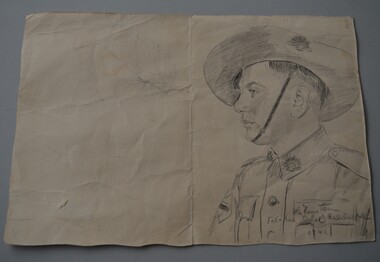
Drawing - Sketch, C1941
... CMF before joining the 2/14th Battalion at Caulfield in September 1940. He disembarked for the Middle East in November, 1940 and fought in the Syrian campaign in 1941. In 1942 the 2/14th Battalion returned to Australia...CMF before joining the 2/14th Battalion at Caulfield in September 1940. He disembarked for the Middle East in November, 1940 and fought in the Syrian campaign in 1941. In 1942 the 2/14th Battalion returned to Australia ...This hand drawn sketch of Robert ISKOV in uniform showing unit patch of the 2/14th Battalion on right sleeve was taken at a Tel-Aviv Cafe dated 1941. During WW2 Tel Aviv was a vibrant modern coastal hub known for its European style cafe culture. Cafes like Balalaika served as major social centers where allied soldiers interacted with local residents. Item belonged to Robert Francis ISKOV VX15237 served with the 59th Battalion/Hume Regiment CMF before joining the 2/14th Battalion at Caulfield in September 1940. He disembarked for the Middle East in November, 1940 and fought in the Syrian campaign in 1941. In 1942 the 2/14th Battalion returned to Australia and sent to Papua where he fought at the Battle of Isurava before the battalion was sent to Gona. In 1943 Bob returned to Australia to undertake officer training and in 1945 with the 2/23rd Battalion sailed to Morotai and served with the battalion on Tarakan. He returned to Australia in November, 1945 and discharged a month later Lead pencil chest high sketch of soldier in Australian Army Uniform on cardboard. Tel Aviv Cafe, Balalaikaww2, bob iskov, amf, 2/14th battalion, tel aviv, sketch, balalaika -
 Wangaratta RSL Sub Branch
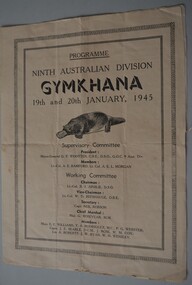
Programme, 9th Australian Division Gymkhana, C1945
... The Australian War Memorial maintains historical film coverage of this specific event. Item belonged to Robert Francis ISKOV VX15237 served with the 59th Battalion/Hume Regiment CMF before joining the 2/14th Battalion at Caulfield in September 1940. ...The Australian War Memorial maintains historical film coverage of this specific event. Item belonged to Robert Francis ISKOV VX15237 served with the 59th Battalion/Hume Regiment CMF before joining the 2/14th Battalion at Caulfield in September 1940. ...Programme of the 9th Australian Division Gymkhana held 19th and 20th January 1945 at Herberton Racecourse, Atherton Tableland, Queensland. The event featured a wide array of sporting, military, and horse racing events to boost morale and physical readiness. The carnival was a massive logistical gathering for the "Magnificent 9th" prior to their final amphibious deployments to Borneo. The Australian War Memorial maintains historical film coverage of this specific event. Item belonged to Robert Francis ISKOV VX15237 served with the 59th Battalion/Hume Regiment CMF before joining the 2/14th Battalion at Caulfield in September 1940. He disembarked for the Middle East in November, 1940 and fought in the Syrian campaign in 1941. In 1942 the 2/14th Battalion returned to Australia and sent to Papua where he fought at the Battle of Isurava before the battalion was sent to Gona. In 1943 Bob returned to Australia to undertake officer training and in 1945 with the 2/23rd Battalion sailed to Morotai and served with the battalion on Tarakan. He returned to Australia in November, 1945 and discharged a month later Large beige coloured paper folded in half to form four pages with black image of a platypus and lettering on cover 19th and 20th January 1945ww2, bob iskov, amf, 9th division, gymkhana, 1945, herberton, programme -
 Wangaratta RSL Sub Branch
Accessory - Machete Scabbard, H Carson Ltd, c1941
... CMF before joining the 2/14th Battalion at Caulfield in September 1940. He disembarked for the Middle East in November, 1940 and fought in the Syrian campaign in 1941. In 1942 the 2/14th Battalion returned to Australia...CMF before joining the 2/14th Battalion at Caulfield in September 1940. He disembarked for the Middle East in November, 1940 and fought in the Syrian campaign in 1941. In 1942 the 2/14th Battalion returned to Australia ...This leather scabbard was mostly likely made by H Carson Ltd in Canada who were suppliers to the military during WW2 of leather sheaths/scabbards. The item is from a collection that belonged to Robert Francis ISKOV VX15237 born at Glenrowan served with the 59th Battalion CMF before joining the 2/14th Battalion at Caulfield in September 1940. He disembarked for the Middle East in November, 1940 and fought in the Syrian campaign in 1941. In 1942 the 2/14th Battalion returned to Australia and sent to New Guinea where he fought at the Battle of Isurava before the battalion was sent to Gona. On 1943 Bob returned to Australia to undertake officer training and in 1945 with the 2/23rd Battalion sailed to Morotai and served with the battalion on Tarakan. He returned to Australia in November, 1945 and discharged a month later.Brown leather scabbard with belt loop and strap fitted with brass stud attached by three studs to sheath.H C Co LTD 941ww2, new guinea, bob iskov, bush knife, machete, scabbard -
 Wangaratta RSL Sub Branch
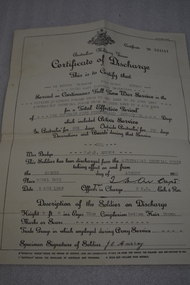
Certificate - Certificate of Discharge, John Brian Murray VX142238, Dated 8 August 1946
... Original AMF Certificate of Discharge certifying VX 142238 Private John Brian Murray born 27/10/1922 at Moyhu 57/60 Australian Infantry Battalion served with CMF 28/5/42 to 29/6/43 and AIF from 30/6/1943 to 8/8/1946 which included overseas service in New Guinea and Solomon Islands....Original AMF Certificate of Discharge certifying VX 142238 Private John Brian Murray born 27/10/1922 at Moyhu 57/60 Australian Infantry Battalion served with CMF 28/5/42 to 29/6/43 and AIF from 30/6/1943 to 8/8/1946 which included overseas service in New Guinea and Solomon Islands. ...Original AMF Certificate of Discharge certifying VX 142238 Private John Brian Murray born 27/10/1922 at Moyhu 57/60 Australian Infantry Battalion served with CMF 28/5/42 to 29/6/43 and AIF from 30/6/1943 to 8/8/1946 which included overseas service in New Guinea and Solomon Islands.Certificate recognises Private Murray's service in the CMF and AIF during WW2Cream coloured paper with black border with Australian Coat of Arms centre top of page. Certificate of Discharge - No 554111jb murray, 57/60 aust infantry battalion, certificate of discharge, ww2 -
 Surrey Hills Historical Society Collection
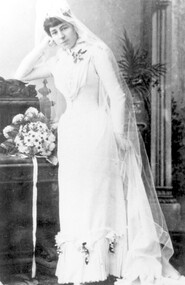
Photograph, Wedding portrait of Mrs Helen M Smith, 1891, 1891
... Australia on 23 October 1918 Obituary describes him as eldest child of the late Charles Ansell & Helen M Smith of Surrey Hills and Lancefield. 2. Stanley Charles – b 1893 (Carlton) - lived Surrey Hills 3. Dorothy Louisa – b 1894 - 1988 4. Harold Maxwell Pasco – b 1897 Oakleigh SERN 3268 Educated Surrey Hills State School Religion Cof E Occupation: Clerk Served with 48th Infantry CMF...Australia on 23 October 1918 Obituary describes him as eldest child of the late Charles Ansell & Helen M Smith of Surrey Hills and Lancefield. 2. Stanley Charles – b 1893 (Carlton) - lived Surrey Hills 3. Dorothy Louisa – b 1894 - 1988 4. Harold Maxwell Pasco – b 1897 Oakleigh SERN 3268 Educated Surrey Hills State School Religion Cof E Occupation: Clerk Served with 48th Infantry CMF ...Helen Malvira Mackenzie (1865-1956) married Charles Ansell Smith (c1861-1934). He was baptised 23 April 1861 in Tintinhull, Somerset - son of William Maxwell & Louisa Claudina Smith (nee Ansell). His father was curate of the church at the time. Helen Malvira (or Malvena) MacKenzie, known as Nellie, was the second daughter of the John Mackenzie J.P., of Westernport, and Wilcannia, N.S.W., and great granddaughter of the late Admiral Pasco, R.N. They lived at 'Devon', 3 Vincent Street from at least 1910 but perhaps earlier until 1915. Charles Ansell and Helen Malvina Smith’s children: 1. Kenneth Ansell – b 1892 d 3 May 1977 at Lancefield SERN 819 Enlisted AIF on 17/8/1914 giving his occupation as book seller Assigned to 8th Battalion, G company Enlisted 17 August 1914 Embarked A24 Benalla on 19 October 1914 Returned to Australia on 23 October 1918 Obituary describes him as eldest child of the late Charles Ansell & Helen M Smith of Surrey Hills and Lancefield. 2. Stanley Charles – b 1893 (Carlton) - lived Surrey Hills 3. Dorothy Louisa – b 1894 - 1988 4. Harold Maxwell Pasco – b 1897 Oakleigh SERN 3268 Educated Surrey Hills State School Religion Cof E Occupation: Clerk Served with 48th Infantry CMF, Kooyong Enlisted 23 July 1915 – parents living at Vincent Street at the time Assigned to 24th Battalion, 7th Reinforcement Embarked HMAT A73 Commonwealth on 26 November 1915 KIA 4 October 1917 at Passchendaele, Ypres No known grave. Parents at ‘Cloverdale’, Lancefield 5. Francis W D (Frank) – b 1898 – 1972 Obituary: Frank (FWD) Smith on Feb 14 (suddenly) Francis Wm Douglas Smith, son of Charles Ansell & Helen M (Surrey Hills & Lancefield) and brother of Kenneth (Lancefield), Dorothy (Mrs Cromwell), Harold (KIA) Roy & Stanley. 6. Roy MacKenzie – b 1901 – 1988 m Ruby Olive Laity in 1931 So, the children were all born before the family came to Surrey Hills but Vincent Street was where they grew up. Charles and Helen are buried in Box Hill Cemetery (CE-NS-1266) Comment: An early example of a 'traditional' wedding dress.B&W bridal studio portrait of Mrs Helen Malvira Smith in a traditional wedding dress. weddings, wedding dresses, helen malvira mackenzie, helen malvira smith, kenneth ansell smith, stanley charles smith, dorothy louisa smith, harold maxwell pasco smith -
 Surrey Hills Historical Society Collection
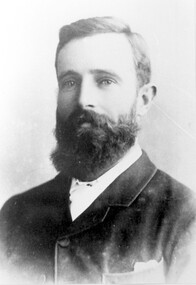
Photograph, Mr Charles Ansell Smith, c 1891
... Australia on 23 October 1918 Obituary describes him as eldest child of the late Charles Ansell & Helen M Smith of Surrey Hills and Lancefield. 2. Stanley Charles – b 1893 (Carlton) - lived Surrey Hills 3. Dorothy Louisa – b 1894 - 1988 4. Harold Maxwell Pasco – b 1897 Oakleigh SERN 3268 Educated Surrey Hills State School Religion Cof E Occupation: Clerk Served with 48th Infantry CMF...Australia on 23 October 1918 Obituary describes him as eldest child of the late Charles Ansell & Helen M Smith of Surrey Hills and Lancefield. 2. Stanley Charles – b 1893 (Carlton) - lived Surrey Hills 3. Dorothy Louisa – b 1894 - 1988 4. Harold Maxwell Pasco – b 1897 Oakleigh SERN 3268 Educated Surrey Hills State School Religion Cof E Occupation: Clerk Served with 48th Infantry CMF ...Charles Ansell Smith (c1861-1934) lived at 'Devon', 3 Vincent Street from at least 1910 but perhaps earlier until 1915. Baptised 23 April 1861 in Tintinhull, Somerset - son of William Maxwell & Louisa Claudina Smith (nee Ansell). His father was curate of the church at the time. Married Helen Malvira MacKenzie. Charles Ansell and Helen Malvina Smith’s children: 1. Kenneth Ansell – b 1892 d 3 May 1977 at Lancefield SERN 819 Enlisted AIF on 17/8/1914 giving his occupation as book seller Assigned to 8th Battalion, G company Enlisted 17 August 1914 Embarked A24 Benalla on 19 October 1914 Returned to Australia on 23 October 1918 Obituary describes him as eldest child of the late Charles Ansell & Helen M Smith of Surrey Hills and Lancefield. 2. Stanley Charles – b 1893 (Carlton) - lived Surrey Hills 3. Dorothy Louisa – b 1894 - 1988 4. Harold Maxwell Pasco – b 1897 Oakleigh SERN 3268 Educated Surrey Hills State School Religion Cof E Occupation: Clerk Served with 48th Infantry CMF, Kooyong Enlisted 23 July 1915 – parents living at Vincent Street at the time Assigned to 24th Battalion, 7th Reinforcement Embarked HMAT A73 Commonwealth on 26 November 1915 KIA 4 October 1917 at Passchendaele, Ypres No known grave. Parents at ‘Cloverdale’, Lancefield 5. Francis W D (Frank) – b 1898 – 1972 Obituary: Frank (FWD) Smith on Feb 14 (suddenly) Francis Wm Douglas Smith, son of Charles Ansell & Helen M (Surrey Hills & Lancefield) and brother of Kenneth (Lancefield), Dorothy (Mrs Cromwell), Harold (KIA) Roy & Stanley. 6. Roy MacKenzie – b 1901 – 1988 m Ruby Olive Laity in 1931 So, the children were all born before the family came to Surrey Hills but Vincent Street was where they grew up. Charles and Helen are buried in Box Hill Cemetery (CE-NS-1266)B&W head and shoulders portrait of a bearded man in formal attire. charles ansell smith, box hill cemetery, helen malvira mackenzie, helen malvira smith, harold maxwell smith, harold pasco maxwell smith, stanley charles smith, dorothy louisa smith, francis w d smith -
 Australian Army Museum of Western Australia
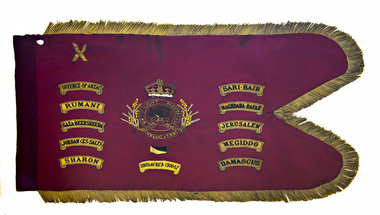
Guidon - 10th Light Horse Regiment
... Later carried by the post-World War Two unit, 10th West Australian Mounted Infantry, raised as a CMF unit of the Royal Australian Armoured Corps in 1949 as a direct successor unit to the above light horse regiment. ...Later carried by the post-World War Two unit, 10th West Australian Mounted Infantry, raised as a CMF unit of the Royal Australian Armoured Corps in 1949 as a direct successor unit to the above light horse regiment. ...Presented to 10th Light Horse Regiment (West Australian Mounted Infantry) by Lt-General Sir Harry Chauvel, GCMG, KCB on the Esplanade, Perth, 10 March 1928. Consecrated by Senior Chaplain COL Riley, OBE, VD, DD. Later carried by the post-World War Two unit, 10th West Australian Mounted Infantry, raised as a CMF unit of the Royal Australian Armoured Corps in 1949 as a direct successor unit to the above light horse regiment. This unit was redesignated as 10th Light Horse in 1956. The Guidon was laid up at the State War Memorial, King's Park on 10 June 1967, following presentation of a new Guidon to 10th Light Horse in 1966. It was transferred to the Army Museum of WA in 1988 as part of the Bicentenary Colours Project. Crimson with gold fringes, swallow tailed end (traditional cavalry Guidon shape). In the centre a black swan within a circle inscribed "10th LIGHT HORSE (WAMI)", across the lower portion of the circle a scroll inscribed with the regimental motto "PERCUTE ET PERCUTE VELOCITER", the whole surrounded with a wreath of Australian wattle and surmounted by the Crown. In the upper canton the roman numeral "X" Below the whole centrepiece is the regimental colour patch in black over gold diagonals in a rectangle and below that is the battle honour SOUTH AFRICA 1900-02 . Emblazoned on either side of the centrepiece are ten selected battle honours from the Great War: DEFENCE OF ANZAC, SARI BAIR, RUMANI, MAGHDABA-RAFAH, GAZA-BEERSHEBA, JERUSALEM, JORDAN (ES SALT), MEGIDDO, SHARON, DAMASCUS. The battle honour for South Africa for unknown reasons was not included on the guidon when originally presented in 1928, and was not emblazoned on the Guidon until the early 1950's. Other related facts:- • The battle honour "South Africa 1900-02" was granted under MO 123/1908 to 18th Australian Light Horse Regiment which was the predecessor Militia Light Horse regiment existing at the time. • This battle honour appeared under 10th Light Horse Regiment in the Australian Army List from 1928 onwards. • Having the battle honour added at a later date would explain why this battle honour is positioned on the lower portion of the guidon in the centre. At the time of approving battle honours for the Great War, the authorised position for any pre-existing South Africa battle honour was in the top left corner of the Guidon or colour, followed by the battle honours of the Great War. (AAO 112/1927). -
 Australian Army Museum of Western Australia
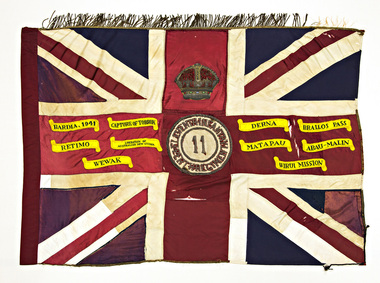
Queen's Colour - 11th Australian Infantry Regiment (Perth Regiment)
... Under major reorganisation of the CMF in 1960, all individual infantry battalions that existed at the time within each State were amalgamated to form State regiments, taking effect from 1 July 1960. Thus from that date the 11/44th, 16th and 28th Infantry Battalions were amalgamated to form The Royal Western Australia Regiment. ...Under major reorganisation of the CMF in 1960, all individual infantry battalions that existed at the time within each State were amalgamated to form State regiments, taking effect from 1 July 1960. Thus from that date the 11/44th, 16th and 28th Infantry Battalions were amalgamated to form The Royal Western Australia Regiment. ...This former King's Colour was originally authorised by King George V in 1919 in recognition of services of 11th Battalion (AIF) during the Great War. Presented by HE the Governor General Sir Ronald Munro-Ferguson, PC, CGMG at a parade in King's Park on 2 October 1920 and handed over to 2nd Battalion, 11th Infantry Regiment (Perth Regiment) of the Citizen Forces. In 1921 this unit became re-designated 11th Battalion (The Perth Regiment) (The title was changed to "The City of Perth Regiment" in 1933). Subsequently consecrated by the Chaplain General, Archbishop COL Riley, OBE, VD, DD at a parade on the Esplanade, Perth, 15 November 1924. At the time of presentation this colour was a plain union flag with no central devices or other distinctions included on it. Following Military Board approval given in 1925 the centre circle and Crown were later added, in accordance with the approved design for a King's Colour. With the re-activation of the Citizen Military Forces (CMF) following the Second World War, the 11th/44th Infantry Battalion (The City of Perth Regiment) was raised as a linked battalion in 1948 to carry on the identity and traditions of the pre-war 11th and 44th Battalions respectively. The King's and Regimental Colours formerly held by these two battalions were passed on to the new battalion who paraded them in rotation on ceremonial occasions. With the accession of HM Queen Elizabeth II to the throne in 1953, all Colours that had originally been presented as King's Colours, and were still carried by units on the current Order of Battle, were automatically deemed to be Queen's Colours. Under major reorganisation of the CMF in 1960, all individual infantry battalions that existed at the time within each State were amalgamated to form State regiments, taking effect from 1 July 1960. Thus from that date the 11/44th, 16th and 28th Infantry Battalions were amalgamated to form The Royal Western Australia Regiment. In September 1960, at a ceremonial parade held at Northam Camp, the Colours carried by all former battalions were handed over for safe keeping by the new regiment. Battle Honours for the Second World War were promulgated under Australian Army Order 135/1961 and the 10 selected honours approved for emblazoning on the Queen's Colour were subsequently added in 1962 These former colours were subsequently laid up in the undercroft at the State War Memorial, King's Park on 29 November 1964. These were transferred to the Army Museum of WA in 1988 as part of the Bicentenary Colours Project. Union flag with gold fringes. In the centre the Arabic numeral "11" on a red background within a gold circle inscribed "ELEVENTH INFANTRY - PERTH REGIMENT", surmounted by the Crown. Emblazoned on the colour are the following Second World War Battle Honours:- BARDIA 1941, CAPTURE OF TOBRUK, DERNA, BRALLOS PASS, RETIMO, LIBERATION OF AUSTRALIAN NEW GUINEA, MATAPAU, ABAU-MALIN, WEWAK, WIRUI MISSION -
 Australian Army Museum of Western Australia
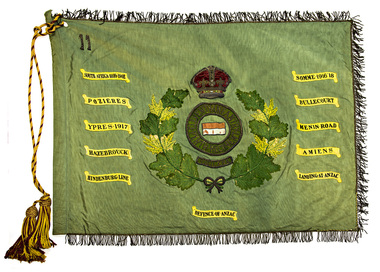
Regimental Colour - 11th Australian Infantry Regiment (Perth Regiment)
... Under major reorganisation of the CMF in 1960, all individual infantry battalions that existed at the time within each State were amalgamated to form State regiments, taking effect from 1 July 1960. Thus from that date the 11/44th, 16th and 28th Infantry Battalions were amalgamated to form The Royal Western Australia Regiment. ...Under major reorganisation of the CMF in 1960, all individual infantry battalions that existed at the time within each State were amalgamated to form State regiments, taking effect from 1 July 1960. Thus from that date the 11/44th, 16th and 28th Infantry Battalions were amalgamated to form The Royal Western Australia Regiment. ...Presented by the Honourable Lord Mayor JT Franklin, CMG, MLC, JP, at a parade held at Karrakatta Camp on 7 April 1929. Consecrated by the Chaplain General COL Riley, OBE, VD, DD. With the re-activation of the Citizen Military Forces (CMF) following the Second World War, the 11th/44th Infantry Battalion (The City of Perth Regiment) was raised in 1948 as a linked battalion to carry on the identity and traditions of the pre-war 11th and 44th Battalions respectively. The King's and Regimental Colours formerly held by these two battalions were passed on to the new battalion who paraded them in rotation on ceremonial occasions. Under major reorganisation of the CMF in 1960, all individual infantry battalions that existed at the time within each State were amalgamated to form State regiments, taking effect from 1 July 1960. Thus from that date the 11/44th, 16th and 28th Infantry Battalions were amalgamated to form The Royal Western Australia Regiment. In September 1960, at a ceremonial parade held at Northam Camp, the Colours carried by all former battalions were handed over for safe keeping by the new regiment These former colours were subsequently laid up in the undercroft at the State War Memorial, King's Park on 29 November 1964. These were transferred to the Army Museum of WA in 1988 as part of the Bicentenary Colours Project. Dark green with gold fringe. In the centre the battalion colour patch of a brown over blue rectangle within a circle inscribed "ELEVENTH INFANTRY - PERTH REGIMENT". Beneath the circle a scroll inscribed with the regimental motto "VIGILANS". The whole surrounded with a wreath of Australian wattle and surmounted by the Crown. In the upper canton the Arabic numeral "11". Battle Honours emblazoned on the colour:- SOUTH AFRICA 1899-1902, SOMME 1916-18, POZIERES, BULLECOURT, YPRES 1917, MENIN ROAD, HAZEBROUCK, AMIENS, HINDENBURG LINE, LANDING AT ANZAC, DEFENCE OF ANZAC
