
Showing 251 items matching "putt"
-
 Bendigo Historical Society Inc.
Document - MERLE HALL COLLECTION: COMMUNITY ARTS CENTRE SPACE REQUIREMENTS
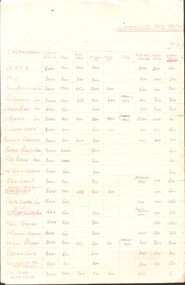
... Attached is a handwritten note (no stated author) entitled ''Plaza Proposal'' (19/1/77) stating that the schedule is for the area requirements of local groups with information as to spending money of architectural surveys of existing buildings and time constraints on putting forward any proposition. List of Community Arts organisations; M.A.S.B.,M.L., Competitions society, Repertory society, Shakespeare Society, Operatic Society, concert Orchestra, Benola Choristers, Brass Bands Association, Pipe Bands Association, Victorian Society of Organ's, Film Group, Bendigo Arts Council, Photographic Society, W.E.L., Music Teachers, Spinners & Weavers, Wyse Players, Organ Club, Friends of the Art Gallery, California Gully Youth Club....Attached is a handwritten note (no stated author) entitled ''Plaza Proposal'' (19/1/77) stating that the schedule is for the area requirements of local groups with information as to spending money of architectural surveys of existing buildings and time constraints on putting forward any proposition. List of Community Arts organisations; M.A.S.B.,M.L., Competitions society, Repertory society, Shakespeare Society, Operatic Society, concert Orchestra, Benola Choristers, Brass Bands Association, Pipe Bands Association, Victorian Society of Organ's, Film Group, Bendigo Arts Council, Photographic Society, W.E.L., Music Teachers, Spinners & Weavers, Wyse Players, Organ Club, Friends of the Art Gallery, California Gully Youth Club. ...Community Arts Centre - a. Space Requirements: 'Spreadsheet' - single page ruled up with horizontal rows listing 21 Bendigo arts organizations and vertical columns inserting 20 varied space requirements (e.g. main auditorium; stage; backstage; wings; etc.) + Total space requirement for each organization. No date or author provided; b. Same 'spreadsheet' but specified as space in square feet. Attached is a handwritten note (no stated author) entitled ''Plaza Proposal'' (19/1/77) stating that the schedule is for the area requirements of local groups with information as to spending money of architectural surveys of existing buildings and time constraints on putting forward any proposition. List of Community Arts organisations; M.A.S.B.,M.L., Competitions society, Repertory society, Shakespeare Society, Operatic Society, concert Orchestra, Benola Choristers, Brass Bands Association, Pipe Bands Association, Victorian Society of Organ's, Film Group, Bendigo Arts Council, Photographic Society, W.E.L., Music Teachers, Spinners & Weavers, Wyse Players, Organ Club, Friends of the Art Gallery, California Gully Youth Club.community arts center, merle hall collection -
 Federation University Historical Collection
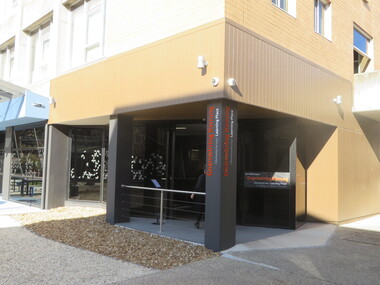
Photograph, Clare Gervasoni, Gnarrwirring Karung (Learning Place), Federation University Mt Helen Campus, 2018, 22/06/2018
... “The ceremony is a fine example of putting Aboriginal culture at the centre of our daily lives.” ...“The ceremony is a fine example of putting Aboriginal culture at the centre of our daily lives.” ...Federation University Australia’s Student Commons Area at the Mt Helen Campus was the first FedUni building to be officially given an Aboriginal name, Gnarrwirring Karung. Meaning Learning Place in the local Wadawurrung language, the re-named centre (pronounced Narrowing Ker Ung) will provide recognition of the area’s cultural heritage and increase the vibrancy, diversity and rich culture throughout the campus. The re-naming ceremony was held at the Gnarrwirring Karung Student Commons Area, S Building, Mt Helen Campus. “The choice of name follows an extensive process of seeking suggestions from the student body, the University’s Aboriginal Education Centre and local Aboriginal custodians,” Geoff Lord, Chairman of the University’s Reconciliation Action Plan (RAP) Committee, said. “The official naming meets many elements recognised within the FedUni RAP such as enhancing community, embedding culture, providing opportunity and, most importantly, respect. “The ceremony is a fine example of putting Aboriginal culture at the centre of our daily lives.” Jasmine Graham, Manager of the Aboriginal Education Centre, said the re-naming was a milestone for the local Aboriginal community. “The University is committed to greater recognition of Aboriginal heritage and culture throughout all of its campuses,” Ms Graham said. “Gnarrwirring Karung will be an impressive landmark throughout the Mt Helen Campus and a welcoming learning place.” A number of photographs taken at the naming of a Federation University space in the Mt Helen Campus 'S' Building. The space has been named Gnarrwirring Karung, Waddawurrung for Learning Place. waddawurrung, gnarrwirring karung, aboriginal, mt helen campus, reconciliation action plan, s building, waddawurrung language, place names -
 Royal District Nursing Service (now known as Bolton Clarke)
Photograph - Photograph, black and white, c. 1967
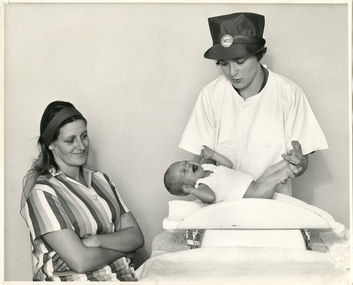
... The photograph is taken in the home of the mother and baby and the Sister is in the process of putting the baby onto the Baby scales to ascertain the babe's weight. ...The photograph is taken in the home of the mother and baby and the Sister is in the process of putting the baby onto the Baby scales to ascertain the babe's weight. ...This photograph depicts Post-Natal care being given by a Royal District Nursing Service (RDNS), Sister who is working in the RDNS Domiciliary Infant and Maternal Care (DIMC) section of the Service. The photograph is taken in the home of the mother and baby and the Sister is in the process of putting the baby onto the Baby scales to ascertain the babe's weight. Sisters employed in the DIMC section of RDNS gave Post-natal care to both the mother and her newly born babe when they were discharged early from hospital. This photograph was taken in the year following Melbourne District Nursing Service (MDNS) being granted Royal patronage in 1966 and becoming Royal District Nursing Service. The Sister is wearing the the same grey uniform frock used by MDNS but the badge on her peaked cap has changed from a red Maltese cross to a metal round silver badge with a royal blue circle around the edge with the words 'Royal District Nursing Service' in white capital letters running inside the blue circle.The centre of the badge is divided into three sections; a silver rising sun top and bottom, and a thick royal blue horizontal central strip with 'RDNS' written in large white capital letters. This uniform continued to be worn until 1971 when it changed colour and style. In August 1893 Melbourne District Nursing Society (MDNS), commenced a Midwifery Service with Nurse Fowler, who trained in a Hospital and was qualified in General nursing and Midwifery nursing, being the first Midwife employed. Mothers were assessed for suitability of a home birth, or if they required delivery at the Women’s Hospital. The Midwife worked in conjunction with the Doctors at the Women’s Hospital and if a complication arose the patient was transferred to their care. Following birth they gave Post-Natal care to both the mother and babe. In 1898 the service ceased due to lack of funds but recommenced in 1906, and in the August 1925 Annual Report the number of MDNS home births was recorded at 478. MDNS built the After-Care Home and an Anti-Natal Clinic was opened in 1930. The last Ante-Natal clinic was held there in December 1951 and the MDNS Midwifery service ceased in February 1952. In 1964 MDNS commenced a Post-Natal service with General and Midwifery trained MDNS Sisters working from a room at Footscray Hospital, and visiting early discharged Footscray Hospital maternity cases at home. Now as Royal District Nursing Service (RDNS), this service was extended to a Domiciliary Infant and Maternal Care, (DIMC) service operating from most Centres and visiting early discharged, often 24 hours after birth, maternity cases from hospitals to give post-natal care to the mother and babe. Many Sisters working in this area had a Certificate in Infant Welfare as well as their General and Midwifery Certificates.In the right rear of this black and white photograph is a Royal District Nursing Service, (RDNS), Sister who is wearing a white gown over her uniform, and wearing her grey peaked hat with the RDNS badge visible, looking down at a baby she is about to weigh. The baby has sparse dark hair, is wearing a white singlet and is crying. The Baby scales, which are sitting on a table in front of the Sister, are white with a rectangular base and curved sided tray on the top. The Sister is standing behind the scales, and is supporting the babe's body with her right hand and holding baby's legs with her left hand as she lowers babe fully onto the scales. On the left of the photograph, the mother, who has long dark hair with a hair scarf holding it back, and is wearing a striped frock, is siting on a chair with her arms crossed at her waist, and is smiling at her babe as she observes proceedings.. Photographers Stampmdns, melbourne district nursing society, melbourne district nursing service, rdns, royal district nursing service, rdns domiciliary postnatal service, dimc -
 Flagstaff Hill Maritime Museum and Village
Photograph - Vessels, Sail and Steam Ships, A.V. Gregory, Australian Rivals - Past and Present, 1899-1932
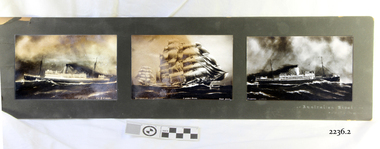
... On this race the “Cutty Sark” lost her rudder in the Indian Ocean, putting her hopelessly out of the race, and enabling the “Thermopylae” to pass her and reach London on 11th October, 115 days out, the “Cutty Sark” limping home seven days later. ...On this race the “Cutty Sark” lost her rudder in the Indian Ocean, putting her hopelessly out of the race, and enabling the “Thermopylae” to pass her and reach London on 11th October, 115 days out, the “Cutty Sark” limping home seven days later. ...These photographs are copies of original paintings by the Australian marine artist A V Gregory (1867-1957), also known as Arthur Victor Gregory. Gregory lived and worked in South Melbourne. He took over the Gregory Studio owned by his father, George Frederick Gregory, painting actively between 1899 and 1932. He usually signed his works as ‘A V Gregory’. Some of his original works have been sold for thousands of dollars. These mounted photographs, by A.V. Gregory, show both steam and sailing ships sailing in the Tea Race from China to London in 1872. The information included with the photographs has the following text: “Tea Clippers “ Well done Cutty Sark, by Bobbie Burns The CUTTY SARK and THERMOPYLAE. The start of the 1872 Tea Race from China to London. The “Cutty Sark” first away, followed closely by the “Thermopylae”, finally parting after several days’ company. On this race the “Cutty Sark” lost her rudder in the Indian Ocean, putting her hopelessly out of the race, and enabling the “Thermopylae” to pass her and reach London on 11th October, 115 days out, the “Cutty Sark” limping home seven days later. The credit of the race was given to the “Cutty Sark” by the shipping world. Copies of the pictures may be had from A.V. Gregory, 326 Albert Road, South Melbourne."The detailed images of the vessels depicted in this photographs shows some of the many sail and steam vessels painted by the renowned Victorian marine artist A V Gregory, whose original works are highly valued today by marine collectors. The pictures and document are significant for their association with the Tea Clippers, famous for racing across the world to arrive in Australia with the fastest time.Photographs of paintings of sail and steamships, three photographs mounted together side by side, titled "Australian Rivals - Past and Present". The centre shows the sailing ships Thermopylae and Cutty Sark. It is flanked on each side by a photograph of a steamship. The document with the photographs gives the history of the famous Tea Race from China to London in 1872.Title: "Australian Rivals - Past and Present". Handwritten on Left photograph "A.V. GREGORY - SS KATOOMBA" Handwritten on Centre photograph; "THERMOPLAE - A.V. GREGORY - CUTTY SARK - FIRST AWAY" Handwritten on Right photograph; "CANBERRA - A/V/ GREGORY" Handwritten on accompanying card is the story of the Tea Clippers.flagstaff hill, flagstaff hill maritime museum and village, warrnambool, maritime museum, maritime village, great ocean road, shipwreck coast, ss katoomba, thermopylae, cutty sark, tea race, tea race china to london 1872, canberra, tea clippers, a v gregory, commercial trading vessel, cargo vessel, sailing vessel, steam vessel, clipper races, australian export, china tea trade -
 City of Moorabbin Historical Society (Operating the Box Cottage Museum)
Newsletter - CMHS Nov. 2014, Moorabbin Mirror Vol. 1 November 2014, November 2014
... Articles about the K.G Putt Memorial Centre Bentleigh Elderly Citizens Club 60th Anniversary Celebration and the induction of locally born Aviator Harry Hawker 1889-1921 into the Australian Aviation Hall of Fame at Wagga Wagga, on 8 Nov 2014. ...Articles about the K.G Putt Memorial Centre Bentleigh Elderly Citizens Club 60th Anniversary Celebration and the induction of locally born Aviator Harry Hawker 1889-1921 into the Australian Aviation Hall of Fame at Wagga Wagga, on 8 Nov 2014. ...This is Vol. 1 of the Moorabbin Mirror produced by CMHS members Fran & Holger Bader November 2014 The Moorabbin Mirror reflects the history and heritage of the former City of Moorabbin — derived from Mooroobin, ‘a resting place’ in the Bunurrung spoken language. In 1994, the City of Moorabbin was integrated into the Cities of Bayside, Glen Eira, Kingston and Monash. CMHS members are informed of the Local Government Mayors , CMHS Committee of Management Members, CMHS Operations & Projects and General Members Meeting Dates. Articles about the K.G Putt Memorial Centre Bentleigh Elderly Citizens Club 60th Anniversary Celebration and the induction of locally born Aviator Harry Hawker 1889-1921 into the Australian Aviation Hall of Fame at Wagga Wagga, on 8 Nov 2014. Following our success in obtaining the PROV Grant in May 2014 Lindie Ward, Museums Mannequins Ltd, brought the new mannequin for the Mary Box Wedding Dress to Box Cottage in August and showed members how to present the dress. In September the new Museum Display Cabinet from TASHCO Pty Ltd, Corio was delivered.The unveiling of the Dress in the Cabinet was celebrated on September 10th by CMHS members with special guests Elizabeth Miller MP Bentleigh and Elizabeth Triarico , History and Heritage Co-ordinator GECC. Also notes of local interest regarding McKinnon Secondary College 60th Anniversary and the success of the Bentleigh Greens Soccer Club .This is Vol. 1 of the Moorabbin Mirror, Newsletter of CMHS November 2014 A4 x 4 pages in pdf and printed form of Vol. 1 Moorabbin Mirror, November 2014MOORABBIN MIRROR / NEWSLETTER OF THE CITY OF MOORABBIN HISTORICAL SOCIETY (CMHS)moorabin, ormond, public records office victoria, ward lindie, miller elizabeth mp, triarico elizabeth, box mary, box alonzo, early settlers, pioneers, putt k. g., hawker harry, tashco pty ltd, australian aviation hall of fame, bentleigh greens soccer club, mckinnon secondary college, cheltenham, moorabbin airport, museum mannequins ltd -
 Eltham District Historical Society Inc
Film - Video (Digital), Geoff Paine, Skipper Cottage: Stories of the Nillumbik Shire with Geoff Paine, June 2020
... When Montsalvat was being built in the 1940s, Lena Skipper who was originally from Sydney invested her money into buying Whitecloud rather than putting money into Montsalvat like many others. ...When Montsalvat was being built in the 1940s, Lena Skipper who was originally from Sydney invested her money into buying Whitecloud rather than putting money into Montsalvat like many others. ...One of a series of videos "Stories from the Nillumbik Shire with Geoff Paine" A brief overview of the Skipper Cottage or Whitecloud and the Bootmakers cottage (mid 1850s) with Sue Thomas, partner of Adam Skipper who have lived there for about 40 years. Includes a view inside the Bootmaker's cottage. Discusses the flood plain and how the house was moved to its present site on high ground due to flooding. The high ground came about due to dumping of rubble from the quarry where the school car park is which was used to source stone to build the schoolhouse across the road. It was moved on horse and wagon approximately 200 metres. The cottage was previously a Cobb and Co stopping station for mail. When Montsalvat was being built in the 1940s, Lena Skipper who was originally from Sydney invested her money into buying Whitecloud rather than putting money into Montsalvat like many others. Upon her death, Matcham Skipper inherited the house. Seaweed was used as insulation in the ceiling and after Matcham owned it a spark from the fireplace set the seaweed on fire and gutted the front of the house which is now all one big room. Also illustrates some of the changes to the house over the years and its construction. The Elm forest has grown naturally from suckers spread from one tree.MP4 Digital file 00:05:50; 674MBvideo recording, bootmakers cottage, lena skipper, lena thomas, matcham skipper, school residence, skipper house, whitecloud cottage -
 Cockatoo History & Heritage Group
Plaque, Cockatoo Kindergarten - Official Opening Plaque
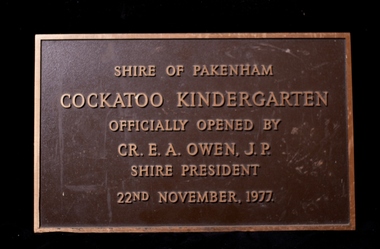
... The local community were successful in putting a halt to the demolition and saved the building. ...The local community were successful in putting a halt to the demolition and saved the building. ...In 1977 residents of Cockatoo built a kindergarten in McBride Street Cockatoo to service the growing population in the area. The building was officially opened on the 22nd of November of that year. Residents formed a Co-op, raised all the money to build the kinder along with lawn bowls and tennis sporting facilities for the town. No small feat, let alone for a town with a population of around 3000. The land was provided by the council for the kinder to use and that was their sole contribution to the building of the kinder. The unique building, was designed by Richard Allen and depicted a children's carousel. The design was to provide a feeling of enjoyment and friendship to the children who used the building. The large glass windows that were installed on the north-eastern side of the building made up 1/3 of the exterior wall. This overlooked the playground of the kinder making it easy to see the children at play from inside. The site of the building is in a dominant position and is highly visible to all who travel through Cockatoo. It was used as a child care facility right up until 2005. The kindergarten has recently been granted heritage listing after Cardinia Council started demolishing the building. The local community were successful in putting a halt to the demolition and saved the building. It will become an integral part of the Cockatoo Ash Wednesday memorial. Details on the fight to save the kinder building can be found at https://sites.google.com/site/cockatoosheritageashwednesday/ Brass Plaque, depicting the opening of the Cockatoo Kindergarten by the Shire of Pakenham Shire President - Cr OwenShire of Pakenham Cockatoo Kindergarten Officially Opened by Cr E A Owen J.P Shire President 22nd November 1977cockatoo, kindergarten opening, -
Surrey Hills Historical Society Collection
Photograph
... William served for nearly 2 years and was killed in 1917, only months before the end of the war whilst putting up barbed wire at Oestoik. His body was brought back the 4 miles from Oestoik to Lille Gate, Ypres in Belgium. ...William served for nearly 2 years and was killed in 1917, only months before the end of the war whilst putting up barbed wire at Oestoik. His body was brought back the 4 miles from Oestoik to Lille Gate, Ypres in Belgium. ...William Frederick Mawson was born in 1893 to Frederick William and Mary Mawson. Prior to the war, William was employed for 5 years as a carpenter with his older brother John who was a partner in Garrett & Mawson, architects and builders of Box Hill. At the age of 22, he enlisted on the 15 July 1915 and was assigned to the 5th Field Company of Engineers, training as a sapper. William served for nearly 2 years and was killed in 1917, only months before the end of the war whilst putting up barbed wire at Oestoik. His body was brought back the 4 miles from Oestoik to Lille Gate, Ypres in Belgium. William wrote a diary, the original of which was donated to Anzac House by his great-nephew John Howden. This diary was borrowed by the Surrey Hills Historical Society for the exhibition 'Gallipoli and beyond' mounted in Boroondara libraries and council spaces during 2015. The diary was then transcribed by Sandra Dexter and limited copies were printed by the Surrey Hills Historical Society. This framed photo authenticates the identification of this soldier whose photo was taken by the Darge company (Dasey1498) and uploaded to the Australian War Memorial online collection, but initially mis-idetified as Manson. His name appears on the panels of names on The Shrine in the Surrey Gardens and a profile of him is included in Sandra Dexter's book 'People of The Shrine' launched on Remembrance Day 2025. Framed photograph of soldier within fabric inset, embroidered with English and Australian flags, white ribbon at base of green wreath which surrounds photo. frederick william mawson, mary mawson, surrey hills, garrett & mawson, william frederick mawson, carpenter, 14 bona vista avenue, architects, world war 1, world war, 1914-1918, diaries, sandra dexter -
Port Melbourne Historical & Preservation Society
Document - Sale Notices, Relating to properties in Port Melbourne, "Sale Notices", 1960 - 1979
... The items concern matters relating to properties and mostly are part of the process of putting a property up for sale. Those realting to a particular property are generally grouped together and are usually arranged in alphabetical order of streets. ...The items concern matters relating to properties and mostly are part of the process of putting a property up for sale. Those realting to a particular property are generally grouped together and are usually arranged in alphabetical order of streets. ...Index of each volume was carried out by Margaret Bride 2013 and Jack Bolt 2017/18.29 thick volumes of letters, forms, memoranda, etc. sent to the Building and Rates Departments of the former City of Port Melbourne by property owners, law firms and others. The items concern matters relating to properties and mostly are part of the process of putting a property up for sale. Those realting to a particular property are generally grouped together and are usually arranged in alphabetical order of streets. The volumes extend from early 1960s to late 1979. They have card front and back covers, metal holders and taped spines . (.01) prior to 30.09 1962 (.02) 1.10.1962 to 30.09.1963 (.03) 1963/64 (.04) 01.10.1964 to 30.09.1965 ; A-F (.05) 01.10.1964 to 30.09.1965 ; G-Z (.06) 01.10.1965 to 30.09.1966 (.07) 1966 to 1967 (.08) 01.10.1967 to 30.09.1968 (.09) 1968 to 1969, A-G (.10) 1968 to 1969, H-Z (.11) 01.10.1969 to 30.09.1970, A-K (.12) 01.10.1969 to 30.09.1970, L-Z (.13) 01.10.1970 to 30.09.1971, A-L (.14) 01.10.1970 to 30.09.1971, M-Z (.15) 01.10.1972 to 30.09.1973, A-H (.16) 01.10.1972 to 30.09.1973, I-Z (.17) 01.10.1973 to 30.09.1974, A-Glocal government - city of port melbourne, built environment - domestic -
 City of Ballarat
Artwork, other - Public Artwork, Deanne Gilson, Murrup Laarr by Deanne Gilson, 2019
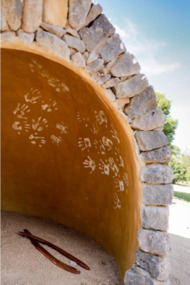
... An Aboriginal stone circle existed in Ballarat pre-colonisation; by putting back what was lost throughout colonisation I pay homage to my ancestors, past, present and emerging”/ – Deanne Gilson, March 2019 ...An Aboriginal stone circle existed in Ballarat pre-colonisation; by putting back what was lost throughout colonisation I pay homage to my ancestors, past, present and emerging”/ – Deanne Gilson, March 2019 A traditional hut made from river stone and stacked rocks, with the hut surrounded by large basalt rocks with plaques featuring unique designs on stoneware plates imbedded into them. ...Murrup Laarr translates as 'Ancestral Stones' in Wadawurrung. This artwork by Dr Deanne Gilson is located in the North Gardens Indigenous Sculpture Park. The park is a significant project for the City of Ballarat and features works by Aboriginal and Torres Strait Islander artists, celebrating the richness and diversity of culture and telling important cultural stories. Dr Deanne Gilson is a Wadawarrung Traditional Custodian and established artist. She installed the first artwork commissioned by the City of Ballarat for the Sculpture Park in early 2019. Murrup Laarr is a contemporary artwork consisting of a traditionally-built stone hut in the middle of a circle of basalt standing stones, marked with ceramic plates reflecting the stories and symbols of dreaming, memory, ceremony.The artwork is of aesthetic and cultural, social and spiritual significance to the people of Ballarat and to Wadawurrung peopleA traditional hut made from river stone and stacked rocks, with the hut surrounded by large basalt rocks with plaques featuring unique designs on stoneware plates imbedded into them. Murrup Laarr (Ancestral Stones), 2019 / By Deanne Gilson / Wadawurrung people have always used stones to mark places of ceremony and important business. The stones are the holders of memory and knowledge, Country and Spirit. They mark the cosmos and seasons. They follow the sun, marking the summer and winter solstice, important dates for planting and harvesting and telling stories of past, present and future. / The stones are alive and still present. Murrup Laar has been created using local basalt stones to tell Wadawurrung stories of dreaming, memory and ceremony. / “Creating Murrup Laarr (Ancestral Stones) at this time has placed Aboriginal people and practices back on Country and created a place to tell our stories. I am very honoured to have had this opportunity. An Aboriginal stone circle existed in Ballarat pre-colonisation; by putting back what was lost throughout colonisation I pay homage to my ancestors, past, present and emerging”/ – Deanne Gilson, March 2019 murrup laarr, wadawurrung -
 City of Melbourne Libraries
Photograph, Bull, Hugh Jones, 1897-1993, Miss Jessie Anderson with bandaged wrist
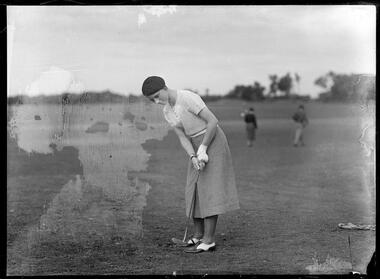
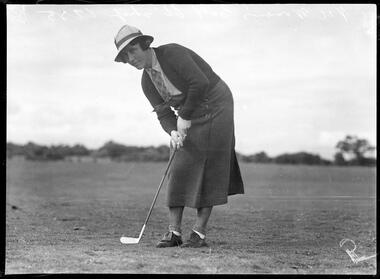
... Photographer notations on slide: "England Anderson Miss B98" Description: Female golfer putting. She is wearing two-tone brogue shoes, a hand-knitted cardigan, beret and skirt. ...Photographer notations on slide: "England Anderson Miss B98" Description: Female golfer putting. She is wearing two-tone brogue shoes, a hand-knitted cardigan, beret and skirt. ...20 year old Scot, Jessie Anderson, practises her putting at Royal Melbourne Golf Course. The press speculated that her heavily bandaged wrist was “a sprained wrist, occasioned through an argument with her luggage”, “a poisoned hand” and, the most likely reason, “sprained at practise”. Featured in "Newsworthy: Melbourne in photographs 1933-1936" exhibition at East Melbourne Library, October to December 2023. Exhibition caption by project volunteer, Fiona Collyer. Photographer notations on slide: "England Anderson Miss B98" Description: Female golfer putting. She is wearing two-tone brogue shoes, a hand-knitted cardigan, beret and skirt. Her left wrist is bandaged. Research by project volunteer, Fiona Collyer: 20 year old Jessie Anderson photographed at the Royal Melbourne Golf Club with a heavily bandaged left wrist. She was part of the British golf team who competed in the Australian Women’s Golf Championship at Royal Melbourne Golf Club in 1935. The press speculated that Jessie had a “sprained wrist, occasioned through an argument with her luggage”, “a poisoned hand” and the most likely reason – “sprained her wrist at practise”. She was defeated in the first round by Victorian, Miss Mona MacLeod. Janet "Jessie" Anderson (1915-2006) was a Scottish golf champion, nicknamed “Wee Jessie” for her small stature. She was also nicknamed “Fairway Maid of Perth”, a play on Sir Walter Scott’s “Fair Maid of Perth”. In 1937, Jessie was the world’s number one ranking woman golfer. Her main wins included the British Women's Amateur Championship (1937, 1955, 1958), the Scottish Women's Amateur Championship (1938, 1939, 1951, 1953, 1955, 1958), the New Zealand Women's Golf Championship (1935) and the French Women's Golf Tournament (1936). Jessie was part of the British golf team who competed in the Australian Women’s Golf Championship against an Australian team at Royal Melbourne Golf Club in 1935, which the British team won. The Australian press said, “Hats off to the British women, sparkle, sportsmanship and the fighting spirit that thrills, they had the last word.” Jessie’s father, Joe, a pro-golfer, owned a sports equipment store in St John’s Street, Perth and he designed and manufactured golf clubs under the OK brand. Jessie designed golf clubs especially for women. In 1939 Jessie became engaged to George Valentine. In 1940, George enlisted in the British army and Jessie in the Auxiliary Territorial Service (ATS), the women’s branch of the British Army, driving army ambulances. George was a POW at Eichstat, Germany, and they were unable to marry until he was freed in 1945. Jessie continued to play championship golf until 1960. They had one son, Francis Iain, born 1948. Jessie was awarded the MBE for services to golf in 1959. She was inducted into the Scottish Sports Hall of Fame in 2003. In 2019, Perth Museum and Art Gallery held a retrospective exhibition of her life and career. A biography, “Wee Jessie: Jessie Valentine, whose golf swing lasted a lifetime” by Dr Eve Soulsby, was published in 2019. Photographer notations on slide: "England Anderson Miss B98".golf, women golfers, royal melbourne golf club -
 Ballarat Tramway Museum
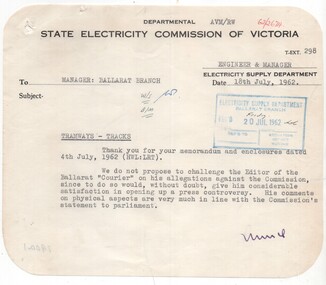
Administrative record - Memorandum, State Electricity Commission of Victoria (SEC) and The Courier Ballarat, Derailment of tram at Sturt and Lydiard Street, Jul. 1962
... May have been the draft pending typing. .4 - Plain sheet with three newspaper clippings - all 4/7/1962 a - "putting off evil day" - questioning the track maintenance as a precursor to closure. ...May have been the draft pending typing. .4 - Plain sheet with three newspaper clippings - all 4/7/1962 a - "putting off evil day" - questioning the track maintenance as a precursor to closure. ...Yields information about the condition of the track at Sturt and Lydiard Sts following derailments of bogie trams and the ensuring correspondence and the views of The Courier., Yields information about the condition of the track at Sturt and Lydiard Sts following derailments of bogie trams and the ensuring correspondence and the views of The Courier.Set of four documents concerning the derailment of tram 35 on 26/6/1952 at the intersection of Sturt and Lydiard Sts. All documents have rounded corners. .1 - Memorandum on SEC paper, light green sheet, dated 18/7/1962 from the Engineer and Manager of the SEC to the Manager Ballarat Branch, regarding the Courier's reports and the Parliamentary report. .2 - Memorandum on a green sheet forwarding Press cuttings and the Work's Superintendent's report re the derailment. .3 - Handwritten report dated 4/7/1962 re the derailment, three sheets on ruled paper, cause of the derailment, works to repair, derailment of 36 at the same location on 3/7 (twice), trackwork issues, track repairs being undertaken and comments re The Courier's reporting. Signed by W. Linaker. May have been the draft pending typing. .4 - Plain sheet with three newspaper clippings - all 4/7/1962 a - "putting off evil day" - questioning the track maintenance as a precursor to closure. Supportive of the trams. b - "Off the Lines" - reporting on the derailment of tram 36 twice that day. c - "Two Tram Derailments" - photo of tram 36, side on view, derailed. trams, tramways, sec, trackwork, derailments, accidents -
Bendigo Historical Society Inc.
Newspaper - Bendigo Advertiser Collection: Schools Searching for a Future - Muskerry East Primary School 2108, August 20 1993
... Recent policy changes require at least 21 pupils for "non-remote" schools to remain open, putting Muskerry East at risk. The community feels the government has shifted requirements, making it harder for small schools to survive. ...Recent policy changes require at least 21 pupils for "non-remote" schools to remain open, putting Muskerry East at risk. The community feels the government has shifted requirements, making it harder for small schools to survive. ...This Article outlines the history, community role, and current challenges facing Muskerry East School, a rural Australian school. The school has existed on the same site since 1878, originally sharing a building with the Methodist church. The current weatherboard building was relocated in 1926 after the closure of Weston school. The school has experienced multiple closures due to low enrolment: from 1902–1922 and 1945–1951. Muskerry East is considered a true "neighborhood school" despite its remote location, with families like the Hicksons, Roulstons, Burkes, and Tuoheys attending for generations. The school serves as the central gathering place for the local farming community, especially for women who rely on school drop-offs and pick-ups for social interaction.It is now the only school remaining in a large area between Heathcote and Elmore, with others having closed. The Directorate of School Education is considering closing the school due to low enrolment (currently 15, projected 16–21), despite community guarantees of future students. Recent policy changes require at least 21 pupils for "non-remote" schools to remain open, putting Muskerry East at risk. The community feels the government has shifted requirements, making it harder for small schools to survive. Parents and community members are actively fighting to keep the school open, emphasizing its importance to local identity and cohesion.There is frustration that bureaucratic decisions may sever long-standing community ties and traditions. Muskerry East School stands as a symbol of rural resilience and community, now threatened by changing educational policies and declining rural populations.Schools searching for a Future. Series of photos and information about Muskeery East Primary School No. 2108. Pictures by Lisa Honeychurch. Written by Owen Davies. This item contains the following documents and Photos: 8091.604a Part of Page 11, the Bendigo Advertiser Friday August 20 1993 8091.604b Black and White Photo. Left to Right: Alma and Ron Hickson, Catherine Hamblin (attended 72 years ago), Beryl Roulston (husband was a student and both children attended the school), Joyce Moroney (student 69 years ago), Nancy Roulston, (Teacher) - Contact the BHS for details 8091.604c Black and White Photo. Left to Right: Beryl Roulston (husband was a student and both children attended the school), Joyce Moroney (student 69 years ago) - Contact the BHS for details 8091.604d Black and White Photo. Centenary Plaque (100 years of the school 9th Dec 1878 - Contact the BHS for details 8091.604e Black and White Photo. Joelene Morrissey (Grade 5) and Linda Hickson (Grade 4) - contact the BHS for details 8091.604f Black and White Photo. Ron Hickson (attended in 1927) and his grand children, L to R: Lauren Tuohey (Grade 4) Rowan Hickson (Grade 2) and Linda Hickson (Grade 5) - contact the BHS for details 8091.604g Black and White Photo. Catherine Hamblin (former pupil 72 years ago, when the school was in the old Methodist Church) - contact the BHS for details 8091.604h Black and White Photo. In the class room on the last day of school for the year 16 Dec 1993 - contact the BHS for details 8091.604i Black and White Photo. In front of the school, pupils, parents and community members - contact the BHS for detailsnewspaper, bendigo advertiser, primary school, muskerry east -
 Flagstaff Hill Maritime Museum and Village
Domestic object - Razor Strop, Early 19th century
... The person using the strop would draw the spine of the blade down along the strop with the blade following, without putting any pressure on the blade. At the end of the stroke, rotate the blade over its spine then draw the spine along the strop again so that the edge moves away from the top. ...The person using the strop would draw the spine of the blade down along the strop with the blade following, without putting any pressure on the blade. At the end of the stroke, rotate the blade over its spine then draw the spine along the strop again so that the edge moves away from the top. ...A razor strop is flexible strip of leather or canvas used to maintain a shaving edge on a thin blade such as a straight razor. Fine powdered jeweler's rouge or other pastes can be added as an abrasive to polish the blade. The strop may be a hanging strip or a hand-held paddle. This one is a hanging strop. Strops were quite commonly found in barber shops and homes before the invention of the safety razor, They are still used for sharpening tool blades. The person using the strop would draw the spine of the blade down along the strop with the blade following, without putting any pressure on the blade. At the end of the stroke, rotate the blade over its spine then draw the spine along the strop again so that the edge moves away from the top. The finer grade of leather strap is used to give the final finish. KEEN EDGE MANUFACTURER In March 1906 Popular Mechanics magazine included an advertisement for Keen Edge Strop. The promise given by the advertiser, Eddy Mfg. Co. (206 Broadway, New York) was “Use the Keen Edge strop for 90 days and if not satisfied return to us and we will refund your money“. The advertisement was for a Combination Razor Strop, “the only strop made which requires no dressing.” Readers were invited to send for a booklet on Razor and the Face. In 1924 Popular Mechanics, published by Hearst Magazines, displayed an advertisement seeking a sales manager “… to sell [to] drug, hardware and cigar stores Keen Edge Strop Dressing, which sharpens straight razors and safety blades and removes old razor strops.” At that time the Keen Edge Mfg. Company was in Dallas, Texas. Razor strops are of historical significance, representing personal effects of men from the time period when men relied on strops to keep a sharp edge on their shaving blade. Strops were commonly owned and used until the acceptance of safety razors.Razor strop, leather and metal. Keen Edge brand, double straps: two straps of different grade leather joined at ends with metal fittings. Stropping faces; sharpening surface is stained red and finishing surface is stained black. One end has padded, bulbous shaped leather handle, the other end has metal, swivel hook hanger. Inscriptions pressed into leather at the ends of the straps. Impressed into leather "FINEST SELECTED HIDE", "KEEN EDGE", "FINISH" (black stained side), “A SHARPENER" (red stained side), “1 2 3”warrnambool, shipwrecked coast, flagstaff hill maritime museum, maritime museum, shipwreck coast, great ocean road, shaving leather, shaving accessory, barber’s equipment, barber shop razor strop, razor strop, straight razor, razor and knife sharpener, keen edge razor strop -
 Eltham District Historical Society Inc
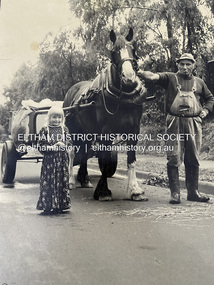
Photograph - Digital copy of photograph, Gordon Allingham, Danielle Hardiman with Eltham Shire Council garbage collector, Joe Buhagiar with his horse drawn cart, Rattray Road, Montmorency, c.1965
... Many people will remember putting out the sometimes battered steel or plastic rubbish bin to be collected by the ‘garbos’ as they rushed down the street and at times precariously hung off the back of a Council truck. ...Many people will remember putting out the sometimes battered steel or plastic rubbish bin to be collected by the ‘garbos’ as they rushed down the street and at times precariously hung off the back of a Council truck. ...Lots of Rubbish by Jim Connor (EDHS Newsletter No. 252, June 2020 History is often about change and we experience this all around us, even with such basic services about how our rubbish is collected and even how our streets are cleaned. Many people will remember putting out the sometimes battered steel or plastic rubbish bin to be collected by the ‘garbos’ as they rushed down the street and at times precariously hung off the back of a Council truck. They often seemed to be in a hurry as they grabbed a bin, tossed the contents into the truck and then went off on their merry way. Now, we need to decide which large coloured plastic ‘wheely’ bin to put out to be picked up by a mechanical arm extending from the truck, while the driver is ensconced in his cabin. Today they rarely handle the bins. Large street sweeper trucks clean the streets, often while we sleep, whereas in the past it was indeed very different. When Montmorency was part of the Shire of Eltham, prior to the municipal restructure in 1994, there was one Council employee who was particularly well known in the area. This was Joe Buhagier, a unique and interesting sight, who with his trusty horse walked and cleaned the local streets. Lyn and Graeme Hardiman remember him as a private person and Lyn would often talk with him each time he came along Rattray Road. One day he reluctantly agreed to have his photograph taken with their daughter Danielle, who was about 5 years old at the time, though he was a little embarrassed about all the fuss. Joe features in the Were Street footpath mosaics showing some of the well-known local Montmorency characters.council staff, danielle hardiman, eltham shire council, garbage collection, graeme hardiman collection, joe buhagiar, montmorency, horse, horse drawn vehicles, lyn dodkins, mosaics, were street, rattray road -
 University of Melbourne, Burnley Campus Archives
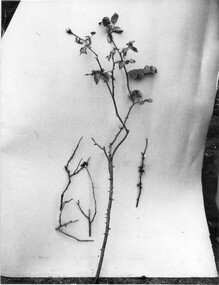
Photograph - Black and white photographs, A.W. Jessep, Grafting and Cutting Display, Unknown
... Seedling Polyanthus." (17) Cuttings. (18) Clump of rooted cuttings. (19) Trimming rooted cutting. (20) Clump of Begonia. (21) Dividing Begonia. (22) Begonia leaf cut into pieces. (23) Rooted cuttings from leaf. (24) Putting leaf pieces in pot. (25) Pot of rooted cuttings. (26) Lupin seedlings emerging. (27) Lupin seedlings. (28) Clump of roots? ...Seedling Polyanthus." (17) Cuttings. (18) Clump of rooted cuttings. (19) Trimming rooted cutting. (20) Clump of Begonia. (21) Dividing Begonia. (22) Begonia leaf cut into pieces. (23) Rooted cuttings from leaf. (24) Putting leaf pieces in pot. (25) Pot of rooted cuttings. (26) Lupin seedlings emerging. (27) Lupin seedlings. (28) Clump of roots? ...Black and white photographs of various sizes pasted on cardboard for display purposes. Some annotated. Labelled: (1) Rose with 4 pieces cut off it. (2)"Citrus rootstock in nursery ready for budding." (3) "Feb. Left. Healthy budstick of current season's growth. Right. Prepared budstick, foliage and undeveloped buds removed, short section of leaf-stick reatined." (4) Same as (3). (5)"Harvest scions while dormant and store in moist, well-drained soil." (6) "Whip-tongue graft after one season of growth." (7) "Graft after one season of growth." (8) "Mastic applied to keep air and moisture from the cut surfaces." (9) "Graft tied to prevent movement." (10) "Young camellia-struck cutting." (11) Cutting beside pot. (12) "Feb. Same pot camellia struck." (13) Clump of dug-up perennials. (14) Divided piece. (15) Trimmed. (16) "April. Seedling Polyanthus." (17) Cuttings. (18) Clump of rooted cuttings. (19) Trimming rooted cutting. (20) Clump of Begonia. (21) Dividing Begonia. (22) Begonia leaf cut into pieces. (23) Rooted cuttings from leaf. (24) Putting leaf pieces in pot. (25) Pot of rooted cuttings. (26) Lupin seedlings emerging. (27) Lupin seedlings. (28) Clump of roots? From A. W. Jessep.roses, nursery, budstick, grafting, growth, camellia, polyanthus, cutting, trimming, begonia, dividing, a. w. jessep, citrus rootstock, scions, whip-tongue graft, perennials, lupin seedlings, teaching -
 Flagstaff Hill Maritime Museum and Village
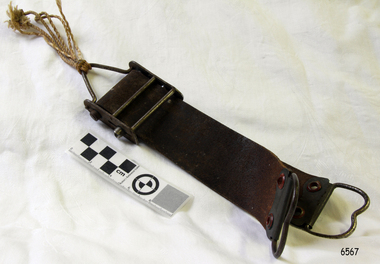
Razor Strop
... To use the strop draw the spine of the blade down along the strop with the blade following, without putting any pressure on the blade. At the end of the stroke, rotate the blade over its spine then draw the spine along the strop again so that the edge moves away from the top. ...To use the strop draw the spine of the blade down along the strop with the blade following, without putting any pressure on the blade. At the end of the stroke, rotate the blade over its spine then draw the spine along the strop again so that the edge moves away from the top. ...This razor strop is made like a leather strap. ABOUT STROPS Straight razors and cut throat razors were the major tools for shaving before the safety razor was invented in the 1880’s and even today specialty shaving shops still sell the straight razors. Along with the razor, the process of shaving would commonly involve lathering up shaving soap using a shaving brush with boar bristles. Men could own several razors and rotate them through the week and some shops sold the razors in a set, a razor for each day of the week. Straight razors could require stropping more than once during the shaving of a heavy beard, and stropping would also be performed at the end of each shave. Honing would only be performed two or three times a year, preserving the blade’s edge. A lot of skill was needed to hone and strop the blades of these early razors and the methods to do so were a large part of the curriculum in Barber colleges. The razor would be sharpened on a grinding wheel then honed on sharpening stone and finally finished using a strop. Straight edge razors would usually be sold unfinished and that process would be completed by the customer. A razor strop, usually made from leather, thick canvas or light timber, would be used to straighten and polish the straight razor for shaving. Strops could also be used to polish other blades such as knives, small metal tools and chisels. Sometimes an abrasive polishing compound is also used to give a mirror finish. Some strops, such as this one in our Collection, are designed to be used while hanging from a nail or peg, while others are hand held. To use the strop draw the spine of the blade down along the strop with the blade following, without putting any pressure on the blade. At the end of the stroke, rotate the blade over its spine then draw the spine along the strop again so that the edge moves away from the top. The finer grade of leather strap is used to give the final finish. Double Swing Razor Strop. Use for honing razors.flagstaff hill, warrnambool, shipwrecked-coast, flagstaff-hill, flagstaff-hill-maritime-museum, maritime-museum, shipwreck-coast, flagstaff-hill-maritime-village, strop, swing razor strop, barber's equipment, shaving equipment, personal accessory -
 Flagstaff Hill Maritime Museum and Village
Paddle Strop
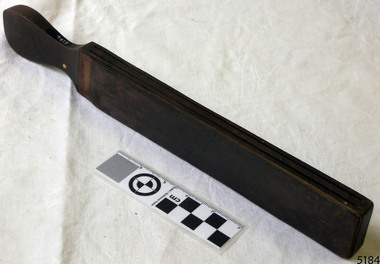
... To use the strop draw the spine of the blade down along the strop with the blade following, without putting any pressure on the blade. At the end of the stroke, rotate the blade over its spine then draw the spine along the strop again so that the edge moves away from the top. ...To use the strop draw the spine of the blade down along the strop with the blade following, without putting any pressure on the blade. At the end of the stroke, rotate the blade over its spine then draw the spine along the strop again so that the edge moves away from the top. ...This razor strop is called a paddle strop. ABOUT STROPS Straight razors and cut throat razors were the major tools for shaving before the safety razor was invented in the 1880’s and even today specialty shaving shops still sell the straight razors. Along with the razor, the process of shaving would commonly involve lathering up shaving soap using a shaving brush with boar bristles. Men could own several razors and rotate them through the week and some shops sold the razors in a set, a razor for each day of the week. Straight razors could require stropping more than once during the shaving of a heavy beard, and stropping would also be performed at the end of each shave. Honing would only be performed two or three times a year, preserving the blade’s edge. A lot of skill was needed to hone and strop the blades of these early razors and the methods to do so were a large part of the curriculum in Barber colleges. The razor would be sharpened on a grinding wheel then honed on sharpening stone and finally finished using a strop. Straight edge razors would usually be sold unfinished and that process would be completed by the customer. A razor strop, usually made from leather, thick canvas or light timber, would be used to straighten and polish the straight razor for shaving. Strops could also be used to polish other blades such as knives, small metal tools and chisels. Sometimes an abrasive polishing compound is also used to give a mirror finish. Some strops, such as this one in our Collection, are designed to be used while hanging from a nail or peg, while others are hand held. To use the strop draw the spine of the blade down along the strop with the blade following, without putting any pressure on the blade. At the end of the stroke, rotate the blade over its spine then draw the spine along the strop again so that the edge moves away from the top. The finer grade of leather strap is used to give the final finish. Wooden paddle strop, (or raxor strop or cushion strop). Strop has two leather sides, numbered 1 and 2, on a slotted paddle. Marked on handle “Hamon”. Sides are numbered 1 and 2. Has two slits in body of strop. "Hamon" stamped on handle. "Hamon" stamped on handle. flagstaff hill, warrnambool, shipwrecked-coast, flagstaff-hill, flagstaff-hill-maritime-museum, maritime-museum, shipwreck-coast, flagstaff-hill-maritime-village, wooden strop, paddle strop, strop, razor strop, shaving accessory, barber's equipment, personal grooming -
 Flagstaff Hill Maritime Museum and Village
Paddle Strop
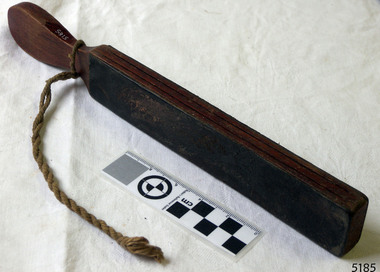
... To use the strop draw the spine of the blade down along the strop with the blade following, without putting any pressure on the blade. At the end of the stroke, rotate the blade over its spine then draw the spine along the strop again so that the edge moves away from the top. ...To use the strop draw the spine of the blade down along the strop with the blade following, without putting any pressure on the blade. At the end of the stroke, rotate the blade over its spine then draw the spine along the strop again so that the edge moves away from the top. ...This razor strop is called a paddle strop. ABOUT STROPS Straight razors and cut throat razors were the major tools for shaving before the safety razor was invented in the 1880’s and even today specialty shaving shops still sell the straight razors. Along with the razor, the process of shaving would commonly involve lathering up shaving soap using a shaving brush with boar bristles. Men could own several razors and rotate them through the week and some shops sold the razors in a set, a razor for each day of the week. Straight razors could require stropping more than once during the shaving of a heavy beard, and stropping would also be performed at the end of each shave. Honing would only be performed two or three times a year, preserving the blade’s edge. A lot of skill was needed to hone and strop the blades of these early razors and the methods to do so were a large part of the curriculum in Barber colleges. The razor would be sharpened on a grinding wheel then honed on sharpening stone and finally finished using a strop. Straight edge razors would usually be sold unfinished and that process would be completed by the customer. A razor strop, usually made from leather, thick canvas or light timber, would be used to straighten and polish the straight razor for shaving. Strops could also be used to polish other blades such as knives, small metal tools and chisels. Sometimes an abrasive polishing compound is also used to give a mirror finish. Some strops, such as this one in our Collection, are designed to be used while hanging from a nail or peg, while others are hand held. To use the strop draw the spine of the blade down along the strop with the blade following, without putting any pressure on the blade. At the end of the stroke, rotate the blade over its spine then draw the spine along the strop again so that the edge moves away from the top. The finer grade of leather strap is used to give the final finish. Wooden strop, paddle strop design (sometimes called razor strop). Has leather attached to one side. Has two slits in body of strop. flagstaff hill, warrnambool, shipwrecked-coast, flagstaff-hill, flagstaff-hill-maritime-museum, maritime-museum, shipwreck-coast, flagstaff-hill-maritime-village, strop, paddle strop, personal effects, shaving equipment, razor strop, barber's equipment -
 Flagstaff Hill Maritime Museum and Village
Paddle Strop
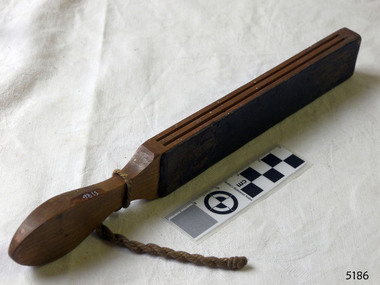
... To use the strop draw the spine of the blade down along the strop with the blade following, without putting any pressure on the blade. At the end of the stroke, rotate the blade over its spine then draw the spine along the strop again so that the edge moves away from the top. ...To use the strop draw the spine of the blade down along the strop with the blade following, without putting any pressure on the blade. At the end of the stroke, rotate the blade over its spine then draw the spine along the strop again so that the edge moves away from the top. ...This razor strop is called a paddle strop. ABOUT STROPS Straight razors and cut throat razors were the major tools for shaving before the safety razor was invented in the 1880’s and even today specialty shaving shops still sell the straight razors. Along with the razor, the process of shaving would commonly involve lathering up shaving soap using a shaving brush with boar bristles. Men could own several razors and rotate them through the week and some shops sold the razors in a set, a razor for each day of the week. Straight razors could require stropping more than once during the shaving of a heavy beard, and stropping would also be performed at the end of each shave. Honing would only be performed two or three times a year, preserving the blade’s edge. A lot of skill was needed to hone and strop the blades of these early razors and the methods to do so were a large part of the curriculum in Barber colleges. The razor would be sharpened on a grinding wheel then honed on sharpening stone and finally finished using a strop. Straight edge razors would usually be sold unfinished and that process would be completed by the customer. A razor strop, usually made from leather, thick canvas or light timber, would be used to straighten and polish the straight razor for shaving. Strops could also be used to polish other blades such as knives, small metal tools and chisels. Sometimes an abrasive polishing compound is also used to give a mirror finish. Some strops, such as this one in our Collection, are designed to be used while hanging from a nail or peg, while others are hand held. To use the strop draw the spine of the blade down along the strop with the blade following, without putting any pressure on the blade. At the end of the stroke, rotate the blade over its spine then draw the spine along the strop again so that the edge moves away from the top. The finer grade of leather strap is used to give the final finish. Wooden strop, paddle strop design (sometimes called razor strop). Has leather attached to one side. Sides are numbered 1 and 2. Has two slits in body of strop. Stamped Hamon Paris France. "Hamon Paris France. "flagstaff hill, warrnambool, shipwrecked-coast, flagstaff-hill, flagstaff-hill-maritime-museum, maritime-museum, shipwreck-coast, flagstaff-hill-maritime-village, paddle strop, strop, shaving equipment, personal effects, barber's equipment, personal grooming accessory -
 Melton City Libraries
Newspaper, Stone Walls protected, 2015
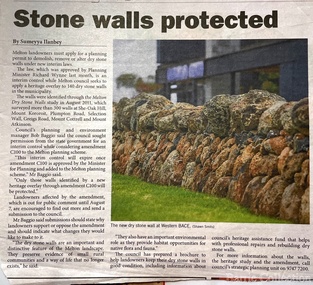
... This is not an easy task, but, along with putting the necessary statutory mechanisms to ensure their retention, it is a task that must be pursued. ...This is not an easy task, but, along with putting the necessary statutory mechanisms to ensure their retention, it is a task that must be pursued. ...Dry stone construction as a technique is used for much more than paddock walls. Across the volcanic plains of western Victoriaare marvelous sheep dips, stock loading ramps, huts, dams, retaining walls, and the rich and largely undiscovered heritage of indigenous dry stone structures. Dry stone walls indicate many aspects of our rural environment; the geological beginnings of the way the landscape was created, the patterns of early settlement by pastoralists and squatters, the types of stock that grazed the land and the methods of cattle and sheep management, of the efforts to thwart the spread of rabbits .... "For the casual but interested observer dry stone walls are good to look at, to photograph, to get up alongside and see the way they are constructed, to appreciate the varying shapes and sizes of stones and learn of the techniques of keeping often quite rounded stones in place. Apart from walls and other dry stone structures on grazing land we can also see dry stone techniques used in other places and in other phases of our history. Indigenous Australians have built, and continue to build, structures for shelter or hunting or trapping eels and fish in rivers and estuaries around the country. At spots around our coast line there is evidence of simple stone structures built by early maritime explorers. Prospectors in early mining encampments used dry stone construction to build retaining walls or the low walls of rudimentary shelters. If the future of dry stone walls in the Australian landscape is to be assured. wall owners and local governments have to accept and embrace their custodial role in assuring the preservation and celebration of walls. This is not an easy task, but, along with putting the necessary statutory mechanisms to ensure their retention, it is a task that must be pursued. The Dry Stone Walls Association of Australia has as its primary goal the increase in awareness of wall owners and local governments of the importance of dry stone walls. It also seeks to increase the level of training of skilled and semi skilled wallers, and the gaining of rudimentary skills by farmers so that they can maintain their own walls". Melton Star Weekly article about the Stone Wallslandscapes of significance -
 City of Melbourne Libraries
Photograph, Bull, Hugh Jones, 1897-1993, Mrs Sloan Morpeth (Miss Susie Tolhurst)
... Photographer notations on slide: "Vic Women's Golf Ch'ship B98" Description: Golfer Susie Tolhurst putting. She wears a hat, tie, skirt, cardigan, handknitted socks and brogues. ...Photographer notations on slide: "Vic Women's Golf Ch'ship B98" Description: Golfer Susie Tolhurst putting. She wears a hat, tie, skirt, cardigan, handknitted socks and brogues. ...Mrs Sloan Morpeth, née Claire “Susie” Tolhurst From her trilby with golf tee sensibly tucked in the brim, to her hand knitted socks and fringed brogues, Susie looks the golf champion she was. Susie (1905-1999) won the Victorian Ladies' Amateur Championship five times between 1919 and 1936. She was defeated in the 1935 Women’s Golf Championship final by Mrs J B Walker of Britain. In 2012, Golf Victoria introduced the Women’s Champions Trophy, renamed in 2016 to the Susie Tolhurst Trophy. Her husband, Mr Sloan Morpeth, designed the Commonwealth, Peninsula Kingswood Country Club and Portsea Golf Clubs. Featured in "Newsworthy: Melbourne in photographs 1933-1936" exhibition at East Melbourne Library, October to December 2023. Exhibition caption by project volunteer, Fiona Collyer. Photographer notations on slide: "Vic Women's Golf Ch'ship B98" Description: Golfer Susie Tolhurst putting. She wears a hat, tie, skirt, cardigan, handknitted socks and brogues. She also has a golf tee tucked into her hatband. Research by project volunteer, Fiona Collyer: Mrs Sloan Morpeth née Claire Helene Susie Tolhurst (known as Susie) Susie Tolhurst (1905-1999) was a champion Victorian golfer. Susie was the winner of the Ladies Amateur Championships five times between 1915 and 1936. She held the Australian title in 1930, 1931. Susie competed in the Australian Women’s Golf Championship at Royal Melbourne in 1935 against the British Women’s Team. She made the final but was defeated by Mrs J B Walker of Britain. The Golf Victoria competition for women held the Susie Tolhurst Trophy. In 1934 Susie Tolhurst married NZ Open Championship golfer Mr Sloan Morpeth. He later designed Peninsula - Kingswood Country Golf Course, Portsea Golf Course and Commonwealth Golf Course. They had one daughter, Simone.Photographer notations on slide: "Vic Women's Golf Ch'ship 1935 B98".golf, women golfers, royal melbourne golf club -
 Bendigo Military Museum
Photograph - Annual Sport Competition: Flag Day - Army Survey Regiment Verses School of Military Survey, Bendigo, 1977
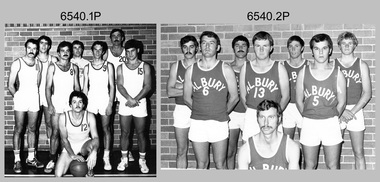
... Putting - Peter Warwick. .17) - Photo, black & white, 1977, Golf. ...Putting - Peter Warwick. .17) - Photo, black & white, 1977, Golf. ...This set of 33 photographs of sports action was taken on Flag Day, an annual sports competition between the Army Survey Regiment (ASR) and the School of Military Survey (SMS), at Bendigo on the 13th of May 1977. Softball was held at Beischer Park Strathdale, sailing was most likely held at Lake Eppalock, rifle shooting at Wellsford Rifle Range and tug-of-war at Fortuna. The venues for basketball, golf, squash and volleyball are unknown. The two RA Svy units took turns each year to host the event. Personnel from the ASR’s Detachment located at Bonegilla were part of the SMS’s teams. The day competition usually comprised basketball, cross country, golf, sailing, squash softball, tennis, rifle shooting, touch football, tug-of-war and volleyball. The evening competition often included darts, carpet bowls, hookey, quoits and snooker. See items 6025.15P for photo proofs of sports action and 6326.25P for softball action and taken on the day. There are numerous duplicates previously published from these photo proofs; however they are inferior in quality.This is a set of 33 photographs of sports action was taken on Flag Day, Army Survey Regiment (ASR) versus the School of Military Survey (SMS), at Bendigo on the 13th of May 1977. The photographs were printed on photographic paper and are part of the Army Survey Regiment’s Collection. The black and white photographs were scanned at 300 dpi. .1) - Photo, black & white, 1977, Basketball. ASR Team Back row L to R: unidentified, Stuart Symonds, Bruce Gordon. Front row L to R: unidentified (x2), Bill Jones, unidentified. Sitting: unidentified. .2) - Photo, black & white, 1977, Basketball. SMS Team Back row L to R: Duncan Burns, Stuart Thaxter, unidentified (x2). Front row L to R: Owen Moss, unidentified, Steve Hansen. Sitting: unidentified. .3) to .5) - Photo, black & white, 1977. Basketball action. .6) - Photo, black & white, 1977, Golf - L to R: Kevin ‘Chuck’ Berry, George Austen, unidentified, Roy Morgan. .7) - Photo, black & white, 1977, Golf - L to R: Stan Vote, Gordon Lowery, Peter Warwick, John ‘JB’ Barrie. .8) & .9) - Photo, black & white, 1977, ASR Golf Team – Back row L to R: Peter Warwick, unidentified, Graeme Jeffers, John Sinclair. Front row L to R: Stan Vote, Roy Morgan, George Austen, Len Thirlwell. .10) & .11) - Photo, black & white, 1977, SMS Golf Team - Back row L to R: Kevin ‘Chuck’ Berry, unidentified, Gordon Lowery. Front row L to R: unidentified, Peter Hardy, unidentified, John ‘JB’ Barrie. .12) & .13) - Photo, black & white, 1977, Golf. Teeing off – unidentified. .14) - Photo, black & white, 1977, Golf. Teeing off – John Sinclair. .15) - Photo, black & white, 1977, Golf. Putting – Stan Vote. .16) - Photo, black & white, 1977, Golf. Putting - Peter Warwick. .17) - Photo, black & white, 1977, Golf. Putting – Roy Morgan. .18) - Photo, black & white, 1977, ASR Rifle Shooting Team - Back row L to R: Paul Davis, unidentified (x2), Max Neil, Rhys De Laine. Front row L to R: Tony Lawler, Rene van den Tol, unidentified, Warren ‘Waldo’ Shirley. .19) - Photo, black & white, 1977, ASR Rifle Shooting Team – L to R: unidentified (x4), 2nd back right: Tony Lawler, unidentified. .20) - Photo, black & white, 1977, SMS Rifle Shooting Team - Back row L to R: John Ashby, unidentified (x3). Front row L to R: Dave Murphy, Wolfgang Thun, John ‘Stormy’ Tempest, unidentified. .21) - Photo, black & white, 1977, Softball – L to R: Jenny Haddow, Debbie Brown, unidentified umpire. .22) - Photo, black & white, 1977, ASR & SMS Sailing Teams – Back row L to R: Chris Osborne, Josh De Groot, unidentified (x2), Greg Francis-Wright, Peter Breukel. 3rd row L to R: Marrianne (Van De Zee) De Groot, unidentified, Kim Reynolds, Alex Cairney, unidentified, Sam Chambers. 2nd row L to R: Les Dixon, Jim Macdonald, unidentified, George Graham, Ted ‘FOT’ Burgess. Front row L to R: Doug Carswell, Alan Adsett, Peter Mustart, Tony Waldon, Dave Miles. .23) - Photo, black & white, 1977, Sailing on Lake Eppalock, Victoria. .24) - Photo, black & white, 1977, SMS Squash Team – Back row L to R: Graham Squire, Peter Constantine AM, Peter Colwell, Bill Boyd OAM, Front row L to R: unidentified, Dick Barwald, Colin Darch, unidentified. .25) - Photo, black & white, 1977, ASR Squash Team – Back row L to R: Andy Wilson, Terry Danger, Errol Fletcher, Dennis Puniard. Front row L to R: Lynn Johnson, Kerry Browne. .26) - Photo, black & white, 1977, ASR Tug-of-War Team: Back row L to R: Russ Mollenhauer, Neville Stone, Jim Cook, Jeff Willey, unidentified (x3). Front row L to R: unidentified, John ‘Flash’ Anderson, Mick ‘Buddha’ Ellis, Ken ‘Sluggo’ Slater, Rob ‘Boges’ Bogumil, Frank Lenane, unidentified. .27) - Photo, black & white, 1977, SMS Tug-of-War Team: Back row L to R: unidentified, Stuart Thaxter, Steve Hansen, unidentified (x2). Front row L to R: Kim Lenson, unidentified (x4), Jamie ‘Fish’ McRae. .28) & .29) - Photo, black & white, 1977, ASR Tug-of-War Team in action. .30) - Photo, black & white, 1977, Volleyball action. .31) - Photo, black & white, 1977, Volleyball action. Chris Edwards blocking. .32) & .33) - Photo, black & white, 1977, Volleyball action..1P to .33P –No personnel are identified. ‘Regiment v School 13 May 1977’ annotated on cover sleeve.royal australian survey corps, rasvy, army survey regiment, army svy regt, fortuna, asr, school of military survey, flag day -
 Eltham District Historical Society Inc
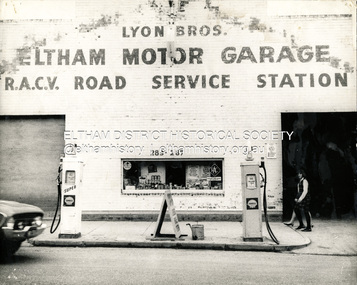
Negative - Photograph, George W. Bell, Lyon Bros. Eltham Motor Garage, 283-287 Main Road, Eltham, c.1964
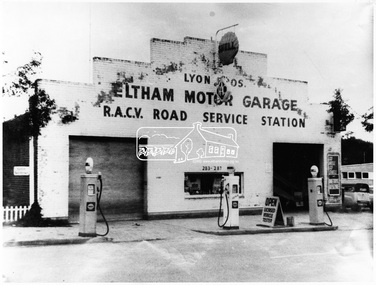
... Community memories after posting this photo on Facebook include: "I can remember my dad putting 2 shilling pieces into a bowser to get petrol after hours."...Community memories after posting this photo on Facebook include: "I can remember my dad putting 2 shilling pieces into a bowser to get petrol after hours." ...Lyon Bros Eltham Motor Garage originally opened as an old tin shed garage in 1923 alongside Dave Lyon’s weatherboard home, a Californian bungalow at present-day 856 Main Road, Eltham in the dip between York and Henry Streets - there was a wood yard and garage at the back. That house remains standing today (2026). It later became a Chiropractor’s practice now operating as Eltham Cosmetic Clinic. Earliest advertisements for the business date from March 1923 – advertise that they have opened a motor garage near the post office, where a car or petrol may be procured day or night, and repairs effected. (The Advertiser, 2 March 1923) Between May 1942 and December 1945 [based on a newspaper article "Eltham Killed in Brownout" (1942, May 15). Eltham and Whittlesea Shires Advertiser (Vic. : 1940 - 1942), p. 3. Retrieved May 23, 2026, from http://nla.gov.au/nla.news-article57496549 and aerial photos taken in December 1945], the brothers relocated the business to 283-287 Main Road Eltham, opposite Arthur Street. The garage was an official RACV Road Service Station and offered vehicles for hire in addition to conducting repairs. It was also an Agent for Shell petrol. During the war Dave was working in the garage one night with a motor running. He was almost unconscious, and Jack Burgoyne happened to stop off with his truck and went and dragged him out. John Lyon used to live on the comer of Bridge Street and Main Road on top of the cliff. He was later killed in an accident at Rosanna railway crossing 29th Feb, 1960 [Source: Doug Orford]. This photo is dated circa 1964 and the address is clearly 283-287 Main Road however by 1971 street numbers had been revised to present-day numbering and by the time the site had been redeveloped as Lyon Bros. Ford the address was 953 Main Road. Community memories after posting this photo on Facebook include: "I can remember my dad putting 2 shilling pieces into a bowser to get petrol after hours."This photo forms part of a collection of photographs gathered by the Shire of Eltham for their centenary project book, "Pioneers and Painters: 100 years of the Shire of Eltham" by Alan Marshall (1971). The collection of over 500 images is held in partnership between Eltham District Historical Society and Yarra Plenty Regional Library (Eltham Library) and is now formally known as the 'The Shire of Eltham Pioneers Photograph Collection.' It is significant in being the first community sourced collection representing the places and people of the Shire's first one hundred years.Digital image 4 x 5 inch B&W Neg953 main road eltham, 1963, automobiles, businesses, eltham, eltham lyon, eltham motor garage, lyon bros. garage, main road eltham, motor vehicles, racv road service station, shell service station, shire of eltham pioneers photograph collection -
 Ballarat Tramway Museum
Photograph - Colour Photograph/s, Carolyn Dean, Apr. 1999
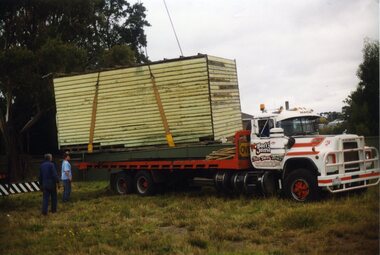
... On Kodak paper. 1095.1 - Loading the shed at Ballarat East - Alastair Reidier and Peter Winspur. .2 - ditto .3 - truck with shed on approach road to house. .4 - ditto and John Phillips .5 - lifting the shed into position at Bungaree over the power line. .6 - ditto .7 - lowering onto the foundations. .8 - tram 14 in Wendouree Parade near depot junction. .9 - Fixing hole in roof of the house - Bungaree - John Phillips .10 - ditto .11 - its snowing - Darren Hutchesson, Carolyn Dean, Alan Snowball - photo John Phillips .12 - putting roof back on the shed .13 - various cars out front of the house. .14 - nailing weather boards back on - Peter Winspur, Sftnon Jenkins, Alan Snowball .15 - ditto .14 used in the May 1999 Fares Please! ...On Kodak paper. 1095.1 - Loading the shed at Ballarat East - Alastair Reidier and Peter Winspur. .2 - ditto .3 - truck with shed on approach road to house. .4 - ditto and John Phillips .5 - lifting the shed into position at Bungaree over the power line. .6 - ditto .7 - lowering onto the foundations. .8 - tram 14 in Wendouree Parade near depot junction. .9 - Fixing hole in roof of the house - Bungaree - John Phillips .10 - ditto .11 - its snowing - Darren Hutchesson, Carolyn Dean, Alan Snowball - photo John Phillips .12 - putting roof back on the shed .13 - various cars out front of the house. .14 - nailing weather boards back on - Peter Winspur, Sftnon Jenkins, Alan Snowball .15 - ditto .14 used in the May 1999 Fares Please! ...Set of 20 photographs taken by Carolyn Dean between 16/4/1999 and 16/5/1999 of moving the ex SEC bike shed to Bungaree and placing the roof back onto the shed and other works at Bungaree and one tram operation photo. On Kodak paper. 1095.1 - Loading the shed at Ballarat East - Alastair Reidier and Peter Winspur. .2 - ditto .3 - truck with shed on approach road to house. .4 - ditto and John Phillips .5 - lifting the shed into position at Bungaree over the power line. .6 - ditto .7 - lowering onto the foundations. .8 - tram 14 in Wendouree Parade near depot junction. .9 - Fixing hole in roof of the house - Bungaree - John Phillips .10 - ditto .11 - its snowing - Darren Hutchesson, Carolyn Dean, Alan Snowball - photo John Phillips .12 - putting roof back on the shed .13 - various cars out front of the house. .14 - nailing weather boards back on - Peter Winspur, Sftnon Jenkins, Alan Snowball .15 - ditto .14 used in the May 1999 Fares Please! .16 - fitting off purlins - Darren Hutchesson and John Phillips .17 - view of house and shed and partially painted fence looking south west. .18 - ditto looking south. .19 - fitting off the sheet metal - John Phillips .20 - cleaning up the tree in frost of the house from breaking off more branches - Alan Snowball and Alastair Reither. .1 > .7-16/4/1999: .8 - 25/4/1999: .9 > .16-15/5/1999: .17 > .20-16/5/1999. See also Reg. No. 1095 for next stage of the move.On rear of each photo in blue ink is date in the upper edge and on lower edge "Photo by Carolyn Dean"btm, sec bike shed, bungaree -
 Eltham District Historical Society Inc
Photograph, George W. Bell, Lyon Bros. Eltham Motor Garage, 283-287 Main Road, Eltham, c.1964
... Just featured is an XL Falcon manufactured 1962-1964 Community memories after posting this photo on Facebook include: "I can remember my dad putting 2 shilling pieces into a bowser to get petrol after hours." ...Just featured is an XL Falcon manufactured 1962-1964 Community memories after posting this photo on Facebook include: "I can remember my dad putting 2 shilling pieces into a bowser to get petrol after hours." ...Lyon Bros Eltham Motor Garage originally opened as an old tin shed garage in 1923 alongside Dave Lyon’s weatherboard home, a Californian bungalow at present-day 856 Main Road, Eltham in the dip between York and Henry Streets - there was a wood yard and garage at the back. That house remains standing today (2026). It later became a Chiropractor’s practice now operating as Eltham Cosmetic Clinic. Earliest advertisements for the business date from March 1923 – advertise that they have opened a motor garage near the post office, where a car or petrol may be procured day or night, and repairs effected. (The Advertiser, 2 March 1923) Between May 1942 and December 1945 [based on a newspaper article "Eltham Killed in Brownout" (1942, May 15). Eltham and Whittlesea Shires Advertiser (Vic. : 1940 - 1942), p. 3. Retrieved May 23, 2026, from http://nla.gov.au/nla.news-article57496549 and aerial photos taken in December 1945], the brothers relocated the business to 283-287 Main Road Eltham, opposite Arthur Street. The garage was an official RACV Road Service Station and offered vehicles for hire in addition to conducting repairs. It was also an Agent for Shell petrol. During the war Dave was working in the garage one night with a motor running. He was almost unconscious, and Jack Burgoyne happened to stop off with his truck and went and dragged him out. John Lyon used to live on the comer of Bridge Street and Main Road on top of the cliff. He was later killed in an accident at Rosanna railway crossing 29th Feb, 1960 [Source: Doug Orford]. This photo is dated circa 1964 and the address is clearly 283-287 Main Road however by 1971 street numbers had been revised to present-day numbering and by the time the site had been redeveloped as Lyon Bros. Ford the address was 953 Main Road. Just featured is an XL Falcon manufactured 1962-1964 Community memories after posting this photo on Facebook include: "I can remember my dad putting 2 shilling pieces into a bowser to get petrol after hours." A similar photo is featured in the Shire of Eltham Pioneers Photograph Collection, SEPP_0664Black and white photograph of Lyon Bros. Eltham Motor Garage 283-287 Main Road Eltham c.1960953 main road eltham, 1963, automobiles, businesses, eltham, eltham motor garage, ford xl falcon, george w. bell collection, lyon, lyon bros. garage, main road eltham, racv road service station, shell service station -
 Stawell Historical Society Inc
Photograph, Pioneer Walk Murals
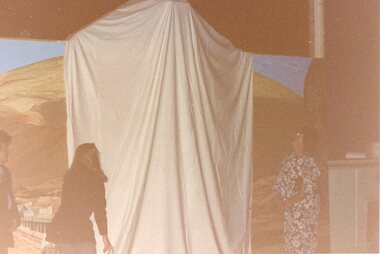
... Herb Skurrie is featured in Mural & Helen Leach. 9. First opening, putting away at Town Hall. 10. Opening Town Hall 16.04.1992. 11. ...Herb Skurrie is featured in Mural & Helen Leach. 9. First opening, putting away at Town Hall. 10. Opening Town Hall 16.04.1992. 11. ...27 colour photographs of the Pioneer Walk Mural displayed in Town Hall in 16.04.1992 prior to being installed in the "Pioneers Walk". Photos 322 - 12 to 14 shows the Pioneers walk way before a roof was placed over the walk way. The mural has been replaced. 322 Opening in Town Hall 16.04.1992, Wayne Kayler Thompson Mayor Cr. Bob Stone & Mrs Stone. 1. Opening speeches in Town Hall. Shire Councillor Laurie Delahunty & Marjory Delahunty. 2. Unveiling by project coordinator Jenny Munro. 3. First opening Town Hall 16.04.1992. This section of Mural was above entrance to Main Street. 4. First opening Town Hall 16.04.1992. 5. Another detail mural taken at Town Hall opening. 6. Mural detail 16.04.1992. 7. Photo of Bill Walker on left featured in Mural. 8. Opening in Town Hall. Mark Dadswell Times news Photographer. Herb Skurrie is featured in Mural & Helen Leach. 9. First opening, putting away at Town Hall. 10. Opening Town Hall 16.04.1992. 11. Detail of mural at opening 16.04.1992. 12. Another detail of boulders and steps in mural. Opening Town Hall. 13. Mural detail. 14. Mural on brick wall with Cate Whitehead, Jenny Munro and Peter Whitemead. 15. Mural detail opening Town Hall 16.04.1992. 16. Mural detail showing town hall drawing at first opening in Town Hall 16.04.1992. 17. Mural detail. 18. Detail in Mural at Town Hall opening 16.04.1992. 19. Edge of mural detail at Town Hall opening. 20. Lower detail of 322 (19) mural in Town Hall. 21. Mural detail Dedicated to the Pioneers of Stawell and Districts. Town Hall opening. 22. Mural detail displayed at Town Hall opening 16.04.1992. 23. Mural detail showing domestic scene and map of Stawell area at Town Hall opening. 24. Mural detail 1st opening at Town Hall. 25. Scene on mural show at 1st opening at Town Hall. 26. Photo showing one end of mural at 1st opening at Town Hall. 26 colour photographs of the pioneer walk "Murals"stawell -
Southern Sherbrooke Historical Society Inc.
Council Ephemera - Shire of Sherbrooke, 1990s
... /--trifold pamphlet, Local law No 6 open air burning and incinerator use -trifold pamphlet, Minimising waste -trifold pamphlet, Local law No 6 open air burning and incinerator use -trifold pamphlet, Our services at a glance -trifold pamphlet, Local law No 6 open air burning and incinerator use -trifold pamphlet, Putting up signs on roadsides, parks or reserves in Sherbrooke -trifold pamphlet, Local law No 6 open air burning and incinerator use -trifold pamphlet, Customer Feedback -bifold pamphlet, Discover Emerald Lake Park -sheet of 28 round stickers featuring Shire logo and "Shire of Sherbrooke Glenfern Road, Upwey" -A4 sheet, blue, Emerald Lake waterslide, with two complimentary ride tickets stapled to it -A4 sheet, red, listing Fire Hazard clearance contractors 1994/5.../--trifold pamphlet, Local law No 6 open air burning and incinerator use -trifold pamphlet, Minimising waste -trifold pamphlet, Local law No 6 open air burning and incinerator use -trifold pamphlet, Our services at a glance -trifold pamphlet, Local law No 6 open air burning and incinerator use -trifold pamphlet, Putting up signs on roadsides, parks or reserves in Sherbrooke -trifold pamphlet, Local law No 6 open air burning and incinerator use -trifold pamphlet, Customer Feedback -bifold pamphlet, Discover Emerald Lake Park -sheet of 28 round stickers featuring Shire logo and "Shire of Sherbrooke Glenfern Road, Upwey" -A4 sheet, blue, Emerald Lake waterslide, with two complimentary ride tickets stapled to it -A4 sheet, red, listing Fire Hazard clearance contractors 1994/5 Council Ephemera - Shire of Sherbrooke ...Folder containing various pamphlets, etc. issued by Shire of Sherbrooke. Contents: -card 14x8cm, With the compliments of the Shire of Sherbrooke -card 14x8cm, You were absent when I called -bifold card 15.5x10cm, with print of painting on front, "Celebrating the Dandenongs" Neil Douglas 1990, artwork, and Shire logo on back, in plain envelope -trifold pamphlet, Monbulk Aquatic Centre Redevelopment Information -trifold pamphlet, An introduction to environmental & noxious weeds in Sherbrooke -trifold pamphlet, A responsible approach to dog ownership in Sherbrooke, stamped Rod Bezanovic, Ranger, Conservation and recreation -trifold pamphlet, A guide to Sherbrooke's animal welfare local law -trifold pamphlet, Community services in Sherbrooke -trifold pamphlet, Local law, Balancing the needs of native and domestic animals in Sherbrooke -trifold pamphlet, Litter -trifold pamphlet, Local law No 6 open air burning and incinerator use -trifold pamphlet, Garden plants are going bush...and becoming environmental weeds!/--trifold pamphlet, Local law No 6 open air burning and incinerator use -trifold pamphlet, Minimising waste -trifold pamphlet, Local law No 6 open air burning and incinerator use -trifold pamphlet, Our services at a glance -trifold pamphlet, Local law No 6 open air burning and incinerator use -trifold pamphlet, Putting up signs on roadsides, parks or reserves in Sherbrooke -trifold pamphlet, Local law No 6 open air burning and incinerator use -trifold pamphlet, Customer Feedback -bifold pamphlet, Discover Emerald Lake Park -sheet of 28 round stickers featuring Shire logo and "Shire of Sherbrooke Glenfern Road, Upwey" -A4 sheet, blue, Emerald Lake waterslide, with two complimentary ride tickets stapled to it -A4 sheet, red, listing Fire Hazard clearance contractors 1994/5shire of sherbrooke, resident information, bylaws -
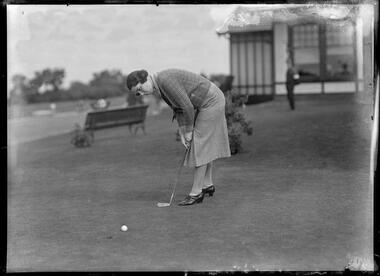 City of Melbourne Libraries
Photograph, Bull, Hugh Jones, 1897-1993, Miss Betty Nankivell
... Trove article identifier: http://nla.gov.au/nla.news-article203852987 Description: Action shot of golfer Betty Nankivell putting on golf course. She wears a checked cardigan, straight skirt, stockings, heeled shoes and a tie, no hat. ...Trove article identifier: http://nla.gov.au/nla.news-article203852987 Description: Action shot of golfer Betty Nankivell putting on golf course. She wears a checked cardigan, straight skirt, stockings, heeled shoes and a tie, no hat. ...Dr Elizabeth “Betty” Nankivell (1907-2003), later Mrs Forward, graduated in 1937 from Melbourne University with a degree in medicine. She worked at Queen Victoria and Royal Adelaide Hospitals. During WWII, she practised medicine in Morwell, and in 1945 joined the Royal Australian Army Medical Corp (R.A.A.M.C.). Betty lived and worked in many South East Asian countries, including 10 years of private practise in Kuala Lumpur, before retiring in 1970 to live in Melbourne. Photographer notations on slide: "Vic Women's Golf Ch'ship B98" Published: The Age 3 September 1935 p. 7 Published title: "EXCITING GOLF DUEL." Published caption: MISS B. NANKIVELL, whose victory over Miss Pam Barton was the outstanding feature of the play in the Australian Championship yesterday. Trove article identifier: http://nla.gov.au/nla.news-article203852987 Description: Action shot of golfer Betty Nankivell putting on golf course. She wears a checked cardigan, straight skirt, stockings, heeled shoes and a tie, no hat. The clubhouse structure is blurred in the background. Research by project volunteer, Fiona Collyer: Dr Elizabeth “Betty” Nankivell, Mrs Forward Betty Nankivell (1907 – 2003) was a champion Victorian golfer and medical doctor. She competed in the Australian Women’s Golf Championship at Royal Melbourne in 1935 against the visiting British Team. She eliminated 18 year old British champion Pam Barton, but was defeated by the eventual winner of the tournament, Mrs J B Walker in the semi finals. In 1938, Betty won the SA Golf Championships at Kooyonga SA. Betty graduated from Melbourne University with a degree in medicine in 1937 and worked at Queen Victoria Hospital and at Royal Adelaide Hospital as R.M.O. (Resident Medical Officer). During the war years, Betty practised medicine in Morwell, Victoria, and in 1945 joined the R.A.A.M.C. (Royal Australian Army Medical Corp) for the Malaya Medical Service. In 1946, she married Alan Forward OBE, a Colonel in the British Army and later the Commissioner of Road Transport in Malaya, and lived and worked in many S E Asian countries including 10 years in private practice in Kuala Lumpur. Betty continued to play golf throughout her life, retiring in 1970, and died in Melbourne in 2003. Sources: Melbourne University: Journal of the University of Melbourne Medical Society: vol. 2, no. 1Photographer notations on slide: "Miss Nankivell B98".golf, women golfers, royal melbourne golf club -
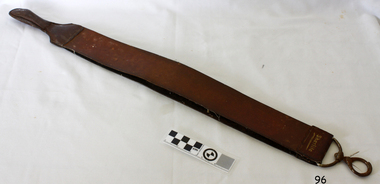 Flagstaff Hill Maritime Museum and Village
Domestic object - Razor Strop, circa 1922
... The person using the strop would draw the spine of the blade down along the strop with the blade following, without putting any pressure on the blade. At the end of the stroke, rotate the blade over its spine then draw the spine along the strop again so that the edge moves away from the top. ...The person using the strop would draw the spine of the blade down along the strop with the blade following, without putting any pressure on the blade. At the end of the stroke, rotate the blade over its spine then draw the spine along the strop again so that the edge moves away from the top. ...A razor strop such as this one was used to sharpen and polish straight-edged razors. This particular design has a swivel hook with a locking clip that allows for movement as the strop is being used. This strop is branded "Sherlite". On May 5th, 1922 the Commonwealth officially accepted and advertised the Trade Mark Application of Thomas Sherry of Victoria, for the Trade Mark of "Sherlite" to be used under the heading of "Leather, Skins unwrought and Wrought”. Thomas Sherry’s application was to use the word “Sherlite” for detachable soles made of rubberised leather. Straight razors and cut-throat razors were the major tools for shaving before the safety razor was invented in the 1880s and even today specialist shaving shops still sell straight razors. Along with the razor, the process of shaving would commonly involve lathering up shaving soap with a shaving brush that had boar bristles. Men could own several razors and rotate them through the week and some shops sold the razors in a set, a razor for each day of the week. Straight razors could require stropping more than once during the shaving of a heavy beard, and stropping would also be performed at the end of each shave. Honing would only be performed two or three times a year, preserving the blade's edge. A lot of skill was needed to hone and strop the blades of these early razors and the methods to do so were a large part of the curriculum in Barber colleges. The razor would be sharpened on a grinding wheel then honed on sharpening stone and finally finished using a strop. Straight edge razors would usually be sold unfinished and that process would be completed by the customer. A razor strop, usually made from leather, thick canvas, or light timber, would be used to straighten and polish the straight razor for shaving. Strops could also be used to polish other blades such as knives, small metal tools, and chisels. Sometimes an abrasive polishing compound is also used to give a mirror finish. Some strops, such as this one in our Collection, are designed to be used while hanging from a nail or peg, while others are handheld. The person using the strop would draw the spine of the blade down along the strop with the blade following, without putting any pressure on the blade. At the end of the stroke, rotate the blade over its spine then draw the spine along the strop again so that the edge moves away from the top. The finer grade of leather strap is used to give the final finish.Razor strop, leather, and metal. Sherlite brand, double straps: two straps of different grade leather joined at ends with metal fittings. Stropping faces; sharpening surface is stained red and finishing surface is stained black. One end has a padded, bulbous-shaped leather grip handle, the other end has a metal, swivel hook hanger. Inscriptions painted in gold on leather at the hook end.Razor strop, leather and metal. Sherlite brand, double straps: two straps of different grade leather joined at ends with metal fittings. Stropping faces; sharpening surface is stained red and finishing surface is stained black. One end has padded, bulbous shaped leather grip handle, the other end has metal, swivel hook hanger. Inscriptions printed in gold on leather at hook end.Printed gold lettering stamped “Sherlite”flagstaff hill, warrnambool, shipwrecked coast, flagstaff hill maritime museum, maritime museum, shipwreck coast, flagstaff hill maritime village, great ocean road, shaving leather, shaving accessory, barber’s equipment, barber shop razor strop, razor strop, straight razor, razor and knife sharpener, sherlite razor strop, personal effects, toiletries, thomas sherry
