
Showing 291 items matching "women's roles"
-
 Koorie Heritage Trust
Book, Burbank, Victoria Katherine, Fighting women : anger and aggression in Aboriginal Australia, 1994
... | Women -- Northern Territory -- Arnhem Land -- Psychology. | Aggressiveness -- Northern Territory -- Arnhem Land. | Sex role.... | Women -- Northern Territory -- Arnhem Land -- Psychology. | Aggressiveness -- Northern Territory -- Arnhem Land. | Sex role -- Northern Territory -- Arnhem Land. | Interpersonal relations. | Feminist criticism -- Northern Territory -- Arnhem Land. xvi, 250 p. : 24 cm. ...xvi, 250 p. : 24 cm.women, aboriginal australian -- northern territory -- arnhem land -- social conditions. | women -- northern territory -- arnhem land -- psychology. | aggressiveness -- northern territory -- arnhem land. | sex role -- northern territory -- arnhem land. | interpersonal relations. | feminist criticism -- northern territory -- arnhem land. -
 Wangaratta RSL Sub Branch
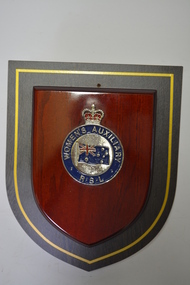
Plaque - Shield, Women's Auxiliary
... In 2018 Wangaratta RSL Women's Auxiliary celebrated its centenary. Women have played a central role in sustaining the activities of ex-service organisations. ...Women’s Auxiliaries were formed by mothers, wives, widows, sisters, daughters and aunts of men who served in the First World War. In May1918 a small band of women from the "Friendly Union" organised themselves,under the leadership of Mrs F C Purbrick, into a Women's Auxiliary of the Wangaratta Returned Soldiers Association (RSA). Their first task was to furnish club rooms for the RSA and this was achieved by seeking donations and raising money by selling jams, jellies and posies of violets by selected girls wearing special badges in the street. Over the years funds have been raised through raffles, competitions, street stalls and catering at numerous events to assist the aims of the Returned Services League. In 2018 Wangaratta RSL Women's Auxiliary celebrated its centenary. Women have played a central role in sustaining the activities of ex-service organisations. Women's auxiliaries are dedicated to fundraising, supporting the activities of their local RSL, and caring for veterans in their wider community.Red timber shield mounted on brown laminated base of particle board in a larger shield shape with metal emblem. Women's Auxillary RSL on metal logo with Crown and Australian Flag mounted in red shieldwomen's auxiliary, wangaratta rsl -
 City of Ballarat
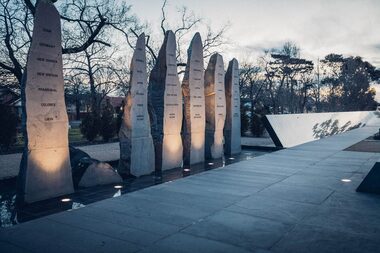
Artwork, other - Public Artwork, Ex-Prisoners of War Memorial by Peter Blizzard, 2004
... role that railways and railway journeys were relevant to many prisoners of war. The Memorial was declared the first military memorial of national significance located outside Canberra in 2008. Dedication services are held at the memorial on the Sunday closest to 6th of February, ANZAC day and on Remembrance Day. The memorial is of historical and aesthetic importance to the people of Ballarat prisoners of war boer war world war 1 world war 2 korean war lest we forget peter blizzard Inscribed with the names of 36,000 Australian men and women ...This memorial designed by Peter Blizzard is dedicated to more than 36,000 Australian men and women were held captive as prisoners by the enemy during the Boer War, World War 1, World War 2 and the Korean War. This memorial honours and names them, the names are etched into the black granite wall adjacent to the pathway. Water springs from beneath the 'Lest We Forget' stone then flows down the wall into the narrow watercourse in front of the first group of names and into the reflective pool, then continues past the second group of names. Finally it disappears under the pathway, returning to its source under the 'Lest We Forget' stone to start the journey again. Water symbolizes the essential nature of man, sacrifice, suffering, spirituality, healing, cleansing, birth and re-birth. The memorial is created from natural materials and is designed to be in harmony with the Ballarat Botanical Gardens, and to create a sense of timeless, dignity and respect. The long pathway of the monument is designed to create a visual perspective of the large distances that Australians travelled to the various conflicts. The paving is shaped like railway sleepers in recognition of the role that railways and railway journeys were relevant to many prisoners of war. The Memorial was declared the first military memorial of national significance located outside Canberra in 2008. Dedication services are held at the memorial on the Sunday closest to 6th of February, ANZAC day and on Remembrance Day. The memorial is of historical and aesthetic importance to the people of BallaratMonument made from carved bluestone, water feature and flagsInscribed with the names of 36,000 Australian men and women were held captive as prisoners by the enemy during the Boer War, World War 1, World War 2 and the Korean War. The listing is by surname and initials and shown by war.prisoners of war, boer war, world war 1, world war 2, korean war, lest we forget, peter blizzard -
 Geelong Cycling Club
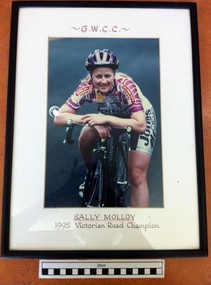
Framed Photograph, 1995
... Women from the Geelong West Cycling Club played a prominent role in establishing women's cycling in Victoria. gwcc; sally molloy; 1995; victorian road champion; felicity wilson; tracey watson; kathy watt; gwcc; "GWCC/Molloy, Sally/1995/Victorian Road Champion" Colour photograph with white mount and black frame. ...Sally Molloy was one of the trio with Tracey Watson and Felicity Wilson coming to prominence in the middle 1990s to establish women in cycling in Victoria. Women cyclists in the 1990s had broken into headlines buoyed by the wins of internationally acclaimed Kathy Watt.Women from the Geelong West Cycling Club played a prominent role in establishing women's cycling in Victoria.Colour photograph with white mount and black frame."GWCC/Molloy, Sally/1995/Victorian Road Champion"gwcc; sally molloy; 1995; victorian road champion; felicity wilson; tracey watson; kathy watt; gwcc; -
 Broadmeadows Historical Society & Museum
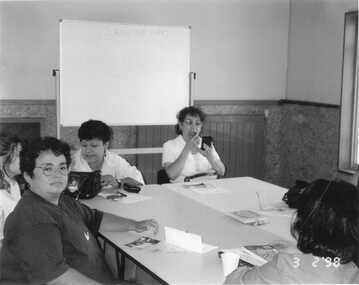
Photograph, Spanish Women's Group at Banksia Gardens 1998, 3 February 1998
... The Spanish Women's Group at Banksia Gardens in 1998 played a crucial role in promoting social inclusion and community engagement. ...In 1998, the Spanish Women's Group at Banksia Gardens was actively engaged in various activities aimed at fostering social inclusion. These initiatives were designed to help individuals integrate into society, providing a supportive environment for community building and personal development.The Spanish Women's Group at Banksia Gardens in 1998 played a crucial role in promoting social inclusion and community engagement. This group provided a supportive environment where individuals could connect, share experiences, and participate in activities designed to help them integrate into society. The initiatives undertaken by the group not only fostered a sense of belonging among its members but also contributed to the broader community's cultural diversity and social cohesion.Black and white photograph on glossy photograph paper.Spanish Women's Group/At Banksia Gardens 1998banksia gardens, broadmeadows, spanish women's group, 1998, social activity -
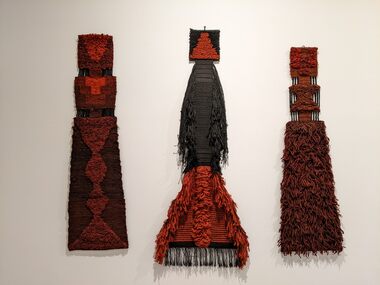 Ararat Gallery TAMA
Ann Greenwood, Untitled (wall hanging)
... In Three Mamacunas, Greenwood draws on the legacy of the Inca Empire, where Mamacunas were women who served in temples as priestesses, weavers, and caretakers of sacred rituals. Their roles embodied creativity, devotion, and cultural continuity. ...In Three Mamacunas, Greenwood draws on the legacy of the Inca Empire, where Mamacunas were women who served in temples as priestesses, weavers, and caretakers of sacred rituals. Their roles embodied creativity, devotion, and cultural continuity. ...Ann Greenwood is an Australian textile artist renowned for her innovative use of weaving, felt, and natural fibres. Based in Gippsland, Victoria, she has developed a distinctive practice that merges traditional textile techniques with contemporary art. Greenwood’s work often incorporates hand-spun wool, plant dyes, and materials sourced from her immediate environment, reflecting her deep connection to nature and sustainability. Over five decades, her practice has encompassed sculpture, installation, and performance, expanding the boundaries of textile art. In Three Mamacunas, Greenwood draws on the legacy of the Inca Empire, where Mamacunas were women who served in temples as priestesses, weavers, and caretakers of sacred rituals. Their roles embodied creativity, devotion, and cultural continuity. Today, the term is reinterpreted in contemporary art and writing as a symbol of women’s strength, wisdom, and custodianship of tradition, linking ancestral practices with present-day explorations of identity and resilience. -
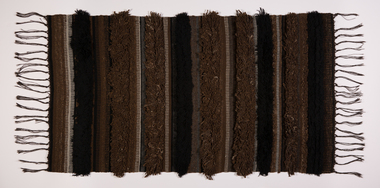 Ararat Gallery TAMA
Ann Greenwood, Rug, 1977-8
... In Three Mamacunas, Greenwood draws on the legacy of the Inca Empire, where Mamacunas were women who served in temples as priestesses, weavers, and caretakers of sacred rituals. Their roles embodied creativity, devotion, and cultural continuity. ...In Three Mamacunas, Greenwood draws on the legacy of the Inca Empire, where Mamacunas were women who served in temples as priestesses, weavers, and caretakers of sacred rituals. Their roles embodied creativity, devotion, and cultural continuity. ...Ann Greenwood is an Australian textile artist renowned for her innovative use of weaving, felt, and natural fibres. Based in Gippsland, Victoria, she has developed a distinctive practice that merges traditional textile techniques with contemporary art. Greenwood’s work often incorporates hand-spun wool, plant dyes, and materials sourced from her immediate environment, reflecting her deep connection to nature and sustainability. Over five decades, her practice has encompassed sculpture, installation, and performance, expanding the boundaries of textile art. In Three Mamacunas, Greenwood draws on the legacy of the Inca Empire, where Mamacunas were women who served in temples as priestesses, weavers, and caretakers of sacred rituals. Their roles embodied creativity, devotion, and cultural continuity. Today, the term is reinterpreted in contemporary art and writing as a symbol of women’s strength, wisdom, and custodianship of tradition, linking ancestral practices with present-day explorations of identity and resilience. -
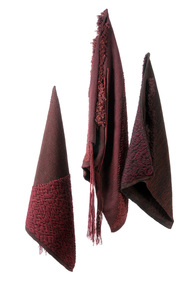 Ararat Gallery TAMA
Three Mamacunas, 1982
... In Three Mamacunas, Greenwood draws on the legacy of the Inca Empire, where Mamacunas were women who served in temples as priestesses, weavers, and caretakers of sacred rituals. Their roles embodied creativity, devotion, and cultural continuity. ...In Three Mamacunas, Greenwood draws on the legacy of the Inca Empire, where Mamacunas were women who served in temples as priestesses, weavers, and caretakers of sacred rituals. Their roles embodied creativity, devotion, and cultural continuity. ...Ann Greenwood is an Australian textile artist renowned for her innovative use of weaving, felt, and natural fibres. Based in Gippsland, Victoria, she has developed a distinctive practice that merges traditional textile techniques with contemporary art. Greenwood’s work often incorporates hand-spun wool, plant dyes, and materials sourced from her immediate environment, reflecting her deep connection to nature and sustainability. Over five decades, her practice has encompassed sculpture, installation, and performance, expanding the boundaries of textile art. In Three Mamacunas, Greenwood draws on the legacy of the Inca Empire, where Mamacunas were women who served in temples as priestesses, weavers, and caretakers of sacred rituals. Their roles embodied creativity, devotion, and cultural continuity. Today, the term is reinterpreted in contemporary art and writing as a symbol of women’s strength, wisdom, and custodianship of tradition, linking ancestral practices with present-day explorations of identity and resilience. -
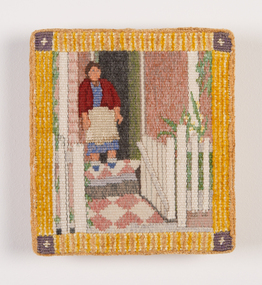 Ararat Gallery TAMA
Sara Lindsay, Rosa, 1978
... Alongside her art practice, Lindsay has lectured at the Tasmanian School of Art, held the role of Curator of Textiles at the Tasmanian Museum and Art Gallery, then the position of Production Manager at the Australian Tapestry Workshop. Since 2013 she has mentored three Karen refugee women...Alongside her art practice, Lindsay has lectured at the Tasmanian School of Art, held the role of Curator of Textiles at the Tasmanian Museum and Art Gallery, then the position of Production Manager at the Australian Tapestry Workshop. Since 2013 she has mentored three Karen refugee women ...Sara Lindsay is a Melbourne-based artist, curator and educator. She worked as a weaver at the Victorian Tapestry Workshop (now the Australian Tapestry Workshop) from its foundation in 1976 until 1990. Alongside her art practice, Lindsay has lectured at the Tasmanian School of Art, held the role of Curator of Textiles at the Tasmanian Museum and Art Gallery, then the position of Production Manager at the Australian Tapestry Workshop. Since 2013 she has mentored three Karen refugee women from Myanmar, assisting in their professional development and furthering their tapestry skills. In 2023 Lindsay began the Ararat New Settlement Weaving Program, teaching and mentoring culturally diverse settlers from refugee and migrant backgrounds in the Ararat region. The artwork exhibited here is part of body of work exploring Lindsay’s family’s historical ties to Sri Lanka. Her British grandfather managed a tea plantation in Ceylon’s hill country during the 1920s and 30s, where her mother was born before returning to England after his early death in 1937. After her first visit to Sri Lanka in 2005, Lindsay developed works that responded to this journey. She chose a quiet, contemplative approach to reflect on the complexity of colonial histories. Research into her family history led her to delve deeper into Sri Lanka’s complex history as a trading nation and to expand her materials to speak to this layered past. The use of cinnamon in this work connects to the story of 17th-century weavers from Southern India who were displaced from the Kingdom of Kandy and sent to the southwest coast to become cinnamon peelers under Portuguese and later Dutch rule. The finely woven ticking strips seen here reference the thick cotton fabric once used to cover mattresses and pillows aboard cargo ships transporting spices from Sri Lanka - a subtle reminder of the human stories woven into trade routes and colonial histories. -
 Ararat Gallery TAMA
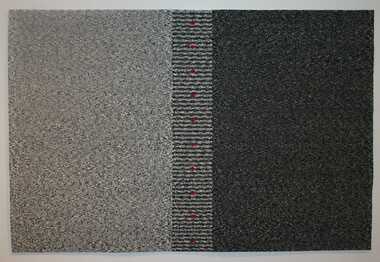
Sara Lindsay, In-Between #2, 1999
... Alongside her art practice, Lindsay has lectured at the Tasmanian School of Art, held the role of Curator of Textiles at the Tasmanian Museum and Art Gallery, then the position of Production Manager at the Australian Tapestry Workshop. Since 2013 she has mentored three Karen refugee women...Alongside her art practice, Lindsay has lectured at the Tasmanian School of Art, held the role of Curator of Textiles at the Tasmanian Museum and Art Gallery, then the position of Production Manager at the Australian Tapestry Workshop. Since 2013 she has mentored three Karen refugee women ...Sara Lindsay is a Melbourne-based artist, curator and educator. She worked as a weaver at the Victorian Tapestry Workshop (now the Australian Tapestry Workshop) from its foundation in 1976 until 1990. Alongside her art practice, Lindsay has lectured at the Tasmanian School of Art, held the role of Curator of Textiles at the Tasmanian Museum and Art Gallery, then the position of Production Manager at the Australian Tapestry Workshop. Since 2013 she has mentored three Karen refugee women from Myanmar, assisting in their professional development and furthering their tapestry skills. In 2023 Lindsay began the Ararat New Settlement Weaving Program, teaching and mentoring culturally diverse settlers from refugee and migrant backgrounds in the Ararat region. The artwork exhibited here is part of body of work exploring Lindsay’s family’s historical ties to Sri Lanka. Her British grandfather managed a tea plantation in Ceylon’s hill country during the 1920s and 30s, where her mother was born before returning to England after his early death in 1937. After her first visit to Sri Lanka in 2005, Lindsay developed works that responded to this journey. She chose a quiet, contemplative approach to reflect on the complexity of colonial histories. Research into her family history led her to delve deeper into Sri Lanka’s complex history as a trading nation and to expand her materials to speak to this layered past. The use of cinnamon in this work connects to the story of 17th-century weavers from Southern India who were displaced from the Kingdom of Kandy and sent to the southwest coast to become cinnamon peelers under Portuguese and later Dutch rule. The finely woven ticking strips seen here reference the thick cotton fabric once used to cover mattresses and pillows aboard cargo ships transporting spices from Sri Lanka - a subtle reminder of the human stories woven into trade routes and colonial histories. -
 Ararat Gallery TAMA
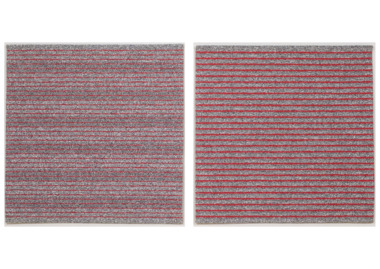
Sara Lindsay, Pulse (diptych), 2001-2002
... Alongside her art practice, Lindsay has lectured at the Tasmanian School of Art, held the role of Curator of Textiles at the Tasmanian Museum and Art Gallery, then the position of Production Manager at the Australian Tapestry Workshop. Since 2013 she has mentored three Karen refugee women...Alongside her art practice, Lindsay has lectured at the Tasmanian School of Art, held the role of Curator of Textiles at the Tasmanian Museum and Art Gallery, then the position of Production Manager at the Australian Tapestry Workshop. Since 2013 she has mentored three Karen refugee women ...Sara Lindsay is a Melbourne-based artist, curator and educator. She worked as a weaver at the Victorian Tapestry Workshop (now the Australian Tapestry Workshop) from its foundation in 1976 until 1990. Alongside her art practice, Lindsay has lectured at the Tasmanian School of Art, held the role of Curator of Textiles at the Tasmanian Museum and Art Gallery, then the position of Production Manager at the Australian Tapestry Workshop. Since 2013 she has mentored three Karen refugee women from Myanmar, assisting in their professional development and furthering their tapestry skills. In 2023 Lindsay began the Ararat New Settlement Weaving Program, teaching and mentoring culturally diverse settlers from refugee and migrant backgrounds in the Ararat region. The artwork exhibited here is part of body of work exploring Lindsay’s family’s historical ties to Sri Lanka. Her British grandfather managed a tea plantation in Ceylon’s hill country during the 1920s and 30s, where her mother was born before returning to England after his early death in 1937. After her first visit to Sri Lanka in 2005, Lindsay developed works that responded to this journey. She chose a quiet, contemplative approach to reflect on the complexity of colonial histories. Research into her family history led her to delve deeper into Sri Lanka’s complex history as a trading nation and to expand her materials to speak to this layered past. The use of cinnamon in this work connects to the story of 17th-century weavers from Southern India who were displaced from the Kingdom of Kandy and sent to the southwest coast to become cinnamon peelers under Portuguese and later Dutch rule. The finely woven ticking strips seen here reference the thick cotton fabric once used to cover mattresses and pillows aboard cargo ships transporting spices from Sri Lanka - a subtle reminder of the human stories woven into trade routes and colonial histories. -
 Ararat Gallery TAMA
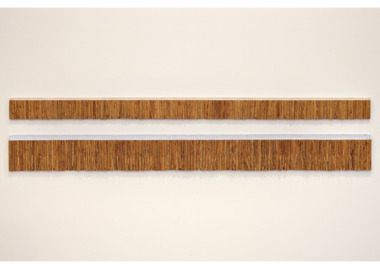
Sara Lindsay, Cinnamon and Ticking #9, 2008
... Alongside her art practice, Lindsay has lectured at the Tasmanian School of Art, held the role of Curator of Textiles at the Tasmanian Museum and Art Gallery, then the position of Production Manager at the Australian Tapestry Workshop. Since 2013 she has mentored three Karen refugee women...Alongside her art practice, Lindsay has lectured at the Tasmanian School of Art, held the role of Curator of Textiles at the Tasmanian Museum and Art Gallery, then the position of Production Manager at the Australian Tapestry Workshop. Since 2013 she has mentored three Karen refugee women ...Sara Lindsay is a Melbourne-based artist, curator and educator. She worked as a weaver at the Victorian Tapestry Workshop (now the Australian Tapestry Workshop) from its foundation in 1976 until 1990. Alongside her art practice, Lindsay has lectured at the Tasmanian School of Art, held the role of Curator of Textiles at the Tasmanian Museum and Art Gallery, then the position of Production Manager at the Australian Tapestry Workshop. Since 2013 she has mentored three Karen refugee women from Myanmar, assisting in their professional development and furthering their tapestry skills. In 2023 Lindsay began the Ararat New Settlement Weaving Program, teaching and mentoring culturally diverse settlers from refugee and migrant backgrounds in the Ararat region. The artwork exhibited here is part of body of work exploring Lindsay’s family’s historical ties to Sri Lanka. Her British grandfather managed a tea plantation in Ceylon’s hill country during the 1920s and 30s, where her mother was born before returning to England after his early death in 1937. After her first visit to Sri Lanka in 2005, Lindsay developed works that responded to this journey. She chose a quiet, contemplative approach to reflect on the complexity of colonial histories. Research into her family history led her to delve deeper into Sri Lanka’s complex history as a trading nation and to expand her materials to speak to this layered past. The use of cinnamon in this work connects to the story of 17th-century weavers from Southern India who were displaced from the Kingdom of Kandy and sent to the southwest coast to become cinnamon peelers under Portuguese and later Dutch rule. The finely woven ticking strips seen here reference the thick cotton fabric once used to cover mattresses and pillows aboard cargo ships transporting spices from Sri Lanka - a subtle reminder of the human stories woven into trade routes and colonial histories. -
 Kew Historical Society Inc
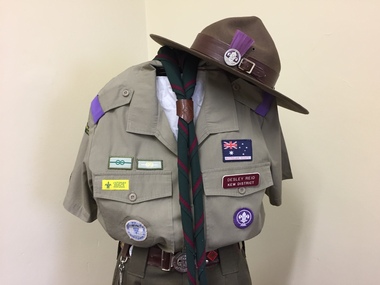
Uniform - Scout Leader Uniform, Kew District, Scout Association of Victoria, c.1993
... The uniform was donated by an office bearer of the Society who, as a women, held a key role in the district. unforms scouts -- kew scouts - kew district badges of office Various Scout badges Short-sleeved, collarless fabric shirt of khaki color, with embroidered badges. ...The khaki shirt has District and Scout Membership badges and length-of-service badges, the Australian Scout Badge and a Red Cross First Aid badge. The leather belt has a collection of Jamboree souvenir metal badges attached. A ‘lemon squeezer’ felt hat completes the outfit. The hat badge and plume was coloured to indicate to which Section the wearer belonged, purple indicating the Commissioner Section. To keep the brim flat, the hat was sometimes kept in a timber frame when not being worn. This uniform was worn by Desley Reid as Assistant District Commissioner of Kew District between 1993 and 1995.The scouting movement has a rich history on Kew. The Kew Historical Society has attempted to build this section of the collection in recognition of its importance. The uniform was donated by an office bearer of the Society who, as a women, held a key role in the district.Short-sleeved, collarless fabric shirt of khaki color, with embroidered badges. Also fabric neck scarf, with braid and vinyl holdfast (woggle) and a leather belt with metal clasp with Scout impression. Various Scout badgesunforms, scouts -- kew, scouts - kew district, badges of office -
 Vision Australia
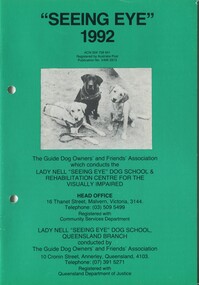
Administrative record - Text, "Seeing Eye" 1992 Lady Nell "Seeing Eye" Dog School & Rehabilitation Centre for the Blind, 1992
... women, as well as the St Leeor Private Nursing Home. Discussion about puppy boarders as well as people who have stepped up into the public relations role (Trevor Mayers and Lesley Marsh) due to staff changes, and return of Greg Cooper to a part-time role....women, as well as the St Leeor Private Nursing Home. Discussion about puppy boarders as well as people who have stepped up into the public relations role (Trevor Mayers and Lesley Marsh) due to staff changes, and return of Greg Cooper to a part-time role. ...President's overview of the year including: 11 people have graduated with 1 more expected shortly, School meets the cost of flying people into Melbourne to train with dog rather than establish schools around Australia, how Elizabeth and Jean came from New Zealand to train as they wanted to attend a school established by a blind person, returned home but the emigrated back to Australia. Jean suffered a stroke and was cared for by her sister, and when Elizabeth needed to train with a new dog, Jean was able to stay in the Nursing Home opposite the school. Until Lady Nell was established, age restrictions were imposed so that no woman over 45 and no man over 55 could train with a dog, which Mrs Gration changed when establishing the school, with the oldest graduate at 78 and the youngest at 14 years of age. Challenges in getting people who had the dedication to become a guide dog trainer, and the movement of recent appointees. Another previous requirement was that only totally blind people could have a guide dog, which was amended by Mrs Gration so that people with minimal sight could also apply for one. Seeing eye dogs are also de-sexed, which is not always the procedure at other institutions. Some discussion of the activities at the Day Activity Centre, commencement of a two storey building at 12 Thanet Street to increase accommodation and indoor recreation activities, hostel for blind men and women, as well as the St Leeor Private Nursing Home. Discussion about puppy boarders as well as people who have stepped up into the public relations role (Trevor Mayers and Lesley Marsh) due to staff changes, and return of Greg Cooper to a part-time role.1 volume with text and illustrationsannual reports, lady nell seeing eye dog school, phyllis gration, trevor mayers, lesley marsh, greg cooper -
 Melbourne Legacy
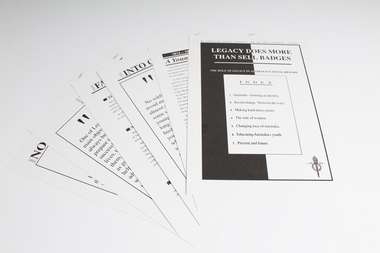
Education kit, Legacy does more than sell badges: The role of Legacy in Australia's social History. An Australian history resource for use with Secondary Students, 1992, 1993
... Contains the following: 00058.1 folder 00058.2 covering letter from the Director of School Education Victoria commending the kit to school principals. 00058.3 Index 00058.4 1914 - 1918 "The war to end all wars" (Card 1) 00058.5 Settling into civilian life (Card 2) 00058.6 Making hard times easier (Card 3) 00058.7 Women in war (Card 4) 00058.8 Changing face of Australa (Card 5) 00058.9 Australia's Youth (Card 6) 00058.10 Legacy now & forever (Card 7) Significant as an example of resources produced by Legacy to educate secondary school students about Legacy's history, work and significance in Australian history. history activities Paper card folder with 8 double-sided paper inserts and a covering letter from the Director of Schools Education. Two copies. Legacy does more than sell badges: The role ...Education kit produced by Sydney Legacy in 1992 and distributed to Victorian schools by Melbourne Legacy in August 1993. Contains the following: 00058.1 folder 00058.2 covering letter from the Director of School Education Victoria commending the kit to school principals. 00058.3 Index 00058.4 1914 - 1918 "The war to end all wars" (Card 1) 00058.5 Settling into civilian life (Card 2) 00058.6 Making hard times easier (Card 3) 00058.7 Women in war (Card 4) 00058.8 Changing face of Australa (Card 5) 00058.9 Australia's Youth (Card 6) 00058.10 Legacy now & forever (Card 7)Significant as an example of resources produced by Legacy to educate secondary school students about Legacy's history, work and significance in Australian history.Paper card folder with 8 double-sided paper inserts and a covering letter from the Director of Schools Education. Two copies.history, activities -
 Wodonga & District Historical Society Inc
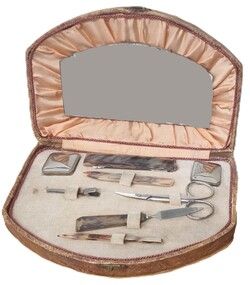
Functional object - Vintage Manicure Set, 1920s
... This was due to the changing role and perception of women as a result of World War I and also the wider availability of items such as coloured nail polish. ...This was due to the changing role and perception of women as a result of World War I and also the wider availability of items such as coloured nail polish. ...Manicure items date back to Egyptian times, but manicure sets were almost completely reserved for the upper class until the early 19th century. A doctor of King Louis XV created what was recognised as the first manicure set. In the 1920s popularity of the manicure set increased. This was due to the changing role and perception of women as a result of World War I and also the wider availability of items such as coloured nail polish. It was influenced by the “flapper” era. The trends set by actresses such as Greta Garbo and Rita Hayworth in the latest technicolour movies inspired the popularity of the manicure amongst the woman of the “Roaring Twenties” This manicure is an example of the home and travel manicures sets which gained prominence at the time. They have continued to be a popular person item until the present day. This item is significant because it is an excellent example of a popular personal item from the 1920s until the present day.A manicure set in a semi-circular wooden box. It is lined with velvet and silk. It has a mirror attached to the inside of the lid. Items are held in place with elasticised loops. Implements include scissors, nail files, tweezers, and alligator clip and two small square metal containers for cosmetics or skin cream. Handles of some items are made of faux tortoiseshell. vintage manicure set, manicure implements -
 Melton City Libraries
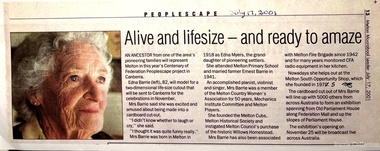
Newspaper, Edna Barrie, 1997,2001
... "Edna Barrie is one of countless women who have played a crucial role in the Melton communityover its history. ..."Edna Barrie is one of countless women who have played a crucial role in the Melton communityover its history. ..."Edna Barrie is one of countless women who have played a crucial role in the Melton communityover its history. She was a tireless volunteer and a stalwart of the community who helped to keep many organisations running and thriving. Edna was born in 1918 into a family with deep roots in Melton. Her grandmother Ann Dowling arrived in the colony from Ireland with her two sisters in 1855. Ann purchased land in Melton and settled on the Ballarat Road (High Street) at Ryans Creek with her husband Henry Myers. The three Dowling sisters had ten children between them who attended Melton State School No. 430, as did Edna. Edna was involved with the Melton branch of the Country Women’s Association for 50 years and was an active member of the Melton Mechanics’ Institute and the Melton Uniting Church throughout her life. She was involved with the local CFA branch from 1942. As a member of the CFA’s Women’s Auxiliary, Edna helped raise funds and provide meals to the firefighters. Edna was a founding member of the Melton & District Historical Society in 1968, and was passionate about preserving and sharing local history. The formation of the society at that time, during a period of increasingly rapid growth for the municipality, was crucial, ensuring that many photos, documents and stories of early Melton were not lost".Newspaper clippings about Edna Barrie local identities -
Canterbury History Group
Book, Janine Wood, Names to Lives From World War II: The Canterbury Baptist Church Honour Board, 2016
... This publication includes a description of Canterbury as it would have been experienced at the time as well as the response or role of the church to war Baptist Church Canterbury World War 1939-1945 This booklet tells the story of 75 men and women who served in World War II from the Canterbury Baptist Church congregation. ...This booklet tells the story of 75 men and women who served in World War II from the Canterbury Baptist Church congregation.This booklet tells the story of 75 men and women who served in World War II from the Canterbury Baptist Church congregation. Includes photographs, bibliography and index. 247 pagesnon-fictionThis booklet tells the story of 75 men and women who served in World War II from the Canterbury Baptist Church congregation. baptist church, canterbury, world war 1939-1945 -
 Surrey Hills Historical Society Collection
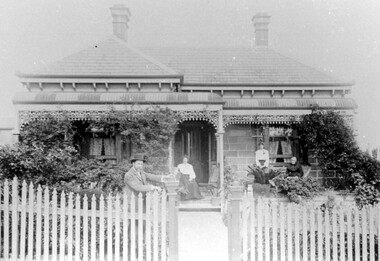
Photograph, "Braemar" 18 Suffolk Road, Surrey Hills
... roles in community organisations. This photo is also important in documenting built heritage that has been demolished. buildings structures and establishments houses timber houses house names braemar architectural styles victorian style families family group sneddon family james sneddon (snr) boroondara cemetery real estate agent ironmonger Image of a Victorian, weatherboard, block fronted, single storey house with decorative veranda, viewed from the front. The garden in front of the house is well established and a light-coloured picket fence surrounds the property. Four people are in the photograph, three women ..."Braemar" at 18 Suffolk Road, Surrey Hills - built c1894, demolished in1977 – and home of James Sneddon Snr. and family from 1890 until c1950. We believe it is James is at the gate and his family on the veranda. James was born in Alloa, Clackmannanshire Scotland in 1833, as was his wife Jane. He died in March 1901 and she in March 1911. They are buried in Boroondara Cemetery (Pres B0522) with their daughter Jane (1864-1928). James Sneddon (Snr) was an important man in early Surrey Hills. He established real estate and ironmongery businesses in Union Road – first on the corner of Stirling Crescent and later over the road on the corner of Windsor Crescent. He was chairman of Surrey Hills’ MUIOOF (Manchester Unity Independent Order of Oddfellows). James Sneddon Jnr. followed his father in the family real estate business and was an even busier community man. He was a JP and had roles in the Surrey Hills ANA, the Progress Association and the Choral Society. He lived 2 doors from his father. The real estate business continued on the corner of Windsor Crescent and Union Road (north side) until the business was sold to the Doubleday (family) after WW2.The Sneddon family were early settlers and business owners in Surrey Hills and remained over 3 generations. Different family members held many roles in community organisations. This photo is also important in documenting built heritage that has been demolished.Image of a Victorian, weatherboard, block fronted, single storey house with decorative veranda, viewed from the front. The garden in front of the house is well established and a light-coloured picket fence surrounds the property. Four people are in the photograph, three women (two seated and one standing) on the veranda and one male, who is leaning against the gate post.buildings, structures and establishments, houses, timber houses, house names, braemar, architectural styles, victorian style, families, family group, sneddon family, james sneddon (snr), boroondara cemetery, real estate agent, ironmonger -
 Surrey Hills Historical Society Collection
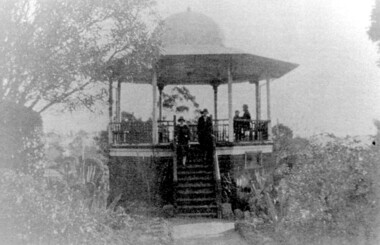
Photograph, John Gray Memorial Rotunda in Surrey gardens, Union Road, Surrey Hills, c 1925, c 1925
... It is also significant as evidence of the extent of the role of the Surrey Hills Progress Association in the provision of public facilities. rotundas surrey gardens union road surrey hills progress association surrey hills brass band parks and reserves 1925 john gray, clarence montgomery, box hill cemetery, cinema john gray memorial rotunda bandstands A black and white photo of an octagonal rotunda situated within Surrey Gardens taken from the perspective of the main entrance. It is a largely wooden structure with a domed chinoiserie-style roof. The rotunda is enclosed by established gardens. There are 4 people in the photo, with 2 women ...The rotunda was built in 1912 by Clarence Montgomery for the Surrey Hills Progress Association and the local community and dedicated to John Gray, "a highly respected and revered citizen". Surrey Hills Brass Band regularly gave concerts in the rotunda, provided music for regular 'loyal' celebrations and also for silent films held in the gardens. The rotunda was quite elevated off the ground due to the slope of the gardens and the bioscope was stored in the room underneath. This was later used as the infant welfare centre until the Progress Association built a dedicated facility for these purposes. The rotunda was demolished in 1972. Clarence Montgomery, carpenter, was living in Sunbury Crescent in 1914. By 1916 he had moved to 83 Croydon Road where he lived for the rest of his life. Clarence was born in 1869 in Taradale, son of John Montgomery and Jane Ford. He married Sarah Ann Ingram in Echuca in 1894. Their children were: 1. Annie (Mrs P Paynter) born Echuca in 1895 2. William Henry born Echuca in 1897 3. Christina Mary (Mrs F Meyers) born Echuca in 1898 4. Violet (Mrs G Ewing) born Echuca in 1902 5. Clarence George Ingram born Echuca in 1906 and died aged 7 months. Violet became a tailoress and Christina a dressmaker. William became a carpenter like his father. Sarah Ann Montgomery died at their home in June 1932 aged 62 years. Clarence died in August 1946 aged 77 years. They are buried in Box Hill Cemetery (P-EB-0020). John Gray was "actively associated with all movements for the benefit of neighbours and fellow citizens". [Quote from the official tribute on his death in 1909.] He was very active in the Surrey Hills Progress Association in the early 1900's. The rotunda built in the Surrey Gardens by the Progress Association in 1912 was dedicated to him. John Gray was born in 1861 in Eldorado. He died on 7 December 1909 in Surrey Hills and is buried in Box Hill Cemetery (M0472). He married Emma Beckett in 1888 at 'Guildford Villa' in Essex Road, the Beckett home. They are listed in both the 1903 and 1906 electoral rolls in Arundel Crescent; his occupation is given as bootmaker. The Alan Holt property register identifies this as 24 Arundel Crescent, known as 'Tumberumba'. John and Emma had a large family: (Gunner) John Robert Gray (1888, Surrey Hills - 21 June 1917, France) Benjamin Walter Gray (1890, Surrey Hills - 1949, Heidelberg) Herbert Harry Gray (1892, Surrey Hills - 1959, Queensland) William Beckett Gray (1897, Surrey Hills - 1899, Surrey Hills) Norman Douglas Gray (1901, Surrey Hills - 1947, Sydney) Evelyn Lizzie Gray (1906, Surrey Hills - 1983) Evelyn married Reginald Roberts and donated a number of photos to the collection. The donor Violet Ewing (nee Montgomery) was Clarence's daughter. She married George Isaac Henry Ewing (blacksmith) in 1934. They inherited the family home at 83 Croydon Road. Although constructed 5 years after their opening, this rotunda was a central feature of the Surrey Gardens which was planted to a design adapted from one suggested by the renowned landscape gardener and botanist William Robert Guilfoyle (1840-1912). Rotundas were a key feature of many late nineteenth and early twentieth century public parks. This particular rotunda was notable for the Chinoiserie influence reflected in its roof. Surrey Gardens are now regarded as one of the City of Boroondara's heritage gardens and this image is significant as evidence of the design of the rotunda which is no longer extant. It is also significant as evidence of the extent of the role of the Surrey Hills Progress Association in the provision of public facilities. A black and white photo of an octagonal rotunda situated within Surrey Gardens taken from the perspective of the main entrance. It is a largely wooden structure with a domed chinoiserie-style roof. The rotunda is enclosed by established gardens. There are 4 people in the photo, with 2 women standing on the steps at the rotunda's entrance. A man and a young person are seated within the rotunda. It has 8 support pillars, which are open with balustrades to 7 sides.rotundas, surrey gardens, union road, surrey hills progress association, surrey hills brass band, parks and reserves, 1925, john gray, clarence montgomery, box hill cemetery, cinema, john gray memorial rotunda, bandstands -
 Lilydale RSL Sub Branch
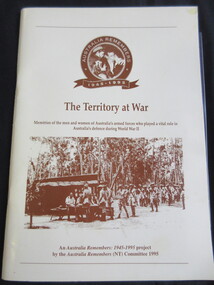
Book - Book - soft cover, Women that Work, Darwin, The Territory at War - Australia Remembers 1945-1995
... Memories of the Men and Women who played a Vital Role in the Defense of Australia in World War 11. ...Memories of the Men and Women who played a Vital Role in the Defense of Australia in World War 11.Booknon-fictionMemories of the Men and Women who played a Vital Role in the Defense of Australia in World War 11. -
 Kew Historical Society Inc
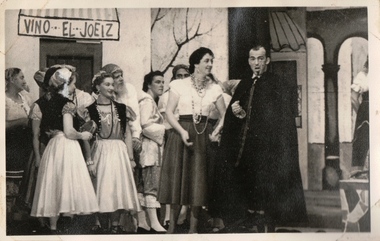
Photograph, The "Q" Theatre Guild, Maritana, 1958
... women's costumes including hats". Black and white photograph of performers in Vincent Wallace's opera Maritana. The performance was produced by Beatrice Oakley for The "Q" Theatre Guild in 1958. Music was provided by the Kew Philharmonic Society conducted by John Trotter. Marion Tilley, the creator of the scrapbook in which the photo is pasted is given credit for designing and making the costumes. Set design was by R. Jewell. An annotation underneath the photo identifies two of the leads: Carla Jeffries and Alan Wilson. The photograph was taken on the night of 21 or 27 June when Jeffries performed the title role ...The "Q" Theatre Guild was formed out of the Kew Light Opera Company in 1957. It marked the transition of the company that had initially been directed by Lance Nicholls to one directed by Beatrice Oakley. It continued to perform in the Kew Recreation Hall, but, with its demolition in 1960, and the opening of the new Kew City Hall in Cotham Road, moved its productions to that venue. Productions of the "Q" Theatre Guild included The Geisha (1957), Maritana (1958), They All Do It (1959), Blossom Time (1959), Love's A Luxury (1959), There And Back & The Bohemian Girl (1960), Die Fledermaus (1960), Gay Rosalinda (1961), The Land Of Smiles (1961), Kisses For A Kid & Hansel And Gretel (1961), Die Fledermaus (1962), Monsieur Beaucaire (1964), Macbeath or The Beggar's Opera, and So To Bed.The scrapbook of annotated photographs, programmes, and newspaper reviews of which this item is a part was assembled by Marion Tilley, wardrobe mistress for, and performer in, productions by the Kew Light Opera Company and the "Q" Theatre Guild. It is significant as a remarkably complete document of theatre performances in Kew, Victoria during the 1950s and 1960s. The scrapbook, and the items individually catalogued within it, have artistic and aesthetic significance within the history of performing arts in Victoria in the middle of the 20th Century. They have social significance in that they reveal socio-cultural values and preoccupations during the period. The records also act as a history of arts activities in the Kew Recreation Hall and later in the Kew City Hall as entertainment and community arts and music precincts.Black and white photograph of performers in Vincent Wallace's opera Maritana. The performance was produced by Beatrice Oakley for The "Q" Theatre Guild in 1958. Music was provided by the Kew Philharmonic Society conducted by John Trotter. Marion Tilley, the creator of the scrapbook in which the photo is pasted is given credit for designing and making the costumes. Set design was by R. Jewell. An annotation underneath the photo identifies two of the leads: Carla Jeffries and Alan Wilson. The photograph was taken on the night of 21 or 27 June when Jeffries performed the title role, a role she shared with Val Breen. Stan Wilson played Don Jose on these same nights.Marion Tilley, the creator of the scrapbook, wrote the following underneath the photograph: "Carla Jeffries, Stan Wilson - I made the men's and women's costumes including hats".performing arts -- kew (vic.), scrapbooks, marion tilley collection, 'q' theatre guild, kew recreation hall, musical comedy -- melbourne -- victoria -
Unions Ballarat
Union Strategy and Industrial Change (D.J. Spiers Collection), 1987
... Includes decline in manufacturing, redundancy, retraining, women in the workforce, public sector management, challenges posed by new-right forces and the role of unions....Includes decline in manufacturing, redundancy, retraining, women in the workforce, public sector management, challenges posed by new-right forces and the role of unions. ...Selection of essays about current (1987) industrial change, impacts of advancing technology. Includes decline in manufacturing, redundancy, retraining, women in the workforce, public sector management, challenges posed by new-right forces and the role of unions.Relevant to the role of unions in technological change and management of change in the workforce. Industrial relations.Book.Front cover: editor's name and title. Title page: in black ink, "D.J. Spiers, Curtin University, April 1988".btlc, ballarat trades and labour council, management of change, redundancy, technology, manufacturing, workforce - skills, women, politics - new right, trade unions -
Unions Ballarat
Book - Labour History No. 66 May 1994 (D.J. Spiers Collection), Irving, Terry
... This edition includes these articles: -Labourism: a Political Genealogy -Class, Populism and Labour Politics in Victoria, 1890-1914 -Keynesianism, Socialism and Labourism and the Role of Ideas in Labour Ideology -A Century of Laborism and the State, 1891-1993: An Historical Interpretation -We are of Age: Class, Locality and Region at Port Kembla, 1900-1940 -Researching Industrial Relations History: The Development of a Databas on Australian Trade Unions 1825-1900 -Loyalty and Communists: an interview with Bill Gollan -International Women's Day in Newcastle in the Fifties and Sixties: A Personal Account -Forthcoming: A Bibliography of Australian Communism -Postcard from California: the Hoover Institute -The ACTU Congress of 1993 -Australian Canadian Labour History Conference -The Australian Society for the Study of Labour History -The Classing Gaze: Sexuality, Class and Surveillance -Book reviews -Newcastle's Special Day; Australians in Spain Memorial Unveiling...This edition includes these articles: -Labourism: a Political Genealogy -Class, Populism and Labour Politics in Victoria, 1890-1914 -Keynesianism, Socialism and Labourism and the Role of Ideas in Labour Ideology -A Century of Laborism and the State, 1891-1993: An Historical Interpretation -We are of Age: Class, Locality and Region at Port Kembla, 1900-1940 -Researching Industrial Relations History: The Development of a Databas on Australian Trade Unions 1825-1900 -Loyalty and Communists: an interview with Bill Gollan -International Women's Day in Newcastle in the Fifties and Sixties: A Personal Account -Forthcoming: A Bibliography of Australian Communism -Postcard from California: the Hoover Institute -The ACTU Congress of 1993 -Australian Canadian Labour History Conference -The Australian Society for the Study of Labour History -The Classing Gaze: Sexuality, Class and Surveillance -Book reviews -Newcastle's Special Day; Australians in Spain Memorial Unveiling Labour and class politics; direct relevance to industrial relations; social issues in general that fall within the purview of the union movement. ...Published semi-annually, contains refereed, scholarly articles about social and labour history in Australasia, - labour politics, trade unions, management labour practices, co-operatives, gender and ethnicity. This edition includes these articles: -Labourism: a Political Genealogy -Class, Populism and Labour Politics in Victoria, 1890-1914 -Keynesianism, Socialism and Labourism and the Role of Ideas in Labour Ideology -A Century of Laborism and the State, 1891-1993: An Historical Interpretation -We are of Age: Class, Locality and Region at Port Kembla, 1900-1940 -Researching Industrial Relations History: The Development of a Databas on Australian Trade Unions 1825-1900 -Loyalty and Communists: an interview with Bill Gollan -International Women's Day in Newcastle in the Fifties and Sixties: A Personal Account -Forthcoming: A Bibliography of Australian Communism -Postcard from California: the Hoover Institute -The ACTU Congress of 1993 -Australian Canadian Labour History Conference -The Australian Society for the Study of Labour History -The Classing Gaze: Sexuality, Class and Surveillance -Book reviews -Newcastle's Special Day; Australians in Spain Memorial UnveilingLabour and class politics; direct relevance to industrial relations; social issues in general that fall within the purview of the union movement.Book; paper.btlc, ballarat trades and labour council, history - labour, labourism, politics - class, industrial relations, economics, politics - communism, women's rights, book reviews, conference reports -
Unions Ballarat
The forgotten rebels of Eureka, Wright, Clare, 2013
... Clare Wright writes about the multitude of women who were at the Ballarat goldfields and the critical roles that they played in the goldfields and the Eureka Stockade. ...Clare Wright writes about the multitude of women who were at the Ballarat goldfields and the critical roles that they played in the goldfields and the Eureka Stockade. ...Clare Wright writes about the multitude of women who were at the Ballarat goldfields and the critical roles that they played in the goldfields and the Eureka Stockade. Contents Introduction : dust and rattling bones Part 1. Transitions 1. A virgin country 2. Deliverance 3. Crossing the line 4. The road Part 2. Transformations 5. The gold diggers on '54 6. Winners and losers 7. The winter of their discontent 8. Parting with my sex Part 3 : Transgressions 9. Burning down the house 10. High camp 11. Crossing the line (reprise) 12. Bloody Sunday. Relevant to Australian and Ballarat history and especially facts around the story of the Eureka Stockade.Paper; hardcover book. Front cover: blue and white Eureka flag background; white, fawn and blue lettering; sticker (The Stella Prize 2014 Shortlist).Front cover includes title and author's name; quotations from reviewers. Back cover: quotes from reviewers.btlc, ballarat trades hall, ballarat trades and labour council, eureka stockade, women in history, goldfields, gold miners, gold mining - ballarat, history -
Whitehorse Historical Society Inc.
Article, Hello Whitehorse, 1994
... City of Whitehorse Local Government Commissioners Oscar Geoff Fifer Dimity Wallace Marie Payne Brian The new City of Whitehorse covering all the former Box Hill and Nunawading municipalities was officially created by State cabinet last Thursday. Women will play a greater role on Whitehorse City Council initially than in most of the other new councils created last week. ...The new City of Whitehorse covering all the former Box Hill and Nunawading municipalities was officially created by State cabinet last Thursday. Women will play a greater role on Whitehorse City Council initially than in most of the other new councils created last week.The new City of Whitehorse covering all the former Box Hill and Nunawading municipalities was officially created by State cabinet last Thursday.Women will play a greater role on Whitehorse City Council initially than in most of the other new councils created last week.The new City of Whitehorse covering all the former Box Hill and Nunawading municipalities was officially created by State cabinet last Thursday. Women will play a greater role on Whitehorse City Council initially than in most of the other new councils created last week.city of whitehorse, local government commissioners, oscar, geoff, fifer, dimity, wallace, marie, payne, brian -
Whitehorse Historical Society Inc.
Book, Introducing ... Winlaton : a Youth Training Centre for Young Women, 1/11/1983 12:00:00 AM
... A booklet written to increase public awareness of the role of Youth Training Centres, in particular the functioning of Winlaton. Introducing ... Winlaton : a Youth Training Centre for Young Women. ...A booklet written to increase public awareness of the role of Youth Training Centres, in particular the functioning of Winlaton.A booklet written to increase public awareness of the role of Youth Training Centres, in particular the functioning of Winlaton.A booklet written to increase public awareness of the role of Youth Training Centres, in particular the functioning of Winlaton.winlaton girls youth training centre., booklet -
 Kew Historical Society Inc
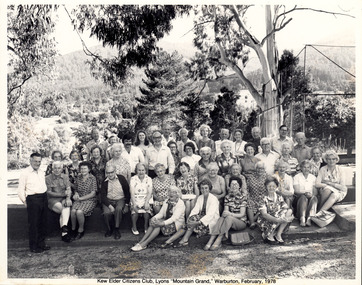
Photograph - Kew Elder Citizens' Club, Lyons 'Mountain Grand' Warburton, Unknown, 1978
... role in formally establishing the Association. This ‘official’ version was reasserted in the later Thematic Environmental History of the City of Boroondara (2012). However the origins and gestation of community of organisations is rarely straightforward. In 1965, five years after Vaughan’s book was published, the author of East Kew Women’s...role in formally establishing the Association. This ‘official’ version was reasserted in the later Thematic Environmental History of the City of Boroondara (2012). However the origins and gestation of community of organisations is rarely straightforward. In 1965, five years after Vaughan’s book was published, the author of East Kew Women’s ...The orthodox version of the origins and history of the Kew Elder(ly) Citizens’ Association was established by Cr. W. D. Vaughan in his book Kew’s Civic Century (1960), when he wrote that: "When Mrs. C. H. Simpson was Mayoress in 1952 she set up the Elderly Citizens’ Association to care for the needs of ages persons in Kew. The idea was strongly supported and a start was made by providing social afternoons for elderly folk at Southesk. Visiting sick people in their homes, providing firewood where needed, and other activities were undertaken by the Association. The aid of Council was sought to further the work. It was decided that a social unit for elderly folk be established at Southesk." (p.126-7). In the following pages, he describes in detail Council’s role in formally establishing the Association. This ‘official’ version was reasserted in the later Thematic Environmental History of the City of Boroondara (2012). However the origins and gestation of community of organisations is rarely straightforward. In 1965, five years after Vaughan’s book was published, the author of East Kew Women’s Club : Twenty Years : 20-7-1945-30-7-1965, writing about the period July 1947 to July 1950, described the role the Club played in establishing the Kew Elder Citizens Association. The author wrote: "At a meeting of the Kew Community Aid, the plight of many elderly people in Kew who were dependent on pensions was raised and in order to ascertain their needs the practice was begun of serving morning tea at the Masonic Hall in Walpole Street, where pensions were then paid. From this beginning the Kew Elder Citizens Association was formed in Kew with wide support, and Club members gave willing support on the committee, in helping serve afternoon tea and in entertainment." (p.4) Photographic evidence also leads to questions about Vaughan’s version of events. A framed photograph in the Society’s Collection shows a Public Meeting to form the Kew Elder Citizens Association in a room at Southesk a year earlier in 1951. Whatever version of the origins of the Association is correct, a later framed photograph in the Society’s collection shows the opening of the completed Clubrooms of the Kew Elder Citizens at South Esk by the Hon. E.P. Cameron M.L.C, Minister of Health, on 12 November 1956. The Association is still active in Kew and is currently located at Hamer Court, opposite the Boroondara General (Kew) Cemetery in High Street, Kew.Framed and titled black and white photograph taken on the occasion of a visit by members of the Kew Elder Citizens Club to Lyons "Mountain Grand" Warburton, in February 1978.community groups -- kew (vic.), senior citizens clubs -- kew (vic), club tours -
University of Melbourne, Burnley Campus Archives
Book - Thesis, Sandra Pullman, Ina Higgins' Role in Advancing Women in Horticulture in Victoria and Australia, 2019
... Ina Higgins' Role in Advancing Women in Horticulture in Victoria and Australia...women December 2019 Dear Jane and Burnley Archives. Thankyou for all the support and information you shared with me over the last 3 years. Best wishes Sandra Pullman Submission by Sandra Pullman for the Master of Architecture by Research, School of Architectural Built Environment, Deakin University, May 2019. Enquiries should be through Deakin University. Ina Higgins' Role ...December 2019 Dear Jane and Burnley Archives. Thankyou for all the support and information you shared with me over the last 3 years. Best wishes Sandra Pullmanina higgins, women in horticulture, horticulture, education of women -
 Expression Australia
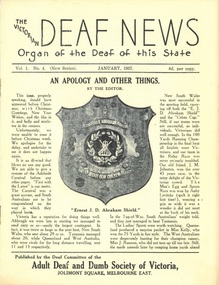
Newsletter, The Victorian Deaf News January 1937
... Published by the Deaf Committee of the Adult Deaf and Dumb Society of Victoria 'The Victorian Deaf News' Newsletter is a significant publication as an historical record giving and insight into the people, activities and events of the Deaf Community in Victoria. e. j. d. abraham shield, kelly, ransom, roly mcgrath, bundy, plunkett, wilbow, levitzke, puddy, dickenson, salton, warburton, south australian carnival, british deaf times, george frankland, joe hepworth, h. m. cuttell, british deaf times, alex mcgregor, h. b. beale, george wilkinson, british deaf monthly, maxwell s. fry, herr albreghs, douglas tilden, thomas williamson, w. k. morrison, g. r. davidson, f. e. frewin, j. mclean, g. newnham, j. m. johnston, r. dow, r. lygon, i. guthrie, alf tyzzer, mrs j. e. muir, t. peters, mrs a. wilson, deaf men's guild, deaf women's guild, w. burgess, w. bladier, j. collins, colin johns, mrs w. a. patterson, vernon griffiths, hood, mrs ed johnson, e. moores. ferguson stokes, damman, hopkins, abbott, richie, thomas james derby, ashby, nancy newton, reiffel, hunt, o'keeffe, caroline, pickett, sinnott, peters, mrs g. h. oakley, c. t. o. graham, Vol. 1 No. 4 (New Series) January 1937; Size 24.5cmHx18.5cmW; 16 pages The Victorian Deaf News January 1937 Newsletter ...Published by the Deaf Committee of the Adult Deaf and Dumb Society of Victoria'The Victorian Deaf News' Newsletter is a significant publication as an historical record giving and insight into the people, activities and events of the Deaf Community in Victoria.Vol. 1 No. 4 (New Series) January 1937; Size 24.5cmHx18.5cmW; 16 pagese. j. d. abraham shield, kelly, ransom, roly mcgrath, bundy, plunkett, wilbow, levitzke, puddy, dickenson, salton, warburton, south australian carnival, british deaf times, george frankland, joe hepworth, h. m. cuttell, british deaf times, alex mcgregor, h. b. beale, george wilkinson, british deaf monthly, maxwell s. fry, herr albreghs, douglas tilden, thomas williamson, w. k. morrison, g. r. davidson, f. e. frewin, j. mclean, g. newnham, j. m. johnston, r. dow, r. lygon, i. guthrie, alf tyzzer, mrs j. e. muir, t. peters, mrs a. wilson, deaf men's guild, deaf women's guild, w. burgess, w. bladier, j. collins, colin johns, mrs w. a. patterson, vernon griffiths, hood, mrs ed johnson, e. moores. ferguson stokes, damman, hopkins, abbott, richie, thomas james derby, ashby, nancy newton, reiffel, hunt, o'keeffe, caroline, pickett, sinnott, peters, mrs g. h. oakley, c. t. o. graham,
