
Showing 1884 items matching "fish-pond"
-
 Federation University Historical Collection
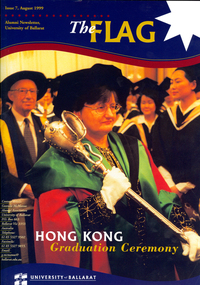
Magazine - Newsletter, The Flag, 1995-2001, 1995-2001
... Eleven copies of the University of Ballarat Alumni newsletter called The Flag. .1) David James, Gwenda McManus, Kerrie Edwards, Steve Bracks, Cordell Kent, Australian Native Gold, Koori Education Unit, Pat Hope, Rozeena Begum, Lidcha Mul. .2) Gwenda McManus, Wilhelmus, David James, University Mace, Trefor Prest, Steve Moneghetti, Shaun Creighton, Peter Blackburn, David Waite, Sandy Blythe, Kim Ross, Michael Wilson, Betty Gill, Betty Fish, Tom Hill, Bill Pryor . .3) David James. ...mcmanus kent bracks vermeend university games greenhill netball magrath coutts turker colville wisely wakeling moneghetti alder atkinson lowe tirale richards blackburn pryor blainey shaw pursell singh blackman wild ballarat school of mines wimmera wimmera institute of tafe merger birkin caro sellers folkes coburn o'donogue kelly plunkett kellett unisports hong kong alumni koala muzumdar-shaw arts academy camp street precinct camp street Eleven copies of the University of Ballarat Alumni newsletter called The Flag. .1) David James, Gwenda McManus, Kerrie Edwards, Steve Bracks, Cordell Kent, Australian Native Gold, Koori Education Unit, Pat Hope, Rozeena Begum, Lidcha Mul. .2) Gwenda McManus, Wilhelmus, David James, University Mace, Trefor Prest, Steve Moneghetti, Shaun Creighton, Peter Blackburn, David Waite, Sandy Blythe, Kim Ross, Michael Wilson, Betty Gill, Betty Fish, Tom Hill, Bill Pryor . .3) David James. ...Eleven copies of the University of Ballarat Alumni newsletter called The Flag. .1) David James, Gwenda McManus, Kerrie Edwards, Steve Bracks, Cordell Kent, Australian Native Gold, Koori Education Unit, Pat Hope, Rozeena Begum, Lidcha Mul. .2) Gwenda McManus, Wilhelmus, David James, University Mace, Trefor Prest, Steve Moneghetti, Shaun Creighton, Peter Blackburn, David Waite, Sandy Blythe, Kim Ross, Michael Wilson, Betty Gill, Betty Fish, Tom Hill, Bill Pryor . .3) David James. Sandy Blythe, Geoffrey Blainey,Jamie Shaw, Kiran Mazumdar, Stuart Pursell, Tony Singh, Ballarat Teachers' College, Frank Nolan, Carolyn Blackman. .4) David James, Malini Chitaranjan, Chandker Varadhan, Lola Montez, Regina Molloy, Bert Labont'e, Jayne Reynolds, Amanda Sandwith, Roger Short, Stephen Kemmis, Barney Glover, Thomas O'Donnell, Sandy Blythe, Laurier Prosser, John Sharpham, Jack Barker, Xiaoli Jiang, Catherine Pearce, Nepal, Ballarat Teachers' College, John Culvenor, Richards Medal, Karl McCann. .5) Gwenda McManus, David James, Ron Wild, Merger, Wimmera Institute of TAFE, Katherine Birkin. .6) David Caro, Chancellor appointment, David James, Ellen Sellers, Ballarat Teachers' College Reunion, Briana Folkes, Lorri Coburn, Paul O'Donohue, Graeme Kelly, Tracy Plunkett, Julie Kellett, Unisports rehabilitation, Hong Kong graduation, China, koalas. .7) Hong Kong graduation, David Janes, Argentina, Richard Alder, threatened animals, reconciliation, Leoda Atkinson, mural, Jodie Lowe, indigenous Australians, Sue Turale, nursing, Hong Kong, Geoffrey Richards, Janice Edwards, Laura Chibnall, Franky Christiano, Nessa Jenkins, Kerrie Powell. .8) David James, Graduate Centre, Greenhill Enterprise Centre, Warren Young, Parks Victoria, Maxitrans, netball, John Magrath, maths, Catering for the Olympics, Eddie Turker, Maryanne Coutts, Sonia Colville, Daryl Wisely, Laura Wakeling. .9) Camp Street Redevelopment, Arts Academy, David James, Gwenda McManus, Doug Lloyd, Ian Gordon, University Appeal, Hong Kong, Sue Turale, Edward Wong, Hakodate University, Paris, nursing, Malaysia, Yuri Tanabe, Amanda Mead, Mary Modeen, Barry Judd. .10) Kerry Cox, Gwenda McManus, wildlife, MartinWestbrooke Brian McLennan Art Scholarship. Anne Saunders, Shenzhen, Hong Kong. .11) CFA, Kerry Cox, Wayne Robinson appointment, Terry Lloyd, Empire Rubber, Churchill Fellowship, Russell Rees, bus mural, Janice Croggon, John McDonald, Imogen Schwarz, Andrew Dark, Jacqueline Dark, building, Jeff Goodiesonmcmanus, kent, bracks, vermeend, university games, greenhill, netball, magrath, coutts, turker, colville, wisely, wakeling, moneghetti, alder, atkinson, lowe, tirale, richards, blackburn, pryor, blainey, shaw, pursell, singh, blackman, wild, ballarat school of mines, wimmera, wimmera institute of tafe, merger, birkin, caro, sellers, folkes, coburn, o'donogue, kelly, plunkett, kellett, unisports, hong kong, alumni, koala, muzumdar-shaw, arts academy, camp street precinct, camp street -
 Ballarat Tramway Museum
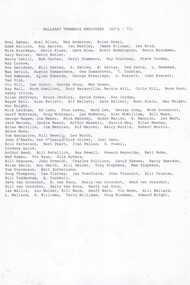
Document - List, Wayne Kell, "Ballarat Tramways Employees (60's - 71)", 2020
... Everett John Everett Ted Fish Vic Gill Ian Grant George Gray Max Green Ray Hall Norm Hamilton Rory Herauville Bernie Hill Colin Hill Norm Hunt Danny Irvine Allan Jeffreys Bruce Jenkins David Jones Ron Jordan Wayne Kell Alan Kellett Alf Kellett Dave Kellett Noel Klein Hec Knight Ron Knight Mick Laidlaw Ed Lake Stan Lakey Herb Lee George Long Norm Lorensini Geoff McErvale Doug McGregor Leo McMahon Alec McWilliam Bill Maes George Magee Jim Maher Mick Mahoney Andre Malins B. ...Everett John Everett Ted Fish Vic Gill Ian Grant George Gray Max Green Ray Hall Norm Hamilton Rory Herauville Bernie Hill Colin Hill Norm Hunt Danny Irvine Allan Jeffreys Bruce Jenkins David Jones Ron Jordan Wayne Kell Alan Kellett Alf Kellett Dave Kellett Noel Klein Hec Knight Ron Knight Mick Laidlaw Ed Lake Stan Lakey Herb Lee George Long Norm Lorensini Geoff McErvale Doug McGregor Leo McMahon Alec McWilliam Bill Maes George Magee Jim Maher Mick Mahoney Andre Malins B. ...Yields information the employees of the SEC from about the 1960's through to closure. Not known if completely accurate.List - typed A4 sheet titled "Ballarat Tramways Employees (60's - 71)", prepared by Wayne Kell. Lists employees in alphabetical order images: .1 - jpg scan of the sheet .2 - pdf of the list in a single vertical column .3 - word document in the image files Noel Aghan Noel Allen Max Anderson Brian Anwyl Adam Balloch Ray Barrow Ian Bentley James Billman Les Bird Mick Blackman Kevin Blake Dave Blaw Brett Boddington Kevin Brookman Gary Butler Kevin Butler Marty Cahill Bob Carter Daryl Chambers R oy Courtney Steve Crosby Ray Curnow Ron Davidson Bill Davies S. Davies W. Davies T Ed Davis L. Denmead Max Devlin Austin Domaschenz Des Domaschenz T. Dunstan Ted Edmunds Allen Edwards George Etheridge D. Everett John Everett Ted Fish Vic Gill Ian Grant George Gray Max Green Ray Hall Norm Hamilton Rory Herauville Bernie Hill Colin Hill Norm Hunt Danny Irvine Allan Jeffreys Bruce Jenkins David Jones Ron Jordan Wayne Kell Alan Kellett Alf Kellett Dave Kellett Noel Klein Hec Knight Ron Knight Mick Laidlaw Ed Lake Stan Lakey Herb Lee George Long Norm Lorensini Geoff McErvale Doug McGregor Leo McMahon Alec McWilliam Bill Maes George Magee Jim Maher Mick Mahoney Andre Malins B. Mannion Les Mark Jack Marone Jackie Mason Arthur Maxwell Harold May Allan Meaney Brian Melville Jim Menzies Alf Mercer Barry Morris Robert Morris Bruce Munn Tom Nancarrow Bill Newell Les North John O’Keefe Dan O’Leary Dick Oliver Joel Owen Eric Patterson Bert Peart Ivan Pellas D. Powell Lindsay Quick Arthur Reed Bill Retallick Rex Rewell Howard Reynolds Neil Robe Ned Romeo Vin Ryan Rick Rykers Bill Segrave John Schmidt Charles Scicluna David Skewes Harry Smerdon Brian Smith Roy Smith Bill Spicer Tony Stephens Max Stephens Tom Stevenson Neil Sutherland Doug Thompson Ian Tierney Ian Trenfield John Truscott Bill Trusler Bill Tuddenham A. Turnbull Dave van Oorschot E. van Rooy Harry van Oorschot Henk van Oorschot Bill van Oorschot Gerry van Rooy Harry van Rooy Ian Wallis Lou Walker Bill Ward Geoff Ward Vin Webb Bill Wellard L. Wellard R. Williams Terry Williams Doug Wiseman Edward Wrightlists, employees, personnel, ballarat, crews -
 Eltham District Historical Society Inc
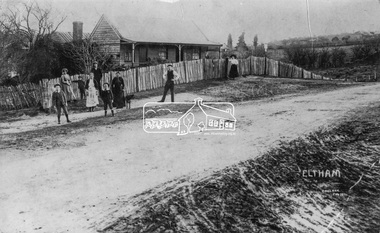
Negative - Photograph, J.H. Clark, Jarrold family and cottage, Main Road, Eltham, 1911
... Around 1930 John changed professions and opened a small cobbler's shop in 1931 near the pond opposite Dalton Street adjacent to the Jarrold family cottage. ...Around 1930 John changed professions and opened a small cobbler's shop in 1931 near the pond opposite Dalton Street adjacent to the Jarrold family cottage. ...Jarrold family and cottage, Main Road, Eltham Members of the Jarrold family and others outside their home in Maria Street (Main Road), Eltham at the bottom of Policeman’s Hill, opposite Dalton Street. The small youth in centre foreground is believed to be George Coleman (see SEPP_0745). John Jarrold (1865-1909) was a local builder and contractor and widely respected resident. Youth in centre is believed to be George Coleman (1906-1953) (See SEPP_0745). Jarrold Cottage built in 1863, also known as 'White Cloud", located at 701 Main Road, Eltham, opposite Dalton Street. The house remains intact and is listed on the Victorian Heritage Database and considered historically significant to the Shire of Nillumbik. The cottage was originally located closer to the Diamond Creek but was subject to flooding. It was dragged by horse to the present site shown, which was chosen for the higher ground that had been created as a result of land fill being deposited here from the quarry further around the bend on Main Road (site of present-day Eltham Primary School carpark) where the stone had been quarried for building the State School in Dalton Street. It had previously been rented for use as a Police Station / residence prior to the building of the permanent police house and station at the corner of Maria and Brougham streets in 1859. At the time of collection of photos for the centenary of the Shire of Eltham (1971) the cottage was owned by the Skipper family and remains in the family to present day (2021). Photo dated as 1911 (by donor?). Photo SEPP_0745 was dated 1905 (by donor?) but is estimated to be c.1909. It is also noted it is thought Jack Coleman is in both photos though it is more likely to be his younger brother George who appears about 5 in this photo and 3 in 745. Cross Reference SEPP_0745 / 748 Photographer: J.H. Clark John Henry Clark was the youngest of three boys born to William Henry Clark (1823-1877) and Maria White (1843-1914). He and his brothers, William Charles Clark (1872-1945), Clement Kent Clark (1874-1912) operated a photography business (Clark Bros.) from 25 Thomas Street, Windsor near Prahran during the period c.1894 to 1914. Following death of Clement in September 1912 and their mother in 1914, the Clark Bros business appears to have dissolved, the premises demolished, and a new house was under construction in 1915. John set up business independently in 1914 operating out of 29 Moor Street, Fitzroy where he is registered in the 1914 and 1915 Electoral Rolls. By 1916 John had relocated to Eltham where he continued his practice as a photographer and took many of the early images around the district of Little Eltham. Around 1930 John changed professions and opened a small cobbler's shop in 1931 near the pond opposite Dalton Street adjacent to the Jarrold family cottage. He never married and continued his profession as a bootmaker from this little shop, maintaining a close relationship with Mrs Jarrold for the rest of their lives. His bootmaker shop remains today beside the Whitecloud cottage and is one of only three remaining shops in the area from the early 20th century. There are a couple of images of Eltham taken by Clark Bros. in the Eltham District Historical Society collection, one such example being Hunniford’s Post Office with Miss Anne Hunniford out front (EDHS_00140 - marked on the back of the print, Clark Bros., 25 Thomas St. Windsor), which would date this image between c.1894 and 1914. Other early images of Eltham taken by John Henry Clark are marked on the face “J. H. Clark Photo” and it is assumed these are dated between 1914 and 1930. It is noted that the Grant of Probate for John H Clark of Eltham South dated 5 April !957 (513/387) records his occupation as "X Photographer".This photo forms part of a collection of photographs gathered by the Shire of Eltham for their centenary project book, "Pioneers and Painters: 100 years of the Shire of Eltham" by Alan Marshall (1971). The collection of over 500 images is held in partnership between Eltham District Historical Society and Yarra Plenty Regional Library (Eltham Library) and is now formally known as 'The Shire of Eltham Pioneers Photograph Collection.' It is significant in being the first community sourced collection representing the places and people of the Shire's first one hundred years.Digital image 4 x 5 inch B&W Negshire of eltham pioneers photograph collection, dalton street, eltham, george coleman, j.h. clark photo, jarrold cottage, jarrold family, main road, maria street, white cloud cottage -
 Eltham District Historical Society Inc
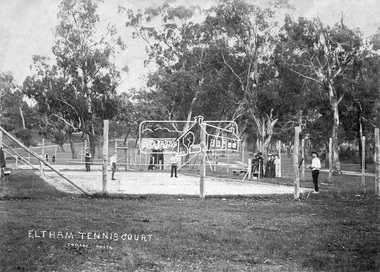
Negative - Photograph, J.H. Clark, Eltham Tennis Court, c.1905
... Around 1930 John changed professions and opened a small cobbler's shop in 1931 near the pond opposite Dalton Street adjacent to the Jarrold family cottage. ...Around 1930 John changed professions and opened a small cobbler's shop in 1931 near the pond opposite Dalton Street adjacent to the Jarrold family cottage. ...People pose for a photograph at the Eltham tennis court. Four men set to play a doubles match while a group of women look on. The sandy looking court (with weeds growing) is surrounded by wooden posts with wire mesh, in the middle of a park with mature gum trees in the background. The tennis court was situated in Eltham South at Bremner’s Flats (near present day Wingrove Park). The court is approximately the location of the present day small carpark. Main Road can be seen in the background from centre left and Mount Pleasant just above, the intersection just above the centre of court. The photo by J.H. Clark has been taken outside the court. Cross Ref SEPP_0721 of the Lady Premiers for 1909-1910 in which an umpires raised seating platform has been erected and the court surface is more refined with marked lines. The Eltham Lawn Tennis Club was formed on a Saturday evening, the 29th of October, 1898 at a meeting held at the Eltham State school. The meeting was large and representative. Twenty members were enrolled, and eight more have since been added. Officers and a committee were duly elected, and the Treasurer was instructed to purchase the necessary requisites without delay. By the end of the first week in November all the requisites were to hand, two courts were marked out, and practice begun. The formal opening of the Courts of this Club took place on Saturday, November 12, 1898, when 26 members and their friends assembled. After several sets had been contested an adjournment was made for tea provided by the members and nicely laid out under the shade of the trees. Afterwards, sets were again formed and the game was proceeded with in a lively spirit till nearly dark, when all dispersed having thoroughly enjoyed themselves during the afternoon. (Evelyn Observer, and South and East Bourke Record (Vic. : 1882 - 1902), Friday 18 November 1898, page 2) Reproduced on p89 of 'Pioneers & Painters' Photographer: J.H. Clark John Henry Clark was the youngest of three boys born to William Henry Clark (1823-1877) and Maria White (1843-1914). He and his brothers, William Charles Clark (1872-1945), Clement Kent Clark (1874-1912) operated a photography business (Clark Bros.) from 25 Thomas Street, Windsor near Prahran during the period c.1894 to 1914. Following death of Clement in September 1912 and their mother in 1914, the Clark Bros business appears to have dissolved, the premises demolished, and a new house was under construction in 1915. John set up business independently in 1914 operating out of 29 Moor Street, Fitzroy where he is registered in the 1914 and 1915 Electoral Rolls. By 1916 John had relocated to Eltham where he continued his practice as a photographer and took many of the early images around the district of Little Eltham. Around 1930 John changed professions and opened a small cobbler's shop in 1931 near the pond opposite Dalton Street adjacent to the Jarrold family cottage. He never married and continued his profession as a bootmaker from this little shop, maintaining a close relationship with Mrs Jarrold for the rest of their lives. His bootmaker shop remains today beside the Whitecloud cottage and is one of only three remaining shops in the area from the early 20th century. There are a couple of images of Eltham taken by Clark Bros. in the Eltham District Historical Society collection, one such example being Hunniford’s Post Office with Miss Anne Hunniford out front (EDHS_00140 - marked on the back of the print, Clark Bros., 25 Thomas St. Windsor), which would date this image between c.1894 and 1914. Other early images of Eltham taken by John Henry Clark are marked on the face “J. H. Clark Photo” and it is assumed these are dated between 1914 and 1930. It is noted that the Grant of Probate for John H Clark of Eltham South dated 5 April !957 (513/387) records his occupation as "X Photographer".This photo forms part of a collection of photographs gathered by the Shire of Eltham for their centenary project book,"Pioneers and Painters: 100 years of the Shire of Eltham" by Alan Marshall (1971). The collection of over 500 images is held in partnership between Eltham District Historical Society and Yarra Plenty Regional Library (Eltham Library) and is now formally known as the 'The Shire of Eltham Pioneers Photograph Collection.' It is significant in being the first community sourced collection representing the places and people of the Shire's first one hundred years.Digital image 4 x 5 inch B&W Negshire of eltham pioneers photograph collection, bremner's flat, eltham, eltham tennis court, j.h. clark photo, pioneers and painters, tennis court, wingrove park, 1905, eltham lawn tennis club, main road, mount pleasant road -
 Eltham District Historical Society Inc
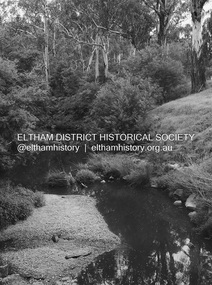
Photograph - Digital Photograph, Alan King, Diamond Creek, Barak Bushlands, Eltham, 2008
... Storm water is filtered through plants in the wetland ponds then is released slowly into the billabong, before flowing into the Diamond Creek. ...Storm water is filtered through plants in the wetland ponds then is released slowly into the billabong, before flowing into the Diamond Creek. ...A habitat corridor and it strengthens the community. Published: Nillumbik Now and Then / Marguerite Marshall 2008; photographs Alan King with Marguerite Marshall.; p185 Barak Bushlands lie west of the Diamond Creek on the corner of Falkiner Street and busy, noisy Main Road. They form part of an important habitat corridor linking the Yarra River to the Kinglake National Park.1 Manna Gums, tawny frogmouths and platypuses are some of the indigenous plants and animals that have made their home there. The bushlands are the result of more than nine years of hard work by the local community with the Nillumbik Council, to transform a degraded flood plain into this refuge of natural beauty. In 1997, shortly after moving into the new Riverside Estate on Falkiner Street, Eltham, several residents noticed the sorry state of the Diamond Creek and surrounding area. Part of it was used as a cow paddock and although small patches of vegetation survived, the area was infested with weeds, rabbits, rubbish and drainage from the housing estate. At various times the 4.4 hectares had been used as a market garden and for shire stock piles. The residents began to restore the area by revegetating land along the Diamond Creek. In 1998 they established the Friends of the Diamond Creek Falkiner Street Reserve2 and 35 families joined from the 90-house Estate. Carolyn Mellor, as the Friends’ Land Manager, undertook a four-year horticulture course to guide this massive project for a volunteer organisation. Since 1999, she has been the Friends’ President. In 1999 the Friends urged the Nillumbik Council to undertake a feasibility study into establishing a wetland system and urban forest. Work began in 2002 with Nillumbik Council funding the project, supplemented by government grants. The Friends also received grants from Melbourne Water and Parks Victoria. Aided by the Friends and other community members, the Council created the Barak Bushlands consisting of a forest, a wetland, a bridge, a path and open space. The beautiful wetland treats most of the estate’s stormwater runoff. Storm water is filtered through plants in the wetland ponds then is released slowly into the billabong, before flowing into the Diamond Creek. The wetland also helps to minimise flooding and the improved water quality provides a flora and fauna habitat. The Friends and other volunteers planted more than 27,000 plants, more than one third of which they grew from seeds they collected at Lower Eltham and Wingrove Parks. Eltham High School students planted thousands of these through a Year Eight program introduced for this purpose. Other groups who assisted were: Green Corps, local Scouts and Guides – 2nd Montmorency, 1st Diamond Creek and 1st Eltham Cub Packs, Eltham College students, Eltham East Primary School, Landcare members, Eltham Lions Club and the Eltham Baptist Church. To maintain enthusiasm for the mammoth task, the Friends and other volunteers ‘adopted’ trees to water and wrote their names on the stakes. In 2004, to recognise the area’s original occupiers, the reserve was named Barak Bushlands. William Barak, who lived from 1824 to 1903, was the last chief of the Yarra Yarra tribe of the Wurundjeri-willam people. Traces of these original inhabitants remain in scar trees (bark sections removed to make a shield or canoe). That same year the Friends’ group was a finalist in the prestigious Federal Government, Banksia Environmental Awards. The Friends have also participated in Clean Up Australia, removing tonnes of rubbish and regularly testing the billabong, wetland and creek, for pollutants. For years the Friends, together with the Australian Platypus Conservancy, have tagged, measured and checked the health of platypuses from the Diamond and Mullum Mullum Creeks. With Latrobe University the Friends have conducted night walks to view owls, possums, bats and sugar gliders. Challenges for the council and the Friends continue with a large rabbit population, some vandalism, weed eradication and maintenance. However, thanks to this community effort, locals can now escape confined urban living on small blocks of land and enjoy the beauty of indigenous plants and animals. Working together has also strengthened the local community,This collection of almost 130 photos about places and people within the Shire of Nillumbik, an urban and rural municipality in Melbourne's north, contributes to an understanding of the history of the Shire. Published in 2008 immediately prior to the Black Saturday bushfires of February 7, 2009, it documents sites that were impacted, and in some cases destroyed by the fires. It includes photographs taken especially for the publication, creating a unique time capsule representing the Shire in the early 21st century. It remains the most recent comprehenesive publication devoted to the Shire's history connecting local residents to the past. nillumbik now and then (marshall-king) collection, barak bushlands, diamond creek (creek), eltham -
 Melbourne Tram Museum
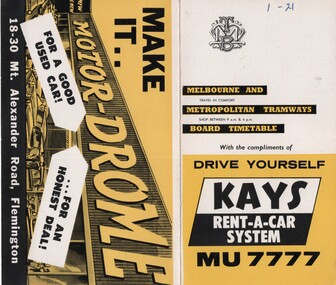
Ephemera - Timetable/s, Melbourne & Metropolitan Tramways Board (MMTB), "MMTB Timetables set of 39", 1960
... Not dated, based on fares - 1960 and possibly after Point Ormond had closed. .1 - Route 1, 21 - East Coburg - City .2 - Route 4, 4A, 4B - Carnegie - City .3 - Route 4D, 14 - East Malvern - City .4 - Route 5, 5A - Malvern Burke Road - City .5 - Route 6, 6A, 6B - Glen Iris - City .6 - Route 7, 7A, 7B, 7D - Camberwell - City .7 - Route 8, 8A - Toorak - City .8 - Route 9, 9A - Northcote via St Georges Road - City .9 - Route 9, 9B, 10, 12 - Sth Melbourne Beach, St Kilda Beach - City .10 - Route 10,11 - West Preston - City .11 - Route 15, 16 - St Kilda Beach - City .12 - Route 15, 22 - Moreland - City .13 - Route 18, 19, 20 - North Coburg - City .14 - Route 27, 28 - Hawthorn - Spencer St .15 - Route 42, 44, 45 - Mont Albert - City .16 - Route 48, 40, 41 - North Balwyn - Spencer St .17 - Route 49 - Essendon (Matthews Ave) - City .18 - Route 50, 54, 57, 58, 60 - West Maribyrnong - City .19 - Route 55, 56 - West Coburg - City .20 - Route 59 - Essendon Aerodrome - City .21 - Route 61, 62, 64, 65 - East Brighton - City .22 - Route 69 - Kew Cotham Road - St Kilda Beach .23 - Route 70, 71, 76 - Wattle Park - City .24 - Route 74, 75, 76 - Burwood - City .25 - Route 77, 80 - Prahran - City .26 - Route 78, 79 - North Richmond - Prahran .27 - Route 82 - Moonee Ponds - Footscray .28 - Williamstown Road - Footscray - Tram and bus .29 - Ballarat Road - Footscray - Tram and bus .30 - Russell St - - Footscray - Tram and bus .31 - East Brunswick - City .32 - Domain Road - City .33 - West Heidelberg - City .34 - Sunshine - City via Ballarat and Footscray Roads .35 - Sunshine - City via South and Dynon Roads .36 - Sunshine Park - City .37 - Garden City - City (Victoria St) .38 - Queens Bridge - Fisherman's Bend via Ingles St .39 - Queens Bridge - Fisherman's Bend via Lorimer St and Princes Bridge - Fisherman's Bend via Williamstown Rd....Not dated, based on fares - 1960 and possibly after Point Ormond had closed. .1 - Route 1, 21 - East Coburg - City .2 - Route 4, 4A, 4B - Carnegie - City .3 - Route 4D, 14 - East Malvern - City .4 - Route 5, 5A - Malvern Burke Road - City .5 - Route 6, 6A, 6B - Glen Iris - City .6 - Route 7, 7A, 7B, 7D - Camberwell - City .7 - Route 8, 8A - Toorak - City .8 - Route 9, 9A - Northcote via St Georges Road - City .9 - Route 9, 9B, 10, 12 - Sth Melbourne Beach, St Kilda Beach - City .10 - Route 10,11 - West Preston - City .11 - Route 15, 16 - St Kilda Beach - City .12 - Route 15, 22 - Moreland - City .13 - Route 18, 19, 20 - North Coburg - City .14 - Route 27, 28 - Hawthorn - Spencer St .15 - Route 42, 44, 45 - Mont Albert - City .16 - Route 48, 40, 41 - North Balwyn - Spencer St .17 - Route 49 - Essendon (Matthews Ave) - City .18 - Route 50, 54, 57, 58, 60 - West Maribyrnong - City .19 - Route 55, 56 - West Coburg - City .20 - Route 59 - Essendon Aerodrome - City .21 - Route 61, 62, 64, 65 - East Brighton - City .22 - Route 69 - Kew Cotham Road - St Kilda Beach .23 - Route 70, 71, 76 - Wattle Park - City .24 - Route 74, 75, 76 - Burwood - City .25 - Route 77, 80 - Prahran - City .26 - Route 78, 79 - North Richmond - Prahran .27 - Route 82 - Moonee Ponds - Footscray .28 - Williamstown Road - Footscray - Tram and bus .29 - Ballarat Road - Footscray - Tram and bus .30 - Russell St - - Footscray - Tram and bus .31 - East Brunswick - City .32 - Domain Road - City .33 - West Heidelberg - City .34 - Sunshine - City via Ballarat and Footscray Roads .35 - Sunshine - City via South and Dynon Roads .36 - Sunshine Park - City .37 - Garden City - City (Victoria St) .38 - Queens Bridge - Fisherman's Bend via Ingles St .39 - Queens Bridge - Fisherman's Bend via Lorimer St and Princes Bridge - Fisherman's Bend via Williamstown Rd. ...Set of 39 MMTB Tram timetables, 2 fold sheets, , providing timetables for specific routes, route numbers, day of week giving information on tram times at departure time points, sections and fares, where applicable all night bus services. All signed by B. H. Misson, Traffic Manager. All sponsored by Kays Rent a Car and Motor Drome, 18-30 Mount Alexander Road, Flemington. The only one missing is Point Ormond. Not dated, based on fares - 1960 and possibly after Point Ormond had closed. .1 - Route 1, 21 - East Coburg - City .2 - Route 4, 4A, 4B - Carnegie - City .3 - Route 4D, 14 - East Malvern - City .4 - Route 5, 5A - Malvern Burke Road - City .5 - Route 6, 6A, 6B - Glen Iris - City .6 - Route 7, 7A, 7B, 7D - Camberwell - City .7 - Route 8, 8A - Toorak - City .8 - Route 9, 9A - Northcote via St Georges Road - City .9 - Route 9, 9B, 10, 12 - Sth Melbourne Beach, St Kilda Beach - City .10 - Route 10,11 - West Preston - City .11 - Route 15, 16 - St Kilda Beach - City .12 - Route 15, 22 - Moreland - City .13 - Route 18, 19, 20 - North Coburg - City .14 - Route 27, 28 - Hawthorn - Spencer St .15 - Route 42, 44, 45 - Mont Albert - City .16 - Route 48, 40, 41 - North Balwyn - Spencer St .17 - Route 49 - Essendon (Matthews Ave) - City .18 - Route 50, 54, 57, 58, 60 - West Maribyrnong - City .19 - Route 55, 56 - West Coburg - City .20 - Route 59 - Essendon Aerodrome - City .21 - Route 61, 62, 64, 65 - East Brighton - City .22 - Route 69 - Kew Cotham Road - St Kilda Beach .23 - Route 70, 71, 76 - Wattle Park - City .24 - Route 74, 75, 76 - Burwood - City .25 - Route 77, 80 - Prahran - City .26 - Route 78, 79 - North Richmond - Prahran .27 - Route 82 - Moonee Ponds - Footscray .28 - Williamstown Road - Footscray - Tram and bus .29 - Ballarat Road - Footscray - Tram and bus .30 - Russell St - - Footscray - Tram and bus .31 - East Brunswick - City .32 - Domain Road - City .33 - West Heidelberg - City .34 - Sunshine - City via Ballarat and Footscray Roads .35 - Sunshine - City via South and Dynon Roads .36 - Sunshine Park - City .37 - Garden City - City (Victoria St) .38 - Queens Bridge - Fisherman's Bend via Ingles St .39 - Queens Bridge - Fisherman's Bend via Lorimer St and Princes Bridge - Fisherman's Bend via Williamstown Rd.All have the route number in ink on the front cover - see image 5691i.jpg for standard cover.trams, tramways, mmtb, timetables, melbourne, fares, route 1, route 22, route 4, route 4a, route 4b, route 4d, route 14, route 5, route 5a, route 6, route 6a, route 6b, route 7, route 7a, route 7b, route 7d, route 8, route 8a, route 9, route 9a, route 9b, route 10, route 11, route 12, route 15, route 16, route 22, route 18, route 19, route 20, route 27, route 28, route 42, route 45, route 44, route 48, route 40, route 41, route 49, route 50, route 54, route 57, route 58, route 60, route 52, route 56, route 59, route 61, route 62, route 64, route 65, route 69, route 70, route 71, route 76, route 74, route 75, route 76, route 77, route 80, route 78, route 79, route 82, williamstown rd, ballarat rd, russell st, route 96, domain rd, west heidelberg, sunshine, garden city, queens bridge, fishermen's bend -
 Melbourne Tram Museum
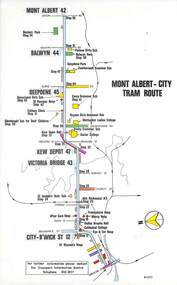
Map, Melbourne & Metropolitan Tramways Board (MMTB), Set of 15 tram route maps, 1977 to 1979
... Copy 1 has "P14909" in pencil in the bottom right hand corner. .5 - Kew - St Kilda Beach - R1/79 - Route 69. .6 - Footscray - Moonee Ponds - R3/81 - Route 82 .7 - Flinders St tram routes - R5/78 - North Balwyn, East Burwood, routes 48, 40, 41, Hartwell, 28, 74 and 75 .8 - William St tram routes - Route 55, 56 and 63 - South Melbourne Depot and Domain. ...Copy 1 has "P14909" in pencil in the bottom right hand corner. .5 - Kew - St Kilda Beach - R1/79 - Route 69. .6 - Footscray - Moonee Ponds - R3/81 - Route 82 .7 - Flinders St tram routes - R5/78 - North Balwyn, East Burwood, routes 48, 40, 41, Hartwell, 28, 74 and 75 .8 - William St tram routes - Route 55, 56 and 63 - South Melbourne Depot and Domain. copy 2 has "P14913" in bottom right hand corner. .9 - Toorak Camberwell and Glen Iris tram routes with Camberwell Junction and Malvern Town Hall, R1/79, routes 8, 7, 6, 72 and 73 shown. .10 - Swanston St tram routes - R12/77 - shows all the Swanston St routes, including East Coburg and Moreland. .11 - Bourke St tram routes - R4/77 - East Brunswick Blyth St and East Preston Tyler St and intermediate routes, routes 95, 96, 97, 90, 89 and 88. .12 - as for .11, dated 1/85, showing extension to La Trobe University - has Metropolitan Transit logo. ...Series of 15 colour route maps for various tram lines or groups of tram lines for the MMTB. Some have the Transport Information Centre telephone printed on them, others have a label stuck on. Some are finished with a plastic laminate finish on either one or both sides. Show the major cross streets, parks, schools, other tram routes, major stop numbers and railway lines. Two copies of each held unless noted otherwise. .1 - Mont - Albert City - R11/77, shows routes 43. 47. 45. 44 .2 - Malvern, East Malvern, Carnegie and East Brighton Tram Routes (from St Kilda Junction) - R1/79 - shows routes 5, 3, 67, 66, 61, 62 and 64. .3 - Swanston St tram guide - R1/79 - lists all routes and route numbers that branch or cross Swanston St between Grattan St and St Kilda Junction. .4 - St Kilda Rd Tram Routes R12/77 - details South Melbourne Beach, route 1 and route 2 and St Kilda Beach routes 15, 16 and 55 otherwise shows were the various routes branch off St Kilda Road. Copy 1 has "P14909" in pencil in the bottom right hand corner. .5 - Kew - St Kilda Beach - R1/79 - Route 69. .6 - Footscray - Moonee Ponds - R3/81 - Route 82 .7 - Flinders St tram routes - R5/78 - North Balwyn, East Burwood, routes 48, 40, 41, Hartwell, 28, 74 and 75 .8 - William St tram routes - Route 55, 56 and 63 - South Melbourne Depot and Domain. copy 2 has "P14913" in bottom right hand corner. .9 - Toorak Camberwell and Glen Iris tram routes with Camberwell Junction and Malvern Town Hall, R1/79, routes 8, 7, 6, 72 and 73 shown. .10 - Swanston St tram routes - R12/77 - shows all the Swanston St routes, including East Coburg and Moreland. .11 - Bourke St tram routes - R4/77 - East Brunswick Blyth St and East Preston Tyler St and intermediate routes, routes 95, 96, 97, 90, 89 and 88. .12 - as for .11, dated 1/85, showing extension to La Trobe University - has Metropolitan Transit logo. Only 1 copy held. Also shows route 92 and 87. .13 - Batman Ave tram routes - R9/77 - Wattle Park, North Richmond and Prahran - routes 70, 71, 78 and 79. .14 - City route guide - R9/77 - showing all route numbers and destinations that passed through the CBD. .15 - Elizabeth St tram routes - R12/77 - Essendon Airport, West Maribyrnong, North Coburg lines, routes 50, 58, 60, 54, 57, 52. 49, 59, 18, 20 and 19. Copy 1 has "P14905" in pencil in bottom left hand corner.trams, tramways, maps, route guide, route numbers, routes, mont albert, route 43, route 47, route 45, route 44, route 42, malvern burke rd, east preston, carnegie, east brighton, south caulfield, route 5, route 3, route 67, route 62, route 64, route 66, glenhuntly tram depot, swanston st, st kilda rd, south melbourne beach, st kilda beach, route 1, route 2, route 15, route 16, route 55, kew- cotham road, route 69, route 79, route 82, footscray, moonee ponds, flinders st, north balwyn, kew, east burwood, burwood, hartwell, richmond, route 48, route 40, route 41, route 28, route 74, route 75, route 56, route 63, william st, west coburg, toorak, camberwell, glen iris, malvern town hall, route 72, route 73, route 7, route 8, bourke st, route 6, route 95, route 96, route 97, route 90, route 89, route 89, east preston, east brunswick, la trobe university, clifton hill, route 92, route 87, route 70, route 71, route 78, route 79, north richmond, prahran, wattle park, essendon airport, west maribyrnong, north coburg, route 50, route 58, route 60, route 54, route 57, route 52, route 49, route 59, route 18, route 20, route 19, batman ave -
 Flagstaff Hill Maritime Museum and Village
Book - A Fictional Story, Jack London, Before Adam, 1910s–1920s
... He left school at 14, worked at various times as an oyster pirate and for the government fish patrol on San Francisco Bay, sailed to Japan, and rode the rails as a hobo, including a stint with an unemployment protest march born of the 1893 financial panic. ...He left school at 14, worked at various times as an oyster pirate and for the government fish patrol on San Francisco Bay, sailed to Japan, and rode the rails as a hobo, including a stint with an unemployment protest march born of the 1893 financial panic. ...Before Adam (1906–07) is one of Jack London's more unusual novels. It's narrated by a modern man who is a "freak of heredity" through recurring, vivid dreams, he relives the memories of a prehistoric ancestor he calls "Big-Tooth." The story was first serialised in Everybody's Magazine before being published as a book, and tells of a man who dreams he lives the life of an early hominid. Most of the narrative unfolds through the eyes of Big-Tooth, one of the more primitive "Cave People," set against the more advanced "Fire People" and the animal-like "Tree People." Supporting characters include the hominid's father, a love interest, and Red-Eye, a savage "atavism" who terrorises the Cave People, with a sabre-toothed cat also playing a role.Hard cover book. Before Adam Author: Jack London Publisher: Collins Clear-Type Press Date: 1910s–1920s Further Information: A plain volume bound in red cloth, with a stuck-on library classification label ("PAT FIC LON") on the spine and no visible date, edition statement, or printer's imprint on the pages shown the copyright/date page. Gilt decoration and lettering to spine, no illustrated boards, and no dust jacket. fictionBefore Adam (1906–07) is one of Jack London's more unusual novels. It's narrated by a modern man who is a "freak of heredity" through recurring, vivid dreams, he relives the memories of a prehistoric ancestor he calls "Big-Tooth." The story was first serialised in Everybody's Magazine before being published as a book, and tells of a man who dreams he lives the life of an early hominid. Most of the narrative unfolds through the eyes of Big-Tooth, one of the more primitive "Cave People," set against the more advanced "Fire People" and the animal-like "Tree People." Supporting characters include the hominid's father, a love interest, and Red-Eye, a savage "atavism" who terrorises the Cave People, with a sabre-toothed cat also playing a role.shipwrecked-coast, flagstaff-hill, flagstaff-hill-maritime-museum, warrnambool, maritime-museum, shipwreck-coast, flagstaff-hill-maritime-village, shipwrecked-artefact, book, pattison collection, warrnambool library, warrnambool mechanics’ institute, ralph eric pattison, corangamite regional library service, warrnambool city librarian, mechanics’ institute library, victorian library board, warrnambool books and records, warrnambool children’s library, before adam, jack london -
 Ringwood and District Historical Society
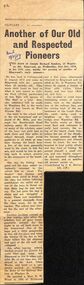
Newspaper, The Mail, Obituary - Joseph Richard Sanders - Old and Respected Pioneer Ringwood 1959 from the Ringwood Mail, 1959
... During the lunch hour a few of the boys generally went to the creek to fish for eels and would be late in getting back to school, greatly to the annoyance of the teacher. ...During the lunch hour a few of the boys generally went to the creek to fish for eels and would be late in getting back to school, greatly to the annoyance of the teacher. ...The article was contributed by J.K.McCaskill, JP. a mayor of Ringwood in the years between 1924-1951.The Sanders family came from England and are mentioned in the book "Ringwood a Place of Many Eagles" by Hugh AndersonObituary from The Ringwood Mail of Joseph Richard Sanders of 18, Wantirna Road, Ringwood, aged 87 years. He came from a family who were early pioneers of Ringwood. he was born in Collingwood but schooled in Ringwood, married and brought up his family in Ringwood. He lived at 18, Wantirna Road .The article was contributed by J.K.McCaskill, JP. a mayor of Ringwood in the years between 1924-1951.Transcript: "The death occurred of Joseph Richard Sanders, 18 Wantirna Rd, Ringwood, on Wednesday, 21st October 1959, in his 87th year, marks the passing of another of Ringwood’s early pioneers. He was born in Collingwood in August 1873 and came to Ringwood with his parents when 15 months old. They made their home on land on what is now known as Jubilee Park (Fuller particulars of this Park will appear in ‘The Mail’ at a later date, also reference will be made to Wantirna Rd, in the early days it was known as West Prussia Rd). Joe went to the school held in the old homestead and orchard of Mr. Mills, just through the Heatherdale Road railway gates. He remembered many of the scholars, some of the boys and girls had to walk three and four miles to school through rough scrub paddocks in all kinds of weather. During the lunch hour a few of the boys generally went to the creek to fish for eels and would be late in getting back to school, greatly to the annoyance of the teacher. One day the fishing was good, and the boys rather reluctantly returned to the school late as usual. The teacher was furious and made them stand in front of the class but before inflicting punishment she called out to one of the boys to throw out that dirty bag he was holding. The lad gave the bag a shake and out wriggled a snake. There was immediately a general stampede from the classroom, led by the teacher. The school was closed for the rest of the afternoon. Another incident related to a few tramps who after the scholars had all gone home, generally camped for the night in an old back room in the homestead. One of the boys put a little gunpowder in this old fireplace and when the tramps lit the fire to boil their billies the old chimney and part of the old wall just collapsed. Joe, after leaving school, worked around the district for some time and later left Ringwood to live in other suburbs. He at one time was employed at the Aust Glass Works, and later as a carpenter worked on building the dome of the Railway Station at Flinders St. He married a Miss E. M. Wood in 1901 at Richmond and a few years afterwards returned to Ringwood and resided at No. 18 Wantirna Rd., where he reared a family' of three girls (Alice, Ethel, Joyce) and two boys (Robert and Joe). Joe recalled many interesting events of earlier years, such as the duplication of the railway line, and the cutting back of the embankment at the Goods Shed, the earth being used to heighten up the railway bridge over Wantirna Rd. The brickworks at Ringwood East and reference to early land surveys, the using of the heavy chain links before the use of the theodolite became general, and the many neighbours and friends whom he knew. He was interested in local public affairs and was fond of fishing. He proved himself a good citizen and was highly respected and esteemed throughout the district, and so another old pioneer passes on." (Contributed by J. K. McCaskill, J.P.) RM 19 Nov 1959 -
 Ballarat Tramway Museum
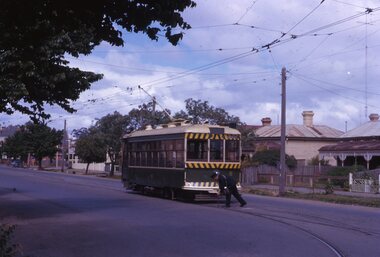
Slide - 35mm slide/s, Noel Simons, 21/11/1962 12:00:00 AM
... Has the shops on the south side of High St. in the background, including the Eaglehawk fish shop. Tram has two roof ads, one an SEC roof ad, and Cohns Drinks and Streets Ice cream ads on front dash panel. 1188.12 - as above, but after tram has passed photographer. ...Has the shops on the south side of High St. in the background, including the Eaglehawk fish shop. Tram has two roof ads, one an SEC roof ad, and Cohns Drinks and Streets Ice cream ads on front dash panel. 1188.12 - as above, but after tram has passed photographer. ...Set of 17 transparencies taken on 21/11/1962 on Kodak mounts. 1188.1 - Bendigo No. 11 at Depot Junction McCrae and Arnold St. with driver/conductor changing points. 1188.2 - Bendigo No. 4 at Charing Cross, side on photo, with City Club Hotel and Alexandra Fountain in the background. Tram has Castrol and SEC 'Electric Cooking' ads. 1188.3 - Bendigo No. 4 climbing View St. after tram has passed photographer. Tram has Streets Ice Cream and Cohns Soft Drinks ad on rear dash panel. In the background are the buildings in View St., including the Princess Theatre. Tram has destination of Eaglehawk. 1188.4 - Trams 2 and 4 crossing at the California Gully or Thorpe St Loop. 1188.5 - Bendigo 4 in Mt Korong Road. Tram inbound with destination of Quarry Hill, just leaving Garden Gully Loop. 1188.6 - Bendigo 4 and 17 crossing at the Hayes St. or Iron Bark Gully Loop. No. 17 bound for Eaglehawk, No. 4, Quarry Hill. 17 has two SEC roof ads and a white horse whiskey ad. 1188.7 - No. 17 bound for Eaglehawk, soon after leaving California Gully. Has large mullock heap in background. 1188.8 - Bendigo 2 and 17 crossing at the Thorpe St. or California Gully Loop. Has butchers shop in background. 1188.9 - Bendigo 17 at the Eaglehawk terminus. Has destination of Quarry Hill. In background is the hotel and shops at the terminus, showing ads for "Melbourne Bitter". Tram has two SEC 'Electric Cooking' ads. Driver and conductor about to assist two lady passengers with a pram and baby. 1188.10 - No. 17 at Eaglehawk terminus, awaiting departure. Has Eaglehawk Town Hall and Post Office in background. Tram has a Whitehorse Whiskey ad on the front dash panel. 1188.11 - No. 3 in High St. Eaglehawk, with destination of Eaglehawk. Has the shops on the south side of High St. in the background, including the Eaglehawk fish shop. Tram has two roof ads, one an SEC roof ad, and Cohns Drinks and Streets Ice cream ads on front dash panel. 1188.12 - as above, but after tram has passed photographer. Note the centre of the road poles. 1188.13 - No. 2 outbound for Eaglehawk at the intersection of Mt. Korong Road and the Calder Highway. Photo taken after the tram has passed the photographer. Has an Ampol service station in the background. 1188.14 - No. 11 leaving the Bendigo depot, crossing the bridge, with the Scrubber car in the background. 1188.15 - No. 21 at the North Bendigo terminus. Tram has destination of Golden Square and Cohns drink ad on front dash and two roof ads on side. 1188.16 - No. 11 on Golden Square route, in High St. at intersection with Old High St. 1188.17 - No. 11 at the Golden Square terminus, conductor turning the pole. Hotel on the left side of the photo. Note the road works barrier and red flag behind the tram. Slide has an end of roll mark on the right hand side of the image.Information written on in black ink and date stamped on purple ink. 1188.1 - "Birney car No. 11 in McCrae St. at Cnr of Arnold about to run into depot, Bendigo" 1188.2 - "No. 4 at Alexandra Fountain, Charing Cross Bendigo" 1188.3 - "No. 4 climbing the View St. Hill from Charing Cross, Bendigo (Eaglehawk Route)" 1188.4 - "No. 4 and 2 at Thorpe St. Loop, California Gully" 1188.5 - "No. 4 in Mt Korong Rd., Long Gully, Near Havilah Rd. (Bendigo) (Eaglehawk Route)" 1188.6 - "Nos. 17 and 4 crossing on Hayes St. Loop, Ironbark, Bendigo" 1188.7 - "No. 17 soon after leaving California Gully (Eaglehawk Route)" 1188.8 - "No.2 and 17 crossing on Thorpe St. Loop, California Gully (Eaglehawk Route)" 1188.9 - "No. 17 at Eaglehawk terminus" 1188.10 - "No. 17 at Eaglehawk terminus" 1188.11 - "No. 3 in High St. Eaglehawk" 1188.12 - "No. 3 nearing Eaglehawk terminus" 1188.13 - "No. 2 in Mt. Korong Rd., Ironbark. Calder highway on left (Eaglehawk route) 1188.14 - "Birney car No. 11 leaving Bendigo depot. Scrubber car at rear" 1188.15 - "No. 21 at North Bendigo Terminus" 1188.16 - "Birney car No. 11 in High St. Bendigo at intersection with Old High Street (Golden Square Route)" 1188.17 - "Birney Car No. 11 at Golden Square terminus, High St., Bendigo". tramways, trams, bendigo, depot junction, charing cross, view st., eaglehawk, north bendigo, golden square, tram 2, tram 3, tram 4, tram 11, tram 17, tram 21, tram scrubber -
 Narre Warren and District Family History Group
Book, Narre Warren & District Family History Group Inc, Casey Cardinia Collection - Upper Beaconsfield / Dewhurst Information File, 2021
... Primary 17/09/2008 A stitch in time for a village – Nola Gregson 2/04/2008 Life in the rally fast lane – Glad Fish 12/10/2005 Church celebrates two decades 7/01/2009 Salisbury House Sojourns 20/12/2006 Sleeping giant a pot of gold 12/12/2007 Fred’s legend lives on 7/03/2007 All fired up about history – Go to Blazes 29/10/2025 Brigade Celebrates a Century 25/03/2009 Goats deliver fine rewards, no butts 6/09/2017 Upper Beac in the 30s - Don Begg 26/05/2010 101 Cheers for Gladys - Gladys Edwards 26/05/2010 Little school that could 13/02/2008 Ash Wednesday Always There 13/02/2008 Nightmare Remains Fresh 13/02/2008 Family Survives “Evil, Horrible Day” 18/01/2017 Des McKenna Made the World a Better Place 12/06/2013 Scout Chief Tracks Award - Bob Taylor UNKNOWN Windrush - property 16/04/2008 Diving Into a Life of Passion - Barry Andrewartha 13/02/2013 Glimpse Into Heart of Hell - Ash Wednesday 13/02/2013 Through the Eyes of the Survivors 13/02/2013 Hell on Earth in the Hills - Ash Wednesday 11/01/2018 Milestone for Maroons 9/07/1905 Upper Beaconsfield Community Centre - pamphlet 23/02/2022 A Day Straight From Hell - Ash Wednesday - pamphlet 26/01/2022 Carmel a “Force For Good” - Carmel McKenna 27/04/2022 Crowds Return for Service 17/07/2019 Moving With the Times 1/05/2019 Honouring the Fallen 4/01/2007 Fire Bale-Out 22/02/2023 Reflecting on the Firestorm 22/02/2023 Locals United in Aftermath 7/09/2016 Hansen Hangs up his Whistle - Rob Hansen 30/08/2023 Tribute to Camel McKenna 22/05/2024 A Taste of Family Legacy - The Carlei Winery 20/04/2015 Finally a Mark of Respect - Cecil Henry Foott 2/10/2024 100 and Tough as Nails - Alexandra Krywokulski 1/10/2025 Final Goodbyes to Bob - Bob Taylor 17/09/2025 Farewell, Mr Community - Bob Taylor 31/10/2018 Reward Our Volunteers - Malcolm Graham Relevant names relating to the articles in the folder are: 10th Field Ambulance, Ulick a'Beckett, Akhoona Park, Ken Aldred, Gertie Alers, Barry Andrewartha, Belinda Andrewartha, Phil Anning, Jessica Anstice, Arch Brown Reserve, Gordon Atkin, Joyce Attreed, Kevin Bailey, Megan Bailey, Ian Baird, Sue Baird, Simon Baldwin, Brad Battin, Henry Bayer, John Bayer, Louis Bayer, Beaconsfield Football Club, Beaconsfield Golf Club, Beaconsfield Scouts, Colin Begg, Don Begg, Flora Begg, Peg Bellair, Matt Bennett MP, Chloe Bentley, Bill Berglun, C P Berglund, J Berry, Berwick & District Garden Club, Berwick Lions Club, John Bevan, Albert Reginald (Bob) Bickham, Emily Bishop, Frances Bishop, Graeme Bishop, Hannah Bishop, Lachlan Bishop, Ryan Bishop, Tom Black, Robert Blaikie, Transport Blakistons, Nancy Boura, Geoff Brooks, Wally Brown, Buckley Ridges, Eric Bumpstead, Meg Burch, Alex Burgess, Dorothy Burgess, Road Burglund, Carl Butler, Betty Buttler, Wendy Byrne, Sr Cahill, Yvonne, Father Caldwall, Brian, David Carlei, Mary Carlei, Sergio Carlei, Carlei Winery & Microbrewery, family Carpenter, Road Carpenter, Ron Carroll, Andrew Castelli, CD Wilson and Sons, Eric Chaplin, Eric Chapman, Pauline Chauncey, Ted Clynch, Graham Cockerell, Jeanette Cockerell, Clive Colles, Dan Colles, Gwyn Colles, Simon Conn, Coonawarra vineyard, Isabelle Cooper, Miss Corder, Jane, Miss Corder, Mary, H Coulson, Bob Coventry, Anne Crawford, Critchley Parker Junior Reserve, John Crosbie, Geoff Davidson, Arthur Day, Hilary Day, Heather De Crespigny, Paul Desmond, Margaret Doolan, Lily Dowie-Crinton, Eva Dowling, Joe Dowling, Muriel Dowling, Robin Dowling, Paul Dunlop, Betty Edwards, Dick Edwards, Gladys Edwards, Harold Edwards, Maureen Edwards, Paul Edwards, Mrs Edwards, Mary, Wendy Eldridge, Dot Evans, Jim Evans, Corey Everitt, Val Ewenson, Brian Fiddes, Tara Firth, Glad Fish, Nick Fish, Bob Florance, Kath Florance, Ann Fogarty, Sarah Fogarty, Cecil Henry Foott, Helen Fyfe, Monsinor Gallagher, George Woods Memorial Rally, Les Gilpin, Ellen Glismann, Jack Glismann, Hans Glissman, John Glissman, Diane Golemark, Adam Lindsay Gordon, Malcolm Graham, George Grant, Peter Gray, Sue Gray, Nola Gregson, Dennis Griffin, Malcolm Griffin, Mark Griffin, Warwick Griffin, Captain Griffiths, Stan Hamilton, Tom Hamilton, Elinor Hansen, Fenella Hansen, Gilda Hansen, Rob Hansen, Dawn Hanson, Iain Hanson, Claud Harris, Ellen Harris, Joan Harris, Kaine Harris, Lorraine Harris, Rosetta Harris, Roy Harris, Solomon Harris, Val Harris, Penny Harris Jennings, Harris Petroleums, Roy Hayball, Nancy Heap, Peggy Heap, Samuel Heap, Bill Herman, Win Holmes, Alistair Horne, Christine Horne, Francis Michael Horne, Frank Horne, Gerard Horne, Kevin Horne, Pearl Horner, Alma Horrigan, Ern Horrigan, Mrs Horrigan, John Howard, Helen Hudson, Concie Hughes, Helen Hughes, Graham Hunter, Robert Irving, Barbara Jackson, Julie Jamieson, Johnny Nathans General Store, Kim Johns, Fred Keeble, Mrs Keeble, Russell Keeble, Graeme Kidd, Emma Kincraik, George Crabtree Kincraik, Janet Kincraik, Betty Knapton, Bill Knapton, Frank Knapton, Nancy Knapton, W J Knapton, Afraa Kori, Alexandra Krzywokulski, John Krzywokulski, Krystine Krzywokulski, Peter Krzywokulski, Ted Krzywokulski, Emily Chapman Laing, Bill Lang, Pam Larkworthy, Phillip Lewis, Sylvia Lewis, Colleen Long, Eddie (Dasha) Lowen, Andrew Ludsy, Brad Mars, John McConchie, Julie McConchie, Fay McCoubrie, David McCulloch, Janet McCulloch, Richard McCurdy, Ian McDonald, Matt McDonald, Peter McHugh, Anthony McKenna, Bernadette McKenna, Carmel McKenna, Catherine McKenna, Damien McKenna, Daniel McKenna, Danny McKenna, Desmond James (Des) McKenna, James McKenna, Jeanne McKenna, John McKenna, Josephine McKenna, Kevin McKenna, Marie McKenna, Matthew McKenna, Michael McKenna, Patrick McKenna, Paul McKenna, Phillip McKenna, Terry McKenna, Lyn McLeod, Murray McLeod, Alison Medwin, Barry Medwin, Joan Medwin, Kerry Medwin, Judy Meeking, Cr Peter Meeking, Jim (Frosty) Miller, Glad Mitchell, Val Mitchell, Montuna Golf Course, Cr Mick Morland, Lillian Morris, Maida Mossop, Mundra, Sheila Murfitt, Ron Murphy, David Myers, Doug Nathan, Johnny Nathan, Ross Neilson, Bill Noblet, Fred Noblet, Palma Noblet, David Norbury, Gloria O'Connor, Gwenda Oldmeadow, Leigh Oldmeadow, Melinda Oldmeadow, Sarah Oldmeadow, Larry Osborn, Harold Osborne, Cr Brett Owen, Will Owen, Neil Paxton, Bob Phelps, Margaret Phillips, Pine Grove Hotel, Debbie Pinney, Ian Pinney, Brian Pockett, Roy Pryor, Sue Pryor, Company Raleigh, Regina Rich, Rev Roger Rich, Mary Riddiford, Jane Rivett-Carnac, Cameron Rocke, Marianne Rocke, Bruce Rogers, Elise Ross, Eldred Royle, Captain Alex Rushall, Salisbury Guesthouse, Jamie Salter, Eva Sansom, Frank Sansom, Cambodia Santehaep, Betty Savory, Fred Savory, Helen Savory, Keith Shelton, Sue Shelton, George Silberbauer, Keira Slootjes, Fred Sluman, Barry Smith, Di Smith, Helen Smith, South West Gippsland Football League, Shaun Spencer, Ron Spinks, Nicole Sprinks, St Bedes Old Mentonians Football Club, St Francis Xavier College, St Johns Anglican Church, St Margarets Berwick Grammar, St Michaels Church, Terry Stephenson, Matt Stevic, Andrew Stoddart, Stoney Creek Brewery, Alistair Taylor, Bob Taylor, David Taylor, Eleanor Taylor, Miss Taylor, Robert Waddell (Bob) Taylor, Ron Taylor, Valerie Taylor, Teckaba Guesthouse, The Grayn Restaurant, Dennis Thistlewaite, Ian Thomas, Dave Thompson, Those Bloody McKennas, Tom Piper Ltd, Hallmon Tremberth, Millicent Tremberth, Truleen Downs Alpaca Farm, Hugh Trumble, Marcus Uhe, Vacuum Oil Co, View Hills Manor, Tom Warne, John Wells, Andrew Wencel, Campbell Westcott, Jacob Westcott, Riki White, Charles Wilson, John Wilson, Stewart Wilson, Sylvia Wilson, Trevor Wilson, Wilson Quarries, Bunny Wingle, Marie Womersley, Mark Woodbridge, Colin Wright. ...Primary 17/09/2008 A stitch in time for a village – Nola Gregson 2/04/2008 Life in the rally fast lane – Glad Fish 12/10/2005 Church celebrates two decades 7/01/2009 Salisbury House Sojourns 20/12/2006 Sleeping giant a pot of gold 12/12/2007 Fred’s legend lives on 7/03/2007 All fired up about history – Go to Blazes 29/10/2025 Brigade Celebrates a Century 25/03/2009 Goats deliver fine rewards, no butts 6/09/2017 Upper Beac in the 30s - Don Begg 26/05/2010 101 Cheers for Gladys - Gladys Edwards 26/05/2010 Little school that could 13/02/2008 Ash Wednesday Always There 13/02/2008 Nightmare Remains Fresh 13/02/2008 Family Survives “Evil, Horrible Day” 18/01/2017 Des McKenna Made the World a Better Place 12/06/2013 Scout Chief Tracks Award - Bob Taylor UNKNOWN Windrush - property 16/04/2008 Diving Into a Life of Passion - Barry Andrewartha 13/02/2013 Glimpse Into Heart of Hell - Ash Wednesday 13/02/2013 Through the Eyes of the Survivors 13/02/2013 Hell on Earth in the Hills - Ash Wednesday 11/01/2018 Milestone for Maroons 9/07/1905 Upper Beaconsfield Community Centre - pamphlet 23/02/2022 A Day Straight From Hell - Ash Wednesday - pamphlet 26/01/2022 Carmel a “Force For Good” - Carmel McKenna 27/04/2022 Crowds Return for Service 17/07/2019 Moving With the Times 1/05/2019 Honouring the Fallen 4/01/2007 Fire Bale-Out 22/02/2023 Reflecting on the Firestorm 22/02/2023 Locals United in Aftermath 7/09/2016 Hansen Hangs up his Whistle - Rob Hansen 30/08/2023 Tribute to Camel McKenna 22/05/2024 A Taste of Family Legacy - The Carlei Winery 20/04/2015 Finally a Mark of Respect - Cecil Henry Foott 2/10/2024 100 and Tough as Nails - Alexandra Krywokulski 1/10/2025 Final Goodbyes to Bob - Bob Taylor 17/09/2025 Farewell, Mr Community - Bob Taylor 31/10/2018 Reward Our Volunteers - Malcolm Graham Relevant names relating to the articles in the folder are: 10th Field Ambulance, Ulick a'Beckett, Akhoona Park, Ken Aldred, Gertie Alers, Barry Andrewartha, Belinda Andrewartha, Phil Anning, Jessica Anstice, Arch Brown Reserve, Gordon Atkin, Joyce Attreed, Kevin Bailey, Megan Bailey, Ian Baird, Sue Baird, Simon Baldwin, Brad Battin, Henry Bayer, John Bayer, Louis Bayer, Beaconsfield Football Club, Beaconsfield Golf Club, Beaconsfield Scouts, Colin Begg, Don Begg, Flora Begg, Peg Bellair, Matt Bennett MP, Chloe Bentley, Bill Berglun, C P Berglund, J Berry, Berwick & District Garden Club, Berwick Lions Club, John Bevan, Albert Reginald (Bob) Bickham, Emily Bishop, Frances Bishop, Graeme Bishop, Hannah Bishop, Lachlan Bishop, Ryan Bishop, Tom Black, Robert Blaikie, Transport Blakistons, Nancy Boura, Geoff Brooks, Wally Brown, Buckley Ridges, Eric Bumpstead, Meg Burch, Alex Burgess, Dorothy Burgess, Road Burglund, Carl Butler, Betty Buttler, Wendy Byrne, Sr Cahill, Yvonne, Father Caldwall, Brian, David Carlei, Mary Carlei, Sergio Carlei, Carlei Winery & Microbrewery, family Carpenter, Road Carpenter, Ron Carroll, Andrew Castelli, CD Wilson and Sons, Eric Chaplin, Eric Chapman, Pauline Chauncey, Ted Clynch, Graham Cockerell, Jeanette Cockerell, Clive Colles, Dan Colles, Gwyn Colles, Simon Conn, Coonawarra vineyard, Isabelle Cooper, Miss Corder, Jane, Miss Corder, Mary, H Coulson, Bob Coventry, Anne Crawford, Critchley Parker Junior Reserve, John Crosbie, Geoff Davidson, Arthur Day, Hilary Day, Heather De Crespigny, Paul Desmond, Margaret Doolan, Lily Dowie-Crinton, Eva Dowling, Joe Dowling, Muriel Dowling, Robin Dowling, Paul Dunlop, Betty Edwards, Dick Edwards, Gladys Edwards, Harold Edwards, Maureen Edwards, Paul Edwards, Mrs Edwards, Mary, Wendy Eldridge, Dot Evans, Jim Evans, Corey Everitt, Val Ewenson, Brian Fiddes, Tara Firth, Glad Fish, Nick Fish, Bob Florance, Kath Florance, Ann Fogarty, Sarah Fogarty, Cecil Henry Foott, Helen Fyfe, Monsinor Gallagher, George Woods Memorial Rally, Les Gilpin, Ellen Glismann, Jack Glismann, Hans Glissman, John Glissman, Diane Golemark, Adam Lindsay Gordon, Malcolm Graham, George Grant, Peter Gray, Sue Gray, Nola Gregson, Dennis Griffin, Malcolm Griffin, Mark Griffin, Warwick Griffin, Captain Griffiths, Stan Hamilton, Tom Hamilton, Elinor Hansen, Fenella Hansen, Gilda Hansen, Rob Hansen, Dawn Hanson, Iain Hanson, Claud Harris, Ellen Harris, Joan Harris, Kaine Harris, Lorraine Harris, Rosetta Harris, Roy Harris, Solomon Harris, Val Harris, Penny Harris Jennings, Harris Petroleums, Roy Hayball, Nancy Heap, Peggy Heap, Samuel Heap, Bill Herman, Win Holmes, Alistair Horne, Christine Horne, Francis Michael Horne, Frank Horne, Gerard Horne, Kevin Horne, Pearl Horner, Alma Horrigan, Ern Horrigan, Mrs Horrigan, John Howard, Helen Hudson, Concie Hughes, Helen Hughes, Graham Hunter, Robert Irving, Barbara Jackson, Julie Jamieson, Johnny Nathans General Store, Kim Johns, Fred Keeble, Mrs Keeble, Russell Keeble, Graeme Kidd, Emma Kincraik, George Crabtree Kincraik, Janet Kincraik, Betty Knapton, Bill Knapton, Frank Knapton, Nancy Knapton, W J Knapton, Afraa Kori, Alexandra Krzywokulski, John Krzywokulski, Krystine Krzywokulski, Peter Krzywokulski, Ted Krzywokulski, Emily Chapman Laing, Bill Lang, Pam Larkworthy, Phillip Lewis, Sylvia Lewis, Colleen Long, Eddie (Dasha) Lowen, Andrew Ludsy, Brad Mars, John McConchie, Julie McConchie, Fay McCoubrie, David McCulloch, Janet McCulloch, Richard McCurdy, Ian McDonald, Matt McDonald, Peter McHugh, Anthony McKenna, Bernadette McKenna, Carmel McKenna, Catherine McKenna, Damien McKenna, Daniel McKenna, Danny McKenna, Desmond James (Des) McKenna, James McKenna, Jeanne McKenna, John McKenna, Josephine McKenna, Kevin McKenna, Marie McKenna, Matthew McKenna, Michael McKenna, Patrick McKenna, Paul McKenna, Phillip McKenna, Terry McKenna, Lyn McLeod, Murray McLeod, Alison Medwin, Barry Medwin, Joan Medwin, Kerry Medwin, Judy Meeking, Cr Peter Meeking, Jim (Frosty) Miller, Glad Mitchell, Val Mitchell, Montuna Golf Course, Cr Mick Morland, Lillian Morris, Maida Mossop, Mundra, Sheila Murfitt, Ron Murphy, David Myers, Doug Nathan, Johnny Nathan, Ross Neilson, Bill Noblet, Fred Noblet, Palma Noblet, David Norbury, Gloria O'Connor, Gwenda Oldmeadow, Leigh Oldmeadow, Melinda Oldmeadow, Sarah Oldmeadow, Larry Osborn, Harold Osborne, Cr Brett Owen, Will Owen, Neil Paxton, Bob Phelps, Margaret Phillips, Pine Grove Hotel, Debbie Pinney, Ian Pinney, Brian Pockett, Roy Pryor, Sue Pryor, Company Raleigh, Regina Rich, Rev Roger Rich, Mary Riddiford, Jane Rivett-Carnac, Cameron Rocke, Marianne Rocke, Bruce Rogers, Elise Ross, Eldred Royle, Captain Alex Rushall, Salisbury Guesthouse, Jamie Salter, Eva Sansom, Frank Sansom, Cambodia Santehaep, Betty Savory, Fred Savory, Helen Savory, Keith Shelton, Sue Shelton, George Silberbauer, Keira Slootjes, Fred Sluman, Barry Smith, Di Smith, Helen Smith, South West Gippsland Football League, Shaun Spencer, Ron Spinks, Nicole Sprinks, St Bedes Old Mentonians Football Club, St Francis Xavier College, St Johns Anglican Church, St Margarets Berwick Grammar, St Michaels Church, Terry Stephenson, Matt Stevic, Andrew Stoddart, Stoney Creek Brewery, Alistair Taylor, Bob Taylor, David Taylor, Eleanor Taylor, Miss Taylor, Robert Waddell (Bob) Taylor, Ron Taylor, Valerie Taylor, Teckaba Guesthouse, The Grayn Restaurant, Dennis Thistlewaite, Ian Thomas, Dave Thompson, Those Bloody McKennas, Tom Piper Ltd, Hallmon Tremberth, Millicent Tremberth, Truleen Downs Alpaca Farm, Hugh Trumble, Marcus Uhe, Vacuum Oil Co, View Hills Manor, Tom Warne, John Wells, Andrew Wencel, Campbell Westcott, Jacob Westcott, Riki White, Charles Wilson, John Wilson, Stewart Wilson, Sylvia Wilson, Trevor Wilson, Wilson Quarries, Bunny Wingle, Marie Womersley, Mark Woodbridge, Colin Wright. ...Folder containing various newspaper clippings and other informative articles about the Upper Beaconsfield / Dewhurst area. There is a table of contents at the start of the folder listing the publication dates and titles of each article. The dates the articles were published, and the titles of the articles are listed below: 7/03/2012 Town Icon is 100 - Frances Bishop 10/11/2004 Barren ground to a garden of Eden – Jim and Dot Evans 14/07/2005 Big tick given for Red Cross 8/08/2007 Farewell to a volunteer – Peg Bellair 17/11/2004 Oh, for the days in the old school yard – Upper Beac. Primary 17/09/2008 A stitch in time for a village – Nola Gregson 2/04/2008 Life in the rally fast lane – Glad Fish 12/10/2005 Church celebrates two decades 7/01/2009 Salisbury House Sojourns 20/12/2006 Sleeping giant a pot of gold 12/12/2007 Fred’s legend lives on 7/03/2007 All fired up about history – Go to Blazes 29/10/2025 Brigade Celebrates a Century 25/03/2009 Goats deliver fine rewards, no butts 6/09/2017 Upper Beac in the 30s - Don Begg 26/05/2010 101 Cheers for Gladys - Gladys Edwards 26/05/2010 Little school that could 13/02/2008 Ash Wednesday Always There 13/02/2008 Nightmare Remains Fresh 13/02/2008 Family Survives “Evil, Horrible Day” 18/01/2017 Des McKenna Made the World a Better Place 12/06/2013 Scout Chief Tracks Award - Bob Taylor UNKNOWN Windrush - property 16/04/2008 Diving Into a Life of Passion - Barry Andrewartha 13/02/2013 Glimpse Into Heart of Hell - Ash Wednesday 13/02/2013 Through the Eyes of the Survivors 13/02/2013 Hell on Earth in the Hills - Ash Wednesday 11/01/2018 Milestone for Maroons 9/07/1905 Upper Beaconsfield Community Centre - pamphlet 23/02/2022 A Day Straight From Hell - Ash Wednesday - pamphlet 26/01/2022 Carmel a “Force For Good” - Carmel McKenna 27/04/2022 Crowds Return for Service 17/07/2019 Moving With the Times 1/05/2019 Honouring the Fallen 4/01/2007 Fire Bale-Out 22/02/2023 Reflecting on the Firestorm 22/02/2023 Locals United in Aftermath 7/09/2016 Hansen Hangs up his Whistle - Rob Hansen 30/08/2023 Tribute to Camel McKenna 22/05/2024 A Taste of Family Legacy - The Carlei Winery 20/04/2015 Finally a Mark of Respect - Cecil Henry Foott 2/10/2024 100 and Tough as Nails - Alexandra Krywokulski 1/10/2025 Final Goodbyes to Bob - Bob Taylor 17/09/2025 Farewell, Mr Community - Bob Taylor 31/10/2018 Reward Our Volunteers - Malcolm Graham Relevant names relating to the articles in the folder are: 10th Field Ambulance, Ulick a'Beckett, Akhoona Park, Ken Aldred, Gertie Alers, Barry Andrewartha, Belinda Andrewartha, Phil Anning, Jessica Anstice, Arch Brown Reserve, Gordon Atkin, Joyce Attreed, Kevin Bailey, Megan Bailey, Ian Baird, Sue Baird, Simon Baldwin, Brad Battin, Henry Bayer, John Bayer, Louis Bayer, Beaconsfield Football Club, Beaconsfield Golf Club, Beaconsfield Scouts, Colin Begg, Don Begg, Flora Begg, Peg Bellair, Matt Bennett MP, Chloe Bentley, Bill Berglun, C P Berglund, J Berry, Berwick & District Garden Club, Berwick Lions Club, John Bevan, Albert Reginald (Bob) Bickham, Emily Bishop, Frances Bishop, Graeme Bishop, Hannah Bishop, Lachlan Bishop, Ryan Bishop, Tom Black, Robert Blaikie, Transport Blakistons, Nancy Boura, Geoff Brooks, Wally Brown, Buckley Ridges, Eric Bumpstead, Meg Burch, Alex Burgess, Dorothy Burgess, Road Burglund, Carl Butler, Betty Buttler, Wendy Byrne, Sr Cahill, Yvonne, Father Caldwall, Brian, David Carlei, Mary Carlei, Sergio Carlei, Carlei Winery & Microbrewery, family Carpenter, Road Carpenter, Ron Carroll, Andrew Castelli, CD Wilson and Sons, Eric Chaplin, Eric Chapman, Pauline Chauncey, Ted Clynch, Graham Cockerell, Jeanette Cockerell, Clive Colles, Dan Colles, Gwyn Colles, Simon Conn, Coonawarra vineyard, Isabelle Cooper, Miss Corder, Jane, Miss Corder, Mary, H Coulson, Bob Coventry, Anne Crawford, Critchley Parker Junior Reserve, John Crosbie, Geoff Davidson, Arthur Day, Hilary Day, Heather De Crespigny, Paul Desmond, Margaret Doolan, Lily Dowie-Crinton, Eva Dowling, Joe Dowling, Muriel Dowling, Robin Dowling, Paul Dunlop, Betty Edwards, Dick Edwards, Gladys Edwards, Harold Edwards, Maureen Edwards, Paul Edwards, Mrs Edwards, Mary, Wendy Eldridge, Dot Evans, Jim Evans, Corey Everitt, Val Ewenson, Brian Fiddes, Tara Firth, Glad Fish, Nick Fish, Bob Florance, Kath Florance, Ann Fogarty, Sarah Fogarty, Cecil Henry Foott, Helen Fyfe, Monsinor Gallagher, George Woods Memorial Rally, Les Gilpin, Ellen Glismann, Jack Glismann, Hans Glissman, John Glissman, Diane Golemark, Adam Lindsay Gordon, Malcolm Graham, George Grant, Peter Gray, Sue Gray, Nola Gregson, Dennis Griffin, Malcolm Griffin, Mark Griffin, Warwick Griffin, Captain Griffiths, Stan Hamilton, Tom Hamilton, Elinor Hansen, Fenella Hansen, Gilda Hansen, Rob Hansen, Dawn Hanson, Iain Hanson, Claud Harris, Ellen Harris, Joan Harris, Kaine Harris, Lorraine Harris, Rosetta Harris, Roy Harris, Solomon Harris, Val Harris, Penny Harris Jennings, Harris Petroleums, Roy Hayball, Nancy Heap, Peggy Heap, Samuel Heap, Bill Herman, Win Holmes, Alistair Horne, Christine Horne, Francis Michael Horne, Frank Horne, Gerard Horne, Kevin Horne, Pearl Horner, Alma Horrigan, Ern Horrigan, Mrs Horrigan, John Howard, Helen Hudson, Concie Hughes, Helen Hughes, Graham Hunter, Robert Irving, Barbara Jackson, Julie Jamieson, Johnny Nathans General Store, Kim Johns, Fred Keeble, Mrs Keeble, Russell Keeble, Graeme Kidd, Emma Kincraik, George Crabtree Kincraik, Janet Kincraik, Betty Knapton, Bill Knapton, Frank Knapton, Nancy Knapton, W J Knapton, Afraa Kori, Alexandra Krzywokulski, John Krzywokulski, Krystine Krzywokulski, Peter Krzywokulski, Ted Krzywokulski, Emily Chapman Laing, Bill Lang, Pam Larkworthy, Phillip Lewis, Sylvia Lewis, Colleen Long, Eddie (Dasha) Lowen, Andrew Ludsy, Brad Mars, John McConchie, Julie McConchie, Fay McCoubrie, David McCulloch, Janet McCulloch, Richard McCurdy, Ian McDonald, Matt McDonald, Peter McHugh, Anthony McKenna, Bernadette McKenna, Carmel McKenna, Catherine McKenna, Damien McKenna, Daniel McKenna, Danny McKenna, Desmond James (Des) McKenna, James McKenna, Jeanne McKenna, John McKenna, Josephine McKenna, Kevin McKenna, Marie McKenna, Matthew McKenna, Michael McKenna, Patrick McKenna, Paul McKenna, Phillip McKenna, Terry McKenna, Lyn McLeod, Murray McLeod, Alison Medwin, Barry Medwin, Joan Medwin, Kerry Medwin, Judy Meeking, Cr Peter Meeking, Jim (Frosty) Miller, Glad Mitchell, Val Mitchell, Montuna Golf Course, Cr Mick Morland, Lillian Morris, Maida Mossop, Mundra, Sheila Murfitt, Ron Murphy, David Myers, Doug Nathan, Johnny Nathan, Ross Neilson, Bill Noblet, Fred Noblet, Palma Noblet, David Norbury, Gloria O'Connor, Gwenda Oldmeadow, Leigh Oldmeadow, Melinda Oldmeadow, Sarah Oldmeadow, Larry Osborn, Harold Osborne, Cr Brett Owen, Will Owen, Neil Paxton, Bob Phelps, Margaret Phillips, Pine Grove Hotel, Debbie Pinney, Ian Pinney, Brian Pockett, Roy Pryor, Sue Pryor, Company Raleigh, Regina Rich, Rev Roger Rich, Mary Riddiford, Jane Rivett-Carnac, Cameron Rocke, Marianne Rocke, Bruce Rogers, Elise Ross, Eldred Royle, Captain Alex Rushall, Salisbury Guesthouse, Jamie Salter, Eva Sansom, Frank Sansom, Cambodia Santehaep, Betty Savory, Fred Savory, Helen Savory, Keith Shelton, Sue Shelton, George Silberbauer, Keira Slootjes, Fred Sluman, Barry Smith, Di Smith, Helen Smith, South West Gippsland Football League, Shaun Spencer, Ron Spinks, Nicole Sprinks, St Bedes Old Mentonians Football Club, St Francis Xavier College, St Johns Anglican Church, St Margarets Berwick Grammar, St Michaels Church, Terry Stephenson, Matt Stevic, Andrew Stoddart, Stoney Creek Brewery, Alistair Taylor, Bob Taylor, David Taylor, Eleanor Taylor, Miss Taylor, Robert Waddell (Bob) Taylor, Ron Taylor, Valerie Taylor, Teckaba Guesthouse, The Grayn Restaurant, Dennis Thistlewaite, Ian Thomas, Dave Thompson, Those Bloody McKennas, Tom Piper Ltd, Hallmon Tremberth, Millicent Tremberth, Truleen Downs Alpaca Farm, Hugh Trumble, Marcus Uhe, Vacuum Oil Co, View Hills Manor, Tom Warne, John Wells, Andrew Wencel, Campbell Westcott, Jacob Westcott, Riki White, Charles Wilson, John Wilson, Stewart Wilson, Sylvia Wilson, Trevor Wilson, Wilson Quarries, Bunny Wingle, Marie Womersley, Mark Woodbridge, Colin Wright. non-fictiondewhurst (vic.), frances bishop -
 Melton City Libraries
Photograph, Bruce Myers, 1931
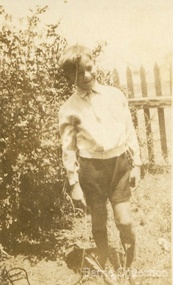
... Dad accompanied by Max and I, frequently fished for eels in the Gillespie’s waterhole just below our place using a rod, line, sinker, hook baited with a worm, and a white floater so as to easily see when an eel was on the hook, so that it could quickly be pulled before it could anchor itself on and under water snag such as a tree root making it impossible to catch, or causing the line to be lost. ...Dad accompanied by Max and I, frequently fished for eels in the Gillespie’s waterhole just below our place using a rod, line, sinker, hook baited with a worm, and a white floater so as to easily see when an eel was on the hook, so that it could quickly be pulled before it could anchor itself on and under water snag such as a tree root making it impossible to catch, or causing the line to be lost. ...My Story by Bruce Myers – June 2001 Arthur Bruce Myers was born on Wednesday morning on the 29/4/1925 at Kelvin Grove Hospital Bacchus Marsh. Background Information: Prepared by Niece Wendy Barrie. The early life of Bruce Myers “Burnbank” Ballarat Road Melton. The family home was built by his grandparents Ann nee Dowling and Henri Miers in 1867. His father Frederick was born in 1877 in Melton the youngest of four boys. Bruce the fourth son of Frederick and Martha, brother Frederick the eldest was followed by Marjorie and Edna. His brother Max was the youngest child. Father Frederick Myers attended Melton State School No 430 enrolling in 1881 and leaving in 1888 gaining his Merit Certificate No 116343. Bruce enrolled in July 1931 and completed and gaining his Merit Certificate in 1937. In 1938 he travelled to Melbourne Boys High School. Bruce was taught piano by his sister Marjorie, a respected Melton music teacher. He entered many Piano competitions and at the age of 10 winning the radio cup in the Junior Cavalcade at 3AW at Latrobe Street. At Melbourne Boys High School during his lunchtime was allowed to practice the piano in the basement for his recreation. He was pestered by another boy (name I have forgotten) a teacher intervened telling him to leave Myers alone. As a young child when listening to music he was able to on hearing it identify the key it was written in, due to his perfect pitch. I remember “Mum” Myers telling about the time they went to see Artur Rubeinstein at a concert, when Bruce was a small boy, it may have been on this occasion that he had noted the key of the piano composition. Bruce writes – In my early teens Max and I frequently accompanied the Williams boys, Wally and Jim on expeditions up the Toolern Creek near where the Gisborne exit now crosses it. The dogs would chase the rabbits into their burrows after placing nets over the burrows a ferret would be let in to burrow, much excitement would be involved in the rush to grab the rabbits as they bolted into the nets. In the same area I used too accompany Dad on an evening rabbit shoot (summer time). After the heat of the day the rabbits would emerge from their burrows at dusk. We would his behind the tree in silence, a mark contrast to the ferreting scene. Dad with the shotgun cocked would wait until 2 or 3 rabbits were close together then fire (Bang!). Hopefully killing two rabbits. They would have to be killed outright, otherwise they would run back into their burrows. Needless to say, one deafening shot ended the event, also it only cost one cartridge. Our only swimming pool was hole in the Toolern Creek at its junction with the blind creek at the eastern entrance to Melton. Dad swum there in the 1880’s teaching many of the youngsters to swim. Females never swum there to my knowledge. The dressing shed consisted of a 4 corrugated iron nailed to a wooden frame about 4 metres by 3 no floor or roof. We always walked the kilometre in our bathers anyway. The swimming hole once dried up leaving about 2 ft of mud. We Melton boys had so much fun fossicking around with our hands and feet and yanking out numerous eels, some very bid. I don’t know what happened to them all. No doubt Dad would have skun one or two for Mum to cook after cutting them up into short lengths. They used to jump around the pan when they were cooking. Dad accompanied by Max and I, frequently fished for eels in the Gillespie’s waterhole just below our place using a rod, line, sinker, hook baited with a worm, and a white floater so as to easily see when an eel was on the hook, so that it could quickly be pulled before it could anchor itself on and under water snag such as a tree root making it impossible to catch, or causing the line to be lost. At about the age of 8, I suddenly discovered amazingly easily means of movement. One day when I was riding the bike on rough bluestone road near the Presbyterian Church [Uniting Church] in Melton when the front fork broke and I landed on my right knee and right eye gashing both, the knee severely. I have carried the scars ever since. I started getting mobile by riding a scooter with good leg on the scooter and swinging the right leg, keeping is straight because bending it was too painful.Childhood photo of Brucelocal identities -
 Ballarat Heritage Services
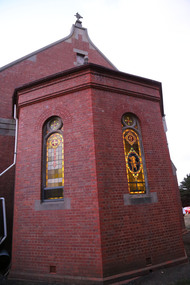
Digital photographs, L.J. Gervasoni, St Brigid's Crossley - Christmas Carols - stained glass windows night, 12/2016
... Peter said " Master, we have fished all night, and have found nothing." Still, they obeyed His command, and the nets were filled almost to breaking point. ...Peter said " Master, we have fished all night, and have found nothing." Still, they obeyed His command, and the nets were filled almost to breaking point. ..."NEW CROSSLEY CHURCH. BLESSING AND OPENING CEREMONY. A lasting testimony to the faithful generosity of the Catholic community at Crossley was vouchsafed on Sunday last, when the beautiful new church of St. Brigid was formally blessed and opened, in the presence of a particularly large congregation of adherents of the Roman Catholic faith, and many supporters of the doctrines of other churches. The function was further enhanced by the presence of two noted Catholics in Dr. Higgins (Bishop of Ballarat) and Dr. Mannix (Coadjutor Archbishop of Melbourne.) Upon arrival at the church the prelates were received by a guard of honor formed by the members of the H.A.C.B. Society, and were introduced to the members of the local committee. Then his Lordship the Bishop formally blessed the exterior and interior of the building. The building is handsome and commo dious, and one that should suffice for the population of the Crossley district for many years to come. Standing upon the highest point in the vicinity it occupies a commanding position and is a prominent landmark for many miles around. At first it was intended to pull down the old church and erect the new one upon the space occupied by it, but subsequently the land adjoining was purchased, and the sacred edifice built upon it. The style of architecture is a free treatment of the Romanesque. In a short space of time the grounds and walks were transformed by working bees and made to conform to the beauty of the building. The interior is most artistic, and would be difficult to improve upon in elegance of design, while the furnishings are most appropriate, and harmonise excellently with the general scheme of decoration. It seats 400 people and in addition there is a choir gallery with a seating capacity of 60. The church is lighted with leaded Cathedral glass windows, and the front presents a pleasing appearance, the entrance porch being surmounted with a semi-Gothic window. The floor is tiled throughout. The ceilings are semi-circular in form, with beautiful designs worked in fibrous plaster. The brickwork of the structure is faced with cement, and it has a slate roof. It is undoubtedly an addition to the ecclesiastical buildings of the district, and was universally admired. The architect was Mr. A. A. Fritsch, of Melbourne, and the contractors Messrs F. and E. Deague, of North Fitzroy. On the doors being thrown open for the admission of the congregation, the seating accommodation was immediately fully taxed, and the lengthy service and sermon were listened to with the greatest interest and attention. Missa Cantata was sung, the Rev. Father Phelan, Koroit, being the celebrant. The musical arrangements were in the capable hands of Mr. Renwick, of Warrnambool, while Miss Logan presided at the organ. Mrs. Dan. Ryan was the soprano soloist, and sang Gounod's Ave Maria at the offertory very sweetly and expressively. At the consecration Rossi's Tantum Ergo was sung by Messrs Crowley and Renwick; Farmer's Kyrie Gloria and Agnus Dei and Webb's Credo were rendered during mass, and while the collection was being taken additional numbers were sung. The occasional sermon was preached by the Coadjutor Archbishop (Dr. Mannix), who based his remarks upon the Gospel for the day, St. Luke V., verses I to II, dealing with the miraculous draught of fish. On His return from Galilee Christ found that the fishermen had been toiling all night, and had caught nothing. He entered one of the ships, and addressed the multitude on shore. It was a beautiful picture, and no doubt he spoke to them about the kingdom to be established on earth. When He had finished speaking He told the fishermen to launch out into the deep. Peter said " Master, we have fished all night, and have found nothing." Still, they obeyed His command, and the nets were filled almost to breaking point. Having brought their ships to land they left everything and followed Him. In that lesson they had a symbol of God's dealing with men through the church He has established on earth. Their confidence was richly rewarded, and Christ founded His church upon those twelve Apostles. At that time the world was mostly pagan, steeped in iniquity and sin. The chosen people of God worshipped with their lips, but their hearts were far from it. When Christ wanted to estab lish His church on earth, and leave an organisation to carry on the work, did He select the most intellectual, or the most rich or powerful men? Neither did the time seem propitious. He selected twelve men who from a human point of view were quite incapable of accomplishing anything. What happened when the Jews put Him to death? The chosen twelve left Him at the critical hour, and when He came to die on the cross they were not there, but hid themselves from the hate and fury of the Jews. When the Holy Ghost came down upon them and strengthened them they became courageous and went forth at the bidding of their Master to teach all nations. Their success was not confined to the first meet ing after Pentecost, at which they made 5000 converts, but continued until the whole world had been brought into the net. It was surely a consolation to them as well as to him (the preacher), that they came from a land which of all others had been faithful to the teaching of Jesus Christ. The sons and daughters of St. Patrick had taken a great part in bringing men into the meshes of the church. It was due to the nation they belonged to that the church flourished not only in Ireland, but in England, Scotland, Ame rica, and Australia. It may have seemed hard that in the providence of God so many had to leave their homes and find a home in other lands. They had emi grated to the towns of England and Scotland, and had been the means of keeping the Catholic faith living in those places. In the United States and Canada many had made a home for themselves, and were always found faithful to God and to the true church. If to-day the Irish Catholics and Catholics of Irish des cent were taken out of the English and Scotch population there would be little left of the true Church of God. Perhaps they had not the learning of other nations. Certainly they had not the wealth of other nations, and not the power of the sword, but God was with them, and the faith they took from the old land nourished in the distant places. There was a time in Aus tralia when those opposed to God and God's Church thought they could rule Providence and make Australia a Pro testant land. They had lived to see whe ther God or His enemies are the more powerful, and the names of those who tried to stamp out the Catholic religion were forgotten, or only remembered be cause of their persecution. They had lived to see the glorious success which rested upon the Catholic Church in Aus-tralia, which the Irish people had built up stone by stone. Nowhere was it held in higher esteem than in these islands, and the people would always be faithful to God and His church. It was an inspira tion to go into the glorious church opened that day. It stood for loyalty and faith fulness and was a credit and a consola tion to the Bishop and people of the diocese, to the architect, and to the priests and the honest and zealous administrator of the parish. There was hope and an inspiration in that day's celebrations, and surely the Catholic faith would sink deeper and deeper into the people as time went on, and the progress of the last fifty years would be small as compared to the progress of the future. He congratulated the Bishop and priests who had raised that temple, and the people of Crossley upon their generosity and self-sacrifice. He prayed that the blessing of God and St. Brigid would rest upon them, their children, and their children's children. He hoped that not one of those who had received the sacrament at that church would be missing when called before the Judgment Seat, and that all would be counted into the enjoyment of eternal bliss. The Rev. Father Kerin then made a statement of the position of the finances, after which a special col lection was made towards the cost of the building. A list of subscribers of £l and upwards was read, to which Bishop Higgins contributed £250, Rev. Father Kerin £20, and the Coadjutor Archbishop £5. The amount totalled £1245 10s 7d. Pre vious donations totalled £1077 3s, and His Lordship gave an additional £250. An indebtedness of £3974 had been reduced by £1245, leaving a debit balance of £2728. The cost ot the church completed was £6250. They had broken the back of the debt, and were not frightened of it. It was also announced that the beautiful Stations of the Cross, which adorn the walls, had been donated by the following: Mr and Mrs. P. Crowe, Mr. and Mrs. T. Bushell, Mr. and Mrs. P. Gorman, Miss M. Dunne, Mr. Mugavin and Miss Mugavin, Mr. and Mrs. C. Conway, Misses A. and F. Broderick, Mr. and Mrs. Michael Hennessy, Miss K. A. M'Carthy, Mr. and Mrs. Wm. Dalton, Mrs. M. J. Greene, Mrs. and Miss K. Dwyer, Mr. and Mrs. John Mugavin, and the Rev. J. J. Manning. The new Estey organ was contributed by the school children, as the result of an enter tainment. Other donors of furnishings, etc., were Mrs. Brown, senr., (Kirkstall), and Mrs. James Maloney (Killarney), and Mrs. and Miss O'Donohue. The vestments were the gifts of Mr. and Mrs. M. Foley, of Killarney. The furnishings, carpeting, etc., of the sanctuary have been carried out by the Crossley Altar Society, of which Mrs. Jno. O'Brien is president, and Miss Mary Ryan secretary. In the course of a brief address Dr. Higgins expressed his deep indebtedness to the Coadjutor Archbishop for coming amongst them at a great sacrifice to assist in the ceremonies. He heartily thanked the people for their unbounded generosity, and congratulated priests and people upon the magnificent results of their efforts. They had an able champion in Dr. Mannix, who since coming amongst them had distinguished himself by his zeal for the church in this new land. He hoped he would be spared for many years to come to use his splendid talents in the service of the church. (Koroit Sentinel and Tower Hill Advocate, Saturday 4 July 1914, page 2)Digital images of the cathedral leadlight windowns in St Brigid's catholic Church, Crossley. st brigid's crossley, st brigid's, catholic church, catholic, church, religion, celebrations, christmas, christmas carols, carols, stained glass, window -
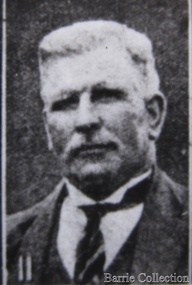 Melton City Libraries
Photograph, Charles Ernest Barrie, Unknown
... For a time during WW1 they lived at Moonee Ponds near the Lang grandparents at Ascot Vale. ...For a time during WW1 they lived at Moonee Ponds near the Lang grandparents at Ascot Vale. ...This document is has been compiled by Wendy Barrie daughter of Ernest (Bon) and Edna Barrie and granddaughter of Charles E and Jessie M Barrie. Ernie Barrie operated a travelling Chaff Cutter in the St Arnaud area where his parents William and Mary Ann had taken up land at Coonooer West in 1873. Ernie commenced his working life with a team of bullocks and a chaff cutter. The earliest connection he had with Melton was in 1887. By the beginning of the 20th century Ernie and his father William and brothers, William, Samuel, James Edwin,[Ted] Robert, Arthur and Albert have been associated with farming and milling in the Melton district. In the early 1900’s Ernie and his brother Ted were in partnership in a Chaff cutting and Hay processing Mill on the corner of Station and Brooklyn road Melton South. The mill was managed by William for a time. By 1906 Charles Ernest and James Edwin were in partnership in the Station Road mill when a connecting rail line across Brooklyn Road for a siding was constructed to the Melton Railway Station. In 1911 the Mill’s letterhead shows C.E. BARRIE Hay Pressing and Chaff Cutting Mills. Melton Railway Station. Telephone No 1 Melton. This Mill as sold to H S K Ward in 1916 and stood until 1977 when it burnt down in a spectacular fire. Ernie built a house at Melton South beside the Chaff Mill at Station Road in 1906 and married Jessie May Lang in August at the Methodist Church. Jessie’s father was Thomas Lang. He came to Melton in 1896 and was the Head Teacher at Melton State School No 430 until he retired in 1917. They had 9 children with 8 surviving to adulthood. Jessie and Ernie had 6 sons and 3 daughters. All the children lived at Darlingsford. In April 1910 the family left Melton for a brief period and moved to a farm in Trundle in NSW. They returned to Melton and purchased Darlingsford in May 1911. For a time during WW1 they lived at Moonee Ponds near the Lang grandparents at Ascot Vale. Mary and Bon attended Bank St State School. The children developed diphtheria in 1916 and their youngest boy, Cecil died of complications. Mary and Bon were taken to Fairfield Hospital and both recovered. At the end of the war influenza broke out the family returned to Darlingsford and shared the home for a short while with the Pearcey family who had been working the farm. By 1922 the family had and grown and Edgar, Tom, Horace, Jessie, Joyce and Jim were living a Darlingsford. Ernie continued during the 1920’s working the farm and attend his many civic and community commitments. Two 8 clydesdale horse teams were used to work the land which meant early rising for the horses to be fed and harnessed to commence the days work. In 1916 Ernie also became involved in a Chaff Mill on the corner of Sunshine and Geelong Road West Footscray, which at the time was being run by John Ralph Schutt. It was known an Schutt Barrie. A flour mill was added at a later stage. Other Schutt and Barrie mills were situated at Parwan and Diggers Rest. Another mill was situated beside the railway line at Rockbank. The Footscray mill ceased operation in 1968 Ernie spent a lot of time and energy at the Parwan Mill and travelling around Parwan and Balliang farms, where he came to know many of the families in the district. Ernies commitment to the civic development to the Melton and district was extensive, he was involved with a number of large events during the 1920’s such as the Melton Exhibitions and the 1929 Back to Melton Celebrations. He was a member of the Australian Natives Association at the turn of the century. He was Chairman of the School Committee at Melton State School 430 and the Melton South State School in thw1920s. He donated the land for a Hall for Melton South in 1909, known as Exford Hall and later in 1919 renamed Victoria Hall. The Hall was demolished in 1992. He was a Councillor, JP, and Vice President and President of the Melton Mechanics Institute Hall Committee in 1915- 1916. He was a member of the Methodist Church and later the Scots Presbyterian Church. He was Superintendent of the Sunday School of the Methodist Church to 1910 and later Scots Presbyterian Church until 1931. This is reflected in the theme of children in the stained glass window which was dedicated in his memory by his wife Jessie as a gift to the Scots Church. Charles Ernest Barrie made many generous donations to many charities who supported young people and children. In 1918 Jessie and Ernie made the first donation to a very prominent Victorian charity whose work still continues. Yooralla. In July 1931 Ernie’s untimely death was a major blow to the family and the Melton community. To this day people still vividly recall the day they lined the streets for his funeral. The day of the funeral is recalled as the day Melton stood as two of their prominent citizens who tragically died on the same dayPhotograph of Charles Ernest Barrie taken from Scenes at Melton and Old Residentslocal identities -
 Bendigo Military Museum
Photograph - 4th Field Survey Squadron Adventurous Training, Mount Remarkable National Park, Flinders Ranges, SA, 4th Field Survey Squadron Adventurous Training, Mount Remarkable National Park, SA, 1987
... L to R: SPR Bruce Graham, LT Geoff ‘GT’ Ford, CPL Jamie ‘Fish’ McRae, SGT Wally Chilcott, SPR Shaun Hynes, CPL Kevin Whitty. .29) - Photo, colour, 1987. ...L to R: SPR Bruce Graham, LT Geoff ‘GT’ Ford, CPL Jamie ‘Fish’ McRae, SGT Wally Chilcott, SPR Shaun Hynes, CPL Kevin Whitty. .29) - Photo, colour, 1987. ...This is a set of 40 photographs of 4th Field Survey Squadron undergoing adventurous training at Mount Remarkable National Park, South Australia in May 1987. It is evident the training focussed on teamwork, leadership, abseiling, rock climbing, field craft and living off the land survival skills. Elements from units of the Army Reserve also participated in the training. Refer to items 6546.42P and 6548.14P for additional photographs taken during the adventurous training.This is a set of 40 photographs of 4th Field Survey Squadron undergoing adventurous training at Mount Remarkable National Park, South Australia in May 1987. The colour photographs are on 35mm negative film and are part of the Army Survey Regiment’s Collection. The photographs were scanned at 96 dpi. .1) - Photo, colour, 1987. Camp activities, unidentified soldier. .2) - Photo, colour, 1987. Camp activities, unidentified personnel. .3) & .4) - Photo, colour, 1987. Hootchie set-up. .5) - Photo, colour, 1987. Camp activities, unidentified personnel. .6) - Photo, colour, 1987. Hootchie set-up. .7) - Photo, colour, 1987. Camp activities. .8) - Photo, colour, 1987. Hootchie set-up, unidentified officer. .9) - Photo, colour, 1987. Camp activities. Results from foraging the forest for food. .10) - Photo, colour, 1987. Camp set-up. .11) - Photo, colour, 1987. Camp activities. .12) - Photo, colour, 1987. Camp activities. L to R: CPL Jeff Prince, unidentified (x3). .13) to .16) - Photo, colour, 1987. Camp activities. .17) & .18) - Photo, colour, 1987. Mount Remarkable National Park terrain. .19) - Photo, colour, 1987. Hootchie set-up. L to R: unidentified, CPL Jeff Prince, SPR Perry Langeberg, unidentified (x3). .20) - Photo, colour, 1987. Camp activities. .21) - Photo, colour, 1987. Camp activities, unidentified personnel. .22) & .23) - Photo, colour, 1987. Camp set-up. .24) - Photo, colour, 1987. Hootchie set-up. .25) - Photo, colour, 1987. Hootchie set-up, unidentified, Mick Hogan, unidentified. .26) - Photo, colour, 1987. Camp activities. L to R: CPL Jeff Prince, SPR Steve Ellis, SGT Peter Imeson, CPL Neale ‘Tex’ Houston, SPR Perry Langeberg, unidentified exchange officer, WO2 Russ Larsen. .27) - Photo, colour, 1987. Hootchie set-up. .28) - Photo, colour, 1987. Camp activities. L to R: SPR Bruce Graham, LT Geoff ‘GT’ Ford, CPL Jamie ‘Fish’ McRae, SGT Wally Chilcott, SPR Shaun Hynes, CPL Kevin Whitty. .29) - Photo, colour, 1987. Camp activities. L to R: CPL Steve Wainwright, SPR Todd Hayley, SPR Pat Austine, WO2 Phil Symmans, SSGT Cam Chapman, CPL Dave Irving. .30) - Photo, colour, 1987. Camp activities. L to R: unidentified (x2), LT Greg Oaten CSC, unidentified (x2), CPL Peter Hardy, unidentified. .31) - Photo, colour, 1987. Camp activities. L to R: CPL Roger Graf, WO2 Bob Rogister, SSM WO1 Bill Griggs, unidentified officer, SPR Simon Reynolds, SPR John Keely. .32) - Photo, colour, 1987. Camp activities. L to R: unidentified, SPR Steve Nokes, SGT Stu Symonds, WO2 Brett ‘Dutchy’ Van Leeuwen, unidentified (x2), CPL John Ratcliffe. .33) - Photo, colour, 1987. Camp activities. L to R: unidentified, SGT Derek Stanmore, CAPT Danny Galbraith, unidentified in foreground. .34) - Photo, colour, 1987. Camp activities. L to R: unidentified (x3), SGT Derek Stanmore, CAPT Danny Galbraith. .35) - Photo, colour, 1987. Camp activities. .36) - Photo, colour, 1987. Camp activities. OC MAJ Peter Cates. .37) - Photo, colour, 1987. Camp activities. L to R: unidentified, CPL Dave Longbottom. .38) - Photo, colour, 1987. Camp activities, unidentified personnel. .39) & .40) - Hootchie set-up..1P to .40P – There are no personnel identified. ‘1987 ADV TRAINING’ annotated on negatives sleeve.royal australian survey corps, rasvy, 4 fd svy sqn -
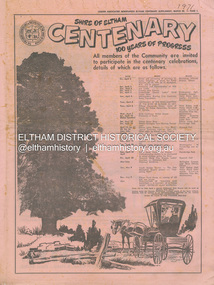 Eltham District Historical Society Inc
Newspaper - Supplement, Leader Associated Newspapers, Shire of Eltham Centenary; 100 Years of Progress, March 30, 1971
... (Eltham) Keith Wilkie’s Mensland (Montmorency) Eltham Home Supplies (Eltham) Safeway (Greensborough) Lower Plenty Fish Supply Blue Gum Milk Bar (Eltham) W. Hutchinson Sand Soil & Gravel Suppliers (Greensborough) Keyzers Milk Bar (Greensborough) P.J. ...Avery Butchers (Eltham) La Ronde Restaurant (Eltham) Lower Plenty Fish Supply Lyon Bros Ford (Eltham) Mac’s Meats (Eltham) Maranne Beauty Salon (Montmorency) Miss V. ...Produced as a supplement to the Diamond Valley News in celebration of the centenary of the Shire of Eltham in 1971. Contains stories of historical note about people and places of the shire as well as numerous advertisng by local businsesses. Also on page 1 lists the program of events commencing Friday, April 2 commencing with a dinner and previewing of paintings by Justus Jorgensen at Montsalvat attended by the Prime Minister, the Rt. Hon. W. H. McMahon running through to the publication of Pioneers & Painters edited by Alan Marshall. Contents: Page 1 Program of Events Page 2 Wingrove . . man of Eltham Page 3 Council people of 100 years Page 5 Capt. Sweeney, Eltham’s first Irish settler Page 6 Station a tribute to ex-concillor Page 7 Eltham 25 Years Ago just a street Page 9 Kangaroo Ground – once the hub of the shire Page 10 Festival of Arts and Crafts at Montsalvat Page 11 Obelisk honours their memory Page 11 Henry Dendy – an Eltham venture Page 12 Free by rail – if they worked Page 12 The long shadow of Ween Cameron Page 13 McMahon’s – a momentous era Page 14 50 Years Ago . . . Lyon Bros Ford Page 15 Beer at 3d. a pint Page 17 Oldest Home Built in 1850 Page 19 History in black and white . . . . Page 20 Historical Pigeon Bank Page 22 Bridge over log crossing Page 22 Pioneer shot by outlaw Page 23 Milestone for Smith Family Page 24 The Eltham Chamber of Commerce Mardi Gras Advertisers: F.J. & R. Favier (Butcher & Delicatessen Lower Plenty) Eltham Hotel Country Art Store (Eltham) A.R. Warren (Eltham) Heidelberg Travel Service Williams Butcher (Lower Plenty) Greensborough Bulk Store Mac’s Meats (Eltham) Buxton Garden Ornaments (Eltham) Hugh Fisher Photographer (Eltham) Para (Mach. Trading Co. (Greensborough) Westfield Shoppingtown (Doncaster) Clinton’s (Eltham) Gillespie & Lewis P/L (Soft Furnishings Greensborough) T. Hutchinson’s Engineers (Greensborough) Knox & Hellemons Pty Ltd (Builders) Angliss Butchers (Eltham) Rainbow Real Estate (Research) Research Licensed Supermarket Gibsons Research Meat Supply Owen Holmes Motors (Greensborough) Research Pharmacy R. & P. Humphries Delicatessen (Eltham) Montsalvat Eltham Apex Mowerama (Eltham) R.H. Dean & Son Real Estate (Greensborough) L.J. & J.D. Avery Butchers (Eltham) Deylen & Torikov (Motor Engineers Eltham) George Lovitt & Co. Pty Ltd Precision Engineers and Toolmakers Montmorency) Fred’s Mower Repairs (Lower Plenty) Gray’s Milk Bar (Montmorency) Maranne Beauty Salon (Montmorency) Evans Bros. & Newell Pty Ltd (Printing Greensborough) La Ronde Restaurant (Eltham) Terry & Margaret’s Garage (Caltex Lower Plenty) Kevin Dawson Building & Joinery Contractors (Eltham) Montmorency Authorised Newsagency Eltham Produce Store (W.J. Cameron) Consolidated Aluminium (Aust.) Pty Ltd (Eltham) Briar Hill Timber & Trading Co. Pty Ltd Diamond Valley Coaches (Eltham) Lyon Bros Ford (Eltham) The Natural Development Association (Eltham Shire) Alan Whitmore R.E.S.I. (Eltham) Keith Wilkie’s Mensland (Montmorency) Eltham Home Supplies (Eltham) Safeway (Greensborough) Lower Plenty Fish Supply Blue Gum Milk Bar (Eltham) W. Hutchinson Sand Soil & Gravel Suppliers (Greensborough) Keyzers Milk Bar (Greensborough) P.J. Timber & Trading Pty Ltd (Eltham) Diamond Valley Motocycles (Honda Macleod) Neville F. Emerson Real Estate (Lower Plenty) Edon Engineering (Eltham) Mobil Service Centre (Eltham) C.A. & J.M. Kohlman (Panton Hill General Store) C.A. & J.M. Kohlman (Smiths Gully General Store) ANZ (Eltham) Diamond Valley Demolition (Eltham) Volkswagen Specialists (D. Young Greensborough) N.F. Thorpe Pty Ltd Precision Engineers (Briar Hill) Ashley’s Milk Bar (Montmorency) J. Turnbull (General Blacksmith Greensborough) Airlook Service Station (Montmorency) A. & L. Mallios (Grocer Hurstbridge) United Refrigeration Pty Ltd (Greensborough) Peter McDougall & Associates Real Estate (Eltham) Hurstbridge Bus & Taxi Service Pty Ltd Browne Bros. Safeway (Eltham) St Andrews Hotel Eltham Real Estate Pty Ltd Eltham Chamber of Commerce B.P. Evergreen Service Station (Eltham) A.R. Warren Fuel Merchant (Eltham) W. Penna Chemist (Eltham) PPH Produce Paint Hardware (Eltham) Eltham Cake Kitchen (Eltham) Fred Ramak Continental Hairdresser (Eltham) Clinton’s (Eltham) Thompson’s Pharmacy (Eltham) Tillings Timber Supermarket (Eltham) Lyon Bros Ford (Eltham) Bob Clarke’s Men’s Wear (Eltham) Eltham Glen Service Station (Eltham) Miss V. Rampton Naturopath (Eltham) Eltham South Milk Bar (Eltham) Eltham Jewellers (Eltham) Baines Supa-Valu Supermarket (Eltham) Sibbel Builders P/L (Eltham) G. & E. Reivers Fly and Shower Screens (Eltham) Kenton Shoeland (Eltham) Eltham Newsagency (Eltham)One copy marked '1971' on fronta. & l. mallios (grocer hurstbridge), a.r. warren (eltham), a.r. warren fuel merchant (eltham), airlook service station (montmorency), alan whitmore r.e.s.i. (eltham), angliss butchers (eltham), anz (eltham), ashley’s milk bar (montmorency), b.p. evergreen service station (eltham), baines supa-valu supermarket (eltham), blue gum milk bar (eltham), bob clarke’s men’s wear (eltham), briar hill timber & trading co. pty ltd, browne bros. safeway (eltham), buxton garden ornaments (eltham), c.a. & j.m. kohlman (panton hill general store), c.a. & j.m. kohlman (smiths gully general store), clinton’s (eltham), consolidated aluminium (aust.) pty ltd (eltham), country art store (eltham), deylen & torikov (motor engineers eltham), diamond valley coaches (eltham), diamond valley demolition (eltham), diamond valley motocycles (honda macleod), edon engineering (eltham), eltham apex, eltham cake kitchen (eltham), eltham chamber of commerce, eltham glen service station (eltham), eltham home supplies (eltham), eltham hotel, eltham jewellers (eltham), eltham newsagency (eltham), eltham produce store (w.j. cameron), eltham real estate pty ltd, eltham south milk bar (eltham), evans bros. & newell pty ltd (printing greensborough), f.j. & r. favier (butcher & delicatessen lower plenty), fred ramak continental hairdresser (eltham), fred’s mower repairs (lower plenty), g. & e. reivers fly and shower screens (eltham), george lovitt & co. pty ltd precision engineers and toolmakers montmorency), gibsons research meat supply, gillespie & lewis p/l (soft furnishings greensborough), gray’s milk bar (montmorency), greensborough bulk store, heidelberg travel service, hugh fisher photographer (eltham), hurstbridge bus & taxi service pty ltd, j. turnbull (general blacksmith greensborough), keith wilkie’s mensland (montmorency), kenton shoeland (eltham), kevin dawson building & joinery contractors (eltham), keyzers milk bar (greensborough), knox & hellemons pty ltd (builders), l.j. & j.d. avery butchers (eltham), la ronde restaurant (eltham), lower plenty fish supply, lyon bros ford (eltham), mac’s meats (eltham), maranne beauty salon (montmorency), miss v. rampton naturopath (eltham), mobil service centre (eltham), montmorency authorised newsagency, montsalvat, mowerama (eltham), n.f. thorpe pty ltd precision engineers (briar hill), neville f. emerson real estate (lower plenty), owen holmes motors (greensborough), p.j. timber & trading pty ltd (eltham), para (mach. trading co. (greensborough), peter mcdougall & associates real estate (eltham), pph produce paint hardware (eltham), r. & p. humphries delicatessen (eltham), r.h. dean & son real estate (greensborough), rainbow real estate (research), research licensed supermarket, research pharmacy, safeway (greensborough), shire of eltham centenary, sibbel builders p/l (eltham), st andrews hotel, t. hutchinson’s engineers (greensborough), terry & margaret’s garage (caltex lower plenty), the natural development association (eltham shire), thompson’s pharmacy (eltham), tillings timber supermarket (eltham), united refrigeration pty ltd (greensborough), volkswagen specialists (d. young greensborough), w. hutchinson sand soil & gravel suppliers (greensborough), w. penna chemist (eltham), westfield shoppingtown (doncaster), williams butcher (lower plenty), a. roy ford, a.g. thomas, agnes bell, albert h. price, andrew ross, anton w. brinkkotter, arthur brindley, b. bessant, b.w. plant, bell family, charles wingrove, culla hill, dave lyon, david w. bell, e.j. andrew, edwin smith, eltham court house, eltham obelisk, ewen hugh cameron, f.e. griffith, f.v. squire, frank mcmahon, george green, george stebbing, h. eric rundle, harold e. bartlett, henry dendy, henry hurst, henry stooke, herbert a. davies, herbert hewitt, i.g. smedley, j.a. mcdonald, jack baker, jack williams, james k. brice, james rossiter, john lyon, john s. smedley, justus jorgensen, kangaroo ground, larry burke, martin mcmahon, menzies jackson, mott family, mrs andrew, mrs harper, p. harmer, p.j. lester, patrick joseph mcmahon, r.j. galbraith, robert burke, robert charles harris, rosehill, s. willey, shillinglaw cottage, shire of eltham war memorial tower, thomas sweeney, tiny carroll, tom orford, w.b. thomas, william morris -
 Eltham District Historical Society Inc
Book, Percy Leason: an artist's life by Margot Tasca, 2016
... He was kept occupied building structures around the property·, such as the garage, the outside toilet, garden beds, trellis arbours and a number of ponds. The elderly, bearded Scotsman with his old hat and baggy pants also provided the inspiration for one of the characters Leason regularly included in his cartoons. ...He was kept occupied building structures around the property·, such as the garage, the outside toilet, garden beds, trellis arbours and a number of ponds. The elderly, bearded Scotsman with his old hat and baggy pants also provided the inspiration for one of the characters Leason regularly included in his cartoons. ..."Who would have thought that a boy born in 1889 from the Victorian Mallee would become a successful artist on New York’s Staten Island? This finely illustrated, exhaustively researched and beautifully written biography on Leason features the artist’s entire career as a painter and cartoonist renowned for his depictions of Australian society in the 1920s and 1930s. Leason’s story is a poignant one tracing his beginnings as a cartoonist, to the bohemian Melbourne art scene in the early 20th century, to his involvement in the artists’ camps of Eltham, to his important series of portraits of Lake Tyers Indigenous Australians, and his eventual move to the US where he has been acknowledged as making an enormous contribution to the New York arts scene. This story, as yet untold, fills a gap in the history of art in Australia and offers a new perspective on Australian art in the first half of the 20th century." - Thames and Hudson website A NEW HOME IN ELTHAM Once they had settled back into Melbourne, Perry and Belle began to look for a place to make a permanent home. Having enjoyed the bush setting of Mosman, they decided to explore the rural fringes of Melbourne. Each weekend they packed a picnic and travelled to the towns in the nearby hills - such as Ferntree Gully, Sassafras, Lilydale and, of course, Cockatoo Creek. Eventually deciding these places might be a little too far from The Herald office, they searched closer to the city. The Heidelberg and Box Hill regions that had inspired his old teacher McCubbin, had become busy, urban areas but further east, towards Warrandyte and Templestowe, there were still large tracts of bush. Finally they settled on Eltham, an area Percy knew very well, having often painted there with Jock Frater. Perry's old friend Dick McCann and his wife Margery had also settled in Eltham. The township was fifteen miles from Melbourne and serviced by an electric train that went to the central Melbourne station of Flinders Street, near where The Herald offices were located. Eltham was a small village in 1925, separated from Melbourne by the Yarra River, and surrounded by orchards and large tracts of bush. Small farms dotted the landscape and the main businesses revolved around ironmongers, blacksmiths, and farming supplies. Of particular appeal to artists was Eltham Park, a large expanse of bushland bounded by the Yarra River on the south side and the Diamond Creek on the east. The park included a playing field that was busy on weekends with cricket or football matches, but for the rest of the week it was mostly empty and an ideal place to paint. The scenery there provided the inspiration for many paintings by Leason, Meldrum and other artists such as Colin Colahan and Peter (A.E.) Newburv. The Leasons found a rundown old farmhouse on four-and-a-half acres of land in New Street, now known as Lavender Park Road. The site was splendid, at the top of a gentle slope which gave panoramic views east to the Dandenong hills, south over the Templestowe orchards and north to Kinglake. The front lawn was taken over by onion grass (or wiregrass as Leason called it) and scattered about the property were many wattles and gum trees. Aloe cacti covered much to the front of the house, while old quince and lucerne hedges separated the house and out-buildings from a rundown apple orchard. Here they would build a new home. ·with financial assistance from The Herald, Leason bought the property and immediately commissioned an architectural firm to design a new house in the popular bungalow style of the time. The old farm house was demolished but Percy saved the siding boards, bricks and corrugated iron for the outbuildings of his new home. The new house was a two storey, triple brick with a large, gabled, terracotta tiled roof. It was situated at the very top of the slope. The paint and varnish were barely dry when the family moved in during the summer of 1925-26 and the fumes were overpowering in the heat. Despite the house being wired for electricity, power poles had not yet reached the area and initially the family had to rely on kerosene lamps and candles. When electricity did arrive, Leason reflected on the community's reception of electricity at the expense of the old growth gum tree corridors in his cartoon, Electricity comes to Wiregrass. The family had now grown to seven. Jack was nearly nine, Jean was seven, Marjory was four, Nancy was two and the baby Patricia was seven months old. Jack and Jean were enrolled in the local primary school down the hill. A retired farmer, Jock McMillan, came to live on the property and help out with the general maintenance. Jock built himself a shack and Belle provided him with meals. He was kept occupied building structures around the property·, such as the garage, the outside toilet, garden beds, trellis arbours and a number of ponds. The elderly, bearded Scotsman with his old hat and baggy pants also provided the inspiration for one of the characters Leason regularly included in his cartoons. Like Leason, Jock smoked a straight stemmed pipe. A neighbour was employed to help Belle with domestic chores, and so the family settled down to live comfortably in their new Eltham house. Two dogs, Maginary and Wodger, completed the large and vibrant household. “Percy Leason; an artist’s life” by Margot Tasca, Thames & Hudson Australia Pty Ltd, Port Melbourne 2016, pp 63-64 Hardback Bookpercy leason, margot tasca, biography, artist, landscape -
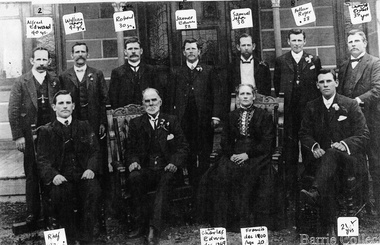 Melton City Libraries
Photograph, Charles Ernest Barrie and family, 1906
... For a time during WW1 they lived at Moonee Ponds near the Lang grandparents at Ascot Vale. ...For a time during WW1 they lived at Moonee Ponds near the Lang grandparents at Ascot Vale. ...Photograph was taken on the 23rd of August 1906, the day of Jessie May Lang and Charles Ernest Barrie's wedding. Held at the Methodist Church Melton. UMMARY – Charles Ernest Barrie d.1931 Born 1871 Ballarat d 1931 This document is has been compiled by Wendy Barrie daughter of Ernest (Bon) and Edna Barrie and granddaughter of Charles E and Jessie M Barrie. My grandfather was well known in the district and was mostly referred to as Ernie. He shared the same initials as his second son Edgar. His three eldest sons lived and farmed in Melton for their entire lives. His descendants are still associated with farming, engineering and earthmoving in Melton. Ernie Barrie operated a travelling Chaff Cutter in the St Arnaud area where his parents William and Mary Ann had taken up land at Coonooer West in 1873. Ernie commenced his working life with a team of bullocks and a chaff cutter. The earliest connection he had with Melton was in 1887. By the beginning of the 20th century Ernie and his father William and brothers, William, Samuel, James Edwin,[Ted] Robert, Arthur and Albert have been associated with farming and milling in the Melton district. In the early 1900’s Ernie and his brother Ted were in partnership in a Chaff cutting and Hay processing Mill on the corner of Station and Brooklyn road Melton South. The mill was managed by William for a time. By 1906 Charles Ernest and James Edwin were in partnership in the Station Road mill when a connecting rail line across Brooklyn Road for a siding was constructed to the Melton Railway Station. In 1911 the Mill’s letterhead shows C.E. BARRIE Hay Pressing and Chaff Cutting Mills. Melton Railway Station. Telephone No 1 Melton. This Mill as sold to H S K Ward in 1916 and stood until 1977 when it burnt down in a spectacular fire. Ernie built a house at Melton South beside the Chaff Mill at Station Road in 1906 and married Jessie May Lang in August at the Methodist Church. Jessie’s father was Thomas Lang. He came to Melton in 1896 and was the Head Teacher at Melton State School No 430 until he retired in 1917. They had 9 children with 8 surviving to adulthood. Jessie and Ernie had 6 sons and 3 daughters. All the children lived at Darlingsford. In April 1910 the family left Melton for a brief period and moved to a farm in Trundle in NSW. They returned to Melton and purchased Darlingsford in May 1911. For a time during WW1 they lived at Moonee Ponds near the Lang grandparents at Ascot Vale. Mary and Bon attended Bank St State School. The children developed diphtheria in 1916 and their youngest boy, Cecil died of complications. Mary and Bon were taken to Fairfield Hospital and both recovered. At the end of the war influenza broke out the family returned to Darlingsford and shared the home for a short while with the Pearcey family who had been working the farm. By 1922 the family had and grown and Edgar, Tom, Horace, Jessie, Joyce and Jim were living a Darlingsford. Ernie continued during the 1920’s working the farm and attend his many civic and community commitments. Two 8 clydesdale horse teams were used to work the land which meant early rising for the horses to be fed and harnessed to commence the days work. In 1916 Ernie also became involved in a Chaff Mill on the corner of Sunshine and Geelong Road West Footscray, which at the time was being run by John Ralph Schutt. It was known an Schutt Barrie. A flour mill was added at a later stage. Other Schutt and Barrie mills were situated at Parwan and Diggers Rest. Another mill was situated beside the railway line at Rockbank. The Footscray mill ceased operation in 1968. Ernie spent a lot of time and energy at the Parwan Mill and travelling around Parwan and Balliang farms, where he came to know many of the families in the district. Ernies commitment to the civic development to the Melton and district was extensive, he was involved with a number of large events during the 1920’s such as the Melton Exhibitions and the 1929 Back to Melton Celebrations. He was a member of the Australian Natives Association at the turn of the century. He was Chairman of the School Committee at Melton State School 430 and the Melton South State School in thw1920s. He donated the land for a Hall for Melton South in 1909, known as Exford Hall and later in 1919 renamed Victoria Hall. The Hall was demolished in 1992. He was a Councillor, JP, and Vice President and President of the Melton Mechanics Institute Hall Committee in 1915- 1916. He was a member of the Methodist Church and later the Scots Presbyterian Church. He was Superintendent of the Sunday School of the Methodist Church to 1910 and later Scots Presbyterian Church until 1931. This is reflected in the theme of children in the stained glass window which was dedicated in his memory by his wife Jessie as a gift to the Scots Church. Charles Ernest Barrie made many generous donations to many charities who supported young people and children. In 1918 Jessie and Ernie made the first donation to a very prominent Victorian charity whose work still continues. Yooralla. In July 1931 Ernie’s untimely death was a major blow to the family and the Melton community. To this day people still vividly recall the day they lined the streets for his funeral. The day of the funeral is recalled as the day Melton stood as two of their prominent citizens who tragically died on the same day. Charles Ernest Barrie with his parents and brothers at the front of the mill house in Melton Southlocal identities -
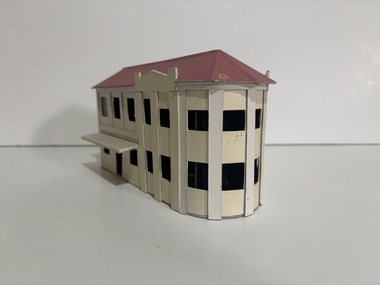 Sunshine and District Historical Society Incorporated
Model - Sunshine in the 1950's Model Railway Buildings
... 2823.01 - Sunshine in the 1950's Model Railway Buildings - Massey Ferguson Head Office Devonshire Road Photo 01.jpeg 2823.01 - Sunshine in the 1950's Model Railway Buildings - Massey Ferguson Head Office Devonshire Road Photo 02.jpeg 2823.01 - Sunshine in the 1950's Model Railway Buildings - Massey Ferguson Head Office Devonshire Road Photo 03.jpeg 2823.02 - Sunshine in the 1950's Model Railway Buildings - Massey Ferguson Show Room And Clock Tower Photo 01.jpeg 2823.02 - Sunshine in the 1950's Model Railway Buildings - Massey Ferguson Show Room And Clock Tower Photo 02.jpeg 2823.03 - Sunshine in the 1950's Model Railway Buildings - Sunshine Technical School Boys Trade Wing.jpeg 2823.04 - Sunshine in the 1950's Model Railway Buildings - Sunshine Technical School Office.jpeg 2823.05 - Sunshine in the 1950's Model Railway Buildings - Coles Hampshire Road.jpeg 2823.06 - Sunshine in the 1950's Model Railway Buildings - Commonwealth Bank Of Australia.jpeg 2823.07 - Sunshine in the 1950's Model Railway Buildings - Sunshine Arcade Jimmy's Barber Shop And Children's Wear Shop.jpeg 2823.08 - Sunshine in the 1950's Model Railway Buildings - Mann's Sporting Goods And Mott's Newsagency.jpeg 2823.09 - Sunshine in the 1950's Model Railway Buildings - Dickins Supermarket.jpeg 2823.10 - Sunshine in the 1950's Model Railway Buildings - Sunshine Railway Station Photo 01.jpeg 2823.10 - Sunshine in the 1950's Model Railway Buildings - Sunshine Railway Station Photo 02.jpeg 2823.11 - Sunshine in the 1950's Model Railway Buildings - Fish And Chips 77 - 79 Hampshire Road.jpeg 2823.12 - Sunshine in the 1950's Model Railway Buildings - Massey Ferguson Factory Building Photo 01.jpeg 2823.12 - Sunshine in the 1950's Model Railway Buildings - Massey Ferguson Factory Building Photo 02.jpeg 2823.13 - Sunshine in the 1950's Model Railway Buildings - Massey Ferguson Factory Building Photo 01.jpeg 2823.13 - Sunshine in the 1950's Model Railway Buildings - Massey Ferguson Factory Building Photo 02.jpeg 2823.14 - Sunshine in the 1950's Model Railway Buildings - Railway House.jpeg 2823.15 - Sunshine in the 1950's Model Railway Buildings - Railway House.jpeg 2823.16 - Sunshine in the 1950's Model Railway Buildings - Railway House.jpeg 2823.17 - Sunshine in the 1950's Model Railway Buildings - Railway House.jpeg 2823.18 - Sunshine in the 1950's Model Railway Buildings - House 18 Dove Street Footscray West Photo 01.jpeg 2823.18 - Sunshine in the 1950's Model Railway Buildings - House 18 Dove Street Footscray West Photo 02.jpeg 2823.18 - Sunshine in the 1950's Model Railway Buildings - House 18 Dove Street Footscray West Photo 03.jpeg 2823.19 - Sunshine in the 1950's Model Railway Buildings - House 18 Throsby Crescent Deer Park Photo 01.jpeg 2823.19 - Sunshine in the 1950's Model Railway Buildings - House 18 Throsby Crescent Deer Park Photo 02.jpeg 2823.20 - Sunshine in the 1950's Model Railway Buildings - House Photo 01.jpeg 2823.20 - Sunshine in the 1950's Model Railway Buildings - House Photo 02.jpeg 2823.20 - Sunshine in the 1950's Model Railway Buildings - Railway Carriage Container.jpeg 2823.21 - Sunshine in the 1950's Model Railway Buildings - Figueres.jpeg...Sunshine Buildings 2823.01 - Sunshine in the 1950's Model Railway Buildings - Massey Ferguson Head Office Devonshire Road Photo 01.jpeg 2823.01 - Sunshine in the 1950's Model Railway Buildings - Massey Ferguson Head Office Devonshire Road Photo 02.jpeg 2823.01 - Sunshine in the 1950's Model Railway Buildings - Massey Ferguson Head Office Devonshire Road Photo 03.jpeg 2823.02 - Sunshine in the 1950's Model Railway Buildings - Massey Ferguson Show Room And Clock Tower Photo 01.jpeg 2823.02 - Sunshine in the 1950's Model Railway Buildings - Massey Ferguson Show Room And Clock Tower Photo 02.jpeg 2823.03 - Sunshine in the 1950's Model Railway Buildings - Sunshine Technical School Boys Trade Wing.jpeg 2823.04 - Sunshine in the 1950's Model Railway Buildings - Sunshine Technical School Office.jpeg 2823.05 - Sunshine in the 1950's Model Railway Buildings - Coles Hampshire Road.jpeg 2823.06 - Sunshine in the 1950's Model Railway Buildings - Commonwealth Bank Of Australia.jpeg 2823.07 - Sunshine in the 1950's Model Railway Buildings - Sunshine Arcade Jimmy's Barber Shop And Children's Wear Shop.jpeg 2823.08 - Sunshine in the 1950's Model Railway Buildings - Mann's Sporting Goods And Mott's Newsagency.jpeg 2823.09 - Sunshine in the 1950's Model Railway Buildings - Dickins Supermarket.jpeg 2823.10 - Sunshine in the 1950's Model Railway Buildings - Sunshine Railway Station Photo 01.jpeg 2823.10 - Sunshine in the 1950's Model Railway Buildings - Sunshine Railway Station Photo 02.jpeg 2823.11 - Sunshine in the 1950's Model Railway Buildings - Fish And Chips 77 - 79 Hampshire Road.jpeg 2823.12 - Sunshine in the 1950's Model Railway Buildings - Massey Ferguson Factory Building Photo 01.jpeg 2823.12 - Sunshine in the 1950's Model Railway Buildings - Massey Ferguson Factory Building Photo 02.jpeg 2823.13 - Sunshine in the 1950's Model Railway Buildings - Massey Ferguson Factory Building Photo 01.jpeg 2823.13 - Sunshine in the 1950's Model Railway Buildings - Massey Ferguson Factory Building Photo 02.jpeg 2823.14 - Sunshine in the 1950's Model Railway Buildings - Railway House.jpeg 2823.15 - Sunshine in the 1950's Model Railway Buildings - Railway House.jpeg 2823.16 - Sunshine in the 1950's Model Railway Buildings - Railway House.jpeg 2823.17 - Sunshine in the 1950's Model Railway Buildings - Railway House.jpeg 2823.18 - Sunshine in the 1950's Model Railway Buildings - House 18 Dove Street Footscray West Photo 01.jpeg 2823.18 - Sunshine in the 1950's Model Railway Buildings - House 18 Dove Street Footscray West Photo 02.jpeg 2823.18 - Sunshine in the 1950's Model Railway Buildings - House 18 Dove Street Footscray West Photo 03.jpeg 2823.19 - Sunshine in the 1950's Model Railway Buildings - House 18 Throsby Crescent Deer Park Photo 01.jpeg 2823.19 - Sunshine in the 1950's Model Railway Buildings - House 18 Throsby Crescent Deer Park Photo 02.jpeg 2823.20 - Sunshine in the 1950's Model Railway Buildings - House Photo 01.jpeg 2823.20 - Sunshine in the 1950's Model Railway Buildings - House Photo 02.jpeg 2823.20 - Sunshine in the 1950's Model Railway Buildings - Railway Carriage Container.jpeg 2823.21 - Sunshine in the 1950's Model Railway Buildings - Figueres.jpeg Collection of paper & cardboard of various buildings in Sunshine in the 1950's that were built for a model railway. ...Scratch built models by hand by Michael Wakeling, a former Sunshine & North Sunshine resident and model railway enthusiast.Collection of paper & cardboard of various buildings in Sunshine in the 1950's that were built for a model railway. Many of the models are of Sunshine's popular buildings.2823.01 - Sunshine in the 1950's Model Railway Buildings - Massey Ferguson Head Office Devonshire Road Photo 01.jpeg 2823.01 - Sunshine in the 1950's Model Railway Buildings - Massey Ferguson Head Office Devonshire Road Photo 02.jpeg 2823.01 - Sunshine in the 1950's Model Railway Buildings - Massey Ferguson Head Office Devonshire Road Photo 03.jpeg 2823.02 - Sunshine in the 1950's Model Railway Buildings - Massey Ferguson Show Room And Clock Tower Photo 01.jpeg 2823.02 - Sunshine in the 1950's Model Railway Buildings - Massey Ferguson Show Room And Clock Tower Photo 02.jpeg 2823.03 - Sunshine in the 1950's Model Railway Buildings - Sunshine Technical School Boys Trade Wing.jpeg 2823.04 - Sunshine in the 1950's Model Railway Buildings - Sunshine Technical School Office.jpeg 2823.05 - Sunshine in the 1950's Model Railway Buildings - Coles Hampshire Road.jpeg 2823.06 - Sunshine in the 1950's Model Railway Buildings - Commonwealth Bank Of Australia.jpeg 2823.07 - Sunshine in the 1950's Model Railway Buildings - Sunshine Arcade Jimmy's Barber Shop And Children's Wear Shop.jpeg 2823.08 - Sunshine in the 1950's Model Railway Buildings - Mann's Sporting Goods And Mott's Newsagency.jpeg 2823.09 - Sunshine in the 1950's Model Railway Buildings - Dickins Supermarket.jpeg 2823.10 - Sunshine in the 1950's Model Railway Buildings - Sunshine Railway Station Photo 01.jpeg 2823.10 - Sunshine in the 1950's Model Railway Buildings - Sunshine Railway Station Photo 02.jpeg 2823.11 - Sunshine in the 1950's Model Railway Buildings - Fish And Chips 77 - 79 Hampshire Road.jpeg 2823.12 - Sunshine in the 1950's Model Railway Buildings - Massey Ferguson Factory Building Photo 01.jpeg 2823.12 - Sunshine in the 1950's Model Railway Buildings - Massey Ferguson Factory Building Photo 02.jpeg 2823.13 - Sunshine in the 1950's Model Railway Buildings - Massey Ferguson Factory Building Photo 01.jpeg 2823.13 - Sunshine in the 1950's Model Railway Buildings - Massey Ferguson Factory Building Photo 02.jpeg 2823.14 - Sunshine in the 1950's Model Railway Buildings - Railway House.jpeg 2823.15 - Sunshine in the 1950's Model Railway Buildings - Railway House.jpeg 2823.16 - Sunshine in the 1950's Model Railway Buildings - Railway House.jpeg 2823.17 - Sunshine in the 1950's Model Railway Buildings - Railway House.jpeg 2823.18 - Sunshine in the 1950's Model Railway Buildings - House 18 Dove Street Footscray West Photo 01.jpeg 2823.18 - Sunshine in the 1950's Model Railway Buildings - House 18 Dove Street Footscray West Photo 02.jpeg 2823.18 - Sunshine in the 1950's Model Railway Buildings - House 18 Dove Street Footscray West Photo 03.jpeg 2823.19 - Sunshine in the 1950's Model Railway Buildings - House 18 Throsby Crescent Deer Park Photo 01.jpeg 2823.19 - Sunshine in the 1950's Model Railway Buildings - House 18 Throsby Crescent Deer Park Photo 02.jpeg 2823.20 - Sunshine in the 1950's Model Railway Buildings - House Photo 01.jpeg 2823.20 - Sunshine in the 1950's Model Railway Buildings - House Photo 02.jpeg 2823.20 - Sunshine in the 1950's Model Railway Buildings - Railway Carriage Container.jpeg 2823.21 - Sunshine in the 1950's Model Railway Buildings - Figueres.jpegsunshine, buildings -
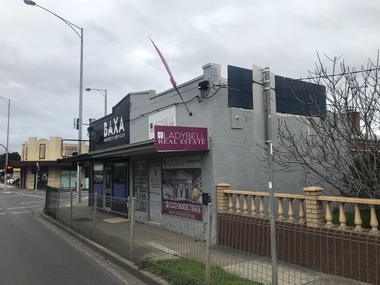 Sunshine and District Historical Society Incorporated
Photograph - Maidstone 2021 Photographs Part 1, John Alchin, 2021
... 5592.01 - Ballarat Rd 3 - 5 Maidstone 2021 Photo 01.JPG 5592.02 - Ballarat Rd 17a Maidstone 2021 Photo 02.JPG 5592.03 - Ballarat Rd 27 - 29 Maidstone - Former Email Meters Factory 2021 Photo 01.JPG 5592.04 - Ballarat Rd 45 - Former Shop 2021 Photo 01.JPG 5592.05 - Ballarat Rd 49 - 57 Maidstone 2021 Photo 01.JPG 5592.06 - Ballarat Rd 63 - 65 Maidstone - Former Shop 2021 Photo 01.JPG 5592.07 - Ballarat Rd 81 Maidstone - Former Shop 2021 Photo 01.JPG 5592.08 - Ballarat Rd 101 Maidstone 2021 Photo 01.JPG 5592.09 - Ballarat Rd 115 Maidstone 2021 Photo 01.JPG 5592.10 - Ballarat Rd 127 - 131 Maidstone 2021 Photo 01.JPG 5592.11 - Ballarat Rd 46 Maidstone - Catholic Archdiocese of Melbourne 2021 Photo 01.JPG 5592.12 - Ballarat Rd 115 Maidstone 2021 Photo 02.JPG 5592.13 - Ballarat Rd 154 Maidstone - Former Shop 2021 Photo 01.JPG 5592.14 - Ballarat Rd 154 Maidstone - Former Shop 2021 Photo 02.JPG 5592.15 - Ballarat Rd 154 Maidstone - Former Shop 2021 Photo 03.JPG 5592.16 - Ballarat Rd 154 Maidstone - Former Shop 2021 Photo 04.JPG 5592.17 - Commercial St 1 - 11 Maidstone - Shops.JPG 5592.18 - Curtin St Maidstone - Fish And Chip Shop 2021 Photo 01.JPG 5592.19 - Dobson Kindergarten Rogers Reserve Maidstone 2021 Photo 01.JPG 5592.20 - Dobson Reserve 2021 Photo 05.JPG 5592.21 - Dobson Reserve 2021 Photo 06.JPG 5592.22 - Drey Park Maidstone 2021 Photo 01.JPG 5592.23 - Emu Rd 35 - 37 Maidstone 2021 Photo 01.JPG 5592.24 - Emu Rd 52 - 64 Maidstone 2021 Photo 01.JPG 5592.25 - Gilda St 10 - 12 Maidstone - MacKillop Education Maidstone Campus 2021 Photo 02.JPG 5592.26 - Hampstead Rd 2 - 8 Maidstone 2021 Photo 02.JPG 5592.27 - Hampstead Rd 2 Maidstone - Supermarket 2021 Photo 01.JPG 5592.28 - Hampstead Rd 5 Maidstone - New Apostolic Church 2021 Photo 01.JPG 5592.29 - Hampstead Rd 40 - Iglesia Ni Cristo - Locale of Melbourne 2021 Photo 01.JPG 5592.30 - Lyon St Maidstone - Our Lady's Parish Hall 2021 Photo 01.JPG 5592.31 - Maidstone Child And Family Centre Rogers Reserve Maidstone 2021 Photo 01.JPG 5592.32 - Mitchell St - Jemena Zone Substation BY 2021 Photo 01.JPG 5592.33 - Mitchell St 54 Maidstone - Worldwide Missionary Movement Melbourne 2021 Photo 01.JPG 5592.34 - Mitchell St 86 - 88 Maidstone 2021 Photo 01.JPG 5592.35 - Mitchell St 90 Maidstone - Hillsong Melbourne West 2021 Photo 01.JPG 5592.36 - Mitchell St 108 Maidstone - Warren And Brown 2021 Photo 01.JPG 5592.37 - Mitchell St 110 - 112 Maidstone 2021 Photo 01.JPG 5592.38 - Mitchell St 112 Maidstone 2021 Photo 01.JPG 5592.39 - Mitchell St 114 - 116 Maidstone 2021 Photo 01.JPG 5592.40 - Mitchell St 116 Maidstone 2021 Photo 01.JPG ...Ballarat Road Commercial Street Curtin Street Emu Road Glida Street Hampstead Road Lyon Street Mitchell Street Maidstone Catholic Archdiocese of Melbourne Dobson Kindergarten Rogers Reserve Dobson Reserve Drey Park MacKillop Education Maidstone Campus New Apostolic Church Ernie's Supermarket Iglesia Ni Cristo - Locale of Melbourne Our Lady's Parish Hall Maidstone Child And Family Centre Jemena Zone Substation Worldwide Missionary Movement Melbourne Hillsong Melbourne West Warren And Brown 5592.01 - Ballarat Rd 3 - 5 Maidstone 2021 Photo 01.JPG 5592.02 - Ballarat Rd 17a Maidstone 2021 Photo 02.JPG 5592.03 - Ballarat Rd 27 - 29 Maidstone - Former Email Meters Factory 2021 Photo 01.JPG 5592.04 - Ballarat Rd 45 - Former Shop 2021 Photo 01.JPG 5592.05 - Ballarat Rd 49 - 57 Maidstone 2021 Photo 01.JPG 5592.06 - Ballarat Rd 63 - 65 Maidstone - Former Shop 2021 Photo 01.JPG 5592.07 - Ballarat Rd 81 Maidstone - Former Shop 2021 Photo 01.JPG 5592.08 - Ballarat Rd 101 Maidstone 2021 Photo 01.JPG 5592.09 - Ballarat Rd 115 Maidstone 2021 Photo 01.JPG 5592.10 - Ballarat Rd 127 - 131 Maidstone 2021 Photo 01.JPG 5592.11 - Ballarat Rd 46 Maidstone - Catholic Archdiocese of Melbourne 2021 Photo 01.JPG 5592.12 - Ballarat Rd 115 Maidstone 2021 Photo 02.JPG 5592.13 - Ballarat Rd 154 Maidstone - Former Shop 2021 Photo 01.JPG 5592.14 - Ballarat Rd 154 Maidstone - Former Shop 2021 Photo 02.JPG 5592.15 - Ballarat Rd 154 Maidstone - Former Shop 2021 Photo 03.JPG 5592.16 - Ballarat Rd 154 Maidstone - Former Shop 2021 Photo 04.JPG 5592.17 - Commercial St 1 - 11 Maidstone - Shops.JPG 5592.18 - Curtin St Maidstone - Fish And Chip Shop 2021 Photo 01.JPG 5592.19 - Dobson Kindergarten Rogers Reserve Maidstone 2021 Photo 01.JPG 5592.20 - Dobson Reserve 2021 Photo 05.JPG 5592.21 - Dobson Reserve 2021 Photo 06.JPG 5592.22 - Drey Park Maidstone 2021 Photo 01.JPG 5592.23 - Emu Rd 35 - 37 Maidstone 2021 Photo 01.JPG 5592.24 - Emu Rd 52 - 64 Maidstone 2021 Photo 01.JPG 5592.25 - Gilda St 10 - 12 Maidstone - MacKillop Education Maidstone Campus 2021 Photo 02.JPG 5592.26 - Hampstead Rd 2 - 8 Maidstone 2021 Photo 02.JPG 5592.27 - Hampstead Rd 2 Maidstone - Supermarket 2021 Photo 01.JPG 5592.28 - Hampstead Rd 5 Maidstone - New Apostolic Church 2021 Photo 01.JPG 5592.29 - Hampstead Rd 40 - Iglesia Ni Cristo - Locale of Melbourne 2021 Photo 01.JPG 5592.30 - Lyon St Maidstone - Our Lady's Parish Hall 2021 Photo 01.JPG 5592.31 - Maidstone Child And Family Centre Rogers Reserve Maidstone 2021 Photo 01.JPG 5592.32 - Mitchell St - Jemena Zone Substation BY 2021 Photo 01.JPG 5592.33 - Mitchell St 54 Maidstone - Worldwide Missionary Movement Melbourne 2021 Photo 01.JPG 5592.34 - Mitchell St 86 - 88 Maidstone 2021 Photo 01.JPG 5592.35 - Mitchell St 90 Maidstone - Hillsong Melbourne West 2021 Photo 01.JPG 5592.36 - Mitchell St 108 Maidstone - Warren And Brown 2021 Photo 01.JPG 5592.37 - Mitchell St 110 - 112 Maidstone 2021 Photo 01.JPG 5592.38 - Mitchell St 112 Maidstone 2021 Photo 01.JPG 5592.39 - Mitchell St 114 - 116 Maidstone 2021 Photo 01.JPG 5592.40 - Mitchell St 116 Maidstone 2021 Photo 01.JPG This is a large collection of photographs which has been split over three identification numbers. ...Maidstone was originally part of the former Shire of Braybrook and later the City of Sunshine. However, in 1994, Victoria underwent council amalgamations, which resulted in Braybrook being incorporated into the City of Maribyrnong. The suburb of Maidstone continues to attract considerable attention from the residents of City of Brimbank, particularly its historical features, the old buildings and distinctive streetscapes that characterise the area.To capture the essence of Maidstone in 2021, a series of photographs were taken. These images document a range of buildings, street scenes, and other notable points of interest throughout the suburb, providing a visual record of its unique character.5592.01 - Ballarat Rd 3 - 5 Maidstone 2021 Photo 01.JPG 5592.02 - Ballarat Rd 17a Maidstone 2021 Photo 02.JPG 5592.03 - Ballarat Rd 27 - 29 Maidstone - Former Email Meters Factory 2021 Photo 01.JPG 5592.04 - Ballarat Rd 45 - Former Shop 2021 Photo 01.JPG 5592.05 - Ballarat Rd 49 - 57 Maidstone 2021 Photo 01.JPG 5592.06 - Ballarat Rd 63 - 65 Maidstone - Former Shop 2021 Photo 01.JPG 5592.07 - Ballarat Rd 81 Maidstone - Former Shop 2021 Photo 01.JPG 5592.08 - Ballarat Rd 101 Maidstone 2021 Photo 01.JPG 5592.09 - Ballarat Rd 115 Maidstone 2021 Photo 01.JPG 5592.10 - Ballarat Rd 127 - 131 Maidstone 2021 Photo 01.JPG 5592.11 - Ballarat Rd 46 Maidstone - Catholic Archdiocese of Melbourne 2021 Photo 01.JPG 5592.12 - Ballarat Rd 115 Maidstone 2021 Photo 02.JPG 5592.13 - Ballarat Rd 154 Maidstone - Former Shop 2021 Photo 01.JPG 5592.14 - Ballarat Rd 154 Maidstone - Former Shop 2021 Photo 02.JPG 5592.15 - Ballarat Rd 154 Maidstone - Former Shop 2021 Photo 03.JPG 5592.16 - Ballarat Rd 154 Maidstone - Former Shop 2021 Photo 04.JPG 5592.17 - Commercial St 1 - 11 Maidstone - Shops.JPG 5592.18 - Curtin St Maidstone - Fish And Chip Shop 2021 Photo 01.JPG 5592.19 - Dobson Kindergarten Rogers Reserve Maidstone 2021 Photo 01.JPG 5592.20 - Dobson Reserve 2021 Photo 05.JPG 5592.21 - Dobson Reserve 2021 Photo 06.JPG 5592.22 - Drey Park Maidstone 2021 Photo 01.JPG 5592.23 - Emu Rd 35 - 37 Maidstone 2021 Photo 01.JPG 5592.24 - Emu Rd 52 - 64 Maidstone 2021 Photo 01.JPG 5592.25 - Gilda St 10 - 12 Maidstone - MacKillop Education Maidstone Campus 2021 Photo 02.JPG 5592.26 - Hampstead Rd 2 - 8 Maidstone 2021 Photo 02.JPG 5592.27 - Hampstead Rd 2 Maidstone - Supermarket 2021 Photo 01.JPG 5592.28 - Hampstead Rd 5 Maidstone - New Apostolic Church 2021 Photo 01.JPG 5592.29 - Hampstead Rd 40 - Iglesia Ni Cristo - Locale of Melbourne 2021 Photo 01.JPG 5592.30 - Lyon St Maidstone - Our Lady's Parish Hall 2021 Photo 01.JPG 5592.31 - Maidstone Child And Family Centre Rogers Reserve Maidstone 2021 Photo 01.JPG 5592.32 - Mitchell St - Jemena Zone Substation BY 2021 Photo 01.JPG 5592.33 - Mitchell St 54 Maidstone - Worldwide Missionary Movement Melbourne 2021 Photo 01.JPG 5592.34 - Mitchell St 86 - 88 Maidstone 2021 Photo 01.JPG 5592.35 - Mitchell St 90 Maidstone - Hillsong Melbourne West 2021 Photo 01.JPG 5592.36 - Mitchell St 108 Maidstone - Warren And Brown 2021 Photo 01.JPG 5592.37 - Mitchell St 110 - 112 Maidstone 2021 Photo 01.JPG 5592.38 - Mitchell St 112 Maidstone 2021 Photo 01.JPG 5592.39 - Mitchell St 114 - 116 Maidstone 2021 Photo 01.JPG 5592.40 - Mitchell St 116 Maidstone 2021 Photo 01.JPG ballarat road, commercial street, curtin street, emu road, glida street, hampstead road, lyon street, mitchell street, maidstone, catholic archdiocese of melbourne, dobson kindergarten, rogers reserve, dobson reserve, drey park, mackillop education maidstone campus, new apostolic church, ernie's supermarket, iglesia ni cristo - locale of melbourne, our lady's parish hall, maidstone child and family centre, jemena zone substation, worldwide missionary movement melbourne, hillsong melbourne west, warren and brown -
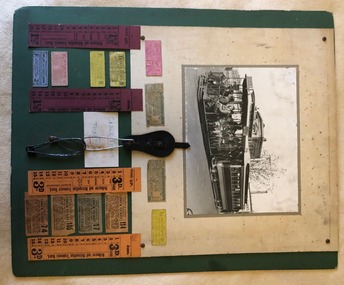 Melbourne Tram Museum
Ephemera - Ticket/s, Melbourne & Metropolitan Tramways Board (MMTB), "Cable Tram Conductor's Ticket Pins", c1930
... In the background is the building on the corner of Elizabeth St and Pelham St (still there in 2018) and in the background is Evan Evans the flag makers building. 192H x 248W - has silver fish damage along top edge, lifting in the top left hand corner from the backing sheet and minor edge damage. ...In the background is the building on the corner of Elizabeth St and Pelham St (still there in 2018) and in the background is Evan Evans the flag makers building. 192H x 248W - has silver fish damage along top edge, lifting in the top left hand corner from the backing sheet and minor edge damage. ...Poster - featuring a photo of a cable tram in Elizabeth St at Pelham St, 12 small cable tram tickets and four bell punch tickets, along with a leather button ticket pin holder and four safety pins. Items placed on a large sheet of cardboard with a green overlay. The photo, pin holder and four small tickets and the bell punch strip tickets glued onto a off white sheet with brass folded pins securing the items to the green card. The rest of the tickets glued to the green card. Underneath is a small sign with the words in blue and red colours "Cable Tram Conductor's Ticket Pins". Photo - grip car - well loaded showing destination of Brunswick and a sign on the side "Direct to Football". Behind the Gripman is a conductor. Bogie cable trailer 480. In the background is the building on the corner of Elizabeth St and Pelham St (still there in 2018) and in the background is Evan Evans the flag makers building. 192H x 248W - has silver fish damage along top edge, lifting in the top left hand corner from the backing sheet and minor edge damage. Dirt marks Small Tickets from Top left hand to Bottom right hand. Tickets 1, 4 to 8 - torn from a strip - pre-purchased? Tickets 9 to 12, torn from a block. Each Ticket has been separately imaged. T1 - 1 1/2d City Tram ticket - Trip Slip -MTO-Co - pink card with purple ink - faded, punched - 27H x 59W T2 - Transfer, MMTB, from Carlton and Prahran lines to other lines as indicated by punch marks with times by the quarter hour - green print on off white card - 31H x 71W - faded. T3 - as above - but not so faded, part town in bottom left hand corner. T4 - 1 1/2d - cable tram section ticket - MMTB - brown print on yellow card - not punched - 24H x 58W T5 - as for 1 - but MMTB - green print on yellow card - heavily creased - 26H x 57W T6 - similar to 5, smaller dimensions and not heavily creased. T7 - 1 1/2d general ticket - detailing lines or section - red ink on pink card - 26H x 56W T8 - 2d - MTCo - Adult or two children under 12, single, black ink on blue card - 24H x 58W T9 - Prahran and Toorak cable tramways check ticket - transfer - conditions on ticket - has 114 in top right hand corner, orange paper, black ink, MMTB - 36H x 67W. T10 - Carlton and Prahran - as for 9, with 17 in top right hand corner, grey paper with black printing - 38H x 65W. T11 - Carlton, N. Carlton, Prahran, St Kilda - as above - 105, brown paper, black ink - 38H x 65W T12 - as for 9, but with 74 in top right hand corner - 35H x 71W Strip tickets - left to right S1 - 1 1/2D, bell punch type - 15 fares - purple card black printing - Up ticket - 182H x 39W S2 - ditto - down direction, no conductor details - 182H x 37W S3 - ditto - 3d, Up direction, orange card, black print - 182H x 39W - has some dirt marks S4 - ditto - 3d down direction - 138H x 38W - has some dirt marks. Leather buckle - cut leather with a strip to secure the pins - button hole on the base with four safety pins placed into it. Pins have rust marks and general deterioration. Leather - 90H x 45W, pins - 3 about 90H x 25W and one 55H x 16W. See Reg Item 1923 for the use of the pins and leather buckle.trams, tramways, cable trams, brunswick, elizabeth st, football, tickets, conductors, mmtb, mto co, transfer tickets, tram 480, trip slips -
 Old Colonists' Association of Ballarat Inc.
Photograph - Newsclipping, The Old Colonists' Association of Ballarat, 1888, 1888
... The lower portion of the front is constructed of Waurn Ponds stone, forming piers, and the upper portion of brick and cement, the background being tuckpointed. ...The lower portion of the front is constructed of Waurn Ponds stone, forming piers, and the upper portion of brick and cement, the background being tuckpointed. ...The Old Colonists' Association Ballarat Inc. is a not for profit charitable organisation providing accommodation for elderly people. It manages a 27 Home retirement village at Charles Anderson Grove Ballarat. Accommodation is offered at significantly below market rates. It has been providing low cost accommodation to the elderly since the 1920s. The Association Council overseas the running of this facility on a voluntary basis. OLD COLONISTS' ASSOCIATION OF BALLARAT. (FROM OUR CORRESPONDENT.) BALLARAT, WEDNESDAY. This association, which was founded in August, 1883, and at first known as the Old Identities' Association, now has a roll of 450 members. The objects of the association are "to aid and assist indigent or suffering old colonists ; to raise a fund, by the voluntary subscriptions of the members and the aid of outside donations, for the purpose of relieving members in sickness and old age; for assisting those in extreme distress, to provide the shelter of a home for old and indigent pioneers of the gold fields, their widows, or anyone connected with the association, and in the event of the death of any member to have his remains decently buried, the association defraying the expenses of the funeral (providing that no funds or property are left by the deceased), and to attend the funeral if so desired by the relatives." The qualifications for member ship are good character and repute, and residence in the colonies for a quarter of a century. For some time the association had no property except the regular subscriptions, but about a year ago they obtained from the Minister of Lands the grant of a very valuable block of land in Lydiard-street, the Crown grant of which they received last week. This block has a frontage of 66ft to Lydiard street, worth at least £100 a foot. The ground was given to the association as a site for them to build a hall upon, and with so valuable an asset they had no difficulty in borrowing at 7 per cent, enough money to construct a hall. For revenue purposes the ground floor of the building has been made into four shops, and the rental from these, judging from the rentals of shops in the vicinity, will not only pay all the interest on the borrowed money, but over £200 a year towards clearing off the principal. The officers of the association are Messrs J. P. Murray, President; J. W. Graham and T. Stoddart, vice presidents; D. Fern, treasurer; and J. Fraser, secretary. The Old Colonists' Hall is an elegant looking building in Lydiard-street, lying between the newly-opened mining exchange and the Commercial Club house, and a few doors north of the Post Office. The style of the facade is classic. The lower portion of the front is constructed of Waurn Ponds stone, forming piers, and the upper portion of brick and cement, the background being tuckpointed. The centre bay is carried by two three quarter columns with Ionic cups, which support a pediment on which is set a cast of the Ballarat coat of arms. The four other bays are supported by pilasters with Corinthian caps mid partly fluted. The entrance is through a spacious circular headed doorway, the keystone of the arch of which bears a sculptured head, in marble, representing that of the president of the Old Colonists' Association here, Mr. John P. Murray. An ample vestibule leads to a wide stone staircase which ends at a spacious landing. The landing has a dome over the centre, with cornice and enrichments, and is lighted from above. The walls round the landing are panelled with marble slabs, which are to be appropriately inscribed in the future. On the first door are the rooms appropriated to the association. The principal of these is a hall 44ft x 33ft and 17ft high. This room is well ventilated and lighted from the back of the building with large windows, and the walls are finished with Keene's cement. The other rooms are committee room, 14ft x 16ft; secretary's, 14ft x 17ft, 6in; kitchen, bedrooms, bathroom, &c. The front portion of the first floor is arranged so that it may be let for offices, or utilised for club purposes. Suitable provision has been made throughout for lighting, ventilation, and means of egress. The architect for the edifice is Mr A. G. Legge, of this city, and the contractors are Messrs. Whitelaw and Atkinson, Irving and Glover, Reynolds, and J. Donaldson. The total cost of the building when completed, which will be in a few weeks, will be about £4,000. (The Argus, 10 May 1888)ballarat old colonists' club, charles anderson grove, old colonists' association -
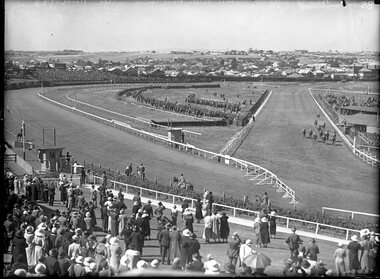 City of Melbourne Libraries
Photograph, Bull, Hugh Jones, 1897-1993, The new straight at Moonee Valley Race Course
... It is located 6 km from the Melbourne CBD in the suburb of Moonee Ponds. It became a non-proprietary property in 1935, and today the Cox Plate, run over 2040 m. each October, is the richest weight-for-age race in Australia for 3 year old and over, under Weight for Age conditions.” ...It is located 6 km from the Melbourne CBD in the suburb of Moonee Ponds. It became a non-proprietary property in 1935, and today the Cox Plate, run over 2040 m. each October, is the richest weight-for-age race in Australia for 3 year old and over, under Weight for Age conditions.” ...Published: Age (Melbourne, Vic.: 1854- ), 11 December 1933 Published title: The New Straight Moonee Valley Published caption: Age (Melbourne, Vic. : 1854 - 1954), Monday 11 December 1933, page 6 The finish of the Koombahla Trial Handicap, the first race run on the new and longer straight across the flat at Moonee Valley racecourse. Magoot won, with Affability second and Great Bear third. This picture, taken from the members' reserve, shows the new straight in relation to the old one (the latter will continue to be used for races of less than seven furlongs), with the finishing post on the right and the new Judge's box in front of the old one. In the distance can be seen the starting points for races over nine furlongs and eight furlongs and a half on another course track. Trove article identifier: http://nla.gov.au/nla.news-article203362672 Research by Project Volunteer, Louise McKenzie: This photo, taken from the elevation of the stand in the Members’ Reserve at Moonee Valley Racecourse, has been framed in order to highlight the new straight, the finishing post, and a new Judge’s Box. In the foreground is a crowd of racegoers in the Members area, showing significantly more women in attendance than men. It is a bright, sunny Tuesday afternoon. The women are wearing small or large brimmed hats and are mostly swathed in generously cut coats with long sleeves that are mid calf length. Some women carry umbrellas to protect them from the sun. The men are wearing suits and hats. The women and men are mostly standing in discrete, rather than mixed groups. More spectators are standing on a banked area in the centre of the track, a large crowd is trackside on the left and another crowd is located to the right of the photo along the final straight. There are stewards on horses in front of the members reserve, and a field of 12 horses approaches the winning post. On a slope at the rear of the photo is evidence of a fairly new housing development, evidenced by the small number of trees. Beyond this there is some vacant land to the left and then more dense housing is evidenced to the right. In the photo the white fencing delineating the course and spectator areas creates wonderful lines and curves. It is a very sharp and clear image. The race underway is the Koombahla Trial Handicap, which was won by Magoot by a length from Affability, with half a length back to Great Bear. At this juncture, Magoot won 3 of 4 starts, and subsequently on Saturday 30 December 1933, with a new up and coming young Flemington trainer J M Murphy, and popular mount Harold Skidmore, Magoot was the favourite and winner of the day’s principal event at Moonee Valley. The Weekly Times that day reported that Magoot had been sold to Launceston sportsman Mr W C Learoyd. The winnings from this race, 400 Pounds , was apparently sufficient to offset the cost of the horse, and would be the equivalent of approximately $9,500 in today’s money. The same article describes Magoot as a “Magpie” gelding as his bloodline was Magpie Tullalah from New Zealand. Sadly, on 9 October 1935, the Examiner (Launceston) reported that Magoot had to be destroyed after falling and breaking her shoulder while running in the Grovedale Handicap in Geelong, but such was her reputation that she warranted an accompanying photograph. Moonee Valley Racecourse was established in 1883 on private land by its owner WS (Sam) Cox – after whom the prestigious horserace, the WS Cox Plate is named. It is located 6 km from the Melbourne CBD in the suburb of Moonee Ponds. It became a non-proprietary property in 1935, and today the Cox Plate, run over 2040 m. each October, is the richest weight-for-age race in Australia for 3 year old and over, under Weight for Age conditions.” According to the Austadiums website, Moonee Valley has a “unique amphitheatre track and was the first Australian metropolitan track to conduct night racing.” This amphitheatre style is evident in Hugh Bull’s photo. THE NEW STRAIGHT AT MOONEE VALLEY. (1933, December 11). The Age (Melbourne, Vic. : 1854 - 1954), p. 6. Retrieved July 23, 2025, from http://nla.gov.au/nla.news-article203362672 Age (Melbourne, Vic. : 1854 - 1954), Monday 11 December 1933, page 6 THE NEW MOONEE VALLEY TRACK (1933, December 11). The Argus (Melbourne, Vic. : 1848 - 1957), p. 7. Retrieved September 1, 2025, from http://nla.gov.au/nla.news-article11719604 Argus (Melbourne, Vic. : 1848 - 1957), Monday 11 December 1933, page 7 MAGOOT SOLD (1933, December 23). The Australasian (Melbourne, Vic. : 1864 - 1946), p. 22 (METROPOLITAN EDITION). Retrieved September 1, 2025, from http://nla.gov.au/nla.news-article141384672 Australasian (Melbourne, Vic. : 1864 - 1946), Saturday 23 December 1933, page 22 SMALL BUT GOOD (1933, December 30). Weekly Times (Melbourne, Vic. : 1869 - 1954), p. 48 (FIRST EDITION). Retrieved September 1, 2025, from http://nla.gov.au/nla.news-article223210074 Weekly Times (Melbourne, Vic. : 1869 - 1954), Saturday 30 December 1933, page 48 MOONEE VALLEY RACES. (1933, December 11). The Sydney Morning Herald (NSW : 1842 - 1954), p. 13. Retrieved September 1, 2025, from http://nla.gov.au/nla.news-article17031425 Sydney Morning Herald (NSW : 1842 - 1954), Monday 11 December 1933, p. 13 ACCIDENTS AT GEELONG MAGOOT DESTROYED (1935, October 10). Examiner (Launceston, Tas. : 1900 - 1954), p. 3 (DAILY). Retrieved September 1, 2025, from http://nla.gov.au/nla.news-article51958216 Examiner (Launceston, Tas. : 1900 - 1954), Thursday 10 October 1935, p. 3 Wikipedia, Moonee Valley Racecourse, https://en.wikipedia.org/wiki/Moonee_Valley_Racecourse eMelbourne, the city past and present, https://www.emelbourne.net.au/biogs/EM01003b.htm Wikipedia, Cox Plate, https://en.wikipedia.org/wiki/W._S._Cox_Plate Austadiums, Moonee Valley, https://www.austadiums.com/stadiums/moonee-valleyPhotographer notations on slide: "New straight at Moonee Valley Race Course - Age 11 Dec 1933 B8".horseracing, race courses, moonee valley, 1930-1939 -
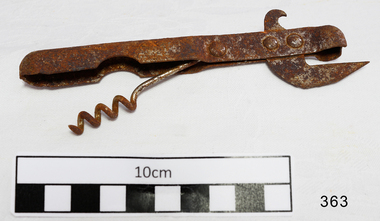 Flagstaff Hill Maritime Museum and Village
Domestic object - Can Opener, Bottle Opener & Corkscrew
... Each type of food came with its own kind of can, and each kind of can came with its own kind of opener. Tinned fish and meat were often sold in rectangular cans. ...Each type of food came with its own kind of can, and each kind of can came with its own kind of opener. Tinned fish and meat were often sold in rectangular cans. ...It took 15 years to invent the can. It took 100 more to invent a standard way to open it. In the 19th century, decades after the invention of canning, there were virtually no can openers. Canned food, such as sardines, came with its own "key" to peel back the tin lid. Birth of the can One of the oddest things about the can opener is that the can predates it by almost 150 years. Though common today, cans were once military-grade technology. In 1795, Napoleon, to whom the phrase "an army marches on its stomach" is attributed, offered 12,000 francs to anyone who could find a way to preserve food. Without any knowledge of bacteria or their role in food spoilage, scientists didn't even know where to begin. It took 15 years before a chef named Nicholas Appert claimed the prize after successfully jarring food. Soon after that, his countryman Philippe de Girard came up with a variant on Appert's method—metal tins—and sold the idea to the British. Spoiled food, and the sickness it caused, was a widespread problem. The public would have benefited from canned food, but for decades cans were almost exclusively for the army and the navy. The canning process, with its hours of boiling and steaming, its scrupulous cleanliness, its heated metal, and its need for a great deal of disposable material, made canned food far too expensive for anyone but the military. No can openers were needed or even possible. The metal of early cans was too thick to make openers practical. Soldiers and sailors had plenty of sharp objects on hand and made ample use of them when they wanted to eat. During the 19th century, the process of canning was refined and mechanised, and the metal wall of the average can slimmed down enough that a civilian could get it open—if that civilian had the right tool. No one had that tool yet, so early cans had to open themselves. In other words, they came with built-in openers. The result was a confusing but pleasing free-for-all, in terms of product engineering. Each type of food came with its own kind of can, and each kind of can came with its own kind of opener. Tinned fish and meat were often sold in rectangular cans. These cans were fitted with a "key" that would roll down the top of the can. Coffee, beans, and other types of meat were packaged in cylinders with metal strips that could be peeled back with their own kinds of built-in keys. Cans of milk, which didn't need to be completely opened, came with puncture devices. As tinned food became more common, its containers became more regular. A nice cylindrical can became the norm, and, as these cans filled kitchens, more engineers put their minds to finding a convenient way to open all of them. The first standalone can opener worked on a simple principle: point, stab, and pull. From the mid-19th century to the end of World War I, the typical can opener looked roughly like a wrench, if the lower 'jaw' of the wrench were replaced with a blade. People used the blade to puncture the top of the can near its edge, push the upper jaw against the side of the can, and drag the blade through the metal along the rim. Because meat was the first and most popular canned substance, these can openers were often shaped to look like cows and given the nickname 'bully beef can openers'. The bully beef can opener, popular in the mid-19th century, resulted in many lost fingers. Later, a corkscrew was added that was seated in the handle, and could be pulled out for use. Bully beef can openers were so common, effective, and sturdy that they are still frequently available on collectors' sites. Some are advertised as “still working,” and every last one of them is, without a doubt, soaked in the blood of our ancestors. Dragging a sharp blade along the edge of a can is certain to cause injury sooner or later. So once people got a reliable can shape and a reliable way to get the can open, the search was on for a reliable way to get a can open without the possibility of losing a finger. The answer came in 1925, from the Star Can Opener Company of San Francisco. This is probably the first can opener that resembles the one people have in their kitchens today. Instead of using a blade to pry open a metal can, buyers could clamp the edge of the can between two wheels and twist the handle of one of the wheels to move the blade around the lip. The Star can openers weren't perfect. Compared to the bully beef model, they were flimsy and breakable, but they probably prevented a few injuries. Six short years after the Star model came to market, the first electric can opener was invented. It was patented in 1931 by the Bunker Clancey Company of Kansas City, who had already been sued by the Star Can Opener Company for trying sell a double-wheeled can opener like the Star model (the case was dismissed). The electric can opener must have seemed like the wave of the future and a sure-fire seller, but it proved to be too far ahead of its time. In 1931 not that many households had electricity, and those that did weren't interested in buying can openers. The Bunker Clancey Company was subsequently bought by the Rival Company, which still makes small appliances like can openers today. It took another 25 years for electrically powered can openers to become practical. In the 1950s, Walter Hess Bodle and his daughter, Elizabeth Bodle, developed an electric can opener in the family garage. Walter came up with the opener's blades and motor, and Elizabeth sculpted the outside. Their can opener was a free-standing unit that could sit on the kitchen counter. The Udico brand of the Union Die Casting Company put it on the market in time for Christmas in 1956 and had great success with it. Over the next few years it came out in different styles and colours, and, like the bully beef can opener, has become a collector's item. Also like the bully beef model, Udico can openers often still work. They don't make 'em like they used to. Although there have been some design changes and refinements over the last sixty years, there have yet to be any more leaps forward in can opener technology. If you're resentfully opening a can, you are almost certainly doing it using the Star design, manually forcing the can between two wheels, or the Bodle design, clamping the can into a free-standing electrical opener. Whether or not you enjoy your holiday meals, at least you can be happy that you are not getting poisoned by your own food or cutting open your hand with the blade you use to get at it. That's something, right?The can opener, Bottle opener and the corkscrew are still very important and essential items in most kitchens.Metal can opener, chromed, with bottle opener, and a corkscrew seated in the handle.None.flagstaff hill, warrnambool, shipwrecked-coast, flagstaff-hill, flagstaff-hill-maritime-museum, maritime-museum, shipwreck-coast, flagstaff-hill-maritime-village, canning, can opener, corkscrew, bottle opener, kitchen equipment -
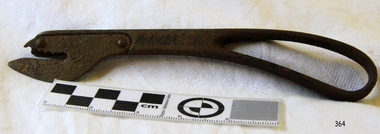 Flagstaff Hill Maritime Museum and Village
Domestic object - Can Opener
... Each type of food came with its own kind of can, and each kind of can came with its own kind of opener. Tinned fish and meat were often sold in rectangular cans. ...Each type of food came with its own kind of can, and each kind of can came with its own kind of opener. Tinned fish and meat were often sold in rectangular cans. ...It took 15 years to invent the can. It took 100 more to invent a standard way to open it. In the 19th century, decades after the invention of canning, there were virtually no can openers. Canned food, such as sardines, came with its own "key" to peel back the tin lid. Birth of the can One of the oddest things about the can opener is that the can predates it by almost 150 years. Though common today, cans were once military-grade technology. In 1795, Napoleon, to whom the phrase "an army marches on its stomach" is attributed, offered 12,000 francs to anyone who could find a way to preserve food. Without any knowledge of bacteria or their role in food spoilage, scientists didn't even know where to begin. It took 15 years before a chef named Nicholas Appert claimed the prize after successfully jarring food. Soon after that, his countryman Philippe de Girard came up with a variant on Appert's method—metal tins—and sold the idea to the British. Spoiled food, and the sickness it caused, was a widespread problem. The public would have benefited from canned food, but for decades cans were almost exclusively for the army and the navy. The canning process, with its hours of boiling and steaming, its scrupulous cleanliness, its heated metal, and its need for a great deal of disposable material, made canned food far too expensive for anyone but the military. No can openers were needed or even possible. The metal of early cans was too thick to make openers practical. Soldiers and sailors had plenty of sharp objects on hand and made ample use of them when they wanted to eat. During the 19th century, the process of canning was refined and mechanised, and the metal wall of the average can slimmed down enough that a civilian could get it open—if that civilian had the right tool. No one had that tool yet, so early cans had to open themselves. In other words, they came with built-in openers. The result was a confusing but pleasing free-for-all, in terms of product engineering. Each type of food came with its own kind of can, and each kind of can came with its own kind of opener. Tinned fish and meat were often sold in rectangular cans. These cans were fitted with a "key" that would roll down the top of the can. Coffee, beans, and other types of meat were packaged in cylinders with metal strips that could be peeled back with their own kinds of built-in keys. Cans of milk, which didn't need to be completely opened, came with puncture devices. As tinned food became more common, its containers became more regular. A nice cylindrical can became the norm, and, as these cans filled kitchens, more engineers put their minds to finding a convenient way to open all of them. The first standalone can opener worked on a simple principle: point, stab, and pull. From the mid-19th century to the end of World War I, the typical can opener looked roughly like a wrench, if the lower 'jaw' of the wrench were replaced with a blade. People used the blade to puncture the top of the can near its edge, push the upper jaw against the side of the can, and drag the blade through the metal along the rim. Because meat was the first and most popular canned substance, these can openers were often shaped to look like cows and given the nickname 'bully beef can openers'. The bully beef can opener, popular in the mid-19th century, resulted in many lost fingers. Bully beef can openers were so common, effective, and sturdy that they are still frequently available on collectors' sites. Some are advertised as “still working,” and every last one of them is, without a doubt, soaked in the blood of our ancestors. Dragging a sharp blade along the edge of a can is certain to cause injury sooner or later. So once people got a reliable can shape and a reliable way to get the can open, the search was on for a reliable way to get a can open without the possibility of losing a finger. The answer came in 1925, from the Star Can Opener Company of San Francisco. This is probably the first can opener that resembles the one people have in their kitchens today. Instead of using a blade to pry open a metal can, buyers could clamp the edge of the can between two wheels and twist the handle of one of the wheels to move the blade around the lip. The Star can openers weren't perfect. Compared to the bully beef model, they were flimsy and breakable, but they probably prevented a few injuries. Six short years after the Star model came to market, the first electric can opener was invented. It was patented in 1931 by the Bunker Clancey Company of Kansas City, who had already been sued by the Star Can Opener Company for trying sell a double-wheeled can opener like the Star model (the case was dismissed). The electric can opener must have seemed like the wave of the future and a sure-fire seller, but it proved to be too far ahead of its time. In 1931 not that many households had electricity, and those that did weren't interested in buying can openers. The Bunker Clancey Company was subsequently bought by the Rival Company, which still makes small appliances like can openers today. It took another 25 years for electrically powered can openers to become practical. In the 1950s, Walter Hess Bodle and his daughter, Elizabeth Bodle, developed an electric can opener in the family garage. Walter came up with the opener's blades and motor, and Elizabeth sculpted the outside. Their can opener was a free-standing unit that could sit on the kitchen counter. The Udico brand of the Union Die Casting Company put it on the market in time for Christmas in 1956 and had great success with it. Over the next few years it came out in different styles and colours, and, like the bully beef can opener, has become a collector's item. Also like the bully beef model, Udico can openers often still work. They don't make 'em like they used to. Although there have been some design changes and refinements over the last sixty years, there have yet to be any more leaps forward in can opener technology. If you're resentfully opening a can, you are almost certainly doing it using the Star design, manually forcing the can between two wheels, or the Bodle design, clamping the can into a free-standing electrical opener. Whether or not you enjoy your holiday meals, at least you can be happy that you are not getting poisoned by your own food or cutting open your hand with the blade you use to get at it. That's something, right?The can opener is still a very important and essential item in most kitchens.Can opener, right handed, metal, upper blade section serrated, inscription 'Peerless Pat.Feb 11-90'.Peerless Pat.Feb 11-90flagstaff hill, warrnambool, shipwrecked-coast, flagstaff-hill, flagstaff-hill-maritime-museum, maritime-museum, shipwreck-coast, flagstaff-hill-maritime-village, cannning, can opener, kitchen equipment -
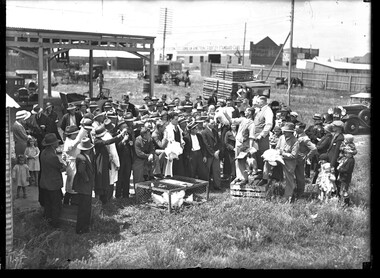 City of Melbourne Libraries
Photograph, Bull, Hugh Jones, 1897-1993, Poultry auction for Christmas dinners, Bentleigh Poultry Market
... The Encyclopedia of Melbourne online advises that the Shire of Moorabbin once covered an extensive area of the south-eastern suburbs, land where the Boon wurrung people had hunted, fished and collected water from the natural springs near Beaumaris and Cheltenham. ...The Encyclopedia of Melbourne online advises that the Shire of Moorabbin once covered an extensive area of the south-eastern suburbs, land where the Boon wurrung people had hunted, fished and collected water from the natural springs near Beaumaris and Cheltenham. ...Published: Age (Melbourne, Vic.: 1854- ), Thursday 21 December 1933, page 11 Published title: : POULTRY FOR CHRISTMAS DINNERS Published caption: With the approach of the Festive Season, the demand for poultry of all descriptions tends to harden and good clearances of many thousands of birds have been effected at recent auctions. The above picture was taken yesterday at the sale conducted by Messrs. Parnham and Carter of Bentleigh, whose auctions are the largest in Melbourne on the basis of individual sales. The auctioneer's assistant is holding up a prime goose for the appraisement of bidders preparing for Christmas fare. Trove article identifier: http://nla.gov.au/nla.news-article203351699 Research by project volunteer, Louise McKenzie: This photo is full of action! A poultry auction is in full flight. The serious-looking auctioneer and his assistant stand on a Parnham & Carter wooden box so that the auctioneer can make eye contact with the bidding crowd. The auctioneer is wearing a waistcoat and tie and has his pencil and paper ready to record the winning bids. The assistant in overalls is holding a live white duck in each hand. Two other assistants also hold live birds. A wire cage on the ground holds a few white chickens – presumably the next auction items. The majority of the substantial crowd is male, mostly wearing Fedora hats and jackets or suits and ties. Some women are present, wearing hats and coats, and at least seven children are visible, some dressed up, others dressed more casually. The auction is taking place in a rural setting, possibly on the site where the birds are farmed. It is an informal, rather rough, grassed area next to a large shed with a high verandah. Two horse drawn vehicles are visible in the background, as well as five motorised vehicles. There are stacks of wooden boxes or crates which look as if they transport birds, and two cows are grazing by the fence. There are two telegraph poles with many lines. In the adjacent block is a very large car business comprising two large brick warehouse style buildings, plus outbuildings. The signage on one brick warehouse mentions Standard Cars. Both a man and a woman have their arms raised to bid. It is an occasion – but a serious one. We cannot be sure if these birds are for breeding or the table, but buying poultry for the Christmas meal was a tradition in Melbourne with purchasers going either to the auctions, or perhaps the Queen Victoria Market. The Argus in its article “Christmas Dinner” on 6 December 1932 advised of increased demand for turkeys and chickens ahead of a possible Christmas shortage. Part of this shortage would be because of the outbreak of Newcastle disease which resulted in a quarantine around Melbourne within which all killing must be under supervision and bear the Government brand. They believed this would result in smaller producers not bothering to get such a permit as "for many of them the poultry cheque is only pin money for their wives.” Interestingly, an article in the Sun News Pictorial of 26 January 1934 reported a strong market, and “One auctioneer stated that buyers were taking up chickens freely now for the Centenary celebrations because they would probably never be as plentiful at the present levels of prices until next season.” That same article quoted officials of the Department of Agriculture stating that "…they had received a fair number of inquiries from farmers recently on the possibilities of table poultry breeding for local and export markets. The good prices being paid for poultry were attracting interest.” In fact, on 29 December 1933, the Sun News-Pictorial had reported that for the first time, the innovation of holding poultry sales in Melbourne between the Christmas and New Year holidays had been trialled the day before, and had proved successful. The Bentleigh area had a long history of poultry farming. The Seal of the Municipality of Moorabbin has a cockerel featured in the top right quadrant, and according to its local history website, “Writers in the local press gave advice on breeding, feeding, marketing and other matters of concern to anyone keeping fowls. In 1914 poultry farms were spread from Ormond, through Cheltenham and Mentone to Mordialloc.” The Encyclopedia of Melbourne online advises that the Shire of Moorabbin once covered an extensive area of the south-eastern suburbs, land where the Boon wurrung people had hunted, fished and collected water from the natural springs near Beaumaris and Cheltenham. The Boon wurrung reputedly called this district Mooroobin, a name that Richard and John King adapted to Moorabbin for the cattle run they established in the mid-1840s. The sandy soil of much of the district proved suitable for market gardening which flourished in Moorabbin from the 1850s. Some districts, such as Highett, remained largely devoted to cattle, while fishing was a major activity in the coastal villages. Moorabbin's population remained tiny throughout the 19th and much of the early 20th century with less than 1000 ratepayers in the shire. When the more popular coastal resort areas of the shire seceded after World War I, Moorabbin was left as an under-serviced, still largely rural area. It was not until the 1930s that the population rose above 20,000. By the late 1930s poultry farming had been added to market gardening as a local industry. But northern sections of the city, such as Bentleigh and McKinnon, were beginning to develop as residential areas. The local council took steps to attract industry and new residents to the city by erecting reputedly the largest neon sign in Melbourne at the time on the Point Nepean Road (later Nepean Highway), pointing out that plentiful residential and industrial land was available. The era of gardeners’ picnics, the formation of the Market Gardeners’ & Fruit Growers’ Association, and the Moorabbin Horticultural, Poultry & Dog Society Spring Shows was over. References: POULTRY SALES HELD (1933, December 29). The Sun News-Pictorial (Melbourne, Vic. : 1922 - 1954; 1956), p. 20. Retrieved July 30, 2024, from http://nla.gov.au/nla.news-article276124760 MUCH INTEREST IN POULTRY (1934, January 26). The Sun News-Pictorial (Melbourne, Vic. : 1922 - 1954; 1956), p. 30. Retrieved July 30, 2024, from http://nla.gov.au/nla.news-article277292695 Christmas Dinner. (1932, December 6). The Argus (Melbourne, Vic. : 1848 - 1957), p. 6. Retrieved July 30, 2024, from http://nla.gov.au/nla.news-article4512606 'Moorabin', eMelbourne, https://www.emelbourne.net.au/biogs/EM01004b.htm 'City of Glen Eira Thematic Environmental History [Refresh] 2020', prepared for The City of Glen Eira by Built Heritage P/L, https://www.gleneira.vic.gov.au/media/7583/glen-eira-c214glen-city-of-glen-eira-thematic-environmentla-history-refresh-2020.pdf Photographer notations on slide: "Poultry for Christmas Dinners Age 21-12-33 B9".christmas, poultry -
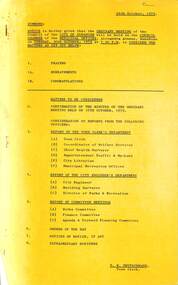 Sunshine and District Historical Society Incorporated
Administrative record - City of Sunshine - Commissioner Mr Alexander Alex George Gillon Collection 1976 - 1982 - Notice of ordinary meeting of the council 30th October 1979, City of Sunshine, 24th October 1979
... Albans Planning Permit Application Extension to Existing Fish & Chip Shop 513 Ballarat Road Albion Planning Permit Cluster Subdivision & Display Homes 104 Station Road Deer Park Planning Permit Store Cromer Avenue Sunshine North Planning Permit Application Industrial Sales Geelong Road Planning Permit Application Additional Roller Staking Rink Lot 89 Wright Street Sunshine Rename Cosma Avenue Off President Road to Eaton Court Albanvale Street Construction Stage 1B Westerngate North Estate Street Construction Stages 21, 22 & 24 Albanvale Estate Furlong Road Estate Stage 6B Construction Works Completed Tenttive Plan of Subdivision 19 to 23 Newstead Street Maribyrnong Contract Vehicle Wheel Wash Sunshine Tip Hulett Street Relocation of Electric Light Pole 41 Conifer Avenue Brooklyn Outdoor Employees Christmas Break Up Pedestrian Operated Signals Main Road East Between Alfrieda Street and Collins Street St. ...Albans Planning Permit Application Extension to Existing Fish & Chip Shop 513 Ballarat Road Albion Planning Permit Cluster Subdivision & Display Homes 104 Station Road Deer Park Planning Permit Store Cromer Avenue Sunshine North Planning Permit Application Industrial Sales Geelong Road Planning Permit Application Additional Roller Staking Rink Lot 89 Wright Street Sunshine Rename Cosma Avenue Off President Road to Eaton Court Albanvale Street Construction Stage 1B Westerngate North Estate Street Construction Stages 21, 22 & 24 Albanvale Estate Furlong Road Estate Stage 6B Construction Works Completed Tenttive Plan of Subdivision 19 to 23 Newstead Street Maribyrnong Contract Vehicle Wheel Wash Sunshine Tip Hulett Street Relocation of Electric Light Pole 41 Conifer Avenue Brooklyn Outdoor Employees Christmas Break Up Pedestrian Operated Signals Main Road East Between Alfrieda Street and Collins Street St. ...Notice of Ordinary Meeting of the Council 30th October 1979 Report of the Town Clerk's Department Report of the Town Clerk Council Meeting Dates 1980 Local Authorities Borrowing Deferred Payment Contracts Proposed Purchase of Land from ICI Deer Park Oval Ballarat Road (Now John McLeod Oval) and Fitzgerald Road Corner Whitesides Avenue (Now Nancy Street Reserve) Proposed Variation to Separate Awards Pottery Demonstration Rainbow Workshop Insurances Supplementary Valuations Report of the Co-Ordinator of Welfare Services School Leavers Project Education Community Youth Support Scheme Youth Camping Equipment Recurrent Funding Northumberland Road and Furlong Road Child Care Centres Income Security Telephone Monitoring Service Citizens' Advice Bureau Albanvale Community Centre Victorian Employment Committee Report of the Chief Health Surveyor Sanitary Services (Builders' Sites) Health Act Registrations for 1979 Application to Transfer of Proprietorship of Premises Under the Health Act Report of the Medical Officer of Health Report of the Superintendent of Traffic & By-Laws Fire Hazards Removal of Fire Hazards Proposed Procession Italian Festival Deer Park Animal Welfare Seminar 9th October 1979 St. Albans Community Arts Festival Report of the City Librarian Bankstown Study Tour Report Melton Library Staffing Report of the City Engineer & Planner Station Road Widening Between Kororoit Creek and Gladstone Street Proposal by the Deer Park Residents Association Landscape Architectural Projects University of Melbourne Centre for Environmental Studies Planning Permit Application Extension to Highpoint West Shopping Centre Rosamond Road Planning Permit Application Three Display Homes and Associated Car Parking St. Albans Road and Gillon Court St. Albans Planning Permit Application Extension to Existing Fish & Chip Shop 513 Ballarat Road Albion Planning Permit Cluster Subdivision & Display Homes 104 Station Road Deer Park Planning Permit Store Cromer Avenue Sunshine North Planning Permit Application Industrial Sales Geelong Road Planning Permit Application Additional Roller Staking Rink Lot 89 Wright Street Sunshine Rename Cosma Avenue Off President Road to Eaton Court Albanvale Street Construction Stage 1B Westerngate North Estate Street Construction Stages 21, 22 & 24 Albanvale Estate Furlong Road Estate Stage 6B Construction Works Completed Tenttive Plan of Subdivision 19 to 23 Newstead Street Maribyrnong Contract Vehicle Wheel Wash Sunshine Tip Hulett Street Relocation of Electric Light Pole 41 Conifer Avenue Brooklyn Outdoor Employees Christmas Break Up Pedestrian Operated Signals Main Road East Between Alfrieda Street and Collins Street St. Albans Roadsides Conservation Committee Roadside Environment Awards 1979/80 Sewerage Facilities Ardeer Station Road Widening Melbourne Metropolitan Planning Scheme Amendment No 81 Part 4 Overcharge of Account Lot 1 Glengala Road Sunshine West Traffic Control Items Prohibited Parking Short Street Maidstone Signs Olex Cables Limited Sunshine Road Replacement of Bus Shelters Forrest Street Ardeer School Crossings Prohibited Parking Brooklyn Primary School Millers Road Brooklyn Prohibited Parking Sunshine Technical School Graham Street Sunshine Parking Princess Street Arcade St. Albans Extension to Bus Route 451 Sunshine to Deer Park Shopping Centre Depot Workshop Alterations & Additions Deer Park Infant Welfare Centre Ballarat Road Deer Park Child Day Care Centre 3 Hume Street Deer Park Council Depot Amenities Block Council Depot Report of the Building Surveyor Building Over Easement Lot 25 McIntyre Road Sunshine North Building Over Easement 8 Roussac Court Sunshine North Building Over Easement 65 Sandera Avenue Sunshine West Fence 45 King Edward Avenue Albion Fence 300 Ballarat Road Sunshine Orders of the Day Accounts Submitted for Payment 15th October 1979ici, deer park oval, john mcleod reserve, nancy street reserve, deer park, ardeer, fitzgerald road, whitesides avenue, northumberland road, furlong road child care, furlong road, sunshine north, northumberland road child care centre, northumberland, station road, kororoit creek, gladstone street, st. albans, highpoint west shopping centre, rosamond road, st. albans road, gillon court, ballarat road, albion, cromer avenue, geelong road, wright street, sunshine, cosma avenue, president road, eaton court, albanvale, newstead street, maribyrnong, sunshine tip, hulett street, conifer avenue, brooklyn, main road east, alfrieda street, collins street, glengala road, sunshine west, short street, maidstone, olex cables, sunshine road, tottenham, forrest street, brooklyn primary school, millers road, graham street, sunshine technical school, princess street, deer park infant welfare centre, mcintyre road, roussac court, sandera avenue, king edward avenue -
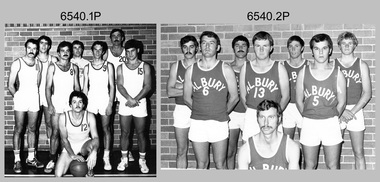 Bendigo Military Museum
Photograph - Annual Sport Competition: Flag Day - Army Survey Regiment Verses School of Military Survey, Bendigo, 1977
... Front row L to R: Kim Lenson, unidentified (x4), Jamie ‘Fish’ McRae. .28) & .29) - Photo, black & white, 1977, ASR Tug-of-War Team in action. .30) - Photo, black & white, 1977, Volleyball action. .31) - Photo, black & white, 1977, Volleyball action. ...Front row L to R: Kim Lenson, unidentified (x4), Jamie ‘Fish’ McRae. .28) & .29) - Photo, black & white, 1977, ASR Tug-of-War Team in action. .30) - Photo, black & white, 1977, Volleyball action. .31) - Photo, black & white, 1977, Volleyball action. ...This set of 33 photographs of sports action was taken on Flag Day, an annual sports competition between the Army Survey Regiment (ASR) and the School of Military Survey (SMS), at Bendigo on the 13th of May 1977. Softball was held at Beischer Park Strathdale, sailing was most likely held at Lake Eppalock, rifle shooting at Wellsford Rifle Range and tug-of-war at Fortuna. The venues for basketball, golf, squash and volleyball are unknown. The two RA Svy units took turns each year to host the event. Personnel from the ASR’s Detachment located at Bonegilla were part of the SMS’s teams. The day competition usually comprised basketball, cross country, golf, sailing, squash softball, tennis, rifle shooting, touch football, tug-of-war and volleyball. The evening competition often included darts, carpet bowls, hookey, quoits and snooker. See items 6025.15P for photo proofs of sports action and 6326.25P for softball action and taken on the day. There are numerous duplicates previously published from these photo proofs; however they are inferior in quality.This is a set of 33 photographs of sports action was taken on Flag Day, Army Survey Regiment (ASR) versus the School of Military Survey (SMS), at Bendigo on the 13th of May 1977. The photographs were printed on photographic paper and are part of the Army Survey Regiment’s Collection. The black and white photographs were scanned at 300 dpi. .1) - Photo, black & white, 1977, Basketball. ASR Team Back row L to R: unidentified, Stuart Symonds, Bruce Gordon. Front row L to R: unidentified (x2), Bill Jones, unidentified. Sitting: unidentified. .2) - Photo, black & white, 1977, Basketball. SMS Team Back row L to R: Duncan Burns, Stuart Thaxter, unidentified (x2). Front row L to R: Owen Moss, unidentified, Steve Hansen. Sitting: unidentified. .3) to .5) - Photo, black & white, 1977. Basketball action. .6) - Photo, black & white, 1977, Golf - L to R: Kevin ‘Chuck’ Berry, George Austen, unidentified, Roy Morgan. .7) - Photo, black & white, 1977, Golf - L to R: Stan Vote, Gordon Lowery, Peter Warwick, John ‘JB’ Barrie. .8) & .9) - Photo, black & white, 1977, ASR Golf Team – Back row L to R: Peter Warwick, unidentified, Graeme Jeffers, John Sinclair. Front row L to R: Stan Vote, Roy Morgan, George Austen, Len Thirlwell. .10) & .11) - Photo, black & white, 1977, SMS Golf Team - Back row L to R: Kevin ‘Chuck’ Berry, unidentified, Gordon Lowery. Front row L to R: unidentified, Peter Hardy, unidentified, John ‘JB’ Barrie. .12) & .13) - Photo, black & white, 1977, Golf. Teeing off – unidentified. .14) - Photo, black & white, 1977, Golf. Teeing off – John Sinclair. .15) - Photo, black & white, 1977, Golf. Putting – Stan Vote. .16) - Photo, black & white, 1977, Golf. Putting - Peter Warwick. .17) - Photo, black & white, 1977, Golf. Putting – Roy Morgan. .18) - Photo, black & white, 1977, ASR Rifle Shooting Team - Back row L to R: Paul Davis, unidentified (x2), Max Neil, Rhys De Laine. Front row L to R: Tony Lawler, Rene van den Tol, unidentified, Warren ‘Waldo’ Shirley. .19) - Photo, black & white, 1977, ASR Rifle Shooting Team – L to R: unidentified (x4), 2nd back right: Tony Lawler, unidentified. .20) - Photo, black & white, 1977, SMS Rifle Shooting Team - Back row L to R: John Ashby, unidentified (x3). Front row L to R: Dave Murphy, Wolfgang Thun, John ‘Stormy’ Tempest, unidentified. .21) - Photo, black & white, 1977, Softball – L to R: Jenny Haddow, Debbie Brown, unidentified umpire. .22) - Photo, black & white, 1977, ASR & SMS Sailing Teams – Back row L to R: Chris Osborne, Josh De Groot, unidentified (x2), Greg Francis-Wright, Peter Breukel. 3rd row L to R: Marrianne (Van De Zee) De Groot, unidentified, Kim Reynolds, Alex Cairney, unidentified, Sam Chambers. 2nd row L to R: Les Dixon, Jim Macdonald, unidentified, George Graham, Ted ‘FOT’ Burgess. Front row L to R: Doug Carswell, Alan Adsett, Peter Mustart, Tony Waldon, Dave Miles. .23) - Photo, black & white, 1977, Sailing on Lake Eppalock, Victoria. .24) - Photo, black & white, 1977, SMS Squash Team – Back row L to R: Graham Squire, Peter Constantine AM, Peter Colwell, Bill Boyd OAM, Front row L to R: unidentified, Dick Barwald, Colin Darch, unidentified. .25) - Photo, black & white, 1977, ASR Squash Team – Back row L to R: Andy Wilson, Terry Danger, Errol Fletcher, Dennis Puniard. Front row L to R: Lynn Johnson, Kerry Browne. .26) - Photo, black & white, 1977, ASR Tug-of-War Team: Back row L to R: Russ Mollenhauer, Neville Stone, Jim Cook, Jeff Willey, unidentified (x3). Front row L to R: unidentified, John ‘Flash’ Anderson, Mick ‘Buddha’ Ellis, Ken ‘Sluggo’ Slater, Rob ‘Boges’ Bogumil, Frank Lenane, unidentified. .27) - Photo, black & white, 1977, SMS Tug-of-War Team: Back row L to R: unidentified, Stuart Thaxter, Steve Hansen, unidentified (x2). Front row L to R: Kim Lenson, unidentified (x4), Jamie ‘Fish’ McRae. .28) & .29) - Photo, black & white, 1977, ASR Tug-of-War Team in action. .30) - Photo, black & white, 1977, Volleyball action. .31) - Photo, black & white, 1977, Volleyball action. Chris Edwards blocking. .32) & .33) - Photo, black & white, 1977, Volleyball action..1P to .33P –No personnel are identified. ‘Regiment v School 13 May 1977’ annotated on cover sleeve.royal australian survey corps, rasvy, army survey regiment, army svy regt, fortuna, asr, school of military survey, flag day -
 Sunshine and District Historical Society Incorporated
Administrative record - City of Sunshine - Commissioner Mr Alexander Alex George Gillon Collection 1976 - 1982 - Minutes of the ordinary meeting of council held on 30th Oct 1979, City of Sunshine, 30th November 1979
... Albans Planning Permit Application Extension to Existing Fish & Chip Shop 513 Ballarat Road Albion Planning Permit Cluster Subdivision & Display Homes 104 Station Road Deer Park Planning Permit Store Cromer Avenue Sunshine North Planning Permit Application Industrial Sales Geelong Road Planning Permit Application Additional Roller Staking Rink Lot 89 Wright Street Sunshine Rename Cosma Avenue Off President Road to Eaton Court Albanvale Street Construction Stage 1B Westerngate North Estate Street Construction Stages 21, 22 & 24 Albanvale Estate Furlong Road Estate Stage 6B Construction Works Completed Tenttive Plan of Subdivision 19 to 23 Newstead Street Maribyrnong Contract Vehicle Wheel Wash Sunshine Tip Hulett Street Relocation of Electric Light Pole 41 Conifer Avenue Brooklyn Outdoor Employees Christmas Break Up Pedestrian Operated Signals Main Road East Between Alfrieda Street and Collins Street St. ...Albans Planning Permit Application Extension to Existing Fish & Chip Shop 513 Ballarat Road Albion Planning Permit Cluster Subdivision & Display Homes 104 Station Road Deer Park Planning Permit Store Cromer Avenue Sunshine North Planning Permit Application Industrial Sales Geelong Road Planning Permit Application Additional Roller Staking Rink Lot 89 Wright Street Sunshine Rename Cosma Avenue Off President Road to Eaton Court Albanvale Street Construction Stage 1B Westerngate North Estate Street Construction Stages 21, 22 & 24 Albanvale Estate Furlong Road Estate Stage 6B Construction Works Completed Tenttive Plan of Subdivision 19 to 23 Newstead Street Maribyrnong Contract Vehicle Wheel Wash Sunshine Tip Hulett Street Relocation of Electric Light Pole 41 Conifer Avenue Brooklyn Outdoor Employees Christmas Break Up Pedestrian Operated Signals Main Road East Between Alfrieda Street and Collins Street St. ...Minutes of the Ordinary Meeting of Council held on 30th Oct 1979 Report of the Town Clerk's Department Report of the Town Clerk Council Meeting Dates 1980 Local Authorities Borrowing Deferred Payment Contracts Proposed Purchase of Land from ICI Deer Park Oval Ballarat Road (Now John McLeod Oval) and Fitzgerald Road Corner Whitesides Avenue (Now Nancy Street Reserve) Proposed Variation to Separate Awards Pottery Demonstration Rainbow Workshop Insurances Supplementary Valuations Report of the Co-Ordinator of Welfare Services School Leavers Project Education Community Youth Support Scheme Youth Camping Equipment Recurrent Funding Northumberland Road and Furlong Road Child Care Centres Income Security Telephone Monitoring Service Citizens' Advice Bureau Albanvale Community Centre Victorian Employment Committee Report of the Chief Health Surveyor Sanitary Services (Builders' Sites) Health Act Registrations for 1979 Application to Transfer of Proprietorship of Premises Under the Health Act Report of the Medical Officer of Health Report of the Superintendent of Traffic & By-Laws Fire Hazards Removal of Fire Hazards Proposed Procession Italian Festival Deer Park Animal Welfare Seminar 9th October 1979 St. Albans Community Arts Festival Report of the City Librarian Bankstown Study Tour Report Melton Library Staffing Report of the City Engineer & Planner Station Road Widening Between Kororoit Creek and Gladstone Street Proposal by the Deer Park Residents Association Landscape Architectural Projects University of Melbourne Centre for Environmental Studies Planning Permit Application Extension to Highpoint West Shopping Centre Rosamond Road Planning Permit Application Three Display Homes and Associated Car Parking St. Albans Road and Gillon Court St. Albans Planning Permit Application Extension to Existing Fish & Chip Shop 513 Ballarat Road Albion Planning Permit Cluster Subdivision & Display Homes 104 Station Road Deer Park Planning Permit Store Cromer Avenue Sunshine North Planning Permit Application Industrial Sales Geelong Road Planning Permit Application Additional Roller Staking Rink Lot 89 Wright Street Sunshine Rename Cosma Avenue Off President Road to Eaton Court Albanvale Street Construction Stage 1B Westerngate North Estate Street Construction Stages 21, 22 & 24 Albanvale Estate Furlong Road Estate Stage 6B Construction Works Completed Tenttive Plan of Subdivision 19 to 23 Newstead Street Maribyrnong Contract Vehicle Wheel Wash Sunshine Tip Hulett Street Relocation of Electric Light Pole 41 Conifer Avenue Brooklyn Outdoor Employees Christmas Break Up Pedestrian Operated Signals Main Road East Between Alfrieda Street and Collins Street St. Albans Roadsides Conservation Committee Roadside Environment Awards 1979/80 Sewerage Facilities Ardeer Station Road Widening Melbourne Metropolitan Planning Scheme Amendment No 81 Part 4 Overcharge of Account Lot 1 Glengala Road Sunshine West Traffic Control Items Prohibited Parking Short Street Maidstone Signs Olex Cables Limited Sunshine Road Replacement of Bus Shelters Forrest Street Ardeer School Crossings Prohibited Parking Brooklyn Primary School Millers Road Brooklyn Prohibited Parking Sunshine Technical School Graham Street Sunshine Parking Princess Street Arcade St. Albans Extension to Bus Route 451 Sunshine to Deer Park Shopping Centre Depot Workshop Alterations & Additions Deer Park Infant Welfare Centre Ballarat Road Deer Park Child Day Care Centre 3 Hume Street Deer Park Council Depot Amenities Block Council Depot Report of the Building Surveyor Building Over Easement Lot 25 McIntyre Road Sunshine North Building Over Easement 8 Roussac Court Sunshine North Building Over Easement 65 Sandera Avenue Sunshine West Fence 45 King Edward Avenue Albion Fence 300 Ballarat Road Sunshine Orders of the Day Accounts Submitted for Payment 15th October 1979 Confirmation of Making A By-law In Connection with By-Law No 127 Disposal refuse (Amendment) By-Law for Adopting the Provision Use and Control of Receptacles for the Deposit and Collection of Refuse and Rubbish (Whether Temporary of Otherwise) and Prescribing the Size Shape and the Materials to be Used in the Construction of Such Receptacles Extraordinary Business Planning Permit Place of Assembly Hampshire Roadici deer park oval, john mcleod oval, ballarat road, deer park, fitzgerald road, whitesides avenue, nancy street reserve, nancy street, ardeer, furlong road child care centre, furlong road, northumberland road child care centre, northumberland road, sunshine north, service citizens' advice bureau, albanvale community centre, albanvale, station road, kororoit creek, gladstone street, st. albans, deer park residents association, highpoint west shopping centre, rosamond road, maribyrnong, st. albans road, gillon court, albion, cromer avenue, geelong road, brooklyn, wright street, sunshine, cosma avenue, eaton court, newstead street, sunshine tip, conifer avenue, hulett street, main road east, alfrieda street, collins street, glengala road, sunshine west, short street, maidstone, olex cables, sunshine road, tottenham, forrest street, brooklyn primary school, millers road, sunshine technical school, graham street, princess street, deer park shopping centre, deer park infant welfare centre, hume street infant welfare centre, hume street, hume street child care centre, mcintyre road, roussac court, sandera avenue, king edward avenue, hampshire road -
 Eltham District Historical Society Inc
Document - Newspaper article, Eltham's growth has been rapid in recent years, c.1960
... Since then eight more shops have been built - a cake shop and fish shop in Dalton [sic – Dudley] Street - for building areas are unprocurable in the Main Street shopping centre now – have been built by Mr. ...Since then eight more shops have been built - a cake shop and fish shop in Dalton [sic – Dudley] Street - for building areas are unprocurable in the Main Street shopping centre now – have been built by Mr. ...ELTHAM’S GROWTH HAS BEEN RAPID IN RECENT YEARS Unknown local paper c.1960s Recent years have seen a rapid change in the appearance of Eltham’s business centre - so rapid, in fact, that the growth of premises has been almost 300%. For more than thirty-five years Eltham had little more than a dozen traders - the town's business area spreading from Pryor Street in the north, to Pitt Street in the south. The greatest density of businesses - no more than a handful of shops - were situated in the present shopping centre but other essential services such as the Post Office, were located half a mile away. As the town's population grew and the need for more shops became apparent, the growth was centralised around the railway station and Shire hall. Few of the old premises are used for their original form of business today, though many are still in existence. One of the oldest (seen clearly in the illustration) still in use is now Ferrari's Greengrocery. This shop was Eltham's butchery in early days, conducted by Jim Ryan. Up to twenty years ago, Mr. Ryan ran his business from the shop. whilst his son toured Eltham in his horse and cart, cutting his customers' orders as he went from door to door. Another business - one of the few still trading in the same goods-was Burgoyne's Hardware. This is now owned by Mr. R. Clinton, a new shop has recently been added and shortly the old premises will disappear completely. The Burgoyne family were well known to Eltham's population. The Post Office and Store (then in Main Road, near Bridge Street) was run by Mr. and Mrs. Burgoyne. The Post Office was later moved, and attached to the hardware store. OLD HOTEL In this same area was the old Eltham Hotel, almost opposite the present hotel. The building still stands, but has been converted into a house. The hitching rail can still be seen by the roadside. Back in the township was Barber's Blue Gum store, later conducted by Mrs. Burges (mother of Garnet Burges) and claimed to be Eltham's oldest shop. Further down the road, just past the hardware store, was the barber shop and billiard saloon. Next door was E. J. Andrew's news agency, library and State Savings Bank. Eltham's original chemist's shop, or dispensary as it was called, is now an electrical repair shop. On this side of the street too, was Mrs. Monteith - Draper. Mr Monteith was the owner of Eltham' s bus service. This bus service had no regular route, but deposited passengers at the point nearest their homes - a. door to door taxi service. Next to Mrs. Monteith stood another grocery - and general store, and next again, the local blacksmith. Another of Butcher Ryan's sons was Eltham's blacksmith and obviously an enterprising man he conducted a timber business next door to his smithy's shop. These two premises are still run by one man - Garnet Burges. BOOM STARTS Twenty years ago, when Thompson's took over Eltham's pharmacy they occupied the old shop adjoining the Shire hall. The building of Thompson's new premises, from which· they operate today, was the beginning of Eltham's recent growth and development. With another grocery store and a bakery at the corner of York Street, a butcher near Franklin Street, a cobbler's shop opposite the State School (did you ever wonder what that-little building attached to one of Eltham's oldest houses had been?), and an estate agency conducted by Mr. Clark, now Eltham Real Estate - only one trader remained - and today, still carries on, the only original owner of one of Eltham's .oldest established businesses - Mr. Dave Lyon, of Lyon Bros. Garage, which was formerly located in what was later used as Chenowyth's Foundry in Main Road. From the early twenties until little more than six or seven years ago that was the picture of Eltham. Some businesses had changed hands - many years before Mr. C. Rains had acquired Andrew's news agency, Mrs. Monteith's drapery had become Mrs. R. Smith's home-made cake shop, to change again and again to many other types of business. But generally, Eltham was unchanged, for nearly thirty years. Then suddenly new shops mushroomed. The new news agency and drapery, the chemist and adjoining shops, a new butcher, a green grocer and several more. POPULATION DOUBLED In the space of a few years, fifteen new shops, two banks, a restaurant and a post office were built at Eltham. New types of businesses found a ready market in an area which was quickly almost doubling its population. A little over twelve months ago, another wave of progress hit Eltham. Since then eight more shops have been built - a cake shop and fish shop in Dalton [sic – Dudley] Street - for building areas are unprocurable in the Main Street shopping centre now – have been built by Mr. D. Kimball; a new ladies’ and children’s wear shop has been opened by Rains; Eltham Dry Cleaners have another of these new shops, and Mr. R. Clinton has built elaborate new premises. Further down the road, Mr. C. Campbell has built a new butcher's shop, and next door, at present under construction, are a self service store and a shop which Mr. J. Hodges will open on completion. In addition to these new shops, Mr. J. Millett has extended his grocery to almost twice its original size. FLOURISHING Outside the central area, other businesses are flourishing. Latimer's felt factory is being developed in a picturesque rustic setting; P. J. Timber and Trading Company have recently completed a large showroom and timber yard, and in the town itself Nicholson and Merritt are now completing the extension of their foot wear factory to double its former area. This is Eltham today. Progress is moving rapidly in this rural area on the fringe of the metropolis. Less than a decade has seen vast development. The years to complete that span of time will see even greater changes and greater prosperity in this heart: of the Diamond Valley. OLD LANDMARK GOES Perhaps the most famous landmark in Eltham's' business section disappeared last Wednesday when the towering blue gum in Pryor Street at the rear of Main Road shops was felled. The tree, stated to be more than 80 feet high, was the one for which the adjoining café was named, when that business was Eltham’s only provision store, long before the turn of the century. Mr. J. Millett, who now owns the property on which the tree stood, deeply regretted its removal, but was mindful of the need for expansion in the business area. The "Old Blue Gum" was removed by Mr. A. Wilson, expert tree feller, from Heidelberg. Its proportions might be assessed by these facts – it took a gang of experienced men two days to completely fell and clear the tree, and, falling sections being brought down by cable tipped electricity wires on the opposite side of Pryor Street.andrew's news agency, bakery, barber shop, barber's blue gum store, billiard saloon, blacksmith, blue gum, burgoyne's hardware, butcher, cake shop, chemist's shop, chenowyth's foundry, cobbler's shop, dave lyon, dispensary, draper shop. mr monteith, dudley street, e. j. andrew's news agency, electrical repair shop, eltham bus service, eltham butchery, eltham dry cleaners, eltham hotel, eltham railway station, eltham real estate, eltham shire hall, eltham shopping centre, eltham shops, eltham town centre, estate agency, expert tree feller, ferrari's greengrocery, fish shop, foot wear factory, franklin street, garnet burges, general store, grocery, heidelberg, horace clark, jim ryan, ladies’ and children’s wear shop, latimer's felt factory, library, lyon bros. garage, main road, mr. a. wilson, mr. c. campbell, mr. c. rains, mr. d. kimball, mr. j. hodges, mr. j. millett, mr. r. clinton, mrs. burges, mrs. monteith, mrs. monteith's drapery, mrs. r. smith's home-made cake shop, nicholson and merritt, p. j. timber and trading company, pitt street, post office, pryor street, self service store, shopping centre, state savings bank, taxi service, thompson's pharmacy, york street
