
Showing 805 items matching "early student"
-
 Warrnambool and District Historical Society Inc.
Documents, Technical Drawings Feed Pump
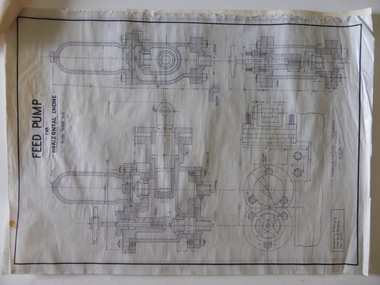
... They are also of interest as examples of the type of work produced by students of Warrnambool Technical School in its early days. Ronald Uebergang Warrnambool Technical School History of Allansford History of Warrnambool ‘Warrnambool Technical School’ ‘Designed by R. ...These drawings have been produced in 1919 by Ron Uebergang when he was a pupil at the Warrnambool Technical School. The Uebergang families were pioneers in the Warrnambool/Allansford area. Ronald Uebergang (1903-1971) was born in Warrnambool to Ernest Uebergang and Mary Watson. He went to Allansford State School and Warrnambool Technical School and married Myra Hall. He was mechanically-minded, a good photographer and fond of music and dancing. He and Myra had a dairy farm at the family property, Hopkins Hill near Allansford and later took up grazing beef cattle. Warrnambool Technical School was established in 1913, and was located first on a Timor Street site and later moved to Caramut Road. Today it is called Brauer College. These drawings are of considerable interest because they were produced by Ron Uebergang and the Uebergang families have been prominent in the history of the Warrnambool and Allansford areas since the 1850s. They are also of interest as examples of the type of work produced by students of Warrnambool Technical School in its early days. .1 A Blueprint for a Feed Pump for a Horizontal Engine - blue background, white drawings. The drawing is two-thirds of the full size object. .2 The same drawing on white see-through paper. The paper has a thick line drawn around the edges in black ink. .3 The same drawing on plain white card with drawings in black ink and a thick line drawn around the edges in black ink. .4 The original brown paper covering used to send the drawings to Warrnambool Technical School in 1921. There are also two pages of handwritten material attached to the drawings by a metal clip and giving a description of the design of the Feed Pump. ‘Warrnambool Technical School’ ‘Designed by R. Uebergang’ ‘Drawn by R. Uebergang’ ‘Date 7/10/19’ ronald uebergang, warrnambool technical school, history of allansford, history of warrnambool -
 Warrnambool and District Historical Society Inc.
Document, Steam Cylinder Horizontal Engin, 1919
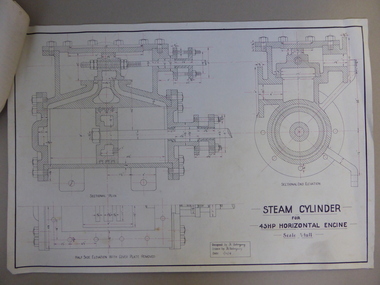
... Members of the Uebergang families have been prominent in the Warrnambool/Allansford area since the early days of the district’s establishment. It is also important as a good example of the type of work produced by students from Warrnambool Technical School in its early years. ...This drawing was produced by Ron Uebergang in 1919 at the Warrnambool Technical School. Members of the Uebergang families have been in the Warrnambool/Allansford area since the early 1850s. Ronald Uebergang (1903-1971) was born in Warrnambool, the son of Ernest Uebergang and Mary Watson. He lived at the family property, Hopkins Hill, and went to Allansford State School and Warrnambool Technical School. He was mechanically-minded, fond of music and dancing and a keen photographer. He married Myra Hall and they ran a dairy farm at Hopkins Hill and later went in for grazing beef cattle. Warrnambool Technical School was established in 1913, firstly at a Timor Street site and later at Caramut Road. Today it is called Brauer College. This drawing is of considerable interest as it was produced by Ron Uebergang. Members of the Uebergang families have been prominent in the Warrnambool/Allansford area since the early days of the district’s establishment. It is also important as a good example of the type of work produced by students from Warrnambool Technical School in its early years. This is a1919 drawing of a Steam Cylinder for a 45 HP Horizontal Engine. The drawing is half the full size of the cylinder. The drawing is on a white card with the sketches done in black and red ink. The card has a heavy black margin around the edges drawn in black ink. The drawing shows a Sectional Plan and a Half Side Elevation with the Cover Plate Removed. The card has the signature of Ron Uebergang. Attached by a metal clip to the card are four pages of measurements and plans of the steam cylinder. These are in black and red ink. Three of these pages have become partly detached. ‘Designed by R. Uebergang’ ‘Drawn by R. Uebergang’ ‘Date 1/12/19’ ronald uebergang, warrnambool technical school, history of allansford, history of warrnambool -
 Warrnambool and District Historical Society Inc.
Drawing, Warrnambool Tech .1 Fly Wheel.2 Bevel Wheels R Uebergang, 1919
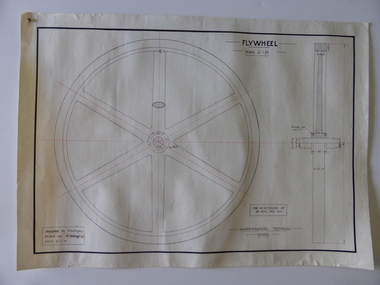
... The drawings also are good examples of the type of work produced by Warrnambool Technical School students in its early years. Warrnambool Technical School Ronald Uebergang History of Allansford ‘Designed by R. ...These drawings have been produced by Ron Uebergang at the Warrnambool Technical School in 1919. Uebergang family members were pioneer settlers in the Warrnambool area in the early 1850s. Ronald John Uebergang (1903-1971) was born in Warrnambool to Ernest Uebergang and Mary Watson. Ron Uebergang lived at the family property, Hopkins Hill at Allansford and went to Allansford State School and Warrnambool Technical School. He was mechanically minded, a good photographer and fond of music and dancing. He married Myra Hall and was a dairy farmer at Hopkins Hill and later grazed beef cattle. Warrnambool Technical School was established in 1913, firstly at a Timor Street site and later at Caramut Road (today it is known as Brauer College). These drawing are of considerable interest as works produced by Ron Uebergang. Uebergang family members have been prominent in the Warrnambool-Allansford area since the pioneering days of the district. The drawings also are good examples of the type of work produced by Warrnambool Technical School students in its early years.These are two designs and drawings by Ron Uebergang produced at the Warrnambool Technical School in 1919. They are drawn on white card using black and red ink. The scale of the Flywheel is three inches to one foot and the Bevel Wheels are one-third full size. The drawings are edged with heavy black lines. The two sheets have the signature of Ron Uebergang. There are also four pages of handwritten notes on the Flywheel and Bevel Wheels.‘Designed by R. Uebergang’ ‘Drawn by R.Uebergang’ ‘Date 4/1/19’ (on Flywheel sheet) ‘Date 27/5/19’ (on Bevel Wheels sheet) warrnambool technical school, ronald uebergang, history of allansford -
 Eltham District Historical Society Inc
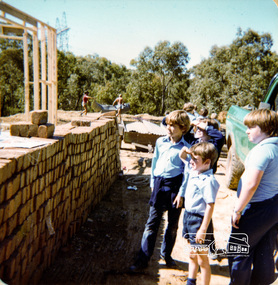
Photograph, Excursion to Fields house next to school early in year, Eltham Christian School, 1982, 1982
... early in year, Eltham Christian School, 1982. From a series of photographs (some cropped) from a magnetic photo album relating to the staff, students and activities of the Eltham Christian School which operated as part of the Eltham Christian Church at Nyora Road, Eltham. ...early in year, Eltham Christian School, 1982. From a series of photographs (some cropped) from a magnetic photo album relating to the staff, students and activities of the Eltham Christian School which operated as part of the Eltham Christian Church at Nyora Road, Eltham. ...Excursion to Fields family house under construction next to school early in year, Eltham Christian School, 1982. From a series of photographs (some cropped) from a magnetic photo album relating to the staff, students and activities of the Eltham Christian School which operated as part of the Eltham Christian Church at Nyora Road, Eltham. See also entries for each photograph.3 colour photographseltham christian school, nyora road, buildings, construction, field house -
 Eltham District Historical Society Inc
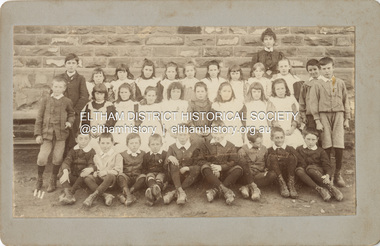
Photograph, Thomas Tennent, Class Photo, Eltham State School No. 209, Dalton Street, Eltham. Teacher Miss Ellen Sweeney, c.1894
... student of the school from 1879 (age 4) to 1889, Ellen was a teacher at Eltham State School from 1891-1898. She returned in 1915 until her marriage to William Hooley of Casterton at St Marys, Eltham, Tuesday, April 24, 1923. Based on Ellen Sweeney's hairstyle, the date is more likely to be in the earlier...student of the school from 1879 (age 4) to 1889, Ellen was a teacher at Eltham State School from 1891-1898. She returned in 1915 until her marriage to William Hooley of Casterton at St Marys, Eltham, Tuesday, April 24, 1923. Based on Ellen Sweeney's hairstyle, the date is more likely to be in the earlier ...Teacher Ellen Sweeney at rear. A former student of the school from 1879 (age 4) to 1889, Ellen was a teacher at Eltham State School from 1891-1898. She returned in 1915 until her marriage to William Hooley of Casterton at St Marys, Eltham, Tuesday, April 24, 1923. Based on Ellen Sweeney's hairstyle, the date is more likely to be in the earlier 1890s Thomas Tennant, photgrapher operated from 116 Johnston Street, Collingwood from c.1891 through to 1900. PANEL 1875-1920 Panels began to be produced around 1875, and were particularly suited, because of their larger size, for capturing family, or even larger, groups. They measured 8.5 by 6.5 inches (22 cm x 16.5 cm). - Frost, Lenore; Dating Family Photos 1850-1920; Valiant Press Pty. Ltd., Berwick, Victoria 1991marg ball collection, shillinglaw family photo album 3, 1891-1898, 1894, class photo, ellen hooley (nee sweeney), ellen sweeney, eltham primary school, eltham state school no. 209, thomas tennent photographer 116 johnston st collingwood -
 Eltham District Historical Society Inc
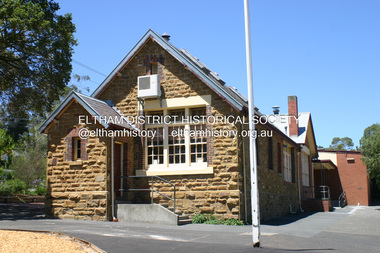
Photograph - Digital Photograph, Alan King, Eltham Primary School No. 209, Dalton Street, Eltham, 28 December 2007
... .; p49 Eltham Primary School at Dalton Street, bustling with hundreds of students, has changed dramatically since it began in July 1855.1 A reminder of its early days is the building in local sandstone with a slate roof. ....; p49 Eltham Primary School at Dalton Street, bustling with hundreds of students, has changed dramatically since it began in July 1855.1 A reminder of its early days is the building in local sandstone with a slate roof. ...This building is the earliest building remaining on site today. It was built in 1875 and was the second school building replacing the original 1856 building of stone walls with wooden shingles on the roof. That building needed to be replaced after the stone walls collapsed outwards. In August 1912 the school issued a requisition for remodelling of the school concerned with replacement of the existing windows with larger and wider windows to allow additional light into the school rooms and the erection of a wooden partition in the centre of the room. An extension to the building at rear and skylights in the roof were added in 1921. Only two low wooden stairs were originally provided to enter the porch. These were rebuilt by 1928. A steel mud grate was introduced 1930s/1940s and an infant shelter shed circa 1945. Covered under Heritage Overlay, Nillumbik Planning Scheme. Published: Nillumbik Now and Then / Marguerite Marshall 2008; photographs Alan King with Marguerite Marshall.; p49 Eltham Primary School at Dalton Street, bustling with hundreds of students, has changed dramatically since it began in July 1855.1 A reminder of its early days is the building in local sandstone with a slate roof. First head teacher was David G Clark who was officially in charge from June 1856 until 1889.2 This school was not the settlement’s first. That was the Church of England Little Eltham School, west of Diamond Creek in 1853 and closed in 1872. In 1855 David Clark and his sister Catherine, opened what was to become the present school, with eight students. The school operated elsewhere in a temporary slab building, also used for worship by the Wesleyans,3 which allowed the wind and rain easy access. As well as having to endure such Spartan conditions, the students paid one penny a week for the privilege. But in June 1856 the patrons objected to the conditions, and they and the Clarks wrote to the National Schools Board, asking for a suitable school. They asked for a grant to buy land for a school, and to appoint the Clarks. As a result, inspector Mr A B Orlebar visited the school. He found 33 children aged from four to 13 and noted, among other things: ‘There is no attempt at classification, and this is owing chiefly to the want of books, every child bringing with it any spelling or reading book he or she may find at home,4 and partly to the master and mistress having little idea of anything but individual instruction.’ Of Mr Clark, Mr Orlebar said: ‘I cannot pass him as coming up to the full standard of a probationer. He promises however to pursue a course….if the commissioners take him into their service.’ Of Catherine: ‘She makes a promise similar to that of her brother. Pupils were orderly and the school seemed well conducted. I cannot therefore hesitate to recommend them both personally as probationers.’ Later at a public meeting, Mr Orlebar pledged the commissioners would give £150 for a school, if this was matched by local residents. The meeting decided the commissioners would acquire two acres (0.8ha) for the school site. The building, constructed with local sandstone, was completed in December 1857, measuring 40 feet x 16 feet (12mx5m) and 10 feet (3m) high. It was divided into two rooms – one for the school and the other for teacher accommodation. So the Eltham school was born, in an area regarded as ‘one of the poorest in the colony’. Excerpts from inspectors’ reports in the following years, show that in some ways school has not changed that much since then: ‘Discipline only moderate. Too much chattering!’ (1873); ‘Several slates were cleaned with saliva applied by the hand! Damp rags would be much nicer.’(1891).5 In 1863 the Board of Education took over the school giving it its current name and number, Eltham Primary School No 209. Overcrowding has dogged the school over much of its history. In 1875 overcrowding spilled part of the school into the local courthouse. But that year the sandstone building, which is still standing, was built for 100 children, costing £553 and replacing the National School building. Now, this section, even following renovations, still bears part of its original graciousness, with lofty timber ceilings, tall vertical windows and original floors.This collection of almost 130 photos about places and people within the Shire of Nillumbik, an urban and rural municipality in Melbourne's north, contributes to an understanding of the history of the Shire. Published in 2008 immediately prior to the Black Saturday bushfires of February 7, 2009, it documents sites that were impacted, and in some cases destroyed by the fires. It includes photographs taken especially for the publication, creating a unique time capsule representing the Shire in the early 21st century. It remains the most recent comprehenesive publication devoted to the Shire's history connecting local residents to the past. nillumbik now and then (marshall-king) collection, dalton street, eltham primary school, state school no. 209 -
 Eltham District Historical Society Inc
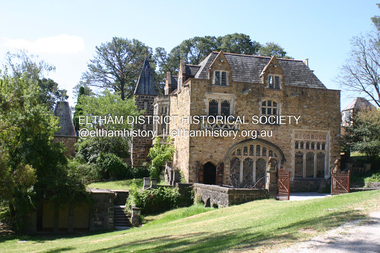
Photograph - Digital Photograph, Alan King, Great Hall, Montsalvat, 8 January 2008
... students and visitors enjoying the unique and beautiful surroundings. This collection of almost 130 photos about places and people within the Shire of Nillumbik, an urban and rural municipality in Melbourne's north, contributes to an understanding of the history of the Shire. Published in 2008 immediately prior to the Black Saturday bushfires of February 7, 2009, it documents sites that were impacted, and in some cases destroyed by the fires. It includes photographs taken especially for the publication, creating a unique time capsule representing the Shire in the early ...Great Hall at Montsalvat built 1938-52, designed by Justus Jorgensen Covered under National Estate, National Trust of Australia (Victoria) State Significance, Victorian Heritage and Heritage Overlay, Nillumbik Planning Scheme. Published: Nillumbik Now and Then / Marguerite Marshall 2008; photographs Alan King with Marguerite Marshall.; p129 At first glance, Montsalvat, the artists’ community at Hillcrest Avenue, Eltham, could belong to another time and place. The French provincial Gothic-style buildings blend picturesquely with the introduced and native trees and farm animals on the five hectare property. But Montsalvat belongs very much to today’s Eltham, having inspired much of its creative activity and style. The use of mud-brick and recycled building materials, for which Eltham is so well-known, was largely popularised by Montsalvat. Montsalvat – unique in Victoria and probably in Australia – is registered by the National Trust and National Estate.1 Montsalvat, named after the castle of the Knights of the Holy Grail, has attracted artists and intellectuals since it was founded in 1934. For years at weekends, artists, lawyers, philosophers, politicians and others, who shared a love for what Montsalvat stood for, gathered for a meal and stimulating discussion. The focus for this gathering of talent was Justus Jörgensen, an eccentric man with vision and charisma. It was Jörgensen’s foresight that saw the creation of Montsalvat, which in 1975 was formed into a trust to benefit the Victorian people. The property was then valued at about three million dollars. It is now visited by thousands of people annually. Born in 1894 and brought up a Catholic, Jörgensen had trained as an architect. He later studied painting at the National Gallery School under artist, Frederick McCubbin, then joined the studio of artist Max Meldrum. In 1924, Jörgensen married medical student Lillian Smith, and with artist friends they travelled to Europe to study the great masters. In London Jörgensen exhibited in several major galleries. One of his still life paintings was included in the book The Art of Still Life by Herbert Furst, which featured 100 of the greatest ever still life paintings.2 In 1929, Jörgensen returned to Melbourne where Lil, now qualified, worked as an anaesthetist at St Vincent’s Hospital. They bought a small house in Brighton and Jörgensen rented a large building in Queen Street for his studio until the Royal Automobile Club of Victoria bought it in 1955. While designing and overseeing the building of a studio for his friend the famous cartoonist Percy Leason, in Lavender Park Road, Jörgensen decided to buy land for a country retreat in Eltham. So the building of Montsalvat began. Jörgensen gathered around a dozen of his friends and students from his Queen Street studio. They set to work, first at weekends then some decided to live permanently on the site. Jörgensen had seen mud-brick buildings in Spain and recognised that Eltham’s clay soil was ideal for mud-bricks and although labour intensive, it was a very cheap way of building. Jörgensen’s students and friends worked under his direction with the help of local tradesmen, including carpenter, Len Jarrold and later stone mason, Horrie Judd. In return Jörgensen would give the students a painting lesson or two. It was the Great Depression when many were out of work. Jörgensen also inspired people to give generously of money and materials. With their help Jörgensen found second-hand materials for building. Friends donated slate for roofing, discarded firebricks were used for flooring and windows and doors and a cast-iron circular staircase came from a wrecker. The students’ day started at 7am with building and domestic chores, shared equally between the sexes. The first building was used by his friends at weekends and then became a home for his wife Lil. It consisted of three rooms and an attic under a high-pitched roof. Jörgensen then built a similar structure with the same high-pitched roof as a more permanent home for his students. The two buildings were joined together with a tower and a studio for Jörgensen. While excavating for the studio a reef of yellow mud-stone was found and then used in construction. The next building was the Great Hall, to be used for dining, exhibitions and meetings and completed in 1958, after a halt during the war. Whelan the Wrecker donated the stone-framed windows from the building that housed the Victorian Insurance Co. in Collins Street, which had been demolished in the 1930s. The swimming pool was donated and cubicles were built for the students with their initials marked in tiles on each doorstep.1 One of Jörgensen’s great abilities was to recognise how to use material which harmonised. He would comb through wreckers’ yards for what he needed. Regarding his buildings as sculptural pieces, his first consideration was for the aesthetic quality of a building and only then for its functionality.2 At Montsalvat, Jörgensen found he was able to put his ideas into practice without compromise and those who worked with him had to conform to his ideas. With the Jörgensens, the colony’s original nucleus consisted of the Skipper family – Mervyn and wife Lena, daughters Helen and Sonia and son Matcham,who was to become an eminent jeweller and sculptor represented in National Gallery collections throughout Australia and in European museums.3 Other members were Arthur Munday, Lesley Sinclair, Helen Lempriere, Ian Robertson, John Smith, George Chalmers, John Busst and Sue Van der Kellan; also Jörgensen’s three sons – Max, Sebastian and Sigmund – and Saskia, Sonia Skipper and Arthur Munday’s daughter. Montsalvat went through some hard times when local gossips spread rumours of sexual shenanigans at Montsalvat. However Montsalvat also had many local supporters – especially amongst the local tradespeople. The colony was certainly unconventional – with Jörgensen’s wife Lil (and son Max) and life-time partner Helen Skipper, (mother of Sebastian and Sigmund) living at Montsalvat. Sonia Skipper says in her biography that the group were ‘very conscious of their responsibilities to each other and a desire to make their relationships work’.4 By World War Two many buildings around the Great Hall were completed. Jörgensen was a pacifist, as were most of his students. Some of the Montsalvat community enlisted while others engaged in essential services like dairy farming and market gardening for the war effort. It was then that Jörgensen constructed farm buildings. After the war many well-known personalities such as Clifton Pugh, landscape gardener Gordon Ford, and builder Alistair Knox, were drawn to Montsalvat. They learnt that building was not a ‘sacred cow’ only for professionals, but that anyone who was willing to get their hands dirty could do it. The post-war shortage of materials also encouraged builders to follow Montsalvat’s lead in reusing materials. When Jörgensen died in 1975, his influence did not – thanks largely to the vigilance of his son, Sigmund, who became its administrator. The weekend dinners have gone, but in 2008 about 14 artists still work at Montsalvat – some living there – including a couple who have been there since its early days. Under Sigmund’s direction Montsalvat further expanded its activities which included festivals, art exhibitions, concerts and weddings. Sigmund completed the Chapel, then the Long Gallery next to the pool, After the barn burnt down, he replaced it in 1999 (the builder was Hamish Knox, Alistair’s son) with a new gallery and entrance and added a restaurant. Sigmund has been careful that any new building blends in with the character of Montsalvat. In 2006 Montsalvat was restructured for its continued financial viability and with the help of Arts Victoria a new executive officer was appointed. A representative board from the wider community was established, which includes members from the former Montsalvat Trust including Sigmund Jörgensen – who is now the heritage and arts adviser to the new company Montsalvat Ltd.5 Today, visiting Montsalvat one still sees artists, students and visitors enjoying the unique and beautiful surroundings.This collection of almost 130 photos about places and people within the Shire of Nillumbik, an urban and rural municipality in Melbourne's north, contributes to an understanding of the history of the Shire. Published in 2008 immediately prior to the Black Saturday bushfires of February 7, 2009, it documents sites that were impacted, and in some cases destroyed by the fires. It includes photographs taken especially for the publication, creating a unique time capsule representing the Shire in the early 21st century. It remains the most recent comprehenesive publication devoted to the Shire's history connecting local residents to the past. nillumbik now and then (marshall-king) collection, eltham, great hall, montsalvat -
 Eltham District Historical Society Inc
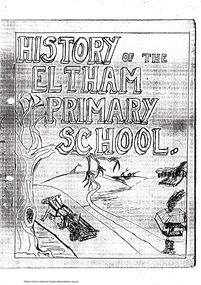
Booklet - Folder, History of Eltham Primary School, 1970
... Photocopy of original book: History of the Eltham Primary School, published in 1970. 14 pages. 3 Photocopies of parts of map Handwritten notes by H.G. about walking to school and early classroom conditons and activiites Writings by Grade 1 students of EPS "about what life was like 150 years ago"...History of Eltham Primary School to 1970 eltham primary school adamson armstrong atkinson betti blackman brown buchanan caldwell clark cochrane coleman curran daply dudfield dunne dunstan elliott findlay fisher gamble gardiner gardner gilchrist gray greenwood haniford harry gilham collection hughes hunniford jobling kane kaylock kewish lancaster main mccoll mcmurrey mcolvan meadow meadows murray murrey orlebar overman pearson peerson potter scott sincom son spicer state school no. 209 stewart sweeney teague unsworth warren williams Photocopy of original book: History of the Eltham Primary School, published in 1970. 14 pages. 3 Photocopies of parts of map Handwritten notes by H.G. about walking to school and early classroom conditons and activiites Writings by Grade 1 students of EPS "about what life was like 150 years ago" History of Eltham Primary School Booklet Folder ...History of Eltham Primary School to 1970Photocopy of original book: History of the Eltham Primary School, published in 1970. 14 pages. 3 Photocopies of parts of map Handwritten notes by H.G. about walking to school and early classroom conditons and activiites Writings by Grade 1 students of EPS "about what life was like 150 years ago"eltham primary school, adamson, armstrong, atkinson, betti, blackman, brown, buchanan, caldwell, clark, cochrane, coleman, curran, daply, dudfield, dunne, dunstan, elliott, findlay, fisher, gamble, gardiner, gardner, gilchrist, gray, greenwood, haniford, harry gilham collection, hughes, hunniford, jobling, kane, kaylock, kewish, lancaster, main, mccoll, mcmurrey, mcolvan, meadow, meadows, murray, murrey, orlebar, overman, pearson, peerson, potter, scott, sincom, son, spicer, state school no. 209, stewart, sweeney, teague, unsworth, warren, williams -
 Eltham District Historical Society Inc
Photograph, A walk through the cemetery at Kangaroo Ground, Diana Bassett-Smith, 1 October 2001, 2001
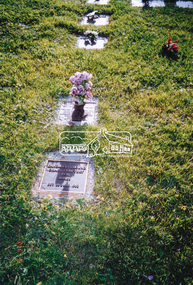
... students at Dandenong. Bill later became Chairman of Kraft Foods. We were reminded of our wanderings in the cemetery at Worthing, England, where we discovered Pelling graves when hunting for Henty ones. A brief collection of reminiscences by Diana Bassett-Smith of locals who are buried at Kangaroo Ground Cemetery along with 17 photographs following a visit on 1 October 2001. 1983 bushfire, air vice marshall wackett, ambrose erswell, barry roach-pierson, bill pelling, billy roach-pierson, birrarung, bourchiers road, ca 13, crichton, david grant, diamond street, diana bassett-smith, donald grant, donaldson road, dorrie bourchier, duff, early settlers, elizabeth cottee, ewan cameron mp, grey house, helen kohn, isabella grant (nee stevenson), jack bourchier, james balfour, james wilson, jean stewart, jessie bull (nee haughton), jimmy cook, jocelyn, joseph stevenson, judge book village, judith furphy, kangaroo ground cemetery, kay roach-pierson, keith jocelyn, kraft foods, lacey, lloyd stuart, louise grant (nee gordon), mardi crocker, marion erswell, ned haughton, nursery, pam chevallier, passiona, peter bassett-smith, pigeon bank, rath, ricketson, robinson, ruth boyd, steven crawford baes, tintagell, tosch, vera jackson, wackett trainer, watershed jackson, willandra poultry farm, zac crocker Colour photograph print A walk through the cemetery at Kangaroo Ground, Diana Bassett-Smith, 1 October 2001 Photograph Photograph Diana Bassett-Smith Peter Bassett-Smith ...Sauntering along the freshly mown grassy pathways, we noticed Bill Pellings Grave, marked with a Bronze plaque with pink artificial roses beside the inscription. Marion Erswell who with her husband Ambrose lived in Eltham at Willandra, their poultry farm where the Judge Book Village is now . She had taught Bill at school and said he was one of her brightest students at Dandenong. Bill later became Chairman of Kraft Foods. We were reminded of our wanderings in the cemetery at Worthing, England, where we discovered Pelling graves when hunting for Henty ones. A brief collection of reminiscences by Diana Bassett-Smith of locals who are buried at Kangaroo Ground Cemetery along with 17 photographs following a visit on 1 October 2001.Colour photograph print1983 bushfire, air vice marshall wackett, ambrose erswell, barry roach-pierson, bill pelling, billy roach-pierson, birrarung, bourchiers road, ca 13, crichton, david grant, diamond street, diana bassett-smith, donald grant, donaldson road, dorrie bourchier, duff, early settlers, elizabeth cottee, ewan cameron mp, grey house, helen kohn, isabella grant (nee stevenson), jack bourchier, james balfour, james wilson, jean stewart, jessie bull (nee haughton), jimmy cook, jocelyn, joseph stevenson, judge book village, judith furphy, kangaroo ground cemetery, kay roach-pierson, keith jocelyn, kraft foods, lacey, lloyd stuart, louise grant (nee gordon), mardi crocker, marion erswell, ned haughton, nursery, pam chevallier, passiona, peter bassett-smith, pigeon bank, rath, ricketson, robinson, ruth boyd, steven crawford baes, tintagell, tosch, vera jackson, wackett trainer, watershed jackson, willandra poultry farm, zac crocker -
 Eltham District Historical Society Inc
Photograph, George Coop, Copy of a photo of Steam locomotive Y-103 at Newport Railway Station, c.1951, 1962
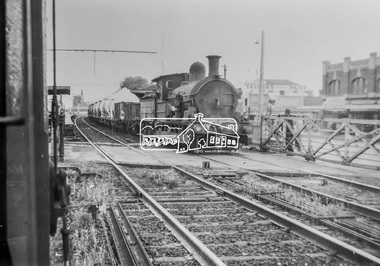
... Hall Street is seen to the right and the two-storey brick building remains to present day One of several photos at Newport taken the same day in the early 1950s when George Coop was a secondary school student. This photo is a 35mm copy (1962) of an original print of the c.1951 negative - possibly to use up the last frame after photographing several other early VR prints....Hall Street is seen to the right and the two-storey brick building remains to present day One of several photos at Newport taken the same day in the early 1950s when George Coop was a secondary school student. This photo is a 35mm copy (1962) of an original print of the c.1951 negative - possibly to use up the last frame after photographing several other early VR prints. ...The Melbourne Road level crossing is now the location of the pedestrian underpass. Hall Street is seen to the right and the two-storey brick building remains to present day One of several photos at Newport taken the same day in the early 1950s when George Coop was a secondary school student. This photo is a 35mm copy (1962) of an original print of the c.1951 negative - possibly to use up the last frame after photographing several other early VR prints.Digital TIFF file Scan of 35mm Ilford FP3 black and white transparencygeorge coop collection, hall street, level crossing, melbourne road, newport railway station, y-103, y-class steam locomotive -
 Kiewa Valley Historical Society
Book - Ledger Commercial, Ledger No 5, Commenced Jan 1st 1897, circa 1890's
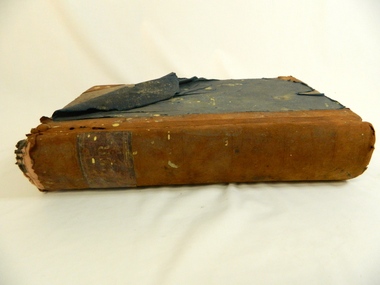
... students of commerce required an accuracy in writing and arithmetic. Neatness and order were a selection requirement This item clearly identifies the Kiewa Valley as having a substantial financial hub to accommodate the various commercial enterprises within a rural environment Circa 1880's. Although Kiewa Valley had mining, agriculture, cattle and sheep it was also composed of a mixed society, encompassing all levels of society at that period. It identifies some family farming history in the specific year of 1897 ledger early ...Historically this ledger not only details the legible hand writing of this era but also the day to day commercial activity in this region. The neatness and the diligence of those who were required to pen the information was a requirement by all who were in commercial trade. Emphasis on neatness was ingrained in students at a young age. This era was well before general typewriters and computers. Generally all students of commerce required an accuracy in writing and arithmetic. Neatness and order were a selection requirement This item clearly identifies the Kiewa Valley as having a substantial financial hub to accommodate the various commercial enterprises within a rural environment Circa 1880's. Although Kiewa Valley had mining, agriculture, cattle and sheep it was also composed of a mixed society, encompassing all levels of society at that period. It identifies some family farming history in the specific year of 1897Leather reinforced corner covers and spine. Remaining book front and back covers are protected by blue weaved cloth. The covers are very thick cardboard, in layers. Missing front index pages C,E - 0,Q,T,U,V,XSpine of book marked in faded golden print "Ledger". First page in hand writing "Ledger No. 5" and underneath handwritten "Commenced Jan 1st !897" After the index pages each page (double sided) has a page number stamped in black and is 6mm highledger, early bookkeeping, local history, commerce circa 1890 -
 Kiewa Valley Historical Society
Book - Reference Chemistry, Elements of Chemistry, first printed 1887 this item 1921
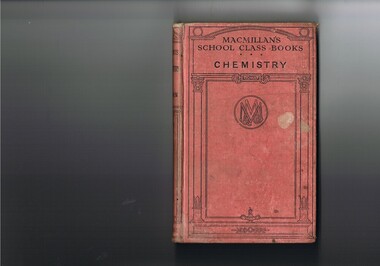
... The student in the 2 Millennium has a far greater reference source available e.g. the internet. This book is significant to the Kiewa Valley as the Davies family (Tas Davies, penned on the first page), belong to the early settlers of the valley. ...This item is a good example of a pre 1960's school science reference books. It contains sketches of experimental apparatus and not colored photographs of later text books. Although the sketches are very instructional they do not show the various colours obtained when mixing some compounds. The history of reprints demonstrates the quality of the information and the ease of study for students using this book. The era of this publication was a time when sources for knowledge in schools was restricted to mainly school books and teacher demonstrations. The student in the 2 Millennium has a far greater reference source available e.g. the internet. This book is significant to the Kiewa Valley as the Davies family (Tas Davies, penned on the first page), belong to the early settlers of the valley. The book acknowledges that although the region was relatively isolated up to the mid 1900s, the good teaching methods of local schools did not suffer in this rural area. This region was not in the backwaters of scholarly development and modern progressive thought. As with "school of the air" distances in rural areas, between centres of learning and recipients, became irrelevant provided that the social stimulant to learn exists. The "local school" mind set within rural areas was, even before the improvement of the communication "explosion" of the early 1900s followed by the internet facilities of the late 1900s, the greatest drive in cutting the anomalies between city and rural learning facilities. Government decentralising higher education facilities into regional centres (Wodonga - Albury) provided greater access for the learned mind.This item (book) has a faded red colour, hard cover with black print and rectangular design. Within this design is an encircled double "M" and "&" (in the left inverted V of the M) and a "Co" (in the right inverted V of the M). On the front cover "MACMILLAN'S SCHOOL CLASS BOOKS CHEMISTRY" and on the spine "ELEMENTS OF CHEMISTRY" underneath "REMSEN" and at the bottom"MACMILLAN & Co"school, chemistry, text books, science experiments -
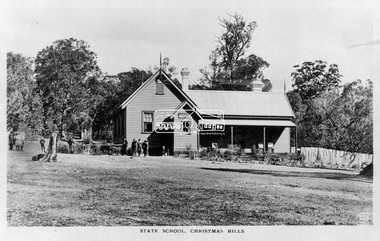 Eltham District Historical Society Inc
Negative - Photograph, State School No. 1362, Christmas Hills, c.1900
... . - Christmas Hills Past & Present (Yarra Glen & District Historical Society), 2004 Early students / school early 20th century This photo forms part of a collection of photographs gathered by the Shire of Eltham for their centenary project book,"Pioneers and Painters: 100 years of the Shire of Eltham" by Alan Marshall (1971). ...The School officially began in 1874 under head teacher Robert Harris, in rooms of the then Christmas Hills Post Office Store. By 1879, authorities agreed a new school was required. As with the citing of the Hall, there was considerable local controversy over whether the school should be built on the high point of School Lane, or the current location (then known as Scrubby Point). This pleasantly-sited bush school was opened in 1880, having been built by Jospeh Stevenson (Jr.) after his successful tender of £390. - Christmas Hills Past & Present (Yarra Glen & District Historical Society), 2004Early students / school early 20th century This photo forms part of a collection of photographs gathered by the Shire of Eltham for their centenary project book,"Pioneers and Painters: 100 years of the Shire of Eltham" by Alan Marshall (1971). The collection of over 500 images is held in partnership between Eltham District Historical Society and Yarra Plenty Regional Library (Eltham Library) and is now formally known as the 'The Shire of Eltham Pioneers Photograph Collection.' It is significant in being the first community sourced collection representing the places and people of the Shire's first one hundred years.Digital image 4 x 5 inch B&W Negsepp, shire of eltham pioneers photograph collection, christmas hills, school, state school no. 1362 -
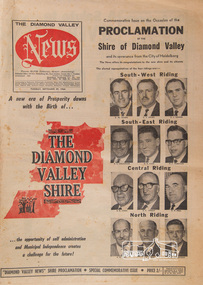 Eltham District Historical Society Inc
Newspaper, Diamond Valley News, 29 Sep 1964; Commemorative Issue on the Occasion of the PROCLAMATION of the Shire of Diamond Valley and its severance from the City of Heidelberg, 29 Sep 1964
... Diamond Creek is still haunted by the ghost of Gold – inc photo of Upper Diamond Creek school students. Education in the early days (Greensborough) Beginning od the Anglican Church Greensborough Apple Tree 120 years old Arch (Adie) has found his promised land – Yarrambat The time when three men owned Watsonia St Katherine’s Church at St Helena Horse bolted when first car arrived Exploration of Plenty River Actual issue Blood bank at Eltham Sewer, Mrs Lucy Nash of Montmorency success at Melbourne Show Eltham Central Park Committee and Eltham Youth Club, Youth Club hall Land subdivision at Warrandtye – to be re-submitted Wage increase will affect council finance Eltham agrees to extra audit fees Clintons announce big extensions New catholic school for Bundoora Peter and Joe here to stay Methodist Church at Greensborough When the railway came to DV Public religious worship in Diamond Creek Saga of the Ryans (Diamond Creek) Golden King Mine – Yarrambat Where history walks in Main St inc photo of Coventry family Watsonia open paddocks before the war (photo) The history of beautiful Greensborough These boundaries have never altered Premiers in 1912 Greensborough FC photo Memorial Gates Photo Catholic parish of DC ...Diamond Creek is still haunted by the ghost of Gold – inc photo of Upper Diamond Creek school students. Education in the early days (Greensborough) Beginning od the Anglican Church Greensborough Apple Tree 120 years old Arch (Adie) has found his promised land – Yarrambat The time when three men owned Watsonia St Katherine’s Church at St Helena Horse bolted when first car arrived Exploration of Plenty River Actual issue Blood bank at Eltham Sewer, Mrs Lucy Nash of Montmorency success at Melbourne Show Eltham Central Park Committee and Eltham Youth Club, Youth Club hall Land subdivision at Warrandtye – to be re-submitted Wage increase will affect council finance Eltham agrees to extra audit fees Clintons announce big extensions New catholic school for Bundoora Peter and Joe here to stay Methodist Church at Greensborough When the railway came to DV Public religious worship in Diamond Creek Saga of the Ryans (Diamond Creek) Golden King Mine – Yarrambat Where history walks in Main St inc photo of Coventry family Watsonia open paddocks before the war (photo) The history of beautiful Greensborough These boundaries have never altered Premiers in 1912 Greensborough FC photo Memorial Gates Photo Catholic parish of DC newspaper local newspapers diamond valley news Local newspaper (complete); 40 pages Diamond Valley News, 29 Sep 1964; Commemorative Issue on the Occasion of the PROCLAMATION of the Shire of Diamond Valley and its severance from the City of Heidelberg. ...Commemorative issue on the occasion of the Proclamation of the Shire of Diamond Valley Wraparound to September 29, 1964 issue Photos and names of Crs. A Salute to severance (from the City of Heidelberg) p.2 The News – “official organ of the City of Heidelberg: established in 1896 Add: Watsonia Garage, Croft Bank Dairies. From Tiny village to thriving township (Greensborough) – discussion of water and electricity supply history includes photos of Main Street, Greensborough Pool, In the days of the giants: Local football players Cordiner and Coventry (Diamond Creek) and others. Diamond Creek is still haunted by the ghost of Gold – inc photo of Upper Diamond Creek school students. Education in the early days (Greensborough) Beginning od the Anglican Church Greensborough Apple Tree 120 years old Arch (Adie) has found his promised land – Yarrambat The time when three men owned Watsonia St Katherine’s Church at St Helena Horse bolted when first car arrived Exploration of Plenty River Actual issue Blood bank at Eltham Sewer, Mrs Lucy Nash of Montmorency success at Melbourne Show Eltham Central Park Committee and Eltham Youth Club, Youth Club hall Land subdivision at Warrandtye – to be re-submitted Wage increase will affect council finance Eltham agrees to extra audit fees Clintons announce big extensions New catholic school for Bundoora Peter and Joe here to stay Methodist Church at Greensborough When the railway came to DV Public religious worship in Diamond Creek Saga of the Ryans (Diamond Creek) Golden King Mine – Yarrambat Where history walks in Main St inc photo of Coventry family Watsonia open paddocks before the war (photo) The history of beautiful Greensborough These boundaries have never altered Premiers in 1912 Greensborough FC photo Memorial Gates Photo Catholic parish of DC Local newspaper (complete); 40 pagesnewspaper, local newspapers, diamond valley news -
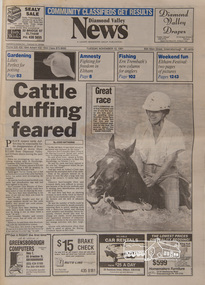 Eltham District Historical Society Inc
Newspaper, Diamond Valley News, 12 Nov 1991, 12 Nov 1991
... Loyola College science students Latest births at Diamond Valley hospital Sunday Community Walks program HEIDELBERG 150 FEATURE General history article Add with history for the Old England Hotel, Heidelberg Janefield Special School Real Estate add with photos of Rosehill Estate, Lower Plenty to be sold. Large real Estate section: Eltham South Historic Mulberry Cottage c 1890 “Arnleigh” Bannons Lane, Yarrambat ca 1889 Early...Loyola College science students Latest births at Diamond Valley hospital Sunday Community Walks program HEIDELBERG 150 FEATURE General history article Add with history for the Old England Hotel, Heidelberg Janefield Special School Real Estate add with photos of Rosehill Estate, Lower Plenty to be sold. Large real Estate section: Eltham South Historic Mulberry Cottage c 1890 “Arnleigh” Bannons Lane, Yarrambat ca 1889 Early ...Cattle Duffing Feared – missing cattle in Hurstbridge, Christmas Hills, Watsons Creek. Riders vie for “Cup of the Mountains” – horse riding Main Road, Research property no longer attractive to buyers due to rezoning to open space. Work at Churinga, Greensborough praised. Crime rates increase Shire of Diamond Valley to ban incinerators – Shire of Eltham to follow Greensborough Secondary College students enjoy Oaks Day Shire of DV President Barbara Smith attends international conference Tea Party at Panorama Heights Pre-School 14 sheep killed at Panton Hill hobby farm Water discolouration to water supply in Eltham and Diamond Valley Amnesty Comments in Letters section on Council draft Conservation and Heritage Strategy Andre Haermeyer selected as ALP candidate for Yan Yean – a newly created seat. Bill Willis of St Andrews pre-selected by Liberal Party for the above Spring Clean campaign 1991 Photos and report on the Eltham Festival Watsonia Neighbourhood Open House Construction of 24 lot housing commission estate in Kemptson St Greensborough and associated traffic plan to be built. Speed humps not a solution Lower Plenty and Hurstbridge Schools Pen Pal scheme Road Safety education at four local schools Wycliffe Bible Centre opened – mud brick construction , designed by Alistair Knox. Loyola College science students Latest births at Diamond Valley hospital Sunday Community Walks program HEIDELBERG 150 FEATURE General history article Add with history for the Old England Hotel, Heidelberg Janefield Special School Real Estate add with photos of Rosehill Estate, Lower Plenty to be sold. Large real Estate section: Eltham South Historic Mulberry Cottage c 1890 “Arnleigh” Bannons Lane, Yarrambat ca 1889 Early Knox home, 17 York Street, Eltham Briar Hill builder recalls early days – Fred Squire p. 77 Kangaroo Ground Sculpture Awards – Peter Burns, Andrew Smith p. 77 Olive Grove and plaque at Simpsons Barracks Signals headquarters p. 77 Lower Plenty Neighbourhood Watch – p. 79 Feature article on weddings at Eltham Gateway Hotel with photos – p. 84 and more… Local newspaper (complete); 104 pagesnewspaper, local newspapers, diamond valley news -
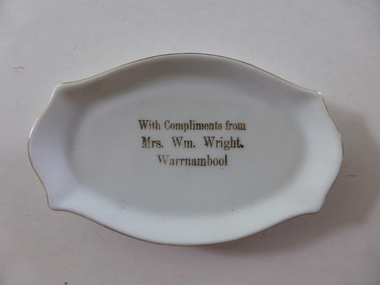 Warrnambool and District Historical Society Inc.
Pin Dish, Mrs Wm Wright Warrnambool, C mid 20th century
... Mrs Wright advertised that her students had success at local shows in items such as shadow work,, embroidered blouse, best cosy, canvas work, novelty pincushion,floss silk work.Her name was Martha but she always traded under her husband's name. She died in 1952. This dish is a a simple reminder of Mrs Wright This pin dish provides a link with one of Warrnambool's early ...Mrs William Wright operated a shop at 95 Liebig street Warrnambool around the turn of the 20th century, where she sold clothing as well as a large range of embroidery and needlework requirement.Some of the work listed in advertisements include shadow work,princess applique and Mount mellick work. She was an experienced and talented needleworker and held classes in a range of work. Mrs Wright advertised that her students had success at local shows in items such as shadow work,, embroidered blouse, best cosy, canvas work, novelty pincushion,floss silk work.Her name was Martha but she always traded under her husband's name. She died in 1952. This dish is a a simple reminder of Mrs Wright This pin dish provides a link with one of Warrnambool's early shopholders and needlewomen. She is featured in a soon to be released publication about women in Warrnambool called Silent Lives. The dish itself is a pleasing little example of a pin dish.Small white plate with gold edging and gold text. It is a rectangular oval shape but all edges are rounded.With compliments Mrs Wm Wright Warrnambool in gold in middle of plate .Made in Czechoslovakiawarrnambool, mrs wm wright, mrs william wright shop, mrs wright liebig st -
 Warrnambool and District Historical Society Inc.
Book, Exercise book Winnie Goodall, Early 20th century
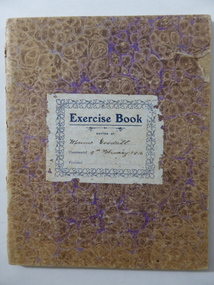
... early manager of the Framlingham Aboriginal Settlement. Another son, Thomas, was a Warrnambool law clerk and Winnie, (born 1901 to mother Leah), was his granddaughter. The Warrnambool Technical School was established in 1913. This exercise book is of interest as an example of school work completed by a Warrnambool Technical School student ...This exercise book has been used by Winnifred (Winnie) Goodall in 1916 when she was a pupil at the Warrnambool Technical School. The material in the book mostly consists of letter-writing practice for business purposes. The Goodalls were pioneer settlers in the Warrnambool district with William and Ellen Goodall arriving in the area in the late 1840s. Eventually they had a property named Wanstead on the Allansford Road in East Warrnambool. One son, William, was an early manager of the Framlingham Aboriginal Settlement. Another son, Thomas, was a Warrnambool law clerk and Winnie, (born 1901 to mother Leah), was his granddaughter. The Warrnambool Technical School was established in 1913.This exercise book is of interest as an example of school work completed by a Warrnambool Technical School student in 1916. It is also of interest because it belonged to Winnie Goodall, a member of an important pioneering family in the Warrnambool district. This is a school exercise book with a cardboard cover and 17 double pages. The cover has a mottled pattern of brown and mauve and the pages have been attached by metal staples but the staples have been removed. The pages have blue ruled lines with handwritten material in blue and black ink. Some of the pages have red hand-drawn lines. The cover is slightly torn. On the first page two cartoon sketches from a newspaper have been pasted in. The front cover has a printed label in blue and white colouring pasted on, with handwritten information on the label. There is a has a circular black , white and blue logo pasted on the inside front cover.‘Exercise Book Written by Winnie Goodall, Commenced 9th February 1916’. Inside cover Logo: Sons of Temperance Warrnambool Division Instituted March 11 1870 Be Firm and Faithful Love Purity Fidelity winnifred goodall, warrnambool technical school, sons of temperance warrnambool -
 Warrnambool and District Historical Society Inc.
Book, Fitting and Turning, 1917
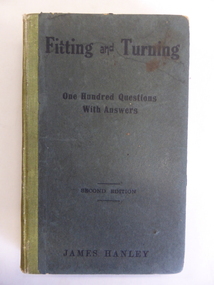
... This book was written with the aim of assisting students attending the Fitting and Turning classes at New South Wales Technical Schools early in the 20th century. ...This book was written with the aim of assisting students attending the Fitting and Turning classes at New South Wales Technical Schools early in the 20th century. ...This book was written with the aim of assisting students attending the Fitting and Turning classes at New South Wales Technical Schools early in the 20th century. The book is inscribed with the name ‘N.F.Heazlewood’. This surname is a common one in the 20th century history of Warrnambool, in particular South Warrnambool. But no specific details have been found on N. Heazlewood. This book is mainly of interest because it is a good example of a technical school text book in the first half of the 20th century. It is also of interest as belonging to a member of a family whose name is known in Warrnambool’s history. This is a hard cover book of 128 pages. The cover is dark green with a lighter green binding on the outside of the cover. There is black lettering on the front cover. There are blank pages for notes at the back of the book and some trade advertisements at the front of the book. The book has a dedication and a preface. On the first page are a stamp from a publisher and an inscription hand-printed in red ink.‘N.F.Heazlewood’ heazlewood (warrnambool), history of warrnambool -
 Warrnambool and District Historical Society Inc.
Postcard - A fag after a fight, !914-1918
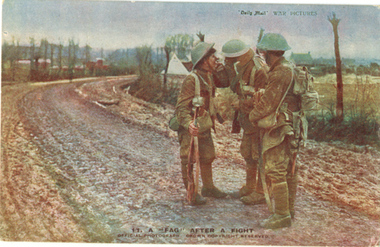
... Daisy Ogier (1907-1987) was a student and then a teacher at Warrnambool Technical School with her early teaching years there from 1925 to 1936 and in 1949. ...Daisy Ogier (1907-1987) was a student and then a teacher at Warrnambool Technical School with her early teaching years there from 1925 to 1936 and in 1949. ...This is number 13 of 27 items in the Daisy Vickers collection of World War One memorabilia. These items were sent or given to Daisy Ogier (nee Vickers) during World War One by Corporal Arthur Anderson who enlisted from Warrnambool in 1915 at the age of 21. He served in Egypt and France and returned to Australia in 1919. Daisy Ogier (1907-1987) was a student and then a teacher at Warrnambool Technical School with her early teaching years there from 1925 to 1936 and in 1949. She became the head mistress from 1950 to 1963 and in 1968. She officially retired in 1976. Daisy Vickers was one of the best loved and dedicated teachers that the school ever had. She married the Reverend Fred Ogier and continued her association with the school after her husband's death.This card is interesting because of its association with World War One and with two local people: Daisy Vickers and Arthur Anderson. This is a colour postcard from World War One with a coloured picture showing three British soldiers in battle dress smoking cigarettes. The background is a road leading to a small settlement probably in France.There is text on both sides and on the back space for correspondence, an address and a stamp. A "FAG" AFTER A FIGHT "Daily Mail" WAR PICTURESdaisy ogier nee vickers, world war one, world war one postcards, daisy vickers -
 Warrnambool and District Historical Society Inc.
Postcard - Les Grenades, 1914-1918
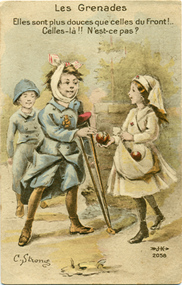
... Daisy Ogier (1907-1987) was a student and then a teacher at Warrnambool Technical School with her early teaching years there from 1925 to 1936 and in 1949. ...Daisy Ogier (1907-1987) was a student and then a teacher at Warrnambool Technical School with her early teaching years there from 1925 to 1936 and in 1949. ...This is number 22 of 27 items in the Daisy Vickers collection of World War One memorabilia. These items were sent or given to Daisy Ogier (nee Vickers) during World War One by Corporal Arthur Anderson who enlisted from Warrnambool in 1915 at the age of 21. He served in Egypt and France and returned to Australia in 1919. Daisy Ogier (1907-1987) was a student and then a teacher at Warrnambool Technical School with her early teaching years there from 1925 to 1936 and in 1949. She became the head mistress from 1950 to 1963 and in 1968. She officially retired in 1976. Daisy Vickers was one of the best loved and dedicated teachers that the school ever had. She married the Reverend Fred Ogier and continued her association with the school after her husband's death. This card is interesting because of its association with World War One and with two local people: Daisy Vickers and Arthur Anderson. This is a coloured postcard with a sketch of three children dressed in military outfits. The child dressed as a nurse is giving a piece of fruit to a child dressed as a wounded soldier. On the back it has space for correspondence and an address.Les Grenadesdaisy vickers, warrnambool, world war one post card, postcard ww1 -
 Warrnambool and District Historical Society Inc.
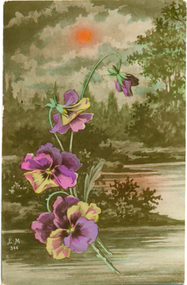
Postcard - Pansies, 1914-1918
... Daisy Ogier (1907-1987) was a student and then a teacher at Warrnambool Technical School with her early teaching years there from 1925 to 1936 and in 1949. ...Daisy Ogier (1907-1987) was a student and then a teacher at Warrnambool Technical School with her early teaching years there from 1925 to 1936 and in 1949. ...This is number 19 of 27 items in the Daisy Vickers collection of World War One memorabilia. These items were sent or given to Daisy Ogier (nee Vickers) during World War One by Corporal Arthur Anderson who enlisted from Warrnambool in 1915 at the age of 21. He served in Egypt and France and returned to Australia in 1919. Daisy Ogier (1907-1987) was a student and then a teacher at Warrnambool Technical School with her early teaching years there from 1925 to 1936 and in 1949. She became the head mistress from 1950 to 1963 and in 1968. She officially retired in 1976. Daisy Vickers was one of the best loved and dedicated teachers that the school ever had. She married the Reverend Fred Ogier and continued her association with the school after her husband's death.This card is interesting because of its association with World War One and two local people Daisy Vickers ans Arthur AndersonThis postcard features pansies and an idyllic sylvan background. On the back it has space for correspondence and an address. There are initials and lettering on the front.E.M. 344 Fabrication Francaise daisy ogier nee vickers, arthur anderson, warrnambool technical school, world war one postcard -
 Warrnambool and District Historical Society Inc.
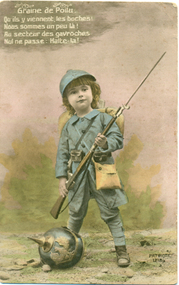
Postcard - Child Soldier, 1914-1918
... Daisy Ogier (1907-1987) was a student and then a teacher at Warrnambool Technical School with her early teaching years there from 1925 to 1936 and in 1949. ...Daisy Ogier (1907-1987) was a student and then a teacher at Warrnambool Technical School with her early teaching years there from 1925 to 1936 and in 1949. ...Daisy Vickers collection: Item 5 of 27Historical Information This is number 24 of 27 items in the Daisy Vickers collection of World War One memorabilia. These items were sent or given to Daisy Ogier (nee Vickers) during World War One by Corporal Arthur Anderson who enlisted from Warrnambool in 1915 at the age of 21. He served in Egypt and France and returned to Australia in 1919. Daisy Ogier (1907-1987) was a student and then a teacher at Warrnambool Technical School with her early teaching years there from 1925 to 1936 and in 1949. She became the head mistress from 1950 to 1963 and in 1968. She officially retired in 1976. Daisy Vickers was one of the best loved and dedicated teachers that the school ever had. She married the Reverend Fred Ogier and continued her association with the school after her husband's death.This card is interesting because of its association with World War One and two local people Daisy Vickers and Arthur AndersonThis postcard has an image of a child soldier holding a gun with a helmet at his foot, There is printing in French on the front and on the back space for correspondence and an address.Graine de Poilu Qu'ils y viennente les boches Nous sommes un peu la! An secteur des gavroches Nul ne passe Halte - la! ! daisy vickers, arthur anderson, world war one, world war one postcard -
 Warrnambool and District Historical Society Inc.
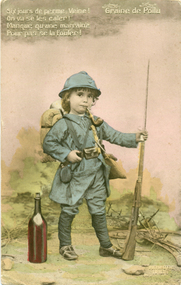
Postcard - Child Soldier 2, 1914-1918
... Daisy Ogier (1907-1987) was a student and then a teacher at Warrnambool Technical School with her early teaching years there from 1925 to 1936 and in 1949. ...Daisy Ogier (1907-1987) was a student and then a teacher at Warrnambool Technical School with her early teaching years there from 1925 to 1936 and in 1949. ...This is number 23 of 27 items in the Daisy Vickers collection of World War One memorabilia. These items were sent or given to Daisy Ogier (nee Vickers) during World War One by Corporal Arthur Anderson who enlisted from Warrnambool in 1915 at the age of 21. He served in Egypt and France and returned to Australia in 1919. Daisy Ogier (1907-1987) was a student and then a teacher at Warrnambool Technical School with her early teaching years there from 1925 to 1936 and in 1949. She became the head mistress from 1950 to 1963 and in 1968. She officially retired in 1976. Daisy Vickers was one of the best loved and dedicated teachers that the school ever had. She married the Reverend Fred Ogier and continued her association with the school after her husband's death. Keywords This card is interesting because of its association with World War One and two local people Daisy Vickers and Arthur Anderson This postcard has an image of a child soldier smoking a pipe, holding a gun and with a bottle at his feet. In the background are some ruins. There is French writing on the back and the front as well as space for an address and correspondence on the back. Graine de Poilu Six jours de perme ; Veine! On va se les caler! Manque qu'une marraine Pour pas se la Fouler! Pour pas se la Fouler caler Fabrication Francaise Patriotic 1218/4 150 PLATINE - A- NOYER -PARIS.. VISE PARIS NO versodaisy ogier nee vickers, arthur anderson, world war 1 postcard -
 Warrnambool and District Historical Society Inc.
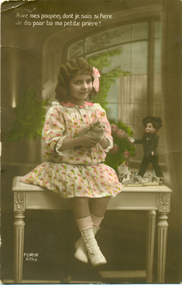
Postcard - Seated girl, 1914-1918
... Daisy Ogier (1907-1987) was a student and then a teacher at Warrnambool Technical School with her early teaching years there from 1925 to 1936 and in 1949. ...Daisy Ogier (1907-1987) was a student and then a teacher at Warrnambool Technical School with her early teaching years there from 1925 to 1936 and in 1949. ...This is number 20 of 27 items in the Daisy Vickers collection of World War One memorabilia. These items were sent or given to Daisy Ogier (nee Vickers) during World War One by Corporal Arthur Anderson who enlisted from Warrnambool in 1915 at the age of 21. He served in Egypt and France and returned to Australia in 1919. Daisy Ogier (1907-1987) was a student and then a teacher at Warrnambool Technical School with her early teaching years there from 1925 to 1936 and in 1949. She became the head mistress from 1950 to 1963 and in 1968. She officially retired in 1976. Daisy Vickers was one of the best loved and dedicated teachers that the school ever had. She married the Reverend Fred Ogier and continued her association with the school after her husband's death.This card is interesting because of its association with World War One and two local people Daisy Vickers and Arthur AndersonThis postcard features a seated girl wearing a pink dress and a pink bow with her dolls on the bench beside her. She is holding a toy kitten. It appears to be a coloured photograph. There is French writing on the front and the back and English writing on the back.Avec mes poupees dont je suis si fiere Je dis pour toi ma petite priere! Furia 615/2 France Oct 10th 1916 Miss Daisy Vickers Bushfield Victoria Australia.daisy vickers, arthur anderson, warrnambool technical school, world war one postcard -
 Warrnambool and District Historical Society Inc.
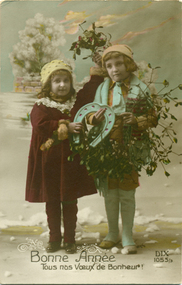
Postcard - Bonne Annee, 1914-1918
... Daisy Ogier (1907-1987) was a student and then a teacher at Warrnambool Technical School with her early teaching years there from 1925 to 1936 and in 1949. ...Daisy Ogier (1907-1987) was a student and then a teacher at Warrnambool Technical School with her early teaching years there from 1925 to 1936 and in 1949. ...This is number 21 of 27 items in the Daisy Vickers collection of World War One memorabilia. These items were sent or given to Daisy Ogier (nee Vickers) during World War One by Corporal Arthur Anderson who enlisted from Warrnambool in 1915 at the age of 21. He served in Egypt and France and returned to Australia in 1919. Daisy Ogier (1907-1987) was a student and then a teacher at Warrnambool Technical School with her early teaching years there from 1925 to 1936 and in 1949. She became the head mistress in 1950 to 1963 and in 1968. Daisy Vickers was one of the best loved and dedicated teachers the school has ever had. She married the Reverend Fred Ogier and continued her association with the school after her husband's death. This card is interesting because of its association with World War One and two local people Daisy Vickers and Arthur AndersonThis postcard features two children standing together holding a horseshoe and flowers. In the background are more flowers. One child is wearing a deep red coloured dress with a lace collar and a hat The other child is wearing a hat, a scarf and leggings.There is black printing on the front. On the back is a hand written letter. Bonne Annee Tous nos Voeux de Bonheur DIX 105.5/3 Belgium August 13th. Dear Daisy, It is a long time since I had a letter from you so I thought I would give you a reminder to write one. Its some time now since I had a letter from Home . They don't come too often now as the Germans sink the mail boats . I am sending a handkerchief along with this card I hope you like it Arthur daisy vickers, warrnambool technical school, world war one postcard -
 Warrnambool and District Historical Society Inc.
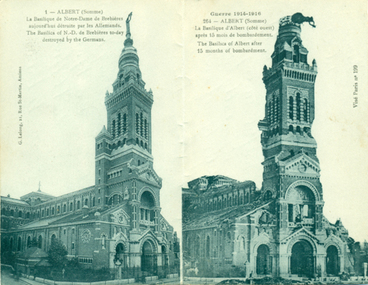
Postcard - Basilica Notre Dame Albert France, 1914-1918
... Daisy Ogier (1907-1987) was a student and then a teacher at Warrnambool Technical School with her early teaching years there from 1925 to 1936 and in 1949. ...Daisy Ogier (1907-1987) was a student and then a teacher at Warrnambool Technical School with her early teaching years there from 1925 to 1936 and in 1949. ...This is number 20 of 27 items in the Daisy Vickers collection of World War One memorabilia. These items were sent or given to Daisy Ogier (nee Vickers) during World War One by Corporal Arthur Anderson who enlisted from Warrnambool in 1915 at the age of 21. He served in Egypt and France and returned to Australia in 1919. Daisy Ogier (1907-1987) was a student and then a teacher at Warrnambool Technical School with her early teaching years there from 1925 to 1936 and in 1949. She became the head mistress from 1950 to 1963 and in 1968. She officially retired in 1976. Daisy Vickers was one of the best loved and dedicated teachers that the school ever had. She married the Reverend Fred Ogier and continued her association with the school after her husband's death.This card is interesting because of its association with World War One and two local people Daisy Vickers and Arthur Anderson This is a piece of paper folded in two to make four pages. Two pages have printed lettering and handwriting . Two pages have black and white photographs of the basilica in Albert, France. 1 - ALBERT (Somme) La Basilique de Notre Dame de Brebieres aujourd' hui detruite par les Allemands . The Basilica of N.D. de Brebieres today destroyed by the Germans. Dear Daisy Just to let you know I received the scarf you sent. It came in very useful during the cold weather especially when there were plenty of snow and ice around. Arthur Miss Daisy Vickers, Bushfield Post Office Victoriadaisy vickers, arthur anderson, world war one postcard, world war one correspondence -
 Warrnambool and District Historical Society Inc.
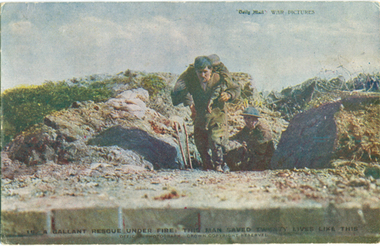
Postcard - A Gallant Rescue Under Fire, 1914-1918
... Daisy Ogier (1907-1987) was a student and then a teacher at Warrnambool Technical School with her early teaching years there from 1925 to 1936 and in 1949. ...Daisy Ogier (1907-1987) was a student and then a teacher at Warrnambool Technical School with her early teaching years there from 1925 to 1936 and in 1949. ...This is number 16 of 27 items in the Daisy Vickers collection of World War One memorabilia. These items were sent or given to Daisy Ogier (nee Vickers) during World War One by Corporal Arthur Anderson who enlisted from Warrnambool in 1915 at the age of 21. He served in Egypt and France and returned to Australia in 1919. Daisy Ogier (1907-1987) was a student and then a teacher at Warrnambool Technical School with her early teaching years there from 1925 to 1936 and in 1949. She became the head mistress from 1950 to 1963 and in 1968. She officially retired in 1976. Daisy Vickers was one of the best loved and dedicated teachers that the school ever had. She married the Reverend Fred Ogier and continued her association with the school after her husband's death.This card is interesting because of its association with World War One and two local people Daisy Vickers and Arthur AndersonThis postcard shows a photograph of a soldier carrying another soldier under fire. A Gallant Rescue Under Fire. This man saved twenty lives like this. Office photograph Crown Copyright Reserved "Daily Mail" Miss Daisy Vickers Bushfield Post Office Victoria Aus.daisy vickers, arthur anderson, warrnambool technical school, world war 1 postcard -
 Warrnambool and District Historical Society Inc.
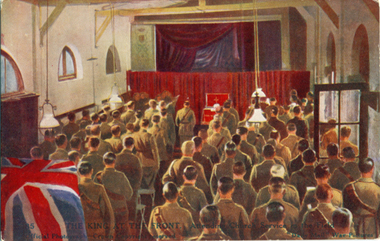
Postcard - The King at the Front, WW1 Postcard, 1914-1918
... Daisy Ogier (1907-1987) was a student and then a teacher at Warrnambool Technical School with her early teaching years there from 1925 to 1936 and in 1949. ...Daisy Ogier (1907-1987) was a student and then a teacher at Warrnambool Technical School with her early teaching years there from 1925 to 1936 and in 1949. ...This is a World War 1 postcard which was sent from France with an image of a gathering of soldiers with the King.This coloured postcard shows soldiers in a hall attending a church service. There is a Union Jack in the foreground and the King is centre front. On the back is space for a stamp and an address and also pencilled writing.This is a World War 1 postcard which was sent from France with an image of a gathering of soldiers with the King. daisy vickers, arthur anderson, world war one -
 Warrnambool and District Historical Society Inc.
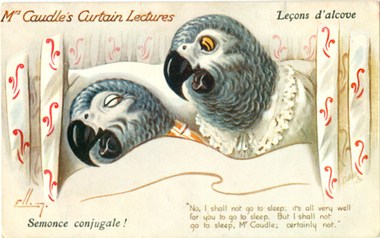
Postcard - Mrs Caudle's Curtain Lectures, 1914-1918
... Daisy Ogier (1907-1987) was a student and then a teacher at Warrnambool Technical School with her early teaching years there from 1925 to 1936 and in 1949. ...Daisy Ogier (1907-1987) was a student and then a teacher at Warrnambool Technical School with her early teaching years there from 1925 to 1936 and in 1949. ...This is number 18 of 27 items in the Daisy Vickers collection of World War One memorabilia. These items were sent or given to Daisy Ogier (nee Vickers) during World War One by Corporal Arthur Anderson who enlisted from Warrnambool in 1915 at the age of 21. He served in Egypt and France and returned to Australia in 1919. Daisy Ogier (1907-1987) was a student and then a teacher at Warrnambool Technical School with her early teaching years there from 1925 to 1936 and in 1949. She became the head mistress from 1950 to 1963 and in 1968. She officially retired in 1976. Daisy Vickers was one of the best loved and dedicated teachers that the school ever had. She married the Reverend Fred Ogier and continued her association with the school after her husband's deathisy Vickers collection: Item 12 of 27This card is interesting because of its association with World War One and two local people Daisy Vickers and Arthur Anderson.This is a coloured postcard featuring two parrots in bed and handwritten material on the back. Jan 6th 1918 Dear Daisy, Its some time since I had a letter from you. Can you play the Piano yet. Christmas is over now. It is cold over here and there is is plenty of snow and ice about. Arthur daisy vickers, arthur anderson, warrnambool technical school, world war 1 postcard -
 Warrnambool and District Historical Society Inc.
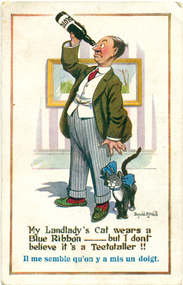
Postcard - My Landlady's Cat, 1914-1918
... Daisy Ogier (1907-1987) was a student and then a teacher at Warrnambool Technical School with her early teaching years there from 1925 to 1936 and in 1949. ...Daisy Ogier (1907-1987) was a student and then a teacher at Warrnambool Technical School with her early teaching years there from 1925 to 1936 and in 1949. ...This is number 17 of 27 items in the Daisy Vickers collection of World War One memorabilia. These items were sent or given to Daisy Ogier (nee Vickers) during World War One by Corporal Arthur Anderson who enlisted from Warrnambool in 1915 at the age of 21. He served in Egypt and France and returned to Australia in 1919. Daisy Ogier (1907-1987) was a student and then a teacher at Warrnambool Technical School with her early teaching years there from 1925 to 1936 and in 1949. She became the head mistress from 1950 to 1963 and in 1968. She officially retired in 1976. Daisy Vickers was one of the best loved and dedicated teachers that the school ever had. She married the Reverend Fred Ogier and continued her association with the school after her husband's deathThis card is interesting because of its association with World War One and two local people Daisy Vickers and Arthur AndersonThis coloured postcard features a man looking into an empty bottle held against his eye. There is a grey and white cat wearing a bow in the foreground and black and blue printing. The reverse has hand written ink writing and space for a stamp.My Landlady's Cat wears a Blue Ribbon but I don't believe it's a Teetotaller !!. Il me semble qu'on y a mis un doigt France Jan 26th Dear Daisy I received your letter dated 6th Nov saying you had been to the show what are you learning to play on the piano Arthur daisy vickers, arthur anderson, warrnambool technical school, world war 1 postcard
