
Showing 404 items matching " pine trees"
-
 Linton and District Historical Society Inc
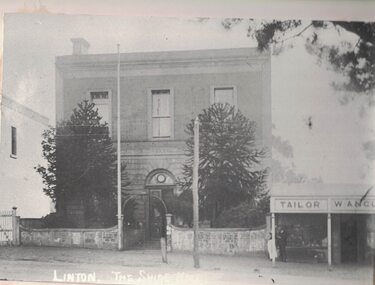
Photograph, Shire of Grenville Hall and Angus Shop, Sussex Street, Linton
... The fence outside it is being used to post notices. Two large pine trees are between the fence and the building. ...The fence outside it is being used to post notices. Two large pine trees are between the fence and the building. ...Shire of Grenville Hall and Angus shop, Sussex Street, Linton. Dating the photograph: The photograph can be dated to after 1887, when John Angus purchased the shop building (originally owned by Thomas Austin) from B. N. Dodd. 'W. Angus': From 1887 until the late 1890s the shop was run by John Angus' wife Wilhelmina Angus, who often advertised her business in the local newspaper, the 'Grenville Standard' (see photograph of advertisement, Registration no. 2019-346). It is not known when Mrs Angus retired, but it is understood that her son William then took over the shop around 1901. Elsie Jennings, an Angus descendant, recalled in a letter to LDHS that her uncle had run a draper's shop at this site. (See letter in "Linton - Township History - Recollections and reminiscences' file.) In 1905, Will Angus advertised that he had moved his business to the building on the corner of Sussex and Clyde Streets (later this became J. H. Barr's drapery shop.) It is not clear whether the "W. Angus" in the sign refers to Wilhelmina Angus or to William Angus.Enlarged black and white copy of original photograph, which has been mounted on white card. The photograph shows a two-storey brick building, and next to it a double-fronted shop. The two-storey building is the original Grenville Shire Hall, built in the mid 1860s. The fence outside it is being used to post notices. Two large pine trees are between the fence and the building. The smaller shop next to the hall has a verandah supported by round timber posts, and signs across the front of the verandah read "Tailor" and "W. Angus". Two men engaged in conversation with each other are standing to the left under the verandah. There is a flagpole attached to one of the gate posts of the hall, and there is a telegraph pole in the street in front of the hall.w. angus, william angus, wilhelmina angus (née statemann), buildings, shire of grenville hall, shops, shire hall, town hall -
 Melbourne Legacy
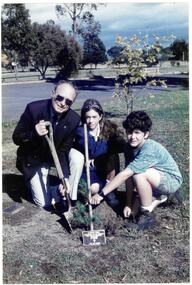
Photograph - Tree Planting, Legacy Lone Pines, 1995
... tree planting...lone pine...A planting of a pine tree by Legatee Mal Huffman and two children at Aberfeldie Primary School. ...A record of a tree planting of a Lone Pine tree. tree planting lone pine On the back "Copyright of Community News.", stamped in red ink. ...A planting of a pine tree by Legatee Mal Huffman and two children at Aberfeldie Primary School. It appear in The Answer in June 1995. From the early 1970s Legacy had a commemorative programme of providing trees grown from seeds from Gallipoli to various towns and schools throughout Australia. This may be part of that project (see the Lone Pine brochure at 00593) or subsequent propagation undertaken by Legacy. Melbourne Legacy’s Commemoration Committee was responsible for the collection, propagation, presentation and dedication of Lone Pines from the 24th Battalion tree at the Shrine of Remembrance. On the 14th September 1989 further seedlings were collected with the hope to raise 1,000 trees from the seeds. Thus, Legacy is helping to keep the memory of the Gallipoli “Lone Pine” alive – its spirit living on today. Presentations are made to schools, ex-service organisations and interested bodies by Legacy Clubs in the hope that they will be cherished as a symbol of nationhood and of its just pride, devotion, courage, selflessness and sense of service to others.A record of a tree planting of a Lone Pine tree.Colour photo of a Legatee and two children planting a tree.On the back "Copyright of Community News.", stamped in red ink.tree planting, lone pine -
 Melbourne Legacy
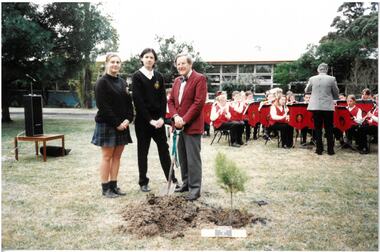
Photograph - Tree Planting, Legacy Lone Pines
... tree planting...lone pine...A planting of a pine tree by a man and two school children at what could be a school. ...A record of a tree planting of a Lone Pine tree. tree planting lone pine Colour photo x 8 of a tree planting at a school. ...A planting of a pine tree by a man and two school children at what could be a school. There was a service with speeches and a band playing. The venue, names and date are unknown. In the early 1970s Legacy had a commemorative programme of providing trees grown from seeds from Gallipoli to various towns throughout Australia. This may be part of that project (see the Lone Pine brochure at 00593) or subsequent propagation undertaken by Legacy. Melbourne Legacy's Commemoration Committee was responsible for the collection, propagation and dedication of Lone Pines from the 24th Battalion tree at the Shrine of Remembrance. On the 14th September 1989 further seedlings were collected with the hope to raise 1,000 trees from then seeds. Thus, Legacy is helping to keep the memory of the Gallipoli "Lone Pine" alive - its spirit living on today. Presentations are made to schools, ex-service organisations and interested bodies by Legacy Clubs in the hope that they will be cherished as a symbol of nationhood and of its just pride, devotion, courage, selflessness and sense of service to others.A record of a tree planting of a Lone Pine tree.Colour photo x 8 of a tree planting at a school.tree planting, lone pine -
 Melbourne Legacy
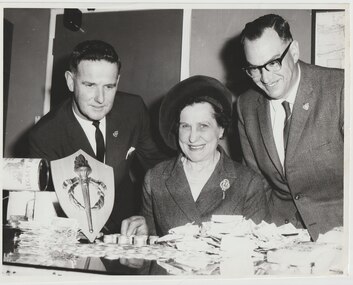
Photograph, Ivan Layton, Mrs Mack and Legatee Bert Davis, 196
... She was given a Legacy lone pine tree by a grateful Legacy to add to her garden. ...She was given a Legacy lone pine tree by a grateful Legacy to add to her garden. ...A photo of Badge Day in the 1960s, with Ivan Layton, Mrs Mack and Legatee Bert Davis counting the donations near a Legacy Appeal tin. Ivan Layton was the Chief Executive Officer for many years. Legatee Bert Davis was the Chief Financial Officer in the early sixties. Mrs Mack was a generous fundraiser. She lived at Mount Macedon and opened her beautiful garden to the public on a regular basis to assist Legacy with fundraising. She was given a Legacy lone pine tree by a grateful Legacy to add to her garden. The letter accompanying the photo said the garden and tree was lost in the Ash Wednesday fires in 1983. Further research shows that Mrs Margaret Mack and her husband Mr John D. (Jack) Mack first opened their garden at Dreamthorpe, Mt Macedon, in April 1950 for a garden fete. It raised £140 for Legacy (source: Trove). The exact date of the photo is unknown but would be early 1960s. Photo donated by Legatee Bert Davis' daughters.An excellent record of important people in Legacy's history.Black and white photo of Ivan Layton, Mrs Mack and Legatee Bert Davis on Badge Day.badge day, ivan layton, bert davis -
 Glenelg Shire Council Cultural Collection
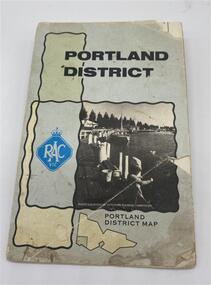
Map - Map - RACV Portland District Map, Portland, Victoria & Mt Gambier, South Australia, RACV, Portland District Portland District Map, Unknown
... A boat to the centre and tall Norfolk pine tree's and buildings in the back, a women and young child are standing on the jetty with fishing rods and buckets. ...A boat to the centre and tall Norfolk pine tree's and buildings in the back, a women and young child are standing on the jetty with fishing rods and buckets. ...Owned by Wilma Harris nee. Bowering resident of Merino Victoria.Fold out pocket map - RACV Portland District Map, Portland, Victoria & Mt Gambier, South Australia. Folds in 8th's. Cover is blue and cream with a black and white image of a curving timber jetty with white posts. A boat to the centre and tall Norfolk pine tree's and buildings in the back, a women and young child are standing on the jetty with fishing rods and buckets. Image and several other shapes two vertical overlapping rectangles bordered n black wavy lines. Has a bright blue RAC VIC logo to the centre left. Opened front - Map of the district has various routes marked in purple. Opened back - features 4 smaller maps focusing on the business districts of Portland, Hamilton, Mount Gambier and The Coonawarra Wineries.Front cover 'PORTLAND DISTRICT' 'Portland District Map' 'Image curtesy of Victorian Tourism Commission' womens history, ros harris, merino, map, racv -
 Emerald Museum & Nobelius Heritage Park
Photograph - Emerald Football Club, 1983, Unknown maker, 1983
... Behind them a house can be seen with mostly pine trees to either side of it....Behind them a house can be seen with mostly pine trees to either side of it. Photograph Emerald Football Club, 1983 Unknown maker ...In this photograph members of both Emerald and South Belgrave football teams can be seen. Further research is needed on the players and team names and founding.This photograph holds historical significance as it depicts the Emerald and South Belgrave football clubs. AFL hold significance within the community as a way of socialising, as well as exercise. The photograph is a good example of a photograph depicting the playing of AFL, and also can be used as a reference for the football ground at the time.Rectangular colour photograph printed on matte photographic paper. The colour photograph depicts AFL team members playing AFL in a match against South Belgrave in 1983, and two players can be seen leaping for the ball whilst other players watch or run towards the leaping players. The players wear either red shorts with a black football shirt with a diagonal red sash like band across it running from the left shoulder to the right hip or white football shorts and a black, red, white, black vertically striped football shirt. In the background the wooden fence lining the field can be seen as well as cars parked at the edge of the field and a few onlookers. Behind them a house can be seen with mostly pine trees to either side of it.Reverse: 1983 v STH BELGRAVE. / SENIORS. / 35 SCOTT . PEARSON / CHRIS CORNISH. /1980s, australian rules football, emerald football club, south belgrave football club, scott pearson, chris cornish -
 Surrey Hills Historical Society Collection
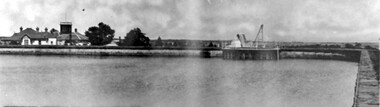
Photograph, Surrey Hills Reservoir No 1
... The excavated material was banked against the sides and pine trees were planted in it to add strength to the embankment. ...The excavated material was banked against the sides and pine trees were planted in it to add strength to the embankment. ...Copied by Ken Hall from an early postcard. This is Surrey Hills Reservoir No 1 on the corner of Tower Street built in c1892 at a cost of £12,000 to supply higher sections of the area. The builders were Jack and Bob Laudehr, partners in a wood yard in St. Kilda (Vic). They began by delivering firewood but extended to contract work involving timber. Another of their projects was to lay cable tram tracks commencing in Acland Street St. Kilda and running along The Esplanade. The reservoir in Canterbury Road was a large concrete structure built before the introduction of reinforcements. The excavated material was banked against the sides and pine trees were planted in it to add strength to the embankment. They were paid £2,000 for their work. Construction of Surrey Hills Number 2 Reservoir was completed in 1913 and the accompanying tower was built in 1929. It is assumed that the Miss Hill as the source of the donation (via Bill Dempsey) was Ivy Annie Hill (1902-1984). She was the only female child of William Valentine Dempsey to not marry. Bill Dempsey's mother was Laura Constance 'Birdie' Hill (1900-1968) who married Albert Dempsey.A sepia photograph within a post card of a reservoir on Canterbury Road, Surrey Hills. In the background to the left you can see the top halves of two houses and the tops of some trees. The photo takes up only the central section of the postcard.Below the photo on the front of the postcard on blue biro "Reservor [sic] Canterbury Rd / Surrey Hills." On the rear in grey lead pencil in Jocelyn Hall's handwriting: "Donor W Dempsey ------------- Keep / (nephew) / [arrow pointing down] / From Miss Hill / 10 Pembroke St SH / This house can be / seen in front of / No 12 which has / tower"1890, water supply, mmbw, edward d dyer (mr), 10 pembroke street, 12 pembroke street, surrey hills, ivy annie hill (miss), william valentine hill (mr), canterbury road, tower street, water supply structures and establishments, dams and reservoirs, jack laudehr (mr), bob laudehr (mr) -
 Sunshine and District Historical Society Incorporated
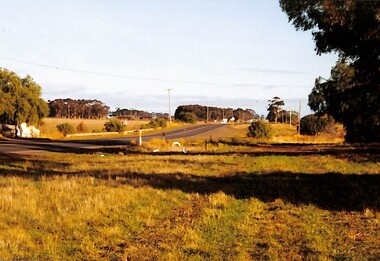
Photograph - Robinsons farm Derrimut, Johnson, Des, 31 May, 2004,(exact)|10 October, 2004(exact)|27 October, 2008(exact)
... Photograph South side or front of Robinson Farm House 416 to 430 Boundary Road Derrimut dated 27 October 2008|Photograph Showing stone wall in front of Robinson Farm House 416 to 430 Boundary Road Derrimut dated 27 October 2008|Photograph Looking to Boundary Road Dry Stone Wall Shears quarters Robinson Farm House 416 to 430 Boundary Road Derrimut dated 27 October 2008|Photograph Horse Stables Robinson Farm House 416 to 430 Boundary Road Derrimut dated 10 October 2008|Photograph North side of Boundary Road near Foxly Lodge looking West over Laverton Creek to Robinsons Road along 316 to 340 North side Boundary Road I Des Johnson had slashed this grass and 5 large pine trees has been cut down 31 May 2005...Robinsons Derrimut Photograph South side or front of Robinson Farm House 416 to 430 Boundary Road Derrimut dated 27 October 2008|Photograph Showing stone wall in front of Robinson Farm House 416 to 430 Boundary Road Derrimut dated 27 October 2008|Photograph Looking to Boundary Road Dry Stone Wall Shears quarters Robinson Farm House 416 to 430 Boundary Road Derrimut dated 27 October 2008|Photograph Horse Stables Robinson Farm House 416 to 430 Boundary Road Derrimut dated 10 October 2008|Photograph North side of Boundary Road near Foxly Lodge looking West over Laverton Creek to Robinsons Road along 316 to 340 North side Boundary Road I Des Johnson had slashed this grass and 5 large pine trees has been cut down 31 May 2005 5 photographic prints of scenes at or near Robinsons farm Derrimut Photograph Robinsons farm Derrimut Johnson, Des. ...Set of prints of photographs taken by Des Johnson. Donated by Des to Sunshine and District Historical Society.Photograph South side or front of Robinson Farm House 416 to 430 Boundary Road Derrimut dated 27 October 2008|Photograph Showing stone wall in front of Robinson Farm House 416 to 430 Boundary Road Derrimut dated 27 October 2008|Photograph Looking to Boundary Road Dry Stone Wall Shears quarters Robinson Farm House 416 to 430 Boundary Road Derrimut dated 27 October 2008|Photograph Horse Stables Robinson Farm House 416 to 430 Boundary Road Derrimut dated 10 October 2008|Photograph North side of Boundary Road near Foxly Lodge looking West over Laverton Creek to Robinsons Road along 316 to 340 North side Boundary Road I Des Johnson had slashed this grass and 5 large pine trees has been cut down 31 May 2005robinsons, derrimut -
 Eltham District Historical Society Inc
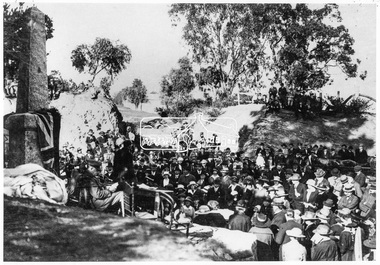
Negative - Photograph, Unveiling of War Memorial Obelisk, corner of Main Road and Bridge Street, Eltham
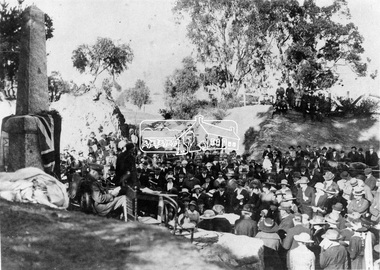
... "Beneath a lonely pine tree on the hill crest out from Eltham, where the Greensborough Road junctions with the main Melbourne Road, Eltham has erected an everlasting tribute to the memory of the fallen heroes of the district. ..."Beneath a lonely pine tree on the hill crest out from Eltham, where the Greensborough Road junctions with the main Melbourne Road, Eltham has erected an everlasting tribute to the memory of the fallen heroes of the district. ...The unveiling of the Eltham Obelisk War Memorial was performed by the Rev. Padre Charles Tregear, assisted by Church of England vicar, Mr Safsford on August 3, 1919. Reproduced page 99 of "Pioneers & Painters." "Beneath a lonely pine tree on the hill crest out from Eltham, where the Greensborough Road junctions with the main Melbourne Road, Eltham has erected an everlasting tribute to the memory of the fallen heroes of the district. It is an obelisk of Harcourt granite in the rough, bearing an appropriate inscription and 27 names—an unpretentious monument by the wayside, which will stand for all time silently expressing the appreciation of the living for the sacrifice of the dead. The obelisk stands 14 feet high. ... Representatives of every house in the town, and many people from the surrounding district, gathered around the obelisk for the opening ceremony. The spring-like sunshine of the afternoon attracted everybody out of doors. There must have been 700 people present when the Lieutenant-Governor, Sir William Irvine, removed the draping of flags and revealed the names on the obelisk, the base of which was surrounded by wreaths and branches of wattle bloom, placed there by parents whose sorrow at the loss of sons was blunted, for the day at least, by feelings of pride. .." Age, Monday 4 August 1919, page 8 This was the memorial's orginal location. It has been relocated numerous times.This photo forms part of a collection of photographs gathered by the Shire of Eltham for their centenary project book,"Pioneers and Painters: 100 years of the Shire of Eltham" by Alan Marshall (1971). The collection of over 500 images is held in partnership between Eltham District Historical Society and Yarra Plenty Regional Library (Eltham Library) and is now formally known as the 'The Shire of Eltham Pioneers Photograph Collection.' It is significant in being the first community sourced collection representing the places and people of the Shire's first one hundred years.Digital image 4 x 5 inch B&W Negsepp, shire of eltham pioneers photograph collection, eltham, main road, bridge street, eltham war memorial, obelisk, obelisk corner -
 Eltham District Historical Society Inc
Negative - Photograph, Unveiling of War Memorial Obelisk, corner of Main Road and Bridge Street, Eltham, 3 Aug. 1919
... "Beneath a lonely pine tree on the hill crest out from Eltham, where the Greensborough Road junctions with the main Melbourne Road, Eltham has erected an everlasting tribute to the memory of the fallen heroes of the district. ..."Beneath a lonely pine tree on the hill crest out from Eltham, where the Greensborough Road junctions with the main Melbourne Road, Eltham has erected an everlasting tribute to the memory of the fallen heroes of the district. ...The unveiling of the Eltham Obelisk War Memorial was performed by the Rev. Padre Charles Tregear, assisted by Church of England vicar, Mr Safsford on August 3, 1919. Reproduced page 99 of "Pioneers & Painters." "Beneath a lonely pine tree on the hill crest out from Eltham, where the Greensborough Road junctions with the main Melbourne Road, Eltham has erected an everlasting tribute to the memory of the fallen heroes of the district. It is an obelisk of Harcourt granite in the rough, bearing an appropriate inscription and 27 names—an unpretentious monument by the wayside, which will stand for all time silently expressing the appreciation of the living for the sacrifice of the dead. The obelisk stands 14 feet high. ... Representatives of every house in the town, and many people from the surrounding district, gathered around the obelisk for the opening ceremony. The spring-like sunshine of the afternoon attracted everybody out of doors. There must have been 700 people present when the Lieutenant-Governor, Sir William Irvine, removed the draping of flags and revealed the names on the obelisk, the base of which was surrounded by wreaths and branches of wattle bloom, placed there by parents whose sorrow at the loss of sons was blunted, for the day at least, by feelings of pride. .." Age, Monday 4 August 1919, page 8 This was the memorial's orginal location. It has been relocated numerous times.This photo forms part of a collection of photographs gathered by the Shire of Eltham for their centenary project book,"Pioneers and Painters: 100 years of the Shire of Eltham" by Alan Marshall (1971). The collection of over 500 images is held in partnership between Eltham District Historical Society and Yarra Plenty Regional Library (Eltham Library) and is now formally known as the 'The Shire of Eltham Pioneers Photograph Collection.' It is significant in being the first community sourced collection representing the places and people of the Shire's first one hundred years.Digital image 4 x 5 inch B&W Neg Print 9 x 12.5cmsepp, shire of eltham pioneers photograph collection, eltham, main road, eltham war memorial, bridge street, obelisk, obelisk corner -
 Bendigo Historical Society Inc.
Administrative record - National Trust Collection: Leigh Lodge, 12 Bannerman Street (formerly Selb Villa), 1973
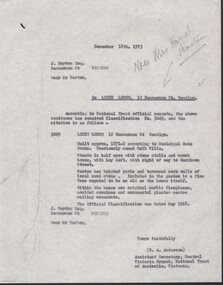
... Included in the garden is a Pine Tree reputed to be as old as the house itself. ...Included in the garden is a Pine Tree reputed to be as old as the house itself. ...Leigh Lodge (formerly Selb Villa) Bendigo, 12 Bannerman St. Bendigo.National Trust Collection: Leigh Lodge, 12 Bannerman Street, Bendigo 3222 A - 15 December 1973, letter from Central Victoria Branch National Trust of Australia, Victoria to J. Barton Esq. that the property at 12 Bannerman Street has received Classification No. 3049, which states: LEIGH LODGE 12 Bannerman St Bendigo. Built approx. 1871-2 according to Municipal Rate Books. Previously named Selb Villa. Stands in half acre with stone stable and coach house, with hay loft, with right of way to Harrison Street. Garden has bricked paths and terraced rock walls of local sand stone. Included in the garden is a Pine Tree reputed to be as old as the house itself. Within the house are original marble fireplaces, moulded cornices and ornamental plaster centre ceiling ornaments. The official Classification was dated May 1968. 3222 B - copy of the classification of Leigh Lodge (as Above), on yellow paper, and handwritten comments. 3222 B handwritten comments on the undated copy of the NT classificationhistoric building -
 Orbost & District Historical Society
Photograph - Photos of Orbost, W S Vogt, 1900-1920
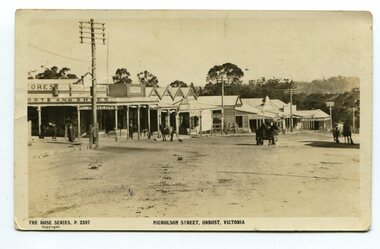
... There are several horses and carts in the building's yard. 2712.4 An oval shaped photograph showing a large group of school children on the right and a number of adults on the left who appear to be speaking to the children. A pine tree in the centre behind, and buildings also behind a fence. 2712.5 A streetscape with a telegraph pole in the left foreground and a group of shop buildings leading down a slope in the centre of the photograph. ...There are several horses and carts in the building's yard. 2712.4 An oval shaped photograph showing a large group of school children on the right and a number of adults on the left who appear to be speaking to the children. A pine tree in the centre behind, and buildings also behind a fence. 2712.5 A streetscape with a telegraph pole in the left foreground and a group of shop buildings leading down a slope in the centre of the photograph. ...These five b/w photos of Orbost were taken in the early 20th Century. 2712.1 is of Ruskin Street looking east from Nicholson Street with the Post Office on the corner. The Orbost Shire Council chambers is also shown. 2712.2 is an excellent photograph of the Post Office on the corner of Nicholson and Ruskin Streets. 2712.3 is a photograph of the first butter factory, built 1893 in Lochiel Street. 2712.4 shows a visit by the Governor of Victoria c.1920s. 2712.5 is a photo looking looking down Nicholson Street from the Ruskin Street corner. It shows a line of shops which were amongst the earliest in Orbost. These photographs are significant because they are a record of early Orbost. Five b/w photos/postcards of Orbost. 2712.1 People standing in a street; a building on the right, also buildings on the left. Telegraph pole on left hand side. 2712.2 Two horses and carts, a man riding a horse, dog in foreground. They are all in front of an elaborate wooden building (the Orbost) Post Office, and on the right hand side background is another building with the words L Herbert Snowy River Stores. 2712.3 A large wooden two-storey building behind a wooden post and rail fence. The building has several gables. A man with an apron is visible in the doorway of the top storey. There are several horses and carts in the building's yard. 2712.4 An oval shaped photograph showing a large group of school children on the right and a number of adults on the left who appear to be speaking to the children. A pine tree in the centre behind, and buildings also behind a fence. 2712.5 A streetscape with a telegraph pole in the left foreground and a group of shop buildings leading down a slope in the centre of the photograph. Several people standing around, and horses and carts. 2712.1 On front: Orbost, East Gippsland. Stanley Vogt, Bairnsdale 2712.2 On front: Orbost, Post Office. W S Vogt, Bairnsdale 2712.3 On front: Butter Factory, Orbost 2712.4 On front: added in ink is THE GOVERNOR'S VISIT TO ORBOST 2712.5 On front: Nicholson Street, Orbost, Victoria Rose Series P2397orbost, butter factory, post office, governor's visit -
 Blackburn Cricket Club
1930s Blackburn Cricket Club team
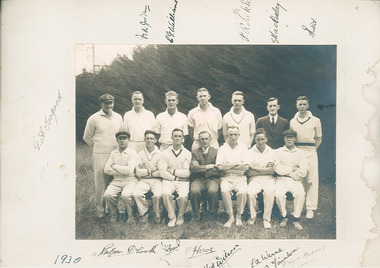
... The picture is taken at the northern end of the oval with the pine trees along the railway line in the background. ...The picture is taken at the northern end of the oval with the pine trees along the railway line in the background. ...Picture of a 1930 Blackburn CC team. The picture is taken at the northern end of the oval with the pine trees along the railway line in the background. Twelve players and two other gentlemen in full suits are pictured and there appears to be a mix of young and middle aged men. Two players (front row third from right and second row far right) appear to be wearing the same jumper in full sleeve and vest form respectively while two other players are wearing similar jumpers and another two wearing plain versions. The caps being worn by two gentlemen appear to be identical. Thirteen original signatures and the year are signed on the paper mat to which the picture is glued. The signatures appear to be signed using a fountain pen however another name (David Murray) appears to have been added using a pencil at a later date. Some of the signatures include D Cook, H.M Wilson, G.A Jorgood, C.G Williams, Rliekle, S Mackinlay and L.A Warne. Les Warne played in the 1st XI at Blackburn from 1930 to 1955 and was the captain of the 1938-39 premiership winning team. Les recieved a life membership in 1953. -
Emerald Museum & Nobelius Heritage Park
Photograph - Avonsleigh Church of Christ, Unknown photographer, 1970s
... It is surrounded by wooden railings with tall pine trees visible in the background.,This photograph depicts a rear view of Avonsleigh Church of Christ. ...It is surrounded by wooden railings with tall pine trees visible in the background.,This photograph depicts a rear view of Avonsleigh Church of Christ. ...Government surveys of the area now occupied by Avonsleigh, Emerald, Monbulk and surrounding townships set aside space for places of worship as part of plans for permanent settlements after the conclusion of the gold rushes towards the end of the Nineteenth Century. The first churches in what is now the City of Casey/Cardinia Shire area were located in Cranbourne and Berwick, so although the Avonsleigh Church of Christ was the fourth church to be built in the region, it was the first in the hills. The Church is located at 17 Avon Road, Avonsleigh. The trees visible in the photograph appear at the front of the property, running parallel to the road, suggesting that the photograph depicts the rear of the building. Although it is known that a Church of Christ was built on the current site in 1887, more research is needed to ascertain whether it is the original building. Churches of Christ are autonomous congregations that emerged from the American Restoration movements led by Barton W. Stone and Thomas Campbell. One source suggests that the Churches of Christ were established in Australia as early as 1845, when a British immigrant who had learned of the denomination in New Zealand joined a Scottish Baptist Church in Adelaide who shifted focus as a result of his testimony. By 1865 there were five churches in the Southern region of Australia, with 253 adherents.The photograph is significant as an image of Avonsleigh Church of Christ as it appeared towards the end of the Twentieth Century. The Avonsleigh Church was originally built in 1887 and is still in use as a place of worship.Black and white rectangular photograph printed on photographic paper. This photograph depicts a rear view of Avonsleigh Church of Christ. The church is a single-storey wooden structure with a tin roof. Access ramps lead up to double doors in the foreground of the picture. A clear area of land surrounds the building on three sides. In the background of the photograph tall trees can be seen. This photograph depicts Avonsleigh Church of Christ. The church is a single-storey wooden structure painted cream with burgundy details. It is surrounded by wooden railings with tall pine trees visible in the background.,This photograph depicts a rear view of Avonsleigh Church of Christ. The church is a single-storey wooden structure with a tin roof. Access ramps lead up to double doors in the foreground of the picture. A clear area of land surrounds the building on three sides. In the background of the photograph tall trees can be seen. ,This photograph depicts a rear view of Avonsleigh Church of Christ. The church is a single-storey wooden structure painted cream with burgundy details and a tin roof. This photograph depicts details of the double-entry doorways. A grassed area is visible in the foreground of the picture and tall trees are visible behind the church.Obverse: 72% (92%?) 1.9 / VEMU 97-a /avonsleigh, avonsleigh church of christ, church of christ, churches, places of worship, land surveys, early settlers, barton w. stone, thomas campbell, religion -
 University of Melbourne, Burnley Campus Archives
Photograph - Sepia print, A.E. Bennett, Entrance Gates, 1894-1990
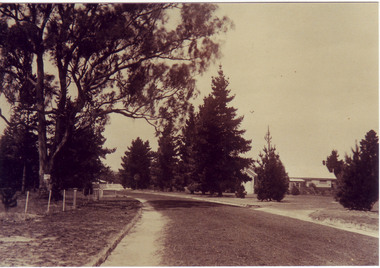
... ...pine tree avenue...I have seen a plan which showed an attractive avenue of trees (pine) from the western end of the property (where the Stockman's Cottage was later sited.)"...I have seen a plan which showed an attractive avenue of trees (pine) from the western end of the property (where the Stockman's Cottage was later sited.)" entrance gates prize essays alfred e. bennett curator's residence pavilion stockman's cottage pine tree avenue 2 copies sepia photograph. ...Note by E.B. Littlejohn, "Is the roadway the original Swan Street? Entrance gates to Gardens in the distance. Roadway leading to the Pavilion hidden behind the trees. No elms showing along the roadway," and by T.H. Kneen, "The roadway appears to terminate at the gates outside the Curator's Residence, sweeping past the Pavilion on the right. I have seen a plan which showed an attractive avenue of trees (pine) from the western end of the property (where the Stockman's Cottage was later sited.)" 2 copies sepia photograph. Copy of sepia photograph of the roadway to the Entrance Gates and Curator's Cottage seen in the distance, with the Pavilion on the right, in, "Prize Essays," Alfred E. Bennett, c.1894, after p 116. Pinus radiata avenue on each side of the road.entrance gates, prize essays, alfred e. bennett, curator's residence, pavilion, stockman's cottage, pine tree avenue -
 Williamstown Botanic Gardens- Hobsons Bay City Council
Postcard - Williamstown Botanic Gardens, c1900 - 1920
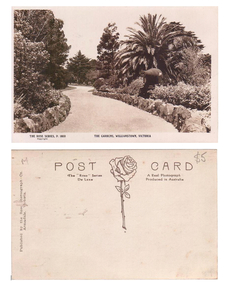
... There is a cannon on the right hand side of the card beneath a spreading palm tree. There is a tall pine and a cypress tree in the background. ...There is a cannon on the right hand side of the card beneath a spreading palm tree. There is a tall pine and a cypress tree in the background. ...The original postcards in this series (2013.002 to 2013.018) were generously loaned to Williamstown Botanic Gardens by a private collector for copying. The postcards are evidence of the interest the gardens held as a subject for postcard publishers. The text and images provide a snapshot into fashions, social interests and concerns of the time. The professionally produced images provide a pictorial history of Gardens including changing planting styles, various structures and features of the Gardens eg the aviary, cannons, the fountain, the second Curator’s Lodge and gates. The images offer an opportunity to compare garden vistas with the present day. This postcard is evidence of the location of one of the cannons relocated from Fort Gellibrand in 1906. They were removed from the Gardens in the 1960s. These same cannons remain a feature on the Williamstown waterfront in 2013. A sepia postcard depicting a winding path lined with rocks. There is a cannon on the right hand side of the card beneath a spreading palm tree. There is a tall pine and a cypress tree in the background. The cannons were relocated from Fort Gellibrand to the Gardens in 1906. Front: ‘THE ROSE SERIES, P. 1030 THE GARDENS, WILLIMASTOWN, VICTOORIA / copyright’. Reverse: Left side vertical ‘Published by the Rose Stereograph Co. / Armadale, Victoria’. Across the top of the card: ‘POST CARD / The “Rose” Series A Real Photograph / De Luxe Produced in Australia’. There is an image of a rose and stem with three leaves in the centre of the card. In pencil on top right hand corner: $5 [believed to be inserted by the vendor of the card]postcard, gardens, post-card, williamstown-botanic-gardens, hobsons-bay-city-council, garden-path, cannon, rose stereograph, rose-series, 1906 -
 Stawell Historical Society Inc
Photograph, “The Sycamores” Driveway entrance Gates
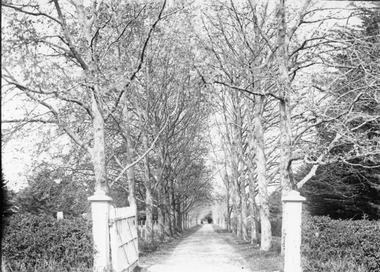
... Osmand's "Sycamores" was in a secluded block of the eastern side of the creek along which was planted pine and cypress trees. He built a comfortable house and line the carriage way with Sycamores. ...Osmand's "Sycamores" was in a secluded block of the eastern side of the creek along which was planted pine and cypress trees. He built a comfortable house and line the carriage way with Sycamores. ...Entrance gates to “The Sycamores” Driveway. A show place on Concongella from mid 1860's. "The Sychmores" where William Osmand lived. Osmand's "Sycamores" was in a secluded block of the eastern side of the creek along which was planted pine and cypress trees. He built a comfortable house and line the carriage way with Sycamores. Osmand was on the of the men who made money in the Stawell reefs mines. "The Sycamores" has been owned by the West family since c 1920. Black & white photograph (2 copies) of an entrance gateway with an avenue of deciduous trees.concongella -
 Charlton Golden Grains Museum Inc
Photograph - Sepia Photograph High St Charlton
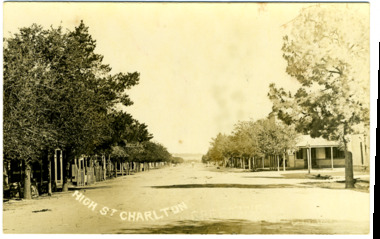
... The 6th of six. c 1905 Shows mature trees including pine in froint of Tipppett's shop. ...The 6th of six. c 1905 Shows mature trees including pine in froint of Tipppett's shop. ...High St Charlton c.1905Sepia Photograph High St Charlton. Corner of High St. and Armstrong St. Part of a series of Charlton postcards. The 6th of six. c 1905 Shows mature trees including pine in froint of Tipppett's shop. Bank of Victoria on corner. No vehicles in street. One pedestrian.High St Charltonhigh st. charlton, tippett's shop, bank of victoria -
 Kiewa Valley Historical Society
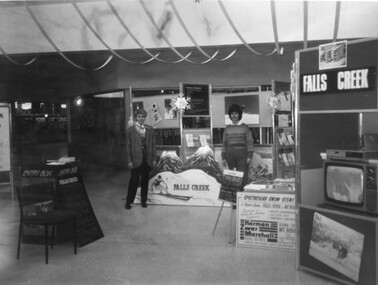
Photographs - Mt Beauty, Tawonga South and Falls Creek
... Tawonga District Hospital/Mt Beauty Hospital before the Nursing Home - removing pine trees 18. Water Board Installation at Tawonga South (outside Rookes house) 19. ...Tawonga District Hospital/Mt Beauty Hospital before the Nursing Home - removing pine trees 18. Water Board Installation at Tawonga South (outside Rookes house) 19. ...Mt Beauty and Tawonga South are in the Kiewa Valley Mt Beauty and Tawonga are in the Kiewa Valley. Many of these photos record people who lived in these towns and their activities.Collection of black and white photos of Mt Beauty and Tawonga. Most are labelled (and some include names but no dates) in pencil on the back.Varying sizes. 1. Marketing Falls Creek 2. Driver Education Car Presentation- Mt Beauty Secondary College 3. Start of Mt Beauty Marathon 4. Mount Beauty Paramedical Day Care Centre 5. Falls Creek - Original Halley's Comet 6. Falls Creek - Original Snow-making on Twin Towers 7. Group of 10 girls 8. Mt Beauty Primary School - Tidy Towns Competition 9.Mt Beauty Primary School 10. Start of Mt Beauty Marathon 11. Lou Leiberman - Local Member 12. Bank Manager, Commonwealth Bank on left. 13. Driver Education Car - Mt Beauty Secondary College 14. Original Snow-making on Twin Towers at Falls Creek 15. Two girls 16. Mt Beauty - Home Improvement Centre 17. Tawonga District Hospital/Mt Beauty Hospital before the Nursing Home - removing pine trees 18. Water Board Installation at Tawonga South (outside Rookes house) 19. Dederang Catholic Church 20. Two men (names on back) 21. Tawonga Store 22. Mt Beauty - old butcher shop on right hand side 23.Tidy Towns Mt Beauty Labelled in pencil on the backmt beauty, tidy towns, driver education, marathon, falls creek -
 Eltham District Historical Society Inc
Photograph, 35 Ingrams Road, Research, Eltham Heritage Tour, 24 May 1992, 24/05/1992
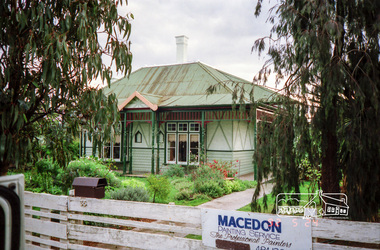
... Maroondah Dam was constructed in. 1920 to replace the original weir and at that time: the Aqueduct - as established into the landscape - with bridges and tunnels and pine trees were used to stop rubbish polluting the water."...Maroondah Dam was constructed in. 1920 to replace the original weir and at that time: the Aqueduct - as established into the landscape - with bridges and tunnels and pine trees were used to stop rubbish polluting the water." ...ELTHAM HERITAGE TOUR The Society excursion on 24th May 1992 was arranged by David Bick, leader of the team carrying out the Shire's heritage study. David selected a number of sites or buildings identified in the study, some of them lesser known components of the Shire's heritage. The tour commenced at the Eltham Shire Office at 10.00 am. Travel was by private car and mini-bus with stops at about twelve locations for commentary by David.It included a short walk in Hurstbridge and lunch at Kinglake. Highlights of the tour included: - 10 am Leave from Shire Offices - 3 Important Trees - A Physical Link to Eltham's First Settlers - Toorak Mansion Gates - A Surviving Farm House - An Intact Circa 1900 Main Street - First Settlers - Gold Miners, and Timber-getters - An Early Hotel - A Pioneering Homestead - Changing Eltham Shire - 20th Century - 4 pm Afternoon Tea and Finish Tour Extract from ELTHAM CULTURAL HERITAGE TOUR (Newsletter No. 85, July 1992, by Bettina Woodburn) "On a right-angle turning of the Eltham Road is Wellers Pub, a Cobb & Co. coaching stop on the way to distant gold-fields and places north of the Yarra River. The Hotel dates from the 1870's. Daily distances for a bullock team was eight miles, horses could do double that distance. We turned into Cassells Road and on the corner of Ingrams Road we admired an elaborate Edwardian villa, 1900 style. The Aqueduct conveying Melbourne's water supply was a communication line and a technological advance in 1891. It has been enlarged and re-faced and no longer used here but piped underground. Proclaimed a linear park it has reverted to crown land, controlled by local Council. Maroondah Dam was constructed in. 1920 to replace the original weir and at that time: the Aqueduct - as established into the landscape - with bridges and tunnels and pine trees were used to stop rubbish polluting the water."Record of the Society's history and activities and highlighting various aspects of the Heritage Study undertaken by David Bick used to create the future heritage overlay for the Shire of Eltham and later Nillumbik Shire.Roll of 35mm colour negative film, 4 stripsKodak Gold 100 5095shire of eltham historical society, activities, heritage tour, ingrams road, research (vic.) -
 Federation University Historical Collection
Book, Ferdinand von Mueller, Introduction to Botanic Teachings at the Schools of Victoria, 1877, 1877 (exact)
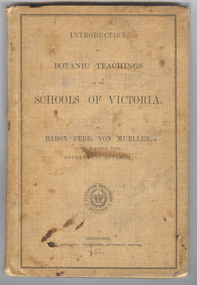
... Chapters include Eucalyptus Trees; Wattles or Acacias; Casuarinas or Sheoaks; Cypress Pines or Sandarac trees; Exocarpos trees of Natice Cherry trees; Mistletoes; Native Honeysuckles or Banksias; Bellflower, Lobelia and Goodenia; Heaths; Correas; Mallow; Buttercups and Clematis; Cruciferous Plants; Mints; Orchids; grasses; ferns. ...Chapters include Eucalyptus Trees; Wattles or Acacias; Casuarinas or Sheoaks; Cypress Pines or Sandarac trees; Exocarpos trees of Natice Cherry trees; Mistletoes; Native Honeysuckles or Banksias; Bellflower, Lobelia and Goodenia; Heaths; Correas; Mallow; Buttercups and Clematis; Cruciferous Plants; Mints; Orchids; grasses; ferns. ...Ferdinand von Mueller was an examiner of botany at the Ballarat School of Mines (SMB) between 1880 and 1888. During that era he was active in donating related items to the School. When the Ballarat School of Mines Council agreed to introduce pharmacy and botany classes in 1879, it was apparent students would require access to botanical specimens in order to further their studies. Council members, who were inspired by the work of Baron Ferdinand von Mueller, authorised development of an area along the School's northern boundary, fronting Lydiard Street South, and oversaw the establishment of the new Botanical Gardens. Baron von Mueller took a practical role the development of SMB's Botanical Gardens from the beginning. He became a generous benefactor who 'donated collections of seeds and leguminous fodder plants, including valued grasses of interest and use to agriculturalists and graziers generally' to SMB over many years. Ferdinand von Mueller's entry on the University of Ballarat Honour Roll can be found at http://www.ballarat.edu.au/curator/honour-roll/honourroll_von_mueller.shtml A light brown, hardcovered book of 152 pages. Chapters include Eucalyptus Trees; Wattles or Acacias; Casuarinas or Sheoaks; Cypress Pines or Sandarac trees; Exocarpos trees of Natice Cherry trees; Mistletoes; Native Honeysuckles or Banksias; Bellflower, Lobelia and Goodenia; Heaths; Correas; Mallow; Buttercups and Clematis; Cruciferous Plants; Mints; Orchids; grasses; ferns. The book has numerous botanical line drawings, and a comprehensive index.Inside front cover "J. Clement Souter M.D."victorian, schools, botany, ferdinand von mueller, von mueller, botanic illustrations, j. clement souter -
 Federation University Historical Collection
Book, Ferdinand Von Mueller, Introduction to Botanic Teachings at the Schools of Victoria, 1877
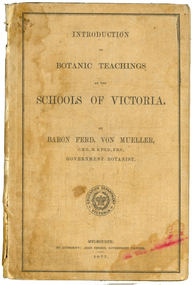
... Chapters include Eucalyptus Trees; Wattles or Acacias; Casuarinas or Sheoaks; Cypress Pines or Sandarac trees; Exocarpos trees of Natice Cherry trees; Mistletoes; Native Honeysuckles or Banksias; Bellflower, Lobelia and Goodenia; Heaths; Correas; Mallow; Buttercups and Clematis; Cruciferous Plants; Mints; Orchids; grasses; ferns. ...Chapters include Eucalyptus Trees; Wattles or Acacias; Casuarinas or Sheoaks; Cypress Pines or Sandarac trees; Exocarpos trees of Natice Cherry trees; Mistletoes; Native Honeysuckles or Banksias; Bellflower, Lobelia and Goodenia; Heaths; Correas; Mallow; Buttercups and Clematis; Cruciferous Plants; Mints; Orchids; grasses; ferns. ...Ferdinand von Mueller was an examiner of botany at the Ballarat School of Mines (SMB) between 1880 and 1888. During that era he was active in donating related items to the School. When the Ballarat School of Mines Council agreed to introduce pharmacy and botany classes in 1879, it was apparent students would require access to botanical specimens in order to further their studies. Council members, who were inspired by the work of Baron Ferdinand von Mueller, authorised development of an area along the School's northern boundary, fronting Lydiard Street South, and oversaw the establishment of the new Botanical Gardens. Baron von Mueller took a practical role the development of SMB's Botanical Gardens from the beginning. He became a generous benefactor who 'donated collections of seeds and leguminous fodder plants, including valued grasses of interest and use to agriculturalists and graziers generally' to SMB over many years. Ferdinand von Mueller's entry on the University of Ballarat Honour Roll can be found at http://www.ballarat.edu.au/curator/honour-roll/honourroll_von_mueller.shtml Also See Cat. No. 12062A light brown, hardcovered book of 152 pages. Chapters include Eucalyptus Trees; Wattles or Acacias; Casuarinas or Sheoaks; Cypress Pines or Sandarac trees; Exocarpos trees of Natice Cherry trees; Mistletoes; Native Honeysuckles or Banksias; Bellflower, Lobelia and Goodenia; Heaths; Correas; Mallow; Buttercups and Clematis; Cruciferous Plants; Mints; Orchids; grasses; ferns. The book has numerous botanical line drawings, and a comprehensive index.Inside front cover "Botanist, Teacher, researcher. My you make your mark like the baron. Best wishes for your birthday 1999 Martin"victorian, schools, botany, ferdinand von mueller, von mueller, botanic illustrations, flora, change number -
Bendigo Historical Society Inc.
Newspaper - Bendigo Advertiser Collection: Schools Searching for a Future - Mandurang South Primary School 1628, August 13 1993
... This item contains the following documents: 8091.602a Part of Page 11, the Bendigo Advertiser Friday August 13 1993 8091.602b Part of Page 11, the Bendigo Advertiser Friday August 13 1993 8091.602c Black and White Photo of four kids playing cricket on the oval besides the school - Contact BHS for Details 8091.602d Black and White Photo of Grade Four student Gary Wilkins sitting under a pine tree, possibly reading - Contact BHS for Details 8091.602e Black and White Photo of Grade Four students "Bush Cooking" around a camp fire Left to Right: Travis Singe, Tristian Gillies, Gary Wilkins, Bill Riddell - Contact BHS for Details 8091.602f Black and White Photo Front of Mandurang South School - Contact the BHS for Details 8091.602g Black and White Photo Front of Mandurang South School - Contact the BHS for Details 8091.602h Black and White Photo Two men and three kids in front of the school sign. ...This item contains the following documents: 8091.602a Part of Page 11, the Bendigo Advertiser Friday August 13 1993 8091.602b Part of Page 11, the Bendigo Advertiser Friday August 13 1993 8091.602c Black and White Photo of four kids playing cricket on the oval besides the school - Contact BHS for Details 8091.602d Black and White Photo of Grade Four student Gary Wilkins sitting under a pine tree, possibly reading - Contact BHS for Details 8091.602e Black and White Photo of Grade Four students "Bush Cooking" around a camp fire Left to Right: Travis Singe, Tristian Gillies, Gary Wilkins, Bill Riddell - Contact BHS for Details 8091.602f Black and White Photo Front of Mandurang South School - Contact the BHS for Details 8091.602g Black and White Photo Front of Mandurang South School - Contact the BHS for Details 8091.602h Black and White Photo Two men and three kids in front of the school sign. ...The document highlights the challenges faced by Mandurang South, a small rural school, in the face of government education reforms and potential closure. Mandurang South was considered an easy target for closure under new government 'quality provision' guidelines. Despite demonstrating a strong curriculum and experienced leadership, the school faced severe staffing reductions: from two teachers plus specialist support to just 1.4 teachers for 32 students. This would require one teacher to manage 31 children across seven grades in a single classroom, raising concerns about educational quality. Parents and teachers collaborated intensively to prepare a submission proving the school's quality, hoping to meet government criteria for survival. Some parents, including former students, expressed willingness to close or merge the school if educational standards could not be maintained, while others wanted to keep it open. The school community was holding a referendum to decide its stance for an upcoming taskforce meeting. Mandurang South and its neighboring school, Mandurang Primary, originated from a split in 1875 due to the distances children had to travel. The school has a rich history, with its original weatherboard building and a notable stand of century-old trees, making it a model for rural education and a point of local pride. The most likely option discussed was merging with Mandurang Primary, which would be ironic given their historical split over a century ago.Mandurang South's situation serves as a test case for the broader impact of educational 'rationalisation' policies on small rural schools. Mr. Balmer was Head Teacher in 1875. Heintervened to stop residents from cutting timber on school grounds, preserving a notable stand of eucalypts and conifers.The school grounds are recognized for their natural beauty, attracting visitors and providing students with daily exposure to native wildlife and nature-based activities. The school offers standard facilities (oval, courts, shelter) and unique curriculum elements like "bush cooking," making learning relevant to its rural setting. Mandurang South School is valued at $50,000–$70,000, but faces closure due to economic constraints and potential staff reductions.There is concern that closure could lead to further school consolidations in the Mandurang valley, as part of a broader government education reform. The possible closure is seen as a loss to the community’s heritage and educational landscape, with uncertainty about the future of other local schools.Schools searching for a Future. Series of photos and information about Mandurang Primary School No. 1628. Pictures by Lisa Honeychurch. Written by Owen Davies. This item contains the following documents: 8091.602a Part of Page 11, the Bendigo Advertiser Friday August 13 1993 8091.602b Part of Page 11, the Bendigo Advertiser Friday August 13 1993 8091.602c Black and White Photo of four kids playing cricket on the oval besides the school - Contact BHS for Details 8091.602d Black and White Photo of Grade Four student Gary Wilkins sitting under a pine tree, possibly reading - Contact BHS for Details 8091.602e Black and White Photo of Grade Four students "Bush Cooking" around a camp fire Left to Right: Travis Singe, Tristian Gillies, Gary Wilkins, Bill Riddell - Contact BHS for Details 8091.602f Black and White Photo Front of Mandurang South School - Contact the BHS for Details 8091.602g Black and White Photo Front of Mandurang South School - Contact the BHS for Details 8091.602h Black and White Photo Two men and three kids in front of the school sign. Left to Right: Brian Murdoch, Brian's daughter Ebony, John's son and daughter, Roger and Erin, and John Murdoch - Contact the BHS for Details 8091.602i Black and White Photo of Mrs Bess Coghill, the former Post Mistress at Mandurang South - Contact the BHS for Details 8091.602j Black and White Photo of the school sign - Contact the BHS for Detailsnewspaper, bendigo advertiser, mandurang south, primary school -
 Sunshine and District Historical Society Incorporated
Photograph - Maribyrnong Photographs 2021 Part 2, John Alchin, 2021
... 5599.01 - Raleigh Preserving Meat Works 2021 Photo 02.JPG 5599.02 - Raleigh Preserving Meat Works 2021 Photo 03.JPG 5599.03 - Raleigh Preserving Meat Works 2021 Photo 06.JPG 5599.04 - Raleigh Preserving Meat Works 2021 Photo 09.JPG 5599.05 - Raleigh Preserving Meat Works 2021 Photo 15.JPG 5599.06 - Raleigh Preserving Meat Works 2021 Photo 17.JPG 5599.07 - Raleigh Rd - Maribyrnong Reserve 2021 Photo 01.JPG 5599.08 - Raleigh Rd - Maribyrnong Reserve 2021 Photo 03.JPG 5599.09 - Raleigh Rd - Maribyrnong Reserve 2021 Photo 04.JPG 5599.10 - Raleigh Rd - Maribyrnong Reserve 2021 Photo 05.JPG 5599.11 - Raleigh Rd - Maribyrnong Reserve 2021 Photo 12.JPG 5599.12 - Raleigh Rd Maribyrnong - Maribyrnong War Memorial And Cenotaph 2021 Photo 01.JPG 5599.13 - Raleigh Rd Maribyrnong - Maribyrnong War Memorial And Cenotaph 2021 Photo 03.JPG 5599.14 - Raleigh Rd Bridge 2021 Photo 02.JPG 5599.15 - Raleigh Rd Bridge 2021 Photo 01.JPG 5599.16 - Raleigh Rd Maribyrnong - Pine Trees 2021 Photo 01.JPG 5599.17 - Randall Rd Maribyrnong - Maribyrnong Community Centre 2021 Photo 01.JPG 5599.18 - Remont Hill Maribyrnong 2021 Photo 01.JPG ...Raleigh Road Randall Road Maribyrnong Maribyrnong Preserving Meat Works Maribyrnong Reserve Maribyrnong War Memorial And Cenotaph Maribyrnong Community Centre Remont Hill 5599.01 - Raleigh Preserving Meat Works 2021 Photo 02.JPG 5599.02 - Raleigh Preserving Meat Works 2021 Photo 03.JPG 5599.03 - Raleigh Preserving Meat Works 2021 Photo 06.JPG 5599.04 - Raleigh Preserving Meat Works 2021 Photo 09.JPG 5599.05 - Raleigh Preserving Meat Works 2021 Photo 15.JPG 5599.06 - Raleigh Preserving Meat Works 2021 Photo 17.JPG 5599.07 - Raleigh Rd - Maribyrnong Reserve 2021 Photo 01.JPG 5599.08 - Raleigh Rd - Maribyrnong Reserve 2021 Photo 03.JPG 5599.09 - Raleigh Rd - Maribyrnong Reserve 2021 Photo 04.JPG 5599.10 - Raleigh Rd - Maribyrnong Reserve 2021 Photo 05.JPG 5599.11 - Raleigh Rd - Maribyrnong Reserve 2021 Photo 12.JPG 5599.12 - Raleigh Rd Maribyrnong - Maribyrnong War Memorial And Cenotaph 2021 Photo 01.JPG 5599.13 - Raleigh Rd Maribyrnong - Maribyrnong War Memorial And Cenotaph 2021 Photo 03.JPG 5599.14 - Raleigh Rd Bridge 2021 Photo 02.JPG 5599.15 - Raleigh Rd Bridge 2021 Photo 01.JPG 5599.16 - Raleigh Rd Maribyrnong - Pine Trees 2021 Photo 01.JPG 5599.17 - Randall Rd Maribyrnong - Maribyrnong Community Centre 2021 Photo 01.JPG 5599.18 - Remont Hill Maribyrnong 2021 Photo 01.JPG This is a large collection of photographs which has been split over three identification numbers. ...Maribyrnong was originally part of the former Shire of Braybrook and later the City of Sunshine. However, in 1994, Victoria underwent council amalgamations, which resulted in Braybrook being incorporated into the City of Maribyrnong. The suburb of Maribyrnong continues to attract considerable attention from the residents of City of Brimbank, particularly its historical features, the old buildings and distinctive streetscapes that characterise the area.To capture the essence of Maribyrnong in 2021, a series of photographs were taken. These images document a range of buildings, street scenes, and other notable points of interest throughout the suburb, providing a visual record of its unique character.5599.01 - Raleigh Preserving Meat Works 2021 Photo 02.JPG 5599.02 - Raleigh Preserving Meat Works 2021 Photo 03.JPG 5599.03 - Raleigh Preserving Meat Works 2021 Photo 06.JPG 5599.04 - Raleigh Preserving Meat Works 2021 Photo 09.JPG 5599.05 - Raleigh Preserving Meat Works 2021 Photo 15.JPG 5599.06 - Raleigh Preserving Meat Works 2021 Photo 17.JPG 5599.07 - Raleigh Rd - Maribyrnong Reserve 2021 Photo 01.JPG 5599.08 - Raleigh Rd - Maribyrnong Reserve 2021 Photo 03.JPG 5599.09 - Raleigh Rd - Maribyrnong Reserve 2021 Photo 04.JPG 5599.10 - Raleigh Rd - Maribyrnong Reserve 2021 Photo 05.JPG 5599.11 - Raleigh Rd - Maribyrnong Reserve 2021 Photo 12.JPG 5599.12 - Raleigh Rd Maribyrnong - Maribyrnong War Memorial And Cenotaph 2021 Photo 01.JPG 5599.13 - Raleigh Rd Maribyrnong - Maribyrnong War Memorial And Cenotaph 2021 Photo 03.JPG 5599.14 - Raleigh Rd Bridge 2021 Photo 02.JPG 5599.15 - Raleigh Rd Bridge 2021 Photo 01.JPG 5599.16 - Raleigh Rd Maribyrnong - Pine Trees 2021 Photo 01.JPG 5599.17 - Randall Rd Maribyrnong - Maribyrnong Community Centre 2021 Photo 01.JPG 5599.18 - Remont Hill Maribyrnong 2021 Photo 01.JPG raleigh road, randall road, maribyrnong, maribyrnong preserving meat works, maribyrnong reserve, maribyrnong war memorial and cenotaph, maribyrnong community centre, remont hill -
 City of Moorabbin Historical Society (Operating the Box Cottage Museum)
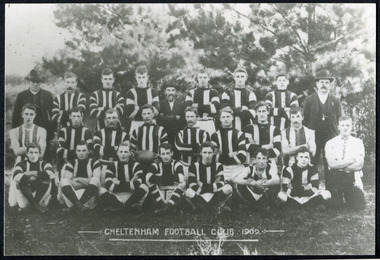
Photographs, x 3 Black & White Cheltenham Football Club 1909,1913, 1946, 20thC
... The Moorabbin council then leveled the playing area and erected a post and rail fence around the ground. Pine tree shrubs were then planted on the west side of the ground. ...The Moorabbin council then leveled the playing area and erected a post and rail fence around the ground. Pine tree shrubs were then planted on the west side of the ground. ...Known as the Rosellas, the early Cheltenham Football Club sides began playing on a regular basis in 1890, and would travel long distances by steam train to play country teams, such as Ballarat where they would arrive at their destination, play the match, socialize then return to the station. Opposition players and supporters would give three hearty cheers on their departure. The Cheltenham home games were played on a paddock on the corner of Park and Charman roads in Cheltenham. In 1907 the Cheltenham progress committee made an application to the board of land works for land in Weatherall Road for recreational service to the public. That application was received and granted, then developed where Cheltenham Recreational Reserve now stands. The land in the early days was virgin bush and the response for voluntary help to clear the area was outstanding. Nearly all the market gardeners in the district along with horses, ploughs, axes, shovels completely cleared the area in three weeks. The Moorabbin council then leveled the playing area and erected a post and rail fence around the ground. Pine tree shrubs were then planted on the west side of the ground. The ground was opened in 1909 and the first Cheltenham side entered in the newly formed Federal Football Association along with seven other foundation members, Mordialloc, Mentone, Moorabbin, Frankston, Glenhuntly, Elsternwick, and Ellindale. The grand final for that year, 1909 was a hard encounter between Cheltenham and Ellindale with Cheltenham coming out victors, thus becoming the inaugural Federal Football Association premiers. Cheltenham went onto win five senior premierships in the Federal Football Association by the end of the 1920s, they won the flags in 1909, 1911, 1913, 1922 and 1925, with the late Percy Woff playing in all 5 premiership sides and was captain in 1922. 1928 saw the start of an outstanding career from our oldest living player Tom Connor. Cheltenham continued to win premierships in the 1920’s and 1930’s with juniors taking out the 1929 and 1933 flags, under the guidance of Woff, and that continued in 1934 when Cheltenham took out the 1st XVIII and 2nd XVIII premierships. Cheltenham produced its only Brownlow medallist in Peter Box who played in the late 1940s, before going to Footscray where he became a champion. The 3rd XVIII went through the season undefeated in 1974 winning the premiership, with Trevor Barker a key player before going to St Kilda the following year. The club won three senior premierships under coach Barry White in 1992, 1993 and 1995. ( from CFNC website 2019) Cheltenham Football Club was formed 1890 and succeeded in winning many Premierships as a member of the Federal Football Association, Outstanding players Peter Box Brownlow Medalist 1956 Footscay VFL, , Trevor Barker and Kevin Roberts St Kilda VFL.3x Black & White photographs of the players in the Australian Rules Cheltenham Football Club 1909, 1913 and 1946 extra photo of Peter Box Folio 10 MAV 01059a) CHELTENHAM FOOTBALL CLUB 1909 Cheltenham Football Club 1909. Back row: A Chandler, committee member; R. Robertson, back-pocket; J. Harris, half back flank; J Adams, ruck and forward-pocked; M. J. Monk, club president; L. Woff, back-pocket; W. Adams, ruck and back-pocket; P. Woff, rover and forward-pocket; A Monk, committee member. Middle row: W. Hore, back pocket and ruck; A. Towns, half-forward flank; W. Carson, full back; F. Andrews, captain-half forward flank; H. Butler, centre half back; J. Warburton, centre half-forward; A. Slater, half-back flank; F. Fisher, half-forward flank; C. Sherwood, trainer. Front Row: G Gouldthorpe, wing; H. King, full-forward; W. Johnston, ruck and forward-pocket; P Spears, rover and forward-pocket; F. Bichl, wing; A. Bichl. rover and forward-pocket; F. Butler, centre player. Courtesy, Lionel Seal. ( from CFC website 2019) b) CHELTENHAM 1913 PREMIERS c) CHELTENHAM -1946 / Back row - J. Fisher, G.Corrigan, N.Hocking, F.Virtue, R.Craven, L.Baker, M.Blundell / 2nd Row - J.Phillips, T.Connor, E.Hawkins, A.Blakely, G.Baker, A.Dark, J.Barker, D.Craven, J.Pickering, P.Cameron,/ W.Hicks, G.Hoskings, R.Beihl, A.Hubbard, R.Kier, C.Russell. / Front Row - Clark Taylor, J.Slade, N.Niel, J.Brooks, T,Butler, H.Hosking, C.Hacusler, E.Hornibrook, W.Briggs, B.Russell, L.Biehl, / W Ripponcheltenham football club, australian rules football, victorian football association, victorian football league, smith j l; smith mary ann, stanley helen, , chaff cutter, horse drawn carts, toll gates brighton, motor cars 1900, steam engines, early settlers, bentleigh, parish of moorabbin, city of moorabbin, county of bourke, moorabbin roads board, shire of moorabbin, henry dendy's special survey 1841, were j.b.; bent thomas, o'shannassy john, king richard, charman stephen, highett william, ormond francis, maynard dennis, market gardeners, vineyards, orchards, cheltenham, two acre village, holloway josiah,, woff percy, connor tom, box peter, barker trevor, white barry, browlow charles, -
 Federation University Art Collection
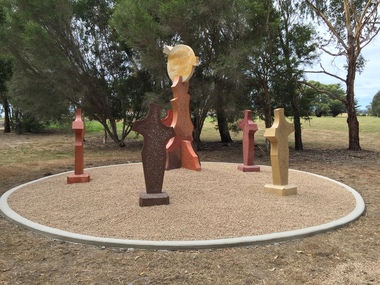
Sculpture, 'Mungo Moon' by Don Barrett, 2015
... There are already art features along this route, including primary schools’ Bug Blitz totems near the Kurnai College school crossing, native vegetation and history panels near the Hare Homestead in Mathison Park, and outdoor sculptures in the pine trees near the Federation University Switchback Gallery. ...There are already art features along this route, including primary schools’ Bug Blitz totems near the Kurnai College school crossing, native vegetation and history panels near the Hare Homestead in Mathison Park, and outdoor sculptures in the pine trees near the Federation University Switchback Gallery. churchill art and culture pathway barrett don barrett gippsland campus federation university churchill sculpture A large sculpture in five pieces set in an external location. ...'Mungo Moon' by Don Barrett is the first sculpture erected on the Churchill Art and Culture Pathway. It was officially unveiled by Professor David Battersby on 15 April 2015 From Churchill & District News 16 October 2014 The Churchill Art and Culture Walking Pathway will have its official public opening on Saturday October 18, with a walk finishing at Federation University Australia’s Switchback Gallery at the Federation University Gippsland Campus. ... An important link on the newly developed pathway was recently completed with a path south of the FedUni Student West Residences. The path now allows walkers to turn off the Eel Hole Creek path before reaching Glendonald Estate and to follow a picturesque, tree lined walkway to join up with the footpath on the Eastern side of Northways Road. From there the footpath joins into Federation University’s network of walking paths that proceeds past the Switchback Art Gallery, down through the pine plantation and along Lake Kretlow and the Churchill Golf Course. Project Manager Mike Answerth, said the opening of the West Residences section of the path means there is now only one short link to complete. “We’re now very close to realising the project’s objective to join up all these walking paths to provide a continuous pathway that encompasses town, campus and parkland. The next stage of the project will be the completion of Latrobe City’s East West Link and the enhancement of the walking path with artistic and cultural features.” said Mr. Answerth. Head of Federation University Australia Gippsland Campus, Dr Harry Ballis, said the project had been made possible through the contributions of the five former Gippsland Education Precinct (GEP) partners. “The Art and Culture Pathway represents another important step in joining the Churchill township and the university campus as a physical and social entity,” Dr Ballis said. “This was an initiative of the GEP and it is pleasing to see it coming to fruition.” The path now reaches as far as the golf driving range but plans are already under way to connect with the Mathison Park board walk and pathway, which surrounds Lake Hyland in Churchill. When the loop is completed, residents and visitors will have an approximately 5km circular walking path which links up the Churchill town centre, Federation University Australia and Mathison Park. There are already art features along this route, including primary schools’ Bug Blitz totems near the Kurnai College school crossing, native vegetation and history panels near the Hare Homestead in Mathison Park, and outdoor sculptures in the pine trees near the Federation University Switchback Gallery. contemporaryA large sculpture in five pieces set in an external location. It is part of the Churchill Art and Culture Walking Pathway. Don Barrett’s work is mainly in concrete with added coloured oxides to portray the feeling of the Australian landscape. Barrett focuses on concepts of Australia’s short history and indigenous history. churchill art and culture pathway, barrett, don barrett, gippsland campus, federation university, churchill, sculpture -
 Bayside Gallery - Bayside City Council Art & Heritage Collection
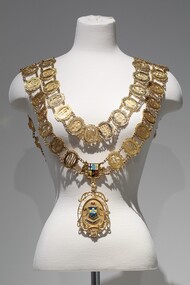
Ceremonial object - Mayoral chain, Blashki, City of Sandringham Mayoral Chain, c. 1954
... The main medallion has an oval central panel that features the coloured Sandringham seal in enamel depicting two sailboats in the water, a pier protruding from the left, a coastline on the right with two pine trees. Above the scene are decorative triangles in light blue and yellow, above which is another section in dark blue containing a third sailboat. ...The main medallion has an oval central panel that features the coloured Sandringham seal in enamel depicting two sailboats in the water, a pier protruding from the left, a coastline on the right with two pine trees. Above the scene are decorative triangles in light blue and yellow, above which is another section in dark blue containing a third sailboat. ...This chain was part of the official regalia worn by the Mayor of the City of Sandringham before the amalgamation into Bayside City Council in 1994. The chain was seen as an outward sign of power, authority, and responsibility and was a formal, full-dress type of regalia that was worn by the mayor over their robes at ceremonial functions. The large central drop medallion features the design of the council sea, and the links of the chains are made of cutwork initials of each Mayor. The Sandringham seal was designed by Sans and McDougal had been selected in 1917, by a special committee and its main features are the Sandringham pier and breakwater, with a yacht in full sail as an inset, supported by two dolphins. The motto reads 'Omni Opere' which translates to ‘With all earnestness.’9 carat yellow gold mayoral chain for the City of Sandringham. Consists of two concentric circles of 57 small oval links, with an Australian Coat of Arms as a centrepiece and a large 'drop' medallion of the City of Sandringham seal below. Each oval link is made up of the cutwork initials of a mayor, the surrounding oval border has an inscription above the initials which gives the mayor's name; an inscription below gives dates of office; the earliest is Cr. B.J. Ferdinando 1917-18, and latest is Cr. S.T. Russell 1993-94. The ovals are surrounded by decorative scrolls and are joined by small curb chains. The outer circle contains 31 links, while the inner contains 26. On both shoulders sit decorative bars, joining the front of the chain to the back. The main medallion has an oval central panel that features the coloured Sandringham seal in enamel depicting two sailboats in the water, a pier protruding from the left, a coastline on the right with two pine trees. Above the scene are decorative triangles in light blue and yellow, above which is another section in dark blue containing a third sailboat. The seal is flanked by two engraved dolphins and above it sits an engraved St Edward's gold crown filled with red enamel. Below the seal, there is a ribbon containing the Latin motto 'OMNI OPERE' which is engraved and filled in dark blue enamel. The pendant is surrounded by cutwork lettering reading 'CITY OF SANDRINGHAM / 1919' and leaf decorations. The medallion is inscribed on the reverse with important dates in Sandringham's history. A fleur-de-lys joins the medallion to the Australian Coat of Arms centrepiece above. The Coat of Arms features a shield, depicting symbols of Australia's six states, in enamel, flanked by an engraved kangaroo on the left and emu on the right. Below it sits a ribbon engraved 'ADVANCE AUSTRALIA'.mayoral chain, ceremonial wear, seal, medallion, mayor, coat of arms, crest, bayside, blashki & sons, city of sandringham, sandringham, omni opere, blashki, mayoral regalia, motto, st edward's crown, sans and mcdougall -
 Mt Dandenong & District Historical Society Inc.
Photograph, Kalorama Gap Under Snow 1921, 1921
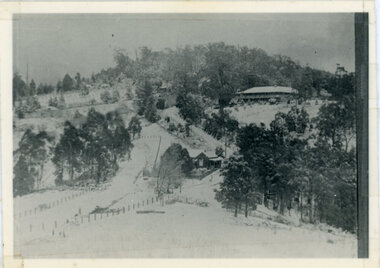
... At the bend of the road behind the big pine tree and the dark blackwood can be seen faintly the gable of Price’s house that contained the first shop on the mount. ...At the bend of the road behind the big pine tree and the dark blackwood can be seen faintly the gable of Price’s house that contained the first shop on the mount. ...View of Kalorama Gap under snow taken in 1921. Mountjoy Guest House is at top right and Beulah Tea Rooms is in the centre. This photograph has a detailed inscription on the back handwritten by John Lundy-Clarke in 1974.Kalorama Gap under snow 1921 The leafless elm trees are low in the centre and the dual nature of the nearer one can be clearly seen, two small suckers of the older farther tree being twisted together in 1898 by Fred Jeeves. The older tree was planted 1880. Mrs Hands shop can be clearly seen, which was the Mount Dandenong North Post Office. The old Main Road runs up the centre of the picture and turns to the right and disappears behind “Mountjoy” the big guest house built by Paynters in 1905 and sold to Ellis Jeeves 1908, whose family ran it till 1943. At the bend of the road behind the big pine tree and the dark blackwood can be seen faintly the gable of Price’s house that contained the first shop on the mount. Above it is H Walker’s cottage on Ridge Road that still exists, his homestead is on the left of the picture on the same level. Below this house and to the left can be seen Ted Prices hay and corn store. The present estate agency lies between these two buildings, on the road which had recently been built. This can be seen winding from the lower left corner of picture to the left of the elms. The CRB had recently fenced the road and this is clearly seen as it circles behind trees in the left centre. Barber’s Road crosses CRB Road to the left of the dray under the leafless elm and the Coach Road dives down to the right just behind the pair of blackwoods to right of the elms. The picture was taken from just above the boundary of Isaac Jeeves’s selection Crown Allotment “C” (Jeeves Saddle) which stretched across the Gap to the other side of Mrs Hand’s shop, monopolising the gap from 1871 to 1879. Price’s house remains partly as the small house – “Mirra Laken”. kalorama gap, fiveways, post office, mountjoy, guest house, snow -
 Eltham District Historical Society Inc
Photograph, A walk through the cemetery at Kangaroo Ground, Diana Bassett-Smith, 1 October 2001, 2001
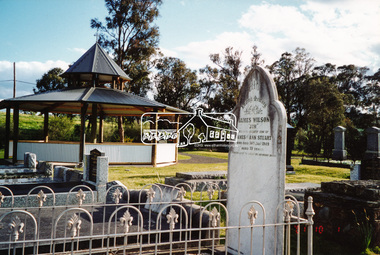
... It was a Wilson who had a nursery at the North Eastern end of Bourchiers Road on the land known as Tintagell alongside the Yarra. He grew trees, pines in particular, and supplied within the district and to the gardens of Melbourne. ...It was a Wilson who had a nursery at the North Eastern end of Bourchiers Road on the land known as Tintagell alongside the Yarra. He grew trees, pines in particular, and supplied within the district and to the gardens of Melbourne. ...The Kangaroo Ground Cemetery celebrated its 150th anniversary in 2001. Celebrations included the opening of a new rotunda on the 26 October 2001. Ths photo is a part of a brief collection of reminiscences by Diana Bassett-Smith of locals who are buried at Kangaroo Ground Cemetery along with 17 photographs following a visit on 1 October 2001. "One other headstone, that of James Wilson. It was a Wilson who had a nursery at the North Eastern end of Bourchiers Road on the land known as Tintagell alongside the Yarra. He grew trees, pines in particular, and supplied within the district and to the gardens of Melbourne. According to Jimmy Cook. The last of the warriors is between the gate and the river. And confirmed by Dorrie Bourchier that the original pines to what is now our property came from Wilson. The only one left now is by Passiona. Lightening claimed the one at the corner of our drive." Colour photograph printkangaroo ground cemetery, rotunda, james wilson -
 Eltham District Historical Society Inc
Photograph - Colour Print, Janefield, Bundoora, c.1982
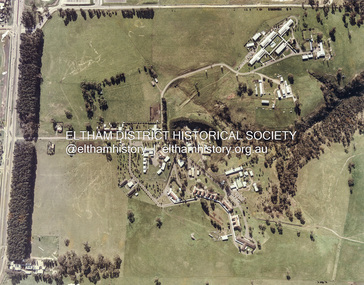
... Mick informed Peter that it was his job to remove the 14 acres of pine tree roots, after the trees were cut down (due to old age and an infestation of sap sucking insects). ...Mick informed Peter that it was his job to remove the 14 acres of pine tree roots, after the trees were cut down (due to old age and an infestation of sap sucking insects). ...The photo encompasses what is present-day University Hill shopping complex and the Janefield Wetlands. Plenty Road is just visible to the left of the photo. Janefield was an area 18 km north-east of central Melbourne that is now part of Bundoora. In 1842 a flour mill, powered by the Plenty River, was built at Janefield, although the locality was not known by that name at that time. It seems that the name Springfield was used in the late 1840s, after a Springfield homestead, and this was changed to Janefield possibly upon the death of Jane Brock in 1847. She was the wife of James Brock, a local landowner and son of the purchaser of the flour mill. This photo is not strictly within the area of interest for EDHS but overlaps do occur at times with other Society’s interests through families and other associated connections. Eltham District Historical Society member (and Greensborough Historical Society member), Peter Van Eeken was undertaking research into this photo and approached the Local History Librarian at Yarra Plenty Regional Library to enquire about digitising the large print copy to facilitate research. Approaches were made to EDHS who had suitable facilities and were willing to accommodate and all parties agreed to add the image as part of their respective collections in partnership. Michael Lanigan, started work as a message boy at Mont Park when he left school at age 14. He worked his way up the system to become farm manager at Mont Park and Janefield Special School. He was one of the last people to drive a herd of cattle (in 1964) between the two locations along Plenty Road. He retired when the school closed around 1993. Mick pointed out the location of three remnant farm houses of the 1800s. The Brock House being the main one. Peter has been unable to find any photos of the Brock House, which what built in the late 1850s, severely burnt in the 1930s and demolished in the mid 1960s. The tree plantation along Plenty Road was established in 1930 and cut down in the mid 1980s. The Victorian Government established tree plantations at about 350 schools in the early 1930s. Briar Hill School had one but Peter is not sure about any other local schools having a tree plantation. Mick informed Peter that it was his job to remove the 14 acres of pine tree roots, after the trees were cut down (due to old age and an infestation of sap sucking insects). For Mick, this was an impossible job, so he arranged a contract, to house all the soil removed from works associated with the construction of the Greensborough Bypass, which needed temporary storage as it was too valuable, and would be great for use in road construction. The contract to store the soil was important to Mick, as the contract stipulated that when the soil was eventually removed, the tree roots had to be removed too. Which got rid of Mick's headache. Apparently, the huge mound of soil that covered the roots in the late 1980s could be seen from Briar Hill. Based on this, the photo is most likely to have been taken 1982 or 1983. The key to a final date is working out when the Board of Works Office opened but so far no information has come to light. (It was purchased by La Trobe University in 1991). The Office existed, or is hinted at, in the photo at the extreme north of the photo, opposite McKimmies Road, on the eastern side of Plenty Road. Photo on loan from Michael Lanigan via Peter Van Eeken. He cannot recall why it was taken. brock family, janefield, janefield drive, janefield wetlands, plenty road, university hill
