
Showing 8 items matching " ''drop-kick''"
-
 Bendigo Historical Society Inc.
Document - AGOS INFO, BENDIGO, April 1987
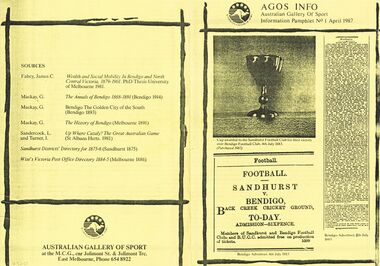
... ... ''Drop-Kick''...The greatest offender, alleged by ''Drop-Kick'' in The Bendigo Advertiser, was Sheldon of Sandhurst, an ancestor of current day player Ken Sheldon of St Kilda. .. ...The greatest offender, alleged by ''Drop-Kick'' in The Bendigo Advertiser, was Sheldon of Sandhurst, an ancestor of current day player Ken Sheldon of St Kilda. .. ...AGOS INFO, Bendigo. Australian Gallery of Sport. Information Pamphlet No. 1 April 1987. Photo of cup awarded to the Sanhurst Football Club for their victory over Bendigo Football Club, 4th July 1883. (Purchased 1987). Extract from Bendigo Advertiser, 4th July 1883 advertising Match between Sandhurst and Bendigo. Admission - Sixpence. Members of Sanhurst & Bendigo Football Clubs and BUCC admitted free on production of tickets. Extract of Bendigo Advertiser, 5th July 1883, FOOTBALL Sandhurst v. Bendigo. (remainder of print too small to read. Sandhurst. Bendigo July 4th 1883 The match played between Sandhurst and Bendigo provides a rare insight into the Australian game at a crucial stage of its development.. . Trophy presented by local jeweler, Mr Joseph Moody. .. Football was relatively weaker in Bendigo than in the comparable city of Ballarat. This can be explained by the high migrant proportion of the Bendigo population, its economic difficulties in the 1880s and by its distance from Melbourne. .. Football overtook cricket by the end of the decade as the most popular sport. .. A regular Saturday competition was played, with matches also played on Wednesdays. These matches were a legacy of the earliest ''scratch'' matches, suggesting a relatively strong union movement which had won concessions for weekend work. Matches started at 3pm. ..The best player on the ground was a contractor and the captain an accountant. .. Transition. The predominance of the ''little mark'' the participation of sometimes frightened junior teams against adults and the division of the game into halves rather than quarters represents an era that has disappeared. Complaints of rough play, poor losers, the problems posed by children. .. An issue, was seen as a blight on the game in 1883. The greatest offender, alleged by ''Drop-Kick'' in The Bendigo Advertiser, was Sheldon of Sandhurst, an ancestor of current day player Ken Sheldon of St Kilda. .. Fundamental issue about the place of sport in society. .. The reason for this is that the Bendigo club was in dispute with the Bendgio Union Cricket Club over control of the Back Creek Ground. If they had been refused the ground, as it was feared, then the whole association would have been forced to disband. Only last minute negotiations resolved the dispute. .. Reflects the values of society, .. Broader conflicts about power and the control of resources within that society. 2000 turned out. The crowd cheered lustily and the players exhibited similar excitement and were urged on by their captains to play up and kick the ball. In the eventual Sanhurst victory, amongst the best players was Edward Cordner, a forerunner of the renowned Cordner family of the Melbourne Football Clubs. Shane Cahill. Sources: Fahey, James C. Wealth and Social Mobility In Bendigo and North Central Victoria, 1868-1891. Mackay, G. The Annals of Bendigo 1868-1891 (Bendigo 1914). Mackay, G. Bendigo The Golden City of the South (Bendigo 1893) Mackay, G. The History of Bendigo (Melbourne 1891). Sandercock, L.. And Turner, I. Up Where Cazaly? The Great Australian Game (St Albans Herts. 1981) Sanhurst Districts' Directory for 1875-6 (Sandhurst 1875) Wise's Victoria Post Office Directory 1884-5 (Melbourne 1886). Australian Gallery Of Sport at the MCG, cnr Joliment St. & Joliment Trc. East Melbourne, Phone 654 8922. clubs and associations, football, agos, agos info, bendigo. australian gallery of sport. information pamphlet no. 1 april 1987. photo cup awarded sanhurst football club for victory bendigo football club, 4th july 1883. (purchased 1987). advertiser, 4th july 1883 match between sandhurst v. bendigo. admission - sixpence. members sanhurst & bendigo football clubs and bucc free. extract, 5th july 1883, football sandhurst v. bendigo. sandhurst. bendigo july 4th 1883 sandhurst and bendigo provides insight into the australian stage development.. . trophy local jeweler, mr joseph moody. .. football weaker in bendigo than in ballarat. explained by the migrant proportion bendigo population, its economic difficulties 1880s distance from melbourne.. football overtook cricket by end decade the popular sport.. saturday competition played, matches also wednesdays. legacy of the earliest ''scratch'' matches, strong union movement concessions for weekend work. matches started at 3pm.. best player on the ground a contractor the captain accountant. .. transition. predominance ''little mark'' participation frightened junior teams adults game halves rather than quarters represents an era disappeared. complaints rough play, poor losers, problems posed children., a blight 1883. offender, ''drop-kick'', sheldon, ancestor ken sheldon of st kilda...bendigo club was in dispute bendgio union cricket club control of the back creek ground. refused, as it was feared, association forced to disband. negotiations resolved dispute..values of society.. conflicts power control resources. 2000 turned out. crowd cheered players exhibited similar excitement captains. edward cordner. cordner family melbourne football clubs. shane cahill. sources: fahey, james c. wealth and social mobility in bendigo and north central victoria, 1868-1891. mackay, g. the annals of bendigo 1868-1891 (bendigo 1914). mackay, g. bendigo the golden city of the south (bendigo 1893) mackay, g. the history of bendigo (melbourne 1891). sandercock, l.. and turner, i. up where cazaly? the great australian game (st albans herts. 1981) sanhurst districts' directory for 1875-6 (sandhurst 1875) wise's victoria post office directory 1884-5 (melbourne 1886). australian gallery of sport at the mcg, cnr joliment st. & joliment trc. east melbourne, phone 654 8922. -
 Carlton Football Club
Dinner Program & Menu, Carlton Football Club November 21st 1957 to Mr H R Clover, 1957
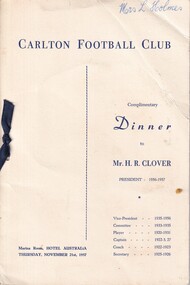
... He excells in punting, drop, and place kicking. He is a great marksman and a splendid exponent, one of the greatest the district has produced, besides being a fair cricketer also." ...He excells in punting, drop, and place kicking. He is a great marksman and a splendid exponent, one of the greatest the district has produced, besides being a fair cricketer also." ...Dinner to Mr H R Clover player Career : 1920-24, 1926-31 Debut : Round 2, 1920 vs. Richmond, aged 25 years, 46 days Carlton Player No. 346 Games : 147 Goals : 396 Guernsey No. 1 Last Game : Semi Final, 1931 vs. Collingwood, aged 36 years, 180 days Height : 185 cm (6 ft. 1 in.) Weight : 86.5 kg (13 stone, 9 lbs.) DOB : 20 March, 1895 League Leading Goalkicker: 1922 Leading Goalkicker: 1920, 1921, 1922, 1923, 1926, 1928 Best and Fairest: 1929 Captain Coach: 1922-1924, 1927 Champion of the Colony: 1921 VFL AFL Hall of Fame Carlton Hall of Fame Team of the Century President: 1956-57 Vice President: 1932, 1935-54 Club Secretary: 1925-26 Horace “Horrie” Clover was Carlton’s star centre half-forward of the 1920’s; a high flying, long-kicking champion who enjoyed a stellar career with the Old Dark Navy Blues, then went on to be one of our longest-serving administrators. But even before he took the field for Carlton, Clover had to conquer the odds on the battlefields of France in World War 1. From Maryborough in central Victoria, Horrie enlisted in the 1st AIF in September 1915. After basic training, he embarked for France with reinforcements for the 7th Battalion in January of 1916. Soon pitched into the horrors of trench warfare, he fought and survived until September of that year, when he was transferred to a machine gun company and promoted to the rank of Corporal. On Christmas day, 1916, Horrie was struck down with acute appendicitis. He was evacuated to a field hospital for emergency surgery, where the doctors discovered that his appendix was gangrenous and that his life was in danger. He was immediately transferred to London for specialist treatment, and months of recuperation. Pronounced unfit for further front-line service, he was repatriated back to Australia in August 1917, and honourably discharged in May of the following year – six months before the Armistice. Having recovered, and keen to have a crack at senior football, Clover trained with Richmond and Melbourne before Carlton gave him an opportunity at VFL level. And how he delivered! In his first match in 1920 – ironically, against Richmond - he kicked four goals from centre half-forward, and hit the post three times! By the end of his first season at Princes Park, Clover was one of Carlton’s drawcards. Former Australian Prime Minister Sir Robert Menzies was just one of the many Carlton fans who were captivated; “he was the most artistic of high marks, unforgettable at half-forward,” said Menzies. Horrie could kick a football, too. A balanced, deceptively quick mover, he was a glorious running drop-kick for goal. Playing against Richmond again at Princes Park in July, 1921, he let fly with a monster kick that was later measured at 86.26 metres – that’s 94 yards, 2 feet in imperial terms! And there are numerous other instances where he roosted the ball more than 70 metres. In round 12 of 1921, he slotted 13 goals in a game against St Kilda; a club record which still stands today. The Blues made the finals in third place in 1921 and battled through to meet Richmond for the Premiership. Then the heavens above the MCG opened up on the day before the decider, turning the ground into a quagmire. In what was to be Clover’s only Grand Final appearance, Richmond won a slogging, mauling contest by four points. While Premiership glory eluded him, Horrie was Carlton’s top goalkicker in three of his first four seasons, including 1922, where his total of 58 was the competition’s best. He was appointed captain of the Blues that same year, and in 1923 took on the dual role of captain-coach. Over 1924 / 1925, he suffered more debilitating illness that prevented him from playing all season. Unable to pull on his football boots, he took on the job of Club Secretary, and continued in that position even after returning to the field in 1926. When he did eventually resume, he formed a new, powerful Carlton forward set-up with a young Harry “Soapy” Vallence at full-forward. Twice more – in 1926 and 1928, Clover’s brilliance and accuracy in front of goal saw him at the top of Carlton’s goal-kicking, and in 1929 – aged 34, he was honoured with the captaincy of Victoria against WA in his ninth and final game in the Big Vee. show_image.php?id=205 Horrie Clover retired as a player in 1931 after 147 games. His total of 396 goals is still ranked fifth best in Carlton’s proud history (only displaced for fourth when Brendan Fevola broke through in 2007/2008) – and it should be remembered that all but a handful of his games were played at centre half-forward, not in the goal square. In 1932 he was elected Vice-President of the Carlton Football Club, but retired after one year. In February 1935 on learning of Terry Ogden's the serious illness, Clover and Newton Chandler offered their services for a blood transfusion for the club's wing man. After a blood test Chandler's blood was accepted. However, Ogden passed away the next month. Clover stood again in 1935, was elected – and spent twenty unbroken years serving his beloved Blues. He even took on the Presidency in 1956, aged 60, and was as vigorous and determined as ever in his two years in the job. Carlton Football Club mourned deeply when Horrie Clover passed away on the first day of January, 1984. Three years later, he was among the first to be inducted into the Carlton Hall of Fame. Testament to his stature in the game as a whole, he was elected to the AFL Hall of Fame in 1996; and May 2000 saw him named as one of four emergencies in Carlton’s Team of the Century. A champion in every sense of the word, he spent 37 years of his remarkable life at Princes Park. Footnote The Argus published an article on Maryborough, April 12 1930, it said; "Clover has been the leading half-forward in League ranks for some time. It takes a specialist to fill the position capably, and the Carisbrook man does this admirably. Like good wine he has improved with age, and besides being one of the greatest half forwards that has ever appeared on a football field, he is about the best all round kicker that has ever played the game. He excells in punting, drop, and place kicking. He is a great marksman and a splendid exponent, one of the greatest the district has produced, besides being a fair cricketer also." When Clover returned to football in 1926, The Argus mentioned that they thought it was the first time a member of the Permit and Umpire Committee had played in a League game. 13 GOAL AWARD Round 12, 1921 At the Carlton AGM held on Monday 27 February 1922, Horrie Clover "was presented with ball used on the occasion, the St.Kilda club having generously donated it to the Carlton officials, who had it mounted for the purpose." (Age February 22 1922) 1922 The Art Of Forward Play Horrie wrote an article for the Sporting Globe August 30 p7 To read click here> http://nla.gov.au/nla.news-article184798404 1928 Idol of Carlton Crowds - Australia's Best Centre Half Forward The Sporting Globe's football writer W. S. "Jumbo" Sharland writes about Horrie Clover To read click here> http://nla.gov.au/nla.news-article183958222 Footballer Who Gambles With Death. Daily Pictorial (Sydney) article about Horrie. http://nla.gov.au/nla.news-article246129350 1932 Jack Worrall on Clover Writing for the Australasian September 03 p7; "Take Horrie Clover as an example, a real specialist, one of the best forwards the game has seen, and the best all-round kick that has ever come under my purview. For that reason he deserves a line to himself. He played the game like a sportsman, was a glorious high mark, and could cover a great distance by either drop, punt, or place kick - a remarkable accomplishment. Many players have been notable kicks in two aspects of the game, yet none have equalled Clover in the three branches. His nearest rival as an all-round kick, though not quite as certain in his efforts, was Frank Caine, of Carlton, who, like Clover, also hailed from the country." 1933 Coming Football Champion Melbourne, Saturday A special warning was issued to the Victorian Football League delegates last night by Mr. D. H. Crone, a Carlton delegate, not to angle for a certain "coming" champion that the Carlton Club had signed up that day. At first delegates were a little puzzled at the statement, but when it was explained that Horrie Clover, former champion half-forward, had that day become the father of of a son they burst into sustained laughter. It was only by persistent ringing of the bell by the chairman that order was restored. (News (Adelaide) May 20 1933 p3) 1933 - The Place Kick A letter to The Argus via the Huon Times about the lack of place kicking expertise in the VFL. The writer mentions that he got Horrie to play football in Maryborough after he saw the then 15 y.o. place kick a ball 63 yards, and later with Carlton, Clover place kicked 8 goals in one match. To read click here> http://nla.gov.au/nla.news-article137253000 Milestones 50 Games: Round 1, 1923 vs Fitzroy 100 Games: Round 18, 1927 vs St Kilda 100 Goals: Round 18, 1921 vs Collingwood 200 Goals: Round 3, 1924 vs St Kilda 300 Goals: Round 11, 1928 vs Geelong Links Articles: The Magical 'Three Goal Average' | A Letter From Horrie | Our Flagless Greats Blueseum: Stat Shot for Horrie Clover | Career Breakdown | Clover's big goals hauls | Clover's Blueseum Image Gallery A dinner to celebrate career Horrie Clover in 1957 Four Page Program & Menu 1927 -
 Halls Gap & Grampians Historical Society
Newspaper - B/W
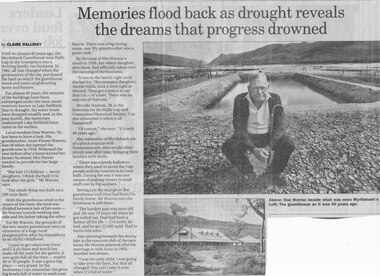
... dropped steadily and, in the past month, the memories underneath Lake Bellfield have come to the surface. Local resident Don warren 70, has been to have a look. His grandmother Anne Flower Warren, was 56 when she opened the guesthouse in 1916. Widowed, the year before after a horse kicked...dropped steadily and, in the past month, the memories underneath Lake Bellfield have come to the surface. Local resident Don warren 70, has been to have a look. His grandmother Anne Flower Warren, was 56 when she opened the guesthouse in 1916. Widowed, the year before after a horse kicked ...Until the closure 40 years ago, the Myrtlebank Guesthouse near Halls Gap in the Grampians was a thriving family - run business. In 1962, all that changed when the government of the day purchased the land on which the guesthouse stood and some neighbouring farms and houses. For almost 40 Years, the remains of the buildings have been submered under the man made reservoir known as Lake Bellfield. Due to drought, the eater levels have dropped steadily and, in the past month, the memories underneath Lake Bellfield have come to the surface. Local resident Don warren 70, has been to have a look. His grandmother Anne Flower Warren, was 56 when she opened the guesthouse in 1916. Widowed, the year before after a horse kicked her farmer husband, Mrs Flower needed to provide for their large family. "She had 13 children - seven daughters. I think she built it to look after the girls," Mr Warren says, "The whole think was built on a 500 acre farm." With the guesthouse sited in the centre of the farm, the land was divided between two of her sons- Mr Warren's uncle working one side and his father taking the other. For Mr Warren, the grounds of the two-storey guesthouse were an extension of a huge rural playground in what he remembers as an idyllic childhood. "I used to get taken over there and I'd sit there and watch her make all the toast for the guests. It was quite full all the time - maybe 40 or 50 people. It was a great big place - very grand. In the bedrooms I can remember the great big bowls full of water to wash your face in. There was a big dining room, too. My grandmother was a great cook." By the time of Mrs Warren's death in 1936, her eldest daughter also Anne, had officially taken over the running of the business. "It was in the family right until the last bit. The youngest daughter, Auntie Hilda, took it over right at the end. they got a notice to say that's it - it's over There was no way out of that one." Mrs Ida Stanton, 78, is the historian for the Halls Gap and Grampians Historical Society. Can she remember it when it all happened? "Of course" she says "It's only 40 years ago" Her memories of Myrtlebank are of a place popular with honeymooners, who would often return year after year, bringing their families with them. "There was a lovely ballroom where they used to invite the Gap people and the tourists in to have balls. During the war it was one means of making money to send stuff over to the soldiers." Seeing just the stumps of the guesthouse and what had been his family home, Mr Warren says the bitterness is still there. "The hardest part was poor old dad. He was 70 years old when he got turfed out. Dad had been a farmer all his life - 214 acres, he had, and he got 22,000 quid. Had to move into town" Also showing beneath the drying lake is the concrete slab of the new home Mr Warren planned after his marriage to wife Anne in 1955. Another lost dream. " I was the only child, I was going to take over the farm, but that all changed. You can't take it over when it's full of water. Newspaper clipping of history of Myrtlebank by Don Warren and photo of Don at old site of pooland guest House photo Article by Claire Halliday from newspaper 2002 accommodation, guesthouses, myrtlebank -
 Geelong Football Club
Ross Faulkner Football signed by Doug Wade & Wayne Closter
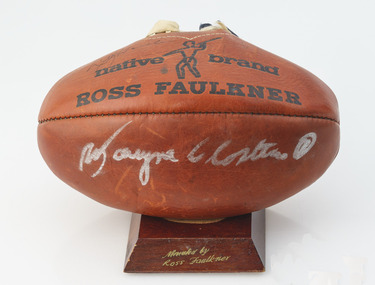
... kicking. Often he was able to score goals with 70-metre torpedo punts. Occasionally he scored from drop-kicks. ...kicking. Often he was able to score goals with 70-metre torpedo punts. Occasionally he scored from drop-kicks. ...Doug ‘Pudden’ Wade Born: 16/10/1941 From: Horsham Height: 188cm Weight: 92kg Natural kicking foot: Right Guernsey number: 23 First senior match for Geelong: Round 1, 1961 v Collingwood at Kardinia Park Regarded by many as Geelong’s greatest ever full-forward, his greatest attributes were determination, fast leading, strong marking and prodigious kicking. Often he was able to score goals with 70-metre torpedo punts. Occasionally he scored from drop-kicks. When in top form he was a most inspiring player. If opponents tried to upset his game with niggling tactics he displayed a fiery aspect of his nature, which kept spectators ‘interested’. He played the forward role like an aggressive defender. Probably his most outstanding performance was a 13-goal effort at the Lake Oval in heavy conditions in 1967. A severe knee injury suffered in an interstate match in 1964 restricted his performances for about two seasons. In his time at Geelong he seemed to perform better as the seasons rolled on. He played in North Melb’s Premiership-winning team in 1975, twelve years after the same achievement with the Cats. Total Brownlow Medal votes for Geelong: 34 Premiership team selection: 1963 Night/Pre-Season Premiership team selection: 1961 Captain: 22 matches (1971-72) Club Best & Fairest: 1969 Fifth in club B&F count: 1961 Sixth in club B&F count: 1962 (equal), 1967, 1971 Seventh in club B&F count: 1964, 1972 Tenth in club B&F count: 1966, 1968 Club leading goalscorer: 1961 (51 gls), 1962 (68 gls), 1963 (48 gls), 1964 (41 gls), 1966 (52 gls), 1967 (96 gls), 1968 (64 gls), 1969 (127 gls), 1970 (74 gls), 1971 (94 gls), 1972 (90 gls) Competition leading goalscorer: 1962, 1967, 1969 Instances of seven goals or more in a match for Geelong: 35 Australian Football Hall of Fame inductee (2000) GFC Team of the 20th Century selection (full forward) GFC Hall of Fame inductee (1996) GFC Hall of Fame Legend GFC Life Membership (1968) Career span for Geelong: 1961-72 Total matches for Geelong: Premiership 208, Night/Pre-Season Series 4, Interstate 7 Total goals for Geelong: Premiership 834, Night/Pre-Season Series 11, Interstate 31 Finals matches for Geelong: 12 Finals goals for Geelong: 46 Last senior match for Geelong: Round 22, 1972 v North Melb at Kardinia Park Transferred to North Melb in 1973 Wayne Closter Born: 26/02/1945 From: Darley Height: 180cm Weight: 81kg Natural kicking foot: Right Guernsey number: 1 First senior match: Round 1, 1964 v Melbourne at the MCG In his first season as a listed player, he was selected in the Reserve Grade 1963 Premiership team. A favorable impression of his ability was created in his debut. He was opposed by Melbourne's Frank 'Bluey' Adams on a wing and out-pointed him convincingly. Initially he played many fine matches as a wingman. Later he moved into the centre where his good form continued. Features of his play were strong marking, good control and excellent kicking. He became one of the greatest ever exponents of kicking ambidextrously, and it became difficult to judge which was his natural kicking foot. National Service training obligations during a number of seasons deprived him of the chance of playing 200 matches and to represent Victoria, however the AFL acknowledged his contribution by inducting him into the 200 club during 2007. From 1977 until 1979 he coached the Reserves before spending 10 seasons as a 3GL/K-Rock football commentator. Total Brownlow Medal votes: 29 Captain: 1 match (Round 9, 1974 v South Melb at Kardinia Park) Fourth in club B&F count: 1967, 1971 (equal) Fifth in club B&F count: 1966 Sixth in club B&F count: 1964, 1968, 1972 Eighth in club B&F count: 1970, 1974 Ninth in club B&F count: 1973 GFC Hall of Fame inductee (2002) GFC Life Membership (1971) Career span: 1964-75 Total matches: Premiership 191, Night/Pre-Season Series 2 Total goals: Premiership 72, Night/Pre-Season Series 0 Finals matches: 8 Finals goals: 1 Last senior match: Round 22, 1975 v Fitzroy at Waverley Park Information provided by Col Hutchinson Geelong Cats Historian Red, slightly deflated Ross Faulkner football. In black on one side of the white laces states - MATCH/Native Brand/ ROSS FAULKNER - with a symbol of figure, and is repeated on the other side states - the football is on a small wooden stand stained dark brown with the text engraved donated by Ross Faulkner - The Football a large player signature on one side in white texta it is believed to be Wayne Closter. There is a signature in pen above the text native on one side of the football by Doug Wade. The football has blue and white ribbons threaded through the laces. Signature Doug Wade and Wayne Closter doug wade, wayne closter, ross faulkner, football, gfc, geelong football club, vietnam war -
 Geelong Football Club
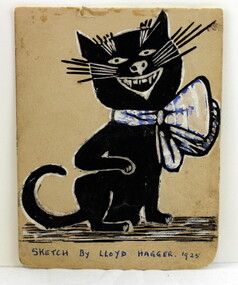
Cats Mascot Sketch, Lloyd Hagger Cat Mascot Sketch, 1925
... drop kicks resulted in many goals for the team. He became well known for scoring many acute angle goals. A mobile performer who could kick effectively with either foot, he played with equal effectiveness at centre half-forward and full forward. ...drop kicks resulted in many goals for the team. He became well known for scoring many acute angle goals. A mobile performer who could kick effectively with either foot, he played with equal effectiveness at centre half-forward and full forward. ...As one of Geelong's finest forwards, Lloyd Hagger was relatively tall and possessed the ability to take high-flying, spectacular finger-tip marks at chest height as he tumbled over packs. His accurate punt and drop kicks resulted in many goals for the team. He became well known for scoring many acute angle goals. A mobile performer who could kick effectively with either foot, he played with equal effectiveness at centre half-forward and full forward. His durability was remarkable. During his 12 seasons he only missed eight matches. He was never short of a word on the field. - Col Hutchinson GFC Historian Hand drawing on paper card. Drawing of a black cat with one paw holding on to it's bow. At the bottom of the sketch in blue pen states "SKETCH BY LLOYD HAGGER, 1925". Lloyd Hagger was the original artist behind the cats logo and a Geelong player. "SKETCH BY LLYOD HAGGER, 1925" cats mascot, gfc black cat, lloyd hagger, geelong cats -
 Carlton Football Club
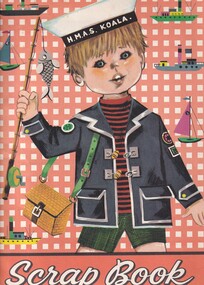
Scrap Book, Dedicated to Carlton Player John Goold
... Ragsy, with his unique kicking style, where he'd hold the ball (always a drop punt - in a time when the drop kick and the torpedo punt still reigned supreme) at the point of the ball, elbows bent and he'd lavishly drop the ball, his right arm then flinging back and up dramatically. ...John Goold double Premiership Player A scrap Book dedicated to twice Premiership Player 1968 - 1970 John Goold Career : 1963 - 1970 Debut : Round 7, 1963 vs Footscray, aged 21 years, 338 days Carlton Player No. 754 Games : 108 Goals : 3 Last Game : Grand Final, 1970 vs Collingwood, aged 29 years, 90 days Guernsey No. 11 Height : 184 cm (6 ft ½ in.) Weight : 76 kg (12 stone, 0 lbs.) DOB : June 27, 1941 Premiership Player 1968, 1970 Carlton Hall of Fame All Australian 1966 A brilliant, flamboyant, two-time Premiership player for Carlton during the Barassi years in the ‘swingin’ sixties,’ John William Crosbie Goold became almost as famous for his dapper appearance off the field, as for his exploits on it. At the height of his football career, he was also a prominent ladies fashion designer – which led to him being dubbed ‘Mr Elegance’ by leading football commentator Lou Richards. Supporters and team-mates however, called him ‘Rags’ or ‘Ragsy,’ because of his involvement in the clothing, or ‘rag’ trade. Goold first came under notice as an outstanding junior athlete at Melbourne Grammar School. A true all-round sportsman, he shone at tennis, athletics, football and cricket. He was also a keen horseman who loved the game of polo and the rough and tumble of fox hunting. While at school he was a fervent Melbourne supporter, but strangely, never had much confidence in his football ability. “If I thought I was good enough, I would certainly have gone to Melbourne,” he said many years later. “But I honestly didn’t think I would ever amount to anything in this game. Cricket and tennis were the games that really interested me.’ However, after graduating from MGS, Goold went home to Healesville to star in the Bloods’ 1962 Yarra Valley Football Association Premiership team – an achievement that brought tempting offers from more than one VFL club. “Incentives were offered elsewhere,” he recalled, “but I gravitated to Carlton – partly because the deep blue of their guernsey attracted me, but mostly because of the good advice I got from people who even then were longsighted enough to predict that big things were ahead for this club.” The Blues were confident enough in Goold’s potential to offer him the guernsey number 11 previously worn with distinction by the likes of Jack Hale, Jim Knight, Ron Hines and Laurie Kerr, and his first senior game came in round 7, 1963 against Footscray at the Western Oval. He played on a half-forward flank alongside Brownlow Medallists Gordon Collis and John James on that Saturday afternoon, and kicked his first career goal in an 8-point win. Little did he know though, that it would be another six seasons before he would again experience the thrill of sending a football spinning between the big posts, because his future lay in defence. By his own admission, Goold struggled to find his feet in VFL football during his first two seasons, until the shock appointment of Ron Barassi as captain-coach of Carlton in 1965 began steering his career back on track. “I think you could say that 1965 was my first year of League football,” he said, “That’s the way I felt - that’s the way I reacted to Barassi.” Under Barassi, Goold rapidly developed into a superb running half-back flanker. Tenacious, and an often freakish high mark, he was unmistakable on the field thanks to his mane of dark hair, his loping running style and somewhat awkward kicking action. Furthermore, he had boundless courage. There is no doubt that he would have played many more games had he not been regularly pole-axed under the high ball – a fact he later freely admitted. “I was always getting knocked out,” he said, “and spent half my bloody time in hospital.” In the second half of 1965, an injury to centre half-back Gordon Collis forced Barassi to use Goold in the key defensive post. While it curtailed his rebounding instincts somewhat, ‘Ragsy’ rose to the challenge and rarely lowered his colours. Testament to his improvement, he finished third behind John Nicholls and Sergio Silvagni in Carlton’s 1965 Best and Fairest award, and followed up by being selected in the Victorian team for the 1966 Hobart Carnival. There, he had a superb series in which he was runner-up to West Australian Barry Cable in voting for the Tassie Medal, and capped it off by being named on a half-back flank in the All Australian team. Barassi’s influence at Carlton bore fruit in his third year, when the Blues returned to finals football at last. Richmond, Carlton, Geelong and Collingwood fought out the 1967 Premiership, and Ragsy Goold won the hearts of the Carlton faithful with two lion-hearted performances. Although Carlton was knocked out of contention by successive losses to Richmond and Geelong, Goold was tireless throughout both games, and it was obvious that he thrived on the added pressure of finals football. Precisely twelve months later, the bitter taste of those defeats was washed away when Barassi’s Blues edged out Essendon by 3 points in the 1968 Grand Final, and ended 21 years of despair at Princes Park. To win Carlton’s ninth VFL flag, the Blues had had to defeat the minor premier Bombers twice during the finals – and did so, thanks to a watertight defence led by Goold, and a dominant ruck division headed by John Nicholls. In round 5, 1969, Carlton hosted South Melbourne at Princes Park in a match significant for a number of reasons. As he regularly did, Ron Barassi swung his team around prior to the opening bounce, and Goold found himself in the unaccustomed role of ruck-rover. While the Blues set about establishing a good break on the scoreboard, Ragsy relished the freedom to kick two first half goals - his first majors for 78 games. Just before half-time however, he was flattened in a pack, concussed again, and replaced during the long break by Barry Gill. Alex Jesaulenko was substituted at the same time – by a shy, ambitious youngster named Bruce Doull, making his senior debut for Carlton in guernsey number 4. In September, 1969 the Navy Blues began their third straight finals campaign with an impressive 6-goal Semi Final win over Collingwood in front of more than 108,000 fans at the MCG. A fortnight later, Richmond stunned the flag favourites with a withering last quarter in the Grand Final, and knocked Carlton out of the Premiership race again at the last hurdle. Half-way through the year, Carlton's club doctor discovered that Goold had been playing with shin splints in both of his lower legs. The pain they caused was considerable, but Ragsy soldiered on and held down centre half-back throughout the season. John Goold’s VFL career at Carlton culminated in the fabled 1970 Grand Final triumph over Collingwood. What is not so well known is that Ragsy was only cleared to play in that game on the morning of the match. After narrowly losing to Collingwood in the second Semi Final, the Navy Blues destroyed St Kilda by 62 points in the Preliminary Final, and earned another shot at the Magpies in the decider. But one of Carlton’s problems was that Goold had been kicked on a shin against St Kilda, causing a burst blood vessel and serious swelling. Despite the best efforts of the club medical staff, Ragsy had only a slim chance of playing in the Grand Final right up until game day, when his worried coach reluctantly allowed him to take his place in the side. Later, Barassi justified his decision by saying that in his opinion, a less than fully fit Goold was still worth his place in the team. By half time in the Grand Final however, he was probably questioning that judgement - because Carlton had been totally outplayed, and trailed an impressive, cohesive Collingwood by 44 points. Therefore, Carlton’s magnificent comeback – orchestrated by Barassi, and sparked by the fairytale exploits of 19th man Ted Hopkins – is one of the greatest of all football stories. Against enormous odds, the Navy Blues fought their way back into the contest, and eventually, rolled over the top of the frantic Magpies to snatch victory by 10 points in the last few minutes of the match. Hopkins ended up with four goals, Barassi was hailed a genius, and Ragsy Goold was carted off to hospital immediately after the game to have further urgent treatment. While there, he decided that there was no better time to end his VFL career – especially because his burgeoning business interests were demanding more and more of his time. In the years after his football career ended, John Goold created a remarkably successful business empire. In 1971 he sold his fashion label and took up farming at Mortlake in western Victoria, where he coached the local football team for three seasons. Later, he formed a diversified pastoral company, and purchased a magnificent complex called Ballangeich Run at nearby Ellerslie. While his passion for farming and livestock grew, he began breeding top quality polo ponies, and represented Australia in international competition. During the 1997 and 1998 seasons, John's son Ed Goold played reserve grade football for Carlton. MEMORIES.... Ragsy Goold; the name stirs memories form my long ago childhood. Ragsy, with his unique kicking style, where he'd hold the ball (always a drop punt - in a time when the drop kick and the torpedo punt still reigned supreme) at the point of the ball, elbows bent and he'd lavishly drop the ball, his right arm then flinging back and up dramatically. That was the thing about Ragsy (so named because he worked in the clothing, or 'rag' trade), he was always dramatic. He always ensured his ankle guards and wrist guard were glowing white to match the great white CFC monogram he wore proudly on his chest, and with his long flowing locks, cut a dynamic figure through a young boy's mind. Ragsy was my idol. I loved his dashes from half back, his long accurate drop punts, most of all I loved his flair for the game. Ragsy played the game as an entertainer as well as a sportsman - he leapt high to punch or mark, and always seemed to have a bit of the thoroughbred about him - which is probably why after he retired, he took up fox chasing, polo, and riding his beloved thoroughbreds across the paddocks and over the fences of his property, I think he may have even represented Australia at the sport – really, that’s sort of how he played as a footballer. All sinewy muscle, long legs and famous leaps for the saving punch. Ragsy was part of the great backline that helped revive Carlton's fortunes. Legendary players Wes Lofts, Ian Collins, Kevin 'Racehorse' Hall, Vinnie Waite among them. All great teams have a great defence and the defence that Ragsy was an integral part of was no different. Where others provided the biffo, the muscle or the defensive pressure, Ragsy provided the dash, the flair, the sense of adventure that all great backlines must have. AND MORE.... I have had many favourite players while following the Blues, but there will always be a special spot for Ragsy Goold - running the lines, all long hair and flashing white guards. As a young man I moved to Carlton and began acting in a place called one-c-one. One night after a play, I was walking home. It was winter, and I was wearing my favouritte overcoat, a genuine ankle length tweed affair I had picked up in an Op Shop in Oakleigh for three dollars. As I strutted across Lygon Street, a deep male voice behind me called, 'hey laddie, how much for the overcoat?' I turned, and there was my childhood idol, Ragsy Goold, two beautiful women in tow, smiling and waiting for my answer. I loved that coat too much to part with it, even to Ragsy, so I shook my head - and he smiled, then walked off. I stood for a moment in the middle of the street shaking my head in disbelief. Ragsy bloody Goold had just offered to buy my overcoat! I knew at that point, as a young man of about twenty three, that life was going to be full of surprises and very entertaining - a bit like John ‘Ragsy’ Goold. ONE MORE.... A cold, wet day in the mid 1960's at the MCG and Victoria were playing South Australia (?) The ball that day was like a piece of soap, with players finding it impossible to mark. Just before half time a long kick sailed toward the mud heap that was the centre of the ground, and the pack rose to meet it. From this group of players an arm shot straight up, and the ball instantly came to a dead stop. The footy stuck in the player's palm as if the hand was coated in Tarzan's Grip. After all these years, it's the only recollection I have of that match, and that player was 'Mr. Elegance' John Goold. HUMOROUS HUNGRY.... Former opponent Richmond's Kevin Bartlett on Radio SEN in 2012 received a phone call from John. After the call Kevin told his listeners how "Mr Elegance" would always be dressed in a nice suit, shirt-tie and highly polished shoes. He then cracked a joke saying something like; "You know, John was so 'posh' that he used to play football wearing a cravat!" Milestones 50 Games: Round 15, 1967 vs Melbourne 100 Games: Round 13, 1970 vs Geelong Career Highlights 1965 - Percy Bentley Trophy - 3rd Best & Fairest 1966 - 5th Best & Fairest 1967 - Maurie Sankey Memorial Trophy - 4th Best & Fairest (on count back) 1968 - Premiership Player 1970 - 7th Best & Fairest 1970 - Premiership Player Foolscap Scrap Book -
 City of Melbourne Libraries
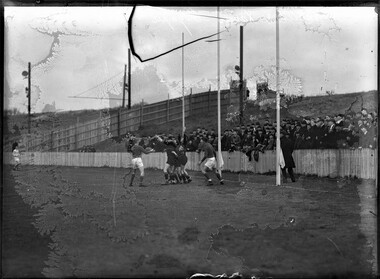
Photograph, Bull, Hugh Jones, 1897-1993, Photograph, Scotch College v. Xavier College football match, 1934
... kick it. The ball was made from possum skin, filled with pounded charcoal and tied with kangaroo sinews. Protector of Aborigines in Victoria, William Thomas (1794-1867) observed in 1841- “The men and boys joyfully assemble when this game is to be played. One makes a ball of possum skin, somewhat elastic, but firm and strong… The players of this game do not throw the ball as a white man might do, but drop...kick it. The ball was made from possum skin, filled with pounded charcoal and tied with kangaroo sinews. Protector of Aborigines in Victoria, William Thomas (1794-1867) observed in 1841- “The men and boys joyfully assemble when this game is to be played. One makes a ball of possum skin, somewhat elastic, but firm and strong… The players of this game do not throw the ball as a white man might do, but drop ...At the first match of the 1934 Public Schools Premiership and Championships at Olympic Park (where AAMI Park is now) between Scotch College (white shorts) and Xavier College, (black shorts) a mark is missed by Xavier players and then taken by a Scotch player. Research by project volunteer, Fiona Collyer: A crowd of schoolboys standing behind a picket fence, watch with anticipation as two teams contest a football at the goalposts. The Public Schools Premiership and Championship was an Australian Rules football tournament held every winter over five weeks between six schools- Scotch College, Xavier College, Melbourne Grammar, Wesley College and traditional rivals Geelong Grammar and Geelong College. The school that won the most games out of the five played, won the competition. As the 1933 Premiers, Xavier College had the honour of playing the opening match of the season on 28 June against runners-up Scotch College at Olympic Park (where AAMI Park is now). The Public Schools Premiership matches were widely reported in Melbourne’s daily newspapers with photographs and commentary of every game. Weekly society magazine “Table Talk” featured reports and seven photographs of the first games of the season. Australian Broadcasting Commission (ABC) wireless station 3AR interspersed their afternoon program of reproduced music with detailed descriptions of the matches. Also reporting the matches was “Forty-Years-On”, presumably a student in the 1890s, whose regular column in The Herald newspaper “Activities In The Public Schools” published all the latest news on Victoria’s public (private) schools. In his column for The Australasian 7 July 1934, “Old Boy” writes about the Scotch versus Xavier match: “For more than half the game last week, Scotch was outplayed, but took the lead early in the last term and kept it. Scotch surprised even its own supporters by its dash in the last 25 minutes. Xavier, who became over confident by the prospects of victory, could not withstand the final onslaught. In the last quarter Scotch was the better side and won by seven points.” The final score was Scotch 11.11 (77 points) and Xavier 10.10 (70 points). At the end of this exciting match the overjoyed Scotch boys swarmed over the Olympic Park fences to chair their captain, Stanley Steele and carry him shoulder high, to the pavilion. The first documented game of a variation of Australian Rules football was played at Richmond Paddock (now Yarra Park) from 7 August 1858. Australian Rules football writer Hugh Buggy of The Argus 16 April 1952 explains: “It began when boys and masters of Scotch College and Melbourne Grammar School decided to play a 40-a-side game, with the first team to score two goals to be the winner. Goal posts were pitched more than a mile apart, one set on the Jolimont Hill and the other at Punt road Richmond. Nobody defined the boundary, and the play swung over the broad acres of the park and around the gum trees. It went on and on like a Test match, from noon till dusk. After 15 hours of play on three Saturdays the score was one goal all, and the game was abandoned for that season.” Rules of the game hadn’t been decided at this time - the earliest known rules were codified a year later in 1859. A sculpture and plaque located outside the Melbourne Cricket Ground (MCG), created by sculptor Louis Laumen in 2001, commemorates this game. It depicts two school boys chasing a ball along with umpire Tom Wills, a co-writer of the rules and promoter of Australian Rules football. A medley of Gaelic football, an Aboriginal game called marngrook as well as football played in English public (that is private) schools have been cited as inspiration for Australian Rules football. The word “Marngrook” meaning “game ball”, comes from the language of the Gunditjmara, First Nations people of southwestern Victoria. Marngrook was played at gatherings and celebrations and involved players competing to jump and catch the ball after it was kicked high into the air. The player that catches the ball then gets to kick it. The ball was made from possum skin, filled with pounded charcoal and tied with kangaroo sinews. Protector of Aborigines in Victoria, William Thomas (1794-1867) observed in 1841- “The men and boys joyfully assemble when this game is to be played. One makes a ball of possum skin, somewhat elastic, but firm and strong… The players of this game do not throw the ball as a white man might do, but drop it and at the same time kick it with their feet, using the instep for that purpose. The tallest men have the best chances in this game. Some of them will leap as high as five feet from the ground to catch the ball. The person who secures the ball kicks it. This continues for hours and the natives never seem to tire of the exercise.” The Victorian Football League (VFL), was founded in 1897 with eight teams playing Australian Rules football and held its first Grand Final at the MCG in 1902. From the start the games attracted large enthusiastic crowds, which included women. “Viva” writing in the Supplement to The Weekly Times - 3 July 1886 LADIES COLUMN (By Viva) FOOTBALL. A Social Sketch. “…Of the popularity of football and footballers among women, there can be no doubt. Young, soft hearted girls, who would not “tread upon a worm," avow that football matches are "awfully jolly," and seem to regard accidents as a necessary part of the amusement…a great proportion of the spectators were ladies.” “Minetta” writing for Punch Magazine - “Ladies Letter, Holmby House, Toorak” 22 June 1905 “The "Football Girl" is a feminine genus at present much to the fore in Melbourne. Not that she plays football—at least not beyond a kick in the backyard or paddock—oh, dear, no! Her interest in the game is purely from a spectacular point of view. "Football Girls" usually hunt in couples, with two male barrackers attached. They know all about So-and-So's form, and whether he is a trier or has been bought. They go to each match of their particular club, and watch the play intently, their faces wearing a decidedly strained expression when their club is getting the worst of it. They are not ashamed to barrack either, when matters are progressing successfully… Yours ever, MINETTA.” The Herald 2 July 1909 published a cartoon by Ambrose Dyson depicting women football fans, which asked- “THE QUESTION OF THE DAY. Should Girls Go To Football Matches? Should they? The sex made up their mind about the matter very early on.” The resounding answer was- “Well, I’d like to see the man that would stop me!” At the final match of the 1934 tournament on August 2, Melbourne Grammar finished the season unbeaten, winning their tenth Public Schools premiership in 16 years. The Weekly Times 11 August 1934 reported-“Melbourne Grammar…had a rather lucky escape against Xavier…Had a Xavier player not touched a shot, kicked by a team-mate, as it was going through goal Grammar would have been beaten.” Final score - Melbourne Grammar 13.7 (85 points) defeated Xavier College 12.9 (81 points). Ladder for the 1934 Season- Melbourne Grammar-5 wins Wesley College- 4 wins Scotch College- 3 wins Xavier College- 2 wins Geelong Grammar- 1 win Geelong College- 0 wins The Associated Public Schools of Victoria (APS) exists today where eleven member (private) schools, including co-educational schools, participate in 21 sporting competitions throughout the year. (The descriptor “Public School” references the historical usage of the term and the model of the British public). PUBLIC SCHOOLS FOOTBALL BEGINS WITH SCOTCH--XAVIER MATCH. (1934, June 29). The Age (Melbourne, Vic. : 1854 - 1954), p. 11. Retrieved June 23, 2025, from http://nla.gov.au/nla.news-article204824484 PUBLIC SCHOOLS FOOTBALL AT OLYMPIC PARK (1934, July 5). Table Talk (Melbourne, Vic. : 1885 - 1939), p. 5. Retrieved May 30, 2025, from http://nla.gov.au/nla.news-article149682433 PUBLIC SCHOOLS FOOTBALL. (1936, July 3). The Argus (Melbourne, Vic. : 1848 - 1957), p. 18. Retrieved May 30, 2025, from http://nla.gov.au/nla.news-article11888301 PUBLIC SCHOOLS. (1934, June 29). The Age (Melbourne, Vic. : 1854 - 1954), p. 5. Retrieved August 6, 2025, from http://nla.gov.au/nla.news-article204824486 https://en.m.wikipedia.org/wiki/History_of_Australian_rules_football COLLEGE SPORTS (1934, July 7). The Australasian (Melbourne, Vic. : 1864 - 1946), p. 48 (METROPOLITAN EDITION). Retrieved August 6, 2025, from http://nla.gov.au/nla.news-article145238393 GRAMMAR CHAMPIONS (1934, August 11). Weekly Times (Melbourne, Vic. : 1869 - 1954), p. 72. Retrieved August 6, 2025, from http://nla.gov.au/nla.news-article224562842 LETS LOOK AT FOOTBALL with HUGH BUGGY (1952, April 16). The Argus (Melbourne, Vic. : 1848 - 1957), p. 9. Retrieved August 6, 2025, from http://nla.gov.au/nla.news-article23174340 FOR YOUNG PEOPLE AMONG THE SCHOOLS. (1934, August 7). The Age (Melbourne, Vic. : 1854 - 1954), p. 4. Retrieved August 6, 2025, from http://nla.gov.au/nla.news-article205521661 https://www.nma.gov.au/defining-moments/resources/australian-rules-football#:~:text=In%20the%20winter%20of%201858,games%20of%20Australian%20Rules%20football. https://apssport.org.au/about/ http://lindsaymagazine.co/from-marngrook-to-australian-rules-football/ https://collection.australiansportsmuseum.org.au/objects/70993/possum-skin-ball FOOTBALL. (1886, July 3). Weekly Times (Melbourne, Vic. : 1869 - 1954), p. 6 (SUPPLEMENT TO THE STORY TELLER). Retrieved September 7, 2025, from http://nla.gov.au/nla.news-article221741193 Ladies' Letter. (1905, June 22). Punch (Melbourne, Vic. : 1900 - 1918; 1925), p. 28. Retrieved September 22, 2025, from http://nla.gov.au/nla.news-article175410975 THE QUESTION OF THE DAY. (1909, July 2). The Herald (Melbourne, Vic. : 1861 - 1954), p. 9. Retrieved September 22, 2025, from http://nla.gov.au/nla.news-article242062970 Photographer notations on slide: "Scotch v. Xavier - Olympic Park B42". football, schools -
 City of Melbourne Libraries
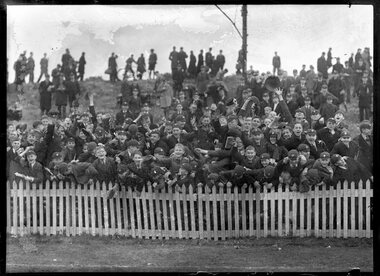
Photograph, Bull, Hugh Jones, 1897-1993, Scotch College v. Xavier College football match
... kick it. The ball was made from possum skin, filled with pounded charcoal and tied with kangaroo sinews. Protector of Aborigines in Victoria, William Thomas (1794-1867) observed in 1841- “The men and boys joyfully assemble when this game is to be played. One makes a ball of possum skin, somewhat elastic, but firm and strong… The players of this game do not throw the ball as a white man might do, but drop...kick it. The ball was made from possum skin, filled with pounded charcoal and tied with kangaroo sinews. Protector of Aborigines in Victoria, William Thomas (1794-1867) observed in 1841- “The men and boys joyfully assemble when this game is to be played. One makes a ball of possum skin, somewhat elastic, but firm and strong… The players of this game do not throw the ball as a white man might do, but drop ...Published: 29 June 1934 Published title: PUBLIC SCHOOLS FOOTBALL BEGINS WITH SCOTCH--XAVIER MATCH. Published caption: “The Public Schools 1934 Football season began yesterday when Scotch met Xavier on the Olympic Park ground, and after a wonderful recovery in the third term, Scotch registered a narrow win. Pictured above is the crowd of Scotch boys who congregated behind the goal after the addition of another goal to their score.” Description: Scotch College pupils exuberantly cheer their team’s goal at the first football match of the Public Schools Premiership and Championship for 1934 between Scotch College and Xavier College at Olympic Park, Melbourne (where AAMI Park is now). Research by project volunteer, Fiona Collyer: The Public Schools Premiership and Championship was an Australian Rules football tournament held every winter, over five weeks between six schools- Scotch College, Xavier College, Melbourne Grammar, Wesley College and traditional rivals Geelong Grammar and Geelong College. The school that won the most games out of the five played, won the competition. As the 1933 Premiers, Xavier College had the honour of playing the opening match of the season on 28 June against runners-up Scotch College at Olympic Park (where AAMI Park is now). The Public Schools Premiership matches were widely reported in Melbourne’s daily newspapers with photographs and commentary of every game. Weekly society magazine “Table Talk” featured reports and seven photographs of the first games of the season. Australian Broadcasting Commission (ABC) wireless station 3AR interspersed their afternoon program of reproduced music with detailed descriptions of the matches. Also reporting the matches was “Forty-Years-On”, presumably a student in the 1890s, whose regular column in The Herald newspaper “Activities In The Public Schools” published all the latest news on Victoria’s public (private) schools. In his column for The Australasian 7 July 1934, “Old Boy” writes about the Scotch versus Xavier match- “For more than half the game last week, Scotch was outplayed, but took the lead early in the last term and kept it. Scotch surprised even its own supporters by its dash in the last 25 minutes. Xavier, who became over confident by the prospects of victory, could not withstand the final onslaught. In the last quarter Scotch was the better side and won by seven points.” The final score was Scotch 11.11 (77 points) and Xavier 10.10 (70 points). At the end of this exciting match the overjoyed Scotch boys swarmed over the Olympic Park fences to chair their captain, Stanley Steele and carry him shoulder high, to the pavilion. The first documented game of a variation of Australian Rules football was played at Richmond Paddock (now Yarra Park) from 7 August 1858. Australian Rules football writer Hugh Buggy of The Argus 16 April 1952 explains- “It began when boys and masters of Scotch College and Melbourne Grammar School decided to play a 40-a-side game, with the first team to score two goals to be the winner. Goal posts were pitched more than a mile apart, one set on the Jolimont Hill and the other at Punt road Richmond. Nobody defined the boundary, and the play swung over the broad acres of the park and around the gum trees. It went on and on like a Test match, from noon till dusk. After 15 hours of play on three Saturdays the score was one goal all, and the game was abandoned for that season.” Rules of the game hadn’t been decided at this time - the earliest known rules were codified a year later in 1859. A sculpture and plaque located outside the Melbourne Cricket Ground (MCG), created by sculptor Louis Laumen in 2001, commemorates this game. It depicts two school boys chasing a ball along with umpire Tom Wills, a co-writer of the rules and promoter of Australian Rules football. A medley of Gaelic football, an Aboriginal game called marngrook as well as football played in English public (that is private) schools have been cited as inspiration for Australian Rules football. The word “Marngrook” meaning “game ball”, comes from the language of the Gunditjmara, First Nations people of southwestern Victoria. Marngrook was played at gatherings and celebrations and involved players competing to jump and catch the ball after it is kicked high into the air. The player that catches the ball then gets to kick it. The ball was made from possum skin, filled with pounded charcoal and tied with kangaroo sinews. Protector of Aborigines in Victoria, William Thomas (1794-1867) observed in 1841- “The men and boys joyfully assemble when this game is to be played. One makes a ball of possum skin, somewhat elastic, but firm and strong… The players of this game do not throw the ball as a white man might do, but drop it and at the same time kick it with their feet, using the instep for that purpose. The tallest men have the best chances in this game. Some of them will leap as high as five feet from the ground to catch the ball. The person who secures the ball kicks it. This continues for hours and the natives never seem to tire of the exercise.” The Victorian Football League (VFL), was founded in 1897 with eight teams playing Australian Rules football and held its first Grand Final at the MCG in 1902. From the start the games attracted large enthusiastic crowds, which included women. “Viva” writing in the Supplement to The Weekly Times-3 July 1886- LADIES COLUMN (By Viva) FOOTBALL. A Social Sketch. “…Of the popularity of football and footballers among women, there can be no doubt. Young, soft hearted girls, who would not “tread upon a worm," avow that football matches are "awfully jolly," and seem to regard accidents as a necessary part of the amusement…a great proportion of the spectators were ladies.” “Minetta” writing for Punch Magazine - “Ladies Letter, Holmby House, Toorak” 22 June 1905 “The "Football Girl" is a feminine genus at present much to the fore in Melbourne. Not that she plays football—at least not beyond a kick in the backyard or paddock—oh, dear, no! Her interest in the game is purely from a spectacular point of view. "Football Girls" usually hunt in couples, with two male barrackers attached. They know all about So-and-So's form, and whether he is a trier or has been bought. They go to each match of their particular club, and watch the play intently, their faces wearing a decidedly strained expression when their club is getting the worst of it. They are not ashamed to barrack either, when matters are progressing successfully… Yours ever, MINETTA.” The Herald 2 July 1909 published a cartoon by Ambrose Dyson depicting women football fans, which asked- “THE QUESTION OF THE DAY. Should Girls Go To Football Matches? Should they? The sex made up their mind about the matter very early on.” The resounding answer was- “Well, I’d like to see the man that would stop me!” At the final match of the 1934 tournament on August 2, Melbourne Grammar finished the season unbeaten, winning their tenth Public Schools premiership in 16 years. The Weekly Times 11 August 1934 reported-“Melbourne Grammar…had a rather lucky escape against Xavier…Had a Xavier player not touched a shot, kicked by a team-mate, as it was going through goal Grammar would have been beaten.” Final score - Melbourne Grammar 13.7 (85 points) defeated Xavier College 12.9 (81 points). Ladder for the 1934 Season- Melbourne Grammar-5 wins Wesley College- 4 wins Scotch College- 3 wins Xavier College- 2 wins Geelong Grammar- 1 win Geelong College- 0 wins The Associated Public Schools of Victoria (APS) exists today where eleven member (private) schools, including co-educational schools, participate in 21 sporting competitions throughout the year. (The descriptor “Public School” references the historical usage of the term and the model of the British public school). PUBLIC SCHOOLS FOOTBALL BEGINS WITH SCOTCH--XAVIER MATCH. (1934, June 29). The Age (Melbourne, Vic. : 1854 - 1954), p. 11. Retrieved June 18, 2025, from http://nla.gov.au/nla.news-article204824484 PUBLIC SCHOOLS FOOTBALL AT OLYMPIC PARK (1934, July 5). Table Talk (Melbourne, Vic. : 1885 - 1939), p. 5. Retrieved June 18, 2025, from http://nla.gov.au/nla.news-article149682433 PUBLIC SCHOOLS. (1934, June 29). The Age (Melbourne, Vic. : 1854 - 1954), p. 5. Retrieved June 3, 2025, from http://nla.gov.au/nla.news-article204824486 PUBLIC SCHOOLS FOOTBALL. (1936, July 3). The Argus (Melbourne, Vic. : 1848 - 1957), p. 18. Retrieved August 6, 2025, from http://nla.gov.au/nla.news-article11888301 https://en.m.wikipedia.org/wiki/History_of_Australian_rules_football COLLEGE SPORTS (1934, July 7). The Australasian (Melbourne, Vic. : 1864 - 1946), p. 48 (METROPOLITAN EDITION). Retrieved May 30, 2025, from http://nla.gov.au/nla.news-article145238393 GRAMMAR CHAMPIONS (1934, August 11). Weekly Times (Melbourne, Vic. : 1869 - 1954), p. 72. Retrieved June 1, 2025, from http://nla.gov.au/nla.news-article224562842 LETS LOOK AT FOOTBALL with HUGH BUGGY (1952, April 16). The Argus (Melbourne, Vic. : 1848 - 1957), p. 9. Retrieved June 15, 2025, from http://nla.gov.au/nla.news-article23174340 FOR YOUNG PEOPLE AMONG THE SCHOOLS. (1934, August 7). The Age (Melbourne, Vic. : 1854 - 1954), p. 4. Retrieved June 14, 2025, from http://nla.gov.au/nla.news-article205521661 https://www.nma.gov.au/defining-moments/resources/australian-rules-football#:~:text=In%20the%20winter%20of%201858,games%20of%20Australian%20Rules%20football. https://apssport.org.au/about/ http://lindsaymagazine.co/from-marngrook-to-australian-rules-football/ https://collection.australiansportsmuseum.org.au/objects/70993/possum-skin-ball FOOTBALL. (1886, July 3). Weekly Times (Melbourne, Vic. : 1869 - 1954), p. 6 (SUPPLEMENT TO THE STORY TELLER). Retrieved September 7, 2025, from http://nla.gov.au/nla.news-article221741193 Ladies' Letter. (1905, June 22). Punch (Melbourne, Vic. : 1900 - 1918; 1925), p. 28. Retrieved September 11, 2025, from http://nla.gov.au/nla.news-article175410975 THE QUESTION OF THE DAY. (1909, July 2). The Herald (Melbourne, Vic. : 1861 - 1954), p. 9. Retrieved September 17, 2025, from http://nla.gov.au/nla.news-article242062970 Photographer notations on slide: "Scotch v Xavier - Olympic Park B42". schools, football
