
Showing 243 items matching " aesthetics"
-
 Women's Art Register
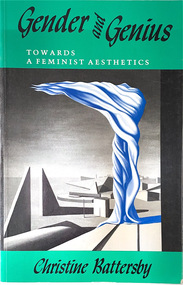
Book, Chritine Battersby, Gender and Genius. Towards a Feminist Aesthetics, 1989
... Towards a Feminist Aesthetics...Towards a Feminist Aesthetics Book Book Chritine Battersby Indiana University Press ...Using the writings of ancient and contemporary male philosophers the book interrogates ideas around narrow gender roles, and the creation of feminist aesthetic.Booknon-fictionUsing the writings of ancient and contemporary male philosophers the book interrogates ideas around narrow gender roles, and the creation of feminist aesthetic.myths, creativity, motherhood, psychoanalytic theory, prejudice -
 Great Stupa of Universal Compassion
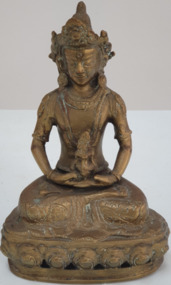
Sculpture - Amitayus (Buddha of limitless life)
... Amitayus Buddha statue, wearing jewelled ornaments of a peaceful heavenly god according to the classical Indian system of divine aesthetics. ...Amitayus is considered one of the Five Dhyani Buddhas in Mahayana Buddhism. tibetan buddhism holy objects Buddhist art Statues Amitayus Buddha statue, wearing jewelled ornaments of a peaceful heavenly god according to the classical Indian system of divine aesthetics. Sculpture Amitayus (Buddha of limitless life) ...Amitayus, also called Amitabha, is the Buddha of Infinite Light, associated with longevity. He is holding in his hands a vessel containing the nectar of immortality. Amitayus is considered one of the Five Dhyani Buddhas in Mahayana Buddhism. Amitayus Buddha statue, wearing jewelled ornaments of a peaceful heavenly god according to the classical Indian system of divine aesthetics. tibetan buddhism, holy objects, buddhist art, statues -
 Mrs Aeneas Gunn Memorial Library
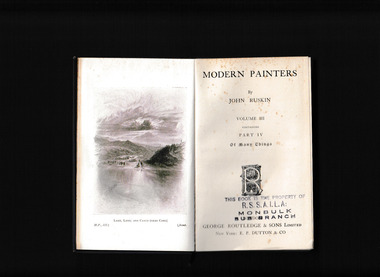
Book, George Routledge, Modern painters, 19
... Aesthetics...Aesthetics Painting Ruskin argues that recent painters emerging from the tradition of the picturesque are superior in the art of landscape to the old masters. ...Ruskin argues that recent painters emerging from the tradition of the picturesque are superior in the art of landscape to the old masters. The book was primarily written as a defense of the later work of J. M. W. Turner. Ruskin used the book to argue that art should devote itself to the accurate documentation of natureIll, p.372.non-fictionRuskin argues that recent painters emerging from the tradition of the picturesque are superior in the art of landscape to the old masters. The book was primarily written as a defense of the later work of J. M. W. Turner. Ruskin used the book to argue that art should devote itself to the accurate documentation of natureaesthetics, painting -
 Robin Boyd Foundation
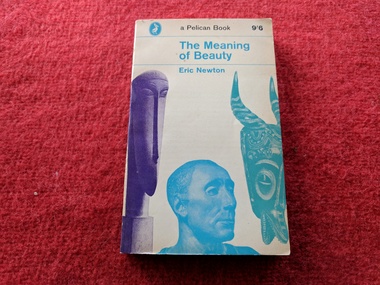
Book, Eric Newton, The Meaning of Beauty, 1962
... ... Aesthetics...Art Philosophy Aesthetics Walsh St library Softcover The Meaning of Beauty Book Eric Newton Penguin Books ...Softcoverart philosophy, aesthetics, walsh st library -
 City of Stonnington
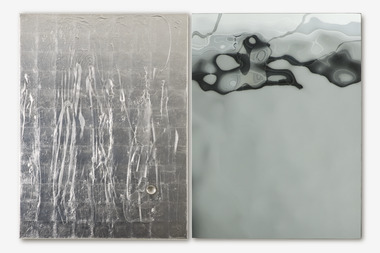
Rosslynd Piggott, Mirror, mirror x3, 2008-2009
... ...Aesthetics...Stonnington contemporary art collection Materiality Aesthetics Rosslynd Piggott Oil and palladium lead on linen, rhodium plated silver, glass Mirror, mirror x3 Rosslynd Piggott ...Since 1981, internationally acclaimed artist Rosslynd Piggott has maintained a prolific practice across a variety of media and techniques, including glass-blowing, fabric, painting, installation, drawing and photography. Influenced by natural forms, systems, Japanese design and surrealistic figuration, Piggott’s practice is marked by an attention to aesthetics and the material properties of things. The slumped glass surface and jewel-like ornament of Mirror x 3 shares with the viewer Piggott’s slow and deliberate engagement with the exquisite and the unknowable. Oil and palladium lead on linen, rhodium plated silver, glassstonnington contemporary art collection, materiality, aesthetics, rosslynd piggott -
 Robin Boyd Foundation
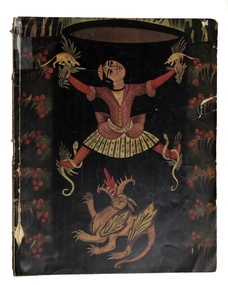
Journal, Peter Bellew, Art in Australia, Jun, Jul, Aug 1942
... Includes 2 articles by Walter Bunning - "Aesthetics and War" p.71, "Rachel Forster Hospital" p.85. ...Includes 2 articles by Walter Bunning - "Aesthetics and War" p.71, "Rachel Forster Hospital" p.85. ...Includes 2 articles by Walter Bunning - "Aesthetics and War" p.71, "Rachel Forster Hospital" p.85. Walter Bunning was a prominent Australian architect and urban planner - a contemporary of Robin Boyd.walter bunning, rachel forster hospital, world war 2, walsh st library -
 Robin Boyd Foundation
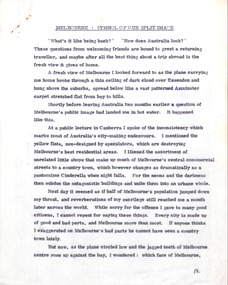
Document - Manuscript, Robin Boyd, Melbourne: Symbol of Our Split Image, 1964
... Discusses Melbourne's good and poor buildings, planning, arts, aesthetics etc. Melbourne does however maintain an image and individuality when compared with other cities....Discusses Melbourne's good and poor buildings, planning, arts, aesthetics etc. Melbourne does however maintain an image and individuality when compared with other cities. ...A look at Melbourne within a two month span: before and after and opposing views. Discusses Melbourne's good and poor buildings, planning, arts, aesthetics etc. Melbourne does however maintain an image and individuality when compared with other cities.Original manuscript of an article published as ‘Melbourne: The symbol of Australia’s split personality’in "The Australian", 01.09.1964. Typewritten (c copy), pencil edits, quarto, 4 pagesmelbourne, urban character, city, architecture, buildings, australian image, australian culture, robin boyd, manuscript -
 Robin Boyd Foundation
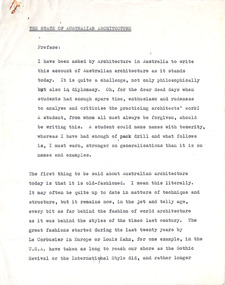
Document - Manuscript, Robin Boyd, The State of Australian Architecture, 1967
... In this article, requested by Architecture in Australia, Boyd condemns the lack of development in the shaping the identity of Australian architecture, similar to the contents of Texas Quarterly 'Architecture in Australia' Vol.5 (see D092), Boyd writes about the need for designers and architects to create a new design language rather than recycling and reminiscing on old British aesthetics despite wanting to gain international recognition....In this article, requested by Architecture in Australia, Boyd condemns the lack of development in the shaping the identity of Australian architecture, similar to the contents of Texas Quarterly 'Architecture in Australia' Vol.5 (see D092), Boyd writes about the need for designers and architects to create a new design language rather than recycling and reminiscing on old British aesthetics despite wanting to gain international recognition. ...In this article, requested by Architecture in Australia, Boyd condemns the lack of development in the shaping the identity of Australian architecture, similar to the contents of Texas Quarterly 'Architecture in Australia' Vol.5 (see D092), Boyd writes about the need for designers and architects to create a new design language rather than recycling and reminiscing on old British aesthetics despite wanting to gain international recognition.Original manuscript of an article published in Architecture in Australia, Vol.56, No.3, June 1967 pp.454-465.Typewritten (c copy), pencil edits, quarto, 26 pagesPencil corrections and edits in textaustralian architecture, sydney school, architecture in australia, robin boyd, manuscript -
 Federation University Historical Collection
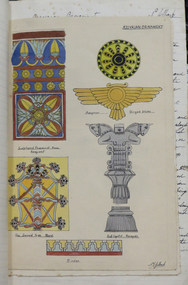
Book, N.T. Jelbart, Historic Ornament Part 1, 1934, 1934
... Students studied the influences of history, geography, culture and climate on ornamental aesthetics, including the tools, materials and methods applied to decorative objects, interior design and architecture....Students studied the influences of history, geography, culture and climate on ornamental aesthetics, including the tools, materials and methods applied to decorative objects, interior design and architecture. n.t. jelbart ballarat technical art school historic ornament art history Handwritten and drawn notes from the Ballarat Technical Art School by N.T. ...Norman JELBART (1916-1984) Norman Thomas Jelbart studied Historic Ornament Parts I and II as part of his training at the Ballarat Technical Art School to become an architect. These are some of his notes. The study of Historic Ornament spanned time and space to inform and inspire designers. Students studied the influences of history, geography, culture and climate on ornamental aesthetics, including the tools, materials and methods applied to decorative objects, interior design and architecture.Handwritten and drawn notes from the Ballarat Technical Art School by N.T. Jelbartn.t. jelbart, ballarat technical art school, historic ornament, art history -
 Emerald Museum & Nobelius Heritage Park
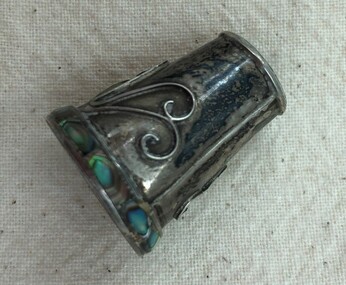
Domestic object - Thimble, Mid 20th century
... This thimble was made in Taxco, Mexico, a place famous for its silver work blending pre-Columbian motifs with baroque and art deco aesthetics. This thimble is part of a group of eight thimbles which belonged to Beryl Collett (1925-2018), a woman with considerable handicraft skills and interests. ...This thimble was made in Taxco, Mexico, a place famous for its silver work blending pre-Columbian motifs with baroque and art deco aesthetics. This thimble is part of a group of eight thimbles which belonged to Beryl Collett (1925-2018), a woman with considerable handicraft skills and interests. ...Thimbles have long been used as a shield for the fingertip when hand sewing. This thimble was made in Taxco, Mexico, a place famous for its silver work blending pre-Columbian motifs with baroque and art deco aesthetics. This thimble is part of a group of eight thimbles which belonged to Beryl Collett (1925-2018), a woman with considerable handicraft skills and interests. They form part of a large and varied range of objects which were either collected by or hand-made by Beryl and which have been donated to the Museum. This varied thimble collection has been collected during the long lifetime of a local woman who enjoyed needlework and lacemaking.Taxco handmade sterling silver thimble with a scroll pattern on the side and a narrow abalone inlay band around rim. Honeycomb pattern on the top. Thimble has a seam. Inside thimble are a 4-digit number and maker's marks which are difficult to decipher.beryl collett, thimbles, taxco -
 Emerald Museum & Nobelius Heritage Park
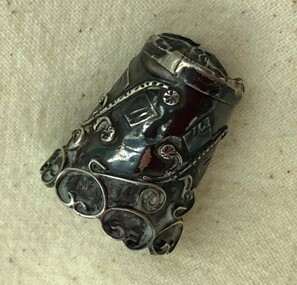
Domestic object - Thimble, Mid 20th century
... This thimble was made in Taxco, Mexico, a place famous for its silver work blending pre-Columbian motifs with baroque and art deco aesthetics. This thimble is part of a group of eight thimbles which belonged to Beryl Collett (1925-2018), a local woman with considerable handicraft skills and interests. ...This thimble was made in Taxco, Mexico, a place famous for its silver work blending pre-Columbian motifs with baroque and art deco aesthetics. This thimble is part of a group of eight thimbles which belonged to Beryl Collett (1925-2018), a local woman with considerable handicraft skills and interests. ...Thimbles have long been used as a shield for the fingertip when hand sewing. This thimble was made in Taxco, Mexico, a place famous for its silver work blending pre-Columbian motifs with baroque and art deco aesthetics. This thimble is part of a group of eight thimbles which belonged to Beryl Collett (1925-2018), a local woman with considerable handicraft skills and interests. These thimbles form part of a large and varied range of objects which were either collected by or hand-made by Beryl and which have been donated to the Museum. This varied thimble collection has been collected during the long lifetime of a local woman who enjoyed needlework and lacemaking.Taxco handmade sterling silver thimble with a very ornate pattern on the side. No band at rim. Thimble has a seam. The top has been damaged and repaired with solder. Inside thimble is imprinted '15' followed by indiscernible maker's marks.beryl collett, thimbles, taxco, mexico -
 Flagstaff Hill Maritime Museum and Village
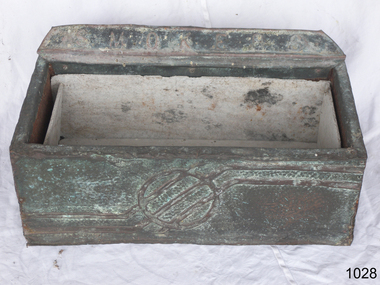
Functional object - Floor ash Tray, 1900 to 1960s
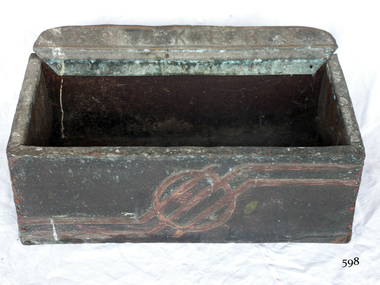
... As time went on, and the onset of women smoking both cigars and cigarettes became less of a departure from the average person, ashtrays saw a decline in design and aesthetics beginning more of a shift towards practicality. ...As time went on, and the onset of women smoking both cigars and cigarettes became less of a departure from the average person, ashtrays saw a decline in design and aesthetics beginning more of a shift towards practicality. ...The word ashtray came into use around the 1920 and is a receptacle for ash from cigarettes and cigars and are typically made of fire retardant material such as glass, heat resistant plastic, pottery, metal, or stone. The most common ashtray design is a shallow cylinder with a flat base, designed to rest on a table. Other ashtrays, particularly in public places, are either wall or floor mounted. While simple, utilitarian forms of ashtrays existed long before the 19th century, it was during the start of the 20th century that the design, aesthetics and their popularity took off. As more women began to smoke. in the early 1900s, the ashtray went closer to being an art form as many women avoided the use of the traditional ashtray as it failed to reflect their feminine values, regarded as an item rather basic in design the general societal through of the time was that smoking was an activity exclusive to men. What emerged were detailed, often very fancy ashtrays acceptable to women depicting either pastoral scenes or vibrantly coloured landscapes. As time went on, and the onset of women smoking both cigars and cigarettes became less of a departure from the average person, ashtrays saw a decline in design and aesthetics beginning more of a shift towards practicality. The subject item is a primitive form of ashtray used in public spaces any time from the 1920-1960s and is not associated with an historic person or event. However the item could have come from the Warrnambool Town Hall given the inscription on the base of the item.Ash tray-large rectangular floor model with cement sheet lining. Made from a wooden box covered with textured metal on the outsideThe metal has a relief design embossed at the top back "smokers" and "Town Hall" printed on bottom.flagstaff hill, warrnambool, flagstaff-hill-maritime-museum, maritime-museum, shipwreck-coast, flagstaff-hill-maritime-village, ash tray, town hall, cigarette tray, smoker's ash tray -
 Flagstaff Hill Maritime Museum and Village
Functional object - Floor ash Tray, 1900 to 1960s
... As time went on, and the onset of women smoking both cigars and cigarettes became less of a departure from the average person, ashtrays saw a decline in design and aesthetics beginning more of a shift towards practicality. ...As time went on, and the onset of women smoking both cigars and cigarettes became less of a departure from the average person, ashtrays saw a decline in design and aesthetics beginning more of a shift towards practicality. ...The word ashtray came into use around the 1920 and is a receptacle for ash from cigarettes and cigars and are typically made of fire retardant material such as glass, heat resistant plastic, pottery, metal, or stone. The most common ashtray design is a shallow cylinder with a flat base, designed to rest on a table. Other ashtrays, particularly in public places, are either wall or floor mounted. While simple, utilitarian forms of ashtrays existed long before the 19th century, it was during the start of the 20th century that the design, aesthetics and their popularity took off. As more women began to smoke. in the early 1900s, the ashtray went closer to being an art form as many women avoided the use of the traditional ashtray as it failed to reflect their feminine values, regarded as an item rather basic in design the general societal through of the time was that smoking was an activity exclusive to men. What emerged were detailed, often very fancy ashtrays acceptable to women depicting either pastoral scenes or vibrantly coloured landscapes. As time went on, and the onset of women smoking both cigars and cigarettes became less of a departure from the average person, ashtrays saw a decline in design and aesthetics beginning more of a shift towards practicality. The subject item is a primitive form of ashtray used in public spaces any time from the 1900 -1960s and is not associated with an historic person or event. However the item could have come from the Warrnambool Town Hall given the inscription on the base of the item.Ash tray-large rectangular floor model made from a wooden box covered with textured metal on the outsideThe metal has a relief design embossed at the top back "smokers" and "Town Hall" printed on bottom.flagstaff hill, warrnambool, flagstaff-hill-maritime-museum, maritime-museum, shipwreck-coast, flagstaff-hill-maritime-village, ash tray -
 Ararat Gallery TAMA
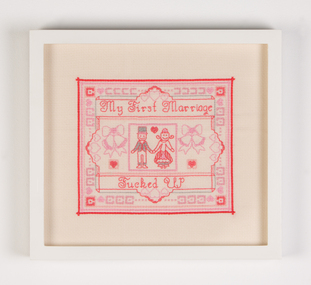
Silke Raetze, My First Marriage, 2008
... The design of these works mimic the aesthetics of Victorian era cross-stitch, but the messages contained within offer a wry commentary on the contemporary state of gender relations and family life....The design of these works mimic the aesthetics of Victorian era cross-stitch, but the messages contained within offer a wry commentary on the contemporary state of gender relations and family life. ...Formally trained in painting, Silke Raetze’s practice encompasses a variety of different mediums and techniques, including text-based cross-stitch embroidery. Raetze explores the undercurrents of love and lust, hopes and disappointments. These three works offer an ironic response to the polite tradition of cross-stitch and the moral teachings that the content of cross-stitch samplers were designed to impart to young girls. The design of these works mimic the aesthetics of Victorian era cross-stitch, but the messages contained within offer a wry commentary on the contemporary state of gender relations and family life. -
 Ararat Gallery TAMA
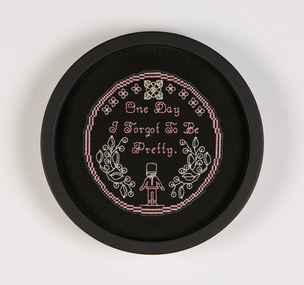
Silke Raetze, Forgot To Be Pretty, 2008
... The design of these works mimic the aesthetics of Victorian era cross-stitch, but the messages contained within offer a wry commentary on the contemporary state of gender relations and family life....The design of these works mimic the aesthetics of Victorian era cross-stitch, but the messages contained within offer a wry commentary on the contemporary state of gender relations and family life. ...Formally trained in painting, Silke Raetze’s practice encompasses a variety of different mediums and techniques, including text-based cross-stitch embroidery. Raetze explores the undercurrents of love and lust, hopes and disappointments. These three works offer an ironic response to the polite tradition of cross-stitch and the moral teachings that the content of cross-stitch samplers were designed to impart to young girls. The design of these works mimic the aesthetics of Victorian era cross-stitch, but the messages contained within offer a wry commentary on the contemporary state of gender relations and family life. -
 Ararat Gallery TAMA
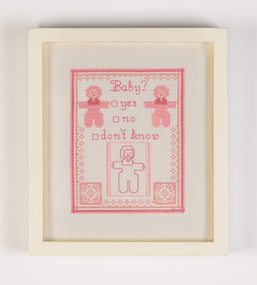
Silke Raetze, Baby, 2008
... The design of these works mimic the aesthetics of Victorian era cross-stitch, but the messages contained within offer a wry commentary on the contemporary state of gender relations and family life....The design of these works mimic the aesthetics of Victorian era cross-stitch, but the messages contained within offer a wry commentary on the contemporary state of gender relations and family life. ...Formally trained in painting, Silke Raetze’s practice encompasses a variety of different mediums and techniques, including text-based cross-stitch embroidery. Raetze explores the undercurrents of love and lust, hopes and disappointments. These three works offer an ironic response to the polite tradition of cross-stitch and the moral teachings that the content of cross-stitch samplers were designed to impart to young girls. The design of these works mimic the aesthetics of Victorian era cross-stitch, but the messages contained within offer a wry commentary on the contemporary state of gender relations and family life. -
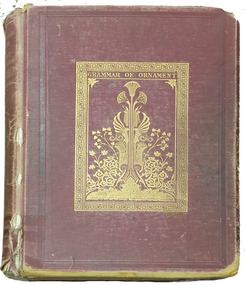 Federation University Historical Collection
Book, Owen Jones, The Grammar of Ornament, 1868
... Students studied the influences of history, geography, culture and climate on ornamental aesthetics, including the tools, materials and methods applied to decorative objects, interior design and architecture. ...Students studied the influences of history, geography, culture and climate on ornamental aesthetics, including the tools, materials and methods applied to decorative objects, interior design and architecture. ...Book featuring coloured plates of examples of historic ornamentRed cloth hard covered book of 112 plates bookplatenon-fictionBook featuring coloured plates of examples of historic ornamentornament, grammar, plates -
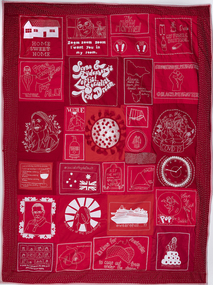 Ararat Gallery TAMA
Nicole O'Loughlin, COVID Dis-Comforter, 2020
... COVID Dis-Comforter is a stitched journal in which the artist has documented the personal, political, and social implications of the COVID-19 pandemic. The quilt’s aesthetics take inspiration from the Westbury Quilt made by Misses Hampson in Tasmania 1900-1903, held in the National Gallery of Australia Collection....COVID Dis-Comforter is a stitched journal in which the artist has documented the personal, political, and social implications of the COVID-19 pandemic. The quilt’s aesthetics take inspiration from the Westbury Quilt made by Misses Hampson in Tasmania 1900-1903, held in the National Gallery of Australia Collection. ...Nicole O’Loughlin is an interdisciplinary artist who works across a variety of mediums to explore societal issues, pop culture and the idea of the feminine. She works across textiles, painting, drawing and printmaking. Using traditional media in a contemporary context O’Loughlin challenges the idea of craft and pushes back against the industrialisation of the hand made. COVID Dis-Comforter is a stitched journal in which the artist has documented the personal, political, and social implications of the COVID-19 pandemic. The quilt’s aesthetics take inspiration from the Westbury Quilt made by Misses Hampson in Tasmania 1900-1903, held in the National Gallery of Australia Collection. -
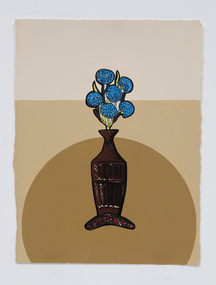 Wyndham Art Gallery (Wyndham City Council)
Painting, Tony Albert, Interior Composition (with Appropriated Aboriginal Design Vase) IX, 2022
... Albert’s technique and imagery are distinctly contemporary, displacing traditional Australian Aboriginal aesthetics with an urban conceptuality. Appropriating textual references from sources as diverse as popular music, film, fiction, and art history, Albert plays with the tension arising from the visibility, and in-turn, the invisibility of Aboriginal People across the news media, literature, and the visual world. ...Albert’s technique and imagery are distinctly contemporary, displacing traditional Australian Aboriginal aesthetics with an urban conceptuality. Appropriating textual references from sources as diverse as popular music, film, fiction, and art history, Albert plays with the tension arising from the visibility, and in-turn, the invisibility of Aboriginal People across the news media, literature, and the visual world. ...Tony Albert’s 2022 solo exhibition at Sullivan+Strumpf, Remark, continues the artist’s investigation into the imagery and identification of appropriated Indigenous Australian iconography in domestic decoration and design. Incorporating fabric from his extensive collection of ‘Aboriginalia’, Remark sees Albert expand on his acclaimed Conversations with Margaret Preston series dimensionality, critically engaging with the fabric in his own right. Like the fabric of Australian society, the appropriated Indigenous imagery printed on souvenir tea towels intertwines in a complicated web of national identity. These are not images by Aboriginal people and our voices and autonomy continued to be silenced through the object’s inauthenticity. As a country we must reconcile with these objects’ very existence. They are painful reiterations of a violent and oppressive history, but we also cannot hide or destroy them because they are an important societal record that should not be forgotten. As an artist this juxtaposition and tension fascinates me. Tony Albert’s multidisciplinary practice investigates contemporary legacies of colonialism, prompting audiences to contemplate the human condition. Drawing on both personal and collective histories, Albert explores the ways in which optimism can be utilised to overcome adversity. His work poses important questions such as how do we remember, give justice to, and rewrite complex and traumatic histories. Albert’s technique and imagery are distinctly contemporary, displacing traditional Australian Aboriginal aesthetics with an urban conceptuality. Appropriating textual references from sources as diverse as popular music, film, fiction, and art history, Albert plays with the tension arising from the visibility, and in-turn, the invisibility of Aboriginal People across the news media, literature, and the visual world. australian first nations art, colonialisation, painting -
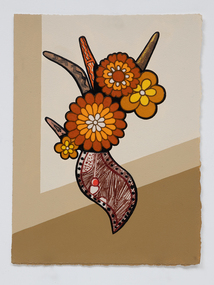 Wyndham Art Gallery (Wyndham City Council)
Painting, Tony Albert, Interior Composition (with Appropriated Aboriginal Design Vase) X, 2022
... Albert’s technique and imagery are distinctly contemporary, displacing traditional Australian Aboriginal aesthetics with an urban conceptuality. Appropriating textual references from sources as diverse as popular music, film, fiction, and art history, Albert plays with the tension arising from the visibility, and in-turn, the invisibility of Aboriginal People across the news media, literature, and the visual world. ...Albert’s technique and imagery are distinctly contemporary, displacing traditional Australian Aboriginal aesthetics with an urban conceptuality. Appropriating textual references from sources as diverse as popular music, film, fiction, and art history, Albert plays with the tension arising from the visibility, and in-turn, the invisibility of Aboriginal People across the news media, literature, and the visual world. ...Tony Albert’s 2022 solo exhibition at Sullivan+Strumpf, Remark, continues the artist’s investigation into the imagery and identification of appropriated Indigenous Australian iconography in domestic decoration and design. Incorporating fabric from his extensive collection of ‘Aboriginalia’, Remark sees Albert expand on his acclaimed Conversations with Margaret Preston series dimensionality, critically engaging with the fabric in his own right. Like the fabric of Australian society, the appropriated Indigenous imagery printed on souvenir tea towels intertwines in a complicated web of national identity. These are not images by Aboriginal people and our voices and autonomy continued to be silenced through the object’s inauthenticity. As a country we must reconcile with these objects’ very existence. They are painful reiterations of a violent and oppressive history, but we also cannot hide or destroy them because they are an important societal record that should not be forgotten. As an artist this juxtaposition and tension fascinates me. Tony Albert’s multidisciplinary practice investigates contemporary legacies of colonialism, prompting audiences to contemplate the human condition. Drawing on both personal and collective histories, Albert explores the ways in which optimism can be utilised to overcome adversity. His work poses important questions such as how do we remember, give justice to, and rewrite complex and traumatic histories. Albert’s technique and imagery are distinctly contemporary, displacing traditional Australian Aboriginal aesthetics with an urban conceptuality. Appropriating textual references from sources as diverse as popular music, film, fiction, and art history, Albert plays with the tension arising from the visibility, and in-turn, the invisibility of Aboriginal People across the news media, literature, and the visual world. australian first nations art, colonialisation, painting -
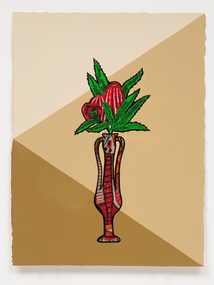 Wyndham Art Gallery (Wyndham City Council)
Painting, Tony Albert, Interior Composition (with Appropriated Aboriginal Design Vase) VII, 2022
... Albert’s technique and imagery are distinctly contemporary, displacing traditional Australian Aboriginal aesthetics with an urban conceptuality. Appropriating textual references from sources as diverse as popular music, film, fiction, and art history, Albert plays with the tension arising from the visibility, and in-turn, the invisibility of Aboriginal People across the news media, literature, and the visual world. ...Albert’s technique and imagery are distinctly contemporary, displacing traditional Australian Aboriginal aesthetics with an urban conceptuality. Appropriating textual references from sources as diverse as popular music, film, fiction, and art history, Albert plays with the tension arising from the visibility, and in-turn, the invisibility of Aboriginal People across the news media, literature, and the visual world. ...Tony Albert’s 2022 solo exhibition at Sullivan+Strumpf, Remark, continues the artist’s investigation into the imagery and identification of appropriated Indigenous Australian iconography in domestic decoration and design. Incorporating fabric from his extensive collection of ‘Aboriginalia’, Remark sees Albert expand on his acclaimed Conversations with Margaret Preston series dimensionality, critically engaging with the fabric in his own right. Like the fabric of Australian society, the appropriated Indigenous imagery printed on souvenir tea towels intertwines in a complicated web of national identity. These are not images by Aboriginal people and our voices and autonomy continued to be silenced through the object’s inauthenticity. As a country we must reconcile with these objects’ very existence. They are painful reiterations of a violent and oppressive history, but we also cannot hide or destroy them because they are an important societal record that should not be forgotten. As an artist this juxtaposition and tension fascinates me. Tony Albert’s multidisciplinary practice investigates contemporary legacies of colonialism, prompting audiences to contemplate the human condition. Drawing on both personal and collective histories, Albert explores the ways in which optimism can be utilised to overcome adversity. His work poses important questions such as how do we remember, give justice to, and rewrite complex and traumatic histories. Albert’s technique and imagery are distinctly contemporary, displacing traditional Australian Aboriginal aesthetics with an urban conceptuality. Appropriating textual references from sources as diverse as popular music, film, fiction, and art history, Albert plays with the tension arising from the visibility, and in-turn, the invisibility of Aboriginal People across the news media, literature, and the visual world. australian first nations art, colonialisation, painting -
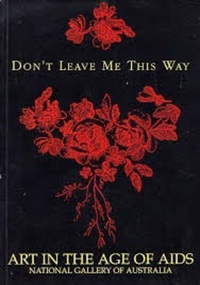 Australian Queer Archives
Book, Don't leave me this way : art in the age of AIDS (Canberra : National Gallery of Australia, 1994), 1994
... Vance Read my lips / Jimmy Somerville For a friend / Jimmy Somerville, Richard Coles Self-documentation, self-imaging,: Australian people living with HIV/AIDS / Kathy Triffitt, co-ordinator Aesthetics and loss / Edmund White Psycho-cultural responses to AIDS / Dennis Altman Faces of AIDS / Lynn Sloan Lovers and friends / Richard Coles Where the streets have new aims: the poster in the age of AIDS / Ted Gott OI: opportunistic identification, open identification in PWA portraiture / Jan Zita Grover Don't leave me this way: art in the age of AIDS : catalogue of works. ...Vance Read my lips / Jimmy Somerville For a friend / Jimmy Somerville, Richard Coles Self-documentation, self-imaging,: Australian people living with HIV/AIDS / Kathy Triffitt, co-ordinator Aesthetics and loss / Edmund White Psycho-cultural responses to AIDS / Dennis Altman Faces of AIDS / Lynn Sloan Lovers and friends / Richard Coles Where the streets have new aims: the poster in the age of AIDS / Ted Gott OI: opportunistic identification, open identification in PWA portraiture / Jan Zita Grover Don't leave me this way: art in the age of AIDS : catalogue of works. 246 p. : ill. ...246 p. : ill. (some col.)Agony down under: Australian artists addressing AIDS / Ted Gott Allan from Sadness: a monologue with slides / William Yang Art from the Pit: some reflections on monuments, memory and AIDS / Simon Watney America: where angels don't fear to tread / Thomas Sokolowski The war on culture / Carole S. Vance Read my lips / Jimmy Somerville For a friend / Jimmy Somerville, Richard Coles Self-documentation, self-imaging,: Australian people living with HIV/AIDS / Kathy Triffitt, co-ordinator Aesthetics and loss / Edmund White Psycho-cultural responses to AIDS / Dennis Altman Faces of AIDS / Lynn Sloan Lovers and friends / Richard Coles Where the streets have new aims: the poster in the age of AIDS / Ted Gott OI: opportunistic identification, open identification in PWA portraiture / Jan Zita Grover Don't leave me this way: art in the age of AIDS : catalogue of works. -
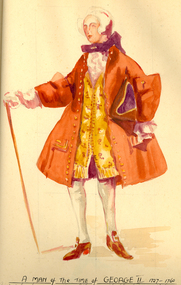 Federation University Historical Collection
Book, Historic Ornament Parts I and II. Ballarat Technical Art School Art History Books, 1931, 1931
... Students studied the influences of history, geography, culture and climate on ornamental aesthetics, including the tools, materials and methods applied to decorative objects, interior design and architecture....Students studied the influences of history, geography, culture and climate on ornamental aesthetics, including the tools, materials and methods applied to decorative objects, interior design and architecture. ballarat school of mines ballarat technical art school art history edith lawn edith curnow val lawn val d'angri curnow lawn ornament costume. ballarat technical art school library artists workbook journal Historic Ornament University Women Ballarat School of Mines Old Girls Association Two books containing student notes and drawing relating to courses at the Ballarat techncial Art School in 1931. ...Edith CURNOW (1913–2003) Ballarat | Australia Edith Gertrude Curnow undertook Industrial Art teacher training at the Ballarat Technical Art School, with a five-year Senior Technical Scholarship, between 1926 and 1931. She taught for a time before marrying compositor James Lawn in 1937. She reportedly continued to teach at the Ballarat Technical Art School as Edith Lawn. She retired in 1972 at which time she was the Lecturer in Charge of Craft Edith Lawn was a member of inaugural Ballarat School of Mines Old Girls Association, and served as first Press Correspondent. Her daughter, Valda Lawn (later D'Angri) also attended and taught at the School. One of the subjects Curnow studied was Historic Ornament. This subject spanned time and space to inform and inspire designers. Students studied the influences of history, geography, culture and climate on ornamental aesthetics, including the tools, materials and methods applied to decorative objects, interior design and architecture.Two books containing student notes and drawing relating to courses at the Ballarat techncial Art School in 1931. The work was undertaken by Edith Curnow. .1) - Foolscap red covered book on Historic Ornament. Includes History of Ornament, Egyptian Ornament, Assyrian Ornament; Greek Ornament, Roman Ornament, Pompeian Ornament, Byzantine, Romanesque Ornament, Norman, Decorated Gothic, Perpendicular Gothic, Renaissance. .2) Green quarto book on Historic Ornament Part 2: Costume. The work includes Egyptian Costume, Greek Costume, Roman Costume, Richard I, Crusades, Edward III, Charles I, Charles II, George II.ballarat school of mines, ballarat technical art school, art history, edith lawn, edith curnow, val lawn, val d'angri, curnow, lawn, ornament, costume., ballarat technical art school library, artists workbook, journal, historic ornament, university women, ballarat school of mines old girls association -
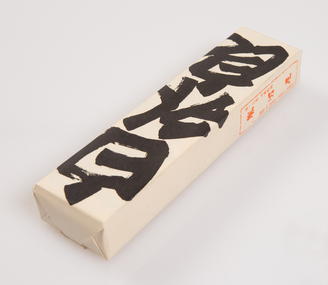 Ararat Gallery TAMA
Shiro Uiro, c. 1900s
... Combining the natural qualities of bamboo, paper and straw with delicate craftsmanship, these unique objects express Japanese aesthetics as applied through fibre crafts. In Japan, the qualities and traits of natural materials are exploited rather than hidden. ...Combining the natural qualities of bamboo, paper and straw with delicate craftsmanship, these unique objects express Japanese aesthetics as applied through fibre crafts. In Japan, the qualities and traits of natural materials are exploited rather than hidden. ...‘The Art of the Japanese Package’ was an exhibition that toured to 10 Australian and 11 New Zealand public galleries in 1979 and 1980. The touring exhibition comprised 221 objects of traditional Japanese packaging which extended from ceramics, wood and paper to woven fibre containers. At the conclusion of the tour, The Japan Foundation and the Crafts Board of the Australia Council donated the vast majority of the exhibition to the Ararat Gallery for its permanent collection. Combining the natural qualities of bamboo, paper and straw with delicate craftsmanship, these unique objects express Japanese aesthetics as applied through fibre crafts. In Japan, the qualities and traits of natural materials are exploited rather than hidden. The texture of straw, the septa of bamboo are not concealed but lovingly incorporated into the whole. In 1979 Hideyuki Oka, curator of ‘The Art of the Japanese Package’ wrote: “In no way self-conscious or assertive, these wrappings have an artless and obedient air that greatly moves the modern viewer. They are whispered evidence of the Japanese ability to create beauty from the simplest products of nature. They also teach us that wisdom and feeling are especially important in packaging because these qualities, or the lack of them, are almost immediately apparent. What is the use of a package if it shows no feeling?” The descriptions of the featured objects were written by Hideyuki Oka, curator of ‘The Art of the Japanese Package’, 1979.Gift of the Japan-Australia Foundation and the Crafts Board of the Australia Council, 1981Another Kyoto confection, a kind of sweetened rice paste, is simply but strikingly wrapped in a package marked with its name (uiro) in vigorously written characters. Simplicity could hardly be carried further, but, as seen in this ensemble of three separate packages, the effect is altogether engaging. - Professor Hideyuki Oka, curator.japanese art, japanese packaging, tsutsumi, gift giving -
 Ararat Gallery TAMA
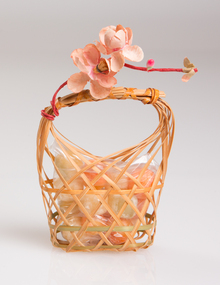
Sekku no Iwaimono, c. 1900s
... Combining the natural qualities of bamboo, paper and straw with delicate craftsmanship, these unique objects express Japanese aesthetics as applied through fibre crafts. In Japan, the qualities and traits of natural materials are exploited rather than hidden. ...Combining the natural qualities of bamboo, paper and straw with delicate craftsmanship, these unique objects express Japanese aesthetics as applied through fibre crafts. In Japan, the qualities and traits of natural materials are exploited rather than hidden. ...‘The Art of the Japanese Package’ was an exhibition that toured to 10 Australian and 11 New Zealand public galleries in 1979 and 1980. The touring exhibition comprised 221 objects of traditional Japanese packaging which extended from ceramics, wood and paper to woven fibre containers. At the conclusion of the tour, The Japan Foundation and the Crafts Board of the Australia Council donated the vast majority of the exhibition to the Ararat Gallery for its permanent collection. Combining the natural qualities of bamboo, paper and straw with delicate craftsmanship, these unique objects express Japanese aesthetics as applied through fibre crafts. In Japan, the qualities and traits of natural materials are exploited rather than hidden. The texture of straw, the septa of bamboo are not concealed but lovingly incorporated into the whole. In 1979 Hideyuki Oka, curator of ‘The Art of the Japanese Package’ wrote: “In no way self-conscious or assertive, these wrappings have an artless and obedient air that greatly moves the modern viewer. They are whispered evidence of the Japanese ability to create beauty from the simplest products of nature. They also teach us that wisdom and feeling are especially important in packaging because these qualities, or the lack of them, are almost immediately apparent. What is the use of a package if it shows no feeling?” The descriptions of the featured objects were written by Hideyuki Oka, curator of ‘The Art of the Japanese Package’, 1979.Gift of the Japan-Australia Foundation and the Crafts Board of the Australia Council, 1981japanese art, japanese packaging, tsutsumi, gift giving -
 Ararat Gallery TAMA
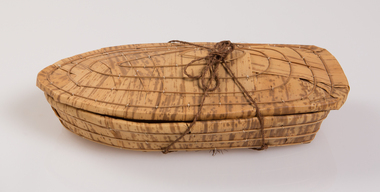
Container for pastries, c. 1900s
... Combining the natural qualities of bamboo, paper and straw with delicate craftsmanship, these unique objects express Japanese aesthetics as applied through fibre crafts. In Japan, the qualities and traits of natural materials are exploited rather than hidden. ...Combining the natural qualities of bamboo, paper and straw with delicate craftsmanship, these unique objects express Japanese aesthetics as applied through fibre crafts. In Japan, the qualities and traits of natural materials are exploited rather than hidden. ...‘The Art of the Japanese Package’ was an exhibition that toured to 10 Australian and 11 New Zealand public galleries in 1979 and 1980. The touring exhibition comprised 221 objects of traditional Japanese packaging which extended from ceramics, wood and paper to woven fibre containers. At the conclusion of the tour, The Japan Foundation and the Crafts Board of the Australia Council donated the vast majority of the exhibition to the Ararat Gallery for its permanent collection. Combining the natural qualities of bamboo, paper and straw with delicate craftsmanship, these unique objects express Japanese aesthetics as applied through fibre crafts. In Japan, the qualities and traits of natural materials are exploited rather than hidden. The texture of straw, the septa of bamboo are not concealed but lovingly incorporated into the whole. In 1979 Hideyuki Oka, curator of ‘The Art of the Japanese Package’ wrote: “In no way self-conscious or assertive, these wrappings have an artless and obedient air that greatly moves the modern viewer. They are whispered evidence of the Japanese ability to create beauty from the simplest products of nature. They also teach us that wisdom and feeling are especially important in packaging because these qualities, or the lack of them, are almost immediately apparent. What is the use of a package if it shows no feeling?” The descriptions of the featured objects were written by Hideyuki Oka, curator of ‘The Art of the Japanese Package’, 1979.Gift of the Japan-Australia Foundation and the Crafts Board of the Australia Council, 1981japanese art, japanese packaging, tsutsumi, gift giving -
 Ararat Gallery TAMA
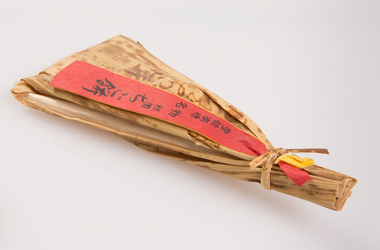
Gion Chigo Mochi, c. 1900s
... Combining the natural qualities of bamboo, paper and straw with delicate craftsmanship, these unique objects express Japanese aesthetics as applied through fibre crafts. In Japan, the qualities and traits of natural materials are exploited rather than hidden. ...Combining the natural qualities of bamboo, paper and straw with delicate craftsmanship, these unique objects express Japanese aesthetics as applied through fibre crafts. In Japan, the qualities and traits of natural materials are exploited rather than hidden. ...‘The Art of the Japanese Package’ was an exhibition that toured to 10 Australian and 11 New Zealand public galleries in 1979 and 1980. The touring exhibition comprised 221 objects of traditional Japanese packaging which extended from ceramics, wood and paper to woven fibre containers. At the conclusion of the tour, The Japan Foundation and the Crafts Board of the Australia Council donated the vast majority of the exhibition to the Ararat Gallery for its permanent collection. Combining the natural qualities of bamboo, paper and straw with delicate craftsmanship, these unique objects express Japanese aesthetics as applied through fibre crafts. In Japan, the qualities and traits of natural materials are exploited rather than hidden. The texture of straw, the septa of bamboo are not concealed but lovingly incorporated into the whole. In 1979 Hideyuki Oka, curator of ‘The Art of the Japanese Package’ wrote: “In no way self-conscious or assertive, these wrappings have an artless and obedient air that greatly moves the modern viewer. They are whispered evidence of the Japanese ability to create beauty from the simplest products of nature. They also teach us that wisdom and feeling are especially important in packaging because these qualities, or the lack of them, are almost immediately apparent. What is the use of a package if it shows no feeling?” The descriptions of the featured objects were written by Hideyuki Oka, curator of ‘The Art of the Japanese Package’, 1979. Gift of the Japan-Australia Foundation and the Crafts Board of the Australia Council, 1981An elegant wooden box, fashioned in the style of boxes used for gifts to the emperor some eight or nine centuries ago, is filled with a Kyoto confection called Gion Chigo Mochi. The Gion is one of Kyoto's entertainment districts, chigo are children dressed in ceremonial Buddhist costume for one of the city's numerous festivals, and mochi are cakes of steamed and pounded rice. The name of the confection derives from the style of the bamboo-sheath wrapping, which suggests the figure of a chigo. - Professor Hideyuki Oka, curator.japanese art, japanese packaging, tsutsumi, gift giving -
 Ararat Gallery TAMA
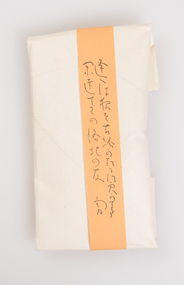
Evening Moon confection, c. 1900s
... Combining the natural qualities of bamboo, paper and straw with delicate craftsmanship, these unique objects express Japanese aesthetics as applied through fibre crafts. In Japan, the qualities and traits of natural materials are exploited rather than hidden. ...Combining the natural qualities of bamboo, paper and straw with delicate craftsmanship, these unique objects express Japanese aesthetics as applied through fibre crafts. In Japan, the qualities and traits of natural materials are exploited rather than hidden. ...‘The Art of the Japanese Package’ was an exhibition that toured to 10 Australian and 11 New Zealand public galleries in 1979 and 1980. The touring exhibition comprised 221 objects of traditional Japanese packaging which extended from ceramics, wood and paper to woven fibre containers. At the conclusion of the tour, The Japan Foundation and the Crafts Board of the Australia Council donated the vast majority of the exhibition to the Ararat Gallery for its permanent collection. Combining the natural qualities of bamboo, paper and straw with delicate craftsmanship, these unique objects express Japanese aesthetics as applied through fibre crafts. In Japan, the qualities and traits of natural materials are exploited rather than hidden. The texture of straw, the septa of bamboo are not concealed but lovingly incorporated into the whole. In 1979 Hideyuki Oka, curator of ‘The Art of the Japanese Package’ wrote: “In no way self-conscious or assertive, these wrappings have an artless and obedient air that greatly moves the modern viewer. They are whispered evidence of the Japanese ability to create beauty from the simplest products of nature. They also teach us that wisdom and feeling are especially important in packaging because these qualities, or the lack of them, are almost immediately apparent. What is the use of a package if it shows no feeling?” The descriptions of the featured objects were written by Hideyuki Oka, curator of ‘The Art of the Japanese Package’, 1979.Gift of the Japan-Australia Foundation and the Crafts Board of the Australia Council, 1981japanese art, japanese packaging, tsutsumi, gift giving -
 Ararat Gallery TAMA
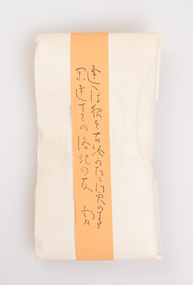
Evening Moon confection, c. 1900s
... Combining the natural qualities of bamboo, paper and straw with delicate craftsmanship, these unique objects express Japanese aesthetics as applied through fibre crafts. In Japan, the qualities and traits of natural materials are exploited rather than hidden. ...Combining the natural qualities of bamboo, paper and straw with delicate craftsmanship, these unique objects express Japanese aesthetics as applied through fibre crafts. In Japan, the qualities and traits of natural materials are exploited rather than hidden. ...‘The Art of the Japanese Package’ was an exhibition that toured to 10 Australian and 11 New Zealand public galleries in 1979 and 1980. The touring exhibition comprised 221 objects of traditional Japanese packaging which extended from ceramics, wood and paper to woven fibre containers. At the conclusion of the tour, The Japan Foundation and the Crafts Board of the Australia Council donated the vast majority of the exhibition to the Ararat Gallery for its permanent collection. Combining the natural qualities of bamboo, paper and straw with delicate craftsmanship, these unique objects express Japanese aesthetics as applied through fibre crafts. In Japan, the qualities and traits of natural materials are exploited rather than hidden. The texture of straw, the septa of bamboo are not concealed but lovingly incorporated into the whole. In 1979 Hideyuki Oka, curator of ‘The Art of the Japanese Package’ wrote: “In no way self-conscious or assertive, these wrappings have an artless and obedient air that greatly moves the modern viewer. They are whispered evidence of the Japanese ability to create beauty from the simplest products of nature. They also teach us that wisdom and feeling are especially important in packaging because these qualities, or the lack of them, are almost immediately apparent. What is the use of a package if it shows no feeling?” The descriptions of the featured objects were written by Hideyuki Oka, curator of ‘The Art of the Japanese Package’, 1979.Gift of the Japan-Australia Foundation and the Crafts Board of the Australia Council, 1981japanese art, japanese packaging, tsutsumi, gift giving -
 Ararat Gallery TAMA
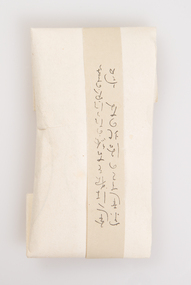
Evening Moon confection, c. 1900s
... Combining the natural qualities of bamboo, paper and straw with delicate craftsmanship, these unique objects express Japanese aesthetics as applied through fibre crafts. In Japan, the qualities and traits of natural materials are exploited rather than hidden. ...Combining the natural qualities of bamboo, paper and straw with delicate craftsmanship, these unique objects express Japanese aesthetics as applied through fibre crafts. In Japan, the qualities and traits of natural materials are exploited rather than hidden. ...‘The Art of the Japanese Package’ was an exhibition that toured to 10 Australian and 11 New Zealand public galleries in 1979 and 1980. The touring exhibition comprised 221 objects of traditional Japanese packaging which extended from ceramics, wood and paper to woven fibre containers. At the conclusion of the tour, The Japan Foundation and the Crafts Board of the Australia Council donated the vast majority of the exhibition to the Ararat Gallery for its permanent collection. Combining the natural qualities of bamboo, paper and straw with delicate craftsmanship, these unique objects express Japanese aesthetics as applied through fibre crafts. In Japan, the qualities and traits of natural materials are exploited rather than hidden. The texture of straw, the septa of bamboo are not concealed but lovingly incorporated into the whole. In 1979 Hideyuki Oka, curator of ‘The Art of the Japanese Package’ wrote: “In no way self-conscious or assertive, these wrappings have an artless and obedient air that greatly moves the modern viewer. They are whispered evidence of the Japanese ability to create beauty from the simplest products of nature. They also teach us that wisdom and feeling are especially important in packaging because these qualities, or the lack of them, are almost immediately apparent. What is the use of a package if it shows no feeling?” The descriptions of the featured objects were written by Hideyuki Oka, curator of ‘The Art of the Japanese Package’, 1979.Gift of the Japan-Australia Foundation and the Crafts Board of the Australia Council, 1981japanese art, japanese packaging, tsutsumi, gift giving
