
Showing 69 items matching " agricultural workers"
-
 City of Ballarat Libraries
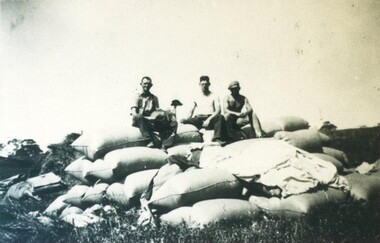
Photograph - Card Box Photographs, Agricultural workers on chaff filled bags 1939
... Agricultural workers on chaff filled bags 1939....Jim Clancy, Sid Stewart and John Hunter sit of 'sleeping quarters' for workers on threshing machines on a farm at Millbrook. Jim Clancy Sid Stewart John Hunter Millbrook Farm Work Agriculture People Agricultural workers on chaff filled bags 1939. ...Jim Clancy, Sid Stewart and John Hunter sit of 'sleeping quarters' for workers on threshing machines on a farm at Millbrook.jim clancy, sid stewart, john hunter, millbrook, farm work, agriculture, people -
 Hymettus Cottage & Garden Ballarat
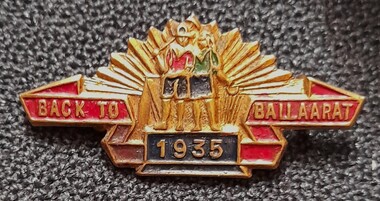
Badge - Souvenir badge, Back to Ballarat 1935
... Symbols of the City of Ballaarat, a miner, and an agricultural worker set against the rising sun....Symbols of the City of Ballaarat, a miner, and an agricultural worker set against the rising sun. Back to Ballarat 1935 Badge Souvenir badge ...The Ballarat Homecoming celebrations in 1935 were claimed in the local newspaper, The Courier to be 'the greatest pageant organised in any of Victoria's provincial centres'. The celebrations included street stalls, illuminations and carnival rides.A rare survivor of an ephemeral souvenir item from the Back to Ballarat March 9-10th, 1935.Symbols of the City of Ballaarat, a miner, and an agricultural worker set against the rising sun.Stokes Melb stamped to back of badge.ballarat, stokes, 1935, homecoming -
 Linton and District Historical Society Inc
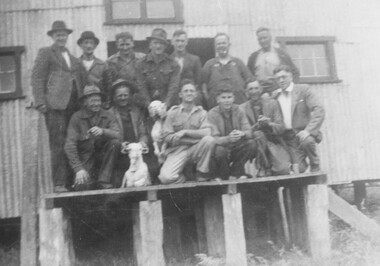
Photograph, Shearers at Linton Park
... ... Agricultural workers...Linton Park Charlie Christie Carl Hoffman Bill Hyatt Jack Mark Graeme Stevens Fred Ward Rural activity Agricultural workers Shearers Black and white photo of shearers at Linton Park woolshed. ...Black and white photo of shearers at Linton Park woolshed.linton park, charlie christie, carl hoffman, bill hyatt, jack mark, graeme stevens, fred ward, rural activity, agricultural workers, shearers -
 Brighton Historical Society
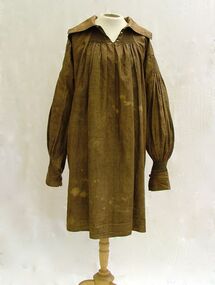
Smock, early-mid 19th century
... Agricultural worker's hand-loomed linen smock, dyed brown. ...smock rural dress linen hand stitching agriculture Agricultural worker's hand-loomed linen smock, dyed brown. ...Agricultural worker's hand-loomed linen smock, dyed brown. Fully hand-stictched with smocking details on front and back and sleeves. Opening at front and back neck area fastened with now missing buttons.smock, rural dress, linen, hand stitching, agriculture -
 Sunshine and District Historical Society Incorporated
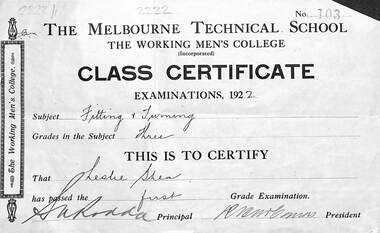
Archive - Leslie "Les" John Shea Collection
... Leslie “Les” John Shea was a skilled agricultural‑machinery worker at McKay Massey Ferguson in Sunshine. ...Leslie “Les” John Shea was a skilled agricultural‑machinery worker at McKay Massey Ferguson in Sunshine. ...Leslie “Les” John Shea was a skilled agricultural‑machinery worker at McKay Massey Ferguson in Sunshine. Along with three colleagues, he became dissatisfied with the direction of the company and left to establish a new, independent manufacturing firm. His partners were Tom Connor, Charles "Tom" Dealy, Edward "Ted" George Waters and Jim D. Phillips of Albury. His technical expertise and leadership helped shape Connor‑Shea into a major national manufacturer. Two documents are on the History of Connor Shea.2222.01 - Leslie Les John Shea Collection - Certificate 103 The Melbourne Technical Schools Class Certificate for Leslie Shea 1922 for Fitting and Turning Certificate 103 The Melbourne Technical Schools Class Certificate for Leslie Shea 1922 for Fitting and Turning 2222.02 - Leslie Les John Shea Collection - Certificate 105 The Melbourne Technical Schools Class Certificate for Leslie Shea 1922 for Metal Founding Certificate 105 The Melbourne Technical Schools Class Certificate for Leslie Shea 1922 for Metal Founding 2222.03 - Leslie Les John Shea Collection - Certificate 73193 The Melbourne Technical Schools Second Grade Certificate for Leslie Shea 1920 for Geometry Certificate 73193 The Melbourne Technical Schools Second Grade Certificate for Leslie Shea 1920 for Geometry 2222.04 - Leslie Les John Shea Collection -Certificate 82693The Melbourne Technical Schools Second Grade Certificate for Leslie Shea 1921 for Trigonometry Certificate 82693The Melbourne Technical Schools Second Grade Certificate for Leslie Shea 1921 for Trigonometry 2222.05 - Leslie Les John Shea Collection - Certificate 83075 The Melbourne Technical Schools Second Grade Certificate for Leslie Shea 1921 for Mechanics and Heat Certificate 83075 The Melbourne Technical Schools Second Grade Certificate for Leslie Shea 1921 for Mechanics and Heat 2222.06 - Leslie Les John Shea Collection - Certificate 83574 The Melbourne Technical Schools Second Grade Certificate for Leslie Shea 1921 for Engineering Drawing Certificate 83574 The Melbourne Technical Schools Second Grade Certificate for Leslie Shea 1921 for Engineering Drawing 2222.07 - Leslie Les John Shea Collection - Certificate 89868 The Melbourne Technical Schools Second Grade Certificate for Leslie Shea 1922 for Electricity and Magnetism Certificate 89868 The Melbourne Technical Schools Second Grade Certificate for Leslie Shea 1922 for Electricity and Magnetism 2222.08 - Leslie Les John Shea Collection - Certificate 90442 The Melbourne Technical Schools Second Grade Certificate for Leslie Shea 1922 for Land Surveying Certificate 90442 The Melbourne Technical Schools Second Grade Certificate for Leslie Shea 1922 for Land Surveying 2222.09 - Leslie Les John Shea Collection - Certificate 90538 The Melbourne Technical Schools Second Grade Certificate for Leslie Shea 1922 for Applied Mechanics Certificate 90538 The Melbourne Technical Schools Second Grade Certificate for Leslie Shea 1922 for Applied Mechanics 2222.10 - Leslie Les John Shea Collection - Certificate 91089 The Melbourne Technical Schools Second Grade Certificate for Leslie Shea 1922 for Engineering Drawing Structures Certificate 91089 The Melbourne Technical Schools Second Grade Certificate for Leslie Shea 1922 for Engineering Drawing Structures 2222.11 - Leslie Les John Shea Collection - Certificate 91114 The Melbourne Technical Schools Second Grade Certificate for Leslie Shea 1922 for Engineering Drawing Machines Certificate 91114 The Melbourne Technical Schools Second Grade Certificate for Leslie Shea 1922 for Engineering Drawing Machines 2222.12 - Leslie Les John Shea Collection - Certificate 97611 The Melbourne Technical Schools Second Grade Certificate for Leslie Shea 1923 for Engineering Drawing Machines Certificate 97611 The Melbourne Technical Schools Second Grade Certificate for Leslie Shea 1923 for Engineering Drawing Machines 2222.13 - Leslie Les John Shea Collection - Certificate 96820 The Melbourne Technical Schools Second Grade Certificate for Leslie Shea 1923 for Applied Mechanics Machines Certificate 96820 The Melbourne Technical Schools Second Grade Certificate for Leslie Shea 1923 for Applied Mechanics Machines 2222.14 - Leslie Les John Shea Collection - Certificate 96806 The Melbourne Technical Schools Second Grade Certificate for Leslie Shea 1923 for Applied Mechanics Structures Certificate 96806 The Melbourne Technical Schools Second Grade Certificate for Leslie Shea 1923 for Applied Mechanics Structures 2222.15 - Leslie Les John Shea Collection - Certificate 96806 The Melbourne Technical Schools Second Grade Certificate for Leslie Shea 1923 for Applied Mechanics Structures Certificate 96942 The Melbourne Technical Schools Second Grade Certificate for Leslie Shea 1923 for Algebra 2222.16 - Leslie Les John Shea Collection - Certificate 97413 The Melbourne Technical Schools Second Grade Certificate for Leslie Shea 1923 for Milling and Gear Cutting Certificate 97413 The Melbourne Technical Schools Second Grade Certificate for Leslie Shea 1923 for Milling and Gear Cutting 2222.17 - Leslie Les John Shea Collection - Certificate 73010 The Melbourne Technical Schools First Grade Certificate for Leslie Shea 1920 for Algebra Certificate 73010 The Melbourne Technical Schools First Grade Certificate for Leslie Shea 1920 for Algebra 2222.18 - Leslie Les John Shea Collection - Certificate 104 The Melbourne Technical Schools Class Certificate for Leslie Shea 1921 for Patternmaking Certificate 104 The Melbourne Technical Schools Class Certificate for Leslie Shea 1921 for Patternmaking 2222.19 - Leslie Les John Shea Collection - Letter To Whom it may concern 4 March 1924 Letter To Whom it may concern 4 March 1924 2222.20 - Leslie Les John Shea Collection - Letter To Whom it may concern 4 March 1924 Letter To Whom it may concern 4 March 1924 2222.21 - Leslie Les John Shea Collection - Letter To Whom it may concern 5 March 1924 Letter To Whom it may concern 5 March 1924 2222.22 - Leslie Les John Shea Collection - Letter To Whom it may concern 5 March 1924 Letter To Whom it may concern 5 March 1924 2222.23 - Leslie Les John Shea Collection - Letter from The Melbourne Technical School 4 March 1924 Leslie Shea attended 4 year course for Machines and Structures Letter from The Melbourne Technical School 4 March 1924 Leslie Shea attended 4 year course for Machines and Structures 2222.24 - Leslie Les John Shea Collection - Certificate State Emergency Council Leslie Shea Air raid Precautions 9 March 1942 Certificate State Emergency Council Leslie Shea Air raid Precautions 9 March 1942 2222.25 - Leslie Les John Shea Collection - The Preparatory School The Working Mens College Melbourne 8th July 1920 The Preparatory School The Working Mens College Melbourne 8th July 1920 2222.26 - Leslie Les John Shea Collection - Photograph of house and couple in horse drawn carriage Photograph of house and couple in horse drawn carriage 2222.27 - Leslie Les John Shea Collection - Photograph of best design Photograph of best design 2222.28 - Leslie Les John Shea Collection - Photograph in plane with another man Photograph in plane with another man 2222.29 - Leslie Les John Shea Collection - Photograph in plane Photograph in plane 2222.30 - Leslie Les John Shea Collection - Newspaper Article This was written by A satisfied client Newspaper Article This was written by A satisfied client 2222.31 - Leslie Les John Shea Collection - Bieriot XI Single Seater Plane Drawing Bieriot XI Single Seater Plane Drawing 2222.32 - Leslie Les John Shea Collection - Typed Report Connor Shea History Typed Report Connor Shea History 2222.33 - Leslie Les John Shea Collection - Statutory Report Connor Shea Holdings Limited 1961 Statutory Report Connor Shea Holdings Limited 1961 2222.34 - Leslie Les John Shea Collection - Newspaper Article Lifes a wonderful whirl at 60 in a Cessna Newspaper Article Lifes a wonderful whirl at 60 in a Cessna 2222.35 - Leslie Les John Shea Collection - Connor Shea (Holdings) Limited Annual Report 1977 Connor Shea (Holdings) Limited Annual Report 1977 2222.36 - Leslie Les John Shea Collection - Brochure Connor Shea 25 Years in the Field 1952 Brochure Connor Shea 25 Years in the Field 1952 2222.37 - Leslie Les John Shea Collection - Brochure Connor Shea 25 Years in the Field 1952 with cover Brochure Connor Shea 25 Years in the Field 1952 with cover 2222.38 - Leslie Les John Shea Collection - Typed report History and Achievement of Connor Shea and Co Typed report History and Achievement of Connor Shea and Coconnor shea, fouth avenue, sunshine, farm machinery, les shea, leslie shea -
 Ballarat Heritage Services
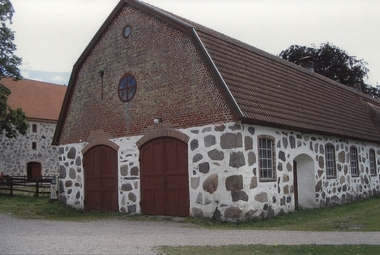
Photograph - Digital photograph, Denise Kinnane, Barn at Rabelofs, Sweden, 2007
... This led to the large agricultural workers' strike in 1907 that was concentrated on Kennedy's three farms Råbelöf, Odersberga and Hammarsjö. ...This led to the large agricultural workers' strike in 1907 that was concentrated on Kennedy's three farms Råbelöf, Odersberga and Hammarsjö. ...The barn is situated near Råbelöv castle, and near the small medieval church adjacent to the property, that is a popular baptismal and wedding church. Råbelöv Castle is a castle in Kristianstad Municipality, Scania, in southern Sweden. The castle was built in 1637. In this year, Christopher Ulfeld Råbelöf's current main building, his and his wife's initials were still on the north end. He died in 1657 and was succeeded at Råbelöf first by his son Björn, then by his nephew Otto. Both died young, whereby Christopher's son Ebbe, married to Hedewig, daughter of Christian IV and his second wife, Kirsten Munck, took office in 1663. In 1676 - 1678 Kristianstad was held by the Danes, but was besieged by Charles XI. The siege staff were located at Råbelöf, both on the enclosed yard and on a moat surrounded by a islet just west of the farm. During this time, Råbelöf was held by Ebbe's daughter Anna Catharina, married to Carl Gustaf Skytte. The latter settled for a time in 1712 on the fortified island within the moat to protect himself from the then ravaging plague. From the Skåne trip in 1749, Linnaeus describes homes and a lovely garden with mulberry and walnut trees, grapes, lavender and white lilies in abundance. The owner was then Anna Catharina Ridderschantz, married to Ludvig Gustaf von Böhnen. She made 1763 Råbelöf and Odersberga fidei committee for the benefit of her three daughters. The Fidei Commission letter is difficult to interpret when it comes to the time after the three daughters, something that several times caused bitter heritage disputes. In 1782 the entire farm burned, the main building was badly damaged and the family moved to Råbelöf belonging to Odersberga, which then had completely new buildings, those that are still there today. Only in 1833 then did the fidei commissioner Fredrik von Rosen return to Råbelöf. The main building had then been cut down and fitted with a new south gable. According to fidei commission rules, Råbelöf returned to the von Böhnen family in 1864. Accession did not become presumed Celestine von Böhnen but instead her older brother Axel. Celestine was married to John William Kennedy. The fide commission went to her and John Williams son James Kennedy. The family could then look back on a number of tortuous legal proceedings between John William and his wife Celestine on the one hand and Axel and his wife Elsa Maria on the other. James was a chamberlain, sitting in the first chamber where he fought socialism. This led to the large agricultural workers' strike in 1907 that was concentrated on Kennedy's three farms Råbelöf, Odersberga and Hammarsjö. In 1906, his eldest son Douglas, the future fidei commissioner, took his life. Four years later another son took his life. James and his wife took the disasters hard, they fell ill. The young son Gilbert got in 1908, only 22 years old, took over responsibility for the farm. James son Gilbert Kennedy took over as Fidei Commissioner in 1916 and they became known as outstanding farmers with, among other things, grazing for dairy cows and fruit growing as specialties. He passed away in 1946 and was succeeded by his son Douglas, who gave continuity to Råbelöf's position with among other things, a new barn with loose running and slatted floors in 1965. Douglas Kennedy held the farm 61 years before he passed away in 2007. He became the last fidei commissioner, the property became a fideicommissie corporation inherited by his sister-in-law John Murray, who in turn in 2010 left it his children Caroline Murray Karlsson and Johan Murray. Since October 2014, Johan Murray has been the sole owner.Digital photograph of a Barn at Rabelofs, Swedenkristianstadt, kennedy, sweden, råbelöv, church, castle, barn -
 Flagstaff Hill Maritime Museum and Village
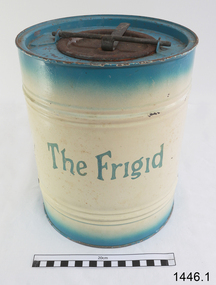
Freezer, circa 1930's
... He had already completed his apprenticeship as a tinplate worker but he tried various other occupations, including trying out the gold mines in Victoria, before he established himself as a tinsmith in 1853. His products included many agricultural...He had already completed his apprenticeship as a tinplate worker but he tried various other occupations, including trying out the gold mines in Victoria, before he established himself as a tinsmith in 1853. His products included many agricultural ...This ice cream freezer, manufactured in South Australia in the 1930's, was advertised to "keep the contents of the cream compartment frozen for many hours". It was promoted for use at picnics to keep salads cool. Its design is very similar to other freezers of The Frigid name which were made in 1939; those freezers were all one colour whereas this one is blue around the top and bottom of the barrel and cream in the centre with blue/green lettering. The process of making ice cream was to pack the outer chamber full with a combination of 3 parts ice cubes of about 1 inch (2.cm) to one part coarse salt, then pour into the chamber about 1 cup of cold water. After this, the ingredients for ice cream or sorbet were poured into the inner chamber, then attach the lid and turn The Frigid freezer upside down for about 40 minutes or until the right consistency is reached. Advice as given to open the freezer every 20 minutes and stir around the contents that were frozen against the sides of the inner chamber. The ingredients for the ice cream could include cream, sugar, vanilla and eggs. The label on the box of The Frigid shows the address of A Simpson and Son to be at Pirie Street, Adelaide. This address was used as early as 1876 and later catalogues, 1931 - 1960 still show this address. Alfred Simpson and his family emigrated from England, arriving in South Australia in 1849. He had already completed his apprenticeship as a tinplate worker but he tried various other occupations, including trying out the gold mines in Victoria, before he established himself as a tinsmith in 1853. His products included many agricultural items. His son, Alfred Muller Simpson, joined the business when he turned 21. In the 1860 Simpson's products included 'explosion proof' safes. In the late 1880's A Simpson and Son manufactured munitions and mines for the war. At the time of Alfred's death in 1891, A Simpson and Son had the largest metal manufacturing plant in Australia. From 1898 the company's reputation grew from the process of enamel plating with porcelain. During the First World War, Simpsons returned to the manufacture of munitions. Alfred M. Simpson's sons (Alfred Allen, known as Allen, and Fredrick Neighbour) joined the company when they finished their schooling. Allen was also associated with the Royal Geological Society over many years and when the CT Madigan surveyed Central Australia in 1929, the Simpson Desert was named in his honour. Cape Simpson in Antarctica is also named after him due to his assistance to Douglas Mawson. A new factory was opened at Dudley Park in the 1940s and the company began the manufacture of whitegoods. In 1963 A. Simpson and Son merged with Pope Industries to form Simpson Pope Holdings. Alfred Simpson became chairman of the board of Simpson Pope Holdings. The Simpson brand, now owned by Electrolux, continues to produce a variety of household appliances. (Reference: State Library of South Australia) A Simpson and Son was an early colonial business that has lasted well into the 20th century and the name Simpson is still associated with whitegoods. Freezer, 2 quart (1.8 litre) capacity, made by A Simpson and Son Ltd, marked "The Frigid". Cylinder shaped, constructed from enamelled sheet metal, has two catches one on the base and one on top. Inner cylinder for holding contents for freezing. Slightly rusted. Freezer is inside original cardboard box with yellow label showing manufacturer details. Circa 1930'sOutside of freezer is printed in blue"The Frigid". Box includes "THE "FRIGID" FREEZER" and branded "S & S" inside a circle.flagstaff hill, warrnambool, shipwrecked-coast, flagstaff-hill, flagstaff-hill-maritime-museum, maritime-museum, shipwreck-coast, flagstaff-hill-maritime-village, a. simpson & son limited, manufacturer, foundry, freezer, 2 quart freezer, portable freezer, kitchen appliance, the frigid, ice cream freezer, ice cream maker 1930's -
 Federation University Historical Collection
Book - Book - Scrapbook, Ballarat School of MInes: Scrapbook of Newspaper Cuttings, Book 28, September 1986 to November 1986
... The papers concerned are The Courier, Ballarat, The Australian, The Age over the period of 3 September 1986 to 20 November 1986. teaching positions advertised pre-employment courses courses available bruce muir agricultural challenge students gain steel building licences at ballarat airport barometer for smb students community integration a challenge career expo 86 smb course for community workers apprentices honoredat town hall head of geology philip day retires patrick hope business head at bcae filipinos discuss industry problems south street society transfers theatre title to council jim mckay fills lifelong ambition trainees at smb in jobs giving students choice age no barrier to lois rowan education help for disabled people fuel misers ready for action robert hill stephen canny darryn bauer andrew claywoth simon hawker glen meadows ross taylor hairdressing apprentices lessa arnott and lois rowan something old something new at sovereign hill top potters' work at ballarat expo gwyn hanssen-pigott e j tippett smb's first patron obituary for e j tippett david davies picture to be auctioned "the season of storm stress and toil" student teachers from the sultanate of brunei visit smb ballarat girls' technical school class of 1959 reunion instruction on computers at smb $1.3m for new science and food services facility ceramics instructor neville french sheehan opens new motor school at smb art student david noonan at exhibition nerrina art exhibition opens nerrina is group of ballarat women geoff mainwaring guides group what they need most is understanding Book with yellow cover, front, spiral bound. ...Collection of newspaper articles related to Ballarat School Of Mines.They cover activities and advertisements for staff. The papers concerned are The Courier, Ballarat, The Australian, The Age over the period of 3 September 1986 to 20 November 1986.Book with yellow cover, front, spiral bound. teaching positions advertised, pre-employment courses, courses available, bruce muir agricultural challenge, students gain steel building licences at ballarat airport, barometer for smb students, community integration a challenge, career expo 86, smb course for community workers, apprentices honoredat town hall, head of geology philip day retires, patrick hope business head at bcae, filipinos discuss industry problems, south street society transfers theatre title to council, jim mckay fills lifelong ambition, trainees at smb in jobs, giving students choice, age no barrier to lois rowan, education help for disabled people, fuel misers ready for action, robert hill, stephen canny, darryn bauer, andrew claywoth, simon hawker, glen meadows, ross taylor, hairdressing apprentices lessa arnott and lois rowan, something old something new at sovereign hill, top potters' work at ballarat expo, gwyn hanssen-pigott, e j tippett smb's first patron, obituary for e j tippett, david davies picture to be auctioned, "the season of storm stress and toil", student teachers from the sultanate of brunei visit smb, ballarat girls' technical school class of 1959 reunion, instruction on computers at smb, $1.3m for new science and food services facility, ceramics instructor neville french, sheehan opens new motor school at smb, art student david noonan at exhibition, nerrina art exhibition opens, nerrina is group of ballarat women, geoff mainwaring guides group, what they need most is understanding -
 Orbost & District Historical Society
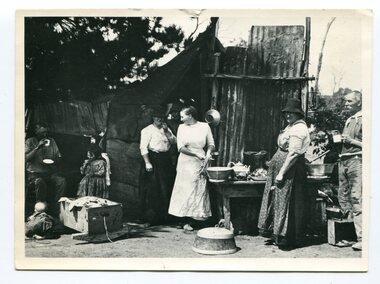
black and white photograph, C1916
... This is a photograph of a railway camp, set up to house workers and their families when building the Bairnsdale to Orbost Railway in 1916. The Bairnsdale-Orbost railway was opened in 1916 to serve the agricultural and timber industry. ...This is a photograph of a railway camp, set up to house workers and their families when building the Bairnsdale to Orbost Railway in 1916. The Bairnsdale-Orbost railway was opened in 1916 to serve the agricultural and timber industry. ...This is a photograph of a railway camp, set up to house workers and their families when building the Bairnsdale to Orbost Railway in 1916. The Bairnsdale-Orbost railway was opened in 1916 to serve the agricultural and timber industry. Because of the decline in traffic and heavy operating costs, the line was finally closed in August, 1987. Orbost Railway Station was opened on Monday 10 April 1916 as the terminus of the Orbost railway line, and closed in 1987. The station was located on the west side of the Snowy River despite the town of Orbost being on the east side of the river, in order to save on the costs of a bridge over the river, which at the time had highly variable levels.This item is associated with the history of the Orbost-Bairnsdale railway line and therefore reflects the role that the rail line played in the social and economic history of Orbost.A black / white photograph of a campsite kitchen. The kitchen is outside against a roughly constructed hut. There are three women preparing food. Two men are drinking from tin mugs. a small child is crawling on the ground and another is seated.on back - "Railway Camp"orbost-railway newmerella-railway-camp transport -
 Orbost & District Historical Society
black and white photograph, C1914
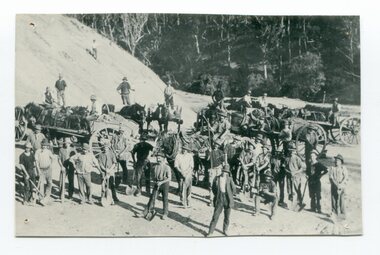
... workers associated with the Orbost - Bairnsdale railway. This item is associated with the history of the Orbost-Bairnsdale railway line and therefore reflects the role that the rail line played in the social and economic history of Orbost. The Bairnsdale-Orbost railway was opened in 1916 to serve the agricultural ...This photograph shows men working in the gravel pit at Newmerella just outside Orbost. Not long after this photograph was taken an accidental explosion killed three workers. In the newspaper, The Hobart Mercury on Saturday March 1914, There was this report: "EXPLOSION OF BLASTING CHARGE. THREE MEN KILLED. MELBOURNE, March 13 A fatal accident occurred this after- noon on the railway construction works at Hagen's Cutting, about two miles from Orbost, three men being killed. The victims were John Carroll, contractor, his son, Peter Carroll, and John Sullivan, a navvy. The gang had just finished work, and the three stayed behind to draw a blasting charge, which had missed fire yesterday. J. Carroll was using a pick, and it is presumed that the tool struck a percussion cap, and fired the charge. He and Sullivan were killed instantly, Carroll being literally blown to pieces. Fragments of his body and garments were recovered from the surrounding bush, and the main portion of the trunk, with leg attached, was hurled a distance of 200 yards. Peter Car roll was terribly- injured, and he died before medical aid arrived. ' This is a pictorial record of construction workers associated with the Orbost - Bairnsdale railway. This item is associated with the history of the Orbost-Bairnsdale railway line and therefore reflects the role that the rail line played in the social and economic history of Orbost. The Bairnsdale-Orbost railway was opened in 1916 to serve the agricultural and timber industry. Because of the decline in traffic and heavy operating costs, the line was finally closed in August, 1987. A black / white photograph of a large group of men with horses and wagons. Most are holding tools - picks, spades and shovels. Some of the wagons are loaded with soil.railway-construction east-gippsland-railway orbost-railway quarry-gravel-newmerella -
 Orbost & District Historical Society
black and white photograph, 1924
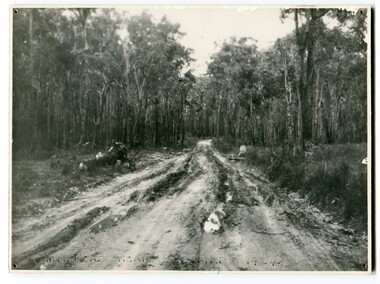
... workers. Today although the timber mills have disappeared, some of the buildings still remain. Little now remains to remind of the saw-milling history apart from photographs and some relics - a boiler and a brick furnace. There was also a thriving agricultural...workers. Today although the timber mills have disappeared, some of the buildings still remain. Little now remains to remind of the saw-milling history apart from photographs and some relics - a boiler and a brick furnace. There was also a thriving agricultural ...This photograph shows the main road near Bellbird, East Gippsland, in 1924. This road would have been the Princes Highway, a main thoroughfare through to New South Wales. Bellbird Creek is a small rural location between Orbost and Cann River. There was no township at Cabbage Tree at this time. The Cabbage Tree Creek township was established to support the booming timber industry of the mid 20th century. Five timber mills worked full time supporting the families that were drawn to the area's wealth of natural resources. Nestled on the banks of the Cabbage Tree Creek, the township was built by those mills to house their workers. Today although the timber mills have disappeared, some of the buildings still remain. Little now remains to remind of the saw-milling history apart from photographs and some relics - a boiler and a brick furnace. There was also a thriving agricultural community farming dairy, beef, seed beans and fresh peas and beans that were sent to the Victoria Market in Melbourne. Dairy farming still plays an essential role in the township. this is a pictorial record of the Princes Highway, the main road from East Gippsland to the New South Wales border.A large black / white photograph of a very wet and boggy bush road.on front - "Main Rd near Bellbird 1924"road princes-highway bellbird-creek-1924 -
 City of Moorabbin Historical Society (Operating the Box Cottage Museum)
Tool - bale hook small, c1900
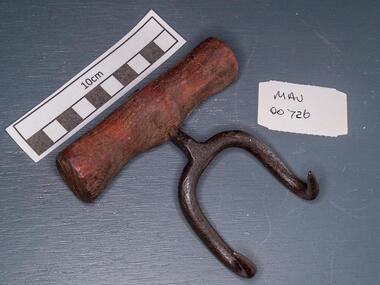
... agricultural industry. Other variants exist, such as in forestry, for moving logs, and a type with a long shaft, used by city workers to remove manhole covers. ...agricultural industry. Other variants exist, such as in forestry, for moving logs, and a type with a long shaft, used by city workers to remove manhole covers. ...A hook as a hand tool is used for securing and moving loads. It consists of a round wooden handle with a strong metal hook projecting at a right angle from the centre of the handle. The appliance is held in a closed fist with the hook projecting between two fingers. This type of hook is used in many different industries, and has many different names. It may be called a box hook, cargo hook, loading hook, or a docker's hook, and a baling hook, bale hook, or hay hook in the agricultural industry. Other variants exist, such as in forestry, for moving logs, and a type with a long shaft, used by city workers to remove manhole covers. A hay hook is slightly different in design in that the shaft is typically longer. It is used on farms to secure and move bales of hay, which are otherwise awkward to pick up manually. A small bale hook with a wooden handle and 2 curved steel hooks pioneers, early settlers, market gardeners, moorabbin, bentleigh, cheltenham, brighton, tools, craftsman, carpenters, , blacksmiths, builders, farmers, graziers, wool bales, hay bales, -
 Glenelg Shire Council Cultural Collection
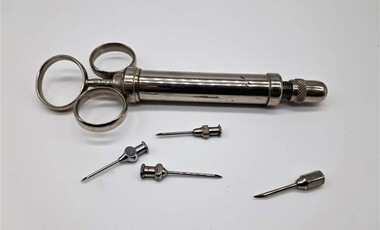
Functional object - Veterinary Syringe, 1900s
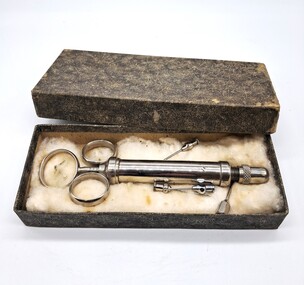
... This was donated by a worker at Portland Veterinary Clinic Rural Agriculture Farming Portland Glenelg Shire Plunger: 0 2 4 6 8 10 Grey mottled cardboard box containing a silver coloured syringe. ...This syringe would have been used by a vet to administer drugs and medicines to animals.The Glenelg Shire has a strong farming industry and community. Vets were and still are invaluable to the community. This was donated by a worker at Portland Veterinary ClinicGrey mottled cardboard box containing a silver coloured syringe. There are also four needles. The syringe and needles are on cotton wool. The syringe has three circular rings at the top. Two are attached to the main body of the syringe and the third is attached to the plunger. The plunger has numerical measurements on it. The end of the syringe can be screwed off in order to place in the needle required.Plunger: 0 2 4 6 8 10 rural, agriculture, farming, portland, glenelg shire -
 Glenelg Shire Council Cultural Collection
Functional object - Veterinary Syringe, 1900s
... This was donated by a worker at Portland Veterinary Clinic Rural Agriculture Farming Portland Glenelg Shire Plunger: 0 2 4 6 8 10 Stainless steel syringe. ...This syringe would have been used by a vet to administer drugs and medicines to animals.The Glenelg Shire has a strong farming industry and community. Vets were and still are invaluable to the community. This was donated by a worker at Portland Veterinary ClinicStainless steel syringe. The syringe has three circular rings at the top. Two are attached to the main body of the syringe and the third is attached to the plunger. The plunger has numerical measurements on it. The end of the syringe can be screwed off in order to place in the needle required.Plunger: 0 2 4 6 8 10 rural, agriculture, farming, portland, glenelg shire -
 Glenelg Shire Council Cultural Collection
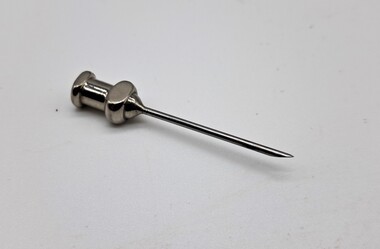
Functional object - Veterinary Syringe - needle, 1900s
... This was donated by a worker at Portland Veterinary Clinic Rural Agriculture Farming Portland Glenelg Shire STAINLESS Metal needle for use with a syringe Functional object Veterinary Syringe - needle ...This syringe would have been used by a vet to administer drugs and medicines to animals.The Glenelg Shire has a strong farming industry and community. Vets were and still are invaluable to the community. This was donated by a worker at Portland Veterinary ClinicMetal needle for use with a syringeSTAINLESS rural, agriculture, farming, portland, glenelg shire -
 Glenelg Shire Council Cultural Collection
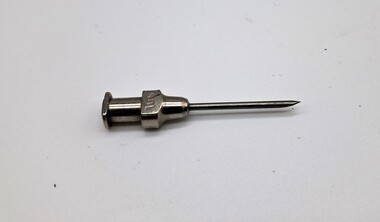
Functional object - Veterinary Syringe - needle, 1900s
... This was donated by a worker at Portland Veterinary Clinic Rural Agriculture Farming Portland Glenelg Shire STAINLESS Metal needle for use with a syringe Functional object Veterinary Syringe - needle ...This syringe would have been used by a vet to administer drugs and medicines to animals.The Glenelg Shire has a strong farming industry and community. Vets were and still are invaluable to the community. This was donated by a worker at Portland Veterinary ClinicMetal needle for use with a syringeSTAINLESS rural, agriculture, farming, portland, glenelg shire -
 Glenelg Shire Council Cultural Collection
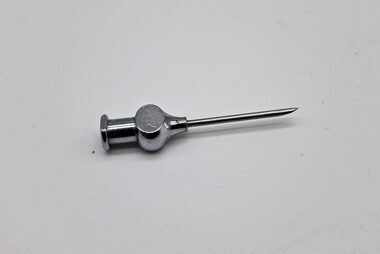
Functional object - Veterinary Syringe - needle, 1900s
... This was donated by a worker at Portland Veterinary Clinic Rural Agriculture Farming Portland Glenelg Shire STAINLESS Metal needle for use with a syringe Functional object Veterinary Syringe - needle ...This syringe would have been used by a vet to administer drugs and medicines to animals.The Glenelg Shire has a strong farming industry and community. Vets were and still are invaluable to the community. This was donated by a worker at Portland Veterinary ClinicMetal needle for use with a syringeSTAINLESS rural, agriculture, farming, portland, glenelg shire -
 Orbost & District Historical Society
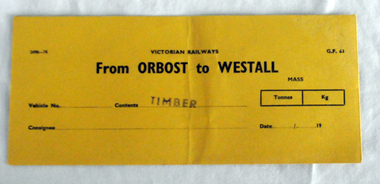
railways envelope, C 1980's
... workers only platform on 16 October 1954. It was provided for the adjacent Martin & King railway coachbuilding factory. The station was opened to the public on 1 June 1959 when all trains on the line began stopping there. The Bairnsdale-Orbost railway was opened in 1916 to serve the agricultural...workers only platform on 16 October 1954. It was provided for the adjacent Martin & King railway coachbuilding factory. The station was opened to the public on 1 June 1959 when all trains on the line began stopping there. The Bairnsdale-Orbost railway was opened in 1916 to serve the agricultural ...This item was used by Victorian Railways 1970's/1980's. It was used at Orbost Railway Station for the consignment of timber from Orbost to Westall.. Westall was a major timber-receiving depot near Dandenong, Victoria. Westall railway station is located on the Pakenham and Cranbourne lines in Victoria, Australia. It serves the south-eastern Melbourne suburb of Clayton South, opening on 6 February 1951. Westall station was opened as a workers only platform on 16 October 1954. It was provided for the adjacent Martin & King railway coachbuilding factory. The station was opened to the public on 1 June 1959 when all trains on the line began stopping there. The Bairnsdale-Orbost railway was opened in 1916 to serve the agricultural and timber industry. Because of the decline in traffic and heavy operating costs, the line was finally closed in August, 1987. Orbost Railway Station was opened on Monday 10 April 1916 as the terminus of the Orbost railway line, and closed in 1987. The station was located on the west side of the Snowy River despite the town of Orbost being on the east side of the river, in order to save on the costs of a bridge over the river, which at the time had highly variable levels. This item is associated with the history of the Orbost-Bairnsdale railway line and therefore reflects the role that the rail line played in the social and economic history of Orbost.An unused brown/buff coloured goods/freight consignment envelope used by Victorian Railways, this one for timber from Orbost to Westall. It is DL size.2497-78 VICTORIAN RAILWAYS G.F 63 From ORBOST to WESTALL MASS Tonnes kg Vehicle No Contents TIMBER Consignee Date orbost-bairnsdale-railway westall -
 Kiewa Valley Historical Society
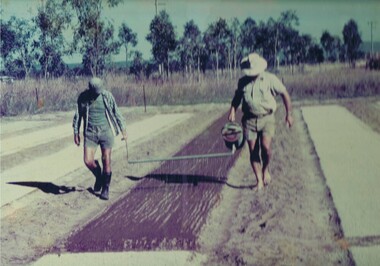
Photograph Tobacco planting, Planting Tobacco seeding, Circa mid to late 1900's
... Some workers did use protective "gum" boots but the majority of farm owners were skeptical of city scientists and their carcinogenic concerns, and it was only after the younger generation of farmers , who had attended Agricultural colleges, encompassed the scientific approach to farm management and began working closely with agricultural scientists. ...This promotional photograph by the Tobacco Growers Association was in response to a 1935 meeting of tobacco growers from Victoria, South Australia and Queensland which produced four major resolutions for the industry covering the remainder of the 1900s. These four resolutions were: (1) Adequate tariff protection (2) Control of pests and diseases (3) Orderly marketing (4) The formation of an advisory council of growers. History has produced the following results. (1) adequate tariff protection was never achieved,(2) control of disease through benzol vapour (CSIRO) breakthrough, was later identified as carcinogenic, (3) orderly marketing was achieved through (4) the establishment of the Tobacco Growers Association(1984). In October 2006, by way of Government buy back of tobacco leases from growers, resulted in the end of Tobacco farming in Australia (after 136 years of planting the first crop). It was also significant that the major tobacco companies such as Philip Morris and The British American Tobacco Australasia advised the industry that it would source its tobacco requirements overseas by 2009.The remnants of the Tobacco Industry can still be viewed throughout the Kiewa Valley and adjacent regions on the former tobacco farms which still have the tobacco drying sheds and now converted into hay sheds. The problems from the large quantities of carcinogenic infused soil of farmlands in the region, still remains a problem now and for future generations. This particular photograph shows the lack of understanding by farmers and the contracted labour, at that time, and is demonstrated by the bare footed farmer walking next to the seed canister. Some workers did use protective "gum" boots but the majority of farm owners were skeptical of city scientists and their carcinogenic concerns, and it was only after the younger generation of farmers , who had attended Agricultural colleges, encompassed the scientific approach to farm management and began working closely with agricultural scientists. The "she'll be right mate" attitude of the earlier farming/rural community has since mid 1970s, been slowly dissipating. Stricter controls of herbicides and pesticides used in agriculture are now in force. The death of the tobacco industry(2006) resulted in the expansion of the dairy , sheep, beef cattle, venison and lama wool producers in the Kiewa Valley and surrounding regions.Coloured photograph pasted onto a thick wood chip backing. Two galvanised eyelets at the top of the frame, 50mm from each end, with a twine cord stretch from each, for hanging purposes. See also KVHS 0054(B) to KVHS 0054(F)A sign, which has been removed from the picture at some previous point in time is "The Tobacco seed, being so fine, is suspended in water and sown onto the seed base using a watering can [as in the photo] or similar device - August - Sept."tobacco, farming, rural industry, licences, ollie mould, blue mould, benzol vapour -
 Kiewa Valley Historical Society
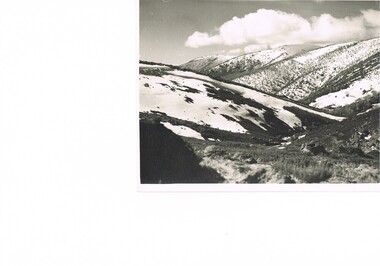
Photograph of Snow Covered Catchment Area Vic, Snow Covered Catchment Area Victorian Alps - 1950s, Circa 1950
... workers to the region but also immigrants who appreciated alpine regions. Some of these immigrants contributed to the expansion of the region and provided for a greater degree of diverse professions and rural related work force. This photograph depicts the borderline in time between an exclusively rural based population and respective activities(early 1900s)to the present (2000 on wards) integrated village, tourist and retiree/holiday area. The time when land was exclusively used in agriculture ...This photograph details (early to mid1950s), the Victorian Alpine region when this remote area was part of a "lay back" rural landscape,occasionally visited by recreational adventurers and some wayward tourists. The mountain ranges had provided an adequate barrier against the way-would traveller, but with the opening up of this region by the provision of improved roadways and accommodation facilities, courtesy of the Kiewa Valley Hydro Electricity Scheme, changes such as tourism and its impact upon the "natural" state started to show its side effects (clearing of the land). The expansion of the European immigration numbers (1950s) coming into Australia was increasing after World War II which not only provided increased construction workers to the region but also immigrants who appreciated alpine regions. Some of these immigrants contributed to the expansion of the region and provided for a greater degree of diverse professions and rural related work force.This photograph depicts the borderline in time between an exclusively rural based population and respective activities(early 1900s)to the present (2000 on wards) integrated village, tourist and retiree/holiday area. The time when land was exclusively used in agriculture and Alpine grazing lands is over. The Kiewa Valley is loosing its hiding place and is becoming more and more a source of untapped residential land and winter time recreational adventure lands. The changes brought about by modern technologies involving recreational activities such as hang gliding, gliding (local airstrip), mountain bikes, car rallies and their associated clubs is providing for an increased short term population boost. These together with the attractions for retirees is changing not only the physical nature of the Kiewa valley but also its "soul".This item is a black and white photograph of a section of snow covered catchment area in the Victorian Alps in the mid 1900. It is on 200 gms paper but not on photographic paper and has a white boarder (3 mm).kiewa valley tourism, victorian alps, alternate energy supplies, alpine population growth -
 Bendigo Historical Society Inc.
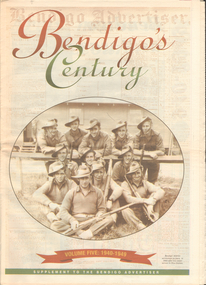
Newspaper - LONG GULLY HISTORY GROUP COLLECTION: BENDIGO'S CENTURY VOLUME FIVE: 1940 - 1949
... BENDIGO History long gully history group The Long Gully History Group - Bendigo's Century - Volume Five: 1940 - 1949 Bendigo Advertiser Central Deborah Mine Jackie Lewis Bob Johnson W Landy Ryga Yates Les Johnson Central Nell Gwynne Department of Defence Bendigo Jockey Club 8th Division Robert Menzies Deborah Mine Bendigo Decentralisation Vigilance Committee Cr W H Taylor Bendigo War Funds Organisation The Easter Fair Society Bendigo Agricultural Show Committee Mr E G Ham Mr J V Fairbairn Cr A Staples The Bendigo Chamber of Commerce Richard Hartley Smith Abbott Captain Harley Abbott Bendigo Art Gallery Bill Woodfull Bendigo High School North Deborah Mine Boardwalk Toni Riley Pharmacy Windermere Hotel Cr G A Pethard Coliban System North Deborah Mine Bendigo Pottery Bendigo Trades Hall Council Private Lawrence Burstall Major-General G J Rankin MHR Andrew Dunstan Ordnance Factory Royal Australian Navy HMAS Bendigo SEC Offices MUIOOF YMCA Georger Addlem Fred Addlem Cr A J Anderson Pauline Buvhan Thompson Leslie Thompson Edward Joseph Leonski Bendigo Football League Mr J Dedman William Stephens Forest Street Methodist Church Pte Charles Phillips Pte W E durward Pte T Foley William John Stephens Central Nell Gwynne Air Chief Marshall Sir Arthur Tedder Cr Taylor United Nations Flying Officer R Bruce Tuff Flight Lieutenant Owens Royal Air Force Commonwealth War Workers Housing Trust Scheme Mr S McKinnon Bendigo Decentralised Vigilance Committee Ravenswood Estate John Lienhop MLC Margaret (Peggy) Brennan Strathfieldsaye Shire Council School of Mines Bendigo Base Hospital William George Ashman Ashman's Tailors Bendigo Jockey Club Victorian Football Association Bendigo East Swimming Pool Deborah Anticline Specimen Hill Methodist Church North Deborah Adolf Hitler Benito Mussolini Australian 7th Division Cr Galvin Bendigo War Funds Organisation HMAS Bendigo Lt-Commander Jackson Bendigo Football League Central Deborah Mine Victoria Day Cr Truscott Bendigo Gaol Lansellstowe AWAS Barracks Bendigo Citizens Committee John Cain Snr Ordnance Factory Bendigo Agricultural Society The Duke of Gloucester Duchess of Gloucester Bendigo Tennis Association North Deborah Gillies Famous Pies Aids & Appliance Shop Mrs Georgina Scott Dr J A Neptune Scott Alfred Sisley Corot Daubigney Louis Sonnenberg Gas Employees' Union John Lienhop Soldier Settlement Commission Burnewang Estate King George VI Princess Elizabeth Lt Philip Mountbatten Mr E J W Herbert Ansett Airways Reg Ansett Most Rev Dr John McCarthy Dr Bernard Stewart Michael Giudice Bendigo United Breweries Bendigo Lyric Photo Plays Bendigo Sun Newspaper Shamrock Hotel West Bendigo Progress Association Alan McDonald South Bendigo Football Club Albert Collier J T Webbo Mervyn Tresize State Rivers and Water Supply Commission Eppalock Reservoir Public Works Committee Bendigo Rotary Club John Edgar Bendigo Base Hospital Albert Dunstan Benevolent Home Magetti's Wine Hall Wallace Reef Wine Hall Magetti Family Albert Magetti Lance Galvin Bradford Cotton Spinnings (Victoria) Pty Otd Arthur Syer Stanley Crossman Albert Arthur Dunstan Rev Dr Henry Backhaus City Family Hotel Lyric Theatre Bank of Australasia City Club HotelColonial Mutual Building R Matchett & Co Lansellstowe Leonard Lansell Bendigo Bas Hospital Australian Women's Army Service Mr Hollway Kenworth (Aust) Ltd Foggitt Jones's Bacon Factory Gordon Sayers Sandhurst Trustees Dr John Drowley Alexander Hislop Royal Mint North Deborah Mine Ironbark South Mining Company Central Nell Gwynne Company New Chum Syncline Newspaper supplement titled Bendigo's Century Volume Five: 1940 - 1949. ...Newspaper supplement titled Bendigo's Century Volume Five: 1940 - 1949. Each year has heading of Who's Who, Weather, Sport and Business. Front page is titled Bendigo's Century and has a photo of a group of soldiers in uniform and with rifles. They were district servicemen on leave in 1944. Each year has heading of Who's Who, Weather, Sport and Business. First years are 1940 - 1949 titled Bendigo as it was. It has two photos of women wading through the 1949 Pall Mall flood waters and one of Miners in the crib room of the Central Deborah Mine. They are Jackie Lewis, Bob Johnson, W Landy, Ryga Yates and Les Johnson. 1940 - Army moves in to racecourse, 1941 - Devastating fire at pottery, 1942 - Forces expand, 1943 - Nation's eyes on Bendigo, 1944 - News dawns of D-day landing, 1945 - City cheers the end of the war, 1946 - Celebrations begin in city, 1947 - Gallery gets top paintings, 1948 - Water plan looks good and 1949 - Flood takes a toll on city.bendigo, history, long gully history group, the long gully history group - bendigo's century - volume five: 1940 - 1949, bendigo advertiser, central deborah mine, jackie lewis, bob johnson, w landy, ryga yates, les johnson, central nell gwynne, department of defence, bendigo jockey club, 8th division, robert menzies, deborah mine, bendigo decentralisation vigilance committee, cr w h taylor, bendigo war funds organisation, the easter fair society, bendigo agricultural show committee, mr e g ham, mr j v fairbairn, cr a staples, the bendigo chamber of commerce, richard hartley smith abbott, captain harley abbott, bendigo art gallery, bill woodfull, bendigo high school, north deborah mine, boardwalk, toni riley pharmacy, windermere hotel, cr g a pethard, coliban system, north deborah mine, bendigo pottery, bendigo trades hall council, private lawrence burstall, major-general g j rankin mhr, andrew dunstan, ordnance factory, royal australian navy, hmas bendigo, sec offices, muioof, ymca, georger addlem, fred addlem, cr a j anderson, pauline buvhan thompson, leslie thompson, edward joseph leonski, bendigo football league, mr j dedman, william stephens, forest street methodist church, pte charles phillips, pte w e durward, pte t foley, william john stephens, central nell gwynne, air chief marshall sir arthur tedder, cr taylor, united nations, flying officer, r bruce tuff, flight lieutenant owens, royal air force, commonwealth war workers housing trust scheme, mr s mckinnon, bendigo decentralised vigilance committee, ravenswood estate, john lienhop mlc, margaret (peggy) brennan, strathfieldsaye shire council, school of mines, bendigo base hospital, william george ashman, ashman's tailors, bendigo jockey club, victorian football association, bendigo east swimming pool, deborah anticline, specimen hill methodist church, north deborah, adolf hitler, benito mussolini, australian 7th division, cr galvin, bendigo war funds organisation, hmas bendigo, lt-commander jackson, bendigo football league, central deborah mine, victoria day, cr truscott, bendigo gaol, lansellstowe, awas barracks, bendigo citizens committee, john cain snr, ordnance factory, bendigo agricultural society, the duke of gloucester, duchess of gloucester, bendigo tennis association, north deborah, gillies famous pies, aids & appliance shop, mrs georgina scott, dr j a neptune scott, alfred sisley, corot, daubigney, louis sonnenberg, gas employees' union, john lienhop, soldier settlement commission, burnewang estate, king george vi, princess elizabeth, lt philip mountbatten, mr e j w herbert, ansett airways, reg ansett, most rev, dr john mccarthy, dr bernard stewart, michael giudice, bendigo united breweries, bendigo lyric photo plays, bendigo sun newspaper, shamrock hotel, west bendigo progress association, alan mcdonald, south bendigo football club, albert collier, j t webbo, mervyn tresize, state rivers and water supply commission, eppalock reservoir, public works committee, bendigo rotary club, john edgar, bendigo base hospital, albert dunstan, benevolent home, magetti's wine hall, wallace reef wine hall, magetti family, albert magetti, lance galvin, bradford cotton spinnings (victoria) pty otd, arthur syer, stanley crossman, albert arthur dunstan, rev dr henry backhaus, city family hotel, lyric theatre, bank of australasia, city club hotelcolonial mutual building, r matchett & co, lansellstowe, leonard lansell, bendigo bas hospital, australian women's army service, mr hollway, kenworth (aust) ltd, foggitt jones's bacon factory, gordon sayers, sandhurst trustees, dr john drowley, alexander hislop, royal mint, north deborah mine, ironbark south mining company, central nell gwynne company, new chum syncline -
 Bendigo Historical Society Inc.
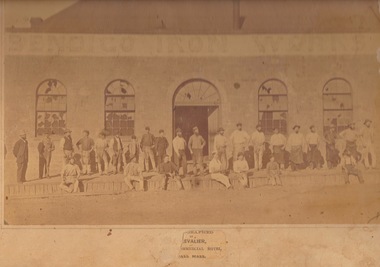
Photograph - Bendigo Iron Works
... agricultural castings, and bells. Bendigo Iron Works Chevalier Sepia coloured photograph of Bendigo Iron Works, mounted on card. There are four windows and a door visible behind a large group of workers standing in front of the building. ...Joel Horwood established the Horwood's Foundry in the late 19th Century in Vine Street Bendigo. The Foundry manufactured mining machinery, agricultural castings, and bells.Sepia coloured photograph of Bendigo Iron Works, mounted on card. There are four windows and a door visible behind a large group of workers standing in front of the building. Some of the workers are seated on a raised platform. Most of the windows have broken glass. A partially torn label below the photograph reads "Photographed by Chevalier Commercial Hotel Pall Mall"bendigo iron works, chevalier -
 Kiewa Valley Historical Society
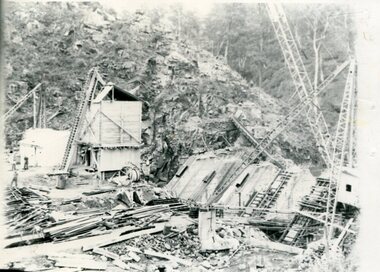
Photographs x 2 - Clover Dam, Circa 1940's
... agriculture and grazing to be less vulnerable to seasonal flooding thereby resulting in a more stable annual production level. Photographs also document early engineering and building techniques used in the construction of dams and power stations during the 1940’s and 1950’s. Note the lack of safety equipment and suitable work attire worn by construction workers ...As part of the push to cut electricity costs and diversify supply, the Victorian Government (circa 1930) implemented the conversion strategy from mainly brown coal supply to hydro - electricity. The Kiewa Hydroelectric Scheme became the largest scheme of its kind in the State Of Victoria and the second largest scheme in Australia. Clover Dam and Power Station were built by the State Electricity Commission of Victoria as part of the Kiewa Hydro Electric Scheme from the late 1930's to the early 1940's. This dam was constructed to supply water to feed four turbines (62 mega watts) at the West Kiewa Power Station. This was at the forefront of sustainable "Green" energy. Costs associated with power supplies is still a major incentive of governments, however environmentally friendly alternatives such as wind and nuclear have also made inroads. The Kiewa valley and its surrounding alpine catchment were looked at(Victorian State Government), from the beginning of the twentieth century as a source of alternate power for an ever-increasing demand for electricity by growing population and heavy industrial areas within Melbourne City and State regions. Construction of dams, such as Clover Dam provided the large quantity holding areas of water required to turn the turbines at the various power stations to provide the electricity needed. The impact of these controls by moderating water run-off from the alpine regions is beneficial in reducing flooding from thawing of snow on the alps. This by-product allows agriculture and grazing to be less vulnerable to seasonal flooding thereby resulting in a more stable annual production level. Photographs also document early engineering and building techniques used in the construction of dams and power stations during the 1940’s and 1950’s. Note the lack of safety equipment and suitable work attire worn by construction workers on the sites 1. Black and white photograph of Clover Dam under construction. Has a .5cm white border around photo 2. Black and white photograph of Clover Dam under construction showing workmen at work. Has a .5cm white border around photo Written in pencil on back of both photographs - Clover Damclover dam, secv -
 Warrnambool and District Historical Society Inc.
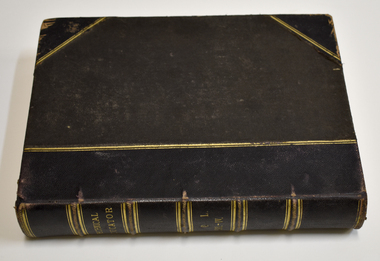
Book - Encyclopedia of Technical Education, Cassell, Petter and Galpin, The Technical Educator Volume 3-4, Late 19th Century
... This book contains two volumes (3 and 4) of technical education on such subjects as chemistry, engineering, agriculture, mining, photography, fortifications and silk culture. The book is designed to assist tradesmen, engineers and other technical workers in the late 19th Century....This book contains two volumes (3 and 4) of technical education on such subjects as chemistry, engineering, agriculture, mining, photography, fortifications and silk culture. The book is designed to assist tradesmen, engineers and other technical workers in the late 19th Century. ...Encyclopedia of Technical Education.Two volumes with technical information on a wide range of subjects.This is a book of 428 pages. The cover has brown composite material with a leather spine and corners. The spine has gold lettering and gold ridged lines. The corners are somewhat tattered. The title page and some other pages are torn. The pages contain printed text, black and white diagrams and sketches and colour illustrations.non-fictionEncyclopedia of Technical Education.Two volumes with technical information on a wide range of subjects. technical education, technical school text book, warrnambool -
National Wool Museum
Book, Australian Worker's Union: Official report of the seventy-sixth annual convention, 1962
... "Australian Worker's Union: Official report of the seventy-sixth annual convention, 1962" Shearing Agriculture - industrial relations Labour Movement - Australia Australian Workers' Union Shearing Agriculture - industrial relations Labour Movement - Australia Australian Worker's Union: Official report of the seventy-sixth annual convention, 1962 Book ..."Australian Worker's Union: Official report of the seventy-sixth annual convention, 1962"shearing agriculture - industrial relations labour movement - australia, australian workers' union, shearing, agriculture - industrial relations, labour movement - australia -
National Wool Museum
Book, Australian Worker's Union: Official report of the seventy-fourth annual convention, 1960
... "Australian Worker's Union: Official report of the seventy-fourth annual convention, 1960" Shearing Agriculture - industrial relations Labour Movement - Australia Australian Workers' Union Shearing Agriculture - industrial relations Labour Movement - Australia Australian Worker's Union: Official report of the seventy-fourth annual convention, 1960 Book ..."Australian Worker's Union: Official report of the seventy-fourth annual convention, 1960"shearing agriculture - industrial relations labour movement - australia, australian workers' union, shearing, agriculture - industrial relations, labour movement - australia -
National Wool Museum
Book, Farmers and settlers industrial association: log of claims for pastoral industry award
... "Log of claims for pastoral industry award" -A R Johnson, Farmers and Settlers Industrial Association, to Australian Workers Union. Agriculture - industrial relations Labour Movement - Australia Shearing Shearing sheds Sheep stations - management Stockmen Australian Workers' Union Farmers and Settlers Industrial Association Agriculture - industrial relations Labour Movement - Australia Shearing Shearing sheds Sheep stations - management Stockmen Farmers and settlers industrial association: log of claims for pastoral industry award Book ..."Log of claims for pastoral industry award" -A R Johnson, Farmers and Settlers Industrial Association, to Australian Workers Union.agriculture - industrial relations labour movement - australia shearing shearing sheds sheep stations - management stockmen, australian workers' union farmers and settlers industrial association, agriculture - industrial relations, labour movement - australia, shearing, shearing sheds, sheep stations - management, stockmen -
 National Wool Museum
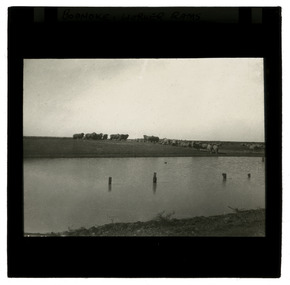
Photograph - Boonoke, Worker Rams, J W Allen, 1900 - 1940
... Agriculture New South Wales Graziers Association Travel Sheep Breeding Photography Glass Lantern Slides J W Allen [handwritten] BOONOKE, WORKER RAMS Black and white glass lantern slide with paper edging showing rams in a paddock in the background, with a fence line under water in the foreground. ...This item is part of a collection of seven black and white glass lantern slides previously housed together in a glass plate box. The slides are part of a greater collection of around forty three black and white glass lantern slides, along with other photographs and photo albums related to this collection. This item is associated with the New South Wales Graziers Association world tour of merino sheep 1928/9. The slides were possibly used as supporting material in presentations made by J W Allen when on tour.Black and white glass lantern slide with paper edging showing rams in a paddock in the background, with a fence line under water in the foreground.[handwritten] BOONOKE, WORKER RAMSagriculture, new south wales graziers association, travel, sheep, breeding, photography, glass lantern slides, j w allen -
 National Wool Museum
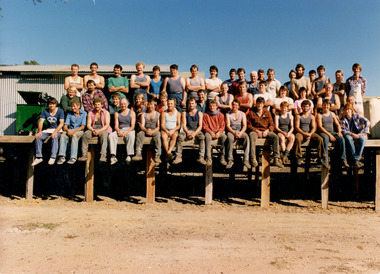
Photograph - Shearing Team at Puckapunyal Army Base, Seymour, 1987
... Shearing Agriculture Wool Workers Army Base Seymour Victoria Rural Life People Portrait Working Life Puckapunyal back: [handwritten] Shearing Team Puckapunyal army Base Seymour / 75,000 Sheep, 21 Shearers plus shed staff Yard staff / and cooks / Started Shearing for Jim Walker / Sep 8th 1986 Colour photograph showing an outdoor group portrait of people seated and standing on the deck of a shearing shed, with blue sky above and gravel road below. ...Colour photograph showing an outdoor group portrait of people seated and standing on the deck of a shearing shed, with blue sky above and gravel road below. Handwritten text in black ink is shown on the back. back: [handwritten] Shearing Team Puckapunyal army Base Seymour / 75,000 Sheep, 21 Shearers plus shed staff Yard staff / and cooks / Started Shearing for Jim Walker / Sep 8th 1986shearing, agriculture, wool, workers, army base, seymour, victoria, rural life, people, portrait, working life, puckapunyal -
 National Wool Museum
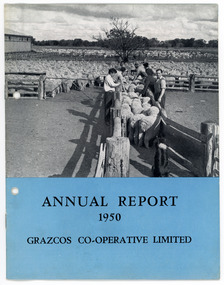
Document - Grazcos Annual Report, Grazcos Co-operative Limited, 1950
... Agricultural co-operative agricultural wholesaling annual reports rural life rural industry business corporate body front: ANNUAL REPORT / 1950 / GRAZCOS CO-OPERATIVE LIMITED Booklet featuring a black and white image of sheep and farm workers at stockyards, with printed black text on blue background below image. ...The co-operative was registered in 1919 as the Graziers Co-op Shearing Company Limited. It changed its name in September 1948 to Grazcos Co-operative Ltd. In 1981 the co-operative merged with Farmers & Graziers Co-op Ltd to form Farmers Grazcos Co-op Ltd. This item is part of a collection of Annual Reports from Grazcos dated from 1949 - 1980.Booklet featuring a black and white image of sheep and farm workers at stockyards, with printed black text on blue background below image.front: ANNUAL REPORT / 1950 / GRAZCOS CO-OPERATIVE LIMITEDagricultural co-operative, agricultural wholesaling, annual reports, rural life, rural industry, business, corporate body
