
Showing 18 items matching " archetype"
-
 Friends of Ballarat Botanical Gardens History Group
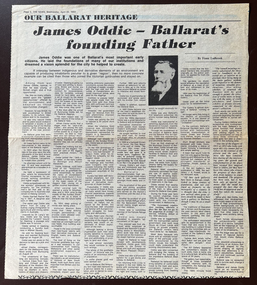
Work on paper - Our Ballarat Heritage, James Oddie, Ballarat's founding Father. The News, April 20, 1983, 1983
... James Oddie is an archetypal example of the young men of British origin who came to the Ballarat diggings hoping to make their fortune during the Gold Rush and stayed on to establish the foundations of the regional centre that became the modern city of today....James Oddie is an archetypal example of the young men of British origin who came to the Ballarat diggings hoping to make their fortune during the Gold Rush and stayed on to establish the foundations of the regional centre that became the modern city of today. ...James Oddie is an archetypal example of the young men of British origin who came to the Ballarat diggings hoping to make their fortune during the Gold Rush and stayed on to establish the foundations of the regional centre that became the modern city of today.James Oddie witnessed the Eureka Stockade and played a significant role in the formative years of Ballarat's development.Part of a single newspaper sheet, folded, yellow with age.Nonechartists, eureka stockade, geelong, buninyong, doctor lang, foundry business, storeman, licences, estate agent, benefactor, ballarat benevolent asylum, rachel riding, female refuge, ballarat bank, mount pleasant observatory, electric light, trams, ballarat botanical gardens, railways, ballarat art gallery, john garner collection, gardens, ballarat -
 Women's Art Register
Archive (Collection) - Helen Chierego Artist Archive
... ... Archetype...Femininity Goddess Archetype Iconography Mythology Drawing Archive Helen Chierego Artist Archive ...femininity, goddess, archetype, iconography, mythology, drawingfemininity, goddess, archetype, iconography, mythology, drawing -
Women's Art Register
Archive (Series) - Chierego, Helen. Artist File 1
... ... Archetype...Femininity Goddess Archetype Iconography Mythology Drawing Foolscap white archival 4 flap folder or document wallet Archive Chierego, Helen. ...Artwork Imagesfemininity, goddess, archetype, iconography, mythology, drawingfemininity, goddess, archetype, iconography, mythology, drawing -
Women's Art Register
Archive (Series) - Helen Chierego. Duplicate File 1
... ... Archetype...Drawing Femininity Goddess Archetype Iconography Mythology Foolscap manilla file Archive Helen Chierego. ...Artwork Imagesdrawing, femininity, goddess, archetype, iconography, mythologydrawing, femininity, goddess, archetype, iconography, mythology -
 Geoffrey Kaye Museum of Anaesthetic History
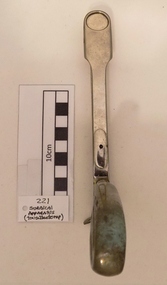
Tool - Tonsil Guillotine, Sluder, circa 1911
... New instruments were created using as archetype Physick´s tonsilotome model. Fahnestock, in the United States, 1832, Mackenzie in London, 1880, Brunings in 1908 and Sluder in 1911 in the United "States developed similar equipment. ...New instruments were created using as archetype Physick´s tonsilotome model. Fahnestock, in the United States, 1832, Mackenzie in London, 1880, Brunings in 1908 and Sluder in 1911 in the United "States developed similar equipment. ...New instruments were created using as archetype Physick´s tonsilotome model. Fahnestock, in the United States, 1832, Mackenzie in London, 1880, Brunings in 1908 and Sluder in 1911 in the United "States developed similar equipment. Greenfield Sluder, an ENT doctor, in Saint Louis was not the first to use the guillotine-cutter for tonsillectomy, but he published a study, in 1912, in which he affirmed to have reached 99.6% of success in his surgeries through this technique (1,2). They all aimed to accomplish surgery as fast as they could, especially in children, for the account of the lack of anesthetic techniques." Retrieved from URL: http://www.internationalarchivesent.org/additional/acervo_eng.asp?id=395 Sluder's Tonsil Guillotine large size. This metal piece of tonsillectomy equipment was designed by Greenfield Sluder in 1911. The piece has generalised oxidation spots on its surface but mostly founded over the top retractile arm blade holder and handle, also has sulphated areas at the base of the handle surface with a bluish colouration. This piece has a screw attached on top of the arm as part of the adjustable blade retractile system.sluder, greenfield, tonsil, guillotine, tonsillectomy -
 Eltham District Historical Society Inc
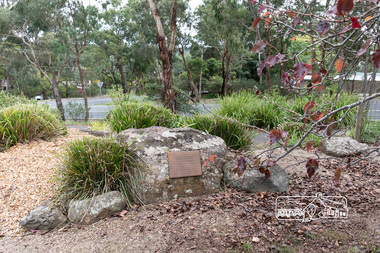
Photograph, Peter Pidgeon, Memorial to Gordon Craig Ford, Landscape Designer, Eltham Cemetery, Victoria, 5 April 2021
... Commissions included Monash University and countless industrial sites but designing for the archetypal quarter-acre block gave him the most satisfaction. ...Commissions included Monash University and countless industrial sites but designing for the archetypal quarter-acre block gave him the most satisfaction. ...Gordon Ford was a conservationist and a pioneer of natural-style landscaping. He came to Eltham in 1948 and bought a block of land in John Street extending through to Pitt Street. Artist Peter Glass lived opposite in John Street. Early on, Gordon worked for Alistair Knox on construction of the mudbrick Busst house amongst others. At the same time, with the help of friends including artist Clifton Pugh, he progressively built his own house ‘Fülling’, which "grew like Topsy" utilising a variety of second-hand materials. His main focus, which became his life-long occupation, was garden landscaping. Inspired by Edna Walling and Ellis Stones, he sought to reflect the bush settings of rural Victoria where he had grown up. Commissions included Monash University and countless industrial sites but designing for the archetypal quarter-acre block gave him the most satisfaction. He had a huge impact on the look of gardens in Australia from the 1950s, creating seemingly natural bush environments by carefully integrating indigenous and exotic plantings. Gordon died in 1999 and is buried in Eltham Cemetery; the gravesite is marked by a plaque. Another plaque (away from his grave) notes his landscaping design work within the cemetery grounds and at Alistair Knox Park. Gordon Craig Ford Landscape Designer 30. 8 .1918 - 16. 6. 1999 Eltham Cemetery Trustee fom 1987 - 1999 Gordon settled in Eltham in 1948 He was a conservationist and a pioneer of natural style landscaping, continuing design and construction until his death. His local work and influence can be seen in many private gardens, the Eltham Cemetery and the Alistair Knox Park.Born Digitaleltham cemetery, gravestones, gordon craig ford -
 Eltham District Historical Society Inc
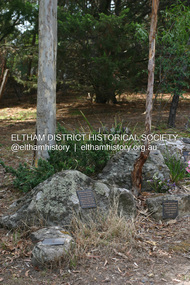
Photograph - Digital Photograph, Alan King, Grave of Gordon Ford, Eltham Cemetery, Victoria, 27 January 2008
... Commissions included Monash University and countless industrial sites but designing for the archetypal quarter-acre block gave him the most satisfaction. ...Commissions included Monash University and countless industrial sites but designing for the archetypal quarter-acre block gave him the most satisfaction. ...Gordon Ford was a conservationist and a pioneer of natural-style landscaping. He came to Eltham in 1948 and bought a block of land in John Street extending through to Pitt Street. Artist Peter Glass lived opposite in John Street. Early on, Gordon worked for Alistair Knox on construction of the mudbrick Busst house amongst others. At the same time, with the help of friends including artist Clifton Pugh, he progressively built his own house ‘Fülling’, which "grew like Topsy" utilising a variety of second-hand materials. His main focus, which became his life-long occupation, was garden landscaping. Inspired by Edna Walling and Ellis Stones, he sought to reflect the bush settings of rural Victoria where he had grown up. Commissions included Monash University and countless industrial sites but designing for the archetypal quarter-acre block gave him the most satisfaction. He had a huge impact on the look of gardens in Australia from the 1950s, creating seemingly natural bush environments by carefully integrating indigenous and exotic plantings. Gordon died in 1999 and is buried in Eltham Cemetery; the gravesite in a natural landscape setting is marked by a plaque. Another plaque (away from his grave) notes his landscaping design work within the cemetery grounds and at Alistair Knox Park. Gordon Craig Ford 30-8-1918 - 16-6-1999 Landscape designer Loved and respected Husband of Gwen, father Of Angela, Emma, Ben, Cassie, Dailan, Caitlin. A good life lived well Published: Nillumbik Now and Then / Marguerite Marshall 2008; photographs Alan King with Marguerite Marshall.; p55This collection of almost 130 photos about places and people within the Shire of Nillumbik, an urban and rural municipality in Melbourne's north, contributes to an understanding of the history of the Shire. Published in 2008 immediately prior to the Black Saturday bushfires of February 7, 2009, it documents sites that were impacted, and in some cases destroyed by the fires. It includes photographs taken especially for the publication, creating a unique time capsule representing the Shire in the early 21st century. It remains the most recent comprehenesive publication devoted to the Shire's history connecting local residents to the past. nillumbik now and then (marshall-king) collection, graves, eltham cemetery, gordon craig ford, gravestones, gwen ford, memorials -
 Flagstaff Hill Maritime Museum and Village
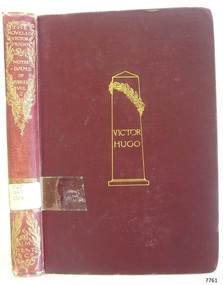
Book - Fictional Novel, Victor Hugo, Notre Dame of Paris Vol 2, 1899
... Culturally, Quasimodo and Esmeralda have become universal archetypes, continuously adapted into plays, films, operas, and animations for nearly two centuries. ...The novel is better known today by its English title, The Hunchback of Notre-Dame. This grand historical novel is set in 1482 Paris and revolves around the doomed gypsy dancer Esmeralda, the tortured archdeacon Claude Frollo, the dashing but shallow captain Phoebus, and the fiercely loyal, deformed bell-ringer Quasimodo. By the time you reach the final volume, the narrative is driving toward its intense, tragic climax. Beyond the human drama, the book is a love letter to Gothic architecture; Hugo famously wrote it to spark a preservation movement to save the crumbling Notre-Dame Cathedral from neglect and modernisation.Notre Dame of Paris Vol 2 Author: Victor Hugo Publisher: J M Dent & Co Date: 1899 Further Information: Translated by J. Carroll Beckwith Vol. 1 is 7072, Vol. 3 is 7073, Vol.4 is 8036fictionThe novel is better known today by its English title, The Hunchback of Notre-Dame. This grand historical novel is set in 1482 Paris and revolves around the doomed gypsy dancer Esmeralda, the tortured archdeacon Claude Frollo, the dashing but shallow captain Phoebus, and the fiercely loyal, deformed bell-ringer Quasimodo. By the time you reach the final volume, the narrative is driving toward its intense, tragic climax. Beyond the human drama, the book is a love letter to Gothic architecture; Hugo famously wrote it to spark a preservation movement to save the crumbling Notre-Dame Cathedral from neglect and modernisation.flagstaff hill, warrnambool, shipwrecked coast, flagstaff hill maritime museum, maritime museum, shipwreck coast, flagstaff hill maritime village, great ocean road, book, pattison collection, warrnambool library, warrnambool mechanics’ institute, ralph eric pattison, corangamite regional library service, warrnambool city librarian, mechanics’ institute library, victorian library board, warrnambool books and records, warrnambool children’s library, notre dame of paris vol 4, victor hugo, j. carroll beckwith -
 Monbulk RSL Sub Branch
Book, Roger McDonald, 1915, 1979
... With remarkable skill and in achingly beautiful prose, Roger McDonald takes the reader on an archetypal Australian journey which parallels the nation's progress from its country childhood, through the adolescent exuberance of its young cities, to initiation on one of the world's ancient battlefields. ...The year young Australians sailed off to war in high hopes of adventure, only to find themselves faced with disaster. The tragedy and violence of Gallipoli provide the climax to this very personal, moving and surprisingly romantic story. With remarkable skill and in achingly beautiful prose, Roger McDonald takes the reader on an archetypal Australian journey which parallels the nation's progress from its country childhood, through the adolescent exuberance of its young cities, to initiation on one of the world's ancient battlefields. It is a vital journey, haunted by menace and disillusionment, one embedded in our national mythology. This astonishing first novel, published to great critical acclaim in 1979 and since then selling over 100,000 copies, tells the story of two boys from the bush, the thoughtful and awkward Walter and his knowing friend Billy Mackenzie, and their girls Frances and Diana. Together they discover a future which seems full of promise, drawing them into the exciting turmoil of passion and war. But theirs is a fateful alliance, in a world all too quickly passing, with an outcome they never could have foreseen.p.426fictionThe year young Australians sailed off to war in high hopes of adventure, only to find themselves faced with disaster. The tragedy and violence of Gallipoli provide the climax to this very personal, moving and surprisingly romantic story. With remarkable skill and in achingly beautiful prose, Roger McDonald takes the reader on an archetypal Australian journey which parallels the nation's progress from its country childhood, through the adolescent exuberance of its young cities, to initiation on one of the world's ancient battlefields. It is a vital journey, haunted by menace and disillusionment, one embedded in our national mythology. This astonishing first novel, published to great critical acclaim in 1979 and since then selling over 100,000 copies, tells the story of two boys from the bush, the thoughtful and awkward Walter and his knowing friend Billy Mackenzie, and their girls Frances and Diana. Together they discover a future which seems full of promise, drawing them into the exciting turmoil of passion and war. But theirs is a fateful alliance, in a world all too quickly passing, with an outcome they never could have foreseen.gallipoli campaign - fiction, world war 1914-1918 - fiction -
 Monbulk RSL Sub Branch
Book, Pan Macmillan, Ray Parkin's odyssey sailor, artist, writer, prisoner of war, 2012
... At first glance he looked every inch the archetypal petty officer that he was - tough, practical and a model of naval discipline. ...In 1939, Ray Parkin was serving on the Australian light cruiser HMAS Perth. At first glance he looked every inch the archetypal petty officer that he was - tough, practical and a model of naval discipline. Yet Ray was no ordinary sailor. Despite a lack of formal education, he had the soul of an artist and a philosopher's enquiring mind. As HMAS Perth was embroiled in war - in the Mediterranean and then in South-East Asia - Ray became both a witness and a chronicler of the conflict through his meticulous diaries and his minutely observed watercolours and sketches. When Perth was sunk off the coast of Java, Ray was one of the survivors. After a valiant attempt to sail back to Australia in a lifeboat, he surrendered and spent the rest of the war as a prisoner of the Japanese, first building the Thai-Burma Railway and then working as a slave labourer in a Japanese coalmine. The horrors and privations of those years saw some of his most memorable artwork - documenting both the beauty of the natural world and the savageries and humiliations of the POW ordealIll, maps, index, p.654.non-fictionIn 1939, Ray Parkin was serving on the Australian light cruiser HMAS Perth. At first glance he looked every inch the archetypal petty officer that he was - tough, practical and a model of naval discipline. Yet Ray was no ordinary sailor. Despite a lack of formal education, he had the soul of an artist and a philosopher's enquiring mind. As HMAS Perth was embroiled in war - in the Mediterranean and then in South-East Asia - Ray became both a witness and a chronicler of the conflict through his meticulous diaries and his minutely observed watercolours and sketches. When Perth was sunk off the coast of Java, Ray was one of the survivors. After a valiant attempt to sail back to Australia in a lifeboat, he surrendered and spent the rest of the war as a prisoner of the Japanese, first building the Thai-Burma Railway and then working as a slave labourer in a Japanese coalmine. The horrors and privations of those years saw some of his most memorable artwork - documenting both the beauty of the natural world and the savageries and humiliations of the POW ordealprisoners of war - japan - death railway, ex prisoners of war - biography -
 Monbulk RSL Sub Branch
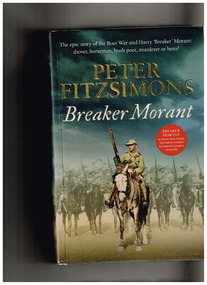
Book, Peter Fitzimons, Breaker Morant, 2020
... Most Australians have heard of the Boer War of 1899 to 1902 and of Harry 'Breaker' Morant, a figure who rivals Ned Kelly as an archetypal Australian folk hero. Born in England and emigrating to Queensland in 1883 in his early twenties, Morant was a charming but reckless man who established a reputation as a rider, polo player and writer. ...The epic story of the Boer War and Harry 'Breaker' Morant: drover, horseman, bush poet - murderer or hero? Most Australians have heard of the Boer War of 1899 to 1902 and of Harry 'Breaker' Morant, a figure who rivals Ned Kelly as an archetypal Australian folk hero. Born in England and emigrating to Queensland in 1883 in his early twenties, Morant was a charming but reckless man who established a reputation as a rider, polo player and writer. He submitted ballads to The Bulletin that were published under the name 'The Breaker' and counted Banjo Paterson as a friend. When appeals were made for horsemen to serve in the war in South Africa, Morant joined up, first with the South Australian Mounted Rifles and then with a South African irregular unit, the Bushveldt Carbineers. In September 1901 Morant and two other Australians, Lieutenants Peter Handcock and George Witton, were arrested for the murder of Boer prisoners. Morant and Handcock were court-martialled and executed in February 1902 as the Boer War was in its closing stages, but the debate over their convictions continues to this day. Does Breaker Morant deserve his iconic status? Who was Harry Morant? What events and passions led him to a conflict that was essentially an Imperial war, played out on a distant continent under a foreign flag? Was he a scapegoat for British war crimes or a criminal himself? With his trademark brilliant command of story, Peter FitzSimons unravels the many myths and fictions that surround the life of Harry Morant. The truths FitzSimons uncovers about 'The Breaker' and the part he played in the Boer War are astonishing - and, in the hands of this master storyteller, make compelling reading.Ill, bib, index, p.500.non-fictionThe epic story of the Boer War and Harry 'Breaker' Morant: drover, horseman, bush poet - murderer or hero? Most Australians have heard of the Boer War of 1899 to 1902 and of Harry 'Breaker' Morant, a figure who rivals Ned Kelly as an archetypal Australian folk hero. Born in England and emigrating to Queensland in 1883 in his early twenties, Morant was a charming but reckless man who established a reputation as a rider, polo player and writer. He submitted ballads to The Bulletin that were published under the name 'The Breaker' and counted Banjo Paterson as a friend. When appeals were made for horsemen to serve in the war in South Africa, Morant joined up, first with the South Australian Mounted Rifles and then with a South African irregular unit, the Bushveldt Carbineers. In September 1901 Morant and two other Australians, Lieutenants Peter Handcock and George Witton, were arrested for the murder of Boer prisoners. Morant and Handcock were court-martialled and executed in February 1902 as the Boer War was in its closing stages, but the debate over their convictions continues to this day. Does Breaker Morant deserve his iconic status? Who was Harry Morant? What events and passions led him to a conflict that was essentially an Imperial war, played out on a distant continent under a foreign flag? Was he a scapegoat for British war crimes or a criminal himself? With his trademark brilliant command of story, Peter FitzSimons unravels the many myths and fictions that surround the life of Harry Morant. The truths FitzSimons uncovers about 'The Breaker' and the part he played in the Boer War are astonishing - and, in the hands of this master storyteller, make compelling reading. boer war 1899-1901 - history, boer war 1899-1902 - biography -
Friends of Ballarat Botanical Gardens History Group
Work on paper - The Heracles Statue, Ballarat Botanical Gardens, Heracles: "The archetypal hero"
... John Garner Collection Ballarat Botanical Gardens Gardens Ballarat Heracles Mythology statue Herakles Heracles: "The archetypal hero". Work on paper The Heracles Statue, Ballarat Botanical Gardens. ...john garner collection, ballarat botanical gardens, gardens, ballarat, heracles, mythology, statue, herakles -
 Flagstaff Hill Maritime Museum and Village
Book - Fictional Novel, Victor Hugo, Notre Dame of Paris Vol 4, 1899
... Culturally, Quasimodo and Esmeralda have become universal archetypes, continuously adapted into plays, films, operas, and animations for nearly two centuries. ...The novel is better known today by its English title, The Hunchback of Notre-Dame. This grand historical novel is set in 1482 Paris and revolves around the doomed gypsy dancer Esmeralda, the tortured archdeacon Claude Frollo, the dashing but shallow captain Phoebus, and the fiercely loyal, deformed bell-ringer Quasimodo. By the time you reach Volume 4, the narrative is driving toward its intense, tragic climax. Beyond the human drama, the book is a love letter to Gothic architecture; Hugo famously wrote it to spark a preservation movement to save the crumbling Notre-Dame Cathedral from neglect and modernisation.Notre Dame of Paris Vol 4 Author: Victor Hugo Publisher: J M Dent & Co Date: 1899 Further Information: Translated by J. Carroll Beckwith Vol. 1 is 7072, Vol. 3 is 7073, Vol. 2 is 7761fictionThe novel is better known today by its English title, The Hunchback of Notre-Dame. This grand historical novel is set in 1482 Paris and revolves around the doomed gypsy dancer Esmeralda, the tortured archdeacon Claude Frollo, the dashing but shallow captain Phoebus, and the fiercely loyal, deformed bell-ringer Quasimodo. By the time you reach Volume 4, the narrative is driving toward its intense, tragic climax. Beyond the human drama, the book is a love letter to Gothic architecture; Hugo famously wrote it to spark a preservation movement to save the crumbling Notre-Dame Cathedral from neglect and modernisation.flagstaff hill, warrnambool, shipwrecked coast, flagstaff hill maritime museum, maritime museum, shipwreck coast, flagstaff hill maritime village, great ocean road, book, pattison collection, warrnambool library, warrnambool mechanics’ institute, ralph eric pattison, corangamite regional library service, warrnambool city librarian, mechanics’ institute library, victorian library board, warrnambool books and records, warrnambool children’s library, notre dame of paris vol 4, victor hugo, j. carroll beckwith -
 Flagstaff Hill Maritime Museum and Village
Book - Fictional Novel, Victor Hugo, Notre Dame of Paris Vol 3, 1899
... Culturally, Quasimodo and Esmeralda have become universal archetypes, continuously adapted into plays, films, operas, and animations for nearly two centuries. ...The novel is better known today by its English title, The Hunchback of Notre-Dame. This grand historical novel is set in 1482 Paris and revolves around the doomed gypsy dancer Esmeralda, the tortured archdeacon Claude Frollo, the dashing but shallow captain Phoebus, and the fiercely loyal, deformed bell-ringer Quasimodo. By the time you reach the final volume, the narrative is driving toward its intense, tragic climax. Beyond the human drama, the book is a love letter to Gothic architecture; Hugo famously wrote it to spark a preservation movement to save the crumbling Notre-Dame Cathedral from neglect and modernisation.Notre Dame of Paris Vol 3 Author: Victor Hugo Publisher: J M Dent & Co Date: 1899 Further Information: Translated by J. Carroll Beckwith Vol. 1 is 7072, Vol. 3 is 7073, Vol.4 is 8036fictionThe novel is better known today by its English title, The Hunchback of Notre-Dame. This grand historical novel is set in 1482 Paris and revolves around the doomed gypsy dancer Esmeralda, the tortured archdeacon Claude Frollo, the dashing but shallow captain Phoebus, and the fiercely loyal, deformed bell-ringer Quasimodo. By the time you reach the final volume, the narrative is driving toward its intense, tragic climax. Beyond the human drama, the book is a love letter to Gothic architecture; Hugo famously wrote it to spark a preservation movement to save the crumbling Notre-Dame Cathedral from neglect and modernisation.flagstaff hill, warrnambool, shipwrecked coast, flagstaff hill maritime museum, maritime museum, shipwreck coast, flagstaff hill maritime village, great ocean road, book, pattison collection, warrnambool library, warrnambool mechanics’ institute, ralph eric pattison, corangamite regional library service, warrnambool city librarian, mechanics’ institute library, victorian library board, warrnambool books and records, warrnambool children’s library, notre dame of paris vol 4, victor hugo, j. carroll beckwith -
 Flagstaff Hill Maritime Museum and Village
Book - Fictional Novel, Victor Hugo, Notre Dame of Paris Vol 1, 1899
... Culturally, Quasimodo and Esmeralda have become universal archetypes, continuously adapted into plays, films, operas, and animations for nearly two centuries. ...The novel is better known today by its English title, The Hunchback of Notre-Dame. This grand historical novel is set in 1482 Paris and revolves around the doomed gypsy dancer Esmeralda, the tortured archdeacon Claude Frollo, the dashing but shallow captain Phoebus, and the fiercely loyal, deformed bell-ringer Quasimodo. By the time you reach the final volume, the narrative is driving toward its intense, tragic climax. Beyond the human drama, the book is a love letter to Gothic architecture; Hugo famously wrote it to spark a preservation movement to save the crumbling Notre-Dame Cathedral from neglect and modernisation.Notre Dame of Paris Vol 1 Author: Victor Hugo Publisher: J M Dent & Co Date: 1899 Further Information: Translated by J. Carroll Beckwith Vol. 4 is 8036, Vol. 2 is 7073, Vol. 3 is 7761fictionThe novel is better known today by its English title, The Hunchback of Notre-Dame. This grand historical novel is set in 1482 Paris and revolves around the doomed gypsy dancer Esmeralda, the tortured archdeacon Claude Frollo, the dashing but shallow captain Phoebus, and the fiercely loyal, deformed bell-ringer Quasimodo. By the time you reach the final volume, the narrative is driving toward its intense, tragic climax. Beyond the human drama, the book is a love letter to Gothic architecture; Hugo famously wrote it to spark a preservation movement to save the crumbling Notre-Dame Cathedral from neglect and modernisation.flagstaff hill, warrnambool, shipwrecked coast, flagstaff hill maritime museum, maritime museum, shipwreck coast, flagstaff hill maritime village, great ocean road, book, pattison collection, warrnambool library, warrnambool mechanics’ institute, ralph eric pattison, corangamite regional library service, warrnambool city librarian, mechanics’ institute library, victorian library board, warrnambool books and records, warrnambool children’s library, notre dame of paris vol 4, victor hugo, j. carroll beckwith -
 Flagstaff Hill Maritime Museum and Village
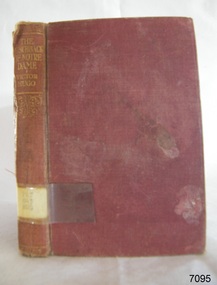
Book - A Fictional Story, Collins Clear Type Press et al, The Hunchback of Notre Dame, 1910-1925
... The Hunchback of Notre-Dame is unquestionably a major work of world literature a founding text of French Romanticism, credited with helping save Notre-Dame Cathedral from further decay, and the source of one of literature's most enduring character archetypes, Quasimodo. It has been adapted into opera, ballet, numerous films and stage musicals. ...The Hunchback of Notre-Dame is Victor Hugo's 1831 historical novel set in fifteenth-century Paris. It follows Quasimodo, the deformed bell-ringer of Notre-Dame Cathedral; Esmeralda, a beautiful Romani street dancer; Claude Frollo, the tormented archdeacon obsessed with her; and Captain Phoebus, the soldier she loves. The novel is as much a portrait of the cathedral itself and medieval Paris as it is a story of its characters. Hugo used the book partly as a plea for the preservation of Gothic architecture, which was being neglected and demolished in his own era. The novel's success is credited with sparking renewed public interest in Notre-Dame and Gothic buildings generally, which contributed to the eventual restoration campaign led by Eugène Viollet-le-Duc in the 1840s.Hard cover book. The Hunchback of Notre Dame Author: Victor Hugo Illustrator: Arthur A Dixon Publisher: Collins Clear-Type Press Date: 1910-1925 Further Information: Red Cloth plain hardcover with lettering and patterning to spine in gilt. The spine has a Library label with an inscription.fictionThe Hunchback of Notre-Dame is Victor Hugo's 1831 historical novel set in fifteenth-century Paris. It follows Quasimodo, the deformed bell-ringer of Notre-Dame Cathedral; Esmeralda, a beautiful Romani street dancer; Claude Frollo, the tormented archdeacon obsessed with her; and Captain Phoebus, the soldier she loves. The novel is as much a portrait of the cathedral itself and medieval Paris as it is a story of its characters. Hugo used the book partly as a plea for the preservation of Gothic architecture, which was being neglected and demolished in his own era. The novel's success is credited with sparking renewed public interest in Notre-Dame and Gothic buildings generally, which contributed to the eventual restoration campaign led by Eugène Viollet-le-Duc in the 1840s.warrnambool, shipwrecked-coast, flagstaff-hill, flagstaff-hill-maritime-museum, maritime-museum, shipwreck-coast, flagstaff-hill-maritime-village, shipwrecked-artefact, book, the hunchback of notre dame, victor hugo -
 Flagstaff Hill Maritime Museum and Village
Book - Fictional Story, Brentano’s Ltd et al, Gentlemen Prefer Blondes, 1926
... It's frequently taught and discussed alongside The Great Gatsby as a defining satire of 1920s American excess, gender roles and the 'dumb blonde' archetype, though Loos's Lorelei is written with sly, subversive intelligence beneath the ditsy narration. ...Gentlemen Prefer Blondes is the Illuminating Diary of a Professional Lady that follows Lorelei Lee, a self-absorbed, gold-digging blonde flapper from Arkansas, as she journals her romantic and financial conquests travelling from New York to Europe (Paris, London) with her more sensible friend Dorothy, collecting rich admirers, diamonds and comic misadventures along the way. It was published the same year as F. Scott Fitzgerald's The Great Gatsby and Carl Van Vechten's Firecrackers, and is considered one of several notable 1925 American novels focused on the carefree hedonism of the Jazz Age. The London/Brentano's edition you're describing (1926) came out shortly after the original 1925 American edition, illustrated throughout in Art Deco style by caricaturist Ralph Barton.Hard cover book. Gentlemen Prefer Blondes Author: Anita Loos Publisher: Brentanos Ltd Illustrator: Ralph Barton Date: 1926 Further Information: Plain blue Cloth hardcover with lettering and patterning to spine in black. The spine has a Library label with an inscription. fictionGentlemen Prefer Blondes is the Illuminating Diary of a Professional Lady that follows Lorelei Lee, a self-absorbed, gold-digging blonde flapper from Arkansas, as she journals her romantic and financial conquests travelling from New York to Europe (Paris, London) with her more sensible friend Dorothy, collecting rich admirers, diamonds and comic misadventures along the way. It was published the same year as F. Scott Fitzgerald's The Great Gatsby and Carl Van Vechten's Firecrackers, and is considered one of several notable 1925 American novels focused on the carefree hedonism of the Jazz Age. The London/Brentano's edition you're describing (1926) came out shortly after the original 1925 American edition, illustrated throughout in Art Deco style by caricaturist Ralph Barton.shipwrecked-coast, flagstaff-hill, flagstaff-hill-maritime-museum, warrnambool, maritime-museum, shipwreck-coast, flagstaff-hill-maritime-village, shipwrecked-artefact, book, pattison collection, warrnambool library, warrnambool mechanics’ institute, ralph eric pattison, corangamite regional library service, warrnambool city librarian, mechanics’ institute library, victorian library board, warrnambool books and records, warrnambool children’s library, gentlemen prefer blondes, anita loos -
 Women's Art Register
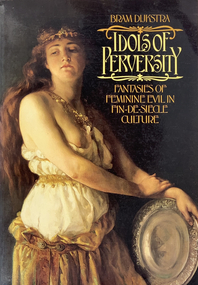
Book, Oxford University Press, Idols of perversity. Fantasies of Feminine evil in Fin-de-Siecle Culture, 1989
... A richly illustrated treatise which contributes to our understanding of this period and its connection to the anti -women attitudes that continue today, and how Victorian ideas still exist as contemporary archetypes. Provides a feminist reading on many familiar literary and art works, and theoretical frameworks from the time. painting feminism sexuality violence symbolism mythology motherhood Darwinism Pre-Raphaelites Analysis of late 19th century American and European writing, art, science and philosophy exploring cultural misogyny. ...Analysis of late 19th century American and European writing, art, science and philosophy exploring cultural misogyny. Discusses the attitude to women as having only sexual and reproductive roles and being depicted as symbols of evil, passivity and sensuality, and ever dependent, while men were free to follow financially independent public and intellectual lives.Booknon-fictionAnalysis of late 19th century American and European writing, art, science and philosophy exploring cultural misogyny. Discusses the attitude to women as having only sexual and reproductive roles and being depicted as symbols of evil, passivity and sensuality, and ever dependent, while men were free to follow financially independent public and intellectual lives. painting, feminism, sexuality, violence, symbolism, mythology, motherhood, darwinism, pre-raphaelites
