
Showing 13 items matching " bowles elizabeth"
-
 Glen Eira Historical Society
Letter - Newing, Thomas R
... ... Bowles Elizabeth...Newing Thomas Robert Redan Road Caulfield ‘Ellington’ House names Brighton Cemetery Bowles Elizabeth Shire President Cook C Horseriders Councillors Lamb Patricia M Ballantyne R Neville Street Newington Street Letter Newing, Thomas R ...Eight items about Thomas Robert Newing: 1/Four letters between Mr. Ballantyne and Patricia M. Lamb, requesting information on her great great grandfather. 2/Two handwritten articles about Thomas Robert Newing, one taken from Sand Swamp and Health, the other unknown and undated, but both appear to respond to first two letters. 3/Handwritten details about inscriptions on gravestones at Brighton Cemetery of Alexander MacGeorge, and other information obtained from Cemetery curator, date unknown, author unknown, but appear to respond to third letter. 4/Handwritten research notes by Claire Barton dated 30/04/2013 concerning the Newing family and other owners of ‘Ellington’ and adjacent properties.newing thomas robert, redan road, caulfield, ‘ellington’, house names, brighton cemetery, bowles elizabeth, shire president, cook c, horseriders, councillors, lamb patricia m, ballantyne r, neville street, newington street -
 Bendigo Historical Society Inc.
Newspaper - Fortuna Article - "Melody Maker", Jan 07 2008
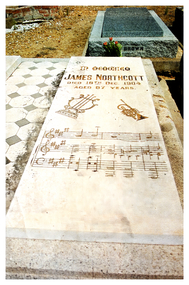
... Peter Hoey Finn arrived during the goldfields, owned a store that burned down, and later carved the granite bowl of the Alexandra Fountain as a mason. Elizabeth Watson was he only woman known to have died in a mining accident in Bendigo, tragically killed in 1863 due to her dress getting caught in mining machinery. ...Peter Hoey Finn arrived during the goldfields, owned a store that burned down, and later carved the granite bowl of the Alexandra Fountain as a mason. Elizabeth Watson was he only woman known to have died in a mining accident in Bendigo, tragically killed in 1863 due to her dress getting caught in mining machinery. ...James Northcott In 1867 married Miss Lansell sister of George Lansell. A prominent bandsman in Bendigo, recognized for his musical contributions and honored with a silver cornet in 1871. His grave in the Bendigo Cemetery features musical notes. William Francis and Richard Francis were founders of the Beehive store during the gold rush era. Peter Hoey Finn arrived during the goldfields, owned a store that burned down, and later carved the granite bowl of the Alexandra Fountain as a mason. Elizabeth Watson was he only woman known to have died in a mining accident in Bendigo, tragically killed in 1863 due to her dress getting caught in mining machinery. The monumental section of Bendigo Cemetery has had about 60,000 interments since 1854, with some graves containing up to six people.The cemetery is denominational, with burial locations historically determined by religion.Community and Historical Significance:Cemetery tours are offered at Bendigo, White Hills, Eaglehawk, and Kangaroo Flat as part of the Summer in the Parks program. Many Australians have a family connection to Bendigo, with an estimated one in seven families linked to the area.Prominent Graves in the Bendigo Cemetery Article - "Melody Maker" - The Bendigo Miner Thursday Jan 07 2008 This item contains the following: 11217.11a Colour Photo of The Grave of Bandsman James Northcott 11217.11b Colour Photo of The Grave of Sir John Quick, the federal member for Bendigo 1901-1913, died 1932 11217.11c Colour Photo of The Grave of Anne Caudle in whose honour the Ann Caudle Centre is named, died in 1865 11217.11d Colour Photo of a Father and Mother - Some graves contain up to six people 11217.11e Part of page 5 - Melody Makernon-fictionbendigo, fortuna, george lansell, james northcott, anne caudle, john quick, northcott band -
 Bendigo Historical Society Inc.
Newspaper - The Bendigo Miner 17 January 2008 - Streets of Silence
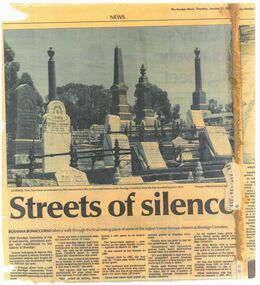
... Peter Hoey Finn, who carved the bowl of the Alexandra fountain. Elizabeth Watson, the only woman to have died in a mining accident in 1863....Peter Hoey Finn, who carved the bowl of the Alexandra fountain. Elizabeth Watson, the only woman to have died in a mining accident in 1863. newspaper Bendigo Cemetery Anne Caudle Sir John Quick James Northcott William Francis Richard Francis Peter Hoey Finn Elizabeth Watson Bendigo The Bendigo Miner A3 colour photocopies of newspaper articles from the Bendigo Miner, Thursday January 17, 2008. ...The article references several of Bendigo's famous names including: Anne Caudle, founder of the Anne Caudle Centre (previously the Benevolent Asylum) which was established in March 1860. Sir John Quick, politician known as the Father of the Federation. James Northcott, musician who received a silver cornet. William and Richard Francis, who founded the Beehive Store. Peter Hoey Finn, who carved the bowl of the Alexandra fountain. Elizabeth Watson, the only woman to have died in a mining accident in 1863.A3 colour photocopies of newspaper articles from the Bendigo Miner, Thursday January 17, 2008. Date of photocopy unknown. Location of original paper unknown. The article was spread across two pages and has been cut from the larger paper. The article is torn, discoloured and folded. "Streets of Silence" is an article where "Rosanna Bonaccurso takes a walk through the final resting place of some of the region's most famous citizens at Bendigo Cemetery." newspaper, bendigo cemetery, anne caudle, sir john quick, james northcott, william francis, richard francis, peter hoey finn, elizabeth watson, bendigo, the bendigo miner -
Glen Eira Historical Society
Photograph - Elsternwick
... Bowl Centre... Larch Street... Montessorie School... Collins Milk Bar... Milk Bars... Collins Lin... Hartrick Miss... Armond Mr.... Lennie Mr.... Rothells Sausage Factory... North Road... Red Bus Service Transport... Furlonger Miss... Dance Studio... Moran and Cato Grocery... Cato family... Newsagent... Tozer Brook... Furniture Store... Green Gables American style soda fountain and milk bar... Hoyts Renown Theatre... State Savings Bank... Riddell Parade... Clarence Street... Aileen Avenue... Smith Keith James... Camden Town... Sports club... Peer Gary... Gary Peer & Associates... Brukarz Jack... Ray White Real Estate... Real Estate Agents... Classic Cinema Theatres... St. George’s Road... Elizabeth...Bowl Centre Larch Street Montessorie School Collins Milk Bar Milk Bars Collins Lin Hartrick Miss Armond Mr. Lennie Mr. Rothells Sausage Factory North Road Red Bus Service Transport Furlonger Miss Dance Studio Moran and Cato Grocery Cato family Newsagent Tozer Brook Furniture Store Green Gables American style soda fountain and milk bar Hoyts Renown Theatre State Savings Bank Riddell Parade Clarence Street Aileen Avenue Smith Keith James Camden Town Sports club Peer Gary Gary Peer & Associates Brukarz Jack Ray White Real Estate Real Estate Agents Classic Cinema Theatres St. George’s Road Elizabeth ...This file contains three items. Photocopied and three page retyped article, undated c.1930s and source unknown from Real Estate Agent Philippe Batters 03/09/1997. Three page document from Keith James Smith, undated, on research on Elsternwick and Glen Huntly Road shops and traders. Three articles from THE AGE 13/05/2000 and 15-16/02/2013 and MELB BAYSIDE WEEKLY 03/11/2010 giving snap shots of Elsternwick housing and facts.batters philippe, real estate agents, elsternwick, paddocks, glen huntly road, walter kelly, elsternwick park, slaughter yards, glen eira roads, point ormond, glenhuntly railway station, nepean highway, grange road, holdsworth’s jewellers, staniland grove, coles store, shops, orrong road, fosseys, hattams mensware, woolworths, dalgarnos crockery and kitchenware, chapmans gifts, garth’s shoe store, garth jack, allen’s furniture and auction rooms, elsternwick market, adam’s cakes, mr. green’s pet shop, turner mr., grocer shop, moores lendring library, hopetown gardens, gardens, jack hatheralls butchershop, butchers, chinese laundry, chinese community, laundries, mr. & mrs. darbyshires milkbar, st. johns church, kooyong road, hasseles garage, garages, royal parade, glenhuntly, camden, hawthorn road, blacksmiths, camden town, dolls hospital, caulfield state school 773, independent picture, theatres, camden theatre, southern indoor bowl centre, larch street, montessorie school, collins milk bar, milk bars, collins lin, hartrick miss, armond mr., lennie mr., rothells sausage factory, north road, red bus service transport, furlonger miss, dance studio, moran and cato grocery, cato family, newsagent, tozer brook, furniture store, green gables american style soda fountain and milk bar, hoyts renown theatre, state savings bank, riddell parade, clarence street, aileen avenue, smith keith james, camden town, sports club, peer gary, gary peer & associates, brukarz jack, ray white real estate, real estate agents, classic cinema theatres, st. george’s road, elizabeth street, allison road, gladstone park, myrtle street, victoria street, caulfield, st kilda east, lisbon house, orrong road, house names, rippon lea estate, caulfield south, carnegie, gordon street, carre street, main street, clarence street, elsternwick club, jewish holocaust museum, daily planet, brothels, wesley college, elsternwick primary, st. joseph’s primary, scholem aleichen college, liebler yavneh, hopetoun gardens, harleston park -
 Tatura Irrigation & Wartime Camps Museum
Painting - Oil, Frau Charlotte Rippert, Bowl of Flowers/ Carnations, 1940's
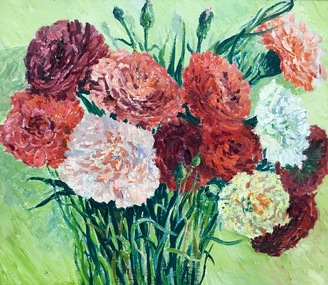
... Transported on Queen Elizabeth to Australia and interned at Camp 3 1941-1945. charlotte rippert german lutheran missionaries internment camp 3 artists internment camp artists Laminate Label - reads "Bowl of Flowers, Artist: Charlotte Rippert, Donor Elfrieda Faig nee Kaltenbach." ...Painting by Charlotte Rippert, a German Lutheran Missionary in Egypt, arrested as a security risk in Cairo, 1941. Transported on Queen Elizabeth to Australia and interned at Camp 3 1941-1945.Oil painting of bunch of carnations. Dark red, red, pink and white. Lime green backgroundLaminate Label - reads "Bowl of Flowers, Artist: Charlotte Rippert, Donor Elfrieda Faig nee Kaltenbach."charlotte rippert, german lutheran missionaries, internment camp 3 artists, internment camp artists -
 Tatura Irrigation & Wartime Camps Museum
Painting - Painting - oil, Poppies
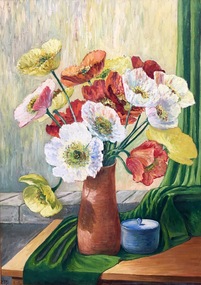
... Frau C Rippert was a Lutheran Missionary worker in Cairo, Egypt when the British Army was in north Africa and she was arrested and transferred to Palestine and later sent on the Queen Elizabeth to Australia where she was interned painting - oil rippert fc vollmer h poppies camp 3 tatura ww2 camps illustrations oil Oil painting of poppies in a brown vase beside a blue cylindrical bowl with lid. ...Frau C Rippert was a Lutheran Missionary worker in Cairo, Egypt when the British Army was in north Africa and she was arrested and transferred to Palestine and later sent on the Queen Elizabeth to Australia where she was internedOil painting of poppies in a brown vase beside a blue cylindrical bowl with lid. On a green cloth which is draped over a fawn coloured table. Brown frame with pale strip.painting - oil, rippert fc, vollmer h, poppies, camp 3, tatura, ww2 camps, illustrations, oil -
 Broadmeadows Historical Society & Museum
Ephemera - Ticket, Government of Victoria, Royal Concert Ticket, 1963, 1962/63
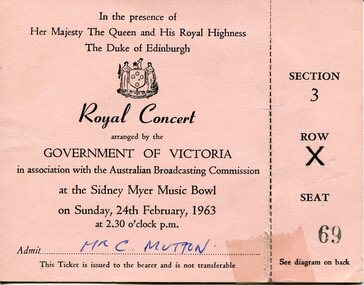
... Bowl...Victoria Government...Australian Broadcasting Commission...Queen Elizabeth...Royal Visit Royal Concert 1963 Sidney Myer Music Bowl Victoria Government Australian Broadcasting Commission Queen Elizabeth II Duke of Edinburgh Melbourne souvenir admission ticket civic ceremony crowd management seated allocation cultural event Recto (front): “In the presence/of Her Majesty The Queen and His Royal Highness/The Duke of Edinburgh”/“Royal Concert”/“arranged by/the Government of Victoria”/“in association with the Australian Broadcasting Commission”/“at the Sidney Myer Music Bowl”/“on Sunday, 24th February, 1963”/“at 2.30 o’clock p.m.” ...The ticket documents a Royal Concert held during the 1963 visit of the British monarch and consort to Australia, organised by the Government of Victoria with the Australian Broadcasting Commission, reflecting its civic and national significance. Hosted at Melbourne’s Sidney Myer Music Bowl, the event required large-scale crowd management, evidenced by the printed access map on the ticket. The named bearer and fixed, non-transferable seating indicate controlled attendance and heightened security appropriate to a royal event.This item has local historic significance for Broadmeadows and Campbellfield, providing primary evidence of major industrial development and civic engagement in Victoria during the 1960s.This item is of historic and social significance as tangible evidence of civic life, monarchy-related public events, and state-organised cultural programming in Victoria during the early 1960s. It documents public engagement with royal visits and the ceremonial relationship between Australia and the British Crown in the mid 20th century.Single sheet of pale pink paper, printed in black ink, folded vertically. The recto contains formal event text and seat information. The verso contains a printed location map and directional diagram.Recto (front): “In the presence/of Her Majesty The Queen and His Royal Highness/The Duke of Edinburgh”/“Royal Concert”/“arranged by/the Government of Victoria”/“in association with the Australian Broadcasting Commission”/“at the Sidney Myer Music Bowl”/“on Sunday, 24th February, 1963”/“at 2.30 o’clock p.m.”/“Admit… Mr C. Mutton” / “This Ticket is issued to the bearer and is not transferable”/“SECTION 3”/“ROW X”/“SEAT 69” Verso (back): “From Linlithgow Ave”/“King George V Memorial”/“Swan St Bridge”/“Alexandra Ave”/“To Sections 2 & 3”/ Hand-applied label: “WI-4242” royal visit, royal concert, 1963, sidney myer music bowl, victoria government, australian broadcasting commission, queen elizabeth ii, duke of edinburgh, melbourne, souvenir, admission ticket, civic ceremony, crowd management, seated allocation, cultural event -
 Vision Australia
Document - Text, Blind bowlers meet the challenge
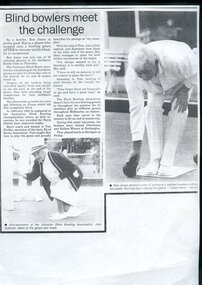
... The article includes a picture of Ron Jones about to release the ball and Jean Sullivan after releasing a bowl. Elizabeth Maxwell Neil Maxwell Victorian Blind Bowling Association Ron Jones Summary update of Centenary Appeal 1 photocopied newspaper article with two images Blind bowlers meet the challenge Document Text ...Article profiling Ron Jones, who played at the Jerilderie Bowls Club as part of a three day visit and season break up by the Victorian Blind Bowlers Association. Taking up bowling six years ago, he soon competed at the Australian Blind Bowling championships and was awarded the trophy for the most improved. The Bowling Association does not have its own grounds, so throughout the summer its 41 members played on greens all over Melbourne. The article includes a picture of Ron Jones about to release the ball and Jean Sullivan after releasing a bowl.1 photocopied newspaper article with two imagesnon-fictionelizabeth maxwell, neil maxwell, victorian blind bowling association, ron jones -
 Vision Australia
Document - Text, Victorian Blind Indoor Bias Bowls Association letterhead
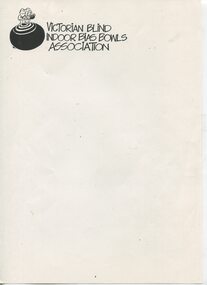
... Elizabeth Maxwell Neil Maxwell Office equipment and supplies Victorian Blind Indoor Bias Bowls Association Summary update of Centenary Appeal Victorian Blind Indoor Bias Bowls Association A4 page with photocopied letterhead of a cartoon lawn bowl with female and male on top Victorian Blind Indoor Bias Bowls Association letterhead Document Text ...Blank letterhead for documents sent out by the Victorian Blind Indoor Bias Bowls Association, during 1980's.A4 page with photocopied letterhead of a cartoon lawn bowl with female and male on topnon-fictionVictorian Blind Indoor Bias Bowls Associationelizabeth maxwell, neil maxwell, office equipment and supplies, victorian blind indoor bias bowls association -
 Mont De Lancey
Book, Elizabeth Craig, New Standard Cookery Illustrated, 1933
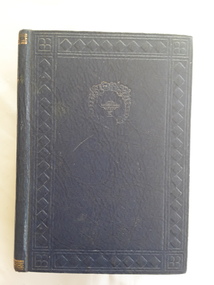
... Elizabeth Craig. Front cover has an embossed border of triangles in a lined edging with a bowl surrounded by flowers at the top. ...Elizabeth Craig. Front cover has an embossed border of triangles in a lined edging with a bowl surrounded by flowers at the top. ...An illustrated cookery book for both experienced and inexperienced housewives with modern and favourite old recipes.A thick dark blue hardcover New standard Cookery Book Illustrated edited by Elizabeth Craig. Front cover has an embossed border of triangles in a lined edging with a bowl surrounded by flowers at the top. The spine has the title and a bowl printed in gold lettering. Black and white photographs are throughout. 1015p.non-fictionAn illustrated cookery book for both experienced and inexperienced housewives with modern and favourite old recipes.cookbooks, cookery books -
 Wodonga & District Historical Society Inc
Ceremonial object - Baptismal Font, c1863
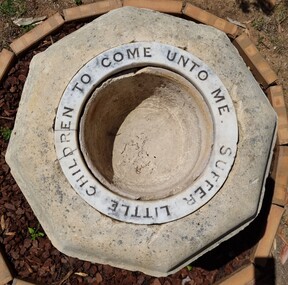
... It was the wish of Ray Schmidt and his wife Elizabeth that the Font should come to the Wodonga & District Historical Society after their deaths. It is now displayed at Hut 97. St Luke's Church Wodonga Religious ceremonial items Anglican Church Wodonga Around bowl "SUFFER THE LITTLE CHILDREN WHO COME UNTO ME" A baptismal font made from hewn stone from the Wodonga area. ...St Luke’s Anglican Church officially opened on 15 March 1863. It was constructed from locally hewn stone. After serving the congregation for more than a century, the Church was closed by the Health Commission due to its deteriorated condition which was judged to be beyond repair. It was demolished by voluntary labour on the 10 – 11 August 1968. St Luke’s originally operated as a branch of the Albury church. The first resident minister at Wodonga was Rev. J. H. White who came in 1879. Much of the demolition of the church was organised and carried out by Raymond John Schmidt, a long-time parishioner of St Luke’s. After the demolition, the font was relocated to the Schmidt family garden. It was the wish of Ray Schmidt and his wife Elizabeth that the Font should come to the Wodonga & District Historical Society after their deaths. It is now displayed at Hut 97.A baptismal font made from hewn stone from the Wodonga area. Central bowl for holy water is surrounded by an inscription.Around bowl "SUFFER THE LITTLE CHILDREN WHO COME UNTO ME"st luke's church wodonga, religious ceremonial items, anglican church wodonga -
 Wodonga & District Historical Society Inc
Functional object - G. Awburn Caterer Wodonga Plate
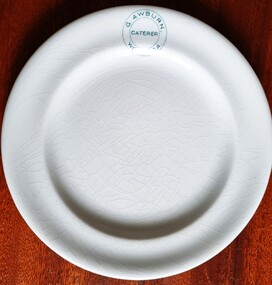
... Elizabeth II. More than 1,300 patterns have been created throughout Johnson Brothers' history. Due to their growing success, manufacturing plants were established overseas including the establishment of a tableware factory, Johnson Brothers Australia in 1957 in Croydon, Victoria operated through a company known as Sovereign Pottery Ltd. Due to rising competition, Johnson Brothers became part of the Wedgewood Group in 1968. In 2015, following the acquisition of Wedgewood by Finnish company Fiskars, the Johnson Brothers branding was discontinued. The trademark on this bowl...Elizabeth II. More than 1,300 patterns have been created throughout Johnson Brothers' history. Due to their growing success, manufacturing plants were established overseas including the establishment of a tableware factory, Johnson Brothers Australia in 1957 in Croydon, Victoria operated through a company known as Sovereign Pottery Ltd. Due to rising competition, Johnson Brothers became part of the Wedgewood Group in 1968. In 2015, following the acquisition of Wedgewood by Finnish company Fiskars, the Johnson Brothers branding was discontinued. The trademark on this bowl ...Mr George Awburn Jr. arrived in Wodonga West with his parents by bullock dray when he was aged six years old. As a young man he went to Melbourne where he worked with the Melbourne Tramway and Omnibus Company. He drove the first through tram from Abbotsford to Balaclava. On he return to Wodonga, Mr. Awburn opened a bakery and grocery business in Sydney St., Wodonga which he conducted up till the time of his death in 1946. He was active in community affairs in roles including being a foundation member of the Library Committee, a committeeman of the Town Band and football club, a member of the Hibernian Lodge and an ardent worker for the Roman Catholic Church. Johnson Bros. was founded by two brothers named Alfred and Frederick who purchased a pottery factory in Hanley, England, in 1883. They were grandsons of a renowned English potter, Alfred Meakin. They were later joined in the business by their brothers Henry and Robert. Their business grew rapidly, as they were one of the world's largest pottery factories by the turn of the 20th century. By 1970, Johnson Bros. obtained the Royal Charter to become the official provider of china for Her Majesty Queen Elizabeth II. More than 1,300 patterns have been created throughout Johnson Brothers' history. Due to their growing success, manufacturing plants were established overseas including the establishment of a tableware factory, Johnson Brothers Australia in 1957 in Croydon, Victoria operated through a company known as Sovereign Pottery Ltd. Due to rising competition, Johnson Brothers became part of the Wedgewood Group in 1968. In 2015, following the acquisition of Wedgewood by Finnish company Fiskars, the Johnson Brothers branding was discontinued. The trademark on this bowl was used by Johnson Brothers between 1913 and 1942.This item originates from a well-known and respected Wodonga business.A round china plate imprinted with business name of G. Awburn Wodonga and Johnson Brothers on the back of the plate.On front: G. Awburn Caterer Wodonga On back: Hotelware / Johnson Bros/ Englandawburn family, wodonga businesses -
 Wodonga & District Historical Society Inc
Domestic object - Shallow Vegetable Serving bowl, Johnson Brothers England, 1913 - 1942
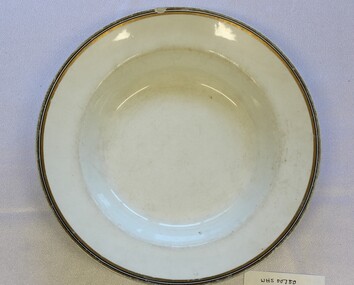
... Elizabeth II. More than 1,300 patterns have been created throughout Johnson Brothers' history. Due to their growing success, manufacturing plants were established overseas including the establishment of a tableware factory, Johnson Brothers Australia in 1957 in Croydon, Victoria operated through a company known as Sovereign Pottery Ltd. Due to rising competition, Johnson Brothers became part of the Wedgewood Group in 1968. In 2015, following the acquisition of Wedgewood by Finnish company Fiskars, the Johnson Brothers branding was discontinued. The trademark on this bowl...Elizabeth II. More than 1,300 patterns have been created throughout Johnson Brothers' history. Due to their growing success, manufacturing plants were established overseas including the establishment of a tableware factory, Johnson Brothers Australia in 1957 in Croydon, Victoria operated through a company known as Sovereign Pottery Ltd. Due to rising competition, Johnson Brothers became part of the Wedgewood Group in 1968. In 2015, following the acquisition of Wedgewood by Finnish company Fiskars, the Johnson Brothers branding was discontinued. The trademark on this bowl ...Johnson Bros. was founded by two brothers named Alfred and Frederick who purchased a pottery factory in Hanley, England, in 1883. They were grandsons of a renowned English potter, Alfred Meakin. They were later joined in the business by their brothers Henry and Robert. Their business grew rapidly, as they were one of the world's largest pottery factories by the turn of the 20th century. By 1970, Johnson Bros. obtained the Royal Charter to become the official provider of china for Her Majesty Queen Elizabeth II. More than 1,300 patterns have been created throughout Johnson Brothers' history. Due to their growing success, manufacturing plants were established overseas including the establishment of a tableware factory, Johnson Brothers Australia in 1957 in Croydon, Victoria operated through a company known as Sovereign Pottery Ltd. Due to rising competition, Johnson Brothers became part of the Wedgewood Group in 1968. In 2015, following the acquisition of Wedgewood by Finnish company Fiskars, the Johnson Brothers branding was discontinued. The trademark on this bowl was used by Johnson Brothers between 1913 and 1942. An item which reflects the changing market for tableware that was reasonably priced and serviceable. Their innovation of the pottery line called semi-porcelain changed the industry. This development allowed potteries to produce fashionable pottery items that were affordable to all social classes of the time. Their use became widespread in Australia, especially following their establishment of a tableware factory in Melbourne, Victoria. A shallow white bowl with gold trim, probably used for serving vegetables at the table. The underside of the bowl bears the mark of Johnson Bros England. The mark is composed of a green crown above the words "Johnson Bros England" also in green.On under side of bowl, beneath a green crown "Johnson Bros/England"johnson brothers ceramics, domestic utensils, kitchenware
