
Showing 77 items matching " bowling court"
-
 Musculoskeletal Health Australia (now held by the Glen Eira Historical Society)
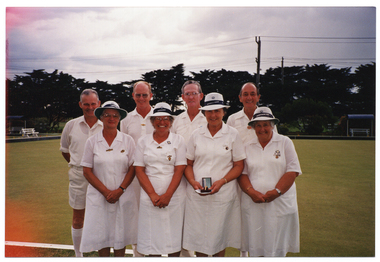
Photograph - Group photo
... ... bowling court...Colour photo of eight people, four men and four women, standing in two rows on a grass bowling court. One woman is holding a gold watch in a presentation case in her hand....Eight lawn bowls players pose for a photo on the bowling green (date and location unknown) on the occasion of the unidentified woman in the front row being the recipient of a gift of a gold watch. arthritis foundation of victoria afv gift recipient gold watch lawn bowls bowling green bowling court grass court bowls club club members Colour photo of eight people, four men and four women, standing in two rows on a grass bowling court. ...Eight lawn bowls players pose for a photo on the bowling green (date and location unknown) on the occasion of the unidentified woman in the front row being the recipient of a gift of a gold watch.Colour photo of eight people, four men and four women, standing in two rows on a grass bowling court. One woman is holding a gold watch in a presentation case in her hand.arthritis foundation of victoria, afv, gift recipient, gold watch, lawn bowls, bowling green, bowling court, grass court, bowls club, club members -
 Musculoskeletal Health Australia (now held by the Glen Eira Historical Society)
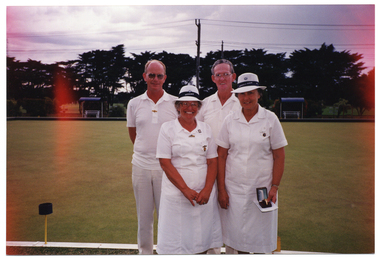
Photograph - Group photo
... ... bowling court...Colour photo of four people, two men and two women, standing in two rows on a grass bowling court. One woman is holding a gold watch in a presentation case in her hand....Eight lawn bowls players pose for a photo on the bowling green (date and location unknown) on the occasion of the unidentified woman in the front row being the recipient of a gift of a gold watch. arthritis foundation of victoria afv gift recipient gold watch lawn bowls bowling green bowling court grass court bowls club club members Colour photo of four people, two men and two women, standing in two rows on a grass bowling court. ...Eight lawn bowls players pose for a photo on the bowling green (date and location unknown) on the occasion of the unidentified woman in the front row being the recipient of a gift of a gold watch.Colour photo of four people, two men and two women, standing in two rows on a grass bowling court. One woman is holding a gold watch in a presentation case in her hand.arthritis foundation of victoria, afv, gift recipient, gold watch, lawn bowls, bowling green, bowling court, grass court, bowls club, club members -
 Halls Gap & Grampians Historical Society
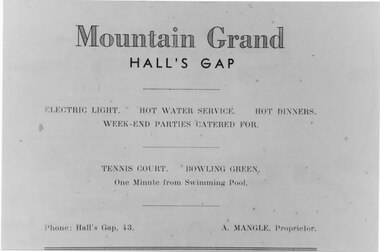
Photograph - B/W
... Advertisement for Mountain Grand Halls Gap A Mangle was the proprietor Electric Light, Hot water service, Hot dinners, Week-end parties catered for Tennis Court, Bowling Green, one minute from swimming pool...Advertisement for Mountain Grand Halls Gap A Mangle was the proprietor Electric Light, Hot water service, Hot dinners, Week-end parties catered for Tennis Court, Bowling Green, one minute from swimming pool MEDIA Advertisements ACCOMMODATION Mountain Grand AGFA quality paper made in Germany Advertisement for Guest House Photograph B/W ...Advertisement for Mountain Grand Halls Gap A Mangle was the proprietor Electric Light, Hot water service, Hot dinners, Week-end parties catered for Tennis Court, Bowling Green, one minute from swimming poolAdvertisement for Guest HouseAGFA quality paper made in Germanymedia, advertisements, accommodation, mountain grand -
 Lakes Entrance Historical Society
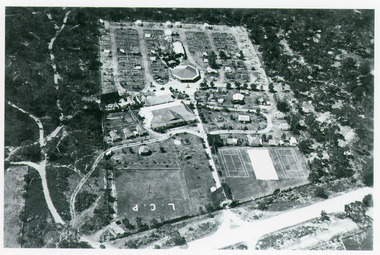
Photograph - Whiter's Camp Park Lakes Entrance 1935, Bulmer H D
... Black and white aerial view of Whiters Camp Park, looking north from Roadknight Street, showing layout of park including tennis courts, bowling green, picnic area, cottages, rotunda, and the family residence. ...Tourism Camping Black and white aerial view of Whiters Camp Park, looking north from Roadknight Street, showing layout of park including tennis courts, bowling green, picnic area, cottages, rotunda, and the family residence. ...Black and white aerial view of Whiters Camp Park, looking north from Roadknight Street, showing layout of park including tennis courts, bowling green, picnic area, cottages, rotunda, and the family residence. Lakes Entrance Victoria tourism, camping -
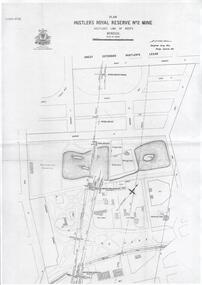 Bendigo Historical Society Inc.
Plan - Hustler's Royal Reserve No. 2 Mine, April, 2014
... One page plan (photocopy) of Hustler's Royal Reserve No. 2 Mine (Park Shaft) showing mine location, dams, tennis courts, bowling green, Jail (sic) Barnard Street, View Street and Park Road. ...goldmining accident quartz mining Hustler's Royal Reserve No. 2 Mine Park Shaft Hustler's line of reef Gaol One page plan (photocopy) of Hustler's Royal Reserve No. 2 Mine (Park Shaft) showing mine location, dams, tennis courts, bowling green, Jail (sic) Barnard Street, View Street and Park Road. ...One page plan (photocopy) of Hustler's Royal Reserve No. 2 Mine (Park Shaft) showing mine location, dams, tennis courts, bowling green, Jail (sic) Barnard Street, View Street and Park Road. Whitelaw plan, 1913.goldmining, accident, quartz, mining, hustler's royal reserve no. 2 mine, park shaft, hustler's line of reef, gaol, -
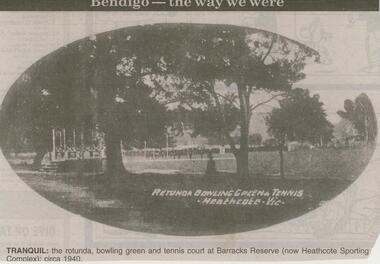 Bendigo Historical Society Inc.
Newspaper - JENNY FOLEY COLLECTION: TRANQUIL
... Tranquil: the rotunda, bowling green and tennis court at Barracks Reserve 9noe Heathcote Sporting Complex), circa 1940. ...Tranquil: the rotunda, bowling green and tennis court at Barracks Reserve 9noe Heathcote Sporting Complex), circa 1940. ...Bendigo Advertiser ''The way we were'' from February 2001. Tranquil: the rotunda, bowling green and tennis court at Barracks Reserve 9noe Heathcote Sporting Complex), circa 1940. The clip is in a folder.newspaper, bendigo advertiser, the way we were -
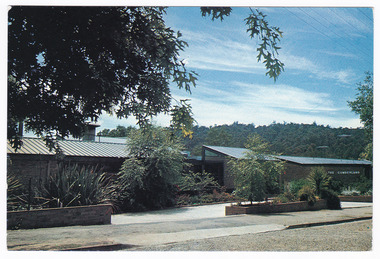 Marysville & District Historical Society
Postcard (item) - Colour postcard, The Cumberland Marysville 'Victoria's Premmier Holiday Hotel", Unknown
... Situated high in the mountains 65 miles from Melbourne, The Cumberland offers/ the ultimate in relaxation: Private Swimming Pool, Tennis Court, Bowling Green,/ Croquet Green, Golf, Horse Back Riding, extensive gardens plus its famous/ reputation for high standard food and wine. ...A colour postcard from The Cumberland guest house in Marysville. marysville victoria australia the cumberland guest house accommodation postcard Situated high in the mountains 65 miles from Melbourne, The Cumberland offers/ the ultimate in relaxation: Private Swimming Pool, Tennis Court, Bowling Green,/ Croquet Green, Golf, Horse Back Riding, extensive gardens plus its famous/ reputation for high standard food and wine. ...A colour postcard from The Cumberland guest house in Marysville.A colour postcard from The Cumberland guest house in Marysville.Situated high in the mountains 65 miles from Melbourne, The Cumberland offers/ the ultimate in relaxation: Private Swimming Pool, Tennis Court, Bowling Green,/ Croquet Green, Golf, Horse Back Riding, extensive gardens plus its famous/ reputation for high standard food and wine. marysville, victoria, australia, the cumberland guest house, accommodation, postcard -
 Marysville & District Historical Society
Postcard (item) - Colour postcard, The Cumberland Marysville 'Victoria's Premmier Holiday Hotel", Unknown
... Situated high in the mountains 65 miles from Melbourne, The Cumberland offers/ the ultimate in relaxation: Private Swimming Pool, Tennis Court, Bowling Green,/ Croquet Green, Golf, Horse Back Riding, extensive gardens plus its famous/ reputation for high standard food and wine. ...A colour postcard from The Cumberland guest house in Marysville. marysville victoria australia the cumberland guest house accommodation postcard Situated high in the mountains 65 miles from Melbourne, The Cumberland offers/ the ultimate in relaxation: Private Swimming Pool, Tennis Court, Bowling Green,/ Croquet Green, Golf, Horse Back Riding, extensive gardens plus its famous/ reputation for high standard food and wine. ...A colour postcard from The Cumberland guest house in Marysville.A colour postcard from The Cumberland guest house in Marysville.Situated high in the mountains 65 miles from Melbourne, The Cumberland offers/ the ultimate in relaxation: Private Swimming Pool, Tennis Court, Bowling Green,/ Croquet Green, Golf, Horse Back Riding, extensive gardens plus its famous/ reputation for high standard food and wine. marysville, victoria, australia, the cumberland guest house, accommodation, postcard -
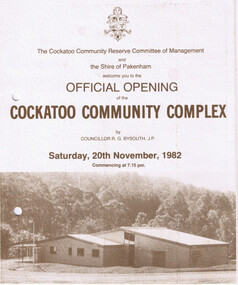 Cockatoo History & Heritage Group
Order of Ceremony, Official Opening of the Cockatoo Community Complex, Saturday 20th November, 1982
... The first stage saw the construction of the kindergarten building which was opened in 1977, followed by the bowling green, tennis courts, netball courts and public toilets. ...The first stage saw the construction of the kindergarten building which was opened in 1977, followed by the bowling green, tennis courts, netball courts and public toilets. ...In 1976, the Shire of Pakenham recognising that Cockatoo was the second largest township within the shire, acknowledged requests for the provision of recreation facilities. Council purchased four hectares of land strategically located in the Town Centre and in conjunction with the local community, embarked upon a programme of staged development of the site. The first stage saw the construction of the kindergarten building which was opened in 1977, followed by the bowling green, tennis courts, netball courts and public toilets. The Community Complex Building was the final development of the site.The Cockatoo Community Complex building, was the final stage of the development and was opened on the 20th November 1982. It was a replacement for the old Cockatoo Hall, which had not been renovated since 1936. The old Cockatoo Hall was lost in the Ash Wednesday fires on the 16th February 1983. The community complex played an integral part in the recovery stages after Ash Wednesday.Four page document, including Acknowledgements, Order of Ceremony, Menu and Site Plan of the Cockatoo community ComplexTwo punctured holes for folder storagecockatoo community complex, cockatoo hall, hall opening, cockatoo -
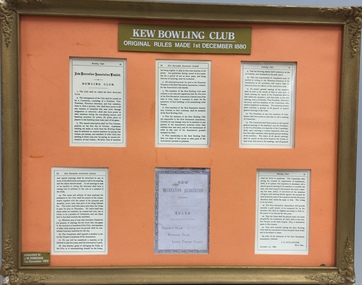 Kew Historical Society Inc
Document, Kew Recreation Association Rules, 1880
... Kew Recreation Association [Cricket Club, Bowling Club, Lawn Tennis Court]: Framed copy of original rules promulgated 1 December 1880. ...The collection illuminates two of the Victorian historic themes - 'Building community life' through forming community organisations and 'Shaping cultural and creative life' by participating in sport and recreation. kew bowling club - wellington street - kew (vic) clubs - lawn bowls - kew (vic) kew recreation association Kew Recreation Association [Cricket Club, Bowling Club, Lawn Tennis Court]: Framed copy of original rules promulgated 1 December 1880. ...Sports Clubs in Kew in the final decades of the 19th century and in the early 20th century were often umbrella organisations with facilities for a number of sports. Typically in Kew, this included teams in lawn bowls, tennis and croquet. The Kew Bowling Club was formed in 1880 while the privately owned Auburn Heights Recreation Club was opened in 1904. By 1998, the two Clubs decided to amalgamate at the Auburn Heights site in Barkers Road, forming the Kew Heights Sports Club. The combined club was itself taken over by the Melbourne Cricket Club in 2012 becoming MCC Kew Sports Club. In 2017 MCC Kew closed and its landholding was subsequently sold to Carey Baptist Grammar School. Both the Kew and Auburn Heights Clubs assembled important collections. These historically significant and large collections were donated to the Society in 2020. The collections include manuscripts, pictures, trophies, plans, honour boards etc. References Barnard FGA 1910, 'Sports and Pastimes' in Jubilee History of Kew Victoria: Its origin & progress 1803-1910. Nixon NV 1980, The History of the Kew Bowling Club 1880-1980. Reeve S 2012, City of Boroondara: Thematic Environmental History, p.216.The combined collections of the four sporting clubs making up the collection number hundreds of items that are historically significant locally. They are also significant to the sporting history of the greater Melbourne area and to the sports of lawn bowls and tennis in Australia in the 19th and 20th centuries. The collection illuminates two of the Victorian historic themes - 'Building community life' through forming community organisations and 'Shaping cultural and creative life' by participating in sport and recreation.Kew Recreation Association [Cricket Club, Bowling Club, Lawn Tennis Court]: Framed copy of original rules promulgated 1 December 1880. The item is part of the historic Kew Bowling Club (1880-1898) collection gifted to the Kew Historical Society by MCC Kew Sports Club in 2020. kew bowling club - wellington street - kew (vic), clubs - lawn bowls - kew (vic), kew recreation association -
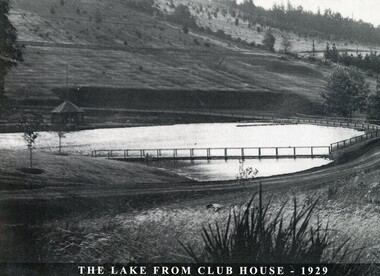 Emerald Museum & Nobelius Heritage Park
Photograph - Photographic print of the Emerald Country Club ornamental lake, THE LAKE FROM THE CLUB HOUSE - 1929, c.1920s-1930s
... It offered accommodation and dining, a nine-hole golf course, tennis courts, a bowling green as well as swimming and fishing facilities. ...It offered accommodation and dining, a nine-hole golf course, tennis courts, a bowling green as well as swimming and fishing facilities. ...The Emerald Country Club was originally set up as a country retreat for the wealthy in the late 1920s. It was modelled on American country clubs and it was situated on land formerly owned by the Gembrook Nurseries. It offered accommodation and dining, a nine-hole golf course, tennis courts, a bowling green as well as swimming and fishing facilities. This photograph of the ornamental lake was taken in 1929.This photograph evokes the iconic and beautiful former Emerald Country Club in its earlier days.Black and white photographic print of the ornamental lake of the former Emerald Country Club and environs looking west towards the pavilion next to the lake and Lakeside Drive. The photograph has a printed title at the bottom. On bottom of photograph: 'THE LAKE FROM CLUB HOUSE - 1929'emerald country club, gembrook nurseries, golf -
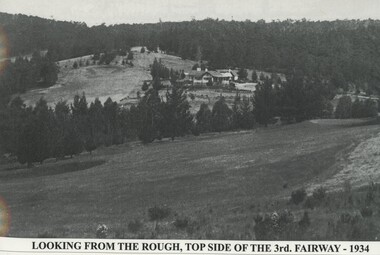 Emerald Museum & Nobelius Heritage Park
Photograph - Photographic print of the Emerald Country Club, LOOKING FROM THE ROUGH, TOP SIDE OF THE 3rd FAIRWAY -1934, 1934
... It offered accommodation and dining, a nine-hole golf course, tennis courts, a bowling green as well as swimming and fishing facilities. ...It offered accommodation and dining, a nine-hole golf course, tennis courts, a bowling green as well as swimming and fishing facilities. ...The Emerald Country Club was originally set up as a country retreat for the wealthy in the late 1920s. It was modelled on American country clubs and it was situated on land formerly owned by the Gembrook Nurseries. It offered accommodation and dining, a nine-hole golf course, tennis courts, a bowling green as well as swimming and fishing facilities. This photograph of the 3rd fairway and the club house was taken in 1934.This photograph evokes the iconic and beautiful former Emerald Country Club in its earlier days.Black and white photographic print of the former Emerald Country Club taken from the top side of the 3rd fairway. The club house is in the middle distance. The print has been laminated with a printed title at the bottom.At bottom of print: 'LOOKING FROM THE ROUGH, TOP SIDE OF THE 3rd. FAIRWAY - 1934'emerald country club, gembrook nurseries, golf -
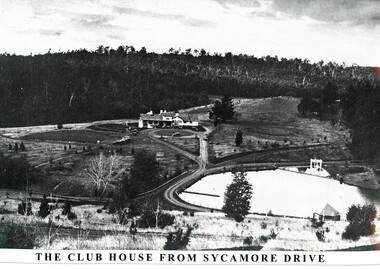 Emerald Museum & Nobelius Heritage Park
Photograph - Photographic print of Emerald Country Club, The Club House From Sycamore Drive, c.1920s-1930s
... It offered accommodation and dining, a nine-hole golf course, tennis courts, a bowling green as well as swimming and fishing facilities. ...It offered accommodation and dining, a nine-hole golf course, tennis courts, a bowling green as well as swimming and fishing facilities. ...The Emerald Country Club was originally set up as a country retreat for the wealthy in the late 1920s. It was modelled on American country clubs, and it was situated on land formerly owned by the Gembrook Nurseries. It offered accommodation and dining, a nine-hole golf course, tennis courts, a bowling green as well as swimming and fishing facilities. This photograph shows the club house and environs including the ornamental lake in the foreground.This photograph captures the iconic and beautiful former Emerald Country Club in its earlier days.Black and white photographic print of the former Emerald Country Club showing the club house in the centre and the lake in the right foreground. The print has been laminated with a printed title at the bottom. On the bottom of print: 'THE CLUB HOUSE FROM SYCAMORE DRIVE'emerald country club, gembrook nurseries, golf -
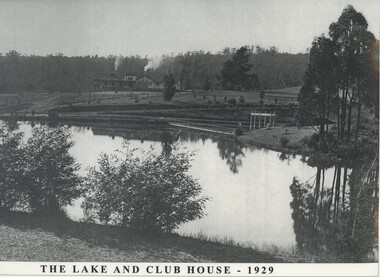 Emerald Museum & Nobelius Heritage Park
Photograph - Photographic print of the ornamental lake at the Emerald Country Club, THE LAKE AND THE CLUB HOUSE - 1929, 1929
... It offered accommodation and dining, a nine-hole golf course, tennis courts, a bowling green as well as swimming and fishing facilities. ...It offered accommodation and dining, a nine-hole golf course, tennis courts, a bowling green as well as swimming and fishing facilities. ...The Emerald Country Club was originally set up as a country retreat for the wealthy in the late 1920s. It was modelled on American country clubs and it was situated on land formerly owned by the Gembrook Nurseries. It offered accommodation and dining, a nine-hole golf course, tennis courts, a bowling green as well as swimming and fishing facilities. This photograph focuses on the ornamental lake in front of the club house and was taken in 1929.This photograph evokes the iconic and beautiful former Emerald Country Club in its earlier days.Black and white photographic print of the ornamental lake at the former Emerald Country Club - the club house with smoking chimneys is in the background. The print has been laminated and has a printed title at the bottom. On bottom of image: 'THE LAKE AND THE CLUB HOUSE - 1929'emerald country club, gembrook nurseries, golf -
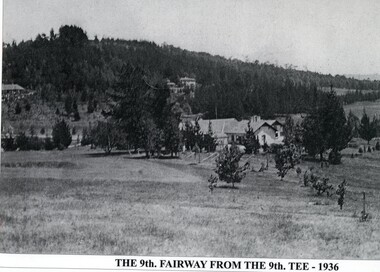 Emerald Museum & Nobelius Heritage Park
Photograph - Photographic print of Emerald Country Club, THE 9th FAIRWAY FROM THE 9th TEE - 1936, 1936
... It offered accommodation and dining, a nine-hole golf course, tennis courts, a bowling green as well as swimming and fishing facilities. ...It offered accommodation and dining, a nine-hole golf course, tennis courts, a bowling green as well as swimming and fishing facilities. ...The Emerald Country Club was originally set up as a country retreat for the wealthy in the late 1920s. It was modelled on American country clubs and it was situated on land formerly owned by the Gembrook Nurseries. It offered accommodation and dining, a nine-hole golf course, tennis courts, a bowling green as well as swimming and fishing facilities. This photograph taken in 1936 shows a side view of the club house taken from the 9th tee.This photograph captures the iconic and beautiful former Emerald Country Club in its earlier days.Black and white photographic print of the former Emerald Country Club showing club house in centre and the 9th fairway. It is laminated with a printed title at the bottom.At bottom of image: 'THE 9th FAIRWAY FRORM THE 9th TEE - 1936'emerald country club, gembrook nurseries, golf -
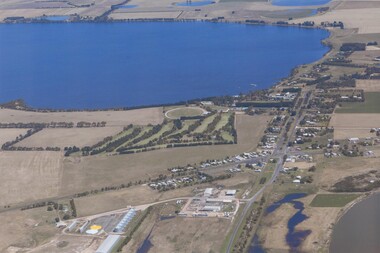 Lake Bolac & District Historical Society
Colour photograph, Aerial view of Lake Bolac and village. After the rain, 2010
... Note the edge of the salt-lake in the bottom right, the Industrial Estate bottom left and centre, the golf course, the current footy oval, Bowling Club, tennis courts and swimming pool with the P-12 College through the trees on the bank of the lake. ...Note the edge of the salt-lake in the bottom right, the Industrial Estate bottom left and centre, the golf course, the current footy oval, Bowling Club, tennis courts and swimming pool with the P-12 College through the trees on the bank of the lake. ...Aerial view of Lake Bolac after the drought had broken in late 2010. The fresh-water lake is now full, as are the wetlands. Note the edge of the salt-lake in the bottom right, the Industrial Estate bottom left and centre, the golf course, the current footy oval, Bowling Club, tennis courts and swimming pool with the P-12 College through the trees on the bank of the lake. An Archaeologist might be able to discern the original footy oval bottom centre, built on what was once the town Common (below the industrial buildings),and the second oval (above the salt lake.) The houses are spreading along the west bank of the lake beyond the school.lake bolac, 2010, village, fresh-water lake, salt lake, golf, tennis, bowling, swimming, college, -
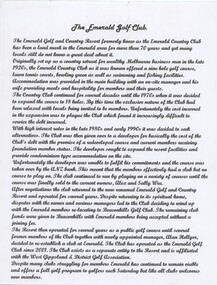 Emerald Museum & Nobelius Heritage Park
Essay - Local history typescript, The Emerald Golf Club, c.1990s
... It offered accommodation and dining, a nine-hole golf course, tennis courts, a bowling green as well as swimming and fishing facilities. ...It offered accommodation and dining, a nine-hole golf course, tennis courts, a bowling green as well as swimming and fishing facilities. ...The Emerald Country Club was originally set up as a country retreat for the wealthy in the late 1920s. It was modelled on American country clubs and it was situated on land formerly owned by the Gembrook Nurseries. It offered accommodation and dining, a nine-hole golf course, tennis courts, a bowling green as well as swimming and fishing facilities. By the 1970s the exclusive nature of the club had been relaxed and the golf course expanded. Its complex history since then is detailed in the typescript. This short essay describes the history of golf in Emerald.A typed A4 page entitled: 'The Emerald Golf Club'. The font is of a cursive style.emerald country club, gembrook nurseries, golf, emerald golf club -
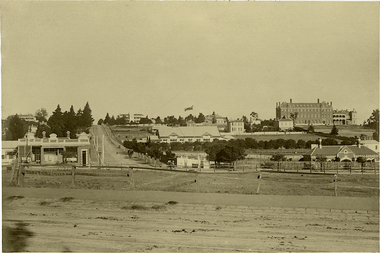 Kew Historical Society Inc
Photograph, J F C Farquhar, Wellington Street From High Street, 1891
... The building was used for dances, civic functions and exhibitions. A bowling green, tennis courts, and a cricket ground surrounded the Hall. ...The building was used for dances, civic functions and exhibitions. A bowling green, tennis courts, and a cricket ground surrounded the Hall. ...At the beginning of the 1890s, the Kew businessman and Town Councillor, Henry Kellett, commissioned J.F.C. Farquhar to photograph scenes of Kew. These scenes included panoramas as well as pastoral scenes. The resulting set of twelve photographs was assembled in an album, Kew Where We Live, from which customers could select images for purchase.The preamble to the album describes that the photographs used the ‘argentic bromide’ process, now more commonly known as the gelatine silver process. This form of dry plate photography allowed for the negatives to be kept for weeks before processing, hence its value in landscape photography. The resulting images were considered to be finely grained and everlasting. Evidence of the success of Henry Kellett’s venture can be seen today, in that some of the photographs are held in national collections.It is believed that the Kew Historical Society’s copy of the Kellett album is unique and that the photographs in the book were the first copies taken from the original plates. It is the first and most important series of images produced about Kew. The individual images have proved essential in identifying buildings and places of heritage value in the district.Very few of the natural or built features in this panoramic photograph of Wellington Street remain. The open land between High Street South and Denmark Street, then known as O’Shannessy’s Paddock, was to become a residential subdivision at the beginning of the 20th Century. On the far side of Denmark Street, bordered by a picket fence, is the Kew Railway Station (demolished 1957). Further east, the large building with the flagpole is the Kew Recreation Hall (demolished 1960), which was the centre of civic life for almost a century. The building was used for dances, civic functions and exhibitions. A bowling green, tennis courts, and a cricket ground surrounded the Hall. The dominant building in the photograph is Xavier College, founded in 1872 by the Society of Jesus. The first classes for pupils were held in 1878. It is presumed that Farquhar used its roof for two of his bird’s eye views.Wellington Street from High Streetkew illustrated, kew where we live, photographic books, henry kellett -
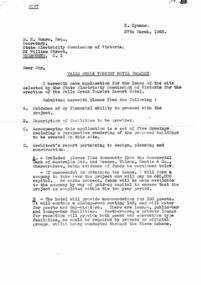 Falls Creek Historical Society
Document - Application For Lease Of Site Selected By S.E.C
... As well as serving as a winter sports hotel, the plan featured indoor facilities including a heated swimming pool, squash courts, bowling alley and sauna bath. Stables, a tennis court and boats would also attract year-round tourism. ...As well as serving as a winter sports hotel, the plan featured indoor facilities including a heated swimming pool, squash courts, bowling alley and sauna bath. Stables, a tennis court and boats would also attract year-round tourism. ...Bob (Herman) Hymans (a former member of the Royal Netherlands Navy) was born in Bloemendaal, Holland on 30th September 1922. During World War II he fought against the Japanese in the Dutch East Indies (now Indonesia) and was imprisoned in Changi and on the Burma Railway. After gaining qualifications as a Ski Instructor, Bob arrived in Falls Creek in July 1950. Working as an Instructor and Supervisor at Bogong Lodge, Bob decided his future was in accommodation. He was successful in negotiating an indenture for land from the State Electricity Commission (SEC). It took Bob two years to build his Grand Coeur Chalet but, tragically, it was burned down in August 1961. Bob also built the first Chairlift in Australia. This was a single chairlift and the structure was built from wooden electricity poles. He was constantly full of new ideas and proposals for the village. Bob Hymans died on 7th July 2007. This Collection of documents and letters tells the story of Bob's endeavours to develop Falls Creek into the ski village it is today.This item is significant because it documents proposals put forward by Bob Hymans to develop facilities in the Falls Creek Tourist Area.A letter of application from Mr Hymans for the lease of land offered by the State Electricity Commission to develop a tourist hotel. His hotel would provide accommodation for 100 guests. It would contain a dining-room seating 140 and cater for guests and day-visitors. Other facilities included a lounge, public-bar and lounge-bar facilities. A private lounge for reception would also provide guest and convention facilities. His project was designed as a year-round resort hotel. As well as serving as a winter sports hotel, the plan featured indoor facilities including a heated swimming pool, squash courts, bowling alley and sauna bath. Stables, a tennis court and boats would also attract year-round tourism. The budgeted cost was £130,000 plus bowling alley equipment. He planned that construction would commence in October, 1963 and be completed in June, 1965.falls creek tourist area management committee, hymans' hotel plans, falls creek development -
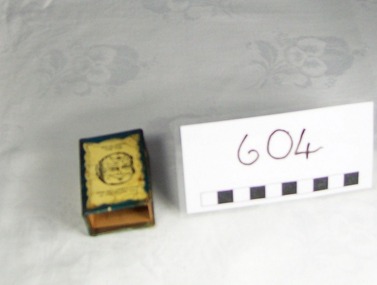 Blacksmith's Cottage and Forge
Matchbox and Matchbox Holder, Box : Bryant and May's, early 20th. century
... These included a dining hall and sports facilities such as a tennis court and bowling green which were constructed in the 1920s. ...These included a dining hall and sports facilities such as a tennis court and bowling green which were constructed in the 1920s. ...The Bryant and May Factory is located in the suburb of Cremorne in Melbourne, Australia. It was constructed in 1909 as the Empire Works to a design by prolific Melbourne architect William Pitt. It was purchased soon after by British safety match manufacturer Bryant and May who significantly expanded the building adding an additional level and the landmark clock tower. Bryant and May were unique in that they operated as a model factory providing workers with conditions and amenities which even today seem generous. These included a dining hall and sports facilities such as a tennis court and bowling green which were constructed in the 1920s. Bryant and May ceased Australian match manufacture in the early 1980s as a result of import competition. Their iconic Redheads matches are now imported from Sweden. The complex has since been converted for use as offices and showrooms but is extremely well preserved. It is listed on the Victorian Heritage Register. Source: www.wikipedia.org Local social history of Bacchus MarshMetal matchbox holder for a matchbox-one side has a photo of a local cricket team, the other side has a caricature of a man's face when held one way up is smiling and when turned up the other way the face is looking unhappy. The cover is blue with yellow. The matchbox cover is made of a thin veneer wood. The makers inscription is in blue and red.Cover/spine: Strike The Border Inn Bacchus Marsh for a good spot Phone 16 Cyril Jones, Proprietor. Cover/side: This man always calls in at the Border Inn. This Man wishes he did Matchbox:Bryant & May's "Crown" Safety Matchesbox, souvenir, sport, item, cricket, match, team, cyril, jones, border, inn, cover, novelty -
 Bendigo Historical Society Inc.
Document - Geological Survey of Victoria, Hustlers Line of Reef, Bendigo, April, 2014
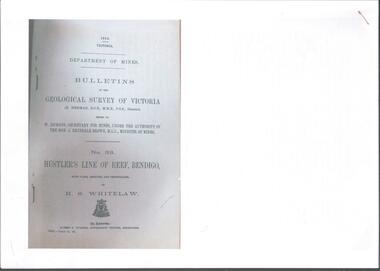
... Includes plan of Hustlers Royal Reserve No. 2, (main shaft) showing location on Pall Mall, and location of Post Office and Law Courts; plan of location of Hustlers Royal Reserve No. 2 (Park Shaft) showing Jail (sic), Camp Hill State School, two 'lagoons' in between tennis court, croquet court and bowling green; a plan of the Great Extended Hustler's Shaft and two copied images of Hustler's Hill showing mining buildings, poppet heads and chimneys. ...Includes plan of Hustlers Royal Reserve No. 2, (main shaft) showing location on Pall Mall, and location of Post Office and Law Courts; plan of location of Hustlers Royal Reserve No. 2 (Park Shaft) showing Jail (sic), Camp Hill State School, two 'lagoons' in between tennis court, croquet court and bowling green; a plan of the Great Extended Hustler's Shaft and two copied images of Hustler's Hill showing mining buildings, poppet heads and chimneys. ...Seven men were killed at the Great Extended Hustler's mine disaster on 2nd May 1914 by an explosion of dynamite occurring as the men were waiting at the plat to ascend the mine at the end of their shift. No blame was attached to anyone in the findings of the inquisition. It was unknown what caused the dynamite to explode. This document formed part of the research done at the time by Bendigo Historical Society, of the 100 years commemoration of the mine disaster, held at Hustler's Hill in 2014. Seven page photocopy of Department of Mines, Bulletin, Geological Survey of Victoria, Hustlers Line of Reef, Bendigo, No. 33 by H.S. Whitelaw. Includes plan of Hustlers Royal Reserve No. 2, (main shaft) showing location on Pall Mall, and location of Post Office and Law Courts; plan of location of Hustlers Royal Reserve No. 2 (Park Shaft) showing Jail (sic), Camp Hill State School, two 'lagoons' in between tennis court, croquet court and bowling green; a plan of the Great Extended Hustler's Shaft and two copied images of Hustler's Hill showing mining buildings, poppet heads and chimneys. Comet, K.K., Hustler's No. 1, Old Comet and United Hustler's and Redan Mines are shown in the images. great extended hustlers, goldmining, accident, quartz, mining, k.k. mine, comet mine, hustler's line of reef, old comet, united hustler's, redan -
 Bayside Gallery - Bayside City Council Art & Heritage Collection
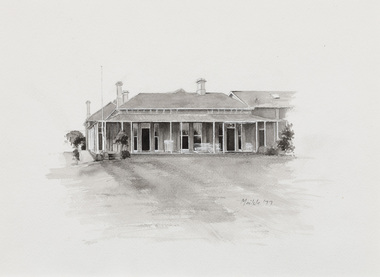
Work on paper - ink and watercolour, Annette Meikle, Sandringham Club, 1977
... Members enjoyed lawn tennis courts, a bowling green and a cricket green, as well as a large billiard room. ...Members enjoyed lawn tennis courts, a bowling green and a cricket green, as well as a large billiard room. ...In 1977, artist Annette Meikle undertook a commission to illustrate a book recording stories of places and people in the Bayside area. It was published in 1978 as Sandringham Sketchbook, with text by Elizabeth Waters. The sketches were intended to record remaining examples of Bayside’s early architecture and environment, as well as reflect newer architectural changes. Meikle went on to donate 22 of these sketches to Bayside City Council in 2003. In the mid 1870s wealthy solicitor David Abbot bought a large block on the corner of Bamfield Street and Beach Road and built an imposing family home with a stately tower. It featured rare Hawthorn Blacks – hand-made bricks of brown-red with streaks of charcoal black. For many years the home was the most prominent in the district. In 1922 ‘Coggeshall’ was subdivided, and the house was sold to the Sandringham Club, a gentleman’s club that had formed in 1913 and required more space for its growing membership. Members enjoyed lawn tennis courts, a bowling green and a cricket green, as well as a large billiard room. The Sandringham Club still owns ‘Coggeshall’.Annette Meikle, Sandringham Club 1977, ink and watercolour, 25.7 x 35.7 cm. Bayside City Council Art and Heritage Collection. Donated by the artist, 2003annette meikle, sandringham sketchbook, elizabeth waters, sandringham, sandringham club, gentleman’s club, coggeshall, david abbot, historic house -
 Kew Historical Society Inc
Plan, Melbourne & Metropolitan Board of Works. Borough of Kew Detail Plan No.1579, 1904
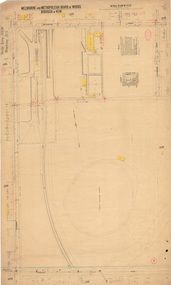
... courts off Wellington Street. The plan shows the outline of the Recreation Hall, constructed in 1880, at the rear of which is listed a bowling green, two tennis courts, a ‘skittle alley’ and a pavilion. ...courts off Wellington Street. The plan shows the outline of the Recreation Hall, constructed in 1880, at the rear of which is listed a bowling green, two tennis courts, a ‘skittle alley’ and a pavilion. ...The Melbourne and Metropolitan Board of Works (MMBW) plans were produced from the 1890s to the 1950s. They were crucial to the design and development of Melbourne's sewerage and drainage system. The plans, at a scale of 40 feet to 1 inch (1:480), provide a detailed historical record of Melbourne streetscapes and environmental features. Each plan covers one or two street blocks (roughly six streets), showing details of buildings, including garden layouts and ownership boundaries, and features such as laneways, drains, bridges, parks, municipal boundaries and other prominent landmarks as they existed at the time each plan was produced. (Source: State Library of Victoria). This plan forms part of a large group of MMBW plans and maps that was donated to the Society by the Mr Poulter, City Engineer of the City of Kew in 1989. Within this collection, thirty-five hand-coloured plans, backed with linen, are of statewide significance as they include annotations that provide details of construction materials used in buildings in the first decade of the 20th century as well as additional information about land ownership and usage. The copies in the Public Record Office Victoria and the State Library of Victoria are monochrome versions which do not denote building materials so that the maps in this collection are invaluable and unique tools for researchers and heritage consultants. A number of the plans are not held in the collection of the State Library of Victoria so they have the additional attribute of rarity.Original survey plan, issued by the MMBW to a contractor with responsibility for constructing sewers in the area identified on the plan within the Borough of Kew. The plan was at some stage hand-coloured, possibly by the contractor, but more likely by officers working in the Engineering Department of the Borough and later Town, then City of Kew. The hand-coloured sections of buildings on the plan were used to denote masonry or brick constructions (pink), weatherboard constructions (yellow), and public buildings (grey). While MMBW Plan No.1579 does not include many buildings, those that it does show are significant to Kew’s history. These include the ‘Kew [Railway] Station’ in Denmark Street and the ‘Recreation Hall’ and rear courts off Wellington Street. The plan shows the outline of the Recreation Hall, constructed in 1880, at the rear of which is listed a bowling green, two tennis courts, a ‘skittle alley’ and a pavilion. When the Hall was first built, the Kew Cricket Club occupied an adjacent ground, however in 1885 this was acquired by the State Government as the future location of the Kew Railway Station. The Plan also shows a single oval at Xavier College. This oval was completed in 1883. One of the current ovals conforms to this oval’s original shape and position in the school grounds.melbourne and metropolitan board of works, detail plans, maps - borough of kew, mmbw 1579, cartography -
 Eltham District Historical Society Inc
Newspaper Clipping, Eltham Plans £2.5m Community Centre Over Next 15 Years, The Age, 6 March 1963 page 7, 1963
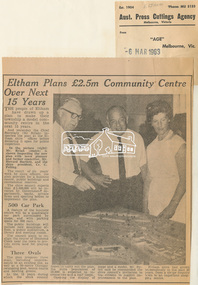
... Three Ovals The plan proposes three ovals, including improvements to an existing one, as well as a 50-metre Olympic swimming pool, tennis courts and bowling greens. In the 15 years which the shire council hopes to carry out the plan, the shire population of 18,000 is expected to increase two and a half times. ...Three Ovals The plan proposes three ovals, including improvements to an existing one, as well as a 50-metre Olympic swimming pool, tennis courts and bowling greens. In the 15 years which the shire council hopes to carry out the plan, the shire population of 18,000 is expected to increase two and a half times. ...Eltham Plans £2.5m Community Centre Over Next 15 Years THE people of Eltham have drawn up a plan to make their township a model community centre in the next 15 years. And yesterday the Chief Secretary (Mr Rylah) inspected the plan at the Eltham shire offices before declaring it open for public inspection In the picture (right) Mr. Rylah (centre) is shown inspecting the new plan with town planner and former councillor, Mr. Howard Bartlett, and the shire president, Cr. C. Pelling. The result of six years' work by shire officers, the plan provides for a business centre, public buildings and recreational reserves. The shire council expects that £2,500,000 will be invested by Government departments, banks, private firms and sporting bodies to implement the plan. 500 Car Park A feature of the business centre will be a quadrangle car park surrounded by shops, and with parking space for 500 cars. The public buildings will include new municipal offices, a public auditorium, a library and meeting rooms. The council plans to realign the course of Diamond Creek near the town to provide extra land for playing fields. Three Ovals The plan proposes three ovals, including improvements to an existing one, as well as a 50-metre Olympic swimming pool, tennis courts and bowling greens. In the 15 years which the shire council hopes to carry out the plan, the shire population of 18,000 is expected to increase two and a half times. Opening the display of maps and a model, Mr. Rylah said he commended the shire council's invitation to the citizens to suggest improvements to the plan. Eltham shire had grown tremendously in the past 20 years, from a sleepy country town to an important shopping centre. Digital file only of copy provided on loanauditorim, bowlong green, charis pelling, eltham community centre, rylah, howard bartlett, car park, library, forward plan -
 City of Moorabbin Historical Society (Operating the Box Cottage Museum)
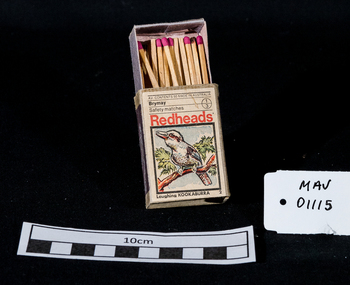
Containers, matchbox 'Redhead' with matches, 20thC
... These included a dining hall and sports facilities such as a tennis court and bowling green which were constructed in the 1920s. ...These included a dining hall and sports facilities such as a tennis court and bowling green which were constructed in the 1920s. ...On 15th December 1909, Bryant & May, Australia’s first match factory at Church Street, Richmond, Victoria. was opened by The Honourable Alfred Deakin, Prime Minister of Australia, and Mrs. Deakin. It was heralded by the first Commonwealth Government of newly-federated Australia because the government of the day was anxious to encourage secondary industry and pledged tariff protection of local manufacturers. The building was constructed in 1909 as the Empire Works to a design by prolific Melbourne architect William Pitt and was purchased soon after by British safety match manufacturer Bryant and May, who significantly expanded the building, adding another level and the landmark clock tower. Bryant and May were unique in that they operated as a model factory, providing workers with conditions and amenities that even today seem generous. These included a dining hall and sports facilities such as a tennis court and bowling green which were constructed in the 1920s. Bryant and May ceased Australian match manufacture in the early 1980s as a result of import competition. Their iconic Redheads matches are now imported from Sweden. The complex has since been converted for use as offices and showrooms but is extremely well preserved. It is listed on the Victorian Heritage Register. Bryant and May was a United Kingdom (UK) company created in the mid-nineteenth century specifically to make matches. Their original Bryant and May Factory was located in Bow, London. They later opened other match factories in the United Kingdom and Australia, such as the Bryant and May Factory, Melbourne; and owned match factories in other parts of the world. Bryant and May survived as an independent company for over seventy years, but went through a series of mergers with other match companies and later with consumer products companies. To protect its position Bryant and May merged with or took over its rivals. In 1971 the Northern Ireland factory, Maguire & Patterson closed down following a terrorist attack.. In the 1980s, factories in Gloucester and Glasgow closed too leaving Liverpool as the last match factory in the UK, until December 1994. . The registered trade name Bryant and May still exists and it is owned by Swedish Match, as are many of the other registered trade names of the other, formerly independent, companies within the Bryant and May group. Two French chemists, Henri Savene and Emile David Cahen, proved in 1898 that the addition of phosphorus sesquisulfide meant that the substance was not poisonous, that it could be used in a "strike-anywhere" match, and that the match heads were not explosive. British company Albright and Wilson, was the first company to produce phosphorus sesquisulfide ( Red Phosphorous) matches commercially. The company developed a safe means of making commercial quantities of phosphorus sesquisulfide in 1899 and started selling it to match manufacturers. Matches were first produced by Bryant & May in Australia in 1909. The Redhead name applies to the red striking heads of the matches which were introduced to Australia in 1946. The logo on the matchbox depicted the head and shoulder of a redheaded woman and has had four major updates since that time with a number of special issues depicting birds, animals and notable persons also produced.The Bryant & May Ltd factory in Church St Richmond is a listed building and has been converted to apartments following the closure of the Company 1980. Bryant & May's Ltd were influential in fighting against the dreadful disease known as Phossy jaw which was caused by white phosphorus used in the manufacture of the early matches. They were also the object of the 'Match Girls Strike' in London 1888, which won important improvements in working conditions and pay for the mostly female workforce working with the dangerous white phosphorus. The public were slow to purchase these safety matches because of the higher price .A box of safety matches with unused matches made by Bryant & May Pty Ltd , Richmond Victoria Australia. The tray containing the matches slides inside the open ended cover.. The striking patch is on both sides of the cover. Av. CONTENTS 50 MADE IN AUSTRALIA / Brymay / 1/3 / Safety Matches / Redheads / a colour picture of a Kookaburra / Laughing KOOKABURRAsafety matches, bryant & may pty ltd, phossy jaw disease, early settlers, moorabbin, bentleigh, cheltenham, lights, lamps, tobacco, white phosphorous, phosphorus sesquisulfide, swedish match pty ltd, pitt william, savens henri, cahen emile david , richmond victoria, -
 City of Moorabbin Historical Society (Operating the Box Cottage Museum)
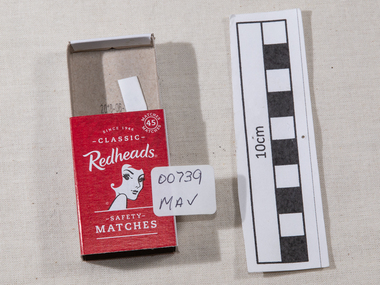
Manufactured Objects, safety matches 'Redheads' 2015, c2015
... These included a dining hall and sports facilities such as a tennis court and bowling green which were constructed in the 1920s. ...These included a dining hall and sports facilities such as a tennis court and bowling green which were constructed in the 1920s. ...This is a current example of the 'Redhead' logo used by Bryant & May Ltd Richmond,Victoria, Australia c 1946 - 1980 On 15th December 1909, Bryant & May, Australia’s first match factory at Church Street, Richmond, Victoria. was opened by The Honourable Alfred Deakin, Prime Minister of Australia, and Mrs. Deakin. It was heralded by the first Commonwealth Government of newly-federated Australia because the government of the day was anxious to encourage secondary industry and pledged tariff protection of local manufacturers. The building was constructed in 1909 as the Empire Works to a design by prolific Melbourne architect William Pitt and was purchased soon after by British safety match manufacturer Bryant and May, who significantly expanded the building, adding another level and the landmark clock tower. Bryant and May were unique in that they operated as a model factory, providing workers with conditions and amenities that even today seem generous. These included a dining hall and sports facilities such as a tennis court and bowling green which were constructed in the 1920s. Bryant and May ceased Australian match manufacture in the early 1980s as a result of import competition. Their iconic Redheads matches are now imported from Sweden. The complex has since been converted for use as offices and showrooms but is extremely well preserved. It is listed on the Victorian Heritage Register. Bryant and May was a United Kingdom (UK) company created in the mid-nineteenth century specifically to make matches. Their original Bryant and May Factory was located in Bow, London. They later opened other match factories in the United Kingdom and Australia, such as the Bryant and May Factory, Melbourne; and owned match factories in other parts of the world. Bryant and May survived as an independent company for over seventy years, but went through a series of mergers with other match companies and later with consumer products companies. To protect its position Bryant and May merged with or took over its rivals. In 1971 the Northern Ireland factory, Maguire & Patterson closed down following a terrorist attack.. In the 1980s, factories in Gloucester and Glasgow closed too leaving Liverpool as the last match factory in the UK, until December 1994. . The registered trade name Bryant and May still exists and it is owned by Swedish Match Industries as are many of the other registered trade names of the other, formerly independent, companies within the Bryant and May group. Two French chemists, Henri Savene and Emile David Cahen, proved in 1898 that the addition of phosphorus sesquisulfide meant that the substance was not poisonous, that it could be used in a "strike-anywhere" match, and that the match heads were not explosive. British company Albright and Wilson, was the first company to produce phosphorus sesquisulfide ( Red Phosphorous) matches commercially. The company developed a safe means of making commercial quantities of phosphorus sesquisulfide in 1899 and started selling it to match manufacturers. Matches were first produced by Bryant & May in Australia in 1909. The Redhead name applies to the red striking heads of the matches which were introduced to Australia in 1946. The logo on the matchbox depicted the head and shoulder of a redheaded woman and has had four major updates since that time with a number of special issues depicting animals, birds and notable persons also producedThe Bryant & May Ltd factory in Church St Richmond is a listed building and has been converted to apartments following the closure of the Company 1980. Bryant & May's Ltd were influential in fighting against the dreadful disease known as Phossy jaw which was caused by white phosphorus used in the manufacture of the early matches. They were also the object of the 'Match Girls Strike' in London 1888, which won important improvements in working conditions and pay for the mostly female workforce working with the dangerous white phosphorus. The public were slow to purchase these safety matches because of the higher price An empty box of 'Redheads' safety matches made in Sweden for ST-Group, Springvale, Victoria, Australia c2015. The tray for the matches slides inside the open ended cover. The striking patch is on both sides of the cover. The matches have been removed. Matches were first produced by Bryant & May in Australia in 1909. The Redhead name applies to the red striking heads of the matches which were introduced to Australia in 1946. The logo on the matchbox depicted the head and shoulder of a redheaded woman and has had four major updates since that time with a number of special issues depicting animals, birds and notable persons also produced. Bryant and May ceased Australian match manufacture in the early 1980s.Top of cover ; Redheads / 45 safety / matches . Logo ; head & shoulders of a female with red hair Base of coverMade in Sweden / Redheads (R) is proudly marketed / by ST- Group Australia. / 718 Princes Highway Springvale Vic. 3171 / .............../ Readheads is a registered trademark / of Swedish Match Industries AB. / Complies ith European / Match Standard EN 1783-1997-SAF/ WARNING; / KEEP OUT OF REACH / OF CHILDREN. STRIKE / GENTLY AWAY FROM BODY . / barcode.redheads safety matches, safety matches, bryant & may pty ltd, phossy jaw disease, early settlers, moorabbin, bentleigh, cheltenham, lights, lamps, tobacco, white phosphorous, phosphorus sesquisulfide, swedish match pty ltd, pitt william, savens henri, cahen emile david , richmond victoria, match girls strike 1888, -
 Eltham District Historical Society Inc
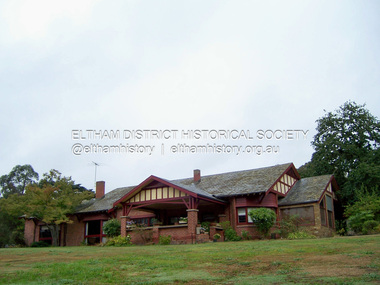
Photograph - Digital Photograph, Marguerite Marshall, 'Worlingworth', 10-26 Banoon Road, Eltham, 30 January 2006
... The property then included a nine-hole golf course, a tennis court, a bowling green, a boathouse and a boat-ramp.4 For most of his career Thomson, who was born in 1901, was attached to The University of Melbourne. ...The property then included a nine-hole golf course, a tennis court, a bowling green, a boathouse and a boat-ramp.4 For most of his career Thomson, who was born in 1901, was attached to The University of Melbourne. ...'Worlingworth', Eltham, home of noted anthropologist the late Professor Donald Thomson and his wife Dorita Thomson. Covered under Heritage Overlay, Nillumbik Planning Scheme. Published: Nillumbik Now and Then / Marguerite Marshall 2008; photographs Alan King with Marguerite Marshall.; p127 Dubbed as ‘Australia’s Lawrence of Arabia’ anthropologist Donald Thomson lived much of his life in Eltham, at Banoon Road. On his retirement as Professor of Anthropology in 1968, The University of Melbourne professorial board compared Thomson to Lawrence of Arabia because of his work for Aborigines and his controversial personality. Although Thomson is now recognised for his huge contribution, during his lifetime he suffered opposition and his life has been described as ‘tragic’.1 Thomson failed to gain the recognition as a scientist that he felt he deserved and he failed to alter government policy towards Aboriginal people. But towards the end of his life in 1970, anthropologists were moving towards the type of research he had done and the movement to grant land rights to Aborigines was strengthening. Thomson is best known for his anthropological fieldwork in Cape York, Arnhem Land and Central Australia, but he is also known for his scholarly contributions to ornithology and ecology. Thomson documented every aspect of the daily and ritual life of the Aboriginal world of Cape York and Arnhem Land in the 1930s and 1940s. The huge collection in Museum Victoria includes 11,000 photographs, 7500 items of material culture, 1000 botanical and zoological specimens and 4500 pages of field-notes.2 The film Ten Canoes used Thomson’s photographs as a source. Thomson bought the Eltham property known as Worlingworth in 1934. The single-storey 60-square house standing by the Yarra River was built in 1922-23. It is one of the last in Eltham to survive with its farm setting intact. It is also one of the few substantial residences built in the Eltham Shire from the late 19th century to the early 20th century, which signalled a major change in the area towards the residential municipality it is today.3 The original section, built in the mid 1860s, of rose pink hand-made bricks and stone quarried on the property, was incorporated in the new red-brick house built in 1922. An immense oak tree by the house grew from an acorn brought by Patrick Armstrong who first bought the land in March 14, 1862. Armstrong named Worlingworth after his forbears’ village in Suffolk, England. Worlingworth saw grand days when Commander Alan A Barlee (R.N.) bought it in 1922 after winning the Calcutta Sweep. The property then included a nine-hole golf course, a tennis court, a bowling green, a boathouse and a boat-ramp.4 For most of his career Thomson, who was born in 1901, was attached to The University of Melbourne. In 1935 he represented the Commonwealth Government at Caledon Bay in east Arnhem Land to investigate and mediate for four Aborigines accused of killing five Japanese and three Europeans. In 1938 Thomson was awarded a PhD in Anthropology at Cambridge University, and during his career, he received several medals from British Societies, who perhaps appreciated his work better than their Australian counterparts. From World War Two, Thomson suffered a string of hardships, beginning with severe wounding in Dutch New Guinea (for his military service in New Guinea he was awarded an OBE) and he was invalided from service in 1944. That year he was diagnosed with diabetes. A fire in 1946 destroyed what Thomson regarded as perhaps the best record he had made of Aboriginal life – the 20,000 feet, (6096m) of film he had shot in Arnhem Land. In 1954 he and wife, Gladys, divorced. The next year he married his technical assistant, Dorita McColl. Several times during his career Thomson had major disagreements. For instance Professor P Elkin constantly opposed his work. He also opposed Thomson when he campaigned vigorously in 1947 against the establishment of a rocket range at Woomera, South Australia, because of the threat it posed Aborigines. Thomson resigned in frustration from the Victorian Aborigines Welfare Board in 1967, after serving for ten years, because he found that his advice was disregarded. His ashes were scattered over Caledon Bay from the air.This collection of almost 130 photos about places and people within the Shire of Nillumbik, an urban and rural municipality in Melbourne's north, contributes to an understanding of the history of the Shire. Published in 2008 immediately prior to the Black Saturday bushfires of February 7, 2009, it documents sites that were impacted, and in some cases destroyed by the fires. It includes photographs taken especially for the publication, creating a unique time capsule representing the Shire in the early 21st century. It remains the most recent comprehenesive publication devoted to the Shire's history connecting local residents to the past. nillumbik now and then (marshall-king) collection, banoon road, donald thomson, dorita thomson, eltham, worlingworth -
 Sunshine and District Historical Society Incorporated
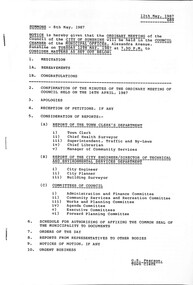
Administrative record - City of Sunshine Council Meetings 1986 - 1994 - Notice of Ordinary Meeting 12th May 1987, City of Sunshine, 8th May 1987
... Bowling Club...Yarmouth Avenue...Somerville Road...Tottenham...Glengala Road...Links Street...McKechnie Street...Gratz Street...Sun Crescent...Christie Street...Geelong Road...Angler's Hotel...Raleigh Road...Daveyduke Industries...Hesser Street...Albion...Anderson Road...Drake Street...Massey Ferguson...Main Road West...Oakwood Road...Cromer Avenue...Sydney Street...Craigavon Court...Albans Road Bridge Over Railway Line Albion Improvements Somers Street Sunshine North Private Street Scheme Northwestern Sewer Report of the City Planner Rezoning Application Land Bounded by Kent Street, Stewart Street, Hotham Street & Pritchard Avenue Braybrook (Existing Use Tennis Courts, Sunshine VRI Bowling Club, Squash Courts & Car Parking) Planning Permit Amended Plans / Permit Flats 29 Yarmouth Avenue St. ...Albans Road Bridge Over Railway Line Albion Improvements Somers Street Sunshine North Private Street Scheme Northwestern Sewer Report of the City Planner Rezoning Application Land Bounded by Kent Street, Stewart Street, Hotham Street & Pritchard Avenue Braybrook (Existing Use Tennis Courts, Sunshine VRI Bowling Club, Squash Courts & Car Parking) Planning Permit Amended Plans / Permit Flats 29 Yarmouth Avenue St. ...Notice of Ordinary Meeting 12th May 1987 Report of the Town Clerk's Department Report of the Town Clerk Accounts for Payment as at 30th April 1987 Sunshine Council Staff Social Club Future State / Commonwealth Funding for Local Government in Victoria Financial Relationships Between State and Local Government Plant & Equipment Multiple Sclerosis Swim-A-Thon Loan Nursery Store Control Use of Council Chamber Heart Health Awareness Program Local Government Elections Bill 1987 Fairbairn Road Sunshine West Private Street Scheme Proposed Discontinuance of Part of the Right of Way Between Corio Street and Derby Road Off Watt Street Sunshine Proposed Closure of Part of the Right of Way Between Main Road East and Princes Street St. Albans Occupational Health and Safety Improvements Occupational Health and Safety Discussion Paper and Draft Code of Practice on Safe Manual Handling Unexpended Loan Funds Municipal Association of Australia Supplementary Valuations Redemption of Inscribed Stock Visit to Blacktown Child Care Administration Report Report of the Chief Health Officer Registration of Premises Health Act & Food Act Transfer of Registration of Premises Prosecution Proceedings Sunshine Magistrates Court Issuing of Septic Tank Approval Notices Food Premises Lot 460 Fitzgerald Road Sunshine West Report of the Superintendent Traffic & By-laws Dog Act Stray Dogs Western Suburbs Traffic and Parking Infringements Court Proceedings Proposed Procession Tarxien Social Club From Our Lady of Perpetual Sucor Church Ballarat Road Maidstone and Proceed East Along Ballarat Road to Church Hall, a Distance of 200 yards Proposed Procession Maltese Celebrations St. Bernadettes Church Westmoreland Road Sunshine North Proposed Procession Santa Marija Assunta Association From St. Peter Chanel Church Along Ballarat Road, Left into Miles Street and then Left into Harrison Street Deer Park Report of the Chief Librarian Libraries Review Options for State Government Funding of Municipal Public Libraries in Victoria Report Mobile Library Driver Sculpture Park Northumberland Road Corner Warwick Road Sunshine North Funding T.A.F.E. West Time and Motion Theater Group T.A.F.E. West Stream 4/5 Programs Quarterly Report of the Community Music Officer Government Grants for Music Projects Report of the Acting Manager Community Services Integration Recreation Officer Submission Ministry of Housing Rental Arrears Recovery Procedures Playground Equipment Marie Mill Community Centre Advisory Committee Victorian Arts Centre Council Concerts Richmond Translation and Interpreting Service Commonwealth Nursing Homes and Hostels Review Home and Community Care Program (HACC) Submission for the Continuation and Extension of the Sunshine Adult Day Care Centre Project Mid West Temporary Care Programme West Sunshine Community Centre Advisory Committee Meeting Wattle District Health Council Killeen Street Child Care Centre Procedure Manual for After School Programmes Report of the City Engineer Proposed Toxic Waste Disposal Facility MMBW Combined Area Commissions Station Road Albanvale Western Side Landscaped Area by Lions Club of Deer Park (Deer Park Lions Club) House of Sunshine Foyer Flooding House of Sunshine Additions & Alterations Sunshine Park Tennis Club Flood Lighting Tree Removals Installation of School Crossing in Willaton Street at Ginifer Station Between Clare Street and Bailey Street Plans for the Construction of the Road and Drains Associated with Subdivision of City link Pty Ltd Francis Street Brooklyn Intersection of McIntyre Road, Furlong Road and Berkshire Road Notice of Motion to Install Traffic Lights Keep Clear Marking Painted on the Road Pavement McIntyre Road at the New Sunshine Fire Station Plans for Construction of Road and Drains Associated with Subdivision of Urban Land Authority's Land Grantham Parade St. Albans Traffic Facilities Programme Westmoreland Road / Warwick Road Roundabout Tenders Station Road Duplication Gladstone Street to Mawson Avenue Deer Park Traffic Control Items St. Albans Road Bridge Over Railway Line Albion Improvements Somers Street Sunshine North Private Street Scheme Northwestern Sewer Report of the City Planner Rezoning Application Land Bounded by Kent Street, Stewart Street, Hotham Street & Pritchard Avenue Braybrook (Existing Use Tennis Courts, Sunshine VRI Bowling Club, Squash Courts & Car Parking) Planning Permit Amended Plans / Permit Flats 29 Yarmouth Avenue St. Albans Planning Permit Application Extensions to Offensive Industry Somerville Road Tottenham Planning Permit Application Alterations to Paper Mill Somerville Road Tottenham Planning Permit Application Minor Sportsground (Bocce Courts) Glengala Road North West Corner Links Street Sunshine West Planning Permit Application Trash & Treasure Market McKechnie Street North East Corner Gratz Street St. Albans Planning Permit Application Illuminated and Animated Sign 290 Ballarat Road Braybrook Planning Permit Application Light Industry Cake Shop 31A Sun Crescent Sunshine Planning Permit Application Flats 22 - 24 Christie Street Deer Park Planning Permit Application Alterations to Existing Floodlit Panel Sign 552 Geelong Road Brooklyn Planning Permit Application Alterations & Additions to Existing the Angler's Hotel Raleigh Road Maribyrnong Melbourne Metropolitan Planning Scheme Amendment No 150 Part 20 Melbourne Metropolitan Planning Scheme Amendment No 384 Melbourne Metropolitan Planning Scheme Amendment No 320 Part 2 Melbourne Metropolitan Planning Scheme Amendment No 428 Melbourne Metropolitan Planning Scheme Amendment No 429 Planning Permit Application Council Prosecution Daveyduke Industries Hesser Street Albion Planning Permit Application Four Flats 141 Anderson Road Albion Planning Permit Application Manufacturing Sales 129 - 131 McIntyre Road South West Corner Drake Street Sunshine North Melbourne Metropolitan Planning Scheme Amendment No 386 Part 1 Planning Permit Application Factory 38 & 40 McIntyre Road Sunshine North Sunshine Plaza Extensions Historic Buildings Council Decision (Former Massey Ferguson Site Showroom, Clock Tower, Russell Street Guardhouse Entrance & Gates, Remaining Buildings Fronting Devonshire Road East of Russell Street Exteriors, Buildings Which House the Assembly Floor structure North of Showroom, Foundry & Crane Causeway) Education Department Land South West Corner Main Road West and Oakwood Road Albanvale Delegated Matters Plan of Consolidation Lots 210 & 212 Cromer Avenue and Lots 209 & 211 McIntyre Road Sunshine North Plan of Strata Subdivision 11 Sydney Street Albion Plan of Transfer and Consolidation Craigavon Court Deer Park Report of the Building Surveyor Location of Building12 Cooke Avenue Sunshine North Dangerous Building Unit 8 91 - 93 The Esplanade Maribyrnong Dangerous Building Unit 9 91 - 93 The Esplanade Maribyrnong Location of Building 43 Trafalgar Street Albanvale Statistical Information Building Permits From 1st January 1987 to 31st March 1987 Schedule for Authorising of Affixing the Common Seal of the Municipality to Documents Orders of the Day Loan Planning Permit Application Motor Repair Station Omar Street Maidstone Show Cause Notice 19 Second Avenue Sunshine Proposal to Construct Fairbairn Road Private Street Scheme Under the Provisions of Division 10 of Part XIX of the Local Government Act 1958 Proposal to Construct Somers Street Private Street Scheme Under the Provisions of Division 10 of Part XIX of the Local Government Act 1958 Notice of Motions Record of Ordinary Council Meeting Proceedings Management of Child Care Centres Balance Sheets Fundraising Sunshine Community Nursing Home Striking of Special Rate Small Business Planning Permit Application Motor Repair / Panel Beating 70 Monash Street Sunshine Maribyrnong RSL Repairs & Restoration Education Council of Adult Education Centres Child Care Administration Municipal Boundaries Brooklyn Australian Nuclear Free Zones Secretariat Proposed Off Street Parking McIntyre Road Sunshine North Proposed Acquisition of Land McIntyre Road Sunshine North Proposed Renaming of Reserves for Two long Serving Members of the Council Cr. Ian M. Mill and Cr. Don J. McKay Council Stationery Garbage Disposalfairbairn road, sunshine west, corio street, derby road, watt street, sunshine, main road east, princes street, st. albans, fitzgerald road, tarxien social club, our lady of perpetual sucor church, ballarat road, maidstone, st. bernadettes church, westmoreland road, sunshine north, santa marija assunta association, st. peter chanel church, miles street, harrison street, deer park, northumberland road, warwick road, marie mill community centre, randall street, maribyrnong, west sunshine community centre, kermeen street, killeen street child care centre, killeen street, station road, albanvale, lions club of deer park, deer park lions club, sunshine park tennis club, stanford street, willaton street, ginifer railway station, clare street, bailey street, francis street, brooklyn, thomas borthwick & sons, mcintyre road, furlong road, berkshire road, sunshine fire station, grantham parade, gladstone street, mawson avenue, st. albans road bridge, st. albans road, somers street, kent street, stewart street, hotham street, pritchard avenue, braybrook, sunshine vri bowling club, yarmouth avenue, somerville road, tottenham, glengala road, links street, mckechnie street, gratz street, sun crescent, christie street, geelong road, angler's hotel, raleigh road, daveyduke industries, hesser street, albion, anderson road, drake street, massey ferguson, main road west, oakwood road, cromer avenue, sydney street, craigavon court, cooke avenue, the esplanade, omar street, second avenue, monash street, maribyrnong rsl, raleigh street -
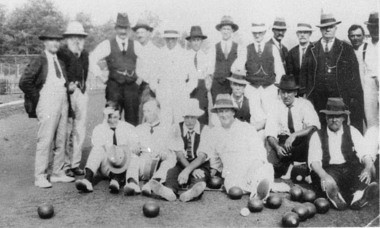 Upper Yarra Museum
Negative Photographic Reproduction, Bowling club 1900 Powelltown
... The community built their own facilitys. they also built tennis courts and a picture theater/hall at Gilderoy bowling club 1900 powelltown bowling ball bowling pitch 03052 Bowling club 1900 Powelltown. ...Primitive Bowls started in Ancient Egypt, and the common form has remained very popular throughout the 20th century, with the popularity waning in the 21st century.Powelltown had a very vibrant community with many recreational, activities, Bowls, cricket, football, tennis, swimming, and dances, held at powelltown and Yarra Junction. The community built their own facilitys. they also built tennis courts and a picture theater/hall at Gilderoy03052 Bowling club 1900 Powelltown. Upper Yarra Shire 1888-1988 Centenary collection. Black & white Negative, scanned at 600 dpibowling club 1900 powelltown bowling ball bowling pitch -
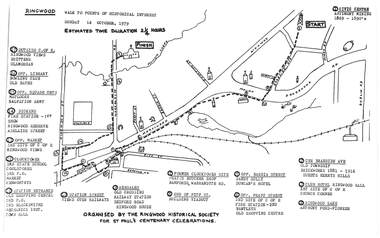 Ringwood and District Historical Society
Pamphlet, Ringwood Walk - Points of Historical Interest, 1979
... 1 - Start 2 - Cnr Braeside Avenue, old township, brickworks 1881-1916, Guests, Herrys, Hills 3 - Club Hotel, Ringwood Hall, 1st site of C of E church corner 4 - Ringwood Lake, Anthony Ford - pioneer 5 - Opposite Bardia Street, Sandy Gully, Duncan's Hotel 6 - Opposite Pratt Street, 2nd site of C of E, 2nd fire station, Bentleys, old shopping centre 7 - Warrandyte Road, Former Clocktower site, Pratts butcher shop, Bamfords 8 - End of Pitt Street, building viaduct 9 - Bedford Road, Webdales, old crossing, railway station 10 - Station Street, views over railways 11 - Station entrance, old shopping centre, 2nd Postoffice, 2nd blacksmiths, Mechanics Institute, Town Hall 12 - Clocktower, 3rd State School, coolstores, 3rd Postoffice, market, Kenworthys 13 - Opposite market, 3rd site of C of E, Ringwood views 14 - Adelaide Street, Dickens, 1st fire station, Ringwood Reserve 15 - Opposite squash courts, Matlocks, Salvation Army 16 - Opposite library, bowling club, old baths 17 - Outside C of E, Ringwood views, Brittens, Glamorgan...1 - Start 2 - Cnr Braeside Avenue, old township, brickworks 1881-1916, Guests, Herrys, Hills 3 - Club Hotel, Ringwood Hall, 1st site of C of E church corner 4 - Ringwood Lake, Anthony Ford - pioneer 5 - Opposite Bardia Street, Sandy Gully, Duncan's Hotel 6 - Opposite Pratt Street, 2nd site of C of E, 2nd fire station, Bentleys, old shopping centre 7 - Warrandyte Road, Former Clocktower site, Pratts butcher shop, Bamfords 8 - End of Pitt Street, building viaduct 9 - Bedford Road, Webdales, old crossing, railway station 10 - Station Street, views over railways 11 - Station entrance, old shopping centre, 2nd Postoffice, 2nd blacksmiths, Mechanics Institute, Town Hall 12 - Clocktower, 3rd State School, coolstores, 3rd Postoffice, market, Kenworthys 13 - Opposite market, 3rd site of C of E, Ringwood views 14 - Adelaide Street, Dickens, 1st fire station, Ringwood Reserve 15 - Opposite squash courts, Matlocks, Salvation Army 16 - Opposite library, bowling club, old baths 17 - Outside C of E, Ringwood views, Brittens, Glamorgan Sketch of walking route for 17 historical points of interest organised by the Ringwood Historical Society for St. ...Sketch of walking route for 17 historical points of interest organised by the Ringwood Historical Society for St. Paul's Church Centenary Celebrations - 14 October 1979, estimated duration 2-1/4hours.1 - Start 2 - Cnr Braeside Avenue, old township, brickworks 1881-1916, Guests, Herrys, Hills 3 - Club Hotel, Ringwood Hall, 1st site of C of E church corner 4 - Ringwood Lake, Anthony Ford - pioneer 5 - Opposite Bardia Street, Sandy Gully, Duncan's Hotel 6 - Opposite Pratt Street, 2nd site of C of E, 2nd fire station, Bentleys, old shopping centre 7 - Warrandyte Road, Former Clocktower site, Pratts butcher shop, Bamfords 8 - End of Pitt Street, building viaduct 9 - Bedford Road, Webdales, old crossing, railway station 10 - Station Street, views over railways 11 - Station entrance, old shopping centre, 2nd Postoffice, 2nd blacksmiths, Mechanics Institute, Town Hall 12 - Clocktower, 3rd State School, coolstores, 3rd Postoffice, market, Kenworthys 13 - Opposite market, 3rd site of C of E, Ringwood views 14 - Adelaide Street, Dickens, 1st fire station, Ringwood Reserve 15 - Opposite squash courts, Matlocks, Salvation Army 16 - Opposite library, bowling club, old baths 17 - Outside C of E, Ringwood views, Brittens, Glamorgan
