
Showing 1780 items matching " cargo ship"
-
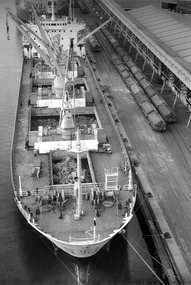 Glenelg Shire Council Cultural Collection
Photograph - Photograph - Unknown cargo ship, aerial view, n.d
... Photograph - Unknown cargo ship, aerial view...Aerial view of cargo ship berthed at a wharf. Contents of hold (sacked goods) are visible....Photograph Photograph - Unknown cargo ship, aerial view ...Port of Portland Authority archives.Front: (no inscriptions) Back: (no inscriptions)port of portland archives -
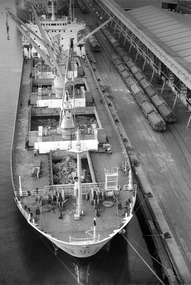 Glenelg Shire Council Cultural Collection
Photograph - Photograph - Unknown cargo ship, aerial view, n.d
... Photograph - Unknown cargo ship, aerial view...Aerial view of cargo ship berthed at a wharf. Contents of hold (sacked goods) are visible....Photograph Photograph - Unknown cargo ship, aerial view ...Port of Portland Authority archives.Front: (no inscriptions) Back: (no inscriptions)port of portland archives -
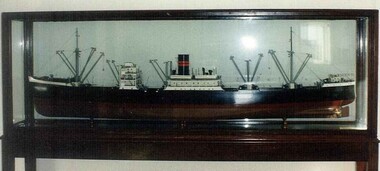 Glenelg Shire Council Cultural Collection
Artwork, other - Model Ship, MacKenzie and Co, Clan MacDougal Model Cargo Ship, n.d
... Clan MacDougal Model Cargo Ship...Clan MacDougal Model Cargo Ship Artwork, other Model Ship MacKenzie and Co. ...Port of Portland CollectionModel of a ship. Hull is painted in black (above water line) and burgundy (below water line). Ship has three masts, a smoke stack (black with red stripes) and a white super structure with portholes. Supported on brass stands. Housed in a timber and glass case. Label in case.Front: T.S.M.V. Clan MacDougall Length BP 475', Breadth 64'-6", Depth 41½. Built by the Greenock Dockyard Co. Ltd. for Clanline Steamers Ltd., London.port of portland collection -
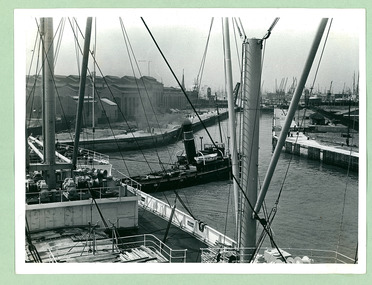 Department of Health and Human Services
A large cargo ship entering the Royal Docks in the Port of London - Department of Health – National Fitness Office (Sports & Recreation) – Historical Press Release Photo Collection
... A large cargo ship entering the Royal Docks in the Port of London - Department of Health – National Fitness Office (Sports & Recreation) – Historical Press Release Photo Collection ...Department of Health – National Fitness Office (Sports & Recreation) – Historical Press Release Photo - Empire Youth Day & Royals on Tour Collection Department of Health – National Fitness Office (Sports & Recreation) – Historical Press Release Photo - Empire Youth Day & Royals on Tour Collection A large cargo ship entering the Royal Docks in the Port of London - Department of Health – National Fitness Office (Sports & Recreation) – Historical Press Release Photo Collection ...Department of Health – National Fitness Office (Sports & Recreation) – Historical Press Release Photo - Empire Youth Day & Royals on Tour CollectionDepartment of Health – National Fitness Office (Sports & Recreation) – Historical Press Release Photo - Empire Youth Day & Royals on Tour Collection -
 Glenelg Shire Council Cultural Collection
Photograph - Photograph - Early Shipping: Ocean/Railway Pier, c. 1938
... ... Cargo Ship...Black and white photo. Of a cargo ship. Three couta boats on left of photo....Of a cargo ship. Three couta boats on left of photo. ...Port of Portland Authority ArchivesFront: Back-'....shore Barton R...' - Blue pen Circa 1938port of portland archives, portland harbour, cargo ship, couta boats -
Glenelg Shire Council Cultural Collection
Postcard - Postcard - S. S. Myrtlebank, 1933
... ... cargo ship...Myrtlebank was a British cargo ship built in 1908....Myrtlebank was a British cargo ship built in 1908. postcard cargo ship Black and white postcard S. ...S. S. Myrtlebank was a British cargo ship built in 1908.Black and white postcard S. S. Myrtlebank berthed at Ocean Pier, Portland 1950s.postcard, cargo ship -
Glenelg Shire Council Cultural Collection
Photograph - Photograph - loading unknown cargo onto ship, n.d
... Photograph - loading unknown cargo onto ship...Loading unknown cargo (possibly fruit) with a ship's crane onto ship with partially visible name (Straat ..)...Photograph Photograph - loading unknown cargo onto ship ...Port of Portland Authority archivesFront: (no inscriptions) Back: (no inscriptions)port of portland archives, cargo, cargo handling, portland harbour -
Glenelg Shire Council Cultural Collection
Photograph, (Unknown cargo loaded onto ship), n.d
... (Unknown cargo loaded onto ship)...(Unknown cargo loaded onto ship) Photograph Photograph ...Port of Portland Authority archives.Front: (no inscriptions) Back: (no inscriptions)port of portland -
Glenelg Shire Council Cultural Collection
Functional object - Lifebuoy, n.d
... ... cargo ship...The lifebuoy came from the S S Casino. A popular cargo ship, the Casino was a regular sight on the Moyne river and along the coast. ...The lifebuoy came from the S S Casino. A popular cargo ship, the Casino was a regular sight on the Moyne river and along the coast. ...City of Portland Collection|Kurtze Museum|19/4/2000. The lifebuoy came from the S S Casino. A popular cargo ship, the Casino was a regular sight on the Moyne river and along the coast. The ship was an integral part of coastal life until she was shipwrecked in the 1930's, and objects from the Casino can now be found in collections from across the region.S S CasinoCanvas covered ring of bouyant material (possibly cork), with rope loop fixed to 4 ponts on the outside edge. Inscription "S.S. CASINO" centre top, "PORT FAIRY" at centre bottom, a flag painted centre left and centre right.Front: Centre top "S. S. CASINO"|Centre bottom "PORT FAIRY"|flag on centre left and centre rightss casino, port fairy, cargo ship, lifebuoy -
 Mission to Seafarers Victoria
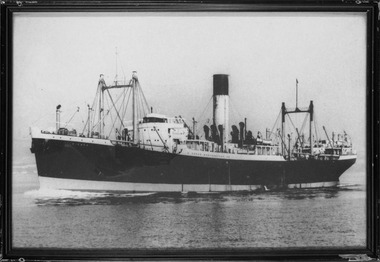
Photograph - Photograph, Black and white, S.S. Diomed, unknown
... ...cargo ship...Diomed' was the last of the Blue Funnel Line's coal-burning cargo ships. Launched in 1922 she made her last voyage from Australia to England in 1952 where she was broken up. ...Diomed' was the last of the Blue Funnel Line's coal-burning cargo ships. Launched in 1922 she made her last voyage from Australia to England in 1952 where she was broken up. ...The S.S.'Diomed' was the last of the Blue Funnel Line's coal-burning cargo ships. Launched in 1922 she made her last voyage from Australia to England in 1952 where she was broken up. The ship had been in service in Australia for thirty years, and as a parting gesture the ship's bell was presented to the Mission to Seafarers, Victoria by Alfred Holt & Co, the ship's owner in 1953 (see MTSV 0084 for the catalogue record of the ship's bell).Lay reader, Randall Stewart Murray, was a regular visitor to the s.s. Diomed over a number of years and accepted the offer of the ships brass bell when the ship was being broken up in 1953. This bell was on display in the Port Melbourne Mission and is now on the stage in the Flinders Street Mission.A black and white photograph of a ship at sea, the s.s. "Diomed", in a glazed, thin, black, wooden frame: verso detailed labels and information on torn brown-paper backing. String hanging system.Three labels. Label 1, Blue funnel line description of four ships. Label 2, "deans" framer's label with hand-written numbers: D13290 and 239/021. Label 3, Seabridge Australia Pty Ltd with donor details.s.s. diomed, blue funnel line shipping, seabridge australia pty ltd, deans melbourne, steamship, cargo ship, port melbourne, r. stewart murray, randall stewart murray, 1953, seabridge australia -
 Flagstaff Hill Maritime Museum and Village
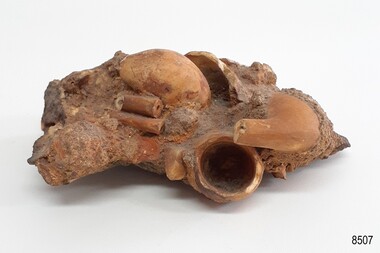
Leisure object - Tobacco Pipes, circa 1869
... ...cargo ship 1869...The pipes may have been amongst the ship's cargo, but could have been included in a passenger’s personal effects. ...The pipes may have been amongst the ship's cargo, but could have been included in a passenger’s personal effects. ...This concretion of tobacco pipes is one of a group of artefacts in the McCulloch Collection. It was recovered from the shipwreck of the Victoria Tower. The pipes may have been amongst the ship's cargo, but could have been included in a passenger’s personal effects. The object is now one of the shipwreck artefacts in Flagstaff Hill’s Mc Culloch Collection, which includes items recovered from the wrecks of the Victoria Tower (wrecked in 1869) and Loch Ard (wrecked in 1878). They were salvaged by a diver in the early 1970s from the southwest coast of Victoria. Advanced marine technology had enabled divers to explore the depths of the ocean and gather its treasures before the Government introduced protective legislation. The artefacts were donated to the Queensland Department of Environment and Heritage Protection (EHP) by a passionate shipwreck lover. Bruce McCulloch verified their locations. In 2017, the Department repatriated them to Flagstaff Hill, where they joined our vast collection of artefacts from Victoria’s Shipwreck Coast. The Victoria Tower: - The three-masted iron clipper ship was built in 1869 in Liverpool, England, as a passenger and cargo ship for the Australian trade. It was named after one of the two towers of the British Houses of Parliament and owned by the White Star line. The Victoria Tower sailed under the command of Captain Kerr from Liverpool towards Melbourne on its maiden voyage with 4 passengers and 16 crew plus a general cargo including bottled beer, slates, iron pipes and hardware. It was almost at her destination when, on 17th October, 1869, it was wrecked at Point Impossible, west of Thompsons Creek, Breamlea, near Torquay. The shipwreck is a very popular dive site.The artefact is an example of cargo or personal items on board a ship in 1869. It provides a reference point for classifying and dating similar items. This artefact is significant for its association with the British-built, iron clipper ship Victoria Tower, a commercial and immigrant sailing ship constructed to carry cargo and passengers to colonial Australia. The vessel is recorded on the Victoria Heritage Database, VHR S698.Concretion of clay tobacco pipes. Bowls and stems of several broken orange tobacco pipes are joined together in ac irregularly shaped clump of concretion from the sea. The concretion also contains stones, shells, sand and particles of seaweed. It was recovered wreck of the ship Victoria Tower.flagstaff hill, warrnambool, maritime village, maritime museum, flagstaff hill maritime museum and village, shipwreck coast, great ocean road, shipwreck artefact, wreck dive, mcculloch collection, bruce mcculloch, white star line, victorian heritage register, clipper ship, victoria tower, captain kerr, shipwreck victoria tower, migrant ship 1869, cargo ship 1869, iron clipper, british clipper ship, 1869, cargo imported to australia, pipe cluster, concretion of pipes, pipe, ceramic pipes, tobacco pipes, smoker's pipes, southwest coast victoria, torquay, diver, evans, liverpool, sailing ship, iron hull, migrant ship, cargo ship, 1869 shipwreck -
 Flagstaff Hill Maritime Museum and Village
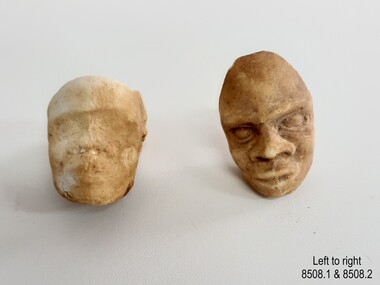
Leisure object - Tobacco Pipe Heads, circa 1869
... ...cargo ship 1869...The pipe heads could have been from the ship's cargo or amongst a passenger’s personal belongings. ...The pipe heads could have been from the ship's cargo or amongst a passenger’s personal belongings. ...These tobacco pipe heads are one of a group of artefacts in the McCulloch Collection that were recovered from the shipwreck Victoria Tower and were donated together. The pipe heads could have been from the ship's cargo or amongst a passenger’s personal belongings. The stems of the clay pipes would have been easily broken during the 100 or so years they were under the sea. Other tobacco pipes in our collection were recovered from the Victoria Tower and the Loch Ard. The object is now one of the shipwreck artefacts in Flagstaff Hill’s Mc Culloch Collection, which includes items recovered from the wrecks of the Victoria Tower (wrecked in 1869) and Loch Ard (wrecked in 1878). They were salvaged by a diver in the early 1970s from the southwest coast of Victoria. Advanced marine technology had enabled divers to explore the depths of the ocean and gather its treasures before the Government introduced protective legislation. The artefacts were donated to the Queensland Department of Environment and Heritage Protection (EHP) by a passionate shipwreck lover. Bruce McCulloch verified their locations. In 2017, the Department repatriated them to Flagstaff Hill, where they joined our vast collection of artefacts from Victoria’s Shipwreck Coast. The Victoria Tower: - The three-masted iron clipper ship was built in 1869 in Liverpool, England, as a passenger and cargo ship for the Australian trade. It was named after one of the two towers of the British Houses of Parliament and owned by the White Star line. The Victoria Tower sailed under the command of Captain Kerr from Liverpool towards Melbourne on its maiden voyage with 4 passengers and 16 crew plus a general cargo including bottled beer, slates, iron pipes and hardware. It was almost at her destination when, on 17th October 1869, it was wrecked at Point Impossible, west of Thompsons Creek, Breamlea, near Torquay. The shipwreck is a very popular dive site. The artefact is an example of cargo or personal items on board a ship in 1869. It provides a reference point for classifying and dating similar items. This artefact is significant for its association with the British-built, iron clipper ship Victoria Tower, a commercial and immigrant sailing ship constructed to carry cargo and passengers to colonial Australia. The vessel is recorded on the Victoria Heritage Database, VHR S698. Tobacco pipe heads, two(2); bowls of white unglased clay tobacco pipes. Pipe bowls are each decorated with the image of a Negro slave head moulded into it and facing away from the smoker. The pipe heads have no stems. Both have a vertical line down the centre of the face, broad nostrils, sunken eyes, and recessed hair. 8508.1 - features are worn, but the ear is distinct, forehead bare, eyes sunken. The bowl is complete. 8508.2 - features are distinct, eyes closed, thick, broad lips. The back section of the bowl is missing. The items were recovered from the wreck of the ship Victoria Tower.white star line, victorian heritage register, clipper ship, victoria tower, captain kerr, shipwreck victoria tower, migrant ship 1869, cargo ship 1869, iron clipper, british clipper ship, 1869, cargo imported to australia, pipe heads, clay pipe fragments, pipe, ceramic pipe, clay pipe, smoker’s pipe, smoking accessory, tobacco pipe, smoker's pipe, personal effects, tobacco, smoking pipe, smoking tool, smoking habit, smoker, tobacco smoker, tobacco pipe heads, flagstaff hill maritime museum and village, warrnambool, great ocean road, maritime museum, shipwreck artefact, southwest coast victoria, shipwreck coast, torquay, diver, bruce mcculloch, evans, liverpool, sailing ship, iron hull, migrant ship, cargo ship, 1869 shipwreck -
 Flagstaff Hill Maritime Museum and Village
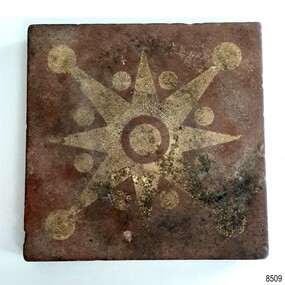
Ceramic - Floor Tile, Maw & Co, 1862-1869
... ...cargo ship 1869...The tile could have been from the ship's cargo or amongst the ship’s fittings. It was made by Maw & Co., of Broseley, England, makers of earthenware encaustic and geometric floor tiles. ...The tile could have been from the ship's cargo or amongst the ship’s fittings. It was made by Maw & Co., of Broseley, England, makers of earthenware encaustic and geometric floor tiles. ...The floor tile is one of a group of artefacts in the McCulloch Collection that were recovered from the shipwreck Victoria Tower and were donated together. The tile could have been from the ship's cargo or amongst the ship’s fittings. It was made by Maw & Co., of Broseley, England, makers of earthenware encaustic and geometric floor tiles. In 1850, George Maw and his brother Arthur began their first factory in Worcester, and in 1862, the company moved to Broseley, Shropshire. The object is now one of the shipwreck artefacts in Flagstaff Hill’s McCulloch Collection, which includes other items recovered from the Victoria Tower, built in Liverpool by Evans in 1969, and wrecked the same year near Torquay, Victoria, on its maiden voyage. A diver salvaged the objects in the early 1970s while working along the southwest coast of Victoria. Advanced marine technology had enabled divers to explore the depths of the ocean and gather its treasures before the Government introduced protective legislation. The artefacts were donated to the Queensland Department of Environment and Heritage Protection (EHP) by a passionate shipwreck lover. Bruce McCulloch verified their locations. In 2017, the Department repatriated them to Flagstaff Hill, where they joined our vast collection of artefacts from Victoria’s Shipwreck Coast. The Victoria Tower: - The three-masted iron clipper ship was built in 1869 in Liverpool, England, as a passenger and cargo ship for the Australian trade. It was named after one of the two towers of the British Houses of Parliament and owned by the White Star line. The Victoria Tower sailed under the command of Captain Kerr from Liverpool towards Melbourne on its maiden voyage with 4 passengers and 16 crew plus a general cargo including bottled beer, slates, iron pipes and hardware. It was almost at her destination when, on 17th October 1869, it was wrecked at Point Impossible, west of Thompsons Creek, Breamlea, near Torquay. The shipwreck is a very popular dive site. The artefact is an example of cargo or personal items on board a ship in 1869. It provides a reference point for classifying and dating similar items. This artefact is significant for its association with the British-built, iron clipper ship Victoria Tower, a commercial and immigrant sailing ship constructed to carry cargo and passengers to colonial Australia. The vessel is recorded on the Victoria Heritage Database, VHR S698. Ceramic tile, square, with star or compass design. The brown floor tile has a cream design of a pointed star with a circle in its centre and between, and on the end of, each point. The side profile of the tile shows the division between the top layer and the base, with a groove between the two. The back of the tile has parallel ridges and is embossed with an inscription. The tile was made by MAW & Co. of Broseley, England, and was recovered from the wrecked ship Victoria Tower. Inscribed "MAW & CO BROSELEY" flagstaff hill, warrnambool, maritime village, maritime museum, flagstaff hill maritime museum and village, shipwreck coast, great ocean road, shipwreck artefact, wreck dive, mcculloch collection, bruce mcculloch, white star line, victorian heritage register, clipper ship, victoria tower, captain kerr, shipwreck victoria tower, migrant ship 1869, cargo ship 1869, iron clipper, british clipper ship, 1869, cargo imported to australia, tile, floor tile, ceramic tile, compass pattern, star pattern, flooring, george maw, arthur maw, maw & co., beverley, worcester, made in england -
Glenelg Shire Council Cultural Collection
Photograph - Photograph - Cargo loaded onto ship, n.d
... Photograph - Cargo loaded onto ship...Photograph Photograph - Cargo loaded onto ship ...Port of Portland Authority archives.Front: (no inscriptions) Back: (no inscriptions)port of portland archives -
Glenelg Shire Council Cultural Collection
Photograph, Unknown cargo loaded/unloaded onto ship, n.d
... Unknown cargo loaded/unloaded onto ship...Port of Portland Front: (no inscriptions) Back: (no inscriptions) Sacks of unknown goods being lifted with slings off side of ship. Unknown cargo loaded/unloaded onto ship Photograph Photograph ...Port of Portland Authority archives.Front: (no inscriptions) Back: (no inscriptions)port of portland -
Glenelg Shire Council Cultural Collection
Photograph - Photograph - Early Shipping: Ocean/Railway Pier, 14/01/1958
... Black and white aerial photo. Of cargo ship berthed at ocean Pier....Port of Portland Authority Archives Port of Portland Archives Portland Harbour Ship Berthed Ocean Pier Aerial Photo Front: Back- Purple stamp-'14 January 1958' Black and white aerial photo. Of cargo ship berthed at ocean Pier. Photograph Photograph - Early Shipping: Ocean/Railway Pier ...Port of Portland Authority ArchivesFront: Back- Purple stamp-'14 January 1958'port of portland archives, portland harbour, ship berthed, ocean pier, aerial photo -
Glenelg Shire Council Cultural Collection
Photograph - Photograph - Early Shipping: Ocean / Railway Pier, n.d
... Black and white photo of cargo ship. Photo glued to brownish cardboard, with grey edging...Port of Portland Authority Archives Port of Portland Archives Portland Harbour Ship Berthed Back: Blue stamp 'PORTLAND HARBOR TRUST COMMISSIONERS Black and white photo of cargo ship. Photo glued to brownish cardboard, with grey edging Photograph Photograph - Early Shipping: Ocean / Railway Pier ...Port of Portland Authority ArchivesBack: Blue stamp 'PORTLAND HARBOR TRUST COMMISSIONERSport of portland archives, portland harbour, ship berthed -
 Flagstaff Hill Maritime Museum and Village
Functional object - Water Boiler, Jackson Boilers Ltd, 1920s
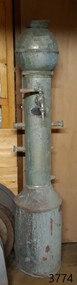
... ...cargo ship...It was a fitting in the vessel Reginald M, a small cargo ship built at Port Adelaide in 1922 and named after her builder and first owner, John Murch. ...It was a fitting in the vessel Reginald M, a small cargo ship built at Port Adelaide in 1922 and named after her builder and first owner, John Murch. ...Jackson Boilers Ltd., brass founders, electro platers and sheet metal works made this tube water boiler. It was a fitting in the vessel Reginald M, a small cargo ship built at Port Adelaide in 1922 and named after her builder and first owner, John Murch. The Reginald M was launched at Largs Bay, South Australia, in 1922 to carry cargo around South Australia that included guano, barley, wool, horses, cattle, timber, explosives, potatoes, shell grit, and gypsum. It passed through numerous owners over the years and primarily maintained its purpose as a cargo vessel. In 1975, the decommissioned Reginald M was purchased by Flagstaff Hill Maritime Museum as an attraction. Although restoration efforts were undertaken and maintained for the craft above the water line, deterioration occurred below the surface and resulted in the ship being unsafe for visitors to board. It was broken up and removed from Flagstaff Hill in 2018, but items such as the historical boiler remain in Flagstaff Hill’s Collection. JACKSON BOILERS LTD.: - In 1911, Henry Jackson was the Managing Director at Jackson Boilers Ltd. He had gained around 30 years’ experience as a tin plate worker, plumber and gas fitter at Ilkey in 1881, then at Leeds by 1901. By 1921, he had changed employment from Jackson Boilers to Managing Director of Patent Water Boilers. During World War I, Jackson Boilers Ltd of Leeds performed war work like many other manufacturers at that time. The firm made cases for the explosive picric acid and electroplated fuse hole plugs. In 1918, the firm employed 15 males and 19 females. Jacksons Boilers became very successful throughout the first half of the twentieth century with showrooms and sales offices in Scotland, the Midlands and Southern England. It also had an office in Dublin, Ireland. In the post-war 1920s, the firm’s production included instantaneous water boilers and coffee machines for cafes, restaurants and canteens. Jackson Boilers also began to supply shipping lines with catering water boilers for their ships. The firm applied for a USA patent for the tube boiler in 1930, for the design which appears to have been invented in 1926. A 1971 advertisement adds the credentials, Members of the Catering Equipment Manufacturers’ Association. The tube water boiler was designed specifically for use in a ship's restaurant or dining area and patented by Jackson Boilers Ltd. of Leeds. The boiler is significant as a patented design, illustrating the evolution of maritime, commercial and domestic water boilers that have led to many innervations and improvements in today's boilers that are used in heating and in producing hot water for domestic and catering use. It is also significant as it is one of the earlier boilers the Jackson company made in the early 1920s before they applied for a US patent on their revised design in 1926.Water boiler, free standing Jackson's Tube boiler. A tall metal cylindrical stand with a metal sphere on top and several pipe fittings on the sides. A brass tap with a lever handle is connected to the front. A plaque with maker's details is attached under the tap. Details are also impressed into the cylinder above the tap.Jackson Boilers Leeds Ltd. "JACKSON'S PATENT" . Other details indecipherable. flagstaff hill maritime museum and village, flagstaff hill maritime museum, flagstaff hill, maritime museum, maritime village, warrnambool, great ocean road, leeds, jackson boilers ltd, jackson boilers, henry jackson, brass founders, electro platers, sheet metal works, patent water boilers, leeds manufacturer, tube water boiler, domestic boiler, tube domestic boiler, tube boiler, water heaters, water boilers, self-feeding water boilers, sheet metal work instantaneous water heaters, engineering, allied trades, metal workers, metal trade, food machinery, hospitality equipment, ship equipment, ship water boiler, ship heater, catering boilers, café boiler, restaurant boiler, canteen boiler, catering equipment manufacturers’ association, cema, kitchen equipment, kitchen appliance, war work, world war i, wwi, picric acid, picric acid cases, fuse hole plugs, electro plated fuse hole plugs, reginald m, cargo ship, port adelaide, 1922, john murch -
 Flagstaff Hill Maritime Museum and Village
Container - Earthenware jar, Bailey & Co, circa 1869
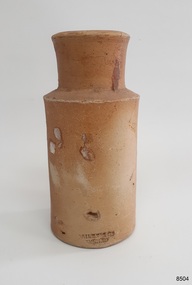
... ...cargo ship...The jar could have been from the ship's cargo or amongst the passengers' personal effects. ...The jar could have been from the ship's cargo or amongst the passengers' personal effects. ...The handmade earthenware jar, made by Bailey & Co. of England, was one of a group of artefacts in the McCulloch Collection that were recovered from the shipwreck Victoria Tower. The jar could have been from the ship's cargo or amongst the passengers' personal effects. The object is now one of the shipwreck artefacts in Flagstaff Hill’s McCulloch Collection, which includes other items recovered from the Victoria Tower, built in Liverpool by Evans in 1969, and wrecked the same year near Torquay, Victoria, on its maiden voyage. A diver salvaged the objects in the early 1970s while working along the southwest coast of Victoria. Advanced marine technology had enabled divers to explore the depths of the ocean and gather its treasures before the Government introduced protective legislation. The artefacts were donated to the Queensland Department of Environment and Heritage Protection (EHP) by a passionate shipwreck lover. Bruce McCulloch verified their locations. In 2017, the Department repatriated them to Flagstaff Hill, where they joined our vast collection of artefacts from Victoria’s Shipwreck Coast.The artefact is an example of cargo or personal items on board a ship in 1869. It provides a reference point for classifying and dating similar items. This artefact is significant for its association with the British-built, iron clipper ship Victoria Tower, a commercial and immigrant sailing ship constructed to carry cargo and passengers to colonial Australia. The vessel is recorded on the Victoria Heritage Database, VHR S698.Container, round brown earthenware jar with a wide mouth, thick lip, a wide neck that tapers slightly inwards towards the shoulder, and a body that tapers slightly inward towards the base. The glazed surface is rough. The variegated colours of the clay also have small dark speckles. There are several chips and dents on the jar. The inscription is stamped into the lower edge. Made by Bailey & Co., England. Recovered from the wreck of the Victoria Tower.Inscription “Bailey [&] Co / ENGLAND” flagstaff hill maritime museum and village, warrnambool, great ocean road, maritime museum, shipwreck artefact, southwest coast victoria, shipwreck coast, victoria tower, 1869, torquay, diver, bruce mcculloch, handmade, earthenware, jar, storage jar, stoneware, domestic container, kitchenware, bailey & co. england, sailing ship, evans of liverpool, evans, liverpool, clipper ship, iron hull, migrant ship, cargo ship, 1869 shipwreck -
 Flagstaff Hill Maritime Museum and Village
Leisure object - Doll's Leg, circa 1869
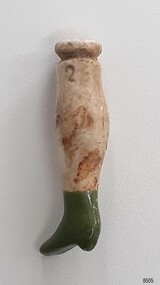
... ...cargo ship...The jar could have been from the ship's cargo or amongst the passengers' personal effects. ...The jar could have been from the ship's cargo or amongst the passengers' personal effects. ...The ceramic doll's leg was one of a group of artefacts in the McCulloch Collection that were recovered from the shipwreck Victoria Tower. The jar could have been from the ship's cargo or amongst the passengers' personal effects. The object is now one of the shipwreck artefacts in Flagstaff Hill’s McCulloch Collection, which includes other items recovered from the Victoria Tower, built in Liverpool by Evans in 1969, and wrecked the same year near Torquay, Victoria, on its maiden voyage. A diver salvaged the objects in the early 1970s while working along the southwest coast of Victoria. Advanced marine technology had enabled divers to explore the depths of the ocean and gather its treasures before the Government introduced protective legislation. The artefacts were donated to the Queensland Department of Environment and Heritage Protection (EHP) by a passionate shipwreck lover. Bruce McCulloch verified their locations. In 2017, the Department repatriated them to Flagstaff Hill, where they joined our vast collection of artefacts from Victoria’s Shipwreck Coast.The artefact is an example of cargo or personal items on board a ship in 1869. It provides a reference point for classifying and dating similar items. This artefact is significant for its association with the British-built, iron clipper ship Victoria Tower, a commercial and immigrant sailing ship constructed to carry cargo and passengers to colonial Australia. The vessel is recorded on the Victoria Heritage Database, VHR S698.Doll's leg, cream-coloured ceramic leg with two seams, a flat solid top and a glazed green ankle-length heeled boot. A shallow groove runs around the leg just below the top. An inscription is stamped into the leg below the groove. Recovered from the wreck of the Victoria Tower. Inscribed "2"flagstaff hill, warrnambool, maritime village, maritime museum, flagstaff hill maritime museum and village, shipwreck coast, great ocean road, shipwreck artefact, wreck dive, mcculloch collection, bruce mcculloch, victorian heritage register, sailing ship, doll's leg, ceramic doll leg, porcelain doll leg, doll's limb, ceramic limb from doll, children's toy, children's recreation, doll's leg with green boot, southwest coast victoria, victoria tower, 1869, torquay, diver, evans, liverpool, clipper ship, iron hull, migrant ship, cargo ship, 1869 shipwreck -
 Flagstaff Hill Maritime Museum and Village
Functional object - Lamp Fitting, circa 1869
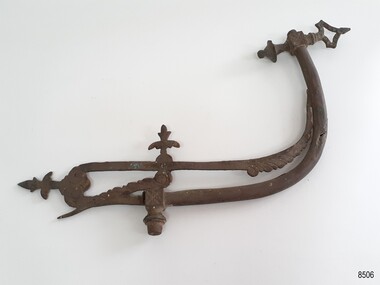
... ...cargo ship...The jar could have been from the ship's cargo or amongst the passengers' personal effects. ...The jar could have been from the ship's cargo or amongst the passengers' personal effects. ...The brass lamp fitting was one of a group of artefacts in the McCulloch Collection that were recovered from the shipwreck Victoria Tower. The jar could have been from the ship's cargo or amongst the passengers' personal effects. The object is now one of the shipwreck artefacts in Flagstaff Hill’s McCulloch Collection, which includes other items recovered from the Victoria Tower, built in Liverpool by Evans in 1969, and wrecked the same year near Torquay, Victoria, on its maiden voyage. A diver salvaged the objects in the early 1970s while working along the southwest coast of Victoria. Advanced marine technology had enabled divers to explore the depths of the ocean and gather its treasures before the Government introduced protective legislation. The artefacts were donated to the Queensland Department of Environment and Heritage Protection (EHP) by a passionate shipwreck lover. Bruce McCulloch verified their locations. In 2017, the Department repatriated them to Flagstaff Hill, where they joined our vast collection of artefacts from Victoria’s Shipwreck Coast. The artefact is an example of cargo or personal items on board a ship in 1869. It provides a reference point for classifying and dating similar items. This artefact is significant for its association with the British-built, iron clipper ship Victoria Tower, a commercial and immigrant sailing ship constructed to carry cargo and passengers to colonial Australia. The vessel is recorded on the Victoria Heritage Database, VHR S698. Brass decorative gas lamp fitting. Two flat arms of different lengths are joined on either side of a fitting that has a fleur-de-lis-like design. The shorter arm has a J-shaped brass pipe fitted to it with a decorative threaded cube joint partway along, and ends with a triangular tap and knob. The longer arm is also J-shaped and ends with a feather design. There are remnants of green paint on the cube fittings and the knob. Recovered from the wreck of the Victoria Tower.flagstaff hill, warrnambool, maritime village, maritime museum, flagstaff hill maritime museum and village, shipwreck coast, great ocean road, shipwreck artefact, wreck dive, mcculloch collection, bruce mcculloch, victorian heritage register, sailing ship, lamp fitting, gas lamp fitting, ship’s fitting, ship’s lamp, brass lamp fitting, lighting, domestic lighting, ship’s lighting, southwest coast victoria, victoria tower, 1869, torquay, diver, evans, liverpool, clipper ship, iron hull, migrant ship, cargo ship, 1869 shipwreck -
Port Melbourne Historical & Preservation Society
Photograph - Cruise and cargo ships, Port of Melbourne, Ron Laing, 1999 - 2000
... A set of 32 colour photos of various cruise and cargo ships visiting the Port of Melbourne in 1999-2000....Photograph Cruise and cargo ships, Port of Melbourne Ron Laing ...Part of Ron Laing's collection of photographs recording Port Melbourne over a thirteen year period. Donated to the PMH&PS by the photographer.A set of 32 colour photos of various cruise and cargo ships visiting the Port of Melbourne in 1999-2000.piers and wharves - station pier, ron laing, vistamar, silver cloud, rotterdam, norwegian star, arcadia (ex star princess), takaradi, óocl accord, msc rita, óceanic odyssey, direct jabiru, msc fremantle, doulos, kakariki, legend of the seas, uss paul hamilton, fletcher, blue ridge, benfold, chosen, lake erie, nivose - french nato ship -
Port Melbourne Historical & Preservation Society
Photograph - Aircraft carrier, Melbourne, at Princes Pier, Port Melbourne, Douglas Smallpage, 1970s
... (7) B&W photographs of various cargo ships and aircraft carrier "Melbourne" laying at Princes Pier in the 1970s...piers and wharves - princes pier hmas melbourne (7) B&W photographs of various cargo ships and aircraft carrier "Melbourne" laying at Princes Pier in the 1970s Photograph Aircraft carrier, Melbourne, at Princes Pier, Port Melbourne Douglas Smallpage ...(7) B&W photographs of various cargo ships and aircraft carrier "Melbourne" laying at Princes Pier in the 1970spiers and wharves - princes pier, hmas melbourne -
Glenelg Shire Council Cultural Collection
Photograph - Photograph - Unknown cargo loaded/unloaded onto ship, n.d
... Photograph - Unknown cargo loaded/unloaded onto ship...ship. Three people are observing the process. Photograph Photograph - Unknown cargo loaded/unloaded onto ship ...Port of Portland AuthorityFront: (no inscriptions) Back: (no inscriptions)port of portland archives -
 Flagstaff Hill Maritime Museum and Village
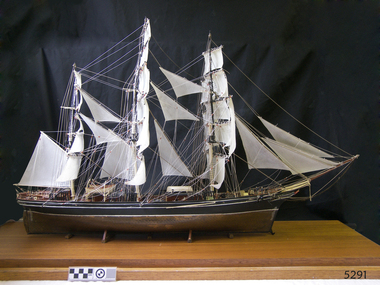
Craft - Ship model, Cutty Sark, 20th century
... ship...Commercial trading vessel...Cargo...Later, a Portuguese company bought her as a cargo ship and then renamed it FERREIRA. Later, it was purchased by a returned sea captain for use as a training ship in Cornwall. ...Later, a Portuguese company bought her as a cargo ship and then renamed it FERREIRA. Later, it was purchased by a returned sea captain for use as a training ship in Cornwall. ...ABOUT THE CUTTY SARK The CUTTY SARK, built in Britain in 1869, was one of the last historic sailing ships. The vessel traded in tea from China for a few years, then began trading with Australia in the wool industry. It held the record sailing speed from Australia to Britain for ten years! Later, a Portuguese company bought her as a cargo ship and then renamed it FERREIRA. Later, it was purchased by a returned sea captain for use as a training ship in Cornwall. After the captain’s death, the ship was transferred to a training college in Greenwich in 1938. In 1954, the sailing ship was placed permanently in dry dock at Greenwich for display.The sailing ship CUTTY SARK carried export cargos of wool from the Australian wool industry.Model of the sailing ship, CUTTY SARK, in full rig, with a lifeboat on deck. A black stripe with thin, white boarders is around the ship. The model is mounted on a timber plinth. flagstaff hill, warrnambool, shipwrecked coast, flagstaff hill maritime museum, maritime museum, shipwreck coast, flagstaff hill maritime village, great ocean road, cutty sark, historic sailing ship, tea clipper, sail training vessel, cadet training ship, commercial trading vessel, cargo sail vessel, ship model cutty sark, australian wool export -
 Flagstaff Hill Maritime Museum and Village
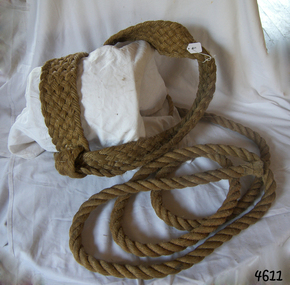
Equipment - Barrel Sling
... ...loading cargo...ship...This barrel sling is significant as equipment typically carried on board sailing ships for use in port when loading and unloading cargo. Flagstaff Hill Warrnambool Maritime Museum Maritime Village Great Ocean Road Shipwreck Coast barrel sling cask dock loading cargo ship equipment sailmaker ropework Barrel sling, handmade from hemp fibre. ...This handmade barrel sling is used for hoisting barrels onto ships. It is made from hemp fibre and is part of the equipment carried on 19th and early 20th century vessels for loading and unloading barrels and casks at the docks.This barrel sling is significant as equipment typically carried on board sailing ships for use in port when loading and unloading cargo.Barrel sling, handmade from hemp fibre.flagstaff hill, warrnambool, maritime museum, maritime village, great ocean road, shipwreck coast, barrel sling, cask, dock, loading cargo, ship equipment, sailmaker, ropework -
 Flagstaff Hill Maritime Museum and Village
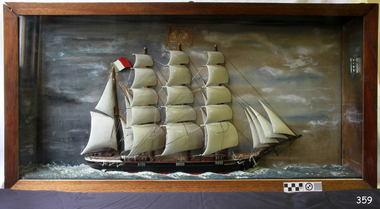
Craft - Ship Model, Hygeia, Bef. 1983
... ...cargo ship...In August 1877, the ship was dispatched from Alexandria, Egypt, destined for Fairmouth with a cargo of beans, but mysteriously went missing. ...Flagstaff Hill Maritime Museum and Village Maritime Museum Maritime Village Great Ocean Road Shipwreck Coast ship model ship model hygeia hobby craft maritime model model making Hygeia sailing ship 1863 1877 cargo ship Italian flag square-rigged barque three-masted "HYGEIA" Ship model; diorama with a model of the sailing ship HYGEIA at sea in full sail, in a setting of sky and sea. ...This ship model is a representation of the wooden barque Hygeia, which is also the name of the Greek goddess of health, cleanliness and hygiene. The model flies the Italian flag, which was adopted in 1946 but originated in 1797. The colours stand for freedom, solidarity and equality. The three-masted, wooden barque Hygeia was built in 1863 in the UK by J.M. Reed to carry cargo. It was first registered on July 30th, 1863, at Sunderland, UK, by owners Matthew Cay Jr. & Joseph Crisp. In August 1877, the ship was dispatched from Alexandria, Egypt, destined for Fairmouth with a cargo of beans, but mysteriously went missing. The ship diorama exemplifies the popular, centuries-old hobby of ship model making, with the setting of sea and sky giving it depth and context. The model also shows the configuration of a three-masted, fully rigged sailing ship, of the type that carried immigrants to Australia. Ship model; diorama with a model of the sailing ship HYGEIA at sea in full sail, in a setting of sky and sea. It displays a tricolour flag with three vertical stripes of equal width, which from the hoist side are coloured green, white and red. An inscription has the ship's name, Hygeia."HYGEIA"flagstaff hill maritime museum and village, maritime museum, maritime village, great ocean road, shipwreck coast, ship model, ship model hygeia, hobby, craft, maritime model, model making, hygeia, sailing ship, 1863, 1877, cargo ship, italian flag, square-rigged, barque, three-masted -
 Flagstaff Hill Maritime Museum and Village
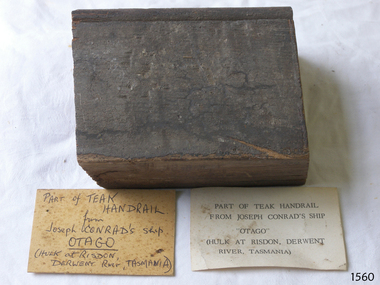
Souvenir - Wood Sample, Alexander Stephen and Sons, 1869
... ...cargo ship...Flagstaff Hill Flagstaff Hill Maritime Museum and Village Warrnambool Maritime Museum Maritime Village Great Ocean Road Shipwreck Coast Joseph Conrad Joseph Conrad's ship Captain Joseph Conrad Otago barque Otago merchant ship cargo ship hulk 1869 ship iron hull sailing ship handrail fitting souvenir wood sample teak New Zealand Sydney Newcastle Tasmania Hobart Derwent River Otago Harbour Otago Bay Conrad Drive 19th century Mauritius marine author marine novel Alex Villiers Georg Stage Handwritten on a card, and typed on another card: "PART OF TEAK HANDRAIL / from / Joseph CONRAD'S ship / OTAGO / (HULK at RISDON, DERWENT River, TASMANIA) Wood sample; a rectangular section of a teak wood handrail that has a bead planed along one side. ...This teak wood sample was part of a handrail from the wreck of the barque Otago. The barque Otago 1869-1931 - The iron-hulled 3-masted barque Otago was built in Glasgow by Alexander Stephen & Sons Ltd, Kelvinhaugh, as a merchant ship and launched in 1869. The vessel changed hands several times in the late 19th century after being sold to an Australian firm in 1871. During one of its voyages, the captain died while the ship was in port at Bangkok. Marine author Joseph Conrad was on board and, being a qualified captain, he took command and continued the journey to Sydney and Mauritius. It was the only ship he ever commanded. In 1903, the Melbourne shipping company Huddart, Parko & Co., purchased the Otago and converted it to serve as a coal hulk for use in Sydney. The Otago was later sent to Hobart, Tasmania, where it continued as a hulk until 1931. It was sold for scrap and eventually abandoned on the banks of the Derwent River at a place now known as Otago Bay, opposite Conrad Drive, Otago. The outline of the hull is still visible, and a nearby plaque tells the story. There are other vessels also named Otago, one of which was built in the same year. Joseph Conrad (1857-1927): - Polish-born Joseph Conrad became a British subject in 1886. He was a renowned marine fiction writer and, for a short time, a mariner and Captain. As a 13-year-old boy, Joseph Conrad desired to be a sailor. At 19, he joined the British merchant marine, working in several roles. He eventually qualified as a captain but only served in this role once: from 1888 to 1889, when he commanded the barque Otago, taking over from the deceased captain and completing the ship’s journey from Sydney to Mauritius. In 1889, he began writing his first novel, Almayer’s Folly. He retired from life as a mariner in 1894, aged 36. Conrad’s affection for Australia and his visits to Australia from 1878 to 1982 were later commemorated by a plaque in Circular Quay, Sydney. Conrad continued as an author; some characters in his books were said to be inspired by his maritime experiences and the people he had met. By the end of his life, he had completed 19 novels, stories, and essays, plus one incomplete novel, Suspense, which was finished and published posthumously. In 1924, Prime Minister Ramsay MacDonald offered Conrad a knighthood for his work, but he declined. There is an 1882 sailing ship named the Joseph Conrad, after the author, that is now preserved at the Mystic Seaport Maritime Museum in the USA as part of the fleet of historic ships, used as an exhibit and a training ship. The Danish square-rigged training ship was originally named Georg Stage but was renamed by marine author Alan Villiers when he bought it in 1934. The wood sample from the Otago is significant for its association with renowned marine author Joseph Conrad, who had once commanded the vessel; it was his only command as Captain and was known as Joseph Conrad's Otago. The maritime connection with Conrad extends to items in the collection, including some of his maritime novels based on his first-hand knowledge, a wooden ship model of a ship named after him, and a navigation chart of Otago Harbour. The sample of teak is significant as an example of materials used in the construction of the 1869 iron-hulled sailing ship, built in Glasgow, Scotland, specifically for use to sail across the world with cargo to trade between the colonies including Australian ports. Wood sample; a rectangular section of a teak wood handrail that has a bead planed along one side. Two cards with the sample have inscriptions, one handwritten and one typed. The sample is from the wreck of the barque Otago, once under the command of Captain Joseph Conrad. Handwritten on a card, and typed on another card: "PART OF TEAK HANDRAIL / from / Joseph CONRAD'S ship / OTAGO / (HULK at RISDON, DERWENT River, TASMANIA)flagstaff hill, flagstaff hill maritime museum and village, warrnambool, maritime museum, maritime village, great ocean road, shipwreck coast, joseph conrad, joseph conrad's ship, captain joseph conrad, otago, barque otago, merchant ship, cargo ship, hulk, 1869 ship, iron hull, sailing ship, handrail, fitting, souvenir, wood sample, teak, new zealand, sydney, newcastle, tasmania, hobart, derwent river, otago harbour, otago bay, conrad drive, 19th century, mauritius, marine author, marine novel, alex villiers, georg stage -
 Flagstaff Hill Maritime Museum and Village
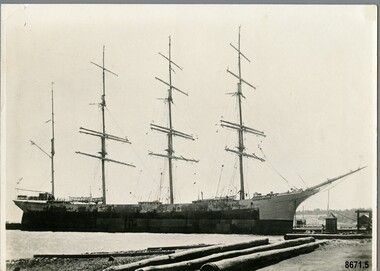
Photograph - Vessel "Strathgryfe", late 19th or early 20th century
... ...cargo ship...Flagstaff Hill Maritime Museum and Village Warrnambool Great Ocean Road Shipwreck Coast Strathgryfe barque steel barque Margretha Graciosa Frederick Trewartha Mercantile trade Russell and Company merchandise cargo ship Glen Huntly W. W. 1 Back of Photo - donor's name and telephone number "Strarthgryfe" [Strathgryfe] / "late" / "Margurita" [Margretha] Black and white photograph of a four masted barque moored at a dock. ...This photograph was one of ten photographs donated to Flagstaff Hill Maritime Museum and Village by Fred Trewartha. Frederick John Fox Trewartha (Fred) was a well-known Warrnambool businessman. He was born in Beeac near Geelong in 1920 and came to Warrnambool with his family as a very young child. He was apprenticed to his father John, as a saddler and later opened his own shop on Raglan Parade. He then moved into working with tarpaulins and canvases for the trucking industry. Fred was keenly interested in photography (and was a member of the Warrnambool Cine Club), yachting and boat building. He kept his yacht moored at Port Fairy for many years and participated in sailing events locally and interstate. He also built boats with his sons. He had the opportunity to meet many older sailors and it's thought this photo (and others in the set) may have been given to him by one of these men. Fred Trewartha died in 2016 in Warrnambool. The "Strathgryfe" was a four masted steel barque built in 1890 by "Russell and Company", Port Glasgow and was owned by Duncan McGillivray (The Strathgryfe Ship Company Limited), Greenock. It arrived in Melbourne in December 1891 from New York. Between 1891 and 1910 it carried merchandise in and out of Australia to ports around the world - Melbourne to London (1892), Newcastle to San Francisco (1894), Capetown to Newcastle (1894), New York to Shanghai (1897), New York to Melbourne (1898), Frederickstadt to Melbourne (1899), Liverpool to Sydney (1900), San Francisco to Brisbane (1903), Newcastle to Pisagna, Chile (1905) and Rotterdam to Melbourne (1910). It carried breadstuffs from San Francisco, coal from Newcastle, wool from Sydney, saltpetre from Hamburg and wheat from Brisbane and Melbourne as well as a variety of general merchandise. In 1898, whilst on route between New York and Melbourne, it came across the Captain and crew of the missing barque "Glen Huntley" which had been reported as "lost" several months earlier. They had been marooned at Tristan D'Acunha (a remote group of volcanic islands in the South Atlantic ocean). Captain McIntyre, of the Strathgryfe, offered to bring Captain Shaw (of the Glen Huntly) on to Melbourne with them but the "old mariner" decided to stay on with his crew till arrangements could be made for rescuing the whole of them. In 1899, when in Melbourne, seven of its crew refused to go to sea in it due to its unsafe conditions. They said the vessel was unseaworthy and that the rigging was unsafe and the lifeboats, not watertight. The Captain (Donald McIntyre) denied the allegations and produced a marine surveyor's certificate as evidence of the condition of the vessel. The men were sentenced to three weeks imprisonment. In 1901 there was a fire on board the Strathgryfe just after it left Sydney for London which resulted in many bales of wool being destroyed. In 1902 it was beached at Shellback island (near Wilson's promontory) for several weeks and had to be considerably dismantled in order to lighten its load enough to allow tugs to pull it back into deep water. In 1910 it was sold to a German firm and renamed "Margretha". It continued to operate in Australian ports until 1914 when it left Sydney for the English Channel with 42,438 bags of wheat. However owing to W.W.1 breaking out, it made for the port of St Michael's where it remained for twenty-one months. Later it was seized by the Portuguese Government and renamed "Graciosa" and was leased back to the English Government. It was sunk by two German submarines in 1918.This photograph is significant as a record of the world wide mercantile trade Australia was engaged in at the end of the nineteenth century and beginning of the twentieth century.Black and white photograph of a four masted barque moored at a dock. The rigging and two lifeboats are clearly visible. Three large timber logs are in the foreground. On the back of the photograph, the donor's name and telephone number have been written in black ballpoint pen and the name of the ship has been handwritten (incorrectly) in pencil in cursive script.Back of Photo - donor's name and telephone number "Strarthgryfe" [Strathgryfe] / "late" / "Margurita" [Margretha]flagstaff hill maritime museum and village, warrnambool, great ocean road, shipwreck coast, strathgryfe, barque, steel barque, margretha, graciosa, frederick trewartha, mercantile trade, russell and company, merchandise, cargo ship, glen huntly, w. w. 1 -
Glenelg Shire Council Cultural Collection
Photograph - Photograph - S. S. Casino, Portland, n.d
... ... cargo ship...S S Casino Portland Harbour Fishermens Wharf vessel steamship cargo ship Back: 'S.S. Casino unloading cargo at 'Fishermen's Wharf' Portland. ...Black and white photo of the S.S. Casino, berthed at Railway Pier, Portland. View of bow, facing seaward.Back: 'S.S. Casino unloading cargo at 'Fishermen's Wharf' Portland. Another view' - handwritten in black ink. Round purple stamp 'PRINTED BY M.E. ANDREWS PORTLAND's s casino, portland harbour, fishermens wharf, vessel, steamship, cargo ship
