
Showing 14 items matching " cleverdon "
-
 Kew Historical Society Inc
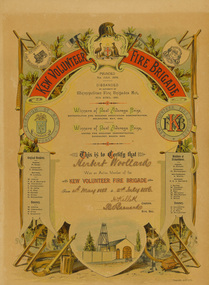
Document, Troedel & Co, Kew Volunteer Fire Brigade, Certificate of Membership, 1886
... Loxton; [Members} F.G.A. Barnard, W. Cleverdon, L. Gurzanscky, T.G. Jellis, J.A. Kay, H. ...Loxton; [Members} F.G.A. Barnard, W. Cleverdon, L. Gurzanscky, T.G. Jellis, J.A. Kay, H. ...1879 - The Argus, Friday 11 July 1879, page 4. The Kew Borough Council having decided to initiate a fire brigade, invited volunteers to send in their names. About 40 complied with the invitation and met at the Town-hall to choose 12 of their number to form the brigade. The 12 elected then chose their officers as follows :— Councillor Gray, captain ; Mr. Thomas Greenhill, foreman ; and Mr. H. Loxton, secretary. The brigade decided to apply to the council for uniforms and a bell; and after adopting rules for their guidance the meeting separated. The brigade now possesses a reel and 500ft. of hose, and a shed is being erected in Little Walpole-street for a station. The council have applied for six additional fireplugs in the Main-road, so that the brigade may now be considered fairly established. The Volunteer Fire Brigade was replaced in 1891 by a detachment of the Metropolitan Fire Brigade and a new Fire Station in Walton Street constructed in 1893; subsequently demolished in 1941.The certificate includes the only known image of the first fire station in Kew. It was donated by Mrs L. Bray. The donor's father, Mr. A. Wood, was a member at time of the Brigade's 'disbandment'.Kew Volunteer Fire Brigade: Certificate of Membership, 1886. Testifying that Herbert Woollard was an active member of the Kew Volunteer Fire Brigade between 4th May 1883 and 2nd July 1886. Signed with pen and ink H. Kellett (Captain) and F.G.A. Barnard (Hon. Sec.). The certificate is believed to include the only picture of the first Kew Fire Station.The certificate lists the original members of the brigade on the left side as: Captain H. Gray, Lieutenant T. Greenhill, and Secretary H. Loxton; [Members} F.G.A. Barnard, W. Cleverdon, L. Gurzanscky, T.G. Jellis, J.A. Kay, H. Kellett, H. Kirby, D. McLachlan; (Honorary members) W. Atkins, W. Cleverdon, H. Gray, T. Greenhill. At the right is a list of members at the time of disbandment: Captain H. Kellett, Lieutenant H. Burmeister, Sub-Lieutenant A. Wallis, Secretary F.G.A. Barnard; [Members] J. Burke, W. Gardner, L. Gillman, F. Kay, H. Kirwood, W. MacKenzie, C. Wallis, A Wood; [Honorary members] G. Hinchcliffe, T. G. Jellis, J. A. Kay, D. McLaughlan.Troedel & Co. Lith [printer].kew volunteer fire brigade, h. woollard, brougham street -- kew (vic.) -
 Uniting Church Archives - Synod of Victoria
Photograph, Undated c.1900
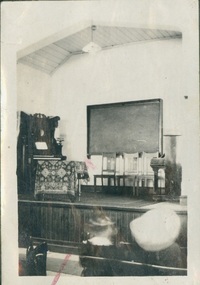
... The building was designed by Geelong architect William Henry Cleverdon and was built of brick in the Gothic style. ...The building was designed by Geelong architect William Henry Cleverdon and was built of brick in the Gothic style. ...The Wesleyan Church, Denham Street in Lower Hawthorn, as the area was then called, was opened on 2 May 1886. The building was designed by Geelong architect William Henry Cleverdon and was built of brick in the Gothic style. Its dimensions were 55 x 33 ft and the façade incorporated a rose window and spire 50 ft high. A wooden vestry was placed to the rear. The building and the organ were seriously damaged by fire on 1 April 1970, started by a painter's blowtorch. The church was not rebuilt.B & W photograph of the interior of the Denham St. Methodist Church Hall, Hawthorn. The photograph is taken from the seating area towards the stage, which is furnished with an organ, an upright piano, a table and chairs.denham street methodist church, organ, hall -
 Uniting Church Archives - Synod of Victoria
Photograph, Undated
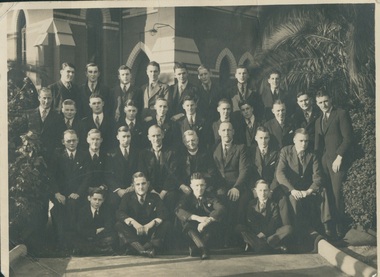
... The building was designed by Geelong architect William Henry Cleverdon and was built of brick in the Gothic style. ...The building was designed by Geelong architect William Henry Cleverdon and was built of brick in the Gothic style. ...The Wesleyan Church, Denham Street in Lower Hawthorn, as the area was then called, was opened on 2 May 1886. The building was designed by Geelong architect William Henry Cleverdon and was built of brick in the Gothic style. Its dimensions were 55 x 33 ft and the façade incorporated a rose window and spire 50 ft high. A wooden vestry was placed to the rear. The building and the organ were seriously damaged by fire on 1 April 1970, started by a painter's blowtorch. The church was not rebuilt.B & W photograph of a group of young men standing and sitting with the minister outside the Methodist Church in Denham St. Hawthorn.denham street methodist church, organ, hall -
 Uniting Church Archives - Synod of Victoria
Photograph, Undated c.1930s
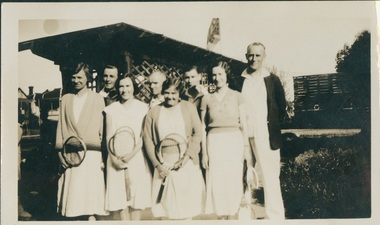
... The building was designed by Geelong architect William Henry Cleverdon and was built of brick in the Gothic style. ...The building was designed by Geelong architect William Henry Cleverdon and was built of brick in the Gothic style. ...The Wesleyan Church, Denham Street in Lower Hawthorn, as the area was then called, was opened on 2 May 1886. The building was designed by Geelong architect William Henry Cleverdon and was built of brick in the Gothic style. Its dimensions were 55 x 33 ft and the façade incorporated a rose window and spire 50 ft high. A wooden vestry was placed to the rear. The building and the organ were seriously damaged by fire on 1 April 1970, started by a painter's blowtorch. The church was not rebuilt.B & W photograph of a group of 8 tennis players standing in front of a tennis pavilion. denham street methodist church, organ, hall, tennis -
 Uniting Church Archives - Synod of Victoria
Photograph, Undated c.1930s
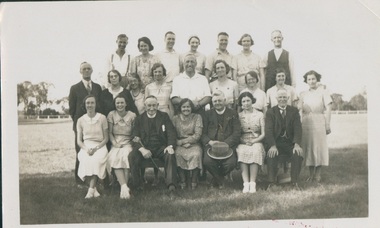
... The building was designed by Geelong architect William Henry Cleverdon and was built of brick in the Gothic style. ...The building was designed by Geelong architect William Henry Cleverdon and was built of brick in the Gothic style. ...The Wesleyan Church, Denham Street in Lower Hawthorn, as the area was then called, was opened on 2 May 1886. The building was designed by Geelong architect William Henry Cleverdon and was built of brick in the Gothic style. Its dimensions were 55 x 33 ft and the façade incorporated a rose window and spire 50 ft high. A wooden vestry was placed to the rear. The building and the organ were seriously damaged by fire on 1 April 1970, started by a painter's blowtorch. The church was not rebuilt.B & W photograph of a group of 8 men and women with 2 ministers, sitting and standing outdoors. The group was probably from the Denham St. Methodist Church.denham street methodist church, organ, hall, tennis -
 Bendigo Historical Society Inc.
Document - CONNELLY, TATCHELL, DUNLOP COLLECTION: LEGAL PAPERS, 1886
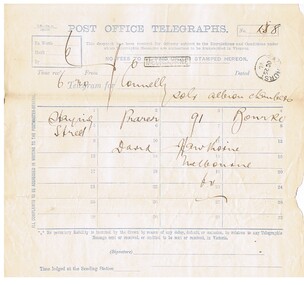
... Connelly, Tatchell & Dunlop - Legal Papers. 1 - 1886 - Post Office Telegraph from Connelly T Jefferson re Brady V Hawthorne. 2 - 1886 - Letter from Cleverdon & Westley, Solicitors, 60 Chancery Lane, Melbourne re Turner to Mossop 3 - 1886 - Post Office Telegraph from Bennett & Co re Hawthorne & Brady. 4 - 1886 - Letter from Crawford W H Ballarat. 5 - 1886 - Post Office Telegraph from Hawthorne David, Melbourne. 6 - 1886 - Letter from Bennett, Attenborough, Wilks & Nunn, 102 Collins St West, Melbourne re Hindle Hy, deceased....COTTAGE Miners Connelly Tatchell & Dunlop Connelly T Jefferson Brady Hawthorne Cleverdon & Westley Turner Mossop Bennett & Co Crawford W H Hawthorne David Bennett Attenborough Wilks & Nunn Hindle Hy Documents. ...Documents. Connelly, Tatchell & Dunlop - Legal Papers. 1 - 1886 - Post Office Telegraph from Connelly T Jefferson re Brady V Hawthorne. 2 - 1886 - Letter from Cleverdon & Westley, Solicitors, 60 Chancery Lane, Melbourne re Turner to Mossop 3 - 1886 - Post Office Telegraph from Bennett & Co re Hawthorne & Brady. 4 - 1886 - Letter from Crawford W H Ballarat. 5 - 1886 - Post Office Telegraph from Hawthorne David, Melbourne. 6 - 1886 - Letter from Bennett, Attenborough, Wilks & Nunn, 102 Collins St West, Melbourne re Hindle Hy, deceased.cottage, miners, connelly, tatchell & dunlop, connelly t jefferson, brady, hawthorne, cleverdon & westley, turner, mossop, bennett & co, crawford w h, hawthorne david, bennett attenborough wilks & nunn, hindle hy -
 Uniting Church Archives - Synod of Victoria
Photograph, Undated c.1900
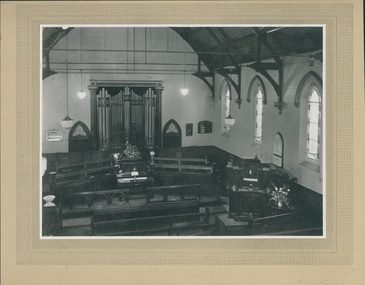
... The building was designed by Geelong architect William Henry Cleverdon and was built of brick in the Gothic style. ...The building was designed by Geelong architect William Henry Cleverdon and was built of brick in the Gothic style. ...The Wesleyan Church, Denham Street in Lower Hawthorn, as the area was then called, was opened on 2 May 1886. The building was designed by Geelong architect William Henry Cleverdon and was built of brick in the Gothic style. Its dimensions were 55 x 33 ft and the façade incorporated a rose window and spire 50 ft high. A wooden vestry was placed to the rear. The building and the organ were seriously damaged by fire on 1 April 1970, started by a painter's blowtorch. The church was not rebuilt. The organ was built in 1900 by E. Cornwall Cook, of Barrington Place, Burwood Road, Hawthorn. It was opened on 8 August 1901 by George Peake. The Swell strings may have been added (or substituted for earlier material) by Frederick Taylor, whose workshop was nearby in Burwood Road. At some stage the colourfully decorated façade pipes were repainted in a gold finish. The organ was badly damaged in the 1970 fire and the metal pipes were sent to Hill, Norman & Beard who melted them down for scrap.B & W photograph of the interior of the Denham St. Methodist Church, Hawthorn. Mounted on card.denham street methodist church, organ, hall, e. cornwall cook, george peake, norman & bead, frederick taylor -
 Uniting Church Archives - Synod of Victoria
BW photo, Undated
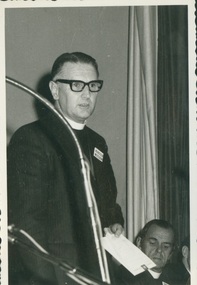
... Before going to university and Queen’s for his arts degree and theological training, Mr Cleverdon, who was now the minister at Neil Street, Ballarat, offered Jock the opportunity to minister to the small congregation at Brown Hill, Ballarat, which was in his Circuit, and to live with the Cleverdons. ...Before going to university and Queen’s for his arts degree and theological training, Mr Cleverdon, who was now the minister at Neil Street, Ballarat, offered Jock the opportunity to minister to the small congregation at Brown Hill, Ballarat, which was in his Circuit, and to live with the Cleverdons. ...JOHN CORBEN LAVENDER (Jock) Jock was born in Ivanhoe, but spent most of his youth in Northcote where his father was a bank manager, and where he attended primary school, high school and the Methodist church in High Street which became a central point in his life. He took his first job in the dispatch office at McPhersons nut and bolt factory in North Richmond in 1935. After a short time at McPhersons he moved to the Trustees Executors and Agency Company in 1936. While working at the Trustees Jock developed the conviction that his vocation lay with the church. This necessitated studying Matriculation at night school for two years as well as working and studying to become a Local Preacher. The minister at Northcote at the time was the Rev.F.T.Cleverdon who helped him prepare to apply as a candidate for Ordination. Before going to university and Queen’s for his arts degree and theological training, Mr Cleverdon, who was now the minister at Neil Street, Ballarat, offered Jock the opportunity to minister to the small congregation at Brown Hill, Ballarat, which was in his Circuit, and to live with the Cleverdons. He spent a year in Ballarat under the tutelage of Rev.F.T Cleverdon in 1939. Jock was accepted by the 1940 Victorian Methodist Conference as a Candidate for the Ministry and started his studies for his theological training and an arts degree at Melbourne University that year. Because of a shortage of ministers, due to the war, Jock was taken out of Queen’s in 1943 to take charge of two fairly small churches in Caulfield - Hawthorn Road and Bambra Road. Jock was ordained in 1945 & married two days later to Elsie Chipperfield, with whom he had worked at the Trustees Executors and Agency. He had joined the RAAF as a chaplain and was sent to Borneo. Returning to Australia in early 1946, he was then appointed to Orbost for a year, Bracknell in Tasmania in 1948, followed by Reid in Canberra, 1951. The next move was to Portland in 1954. Unfortunately not long after this, Elsie was diagnosed with breast cancer. This necessitated a move back to Melbourne - to Mitcham in 1957. Elsie died in December 1957. This period was a very hard time as Jock had four young daughters but his mother helped out by living in for most of the week until Jock was married to Peg in 1959 and their son was born in 1961. In 1964 Jock was moved to Launceston, his first city church. These years were challenging for Jock as he felt compelled to speak out around social issues, such as the Vietnam War & Aboriginal rights, although many did not agree with his view. In 1969 Jock was moved to Horsham to take up the role of Separated Chairman of the North-Western District responsible for Circuits, ministers and families for policy issues and pastoral concerns over an area from the South Australian border, up to the Murray and over it to Wentworth and Dareton, up river to Swan Hill and south to Ballarat and Daylesford. It was a demanding job but richly rewarding in the relationships made with ministers and their families. In 1971 Jock was elected Secretary of the Methodist Conference and in 1972 was voted President of the Conference. He felt it an honour and a vote of confidence by clergy and lay people The final move was to Geelong in 1976 where Jock was the minister at Wesley until 1983.Jock found Geelong a very satisfying parish in which to finish his active ministry. It was while he was Minister of Wesley Church, Geelong, that the Uniting Church came into being and Jock became the first Chairman of the Barwon Presbytery. There were now two ministers at Wesley – Jock and Alex Peerman, whose joint congregation of St. Giles (Pres) and City Congregational now joined with Wesley to become the City Parish. Jock was very surprised to be elected as the third Moderator of the Uniting Church in Victoria, to take office in 1979/1980 1983 saw retirement to Portarlington several months’ locum in both Canada & Kununurra. When the property at Portarlington became too large to maintain, they moved in 1994 into the current house in Belmont & returned to the Wesley Church here. Deceased c.2015. Rev. John (Jock) Lavender is pictured standing at a microphone, wearing clerical clothingRev. J C Lavenderrev. john (jock) lavender; methodist minister; uniting church minister; -
 Uniting Church Archives - Synod of Victoria
BW photo, 1980s?
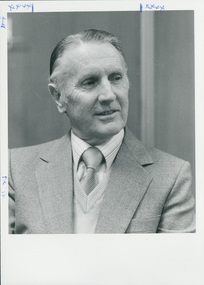
... Before going to university and Queen’s for his arts degree and theological training, Mr Cleverdon, who was now the minister at Neil Street, Ballarat, offered Jock the opportunity to minister to the small congregation at Brown Hill, Ballarat, which was in his Circuit, and to live with the Cleverdons. ...Before going to university and Queen’s for his arts degree and theological training, Mr Cleverdon, who was now the minister at Neil Street, Ballarat, offered Jock the opportunity to minister to the small congregation at Brown Hill, Ballarat, which was in his Circuit, and to live with the Cleverdons. ...JOHN CORBEN LAVENDER (Jock) Jock was born in Ivanhoe, but spent most of his youth in Northcote where his father was a bank manager, and where he attended primary school, high school and the Methodist church in High Street which became a central point in his life. He took his first job in the dispatch office at McPhersons nut and bolt factory in North Richmond in 1935. After a short time at McPhersons he moved to the Trustees Executors and Agency Company in 1936. While working at the Trustees Jock developed the conviction that his vocation lay with the church. This necessitated studying Matriculation at night school for two years as well as working and studying to become a Local Preacher. The minister at Northcote at the time was the Rev.F.T.Cleverdon who helped him prepare to apply as a candidate for Ordination. Before going to university and Queen’s for his arts degree and theological training, Mr Cleverdon, who was now the minister at Neil Street, Ballarat, offered Jock the opportunity to minister to the small congregation at Brown Hill, Ballarat, which was in his Circuit, and to live with the Cleverdons. He spent a year in Ballarat under the tutelage of Rev.F.T Cleverdon in 1939. Jock was accepted by the 1940 Victorian Methodist Conference as a Candidate for the Ministry and started his studies for his theological training and an arts degree at Melbourne University that year. Because of a shortage of ministers, due to the war, Jock was taken out of Queen’s in 1943 to take charge of two fairly small churches in Caulfield - Hawthorn Road and Bambra Road. Jock was ordained in 1945 & married two days later to Elsie Chipperfield, with whom he had worked at the Trustees Executors and Agency. He had joined the RAAF as a chaplain and was sent to Borneo. Returning to Australia in early 1946, he was then appointed to Orbost for a year, Bracknell in Tasmania in 1948, followed by Reid in Canberra, 1951. The next move was to Portland in 1954. Unfortunately not long after this, Elsie was diagnosed with breast cancer. This necessitated a move back to Melbourne - to Mitcham in 1957. Elsie died in December 1957. This period was a very hard time as Jock had four young daughters but his mother helped out by living in for most of the week until Jock was married to Peg in 1959 and their son was born in 1961. In 1964 Jock was moved to Launceston, his first city church. These years were challenging for Jock as he felt compelled to speak out around social issues, such as the Vietnam War & Aboriginal rights, although many did not agree with his view. In 1969 Jock was moved to Horsham to take up the role of Separated Chairman of the North-Western District responsible for Circuits, ministers and families for policy issues and pastoral concerns over an area from the South Australian border, up to the Murray and over it to Wentworth and Dareton, up river to Swan Hill and south to Ballarat and Daylesford. It was a demanding job but richly rewarding in the relationships made with ministers and their families. In 1971 Jock was elected Secretary of the Methodist Conference and in 1972 was voted President of the Conference. He felt it an honour and a vote of confidence by clergy and lay people The final move was to Geelong in 1976 where Jock was the minister at Wesley until 1983.Jock found Geelong a very satisfying parish in which to finish his active ministry. It was while he was Minister of Wesley Church, Geelong, that the Uniting Church came into being and Jock became the first Chairman of the Barwon Presbytery. There were now two ministers at Wesley – Jock and Alex Peerman, whose joint congregation of St. Giles (Pres) and City Congregational now joined with Wesley to become the City Parish. Jock was very surprised to be elected as the third Moderator of the Uniting Church in Victoria, to take office in 1979/1980 1983 saw retirement to Portarlington several months’ locum in both Canada & Kununurra. When the property at Portarlington became too large to maintain, they moved in 1994 into the current house in Belmont & returned to the Wesley Church Geelong.Head and shoulders portrait of the Rev. John (Jock) Lavender, wearing suit and tie.Jock Lavenderrev. john (jock) lavender; methodist minister; uniting church minister; -
 Uniting Church Archives - Synod of Victoria
BW photo, 1979
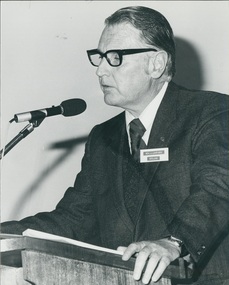
... Before going to university and Queen’s for his arts degree and theological training, Mr Cleverdon, who was now the minister at Neil Street, Ballarat, offered Jock the opportunity to minister to the small congregation at Brown Hill, Ballarat, which was in his Circuit, and to live with the Cleverdons. ...Before going to university and Queen’s for his arts degree and theological training, Mr Cleverdon, who was now the minister at Neil Street, Ballarat, offered Jock the opportunity to minister to the small congregation at Brown Hill, Ballarat, which was in his Circuit, and to live with the Cleverdons. ...JOHN CORBEN LAVENDER (Jock) Jock was born in Ivanhoe, but spent most of his youth in Northcote where his father was a bank manager, and where he attended primary school, high school and the Methodist church in High Street which became a central point in his life. He took his first job in the dispatch office at McPhersons nut and bolt factory in North Richmond in 1935. After a short time at McPhersons he moved to the Trustees Executors and Agency Company in 1936. While working at the Trustees Jock developed the conviction that his vocation lay with the church. This necessitated studying Matriculation at night school for two years as well as working and studying to become a Local Preacher. The minister at Northcote at the time was the Rev.F.T.Cleverdon who helped him prepare to apply as a candidate for Ordination. Before going to university and Queen’s for his arts degree and theological training, Mr Cleverdon, who was now the minister at Neil Street, Ballarat, offered Jock the opportunity to minister to the small congregation at Brown Hill, Ballarat, which was in his Circuit, and to live with the Cleverdons. He spent a year in Ballarat under the tutelage of Rev.F.T Cleverdon in 1939. Jock was accepted by the 1940 Victorian Methodist Conference as a Candidate for the Ministry and started his studies for his theological training and an arts degree at Melbourne University that year. Because of a shortage of ministers, due to the war, Jock was taken out of Queen’s in 1943 to take charge of two fairly small churches in Caulfield - Hawthorn Road and Bambra Road. Jock was ordained in 1945 & married two days later to Elsie Chipperfield, with whom he had worked at the Trustees Executors and Agency. He had joined the RAAF as a chaplain and was sent to Borneo. Returning to Australia in early 1946, he was then appointed to Orbost for a year, Bracknell in Tasmania in 1948, followed by Reid in Canberra, 1951. The next move was to Portland in 1954. Unfortunately not long after this, Elsie was diagnosed with breast cancer. This necessitated a move back to Melbourne - to Mitcham in 1957. Elsie died in December 1957. This period was a very hard time as Jock had four young daughters but his mother helped out by living in for most of the week until Jock was married to Peg in 1959 and their son was born in 1961. In 1964 Jock was moved to Launceston, his first city church. These years were challenging for Jock as he felt compelled to speak out around social issues, such as the Vietnam War & Aboriginal rights, although many did not agree with his view. In 1969 Jock was moved to Horsham to take up the role of Separated Chairman of the North-Western District responsible for Circuits, ministers and families for policy issues and pastoral concerns over an area from the South Australian border, up to the Murray and over it to Wentworth and Dareton, up river to Swan Hill and south to Ballarat and Daylesford. It was a demanding job but richly rewarding in the relationships made with ministers and their families. In 1971 Jock was elected Secretary of the Methodist Conference and in 1972 was voted President of the Conference. He felt it an honour and a vote of confidence by clergy and lay people The final move was to Geelong in 1976 where Jock was the minister at Wesley until 1983.Jock found Geelong a very satisfying parish in which to finish his active ministry. It was while he was Minister of Wesley Church, Geelong, that the Uniting Church came into being and Jock became the first Chairman of the Barwon Presbytery. There were now two ministers at Wesley – Jock and Alex Peerman, whose joint congregation of St. Giles (Pres) and City Congregational now joined with Wesley to become the City Parish. Jock was very surprised to be elected as the third Moderator of the Uniting Church in Victoria, to take office in 1979/1980 1983 saw retirement to Portarlington several months’ locum in both Canada & Kununurra. When the property at Portarlington became too large to maintain, they moved in 1994 into the current house in Belmont & returned to the Wesley Church Geelong.Upper body photo of Rev. John (Jock) Lavender (Geelong) speaking at a lectern.Church & Nation 23/5/79, p. 5; Rev. Lavenderrev. john (jock) lavender; methodist minister; uniting church minister; -
 Uniting Church Archives - Synod of Victoria
BW photo, March 1986
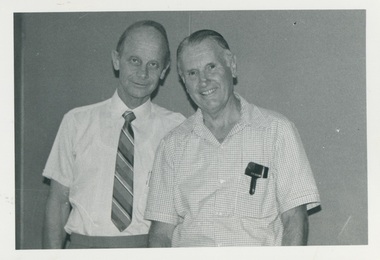
... Before going to university and Queen’s for his arts degree and theological training, Mr Cleverdon, who was now the minister at Neil Street, Ballarat, offered Jock the opportunity to minister to the small congregation at Brown Hill, Ballarat, which was in his Circuit, and to live with the Cleverdons. ...Before going to university and Queen’s for his arts degree and theological training, Mr Cleverdon, who was now the minister at Neil Street, Ballarat, offered Jock the opportunity to minister to the small congregation at Brown Hill, Ballarat, which was in his Circuit, and to live with the Cleverdons. ...John (Jock) Corben Lavender Jock was born in Ivanhoe, but spent most of his youth in Northcote where his father was a bank manager, and where he attended primary school, high school and the Methodist church in High Street which became a central point in his life. He took his first job in the dispatch office at McPhersons nut and bolt factory in North Richmond in 1935. After a short time at McPhersons he moved to the Trustees Executors and Agency Company in 1936. While working at the Trustees Jock developed the conviction that his vocation lay with the church. This necessitated studying Matriculation at night school for two years as well as working and studying to become a Local Preacher. The minister at Northcote at the time was the Rev.F.T.Cleverdon who helped him prepare to apply as a candidate for Ordination. Before going to university and Queen’s for his arts degree and theological training, Mr Cleverdon, who was now the minister at Neil Street, Ballarat, offered Jock the opportunity to minister to the small congregation at Brown Hill, Ballarat, which was in his Circuit, and to live with the Cleverdons. He spent a year in Ballarat under the tutelage of Rev.F.T Cleverdon in 1939. Jock was accepted by the 1940 Victorian Methodist Conference as a Candidate for the Ministry and started his studies for his theological training and an arts degree at Melbourne University that year. Because of a shortage of ministers, due to the war, Jock was taken out of Queen’s in 1943 to take charge of two fairly small churches in Caulfield - Hawthorn Road and Bambra Road. Jock was ordained in 1945 & married two days later to Elsie Chipperfield, with whom he had worked at the Trustees Executors and Agency. He had joined the RAAF as a chaplain and was sent to Borneo. Returning to Australia in early 1946, he was then appointed to Orbost for a year, Bracknell in Tasmania in 1948, followed by Reid in Canberra, 1951. The next move was to Portland in 1954. Unfortunately not long after this, Elsie was diagnosed with breast cancer. This necessitated a move back to Melbourne - to Mitcham in 1957. Elsie died in December 1957. This period was a very hard time as Jock had four young daughters but his mother helped out by living in for most of the week until Jock was married to Peg in 1959 and their son was born in 1961. In 1964 Jock was moved to Launceston, his first city church. These years were challenging for Jock as he felt compelled to speak out around social issues, such as the Vietnam War & Aboriginal rights, although many did not agree with his view. In 1969 Jock was moved to Horsham to take up the role of Separated Chairman of the North-Western District responsible for Circuits, ministers and families for policy issues and pastoral concerns over an area from the South Australian border, up to the Murray and over it to Wentworth and Dareton, up river to Swan Hill and south to Ballarat and Daylesford. It was a demanding job but richly rewarding in the relationships made with ministers and their families. In 1971 Jock was elected Secretary of the Methodist Conference and in 1972 was voted President of the Conference. He felt it an honour and a vote of confidence by clergy and lay people The final move was to Geelong in 1976 where Jock was the minister at Wesley until 1983.Jock found Geelong a very satisfying parish in which to finish his active ministry. It was while he was Minister of Wesley Church, Geelong, that the Uniting Church came into being and Jock became the first Chairman of the Barwon Presbytery. There were now two ministers at Wesley – Jock and Alex Peerman, whose joint congregation of St. Giles (Pres) and City Congregational now joined with Wesley to become the City Parish. Jock was very surprised to be elected as the third Moderator of the Uniting Church in Victoria, to take office in 1979/1980 1983 saw retirement to Portarlington several months’ locum in both Canada & Kununurra. When the property at Portarlington became too large to maintain, they moved in 1994 into the current house in Belmont & returned to the Wesley Church here. In the words of Rev. Prof. Norman Young and Rev. Peter Gador-Whyte at Jock’s funeral service: “We are here today to give thanks to God for Jock Lavender; a gentle man of great compassion, humour and humility. We gather to remember the love he shared so generously the faith he lived so graciously, and the hope he expressed both in his preaching and in his presence. As President of the Methodist Conference and Moderator of the Uniting Church Jock held significant leadership roles within the church and did so with great dignity and grace never lording it over people but leading by example with an inner strength and faith that won respect and trust. There was something really special about him that is hard to put your finger on. We have all been blessed by God through Jock. Mr Alexander Kilgour Alex Kilgour was for many years an active elder and layman in the Presbyterian and then Uniting Church. He was involved in many committees at Synod level for many years. He was a Moderator of the Synod of Victoria of the UCA—one of the first laypeople to take on the role in the early years of the UCA. He was for many years Executive Director of the Resources Commission of the Synod. He worked at Mitchell Brushes (the company owned by Ethel and John Mitchell. B&W photograph. The Rev. John C (Jock) Lavender and Mr Alex Kilgour, dressed in shirts, are standing shoulder to shoulder, facing the camera.C&N 19/3/1986rev. jock lavender; mr alex kilgour; methodist, presbyterian, uniting church; synod appointments; moderator -
 Kew Historical Society Inc
Certificate - Certificate of Appreciation to Mr John Watson Esq, Kew Methodist Church, 1907
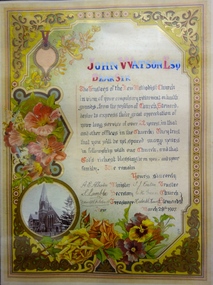
... Services were regularly held for some time at the same place, and funds for purchasing a block of land were gradually collected, resulting in the present site in Highbury Grove being purchased for £350. Messrs. W. Cleverdon, A. Money, T. E. Serpell, and T. Vasey, of Hawthorn, and Messrs. ...Services were regularly held for some time at the same place, and funds for purchasing a block of land were gradually collected, resulting in the present site in Highbury Grove being purchased for £350. Messrs. W. Cleverdon, A. Money, T. E. Serpell, and T. Vasey, of Hawthorn, and Messrs. ..."METHODIST CHURCH. In 1881, during the ministry of Rev. W. H. Fitchett, B.A., at Hawthorn, a number of members of the denomination living at Kew considered that the time was opportune for founding a local Church. The Superintendent of the Circuit, the Rev. W. A. Quick of Richmond, met the members and formed them into a society class under the leadership of Mr. A. Brown and a Church was formally instituted at the house of Mr. T. J. Eaton, of Eglinton Street, in December, 1881. Services were regularly held for some time at the same place, and funds for purchasing a block of land were gradually collected, resulting in the present site in Highbury Grove being purchased for £350. Messrs. W. Cleverdon, A. Money, T. E. Serpell, and T. Vasey, of Hawthorn, and Messrs. A. Brown, R. Eyre, and T. J. Eaton of Kew, were appointed trustees. A public meeting was held a the Town Hall, when over £100 was raised. The Rev. John Harcourt, who had just been placed on the supernumerary list, was persuaded to undertake the charge, and commenced services in the Town Hall on 29th April, 1882, which were continued for eighteen months. A Sunday School was started, and altogether the effort progressed so satisfactorily that in October, 1882, the foundation and memorial stones of the present Church were laid by Mr James Huddart. At the tea meeting held in connection with this event nearly £200 was raised and a few months later £250 more was obtained by means of a bazaar. The contract for building Church was let for £1,200. The Sunday School celebrated its first anniversary in June, and the Church was opened on 7th October 1883, the preachers on the occasion being Revs. E. J. Watkin, S. Chapman, and John Harcourt, the collections amounting to £230. Towards raising these sums of money the ladies of the congregation helped very materially. In 1886 the foundation stone of a Sunday school, to cost about £900, was laid by Mrs. H Berry, the building being opened in April 1887. During the same year the Church was enlarged. In 1889 parsonage was erected, and again arrangements had to be made for a further enlargement of the Church, at a cost of nearly £2,000. The foundation stones of the tower were laid by Rev J. Harcourt, and of the transepts by Mrs. Job Smith and Mrs. John Watson. These additions were made during the ministry of Rev. P. R. C. Ussher, the first minister appointed to Kew by conference. He has been succeeded by Revs. Henry Howard, J. de Q. Robin, J. J. Brown, J. G. Wheen, A. E. Albiston, M.A., and F. J. Nance, M.A., who is at present ably filling the pulpit. For the musical portion of the services, the Church has been greatly indebted to the enthusiasm of Mr. C. Gardner, the leader of the choir, and Mr. C. E. Gardner, the organist. The Sunday School has had a number of excellent workers, among whom may be mentioned Messrs. Burchett, Allum, Hillard, Tonkin, Dent, Avery, McDonald, Green, and B. Hoadley, who have acted as Superintendents, and Messrs. Arnall and McCaghern as Secretaries. The present trustees are Messrs. H. Berry, Job Smith, A. Hoadley, F. Vial, C. Powers, H. L. Carnegie, C. H. Green, W. R. Rylah, E. M. Tonkin, S. Gaylard, J. Gregory, J. R. McDonald, T. J. Eaton, F. S. Fitchett, and S. Lamble; Society Stewards, T. J. Eaton and B. Hoadley; Poor Stewards, G. Hinchliffe and G. Fraser; Church Stewards, C. H. Green and G. Hinchliffe; Treasurer, F. S. Fitchett; Secretary, S. Lamble." Source: FGA Barnard, Jubilee History of Kew, Victoria, 1910Commemorative tributes were regularly produced in the 19th and early 20th Century to honour community service. Most were adapted from traditional lithographed models. This example, while created within a formal lithographed border has been transmuted into the equivalent of an illuminated document, hand-painted, and therefore rare. The use of flowers in the design emphasises the sentimental and spiritual aspects of the certificate. The document is a rare unique record of the Kew Methodist Church's history.A hand written testimonial for John Watson Esq from the Trustees of the Kew Methodist Church. The customised colour lithograph includes, at lower left, a turn of the century photograph of the Kew Methodist Church in Highbury Grove. The entire certificate is surrounded by floral art and scroll work. The central text uses neo-gothic lettering.‘Dear Sir … in view of your compulsory retirement on health grounds, from the position of Church Steward, [the Trustees] desire to express their great appreciation of your long service of over 22 years, in that and other offices in the Church. They trust that you will yet be spared many years in fellowship with our Church, and that God’s richest blessing be on you, and your family. We remain, Yours sincerely A. E. Albiston (Minister), S. Lamble (Secretary), F. S. Fitchett (Treasurer), T. J. Eaton (Trustee), C. H. Green and Hubert S. Howell (Church Stewards); March 28th 1907’. john watson esq, kew methodist church, highbury grove, certificates, tesimonials -
 Federation University Historical Collection
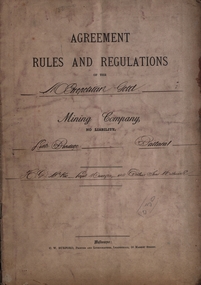
Book, Agreement Rules & Regulations of the metropolitan Gold Mining Company, Little Bendigo, 1898-1899
... A mining compny in Ballarat. edward daniel t. byrne register-general's office w.m. acheson john heinz metropolitan gold mining company henry donald mckee maxwell bruce henry stone wiliam cleverdon h.p. smith h. poppeus f.c.k. lewin share scrip little bendigo ballarat mining Printed book of rules, regulations and shareholders. ...A mining compny in Ballarat.Printed book of rules, regulations and shareholders.edward daniel, t. byrne, register-general's office, w.m. acheson, john heinz, metropolitan gold mining company, henry donald mckee, maxwell bruce, henry stone, wiliam cleverdon, h.p. smith, h. poppeus, f.c.k. lewin, share scrip, little bendigo, ballarat, mining -
 Surrey Hills Historical Society Collection
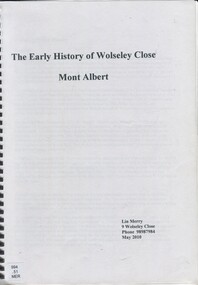
Book, The early history of Wolseley Close, Mont Albert, 2010
... Land Title information, surveys, subdivision Includes list of occupants of the house, p.17 cragg family windsor crescent surrey hills (mr) william ainger (mr) isaiah ainger whitehorse road noorn hill house names koonda d j maloney (mrs) louisa clara maggs taramera union road st.abbs york street (mr) william henry cleverdon wolseley street windsor park estate tarawera merry family clinton family adams family tel-el-kebir farrell family (mr) william clark trafalgar street (mr) (sir) matthew davies (mr) c h james (mr) james munro (mrs) elizabeth clark langdale (mr) stanley dewar (mr) john jose (mrs) emily hampton potton (mr) alexander potton (mr) john atkinson morris freehold investment & banking co. mont albert windsor park surrey hills dalton family (mr) henry wood wolseley close 19p : col ill Includes some plans of houses built in Wolseley Close, Mont Albert, Victoria. ...Includes copy of will of William Clark. Resident of the property at 9 Wolseley Close in 1910. Includes copy of the Alan Holts home occupier / tenant records - names from 1920 - 1980. Includes photo of Wolseley Close house, taken 1888/1889 plus colour photo of Wolseley Close house taken by Lin Merry, 2010. Land Title information, surveys, subdivision Includes list of occupants of the house, p.17Includes some plans of houses built in Wolseley Close, Mont Albert, Victoria. Outlines details of property at 9 Wolseley Close19p : col illcragg family, windsor crescent, surrey hills, (mr) william ainger, (mr) isaiah ainger, whitehorse road, noorn hill, house names, koonda, d j maloney, (mrs) louisa clara maggs, taramera, union road, st.abbs, york street, (mr) william henry cleverdon, wolseley street, windsor park estate, tarawera, merry family, clinton family, adams family, tel-el-kebir, farrell family, (mr) william clark, trafalgar street, (mr) (sir) matthew davies, (mr) c h james, (mr) james munro, (mrs) elizabeth clark, langdale, (mr) stanley dewar, (mr) john jose, (mrs) emily hampton, potton, (mr) alexander potton, (mr) john atkinson morris, freehold investment & banking co., mont albert, windsor park surrey hills, dalton family, (mr) henry wood, wolseley close
