
Showing 37 items matching " counted thread"
-
 Embroiderers Guild, Victoria
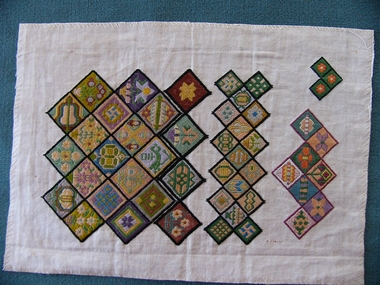
Textile - Counted Thread Embroidery Sampler, Prior in 1992 when purchased
... Counted Thread Embroidery Sampler...... Counted thread...Textile Counted Thread Embroidery Sampler ...Donor note - bought (probably at auction) in London by Pat Earnshaw (Lacemaker).Rectangle of linen with embroidered diamonds in muted colours and outlined in black, designs are counted work with varied patterns.embroidery, counted thread, india, portugal -
 Embroiderers Guild, Victoria
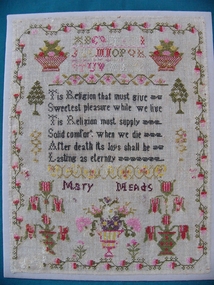
Textile - Mary Meads 1830 Sampler, Mary Meads, 1830
... ... Counted thread...Religious verse, alphabet and various spot motifs in counted thread....Religious verse, alphabet and various spot motifs in counted thread. Textile Mary Meads 1830 Sampler Mary Meads ...Refer Registration No. 1095. Mary Meads - sister of Emma Meads, donor's great grandmother. Mary married and came to Australia on one of the early sailing ships. Emma was raised by her grandmother as she had measles and couldn't come out to Australia.Natural coloured linen - rose bud border in green and pinks. Religious verse, alphabet and various spot motifs in counted thread.Tis Religion that must give Sweetest pleasure while we live Tis religion must supply Solid comfort when we die After death it's Joy shall be Lasting as eternity. Mary Meadsembroidery, counted thread, samplers, 1820-40, england -
 Embroiderers Guild, Victoria
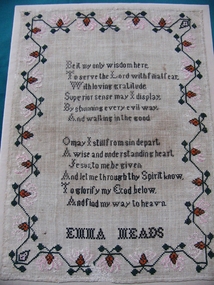
Textile - Emma Meads 1830 Sampler, Emma Meads, 1830
... ... Counted thread...Natural coloured linen. Counted thread, honey suckle border in pink, white, orange and very dark green. ...Emma Meads Natural coloured linen. Counted thread, honey suckle border in pink, white, orange and very dark green. ...Emma Meads worked this sampler, her name is embroidered on it. Mary Meads was donor's great grandmother. Emma Meads was Mary's sister. Mary married and came out to Australia on one of the early sailing ships. Emma was raised by her grandmother because she had measles and couldn't come out with Mary. Refer Registration No. 1096, Mary Meads sampler.Natural coloured linen. Counted thread, honey suckle border in pink, white, orange and very dark green. Religious verse in black.Be it my only wisdom here To serve the Lord with filial fear With loving gratitude Superior sense may I display By shunning every evil way And walking in the good. O may I still from sin depart A wise and understanding heart Jesus, to me be given And let me through thy Spirit know To glorify my God below And find my way to Heaven. Emma Meadsembroidery, counted thread, samplers, 1820-40, england -
 Embroiderers Guild, Victoria
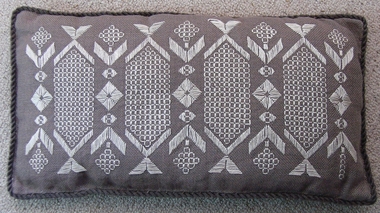
Domestic Object - Cushion, 1965-66
... ... Counted thread...Brown linen cushion, Counted thread embroidery. stitched in perle 8 thread in a geometric design. ...Embroidery Cushion 1960-80 Denmark Counted thread Brown linen cushion, Counted thread embroidery. stitched in perle 8 thread in a geometric design. ...Bought by Lady Amies for the Guild while overseas and worked by her during her trip 1965-66.Brown linen cushion, Counted thread embroidery. stitched in perle 8 thread in a geometric design. Brown corded wool edge. End closed with hook and eyes.embroidery, cushion, 1960-80, denmark, counted thread -
 Embroiderers Guild, Victoria
Textile - Ecclesiastical Whitework Sampler, Mrs H.S. Williamson, 1980-2000
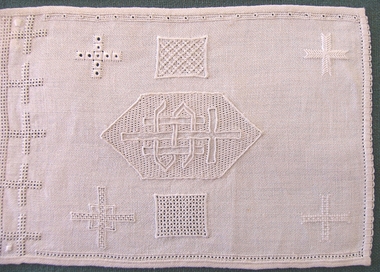
... ... Counted thread...These pieces show the use of different materials (even weave linen, fine linen and very fine linen) threads, stitches and designs suitable for ecclesiastical use. Evenweave - counted thread work and hems and borders....Evenweave - counted thread work and hems and borders. Textile Ecclesiastical Whitework Sampler Mrs H.S. ...Designed and worked by Mrs H.S. Williamson.These pieces show the use of different materials (even weave linen, fine linen and very fine linen) threads, stitches and designs suitable for ecclesiastical use. Evenweave - counted thread work and hems and borders.embroidery, counted thread, surface stitchery, whitework, ecclesiastical, 1980-2000, england, samplers -
 Embroiderers Guild, Victoria
Textile - Wall Hanging, circa 1960
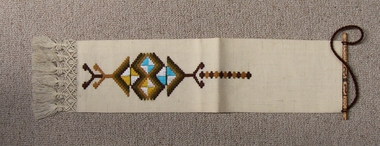
... ... Counted thread...Geometric design in counted thread work. Rod across top with brown wool loop to hang. ...Geometric design in counted thread work. Rod across top with brown wool loop to hang. ...Donor's note - made in an orphanage at Samsun Anatolia, Turkey.Even weave linen embroidered with wool in brown, blue, green, yellow and white. Geometric design in counted thread work. Rod across top with brown wool loop to hang. Fringe across bottom.on paper label: " tutunum tuter". Fabric label "samsun olgunlasma Made in Turkey"embroidery, wall hanging, 1960-80, turkey, counted thread, macrame fringe -
 Embroiderers Guild, Victoria
Textile - Moroccan Blue and White Mat
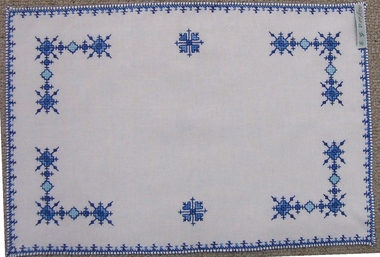
... The embroiderer simply counts each thread; one stitch spans two to four threads of the fabric. ...White cotton mat decorated with counted thread and with a rolled, buttonhole stitched hem in shades of blue,...The embroiderer simply counts each thread; one stitch spans two to four threads of the fabric. ...Moroccan hand embroidery dates back to the earl 18th century. The Berber tribes of Morocco, North Africa, used permanent tattoo symbols on their bodies, as a sign of cultural beauty. Later this very decoration was transferred onto pottery and then as hand embroidery, and became a big part of the country's tradition. Many cities in the north of Morocco, like Meknes, Rabat, Salé, and Fez are all known for their unique way of embroidery style, technique, colours and fabric. This particular piece of hand embroidery was done in Meknes in 1991. It has no pattern transferred or drawn onto the actual fabric. The embroiderer simply counts each thread; one stitch spans two to four threads of the fabric. Embroidering horizontally, vertically or diagonally, leaving blanks to achieve the desired symmetrical design. This is an extremely time-consuming technique, which requires mathematical precision and a lot of concentration and patience, There is no reverse side.White cotton mat decorated with counted thread and with a rolled, buttonhole stitched hem in shades of blue,mat, embroidery, morocco, cross stitch -
 Embroiderers Guild, Victoria
Textile - Ecclesiastical Whitework Sampler, Mrs H.S. Williamson, 1980-2000
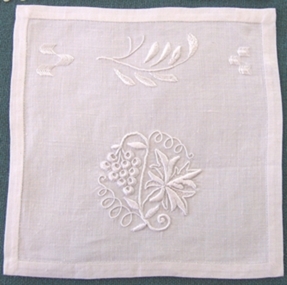
... ... Counted thread...Williamson. Embroidery Counted thread Surface stitchery Whitework Ecclesiastical 1980-2000 England Samplers These pieces show the use of different materials (even weave linen, fine linen and very fine linen) threads, stitches and designs suitable for ecclesiastical use. ...Designed and worked by Mrs H.S. Williamson.These pieces show the use of different materials (even weave linen, fine linen and very fine linen) threads, stitches and designs suitable for ecclesiastical use. Fine linen - surface stitchery, vine and grape motif, plain edging.embroidery, counted thread, surface stitchery, whitework, ecclesiastical, 1980-2000, england, samplers -
 Embroiderers Guild, Victoria
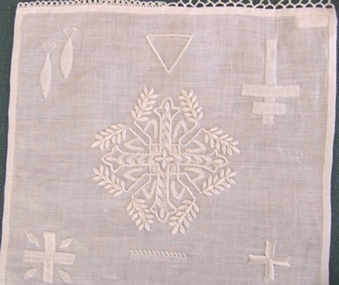
Textile - Ecclesiastical Whitework Sampler, Mrs H.S. Williamson, 1980-2000
... ... Counted thread...Williamson. Embroidery Counted thread Surface stitchery Whitework Ecclesiastical 1980-2000 England Samplers These pieces show the use of different materials (even weave linen, fine linen and very fine linen) threads, stitches and designs suitable for ecclesiastical use. ...Designed and worked by Mrs H.S. Williamson.These pieces show the use of different materials (even weave linen, fine linen and very fine linen) threads, stitches and designs suitable for ecclesiastical use. Very fine linen - surface embroidery various cross motifs, decorative hem finishes.embroidery, counted thread, surface stitchery, whitework, ecclesiastical, 1980-2000, england, samplers -
 Embroiderers Guild, Victoria
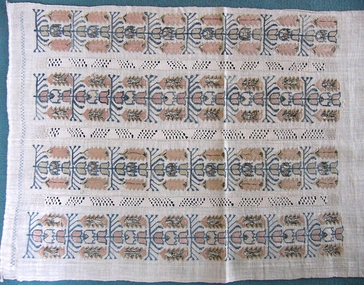
Textile - Turkish Towel Fragment, Late 19th century
... ... Counted thread...Embroidery Towels Late 19th century Turkey Counted thread Natural coloured cotton fabric hand woven. ...Natural coloured cotton fabric hand woven. Heavily embroidered with alternate bands of needle weaving and floral sprays of tent and cross stitch in pink and blue silks, along with metal threadsembroidery, towels, late 19th century, turkey, counted thread -
 Embroiderers Guild, Victoria
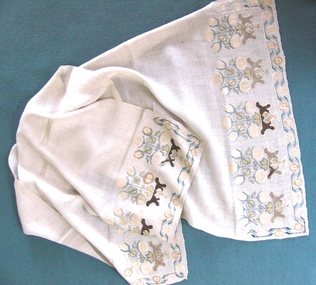
Textile - Embroidered Turkish Towel, Late 19th century
... ... Counted thread...Embroidery Towels Late 19th century Turkey Counted thread Double ended towel of natural coloured cotton with a rough texture which is typical of the area and probably hand woven. ...Double ended towel of natural coloured cotton with a rough texture which is typical of the area and probably hand woven. A row of five flower vases embroidered in green and brown silk threads. Metal thread also used. Pulled thread strips separate vases.embroidery, towels, late 19th century, turkey, counted thread -
 Embroiderers Guild, Victoria
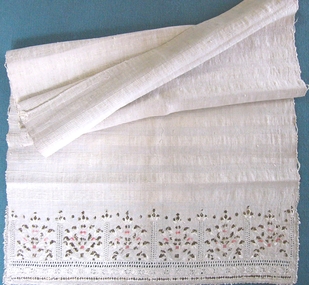
Textile - Embroidered Turkish Towel, Late 19th century
... ... Counted thread...Embroidery Towels Late 19th century Turkey Counted thread Drawn thread Natural coloured linen hand woven. ...Natural coloured linen hand woven. Embroidered at one end only with a vase of flowers in ecru, pink and gold thread. Vases separated by pulled thread rows. Along lower edge alternate blocks of satin stitched and drawn thread.embroidery, towels, late 19th century, turkey, counted thread, drawn thread -
 Embroiderers Guild, Victoria
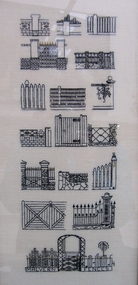
Artwork, other - Blackwork Picture, Lynette McAlister, "Malvern Fences", 1989-90
... ... Counted thread...Embroidery Pictures Counted thread 1980-2000 Australia Blackwork Picture worked in blackwork embroidery, black thread on ivory linen. ...Made by Lynette McAlister (member). Acquired for the Collection from the 1990 Guild Exhibition. Nov 1997 washed and remounted on acid free card. Previously on masonite with far too much padding.Picture worked in blackwork embroidery, black thread on ivory linen. Original design suggested by pen sketches, illustrating a report on Malvern. embroidery, pictures, counted thread, 1980-2000, australia, blackwork -
 Embroiderers Guild, Victoria
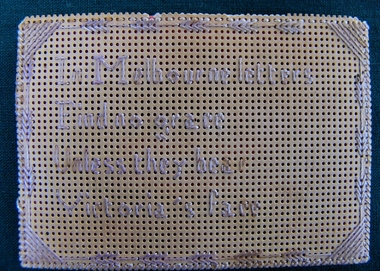
Tool - Stamp Holder, c. 1900
... ... Counted thread...19th century Embroidery Small Articles Counted thread Australia Side 1, In Melbourne letters Side 2, To guard her head from Find no grace Dust and damps Unless they bear This case provides for Victoria's face Postage stamps Perforated paper with silk embroidery sewing together with decorative stitching. ...Perforated paper with silk embroidery sewing together with decorative stitching. Side 1, In Melbourne letters Side 2, To guard her head from Find no grace Dust and damps Unless they bear This case provides for Victoria's face Postage stamps19th century, embroidery, small articles, counted thread, australia -
 Embroiderers Guild, Victoria
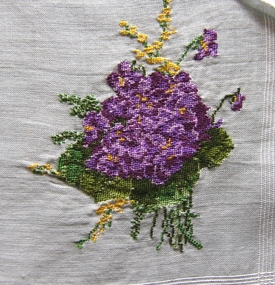
Accessory - Handkerchief with Petit Point Bouquet, 1930's
... ... Counted thread...Embroidery Counted thread Handkerchiefs 1920-40 White cotton with woven strip. ...White cotton with woven strip. One corner has a bunch of violets worked in fine petit point.embroidery, counted thread, handkerchiefs, 1920-40 -
 Embroiderers Guild, Victoria
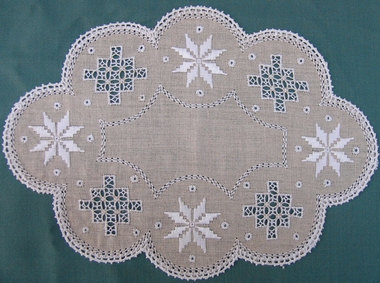
Textile - Lefkara Cyprus Embroidered Mat, c. 1970
... ... Counted thread...Embroidery Mats Counted thread Lefkara Cyprus 1960-80 Oval hand woven beige linen embroidered in white in a modern version of traditional Cyprus embroidery. ...From the village of Lefkara, Cyprus.Oval hand woven beige linen embroidered in white in a modern version of traditional Cyprus embroidery. Design is 4 stars in satin stitch, and 4 alternating designs of squares. Scalloped embroidered edge. embroidery, mats, counted thread, lefkara, cyprus, 1960-80 -
 Embroiderers Guild, Victoria
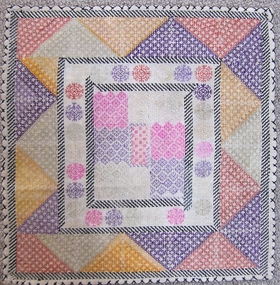
Textile - Coloured Blackwork Embroidered Mat, 1970's
... ... Counted thread...Embroidery Counted thread Mats 1960-80 Afghanistan Cream linen with patterns in coloured threads, similar to the patterns in Elizabethan blackwork. ...Cream linen with patterns in coloured threads, similar to the patterns in Elizabethan blackwork. N.B. colours are not fast. embroidery, counted thread, mats, 1960-80, afghanistan -
 Embroiderers Guild, Victoria
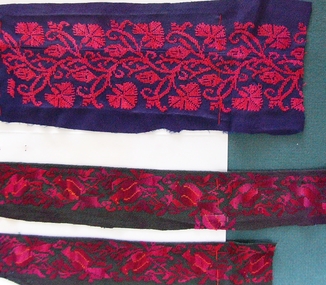
Textile - Bedouin Embroidered Garment Fragments
... ... Counted thread..."Pieces of embroidery from Bedouins which they sell in the market at Beersheba". Embroidery Counted thread Cross stitch Fragments Jordan Middle East A. ..."Pieces of embroidery from Bedouins which they sell in the market at Beersheba".A. Two strips of synthetic grey fabric with cross stitch embroidery of birds in shades of pink and red. B. One piece dark blue fabric with red cross stitch flowers C. Two multiple tassels mainly red cord with white and blue beads embroidery, counted thread, cross stitch, fragments, jordan, middle east -
 Embroiderers Guild, Victoria
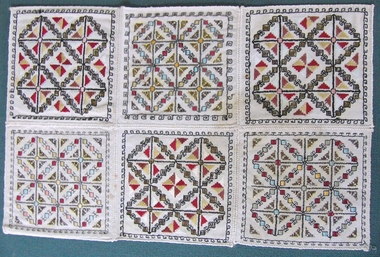
Textile - Eastern European Embroidered Mat, Baroness Viola, Late 19th century
... ... Counted thread...Czechoslovakia Embroidery Mats Counted thread Late 19th century Mid European 6 squares of white cotton joined to make a larger mat. 3 squares in one design and 3 in another. ...Belonged to Baroness Felicitas Wiedersperger of Tazivitz, worked by her sister the Baroness Viola.6 squares of white cotton joined to make a larger mat. 3 squares in one design and 3 in another. All 6 squares are outlined in a black border. Designs are in satin stitch in cotton and metal threads (gold).czechoslovakia, embroidery, mats, counted thread, late 19th century, mid european -
 Embroiderers Guild, Victoria
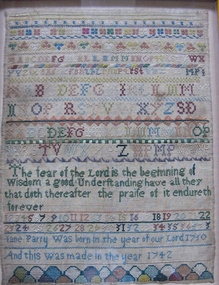
Textile - Jane Parry 1742 Band Sampler, Jane Parry, 1742
... ... Counted thread...Embroidery Sampler 18th Century England Counted thread Alphabets "The Fear of the Lord is the beginning of wisdom. ...Acquired with money from the Sampler Exhibition at the Guild - March 1988.Aged linen ground with multi-coloured cotton thread. Bands of pattern, letters, numbers, religious text and maker's name Jane Parry and when born 1730, and when she made the sampler 1742. Cross stitch, Satin stitch and eyelets were used. Restored, mounted and framed in 1988."The Fear of the Lord is the beginning of wisdom. A good understanding have all they that doth thereafter the praise of it endureth forever". "Jane Parry was born in the year of our Lord 1730 and this was made in the year 1742"embroidery, sampler, 18th century, england, counted thread, alphabets -
 Embroiderers Guild, Victoria
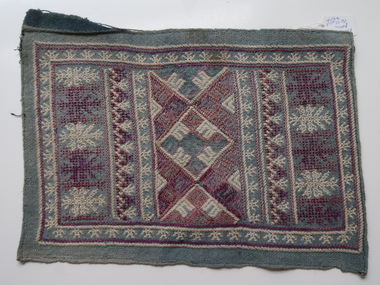
Textile - Vietnamese Embroidered Clothing Panel, 1990
... Small embroidered panel, faded indigo with counted thread embroidery....Example of Hill Tribes embroidery Small embroidered panel, faded indigo with counted thread embroidery. Textile Vietnamese Embroidered Clothing Panel ...Purchased by donor north of Sapa near Mount Fansipan, Vietnam. Small embroidered panel worn as part of everyday wear on back of jacket/top.Example of Hill Tribes embroiderySmall embroidered panel, faded indigo with counted thread embroidery. -
 Embroiderers Guild, Victoria
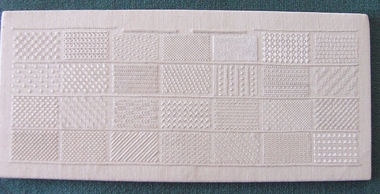
Textile - Royal School of Needlework Whitework Sampler, Miss Elizabeth Lewis, RSN Whitework Sampler, 1940-60
... Cream sampler with counted thread work, probably in stranded cotton or fine linen (52 threads to the inch). ...The sampler is divided into rectangles and each rectangle has a different counted thread pattern. It is mounted on board. ...One of a number of samplers embroidered by the donor's aunt, while she was studying at the Royal School of Needlework. She taught and judged embroidery throughout England.Cream sampler with counted thread work, probably in stranded cotton or fine linen (52 threads to the inch). The sampler is divided into rectangles and each rectangle has a different counted thread pattern. It is mounted on board.embroidery, samplers, 1940-60, england, white work -
 Embroiderers Guild, Victoria
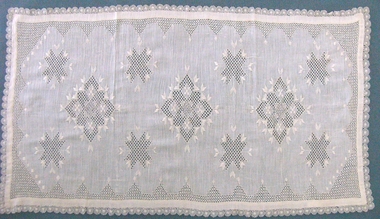
Textile - Linen Drawn Thread Embroidered Mat, Early 20th century
... Simple design of counted thread and drawn thread. Hem of Armenian edge stitch....Simple design of counted thread and drawn thread. Hem of Armenian edge stitch. ...Cream handwoven linen with self coloured linen thread embroidery. Simple design of counted thread and drawn thread. Hem of Armenian edge stitch.embroidery, mats, drawn thread, 1900-20, mid european -
 Embroiderers Guild, Victoria
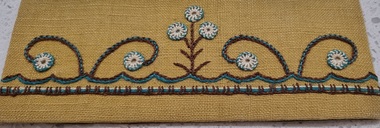
Textile - Hilda Watson Embroidery Sampler, Hilda Watson, 1937-1987
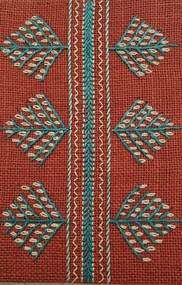
... One of eight stitch samplers worked on coarse counted thread or woven linen. Demonstrating a variety of techniques and embellishments....Embroidery Sampler England Hilda Watson Milford Surrey Label on back One of eight stitch samplers worked on coarse counted thread or woven linen. Demonstrating a variety of techniques and embellishments. ...Hilda was a member of The Embroiderers Guild U.K., a teacher and Judge. She prepared study material and embroidered items for the British Home Industries. Hilda worked on the WW1 tapestry depicting Women's War Work, displayed in the Imperial War Museum. An Annual Prize is awarded in her name for Silk Shading, by a First Year Apprentice at the Royal School of Needlework, London.One of eight stitch samplers worked on coarse counted thread or woven linen. Demonstrating a variety of techniques and embellishments.Hilda Watson Milford Surrey Label on backembroidery, sampler, england -
 Embroiderers Guild, Victoria
Textile - Hilda Watson Embroidery Sampler, Hilda Watson, 1937-1987
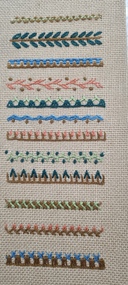
... One of eight stitch samplers worked on coarse counted thread or woven linen. Demonstrating a variety of techniques and embellishments....Sampler Embroidery Hilda Watson Milford Surrey Label on back One of eight stitch samplers worked on coarse counted thread or woven linen. Demonstrating a variety of techniques and embellishments. ...Hilda was a member of The Embroiderers Guild U.K., a teacher and Judge. She prepared study material and embroidered items for the British Home Industries. Hilda worked on the WW1 tapestry depicting Women's War Work, displayed in the Imperial War Museum. An Annual Prize is awarded in her name for Silk Shading, by a First Year Apprentice at the Royal School of Needlework, London.One of eight stitch samplers worked on coarse counted thread or woven linen. Demonstrating a variety of techniques and embellishments.Hilda Watson Milford Surrey Label on backsampler, embroidery -
 Embroiderers Guild, Victoria
Textile - Hilda Watson Embroidery Sampler, Hilda Watson, 1937-1987
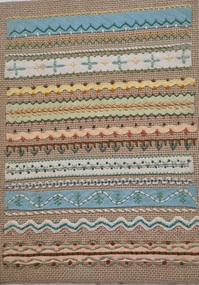
... One of eight stitch samplers worked on coarse counted thread or woven linen. Demonstrating a variety of techniques and embellishments....Sampler embroi Embroidery Hilda Watson Milford Surrey Label on back One of eight stitch samplers worked on coarse counted thread or woven linen. Demonstrating a variety of techniques and embellishments. ...Hilda was a member of The Embroiderers Guild U.K., a teacher and Judge. She prepared study material and embroidered items for the British Home Industries. Hilda worked on the WW1 tapestry depicting Women's War Work, displayed in the Imperial War Museum. An Annual Prize is awarded in her name for Silk Shading, by a First Year Apprentice at the Royal School of Needlework, London.One of eight stitch samplers worked on coarse counted thread or woven linen. Demonstrating a variety of techniques and embellishments.Hilda Watson Milford Surrey Label on backsampler, embroi, embroidery -
 Embroiderers Guild, Victoria
Textile - Hilda Watson Embroidery Sampler, Hilda Watson, 1937-1987
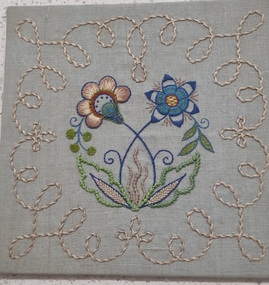
... One of eight stitch samplers worked on coarse counted thread or woven linen. Demonstrating a variety of techniques and embellishments....Sampler Embroidery Hilda Watson Milford Surrey Label on back One of eight stitch samplers worked on coarse counted thread or woven linen. Demonstrating a variety of techniques and embellishments. ...Hilda was a member of The Embroiderers Guild U.K., a teacher and Judge. She prepared study material and embroidered items for the British Home Industries. Hilda worked on the WW1 tapestry depicting Women's War Work, displayed in the Imperial War Museum. An Annual Prize is awarded in her name for Silk Shading, by a First Year Apprentice at the Royal School of Needlework, London.One of eight stitch samplers worked on coarse counted thread or woven linen. Demonstrating a variety of techniques and embellishments.Hilda Watson Milford Surrey Label on backsampler, embroidery -
 Embroiderers Guild, Victoria
Textile - Hilda Watson Embroidery Sampler, Hilda Watson, 1937-1987
... One of eight stitch samplers worked on coarse counted thread or woven linen. Demonstrating a variety of techniques and embellishments....Sampler Embroidery Hilda Watson Milford Surrey Label on back One of eight stitch samplers worked on coarse counted thread or woven linen. Demonstrating a variety of techniques and embellishments. ...Hilda was a member of The Embroiderers Guild U.K., a teacher and Judge. She prepared study material and embroidered items for the British Home Industries. Hilda worked on the WW1 tapestry depicting Women's War Work, displayed in the Imperial War Museum. An Annual Prize is awarded in her name for Silk Shading, by a First Year Apprentice at the Royal School of Needlework, London.One of eight stitch samplers worked on coarse counted thread or woven linen. Demonstrating a variety of techniques and embellishments.Hilda Watson Milford Surrey Label on backsampler, embroidery -
 Embroiderers Guild, Victoria
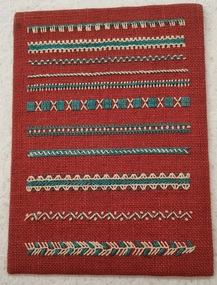
Textile - Hilda Watson Embroidery Sampler, Hilda Watson, 1937-1987
... One of eight stitch samplers worked on coarse counted thread or woven linen. Demonstrating a variety of techniques and embellishments....Sampler Embroidery Hilda Watson Milford Surrey Label on back One of eight stitch samplers worked on coarse counted thread or woven linen. Demonstrating a variety of techniques and embellishments. ...Hilda was a member of The Embroiderers Guild U.K., a teacher and Judge. She prepared study material and embroidered items for the British Home Industries. Hilda worked on the WW1 tapestry depicting Women's War Work, displayed in the Imperial War Museum. An Annual Prize is awarded in her name for Silk Shading, by a First Year Apprentice at the Royal School of Needlework, London.One of eight stitch samplers worked on coarse counted thread or woven linen. Demonstrating a variety of techniques and embellishments.Hilda Watson Milford Surrey Label on backsampler, embroidery -
 Embroiderers Guild, Victoria
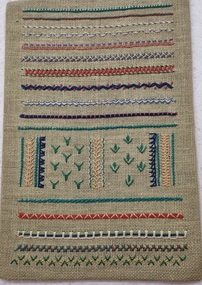
Textile - Hilda Watson Embroidery Sampler, Hilda Watson, 1937-1987
... One of eight stitch samplers worked on coarse counted thread or woven linen. Demonstrating a variety of techniques and embellishments....Sampler Embroidery Hilda Watson Milford Surrey Label on back One of eight stitch samplers worked on coarse counted thread or woven linen. Demonstrating a variety of techniques and embellishments. ...Hilda was a member of The Embroiderers Guild U.K., a teacher and Judge. She prepared study material and embroidered items for the British Home Industries. Hilda worked on the WW1 tapestry depicting Women's War Work, displayed in the Imperial War Museum. An Annual Prize is awarded in her name for Silk Shading, by a First Year Apprentice at the Royal School of Needlework, London.One of eight stitch samplers worked on coarse counted thread or woven linen. Demonstrating a variety of techniques and embellishments.Hilda Watson Milford Surrey Label on backsampler, embroidery
