
Showing 41 items matching " derby line"
-
 Bendigo Historical Society Inc.
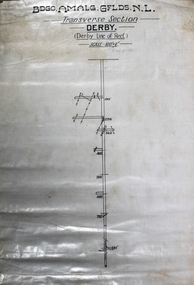
Map - Derby Line of Reef, Unknown
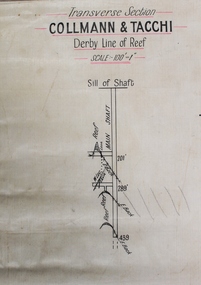
... Derby Line of Reef......Derby line of reef...A crosscut east from this shaft ata depth of 200 feet reaches the Derby Line in a distance of 700 feet. (https://search.informit.org/doi/10.3316/aesis.200104712) ...Transverse Section, Derby, Derby Line of Reef. Scale 100' = 1". Plan forms part of the Margaret Roberts Collection....Map Derby Line of Reef ...Informit: Lease application no.11038 contains a length of about 48 chains of the Paddy's Gully line of reefs. The Derby Anticline penetrates the area from its north boundary for a distance ofabout 30 chains at which point the fold disappears southwards. The outcrop of the Paddy's Gully Anticline is exposed in McClure Street. Along this section of the Paddys Gully line the top of what is regarded as 'favorable beds' occurs about 150 feet from the surface. It is estimated that the containing beds of Ladam's reef and the Garden Gully 300 feet reef, both of which proved to have been rich ore bodies on the Garden Gully line adjoining on the west, will be found at the approximate depth of 550 feet onthe Paddy's Gully line near the intersection of McClure and Bannerman Streets. A shorter vertical point of attack, though the position is less favorable geologically, is kocks Pioneer east shaft which is 420 feet deep. A crosscut east from this shaft ata depth of 200 feet reaches the Derby Line in a distance of 700 feet. (https://search.informit.org/doi/10.3316/aesis.200104712) Printed in black text on top of plan: 'Bgo Amalg Gflds N.L." (Bendigo Amalgamated Goldfields N.L.) Transverse Section, Derby, Derby Line of Reef. Scale 100' = 1". Plan forms part of the Margaret Roberts Collection.gold mining, gold, bendigo, derby, derby line of reef, transverse section -
 Bendigo Historical Society Inc.
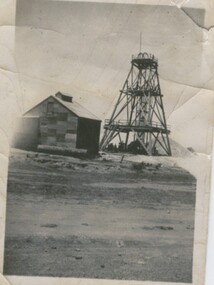
Photograph - NEANGAR, EAGLEHAWK, DERBY LINE
... NEANGAR, EAGLEHAWK, DERBY LINE...On back in biro ' Neangar, Eaglehawk, Derby Line. ....On back in biro ' Neangar, Eaglehawk, Derby Line. . Photograph NEANGAR, EAGLEHAWK, DERBY LINE ...black and white photo: poppet legs with corrugated iron building at left. On back in biro ' Neangar, Eaglehawk, Derby Line. .organization, business, neangar, eaglehawk -
 Bendigo Historical Society Inc.
Map - HUSTLER'S & CHRISTMAS LINES OF REEFS - PLAN OF LINES OF SECTION OF REEFS
... ... Derby Line...Paddy's Gully Line, Derby Line, Millers Line, Hustler's Line, Great Extended Hustler's Co with levels, depths, geological features and stone encountered. ...Paddy's Gully Line, Derby Line, Millers Line, Hustler's Line, Great Extended Hustler's Co with levels, depths, geological features and stone encountered. ...Underground Survey of Mines Bendigo. Plan of Cross Section Lines Shewing Connections with Trigonometrical Stations and Base Lines. 13/3/99 Signed ? Stirling. Places and mines mentioned Speciman Hill, Tambour Major, Lansell's 180, Victory and Pandora, Great Extended Hustler's, Windmill Hill on Victoria Reef. Next part of map is a Plan of Lines of Section between the Hustler's and Christmas Lines of Reefs. 8/3/99. Signed ?. Transverse Section. Shows Tambour Major Co., near the Christmas Line of Reef, Crosscuts and their depth, geological features and stone encountered. Then shows Thistle Line, Charshalton Line, Napoleon Line, Nell Gwynne Line, New Chum Line, Lansell's No 180 with levels, depths and geological features. Drawing is continued in three parts to fit on paper. Lansell's East Shaft with levels and depths, geological features and stone encountered. Sheepshead Line, Old Shaft, Garden Gully Line, Victory and Pabndora Co with crosscuts, depths, geological features and stone encountered. Paddy's Gully Line, Derby Line, Millers Line, Hustler's Line, Great Extended Hustler's Co with levels, depths, geological features and stone encountered. A note beside a Saddle Reef: 360,000 pounds paid in dividends from this reef. Average ounces per ton gold noted where found. Reference Table for stone and geological features. Datum Line 700 feet above Sea Level Unscannedmining, parish map, hustler's & christmas lines of reefs, plan of lines of section of reefs, ? stirling, specimen hill, tambour major, lansell's 180, victory & pandora, great extended hustler's, windmill hill, victoria reef, tambour major co, christmas line, hustler's line, thistle line, carshalton line, napoleon line, nell gwynne line, new chum line, lansell's no 180, lansell's east shaft, sheepshead line, old shaft, garden gully line, paddy's gully line, derby line, miller's line, hustler's line, great extended hustler's co -
 Bendigo Historical Society Inc.
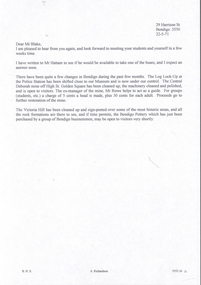
Document - NEW CHUM & VICTORIA LINES OF REEF - NEW CHUM & VICTORIA LETTER & NOTES
... Collman and Tacchi. Derby Line...The Paddy's gully Line - The British American, Lansell's Sandhurst (Needle) and the Collman and Tacchi. On the Derby Line - Johnson's No 3 (Nelson) and on the Hustlers Line are the United Hustlers and Redan and the K. ...The Paddy's gully Line - The British American, Lansell's Sandhurst (Needle) and the Collman and Tacchi. On the Derby Line - Johnson's No 3 (Nelson) and on the Hustlers Line are the United Hustlers and Redan and the K. ...Handwritten letter to Mr. Blake with reference to meeting students and the changes in Bendigo. Mentioned are the Log Lock-Up, the Central Deborah Mine, the ex-manager of the mine, Mr. Rowe acting as a guide, Victoria Hill and the Bendigo Pottery. The notes titled ''To replace Around the Goldfields'' mentions the Third Edition, 'Historic Guide to Bendigo', published in 1969 of land reclamation schemes rapidly removing all traces of several mines. Those affected on the New Chum Line of Reef are: The Victoria Consols, Ironbark and Hercules and Energetic. The Sheepshead Line - the Ironbark and Ironbark South. On the Garden Gully Line - The Cornish United, Koch's Pioneer and Confidence Extended. The Paddy's gully Line - The British American, Lansell's Sandhurst (Needle) and the Collman and Tacchi. On the Derby Line - Johnson's No 3 (Nelson) and on the Hustlers Line are the United Hustlers and Redan and the K. K. Mines. Also, a carbon copy of the notes.document, memo, new chum & victoria letter & notes, mr blake, mr hattam, log lock-up, central deborah mine, mr rowe, victoria hill, bendigo pottery, historic guide to bendigo third edition, new chum line of reef, the victoria consols, ironbark, hercules and energetic, sheepshead line, ironbark, ironbark south, garden gully line, cornish united, koch's pioneer, confidence extended, paddy's gully line, the british american, lansell's sandhurst (needle), collman and tacchi. derby line, johmson's no 3 (nelson), hustlers line, united hustlers and redan, k k mines -
 Bendigo Historical Society Inc.
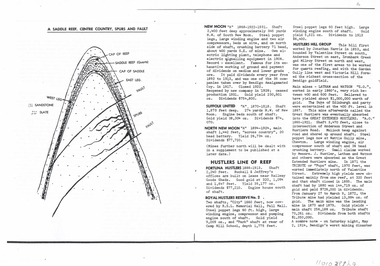
Document - LONG GULLY HISTORY GROUP COLLECTION: HUSTLERS LINE OF REEF
... ... Derby Line - Johnson's No 3...The are: Fortuna Hustlers, Royal Hustlers Reserve No 2 - City and Park Shafts, Great Hustlers, Latham, Watson, Great Extended Hustlers, Tribute or Pups Shaft, Bendigo's Worst Mining Disaster May 2 1914, Hustlers Reef (Old Hustlers) and Hustlers Reef No 1, Lansell's Comet Lightening Hill Line, The Old Comet (Cooper's Claim), United Hustlers and Redan, K K Shaft, North or New Hustlers (once known as Agnew Hustlers), Derby Line - Johnson's No 3, Paddy's Gully Line, Lansell's 'Sandhurst' (Needle), Needle Loops, Cleopatra Needle top, British American, Collman and Tacchi and South Virginia. ...The are: Fortuna Hustlers, Royal Hustlers Reserve No 2 - City and Park Shafts, Great Hustlers, Latham, Watson, Great Extended Hustlers, Tribute or Pups Shaft, Bendigo's Worst Mining Disaster May 2 1914, Hustlers Reef (Old Hustlers) and Hustlers Reef No 1, Lansell's Comet Lightening Hill Line, The Old Comet (Cooper's Claim), United Hustlers and Redan, K K Shaft, North or New Hustlers (once known as Agnew Hustlers), Derby Line - Johnson's No 3, Paddy's Gully Line, Lansell's 'Sandhurst' (Needle), Needle Loops, Cleopatra Needle top, British American, Collman and Tacchi and South Virginia. ...Page mentioning mines on the Hustlers Line of Reef. The are: Fortuna Hustlers, Royal Hustlers Reserve No 2 - City and Park Shafts, Great Hustlers, Latham, Watson, Great Extended Hustlers, Tribute or Pups Shaft, Bendigo's Worst Mining Disaster May 2 1914, Hustlers Reef (Old Hustlers) and Hustlers Reef No 1, Lansell's Comet Lightening Hill Line, The Old Comet (Cooper's Claim), United Hustlers and Redan, K K Shaft, North or New Hustlers (once known as Agnew Hustlers), Derby Line - Johnson's No 3, Paddy's Gully Line, Lansell's 'Sandhurst' (Needle), Needle Loops, Cleopatra Needle top, British American, Collman and Tacchi and South Virginia. Also mentioned is Total Gold Yield, Main Shafts on Field, Price of Gold (Old Currency) and Saddle Reefs and Spurs. Also mentioned are New Moon, Suffolk United, South New Moon and North New Moon. There is a diagram of a Saddle Reef, Centre Country, Spurs and Fault. Depth of shaft, machinery, location, dividends and yields are also mentioned. Price of Gold (Old Currency): 1851-1930, Price varied from Approx. £3/17/6 to £4 per ounce. 1938, from £6/19/10 to £7/8/10 per ounce. 1946/47/48 £10/15/3 per ounce, May 1, 1954 £15/12/6 per ounce.bendigo, history, long gully history group, the long gully history group - hustlers line of reef, fortuna hustlers, buckell & jeffrey's, railway goods sheds, rsl memorial hall, camp hill school, royal hustlers reserve no 2 - city and park shafts, jonathan harris, latham and watson, great hustlers, great extended hustlers, wattle gully mine, messrs j hustler latham and watson, tribute or pups shaft, bendigo's worst mining disaster, hustlers reef (old hustlers) and hustlers reef no 1, lansell's comet, the old comet (cooper's claim, united hustlers and redan, k k shaft, north or new hustlers (once known as agnew hustlers), derby line - johnson's no 3, pa ddy's gully line, lansell's 'sandhurst' (needle), needle loops, cleopatra needle top, british american, collman and tacchi, south virginia, saddle reefs and spurs, new moon, suffolk united, south new moon, north new moon -
 Bendigo Historical Society Inc.
Document - LONG GULLY HISTORY GROUP COLLECTION: ANTICLINAL AXIAL LINES - BENDIGO GOLD FIELD
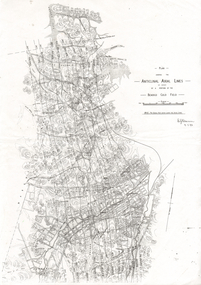
... ... Derby Line...BENDIGO History long gully history group The Long Gully History Group - Anticlinal Axial Lines - Bendigo Gold Field E J Dunn Christmas Line thistle Line Carshalton Line Napoleon Line Nell Gwynne Line New Chum Line Sheepshead Line Deborah Line Garden Gully Line Paddy's Gully Line Derby Line Miller's Line Hustlers Line Lightning Line plan shewing the Anticlinal Axial lines of a portion of the Bendigo gold Field. ...plan shewing the Anticlinal Axial lines of a portion of the Bendigo gold Field.bendigo, history, long gully history group, the long gully history group - anticlinal axial lines - bendigo gold field, e j dunn, christmas line, thistle line, carshalton line, napoleon line, nell gwynne line, new chum line, sheepshead line, deborah line, garden gully line, paddy's gully line, derby line, miller's line, hustlers line, lightning line -
 Bendigo Historical Society Inc.
Map - LONG GULLY HISTORY GROUP COLLECTION: GEOLOGICAL MAP - BENDIGO GOLD FIELD
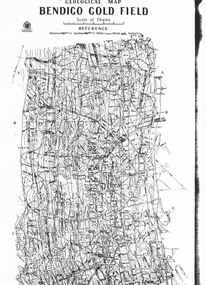
... ... Derby Line...BENDIGO History long gully history group The Long Gully History Group - Geological map - Bendigo Gold Field Mines Department H Herman Lightning Hill Line Hustlers Line Derby Line Paddy's Gully Line Garden Gully Line Deborah Line Sheepshead Line New Chum Line Nell Gwynne Line British and Foreign Line Napoleon Line Carshalton Line Thistle Line Christmas Line Lancashire Line Copy of a Geological Map of the Bendigo Gold Field. ...Copy of a Geological Map of the Bendigo Gold Field. Map shows Lines of Reef, Anticlines, Synclines, Shafts, Alluvial Contours Gullies and some street names. Copy is hard to read. There are two pages.bendigo, history, long gully history group, the long gully history group - geological map - bendigo gold field, mines department, h herman, lightning hill line, hustlers line, derby line, paddy's gully line, garden gully line, deborah line, sheepshead line, new chum line, nell gwynne line, british and foreign line, napoleon line, carshalton line, thistle line, christmas line, lancashire line -
 Bendigo Historical Society Inc.
Document - MCCOLL, RANKIN AND STANISTREET COLLECTION: BENDIGO GOLDFIELD REPORT - VICTOR PABST, 1919
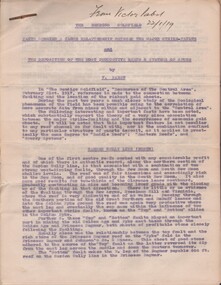
... ... Derby Line...Garden Gully Line (North) Garden Gully Line (South) Sheepshead Line Hustler Line Derby Line New Chum Line (North) New Chum Line Central Paddy's Gully Line Nell Gwynne Line Christmas Line Birds line Lancashire Line & Stafford Fault Carshalton Line Victor Pabst. ...Documents: Carbon copy of 9 page report: 'The Bendigo Goldfield, Facts showing a close relationship between the major strike faults and the deposition of the most productive reefs and systems of spurs'.Victor Pabst.organization, business, gold mining, victor pabst. garden gully line (north), garden gully line (south), sheepshead line, hustler line, derby line, new chum line (north), new chum line central, paddy's gully line, nell gwynne line, christmas line, birds line, lancashire line & stafford fault, carshalton line -
 Bendigo Historical Society Inc.
Map - Collmann and Tacchi, Unknown
... Printed in black text on top of plan: 'Transverse section, Collmann & Tacchi, Derby line of reef'. Plan shows shaft, sill of shaft, and geological features. ...Collman and Tacchi Gold Mine was located near the intersection of Eaglehawk Road and Rule Street, Long Gully. gold mining gold Bendigo Collman and Tacchi transverse section Printed in black text on top of plan: 'Transverse section, Collmann & Tacchi, Derby line of reef'. Plan shows shaft, sill of shaft, and geological features. ...Collman and Tacchi Gold Mine was located near the intersection of Eaglehawk Road and Rule Street, Long Gully. Printed in black text on top of plan: 'Transverse section, Collmann & Tacchi, Derby line of reef'. Plan shows shaft, sill of shaft, and geological features. Scale 100' = 1". Plan forms part of the Margaret Roberts Collection.gold mining, gold, bendigo, collman and tacchi, transverse section -
 Bendigo Historical Society Inc.
Document - THE JOHNSON GROUP - NOTES ON THE THE JOHNSON GROUP OF MINES
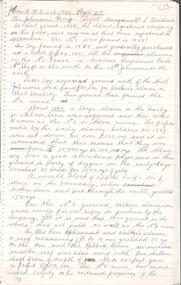
... ... Derby or Nelson Line...Shaft Nth Johnsons Walker's Claim Derby or Nelson Line No 3 or Nelson Mine The Old Rose of Denmark The Robbie Burns Mr Richard Williams Dagmar Reef Weston & Johnson Bendigo G'field Registry J N Wartney John Hooper Five handwritten notes on the The Johnson Group of Mines. ...Five handwritten notes on the The Johnson Group of Mines. Notes mention history, where the gold was found, production, origin of name, and a mine manager's report. Notes prepared by Albert Richardson.document, gold, the johnson group, the johnson group, notes on the the johnson group of mines, mr l weichard, confidence ext'd ? shaft, nth johnsons, walker's claim, derby or nelson line, no 3 or nelson mine, the old rose of denmark, the robbie burns, mr richard williams, dagmar reef, weston & johnson, bendigo g'field registry, j n wartney, john hooper -
 Bendigo Historical Society Inc.
Photograph - JOHNSON'S REEF GOLD LUBRICATOR, c.1880-1890
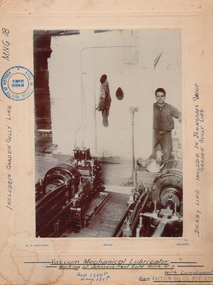
... Inscriptions: included in Garden Gully Lane MNG18. Derby Line, included in Johnson's Group of Garden Gully Line. ...Inscriptions: included in Garden Gully Lane MNG18. Derby Line, included in Johnson's Group of Garden Gully Line. ...Vacuum mechanical Lubricator Machinery (vacuum mechanical working at Johnson's Reef Gold, Mine No. 3. Lubricator. Man standing to RH side, hand on lever. Photo mounted on board. Inscriptions: included in Garden Gully Lane MNG18. Derby Line, included in Johnson's Group of Garden Gully Line. Shaft 1250ft. Winze 175ft.place, mining site, johnson's reef -
 Bendigo Historical Society Inc.
Administrative record - East Moon Gold Mining Company Mine Manager's Report Book, 1919 - 1920
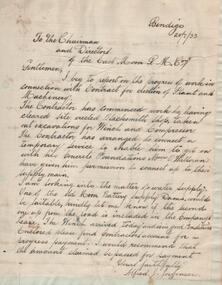
... The company will work an extensive lease on the Paddy’s Gully and Derby lines of reef at Eaglehawk. A shaft was sunk on the Paddy’s Gully line in the property of the New Moon Co. some years ago to a depth of 380 ft. and another shaft was sunk by the same company on the Derby line of reef to 134 ft. ...The company will work an extensive lease on the Paddy’s Gully and Derby lines of reef at Eaglehawk. A shaft was sunk on the Paddy’s Gully line in the property of the New Moon Co. some years ago to a depth of 380 ft. and another shaft was sunk by the same company on the Derby line of reef to 134 ft. ...February 1933: East Moon Gold Mining Co. N.L. has been formed with a capital of £25,000 in 36,000 shares of 10/- each issued at 1/-. The company will work an extensive lease on the Paddy’s Gully and Derby lines of reef at Eaglehawk. A shaft was sunk on the Paddy’s Gully line in the property of the New Moon Co. some years ago to a depth of 380 ft. and another shaft was sunk by the same company on the Derby line of reef to 134 ft. In the Paddy’s Gully shaft a large body of spurs 10ft wide at the 256ft plat was exposed and continued downward for 36 ft (56ft?) before passing out of the shaft to the east. A little gold was seen in the stone but no work was done. The development of this formation will be the first work undertaken by the new company. (The Sun News Pictorial Monday 20th February 1933, page 23) Black hard cover book, red binding on spine, one hundred and eighty eight pages of which sixty five are used. Label on front cover: 'East Moon G.M.C . N.L.' Book contains: a. handwritten reports from Alfred Jorgensen regarding the installation of the plant and machinery at the mine b. reports from E.G. Robertson, the Manager of the East Moon Gold Mining Company. Typed report by E.G. Robertson, 8th July 1935 reports on the Paddy's Gully shaft, the Derby shaft and the Hustlers shaft. Entries date from 20th July 1933 to 22nd. August 1935. Mine Manager's book forms part of the Margaret Roberts Collection of Mining records.bendigo, margaret roberts, legal managers, mine manager, east moon gold mining company n.l., e.g. robertson mine manager, alfred jorgensen contractor, paddy's gully shaft, derby shaft, hustler's shaft, -
 Victorian Harness Racing Heritage Collection at Lord's Raceway Bendigo
Photograph - Wooden framed photo finish, A Copley, New Derby, 6 December 1930
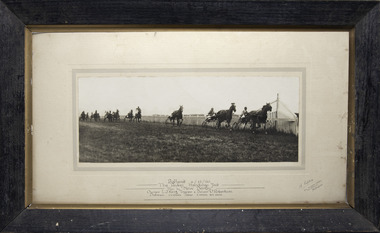
... Top line: Ballarat / 6-12-30 Second line: The Redan Handicap Trot Third line: Won by "New Derby" Fourth line: Owner LJ King / Trainer & Driver C Robertson Bottom line: Distance 1 1/4 miles / Time 2 min 59 secs Bottom right corner: A Copley, 434a Flinders Street Near William St Melbourne...New Derby owned by LJ King, was trained and driven by C Robertson. horses race winner driver trainer owner ballarat 1930 new derby c robertson lj king a copley charlie robertson charlie robertson jnr c robertson jnr Top line: Ballarat / 6-12-30 Second line: The Redan Handicap Trot Third line: Won by "New Derby" Fourth line: Owner LJ King / Trainer & Driver C Robertson Bottom line: Distance 1 1/4 miles / Time 2 min 59 secs Bottom right corner: A Copley, 434a Flinders Street Near William St Melbourne One large black and white photograph in a black frame. ...New Derby won The Redan Handicap Trot Ballarat on the 6 December 1930. New Derby owned by LJ King, was trained and driven by C Robertson. One large black and white photograph in a black frame. Top line: Ballarat / 6-12-30 Second line: The Redan Handicap Trot Third line: Won by "New Derby" Fourth line: Owner LJ King / Trainer & Driver C Robertson Bottom line: Distance 1 1/4 miles / Time 2 min 59 secs Bottom right corner: A Copley, 434a Flinders Street Near William St Melbournehorses, race, winner, driver, trainer, owner, ballarat, 1930, new derby, c robertson, lj king, a copley, charlie robertson, charlie robertson jnr, c robertson jnr -
 Bendigo Historical Society Inc.
Document - GARDEN GULLY LINE OF REEF
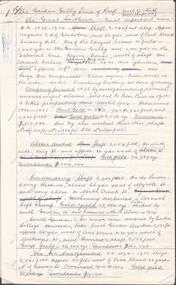
... 'The Garden Gully line of reef, south to north, main shafts only' Great Southern, first important mine 1876 - 1924 Ulster United Londonderry shaft The Sea Amalgamated Garden Gully United 'Bendigo's most famous mine' 1874 - 1921 Victory and Pandora Ironbark 1871 - 1921 Unity Mine Carlisle United Long Gully ' Bendigo's richest mine' Cornish United 1866 - 1920 Koch's pioneer Windmill Hill 1874 - 1920 Confidence Extended 1877 - 1896 - 1915 Johnson's Group California Gully No. 1 and No. 2 and No. 3 Derby line North Johnson's Princess Dagmar 1876 - 1918 Golden Age 1870 - 1917 Johnson's Reef Extended Golden Pyke 1870 - 1921 Constellation 1887 - 1923 Great Northern 1877 - 1922 Virginia 1878 - 1922 Specimen Hill United 1860 - 1920 New Argus 1864 - 1922 Clarence United Sailors Gully 1857 - 1918 South New Moon 1871-1920's and 1933 - 1941 New Moon 1868 - 1922 - 1931 Suffolk United 1870 - 1918 North New Moon 1894 - 1924...'The Garden Gully line of reef, south to north, main shafts only' Great Southern, first important mine 1876 - 1924 Ulster United Londonderry shaft The Sea Amalgamated Garden Gully United 'Bendigo's most famous mine' 1874 - 1921 Victory and Pandora Ironbark 1871 - 1921 Unity Mine Carlisle United Long Gully ' Bendigo's richest mine' Cornish United 1866 - 1920 Koch's pioneer Windmill Hill 1874 - 1920 Confidence Extended 1877 - 1896 - 1915 Johnson's Group California Gully No. 1 and No. 2 and No. 3 Derby line North Johnson's Princess Dagmar 1876 - 1918 Golden Age 1870 - 1917 Johnson's Reef Extended Golden Pyke 1870 - 1921 Constellation 1887 - 1923 Great Northern 1877 - 1922 Virginia 1878 - 1922 Specimen Hill United 1860 - 1920 New Argus 1864 - 1922 Clarence United Sailors Gully 1857 - 1918 South New Moon 1871-1920's and 1933 - 1941 New Moon 1868 - 1922 - 1931 Suffolk United 1870 - 1918 North New Moon 1894 - 1924 Document GARDEN GULLY LINE OF REEF ...Handwritten document . 'The Garden Gully line of reef, south to north, main shafts only' Great Southern, first important mine 1876 - 1924 Ulster United Londonderry shaft The Sea Amalgamated Garden Gully United 'Bendigo's most famous mine' 1874 - 1921 Victory and Pandora Ironbark 1871 - 1921 Unity Mine Carlisle United Long Gully ' Bendigo's richest mine' Cornish United 1866 - 1920 Koch's pioneer Windmill Hill 1874 - 1920 Confidence Extended 1877 - 1896 - 1915 Johnson's Group California Gully No. 1 and No. 2 and No. 3 Derby line North Johnson's Princess Dagmar 1876 - 1918 Golden Age 1870 - 1917 Johnson's Reef Extended Golden Pyke 1870 - 1921 Constellation 1887 - 1923 Great Northern 1877 - 1922 Virginia 1878 - 1922 Specimen Hill United 1860 - 1920 New Argus 1864 - 1922 Clarence United Sailors Gully 1857 - 1918 South New Moon 1871-1920's and 1933 - 1941 New Moon 1868 - 1922 - 1931 Suffolk United 1870 - 1918 North New Moon 1894 - 1924Albert Richardsonbendigo, mining, garden gully line of reef mines -
Bendigo Historical Society Inc.
Map - LEICHARDT : COUNTY OF BENDIGO, 15-6-19
... Leichardt, County of Bendigo, Bridgewater, Yarraberb, Nerring, Marong, Woodstock, Derby, Sandhurst & Inglewood Railway Line. Photo-Lithographed at the Department of Lands and Survey, Melbourne, by T.F. ...Leichardt, County of Bendigo, Bridgewater, Yarraberb, Nerring, Marong, Woodstock, Derby, Sandhurst & Inglewood Railway Line. Photo-Lithographed at the Department of Lands and Survey, Melbourne, by T.F. ...Map. Leichardt, County of Bendigo, Bridgewater, Yarraberb, Nerring, Marong, Woodstock, Derby, Sandhurst & Inglewood Railway Line. Photo-Lithographed at the Department of Lands and Survey, Melbourne, by T.F. McGauran, 15-6-09. Price 1/-. (number 68 in map cupboard 1)T.F. McGauranmap, bendigo, leichardt -
 Bendigo Historical Society Inc.
Document - Hustlers, Sheepshead and Deborah lines of reef
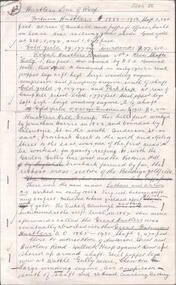
... North, or New Hustlers, once known as Agnew Hustlers, wooden poppet legs, south side, Kneebone Street, Eaglehawk. Derby line, Johnson's No. 3, South Johnson's (east shaft of Collman and Tacchi) 439 feet on west wide of Woods Street, south of Wetherall Street. ...North, or New Hustlers, once known as Agnew Hustlers, wooden poppet legs, south side, Kneebone Street, Eaglehawk. Derby line, Johnson's No. 3, South Johnson's (east shaft of Collman and Tacchi) 439 feet on west wide of Woods Street, south of Wetherall Street. ...Albert Richardson was a mining historian who wrote widely on the mines of the Bendigo Goldfield. The park opposite the Goldmines Hotel in Marong Road, is named in his honour. Five page document, hand written by Albert Richardson on lined foolscap and edited with cross-outs and insertions, . The mines along the Hustlers line of reef and the Sheepshead line of reef are described. Mines listed on Hustlers line of reef: Fortuna Hustlers (1888 - 1913), shaft 2,240 feet at rear of Buckell and Jeffrey's offices; Royal Hustlers Reserve No. 2 - two shafts 'City" 860 feet, now covered by R.S.L. building Pall Mall, steel poppet legs 60 ft high and 'Park Shaft" at rear of Camp Hill School, 1,775 feet, steel poppet legs 60 feet high; Hustlers Hill Group first worked by Jonathan Harris in 1853 and bounded by Valentine, Anderson and Ironbark Creek to the north and Milroy Street to the east, one of first areas worked for quartz reefing. It with Garden Gully line west and Victoria Hill Ironbark, formed by far the richest cross section of the Bendigo Goldfield. Great Extended Hustlers (1865-1921) close to intersection of Anderson Street and Hustlers Road, mullock heap against road and shored up around shaft, steel poppet legs now at Wattle Gully mine, Chewton, large winding machine, air compressor south of shaft and 36 head crushing battery. Hustlers Reef (Old Hustlers) and Hustlers Reef No. 1, two shafts, main 2,210 feet, about 220 yards east of Moran Street and against Fenton Street. , No. 1 shaft 1,140 feet and about 155 yards east of Moran Street. Lansell's Comet, Lightining Hill line, 2.100 feet, on Comet Hill approx 70 yards west of Holmes Road, near Comet Creek, steel poppet legs. United Hustlers and Redan (1876-1918), main Redan, 1,830 feet about 155 yards west of Sandhurst Roead, in line with Comet Hill State School, this hill known as Redan Hill. North, or New Hustlers, once known as Agnew Hustlers, wooden poppet legs, south side, Kneebone Street, Eaglehawk. Derby line, Johnson's No. 3, South Johnson's (east shaft of Collman and Tacchi) 439 feet on west wide of Woods Street, south of Wetherall Street. Paddy's Gully Line, south to north, some shafts - Lansell's 'Sandhurst" ('Needle") Eaglehawk Road shaft 2,425 feet, about 50 yards east of Needle Loops, a brick square sided chimney with Cleopatra Needle top. British American, 789 feet, just south of Holdsworth Road. Collman and Tacchi, main shaft 2,588 feet, 60 yards west of Eaglehawk Road, California Gully. Deborah Line of Reef, The Deborah (1932-1954) shaft 2.017 feet, west of Adams Road and south of Abel Street, Quarry Hill. North Deborah (1937 - 1954) shaft 1,151 feet, Breen Street, Quarry Hill, steel poppet legs. Central Deborah (1939-1954) shaft 1,347 feet Sheepshead line of reef, Lansell's South Red, White and Blue, shaft 2,124 feet, north east of Bellevue Road and 220 yards east of Adams Road. The New Red, White and Blue Consolidated (Big Blue) main shaft 2,416 feet. Lansell's Bendigo Battery 105 head, north of 'Big Blue" on his freehold lease, commenced crushing on 24th February 1895. After closing was erected as the Showground's Industrial Hall, July 1926. North Red, White and Blue, burnt down February 1926, new company 1934, closed 1938. Document is part of the Albert Richardson Collection of Bendigo mining history. bendigo, gold mining, deborah line of reef, sheepshead line of reef, hustlers line of reef, royal hustlers reserve mine, hustlers hill group of mines, great extended hustlers, hustlers reef no. 1, lightning hill line, old comet, collman and tacchi, lansell's comet, north deborah, central deborah, dhrrpdhrsf linr og trrg, new red, white and blue consolidated mine, big blue, lansell's bendigo battery, north red, white and blue mine, albert richardson collection -
 Federation University Historical Collection
Postcard - photographic, Clock Tower and Infirmary, Salisbury
... Smith of Derby continues to be responsible for maintaining the clock, and so this firm has now been providing a service to the City for over 100 years. salisbury clock tower chatham-holmes family collection carriage bridge Sepia photographic postcard depicting a bridge and road lined with buildings and a clock tower in Salisbury, Wiltshire, England. ...The Salisbury Clock Tower was built in memory of Arabella Roberts who died on 23 January 1892. The firm Smith of Derby installed the illuminated clock mechanism with four faces and was still responsible for maintenance when, in December 1970, it replaced the original gravity mechanism with a more modern movement. The original clock mechanism was sold to a customer in Providence, USA. In 1997, the new mechanism was completely refurbished and updated to include automatic adjustment for British Summer Time. At the same time the tower itself was restored, the main contractors for this work being R. Moulding and Co of South Newton. Smith of Derby continues to be responsible for maintaining the clock, and so this firm has now been providing a service to the City for over 100 years. Sepia photographic postcard depicting a bridge and road lined with buildings and a clock tower in Salisbury, Wiltshire, England.salisbury, clock tower, chatham-holmes family collection, carriage, bridge -
 Flagstaff Hill Maritime Museum and Village
Functional object - Hat Box, John Brush, Son & Co, 1920s
... Derby style. The hat box was likely to have been purchased, complete with its fashionable hat and personalised with the initials ‘G.M.’. The five shipping labels on the hat box tell that the owner traveller overseas with it on more than one occasion. The owner had first travelled with the shipping line...Derby style. The hat box was likely to have been purchased, complete with its fashionable hat and personalised with the initials ‘G.M.’. The five shipping labels on the hat box tell that the owner traveller overseas with it on more than one occasion. The owner had first travelled with the shipping line ...This sturdy, deep hat box has been carefully constructed to give the contents utmost protection in the roughest of travel conditions. At the same time, attention to detail and quality of materials makes the box an attractive, desirable and useful piece of luggage. The supports inside the hat box show that the hat’s brim dipped at the front and back in the popular 1920s Homburg or Derby style. The hat box was likely to have been purchased, complete with its fashionable hat and personalised with the initials ‘G.M.’. The five shipping labels on the hat box tell that the owner traveller overseas with it on more than one occasion. The owner had first travelled with the shipping line Peninsular & Orient Steam Navigation Company, and may have been one the first Australian passengers in 1932, as the remnant of label on the base reads Sydney. The owner later voyaged under the company’s new name of P & O. and travelled from at least one of the voyages from Melbourne to London The square label, with “P & O” and red printed “M” in centre of circle, refers to alphabetical organisation of baggage by surname, connecting the owner ‘G.M.’ to the owner’s voyage with P & O. The P & O shipping line’s early beginnings started with the partnership of London ship broker Brodie McGhie Willcox and Scottish sailor Arthur Anderson in 1822. The partnership was joined by Irish shipowner Captain Richard Bourne in 1835 and they began operation as the Peninsular & Orient Steam Navigation Company with a service between London- Spain - Portugal. In 1932 the company expanded to include Australia with its passenger services departing from Sydney; in 1840 the company was incorporated. After various take-overs of other shipping lines and businesses, it operated under the name P & O. JOHN BRUSH The hat box was made by Australian saddle designer and maker, John Brush, Sons & Co. Brush began his saddlery trade in Roma, Queensland, His designing process included consulting with the men who rode and worked the horses. He was described in the Sydney Morning Herald of December 15, 1897, as a leading Sydney saddler, well known and reliable, with every kind of English and Australian saddle on view. John Brush established his business in 1840, operating from 371 George Street Sydney. A catalogue from that era jointly advertises John Brush (371 George Sty Sydney) and Butlers & Brush (432-4 Queen Street Sydney), both under the name of Edward Butler & Co. Pty. Ltd. The catalogue included saddlery, harness equipment, riding wear and travel goods, and strongly promoted the Wienkek made saddles, which he distributed Australia wide. John Brush, So & co. advertised its ‘new’ address in 1887, as 403 George Street Sydney. In 1898 Brush made a side-saddle for a customer, a design popular with gentlewomen of the era. The business was still operating over 100 years later, producing a catalogue in the 1950s.This early 20th century hat box is significant for being one of a kind in our Collection. Its fitted design shows the shape of the hat, dating it from the 1920s men’s fashions. The hat box is significant for being a high quality hat box made in Sydney, Australia by prominent and successful early colonial saddler and leather goods business, John Brush, Son & Co. The labels on the outside of the hat box are also significant, representing the prosperous lifestyle of an Australian traveller who purchased quality goods and cared for them. The traveller was able to depart from firstly the Port of Sydney and later the Port of Melbourne. Hatbox, oval shape, brown leather, strong, sturdy construction, six pieces, and metal lock on base. Wide lid, then tapers to a narrower base that has a red leather trim. Brown velvet fabric lining inside and covers some accessories. Other internal accessories are trimmed with plain red paper and blue and white striped paper. The lid has two attached leather tabs and a leather handle and underneath it has a drawstring liner and oval, gold-lettered maker’s label. The internal oval box has a leather retention strap and brim support. Separate moulded brim support is included. A detached leather strap with catch is inside the base. Inscriptions are stamped on the lid, printed on the maker’s label, attached as printed paper labels to the lid, sides, and under the base. Maker is John Brush, Son & Co. of Sydney. The owner’s initials “G.M” are embossed on the lid.Stamped on lid “G. M.” Label, oval, inside lid “JOHN BRUSH, SON & CO. / MANUFACTURERS & IMPORTERS / of / SADDLERY AND HARNESS / 403, GEORGE ST. / SYDNEY” Label, paper: “BAGGAGE, MELBOURNE TO LONDON’, part of word ‘CABIN’ and “P & O” Label, square, white background, black print, circular emblem: ‘PE - - - - - & ORIEN-’, ‘STEAM NAVIATION COMPY.’ BAGGAGE’ and a red printed “M” in centre of circle. Label, rectangular, white background, black print; narrow line border, text in rows and an ‘X’ overprinted, from corner to corner of the border: “BAGGAGE / P. & O. S. N. Co. / MELBOURNE / To / LONDON” Label, paper, rectangular, white background, black print, an “X” across the label: “CABIN / P & O / “ Label, paper, on base, “– aid” [Paid], “SYDNEY” flagstaff hil, warrnambool, flagstaff hill maritime museum, maritime museum, shipwreck coast, flagstaff hill maritime village, great ocean road, hat box, leather hat box, vintage hat box, top hat, homburg hat, derby hat, travel ware, luggage, leather goods, travel goods, clothing accessory, men’s clothing, john brush, son & co, saddler, sydney firm, peninsular & orient steam navigation company, p & o, g.m., melbourne to london, sydney port, melbourne port, hat case -
 City of Moorabbin Historical Society (Operating the Box Cottage Museum)
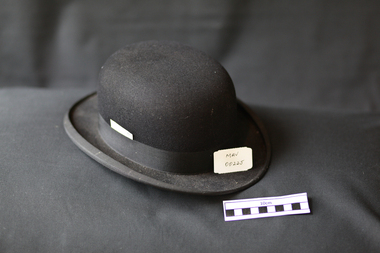
Headwear - Clothing, Bowler Hat black, 20thC
... Derby hat was devised in London during a time when the top hat was the upper-class men’s hat of choice and the lower social class wore soft, cloth caps. However, the top hat was impractical and inconvenient for those on horseback as it easily toppled over and was easily damaged. Bowler hats were termed “stiff” hats– they were given a coat of shellac in the construction process and therefore never conformed to the shape of the wearers head. While very stiff, the hat is lined...Derby hat was devised in London during a time when the top hat was the upper-class men’s hat of choice and the lower social class wore soft, cloth caps. However, the top hat was impractical and inconvenient for those on horseback as it easily toppled over and was easily damaged. Bowler hats were termed “stiff” hats– they were given a coat of shellac in the construction process and therefore never conformed to the shape of the wearers head. While very stiff, the hat is lined ...The Bowler hat, characterised by its dome-like crown, was invented in 1849 by a pair of hat-makers: brothers Thomas and William Bowler. They were commissioned by the famous London hat retailer “Lock & Co” to invent a close-fitting, low-crowned hat for their customer Mr. Edward Coke. It would be sturdy and not easily knocked or blown off the wearer’s head. The difference between a Bowler hat and a Derby hat is simply that Bowler hats are British, Derby hats are American. The Bowler / Derby hat was devised in London during a time when the top hat was the upper-class men’s hat of choice and the lower social class wore soft, cloth caps. However, the top hat was impractical and inconvenient for those on horseback as it easily toppled over and was easily damaged. Bowler hats were termed “stiff” hats– they were given a coat of shellac in the construction process and therefore never conformed to the shape of the wearers head. While very stiff, the hat is lined in a beautiful, soft silk to ensure comfort. The Bowler hat marked the first middle ground between formality and casual wear. c1900 The Derby hats were very popular for all classes in USA including criminals like Butch Cassidy & Sundance Kid and c1920 many fashionable women also wore them. In England and Commonwealth the Bowler hat remained popular throughout the 1800s and through the first half of the 1900s, being worn by everyone from politicians, actors, accountants, bankers, and the 'everyman' on the street.The family of Nance Blackman were early settlers in Moorabbin ShireA black felt Bowler hat with cream silk lining and black ribbon bandInside Crown & Band ; The Cobweb Felt / easiest/ fitting / extra light / Inside Band Best Quality / 6111hats, hatters, blackman nance, clothing, suits, fashion wear, bankers, actors, politicians, bowler hats, derby hats, top hats, social classes, moorabbin, cheltenham, bentleigh, brighton, market gardeners, pioneers, early settlers, bowler thomas, bowler william, lock & co. ltd. london, england, america, canada -
 Eltham District Historical Society Inc
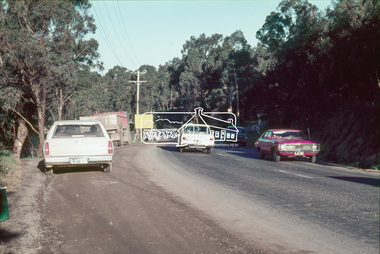
Slide, Main Road, Lower Plenty, 25 Jul 1973
... It was also the setting for Billy Cart derbies held on special occassions such as the Eltham Easter Gymkhana at Eltham Lower Park. Contestants would line up and race each other down the hill to the finish line at Bolton Street. ...It was also the setting for Billy Cart derbies held on special occassions such as the Eltham Easter Gymkhana at Eltham Lower Park. Contestants would line up and race each other down the hill to the finish line at Bolton Street. ...This section of Main Road was known by locals as the "Windy Mile" due to its many little wists and turns. It was also the setting for Billy Cart derbies held on special occassions such as the Eltham Easter Gymkhana at Eltham Lower Park. Contestants would line up and race each other down the hill to the finish line at Bolton Street. Main Road, Lower Plenty underwent substantial changes when it was duplicated with the road becoming two lanes each way and split level due to the cross gradient. This particular section running down the hill from Panorama Avenue to Bolton Street with its twists and turns had many of them straightened out during the road widening constuction work.35 mm colour positive transparency Mount - Agfacolor Service (Blue)main road, infrastructure, lower plenty, roads, windy mile -
 Bendigo Historical Society Inc.
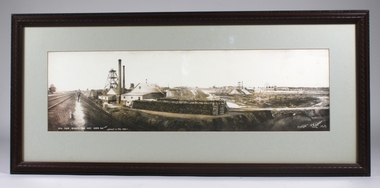
Photograph - Framed Print of New Chum Railway Gold Mine
... line with a man standing next to it, a poppet head, two chimneys and mining buildings. In the background there are numerous mines. In the middle foreground is a large collection of firewood. White writing on the lower left - NEW CHUM. RAILWAY. GOLD MINE 4226 Feet DEEPEST IN THE WORLD White writing on lower right - Copyright (signature) R Scott Melb. A grey mount surrounds the photograph. Behind glass with a dark brown wooden frame. On the rear lower right corner there is a white sticker FRAMED BY PPAUL DERBY...line with a man standing next to it, a poppet head, two chimneys and mining buildings. In the background there are numerous mines. In the middle foreground is a large collection of firewood. White writing on the lower left - NEW CHUM. RAILWAY. GOLD MINE 4226 Feet DEEPEST IN THE WORLD White writing on lower right - Copyright (signature) R Scott Melb. A grey mount surrounds the photograph. Behind glass with a dark brown wooden frame. On the rear lower right corner there is a white sticker FRAMED BY PPAUL DERBY ...A black and white photograph showing a railway line with a man standing next to it, a poppet head, two chimneys and mining buildings. In the background there are numerous mines. In the middle foreground is a large collection of firewood. White writing on the lower left - NEW CHUM. RAILWAY. GOLD MINE 4226 Feet DEEPEST IN THE WORLD White writing on lower right - Copyright (signature) R Scott Melb. A grey mount surrounds the photograph. Behind glass with a dark brown wooden frame. On the rear lower right corner there is a white sticker FRAMED BY PPAUL DERBY 18.6..91 FRAMER CORNER Shop 4 Limerick Castle Arcade Williamson Street Bendigonew chum railway gold mine, bendigo gold mines, bendigo -
 Bendigo Historical Society Inc.
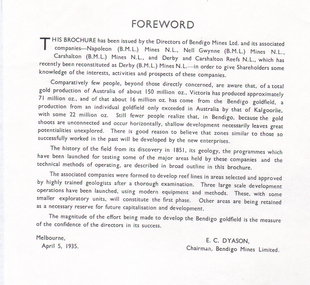
Document - Kangaroo Flat Gold Mine Collection: Bendigo Gold field, E.C. Dyason, Bendigo Mines Limited, April 5, 1935
... line of reef. In 1993, the Company consolidated ownership of the entire Goldfield when it purchased WMC’s interests. A detailed account of the recent history of Bendigo Mining is outlined in the Company History. Bendigo Mining NL website: https://www.bmnl.com.au/goldfield-history/ Catherine Reef United Claimholders Gold Mine operated from 1861. The Mine was cited as having one of the most 'extensive works in the colony'. (Dickers Mining Records, Oct. 1862) Bendigo Mining N.L. Bendigo mining gold Kangaroo Flat Napoleon Mines N.L. Nell Gwynne Mines N.L. Carshalton N.L. Derby ...Bendigo Mining 1993 to present In the 1980s Bendigo Mining listed on the ASX with ownership of leases along the Deborah line of reef. In 1993, the Company consolidated ownership of the entire Goldfield when it purchased WMC’s interests. A detailed account of the recent history of Bendigo Mining is outlined in the Company History. Bendigo Mining NL website: https://www.bmnl.com.au/goldfield-history/ Catherine Reef United Claimholders Gold Mine operated from 1861. The Mine was cited as having one of the most 'extensive works in the colony'. (Dickers Mining Records, Oct. 1862)Thirty page photocopied extract from a brochure issued by the Directors of Bendigo Mines Ltd and its associated Companies - Napoleon Mines N.L., Nell Gwynne Mines N.L., Carshalton Mines N.L. and Derby and Carshalton Reefs N.L., 'in order to give shareholders some knowledge of the interests, activities and prospects of these companies'.bendigo mining n.l., bendigo, mining, gold, kangaroo flat, napoleon mines n.l., nell gwynne mines n.l., carshalton n.l., derby -
 Bendigo Historical Society Inc.
Plan - Whip and Jersey Gold Mine, 19th December, 1917
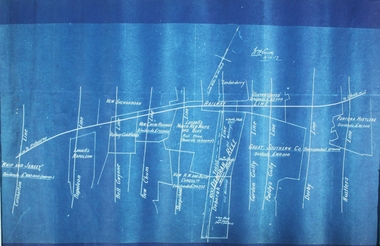
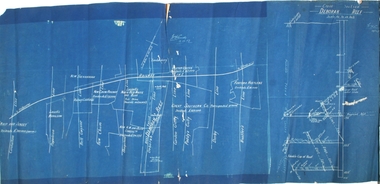
... Derby...Hustlers....Deborah...railway line...Derby, Hustlers. Deborah Reef marked in bold text. Bendigo to Melbourne railway line at top of plan. ...The Whip and Jersey Mine was located south of Hunter Street, Golden Square. gold mining gold Bendigo Whip and Jersey Carshalton Napoleon Nell Gwynne New Chum Sheepshead Garden Gully Paddy Gully Derby Hustlers. Deborah railway line N. Cundy, 19.12.17 Blue wax paper plan with white inscriptions, titled 'Whip and Jersey'. ...The Whip and Jersey Mine was located south of Hunter Street, Golden Square.Blue wax paper plan with white inscriptions, titled 'Whip and Jersey'. Plan shows reef lines: Carshalton, Napoleon, Nell Gwynne, New Chum, Sheepshead, Garden Gully, Paddy Gully, Derby, Hustlers. Deborah Reef marked in bold text. Bendigo to Melbourne railway line at top of plan. 'Whip and Jersey, £200,000', written in white on left hand side of plan. Plan forms part of the Margaret Roberts Collection.N. Cundy, 19.12.17gold mining, gold, bendigo, whip and jersey, carshalton, napoleon, nell gwynne, new chum, sheepshead, garden gully, paddy gully, derby, hustlers., deborah, railway line -
 Bendigo Historical Society Inc.
Plan - Deborah Reef, 19th December, 1917
... Derby...Hustlers....Deborah...railway line...gold mining gold Bendigo Whip and Jersey Carshalton Napoleon Nell Gwynne New Chum Sheepshead Garden Gully Paddy Gully Derby Hustlers. Deborah railway line Deborah Gold Mine Deborah Reef cross section N. ...Blue paper map, white text and plan, showing reef lines. Same plan as 11270.71, with addition of Deborah Reef cross section, on extreme right of plan. N. Cundy, 19.12.17gold mining, gold, bendigo, whip and jersey, carshalton, napoleon, nell gwynne, new chum, sheepshead, garden gully, paddy gully, derby, hustlers., deborah, railway line, deborah gold mine, deborah reef, cross section -
 Bendigo Historical Society Inc.
Booklet - Albert Richardson Collection: Bendigo Goldfield, MInes Department, Victoria 1936, 1936
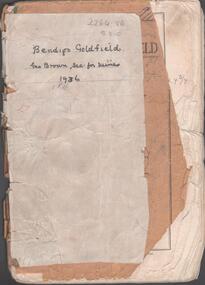
... Line are further described with their date of formation, sill heights and area of claim. Fifty one page booklet. On front page: Bendigo Goldfield, issued by Geo Brown, Secretary for Mines, under the authority of The Hon. E.J. Hogan, M.L.A., Minister of Mines. Mines Department, Melbourne, Victoria, Australia, 1936.Content includes: historical information; recent development and future prospects, geology and lines of reef. Reef lines described are: Tysons, Lightning Hill, Hustlers, Derby ...Albert Richardson was an expert on the history of the Bendigo Goldfield. The Albert Richardson Park at Victoria Hill, is named in his honour. He was a prominent member of the Bendigo Historical Society. Fifty one page booklet. On front page: Bendigo Goldfield, issued by Geo Brown, Secretary for Mines, under the authority of The Hon. E.J. Hogan, M.L.A., Minister of Mines. Mines Department, Melbourne, Victoria, Australia, 1936.Content includes: historical information; recent development and future prospects, geology and lines of reef. Reef lines described are: Tysons, Lightning Hill, Hustlers, Derby, Paddy's Gully, Garden Gully, Deborah, Sheepshead, New Chum, Nell Gwynne, British and Foreign, Napoleon, Lancashire, Carshalton, Thistle, Christmas and Birds. On front cover 'Bendigo Goldfield, Geo Brown, Sec. for Mines, 1936' written in black pen. On first page 'A.Richardson, 29 Harrison Street, Bendigo' The booklet is annotated throughout by Albert Richardson, for example, the mines along the New Chum Line are further described with their date of formation, sill heights and area of claim.albert richardson, gold mining, goldfield, reef lines, 1936, mines department -
Bendigo Historical Society Inc.
Document - MINING WARDEN COLLECTION: BENDIGO HISTORICAL MINING RECORDS
... line of reef located on, the start and end year. Individual mine data is enclosed in a manilla folder within the box. Reef lines listed are: Derby...line of reef located on, the start and end year. Individual mine data is enclosed in a manilla folder within the box. Reef lines listed are: Derby ...Historical records originally from the Mining Warden's Office, Mines Department, Bendigo. Information collated from 1870's to 1980's. A summary document lists the BEN# from 3754 to 4080 and describes the mine name; the BEN#, the line of reef located on, the start and end year. Individual mine data is enclosed in a manilla folder within the box. Reef lines listed are: Derby Christmas Garden Gully Gravel Hill Thistle Carshalton Myers Flat Birds Hit or Miss Break of Day Crusoe Big Hill line Sample entry: Brilliant Co., BEN# 3757, Garden Gully line of reef, 1870 - 1880.bendigo, mining, mining warden records -
Bendigo Historical Society Inc.
Document - MINING WARDEN COLLECTION: BENDIGO HISTORICAL MINING RECORDS
... line of reef located on, the start and end year. Individual mine data is enclosed in a manilla folder within the box. Reef lines listed are: Lancashire Carsharlton Derby Thistle Millers Derby Sample entry: Jersey Reef Claims, #3546, Lancashire line of reef, 1865 to 1882,...line of reef located on, the start and end year. Individual mine data is enclosed in a manilla folder within the box. Reef lines listed are: Lancashire Carsharlton Derby Thistle Millers Derby Sample entry: Jersey Reef Claims, #3546, Lancashire line of reef, 1865 to 1882, Document MINING WARDEN COLLECTION: BENDIGO HISTORICAL MINING RECORDS ...Historical records originally from the Mining Warden's Office, Mines Department, Bendigo. Information collated from 1870's to 1980's. A summary document lists the BEN# from 3533 to 3745 and describes the mine name; the BEN#, the line of reef located on, the start and end year. Individual mine data is enclosed in a manilla folder within the box. Reef lines listed are: Lancashire Carsharlton Derby Thistle Millers Derby Sample entry: Jersey Reef Claims, #3546, Lancashire line of reef, 1865 to 1882,bendigo, mining, mining warden records -
Bendigo Historical Society Inc.
Document - MINING WARDEN COLLECTION: BENDIGO HISTORICAL MINING RECORDS
... line of reef located on, the start and end year. Mine data is enclosed in a manilla folder within the box. Reef lines listed are: Paddy's Gully Derby Paddy's Gully/Garden Gully Example of entry: Meridien Quartz Mining Co. 2595, Paddy's/Garden Gully, 1876-1877....line of reef located on, the start and end year. Mine data is enclosed in a manilla folder within the box. Reef lines listed are: Paddy's Gully Derby Paddy's Gully/Garden Gully Example of entry: Meridien Quartz Mining Co. 2595, Paddy's/Garden Gully, 1876-1877. ...Historical records originally from the Mining Warden's Office, Mines Department, Bendigo. Information collated from 1870's to 1980's. A summary document lists the BEN# from 2585 to 2800 and describes the mine name; the BEN#, the line of reef located on, the start and end year. Mine data is enclosed in a manilla folder within the box. Reef lines listed are: Paddy's Gully Derby Paddy's Gully/Garden Gully Example of entry: Meridien Quartz Mining Co. 2595, Paddy's/Garden Gully, 1876-1877.bendigo, mining, mining warden records -
 Bendigo Historical Society Inc.
Document - MINING WARDEN COLLECTION: BENDIGO HISTORICAL MINING RECORDS
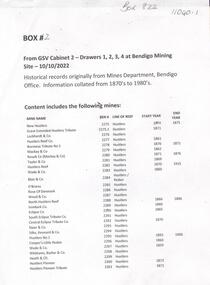
... line of reef located on, the start and end year. Information collated from 1870's to 1980's. Each mine's data is enclosed in a manilla folder within the box. Mines along the following reef lines are described: Hustlers Millers Derby...line of reef located on, the start and end year. Information collated from 1870's to 1980's. Each mine's data is enclosed in a manilla folder within the box. Mines along the following reef lines are described: Hustlers Millers Derby ...Historical records originally from the Mining Warden's Office, Mines Department, Bendigo. A summary document lists the mine name; the Ben #; the line of reef located on, the start and end year. Information collated from 1870's to 1980's. Each mine's data is enclosed in a manilla folder within the box. Mines along the following reef lines are described: Hustlers Millers Derby Paddy's Gully Ben # range from 2275 to 2584 Example of entry: Sydney Garden Gully Quartz Mining Co., Ben # 2371, Millers Reef, 1872 - 1875.bendigo, mining, mining warden's records, mines, reef lines -
 Bendigo Historical Society Inc.
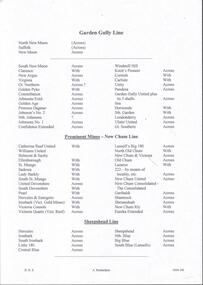
Document - MINING REPORTS - LOCATION OF SHAFT WITH THE REEF
... Handwritten list by Albert Richardson, with typed copy, of mines on the Garden Gully, Sheepshead, Hustlers, Nell Gwynne and the Deborah, Paddy Gully and Derby Lines of Reef. Also a list of prominent mines on the New Chum Line. ...BHS Collection DOCUMENT Gold mining reports Mining Reports Location of Shaft with the Reef North New Moon Suffolk New Moon South New Moon Clarence New Argus Virginia Gt Northern Golden Pyke Constellation Johnsons Extd Golden Age Princess Dagmar Johnson's No 2 Nth Johnsons Johnsons No 1 Confidence Extended Windmill Hill Koch's Pioneer Cornish Carlisle Pandora Garden Gully United Catherine Reef United Williams United Belmont & Saxby Ellenborogh St Mungo Sadowa Lady Barkly South St Mungo United Devonshire South Devonshire Pearl Hercules & Energetic Ironbark (Vict Gold Mines) Victoria Consols Victoria Quartz (Vict Reef) Lansell's Big 180 North Old Chum New Chum & Victoria Old Chum Lazarus 222 New Chum United New Chum Consolidated - The Consolidated Garibaldi Shamrock Hercules Ironbark South Ironbark Little 180 Central Blue Sheepshead Nth Blue Big Blue South Blue (Lansell's) United Hustlers & Redan The Redan Comet (Lansell's) Hustlers Reef plus No 1 Shaft Old Hustlers Gt Extended Hustlers plus 'Pups' Royal Hustlers Reserve Nos 1 & 2 Fortuna Hustlers New Chum Syncline Central Nell Gwynne Monument Hill Central Deborah North Deborah Deborah Collman &Tacchi Lansells Sandhurst Needle Johnsons No 3 (Nelsons) Handwritten list by Albert Richardson, with typed copy, of mines on the Garden Gully, Sheepshead, Hustlers, Nell Gwynne and the Deborah, Paddy Gully and Derby Lines of Reef. Also a list of prominent mines on the New Chum Line. Document MINING REPORTS - LOCATION OF SHAFT WITH THE REEF ...BHS CollectionHandwritten list by Albert Richardson, with typed copy, of mines on the Garden Gully, Sheepshead, Hustlers, Nell Gwynne and the Deborah, Paddy Gully and Derby Lines of Reef. Also a list of prominent mines on the New Chum Line. document, gold, mining reports, mining reports, location of shaft with the reef, north new moon, suffolk, new moon, south new moon, clarence, new argus, virginia, gt northern golden pyke, constellation, johnsons extd, golden age, princess dagmar, johnson's no 2, nth johnsons, johnsons no 1, confidence extended, windmill hill, koch's pioneer, cornish, carlisle, pandora, garden gully united, catherine reef united, williams united, belmont & saxby, ellenborogh, st mungo, sadowa, lady barkly, south st mungo, united devonshire, south devonshire, pearl, hercules & energetic, ironbark (vict gold mines), victoria consols, victoria quartz (vict reef), lansell's big 180, north old chum, new chum & victoria, old chum, lazarus, 222, new chum united, new chum consolidated - the consolidated, garibaldi, shamrock, hercules, ironbark, south ironbark, little 180, central blue, sheepshead, nth blue, big blue, south blue (lansell's), united hustlers & redan, the redan, comet (lansell's), hustlers reef plus no 1 shaft, old hustlers, gt extended hustlers plus 'pups', royal hustlers reserve nos 1 & 2, fortuna hustlers, new chum syncline, central nell gwynne, monument hill, central deborah, north deborah, deborah, collman &tacchi, lansells sandhurst needle, johnsons no 3 (nelsons)
