
Showing 197 items matching " dick white"
-
 Mrs Aeneas Gunn Memorial Library
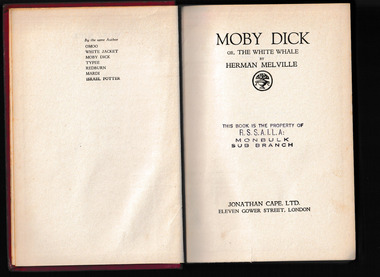
Book, Jonathan Cape, Moby-Dick, or, the white whale, 1935
... Moby-Dick, or, the white whale...American fiction Whaling A nineteenth-century novel in which a young seaman joins the crew of the whaling ship Pequod whose fanatical Captain Ahab is in determined pursuit of the white whale Moby Dick. p.533. Moby-Dick, or, the white whale Book Jonathan Cape Hermann Melville ...A nineteenth-century novel in which a young seaman joins the crew of the whaling ship Pequod whose fanatical Captain Ahab is in determined pursuit of the white whale Moby Dick.p.533.fictionA nineteenth-century novel in which a young seaman joins the crew of the whaling ship Pequod whose fanatical Captain Ahab is in determined pursuit of the white whale Moby Dick.american fiction, whaling -
 Bendigo Historical Society Inc.
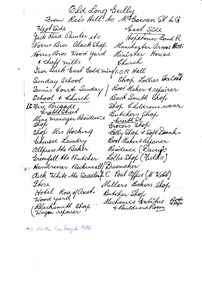
Document - LONG GULLY HISTORY GROUP COLLECTION: OLD LONG GULLY FROM RAE'S HILL TO MCGOWAN ST
... ... Dick White...West Side - Jack Read Painter etc, Norris Bros Black Shop, Norris Bros Wood Yard & Chaff Mills, Iron Bark East Gold Mine, Sunday School, Tennis Courts Sunday School & Church, LG Fire Brigade, Creeth Street, Mine Managers Residence, Shop, Shop Mrs Hocking, Chinese Laundry, Allpress the Baker, Greenfell the Butcher, Hairdresser Beckinsall was the Fire Brigade Hotel, Dick White the Saddler, Store, Hotel Rose of Australia, Woodyard, Blacksmith Shop Wagon Repairer, Hotel Kocks (Pioneer Hotel), 2 China Shops owned by Chinese, Hotel Silver mines Hotel, Police Station, Grocers Shop (per? ...BENDIGO History long gully history group The Long Gully History Group - Old Long Gully from Rae's Hill to McGowan St Jack Read Norris Bros Iron Bark East Gold Mine Long Gully Fire Brigade Mrs Hicking Allpress Greenfell Beckinsall Dick White Rose of Australia Hopetoun Band R Manchester Arms Hotel IOR Hall Davey's Fields M Webb Millars Mechanics Institute & Billiard Room Kocks Pioneer Hoel Silver Mines Hotel E Bryant Windmill Mine Pere? ...Titled Old Long Gully From Rae's Hill to McGowan St. LG. West Side - Jack Read Painter etc, Norris Bros Black Shop, Norris Bros Wood Yard & Chaff Mills, Iron Bark East Gold Mine, Sunday School, Tennis Courts Sunday School & Church, LG Fire Brigade, Creeth Street, Mine Managers Residence, Shop, Shop Mrs Hocking, Chinese Laundry, Allpress the Baker, Greenfell the Butcher, Hairdresser Beckinsall was the Fire Brigade Hotel, Dick White the Saddler, Store, Hotel Rose of Australia, Woodyard, Blacksmith Shop Wagon Repairer, Hotel Kocks (Pioneer Hotel), 2 China Shops owned by Chinese, Hotel Silver mines Hotel, Police Station, Grocers Shop (per? Reef Mine Hotel) E Bryant, Mine Windmill, Church Residence, Minister. East Side - Hopetoun Band R, Manchester Arms Hotel, Minister House, Church, IOR Hall, Shop Lollies Icecream, Boot Maker & Repairer, Back Smith Shop, Shop Childrens Wear, Butchers Shop, Creeth Street, Grocers Shop, Lolly Shop & Soft Drinks, Boot Maker & Repairer, Residence (Davey's), Lollie Shop (Fields), Dressmaker, LG Post Office (M Webb), Millars Bakers Shop, Butcher Shop, Mechanics Institute Books & Paper & Billiard Room, Connell the Baker, Dr SElby, Pentreath Organ Builder & Tuner, Blacksmith Shop, Hexagon Toilet, Kocks Machine Shop, Kocks Mine Office, Kocks Material Shop, Police Station, Dyson's Dam Warm waer, Air Station, Mine Battery stone crusher 80 head approx, Kocks Mine, Needle Mine. Some notes written at the end - Norm Shotples used to have Barber Shop - he has gone to Queensland, Violet Street started off as the German School, Wells Street used to run through Victorian Consol ? the other side, Comet Hill would like a visit. Contact Helen Gorlay at Violet Street would line to some video. Alan has good info on the Long Gully School. Betty has book. Views of Bendigo. Frank Cusack - Bendigo Trust. Bendigo School Hisking? School, Violet Street. Older levels lo?ing at Architecture.bendigo, history, long gully history group, the long gully history group - old long gully from rae's hill to mcgowan st, jack read, norris bros, iron bark east gold mine, long gully fire brigade, mrs hicking, allpress, greenfell, beckinsall, dick white, rose of australia, hopetoun band r, manchester arms hotel, ior hall, davey's, fields, m webb, millars, mechanics institute & billiard room, kocks pioneer hoel, silver mines hotel, e bryant, windmill mine, pere? reef mine hotel, connell, dr selby, pentreath, kocks machine shop, kocks mine office, kocks material shop, dyson's dam, kocks mine, needle mine, norm shotples, german school, victoria consols, helen gorlay, long gully school, frank cusack, bendigo trust -
 Expression Australia
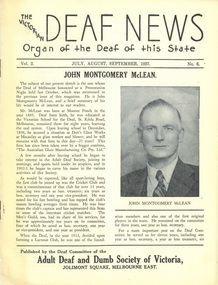
Newsletter, The Victorian Deaf News July-August-September 1937
... john montgomery mclean, may clarke, mrs e. bryan, rev w. h. johnson, a. aird, alice cove, t. a. nelson, ellen whitlow, rose dow, rowe, james, edgar h. peacock, international congress of the deaf and dumb, basketball, lorrie ellis,george mcguinness, bernice cardwell, clarence r. jose, j. m. johnston, w. a. ross, alice c. graham, blackburn home, sllen adcock, hobson, white, ian anderson, rivers, norman may, muriel smith, james, jack reid, ray kemble, ambrose moloney, norma rawlins, j. boortz, taylor, ernest reynolds, e. sturcke, w. duncan, ian hinton, betty doyle, dick white, claude lyfield, alex collins, jack stewart, willie chapmanw. crush, harry puddy, d. scott, alice guest, cove, thomas alexander nelson, ellen whitlow,...Published by the Deaf Committee of the Adult Deaf and Dumb Society of Victoria 'The Victorian Deaf News' Newsletter is a significant publication as an historical record giving and insight into the people, activities and events of the Deaf Community in Victoria. john montgomery mclean, may clarke, mrs e. bryan, rev w. h. johnson, a. aird, alice cove, t. a. nelson, ellen whitlow, rose dow, rowe, james, edgar h. peacock, international congress of the deaf and dumb, basketball, lorrie ellis,george mcguinness, bernice cardwell, clarence r. jose, j. m. johnston, w. a. ross, alice c. graham, blackburn home, sllen adcock, hobson, white, ian anderson, rivers, norman may, muriel smith, james, jack reid, ray kemble, ambrose moloney, norma rawlins, j. boortz, taylor, ernest reynolds, e. sturcke, w. duncan, ian hinton, betty doyle, dick white, claude lyfield, alex collins, jack stewart, willie chapmanw. crush, harry puddy, d. scott, alice guest, cove, thomas alexander nelson, ellen whitlow, Vol. 2 No. 6 1937; Size24.5cmHx19cmW; 16 pages The Victorian Deaf News July-August-September 1937 Newsletter ...Published by the Deaf Committee of the Adult Deaf and Dumb Society of Victoria'The Victorian Deaf News' Newsletter is a significant publication as an historical record giving and insight into the people, activities and events of the Deaf Community in Victoria.Vol. 2 No. 6 1937; Size24.5cmHx19cmW; 16 pagesjohn montgomery mclean, may clarke, mrs e. bryan, rev w. h. johnson, a. aird, alice cove, t. a. nelson, ellen whitlow, rose dow, rowe, james, edgar h. peacock, international congress of the deaf and dumb, basketball, lorrie ellis,george mcguinness, bernice cardwell, clarence r. jose, j. m. johnston, w. a. ross, alice c. graham, blackburn home, sllen adcock, hobson, white, ian anderson, rivers, norman may, muriel smith, james, jack reid, ray kemble, ambrose moloney, norma rawlins, j. boortz, taylor, ernest reynolds, e. sturcke, w. duncan, ian hinton, betty doyle, dick white, claude lyfield, alex collins, jack stewart, willie chapmanw. crush, harry puddy, d. scott, alice guest, cove, thomas alexander nelson, ellen whitlow, -
 The Ed Muirhead Physics Museum
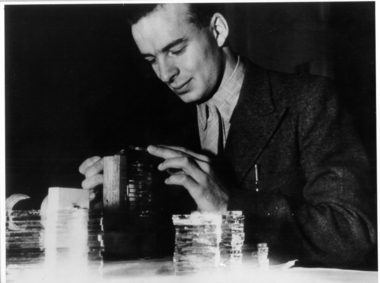
Photograph, Optical Munitions: D. Huey
... Black and white photograph Dick Huey at work assembling plate glass for making gla blocks. ...On front of image in ink: “27” On back of image in pencil: “No 27” On back of image in ink: “27” Black and white photograph Dick Huey at work assembling plate glass for making gla blocks. ...Black and white photograph Dick Huey at work assembling plate glass for making gla blocks. Same photo as 147On front of image in ink: “27” On back of image in pencil: “No 27” On back of image in ink: “27” -
 The Ed Muirhead Physics Museum
Photograph, Optical Munitions: D. Huey
... Black and white photograph Dick Huey at work assembling plate glass for making gla blocks. ...On front of image in ink: “27” On back of image in pencil: “No 27” On back of image in ink: “27” Black and white photograph Dick Huey at work assembling plate glass for making gla blocks. ...Black and white photograph Dick Huey at work assembling plate glass for making gla blocks. Same photo as 147 On front of image in ink: “27” On back of image in pencil: “No 27” On back of image in ink: “27” -
Tatura Irrigation & Wartime Camps Museum
Photograph - black and white, Dick and Bertha Clement, 1970
... A4 size photograph, black and white, of Dick and Bertha Clements, depicting Dick as a life member of Hill Top Golf and Country Club....Dick Clement Bertha Clement Hill Top Golf and Country Club Golf life membership A4 size photograph, black and white, of Dick and Bertha Clements, depicting Dick as a life member of Hill Top Golf and Country Club. ...Photograph probably taken at a celebration when Dick (on the right) Clements was made a life members at Hill Top.A4 size photograph, black and white, of Dick and Bertha Clements, depicting Dick as a life member of Hill Top Golf and Country Club.dick clement, bertha clement, hill top golf and country club, golf life membership -
 Flagstaff Hill Maritime Museum and Village
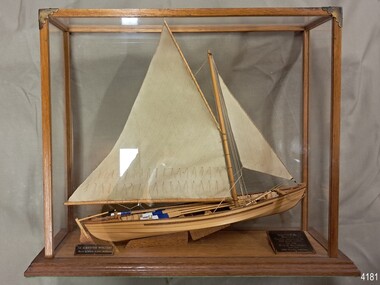
Craft - Ship Model, Whaleboat, Wally St John (ship model maker), New Bedford, 1988
... When he returned, he published his book about the great white whale "Moby Dick". The Wunta Festival began in 1985. ...When he returned, he published his book about the great white whale "Moby Dick". The Wunta Festival began in 1985. ...The whaleboat model was built for the 1988 Warrnambool Wunta Festival by Wally St John, of Melbourne. Its name comes from the port of New Bedford in Massachusetts, America. Coastal whaling in the area began in the 17th Century, and by the mid-18th century, it was performed on a large scale. The town is renowned for the author, Herman Melville, who sailed out on the whaler "Acushnet" in 1841. When he returned, he published his book about the great white whale "Moby Dick". The Wunta Festival began in 1985. In 1988, it was sponsored by the Warrnambool City Council and Mr. Alan Lane, a Warrnambool businessman who served on the Council for 18 years. The festival is held on the first weekend in February and involves the whole community. One of the activities is the Whaleboat Race. International whaleboat racing began in 1805 with a race between America and Britain. The City of Warrnambool Rowing Club started the whaleboat race in 1986 as part of the Wunta festival, and a Whaleboat Club was soon formed. The race is held on the Hopkins River. The ship model of the whaleboat, New Bedford, is significant because it represents vessels used in the early industry of whaling in southwest Victoria. It is also representative of the centuries-old craft of ship model making. It is important for its connection to the Wunta Festival, a Warrnambool community event. It is connected to Mr. Alan L Lane, whose estate generously funded the Alan Lane Foundation for the continuous support and funding of local community events and activities. Ship model of a whaleboat. The boat has two fabric sails, a tiller, and four wooden oars with blue and white sections painted on the blades. The model is mounted on a wooden stand inside a glass case with a wooden frame. Two gold embossed black plaques are on the base of the case, on the front. The plaques have decorative borders and inscriptions. The model of the New Bedford Whaleboat, built by Wally St John, Melbourne, was made for the 1988 WUNTA Festival in Warrnambool. Left plaque: "THE NEW BEDFORD WHALEBOAT / Built by Wally St John Melbourne" Right plaque: "]Logo of a Triangle with "WUNTA festival" "Proudly sponsored by Mr. ALAN LANE for the City of Warrnambool and 1988 Wunta Festival"flagstaff hill, flagstaff hill maritime museum and village, warrnambool, maritime museum, maritime village, great ocean road, shipwreck coast, whaleboat, ship model, vessel, 1988, wunta, wunta festival, wally st john, melbourne, new bedford, massachusetts, america, coastal whaling, herman melville, acushnet, alan lane, alan lane foundation, councillor, whaleboat race, warrnambool rowing club, hopkins river -
 Federation University Historical Collection
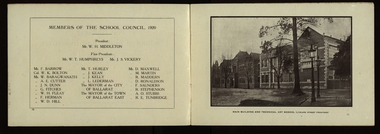
Booklet, The Ballarat School of Mines and Industries 1870-1920 Jubilee Booklet, 1920 (estimated)
... Vawdrey, Hilda Wardle william battery smith herbert drawing from the antique ballarat school of mines botanical gardens ballarat school of mines redmond barry alfred mica smith james bickett museum dick richards ballarat junior technical school s m b ballarat school of mines and industries ballarat technical art school model mine james m bickett j m bickett roderick murchison vocational training rooms wesley church methodist church alexander peacock lathes repatriation repatriatin department war service school council baragwanath gold mining mining laboratory plaster cast R.W. Richards anniversary jubilee White ...The first school of Mines in Australia was established at Ballarat in 1870. At the time of its jubilee (1930) the following people were members of the School Council: W.H. Middleton (President), W.T. Humphreys (VP), J.S. Vickery (VP), F. Barrow, Col. W.K. Bolton, William Baragwanath, A.E. Cutter, J.N. Dunn, G. Fitches, W.H. Fleay, F. Herman. W.D. Hill, T. Hurley, K. Kean. J. Kelly, L. Lederman, Mayor of Ballarat, Mayour of Ballarat East, D. Maxwell, M. Martin, R. Maddern, D. Ronaldson, F. Saunders, R. Stephenson, A.O. Stubbs, R.E. Tunbridge. The School Staff in 1920 comprised: Herbert H. Smith, Walter Rowbotham, Reginald L. Cutter, M.C. Young, Hilda Wardle, M. Wiliamson, P.S. Richards, L.H. Archibald, J. Woods, Ken Moss, W. Kenneth, Mrs McIlvena. B. Robinson, S. Rowe, E. Hope-Jones, Miss Abrams, L.St.G.P. Austin, Alfred Mica Smith, J.R. Pound, Herbert R. Murphy, N.H. Junner, Maurice Copland, L.H. Archibald, E.J.A. McConnon, Newton King, D.m. Hull, T.R. Gordon, John M. Sutherland, T.K. Jebb, Dick Richards, C. Tonkin, A.W. Steane, J. Paterson, H.W. Malin, R.V. Maddison, S.M. Mayo, F.A. King, W.H. Steane, T.R. Gordon, T.A. Williams, H. Waldron, G. Black, E.J. McConnon, R.V. Duncan. R. Cutter, E.G. Vawdrey, Hilda WardleWhite stapled booklet - landscape format - 20pp + soft covers with blue writing. Includes an historical sketch of the Ballarat School of Mines. Contains images of the school from around 1920. The history outlined in the booklet follows: 'Ballarat has helped to influence the life and destinies of Australia in many ways, the recital of which would perhaps prove tedious to the citizens of less favoured localities! However, it can be said, without much fear of contradiction, that only less known thought Australia than its fame as a gold field is the reputation won for it by its school of Mines, ... Ballarat was still quite a new place when the School was founded, but a very propserous and popular place all the same, with a go-ahead lot of citizens brim full of the spirit of enterprise which seemsto animate mining populations generally. Money was plentiful, and they launched out into ventures, which later, were to develop and take the place of the gold mines, while what is more to the point, they understood the value of education. the old digging days were passing away. So far as Ballarat itself was concerned the day of the cradle and tin dish had already passed into an antiquity "as dead and distant as the age of the Tubal Caon," said dir redmond Barry on declaring the School open. Mining had become a serious business, and the mining engineer, the metallurgist, and the geologist had become a power in the land. In these circumstances the suggestions to found a School of Mines met with ready acceptance. The late Mr James M. Bickett had the honor of bringing forward the proposition at a meeting of the Ballarat Mining Board in October, 1869. it was agreed to, and the Government, having been approached for assistance, granted a lease of the old Supreme Court buildings at a nominal reantal. A modest sum, including 100 pounds from the Borough Council of Ballarat West, was subscribed by a number of sympathisers, and on the 26th October, 1870, the inaugural address was delivered by Sir Redmond Barry, the first President of the School. Classes were commenced on the 23rd January, 1871. The students at first were mostly adults. They were chiefly men emloyed at the mines, who had the wisdom and energy to devote their spare time to study, and, though their attendance was somewhat irregular, they made very good progress. Old prints which have been preserved show them at work at furnaces, big bearded men of the old-fashioned type of miner. It is interesting to note that among those who gave evidence and encouragement was Sir Roderick Murchison, who many years before had advised Cornish miners to emigrate to Australia to search for gold, and who in 1848 was in possession of gold ore sent from this country. Sir Roderick sent a parcel of books for the library, and gave useful advice as to the curriculum which should be adopted. The Museum, which now contains a most valuable collection of minerals, was one of the first things attended to, and the reports presented to the Council from time to time speak of additions being made from all parts of the world. New equipment was constantly being added to the School, a good deal of assay work was done, and some specimens were sent from the East Indies for examination as far back as 1873. By this time there was a difficulty in providing accomodation for the students who wished to enrol, and the number of instructors had grown from two to four. In 1882 the first building was being erected on what was then part of the gaol reserve. A little more than ten years afterwards a buildnig formerly serving as a Methodist Church was absorbed, while later on, the demand for accomodation increasing, the attack upon the gaol was renewed. The School continued to grow in reputation and size, and became the science centre of the district, and in 1889 a learge new building was opened by Sir Alexander Peacock. Students came from over seas as well as from all the States of Australia, and after going through their courses they took with them the name and fame of the old School to all parts of the globe. School of Mines boys have played a great part in developing the mining fields of Western Australia, South Australia, and africa, while old students who have made a name in their profession are constantly dropping in to see how the old place is getting along. It was not to be expected, however, that the Ballarat School would be left without rivals, its very success inspiring competition. Mining Schools were started in other parts of Australia, and, at the same time, Victoria ceased to hold first place as a mining state. On the other hand there was a great advance in manufacturing, and the demand for technicaly trained men became a great and as insistent as ever it had been for trained mining men. The Council was quick to adapt the school to the new conditions, and the result is seen in the institution, which is one of Ballarat's proudest possession. Instruction is given in all branches of technical work, and the classes are filled with students who are building up for Ballarat a reputation as an industrial centre, which promises to equal that which it formerly held as a mining town. Owing to its bracing climate, its abundant opportunities for recreations, and its accessibilty, Ballarat as a city is an ideal place for educational purposed, and is yearly becoming more and more appreciated throughout the State. The chairman of one of Ballarat's biggests industries claims that the workman can do twice the day's work here that he can do in Melbourne. he was a little enthusiastic over it, perhaps, but it is a well-known fact that the healthy and invigourating Ballarat climate is conducive to both physical and mental activity, and the records of the School provide ample proof of it. One of the most interesting and successful branches of the School of Mines and Industries - if the name be enlarged with the enlargement of its scope - is the Technical Art School. "The City of Statues" has from its earliest days been a stronghold of art. Art schools have flourised here, and in 1905 the Education Department came to the conclusion that the best thing to do with them was to place them under the management of the School of Mines Council. A magnificent new Technical Art School was built at a cost of some 12,000 pounds on the site of the old Supreme Court building, and was formally opened on the 23rd July, 1915. The results have not only been justified but surpassed all anticipations. The most comprehensive list of subjects is taught, and this list is constantly added to. Students have flocked to the art School, which may be said to occupy a unique position in Australia, and its record of success is really astonishing. Its students supply art teachers for the newer schools that are being built, and many occupy leading positinos in important business houses. So well is its reputation known that orders are constantly being received, not only from Victoria, but from other States, for honor boards and challenge shields to be designed and made. The most recent addition to the School of Mines and Industries is the Junior Technical School, for which a new building is now being erected on a portion of the gaol site, transferred to the School of Mines Counci by the Government. At the present moment temporary quarters are being occupied. Some students after passing through the Junior School go straight to employment, continuing perhaps to attend the evening trade classes, while others move on to the senior School. In a review of the work of the School of Mines mention must be made of a series of industrial research carried out under supervision of the Principal. One in particular, regarding the suitability of the local ores for the manufacture of pigments attracted much attention, while the experiemtns on the manufacture of white potery from Victorian clayes were considered of sufficient importance by the Federal Advisory Council of Science and Industry to warrant the appointment of a special investigator. The results of these have been most encouraging, and may have far-reaching consequences. The vocational training of returned soldiers also should not be overlooked. The work was taken in hand from the first, before the Repatriation Department gave assistance, and now with the help of the department of the School has become one of the largest vocational training centres in Victoria outside of Melbourne. The soldiers, trained in a variety of occupations, have made remarkable progress, and already considerable numbers have found employment in local workshops and factories. To sum up, the School is divided into the following departments, each well staffed and equipped: - The School of Mines, science, and Engineering; the Techncial Art School, the Boys' Junior Technical School, the Girl's Preparatory Technical Classes, Trade Classes, and the Commercial School. The school of Mines, science and Engineering, comprises the following branches: - Mining, Metallurgy, Geology, Electrical Engineering, Civil Engineering, Mechanical Engineering, Applied Chemistry, and Pharmacy. Battery treatments, Cyanide Testing, Smelting, Assays, and Clay Testing from a regular part of the School's work. Students gaining qualifications obtain concession in their courses at the university, should they proceed there to continue their studies. The technical Art school curriculum includes training in all branches of pictorial and applied art, an Architectural Diploma Course, a Draughtman's Course, technical Art teachers' Course, Photography,Ticket Writing, Art Metal Work, Woodcarving, Needlework, and Leather work. The Trade Classes give instruction in Telephone Mechanics, telegraphy, Carpentry, Cabinet Making, Plumbing, Blacksmithing, Fitting, Electric Wiring, and Printing. Numerous Scholarships are offered every year, and altogether students will find few places to equal the Ballarat School of Mines and Industries as a training place for their life's work. One of the first in the continent to be established, its Jubilee finds it still in the front rank, keeping pace with the times, and offering to the youths of this country the means of taking advantage of Australia's teeming opportunities. william, battery, smith, herbert, drawing from the antique, ballarat school of mines botanical gardens, ballarat school of mines, redmond barry, alfred mica smith, james bickett, museum, dick richards, ballarat junior technical school, s m b, ballarat school of mines and industries, ballarat technical art school, model mine, james m bickett, j m bickett, roderick murchison, vocational training rooms, wesley church, methodist church, alexander peacock, lathes, repatriation, repatriatin department, war service, school council, baragwanath, gold mining, mining laboratory, plaster cast, r.w. richards, anniversary, jubilee -
 Federation University Historical Collection
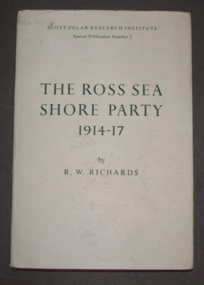
Book, Ross Sea Shore Party 1914-17, 1962
... He later became Principal of the Ballarat School of Mines. dick richards richard w richards antarctica shackleton rw richards aurora mount hope keith jack lionel hooke irvine gaze ernest shackleton mcmurdo sound exploration autograph .1) Inside front cover 'Mary A. Fogarty' .2) Inside front cover written in blue ink “To strive, to seek, to find, and not to yield.” R.W. Richards April 1963. Hard covered book with white ...Hard covered book with white wrapper. non-fictiondick richards, richard w richards, antarctica, shackleton, rw richards, aurora, mount hope, keith jack, lionel hooke, irvine gaze, ernest shackleton, mcmurdo sound, exploration, autograph -
 Federation University Historical Collection
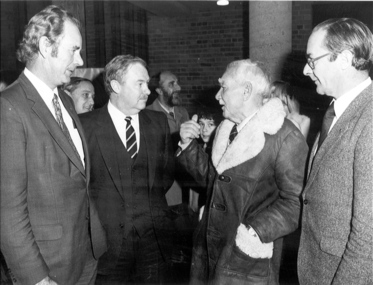
Photograph - Photograph (black & white), Four Principals of the Ballarat School of Mines, June 1983
... See http://guerin.ballarat.edu.au/aasp/is/library/collections/art_history/honour-roll/honourroll_Richards,Dick.shtml ballarat school of mines dick richards antarctica ernest shackleton Black and white photograph featuring 4 men who had serves as Principal of the Ballarat School of Mines. ...This photograph was taken at the presentation of a bust of Dick Richards to the Ballarat School of Mines. Dick Richards joined the Ballarat School of Mines (SMB) in 1914, and soon afterwards was granted leave to join an expedition to Antartica. In 1915 he sailed from Australia with the Antartic Exploraton Expedition, led by Sir Ernest Shackleton. Dick Richards was the physicist and sled manager for Shackleton's Ross Sea Party - with the task to meet Shackleton on the other side of the continent. When Shackleton planned his transcontinental crossing he decided to use supply depots as loads of supplies were too heavy to pull. The depots would enable Shackleton's party to carry just enough to reach the Pole, relying on the depots which were to be left by the Aurora's crew every 60 miles, stowed in 2 sledge journeys in 1915 and 1916. Dick Richards spent 3 freezing years in Antarctica between 1914 and 1917. Travelling south with Sir Ernest Shackleton Richards' worst experience was when his ship Aurora, tethered offshore, was blown away in a gale leaving Richards marooned for two years with nine other men on the ice floe. The Ross Sea Party arrived in McMurdo Sound aboard the Aurora in January 1915. The going was tough on the sledging trips as the sledges were overloaded. Temperatures were as low as minus 68F. In June 1916 the party crossed on foot to Cape Evans, occupied Scott's Hut (from his Terra Nova Expedition, erected in January 1911) in May 1915, for two months. On 10 January 1917 Richards was hunting for seals when he saw a ship on the horizon. It was 'The Aurora'. Picking up the relieved survivors 'The Aurora' arrived in New Zealand on 9 February 1917 to a hero's welcome. Joyce, Wild, Hayward and Richards later won the Albert Medal for their heroic devotion to duty. Later an inlet on the Antartic continent was named after Richards. Dick Richards wrote the following years after the ordeal "To me no undertaking carried through to conclusion is for nothing. And so I don't think of our struggle as futile. It was something the human spirit accomplished." After returning to Australia Dick Richards resumed his work at SMB as Lecturer in Physics and Mathematics, and developed many pieces of experimental equipment. During World War Two he acted as a scientific adviser in the production of optical apparatus in Australia. In 1946 he was appointed Principal and twelve years later he retired after a total of 44 years service. Dick Richards has been honoured through the naming of a Ballarat School of Mines prize - The R.W. Richards Medal. This medal later became a University of Ballarat prize. It has been awarded annually since 1959 to the Bachelor of Applied Science graduate considered to have achieved the most outstanding academic performance of their course. The award was was introduced to commemerate the long years of service to tertiary education in Ballarat by Mr Richards. See http://guerin.ballarat.edu.au/aasp/is/library/collections/art_history/honour-roll/honourroll_Richards,Dick.shtmlBlack and white photograph featuring 4 men who had serves as Principal of the Ballarat School of Mines. Left to Right: E.J. (Jack) Barker, Peter Shiells, Richard W. Richards, Graham Beanland.ballarat school of mines, dick richards, antarctica, ernest shackleton -
 Federation University Historical Collection
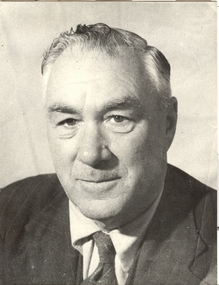
Photograph - Photograph (black & white), Richard W. Richards, c1950
... (Dick) Richards, Principal of the Ballarat School of Mines. Richard W. Richards Photograph Photograph (black & white) ...This photograph was taken at the presentation of a bust of Dick Richards to the Ballarat School of Mines. Dick Richards joined the Ballarat School of Mines (SMB) in 1914, and soon afterwards was granted leave to join an expedition to Antarctica. In 1915 he sailed from Australia with the Antartic Exploration Expedition, led by Sir Ernest Shackleton. Dick Richards was the physicist and sled manager for Shackleton's Ross Sea Party - with the task to meet Shackleton on the other side of the continent. When Shackleton planned his transcontinental crossing he decided to use supply depots as loads of supplies were too heavy to pull. The depots would enable Shackleton's party to carry just enough to reach the Pole, relying on the depots which were to be left by the Aurora's crew every 60 miles, stowed in 2 sledge journeys in 1915 and 1916. Dick Richards spent 3 freezing years in Antarctica between 1914 and 1917. Travelling south with Sir Ernest Shackleton Richards' worst experience was when his ship Aurora, tethered offshore, was blown away in a gale leaving Richards marooned for two years with nine other men on the ice floe. The Ross Sea Party arrived in McMurdo Sound aboard the Aurora in January 1915. The going was tough on the sledging trips as the sledges were overloaded. Temperatures were as low as minus 68F. In June 1916 the party crossed on foot to Cape Evans, occupied Scott's Hut (from his Terra Nova Expedition, erected in January 1911) in May 1915, for two months. On 10 January 1917 Richards was hunting for seals when he saw a ship on the horizon. It was 'The Aurora'. Picking up the relieved survivors 'The Aurora' arrived in New Zealand on 9 February 1917 to a hero's welcome. Joyce, Wild, Hayward and Richards later won the Albert Medal for their heroic devotion to duty. Later an inlet on the Antartic continent was named after Richards. Dick Richards wrote the following years after the ordeal "To me no undertaking carried through to conclusion is for nothing. And so I don't think of our struggle as futile. It was something the human spirit accomplished." After returning to Australia Dick Richards resumed his work at SMB as Lecturer in Physics and Mathematics, and developed many pieces of experimental equipment. During World War Two he acted as a scientific adviser in the production of optical apparatus in Australia. In 1946 he was appointed Principal and twelve years later he retired after a total of 44 years service. Dick Richards has been honoured through the naming of a Ballarat School of Mines prize - The R.W. Richards Medal. This medal later became a University of Ballarat prize. It has been awarded annually since 1959 to the Bachelor of Applied Science graduate considered to have achieved the most outstanding academic performance of their course. The award was was introduced to commemerate the long years of service to tertiary education in Ballarat by Mr Richards. See http://guerin.ballarat.edu.au/aasp/is/library/collections/art_history/honour-roll/honourroll_Richards,Dick.shtml Black and photo portrait of Richard W. (Dick) Richards, Principal of the Ballarat School of Mines. dick richards, r.w. richards, ballarat school of mines, antarctic explorer -
 Federation University Historical Collection
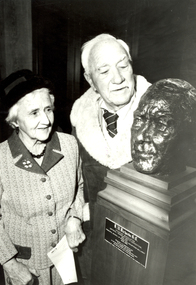
Photograph - Photograph - Black and White, Ballarat Courier, Dick Richards and his sister, Mrs V.S. Greenhalgh with the Bust of Dick Richards, 06/1983
... Greenhalgh with the Bust of Dick Richards. Photograph Photograph - Black and White Ballarat Courier ...Dick Richards joined the Ballarat School of Mines in 1914, and soon afterwards was granted leave to join an expedition to Antartica. In 1915 he sailed from Australia with the Antartic Exploraton Expedition, led by Sir Ernest Shackleton. Most Antarctic enthusiasts know of Ernest Shackleton's attempt to cross the continent, only to be thwarted by the sinking of the ship 'Endurance'. Dick Richards was the physicist and sled manager for Shackleton's Ross Sea Party - with the task to meet Shackleton on the other side of the continent. When Shackleton planned his transcontinental crossing he decided to use supply depots as loads of supplies were too heavy to pull. The depots would enable Shackleton's party to carry just enough to reach the Pole, relying on the depots which were to be left by the Aurora's crew every 60 miles, stowed in 2 sledge journeys in 1915 and 1916. Dick Richards spent 3 freezing years in Antarctica between 1914 and 1917. Richards' worst experience was when his ship Aurora, tethered offshore, was blown away in a gale leaving Richards marooned for two years with nine other men on the ice floe. The expedition, consisting of two teams, were attempting to cross Antarctica from opposite sides, linking up somewhere near the middle. "That was with pretty poor equipment by today's standards, and we did not make it." (Dick Richards) The Ross Sea Party arrived in McMurdo Sound aboard the Aurora in January 1915. The men planned to make two sledging trips to leave supply depots every 60 nautical miles to Mount Hope about 400 miles away. The going was tough as the sledges were overloaded. Temperatures were as low as minus 68F. In June 1916 the party crossed on foot to Cape Evans, occupied Scott's Hut (from his Terra Nova Expedition, erected in January 1911) in May 1915, for two months. On 10 January 1917 Richards was hunting for seals when he saw a ship on the horizon. It was 'The Aurora'. Picking up the relieved survivors 'The Aurora' arrived in New Zealand on 9 February 1917 to a hero's welcome. Joyce, Wild, Hayward and Richards later won the Albert Medal for their heroic devotion to duty. Later an inlet on the Antartic continent was named after Richards. Dick Richards wrote the following years after the ordeal "To me no undertaking carried through to conclusion is for nothing. And so I don't think of our struggle as futile. It was something the human spirit accomplished." Prime Minister Bob Hawke wrote in 1984 'Your incredible journey of almost 2000 miles across the Antarctic Wastelands - involving some 9 months in the field with makeshift equipment - and you're adherence to duty in the face of enormous difficulty, suffering from scurvy, and the death of comrades, will; be an inspiration to your countrymen of the future as it is to us today." After returning to Australia Dick Richards resumed his work at SMB as Lecturer in Physics and Mathematics, and developed many pieces of experimental equipment. During World War Two he acted as a scientific adviser in the production of optical apparatus in Australia. In 1946 he was appointed Principal and twelve years later he retired after a total of 44 years service. Dick Richards has been honoured through the naming of a Ballarat School of Mines prize - The R.W. Richards Medal. This medal later became a University of Ballarat prize. It has been awarded annually since 1959 to the Bachelor of Applied Science graduate considered to have achieved the most outstanding academic performance of their course. (See http://guerin.ballarat.edu.au/aasp/is/library/collections/art_history/honour-roll/honourroll_Richards,Dick.shtml )A man and lady inspect a bust of Richard (Dick) Richards by sculptor Victor Greenhalgh. The scultpure is at the Ballarat School of Mines. The man is Dick Richards, and the woman is his sister and wife of sculptor Victor Greenhalgh. Both Dick Richards and Victor Greenhalgh were former students and teachers at the Ballarat School of Mines. The bust of Dick Richards was Victor Greenhalgh's last work and was cast in bronze after his death. The bust was presented to the Ballarat School of Mines by Mrs V.S. Greenhalgh (widow of the sculptor and sister of the subject). At the presentation Victor Greenhagh's son said "the two men had been friends as well as brothers-in-law, were of similar age, both enjoyed red wine, beer and cricket and both were educationalists, one an artist the other a mathematician."dick richards, r.w. richards, richards, richard w. richards, victor greenhalgh, bust, sculpture, ballarat school of mines, antarctica, ross shore -
 Federation University Historical Collection
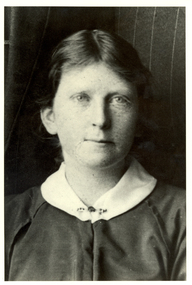
Photograph - Photograph - black and white, Rubie Lonie
... Dick Richards said 'That Miss Lonie had been in this one job all her life is a great tribute to the school, and the Council is conscious of her devoted service.' The Principal, Mr Arblaster, on behalf of himself and the staff presented Miss Lonie with a gold watch and wished her well in her retirement. The next day Miss Lonie, along with Hestor Darby, the SMB Typewriting teacher who was on long service leave, sailed from Melbourne for London, mainly to visit Scotland. ruby lonie ballarat school of mines women University women A black and white photo of a woman, Ruby Lonie Rubie Lonie Photograph Photograph - black and white ...Ruby Lonie was Senior Clerk of the Ballarat School of Mines (SMB) Administrative Staff. Always known as Miss Lonie, her sole position was at SMB where she worked between May 1914 and May 1960. When the SMB Registrar, John Robinson, died in 1935 the question of who would fill the position became a matter of urgency. The temporary answer was Miss Lonie, who was the senior clerk on the Registrar's staff. The permanent position was looked upon as an exclusively male preserve. At Miss Lonie's retirement function SMB President, M.B. John, noted that Miss Lonie had joined the staff in 1914 and had 'done a tremendous job since that time, and for many years had been the Registrar's "Right Hand Man". Twenty Four years after having acted as Registrar the current SMB Registrar, F.F.Ferguson recognised Miss Lonie's assistance and her extensive knowledge of the history and the administrative procedures of the School. He added 'I have noted on many occasions Miss Lonie's kindly interest in people in times of sickness or difficulty and her willingness to help.' Current and former staff members were keen to acknowledge Miss Lonie. Former Principal Dick Richards said 'That Miss Lonie had been in this one job all her life is a great tribute to the school, and the Council is conscious of her devoted service.' The Principal, Mr Arblaster, on behalf of himself and the staff presented Miss Lonie with a gold watch and wished her well in her retirement. The next day Miss Lonie, along with Hestor Darby, the SMB Typewriting teacher who was on long service leave, sailed from Melbourne for London, mainly to visit Scotland.A black and white photo of a woman, Ruby Lonieruby lonie, ballarat school of mines, women, university women -
 Federation University Historical Collection
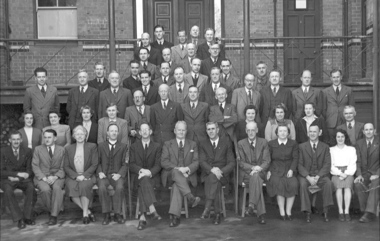
Photograph - Photograph - black and white, Ballarat School of Mines Staff, 1946, 1946
... It is a predecessor institution of Federation University Australia. ballarat school of mines dick richards Patterson Gladstone Procter university women Black and white photograph of Ballarat School of Mines Staff. ...The Ballarat School of Mines was the first school of mines in Australasia. It is a predecessor institution of Federation University Australia. Black and white photograph of Ballarat School of Mines Staff. The photograph is taken at the back of the Administration Building (formerly called new Classrooms). Back left to right: F.L. Collins, A.W. Bridson, J.J. Hanrahan, Harry Brew, G.W. Cornell Second left to right: J.T. Collings, R.W. Whitla, S. Mayo, Neville Bunning Third left to right: L.O. Brown, G.V. Bergin, R.R. Watson, T. Kellock, A.J. Murdoch, R.W. Richards Fourth left to right: A.C. Miller, A.V. Gilpin. T. R. Gordon, R.P. Flowers, H. Yates, D. Mullins, T. Trengove, W. Wilkinson, Lindsay Hillman, C. Fairbank Fifth left to right: A. Johnson, Annie Jones. M. Fogarty, Hester Darby, J. Allsop, William J. Paterson, A. Lambert, H. Goldsmith; M. McTaggart, C. King, M. Harland, F. Gladstone Procter Front left to right: N.W. Penrose, R.R. Calder, S. Williams, Dr Pound, C.F. Jeffrey (Head of Ballarat Junior Technical School, A.F. Heseltine (Principal), D.I. Johnson (Head of Art), J. Sutherland, Ruby H. Lonie, F.W. Ferguson, B. Law, J. Lochead. ballarat school of mines, dick richards, patterson, gladstone procter, university women -
 Federation University Historical Collection
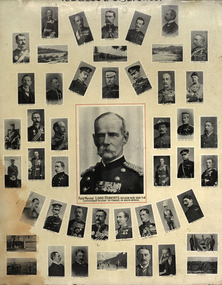
Photograph - Photo-montage, Officers of Forces in South Africa (Boer War), c1900
... dick-cunnynghame...f. roberts...charles warren...brabazon...a.g. wauchope...kelly-kenny...hector mcdonald...baden-powell...lord methuen...f. carrington...n.g. lyttleton...f. howard...j.d.f. french...w.f. gatacre...h.s. rawlinson...eyre crabbe...alderson...kekewich...a. fitzroy hart...g. white...The Boer War was fought from 1899 to 1901. boer war south african war armed services lord roberts weapons alfred milner cecil rhodes w.p. schreiner w. hely hutchinson w.p. symons general mildyard a. hunter holled smith dick-cunnynghame f. roberts charles warren brabazon a.g. wauchope kelly-kenny hector mcdonald baden-powell lord methuen f. carrington n.g. lyttleton f. howard j.d.f. french w.f. gatacre h.s. rawlinson eyre crabbe alderson kekewich a. fitzroy hart g. white lord kitchener lord dundonald plumer h.m.l. rundle w.h. mackinnon h.e. colville f. forestier walker r. clements redvers buller h. chermside g. lyttelton Black and white printed photo montage of Officers who served in the South African Forces during the Boer War. ...The Boer War was fought from 1899 to 1901.Black and white printed photo montage of Officers who served in the South African Forces during the Boer War. Portraits are supplemented with views of: Modder River, Ladysmith, Railway Bridge of Tugela, 4.7 naval gun, Royal Horse Artillery, Johannesburg Fort, Howitzer Gun, Field Artillery. The poster produced as an advertising medium for Wills Tobacco and Cigarettes using the Transvaal Series of cards.boer war, south african war, armed services, lord roberts, weapons, alfred milner, cecil rhodes, w.p. schreiner, w. hely hutchinson, w.p. symons, general mildyard, a. hunter, holled smith, dick-cunnynghame, f. roberts, charles warren, brabazon, a.g. wauchope, kelly-kenny, hector mcdonald, baden-powell, lord methuen, f. carrington, n.g. lyttleton, f. howard, j.d.f. french, w.f. gatacre, h.s. rawlinson, eyre crabbe, alderson, kekewich, a. fitzroy hart, g. white, lord kitchener, lord dundonald, plumer, h.m.l. rundle, w.h. mackinnon, h.e. colville, f. forestier walker, r. clements, redvers buller, h. chermside, g. lyttelton -
 Federation University Historical Collection
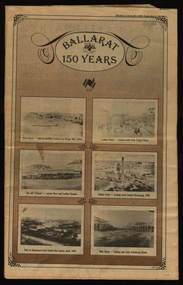
Newspaper, Ballarat 150 Years: Supplement to the Ballarat Courier, 1988, 17/03/1988
... white flat...celia scott...adelphi theatre...victoria theatre...montezuma theatre...charlie napier...juliamatthews...royal theatre...dick...A supplement to celebrate 150 since the establishment of the Port Phillip Colony (Victoria). ballarat anniversary sydney abraham cincotta eureka ballarat school of mines mining ballarat club lal lal iron mine ballarat rangers victorian rifles 3rd battalion victorian rifles ballarat militia white flat celia scott adelphi theatre victoria theatre montezuma theatre charlie napier juliamatthews royal theatre dick richards henry sutton eleanor lucus martin hosking newington estate saleyards g. gay & co ballarat books old benev' alleviated distress on goldfields 40 page newspaper published to celebrate the Sesquicentenary of Ballarat. ...A supplement to celebrate 150 since the establishment of the Port Phillip Colony (Victoria).40 page newspaper published to celebrate the Sesquicentenary of Ballarat. Articles include: 1838-the pastoral period begins; First White Settlers arrive (Anderson, Winter, Yuille, Kirkland, Learmonth); Learmonths - Pioneer Settlers; The Rush to Ballarat; Last of the Aborigines; Eureka Affair Gains New Importance; Mining-After the rush; SMB - First Technical School; Clubs Play their Part; Ballarat Yuilles had Wealthy Ancestors; Town, Country Share a Close Relationship; Many Sides to Metals Industry; True Victorian City; Five Severe Recessions; Financiers to the Fore; Ready for War; City Rich in Sport Facilities; Visitors to most exciting place; No Place for a Nervous Lady; Theatres Provide Welcome Diversion for Mines; Might Achievers Among famous Citizens; Life Seemed Different After the War; Ballarat School of Mines Eastern Station Hotel; Memorial (Her Majesty's) Last of Many Theatres; Art Gallery at its Best; Pilgrimage to Yuille Cairn at Sebastopol Images include: Jelbart tractor; Sunshine Harvester; Bailey's Mansion; Pennyweight Hotel; Bridge Mall; Blue Riband Mine, Black Hill, Burrumbeet Shooting party; A wendouree rowing club; Motor Cycle Racing; Women bowlers, Queen Elizabeth; Gong Gong Methodist Church; Arbour day at Waterloo Farm, Smythes Rd; Gold panners (1890s); Ballarat Cricket Team (1902); William Peart; D'Angri's store; Sturt St Advertisements include: Rehfisch and Co.; UFS Dispensaries; Deutscher Mower Sales and Service; Haymes Paint; Cincotta's; Abraham's Sportscene; McK's; McKay Macleod; St John of God Hospital; Benjamins Real Estate; Ballarat Water Board; Cornell's Pharmacy; Laminex Industries; Coltman Mitre 10; Lal Lal Iron Mine; Heinz Bros; Crockers; Frank ford travel; S.J. Weir; Ludbrook Plumbing Service; Mars; Robert Sim Building Supplies, Frank Day; Sectrol Systems; Thornton Richardsballarat, anniversary, sydney abraham, cincotta, eureka, ballarat school of mines, mining, ballarat club, lal lal iron mine, ballarat rangers, victorian rifles, 3rd battalion victorian rifles, ballarat militia, white flat, celia scott, adelphi theatre, victoria theatre, montezuma theatre, charlie napier, juliamatthews, royal theatre, dick richards, henry sutton, eleanor lucus, martin hosking, newington estate, saleyards, g. gay & co, ballarat books, old benev' alleviated distress on goldfields -
 Federation University Historical Collection
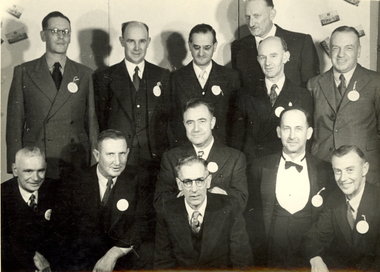
Photograph - Photograph - Black and White, Ballarat School of Mines Past Students Dinner, 1951, 14/04/1951
... Dick Richards. .5) Dave and Hazel Jelbart are on the right. .6) On the right moving away from camera: Albert W. Steane, Mrs Steane, Dr Pound, Ruby Lonie, F.E. Ferguson, B. Elliott, Sylvia Williams. This on the left include Beryl Pickering and Noel Pickering. Ballarat School of Mines Past Students Dinner, 1951 Photograph Photograph - Black and White ...Six photographs from a Ballarat School of Mines Past Students Dinner. The dinner was held on 14 April 1951 in the former Ballarat Technical School (currently the Gribble Building on the SMB Campus of Federation University) .1) Twelve men pose for a photograph. The tall man standing at the back in architect L.H. Vernon. The man at left in the front row is F. Gladstone Procter (alumni and Ballarat Technical Art School teacher); and second from left is William Meinhardt. .2) Left front to rear - Donald Eltringham, Mrs Eltringham, Geoff Mounter, Mrs Mounter, Alan Wilson, Ian McLachlan. Right Front to rear- Doug Dean, Mrs Dean, Bill Meinhardt, Norman Dalton. .3) From left moving away from camera:Mavis McTaggart, Hester Darby, Cr Arthur Nicholson, Mrs Nicholson, Morgan John. On right, 6 from front is Bob Morgan .4) On the right 2nd from camera is (prof Krause?). 3rd from camera is Dick Richards. .5) Dave and Hazel Jelbart are on the right. .6) On the right moving away from camera: Albert W. Steane, Mrs Steane, Dr Pound, Ruby Lonie, F.E. Ferguson, B. Elliott, Sylvia Williams. This on the left include Beryl Pickering and Noel Pickering. ballarat school of mines, ballarat technical art school, renunion, dinner, john, nichlson, darby, mctaggart, jelbart, vernon, proctor, nicholson, glad procter, alumni, f.w. procter, gladstone procter -
 Federation University Historical Collection
Booklet, Ballarat School of Mines Students' Magazine, 1958, 1958
... Contents include: New Students from Asia (Anthony Yeung Chai Shing, Yep Kwok Ming, Archari Kassibhrimi Sarikananda, Teddy Gan Ben Chiang, Richard Tann, Somsack Satapuntu, Chermsak Tanskul, Charles Tai, Chit Cheng Foo); Italian Coachwork Sets the Fashion; the White Australia Policy; Wool; Artists' Society; Literary Society; Maryborough Visit; Roll Call; Higher Education for Girls; Sports, Football, Baseball, Badminton, tennis, School of Mines Society of Artists; Girls' Association Images include: Craig's Royal Hotel, Dick Richards, Peter Robinson, Lansell groat, Elizabeth Scott, Patrick Collier, Nelson Hails, Biruta Mellins, William Widdop, Frank Pomeroy, Alan Clarke, Kaspar Bitans, Walter, Reimann, Gladys Hocking, Keith Alexander; Murray Gillan; John Skuja...Contents include: New Students from Asia (Anthony Yeung Chai Shing, Yep Kwok Ming, Archari Kassibhrimi Sarikananda, Teddy Gan Ben Chiang, Richard Tann, Somsack Satapuntu, Chermsak Tanskul, Charles Tai, Chit Cheng Foo); Italian Coachwork Sets the Fashion; the White Australia Policy; Wool; Artists' Society; Literary Society; Maryborough Visit; Roll Call; Higher Education for Girls; Sports, Football, Baseball, Badminton, tennis, School of Mines Society of Artists; Girls' Association Images include: Craig's Royal Hotel, Dick Richards, Peter Robinson, Lansell groat, Elizabeth Scott, Patrick Collier, Nelson Hails, Biruta Mellins, William Widdop, Frank Pomeroy, Alan Clarke, Kaspar Bitans, Walter, Reimann, Gladys Hocking, Keith Alexander; Murray Gillan; John Skuja Ballarat School of Mines Students' Magazine, 1958 Booklet J.A. ...The Ballarat School of Mines Students' Magazine was published annually. 1958 editor was Peter Robinson. Contents include: School Council, Members of Staff, A Balanced Education, Retirement of the Principal, Principal's Page, Prominent Personalities, Have we the Right Approach?, Sweet and Sour, Paying Homage to the Dead, Sports Awards 1958, Italian Coachwork Sets the Fashion, The "White Australia" Policy, Wool, Roll CallYellow soft covered 56 page magazine with green ink. Contents include: New Students from Asia (Anthony Yeung Chai Shing, Yep Kwok Ming, Archari Kassibhrimi Sarikananda, Teddy Gan Ben Chiang, Richard Tann, Somsack Satapuntu, Chermsak Tanskul, Charles Tai, Chit Cheng Foo); Italian Coachwork Sets the Fashion; the White Australia Policy; Wool; Artists' Society; Literary Society; Maryborough Visit; Roll Call; Higher Education for Girls; Sports, Football, Baseball, Badminton, tennis, School of Mines Society of Artists; Girls' Association Images include: Craig's Royal Hotel, Dick Richards, Peter Robinson, Lansell groat, Elizabeth Scott, Patrick Collier, Nelson Hails, Biruta Mellins, William Widdop, Frank Pomeroy, Alan Clarke, Kaspar Bitans, Walter, Reimann, Gladys Hocking, Keith Alexander; Murray Gillan; John Skujaballarat school of mines, ballarat junior technical school, lansell groat, r. w. richards, elizabeth scott, patrick collier, nelson hails, biruta mellins, william widdop, walter reimann, gladys hocking, keith alexander, frank pomeroy, alan clarke, kaspars bitans, eric mcgrath, teddy gan, juris erdmanis, brian duthie, r. horgan, g. beveridge, t. stanley, p. agrums, d. vendy, j. whelan, a. atkins, b. dunstan, p. collier, d. kirton, i. weir, b. lonsdale, anthony yeung, k. alexander, a. rock, g. barnett, n. delosa, w. reimann, m. villani, a. clarke, john wynd, h. fletcher, c. fraser, p. h. collier, v. dorron, murray gillan, john skuja, chit cheng foo, k. bitans -
![Article - Newspaper Clipping - Digital Image, Umpires honoured 1974 [DVFL], 24/09/1974](/media/collectors/4f729f5697f83e03086015b8/items/5eb52d6821ea671f18fc5fee/item-media/5eb52ddf21ea671f18fd3ccb/item-fit-380x285.jpg?cb=6) Greensborough Historical Society
Greensborough Historical SocietyArticle - Newspaper Clipping - Digital Image, Umpires honoured 1974 [DVFL], 24/09/1974
... The photo shows Alan Ely, President of the Diamond Valley Umpires Association presenting badges to Dick Rohed and Bernie Rayner. diamond valley umpires association diamond valley football league alan ely dick rohed bernie rayner News clipping, black and white text and image. ...In 1974, long service badges were presented to two umpires from the Diamond Valley Umpires Association. Both umpired over 200 games. The photo shows Alan Ely, President of the Diamond Valley Umpires Association presenting badges to Dick Rohed and Bernie Rayner.News clipping, black and white text and image.diamond valley umpires association, diamond valley football league, alan ely, dick rohed, bernie rayner -
Federation University Historical Collection
Booklet, The Ballarat School of Mines and Industries 1870-1920 Jubilee Booklet, 1920 (estimated)
... Vawdrey, Hilda Wardle william battery smith herbert drawing from the antique ballarat school of mines botanical gardens ballarat school of mines redmond barry alfred mica smith james bickett museum dick richards ballarat junior technical school s m b ballarat school of mines and industries ballarat technical art school model mine james m bickett j m bickett roderick murchison vocational training rooms wesley church methodist church alexander peacock lathes repatriation repatriatin department war service school council baragwanath gold mining mining laboratory plaster cast R.W. Richards anniversary jubilee White ...The first school of Mines in Australia was established at Ballarat in 1870. At the time of its jubilee (1930) the following people were members of the School Council: W.H. Middleton (President), W.T. Humphreys (VP), J.S. Vickery (VP), F. Barrow, Col. W.K. Bolton, William Baragwanath, A.E. Cutter, J.N. Dunn, G. Fitches, W.H. Fleay, F. Herman. W.D. Hill, T. Hurley, K. Kean. J. Kelly, L. Lederman, Mayor of Ballarat, Mayour of Ballarat East, D. Maxwell, M. Martin, R. Maddern, D. Ronaldson, F. Saunders, R. Stephenson, A.O. Stubbs, R.E. Tunbridge. The School Staff in 1920 comprised: Herbert H. Smith, Walter Rowbotham, Reginald L. Cutter, M.C. Young, Hilda Wardle, M. Wiliamson, P.S. Richards, L.H. Archibald, J. Woods, Ken Moss, W. Kenneth, Mrs McIlvena. B. Robinson, S. Rowe, E. Hope-Jones, Miss Abrams, L.St.G.P. Austin, Alfred Mica Smith, J.R. Pound, Herbert R. Murphy, N.H. Junner, Maurice Copland, L.H. Archibald, E.J.A. McConnon, Newton King, D.m. Hull, T.R. Gordon, John M. Sutherland, T.K. Jebb, Dick Richards, C. Tonkin, A.W. Steane, J. Paterson, H.W. Malin, R.V. Maddison, S.M. Mayo, F.A. King, W.H. Steane, T.R. Gordon, T.A. Williams, H. Waldron, G. Black, E.J. McConnon, R.V. Duncan. R. Cutter, E.G. Vawdrey, Hilda WardleWhite stapled booklet - landscape format - 20pp + soft covers with blue writing. Includes an historical sketch of the Ballarat School of Mines. Contains images of the school from around 1920. The history outlined in the booklet follows: 'Ballarat has helped to influence the life and destinies of Australia in many ways, the recital of which would perhaps prove tedious to the citizens of less favoured localities! However, it can be said, without much fear of contradiction, that only less known thought Australia than its fame as a gold field is the reputation won for it by its school of Mines, ... Ballarat was still quite a new place when the School was founded, but a very propserous and popular place all the same, with a go-ahead lot of citizens brim full of the spirit of enterprise which seemsto animate mining populations generally. Money was plentiful, and they launched out into ventures, which later, were to develop and take the place of the gold mines, while what is more to the point, they understood the value of education. the old digging days were passing away. So far as Ballarat itself was concerned the day of the cradle and tin dish had already passed into an antiquity "as dead and distant as the age of the Tubal Caon," said dir redmond Barry on declaring the School open. Mining had become a serious business, and the mining engineer, the metallurgist, and the geologist had become a power in the land. In these circumstances the suggestions to found a School of Mines met with ready acceptance. The late Mr James M. Bickett had the honor of bringing forward the proposition at a meeting of the Ballarat Mining Board in October, 1869. it was agreed to, and the Government, having been approached for assistance, granted a lease of the old Supreme Court buildings at a nominal reantal. A modest sum, including 100 pounds from the Borough Council of Ballarat West, was subscribed by a number of sympathisers, and on the 26th October, 1870, the inaugural address was delivered by Sir Redmond Barry, the first President of the School. Classes were commenced on the 23rd January, 1871. The students at first were mostly adults. They were chiefly men emloyed at the mines, who had the wisdom and energy to devote their spare time to study, and, though their attendance was somewhat irregular, they made very good progress. Old prints which have been preserved show them at work at furnaces, big bearded men of the old-fashioned type of miner. It is interesting to note that among those who gave evidence and encouragement was Sir Roderick Murchison, who many years before had advised Cornish miners to emigrate to Australia to search for gold, and who in 1848 was in possession of gold ore sent from this country. Sir Roderick sent a parcel of books for the library, and gave useful advice as to the curriculum which should be adopted. The Museum, which now contains a most valuable collection of minerals, was one of the first things attended to, and the reports presented to the Council from time to time speak of additions being made from all parts of the world. New equipment was constantly being added to the School, a good deal of assay work was done, and some specimens were sent from the East Indies for examination as far back as 1873. By this time there was a difficulty in providing accomodation for the students who wished to enrol, and the number of instructors had grown from two to four. In 1882 the first building was being erected on what was then part of the gaol reserve. A little more than ten years afterwards a buildnig formerly serving as a Methodist Church was absorbed, while later on, the demand for accomodation increasing, the attack upon the gaol was renewed. The School continued to grow in reputation and size, and became the science centre of the district, and in 1889 a learge new building was opened by Sir Alexander Peacock. Students came from over seas as well as from all the States of Australia, and after going through their courses they took with them the name and fame of the old School to all parts of the globe. School of Mines boys have played a great part in developing the mining fields of Western Australia, South Australia, and africa, while old students who have made a name in their profession are constantly dropping in to see how the old place is getting along. It was not to be expected, however, that the Ballarat School would be left without rivals, its very success inspiring competition. Mining Schools were started in other parts of Australia, and, at the same time, Victoria ceased to hold first place as a mining state. On the other hand there was a great advance in manufacturing, and the demand for technicaly trained men became a great and as insistent as ever it had been for trained mining men. The Council was quick to adapt the school to the new conditions, and the result is seen in the institution, which is one of Ballarat's proudest possession. Instruction is given in all branches of technical work, and the classes are filled with students who are building up for Ballarat a reputation as an industrial centre, which promises to equal that which it formerly held as a mining town. Owing to its bracing climate, its abundant opportunities for recreations, and its accessibilty, Ballarat as a city is an ideal place for educational purposed, and is yearly becoming more and more appreciated throughout the State. The chairman of one of Ballarat's biggests industries claims that the workman can do twice the day's work here that he can do in Melbourne. he was a little enthusiastic over it, perhaps, but it is a well-known fact that the healthy and invigourating Ballarat climate is conducive to both physical and mental activity, and the records of the School provide ample proof of it. One of the most interesting and successful branches of the School of Mines and Industries - if the name be enlarged with the enlargement of its scope - is the Technical Art School. "The City of Statues" has from its earliest days been a stronghold of art. Art schools have flourised here, and in 1905 the Education Department came to the conclusion that the best thing to do with them was to place them under the management of the School of Mines Council. A magnificent new Technical Art School was built at a cost of some 12,000 pounds on the site of the old Supreme Court building, and was formally opened on the 23rd July, 1915. The results have not only been justified but surpassed all anticipations. The most comprehensive list of subjects is taught, and this list is constantly added to. Students have flocked to the art School, which may be said to occupy a unique position in Australia, and its record of success is really astonishing. Its students supply art teachers for the newer schools that are being built, and many occupy leading positinos in important business houses. So well is its reputation known that orders are constantly being received, not only from Victoria, but from other States, for honor boards and challenge shields to be designed and made. The most recent addition to the School of Mines and Industries is the Junior Technical School, for which a new building is now being erected on a portion of the gaol site, transferred to the School of Mines Counci by the Government. At the present moment temporary quarters are being occupied. Some students after passing through the Junior School go straight to employment, continuing perhaps to attend the evening trade classes, while others move on to the senior School. In a review of the work of the School of Mines mention must be made of a series of industrial research carried out under supervision of the Principal. One in particular, regarding the suitability of the local ores for the manufacture of pigments attracted much attention, while the experiemtns on the manufacture of white potery from Victorian clayes were considered of sufficient importance by the Federal Advisory Council of Science and Industry to warrant the appointment of a special investigator. The results of these have been most encouraging, and may have far-reaching consequences. The vocational training of returned soldiers also should not be overlooked. The work was taken in hand from the first, before the Repatriation Department gave assistance, and now with the help of the department of the School has become one of the largest vocational training centres in Victoria outside of Melbourne. The soldiers, trained in a variety of occupations, have made remarkable progress, and already considerable numbers have found employment in local workshops and factories. To sum up, the School is divided into the following departments, each well staffed and equipped: - The School of Mines, science, and Engineering; the Techncial Art School, the Boys' Junior Technical School, the Girl's Preparatory Technical Classes, Trade Classes, and the Commercial School. The school of Mines, science and Engineering, comprises the following branches: - Mining, Metallurgy, Geology, Electrical Engineering, Civil Engineering, Mechanical Engineering, Applied Chemistry, and Pharmacy. Battery treatments, Cyanide Testing, Smelting, Assays, and Clay Testing from a regular part of the School's work. Students gaining qualifications obtain concession in their courses at the university, should they proceed there to continue their studies. The technical Art school curriculum includes training in all branches of pictorial and applied art, an Architectural Diploma Course, a Draughtman's Course, technical Art teachers' Course, Photography,Ticket Writing, Art Metal Work, Woodcarving, Needlework, and Leather work. The Trade Classes give instruction in Telephone Mechanics, telegraphy, Carpentry, Cabinet Making, Plumbing, Blacksmithing, Fitting, Electric Wiring, and Printing. Numerous Scholarships are offered every year, and altogether students will find few places to equal the Ballarat School of Mines and Industries as a training place for their life's work. One of the first in the continent to be established, its Jubilee finds it still in the front rank, keeping pace with the times, and offering to the youths of this country the means of taking advantage of Australia's teeming opportunities. william, battery, smith, herbert, drawing from the antique, ballarat school of mines botanical gardens, ballarat school of mines, redmond barry, alfred mica smith, james bickett, museum, dick richards, ballarat junior technical school, s m b, ballarat school of mines and industries, ballarat technical art school, model mine, james m bickett, j m bickett, roderick murchison, vocational training rooms, wesley church, methodist church, alexander peacock, lathes, repatriation, repatriatin department, war service, school council, baragwanath, gold mining, mining laboratory, plaster cast, r.w. richards, anniversary, jubilee -
Marysville & District Historical Society
Document (item) - Gold Mine Prospectus, H.D. McKie, Prospectus of the New Golden Bower & Star Gold M.Co, 1896
... white...reefton turnoff...santa claus reef...bear's creek...mr r ely...bear's creek reef...big river...mr feely...new star reef...golden bower reef...a1 mining co...mr r m lee...locke's no.1 extended gold mining company...mr q dick...William Edward Chester discovered the Golden Secret gold vein which became part of the Golden Bower Mine at Chesterville near Donovans Creek on the Cumberland goldfield which he mined with George Locke until the late 1930s. new golden bower & star gold m.co. donovan's creek nuggety gully creek yarra track marysville victoria share prospectus upper yarra track wood's point victoria mount morgan gold mining co. british mount morgan mine mr white reefton turnoff santa claus reef bear's creek mr r ely bear's creek reef big river mr feely new star reef golden bower reef a1 mining co mr r m lee locke's no.1 extended gold mining company mr q dick A copy of the Prospectus of the New Golden Bower & Star Gold M.Co. near Marysville in Victoria. ...A copy of the Prospectus of the New Golden Bower & Star Gold M.Co. near Marysville in Victoria.A copy of the Prospectus of the New Golden Bower & Star Gold M.Co. near Marysville in Victoria. The Golden Bower gold mine was a quartz reef mine. William Edward Chester discovered the Golden Secret gold vein which became part of the Golden Bower Mine at Chesterville near Donovans Creek on the Cumberland goldfield which he mined with George Locke until the late 1930s. new golden bower & star gold m.co., donovan's creek, nuggety gully creek, yarra track, marysville, victoria, share prospectus, upper yarra track, wood's point, victoria mount morgan gold mining co., british mount morgan mine, mr white, reefton turnoff, santa claus reef, bear's creek, mr r ely, bear's creek reef, big river, mr feely, new star reef, golden bower reef, a1 mining co, mr r m lee, locke's no.1 extended gold mining company, mr q dick -
 Federation University Historical Collection
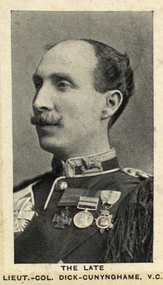
Photograph (black & White), Lieutenant-Colonel Dick-Cunynghame, V.C. - South Africa
... Lieutenant-Colonel Dick-Cunynghame, V.C. - South Africa Photograph (black & White) ...Lieutenant-Colonel Dick-Cunyinhame V.C.Individual image from photographed poster of tobacco and cigarette cards.victoria cross, south africa, dick-cunynghame, lieutenant-colonel, highland regiment, scotland -
Federation University Historical Collection
Book, Allen & Unwin Australia Pty Ltd et al, The Last Antarctic Heros by Lennard Bickel, 1989
... Lennard Bickel has made a career of writing little-known epics of human triumphs over adversity, triumphs that have brought benefit to mankind. sir ernest shackleton antarctic maps roald amundsen douglas mawson captain scott ernerst shackleton frank hurley captain aeneas mackintosh ernest mills joyce ernie wild dick richards reverend a. p. spencer-smith irvine gaze keith jack aurora endurance weddell seals scott's 1910 hut, cape evans cape evans r.w. richards Green book with titles in white font, 230 pages. ...The Last Antarctic Heros. This journey is without parallel in the annals of polar expedition....a task almost beyond human endurance. Lennard Bickel has made a career of writing little-known epics of human triumphs over adversity, triumphs that have brought benefit to mankind.Green book with titles in white font, 230 pages.sir ernest shackleton, antarctic, maps, roald amundsen, douglas mawson, captain scott, ernerst shackleton, frank hurley, captain aeneas mackintosh, ernest mills joyce, ernie wild, dick richards, reverend a. p. spencer-smith, irvine gaze, keith jack, aurora, endurance, weddell seals, scott's 1910 hut, cape evans, cape evans, r.w. richards -
 Federation University Historical Collection
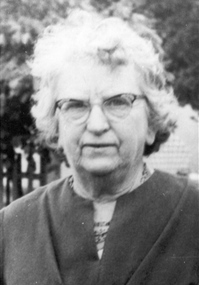
Photograph - Photograph - black and white, Rubie Lonie
... Dick Richards said 'That Miss Lonie had been in this one job all her life is a great tribute to the school, and the Council is conscious of her devoted service.' The Principal, Mr Arblaster, on behalf of himself and the staff presented Miss Lonie with a gold watch and wished her well in her retirement. The next day Miss Lonie, along with Hestor Darby, the SMB Typewriting teacher who was on long service leave, sailed from Melbourne for London, mainly to visit Scotland. ruby lonie ballarat school of mines women University women A black and white photo of a woman, Ruby Lonie Rubie Lonie Photograph Photograph - black and white ...Ruby Lonie was Senior Clerk of the Ballarat School of Mines (SMB) Administrative Staff. Always known as Miss Lonie, her sole position was at SMB where she worked between May 1914 and May 1960. When the SMB Registrar, John Robinson, died in 1935 the question of who would fill the position became a matter of urgency. The temporary answer was Miss Lonie, who was the senior clerk on the Registrar's staff. The permanent position was looked upon as an exclusively male preserve. At Miss Lonie's retirement function SMB President, M.B. John, noted that Miss Lonie had joined the staff in 1914 and had 'done a tremendous job since that time, and for many years had been the Registrar's "Right Hand Man". Twenty Four years after having acted as Registrar the current SMB Registrar, F.F.Ferguson recognised Miss Lonie's assistance and her extensive knowledge of the history and the administrative procedures of the School. He added 'I have noted on many occasions Miss Lonie's kindly interest in people in times of sickness or difficulty and her willingness to help.' Current and former staff members were keen to acknowledge Miss Lonie. Former Principal Dick Richards said 'That Miss Lonie had been in this one job all her life is a great tribute to the school, and the Council is conscious of her devoted service.' The Principal, Mr Arblaster, on behalf of himself and the staff presented Miss Lonie with a gold watch and wished her well in her retirement. The next day Miss Lonie, along with Hestor Darby, the SMB Typewriting teacher who was on long service leave, sailed from Melbourne for London, mainly to visit Scotland.A black and white photo of a woman, Ruby Lonieruby lonie, ballarat school of mines, women, university women -
Federation University Historical Collection
Book - Book - Scrapbook, Ballarat University College: Newspaper Cuttings, January to December 1991 and January to December 1992
... Nicky Taws and Rob Plowright to represent Australia in the World Orienteering Championships. ballarat university college australia day honor to jack barker institutions and merger date university of the third age protests to government dick de fegely buc land rehabilitation rmit and merger student accommodation shortage masters in engineering science hydrogeology krause collection on show music at buc nicky taws rob plowright orienteering championships australian women's cricket development squad camp at buc White A4 two ring folder. ...Newspaper cuttings collected from various sources. - Ballarat Courier, The Australian, Warrnambool Standard, The Age, The Standard, The News, Ballarat News, East Gippsland News. The items are from 26 January to 20 December 1991 and 11 January to 12 December 1992. Institutions in rush to beat merger date - Victoria's education dilemma. University of the Third Age plan for coming year. Protests over the Government's remarks over Ag Department move. Caution urged by MLC Dick de Fegely. Land rehabilitation program centre at BUC. New university must not be thwarted. $24000 grant provided for specialist lectures. Tertiary education faces crisis as student numbers boom. Lack of student accommodation means some students are living in local hotels. BUC and Melbourne Uni given $500000 grant. It will be used to develop a Masters in Engineering Science (Hydrogeology) course, the first of its kind in Victoria. BUC has opened the F M Krause Broken Hill Mineral collection. Students bring weekend of music to BUC. Nicky Taws and Rob Plowright to represent Australia in the World Orienteering Championships. White A4 two ring folder. Divided into months by coloured dividers. Folder has black marks from previous use.ballarat university college, australia day honor to jack barker, institutions and merger date, university of the third age, protests to government, dick de fegely, buc, land rehabilitation, rmit and merger, student accommodation shortage, masters in engineering science, hydrogeology, krause collection on show, music at buc, nicky taws, rob plowright, orienteering championships, australian women's cricket, development squad camp at buc -
Federation University Historical Collection
Correspondence, R. W. (Dick) Richards, Letters from Dick Richards to John Tippett, 1971-84, 1971-1984
... dick richards...r.w. richards...antarctica...albert medal...george cross...john tippett...e.j.t. tippett...tony gaze...irvine gaze...luftwafer...white...Dick Richards recovery from severe physical collapse in August 1916. Richards writes 'he nursed by like a mother for a protracted period. ...' The letter ends with 'I ain't no bloody hero but I thought you would like to know. .3) One page typed letter dated 03 November 1984. It is a general letter which mentions Tony Gaze, Irvine Gaze. Irvine GAZE joined the RAF during World War One and was shot down near at luftwafer camp. A German airman saw Irvine Gaze's white...John Tippett was the President of the Ballarat School of Mines Council dick richards r.w. richards antarctica albert medal george cross john tippett e.j.t. tippett tony gaze irvine gaze luftwafer white polar ribbon hermann goering lex davidson Photocopies of three letters written by Dick Richards to John Tippett. .1) One page typed letter dated 31 October 1971. ...Dick Richards was a Principal at the Ballarat School of Mines. John Tippett was the President of the Ballarat School of Mines CouncilPhotocopies of three letters written by Dick Richards to John Tippett. .1) One page typed letter dated 31 October 1971. The letter relates to the Albert Medal and George Cross. .2) One page typed letter dated 11 November 1983. The letter thanks John and Anne Tippett for their birthday wishes. It also mentions J.L. Cope and the role he played in Dick Richards recovery from severe physical collapse in August 1916. Richards writes 'he nursed by like a mother for a protracted period. ...' The letter ends with 'I ain't no bloody hero but I thought you would like to know. .3) One page typed letter dated 03 November 1984. It is a general letter which mentions Tony Gaze, Irvine Gaze. Irvine GAZE joined the RAF during World War One and was shot down near at luftwafer camp. A German airman saw Irvine Gaze's white polar ribbon and invited him to a meal where the President was Hermann Goering. Tony Zaze was a Spitfire pilot during World War 2 and was shot down about 100 miles from where his father was shot down. He escaped with the assistance of the resistance.dick richards, r.w. richards, antarctica, albert medal, george cross, john tippett, e.j.t. tippett, tony gaze, irvine gaze, luftwafer, white polar ribbon, hermann goering, lex davidson -
 Marysville & District Historical Society
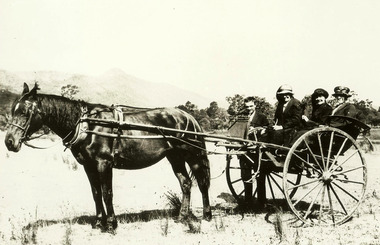
Photograph (item) - Black and white photograph, Unknown
... A digital copy of a black and white photograph of Dick and Louise Batchelor and guests. ...A digital copy of a black and white photograph of Dick and Louise Batchelor and guests. ...A digital copy of a black and white photograph of Dick and Louise Batchelor and guests. ...A digital copy of a black and white photograph of Dick and Louise Batchelor and guests. The Batchelor Family owned and operated Taggerty House near Taggerty in Victoria.A digital copy of a black and white photograph of Dick and Louise Batchelor and guests. The Batchelor Family owned and operated Taggerty House near Taggerty in Victoria.taggerty, victoria, australia, taggerty house, accommodation, james batchelor, photograph, dick batchelor, louise batchelor -
 Marysville & District Historical Society
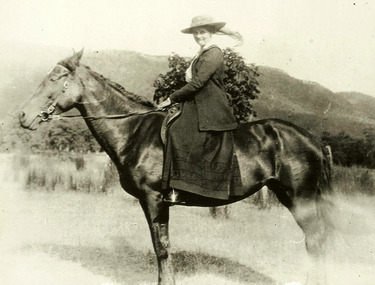
Photograph (item) - Black and white photograph, Unknown
... white photograph of Emily Batchelor on horseback. The Batchelor Family owned and operated Taggerty House near Taggerty in Victoria. taggerty victoria australia taggerty house accommodation james batchelor photograph dick batchelor louise batchelor emily batchelor A digital copy of a black and white photograph of Emily Batchelor on horseback. ...A digital copy of a black and white photograph of Emily Batchelor on horseback. The Batchelor Family owned and operated Taggerty House near Taggerty in Victoria.A digital copy of a black and white photograph of Emily Batchelor on horseback. The Batchelor Family owned and operated Taggerty House near Taggerty in Victoria.taggerty, victoria, australia, taggerty house, accommodation, james batchelor, photograph, dick batchelor, louise batchelor, emily batchelor -
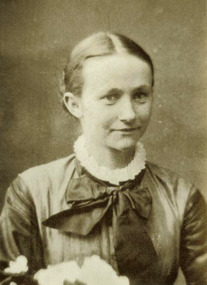 Marysville & District Historical Society
Photograph (item) - Black and white photograph, Unknown
... white photograph of Annie Batchelor. The Batchelor Family owned and operated Taggerty House near Taggerty in Victoria. taggerty victoria australia taggerty house accommodation james batchelor photograph dick batchelor louise batchelor emily batchelor annie batchelor A digital copy of a black and white photograph of Annie Batchelor. ...A digital copy of a black and white photograph of Annie Batchelor. The Batchelor Family owned and operated Taggerty House near Taggerty in Victoria.A digital copy of a black and white photograph of Annie Batchelor. The Batchelor Family owned and operated Taggerty House near Taggerty in Victoria.taggerty, victoria, australia, taggerty house, accommodation, james batchelor, photograph, dick batchelor, louise batchelor, emily batchelor, annie batchelor -
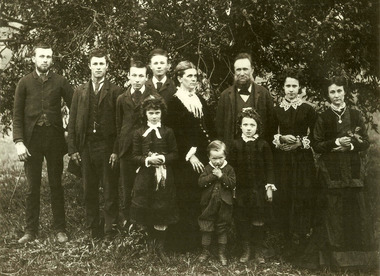 Marysville & District Historical Society
Photograph (item) - Black and white photograph, Unknown
... white photograph of members of the Batchelor Family. The Batchelor Family owned and operated Taggerty House near Taggerty in Victoria. taggerty victoria australia taggerty house accommodation james batchelor photograph dick batchelor louise batchelor emily batchelor annie batchelor A black and white photograph of members of the Batchelor Family. ...A black and white photograph of members of the Batchelor Family. The Batchelor Family owned and operated Taggerty House near Taggerty in Victoria.A black and white photograph of members of the Batchelor Family. The Batchelor Family owned and operated Taggerty House near Taggerty in Victoria.taggerty, victoria, australia, taggerty house, accommodation, james batchelor, photograph, dick batchelor, louise batchelor, emily batchelor, annie batchelor
