
Showing 10 items matching " docks operating company"
-
 Bendigo Military Museum
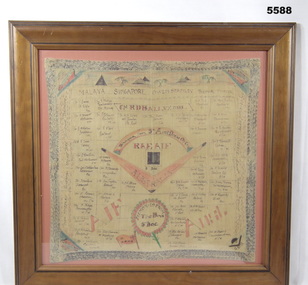
Memorabilia - FABRIC, FRAMED, c. 1944 - 45
... Richmond Douglas Ball VX71333, enlisted on 8.1.1942 age 37 years, discharged from the AIF with the rank of Cpl on 22.12.1944 in 5th Docks Operating Company. Refer Cat No 5592 re his sister "Peggy"...Framed hand drawn fabric souvenir re the 5th Docks Operating Company RAE AIF. Centre piece is a Boomerang with the unit details over, around that is hand drawn details re men in the unit, around the outside are details where the unit served, at the top is the name of the recipient given to....Richmond Douglas Ball VX71333, enlisted on 8.1.1942 age 37 years, discharged from the AIF with the rank of Cpl on 22.12.1944 in 5th Docks Operating Company. Refer Cat No 5592 re his sister "Peggy" memorabilia framed 5th Docks Ball "CPL R.D BALL. ...Richmond Douglas Ball VX71333, enlisted on 8.1.1942 age 37 years, discharged from the AIF with the rank of Cpl on 22.12.1944 in 5th Docks Operating Company. Refer Cat No 5592 re his sister "Peggy"Framed hand drawn fabric souvenir re the 5th Docks Operating Company RAE AIF. Centre piece is a Boomerang with the unit details over, around that is hand drawn details re men in the unit, around the outside are details where the unit served, at the top is the name of the recipient given to."CPL R.D BALL. VX71333"memorabilia, framed, 5th docks, ball -
 Bendigo Historical Society Inc.
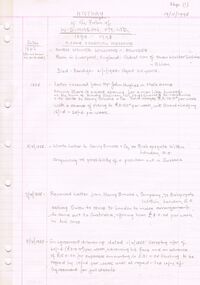
Document - IAN DYETT COLLECTION: HISTORY OF THE FIRM OF W. D. MASON PTY. LTD 1894 - 1998
... ... Docks Operating Company...Mason Pty Ltd 1894 - 1998 Owen Walter Williams Ellen Williams John Jughes Brooks Robinson & Co Henry Brooks & Co Shaw Savill & Albion Company Limited Line Akawa (5026 Tons) Susan Barbara Lawson Walter Williams Samuel Thomas Williams Owen Mostyn Williams W Daley Grandview Estate Homebest Olwyn Philip Harris & Co Limited Ann McKenzie Wavertree Ellen Williams Reed Smart & Tappin Bendigo Cathedral - Sacred Heart Capt'n Snooze Watkin Williams Mr Holmes J R Daley Coles Supermarket Walter David Mason thompson & Harvey Wavertree Ellen Mason Ivo James Byron Steel Albert G Rowley Frank G O'Brien Roy Leonard Mason Ellen Mason Senior - nee Jamieson Alan Mason Melva Mason Thelma Annie Mason G D Garvin & G Eathorne Thomas Lancel Hosking Alan Walter Mason AIF Docks Operating Company Ann (Annie) Williams A J & A M & C X Taylor Five page History of the Firm of W. ...Five page History of the Firm of W. D. Mason Pty. Ltd. 1894 - 1998 & some personal Memoirs. History starts when Owen Walter Williams came from England to work in the glass industry. He came to Bendigo when he was given notice during the depression. Williams/Mason Family History is included and also the history of W. /d. Mason Pty. Ltd.business, auctioneers, j h curnow & son pty ltd, ian dyett collection - history of the firm of w. d. mason pty ltd 1894 - 1998, owen walter williams, ellen williams, john jughes, brooks robinson & co, henry brooks & co, shaw savill & albion company limited line, akawa (5026 tons), susan barbara lawson, walter williams, samuel thomas williams, owen mostyn williams, w daley, grandview estate, homebest, olwyn, philip harris & co limited, ann mckenzie, wavertree ellen williams, reed smart & tappin, bendigo cathedral - sacred heart, capt'n snooze, watkin williams, mr holmes, j r daley, coles supermarket, walter david mason, thompson & harvey, wavertree ellen mason, ivo james byron steel, albert g rowley, frank g o'brien, roy leonard mason, ellen mason senior - nee jamieson, alan mason, melva mason, thelma annie mason, g d garvin & g eathorne, thomas lancel hosking, alan walter mason, aif, docks operating company, ann (annie) williams, a j & a m & c x taylor -
 Bendigo Military Museum
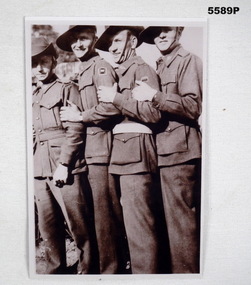
Photograph - PHOTOGRAPH WW2, c.2022
... Refer Cat No 5588 re Richmond Ball, on that item Hedley Sampson's name is also on re 5th Docks Operating Company. Refer Cat No 5589P for Alan Ball. ...Refer Cat No 5588 re Richmond Ball, on that item Hedley Sampson's name is also on re 5th Docks Operating Company. Refer Cat No 5589P for Alan Ball. ...The four Soldiers from left to right are, Hedley Sampson VX71343, Alan Ball VX85724, Richmond Ball VX71333, Dave King VX71340, all from Cohuna. Refer Cat No 5588 re Richmond Ball, on that item Hedley Sampson's name is also on re 5th Docks Operating Company. Refer Cat No 5589P for Alan Ball. Dave King married Betty Ball.Photograph, sepia tone showing four Soldiers standing side on in a row.photographs, 5th docks, ww2 -
 Warrnambool and District Historical Society Inc.
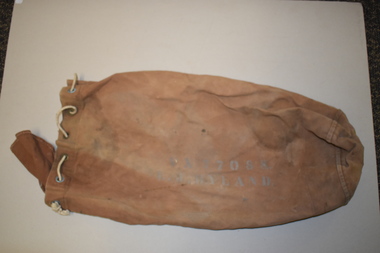
Kit Bag, 1940s
... He enlisted in March 1942 and was discharged in 1946, holding the rank of sapper at the time as a member of the 2/1 Australian Docks Operating Company. He died in Parkville in 1985 at the age of 63. ...He enlisted in March 1942 and was discharged in 1946, holding the rank of sapper at the time as a member of the 2/1 Australian Docks Operating Company. He died in Parkville in 1985 at the age of 63. ...This kit bag is a World War Two issue for Australian Army soldiers. The bag belonged to Leonard John Hyland of the Australian Army. He was born in Woolsthorpe in 1921 and was the son of John and Edith Hyland. He enlisted in March 1942 and was discharged in 1946, holding the rank of sapper at the time as a member of the 2/1 Australian Docks Operating Company. He died in Parkville in 1985 at the age of 63. This bag is of interest as it belonged to Leonard Hyland, an Australian Army member in World War Two. Hyland was from the Warrnambool district.This is a brown cloth bag with a rounded stitched base. At the top of the kit bag are 12 metal eyelets with a drawstring of white cord. The bag is stainedVX 77088 L.J. Hyland leonard hyland, world war two, history of warrnambool, kit bag -
 Mission to Seafarers Victoria
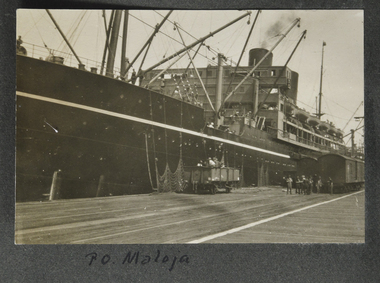
Photograph - Photograph, Sepia, P.O. Maloja, 1928
... operated by The Peninsular and Oriental Steam Navigation between 1923 and 1954. The ship was requisitioned by the Admiralty for service as an Armed Merchant Cruiser upon her arrival at Aden steam ships world war 2 p.o. maloja ss maloja p & o peninsular and oriental steam navigation company fan album Handwritten in black ink beneath lower edge of image on album page as "P O Maloja" (this may be misnamed) see notes below B & W landscape photograph with view from the dock of nearside port bow and superstructure of a moored ship. ...The SS Maloja was a passenger liner operated by The Peninsular and Oriental Steam Navigation between 1923 and 1954. The ship was requisitioned by the Admiralty for service as an Armed Merchant Cruiser upon her arrival at AdenB & W landscape photograph with view from the dock of nearside port bow and superstructure of a moored ship. Men at dockside level are loading or unloading with net in foreground. railway vehicles are lined alongside under a shed. A faint series of letters can be made out near the portholes towards top of bow. This could be name of the vessel. Handwritten in black ink beneath lower edge of image on album page as "P O Maloja" (this may be misnamed) see notes belowsteam ships, world war 2, p.o. maloja, ss maloja, p & o, peninsular and oriental steam navigation company, fan album -
 Flagstaff Hill Maritime Museum and Village
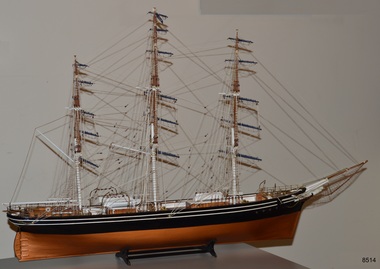
Craft - Ship Model, Billings Boats Denmark Aps, Cutty Sark, 1980s
... company's name. It was sold again and renamed Maria do Amparo. Finally, the ship's name was returned to the original 'Cutty Sark' when it was purchased by Captain Dowman for use as a cadet training ship. The ship continued trading and in 1922 it became the last operating clipper ship in the world. The ship is now a museum, preserved in a dry dock...company's name. It was sold again and renamed Maria do Amparo. Finally, the ship's name was returned to the original 'Cutty Sark' when it was purchased by Captain Dowman for use as a cadet training ship. The ship continued trading and in 1922 it became the last operating clipper ship in the world. The ship is now a museum, preserved in a dry dock ...This ship model of the Cutty Sark was hand-built in the 1980s from a model kit produced by Billings, Denmark. It was on display in the Olde Maritime Motor Inn in Warrnambool until it was refurbished around 2015. The Cutty Sark was a famous clipper ship, launched in 1869 for the tea trade from China to London. The ship was designed for speed, with the ambition to be the fastest ship. In the late 1800s, it competed in the tea clipper races. It was eventually sold to a Portuguese company, Ferreria, and took on the company's name. It was sold again and renamed Maria do Amparo. Finally, the ship's name was returned to the original 'Cutty Sark' when it was purchased by Captain Dowman for use as a cadet training ship. The ship continued trading and in 1922 it became the last operating clipper ship in the world. The ship is now a museum, preserved in a dry dock at Greenwich, England, as part of the British National Historic Fleet. About Barry Williams: - The maker, Barry Williams, worked for the Australian Shipping Line, Huddart Packard Ltd., until it closed down in 1960. Williams then worked for Shaw Savill & Albion Co. Ltd., a substantial British passenger and liner company. and subsequently Furness Withy Ltd. (SS&A's parent company). In the late 1970s Williams and two friends established their own ship chartering company in Melbourne, the Harwood Shipping Co. During the early 1970s Williams and his wife lived in London, near Greenwich, and often walked along the river where the Cutty Sark Maritime Museum is located. The fascination of the Cutty Sark led Williams to build model ships of the same era. At one stage Williams lost the rigging plan for the Cutty Sark but one of his partners, on a visit to London, photographed the Cutty Sark on the river, and Williams used these to complete the rigging on the model. Williams found the making of the model a very demanding but also pleasurable exercise.The model is significant for showing a visual representation of one of the most famous tea clippers, the vessel Cutty Sark. The three-masted ship was built for speed and traded tea between England and China. In 1922 the Cutty Sark became the last operating tea clipper in the world. The craft of ship model building has been popular for centuries, especially with people associated with the sea, such as this model builder, whose career was based around the shipping industry.Ship model; clipper ship, the 'Cutty Sark', a three-masted clipper ship, bare rigging, netting below the bowspit, and fine chains hanging from the bowspit. Black hull with two parallel horizontal stripes below the rail. Lifeboats on board. The white figurehead is below the bowsprit. The model comes with a cradle stand. The ship's name is not visible on the model.flagstaff hill, warrnambool, shipwrecked coast, flagstaff hill maritime museum, maritime museum, shipwreck coast, flagstaff hill maritime village, great ocean road, cunysark, historic sailing ship, tea clipper, sail training vessel, cadet training ship, commercial trading vessel, cargo sail vessel, ship model cutty sark -
 Bendigo Military Museum
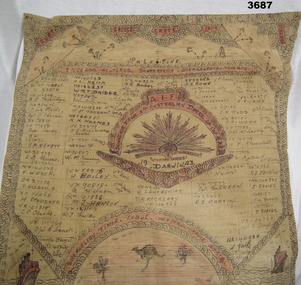
Souvenir - SOUVENIR WW2, Possibly 1943
... Docks Operating Coy. - RAE. Given to Ross by his unit. Refer Cat No 3147 for his service details. Souvenir cloth Hemmed, cream cotton cloth with names of company members in black. ...Item re S W Ross, VX78589, 5th Australian Docks Operating Coy. - RAE. Given to Ross by his unit. Refer Cat No 3147 for his service details.Hemmed, cream cotton cloth with names of company members in black. Rising Sun emblem in centre dated Darwin 1943. AIF Souvenir 5th Australian Docks Op. Coy. - RAE, boomerang at bottom. Cloth has a drawing of a kangaroo at centre bottom & listings of where the unit served around the edges.souvenir, cloth -
 Plutarch Project
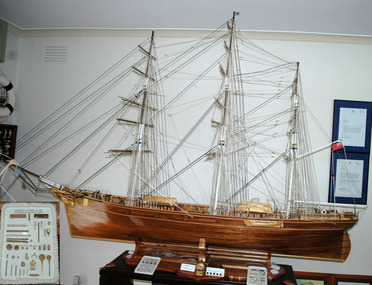
English wooden ship model, Cutty Sark replica, circa 1997
... Eventually, the “Cutty Sark” in 1895 was sold to a Portuguese company called “Ferreira and Co.”, where it continued to operate as a cargo ship until 1922, when it was purchased on that year by the retired sea captain Wilfred Dowman, who used it as a training ship in the town of Falmouth in Cornwall. After his death, the ship was conferred as a gesture of good will to the “Thames Nautical Training College” in Greenhithe in 1938, where it became an auxiliary cadet training ship, outliving its usefulness as a training vessel by 1954, and permanently [being dry docked in Greenwich, London, ] for public viewing. ...Eventually, the “Cutty Sark” in 1895 was sold to a Portuguese company called “Ferreira and Co.”, where it continued to operate as a cargo ship until 1922, when it was purchased on that year by the retired sea captain Wilfred Dowman, who used it as a training ship in the town of Falmouth in Cornwall. After his death, the ship was conferred as a gesture of good will to the “Thames Nautical Training College” in Greenhithe in 1938, where it became an auxiliary cadet training ship, outliving its usefulness as a training vessel by 1954, and permanently [being dry docked in Greenwich, London, ] for public viewing. ...This replica ship was modelled to exact scale by Denis Paraskevatos with the original basic kit enhanced by a large number of brass and mahogany wooden parts used and showing on two labels positioned at the base of the model. These replica parts were specifically designed and constructed by D. Paraskevatos with the help of his family. This model along a large number of others have been displayed at the Victorian Parliament for ten days from the 18th March 2002 (Queens Hall) to the 28th March 2002, and the Melbourne Town Hall from 19th to 27th August 2004. The history of the 65 meter British vessel named Cutty Sark is as follows: THE CUTTY SARK (history) The “Cutty Sark” was a British clipper ship, aptly named of course as a [clipper for its speed ], which was built in 1869 on the [river Clyde in Scotland ] by the Jock Willis Shipping Corporation. It was primarily used to transport tea from China to Great Britain, as well to a lesser extent later in its life, wool from Australia; however, with the advent of the steam engines and the creation also of the Suez Canal in 1869, its days of operation as a sailing vessel were numbered, as the steam ships were now prevailing as technologically advanced cargo carriers through the shorter route by the Suez Canal to China. In fact, within a few years of its operation, as its delegation in the tea industry was declining, it was assigned primarily the duty of transporting wool from Australia to England, but this activity was thwarted again by the steam ships, as they were enabled by their technologies to travel faster to Australia. Eventually, the “Cutty Sark” in 1895 was sold to a Portuguese company called “Ferreira and Co.”, where it continued to operate as a cargo ship until 1922, when it was purchased on that year by the retired sea captain Wilfred Dowman, who used it as a training ship in the town of Falmouth in Cornwall. After his death, the ship was conferred as a gesture of good will to the “Thames Nautical Training College” in Greenhithe in 1938, where it became an auxiliary cadet training ship, outliving its usefulness as a training vessel by 1954, and permanently [being dry docked in Greenwich, London, ] for public viewing. Of course, the “Cutty Sark” was not the only tea clipper constructed and owned by the Jock Willis Corporation, as there were others who were also used for the transportation of tea from China to Great Britain. Noteworthy additionally in its impressive resume is the fact that, the “Cutty Sark” was not only valued and admired for its speed, but also for its prestige that it afforded to its owners, [as media coverage was insatiable during a tea race that was regarded a national sporting event, with fiscal bets being placed on a predicted winning ship ]. Disappointingly, even though the English tea clippers were the best in the world at the time in terms of marine design, they had never won a tea race, and Jock Willis was certainly determined to achieve this goal, as the American clippers were considered the fastest in the tea trade. Nonetheless, the British clippers were proven to be formidable opponents to their American counterparts in the tea trade, when in 1868 a British tea clipper called [“Thermopylae”, managed to travel from the port of London to Melbourne, in only sixty one (61) days, which Jock Willis was hoping to improve on such a feat with the “Cutty Sark” ] . Remarkably, the maximum speed that the “Cutty Sark” could achieve was 17.5 knots in spite of the challenges of the unpredictable winds, if any at times, and the high seas or ferocious storms. Interestingly, [the “Cutty Sark’s” greatest recorded achievement in distance in twenty four (24) hours was three hundred and sixty three (363) nautical miles ], which meant that it was averaging approximately fifteen (15) knots; much faster obviously than the recorded twenty four (24) hour distance of the “Thermopylae” which had accomplished three hundred and fifty (358) nautical miles. .... ______________ -*- Please read the complete history of the Cutty Sark vessel by Maria Paraskevatos in one of the attachments provided with this exhibit. This model along with a large number of others was constructed by the Master craftsman Denis Paraskevatos, in Melbourne and has a historic, artistic significance because of the time and artist efforts in construction.The English Cutty Sark replica model is a wooden replica scaled at 1:25. The wood is mahogany and it is normally displayed in a glass covered enclosure. It has three masts and it is the largest vessel of Denis Paraskevatos collectionCUTTY SARK LONDONreplica, ship, art, model, cutty, sark, greek, artist, paraskevatos, παρασκευάτος, πανομοιότυπο -
 Wodonga & District Historical Society Inc
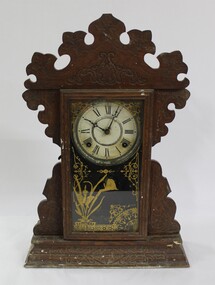
Functional object - 'Sessions' Cottage Clock - early 20th century
... company of E.N.Welch Manufacturing. The clock belonged to local Wodonga bootmaker Franz Gördes (b.1843) who immigrated to Australia from Germany in 1871. After docking in Melbourne Franz headed for the goldfields in Beechworth, but didn't strike gold. He returned to his trade and opened a boot shop in Wodonga, which burnt to the ground the day before the opening. Undeterred, he rebuilt and operated...company of E.N.Welch Manufacturing. The clock belonged to local Wodonga bootmaker Franz Gördes (b.1843) who immigrated to Australia from Germany in 1871. After docking in Melbourne Franz headed for the goldfields in Beechworth, but didn't strike gold. He returned to his trade and opened a boot shop in Wodonga, which burnt to the ground the day before the opening. Undeterred, he rebuilt and operated ...This clock was produced by the American Sessions Clock Company. The company was formed in 1903, after William E. Sessions and his nephew Albert L. Sessions bought out the failing clock company of E.N.Welch Manufacturing. The clock belonged to local Wodonga bootmaker Franz Gördes (b.1843) who immigrated to Australia from Germany in 1871. After docking in Melbourne Franz headed for the goldfields in Beechworth, but didn't strike gold. He returned to his trade and opened a boot shop in Wodonga, which burnt to the ground the day before the opening. Undeterred, he rebuilt and operated the business until his death in 1928.This item has a well documented provenance and connection to the local history of Wodonga.An ornate wooden clock with Roman numeral clock face and glass door with a decorative gold transfer. clock, clocks, session clock company, wodonga, gold rush, gold fields, beechworth -
 City of Melbourne Libraries
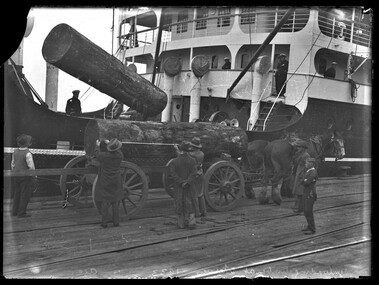
Photograph (item), Bull, Hugh Jones, 1897-1993, Unloading timber at Victoria Dock, 1933
... Dock Company at its facility in Hong Kong, with completion in 1926 for service under the Australia Oriental Line. Her gross register tonnage measured 4,324 tons, reflecting her design for inter-island and coastal trade routes, accommodating both passengers and freight. She operated...Dock Company at its facility in Hong Kong, with completion in 1926 for service under the Australia Oriental Line. Her gross register tonnage measured 4,324 tons, reflecting her design for inter-island and coastal trade routes, accommodating both passengers and freight. She operated ...Photographer notations on slide: "Unloading Timber at Wharves 1933 Age B5" Published: Age (Melbourne, Vic.: 1854- ), Tuesday 15 August 1933 MAHOGANY FROM MANILA. (1933, August 15). The Age (Melbourne, Vic. : 1854 - 1954), p. 11. Retrieved January 16, 2026, from http://nla.gov.au/nla.news-article204377024 Published title: MAHOGANY FROM MANILA Published Caption: Age Tue 15 Aug 1933 Caption: Unloading Mahogany Logs brought from Manila, Philippine Islands, by the steamer Taiping, which berthed yesterday at Victoria Dock. The vessel discharged twenty logs, each weighing three tons, the first shipment of this type of timber landed in Melbourne. Research by Project Volunteer, Louise McKenzie: This photograph in many ways epitomises Melbourne in the 1930s. It is a time of enormous growth, development and change. But before delving into that, the photo itself is very powerful. The huge mahogany logs being unloaded appear to be so heavy that the ship itself seems to list to port as they are craned over the side. They are being levered into a cart to which two large and sturdy Clydesdale horses are hitched. In contrast to the traditional horses, the wharf is crisscrossed with modern railway tracks. Unloading is both mechanical and manual, and the scene is one of intense interest to a young boy bystander. The ship appears to be squat and solid, but the whole image also gives a feeling of movement and intensity. The mahogany being delivered to Melbourne would be intended for high quality furniture. In the 1930s Australia actually had a growing timber industry, but much of the eucalyptus wood was being utilised for mass produced furniture, and much of this furniture would then have had a veneer applied to it. The fact that it was economic to import this timber from the “Philippine Islands” – not a traditional trading market for Australia – reflects a Victorian economy that was strong enough to support a growing demand for good quality furniture Mahogany was described as a classic, strong hardwood, often used for dark opulent furniture. In the 1930s the importation of timber from Manila (Philippines) to Australia was a notable trade, particularly in Philippine Lauan (often referred to as Philippine Mahogany), which was used as a cheaper alternative to other hardwoods. 1930s furniture, dominated by the art deco style, used a mix of luxurious exotic woods like mahogany, macassar and ebony for high-end pieces, often veneered over less expensive woods such as walnut, birch and poplar, and with plywood, chrome and lacquer also popular for more practical, streamlined designs during the Depression era. By the mid 1930s timber mills were being relocated away from the immediate dock area, but the fact that these logs were being transported by horse-drawn cart implies that the load would not have had to be taken too far for milling. 1885 the Melbourne Harbour Trust Commissioners had decided that land in or near the city was far too valuable to be used as timber yards. Furthermore, large stacks of timber posed a fire risk. The Trust asked the Victorian Government to reserve a site on the east side of the Yarra River opposite Yarraville and Spotswood. Here, in 1889, the Trust began building six jetties and a wharf specifically for the landing of timber. Clydesdale horses were initially brought to Victoria from Tasmania in the 1830s, and with the 1850s gold rush they were imported direct from Scotland. Melbourne was from its earliest years an important centre of horse-breeding from both imported and colonial-bred stock, providing the well-built draught horse for pulling heavily loaded wagons, the harness horse for delivery work and drawing coaches, and the saddle-horse used for riding. Stud breeding facilities were advertised from the early 1840s. By the 1870s the horse export trade was thriving, and the Port of Melbourne was the country's busiest exporter of horses to Indian, Asian and New Zealand markets. Kirk's Melbourne Horse and Carriage Bazaar in Bourke Street first advertised for business in 1840, and by the 1850s Bourke Street West was famed for its horse bazaars and saleyards. The Victorian Clydesdale Horse Society reports that Clydesdale working horses were a vital part of Melbourne's infrastructure and agricultural industry in the 1930s, when they reached the peak of their popularity despite the increasing competition from mechanization. Their main roles and usage at this time were: • City Delivery: Clydesdales were a common sight for metropolitan deliveries, particularly for breweries (such as Carlton & United Breweries), milk runs, and bread deliveries. • Industrial Work: They were heavily used for hauling cargo at the docks, in construction, and at specialized sites like the Truganina Explosives Reserve, where they pulled wagons. • Agriculture: In surrounding rural areas, they were the primary power source for ploughing and agricultural machinery. • Specialization: By the 1930s, the Clydesdale was smaller and more compact than the Shire or Percheron breeds, making them ideal for navigation in urban environments. After the 1930s their numbers decreased due to the onset of WWI and mechanisation. Wartime petrol rationing led to a brief revival for the working horse, as suburban tradesmen, now used to motor delivery, took their old jinkers out of mothballs. By 1947, however, only 1.5% of city traffic was horse-drawn. In 1952 the large horse cartage company A. Kellet Pty Ltd sold its 250 horses and converted its Richmond stables to storage. In the 1950s at Station and Princes piers, wharf labourers refused to work with the six draught horses still being used to haul trolleys and which were soon superseded by the fork lift, semi-trailer and mobile crane. Where carefully trained horses had once shunted trains in city goods yards, a few hundred a week were now being killed at the abattoirs for pet and human consumption. The last MCC dray horse was withdrawn from service in 1958, but some of the few remaining working animals are used by the mounted police for crowd control at demonstrations and football games. The death knell had also sounded for the associated trades of farrier, saddler and blacksmith. Our photo, therefore, showing the wharf with both the haulage Clydesdales and the rail lines, is a strong visual summary of the social and economic changes experienced in Victoria in the 1930s and on towards the 1950s. Our photo is located at Victoria Dock (also known as Victoria Harbour) which is still an active component of Melbourne’s port system. In 1892 the West Melbourne Dock (later Victoria Dock) was opened, downstream and immediately west of the Spencer Street railway shunting yards. It contained a swing basin for ships, replacing the one which had been provided on the south side of the river, later to be the Duke and Orr dry dock, west of the Charles Grimes Bridge. Further west was the South Wharf along the river bank. The history of Victoria Dock is extremely well described by Ashley Smith in his 2 March 2022 article in Docklands News, and its accompanying aerial photo of the Dock taken in 1934. He writes: "In the early 1930s Victoria Dock was one of the biggest sites for trade and export in Melbourne. A constant queue of ships sailed in, unloaded their cargo, recharged and reloaded, then left for the next port. Around the time this photo was taken (found in a 1934 photo book), the trapezium-shaped basin had been through some changes since its construction in the 1890s. The 497-metre-long Central Pier, finished in 1919, now featured six sheds to house the ever-increasing volume of cargo. The entrance had also been widened in the 1920s to allow better access. Some of the berths featured three-ton jib electric cranes to help with loading cargo and a rail network connected to the State Railway service. By the time construction was completed, the dock was 39 hectares and hailed as the second-largest dock in the world (behind Cavendish Dock, Barrow-in-Furness). To further save costs, excavations were dug to a more reasonable seven metres below low water, instead of British engineer Sir John Coode’s recommended 8.3 metres. Even then, the costs were still around £900,000. It was envisaged, with the extra wharfage, that around thirty 90-metre ships could berth inside. On March 22, 1892, Victoria Dock was opened by Victoria’s Governor, the Earl of Hopetoun (later Australia’s first Governor-General) who opened the sluice to let the Yarra in. It took six days to fill the basin with The Leader newspaper estimating that it would take another six months to completely fill (March 26, 1892). In the end, it took nearly a year before the first ship was allowed to enter on February 20, 1893, when the steamer Hubbuck sailed in to unload 1200 tonnes of cargo in 15 hours. The Argus (February 23, 1893) reported that the ship’s captain, J. R. Brodie, called the Yarra “better than the Thames”, and compared Victoria Dock favourably to the Albert Dock (Liverpool)." This would be a good time to move our focus on to the Taiping, which is the transporter of these giant mahogany logs. The Taiping was a steel-hulled, single-screw passenger-cargo Chinese steamer, which today has the dubious legacy of being involved in a collision headlined as “The Chinese Titanic”. It was constructed by the Hong Kong and Shampoa Dock Company at its facility in Hong Kong, with completion in 1926 for service under the Australia Oriental Line. Her gross register tonnage measured 4,324 tons, reflecting her design for inter-island and coastal trade routes, accommodating both passengers and freight. She operated routes connecting Australian ports with East Asian destinations. As World War II approached, Taiping continued predominantly working the trade routes between China and Australia, until December 1941, when she evacuated women and children from Hong Kong to Manila just before Japanese forces overran the region. She then safely reached Australia despite enemy air raids. Taiping was then requisitioned by the Royal Navy and repurposed as a victualling stores issuing ship for the Eastern Fleet, supporting logistical needs in the Pacific and Indian oceans. Returned to the Australian Oriental Line in 1947, she underwent refitting and by mid-1948 was chartered to the Shanghai Shipping Company, and modified for greater passenger accommodation – approximately 500 passengers. In 1948/49 the Chinese Civil War took place. The Taiping departed Shanghai on 26 January 1949 as one of the final vessels evacuating civilians from to Keelung Harbour in Taiwan. Reports indicate that the Taiping carried double the rated capacity of passengers i.e. 1000. The ship carried families, military personnel, civilians, carrying personal belongings, gold and valuables in hope of resettlement in Nationalist Taiwan. It also held heavy cargo in the form of silver and gold bullion loaded by the Central Bank of China. Because of the risk of patrols, and to conserve fuel, the Captain took the ship away from the usual open-sea passage, and instead navigated along the coast. He also extinguished navigation lights to avoid detection. Shortly after midnight on 27 January 1949 the Taiping collided with the smaller cargo steamer Chien Yuan in the East China Sea near the Zhoushan Archipelago. The Chien Yuan was also operating in darkness. The subsequent collision was catastrophic. The Chien Yuan sank with in 5 minutes, with the loss of 72 of its 74 crew. The Taiping sustained severe structural compromise from the broadside strike and initially remained afloat, then made a swift descent into the freezing water, with no attempt at an organised evacuation. No formal recovery process was instigated, however a distress signal went out. 32 survivors were picked up by the Australian destroyer HMAS Warramunga (on patrol nearby), a passing US vessel found 2 more, and local Zhoushan fishermen retrieved others. In the end, only 37 people survived. The event is remembered as a poignant moment in the mass migration to Taiwan, with families tragically separated. A memorial to the disaster exists at the Keelung Harbour naval base on Taiwan. With its total of over 1,500 deaths, it constituted one of the worst peacetime maritime losses. It is sometimes referred to as the “Oriental Titanic” because of the similarly large loss of life and speed of demise with the RMS Titanic in 1912. A fictional depiction of this event appears in the John Woo movies “The Crossing (Part 1) (2014), and The Crossing II (2015), known in Chinese as “Taiping Wheel”. The narrative weaves a story around pre-disaster romances and wartime turmoil among passengers, culminating in the ship’s rapid sinking. “The production, a high-budget Sino-Taiwanese-Hong Kong co-effort, portrays the event as a microcosm of the 1940s Sino-Japanese and civil war legacies, though critics noted the melodramatic style prioritizing spectacle over historical precision.” In conclusion, it is nice to return to our photo, and observe the people involved in this moment. The dockworkers are, so typical of the 1930s, dressed in what looks to us like formal clothing – dark suits or coats, white shirts, and black hats. I am particularly drawn to the young boy, bare-headed, arms crossed, and so intent on the unloading process. He too is wearing a white shirt, black trousers and jacket, and black shoes. This is 1933 Melbourne – but the haircut he is sporting is now very “hipster” and modern in 2026 Melbourne. References: MAHOGANY FROM MANILA. (1933, August 15). The Age (Melbourne, Vic. : 1854 - 1954), p. 11. Retrieved January 30, 2026, from http://nla.gov.au/nla.news-article204377024 Wikipedia, Taiping steamer, https://en.wikipedia.org/wiki/Taiping_(steamer) Wikipedia, Victoria Dock, https://en.wikipedia.org/wiki/Victoria_Dock_(Melbourne) Docklands News, Ashley Smith, 2 Mar 2022, https://www.docklandsnews.com.au/victoria-dock/ Living Histories: Heritage Council of Victoria, Jill Barnard, 2008, Jetties and Piers, https://livinghistories.net.au/wp-content/uploads/2015/11/Jetties-ONL-intro_Part-1.pdf eMelbourne, Wharves and Docks, https://www.emelbourne.net.au/biogs/EM01612b.htm Australian Academy of Technological Sciences – Harvesting Wood, https://www.austehc.unimelb.edu.au/tia/225.html Old Treasury Building, On the Water – The Docks, https://tinyurl.com/3wkbk66m Old Treasury Building, On The Road, https://tinyurl.com/dw44yr3t Port of Melbourne, Victorian Places, https://www.victorianplaces.com.au/port-of-melbourne Docklands Heritage Study - Environmental History, https://mvga-prod-files.s3.ap-southeast-4.amazonaws.com/public/2024-05/docklands-heritage-review-thematic-environmental-history-1991.pdf eMelbourne, Horses, https://www.emelbourne.net.au/biogs/EM00723b.htm Victorian Clydesdale Horse Society, https://www.clydesdalesvic.org.au/history The Crossing, https://letterboxd.com/film/the-crossing-i/Photographer notations on slide: "Unloading Timber at Wharves 1933 Age B5"ships, shipping, timber industry, shipwrecks, horses, docks, wharves, 1930-1939, wars, docklands
