
Showing 30 items matching " fathers of federation"
-
 Bendigo Historical Society Inc.
Document - LONG GULLY HISTORY GROUP COLLECTION: LONG GULLY SCHOOL
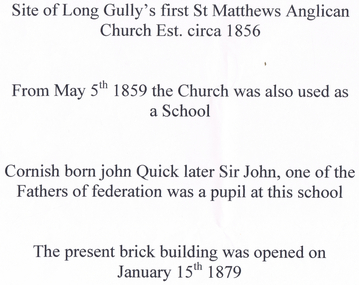
... ... Fathers of Federation...Cornish born John Quick later Sir John, one of the Fathers of Federation was a pupil at this school. ...Cornish born John Quick later Sir John, one of the Fathers of Federation was a pupil at this school. The present brick building was opened on January 15th 1879. ...Paper with Site of Long Gully's first St Matthews Anglican Church Est. circa 1856. From May 5th 1859 the Church was also used as a School. Cornish born John Quick later Sir John, one of the Fathers of Federation was a pupil at this school. The present brick building was opened on January 15th 1879.bendigo, history, long gully history group, the long gully history group - long gully school, st matthews anglican church, sir john quick, fathers of federation -
 Bendigo Historical Society Inc.
Document - BENDIGO LA TROBE UNIVERSITY BROCHURE
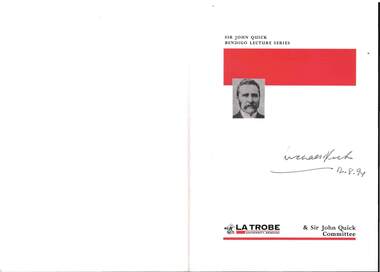
... Bendigo La Trobe University lecture Brochure / Sir John Quick Bendigo Lecture Series dated 12.8.1994 -lecture about Sir John Quick a 'Father ' of Australian Federation...DOCUMENT Latrobe University Bendigo Tertiary education Bendigo La Trobe University lecture Brochure / Sir John Quick Bendigo Lecture Series dated 12.8.1994 -lecture about Sir John Quick a 'Father ' of Australian Federation Document BENDIGO LA TROBE UNIVERSITY BROCHURE ...Bendigo La Trobe University lecture Brochure / Sir John Quick Bendigo Lecture Series dated 12.8.1994 -lecture about Sir John Quick a 'Father ' of Australian Federationdocument, latrobe university, bendigo, tertiary education -
 Ballarat Heritage Services
Photograph - Image, Members of the Australasian Federation Convention
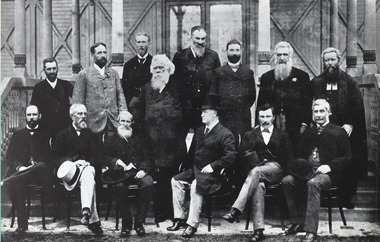
... This group of men are considered fathers of Australian Federation. ...This group of men are considered fathers of Australian Federation. national conventon henry parkes federation Duncan Gillies Sixteen men of the members of the Australasian Federation Convention, 1890. ...This group of men are considered fathers of Australian Federation. Sixteen men of the members of the Australasian Federation Convention, 1890. The bearded man standing in the centre is Henry Parkes. Hon. Andrew Inglis Clark (Tasmania), Hon. Sir Samuel Walker Griffith KCMG (Queensland), Hon. Thomas Playford (Sth. Aust.), Hon. Alfred Deakin (Victoria), Hon. Bolton Stafford Bird (Tas.), George H. Jenkins (Secretary to the Conference), Hon. Capt. William Russell Russell (New Zealand), Hon. Sir Henry Parkes (New South Wales), Hon. William McMillan (N.S.W.), Hon. Sir John Hall KCMG (N.Z.), Hon. John Murtagh Macrossan (Qld), Hon. Duncan Gillies (Vic.), Hon. John Alexander Cockburn M.D.(Sth.Aust.), Hon. Sir James George Lee Steere (Western Australia).national conventon, henry parkes, federation, duncan gillies -
 Bendigo Historical Society Inc.
Document - VICTORIA HILL MARONG RD BENDIGO HERITAGE DAY BROCHURE 2010, 2010
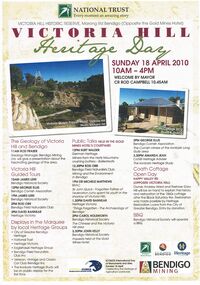
... Victoria Hill Guided Tours James Lerk (Bendigo Historical Society) George Ellis (Bendigo Cornish Association) Rod Orr (Bendigo Field Naturalists Club) David Bannear (Heritage Victoria) Presentations: Rod Fraser The Geology of Victoria Hill and Bendigo, Kurt Walder German Heritage Ballerstedts-miners from the Hartz Mountains crushing battery, Rod Orr Mining and the Environment in Bendigo, Michele Matthews (BRAC) Sir John Quick the Forgotten Father of Federation spent his youth in the shadow of Victoria Hill, David Bannear ''Things Forgotten'' - the Archaelogy of Bendigo, Carol Holsworth the Chinese and Victoria Hill area, John Kelly Inquests held at the Gold Mines Hotel, George Ellis The Cornish miners of the Ironbark and Long Gully area, Amanda Jean The Ironbark Heritage Study. ...Victoria Hill Guided Tours James Lerk (Bendigo Historical Society) George Ellis (Bendigo Cornish Association) Rod Orr (Bendigo Field Naturalists Club) David Bannear (Heritage Victoria) Presentations: Rod Fraser The Geology of Victoria Hill and Bendigo, Kurt Walder German Heritage Ballerstedts-miners from the Hartz Mountains crushing battery, Rod Orr Mining and the Environment in Bendigo, Michele Matthews (BRAC) Sir John Quick the Forgotten Father of Federation spent his youth in the shadow of Victoria Hill, David Bannear ''Things Forgotten'' - the Archaelogy of Bendigo, Carol Holsworth the Chinese and Victoria Hill area, John Kelly Inquests held at the Gold Mines Hotel, George Ellis The Cornish miners of the Ironbark and Long Gully area, Amanda Jean The Ironbark Heritage Study. ...Victoria Hill Marong Rd Bendigo (Opposite the Gold Mines Hotel) Heritage Day Brochure 2010. Victoria Hill Guided Tours James Lerk (Bendigo Historical Society) George Ellis (Bendigo Cornish Association) Rod Orr (Bendigo Field Naturalists Club) David Bannear (Heritage Victoria) Presentations: Rod Fraser The Geology of Victoria Hill and Bendigo, Kurt Walder German Heritage Ballerstedts-miners from the Hartz Mountains crushing battery, Rod Orr Mining and the Environment in Bendigo, Michele Matthews (BRAC) Sir John Quick the Forgotten Father of Federation spent his youth in the shadow of Victoria Hill, David Bannear ''Things Forgotten'' - the Archaelogy of Bendigo, Carol Holsworth the Chinese and Victoria Hill area, John Kelly Inquests held at the Gold Mines Hotel, George Ellis The Cornish miners of the Ironbark and Long Gully area, Amanda Jean The Ironbark Heritage Study. Coath Cottage Open Day owner Andrew Ward and Restorer Gary Hill explain the history and restoration of the 1860s miners cottage after Black Saturday fire. Restoration Loans from the City of Greater Bendigo.bendigo, gold mining, heritage day 2010 -
 Bendigo Historical Society Inc.
Plaque - SIR JOHN QUICK BUSINESS PLAQUE
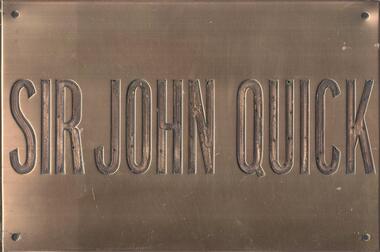
... Sir John was a lawyer and one of the founding fathers of the Australian Federation. See Australian Dictionary of Biography: adb.anu.edu.au › biography › quick-sir-john-8140...Sir John was a lawyer and one of the founding fathers of the Australian Federation. See Australian Dictionary of Biography: adb.anu.edu.au › biography › quick-sir-john-8140 Plaque SIR JOHN QUICK BUSINESS PLAQUE ...Brass name plaque "Sir John Quick' Name partly embelished with black paint, now faded. Glass covering. Originally hung at his legal office in Pall Mall, Bendigo. Sir John was a lawyer and one of the founding fathers of the Australian Federation. See Australian Dictionary of Biography: adb.anu.edu.au › biography › quick-sir-john-8140bendigo, business, sir john quick -
 Unions Ballarat
Alfred Deakin: A biography (Vol 2), La Nauze, J.A, 1965
... Alfred Deakin was one of the founding fathers of Federation and was Prime Minister of Australia over the periods 1903-1904, 1905-1908 and 1909-1910. ...Alfred Deakin was one of the founding fathers of Federation and was Prime Minister of Australia over the periods 1903-1904, 1905-1908 and 1909-1910. ...Alfred Deakin was one of the founding fathers of Federation and was Prime Minister of Australia over the periods 1903-1904, 1905-1908 and 1909-1910. He was the federal member for Ballaarat from 1901-1913 and was attorney general in the Barton government. He also served in the State of Victoria parliament. In his second term, Deakin's government passed the Census and Statistics Act 1905, Papua Act 1905, Representation Act 1905 and Copyright Act 1905. The book is based on Deakin's private papers, writings, private and official materials. This is volume two of a two volume set. Index: 15. Australian Correspondent 16. Three Elevens 17. "A Notice to Quit"? 18. "Nation Building", 1905-1908 19. New Hebrides 20. New Guinea and Hubert Murray 21. Empire 22. London, 1907 23. The Defence of Australia 24. Fusion, 1909 25. "Harvest" and Defeat 26. "Mercy of Release" 27. "A Shadow in a Dream" 28. "Content and more than Content" Appendices: I. Victorian Ministries, 1877-1900 II. Commonwealth Ministries, 1901-1914Biographical interest. Relevance to history of Ballarat and Australia.Hardcover - book; 348 pages. Cover dust jacket: black and white lettering; faded. Cover without dust jacket: green cloth; gold lettering.The book is stamped "The private library of Rex Testro" on title page and on the page following the index.btlc, ballarat trades hall, unions ballarat, deakin, alfred, federation, prime ministers - australia - alfred deakin, biography, politics, members of parliament -
 Bendigo Historical Society Inc.
Newspaper - The Bendigo Miner 17 January 2008 - Streets of Silence
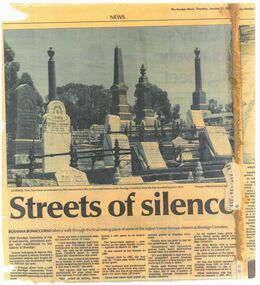
... Sir John Quick, politician known as the Father of the Federation. James Northcott, musician who received a silver cornet. ...Sir John Quick, politician known as the Father of the Federation. James Northcott, musician who received a silver cornet. ...The article references several of Bendigo's famous names including: Anne Caudle, founder of the Anne Caudle Centre (previously the Benevolent Asylum) which was established in March 1860. Sir John Quick, politician known as the Father of the Federation. James Northcott, musician who received a silver cornet. William and Richard Francis, who founded the Beehive Store. Peter Hoey Finn, who carved the bowl of the Alexandra fountain. Elizabeth Watson, the only woman to have died in a mining accident in 1863.A3 colour photocopies of newspaper articles from the Bendigo Miner, Thursday January 17, 2008. Date of photocopy unknown. Location of original paper unknown. The article was spread across two pages and has been cut from the larger paper. The article is torn, discoloured and folded. "Streets of Silence" is an article where "Rosanna Bonaccurso takes a walk through the final resting place of some of the region's most famous citizens at Bendigo Cemetery." newspaper, bendigo cemetery, anne caudle, sir john quick, james northcott, william francis, richard francis, peter hoey finn, elizabeth watson, bendigo, the bendigo miner -
 Blacksmith's Cottage and Forge
Top Hat, late 19th century
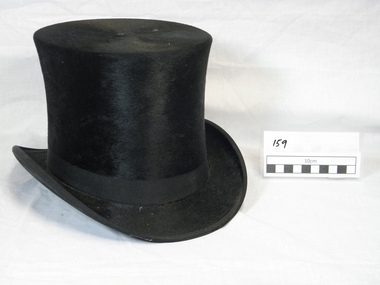
... father were influential people in the town. They owned the property "Millbank". When William Grant died in 1924, his obituary in the 'Express' listed 17 public positions he held, including severaal terms as Shire President. This item has historical significance at a local, state and national level. It is representative of formal gentlemen's dress in the latter part of the 19th century/early 20th century. 1910 top hat gentlemen s fashion mr grant velour ninteenth century attire skilled hatter upper class attire formal wear monopoly token president bacchus marsh shire federation celebrations 1910 federation owner millbank mad hatter opening parliament 1910 royal exhibition building original box greaseproof prize medal royal isignia the sea breeze no 5044 size 6 7 8 Inscription in gold inside hat reads "GREASE PROOF / Prize Medal" / Royal Insignia with motto "Honi soit qui mal y pense" / "VENTILATED / AND / FELT BANDED". ...This hat belonged to Mr William Grant, Shire President of Bacchus Marsh. Mr Grant and his wife were invited to the opening of the first Federal Parliament held in the Royal Exhibition Building, Carlton, on the 9th May 1901. The opening was attended by the Duke and Duchess of Cornwall and York (later George V and Queen Mary) and 12,000 guests. Mr Grant's family were early settlers in Bacchus Marsh, and both he and his father were influential people in the town. They owned the property "Millbank". When William Grant died in 1924, his obituary in the 'Express' listed 17 public positions he held, including severaal terms as Shire President.This item has historical significance at a local, state and national level. It is representative of formal gentlemen's dress in the latter part of the 19th century/early 20th century.Gentleman's black shiny velour top hat with silk ribbon band, bound inside with leather sweat band, adjustable with silk ties. Inscription inside hat. Purple lining with gold embossing. Light canvas coated inside. Protective silver paper sweat band under leather sweat band.Inscription in gold inside hat reads "GREASE PROOF / Prize Medal" / Royal Insignia with motto "Honi soit qui mal y pense" / "VENTILATED / AND / FELT BANDED".1910, top hat, gentlemen s fashion, mr grant, velour, ninteenth century attire, skilled hatter, upper class attire, formal wear, monopoly token, president bacchus marsh shire, federation celebrations 1910, federation, owner millbank, mad hatter, opening parliament 1910, royal exhibition building, original box, greaseproof prize medal royal isignia, the sea breeze, no 5044, size 6, 7 8 -
Federation University Historical Collection
Article - Article - Women, Ballarat School of MInes: Women of Note; Bella Guerin, Educator and Activist, (1858 - 1923)
... federation university...mount helen campus...julia margaret guerin...bella guerin...governor of gaols...ballarat gaol...father...They are named Bella (Bella Guerin) and Vida (Vida Goldstein) women of note feminist political activist teacher melbourne university first female university graduate loreto convent ballarat lady principal of ballarat school of mines 1887-1890 labor party hall of residence bella guerin hall of residence federation university mount helen campus julia margaret guerin bella guerin governor of gaols ballarat gaol father marco guerin brother ballarat school of mines metallurgy assaying women's rights vote for women vida goldstein west gate tunnels tunnel boring machines tbms bella vida Ballarat School of MInes: Women of Note; Bella Guerin, Educator and Activist, (1858 - 1923) Article Article - Women ...Julia Margaret (Bella) Guerin (1858-1923), feminist, political activist and teacher, was born on 23 April 1858. Her father was a Governor of Gaols and was so at Ballarat Gaol from 1860s to 1890.- Having studied at home to pass matriculation in 1878, Bella entered Melbourne University in 1881, the same year her brother Marco began at Ballarat School of Mines to study Metallurgy and Assaying. Bella became the first woman to graduate from an Australian University when she gained her B.A. from the University of Melbourne in December 1883, becoming M.A. upon application in 1885. She taught first at Loreto Convent, Ballarat, urging higher education scholarships for Catholic girls to produce 'a band of noble thoughtful women as a powerful influence for good'; then as Lady Principal of Ballarat School of Mines University classes from 1887-1890, resigning upon marriage. Returning to teaching from financial necessity she began to frequent suffragist circles from the mid 1890s. She also became very involved within the Labor Party. She wrote speeches for Vida Golstein, a campaigner for women's rights, the right to vote and stand for elections. In recognition of her time at Ballarat School of Mines, a Hall of Residence at Federation University, Mount Helen Campus has been named after her, Bella Guerin Hall of Residence. Tunnelling tradition dictates a Tunnel Boring Machine (TBM) cannot start work until it has been given a female name, a sign of good luck for the project ahead. This dates back to the 1500s when miners and military engineers working with explosives for underground excavation, prayed to Saint Barbara for protection.The TBMs working on the two West Gate extensions are named after two very prominent women working for the rights for women. They are named Bella (Bella Guerin) and Vida (Vida Goldstein)women of note, feminist, political activist, teacher, melbourne university, first female university graduate, loreto convent ballarat, lady principal of ballarat school of mines, 1887-1890, labor party, hall of residence, bella guerin hall of residence, federation university, mount helen campus, julia margaret guerin, bella guerin, governor of gaols, ballarat gaol, father, marco guerin, brother, ballarat school of mines, metallurgy, assaying, women's rights, vote for women, vida goldstein, west gate tunnels, tunnel boring machines, tbms, bella, vida -
 Federation University Historical Collection
Photograph, Collection of Henry Sutton Photographs
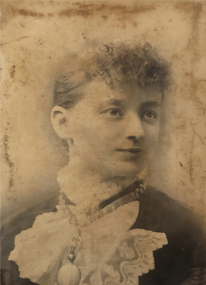
... Father Richard Sutton. Henry Sutton taught Applied Electricity at the Ballarat School of Mines in 1883 to 1886. Photographs Henry Sutton Federation Celebrations 1901 Rye stereoscope Collection of Photographs taken by Henry Sutton. ...Henry Sutton is a talented world-wide accepted inventor with inventions relating to the telephone, photography, wireless, cars, motorcycles, and bicycles as well as many more inventions. Henry was also one of four brothers that ran the Sutton's Music Store after the death of their Father Richard Sutton. Henry Sutton taught Applied Electricity at the Ballarat School of Mines in 1883 to 1886.Collection of Photographs taken by Henry Sutton. Some are single photographs and others are double (side by side on a card)photographs, henry sutton, federation celebrations 1901, rye, stereoscope -
 Federation University Historical Collection
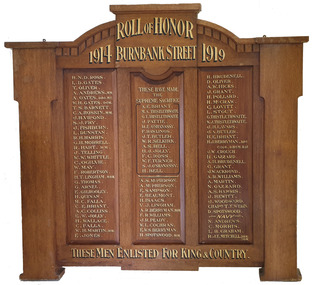
Furniture - Object, Burnbank Street Methodist Sunday School Honor Board
... father was the pastor at the Burnbank Methodist church. Geoffrey Blainey became the first Chancellor of the University of Ballarat, a predecessor of Federation University Australia. ...father was the pastor at the Burnbank Methodist church. Geoffrey Blainey became the first Chancellor of the University of Ballarat, a predecessor of Federation University Australia. ...This honour board is thought to have been made to a design by a student of the Ballarat Technical Art School, a division of the Ballarat School of Mines. "Honor Boards. — During the past few months very many honor boards have been manufactured by Messrs R. Tunbridge and Sons, and their handsome design and workmanship have given complete satisfaction to purchasers. Some time ago, the firm gave five guineas, for prizes to the architectural class at the School of Mines for the best honor board designs, and some magnificent suggestions were submitted by the competitors. Messrs Tunbridge and Sons, in adopting this plan, gave encouragement to the students to develop along the lines of originality in architecture, and at the same time secure a very fine collection of designs. The whole of the honor boards turned out by the firm are of local manufacture and only the very choicest of Australian timbers are used. As Tunbridge and Sons have made the manufacture of honor boards a speciality they are employing a couple of first-class cabinetmakers on the work of making honor hoards only, and the lettering is also done by a local firm. An honor board which has just been completed by Tunbridge and Sons is at present on view in the firm's window facing Sturt street. It is for Holy Trinity Church, Stawell, is manufactured from Queensland maple, beautifully grained, and is of handsome gothic design. This honor Board is 8 feet in height, and measures 5 feet 6 inches across, and it contains 142 names, including 10 heroes who have won distinctions, and 37 soldiers who have made the supreme sacrifice. Tunbridge and Sons have manufactured honor boards for Miners' Rest:, Weatherboard, Scotchman's Lead, Durham lead, the Buninyong Methodist Church, Ballarat Shire south riding, St. Arnaud High School, Knox Sunday School, and Bungaree Shire Council, and there are boards for the Watchem South State School, and Springdallah in hand. People are realising that there is no need to go to Melbourne for honor boards, which are manufactured by Tunbridge and Sons of superior material, and are better finished and their prices are much below metropolitan rates." (Ballarat Star, 27 April 1918) Geoffrey Blainey's father was the pastor at the Burnbank Methodist church. Geoffrey Blainey became the first Chancellor of the University of Ballarat, a predecessor of Federation University Australia. The Honour Board was removed from the Wendouree Uniting Church when it was closed on August November 2019. Timber honour board for the Burnbank Methodist Church in Ballarat.burnbank street methodist sunday school honor board, world war one, honour board, honor board, wendouree uniting church -
 Phillip Island and District Historical Society Inc.
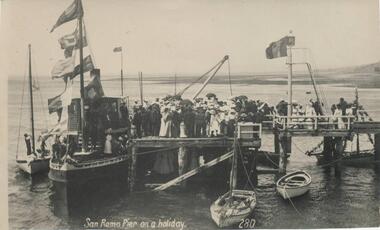
Photograph, 1901
... father of Jimmy & Jack Clarke, twins, and Violet Clarke. Photograph one of a collection of photographs donated by Arthur Woodley, friend of the Clarke brothers. san remo pier cpt george clarke arthur woodley Inscription written by Arthur Woodley - donor. "Probably Federation ...George Clarke was the father of Jimmy & Jack Clarke, twins, and Violet Clarke. Photograph one of a collection of photographs donated by Arthur Woodley, friend of the Clarke brothers.Black & white photograph of holiday makers on the San Remo Pier.Inscription written by Arthur Woodley - donor. "Probably Federation Day 1901. Captain George Clarke can be seen standing directly under single boat mast with flag. He died 1904"san remo pier, cpt george clarke, arthur woodley -
 Mission to Seafarers Victoria
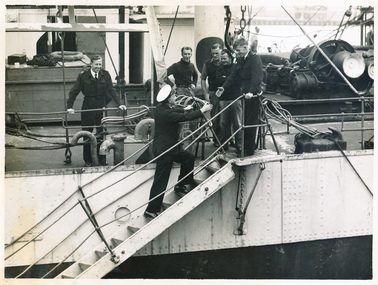
Photograph - Digital copy, Black and white, Kerr Bros Studio, c. 1955
... Federation Square, Melbourne. Padre Frank Oliver, Chaplain to the Mission to Seafarers 1930 - 1960 led the Mission through a period of significant changes through the mid 20th C. This image is one of a series of key images showing the work of the Mission Chaplain in the Post WWII period. uniform machinery ship crew gangway deck handshake chains rope buoy pulleys rivets padre oliver frank leslie oliver mission to seafarers mission to seamen seamen's mission robin kent kerr bros studio Discolouration on the bottom left and top centre of the photograph. Father ...The photograph shows a ship visit. It is historically significant and thought to be one of a series of photographs linked to a publicity campaign circa 1955-1956 promoting the work of the Mission. The campaign partly inspired by the Centenary year of the Mission in Australia (1956) also resulted in the production of a black and white short film "The Flying Angel", featuring and Padre Oliver and the work of the Mission was deposited in 2016 with the Australian Centre for the Moving Image, (ACMI) Federation Square, Melbourne.Padre Frank Oliver, Chaplain to the Mission to Seafarers 1930 - 1960 led the Mission through a period of significant changes through the mid 20th C. This image is one of a series of key images showing the work of the Mission Chaplain in the Post WWII period. Father Frank Oliver wearing uniform including officers cap walking up a gangway and being met by a group of four men. There is a fifth man standing slightly to the left of the photograph.Discolouration on the bottom left and top centre of the photograph.uniform, machinery, ship, crew, gangway, deck, handshake, chains, rope, buoy, pulleys, rivets, padre oliver, frank leslie oliver, mission to seafarers, mission to seamen, seamen's mission, robin kent, kerr bros studio -
 Bendigo Historical Society Inc.
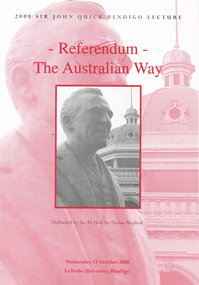
Book - LONG GULLY HISTORY GROUP COLLECTION: REFERENDUM - THE AUSTRALIAN WAY
... It was the Swiss Federation that served as the model on which the founding fathers of our constitution relied in selecting the referendum as the instrument of constitutional change. ...It was the Swiss Federation that served as the model on which the founding fathers of our constitution relied in selecting the referendum as the instrument of constitutional change. ...Book titled - Referendum - The Australian Way, delivered by the Rt Hon Sir Ninian Stephen on Wednesday, 11 October 2000, La Trobe University, Bendigo. The 2000 Sir John Quick Bendigo Lecture. The lecture was written by Michele Matthews. Lecture mentions how the referendums in this country came to be. It was the Swiss Federation that served as the model on which the founding fathers of our constitution relied in selecting the referendum as the instrument of constitutional change. Mentioned in the back of the book is a short life story of Sir John Quick and his work in Australian Federation. Also one about The Rt. Hon. Sir Ninian Stephen.bendigo, history, long gully history group, the long gully history group - referendum - the australian way, 2000 sir john quick bendigo lecture, rt hon sir ninian stephen, la trobe university bendigo, robertson hyetts, quick hyett and rymer, quick and hyett, edmund burke, alfred deakin, playford, the australian natives association, edmund barton, sir robert garran, dr john quick, university of melbourne, michele matthews, mrs cheryle parker -
 Warrnambool and District Historical Society Inc.
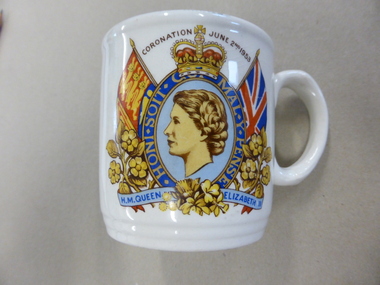
Commemorative mug, Queen Elizabeth 11 Coronation, 1953
... Federation. Queen Elizabeth II became Queen of England at the age of 25 following the death of her father in 1952. ...Federation. Queen Elizabeth II became Queen of England at the age of 25 following the death of her father in 1952. ...This cup was produced as a memento of the Coronation of Queen Elizabeth II in 1953. It was the official design of the British Pottery Manufacturers Federation. Queen Elizabeth II became Queen of England at the age of 25 following the death of her father in 1952. The Coronation was celebrated throughout the British Empire and a commemorative medal was issued. This cup is a high quality item and many such items would have been sold in Australia in 1953. This cup is retained as an example of the type of souvenir sold in Warrnambool and other parts of Australia in 1953. It is an attractive item and will be useful for display. This is a white china cup with a colour image of a crown and the initials ‘E11R’ on one side of the cup and a colour image of Queen Elizabeth in an oval shape surrounded by a crown, French lettering, British flags and foliage on the other side of the cup. The maker’s name and symbol are on the base of the cup. ‘Coronation June 2nd 1953’ ‘Honi Soit Qui Mal Y Pense’ ‘H.M. Queen Elizabeth 11’ ‘E 11 R’ ‘ Sol 391413 J. & G. Meakin England’ queen elizabeth 11 coronation, history of warrnambool -
 Wodonga & District Historical Society Inc
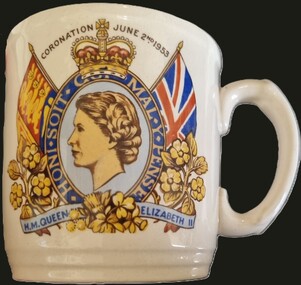
Souvenir - Mug for Coronation of Queen Elizabeth II, 1953
... father King George VI on the 6th February 1952. Elizabeth was crowned as the Queen of the United Kingdom and the other Commonwealth realms on June 2nd 1953 at Westminster Abbey. Preparations for the coronation took over a year, it was the first British coronation to be fully televised when cameras were allowed inside the Abbey for the first time and the event was estimated to have cost £1.57 million. The British Pottery Manufacturers Federation...father King George VI on the 6th February 1952. Elizabeth was crowned as the Queen of the United Kingdom and the other Commonwealth realms on June 2nd 1953 at Westminster Abbey. Preparations for the coronation took over a year, it was the first British coronation to be fully televised when cameras were allowed inside the Abbey for the first time and the event was estimated to have cost £1.57 million. The British Pottery Manufacturers Federation ...Queen Elizabeth II ascended the throne, at the age of 25, on the death of her father King George VI on the 6th February 1952. Elizabeth was crowned as the Queen of the United Kingdom and the other Commonwealth realms on June 2nd 1953 at Westminster Abbey. Preparations for the coronation took over a year, it was the first British coronation to be fully televised when cameras were allowed inside the Abbey for the first time and the event was estimated to have cost £1.57 million. The British Pottery Manufacturers Federation was founded in 1919 and continued to trade until early 1995 when the company was dissolved as a result of its activities becoming fully incorporated within the British Ceramic Confederation. The design for this mug was approved by The British Pottery Manufacturers Federation and then circulated to approved Potters. This item is significant because it records an important event in the British Royal Family, a vital part of the hereditary of many Wodonga residents. Queen Elizabeth became the official head of the Government of Australia at that time.Cream handled China mug with coloured transfer. The image includes a central oval image of a golden profile of the queen (without a crown) against a light blue background. It is surrounded by a dark blue band with gold edging. To the left is the Royal Standard and to the right is the Union Jack and English roses below. Above the central image is the royal crown and above this wording. At Top CORONATION JUNE 2nd 1953 The Latin wording HONI SOIT QUI MAL Y PENSE, contained in the dark blue oval band is the motto of the British chivalric Order of the Garter which means "shamed be whoever thinks ill of it" Beneath the image - H.M QUEEN ELIZABETH II The base of the mug shows a makers mark of the DESIGN mark.coronation of queen elizabeth ii, british royal family -
 Surrey Hills Historical Society Collection
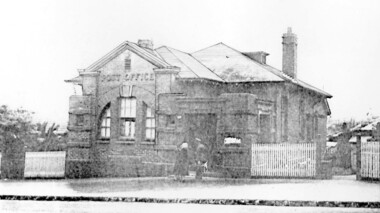
Photograph, Surrey Hills Post Office
... father’s general store at 619-621 Canterbury Road, a few doors down from the Surrey Hills Hotel on the corner of Union Road. Over the next 20 years, the Surrey Hills Post Office moved several times into temporary, shared accommodation – in 1889 into Woodhead’s Corner Store at 364 Canterbury Road; then in 1895 to No 376, Hansen’s Exchange Building, part of Hansen’s Terrace (demolished) and in 1901 to 109 Union Road, on the corner of Windsor Crescent. Following Federation...father’s general store at 619-621 Canterbury Road, a few doors down from the Surrey Hills Hotel on the corner of Union Road. Over the next 20 years, the Surrey Hills Post Office moved several times into temporary, shared accommodation – in 1889 into Woodhead’s Corner Store at 364 Canterbury Road; then in 1895 to No 376, Hansen’s Exchange Building, part of Hansen’s Terrace (demolished) and in 1901 to 109 Union Road, on the corner of Windsor Crescent. Following Federation ...The post office opened at this location in 1912. It was demolished in 2000. Post office history in the area: Until 1883 when the railway came through to Surrey Hills, this was essentially a rural community of scattered farms. Land subdivisions soon occurred along the railway line and limited postal services followed soon after, although a ‘permanent’ home for the post office was two decades away. George Sim Junior is acknowledged as our first postmaster; he opened a post office on 1 October 1884 in his father’s general store at 619-621 Canterbury Road, a few doors down from the Surrey Hills Hotel on the corner of Union Road. Over the next 20 years, the Surrey Hills Post Office moved several times into temporary, shared accommodation – in 1889 into Woodhead’s Corner Store at 364 Canterbury Road; then in 1895 to No 376, Hansen’s Exchange Building, part of Hansen’s Terrace (demolished) and in 1901 to 109 Union Road, on the corner of Windsor Crescent. Following Federation in 1901, the new Commonwealth Government established the Postmaster-General's Department to provide postal services to the nation. Many of the post offices constructed in the following years reflected a growing sense of Australian pride and nationalism. It was 1914 when building commenced on the ‘purpose-built’ post office at 609 Canterbury Road, Surrey Hills. Described as “a polychromatic Federation Freestyle building”, it served as the local post office for nearly 85 years until sold by the Commonwealth Government in c1999, after which the post office moved to the current, less prominent site at 100 Union Road. For nearly 10 years under private ownership, the building was successfully adapted for use as the base for two businesses, Gargoyles and Dragons and later the Surrey Sculpture Studio, and fortuitously the historic integrity of the building was maintained. However although renovated in the 1990's, structurally sound and of historic significance, it was not protected under local or commonwealth heritage legislation and was demolished soon after sale. This is an early image of a demolished building which should have been protected. In 1991, when the City of Camberwell conducted a heritage study, (which still informs the basis of the City of Boroondara’s heritage guidelines for this part of the municipality,) the post office was owned by the Commonwealth Government. As such, it could not be considered for heritage listing by the local authorities. Some years later, the Commonwealth and Australia Post rather belatedly recognized not only that post offices have heritage and social value, but also that the architecture of post offices as community buildings is important. A heritage management scheme was developed for the buildings they own or control under the Environment Protection and Biodiversity Act 1999. Unfortunately, the Surrey Hills Post Office had been sold and demolished before this was finally enacted in 2004. Black and white image, perhaps from a post card, of Surrey Hills post office at 609 Canterbury Road. The building is flanked by a picket fence. There is a woman, a dog and a man in front of the entrance. The man is in uniform - possibly a postal employee.post offices, canterbury road, businesses, surrey hills post office, surrey sculture studio, gargoyles and dragons -
 Federation University Art Collection
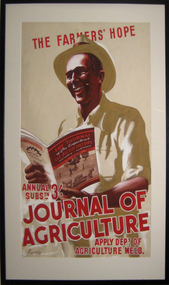
Painting - Gouache, Albino Paganetti, 'Journal of Agriculture', c1935
... Albert’s farming family lived at Italian Hill, near Daylesford, where his father was a vigneron. This item is part of the Federation University Art Collection. ...Albert’s farming family lived at Italian Hill, near Daylesford, where his father was a vigneron. This item is part of the Federation University Art Collection. ...Albino PAGANETTI (1915-1974) Born Victoria. This work won Albino Elvezio (Albert) Paganetti won third place in the Department of Agriculture’s poster competition for their official journal in 1937. The previous year, he took home several prizes at the Wiltshire Poster Contest, including first for ‘Bryant and May’; first for ‘Healing’s Batteries’, and second for the Royal Melbourne Show. A MacRobertson prize-winner, when Paganetti, completed his commercial art course at the Ballarat Technical Art School, he accepted a design position at Morshead and Co., Ballarat. Albert’s farming family lived at Italian Hill, near Daylesford, where his father was a vigneron. This item is part of the Federation University Art Collection. The Art Collection features over 2000 works and was listed as a 'Ballarat Treasure' in 2007.commercial artFramed original poster, gouache on paper, c1935 In the 1936 Ballarat School of Mines Annual Report it was stated: "It is my pleasure to report a most successful year in the Technical Art School. I the Annual Poster Competition for Technical Schools, organised by Wiltshires Pty Limited, 16 prized valued at 33 pounds 8 shillings - out of 23 prizes valued at 56 pounds - were won by our students.art, artwork, paganetti, poster, ballarat technical art school, farmer, jourmal -
 Federation University Art Collection
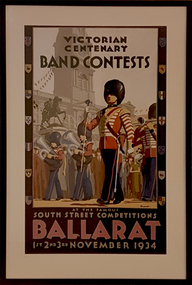
Painting - poster, Don Refshauge, Victorian Centenary Band Contest (Ballarat), 1934
... father, John Henry (Johann Heinrich) Refshauge, was headmaster at the Ballarat Agricultural High School. Donald Refshauge worked as a commercial artist near Ballarat, until he moved to Hamilton with his aging mother, Donella, in 1949. Sadly, within three years he died, aged 40. His probate notice labelled him a ‘retired farmer’. This item is part of the Federation...father, John Henry (Johann Heinrich) Refshauge, was headmaster at the Ballarat Agricultural High School. Donald Refshauge worked as a commercial artist near Ballarat, until he moved to Hamilton with his aging mother, Donella, in 1949. Sadly, within three years he died, aged 40. His probate notice labelled him a ‘retired farmer’. This item is part of the Federation ...Donald REFSHAUGE (1912-1952) A Senior Technical Scholarship recipient, Donald Hamilton Refshauge studied Commercial Art between 1929 and 1935. He was a highly successful student, winning multiple prizes at competition. His father, John Henry (Johann Heinrich) Refshauge, was headmaster at the Ballarat Agricultural High School. Donald Refshauge worked as a commercial artist near Ballarat, until he moved to Hamilton with his aging mother, Donella, in 1949. Sadly, within three years he died, aged 40. His probate notice labelled him a ‘retired farmer’. This item is part of the Federation University Art Collection. The Art Collection features over 2000 works and was listed as a 'Ballarat Treasure' in 2007.Commercial artFramed original poster by Don Refshauge of the Ballarat Technical Art School. In the 1936 Ballarat School of Mines Annual Report it was stated: "It is my pleasure to report a most successful year in the Technical Art School. I the Annual Poster Competition for Technical Schools, organised by Wiltshires Pty Limited, 16 prized valued at 33 pounds 8 shillings - out of 23 prizes valued at 56 pounds - were won by our students.art, artwork, don refshauge, brass band, ballarat, competition, ballarat town hall, uniform, south street, south street competitions, donald refshauge, boer war memorial, coats of arms, band contest, available -
 Federation University Art Collection
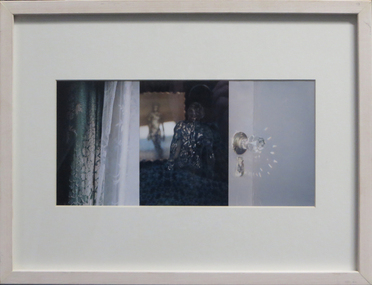
Photograph, Erin McCuskey, 'Shiney Man' by Erin McCuskey
... My work is informed by the moving images of my siblings as children recorded by my father, the houses and homes, spaces and events, which live on as objects themselves in various homes as photos, archives, projected and loved. These flickering images were embedded and now I spend time creating more.” (Central Highlands Art Atlas, http://www.artsatlas.com.au/erin/) This item is part of the Federation...My work is informed by the moving images of my siblings as children recorded by my father, the houses and homes, spaces and events, which live on as objects themselves in various homes as photos, archives, projected and loved. These flickering images were embedded and now I spend time creating more.” (Central Highlands Art Atlas, http://www.artsatlas.com.au/erin/) This item is part of the Federation ...Erin McCUSKEY Erin is a filmmaker, photographer and digital media artist with a bent on ‘difference’. She is the Creative Director at Yum Studio where she has forged a national reputation for delivering innovative and unique creative media projects, using projection, media, social media and social broadcasting. Ern McCuskey has a passion for producing projects with human rights at their core. Her short films, installations and commissions have screened at Museum of Australian Democracy at Eureka (MADE), Melbourne International Film Festival (MIFF), Flickerfest, Indiefest, Gertrude St Projection Festival, Ballarat International Foto Biennale, numerous exhibitions, performances and collections. Erin’s work is informed by the knowledge that difference is a necessary part of society and the core of a healthy one. She is passionate about creating media that is thought provoking, possibly controversial and also entertaining. Media creation is a group pursuit and those behind the camera are more often control the balance of power, therefore she is committed to unique collective story development. “I believe that art is in the everyday, that we all can, should and do, create. My work is informed by the moving images of my siblings as children recorded by my father, the houses and homes, spaces and events, which live on as objects themselves in various homes as photos, archives, projected and loved. These flickering images were embedded and now I spend time creating more.” (Central Highlands Art Atlas, http://www.artsatlas.com.au/erin/) This item is part of the Federation University Art Collection. The Art Collection features over 2000 works and was listed as a 'Ballarat Treasure' in 2007.Three photographs mounted side by side (portrait orientation). #1 image of curtains #2 image of sculpture of man reflected in a mirror #3 light reflecting through crystal door handle. Slight scratching on front bottom of frame. art, artwork, erin mccuskey, mccuskey, photography, foto, available -
 Federation University Art Collection
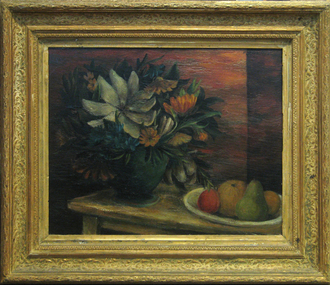
Painting - Oil, et al, [The Green Vase] by David Strachan, c1948
... father. (Barry Pearce, 'Strachan, David Edgar (1919–1970)', Australian Dictionary of Biography, National Centre of Biography, Australian National University, http://adb.anu.edu.au/biography/strachan-david-edgar-11786/text21083, published first in hardcopy 2002, accessed online 6 January 2016.) This item is part of the Federation...father. (Barry Pearce, 'Strachan, David Edgar (1919–1970)', Australian Dictionary of Biography, National Centre of Biography, Australian National University, http://adb.anu.edu.au/biography/strachan-david-edgar-11786/text21083, published first in hardcopy 2002, accessed online 6 January 2016.) This item is part of the Federation ...David STRACHAN (1919–1970) Born 25 June 1919 at Salisbury, Wiltshire, England Arrived 1920 Adelaide, Australia: 1921 Creswick, Victoria David Strachan attended Creswick State School and Geelong Church of England Grammar school. By the age of 16 he wanted to be an artist. Accompanying his mother to London in 1936, he enrolled at the Slade School of Fine Art, where he met Godfrey Miller. In 1937 he attended the Académie de la Grande Chaumière, Paris, and painted at Cassis on the Mediterranean Sea. He returned to Australia in April 1938 and studied at the George Bell School, Melbourne. He had a growing interest in classicism blended with a fascination for the dream-state which was reinforced in his work after he moved to Sydney in 1941. There he was befriended by Jean Bellette and her husband Paul Haefliger, who were to be driving forces behind the Sydney Art Group (founded 1945). He lived on the top floor of the Haefligers' house at Double Bay, and together the three artists drew from models whom the Haefligers hired. In this period Strachan painted and exhibited some of his most poetic works—mainly figurative and landscape subjects, and still-lifes of haunting beauty. His flowers, bowls of fruit, birds, and angelic figures glimmered out of the darkness as things not of this world, evoked faintly, like mythological personages in a gently spoken narrative. He 'spent an erratic war' painting camouflage at Bankstown aerodrome with other artists, among them (Sir) William Dobell, and dancing minor roles with Hélène Kirsova's ballet company. In 1948 Strachan settled in Paris. His paintings, included by Peter Bellew in an exhibition at the Musée National d'Art Moderne, had been well-received by French critics two years earlier. In 1950 he began tentative experiments in etching. These led to the formation of the Stramur-Presse, a business venture which published etchings and lithographs of leading French and English artists. His most important project was a series of twenty-two colour etchings illustrating Alister Kershaw's book of poems, Accent & Hazard (Paris, 1951). Strachan continued to exhibit in Australia and maintained a lively social life with Australian friends. From Paris, he went for weekend painting trips with Moya Dyring in her car and, after 1957, visited the Haefligers on Majorca. He lived in London in 1955-57. His paintings became progressively less soft in effect, his palette brightened, and his forms, especially the still-lifes, became spikier. In the late 1950s his attention drifted towards the study of Hindu philosophers and Jungian psychology. For most of 1957-58 he was enrolled at the C. G. Jung-Institut, Zürich, Switzerland. In 1959 he worked in Silvio Daneo's silkworm factory at Bricherasio, Italy. In May 1960 Strachan returned to Sydney. He lived at Woolloomooloo before buying a house at Paddington in 1963. Over the ensuing years he involved himself energetically with the art scene, exhibiting, teaching (1960-65) at East Sydney Technical College, fund-raising for memorials for Thea Proctor and Dyring, and as the last president (1965) of the Society of Artists. His paintings were out of harmony with the prevailing fashion for abstraction, but he won the Wynne prize for landscape painting in 1961 and 1964 (shared). Perhaps the most moving works of Strachan's last ten years were the mining landscapes, including those he painted near Hill End, leading up to his vast canvas, 'Lewers Freehold Mine'. This was a history picture, depicting the mine as it might have appeared in 1874. He presented it to the Creswick Historical Museum in 1970 in memory of his father. (Barry Pearce, 'Strachan, David Edgar (1919–1970)', Australian Dictionary of Biography, National Centre of Biography, Australian National University, http://adb.anu.edu.au/biography/strachan-david-edgar-11786/text21083, published first in hardcopy 2002, accessed online 6 January 2016.) This item is part of the Federation University Art Collection. The Art Collection features over 1000 works and was listed as a 'Ballarat Treasure' in 2007.Framed still lifefeaturing fruit and flowers.art, artwork, strachan, david strachan, still life, flowers, flora, available -
 Whitehorse Historical Society Inc.
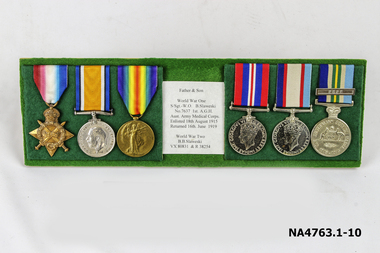
Medal - Military Medals, World War medals WW1 and WW2, 1919 1946
... Australian Service medal 1945 -1975 Reverse has Federation star with name B B Slaweski R 38254 Ribbon Central yellow stripe with green flanked by navy blue Khaki and light blue stripes Medal has clasps PNG and FESR (Far East Strategic Reserve)|7 Small Clasps (For miniature medals )PNG and FESR Photo on back of Board Father and son Slaweski 8 Letter 2/2/1999 addressed to Mitcham RSL with details of Boreslas and Kevin Slaweski. 9 Letter dated 11/2/1999 to Mitcham RSL regarding PNG clasp....Australian Service medal 1945 -1975 Reverse has Federation star with name B B Slaweski R 38254 Ribbon Central yellow stripe with green flanked by navy blue Khaki and light blue stripes Medal has clasps PNG and FESR (Far East Strategic Reserve)|7 Small Clasps (For miniature medals )PNG and FESR Photo on back of Board Father and son Slaweski 8 Letter 2/2/1999 addressed to Mitcham RSL with details of Boreslas and Kevin Slaweski. 9 Letter dated 11/2/1999 to Mitcham RSL regarding PNG clasp. ...Issued to Defence personnel for service during world war I and II1. Green felt covered board with 6 medals to the Father Boleslas Slaweski (Staff Sgt ,Warrant Officer)and Son Bernard Bruce Slaweski and son 2 1914 -1915 star Bronze medal with 4 stars with crown on top star, ribbon has red white and blue colours merged at edges. Medal has crossed swords and laurel wreath Engraved on rear 7637 S/Sgt B Slaweski 1/6 Hosp. A. I. F. 3 British War medal circular medal of Silver Words on obverse GEORGIUS V BRITT OMN REX ET IND EMP AROUND THE HEAD OF KING GEORGE V Reverse has a figure of St. George mounted on a horse with a short sword in one hand, the other raised in victory. The horse tramples on the figures of death the Prussian eagle and skull and crossbones in the background are ocean waves The years 1914 1918 are embossed on the sides Around the edge is 7637 W O 1 B Slaweski A.M.C. A.I.F. Ribbon is dark blue, black, white,orange, white, black and dark blue 3. Victory medal Bronze medal with winged victory figure on obverse with The great war fro civilisation 1914 1918 non the reverse Ribbon is watered from a central red stripe through yellow green blue and purple 4 War medal 1939- 1945 Medal is round cupro nickel obverse shows head of King George 6th with circular inscription G.B>R> REXETINDIAE IMP GEORGIVS VI Reverse has a lion standing on a dragon the top shows the dates 1939- 1945 Ribbon is narrow red central strip with radiating stripes of white (narrow) and blue and red|5 Australian Service medal 1939 - 1945 Nickel silver medal with crowned effigy of King George VI on the obverse Reverse has Australian Coat of Arms placed centrally surrounded by the words The Australian Service Medal 1939- 1945 Ribbon has wide Khaki central stripe flanked by two narrow red stripes and one of dark blue (navy) and one of light blue. (Air Force)|6. Australian Service medal 1945 -1975 Reverse has Federation star with name B B Slaweski R 38254 Ribbon Central yellow stripe with green flanked by navy blue Khaki and light blue stripes Medal has clasps PNG and FESR (Far East Strategic Reserve)|7 Small Clasps (For miniature medals )PNG and FESR Photo on back of Board Father and son Slaweski 8 Letter 2/2/1999 addressed to Mitcham RSL with details of Boreslas and Kevin Slaweski. 9 Letter dated 11/2/1999 to Mitcham RSL regarding PNG clasp.B Slaweski B B Slaweskimilitary history, army -
 Falls Creek Historical Society
Uniform - Olympic Games Ski Suit 1976
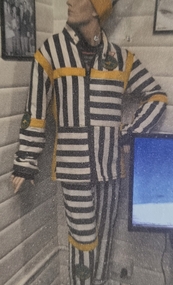
... father, Dr. Claude Farrow was a founding member of the Edelweiss Ski Club of Australia which was formed in 1947. He was also the Founding President of the Federation of Victorian Ski Clubs (F.O.V.S.C) which produced the Ski-Horizon journal. ...father, Dr. Claude Farrow was a founding member of the Edelweiss Ski Club of Australia which was formed in 1947. He was also the Founding President of the Federation of Victorian Ski Clubs (F.O.V.S.C) which produced the Ski-Horizon journal. ...Winter Olympics, Innsbruck, Austria. This uniform was donated to the Falls Creek Historical Society by Dr. Howard W. Farrow who was appointed as a Medical Officer for the Australian Olympic Games Team of 1976. Dr. Farrow's father, Dr. Claude Farrow was a founding member of the Edelweiss Ski Club of Australia which was formed in 1947. He was also the Founding President of the Federation of Victorian Ski Clubs (F.O.V.S.C) which produced the Ski-Horizon journal. Dr. Howard Farrow reported that "the Europeans laughed at us and called us the prisoners". Australia sent a team of eight athletes to Innsbruck, five men and three women. The team consisted of alpine skiers Kim Clifford, David Griff, Robert McIntyre, Joanne Henke and Sally Rodd; figure skaters Billy Schober and Sharon Burley and speed skater Colin Coates, who was competing in his third Winter Olympics. This uniform was designed by famous fashion designer Pru Acton OAM, in response to a request by athletes for a more colourful uniform than the standard green blazer previously worn by the Australian team at the Opening and Closing Ceremonies of the Games.This uniform is significant because it was a modern development of Australian Winter Olympic team uniforms created by a famous Australian fashion designer.The Australian Ski Suit for the 1976 Winter Olympic Games. It has patches of big bold black and white stripes, set horizontally and vertically, with panels of yellow. The Australian emblem of Olympic circles and a kangaroo are placed on the back and front of the jacket and on the arm and leg. A bib-and-brace overall in matching stripes was worn under the jacket.1976 winter olympics, australian winter olympics uniforms, pru acton, dr. howard farrow -
 Falls Creek Historical Society
Equipment - Caber Ski Boots
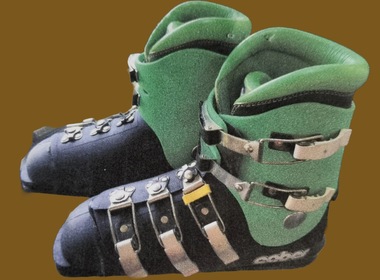
... father, Giovanni took over the reins of the family business. He looked with interest at a new material for ski boots: plastic, travelling to the USA to carry out further investigation. Giovanni began to use plastic polymers which, once heated and melted, were injected directly into the mold and left to cool. He also began a range of sponsorships to promote his brand including the 1964 World Cup slalom event in Cortina d'Ampezzo. He also gained a four year deal with the Italian Winter Sports Federation...father, Giovanni took over the reins of the family business. He looked with interest at a new material for ski boots: plastic, travelling to the USA to carry out further investigation. Giovanni began to use plastic polymers which, once heated and melted, were injected directly into the mold and left to cool. He also began a range of sponsorships to promote his brand including the 1964 World Cup slalom event in Cortina d'Ampezzo. He also gained a four year deal with the Italian Winter Sports Federation ...Giovanni Caberlotto was born on 27 February 1941 in Montebelluna, Italy into a family of boot makers and street vendors. In 1960 Giovanni was called up for military training and enlisted in the Alpini skiing company, learning to ski and gained a military instructor's license. During this time, he learned to recognize boots and materials and looked for innovative solutions to make them more comfortable. He returned home after his military service and convinced his father he no longer wanted to be a street vendor. In 1963 the Caberlotto family sold a piece of land to finance the new business: Caber and established a ski boot factory. In 1965, upon the death of his father, Giovanni took over the reins of the family business. He looked with interest at a new material for ski boots: plastic, travelling to the USA to carry out further investigation. Giovanni began to use plastic polymers which, once heated and melted, were injected directly into the mold and left to cool. He also began a range of sponsorships to promote his brand including the 1964 World Cup slalom event in Cortina d'Ampezzo. He also gained a four year deal with the Italian Winter Sports Federation (FISI). In 1974 he sold Caber to the US company Spalding, remaining as President of the company until 1979. In 1974 the Caberlotto brothers exploited the second part of the family surname and founded Lotto. For non-competition reasons they work on tennis and leisure shoes. The new company, in addition to tennis, becomes a successful brand in football, basketball and athletics. Giovanni left Spalding in 1980 and returned to Montebelluna, becoming the General Manager of Lotto. He died on 3 March 1997 In 1990, Rossignol acquired the Caber boot factory in Italy and rebranded the product under the Rossignol label.These boots are significant because they represented an advance in ski boot technology and were a popular brand in the 1970s.Lime green and black Caber ski boots. Each boot has five metal fastenings.On side of boots - Cabercaber ski boots, skiing equipment, skiing technology -
 Friends of Ballarat Botanical Gardens History Group
Slide - Colour transparency, Eastman Kodak, c. 1940
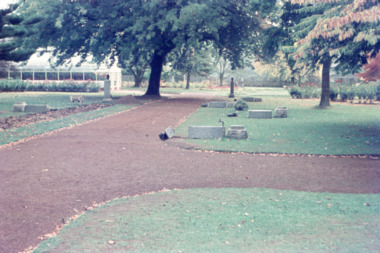
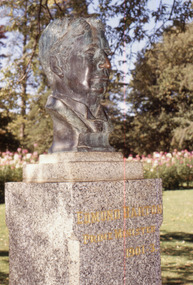
... The collection includes a portrait of one of the founding fathers of Federation, Alfred Deakin, who was the first Federal Member for Ballarat and the second Prime Minister. ballarat botanical gardens trees lawns pathways sculptures busts governors prime ministers avenue richard armstrong couch federation 1940 chestnut trees horse chestnuts bronze granite pedestals alfred deakin sir winston dugan wallace anderson Kodachrome Kodachrome slide depicting the gardens during the installation of the pedestals and busts of the first six prime ministers. ...On March 2, 1940, Sir Winston Dugan, Governor of Victoria unveiled the busts of the six first prime ministers of Australia at a ceremony on the long avenue of Horse Chestnuts. The donor, Richard Armstrong Couch, was born in Ballarat in 1868.The Prime Ministers Avenue is a feature of national significance, set in the magnificent Horse Chestnut Avenue of the Gardens. The 28 Prime Ministers of Australia are displayed as bronze portraits mounted on polished granite pedestals. The collection includes a portrait of one of the founding fathers of Federation, Alfred Deakin, who was the first Federal Member for Ballarat and the second Prime Minister.Kodachrome slide depicting the gardens during the installation of the pedestals and busts of the first six prime ministers.Kodachromeballarat botanical gardens, trees, lawns, pathways, sculptures, busts, governors, prime ministers avenue, richard armstrong couch, federation, 1940, chestnut trees, horse chestnuts, bronze, granite, pedestals, alfred deakin, sir winston dugan, wallace anderson -
 Friends of Ballarat Botanical Gardens History Group
Slide - Colour transparency, Eastman Kodak, c. 1940
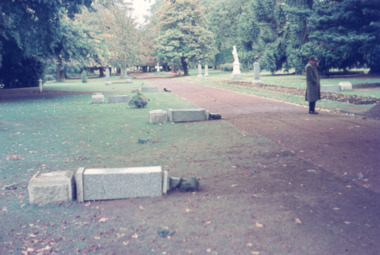
... The collection includes a portrait of one of the founding fathers of Federation, Alfred Deakin, who was the first Federal Member for Ballarat and the second Prime Minister. ballarat botanical gardens trees men pathways lawns sculptures busts prime ministers avenue chestnut trees granite alfred deakin federation horse chestnuts richard armstrong crouch pedestals governor sir winston dugan wallace anderson Kodachrome Kodachrome slide depicting a pathway and lawns where pedestals and busts of the first six prime ministers are lying on the ground to be installed. ...On March 2, 1940, Sir Winston Dugan, Governor of Victoria unveiled the busts of the six first prime ministers of Australia at a ceremony on the long avenue of Horse Chestnuts. The donor, Richard Armstrong Couch, was born in Ballarat in 1868.The Prime Ministers Avenue is a feature of national significance, set in the magnificent Horse Chestnut Avenue of the Gardens. The 28 Prime Ministers of Australia are displayed as bronze portraits mounted on polished granite pedestals. The collection includes a portrait of one of the founding fathers of Federation, Alfred Deakin, who was the first Federal Member for Ballarat and the second Prime Minister.Kodachrome slide depicting a pathway and lawns where pedestals and busts of the first six prime ministers are lying on the ground to be installed. A man with hat, long winter coat is standing on the pathway.Kodachromeballarat botanical gardens, trees, men, pathways, lawns, sculptures, busts, prime ministers avenue, chestnut trees, granite, alfred deakin, federation, horse chestnuts, richard armstrong crouch, pedestals, governor, sir winston dugan, wallace anderson -
 Friends of Ballarat Botanical Gardens History Group
Slide - Colour transparency, Eastman Kodak, c. 1940
... The collection includes a portrait of one of the founding fathers of Federation, Alfred Deakin, who was the first Federal Member for Ballarat and the second Prime Minister. ballarat botanical gardens trees lawns pathways sculptures busts governors prime ministers avenue richard armstrong couch federation 1940 chestnut trees horse chestnuts bronze granite pedestals alfred deakin edmund barton wallace anderson sir winston dugan Kodachrome 3/4 view using flash of the bronze bust and granite pedestal of Prime Minister, Edmund Barton in the Prime Ministers Avenue. ...On March 2, 1940, Sir Winston Dugan, Governor of Victoria unveiled the busts of the six first prime ministers of Australia at a ceremony on the long avenue of Horse Chestnuts. The donor, Richard Armstrong Couch, was born in Ballarat in 1868. Edmund Barton (1849 –1920) was an Australian politician and judge who served as the first Prime Minister of Australia, in office from 1901 to 1903. He was appointed prime minister on 1 January 1901, the day on which the new federal constitution came into effect. The Prime Ministers Avenue is a feature of national significance, set in the magnificent Horse Chestnut Avenue of the Gardens. The 28 Prime Ministers of Australia are displayed as bronze portraits mounted on polished granite pedestals. The collection includes a portrait of one of the founding fathers of Federation, Alfred Deakin, who was the first Federal Member for Ballarat and the second Prime Minister.3/4 view using flash of the bronze bust and granite pedestal of Prime Minister, Edmund Barton in the Prime Ministers Avenue. A vertical scratch line is visible on the right side.Kodachromeballarat botanical gardens, trees, lawns, pathways, sculptures, busts, governors, prime ministers avenue, richard armstrong couch, federation, 1940, chestnut trees, horse chestnuts, bronze, granite, pedestals, alfred deakin, edmund barton, wallace anderson, sir winston dugan -
 City of Melbourne Libraries
Photograph, Bull, Hugh Jones, 1897-1993, Steel manufacturers, McPherson's Ltd, Melbourne
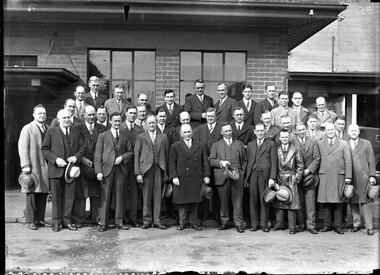
... In 1901, the year Australia united into a federation, the nation’s first blast furnace went into production at Eskbank near Lithgow in New South Wales. The development was spearheaded by William Stafford and his son Esk, and Stafford is known as the father of Australian steel production. ...In 1901, the year Australia united into a federation, the nation’s first blast furnace went into production at Eskbank near Lithgow in New South Wales. The development was spearheaded by William Stafford and his son Esk, and Stafford is known as the father of Australian steel production. ...Photographer notations on slide: Steel Manuf’rs at McPherson’s Ltd 1933 Published: The Age, 30 August 1933 BUREAU OF STEEL MANUFACTURERS OF AUSTRALIA. (1933, August 30). The Age (Melbourne, Vic. : 1854 - 1954), p. 11. Retrieved January 25, 2026, from http://nla.gov.au/nla.news-article204372874 Published title: Bureau of Steel Manufacturers of Australia Published caption: A group of Inter-State Visitors, from the Bureau of Steel Manufacturers of Australia, on a tour of inspection at the Bolt Works of McPhersons Pty. Ltd., Burnley-Richmond, yesterday. Research by Project Volunteer, Louise McKenzie: The photo shows a line up of 36 men, in three rows, in front of a building. They are mostly dressed in dark 3-piece suits, or camel coats. But one gentleman stands out in his full length leather coat! Striped ties are popular, and they are all holding hats. One man, at the rear towards the right, looks a bit younger with his thick, black, brylcreamed hair.. These interstate gentlemen are described in the newspaper caption as representatives of the Bureau of Steel Manufacturers "...on a tour of inspection at the Bolt Works of McPhersons Pty Ltd, Burnley, Richmond." Interestingly, the Bureau of Steel Manufacturers of Australia (BOSMA) still exists, and is the industry body for major Australian steel producers like BlueScope, Liberty, and InfraBuild, representing their interests, engaging with government, and participating in standards setting for the domestic steel market, with a history dating back to 1923. While BOSMA focuses on primary manufacturing, the Australian Steel Institute (ASI) serves as the broader peak body for the entire steel supply chain, from mills to end-users, promoting and supporting the industry. But at the time of this photo, the Australian steel industry was just starting to make headway. As the AST website explains, "Steelmaking in Australia began just a decade prior to the start of the 1851 Gold Rush whilst Australia was still divided into colonies. Iron ore deposits were discovered in 1840 at Iron Knob, South Australia but a lack of equipment meant that the process of producing steel was impossible. Even attempts at smelting the iron ore in a blast furnace to create pig iron were unsuccessful due to the poor quality of iron ore and coke available to the budding industry. In the other colonies at the time, such as Victoria, Tasmania, and New South Wales, there were minor discoveries of iron ore but poor technical expertise and limited quantity meant that the quality of steel was poor. Compared to the far superior steel being imported from Britain at the time, the steel manufacturing industry simply couldn’t compete and was unviable. By the 1870s, almost all steel production in Australia had been abandoned. The situation began to change at the turn of the century. Rapid growth sparked higher demand for industrial machinery made from steel and infrastructure such as rail. It became apparent that there was a need for locally manufactured steel and soon there would be an answer. In 1901, the year Australia united into a federation, the nation’s first blast furnace went into production at Eskbank near Lithgow in New South Wales. The development was spearheaded by William Stafford and his son Esk, and Stafford is known as the father of Australian steel production. In 1915, production expanded with another steel mill in Newcastle that was opened by BHP. It sourced coke from local mines and iron ore from South Australia, creating a domestic loop for steel manufacturing. In the following years, more steelworks opened in Whyalla, South Australia and Port Kembla in NSW. Steel manufacturing in Australia was now underway." The company mentioned in the photo’s notation and in the newspaper caption, was McPhersons, "...an Australian hardware firm, for many years a leading merchant of woodworking and metal-working machinery... [and founded by] Thomas McPherson (c.1823–1888) who had a home "Dudley House" at 142 Dudley Street, West Melbourne. [The] ironmongery business [was located] in 1860 at 149 Spencer Street, Melbourne. Merchandise carried included bells, lathes, horseshoes and steam engines." (Wikipedia - McPherson's Pty Ltd) Anyone who has read Robyn Annear’s excellent award-winning 2014 book Bearbrass – the name for early Melbourne - will remember only too well her description of West Melbourne, from where the city of Melbourne as we know it, emerged. Her book resurrects the village that was early Melbourne – from the arrival of white settlers in 1835 until the first gold rushes shook the town – and brings it to life in vivid colour. The McPherson family, whose arrival in Bearbrass coincides with this period (Thomas arrived in 1852), became intimately involved in the growth and development of Melbourne. Thomas was Mayor of Melbourne (1870-1871); his eldest son Hunter became a successful Sydney businessman; second son Edward and third son William inherited the company, and ran it together until 1896 when Edward killed himself. William had a notable career in politics as treasurer of Victoria 1917-1923, in which year he was knighted. 1928-1929 he was Premier of Victoria, and a noted philanthropist. The family were significant property owners in the city of Melbourne: 149 Spencer Street, 582-588 Collins Street, 554-566 Collins Street, together with a property on Jeffcott Street, West Melbourne, and factories in Sunshine, Tottenham, Kensington and Richmond – all by the mid 1940s. By that time they also had controlling interests in several Australasian industries, including Ajax Bolt and Rivet Pty Ltd of NZ, F W Hercus Manufacturing Co Ltd, manufacturers in South Australia of lathes, guillotines and other heavy machinery, also of Patience and Nicholson (P & N), manufacturers in Maryborough, Victoria, of twist drills and thread-forming tools; also Wiltshire Files on Sunshine Road, Tottenham, manufacturing files and rasps. The Acme Machine Tool Company became a branch of McPhersons, and the company claimed to have supplied, from their own manufacture, all five million rivets (some 3,600 tonnes) used in the building of the Sydney Harbour Bridge – described as a steel through arch bridge, which opened in 1932; the tallest of its kind in the world (Wikipedia – Sydney Harbour Bridge) McPherson’s was also innovative in other ways. It published a comprehensive catalogue, extensively detailed with prices, available free of charge to farmers and other businesses. In 1908 it had 148 pages. By 1937 it had grown to 372 pages. The University of Melbourne’s Archives entry on McPherson’s Limited notes: "After the outbreak of the Second World War, McPherson’s factories worked at full capacity and were crucial to Australia’s war efforts. On 5 December 1944 McPherson's converted to a public company named McPherson's Ltd, with William Edward as Chairman of Directors. By the start of the 1950s the company had a very different Board of Directors; in 1947 the Managing Director Oliver Addison died, and his replacement Marshall Eady died only six months later. Both had been Directors since McPherson’s became a proprietary company in 1913. Another Director, Philip Bevan, died in 1948 and this was followed by the death of William Edward in 1950. S.B Holder, F.G. Thorpe, H.L. Hastie, F. Grassick and D.G. Syme all joined the Board before 1950. The company continued to prosper for many years after the death of William Edward. His son, William David, was invited to join the McPherson’s Ltd Board in 1951. He married Angela Cumming in 1955 and soon after was sent to Brisbane as Director in Charge to oversee the building of a new warehouse. The opening of this warehouse in Queensland meant that the company now had major outlets in five states. As time went on, manufacturing in Australia began to decline and imports of everyday tools began arriving from Asia. These tools were being produced with much lower labour costs and could be sold at cheaper prices. William David retired in 1984 and eventually parts of the company were divested, such as the Richmond Bolt Works which closed in the early 1990s. Since the 1980s, McPherson's has diversified into housewares, printing, and health and beauty care products." This article also contains photos, one of which is a photograph of 'Bolt works picnic' 1920, showing workers in their shirt sleeves participating in a tug of war in a rural "picnic" setting. McPherson’s premises at 554-566 Collins Street more than lasted the test of time and is listed as historically significant. The magnificent art deco building from the 1930s in the heart of Melbourne was first commissioned in 1934 and completed in 1937. It is an imposing building fronting almost a quarter of the city block between Spencer Street and King Street, and was designed to be a warehouse, office and showroom for the hardware empire. International architects Stuart P Calder, and Reid and Pearson designed the four-storey building with a basement level and a stair tower at the centre that provides access to what was a tennis court on the roof. It is considered an example of the streamlined modern style in Melbourne and shows how the McPherson company, protected from taxes after World War I, was able to manufacture goods without being affected by the competition. The building has survived, and its current iteration is as the home to il Mercato Centrale – an Italian style artisan market concept. The University of Melbourne Archives hold a particularly good image of the building from its heyday, complete with Collins Street lamps on the pavement outside the store. And to return to our image, sited at "Bolt Works of McPhersons". Today this segment of McPhersons is still very well known - Ajax. A good summary of the company’s history, and the development of the name and business, can be found on the Mine Suppliers Online website: "AJAX Fasteners can trace its heritage back to 1900, when the Acme Bolt Company was established in West Melbourne, Victoria. In 1909, William McPherson used the company as the basis for establishing McPherson’s Bolt Works – adopting the brand ‘Ajax’ – and moved it to Richmond. Over the years, the company changed many times in response to industry needs to ensure that it remained the premier manufacturer of high quality fasteners in Australia. Many other names in the industry, such as Firth Cleveland, Spurway Cooke and Nettlefolds were merged or acquired into the company. McPhersons ended their 80-year ownership of Ajax in the early 90s when they sold their shares to National Consolidated, which was also a major shareholder at the time. In 1997, Ajax Fasteners moved to new purpose-built premises in Braeside, Victoria. Soon after, National Consolidated was taken over by the diversified manufacturer Austrim. The group soon acquired the iconic Nylex, and adopted the name Nylex Corporation. In January 2007, ACME Operations Pty Ltd acquired Ajax Fasteners and continues to operate the business today from the Braeside plant. The name ACME provides a nostalgic return by the new owners to the company’s heritage, when the Acme Bolt Company was founded in July 1900." REFERENCES: BUREAU OF STEEL MANUFACTURERS OF AUSTRALIA. (1933, August 30). The Age (Melbourne, Vic. : 1854 - 1954), p. 11. Retrieved January 25, 2026, from http://nla.gov.au/nla.news-article204372874 Wikipedia, McPherson’s Pty Ltd, https://en.wikipedia.org/wiki/McPherson%27s_Pty_Ltd Wikipedia, Richmond, Victoria, https://en.wikipedia.org/wiki/Richmond,_Victoria Industry: From the mid-19th century, Richmond was a centre of manufacturing industry, including many large complexes such as the Bryant & May match factory, Jaques Limited engineering works, the Wertheim Piano factory and Pelaco. Wikipedia, Sydney Harbour Bridge, https://en.wikipedia.org/wiki/Sydney_Harbour_Bridge eMelbourne, Manufacturing, https://www.emelbourne.net.au/biogs/EM00896b.htm 'New life for Melbourne's McPherson Building', The Urban Developer, https://www.theurbandeveloper.com/articles/mcphersons-building-melbourne-il-mercato-centrale-food-retail-destination Bureau Of Steel Manufacturers Of Australia Limited, http://www.bosma.org.au/ 'A Brief History of Steel Manufacturing in Australia', AST, https://astraders.com.au/a-brief-history-of-steel-manufacturing-in-australia/ 'Steel manufacturing in Australia: a brief history', Hard Bakka Steel Fabrication, https://www.hardbakka.com.au/component/virtuemart/steel-manufacturing-in-australia-a-brief-history?Itemid=494 McPherson's Limited, University of Melbourne Archives, https://archives.library.unimelb.edu.au/nodes/view/58364 Source of Description: 'Nuts and Bolts: A story of a family and a firm', Barbara Hamer (2006), McPherson’s Printing Group 'Photograph of 'Bolt works picnic' 1920', University of Melbourne Archives, https://archives.library.unimelb.edu.au/assets/display/1287217-max?u=dea2e4d2fd07ac822e624f1e7d39adb3 'Photograph of the exterior of the McPhersons Department store at 546 Collins Street, Melbourne.', University of Melbourne Archives, https://archives.library.unimelb.edu.au/assets/display/1287215-max?u=12430d30453a77059b7d10d49006a521 Robyn Annear, Bearbrass: imagining early Melbourne, Black Inc., 2014 (originally published 1995 by Mandarin) 'Company details', Ajax Fasteners, http://www.minesuppliersonline.com.au/australia/braeside/hardware/ajax-fasteners 'Former McPherson's Building', Victorian Heritage Database, https://vhd.heritagecouncil.vic.gov.au/places/741Photographer notations on slide: "Steel manuf'rs at McPherson's Ltd 1933 B5".1930-1939, industrial workers, clothing and dress, 1930, iron and steel industry, businesses, bridges, industry, melbourne, gold rush, moderne style architecture -
 Federation University Art Collection
Painting, Diana Nikkelson, 'My Family, My Life Goes On' by Diana Nikkelson
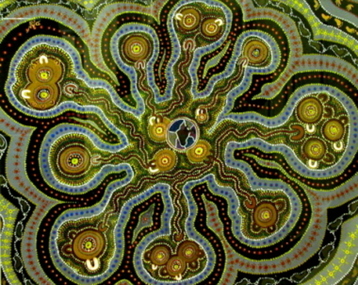
... This work by Ballarat-based Gunditjmara elder Diana Nikkelson was commissioned by the University of Ballarat (later Federation University) for use on the Aboriginal Employment Strategy brochure. The central figures in this painting represent the artist and the fathers of her children. ...The Art Collection features over 000 works and was listed as a 'Ballarat Treasure' in 2007. art artwork diana nikkelson aboriginal dreaming nikkelson gunditjmara aboriginal employment strategy This work by Ballarat-based Gunditjmara elder Diana Nikkelson was commissioned by the University of Ballarat (later Federation University) for use on the Aboriginal Employment Strategy brochure. The central figures in this painting represent the artist and the fathers of her children. ...Diana NIKKELSON (c1943-30 December 2022) Diana Nikkelson is a Ballarat-based Gunditjmara elder. Her grandfather was Watchobaluk. A part of the stolen generation, Diana Nikkelson was one of 10 children, and she had nine children of her own. A founding member of the Ballarat and District Aboriginal Co-operative in the late-70s, Diana Nikkelson was a board director for 16 years and chair for six years. She worked on the Bunjil the Eagle installation at the Koorie Playground at Lake Wendouree, and designed the goanna which was etched into the paving along Police Lane in 2006, and has painted murals across Ballarat. This item is part of the Federation University Art Collection. The Art Collection features over 000 works and was listed as a 'Ballarat Treasure' in 2007.AboriginalThis work by Ballarat-based Gunditjmara elder Diana Nikkelson was commissioned by the University of Ballarat (later Federation University) for use on the Aboriginal Employment Strategy brochure. The central figures in this painting represent the artist and the fathers of her children. The outer groups are Diana Nikkelson’s children and their families. art, artwork, diana nikkelson, aboriginal, dreaming, nikkelson, gunditjmara, aboriginal employment strategy -
 Federation University Art Collection
Work on paper - Printmaking - Silkscreen, Lin Onus, 'Walawala Garrkman' by Lin Onus, 2001
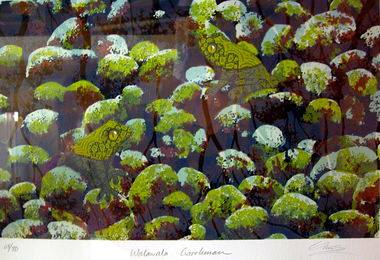
... father's ancestral country, and the use of rarrk cross-hatching-based based painting style that he learned (and was given permission to use when in Arnhemland). His painting Barmah Forest won Canberra's national Aboriginal Heritage Award in 1994. (http://www.cooeeart.com.au/aboriginal_artist/lin_onus/A, accessed 18 May 2015) This item is part of the Federation...father's ancestral country, and the use of rarrk cross-hatching-based based painting style that he learned (and was given permission to use when in Arnhemland). His painting Barmah Forest won Canberra's national Aboriginal Heritage Award in 1994. (http://www.cooeeart.com.au/aboriginal_artist/lin_onus/A, accessed 18 May 2015) This item is part of the Federation ...Lin ONUS (1948-1996) Language: Wiradjuri / Yorta Yorta Lin Onus played a pivotal role in the recognition of Aboriginal art as an expression of a contemporary and dynamic living culture. Prior to his premature death at just 47 years of age he was a prominent, strident, yet non-confrontational agent in renegotiating the history of colonial and Aboriginal Australia. His father, Bill Onus, was the founder of the Aboriginal Advancement League in Victoria and a prominent maker of artefacts in Melbourne. As a young Koori growing up, Lin lived in a cultural environment that included exposure to visiting Aboriginal artists, including Albert Namatjira. He began his artistic life assisting his father in decorating artifacts, went on to develop skills working with metal and painting with air brush as a panel beater; and by 1974 he was painting watercolors and photo-realist landscapes. In the 1970's he completed a set of paintings on the first Aboriginal guerrilla fighter Mosquito, which holds pride of place on the walls of the Advancement League in Melbourne, to this day. Lin Onus was a largely self-taught artist. Particularly important in his development was his visits to Garmedi (Arnhem Land) starting in 1986. Jack Wunuwun, the Yolngu artist, introduced him into the Murrungun-Djinang clan and gave him permission to use some of traditional images in his paintings. His cultural education on the Aboriginal side was also provided by visits to Cummeragunja with his father, and stories told by his uncle Aaron Briggs, known as 'the old man of the forest' who gave him his Koori name - Burrinja, meaning 'star'. They would sit on the banks of the Murray River within view of the Barmah Forest, Lin's spiritual home, the subject of many of his later paintings and his final resting place. Lin's father had been of the Yorta Yorta people from the Barmah Forest country, and Lin also used images from this area in his paintings. The images in his works include haunting photorealist portrayals of the Barmah red gum forests of his father's ancestral country, and the use of rarrk cross-hatching-based based painting style that he learned (and was given permission to use when in Arnhemland). His painting Barmah Forest won Canberra's national Aboriginal Heritage Award in 1994. (http://www.cooeeart.com.au/aboriginal_artist/lin_onus/A, accessed 18 May 2015) This item is part of the Federation University Art Collection. The Art Collection features over 1000 works and was listed as a 'Ballarat Treasure' in 2007.Framed limited edition silkscreen.Signed 'Onus' lower right (posthumously by Tiriki Onus) Edition 68/80art, artwork, lin onus, onus, printmaking, screenprint, aboriginal, dreaming, frogs, available
