
Showing 1348 items matching " gold work"
-
 Embroiderers Guild, Victoria
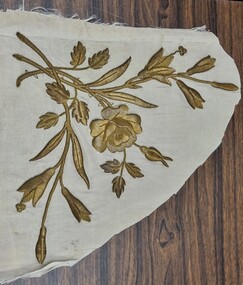
Textile - Gold Work Fragment
... Gold Work Fragment...Gold Work fragment - metal thread worked over card, creating floral bouquet....Textile Gold Work Fragment ...Gold Work fragment - metal thread worked over card, creating floral bouquet. -
 Embroiderers Guild, Victoria
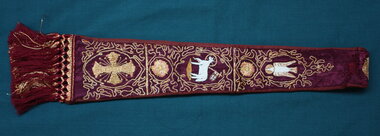
Textile - Ecclesiastical Maniple
... ... Gold work...Dark red silk damask ecclesiastical stole with gold work and silk embroidery. Motifs include dove, lamb, chalice, maltese cross and flowers and latin text. ...(wikipedia) Embroidery Gold work Ecclesiastical Latin texts Dark red silk damask ecclesiastical stole with gold work and silk embroidery. ...The maniple is a liturgical vestment used primarily within the Latin Rite of the Catholic Church, and occasionally by Lutheran and Anglican clergy. It is an embroidered band of silk or like fabric that hangs from the left forearm, worn over the alb. It is used only during Mass, and it is always of the same liturgical colour as other Mass vestments. The original purpose of the maniple is unclear, but it probably originated as a cloth that the priest could use to wipe his hands and face. The maniple corresponds to the epimanikia, cuffs worn on both wrists in the Eastern Orthodox, Eastern Lutheran and Eastern Catholic Churches. (wikipedia)Dark red silk damask ecclesiastical stole with gold work and silk embroidery. Motifs include dove, lamb, chalice, maltese cross and flowers and latin text. Silk and metal thread fringes both ends of both pieces.Latin textsembroidery, gold work, ecclesiastical -
 Embroiderers Guild, Victoria
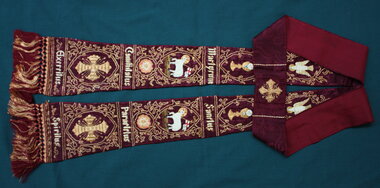
Textile - Ecclesiastical Stole
... ... Gold work...Dark red silk damask ecclesiastical stole with gold work and silk embroidery. Motifs include dove, lamb, chalice, Maltese cross and flowers and Latin text. ...The stole is almost always decorated in some way, usually with two crosses, or sometimes another significant religious design. Embroidery Gold work Ecclesiastical Latin texts Dark red silk damask ecclesiastical stole with gold work and silk embroidery. ...The stole is a liturgical vestment of various Christian denominations, which symbolizes priestly authority; in Protestant denominations which do not have priests but use stoles as a liturgical vestment, however, it symbolizes being a member of the ordained. It consists of a band of coloured cloth, usually of silk, about seven and a half to nine feet long and three to four inches wide, whose ends may be straight or may broaden out in the shape of a spade or bell. The centre of the stole is worn around the back of the neck and the two ends hang down parallel to each other in front, either attached to each other or hanging loose. The stole is almost always decorated in some way, usually with two crosses, or sometimes another significant religious design. Dark red silk damask ecclesiastical stole with gold work and silk embroidery. Motifs include dove, lamb, chalice, Maltese cross and flowers and Latin text. Silk and metal thread fringes both ends of both pieces.Latin textsembroidery, gold work, ecclesiastical -
 Embroiderers Guild, Victoria
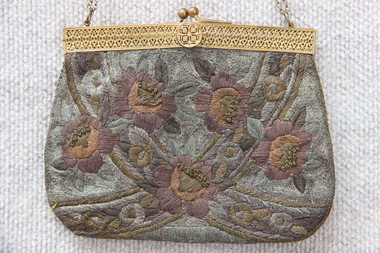
Accessory - Evening Purse, Early 20th C (?)
... ... Gold work...Both sides of bag are embroidered. open-work gold metal frame and double chain handle. ...Embroidery Gold work Metal thread Heavily embroidered in metal thread work in several shades of gold and brown, in a floral design. ...Heavily embroidered in metal thread work in several shades of gold and brown, in a floral design. Both sides of bag are embroidered. open-work gold metal frame and double chain handle. Lined in gold silk.embroidery, gold work, metal thread -
 Bendigo Historical Society Inc.
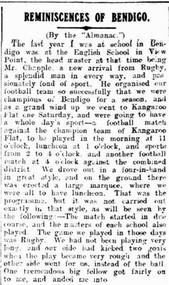
Document - Reminiscences of Bendigo by The Almanac
... ...Gold...Work...Gold. "Reminiscences of Bendigo by The Almanac". Written by Peter MacIver. 5. Goodbye. "Reminiscences of Bendigo by The Almanac". Written by Peter MacIver. 6. School. "Reminiscences of Bendigo by The Almanac". Written by Peter MacIver. 7. Work.... : 1922 - 1954)Wednesday 27 September 1922 - Page 11 David Scott Reminiscences of Bendigo The Almanac Peter McIver Gold Work School Cricket Characters Goodbye Seven pieces written by Peter MacIver about the "Reminiscences of Bendigo" articles written by David Scott and published in the Bendigo Advertiser between 1908 and 1909. 1. ...Dave Scott was born at Montrose, Scotland in 1847 and came to Australia when a boy, and settled with his parents in the Bendigo district. He was closely associated with cricket and cricketers all his life. He was a man with a wonderful knowledge of the game, and of the men who played it. He died in 1922. Obituary may be found on Trove. "The Almanac's" Death Old-time Enthusiast Article - Sporting Globe (Melbourne, Vic. : 1922 - 1954)Wednesday 27 September 1922 - Page 11 Seven pieces written by Peter MacIver about the "Reminiscences of Bendigo" articles written by David Scott and published in the Bendigo Advertiser between 1908 and 1909. 1. David Scott. "The Almanac" Written by Peter MacIver. 2. Characters. "Reminiscences of Bendigo by The Almanac". Written by Peter MacIver. 3. Cricket. "Reminiscences of Bendigo by The Almanac". Written by Peter MacIver. 4. Gold. "Reminiscences of Bendigo by The Almanac". Written by Peter MacIver. 5. Goodbye. "Reminiscences of Bendigo by The Almanac". Written by Peter MacIver. 6. School. "Reminiscences of Bendigo by The Almanac". Written by Peter MacIver. 7. Work. "Reminiscences of Bendigo by The Almanac". Written by Peter MacIver.david scott, reminiscences of bendigo, the almanac, peter mciver, gold, work, school, cricket, characters, goodbye -
 Embroiderers Guild, Victoria
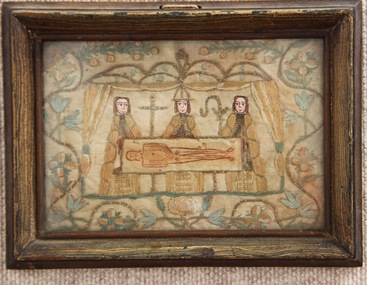
Textile - Medieval Christian 'Three Priests with Christ on Altar', ? 17th century
... ... Gold work...Donation of the estate of Kenneth Lay Antique Dealer High St Armadale 18th Century Silk Embroidery Gold work Renaissance Religious Jesus Christ Three Priests under a Canopy with Jesus Christ on altar, surface embroidery in silk. ...Donation of the estate of Kenneth Lay Antique Dealer High St ArmadaleThree Priests under a Canopy with Jesus Christ on altar, surface embroidery in silk. Couched goldwork highlights, painted body of Christ ? cochineal. Priest/Bishop faces painted - under garment painted outline in now dark brown ink. In old wooden frame. 18th century, silk embroidery, gold work, renaissance, religious, jesus christ -
 Embroiderers Guild, Victoria
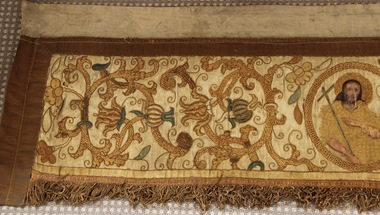
Textile - Metal Thread Altar Frontal
... ...Gold work...Ecclesiastical Gold work Altar frontal with three cartouches - painted faces and hands. ...Altar frontal with three cartouches - painted faces and hands. Goldwork embroidery and applique with small sections of foliage in surface embroidery.ecclesiastical, gold work -
 Embroiderers Guild, Victoria
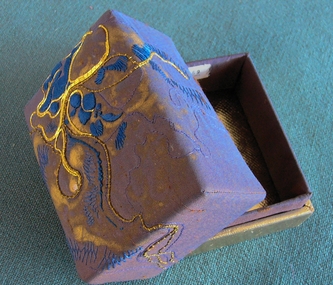
Container - Creative Embroidery & Goldwork Box, Moyra McNeill, Mid 20th century
... Gold work...Given to Edna Wark in 1977. Gold work Embroidery Boxes Creative Embroidery England 1960-80 MM 1978 Synthetic fabric covered box embroidered with a design of couched gold threads, satin stitch, cretan stitch and gold paint. ...Made as a teaching aid for a course entitled 'Colour with Gold". Given to Edna Wark in 1977.Synthetic fabric covered box embroidered with a design of couched gold threads, satin stitch, cretan stitch and gold paint. Base of box is covered in gold kid.MM 1978gold work, embroidery, boxes, creative embroidery, england, 1960-80 -
 Embroiderers Guild, Victoria
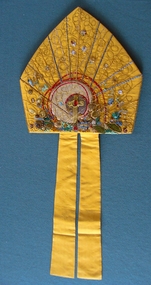
Accessory - Bishop's Mitre, Mrs Morna Sturrock, Mrs Ethel Oates, 1976
... ... Gold work...Embroidery Mitre Australia Gold work Metal thread The mitre was made for the consecration of the Anglican Archbishop, the Rt. ...Photograph of Mrs Oates and Archbishop Dann with Museum sheet.The mitre was made for the consecration of the Anglican Archbishop, the Rt. Rev. Robert Dann. The front, embroidered by Morna Sturrock represents the resurrection. The back, embroidered by Mrs Oates, represents the cave, crucifixion and burial. The mitre is meant to be worn at Easter. The background fabric for the embroidery is a gold silk colour, the lining is blue. The mitre was considered very avant-garde for it's time.embroidery, mitre, australia, gold work, metal thread -
 Embroiderers Guild, Victoria
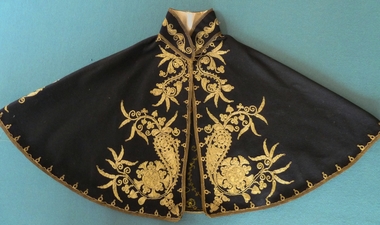
Clothing - 19th C Ottoman Turkish Wool and Goldwork Cape
... ... Gold work...Goldwork Capes Capes Embroidery Gold work Wool Austrian Black wool cape with stand-up collar. ...Victorian-era Ottoman Turkish capes from the 19th century are characterized by their luxurious materials, such as felted wool, velvet, or silk, and intensive hand-embroidered gold bullion thread (known as "Dival" or couched embroidery). These capes, which were often worn by urban elites, frequently feature high collars, short lengths designed to cover the arms, and intricate floral or paisley patterns. Key Characteristics & Design (19th Century): Fabric & Color: Deep black, red, cream, green, or blue "doeskin" wool or silk satin is common, often lined with bright silk. Goldwork: The defining feature is the lavish use of gold metallic couching stitches and gold bullion thread. Structure: Often high-collared, short-length shoulder capes, sometimes closed with a single ball and loop fastening at the neck. Origin: These were typically high-fashion items worn in large urban centres like Istanbul and İzmir during the late 19th century, influencing and being influenced by Western fashion trends. Black wool cape with stand-up collar. Interfaced, but lining missing. Heavily embroidered with gold metal thread. 0.8 mm gold metal braid round all edges and over neck seam. Gold metal thread embroidery in curvi-linear foliage style design on collar, centre back, front edges, lower side and small running design along bottom edge.goldwork, capes, capes, embroidery, gold work, wool, austrian -
 The Beechworth Burke Museum
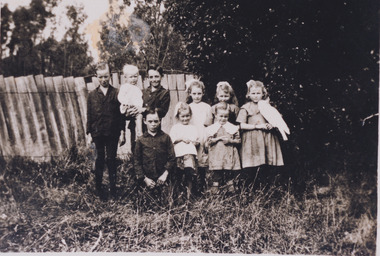
Audio - Oral History, Jennifer Williams, Evelyn Jensen, 13th April 2000
... ...gold rush...work...gold was already gone. Miss Jensen's mother died when Miss Jensen was sixteen. As a result, Miss Jensen had to take care of the children and run the house. This included looking after a few months old baby. Her father was away at work...Mytleford Road Beechworth three mile creek three mile beechworth twin nozzleman Goldrush gold rush work mother young mother children siblings baby grandmother father isolation bush water watertanks kerosene tins wash day bath day creek gardening provide poor money oral history twentieth century recording story Evelyn Jensen / This is a digital copy of a recording that was originally captured on a cassette tape. ...Miss Evelyn Jensen was born in 1908 near Mytleford Road in Beechworth. Miss Jensen was a twin but she also had twelve brothers and sisters. Miss Jensen went to school when she was nine years old but did not enjoy it. Her father was a nozzleman and had a role in finding and collecting gold. More specifically, a nozzleman operated a steel barrel with an interchangeable brass nozzle that sprayed high pressure water onto rock and similar surfaces. This broke down the surface for gold to be found. Unfortunately, when he began most of the gold was already gone. Miss Jensen's mother died when Miss Jensen was sixteen. As a result, Miss Jensen had to take care of the children and run the house. This included looking after a few months old baby. Her father was away at work most days so all of the responsibility fell on her. Her grandmother was present but she was too old to help Miss Jensen. Miss Jensen and her family lived a very long way from the main town and often had to carry kerosene tins full of water half a mile to their house. This was because they have no access to water at their home. This lack of water also meant they had to either bathe in the creek or carry the water back home for a bath. On wash day, they washed their clothes in the creek too. Miss Jensen never married but continued to provide for her family. She spent her days gardening and cooking. They did not have much money so gardening was a way that they provided food for themselves. This oral history recording was part of a project conducted by Jennifer Williams in the year 2000 to capture the everyday life and struggles in Beechworth during the twentieth century. This project involved recording seventy oral histories on cassette tapes of local Beechworth residents which were then published in a book titled: Listen to what they say: voices of twentieth century Beechworth. These cassette tapes were digitised in July 2021 with funds made available by the Friends of the Burke.Miss Jensen's oral history is significant because it demonstrates the struggles of living remotely during this early part of the twentieth century. When Miss Jensen's mother died, she had to take on a lot of responsibility and did not have much support. This history sheds light on these struggles of being a young caregiver but it also gives details on how large families lived in isolated places. An example of this is the way that Miss Jensen often had to do the washing in the creek because that was the only place there was running water. In addition, Miss Jensen's story is significant because her father was a nozzleman. It indicates one of the processes was used to find gold. This oral history account is socially and historically significant as it is a part of a broader collection of interviews conducted by Jennifer Williams which were published in the book 'Listen to what they say: voices of twentieth-century Beechworth.' While the township of Beechworth is known for its history as a gold rush town, these accounts provide a unique insight into the day-to-day life of the town's residents during the 20th century, many of which will have now been lost if they had not been preserved.This is a digital copy of a recording that was originally captured on a cassette tape. The cassette tape is black with a horizontal white strip and is currently stored in a clear flat plastic rectangular container. It holds up 40 minutes of recordings on each sideEvelyn Jensen /mytleford road, beechworth, three mile creek, three mile beechworth, twin, nozzleman, goldrush, gold rush, work, mother, young mother, children, siblings, baby, grandmother, father, isolation, bush, water, watertanks, kerosene tins, wash day, bath day, creek, gardening, provide, poor, money, oral history, twentieth century, recording, story -
 Bendigo Historical Society Inc.
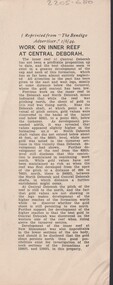
Document - MCCOLL, RANKIN AND STANISTREET COLLECTION: NEW MONUMENT GMC N/L - WORK ON INNER REEF AT CENTRAL DEBORAH, 1/6/1944
... ... gold mining... Work...ORGANIZATION Business new monument gmc n/l McColl Rankin & Stanistreet New Monument GMC Central Deborah Mine Bendigo Advertiser gold mining Work on Inner Reef at Central Deborah McColl, Rankin & Stanistreet Document. ...Document. Article reprinted from the Bendigo Advertiser 1/6/1944. Work on inner reef at Central Deborah. Number of copies, all the same.McColl, Rankin & Stanistreetorganization, business, new monument gmc n/l, mccoll, rankin & stanistreet, new monument gmc, central deborah mine, bendigo advertiser, gold mining, work on inner reef at central deborah -
 Embroiderers Guild, Victoria
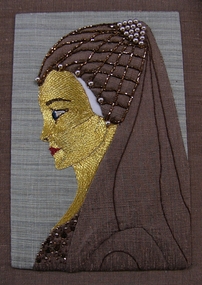
Artwork, other - Metal Thread Embroidery, Edna Wark, "Mistress Mary" Edna Wark, 1975
... Panel embroidered in gold work (or nue) and embellished with beads. ...Embroidery Metal thread Picture 1960-80 Australia Panel embroidered in gold work (or nue) and embellished with beads. ...Panel embroidered in gold work (or nue) and embellished with beads. "Mistress Mary" is dressed in medieval dress of brown silk on a dull green background.embroidery, metal thread, picture, 1960-80, australia -
 Whitehorse Historical Society Inc.
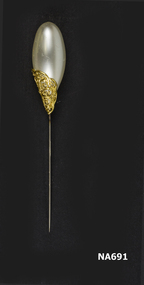
Accessory - Hat Pin
... Large pearl with gold filigree work on base of hat pin...costume accessories hat accessories Large pearl with gold filigree work on base of hat pin Accessory Hat Pin ...Large pearl with gold filigree work on base of hat pincostume accessories, hat accessories -
 Bendigo Historical Society Inc.
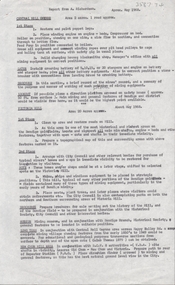
Document - VICTORIA HILL - WORK STAGES FOR THE CENTRAL NELL GWYNNE AND VICTORIA HILL
... Gold...Victoria Hill... Work...DOCUMENT Gold Victoria Hill Work Stages for the Central Nell Gwynne Victoria Hill and New Chum Hill Areas City Council Historical Society Bendigo Branch Caleb Thomas 1879 B C V 8 Lazarus Old Chum New Chum and Victoria P M G Repeater Station Two typed copies (a & b) of restoration plans for the Central Nell Gwynne and Victoria Hill areas. ...Two typed copies (a & b) of restoration plans for the Central Nell Gwynne and Victoria Hill areas. Notes list first and second stages for the work to be carried out. Notes dated ''about May 1968''. New Chum Hill Area is also mentioned.document, gold, victoria hill, work stages for the central nell gwynne, victoria hill and new chum hill areas, city council, historical society bendigo branch, caleb thomas 1879, b c v 8, lazarus old chum, new chum and victoria, p m g repeater station -
 Embroiderers Guild, Victoria
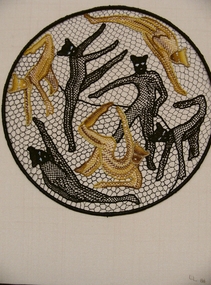
Artwork, other - "The Jellicle Ball" Needle Lace Picture, Lorna M. Law, "The Jellicle Ball", 1986
... Seven cats in black and golds, worked in needle-lace inside a 27" ring wrapped in black thread, the whole mounted on a soft-gold fabriic, and mounted on black, in a narrow black frame. ...Embroidery Pictures Needle lace Australia 1980-2000 Seven cats in black and golds, worked in needle-lace inside a 27" ring wrapped in black thread, the whole mounted on a soft-gold fabriic, and mounted on black, in a narrow black frame. ...Designed and made by Lorna Law, with inspiration from the program of the "Cats" musical, and her daughter's gymnastic exercises.Seven cats in black and golds, worked in needle-lace inside a 27" ring wrapped in black thread, the whole mounted on a soft-gold fabriic, and mounted on black, in a narrow black frame. Cats eyes are silver metallic thread.embroidery, pictures, needle lace, australia, 1980-2000 -
 Bendigo Historical Society Inc.
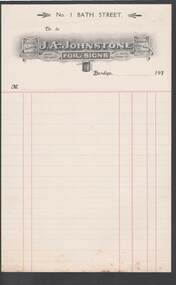
Document - CAMBRIDGE PRESS COLLECTION: ACCOUNT - J. A. JOHNSTONE
... Johnstone, General Advertising Contractor, No. 1 Bath Lane, Bendigo. Aluminium & Gold Work a Speciality. Date line ends 193-.Decorative work around the name and a paint pot and brush underneath. ...Johnstone, General Advertising Contractor, No. 1 Bath Lane, Bendigo. Aluminium & Gold Work a Speciality. Date line ends 193-.Decorative work around the name and a paint pot and brush underneath. ...Account page from J. A. Johnstone, General Advertising Contractor, No. 1 Bath Lane, Bendigo. Aluminium & Gold Work a Speciality. Date line ends 193-.Decorative work around the name and a paint pot and brush underneath. Printed in shades of grey with red cash lines.business, printers, cambridge press, cambridge press collection, j a johnstone -
 Embroiderers Guild, Victoria
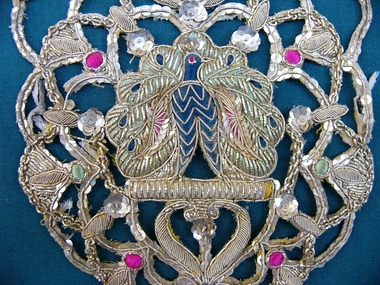
Accessory - Neck piece
... (Cutwork) Gold work, using a variety of bullions and sequins. ...Embroidery Collars Metal thread work India (Cutwork) Gold work, using a variety of bullions and sequins. ...(Cutwork) Gold work, using a variety of bullions and sequins. Peacock motif is the central point at front of collar, composed of bullions, sequins and silk embroidery, also red and blue/green dots of silk embroidery on long over shoulders hands. Collar ties at back of neck with gilt threads and tassels.embroidery, collars, metal thread work, india -
 The Beechworth Burke Museum
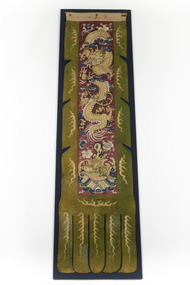
Textile - Banner, c1872
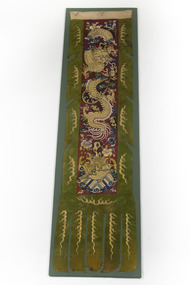
... The embroidery is predominantly gold work with both plyed and floss silk threads....The embroidery is predominantly gold work with both plyed and floss silk threads. ...This banner was one of five banners gifted to the Beechworth Chinese community in recognition of their support of the Hospital and Benevolent Asylum in 1875, from the Carnival Committee. These banners had been purchased in China by a social envoy from Beechworth then presented to the Chinese community during the Beechworth Fine Arts Exhibition in May of that same year, by Donald Fiddes, President of the Ovens District Hospital. The Burke Museum's Chinese Collection presents the history of Chinese settlement in Beechworth from 1856 and its involvement in local community affairs in the second half of the 19th century. In settling in the area they formed their own community with distinctive Chinese cultural traditions, forming their own 'camps' with laid out streets, housing a Temple, Chinese Theatre and restaurants, hotels, stores, gambling houses and dwellings. Members of the Chinese community took an active interest in town affairs and were generous donors to the appeal to build the Ovens District Hospital in 1856/7. The vibrant colours and dynamic graphics of the silk embroidered Chinese banners were a highlight of Beechworth Charitable processions that took place in the main street. Two of the Chinese banners were conserved for the Burke Museum in 2006 by Carol Campbell of Phoenix Conservation Services with funding from Victoria’s Heritage Grants. In 2015, with the enormous support of the Copland Foundation and fundraising activities by the Friends of the Bur Museum Committee, conservation of the third banner was undertaken by Artlab Australia in Adelaide.The banners display traditional Chinese textile techniques and are visually beautiful and very rare and are considered of local and national significance, with the potential to be deemed internationally significant.Multi panelled banner with embroidery and applied design motifs on front. The front panels have been constructed using strips of various weaves and colours of silk that have been embroidered or had a design applied prior to the overall construction of the piece. The embroidery is predominantly gold work with both plyed and floss silk threads.beechworth, burke museum, chinese, benevolent asylum, ovens district hospital, beechworth carnival processions, carnival, processions, beechworth chinese community, beechworth fine arts exhibition, donald fiddes -
 The Beechworth Burke Museum
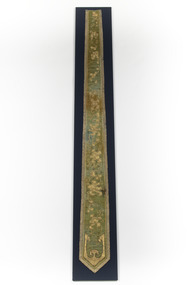
Textile - Banner, c1872
... The embroidery is predominantly gold work with both plyed and floss silk threads....The embroidery is predominantly gold work with both plyed and floss silk threads. ...This banner was one of five banners gifted to the Beechworth Chinese community in recognition of their support of the Hospital and Benevolent Asylum in 1875, from the Carnival Committee. These banners had been purchased in China by a social envoy from Beechworth then presented to the Chinese community during the Beechworth Fine Arts Exhibition in May of that same year, by Donald Fiddes, President of the Ovens District Hospital. The Burke Museum's Chinese Collection presents the history of Chinese settlement in Beechworth from 1856 and its involvement in local community affairs in the second half of the 19th century. In settling in the area they formed their own community with distinctive Chinese cultural traditions, forming their own 'camps' with laid out streets, housing a Temple, Chinese Theatre and restaurants, hotels, stores, gambling houses and dwellings. Members of the Chinese community took an active interest in town affairs and were generous donors to the appeal to build the Ovens District Hospital in 1856/7. The vibrant colours and dynamic graphics of the silk embroidered Chinese banners were a highlight of Beechworth Charitable processions that took place in the main street. Two of the Chinese banners were conserved for the Burke Museum in 2006 by Carol Campbell of Phoenix Conservation Services with funding from Victoria’s Heritage Grants. In 2015, with the enormous support of the Copland Foundation and fundraising activities by the Friends of the Bur Museum Committee, conservation of the third banner was undertaken by Artlab Australia in Adelaide. The banners display traditional Chinese textile techniques and are visually beautiful and very rare and are considered of local and national significance, with the potential to be deemed internationally significant.Multi panelled banner with embroidery and applied design motifs on front. The front panels have been constructed using strips of various weaves and colours of silk that have been embroidered or had a design applied prior to the overall construction of the piece. The embroidery is predominantly gold work with both plyed and floss silk threads.beechworth, burke museum, chinese, benevolent asylum, ovens district hospital, beechworth carnival processions, carnival, processions, beechworth chinese community, beechworth fine arts exhibition, donald fiddes -
 The Beechworth Burke Museum
Textile - Banner, c1872
... The embroidery is predominantly gold work with both plyed and floss silk threads. ...The embroidery is predominantly gold work with both plyed and floss silk threads. ...This banner was one of five banners gifted to the Beechworth Chinese community in recognition of their support of the Hospital and Benevolent Asylum in 1875, from the Carnival Committee. These banners had been purchased in China by a social envoy from Beechworth then presented to the Chinese community during the Beechworth Fine Arts Exhibition in May of that same year, by Donald Fiddes, President of the Ovens District Hospital. The Burke Museum's Chinese Collection presents the history of Chinese settlement in Beechworth from 1856 and its involvement in local community affairs in the second half of the 19th century. In settling in the area they formed their own community with distinctive Chinese cultural traditions, forming their own 'camps' with laid out streets, housing a Temple, Chinese Theatre and restaurants, hotels, stores, gambling houses and dwellings. Members of the Chinese community took an active interest in town affairs and were generous donors to the appeal to build the Ovens District Hospital in 1856/7. The vibrant colours and dynamic graphics of the silk embroidered Chinese banners were a highlight of Beechworth Charitable processions that took place in the main street. Two of the Chinese banners were conserved for the Burke Museum in 2006 by Carol Campbell of Phoenix Conservation Services with funding from Victoria’s Heritage Grants. In 2015, with the enormous support of the Copland Foundation and fundraising activities by the Friends of the Bur Museum Committee, conservation of the third banner was undertaken by Artlab Australia in Adelaide. The banners display traditional Chinese textile techniques and are visually beautiful and very rare and are considered of local and national significance, with the potential to be deemed internationally significant.Multi panelled banner with embroidery and applied design motifs on front. The front panels have been constructed using strips of various weaves and colours of silk that have been embroidered or had a design applied prior to the overall construction of the piece. The embroidery is predominantly gold work with both plyed and floss silk threads. beechworth, burke museum, chinese, benevolent asylum, ovens district hospital, beechworth carnival processions, carnival, processions, beechworth chinese community, beechworth fine arts exhibition, donald fiddes -
 Embroiderers Guild, Victoria
Headwear - Goldwork Pakistani Hat, Early 1970's
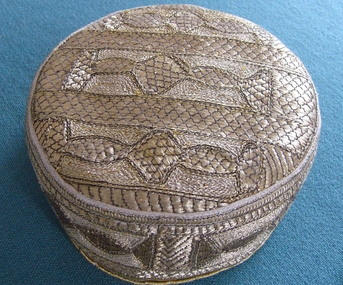
... Cap (man's) in gold laid work, hand stitched on heavy cream cotton, couching stitched in white and dark brown. ...Goldwork Hats Cap Embroidery Hat Pakistan Metal thread Cap (man's) in gold laid work, hand stitched on heavy cream cotton, couching stitched in white and dark brown. ...Bought by donor in 1978 in Pakistan.Cap (man's) in gold laid work, hand stitched on heavy cream cotton, couching stitched in white and dark brown. Assembled by machine.goldwork, hats, cap, embroidery, hat, pakistan, metal thread -
 Embroiderers Guild, Victoria
Textile - Metal Thread Embroidery "Justicia" Edna Wark, Mrs Edna Wark, "Justicia", 1960-80
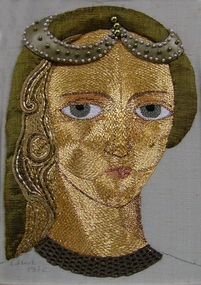
... This is also an 18th century technique of using gold thread and is mentioned by Beryl Dean. Modern gold work - embroidered by Mrs Wark from a design by Con. ...Face entirely worked in Japanese gold thread using the Chinese technique which has no gold ends taken to the back. ...This is also an 18th century technique of using gold thread and is mentioned by Beryl Dean. Modern gold work - embroidered by Mrs Wark from a design by Con. ...This is also an 18th century technique of using gold thread and is mentioned by Beryl Dean. Modern gold work - embroidered by Mrs Wark from a design by Con. Bolton. Taken from a figure of Justicia, the original is hanging in the Senior Common Rooms of Trinity College, Melbourne.Face entirely worked in Japanese gold thread using the Chinese technique which has no gold ends taken to the back. Padded felt is used for the head-dress. Framed in gold with back exposed for study.embroidery, panel, 1960-80, australia, goldwork -
 Embroiderers Guild, Victoria
Textile - Contemporary Felt and Embroidered Panel, Amanda (Mandy) Ginsberg, 2000
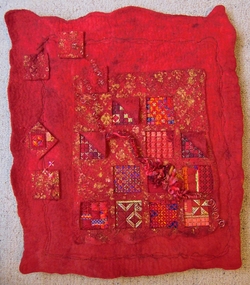
... Red felt (handmade), canvas work, gold and metal threads, beading, and machine embroidery....Embroidery Canvas work Felt Australia 2000-2020 Panels Red felt (handmade), canvas work, gold and metal threads, beading, and machine embroidery. ...Red felt (handmade), canvas work, gold and metal threads, beading, and machine embroidery.embroidery, canvas work, felt, australia, 2000-2020, panels -
 Wodonga & District Historical Society Inc
Textile - Hamilton-Smith Collection Beaded Textile - late 1800s - early 1900s
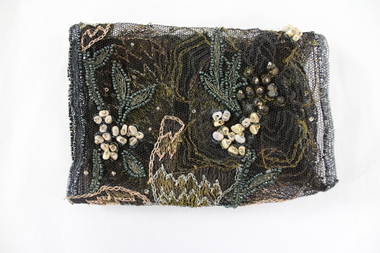
... Bronze and gold embroidery and bead work on black mesh....work of women. Hand sewing and embroidery was central in the everyday lives and domestic roles of women. This item is unique, handmade and has a known owner. It forms part of a significant and representative historical collection which reflects the local history of Wodonga. It contributes to our understanding of social and family life in early twentieth century Wodonga, as well as providing interpretative capacity for themes including local history, social history and women’s history. needlework beading sewing sew hamilton-smith collection hamilton-smith ellwood handmade domestic women women's history Bronze and gold embroidery and bead work on black mesh. ...The Hamilton-Smith collection was donated by the children of Grace Mary Hamilton-Smith nee Ellwood (1911-2004) and John Hamilton-Smith (1909-1984) who settled in Wodonga in the 1940s. The Ellwood family had lived in north-east Victoria since the late 1800s. Grace’s mother, Rosina Ellwood nee Smale, was the first teacher at Baranduda in 1888, and a foundation member of the C.W.A. Rosina and her husband Mark retired to Wodonga in 1934. Grace and John married at St. David’s Church, Albury in 1941. John was a grazier, and actively involved in Agricultural Societies. The collection contains significant items which reflect the local history of Wodonga, including handmade needlework, books, photographs, a wedding dress, maps, and material relating to the world wars. In the nineteenth and early twentieth century prior to the mass production of clothing and textiles, needlework, alongside motherhood, was the defining work of women. Hand sewing and embroidery was central in the everyday lives and domestic roles of women.This item is unique, handmade and has a known owner. It forms part of a significant and representative historical collection which reflects the local history of Wodonga. It contributes to our understanding of social and family life in early twentieth century Wodonga, as well as providing interpretative capacity for themes including local history, social history and women’s history.Bronze and gold embroidery and bead work on black mesh.needlework, beading, sewing, sew, hamilton-smith collection, hamilton-smith, ellwood, handmade, domestic, women, women's history -
 Embroiderers Guild, Victoria
Textile - Braids, 20th C
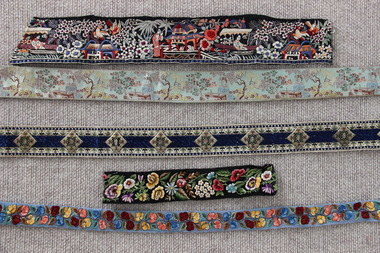
... 5 braid pieces A. machine made, woven on cream background, dark blue centre with gold work, diamonds at regular intervals B. ...Embroidery Weaving 5 braid pieces A. machine made, woven on cream background, dark blue centre with gold work, diamonds at regular intervals B. ...5 braid pieces A. machine made, woven on cream background, dark blue centre with gold work, diamonds at regular intervals B. Green woven oriental lady in garden. C. Black silk ribbon, hand embroidered with Chinese figures, trees, flowers, pagodas etc. D. Blue crepe, machine embroidered flowers in a repeating pattern E. Black crepe, machine embroidered flowers, pansies, roses etc.embroidery, weaving -
 Embroiderers Guild, Victoria
Textile - Goldwork Bible Book Mark, Mrs Naylor, Mid 20th century
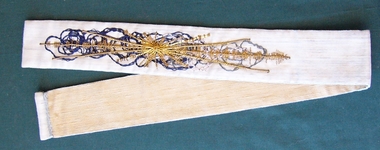
... Bible marker on pale blue textured fabric decorated with free hand embroidery in darker blue which forms a background for a modern style of gold cross worked in metal thread embroidery....Embroidery Surface stitchery Metal work Mid 20th Century England Ecclesiastical Bible marker on pale blue textured fabric decorated with free hand embroidery in darker blue which forms a background for a modern style of gold cross worked in metal thread embroidery. ...Designed and worked by Mrs Naylor. Sent from The Embroiderers Guild, London for the George's Exhibition in 1966 and purchased by the Victorian Guild members.Bible marker on pale blue textured fabric decorated with free hand embroidery in darker blue which forms a background for a modern style of gold cross worked in metal thread embroidery.embroidery, surface stitchery, metal work, mid 20th century, england, ecclesiastical -
![Ceramic - Cup and saucer, Paragon, Miss Eileen Emms cup and saucer, [ca. 1930's]](/media/collectors/50187a8f023fd7201471f198/items/687eec868a45f235b0caa562/item-media/68817f930511e94fb451bd54/item-fit-380x285.jpg?cb=6) Alfred Hospital Nurses League - Nursing History Collection
Alfred Hospital Nurses League - Nursing History CollectionCeramic - Cup and saucer, Paragon, Miss Eileen Emms cup and saucer, [ca. 1930's]
... Teacup and saucer, a striking medallion pattern (specifically a Double Warrant Bone China Medallion design) in the centre of the saucer and cup interior, surrounded by intricate gold filigree work on a rich burgundy background....In addition, on the base of saucer (in burgundy) A 822/1 0 Teacup and saucer, a striking medallion pattern (specifically a Double Warrant Bone China Medallion design) in the centre of the saucer and cup interior, surrounded by intricate gold filigree work on a rich burgundy background. ...cup & saucer where a farewell present to Miss Eileen Emms, Charge Sister Ward 3 (1936) by Staff Nurses of Alfred Hospital when she joined Women's Royal navy Nursing Service during WW 11Teacup and saucer, a striking medallion pattern (specifically a Double Warrant Bone China Medallion design) in the centre of the saucer and cup interior, surrounded by intricate gold filigree work on a rich burgundy background.on base of both cup and saucer are the words (in gilt) PARAGON by appointment to HM The Queen & Queen Mary fine bone china England Regd. And two coats of arms. In addition, on the base of saucer (in burgundy) A 822/1 0 -
 Williamstown Historical Society Inc
Functional object - Embossing stamp
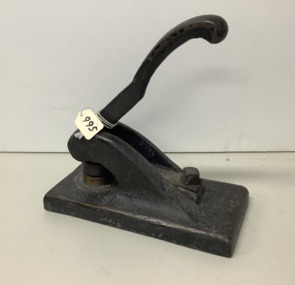
... The press is painted with black enamel paint and gold ‘coach-work’ filligree. ...The press is painted with black enamel paint and gold ‘coach-work’ filligree. Functional object Embossing stamp ...This embossing press was used to stamp, authorise or otherwise identify documents relating to the “United Ancient Order of Druids” Nelson Lodge No. 257. Heavy cast iron implement with spring loaded lever, which when depressed brings two dies together to make an impression on paper. The press is painted with black enamel paint and gold ‘coach-work’ filligree. Impression Mark: NELSON LODGE NO 257 U.A.O.D. -
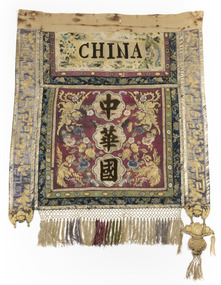 The Beechworth Burke Museum
Textile - Banner, c1872
... The embroidery is predominantly gold work with both plyed and floss silk threads. ...The embroidery is predominantly gold work with both plyed and floss silk threads. ...This banner was one of five banners gifted to the Beechworth Chinese community in recognition of their support of the Hospital and Benevolent Asylum in 1875, from the Carnival Committee. These banners had been purchased in China by a social envoy from Beechworth then presented to the Chinese community during the Beechworth Fine Arts Exhibition in May of that same year, by Donald Fiddes, President of the Ovens District Hospital. The Burke Museum's Chinese Collection presents the history of Chinese settlement in Beechworth from 1856 and its involvement in local community affairs in the second half of the 19th century. In settling in the area they formed their own community with distinctive Chinese cultural traditions, forming their own 'camps' with laid out streets, housing a Temple, Chinese Theatre and restaurants, hotels, stores, gambling houses and dwellings. Members of the Chinese community took an active interest in town affairs and were generous donors to the appeal to build the Ovens District Hospital in 1856/7. The vibrant colours and dynamic graphics of the silk embroidered Chinese banners were a highlight of Beechworth Charitable processions that took place in the main street. Two of the Chinese banners were conserved for the Burke Museum in 2006 by Carol Campbell of Phoenix Conservation Services with funding from Victoria’s Heritage Grants. In 2015, with the enormous support of the Copland Foundation and fundraising activities by the Friends of the Bur Museum Committee, conservation of the third banner was undertaken by Artlab Australia in Adelaide. The banners display traditional Chinese textile techniques and are visually beautiful and very rare and are considered of local and national significance, with the potential to be deemed internationally significant.Multi panelled banner with embroidery and applied design motifs on front. Back panel is painted design of two men. The front panels have been constructed using strips of various weaves and colours of silk that have been embroidered or had a design applied prior to the overall construction of the piece. The embroidery is predominantly gold work with both plyed and floss silk threads. Silk macrame fringe and tassels to central panel and padded lotus and bowl motif hanging tassel from side panels. Velvet lettering applied to front "CHINA" CHINA /beechworth, burke museum, chinese, benevolent asylum, ovens district hospital, beechworth carnival processions, carnival, processions, beechworth chinese community, beechworth fine arts exhibition, donald fiddes
