
Showing 73 items matching " great depression 1930s"
-
 Linton and District Historical Society Inc
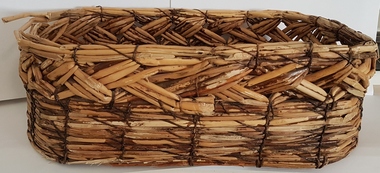
Basket, Reed Basket, Linton
... ... Great Depression 1930s...Rectangular woven basket hand-made at Linton during the Great Depression (1930s). Reeds used to make it came from the old Linton Reservoir on Mortchup Road....Baskets Handcrafts Great Depression 1930s Rectangular woven basket hand-made at Linton during the Great Depression (1930s). ...Rectangular woven basket hand-made at Linton during the Great Depression (1930s). Reeds used to make it came from the old Linton Reservoir on Mortchup Road.baskets, handcrafts, great depression 1930s -
 Greensborough Historical Society
Oral History, Mr and Mrs Coe; David and Grace Lowe; Thomas and Irene Black are interviewed by Bev Moss in 1980, 1930o
... ...great depression 1930s...1930s in Greensborough. These oral histories relate life in a country town during the Great Depression. victor preston coe david low grace low thomas black irene black great depression 1930s greensborough diamond valley oral history bev moss Copy of original handwritten manuscript (14 pages) and typed transcript.(4 pages) Mr and Mrs Coe; David and Grace Lowe; Thomas and Irene Black are interviewed by Bev Moss in 1980. ...These interviews took place in 1980 as part of an Oral History Unit at La Trobe University. The interviewer, Bev Moss, is a GHS member. The interviewees were Mr and Mrs (Victor Preston) Coe, David and Grace Low and Thomas and Irene Black. They discuss life in the 1930s in Greensborough.These oral histories relate life in a country town during the Great Depression.Copy of original handwritten manuscript (14 pages) and typed transcript.(4 pages)victor preston coe, david low, grace low, thomas black, irene black, great depression 1930s, greensborough, diamond valley, oral history, bev moss -
 Greensborough Historical Society
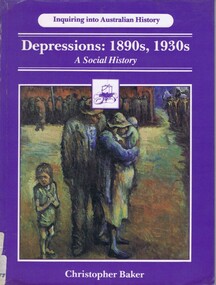
Book, Christopher Baker et al, Depressions: 1890s, 1930s: a social history, by Christopher Baker, 1982_
... ...great depression 1930s...This secondary school textbook looks at life in Australia during the depressions of the 1890s and 1930s. australia history great depression 1930s economic depressions Signed Faye Fort on title page. ...This secondary school textbook looks at life in Australia during the depressions of the 1890s and 1930s.Paperback, 92 p. illus.Signed Faye Fort on title page.australia history, great depression 1930s, economic depressions -
 Kew Historical Society Inc
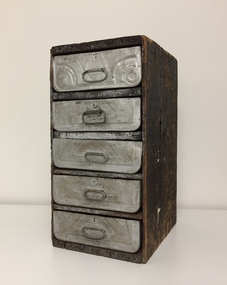
Furniture - Toolbox constructed from recycled materials
... ...great depression - 1930s - australia...It is a fine example of vernacular furniture made of recycled materials . furniture - recycled - depession era - 1930s great depression - 1930s - australia warren trestrail salvation army vernacular furniture Depression-era toolbox constructed from recycled kerosene tins and parts of wooden packing boxes. ...Toolbox, made by Salvation Army Brigadier Warren Trestrail (1895-1971), during the Great Depression from recycled kerosene tins and packing boxes. It proved to be a useful piece of furniture as the family moved around Australia during various postings within the Australian States and Territories. In World War II, Warren Trestrail embarked with the first convoy of soldiers from Australia to the Middle East and served as Salvation Army welfare officer through the Libyan campaign, at Tobruk, and in Greece. In 1942, it was announced that Salvation Army war services at Darwin would be placed under his direction. He had previously been in charge of South Australian war activities. The item was donated to the Society in 2001 by Sadie Trestrail, who had been a teacher at Kew East Primary School for many years. It is a fine example of vernacular furniture made of recycled materials .Depression-era toolbox constructed from recycled kerosene tins and parts of wooden packing boxes. The five tin drawers are made of sections of kerosene tins with handles soldered to the centre of each new drawer. A number of drawers have separators constructed of tin or aluminium. The wooden planks encasing the the drawers are covered with a degraded shellac coating. An analysis of the interior indicates that the brand names of the original parts are largely extant. furniture - recycled - depession era - 1930s, great depression - 1930s - australia, warren trestrail, salvation army, vernacular furniture -
 Kew Historical Society Inc
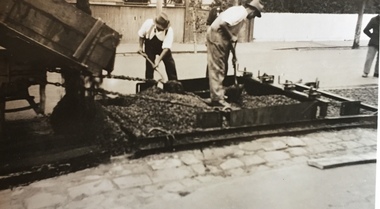
Photograph - Street Works, Studley Park Road, March 1934
... city of kew -- public works -- great depression -- 1930s...Great Depression included bituminising major roads in the district. This photograph of Council works originated in the City of Kew Engineers Department as a record of works undertaken. It was given to the collection by a Mrs Fisher in 1998. Well provenanced photograph of Council-funded public works in Kew during the Great Depression. roadworks -- kew (vic.) street works -- kew (vic.) public works kew (vic.) studley park road -- kew (vic.) city of kew -- engineers department city of kew -- public works -- great depression -- 1930s Typed reverse: "B4 / Kew C.C. / Spreading premixed material on Studley Park Road with drag spreader, March 1934" Original sepia monochrome positive of Council workers spreading bitumen in Studley Park Road, Kew. ...Studley Park Road, like most streets in Kew, was originally a dirt road. Street works during the Great Depression included bituminising major roads in the district. This photograph of Council works originated in the City of Kew Engineers Department as a record of works undertaken. It was given to the collection by a Mrs Fisher in 1998.Well provenanced photograph of Council-funded public works in Kew during the Great Depression. Original sepia monochrome positive of Council workers spreading bitumen in Studley Park Road, Kew.Typed reverse: "B4 / Kew C.C. / Spreading premixed material on Studley Park Road with drag spreader, March 1934"roadworks -- kew (vic.), street works -- kew (vic.), public works kew (vic.), studley park road -- kew (vic.), city of kew -- engineers department, city of kew -- public works -- great depression -- 1930s -
 Kew Historical Society Inc
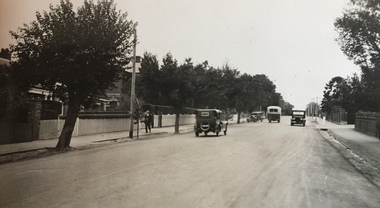
Photograph - Street Works, Studley Park Road, March 1934
... city of kew -- public works -- great depression -- 1930s...Great Depression included bituminising major roads in the district. This photograph of Council works originated in the City of Kew Engineers Department as a record of works undertaken. It was given to the collection by a Mrs Fisher in 1998. Well provenanced photograph of Council-funded public works in Kew during the Great Depression. roadworks -- kew (vic.) street works -- kew (vic.) public works kew (vic.) studley park road -- kew (vic.) city of kew -- engineers department city of kew -- public works -- great depression -- 1930s Typed reverse: "B4 / Kew C.C. / Studley Park Road after surfacing with one coat of premixed material spread with drag, March 1934" Original sepia monochrome positive of Studley Park Road, Kew. ...Studley Park Road, like most streets in Kew, was originally a dirt road. Street works during the Great Depression included bituminising major roads in the district. This photograph of Council works originated in the City of Kew Engineers Department as a record of works undertaken. It was given to the collection by a Mrs Fisher in 1998.Well provenanced photograph of Council-funded public works in Kew during the Great Depression. Original sepia monochrome positive of Studley Park Road, Kew.Typed reverse: "B4 / Kew C.C. / Studley Park Road after surfacing with one coat of premixed material spread with drag, March 1934"roadworks -- kew (vic.), street works -- kew (vic.), public works kew (vic.), studley park road -- kew (vic.), city of kew -- engineers department, city of kew -- public works -- great depression -- 1930s -
 Kew Historical Society Inc
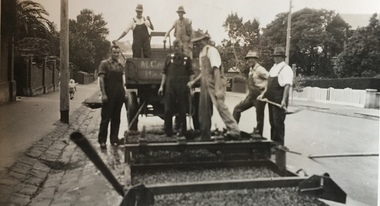
Photograph - Street Works, Studley Park Road, March 1934
... city of kew -- public works -- great depression -- 1930s...Great Depression included bituminising major roads in the district. This photograph of Council works originated in the City of Kew Engineers Department as a record of works undertaken. It was given to the collection by a Mrs Fisher in 1998. Well provenanced photograph of Council-funded public works in Kew during the Great Depression. roadworks -- kew (vic.) street works -- kew (vic.) public works kew (vic.) studley park road -- kew (vic.) city of kew -- engineers department city of kew -- public works -- great depression -- 1930s Typed reverse: "B4 / Kew C.C. / Spreading premixed material on Studley Park Road with drag spreader, view from rear of machine, March 1934" Original sepia monochrome positive of Council workers standing on and beside a dray in Studley Park Road, Kew while resurfacing of the street was taking place. ...Studley Park Road, like most streets in Kew, was originally a dirt road. Street works during the Great Depression included bituminising major roads in the district. This photograph of Council works originated in the City of Kew Engineers Department as a record of works undertaken. It was given to the collection by a Mrs Fisher in 1998.Well provenanced photograph of Council-funded public works in Kew during the Great Depression. Original sepia monochrome positive of Council workers standing on and beside a dray in Studley Park Road, Kew while resurfacing of the street was taking place. The Kew Junction is just visible behind the men.Typed reverse: "B4 / Kew C.C. / Spreading premixed material on Studley Park Road with drag spreader, view from rear of machine, March 1934"roadworks -- kew (vic.), street works -- kew (vic.), public works kew (vic.), studley park road -- kew (vic.), city of kew -- engineers department, city of kew -- public works -- great depression -- 1930s -
 Kew Historical Society Inc
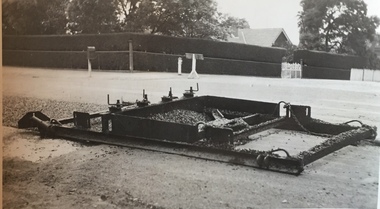
Photograph - Street Works, Studley Park Road, March 1934
... city of kew -- public works -- great depression -- 1930s...Great Depression included bituminising major roads in the district. This photograph of Council works originated in the City of Kew Engineers Department as a record of works undertaken. It was given to the collection by a Mrs Fisher in 1998. Well provenanced photograph of Council-funded public works in Kew during the Great Depression. roadworks -- kew (vic.) street works -- kew (vic.) public works kew (vic.) studley park road -- kew (vic.) city of kew -- engineers department city of kew -- public works -- great depression -- 1930s Typed reverse: "B4 / Kew C.C. / Drag spreader used for premixed material on Studley Park Road, showing end of strip just with spread, with unsurfaced work on left and completed section on right, March 1934" Original sepia photographic positive of a drag used to spread bitumen in Studley Park Road, Kew. ...Studley Park Road, like most streets in Kew, was originally a dirt road. Street works during the Great Depression included bituminising major roads in the district. This photograph of Council works originated in the City of Kew Engineers Department as a record of works undertaken. It was given to the collection by a Mrs Fisher in 1998.Well provenanced photograph of Council-funded public works in Kew during the Great Depression. Original sepia photographic positive of a drag used to spread bitumen in Studley Park Road, Kew.Typed reverse: "B4 / Kew C.C. / Drag spreader used for premixed material on Studley Park Road, showing end of strip just with spread, with unsurfaced work on left and completed section on right, March 1934"roadworks -- kew (vic.), street works -- kew (vic.), public works kew (vic.), studley park road -- kew (vic.), city of kew -- engineers department, city of kew -- public works -- great depression -- 1930s -
 Kew Historical Society Inc
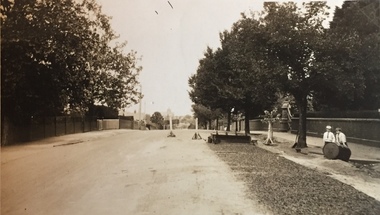
Photograph - Street Works, Studley Park Road, March 1934
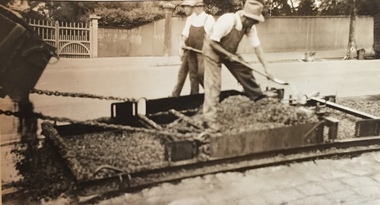
... city of kew -- public works -- great depression -- 1930s...Great Depression included bituminising major roads in the district. This photograph of Council works originated in the City of Kew Engineers Department as a record of works undertaken. It was given to the collection by a Mrs Fisher in 1998. Well provenanced photograph of Council-funded public works in Kew during the Great Depression. roadworks -- kew (vic.) street works -- kew (vic.) public works kew (vic.) studley park road -- kew (vic.) city of kew -- engineers department city of kew -- public works -- great depression -- 1930s Typed reverse: "B4 / Kew C.C. / Studley Park Road showing drag spread surfacing with premixed material, unrolled material on the right, March 1934" Original sepia photographic positive of Studley Park Road, Kew while resurfacing of the street was taking place. ...Studley Park Road, like most streets in Kew, was originally a dirt road. Street works during the Great Depression included bituminising major roads in the district. This photograph of Council works originated in the City of Kew Engineers Department as a record of works undertaken. It was given to the collection by a Mrs Fisher in 1998.Well provenanced photograph of Council-funded public works in Kew during the Great Depression. Original sepia photographic positive of Studley Park Road, Kew while resurfacing of the street was taking place. The Kew Junction is just visible in the distance. Boys sitting on a drum at right. Behind them is the brick fence and front entrance to Tara Hall.Typed reverse: "B4 / Kew C.C. / Studley Park Road showing drag spread surfacing with premixed material, unrolled material on the right, March 1934"roadworks -- kew (vic.), street works -- kew (vic.), public works kew (vic.), studley park road -- kew (vic.), city of kew -- engineers department, city of kew -- public works -- great depression -- 1930s -
 Kew Historical Society Inc
Photograph - Street Works, Studley Park Road, March 1934
... city of kew -- public works -- great depression -- 1930s...Great Depression included bituminising major roads in the district. This photograph of Council works originated in the City of Kew Engineers Department as a record of works undertaken. It was given to the collection by a Mrs Fisher in 1998. Well provenanced photograph of Council-funded public works in Kew during the Great Depression. roadworks -- kew (vic.) street works -- kew (vic.) public works kew (vic.) studley park road -- kew (vic.) city of kew -- engineers department city of kew -- public works -- great depression -- 1930s Typed reverse: "B4 / Kew C.C. / Spreading premixed material on Studley Park Road with drag spreader, March 1934" Original sepia photographic positive of Studley Park Road, Kew while resurfacing of the street was taking place. ...Studley Park Road, like most streets in Kew, was originally a dirt road. Street works during the Great Depression included bituminising major roads in the district. This photograph of Council works originated in the City of Kew Engineers Department as a record of works undertaken. It was given to the collection by a Mrs Fisher in 1998.Well provenanced photograph of Council-funded public works in Kew during the Great Depression. Original sepia photographic positive of Studley Park Road, Kew while resurfacing of the street was taking place. Typed reverse: "B4 / Kew C.C. / Spreading premixed material on Studley Park Road with drag spreader, March 1934"roadworks -- kew (vic.), street works -- kew (vic.), public works kew (vic.), studley park road -- kew (vic.), city of kew -- engineers department, city of kew -- public works -- great depression -- 1930s -
 Bendigo Historical Society Inc.
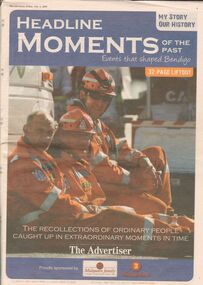
Newspaper - THE ADVERTISER: FRIDAY JULY 3, 2009 HISTORY-EVENTS THAT SHAPED BENDIGO 32 PAGES, 1881
... Newspaper supplement includes images and articles as diverse as the construction of Alexander Fountain in 1881, The Great Depression 1930s, End of World War II 1945, CBD Floods 1949, Queen Elizabeth's Visit 1954, Olympic Games (Melb) and first television in Bendigo 1956, Bendigo farewells local champion horse 1958, Demolition of verandahs on local buildings 1960s, opening of Eppalock 1964, The Vietnam War 1965-1975, The new dragon Sun Loong 1970, The last tram run and Faraday kidnapping 1972, opening of Sacred Heart Cathedral 1977, opening of Hargreaves Mall 1982, Killians Walk Fire and Gaol Siege 1987, Local government Amalgamation 1993, Opening of Marketplace and Discovery Centre 1995, Restoration of Rosalind Park Cascades 1997, Bendigo Tornado 2003. ...Newspaper supplement includes images and articles as diverse as the construction of Alexander Fountain in 1881, The Great Depression 1930s, End of World War II 1945, CBD Floods 1949, Queen Elizabeth's Visit 1954, Olympic Games (Melb) and first television in Bendigo 1956, Bendigo farewells local champion horse 1958, Demolition of verandahs on local buildings 1960s, opening of Eppalock 1964, The Vietnam War 1965-1975, The new dragon Sun Loong 1970, The last tram run and Faraday kidnapping 1972, opening of Sacred Heart Cathedral 1977, opening of Hargreaves Mall 1982, Killians Walk Fire and Gaol Siege 1987, Local government Amalgamation 1993, Opening of Marketplace and Discovery Centre 1995, Restoration of Rosalind Park Cascades 1997, Bendigo Tornado 2003. ...Headline Moments of the Past The Advertiser, Friday July 3, 2009 History - Events That Shaped Bendigo 32 Page Supplement. Newspaper supplement includes images and articles as diverse as the construction of Alexander Fountain in 1881, The Great Depression 1930s, End of World War II 1945, CBD Floods 1949, Queen Elizabeth's Visit 1954, Olympic Games (Melb) and first television in Bendigo 1956, Bendigo farewells local champion horse 1958, Demolition of verandahs on local buildings 1960s, opening of Eppalock 1964, The Vietnam War 1965-1975, The new dragon Sun Loong 1970, The last tram run and Faraday kidnapping 1972, opening of Sacred Heart Cathedral 1977, opening of Hargreaves Mall 1982, Killians Walk Fire and Gaol Siege 1987, Local government Amalgamation 1993, Opening of Marketplace and Discovery Centre 1995, Restoration of Rosalind Park Cascades 1997, Bendigo Tornado 2003. This publication has not been scanned.bendigo, history, bendigo advertiser, alexander fountain construction 1881, bendigo cbd floods 1949, dmolitition of bendigo building verandahs 1960s, last tram run 1972, killians walk fire 1987, bendigo tornado 2003 -
 Orbost & District Historical Society
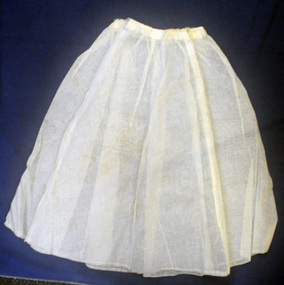
petticoat, 1930's-1940's
... With the Great Depression in the 1930s, narrow skirts returned and petticoats again were unpopular until the end of the decade when revived for some evening, prom, and wedding gowns. ...With the Great Depression in the 1930s, narrow skirts returned and petticoats again were unpopular until the end of the decade when revived for some evening, prom, and wedding gowns. ...This article of clothing is specifically an undergarment to be worn under a skirt or a dress. The petticoat is a separate garment hanging from the waist. In the late 1920s, chiffon dresses with several sheer petticoats became fashionable. With the Great Depression in the 1930s, narrow skirts returned and petticoats again were unpopular until the end of the decade when revived for some evening, prom, and wedding gowns. World War II, with its rationing and general shortage of materials, brought an end to petticoats. Petticoats were revived by Christian Dior in his full-skirted "New Look" of 1947 and tiered, ruffled, stiffened petticoats remained extremely popular during the 1950. Most of the petticoats were netlike crinoline, Worn by Marjorie Burton. It may have been worn underneath dresses with full skirts or may have been designed for a short style wedding dress. Marjorie Burton ( nee Whiteman), born 12 June, in Birmingham, England came to Orbost in 1995. In England she did office work – typing, shorthand and secretarial work - in accountants’ offices and also trained as a comptometrist with Burroughs in London. She came from a middle-class, working, church-going family. Her mother was a milliner who mademany of Marjorie’s clothes, hats and outfits. Marjorie was married in 1938 to a salesman who later became a mechanic in the R.A.F. This item is an example of ahome-made item of clothing and reflects the needlework skills of women in the first half of the twentieth century.A coarse, net, white starched petticoat. It is short and has no bodice. It is home-made, machine stitched and fastens at the waist with metal hooks and eyes. It has four panelspetticoat women's-clothing burton-marjorie -
 Orbost & District Historical Society
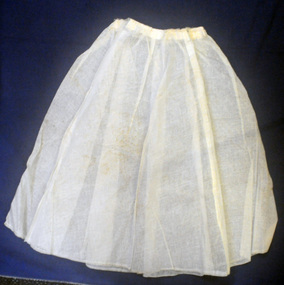
petticoat, 1930's - 1940's
... With the Great Depression in the 1930s, narrow skirts returned and petticoats again were unpopular until the end of the decade when revived for some evening, prom, and wedding gowns. ...With the Great Depression in the 1930s, narrow skirts returned and petticoats again were unpopular until the end of the decade when revived for some evening, prom, and wedding gowns. ...This article of clothing is specifically an undergarment to be worn under a skirt or a dress. The petticoat is a separate garment hanging from the waist. In the late 1920s, chiffon dresses with several sheer petticoats became fashionable. With the Great Depression in the 1930s, narrow skirts returned and petticoats again were unpopular until the end of the decade when revived for some evening, prom, and wedding gowns. World War II, with its rationing and general shortage of materials, brought an end to petticoats. Petticoats were revived by Christian Dior in his full-skirted "New Look" of 1947 and tiered, ruffled, stiffened petticoats remained extremely popular during the 1950. Most of the petticoats were netlike crinoline, Worn by Marjorie Burton. It may have been worn underneath dresses with full skirts or may have been designed for a short style wedding dress. Marjorie Burton ( nee Whiteman), born 12 June, in Birmingham, England came to Orbost in 1995. In England she did office work – typing, shorthand and secretarial work - in accountants’ offices and also trained as a comptometrist with Burroughs in London. She came from a middle-class, working, church-going family. Her mother was a milliner who mademany of Marjorie’s clothes, hats and outfits. Marjorie was married in 1938 to a salesman who later became a mechanic in the R.A.F. This item is an example of a home-made item of clothing and reflects the needlework skills of women in the first half of the twentieth century.A coarse, net, white starched petticoat. It is short and has no bodice. It is home-made, machine stitched and fastens at the waist with metal hooks and eyes. It has four panelspetticoat women's-clothing burton-marjorie -
 Eltham District Historical Society Inc
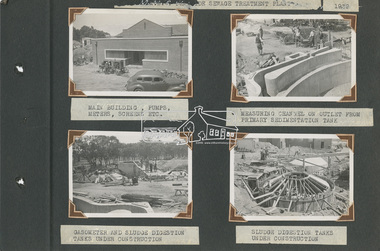
Album - Photograph Album, Alan Gardiner, M.M.B.W Braeside Sewage Treatment Plant Construction, 1939
... Before the construction could commence the Great Depression of the 1930s intervened forcing the shelving of its plans. ...Before the construction could commence the Great Depression of the 1930s intervened forcing the shelving of its plans. ...In April 1928 the MMBW had the land and the plans for what they were to construct but the timing of the actual building did not proceed as planned. Before the construction could commence the Great Depression of the 1930s intervened forcing the shelving of its plans. The new owners then offered the land for lease resulting in Frederick Werrett taking the opportunity to take up the land he formerly owned to continue his market gardening activities of growing potatoes, onions and other crops. The land and improvements made by Syme were leased in 1929 to Harry Telford a trainer from New South Wales. Phar Lap grazed there for a short time. [9] However the population of Melbourne continued to grow and the need for a sewerage treatment plant did not go away. In 1939 when the effects of the Depression had dissipated work on the Sewerage Effluent Treatment Plant commenced and the following year in October the Premier of the State, Albert Dunstan, officially commissioned it. The Sewerage Effluent Treatment Plant at Braeside served the communities of south-east Melbourne for thirty five years until 1975. In that year all the sewers that entered the Braeside plant were diverted to the South Eastern Trunk Sewer complex at Carrum.[10] In 1982 the chairman of the MMBW at that time, Alan Croxford, announced that a substantial part of the property at Braeside would be administered by the Parks and Gardens section of MMBW as a public park. Subsequently the responsibilities were transferred to Parks Victoria, the situation that exists today. It is known as “Braeside Park” now. [Source: Sewerage Treatment Plant at Braeside, Kingston Local History, https://localhistory.kingston.vic.gov.au/articles/407]alan gardiner collection, 1939, braeside sewage treatment plant, construction, melbourne metropolitan board of works, mmbw -
 Eltham District Historical Society Inc
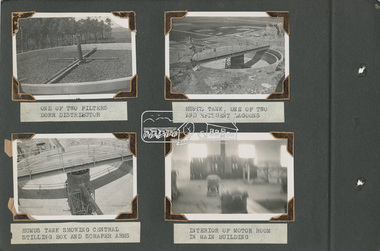
Album - Photograph Album, Alan Gardiner, M.M.B.W Braeside Sewage Treatment Plant Construction, 1939
... Before the construction could commence the Great Depression of the 1930s intervened forcing the shelving of its plans. ...Before the construction could commence the Great Depression of the 1930s intervened forcing the shelving of its plans. ...In April 1928 the MMBW had the land and the plans for what they were to construct but the timing of the actual building did not proceed as planned. Before the construction could commence the Great Depression of the 1930s intervened forcing the shelving of its plans. The new owners then offered the land for lease resulting in Frederick Werrett taking the opportunity to take up the land he formerly owned to continue his market gardening activities of growing potatoes, onions and other crops. The land and improvements made by Syme were leased in 1929 to Harry Telford a trainer from New South Wales. Phar Lap grazed there for a short time. [9] However the population of Melbourne continued to grow and the need for a sewerage treatment plant did not go away. In 1939 when the effects of the Depression had dissipated work on the Sewerage Effluent Treatment Plant commenced and the following year in October the Premier of the State, Albert Dunstan, officially commissioned it. The Sewerage Effluent Treatment Plant at Braeside served the communities of south-east Melbourne for thirty five years until 1975. In that year all the sewers that entered the Braeside plant were diverted to the South Eastern Trunk Sewer complex at Carrum.[10] In 1982 the chairman of the MMBW at that time, Alan Croxford, announced that a substantial part of the property at Braeside would be administered by the Parks and Gardens section of MMBW as a public park. Subsequently the responsibilities were transferred to Parks Victoria, the situation that exists today. It is known as “Braeside Park” now. [Source: Sewerage Treatment Plant at Braeside, Kingston Local History, https://localhistory.kingston.vic.gov.au/articles/407]alan gardiner collection, 1939, braeside sewage treatment plant, construction, melbourne metropolitan board of works, mmbw -
 Wodonga & District Historical Society Inc
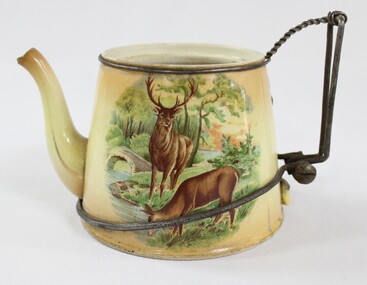
Domestic object - Haeusler Collection Teapot
... The ingenious repair to the teapot's handle reflects the resourcefulness and thriftiness of the Haeusler family during the economic hardships of the 1930s Great Depression. The teapot was manufactured in England, likely dating from the early twentieth-century. ...The ingenious repair to the teapot's handle reflects the resourcefulness and thriftiness of the Haeusler family during the economic hardships of the 1930s Great Depression. The teapot was manufactured in England, likely dating from the early twentieth-century. ...The Wodonga Historical Society Haeusler Collection provides invaluable insight into life in late nineteenth and early twentieth century north east Victoria. The collection comprises manuscripts, personal artefacts used by the Haeusler family on their farm in Wodonga, and a set of glass negatives which offer a unique visual snapshot of the domestic and social lives of the Haeusler family and local Wodonga community. The Haeusler family migrated from Prussia (Germany) to South Australia in the 1840s and 1850s, before purchasing 100 acres of Crown Land made available under the Victorian Lands Act 1862 (also known as ‘Duffy’s Land Act’) in 1866 in what is now Wodonga West. The Haeusler family were one of several German families to migrate from South Australia to Wodonga in the 1860s. This teapot is one of the many domestic objects in the Haeusler Collection that represent family and home life in early twentieth century Wodonga. The ingenious repair to the teapot's handle reflects the resourcefulness and thriftiness of the Haeusler family during the economic hardships of the 1930s Great Depression. The teapot was manufactured in England, likely dating from the early twentieth-century. This item has well documented provenance and a known owner. It forms part of a significant and representative historical collection which reflects the local history of Wodonga. It contributes to our understanding of domestic and family life in early twentieth century Wodonga, as well as providing interpretative capacity for themes including local history, social history, and women’s history. A glazed ceramic teapot with a printed design depicting two deer and a hunter in a woodland on one side, and two deer by a stream in a woodland on the other. The broken handle of the teapot has been replaced with wire. The teapot handle was repaired by Alfred Haeusler (b.1922, d.1997) and holds remarkable balance, perfectly retaining its function. Faded, circular makers mark on the base of teapot, illegible/"ENGLAND"teapot, teaware, tableware, ceramic, domestic, social history -
 National Wool Museum
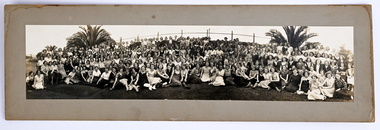
Photograph - Staff Portrait, Valley Worsted Mills, Geelong, 1930's
... Depression...1930s...Working Life...Panoramic...Employees...Staff...Portrait...Textile Industry...Great...During the Great Depression of the 1930s, the female workforce at Valley Worsted Mills and other local Geelong textile factories became more vital than ever. ...During the Great Depression of the 1930s, the female workforce at Valley Worsted Mills and other local Geelong textile factories became more vital than ever. ...The Valley Worsted Mills were established in 1924 on Swanston Street in South Geelong and quickly grew to become the largest and most modern textile mill in Australia, employing roughly 500 workers at its peak. Built out of distinctive red Geelong brick with iconic Art Deco white trimmings and a sawtooth roofline, the massive 11-acre complex served as a major manufacturing cornerstone during the height of the region's historic wool boom. The mill operated at high production for nearly 50 years before merging with John Foster & Son in December 1973, subsequently closing down entirely in the mid-1970s. During the Great Depression of the 1930s, the female workforce at Valley Worsted Mills and other local Geelong textile factories became more vital than ever. Because women were historically paid significantly lower wage rates than men for equivalent labor, local mills increasingly relied on them to keep operating costs low during severe economic strain. These young women, often referred to affectionately as "mill girls," typically started working as young as 14 to 16 years old. They filled specialized, highly skilled roles as menders, warpers, and weavers. For many families in the Geelong region, the steady industrial employment of these women provided a crucial financial lifeline when male breadwinners faced widespread unemployment. Beyond their grueling factory shifts, the mill women maintained a vibrant social culture, even forming organized recreation groups like the Valley Worsted Mills Women’s Basketball team during this era. The donor's father Stan Hoyle, and grandfather Cliff Hoyle, both worked there at the time.Black and white panoramic photograph attached to backing board. Photograph shows a group portrait of female factory workers outdoors.back: [handwritten] Valley / Worsted Mills Geelong / 34 - 40 / Ada? Stan?valley worsted mills, swanston street geelong, geelong, woollen mills, depression, 1930s, working life, panoramic, employees, staff, portrait, textile industry, great depression, female workers, mill girls, social culture, stan hoyle, cliff hoyle -
 Flagstaff Hill Maritime Museum and Village
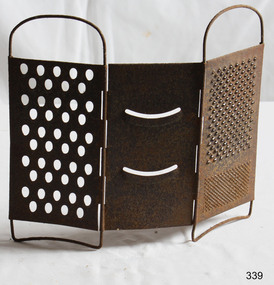
Domestic object - Grater
... During the Great Depression of the 1930s, Philadelphia cheesemonger and entrepreneur Jeffrey Taylor also wanted to stretch cheese for to bulk up cheese features, including vegetables, to make them look like more filling food during difficult economic times. ...During the Great Depression of the 1930s, Philadelphia cheesemonger and entrepreneur Jeffrey Taylor also wanted to stretch cheese for to bulk up cheese features, including vegetables, to make them look like more filling food during difficult economic times. ...François Boullier of France and Isaac Hunt of England both took credit for inventing the cheese grater in the 1540s. Ingredient supplies, mainly milk, ebbed and flowed in both France and England, as they have in the United States during this coronavirus pandemic. Boullier originally aimed to use up an overabundance of cheese in Paris. An avoidance of meat led French farmers to convert their meat herds (often boys) to dairy-producers (girls), which led to more milk and even too much milk, which led to a market flooded with cheese. Boullier made his first cheese grater out of pewter to grate hard, sometimes dried out cheeses, which turned them into a sort of condiment. Pewter is known as a rather soft metal, and Boullier’s original grater is reportedly on display in a museum in Le Havre, France. Isaac Hunt wanted to stretch cheese due to a shortage in England, so he grated and melted it for Welsh rarebit and other dishes. Grating cheese allowed more even distribution of the cheese to melt it in cooking and still does. During the Great Depression of the 1930s, Philadelphia cheesemonger and entrepreneur Jeffrey Taylor also wanted to stretch cheese for to bulk up cheese features, including vegetables, to make them look like more filling food during difficult economic times. Taylor read about Boullier’s invention and made his own by sharpening the holes of a metal shower drain. For the last century, many companies have tried to improve the cheese grater and invent a new “latest” one that we all must-have. Graters are now made of all sorts of materials including bamboo, wood, and various metals. Some are decorated with clowns’ heads, some are shaped like plastic frogs, while others bear knuckle protectors. They vary in size, shape, and function. Grating slots come with different angles and shapes of slots and can grate everything from zucchini, onions and cheese, to cooked eggs, coconut, potatoes, cabbage, and lemon and orange peel, and possibly even create wood shavings. Smaller graters grate ginger and garlic. https://www.cheeseprofessor.com/blog/antique-cheese-gratersThe grater has been used for hundreds of years and has proved its worth in the kitchen throughout history.Grater metal (3 parts) Tripartite with hinges for folding.None.flagstaff hill, warrnambool, shipwrecked-coast, flagstaff-hill, flagstaff-hill-maritime-museum, maritime-museum, shipwreck-coast, flagstaff-hill-maritime-village, grater -
 City of Greater Bendigo - Civic Collection
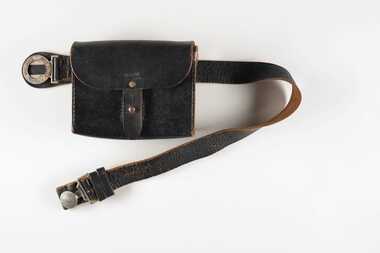
Uniform - Telegram Satchel
... There was a brief resurgence in telegraphy during World War I but the decline continued as the world entered the Great Depression years of the 1930s. Although telegraph lines continued to play an important part in distributing news feeds from news agencies post World War 2, the rise of the internet in the 1990s and the widespread installation of the telephones in homes saw the need for telegrams to greatly decline. ...There was a brief resurgence in telegraphy during World War I but the decline continued as the world entered the Great Depression years of the 1930s. Although telegraph lines continued to play an important part in distributing news feeds from news agencies post World War 2, the rise of the internet in the 1990s and the widespread installation of the telephones in homes saw the need for telegrams to greatly decline. ...Electrical telegraphs were point to point text messaging systems primarily used from the 1840's until the late 20th century. It was the first electrical telecommunications system and were sent by an operator or telegrapher using Morse code. Social telegrams were also encouraged and special pictorial forms and envelopes were designed such as the special purple form and envelope which was used when conveying condolence details during World War 2.(fn. Powerhouse https://collection.powerhouse.com.au/object/163103). There was a brief resurgence in telegraphy during World War I but the decline continued as the world entered the Great Depression years of the 1930s. Although telegraph lines continued to play an important part in distributing news feeds from news agencies post World War 2, the rise of the internet in the 1990s and the widespread installation of the telephones in homes saw the need for telegrams to greatly decline. When the Commonwealth Post and Telegraph Act was passed in June 1902, and a national Postmaster General's Department (the PMG) was established the responsibility for the nation's mail and telephone services fell on Post Offices. The Bendigo Post Office, built in 1887 and situated on Pall Mall was the central distribution centre for receiving and delivering telegrams and continued to deliver communication and postal services until 1997. Now a Visitor Centre, dedicated volunteers at the Post Office continued to demonstrate and educate the public about telegraphic services and the development of this unique form of communication up until 2019 when Covid 19 disrupted every day life, coupled with the death Ted Rankins (the last Post Master and a long term telegraph volunteer at the Post Office). This satchel was used by Junior Postal Workers in Bendigo to carry telegrams which were delivered by bicycle in the early years and is part of the postal collection donated by the Rankins family in memory of Ted. Small, dark coloured rectangle, leather satchel with attached belt and ornate buckle. Satchel is made of four pieces of leather: two side pieces, one piece which is folded to create the front, bottom, back and flap and one piece for the central strap. The central strap has a single hole through which a metal toggle is inserted to secure the flap closed. Stitching is evident around the side seams, around the metal toggle and inside flap where strap is attached and has been reinforced. Satchel has four metal tabs to secure the top front to the top sides and an internal pocket on inside. The leather belt is attached to the back outside of the satchel with four metal press studs. The left side buckle also has reinforced stitching. Both sides of the buckle have decorative elements with the words Post Office / Communications/ Australia on the left side around outer circular edge. Underside of right side of buckle end has the words AROS pressed into it. Inside flap of satchel; Australia / Post / Telegram / Boys written in marker. Buckle; Post Office / Communications / Australia. Underside of right side of buckle end; AROS Internal; Gold address sticker with Ted Rankins contact details.ted rankins collection, bendigo post office, bendigo tourism, city of greater bendigo tourism, post office collection -
 City of Greater Bendigo - Civic Collection
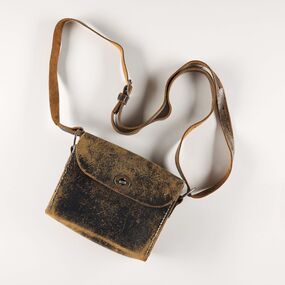
Uniform - Telegram Satchel
... There was a brief resurgence in telegraphy during World War I but the decline continued as the world entered the Great Depression years of the 1930s. Although telegraph lines continued to play an important part in distributing news feeds from news agencies post World War 2, the rise of the internet in the 1990s and the widespread installation of the telephones in homes saw the need for telegrams to greatly decline. ...There was a brief resurgence in telegraphy during World War I but the decline continued as the world entered the Great Depression years of the 1930s. Although telegraph lines continued to play an important part in distributing news feeds from news agencies post World War 2, the rise of the internet in the 1990s and the widespread installation of the telephones in homes saw the need for telegrams to greatly decline. ...Electrical telegraphs were point to point text messaging systems primarily used from the 1840's until the late 20th century. It was the first electrical telecommunications system and were sent by an operator or telegrapher using Morse code. Social telegrams were also encouraged and special pictorial forms and envelopes were designed such as the special purple form and envelope which was used when conveying condolence details during World War 2.(fn. Powerhouse https://collection.powerhouse.com.au/object/163103). There was a brief resurgence in telegraphy during World War I but the decline continued as the world entered the Great Depression years of the 1930s. Although telegraph lines continued to play an important part in distributing news feeds from news agencies post World War 2, the rise of the internet in the 1990s and the widespread installation of the telephones in homes saw the need for telegrams to greatly decline. When the Commonwealth Post and Telegraph Act was passed in June 1902, and a national Postmaster General's Department (the PMG) was established the responsibility for the nation's mail and telephone services fell on Post Offices. The Bendigo Post Office, built in 1887 and situated on Pall Mall was the central distribution centre for receiving and delivering telegrams and continued to deliver communication and postal services until 1997. Now a Visitor Centre, dedicated volunteers at the Post Office continued to demonstrate and educate the public about telegraphic services and the development of this unique form of communication up until 2019 when Covid 19 disrupted every day life, coupled with the death Ted Rankins (the last Post Master and a long term telegraph volunteer at the Post Office). This satchel was used by Junior Postal Workers in Bendigo to carry telegrams which were delivered by bicycle in the early years. Small, rectangle, leather satchel with attached shoulder strap and buckle. Satchel is made of five pieces of leather: two side pieces, one piece which is folded to create the front, bottom, back and flap and two small pieces to hold strap ring. The flap has a single hole through which a metal toggle is inserted to secure the flap closed. Satchel has four metal tabs to secure the top front to the top sides and an internal pocket on inside. The leather strap is attached to the top of the side seams of the satchel with circular metal rings and two metal press studs. Inside flap: Sticker with '540B'bendigo post office, bendigo tourism, city of greater bendigo tourism, making a nation exhibition, post office collection -
 City of Greater Bendigo - Civic Collection
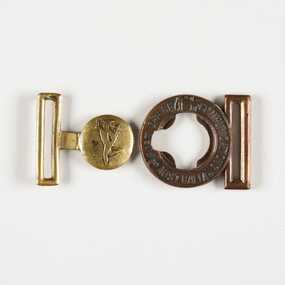
Uniform - Buckle from Telegram Satchel Belt, Post Master General's Department et al
... There was a brief resurgence in telegraphy during World War I but the decline continued as the world entered the Great Depression years of the 1930s. Although telegraph lines continued to play an important part in distributing news feeds from news agencies post World War 2, the rise of the internet in the 1990s and the widespread installation of the telephones in homes saw the need for telegrams to greatly decline. ...There was a brief resurgence in telegraphy during World War I but the decline continued as the world entered the Great Depression years of the 1930s. Although telegraph lines continued to play an important part in distributing news feeds from news agencies post World War 2, the rise of the internet in the 1990s and the widespread installation of the telephones in homes saw the need for telegrams to greatly decline. ...Electrical telegraphs were point to point text messaging systems primarily used from the 1840's until the late 20th century. It was the first electrical telecommunications system and were sent by an operator or telegrapher using Morse code. Social telegrams were also encouraged and special pictorial forms and envelopes were designed such as the special purple form and envelope which was used when conveying condolence details during World War 2.(fn. Powerhouse https://collection.powerhouse.com.au/object/163103). There was a brief resurgence in telegraphy during World War I but the decline continued as the world entered the Great Depression years of the 1930s. Although telegraph lines continued to play an important part in distributing news feeds from news agencies post World War 2, the rise of the internet in the 1990s and the widespread installation of the telephones in homes saw the need for telegrams to greatly decline. When the Commonwealth Post and Telegraph Act was passed in June 1902, and a national Postmaster General's Department (the PMG) was established the responsibility for the nation's mail and telephone services fell on Post Offices. The Bendigo Post Office, built in 1887 and situated on Pall Mall was the central distribution centre for receiving and delivering telegrams and continued to deliver communication and postal services until 1997. Now a Visitor Centre, dedicated volunteers at the Post Office continued to demonstrate and educate the public about telegraphic services and the development of this unique form of communication up until 2019 when Covid 19 disrupted every day life, coupled with the death Ted Rankins (the last Post Master and a long term telegraph volunteer at the Post Office). This belt buckle was used on the leather satchels used by Junior Postal Workers in Bendigo to carry telegrams which were delivered by bicycle in the early years. The buckle is part of the postal collection donated by the Rankins family in memory of Ted Rankins.Circular belt buckle from telegram delivery satchel belt. Inner buckle depicts the Greek deity Hermes who personifies the transmission of information and was adopted as an allegorical representation of the function of postal services. Outer buckle; Post Office / Communications / Australia. Centre top outer buckle; emu, kangaroo and shield Inner buckle; Hermes (left facing)bendigo post office, bendigo tourism, city of greater bendigo tourism, post office collection, ted rankins collection -
 City of Greater Bendigo - Civic Collection
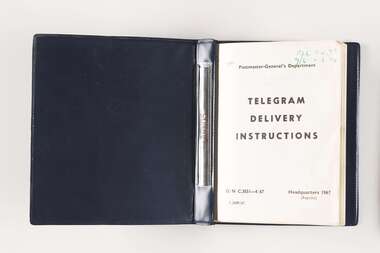
Manual, Post Master General's Department, Telegram Delivery Instructions, 1967
... There was a brief resurgence in telegraphy during World War I but the decline continued as the world entered the Great Depression years of the 1930s. Although telegraph lines continued to play an important part in distributing news feeds from news agencies post World War 2, the rise of the internet in the 1990s and the widespread installation of the telephones in homes saw the need for telegrams to greatly decline. ...There was a brief resurgence in telegraphy during World War I but the decline continued as the world entered the Great Depression years of the 1930s. Although telegraph lines continued to play an important part in distributing news feeds from news agencies post World War 2, the rise of the internet in the 1990s and the widespread installation of the telephones in homes saw the need for telegrams to greatly decline. ...Electrical telegraphs were point to point text messaging systems primarily used from the 1840's until the late 20th century. It was the first electrical telecommunications system and were sent by an operator or telegrapher using Morse code. Social telegrams were also encouraged and special pictorial forms and envelopes were designed such as the special purple form and envelope which was used when conveying condolence details during World War 2.(fn. Powerhouse https://collection.powerhouse.com.au/object/163103). There was a brief resurgence in telegraphy during World War I but the decline continued as the world entered the Great Depression years of the 1930s. Although telegraph lines continued to play an important part in distributing news feeds from news agencies post World War 2, the rise of the internet in the 1990s and the widespread installation of the telephones in homes saw the need for telegrams to greatly decline. When the Commonwealth Post and Telegraph Act was passed in June 1902, and a national Postmaster General's Department (the PMG) was established the responsibility for the nation's mail and telephone services fell on Post Offices. The Bendigo Post Office, built in 1887 and situated on Pall Mall was the central distribution centre for receiving and delivering telegrams and continued to deliver communication and postal services until 1997. Now a Visitor Centre, dedicated volunteers at the Post Office continued to demonstrate and educate the public about telegraphic services and the development of this unique form of communication up until 2019 when Covid 19 disrupted every day life, coupled with the death Ted Rankins (the last Post Master and a long term telegraph volunteer at the Post Office). This book was issued to Junior Postal Workers in Bendigo to guide them in the delivery of telegrams and designed to fit into their delivery satchels and carried while on the job. In the early years telegrams were delivered by bicycle and this manual is part of the postal collection donated by the Rankins family in memory of Ted. Small, blue, vinyl covered manual. Contains thirty printed pages covering all aspects of how to correctly deliver telegrams. Topics include 'Loss of telegram', 'Undelivered Telegram', 'special Delivery' and 'Beware of Dogs'. Bound with two ring metal clip. Front cover; Australian Post Office / Telecommunications Division / Telegram / Delivery / Instructions / Headquarters / 1962 Various annotations and updates throughout. ted rankins collection, bendigo post office, bendigo tourism, city of greater bendigo tourism, post office collection -
 Federation University Historical Collection
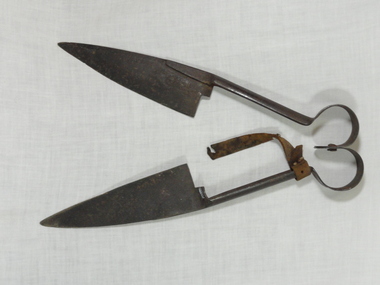
Tool, Handshears
... In the early 1930s the Ballarat School of Mines introduced a wide-ranging Wool Classing Course as jobs were in extremely short supply during the Great Depression. ...In the early 1930s the Ballarat School of Mines introduced a wide-ranging Wool Classing Course as jobs were in extremely short supply during the Great Depression. ballarat school of mines shearing woolclassing sheep Metal handshears used for shearing sheep. ...Hand shears needed to be very sharp and often had a leather strap or ‘driver’ which passed over the hand. Others had sheepskin bound around the grip. Blades had to be regularly sharpened on a grinding stone. Most hand shears were made in Sheffield, England, with various models produced offering wide or narrow blades, sharp or rounded points, and various grips and bows. The technique of Australian hand shearing gradually developed from the 1830s using the old English method of cutting the flank with hand shears in a series of circular cuts from the sheep’s neck to the tail. In the early 1930s the Ballarat School of Mines introduced a wide-ranging Wool Classing Course as jobs were in extremely short supply during the Great Depression. Metal handshears used for shearing sheep.ballarat school of mines, shearing, woolclassing, sheep -
 City of Moorabbin Historical Society (Operating the Box Cottage Museum)
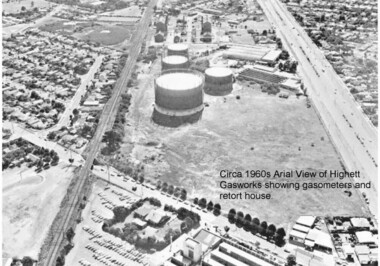
Photograph - Photographs of Highett Gasworks, Gasometer, Retort House and Coal Store at Highett Gasworks, 1974 and 1960
... 1930s the company expanded its gas production facilities to Highett where it had purchased 45 acres of land adjacent to the Melbourne-Frankston railway line. A gasholder with a capacity of 750,000 cubic feet was erected on the Highett land in 1927 and connected with high pressure mains to the Brighton works. Three years later the company directors decided to proceed with the construction of a vertical retort house and coal store. Following a "lull" during the Great Depression...1930s the company expanded its gas production facilities to Highett where it had purchased 45 acres of land adjacent to the Melbourne-Frankston railway line. A gasholder with a capacity of 750,000 cubic feet was erected on the Highett land in 1927 and connected with high pressure mains to the Brighton works. Three years later the company directors decided to proceed with the construction of a vertical retort house and coal store. Following a "lull" during the Great Depression ...Gasometers resulted from complex engineering design evolving from primitive gasholders first used in 1824 in England to power street lights. The 20th century gasometer, (as used at the Highett Gasworks), was comprised of a series of large interconnected, telescopic, cylindrical vessels or lifts, which rose and fell depending on the volume of gas stored. The gasholder operated on a basic principle of a gas-filled floating vessel, rising and falling in a seal of water. The Highett Gasworks had its beginning in 1939 but its beginnings commenced sixty-two years earlier when the privately owned Brighton Gas Company was floated in 1877. By 1880 the company was performing well and making excellent profits. The company was welcomed by residents wanting to replace the shadowy light of a kerosene lamp with the bright luminescence of "modern" gas lamps. The land developers of the day were also keen supporters. But by 1884 people became disgrunted because either the gas had not reached them yet or because the quality of the supply had diminished due to the increasing use. In 1885 a second private gas company, the Central Brighton and Moorabbin Gas Co, Chaired by "Tommy" Bent was floated and for many years the two gas companies enjoyed a shared monopoly in supplying gas from their New Street Works. In the 1930s the company expanded its gas production facilities to Highett where it had purchased 45 acres of land adjacent to the Melbourne-Frankston railway line. A gasholder with a capacity of 750,000 cubic feet was erected on the Highett land in 1927 and connected with high pressure mains to the Brighton works. Three years later the company directors decided to proceed with the construction of a vertical retort house and coal store. Following a "lull" during the Great Depression work recommenced in 1936 and by 1939 the first complete gas-making plant was completed, and gas making commenced. Over the next twenty one years other significant extensions occurred, including an amenities block to accomodate 100 workers. In 1969 Esso commenced the introduction of natural gas to residents homes and the gradual decommissioning of the Highett Gasworks commenced. Part of the old Highett Gasworks site is now a council owned parkThe photos of the Higett Gasworks, now demolished, recall their long history, that originated in the 1800s with the production of gas to supply homes with a new, much improved light source, and later it's other applications such as for stoves etc. The arrival of gas in the Shire of Moorabbin was a huge step forward that encouraged further building and development in the area.Three Photographs of the Highett Gasworks. Two are coloured photos taken in 1974, and one is black and white taken in the 1960s. All are in good conditionOn the back of the two coloured photographs "Highett Gasworks 1974" No inscription on the black and white aerial photograph.brighton, moorabbin, highett, bent thomas, gasometer, highett gasworks, engineering design, brighton gas company, central brighton and moorabbin gas company, great depression, lamp kerosene -
 Mission to Seafarers Victoria
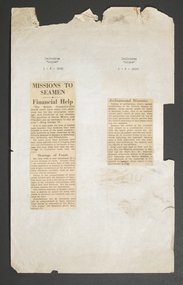
Article - Newspaper clippings, Argus newspaper, 1930s
... Clippings regarding fundraising for the MTS during the 1930s AS an entirely donation dependent organisation the Mission services have constantly needed publicity and promotional support to continue to offer services to seafarers. This collection of pre-WW2 clippings reflects the emergence from a period of great Depression ...Clippings regarding fundraising for the MTS during the 1930sAS an entirely donation dependent organisation the Mission services have constantly needed publicity and promotional support to continue to offer services to seafarers. This collection of pre-WW2 clippings reflects the emergence from a period of great Depression economically.The collection is a useful research source.A group of 8 thin damaged pages with clippings adhered either singly or in groups of 2 or 3 clippings some images - primarily from the "Argus" circa late 1930s. All appear to be related to a drive for fundraising to support the Mission to Seamen.Typed dates and inscriptions at top of each page 1-8fundraising, clippings, mission to seamen -
 Warrnambool and District Historical Society Inc.
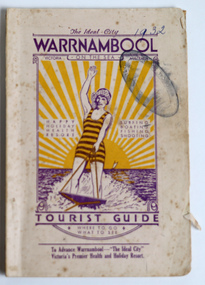
Booklet - Warrnambool Tourist Booklet, Warrnambool Progress Association, Warrnambool On the Sea, Victoria, Australia, Tourist Guide, 1932
... Great Depression, continues to emphasise the health aspect, calling Warrnambool 'Victoria's Premier Health and Holiday Resort'. It also publicises the fact that Warrnambool was declared Victoria's 'Ideal City' in 1928. The Warrnambool Progress Association, formed in 1927, recognized the changing nature of tourism in Australia with the increasing ownership of motor vehicles and so the Warrnambool beaches and camping holidays were highlighted. Today tourism in Warrnambool remains a key component of the city's economy because of its beaches, coastal views, sporting events, winter whales and its proximity to other tourist attractions. This booklet is of considerable interest because of the number of 1930s ...Warrnambool Tourist GuideThis is a booklet with a cream cover featuring a sketch of a woman waterskiing and blue printing. The pages contain black and white photographs, advertisements, two maps and printed text. There is one fold-out page. The booklet is stapled and bound with glue.non-fictionWarrnambool Tourist Guidewarrnambool tourism, warrnambool progress association -
 Eltham District Historical Society Inc
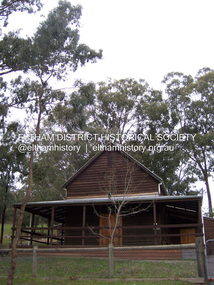
Photograph - Digital Photograph, Marguerite Marshall, Strathewen Public Hall, 20 August 2008
... 1930s. Her daughter Mrs Vera McKimmie, ran it until the 1950s and the house remains in Chads Creek Road. In the Great Depression...1930s. Her daughter Mrs Vera McKimmie, ran it until the 1950s and the house remains in Chads Creek Road. In the Great Depression ...Strathewen Public Hall, social and spiritual centre was later lost in the Black Saturday fires 2009. The Strathewen Community decided a community hall was needed in 1901. In 1902 locals built the hall with messmate trees. It was located on the Cottlesbridge-Strathewen Road. The first function was a Grand concert and Balll attended by about 120 people. Several denominations held Church services and Sunday School services in the Hall. It survived several bushfires until after this photo was taken when it was destroyed in Black Saturday, 9 February 2009. Published: Nillumbik Now and Then / Marguerite Marshall 2008; photographs Alan King with Marguerite Marshall.; p89 Strathewen was settled late, largely because it was difficult to access.1 Early selectors found it a struggle to survive. They had to do everything themselves, from felling trees for buildings, to taking produce to market along bush tracks that they had helped cut. Small dairy farms were typical but fruit became the district’s prime produce. The first settlers east of Arthurs Creek were brothers John and Duncan Smith whose station Glen-Ard was probably operated as a sheep run. Other early settlers were the Mann family, who were to donate land for the hall, provide postal services and John Mann was an Eltham Shire councillor from 1916 to 1919.2 In 1873 James Mann, his wife Jane and their six children, settled on 207 acres (83.7) (Lang Fauld Farm) on both sides of Eagles Nest Road, from the foot of Mount Sugarloaf to the bank of the Arthurs Creek. In 1883 James took up another selection on Chads Creek. It was very hard work and at times he was well behind with his rent. However the family had a good social life, attending the Primitive Methodist Church at the Arthurs Creek Township and on New Year’s Eve throwing a party for all the locals. By 1874 James Mann’s younger brother, John, selected 311 acres (125.8ha) between Eagles Nest Road and upper Arthurs Creek. He called it Carseburn after his home parish in Scotland. Tragically in 1875 John drowned in the Yarra River, at Richmond.3 John Mann’s oldest son, also John, later purchased Duncan Smith’s land, which he named Violet Glen. He was to give one acre (0.4ha) of this land for the Strathewen Hall site. A Mann family diary written at Carseburn in 1897, tells how the district’s name was selected. Strathewen is derived from ‘strath’ meaning ‘broad mountain valley’ and from the name of Ewen H. Cameron, the local parliamentarian for almost 40 years. ‘George Brain came around to get a petition signed to get a post office up here and we had to vote for a name—Strathewen, Glen-Ard, or Headcorie’.4 It was at Carseburn that a public meeting in 1901, decided to build the Strathewen Hall on the Cottlesbridge-Strathewen Road. In 1902 the locals built the hall with messmate trees. The first function was a Grand Concert and Ball attended by around 120 people and several Protestant denominations took turns to hold church services and Sunday School there. Fortunately the hall has survived bushfires to be the town’s spiritual and social centre.5 The area continued to develop and in 1909 a post office operated somewhere at Strathewen and from around 1916 at Carseburn.6 It was not until 1914 that land was bought to establish the Strathewen State School on School Ridge Road. The residents paid £100 to build it on two acres (0.8 ha) while the Education Department contributed £30 and leased the building annually for £1. When teacher Miss Mary Golding opened the school in 1917, it had no equipment.7 But in 1921 the Education Department provided desks and a hexagonal shelter shed (now a rare style in Victoria) and took control in 1925.8 By 1917 Strathewen was booming.9 George Apted had built a coolstore in 1916, and local orchardists bought storage space until the 1950s. This allowed the area to supply the market in and out of season. Guesthouses catered for growing tourism. In the mid 1920s Mrs Eleanor Sparkes built the guest-house Singing Waters, which operated through the 1930s. Her daughter Mrs Vera McKimmie, ran it until the 1950s and the house remains in Chads Creek Road. In the Great Depression land was cleared for timber to be sold as firewood and there was small scale sawmilling. However the orchard industry diminished for several reasons including the 1939 bushfires and rapid changes in production methods. Today the Apteds still operate an orchard and farm at Glen-Ard, which straddles the border between Strathewen and Arthurs Creek. It includes the southern part of Duncan Smith’s original Glen-Ard selection.This collection of almost 130 photos about places and people within the Shire of Nillumbik, an urban and rural municipality in Melbourne's north, contributes to an understanding of the history of the Shire. Published in 2008 immediately prior to the Black Saturday bushfires of February 7, 2009, it documents sites that were impacted, and in some cases destroyed by the fires. It includes photographs taken especially for the publication, creating a unique time capsule representing the Shire in the early 21st century. It remains the most recent comprehenesive publication devoted to the Shire's history connecting local residents to the past. nillumbik now and then (marshall-king) collection, strathewan public hall -
 Eltham District Historical Society Inc
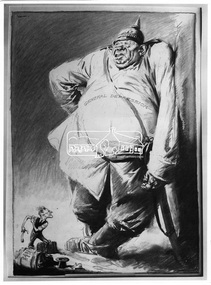
Photograph, Percy Leason, Cartoon "Goliath and the Prodical David", Percy Leason, 1931, 1931
... This political cartoon depicts a black and white drawing; “General Depression”, a large ugly man wearing a German pike helmut, representing the Great Depression which Australians suffered from 1929 through the 1930s with a period of high unemployment, poverty, low profits, deflation, plunging incomes, and lost opportunities for economic growth and personal advancement. ...This political cartoon depicts a black and white drawing; “General Depression”, a large ugly man wearing a German pike helmut, representing the Great Depression which Australians suffered from 1929 through the 1930s with a period of high unemployment, poverty, low profits, deflation, plunging incomes, and lost opportunities for economic growth and personal advancement. ...This political cartoon depicts a black and white drawing; “General Depression”, a large ugly man wearing a German pike helmut, representing the Great Depression which Australians suffered from 1929 through the 1930s with a period of high unemployment, poverty, low profits, deflation, plunging incomes, and lost opportunities for economic growth and personal advancement. This figure overshadows a small man, representing Prime Minster James Scullin with a suitcase labelled “Jim S, London to Australia”. This is a reference to the PM’s decision to travel to London to seek an emergency loan and to attend the Imperial Conference (a meeting of Prime Ministers of the British Empire) He is holding a sling shot. The image has a “David and Goliath theme” denoting Australia as the underdog, a contest where a smaller, weaker opponent faces a much bigger, stronger adversary. The artist Percy Leason (1889 - 1959) was a painter and cartoonist renowned for his depictions of Australian society in the 1920s and 1930s. He lived in Eltham at his property 'Landscape' which he built in New Street (present day Lavender Park Road) from about 1924 to 1938 when he moved to the USA. In 1931 his cartoons were published in the Melbourne magazine “Table Talk” (although it cannot be confirmed that this one was). The original source of this image for the SEPP collection was the Publisher Thomas Nelson based in Melbourne. This photo forms part of a collection of photographs gathered by the Shire of Eltham for their centenary project book,"Pioneers and Painters: 100 years of the Shire of Eltham" by Alan Marshall (1971). The collection of over 500 images is held in partnership between Eltham District Historical Society and Yarra Plenty Regional Library (Eltham Library) and is now formally known as 'The Shire of Eltham Pioneers Photograph Collection.' It is significant in being the first community sourced collection representing the places and people of the Shire's first one hundred years.Digital image and 4 x 5 inch B&W Negsepp, shire of eltham pioneers photograph collection, percy leason, depression, cartoon, comic, james scullin, david and goliath, drawing, political cartoon -
Bendigo Historical Society Inc.
Document - The 1930s Depression Tapes - Interview List, 2005
... In 2005 Michele Matthews interviewed current and former residents of Bendigo for her thesis on the 1930s Depression as part of her PhD Research, with the University of Melbourne Faculty of Arts, History Department. Michele interviewed fifteen members of prominent Bendigonian families. The thesis was titled: "How Depressing?: The impact of the Great...In 2005 Michele Matthews interviewed current and former residents of Bendigo for her thesis on the 1930s Depression as part of her PhD Research, with the University of Melbourne Faculty of Arts, History Department. Michele interviewed fifteen members of prominent Bendigonian families. The thesis was titled: "How Depressing?: The impact of the Great ...In 2005 Michele Matthews interviewed current and former residents of Bendigo for her thesis on the 1930s Depression as part of her PhD Research, with the University of Melbourne Faculty of Arts, History Department. Michele interviewed fifteen members of prominent Bendigonian families. The thesis was titled: "How Depressing?: The impact of the Great Depression on Bendigo and District 1925-1935". The Michele Matthews Collection contains fourteen audio cassette tape recordings and one written transcript. The tapes are each approximately 1 hour and 45 minutes duration. The questions presented to the interviewees explore everyday experiences they would have lived through at the time of the Depression. The questions covered sixteen relevant subjects: • Introduction and housing • Social activities, swimming, cinemas, school and games played with friends • Organizations such as the RSL, Relief Committees etc. and any effect they had on family life • The life of the single woman • Unemployment and Employment • Government Assistance • Charities Aid • Self-help • People Power, e.g. boycotts or protests • Politics • Trouble or crime • Family Health, Medical and Diet • Education • General memories of, and hardships encountered, during the DepressionTwo pages of Interviewee List.history, bendigo, michele matthews collection, the 1930s depression tapes -
Bendigo Historical Society Inc.
Document - The 1930s Depression Tapes - List of Questions for the Interview to follow and prompts, 2005
... In 2005 Michele Matthews interviewed current and former residents of Bendigo for her thesis on the 1930s Depression as part of her PhD Research, with the University of Melbourne Faculty of Arts, History Department. Michele interviewed fifteen members of prominent Bendigonian families. The thesis was titled: "How Depressing?: The impact of the Great...In 2005 Michele Matthews interviewed current and former residents of Bendigo for her thesis on the 1930s Depression as part of her PhD Research, with the University of Melbourne Faculty of Arts, History Department. Michele interviewed fifteen members of prominent Bendigonian families. The thesis was titled: "How Depressing?: The impact of the Great ...In 2005 Michele Matthews interviewed current and former residents of Bendigo for her thesis on the 1930s Depression as part of her PhD Research, with the University of Melbourne Faculty of Arts, History Department. Michele interviewed fifteen members of prominent Bendigonian families. The thesis was titled: "How Depressing?: The impact of the Great Depression on Bendigo and District 1925-1935". The Michele Matthews Collection contains fourteen audio cassette tape recordings and one written transcript. The tapes are each approximately 1 hour and 45 minutes duration. The questions presented to the interviewees explore everyday experiences they would have lived through at the time of the Depression. The questions covered sixteen relevant subjects: • Introduction and housing • Social activities, swimming, cinemas, school and games played with friends • Organizations such as the RSL, Relief Committees etc. and any effect they had on family life • The life of the single woman • Unemployment and Employment • Government Assistance • Charities Aid • Self-help • People Power, e.g. boycotts or protests • Politics • Trouble or crime • Family Health, Medical and Diet • Education • General memories of, and hardships encountered, during the DepressionQuestions, Notes and Prompts for the interviews.history, bendigo, michele matthews collection, the 1930s depression tapes
