
Showing 54 items matching " henty brothers"
-
 Greensborough Historical Society
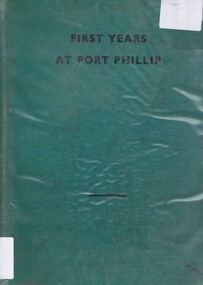
Book, First Years at Port Phillip: by Robert Douglass Boys, 1935_
... ...henty brothers...A history of the discovery of Australia with emphasis on the settlement of Victoria or 'Australia Felix' from the Henty Brothers in Portland in 1834 to the proclamation of the Town Coucil of Melbourne in 1842...A history of the discovery of Australia with emphasis on the settlement of Victoria or 'Australia Felix' from the Henty Brothers in Portland in 1834 to the proclamation of the Town Coucil of Melbourne in 1842 Chronology of the development of white settlement in Victoria victoria-history henty brothers portland australia felix melbourne-history Inscribed on fly-leaf by author "To A R Kenyon with kind regards R D Boys August 8,1935." ...A history of the discovery of Australia with emphasis on the settlement of Victoria or 'Australia Felix' from the Henty Brothers in Portland in 1834 to the proclamation of the Town Coucil of Melbourne in 1842Chronology of the development of white settlement in VictoriaHard cover, green binding., title in black text on front cover. 158 pages. A chronology of Victoria from 1834 to 1842. Includes newspaper articles relating to the book pasted in front end paper.Inscribed on fly-leaf by author "To A R Kenyon with kind regards R D Boys August 8,1935."victoria-history, henty brothers, portland, australia felix, melbourne-history -
 Ballarat Heritage Services
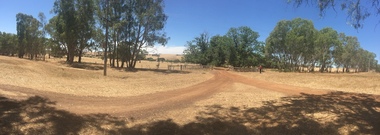
Photograph, Clare Gervasoni, Entrance to Merino Downs Henty, 2015, 22/12/2015
... ...henty brothers...Merino Downs was the property of early squatters the Henty brothers. Pentonvillian Axile George Ind worked for the Henty's at Merino Downs after his arrival at Portland in 1845. ...Merino Downs was the property of early squatters the Henty brothers. Pentonvillian Axile George Ind worked for the Henty's at Merino Downs after his arrival at Portland in 1845. ...Merino Downs was the property of early squatters the Henty brothers. Pentonvillian Axile George Ind worked for the Henty's at Merino Downs after his arrival at Portland in 1845. The Henty Girls were witnesses to his marriage. Colour photograph of land around Merino Downs, Hentyhenty, merino downs, henty brothers, george ind -
 Ballarat Heritage Services
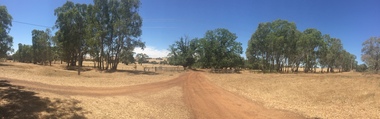
Photograph, Clare Gervasoni, Entrance to Merino Downs, Henty, 2015, 22/12/2015
... ...henty brothers...Merino Downs was the property of early squatters the Henty brothers. Pentonvillian Exile George Ind worked for the Henty's at Merino Downs after his arrival at Portland in 1845. ...Merino Downs was the property of early squatters the Henty brothers. Pentonvillian Exile George Ind worked for the Henty's at Merino Downs after his arrival at Portland in 1845. ...Merino Downs was the property of early squatters the Henty brothers. Pentonvillian Exile George Ind worked for the Henty's at Merino Downs after his arrival at Portland in 1845. The Henty daughters were witnesses to his marriage. Colour panoramic photograph of land around Merino Downs, Henty, Victoriahenty, merino downs, henty brothers, george ind, henty daughters, panorama -
 Ballarat Heritage Services
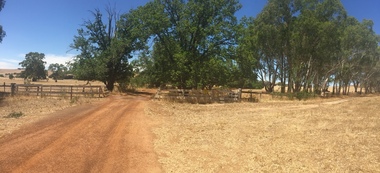
Photograph, Clare Gervasoni, Entrance to Merino Downs Henty, 2015, 22/12/2015
... ...henty brothers...Merino Downs was the property of early squatters the Henty brothers. Pentonvillian Axile George Ind worked for the Henty's at Merino Downs after his arrival at Portland in 1845. ...Merino Downs was the property of early squatters the Henty brothers. Pentonvillian Axile George Ind worked for the Henty's at Merino Downs after his arrival at Portland in 1845. ...Merino Downs was the property of early squatters the Henty brothers. Pentonvillian Axile George Ind worked for the Henty's at Merino Downs after his arrival at Portland in 1845. The Henty Girls were witnesses to his marriage. Colour photograph of land around Merino Downs, Hentyhenty, merino downs, henty brothers, george ind -
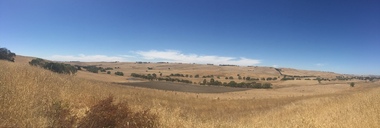 Ballarat Heritage Services
Photograph, Clare Gervasoni, Entrance to Merino Downs Henty, 2015, 22/12/2015
... ...henty brothers...Merino Downs was the property of early squatters the Henty brothers. Pentonvillian Axile George Ind worked for the Henty's at Merino Downs after his arrival at Portland in 1845. ...Merino Downs was the property of early squatters the Henty brothers. Pentonvillian Axile George Ind worked for the Henty's at Merino Downs after his arrival at Portland in 1845. ...Merino Downs was the property of early squatters the Henty brothers. Pentonvillian Axile George Ind worked for the Henty's at Merino Downs after his arrival at Portland in 1845. The Henty Girls were witnesses to his marriage. Colour photograph of land around Merino Downs, Hentyhenty, merino downs, henty brothers, george ind -
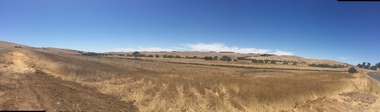 Ballarat Heritage Services
Photograph, Clare Gervasoni, Entrance to Merino Downs Henty, 2015, 22/12/2015
... ...henty brothers...Merino Downs was the property of early squatters the Henty brothers. Pentonvillian Axile George Ind worked for the Henty's at Merino Downs after his arrival at Portland in 1845. ...Merino Downs was the property of early squatters the Henty brothers. Pentonvillian Axile George Ind worked for the Henty's at Merino Downs after his arrival at Portland in 1845. ...Merino Downs was the property of early squatters the Henty brothers. Pentonvillian Axile George Ind worked for the Henty's at Merino Downs after his arrival at Portland in 1845. The Henty Girls were witnesses to his marriage. Colour photograph of land around Merino Downs, Hentyhenty, merino downs, henty brothers, george ind -
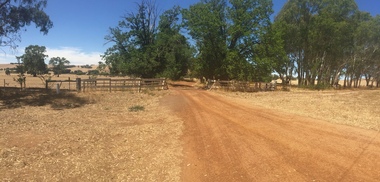 Ballarat Heritage Services
Photograph, Clare Gervasoni, Entrance to Merino Downs Henty, 2015, 22/12/2015
... ...henty brothers...Merino Downs was the property of early squatters the Henty brothers. Pentonvillian Exile George Ind worked for the Henty's at Merino Downs after his arrival at Portland in 1845. ...Merino Downs was the property of early squatters the Henty brothers. Pentonvillian Exile George Ind worked for the Henty's at Merino Downs after his arrival at Portland in 1845. ...Merino Downs was the property of early squatters the Henty brothers. Pentonvillian Exile George Ind worked for the Henty's at Merino Downs after his arrival at Portland in 1845. The Henty Girls were witnesses to his marriage Ann Neagle. Colour photograph of land around Merino Downs, Henty, Victoria.henty, merino downs, henty brothers, george ind -
 Glenelg Shire Council Cultural Collection
Functional object - Fid, n.d
... ... Henty brothers...Originally used by Henty brothers, for splicing cordage (rope) A fid is a conical tool traditionally made of wood or bone. ...It is used to work with rope and canvas in marlinespike seamanship Henty brothers maritime technology Henty brothers Fid made of whale bone. ...Used by Peter Carrison (donor's father-in-law) who was a boat builder. Originally used by Henty brothers, for splicing cordage (rope) A fid is a conical tool traditionally made of wood or bone. It is used to work with rope and canvas in marlinespike seamanshipHenty brothersFid made of whale bone. Three decorative grooves (straight) around top. A fid is a conical tool traditionally made of wood or bone. It is used to work with rope and canvas in marlinespike seamanshipmaritime technology, henty brothers -
 Flagstaff Hill Maritime Museum and Village
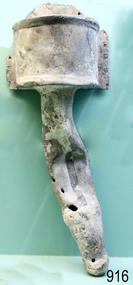
Functional object - Urinal, circa 1825
... ...Henty Brothers...It was a major financial setback for James Henty and his brothers, but one from which they recovered. ...It was a major financial setback for James Henty and his brothers, but one from which they recovered. ...The urinal was probably situated in the forward part of the ship rather than the stern, being one of two placed on either side of the deck and housed immediately adjacent to the doors into the forward castle, or crew sleeping quarters. The toilets on maritime vessels were (and still are) called the ‘heads’, after the sanitation arrangements common until the end of the eighteenth century. The name was given to the ‘head’ of the ship, forward of the forecastle and around the beak or bowsprit. These first lavatories were floored with grating or nets so the force of the sea could wash them clean, and they were always used on the lee or non-weather side so the effluent fell directly into the water rather than back on board. The Children's wrecking: The barque Children was one of the first vessels to be lost in the Western District. The vessel was wrecked to the east of Warrnambool on 14th January 1838. When it ran ashore in hurricane-force winds, 22 passengers and crew were fortunate to escape being battered to death on the rocks. The Children broke up within 20 minutes, sweeping sixteen of those on board to their deaths. After eleven days, the rescued survivors, all of whom were injured, had been taken to Portland. According to Lloyd's Shipping Register 1837-1839, the Children was built in 1825 at Liverpool and operated by owners Gordon & Co, of London. Registration number 123/1837, James Henty then bought her in 1837 as a three-masted barque of 254 tons, with a hull of “part pitch pine, felt sheathed” and “coppered in 1837” at Launceston, registered number 6/1837. In 1838, the Children, under her master Captain H. Browne, completed a successful round trip from Launceston to London (carrying wool and whale oil loaded in Portland), returning in late November of that year carrying a general cargo including house bricks used for ballast. On the 11th of January 1839, the Children sailed from Launceston for Adelaide, with 24 passengers, 14 crew, and an awkward mixed cargo, including 1500 sheep, 8 bullocks, 7 horses, farming implements, and six whaleboats with associated whaling gear. One account states that when the Children was “put out from port, she was light and badly ballasted”. The vessel immediately encountered four days of hurricane-force storms, eventually clearing on the early morning of the 14th. However, it was too late to take accurate measurements of the sun or stars to establish their position relative to the coast. The Children collided with a limestone stack at the entrance of what is now Childers Cove, and the seas smashed the vessel into pieces within half an hour. All the cargo and 16 lives were lost, including 9 children. The Henty brothers contributed £150 towards a fund for the 22 survivors at a memorial service held in Launceston later that year. It was a major financial setback for James Henty and his brothers, but one from which they recovered. In a submission to the Governor of New South Wales dated 24 March 1840, the Henrys summarised their work over the previous six years of establishing the Portland settlement, stating “Six stations have been occupied, one at Portland Bay three at the open country about 60 miles inland called ‘Merino Downs’ They have erected two houses at Portland Bay and two others at Merino Downs”.The urinal recovered from the Children's wreck is significant as part of the original fittings of the early 19th-century barque. The 1839 wreck and recovered artefacts are examples of the construction methods and materials used in that era and can be used to study the evolution of shipbuilding methods and principles. The wreck of the Children is of state significance as one of colonial Victoria’s earliest and most significant maritime disasters, and one of the first vessels lost in the Western District. This is recognised by its inclusion on the Victorian Heritage Register, VHR No. S116. Little is left on the seabed to mark the tragedy, apart from some of the house bricks intended for the Henty settlement. A lead urinal with a rounded back at the top splash plate with an attached semi-circular receptacle or basin (20cm deep and projecting forward 30cm). At the sides are flanges with bolt holes connecting to a ship's wall. The urinal is drained by a funnel-shaped outlet also made of lead, reducing from a 10cm radius to a joined 5 cm pipe. The urinal was recovered from the wreck of the CHILDREN.flagstaff hill, warrnambool, flagstaff-hill, flagstaff-hill-maritime-museum, shipwreck-coast, shipwreck artefact, the children, lead ship’s plumbing, crew urinal, the ‘heads’, ship plumbing, james henty, portland bay, urinal, ship's urinal, ship’s fitting, ship’s lead plumbing, ship’s toilet, ship’s urinal, children, childer’s cove, port campbell, 1839 shipwreck, james henty and co, henty brothers, captain h. browne, portland -
 Warrnambool and District Historical Society Inc.
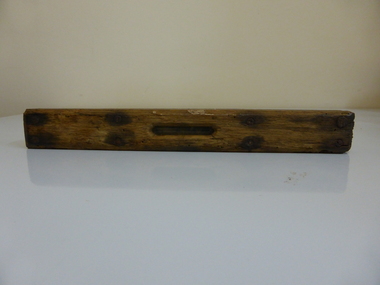
Functional object - Spirit Level
... ...Henty brothers portland...The Hentys of Portland are regarded as the first permanent settlers in the State of Victoria (1834). Stephen Henty, with his brother Edward, was involved in the whaling industry in Portland. ...The Hentys of Portland are regarded as the first permanent settlers in the State of Victoria (1834). Stephen Henty, with his brother Edward, was involved in the whaling industry in Portland. ...This item was given to the Historical Society in 1972, with the donor indicating that the spirit level belonged to the Henty family. The Hentys of Portland are regarded as the first permanent settlers in the State of Victoria (1834). Stephen Henty, with his brother Edward, was involved in the whaling industry in Portland. He also had shipping interests, operating a regular Western District shipping service (‘Champion’, ‘Lady Bird’, ‘Western’, ‘Edina’ etc) and a property ‘Cadnook’, near Harrow. Stephen Henty had close connections with Warrnambool not only because of his shipping interests but also because he was the brother-in-law of an early Warrnambool Harbour Master, Captain Frank Helpman. A spirit level was an essential tool for early settlers as they often built their own homes and constructed the roads nearby, needing to ascertain if what was being constructed was on level ground.It does not seem possible to establish whether this item belonged to the Henty family or to a Henty property. But in the Historical Society collection we have a piece of sheet music which includes the handwriting ‘Mrs Smalpaige, Cadnook’, ‘S. J. Henty’ and the date ‘8th August 1859’. Also the Warrnambool Art Gallery has an authentic Henty piano dating from 1837 and Stephen Henty’s wife died in Hamilton in 1906 so it is possible that the spirit level came to us from a Henty family descendant living nearby via Mr N. Kelly. If the Henty provenance can be proved then this item is of high significance.This is an unvarnished wooden spirit level, apparently home made, with a bubble in the centre. The top has been attached with eight screws, now much rusted. There appears to be some letters in the bubble area but they have not been deciphered “Hentys spirit level, oldest in Australia” is written in ink on the back of the objectspirit level, henty brothers portland, warrnambool, henty family -
 Ballarat Heritage Services
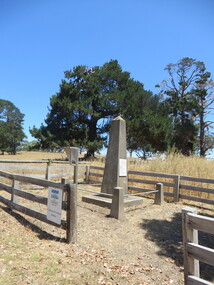
Photograph, Clare Gervasoni, Henty School Memorial, 2015, 22/12/2015
... Colour photograph of a memorial commemorating the Henty School, Major Mitchell, the Henty Brothers and Alexander Peacock....James. henty henty school henty school no 2020 memorial henty memorial major mitchell memorial alexander peacock Colour photograph of a memorial commemorating the Henty School, Major Mitchell, the Henty Brothers and Alexander Peacock. Henty School Memorial, 2015 Photograph Photograph Clare Gervasoni ...The memorial was unveiled on 16 September 1927 by the Hon. A.S. Rodgers, M.H.R. in front of a large gathering. Radio Station 3LO broadcast the National Anthem at the prearranged time of 2.00 pm and the announcer, in a Melbourne studio, read an address prepared by James Sexton. The gathering listened to the broadcast on a six-valve radio set, loaned by Mr J. James. Colour photograph of a memorial commemorating the Henty School, Major Mitchell, the Henty Brothers and Alexander Peacock.henty, henty school, henty school no 2020, memorial, henty memorial, major mitchell memorial, alexander peacock -
 Ballarat Heritage Services
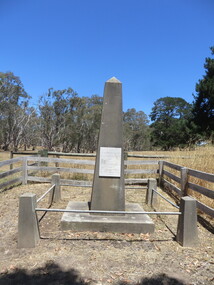
Photograph, Clare Gervasoni, Henty School Memorial, 2015, 22/12/2015
... Colour photograph of a memorial commemorating the Henty School, Major Mitchell, the Henty Brothers and Alexander Peacock....James. henty henty school henty school no 2020 memorial henty memorial major mitchell memorial alexander peacock Colour photograph of a memorial commemorating the Henty School, Major Mitchell, the Henty Brothers and Alexander Peacock. Henty School Memorial, 2015 Photograph Photograph Clare Gervasoni ...The memorial was unveiled on 16 September 1927 by the Hon. A.S. Rodgers, M.H.R. in front of a large gathering. Radio Station 3LO broadcast the National Anthem at the prearranged time of 2.00 pm and the announcer, in a Melbourne studio, read an address prepared by James Sexton. The gathering listened to the broadcast on a six-valve radio set, loaned by Mr J. James. Colour photograph of a memorial commemorating the Henty School, Major Mitchell, the Henty Brothers and Alexander Peacock.henty, henty school, henty school no 2020, memorial, henty memorial, major mitchell memorial, alexander peacock -
 Ballarat Heritage Services
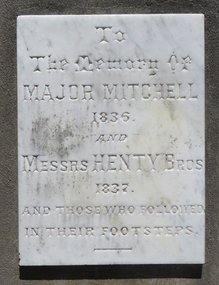
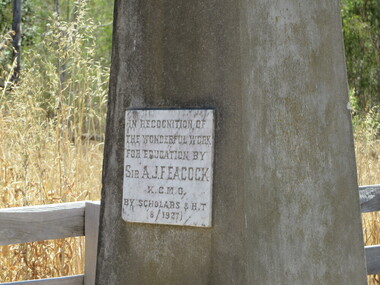
Photograph, Clare Gervasoni, Marble Plaque on the Henty School Memorial, 2015, 22/12/2015
... Colour photograph of a memorial commemorating the Henty School, Major Mitchell, the Henty Brothers and Alexander Peacock....James. henty henty school henty school no 2020 memorial henty memorial major mitchell memorial alexander peacock education Colour photograph of a memorial commemorating the Henty School, Major Mitchell, the Henty Brothers and Alexander Peacock. Marble Plaque on the Henty School Memorial, 2015 Photograph Photograph Clare Gervasoni ...The memorial was unveiled on 16 September 1927 by the Hon. A.S. Rodgers, M.H.R. in front of a large gathering. Radio Station 3LO broadcast the National Anthem at the prearranged time of 2.00 pm and the announcer, in a Melbourne studio, read an address prepared by James Sexton. The gathering listened to the broadcast on a six-valve radio set, loaned by Mr J. James. Colour photograph of a memorial commemorating the Henty School, Major Mitchell, the Henty Brothers and Alexander Peacock.henty, henty school, henty school no 2020, memorial, henty memorial, major mitchell memorial, alexander peacock, education -
 Ballarat Heritage Services
Photograph, Clare Gervasoni, Marble Plaque on the Henty School Memorial, 2015, 22/12/2015
... Colour photograph of a memorial commemorating the Henty School, Major Mitchell, the Henty Brothers and Alexander Peacock....James. henty henty school henty school no 2020 memorial henty memorial major mitchell memorial alexander peacock Colour photograph of a memorial commemorating the Henty School, Major Mitchell, the Henty Brothers and Alexander Peacock. Marble Plaque on the Henty School Memorial, 2015 Photograph Photograph Clare Gervasoni ...The memorial was unveiled on 16 September 1927 by the Hon. A.S. Rodgers, M.H.R. in front of a large gathering. Radio Station 3LO broadcast the National Anthem at the prearranged time of 2.00 pm and the announcer, in a Melbourne studio, read an address prepared by James Sexton. The gathering listened to the broadcast on a six-valve radio set, loaned by Mr J. James. Colour photograph of a memorial commemorating the Henty School, Major Mitchell, the Henty Brothers and Alexander Peacock.henty, henty school, henty school no 2020, memorial, henty memorial, major mitchell memorial, alexander peacock -
 Flagstaff Hill Maritime Museum and Village
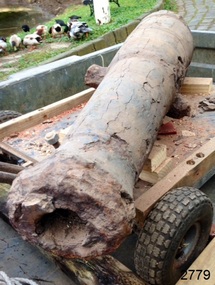
Weapon - Cannon, circa 1825
... ...Henty Brothers...Flagstaff Hill Flagstaff Hill Maritime Museum and Village Warrnambool Maritime Museum Maritime Village Great Ocean Road Shipwreck Coast shipwreck artefact Children barque three-masted Liverpool Childer’s Cove Port Campbell 1839 shipwreck 1939 wreck James Henty and Co Henty Brothers Captain H. Browne First Mate T. Gay Second Mate W. ...In an article dated 26 March 1963, the Warrnambool Standard reported: “A cannon which has lain on the ocean floor since the barque, Children, was wrecked at Childer’s Cove on January 15, 1839, was raised by three Warrnambool skindivers at the weekend … The cannon, weighing about 750 lb. and 4-ft. 6-in. in length … is in excellent order considering the length of time it has remained underwater”. No conservation measures were taken at that time, other than chipping off the marine growth with hammers and cold chisels. The minutes for the 4 February 1974 meeting of the Flagstaff Hill Planning Board recorded that “a cannon recovered some time ago was lying in the garden of [one of the three original divers] and that it could be picked up at any time”. Peter Ronald, past Manager and Diver for Flagstaff Hill, notes that the CHILDREN cannon would have been recovered by the other divers around 1964. When the cannon came into care of Flagstaff Hill, it was given basic conservation relevant to the time. (At the same meeting, the Board was advised of the recovery of an anchor from the wreck of the CHILDREN by Flagstaff Hill divers (Peter Ronald, Colin Goodall and Gary Hayden, and Hank Howey and Andrew Coffee), and its interim relocation in the sea at the end of the Warrnambool Breakwater while awaiting conservation). About the ship CHILDREN 1825-1839: The sailing ship Children was a wooden, three-masted barque constructed of pitch pine in 1825 at Liverpool. It was felt sheathed and was coppered during an upgrade in 1837. The ship was only 29 metres long and 254 tons in weight; it had two decks and a square stern. The James Henty & Co., a pioneering family from Portland, Victoria, purchased the Children in 1837 for use as a coastal trader. The Children, under the command of Captain H. Browne, was on a voyage from Launceston to Adelaide when it foundered in rough conditions at Childers Cove, west of Peterborough, on 14 January 1839. On board were 14 crew members and 24 passengers, including 9 children. The ship’s cargo was awkwardly balanced: it carried 1500 sheep, 8 bullocks, 7 horses, 5000 London house bricks, 6 whaling boats with associated gear, and general trade goods including beef, pork, tobacco, tipe, butter, lime juice, horse hair, curtains, lead shot, beer and spirits. The hurricane-force winds drove the Children into the limestone stack at the entrance to the cove. The seas smashed it into pieces within twenty minutes. The bodies of sixteen of those who had lost their lives were spread across the shore, along with wreckage from the ship and the cargo of animals. Those who survived suffered injuries; they were rescued and taken by horse and cart to Campbell’s farm, near the whaling station at Port Fairy. They arrived at Portland eleven days after the wreck. The wrecking of the Children is one of colonial Victoria’s earliest and most significant maritime disasters. Little is left to mark the tragedy, apart from some house bricks intended for the Henty family’s Portland Bay settlement. Artefacts recovered in the 1960s to early 1970s include this signal cannon, an anchor, the bottom half of her ship’s bell, and two portions of a ship’s fitting, at one time thought to be a brass porthole frame, London housing bricks and timber flooring. Despite its poor condition, the CHILDREN’s signal cannon remains an important and interpretable record of its demise. From 2015, the CHILDREN cannon has been undergoing the first stages of further conservation.The signal cannon recovered from the Children's wreck is significant as part of the original fittings of the early 19th-century barque. It is an example of maritime defence in the early to mid-19th century. The 1839 wreck and recovered artefacts are examples of the construction methods and materials used in that era and can be used to study the evolution of shipbuilding methods and principles. The wreck of the Children is of state significance as one of colonial Victoria’s earliest and most significant maritime disasters, and one of the first vessels lost in the Western District. This is recognised by its inclusion on the Victorian Heritage Register, VHR No. S116. Little is left on the seabed to mark the tragedy, apart from some of the house bricks intended for the Henty settlement. Signal cannon: a 1.3 metre iron 6pdr cannon recovered from the wreck of the CHILDREN. The shape of the cannon tapers from a thick round breech to a flared muzzle, with an 8-centimetre bore, and two side trunnions for pivoting on a wooden gun carriage. It was recovered from the shipwreck site of the CHILDREN by local divers in 1963. This small muzzle-loading signal cannon is in poor and unrestored condition. The cannon’s upper profile of smooth grey metal casing has corroded off, leaving an extensively oxidised rough red surface of crumbling iron. The bottom half of the cannon remains intact, although the outer smooth casing also appears to be separating from the iron core of the barrel. The original grey casting is also missing from the breech and muzzle ends of the cannon. Corrosion and spalling of the upper surface layer of the cannon have removed the maker’s marks and specificationsflagstaff hill, flagstaff hill maritime museum and village, warrnambool, maritime museum, maritime village, great ocean road, shipwreck coast, shipwreck artefact, children, barque, three-masted, liverpool, childer’s cove, port campbell, 1839 shipwreck, 1939 wreck, james henty and co, henty brothers, captain h. browne, first mate t. gay, second mate w. wentworth, portland, portland bay, 1939, ship’s cannon, signal cannon, conservation of marine artefacts, 6pdr small bore cannon, defence -
 Flagstaff Hill Maritime Museum and Village
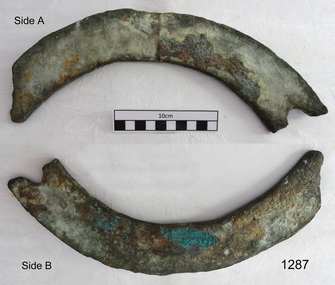
Functional object - Ship's Fitting, circa 1825
... ...Henty Brothers...Flagstaff Hill Flagstaff Hill Maritime Museum and Village Warrnambool Maritime Museum Maritime Village Great Ocean Road Shipwreck Coast shipwreck artefact Children Childer’s Cove Port Campbell 1839 shipwreck James Henty and Co Henty Brothers Captain H. Browne Portland Portland Bay brass flange brass rim ship’s fitting Ship's fitting, of heavy gauge brass circle, previously classified as a section of the ship's fitting, which was raised from the wreck of the Children. ...This attractively patinated artefact was raised from the wreck site of the CHILDREN and was quite reasonably catalogued as a portion of a ship's porthole. This identification is unlikely, however, because the CHILDREN was built at Liverpool in 1824, and round portholes were not in common use until the 1850s. The catalogue identification has since been changed to "Ship's Fitting" Before the appearance of round portholes in the middle of the nineteenth century, the function of introducing light to lower decks was performed by square half-glassed ‘ports’ in the side of the hull (known as a port-sash), or ground-glass ‘bullseyes’ inserted in the deck (scuttles). In historical terms, ports were always square, cut into the timber originally to allow the firing of a ship's guns, and were closed in weather by a tight-fitting square hatch. Flagstaff Hill Shipwreck Museum has three portholes on display that illustrate the gradual development and adoption of circular brass portholes. First in sequence is a small 12.5cm diameter window (with a deep frame for thick wooden hulls) from the 1855 wreck of SCHOMBERG. The second and third are larger 25cm diameter windows (with a shallower frame for thinner iron hulls) from the 1892 wreck of the NEWFIELD and the 1908 wreck of the FALLS OF HALLADALE. Once the apparently obvious use of the brass object is discounted, an accurate and reliable alternative classification is difficult to specify. One artefact register notes it was ‘found in about the centre of the wreck site’. This would mitigate against the possibilities of (1) ‘horseshoe frame’ joining pieces of the keel and hull at the bow of the vessel, or (2) ‘deckseat’ for a binnacle at the stern. It may support the idea of a ‘head frame’ on a cooped companionway or a ‘deckseat’ for a mainmast pump. But this is only speculation. The actual identification is not known. The sip's fitting recovered from the Children's wreck is significant as part of the original fittings of the early 19th-century barque. The 1839 wreck and recovered artefacts are examples of the construction methods and materials used in that era and can be used to study the evolution of shipbuilding methods and principles. The wreck of the Children is of state significance as one of colonial Victoria’s earliest and most significant maritime disasters, and one of the first vessels lost in the Western District. This is recognised by its inclusion on the Victorian Heritage Register, VHR No. S116. Little is left on the seabed to mark the tragedy, apart from some of the house bricks intended for the Henty settlement. Ship's fitting, of heavy gauge brass circle, previously classified as a section of the ship's fitting, which was raised from the wreck of the Children. One end is broken off at an original bolt hole, and the other is severed or cut at an acute angle from the inner rim. The artefact is 6cm across and 1cm deep, indicating strength and function as a substantial and finished item of moulded metal. The upper face bears sedimentary accretion stained red/brown. The rear face has been gouged by hard or corrosive materials and bears brilliant blue/green oxidation.flagstaff hill, flagstaff hill maritime museum and village, warrnambool, maritime museum, maritime village, great ocean road, shipwreck coast, shipwreck artefact, children, childer’s cove, port campbell, 1839 shipwreck, james henty and co, henty brothers, captain h. browne, portland, portland bay, brass flange, brass rim, ship’s fitting -
 Flagstaff Hill Maritime Museum and Village
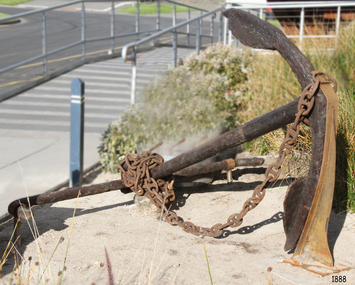
Equipment - Anchor, Before 1831
... ...Henty Brothers...Flagstaff Hill Flagstaff Hill Maritime Museum and Village Warrnambool Maritime Museum Maritime Village Great Ocean Road Shipwreck Coast shipwreck artefact Children barque three-masted Liverpool Childer’s Cove Port Campbell 1839 shipwreck 1939 wreck James Henty and Co Henty Brothers Captain H. Browne First Mate T. Gay Second Mate W. ...The anchor is from the wooden sailing ship CHILDREN, which was wrecked at Childers Cove east of Warrnambool on the 14th of January 1839 with the loss of 16 lives. The Children anchor was raised from the wreck site by Flagstaff Hill Divers: Peter Ronald, Garry Hayden (Terang, still), Tim Goodall (now Warrnambool), and Colin Goodall (now Warrnambool), on Sunday, 3rd January 1974. A week or so later, it was dragged up the cliffs and taken to Warrnambool. It is now on display near the entrance to the Maritime Museum and Village. It appears to be a Pering’s Improved Anchor, developed at Portsmouth after 1813. The addition of broad curvature to the anchor arms provided a stronger purchase than the pre-existing Admiralty Old Pattern Long Shanked Anchor with straight arms. However, the evidence of hammer-welding of the separate pieces of the arms and palms to the central shank, peaked crown and flat palms, suggests the manufacture is before the 1831 Rodger’s Anchor design, which cast both arms and their flukes as one piece that was then attached to the shank by a bolt through the crown. This identification seems consistent with the date of the CHILDREN’s construction in 1824. The CHILDREN was a three-masted barque with a wooden hull built at Liverpool in England. The vessel was bought by the Henty family of Portland (Australia Felix) in 1837 for regular coastal trading between Van Diemens Land (now Tasmania), the Port Phillip District of New South Wales and South Australia. Only 255 tons burden (92 feet in length, with a beam of 25 feet and depth of 17 feet), it sailed from Launceston bound for Adelaide in late December 1838, on its first Australian voyage and under the English master who had brought the barque out, Captain H. Browne. On board the CHILDREN were 24 passengers, including 9 children, the captain and 14 crew; livestock of 1500 sheep, 8 bullocks and 7 horses; general cargo of beef, pork, tobacco, tripe, butter, limejuice, horse hair, currants, lead shot, beer and spirits; 5,000 house bricks from London; and six whaling boats with associated whaling gear. The vessel was battered by gale-force north-westerly winds shortly after setting out from Launceston on 11 January 1839, and adverse sailing conditions persisted for the next four days. At 11 pm on the 14th of January 1839, and many miles north and east of the captain’s navigated position, the CHILDREN struck the Pinnacle, a limestone stack off what is now called Childers Cove. Within half an hour, the ship was destroyed. As well as the loss of livestock and cargo, 16 passengers and crew perished, including the captain, six men, one woman and nine children. In 1931, shifting sands at Childers Cove uncovered the skeleton of an adult male. In 1951, another two skeletons were exposed by storms, an adult male and a child. In 1963, some district scuba divers retrieved a small signal cannon from the site. And in 1974, Flagstaff Hill recovered the anchor and some house bricks. The anchor recovered from the Children's wreck is significant as part of the equipment of the early 19th-century barque. The 1839 wreck and recovered artefacts are examples of the construction methods and materials used in that era and can be used to study the evolution of shipbuilding methods and principles. The wreck of the Children is of state significance as one of colonial Victoria’s earliest and most significant maritime disasters, and one of the first vessels lost in the Western District. This is recognised by its inclusion on the Victorian Heritage Register, VHR No. S116. Little is left on the seabed to mark the tragedy, apart from some of the house bricks intended for the Henty settlement. A large forged, wrought iron anchor from the wreck of the CHILDREN. Flat hammer-welded flukes on opposing curved arms and a peaked crown. It has a metal, elbowed stock or cross-bar and a heavy-duty pinned, flat-ring shackle for the anchor chain. It is in fair condition but extensively corroded after 135 years on the seabed. flagstaff hill, flagstaff hill maritime museum and village, warrnambool, maritime museum, maritime village, great ocean road, shipwreck coast, shipwreck artefact, children, barque, three-masted, liverpool, childer’s cove, port campbell, 1839 shipwreck, 1939 wreck, james henty and co, henty brothers, captain h. browne, first mate t. gay, second mate w. wentworth, portland, portland bay, anchor, ship’s anchor, peter ronald, garry hayden, tim goodall, colin goodall, pering’s improved anchor -
 Flagstaff Hill Maritime Museum and Village
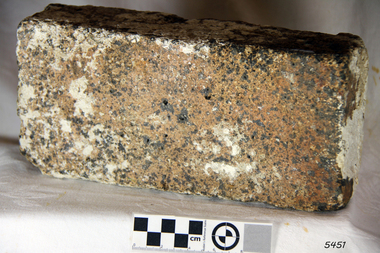
Ceramic - Clay Brick, ca 1837
... ...Henty Brothers...Flagstaff Hill Flagstaff Hill Maritime Museum and Village Warrnambool Maritime Museum Maritime Village Great Ocean Road Shipwreck Coast shipwreck artefact Children barque three-masted Liverpool Childer’s Cove Port Campbell 1839 shipwreck 1939 wreck James Henty and Co Henty Brothers Captain H. Browne First Mate T. Gay Second Mate W. ...According to Lloyds Shipping Register 1837-1839, the CHILDREN was built in 1825 at Liverpool and operated by owners Gordon & Co, of London. London registered number 123/1837. James Henty then bought the vessel in 1837 as a three-masted barque of 254 tons, with a hull of “part pitch pine, felt sheathed” and “coppered 1837”. Launceston registered number 6/1837. In 1838, the CHILDREN, under her master Captain H. Browne, completed a successful round trip from Launceston to London carrying wool and whale oil loaded in Portland, returning in late November of that year carrying a general cargo including the house bricks. On the 11th January 1839, the CHILDREN sailed from Launceston for Adelaide, with 24 passengers, 14 crew, and an awkward mixed cargo, including 1500 sheep, 8 bullocks, 7 horses, farming implements, and six whaleboats with associated whaling gear, and house bricks for the Hentys' settlement in Portland. One account states that when the CHILDREN “put out from port, it was light and badly ballasted”. The vessel immediately encountered four days of hurricane force storms, eventually clearing on the early morning of the 14th to “west force 10”, but too late to take accurate measurements of the sun or stars to establish their position relative to the coast. The CHILDREN collided with a limestone stack at the entrance of what is now called Childers Cove, and the seas smashed it into pieces within half an hour. All the cargo and 16 lives were lost, including 9 children. The Hentys contributed £150 towards a fund for the 22 survivors at a memorial service held in Launceston later that year. It was a major financial setback for the Henrys, but one from which they recovered. In a submission to the Governor of New South Wales dated 24 March 1840, the Henty’s summarised their work over the previous six years of settlement: “Six stations have been occupied, one at Portland Bay…three at the open country about 60 miles inland called ‘Merino Downs’…They have erected two houses at Portland Bay and two others at Merino Downs”. The London house bricks recovered from the Children's wreck are significant as part of the cargo of the early 19th-century barque. The bricks were intended for the owner of the Children, the Henty family, for their Portland settlement. The 1839 wreck and recovered artefacts are examples of the construction methods and materials used in that era and can be used to study the evolution of shipbuilding methods and principles. The wreck of the Children is of state significance as one of colonial Victoria’s earliest and most significant maritime disasters, and one of the first vessels lost in the Western District. This is recognised by its inclusion on the Victorian Heritage Register, VHR No. S116. Little is left on the seabed to mark the tragedy, apart from some of the house bricks intended for the Henty settlement. Clay brick: house brick from London, with some with white marine encrustation, recovered from the wreck of the ship CHILDREN. The brick is an oblong shape and is constructed of a coarse-grained conglomerate. flagstaff hill, flagstaff hill maritime museum and village, warrnambool, maritime museum, maritime village, great ocean road, shipwreck coast, shipwreck artefact, children, barque, three-masted, liverpool, childer’s cove, port campbell, 1839 shipwreck, 1939 wreck, james henty and co, henty brothers, captain h. browne, first mate t. gay, second mate w. wentworth, portland, portland bay, 1939, bricks, london house bricks, clay bricks -
 Flagstaff Hill Maritime Museum and Village
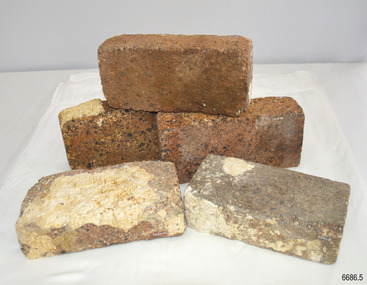
Ceramic - Clay Bricks, Circa 1838
... ...Henty Brothers...Flagstaff Hill Flagstaff Hill Maritime Museum and Village Warrnambool Maritime Museum Maritime Village Great Ocean Road Shipwreck Coast shipwreck artefact Children barque three-masted Liverpool Childer’s Cove Port Campbell 1839 shipwreck 1939 wreck James Henty and Co Henty Brothers Captain H. Browne First Mate T. Gay Second Mate W. ...These bricks are a sample of “5000 house bricks from London” carried by the CHILDREN as ballast, and intended for the Portland Bay settlement of her owners, Henty Bros. Flagstaff Hill divers recovered the bricks from Childers Cove in February 1974 and noted, “These bricks are the major feature of the wreck site. Subsequent notes indicate “The hull structure has broken up, leaving few visible remains, except for piles of house bricks intended for the Hentys of Portland”. According to Lloyds Shipping Register 1837-1839, the CHILDREN was built in 1825 at Liverpool and operated by owners Gordon & Co, of London, London registered number 123/1837; James Henty then bought her in 1837 as a three-masted barque of 254 tons, with a hull of “part pitch pine, felt sheathed” and “coppered 1837”. Launceston registered number 6/1837. In 1838, the CHILDREN, under her master Captain H. Browne, completed a successful round trip from Launceston to London carrying wool and whale oil loaded in Portland, returning in late November of that year carrying general cargo, including house bricks. On the 11th of January 1839, the CHILDREN sailed from Launceston for Adelaide, with 24 passengers, 14 crew, and an awkward mixed cargo, including 1500 sheep, 8 bullocks, 7 horses, farming implements, and six whaleboats with associated whaling gear. One account states that when the CHILDREN “put out from port, it was light and badly ballasted”. The vessel immediately encountered four days of hurricane-force storms, eventually clearing on the early morning of the 14th to “west force 10”, but too late to take accurate measurements of the sun or stars to establish their position relative to the coast. The CHILDREN collided with a limestone stack at the entrance of Childers Cove, and the seas smashed her into pieces within half an hour. All the cargo and 16 lives were lost (including 9 children). The Hentys contributed £150 towards a fund for the 22 survivors at a memorial service held in Launceston later that year. It was a major financial setback for the Hentys, but one from which they recovered. In a submission to the Governor of New South Wales dated 24 March 1840, the Hentys summarised their work over the previous six years of settlement: “Six stations have been occupied, one at Portland Bay…three at the open country about 60 miles inland called ‘Merino Downs’…They have erected two houses at Portland Bay and two others at Merino Downs”.These bricks are significant as a sample of 5000 house bricks carried from London as ballast by the Children and were intended for the Portland Bay settlement of her owners, James Henty & Co. The 1839 wreck and recovered artefacts are examples of the construction methods and materials used in that era and can be used to study the evolution of shipbuilding methods and principles. The wreck of the Children is of state significance as one of colonial Victoria’s earliest and most significant maritime disasters, and one of the first vessels lost in the Western District. This is recognised by its inclusion on the Victorian Heritage Register, VHR No. S116. Little is left on the seabed to mark the tragedy, apart from some of the house bricks intended for the Henty settlement. Five ‘house bricks from London’, some with white marine encrustation, recovered from the wreck of the ship CHILDREN. The bricks are oblong shaped and constructed of a blue-coloured and coarse-grained conglomerate. One brick is higher, shorter and narrower, than the other four bricks.flagstaff hill, flagstaff hill maritime museum and village, warrnambool, maritime museum, maritime village, great ocean road, shipwreck coast, shipwreck artefact, children, barque, three-masted, liverpool, childer’s cove, port campbell, 1839 shipwreck, 1939 wreck, james henty and co, henty brothers, captain h. browne, first mate t. gay, second mate w. wentworth, portland, portland bay, 1939, bricks, london house bricks, clay bricks -
 Flagstaff Hill Maritime Museum and Village
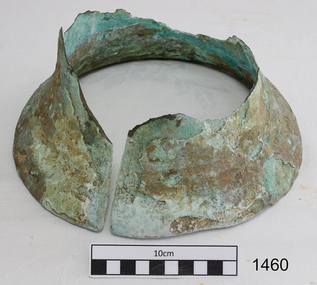
Functional object - Ship's Bell, Before 1837
... ...henty brothers...The shipwreck of the CHILDREN is of State significance ― Victorian Heritage Register S116 flagstaff hill warrnambool shipwrecked coast flagstaff hill maritime museum maritime museum shipwreck coast flagstaff hill maritime village great ocean road the children bell ships bell childers cove henty brothers james henty & co sea-watches nautical time james henty & co bell from the children A part of a brass ship’s bell, recovered from the wreck of the CHILDREN. ...This remnant of a ship's bell was recovered from the wreck site of the CHILDREN by Flagstaff Hill Divers on 1 October 1973. The artefact had lain in the ocean off Childers Cove since the vessel’s disastrous sinking there on 14 January 1839. Other similarly high-value metallic objects raised from the site, and now in the Flagstaff Hill collection, are the ship’s signal cannon (1963) and the ship’s anchor (1974). A ship’s bell was normally struck by the lookout at the forward part of a vessel, following orders “Strike the bell” from the officer of the watch at the helm, or as a warning signal of danger ahead. Its main function was to keep the crew aware of time. Each 24 hours was divided into 4 hour work-shifts, or watches, and each of these was divided into 8 half hours, or glasses, each half hour being determined by the time it took between each turn of the ship’s hourglass. The six watches were the first watch from 8 pm to midnight, the second or middle watch from midnight to 4 am, the third or morning watch from 4 to 8 am, the fourth or forenoon watch from 8 am to midday, the fifth or noon watch from midday to 4 pm, and the sixth or dog watch from 4 to 8 pm. Within each watch, the first half hour would end with one bell, the second with two bells, the third with three bells, and so on until their work shift ended with the ringing of eight bells. The CHILDREN left Launceston on 11 January 1839 and immediately struck heavy weather. By the evening of 14 January, Captain Browne had been continuously on duty for four days and needed sleep. His First Mate T. Gay was incapacitated with seasickness, and the task of command was given to the Second Mate W. Wentworth. At two bells into the first watch, or 9 o’clock that night, the captain went below. Two hours later, at six bells into the first watch, or 11 o’clock that night, the lookout cried “Breakers close ahead”. Within a minute, the ship struck the rocks at the entrance of Childers Cove. Within twenty minutes, the huge seas had taken her stern, three masts and much of her weatherside, leaving survivors clinging to the forecastle. Within two hours, the wreck had completely disappeared. If anyone could have rung the bell by then, it would have been to strike two bells into the middle-watch, or one o’clock on the morning of 15 January. An 1859 Victorian Register of Wrecks from 1835 to 1858 remarks the CHILDREN “Ran ashore through an error in the reckoning and a bad lookout [and] Became a total wreck”. 22 passengers and crew survived the tragedy, but 16 lives were lost, including the captain and second mate, and 9 children. The shipwreck of the CHILDREN is of State significance ― Victorian Heritage Register S116A part of a brass ship’s bell, recovered from the wreck of the CHILDREN. The upper part, or dome of the bell, has corroded away, leaving the lower portion, or mouth of the bell, largely intact. However, this lower surviving portion has been severed vertically with a clear cut similar to a saw cut, leaving a regular 1cm gap down one side of the bell. It is an evocative relic, attractively aged on the seafloor, bearing layers of aqua-marine verdigris and white limestone accretion on a dull bronze surface. There is no visible ship’s name on the bell. flagstaff hill, warrnambool, shipwrecked coast, flagstaff hill maritime museum, maritime museum, shipwreck coast, flagstaff hill maritime village, great ocean road, the children, bell, ships bell, childers cove, henty brothers, james henty & co, sea-watches, nautical time, james henty & co, bell from the children -
Glenelg Shire Council Cultural Collection
Tool - Caulking Screw, n.d
... Claimed to have been originally used by the Henty brothers....Claimed to have been originally used by the Henty brothers. Caulking tool used for prying leaking wooden planks open so leak can be plugged with pitch and hemp. ...Previously owned by Peter Carrison, Bruce's father-in-law, a carpenter and boat-builder. Claimed to have been originally used by the Henty brothers.Caulking tool used for prying leaking wooden planks open so leak can be plugged with pitch and hemp. Has a wooden handle. -
Glenelg Shire Council Cultural Collection
Weapon - Whaling Harpoons, n.d
... Original owner - one of the Henty brothers, bought by Margaret's grandfather, Matthew Edward Mabbitt, lighthouse keeper at a Henty clearing sale about 1900...Original owner - one of the Henty brothers, bought by Margaret's grandfather, Matthew Edward Mabbitt, lighthouse keeper at a Henty clearing sale about 1900 whaling maritime industry hunting henty Back: 'Mcmillan' on back of both harpoon heads - first two letters unclear Two matching harpoons with wooden handles. ...Original owner - one of the Henty brothers, bought by Margaret's grandfather, Matthew Edward Mabbitt, lighthouse keeper at a Henty clearing sale about 1900Two matching harpoons with wooden handles. Metal harpoon heads have been re-plated at some stageBack: 'Mcmillan' on back of both harpoon heads - first two letters unclearwhaling, maritime industry, hunting, henty -
Glenelg Shire Council Cultural Collection
Letter - Letter - Mr William Jones, Launceston, to his daughter Eleanor Rebecca Jones, 01/09/1854
... This ship was owned by the Henty brothers.|Displayed in glass bottle in History House for __ years....This ship was owned by the Henty brothers.|Displayed in glass bottle in History House for __ years. ...These letters came to Portland on the 'City of Sydney' under Captain Henderson. This ship was owned by the Henty brothers.|Displayed in glass bottle in History House for __ years.Hand-written letter in glass bottle. Letter written by Mr William Jones, Launceston, to his daughter Eleanor Rebecca Jones, staying with Captain James Fawthrop at Windsor Cottage, Portland.Front: - Back: - -
Glenelg Shire Council Cultural Collection
Letter - Letter - Mr Williams to his daughter Eleanor Rebecca Jones, William Jones, 17/10/1854
... This ship was owned by the Henty brothers. Captain James Fawthrop was the harbour master at Portland and also captain of the Portland Lifeboat crew at the time of the wrecking of the Admella in 1859....This ship was owned by the Henty brothers. Captain James Fawthrop was the harbour master at Portland and also captain of the Portland Lifeboat crew at the time of the wrecking of the Admella in 1859. ...These letters came to Portland on the 'City of Sydney' under Captain Henderson. This ship was owned by the Henty brothers. Captain James Fawthrop was the harbour master at Portland and also captain of the Portland Lifeboat crew at the time of the wrecking of the Admella in 1859.Hand-written letter in glass bottle. Letter written by Mr Williams Jones, Launceston, to his daughter Eleanor Rebecca Jones who was staying with Captain James Fawthrop at Windsor Cottage, Portland.captain james fawthrop, letter, bottle, windsor cottage -
Warrnambool and District Historical Society Inc.
Medallion, Stokes Melbourne, Centenary of Victoria 1935, 1933
... Portland was settled by the Henty brothers and John Batman and John Fawkner are the two names associated with the founding of Melbourne. ...Portland was settled by the Henty brothers and John Batman and John Fawkner are the two names associated with the founding of Melbourne. ...This medal was given to Victorian school children to celebrate the centenary of European settlement in Victoria and the establishment of Melbourne in 1835. Portland was settled by the Henty brothers and John Batman and John Fawkner are the two names associated with the founding of Melbourne. The Melbourne Shrine of Remembrance was dedicated during these celebrations. This medal is a memento of the centenary of Victoria and may have been given a local Warrnambool school child. Circular silver coloured medal with ring at top and a further ring inserted. The obverse features a sailing ship entering a bay. Since "Portland " is part of the text it is assumed the bay is situated in Portland. Text The reverse features a hatted man wearing a suit and holding a walking stick standing on a grassy shore, a body of water and a sky line of buildings Obverse CENTENARY OF VICTORIA 1934 PORTLAND 1834 Reverse CENTENARY OF MELBOURNE 1935 1835 -
 Victorian Interpretive Projects Inc.
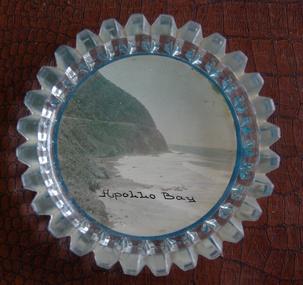
Image of souvenir ware, Apollo Bay
... In the 1840s the Henty brothers established a whaling station at Point Bunbury on the western end of the bay. ...In the 1840s the Henty brothers established a whaling station at Point Bunbury on the western end of the bay. ...Apollo Bay is located between Wye River and Cape Otway on Victoria's scenic coastal route, the Great Ocean Road. In the 1840s the Henty brothers established a whaling station at Point Bunbury on the western end of the bay. The bay was named by Captain Loutit in 1845 when he sheltered his vessel, the Apollo during a storm. (http://en.wikipedia.org/wiki/Apollo_Bay)A coloured picture of a coastline attached to a glass butter plate. The coastline is Cape Patton, Apollo Bay, Victoria"Apollo Bay"apollo bay, beach, coast, souvenir -
Port Melbourne Historical & Preservation Society
Newspaper, Genevieve FORDE, Gateway to Victoria -150 years of history at Sandridge, Emerald Hill and St Kilda come alive, 22 Nov 1984
... They were the Henty Brothers from Tasmania who settled around Portland. ...They were the Henty Brothers from Tasmania who settled around Portland. ...This 18 page Liftout Souvenir from The Emerald Hill and Sandridge Times marks the 150 Anniversary of arrival of the first white settlers in Victoria. They were the Henty Brothers from Tasmania who settled around Portland. Although the first white settlers did not arrive in the area of Sandridge, Emerald Hill and St Kilda until 1835 these are the areas covered in this publication. 18 Page souvenir newspaper with large brown lithograph of 'Sandridge from Hobson's Bay on the front cover.sandridge, emerald hill, st kilda, emerald hill and sandridge times, kitchen, polly woodside, wilbraham liardet -
 Wangaratta RSL Sub Branch
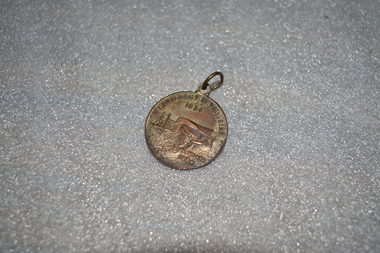
Medal - Silver Medal, C1934
... The medal references Portland, the location of Victoria's first settlement. The Henty brothers, entrepreneur farmers and whalers, established the state's first permanent European settlement in Portland in 1834. ...The medal references Portland, the location of Victoria's first settlement. The Henty brothers, entrepreneur farmers and whalers, established the state's first permanent European settlement in Portland in 1834. ...White metal medal issued to commemorate Melbourne's centenary 1934-35. This medal was given out to Victorian school children; 325,600 white metal medals were struck. The medal references Portland, the location of Victoria's first settlement. The Henty brothers, entrepreneur farmers and whalers, established the state's first permanent European settlement in Portland in 1834. Melbourne was established the following year by a party of settlers led by John Batman.Commemorates the settlement of Portland, Melbourne and Victoria, 1834 - 1935Round two sided silver metal medalFront - Centenary of Victoria 1934 - Portland 1934 Rear - Centenary of Melbourne 1935centenary, victoria, melbourne, medal -
Glenelg Shire Council Cultural Collection
Tool - Marlin spike, n.d
... Originally used by Henty brothers for wire cable splicing. A marlinspike (/ˈmɑːrlɪnspaɪk/, sometimes spelled marlin spike, marlinespike, or [archaic] marlingspike) is a tool used in marine ropework. ...Originally used by Henty brothers for wire cable splicing. A marlinspike (/ˈmɑːrlɪnspaɪk/, sometimes spelled marlin spike, marlinespike, or [archaic] marlingspike) is a tool used in marine ropework. ...Used by Peter Carrison, donor's father-in-law, who was a boat builder. Originally used by Henty brothers for wire cable splicing. A marlinspike (/ˈmɑːrlɪnspaɪk/, sometimes spelled marlin spike, marlinespike, or [archaic] marlingspike) is a tool used in marine ropework. Shaped in the form of a polished metal cone tapered to a rounded or flattened point, it is used in such tasks as unlaying rope for splicing, untying knots, drawing marline tight using a marlinspike hitch, and as a toggle joining ropes under tension in a belaying pin splice.Metal spike with timber knob/handle. Circular groove around head of knob, which has a nail inserted in itmarine technology, maritime industry, rope making, rope work -
Glenelg Shire Council Cultural Collection
Medal, Centenary of Melbourne 1835 Commemorative Medallion, 1834
... The medal references Portland, the location of Victoria's first settlement. The Henty brothers, entrepreneur farmers and whalers, established the state's first permanent European settlement in Portland in 1834. ...The medal references Portland, the location of Victoria's first settlement. The Henty brothers, entrepreneur farmers and whalers, established the state's first permanent European settlement in Portland in 1834. ...White metal medal issued to commemorate Melbourne's centenary 1934-35. This medal was given out to Victorian school children; 325,600 white metal medals were struck. There were also a few VIP pieces in other metals, including two in gold. The medal references Portland, the location of Victoria's first settlement. The Henty brothers, entrepreneur farmers and whalers, established the state's first permanent European settlement in Portland in 1834. Melbourne was established the following year by a party of settlers led by John Batman.White metal medal. Medal, silver. with hole and ring at the top. Obverse: Sailing Ship, Coast, Boat on shore, 3 men. Reverse Colonial man on grass, river, city buildings on other river bank Medal commemorates the centenary of Victoria and Portland 1834 and Melbourne 1835. Obverse:Scene of landing at Portland Bay; in ground below, PORTLAND / 1834; above, centenary of victoria / 1934 Reverse: Pioneer on south bank of Yarra looking across to Melbourne, below 1835 above, CENTENARY / OF / MELBOURNE / 1935Front: Inverse: Centenary of Melbourne 1835 (Top) 1835 (Bottom) Back: Obverse: Centenary of Victoria 1934 (Round Top) Portland 1834 (Bottom)medal, numismatics, celebration, 1834, 1934, 1935, melbourne, portland
