
Showing 67 items matching " home appliances"
-
 Bendigo Historical Society Inc.
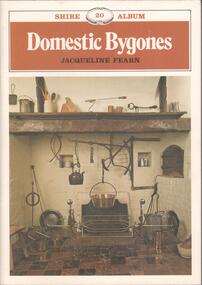
Book - BOOK: DOMESTIC BYGONES BY JACQUELINE FEARN, 1977
... ... home appliances...BHS Collection DOMESTIC EQUIPMENT cooking utensils cooking methods home appliances laundry lighting eating utensils Jacqueline Fearn Softcover book with coloured photograph of a large domestic fireplace with various cooking implements. ...BHS CollectionSoftcover book with coloured photograph of a large domestic fireplace with various cooking implements. Contains 32 pages of black and white photographs and diagrams of items used in the home from the Middle Ages to the Victorian Era.Jacqueline Fearndomestic equipment, cooking utensils, cooking methods, home appliances, laundry, lighting, eating utensils -
 Robin Boyd Foundation
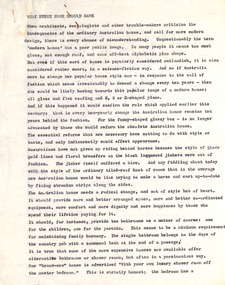
Document - Manuscript, Robin Boyd, What Every Home Should Have, c. 1965
... home... appliances...As examples, he gives two bathrooms (one for parents and one for children), outdoor living, the ability to extend the home as the family gets bigger, kitchens with modern appliances, and central heating and cooling....Australian home appliances Robin Boyd manuscript Typewritten (c copy), quarto, 4 pages What Every Home Should Have Document Manuscript Robin Boyd ...Boyd advocates that the Australian home needs a change of heart to provide more comfort, dignity, and happiness. As examples, he gives two bathrooms (one for parents and one for children), outdoor living, the ability to extend the home as the family gets bigger, kitchens with modern appliances, and central heating and cooling.Typewritten (c copy), quarto, 4 pagesaustralian home, appliances, robin boyd, manuscript -
 Wodonga & District Historical Society Inc
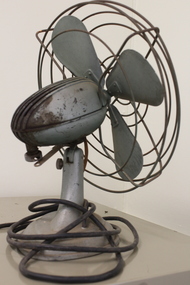
Functional object - Early Electric Table Top Fan, Elcon Australia, 1920s to 1950s
... ...home appliances...home, fans declined in popularity. This fan was manufactured by the Engineering & Construction Company (ELCON) an Australian owned and patented company originally based in Melbourne, Victoria in the late 1920s. The company became a subsidiary of the Electricity Meter & Allied Industries Ltd (EMAIL) in 1939. Then in 1946 they were decentralised to Orange, New South Wales. EMAIL brands included Email, Emailair, Westinghouse, Carmichael, Elcon, Metters and Weatherall. Electrolux purchased the major appliance...Electric fans home appliances Elcon fans This early electric table fan has four metal blades attached to an egg shaped enclosed motor. ...This desk or table-top electric fan marked is typical of the fans popular in the 1930s through to the 1950s. The fans were made for use in the home, office or factory and were produced in a variety of sizes. They were available in both fixed and oscillating models with different speeds. The fans cost several weeks of a man's average wage at the time and were promoted not only as improving comfort in the home but also increasing efficiency at work. With the development of air-conditioning from the 1960s and its increasing use in the workplace and then into the home, fans declined in popularity. This fan was manufactured by the Engineering & Construction Company (ELCON) an Australian owned and patented company originally based in Melbourne, Victoria in the late 1920s. The company became a subsidiary of the Electricity Meter & Allied Industries Ltd (EMAIL) in 1939. Then in 1946 they were decentralised to Orange, New South Wales. EMAIL brands included Email, Emailair, Westinghouse, Carmichael, Elcon, Metters and Weatherall. Electrolux purchased the major appliance division of Email in 2001.This item is representative of early electric fans manufactured in Australia in the early to mid 20th century. They were widely used throughout Australian homes and workplaces prrior to the development of airconditioning.This early electric table fan has four metal blades attached to an egg shaped enclosed motor. Each blade is attached with three rivets. The fan has a wire safety guard surrounding the blades. This is attached to a circular metal base.There is a switch in the centre of the base to adjust speed. A knob at the back of the fan enables its position to be adjusted. There is no longer any branding visible on the fan but it has been identified as an ELCON fan manufacured in Australia. The electrical cord is not the original which has been replaced.electric fans, home appliances, elcon fans -
 Wodonga & District Historical Society Inc
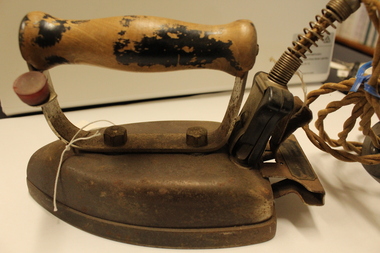
Functional object - "Creda" Electric Iron, Credenda Conduits Co. and Simplex Electric Company Ltd, c1950s
... Since then the Creda brand as such has become rare, and where it does appear it is as a re-badged version of Indesit and Hotpoint home appliances....Since then the Creda brand as such has become rare, and where it does appear it is as a re-badged version of Indesit and Hotpoint home appliances. This iron is typical of the electric irons used in the 1950s. ...Creda had its origins in two companies: the Simplex Steel Conduit Company Ltd. (later Simplex Conduits Ltd.) formed in 1898, and the Credenda Company Ltd. which was the first to use Creda as a brand name. These companies were two of the founding companies of Tube Investments Ltd. From 1919, the Simplex name was used for installation equipment ranges, and Creda for heating, cooking and other domestic appliances. In 1932 Simplex Conduits Ltd. and the Credenda Company Ltd. merged to form the Simplex Electric Company Ltd., but the distinct Simplex and Creda brands continued in use. In 1987 the Simplex Electric Company was taken over by General Electric Company, and formed part of General Domestic Appliance Company Ltd. the following year. In 2015 the large corporation, Whirlpool, took over the Indesit Appliance Company, which owns the Creda brand name. Since then the Creda brand as such has become rare, and where it does appear it is as a re-badged version of Indesit and Hotpoint home appliances.This iron is typical of the electric irons used in the 1950s. It is representative of appliances used by women in their domestic roles.A "Creda" Electric Iron with plug-in cord. It has a metal steel base iron with a wooden handle and a thumb rest. The handle is bolted onto the iron with 2 large screws. The cord socket plugs in behind the handle of the iron. On attached metal plate: "CREDA/ Cat. No 6; Volts 240; AMPS 8"domestic appliances, creda irons -
 Flagstaff Hill Maritime Museum and Village
Domestic object - Ice Chest, 1927
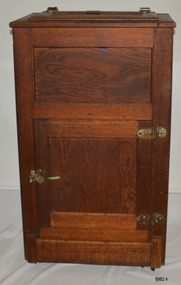
... An ice chest, also called an icebox or refrigerator, was invented by Thomas Moore in 1802 and had become a common home appliance from the mid-1800s until around the 1930s, when electric refrigerators became affordable and safe. ...An ice chest, also called an icebox or refrigerator, was invented by Thomas Moore in 1802 and had become a common home appliance from the mid-1800s until around the 1930s, when electric refrigerators became affordable and safe. ...This particular small ice chest was once part of the domestic furniture of Dr W.R. Angus and his young family in 1927 when they lived in the Nhill and Ballarat districts. The family relocated to Warrnambool in 1939 and brought the ice chest with them. An ice chest, also called an icebox or refrigerator, was invented by Thomas Moore in 1802 and had become a common home appliance from the mid-1800s until around the 1930s, when electric refrigerators became affordable and safe. The non-mechanical ice chest allowed perishable food to be kept fresh for longer than the food-safe or ‘Coolgardie’ used in colonial days in Australia. It required the use of ice blocks, which were delivered to households by the ‘iceman' and his horse and cart. The ice man would use an ice pick to cut the blocks into the right size for the buyer’s ice chest. The ice came from an ‘ice house’, a factory where the ice was made. The ice chest required a block of ice to be placed into the insulated top section on top of the corrugated iron stand. The ice would cool the air and the cool air would flow downwards through the oval hole under the stand and into the refrigerator compartment below. The water from the melted ice would drain from the sloping floor of the top compartment and into the hooded pipe. The pipe went through the refrigerator and ended below its floor, where the drained water would be collected in the metal bowl placed there for that purpose. The lip on the bowl allowed it to be easily removed and emptied at regular intervals before it overflowed. W.R. Angus Collection- The W R Angus Collection spans from 1885 to the mid-1900s and includes historical medical and surgical equipment and instruments from the doctors Edward and Thomas Ryan of Nhill, Victoria. Dr Angus married Gladys in 1927 at Ballarat, the nearest big city to Nhill where he began as a Medical Assistant. He was also Acting House surgeon at the Nhill hospital where their two daughters were born. He and his family moved to Warrnambool in 1939, where Dr Angus operated his own medical practice. He later added the part-time Port Medical Officer responsibility and was the last person appointed to that position. Dr Angus and his wife were very involved in the local community, including the early planning stages of the new Flagstaff Hill, where they contributed to the layout of the gardens. Dr Angus passed away in March 1970.This ice chest is significant for representing a method of refrigeration and food preservation used in the 19th to mid-20th centuries when people were beginning to afford powered domestic refrigerators. After the second world war, most households replaced their food storage cupboards and ice chests with refrigerator appliances. The ice chest is also significant for its connection with the domestic furniture of Dr W.R. Angus and his family, and its inclusion in the W.R. Angus Collection.Ice chest; single front wooden cabinet with two doors and a flap, and three accessories. The top door is a lid with a metal handle at the front and two metal hinges along the back. The front door has two metal hinges on the right-hand side and has a metal lever catch. A hinged flap fits between the front legs at bottom of the ice chest and swings upwards. The front legs have wheels. The insulated top compartment has a metal lining and its floor slopes towards the centre of the back wall. In the floor are a formed oval air-flow hole and the open end of a pipe that has a hood partly covering it. The front compartment is an insulated metal-lined cupboard with a vertical pipe down the centre of the back wall and horizontal rails in the centre of each side wall. The accessories are a rectangular corrugated iron stand, a rectangular wire grid shelf and a round aluminium bowl with a lip and two sides pushed in. The ice chest was made circa 1927 and is part of the W.R. Angus Collection.flagstaff hill, warrnambool, maritime village, maritime museum, shipwreck coast, great ocean road, dr w r angus, dr roy angus, dr ryan, doctor angus, dr angus, ice chest, ice box, antique, food preservation, refrigeration, domestic equipment, kitchen appliance, refrigerator, non-electric refrigerator, non-mechanical refrigerator, w.r. angus collection -
 Glenelg Shire Council Cultural Collection
Functional object - Foot Warmer, Hecla Electrics Pty Ltd, c. 1920
... They made a wide range of appliances for the home, and supplied commercial appliances to cafés, hospitals and offices. ...They made a wide range of appliances for the home, and supplied commercial appliances to cafés, hospitals and offices. ...From Museum Victoria: Made in about 1927 by Hecla Electrics Pty Ltd and sold under the model name 'Foot Warma'. The foot warmer was made from the late 1920s until the 1950s and did not change substantially in design during this time. The Hecla brand name and logo was registered in 1918 by Clarence Marriott. It was inspired by the recent eruption of Iceland's volcano Mt Heckla. Clarence and his father James were metal workers who had made Australia's first carbon filament electric radiators in 1899, and also built an early steam car. As electricity use exploded in the 1920s and 1930s, 'Hecla' became a household name in Melbourne. They made a wide range of appliances for the home, and supplied commercial appliances to cafés, hospitals and offices. In 1927, the company shifted from small premises in the city to a bigger, electric-powered factory in South Yarra. Hecla had no retail stores of its own - instead it sold products through wholesalers and retailers, including the State Electricity Commission (SEC). The company promoted its goods through advertisements in home magazines and displays in shop windows, home shows and the 1935 All-Electricity Exhibition. A popular advertising slogan in the 1930s was 'Hecla household helps make happy healthy housewives!'. Hecla ceased manufacturing in Melbourne in the 1980s.Documentation of how people lived and is an example of early domestic electrical appliances. From Museum Victoria: Hecla Electrics Pty Ltd were a significant Melbourne manufacturing company, who became a household name in the 1920s making small electric appliances such as heaters and kettles. They also made a variety of other electrical appliances for domestic, commercial and military use. The company manufactured electric appliances in Melbourne from about 1922 until the 1980s, although Clarence Marriott, who formed the company, had begun making radiators with his father James in 1899. The company had a reputation for quality products. The company also played an important role within the Australian domestic and commercial appliance industry, both as a leading innovator and through its role in training skilled staff, many of whom went on to work for competitors such as Kambrook, Electrolux and Sunbeam. This electric coffee percolator represents the typical small domestic appliance that the Hecla company was famous for. Along with other items in the Hecla Collection, it highlights the diversity of electric appliances that the company made. This object also highlights the legacy of high quality design and metal construction work that Clarence and James established for the company, stemming from their early work as talented art metal workers. It also represents the first major period of the take-up of electricity use in the home. This take-up began in the 1920s and 1930s with the use of small appliances, and by the 1950s electricity had become commonplace in the home, and large appliances such as refrigerators and stoves became standard.Square metal object. The top surface is heavy cast iron and patterned with floral motifs. In the centre is a circle with the words ' Hecla Foot Warma' inside. Under the top is a black metal base with two feet at either end which extend the length of the base. The back foot is higher than the front foot. There is a circular disk from which extends the electrical cord. The cord is brown and white checks. At the end of the cord is a plug on which is printed 250V AMP S.2 EARTH 5. The plug is brown and made from Bakelite. On the base is a rectangular label which has words printed - HECLA Australia.Top: HECLA/-FOOT-/WARMA Base: Volts / 230/250 / WATTS / 80 / HECLA / Australia / CAT. NO. F26domestic, city of portland, glenelg shire council, electrical, foot warmer, heating, hecla, manufacture -
 Flagstaff Hill Maritime Museum and Village
Domestic object - Food Mincer, Enterprise Manufacturing Company, circa 1911
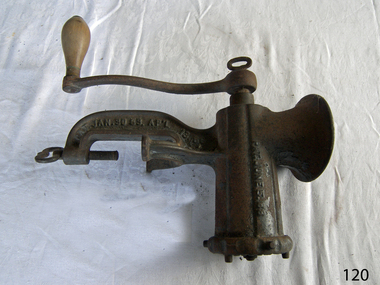
... home food preparation this item's first patent design was approved in 1897. Manufactured by a well known company in the USA the "Enterprise Manufacturing Company” up until 1956. They specialised in making kitchen appliances ...This particular food mincer was manufactured by Enterprise Manufacturing Company. Located in Philadelphia, this company specialized in making hardware products. The company was especially known for its cherry pitters, apple peelers, and coffee mills. The company was founded in 1864 and was located on the corner of Dauphin, 3rd, and American Streets. Enterprise Manufacturing Co. remained in business until 1956 when it was bought by Silex Co.A mass produced early domestic item made for home food preparation this item's first patent design was approved in 1897. Manufactured by a well known company in the USA the "Enterprise Manufacturing Company” up until 1956. They specialised in making kitchen appliances of various types for domestic use and for export. Food mincers of the subject items design are still being produced today under the brand name of "Universal" made by Universal Trading Inc USA.Food mincer, metal, clamp on bench style, with rotating wooden handle. Inscriptions stamped on metal.Marked "Enterprise tinned Meat Chopper" "No. 10" "Enterprise MF'G Co. PHILA. USA" "PAT. JAN.30.83" flagstaff hill, warrnambool, flagstaff hill maritime museum, flagstaff hill maritime village, great ocean road, mincer, food mincer, meat mincer, food preparation, kitchen utensil, domestic object, enterprise manufacturing company, kitchen appliance -
 Blacksmith's Cottage and Forge
Biscuit Forcer
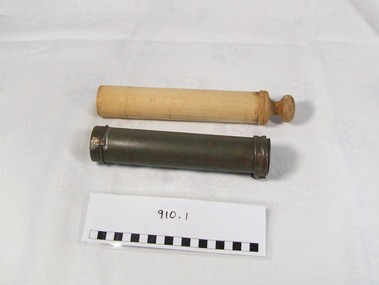
... home in the mid 20th century. Representative of kitchen utensils in common use in working class kitchens in 20th century prior to the common availability of packaged biscuits. domestic kitchen food technology biscuit forcer baking woman s work appliances Tin/metal outer cylinder/case/open one end, lid other end, with star pattern (can be removed for washing). ...Dough was put in forcer/case/cylinder and wooden pin pressed down to force dough out as a star-shaped biscuit. In use in a working-class home in the mid 20th century.Representative of kitchen utensils in common use in working class kitchens in 20th century prior to the common availability of packaged biscuits. Tin/metal outer cylinder/case/open one end, lid other end, with star pattern (can be removed for washing). Inner wooden pin or forcer, knob on end to be pushed into metal cylinder to force dough out through patterned disc.domestic, kitchen, food, technology, biscuit, forcer, baking, woman s, work, appliances -
 Flagstaff Hill Maritime Museum and Village
Domestic object - Food Safe, Willow Ware Pty Ltd, 1950s to 70s
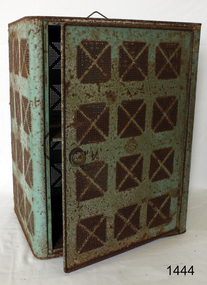
... homes from the mid-19th century and early 20th centuries. It is part of the evolution of food preservation methods leading up to our modern electric appliances. ...This food safe is a mass-produced item made for domestic use by Willow Manufacturing in Australia fin the mid-20th century. Willow started a business in 1887 as a metalworking company based in Melbourne Australia, making tinned biscuit and tea canisters. In the First World War, the company began manufacturing armaments and essential packaging for the war effort. In the early 1920s, Willow produced domestic kitchen bakeware such as tin-plated canisters and baking pans labelled with the well-known Willow brand. Other items at this time include billies, boilers, basins and Coolgardie safes. In the late 1950s, the company ventured into plastics production. and in 1965, the name changed to Willow Ware Pty Ltd, to be more closely linked to its Willow brand. Willow Ware is still in business today.The Australian food safe is an example of domestic food storage and preservation in Australian homes from the mid-19th century and early 20th centuries. It is part of the evolution of food preservation methods leading up to our modern electric appliances. The maker, Willow, has a name associated with practical and reliable domestic products.Metal kitchen safe with two shelves, a hinged door and latch and a small swivel wire handle at the top. Painted light green. Airflow holes have been formed in each side panel. Made by Willow, Australia.Marked "Made in Australia" "Willow"flagstaff hill, warrnambool, flagstaff hill maritime museum, shipwreck coast, flagstaff hill maritime village, great ocean road, food storage, food preservation, willow, willow manufacturing, willow australia, kitchen storage, food care, 19th century, 20th century, willow ware, domestic item, coolgardie meat safe, meat safe, food safe, coolgardie -
 City of Moorabbin Historical Society (Operating the Box Cottage Museum)
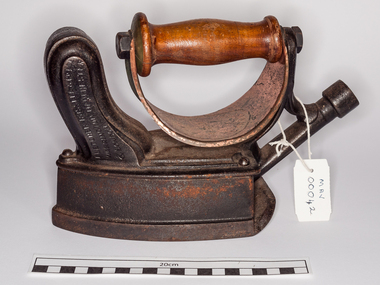
Domestic object - Kitchen equipment, gas-fuelled flat iron, c1900 - 30
... Most homes set aside one day for ironing and some large households had an ironing room with a special stove designed to heat irons. However, most women had to work with a heavy, hot iron close to the fireplace even in summer. Thomas Fletcher (1840-1903). By 1880s he had a gas appliance...Most homes set aside one day for ironing and some large households had an ironing room with a special stove designed to heat irons. However, most women had to work with a heavy, hot iron close to the fireplace even in summer. Thomas Fletcher (1840-1903). By 1880s he had a gas appliance ...Sad-irons or "solid" irons were made by blacksmiths and used to smooth out material by pressing the hot iron over it. A piece of sheet -iron was placed over the kitchen fire and the irons placed on it could be heated whilst remaining clean of ash.. The women used 2 irons - one heating while the other was used. Thick cloth or gloves protected their hands from the hot irons. The handle was removed from the cool iron and re- attached to remove the hot iron from the fire. The cool iron was replaced on the fire or stove to heat again. These irons were cleaned with steel wool to prevent them marking the material. If the iron was too hot the material would scorch. Most homes set aside one day for ironing and some large households had an ironing room with a special stove designed to heat irons. However, most women had to work with a heavy, hot iron close to the fireplace even in summer. Thomas Fletcher (1840-1903). By 1880s he had a gas appliance manufactory in Thynne Street, Warrington. By 1895 the company had become Fletcher Russell and Co Gas Engineers, his firm having merged with Alexander and William Russell of Pendleton Iron Works. Circa 1950, the firm merged into Radiation Ltd which was later acquired by 'TI New World'; 1902: Fletcher, Russell & Co. Ltd., Palatine Works, Warrington In 1880 gas -fuelled irons were connected by rubber tubing to the gas light-fittings of the house or to gas canisters. However , not many houses had access to a gas supply until much later and this iron was popular in 1920’sThese sad irons remind us of the difficult circumstances experienced in their daily routines by the pioneers and early settlers of Moorabbin Shire The family of Miss M Curtis were early settlers in Moorabbin Shire.A gas-fuelled flat iron, made in USA , It would have been attached to a gas hose fitting that was also used at night for light in the house. There is a small chimney to allow for air and to try to control the amount of heat in the iron. A 'shield' is under the leather covered handle to protect the user's hand from the heat, however it is made of copper metal - a heat conductor.FLETCHER RUSSELL CO. / LIM/ PATENT/ WARRINGTON on right side of handle 'Registered' on left side of handle ' Fletcher Russell Co L / Warrington, Manchester / & London.sad iron, kitchen equipment, fletcher russell co. ltd., england, warrington, manchester, pioneers, early settlers, market gardeners, sewing, craftwork, clothing, moorabbin, brighton, bentleigh, fireplaces, stoves, domestic gas supply, gas-light, gas cannisters -
 Orbost & District Historical Society
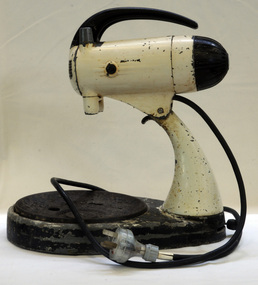
cake mixer, circa 1948
... appliances. Hire-purchase schemes allowed people to take products home and pay for them in instalments. ...The Mixmaster 9B in 1948 was the first Sunbeam appliance to be made in Australia. It was designed in the USA.After years of rationing and shortages, the 1950s were a period of economic prosperity, high employment and great technological development. During this period, Australians enthusiastically adorned their homes with a dazzling range of new domestic appliances. Hire-purchase schemes allowed people to take products home and pay for them in instalments. The American-designed Mixmaster 9B was the first Sunbeam appliance manufactured and sold in Australia in 1948. An early Sunbeam Mixmaster. It is an electronic stand mixer with a black metal base in the shape of a rounded teardrop with two holes for the turntable. It has a cream enameled metal arm, cream coloured metal motor housing with a black plastic handle on the top. On the back of the motor housing is a black plastic knob with ten speed options for the mixer, and the "OFF" position. a black electric cord is attached under the motor housing with a black switch beneath the cord. The motor housing is able to tilt backwards on a hinge which is attached to the top of the stand arm. It is worked on AC or Dc power 240 On the bottom are the words "MODEL 9B". mixmaster sunbeam kitchen-appliance food-technology -
 Orbost & District Historical Society
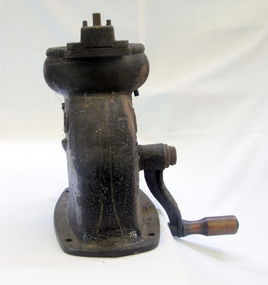
cream separator, 1920s - 1950s
... This is a small separator, typical of home use. This domestic kitchen appliance is typical of the period when food processing was done at home. ...This item would have been very common on farms throughout the Orbost area. Prior to bulk milk, cream was the major commodity which was sold to the butter factory. This is a small separator, typical of home use. This domestic kitchen appliance is typical of the period when food processing was done at home. It would have been before the time of mass food processing factoriesHand operated rusted metal cream separator with metal and wood handle.Front - A.O Handle-75.T.PR.MIN Back- (RHS) A.O. (LHS) Co-op in outline of Australia.cream-separator domestic-food-preparation dairy-farming -
 Orbost & District Historical Society
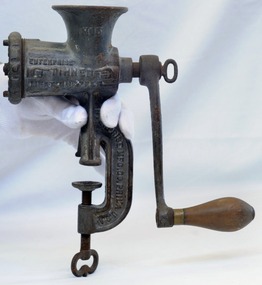
meat grinder, Late 19th century
... This is one of many models of the Enterprise Tinned Meat Chopper No5 This domestic kitchen appliance is typical of the period when food processing was done at home. It would have been before the time of mass food processing factories grinder domestic food-preparation enterprise-mfc Enterprise MFG.Co. ...This is one of many models of the Enterprise Tinned Meat Chopper No5This domestic kitchen appliance is typical of the period when food processing was done at home. It would have been before the time of mass food processing factoriesSmall black metal meat grinder with screw down grip for use on bench tops and tables. Still in working order. Carved wooden handle.Enterprise MFG.Co. PH'A, U.S.A. on clamp. Pat.Jan.30.83.June.5.88 on other side. Enterprise-Tinned-Meat-Chopper on barrel.grinder domestic food-preparation enterprise-mfc -
 Orbost & District Historical Society
grain grinder, circa 1920
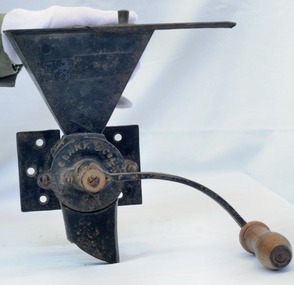
... This domestic appliance is typical of the period when food processing was done at home. It would have been before the time of mass food processing factories grinder food-preparation domestic clark-t&c Underneath -3 Under storer - T&C Clark & Co - Wolverhampton Bottom of handle - Clark & Co Black metal grain grinder. ...This domestic appliance is typical of the period when food processing was done at home. It would have been before the time of mass food processing factoriesBlack metal grain grinder. Top slides off to collect the ground grain. Opening at top to pour in grain. The back has holes to screw or nail to bench. There is a long grinding arm of metal with a wooden handle.Underneath -3 Under storer - T&C Clark & Co - Wolverhampton Bottom of handle - Clark & Cogrinder food-preparation domestic clark-t&c -
 Orbost & District Historical Society
butter cooler
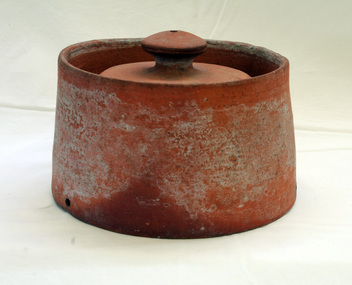
... This domestic kitchen appliance is typical of the period when food processing was done at home. It would have been before the time of mass food processing factories and before domestic refrigeration was common. butter-cooler ceramics earthenware domestic food-storage food-preservation Round earthenware butter cooler. ...This domestic kitchen appliance is typical of the period when food processing was done at home. It would have been before the time of mass food processing factories and before domestic refrigeration was common.Round earthenware butter cooler. Red/orange in colour.Has lid. Small holes at bottom so that butter could breathe. Handle on top for lifting cover. Inside is glazed.butter-cooler ceramics earthenware domestic food-storage food-preservation -
 Orbost & District Historical Society
raisin stoner, late 19th century
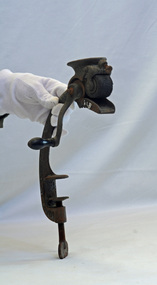
... This domestic kitchen appliance is typical of the period when food processing was done at home. It would have been before the time of mass food processing factories raisin-stoner food-preparation On arm-PAT.APP. ...This domestic kitchen appliance is typical of the period when food processing was done at home. It would have been before the time of mass food processing factoriesA cast iron raisin stoner with a clamp. It has a wooden handle on a turning arm.On arm-PAT.APP. Aug 20.95 Oct 5-97 On one side- WET THE RAISINS On other side-ENTERPRISE M.F.C. PHILADELPHIA. P.A. U.S.A. On chute- No. 38raisin-stoner food-preparation -
 Orbost & District Historical Society
Bread maker, Landers Frary and Clark, Early 20th century
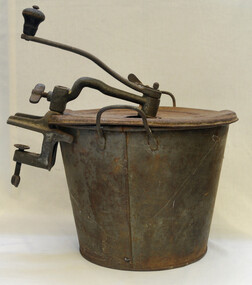
... The advertisements at the time stated that making bread with their machine was superior to hand kneading, This item is good example of a domestic appliance used when most foods were home-made. Access to commercial bread was limited in rural areas and housewives became skilled at bread-making. bread domestic-appliance bread-maker food-technology bakery Put in all liquids first, then flour, turn 3 minutes, raise in pail. ...Bread machines were made for quite a long time from the 1890's on. They came in different heights and capacities. The advertisements at the time stated that making bread with their machine was superior to hand kneading, This item is good example of a domestic appliance used when most foods were home-made. Access to commercial bread was limited in rural areas and housewives became skilled at bread-making.Metal bucket with lid. Lid has hole in centre through which a handle for turning the dough hook comes. Grey rusty coloured.Put in all liquids first, then flour, turn 3 minutes, raise in pail. After raising, turn until dough forms a ball. Take off cross piece, lift out dough with kneader.bread domestic-appliance bread-maker food-technology bakery -
 Orbost & District Historical Society
cheese mold
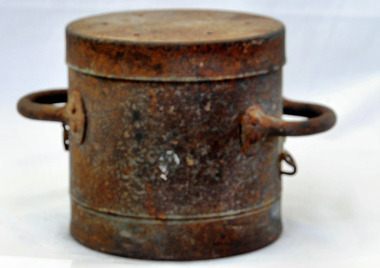
... This domestic kitchen appliance is typical of the period when food processing was done at home. It would have been before the time of mass food processing factories cheese-mould domestic food-preparation Very rusted round tin with detachable bottom and lid for easy removal of cheese. ...This domestic kitchen appliance is typical of the period when food processing was done at home. It would have been before the time of mass food processing factoriesVery rusted round tin with detachable bottom and lid for easy removal of cheese. Small eyelets on each side and large handles each side. Top and bottom lids have holes in them to allow moisture to escape.cheese-mould domestic food-preparation -
Phillip Island and District Historical Society Inc.
Book, YOUNG, Francis, Every man his own mechanic : a complete and comprehensive guide to every description of constructive and decorative work that may be done by the amateur artisan at home and in the colonies to which has been added an appendix presenting a review of new woods, new tools, and appliances, etc
... Every man his own mechanic : a complete and comprehensive guide to every description of constructive and decorative work that may be done by the amateur artisan at home and in the colonies to which has been added an appendix presenting a review of new woods, new tools, and appliances, etc. ...Stamped 'A.W. McNeill'. Labelled 'This book belonged to Archie McNeil who was engineer on the S.S. Narrabeen 1928 as mentioned in the book Western Port Ferries'. -
 Orbost & District Historical Society
biscuit forcer, mid 20th century
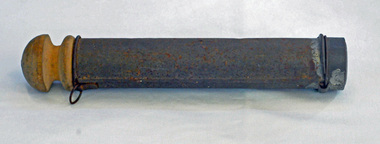
... home in the mid 20th century. This item is representative of kitchen utensils in common use in working class kitchens in 20th century prior to the common availability of packaged biscuits. domestic kitchen food-technology biscuit- forcer baking appliances Biscuit paste forcer made up of a metal barrel with a ring for hanging at top and a wooden plunger with a knob handle on top. ...Biscuit dough was put into the forcer/case/cylinder and the wooden pin pressed down to force dough out as a shaped biscuit. This would have been used in use in an Orbost home in the mid 20th century.This item is representative of kitchen utensils in common use in working class kitchens in 20th century prior to the common availability of packaged biscuits.Biscuit paste forcer made up of a metal barrel with a ring for hanging at top and a wooden plunger with a knob handle on top. This is shaped like a rolling pin. Biscuit mix is forced through the end of the tube to create fancy-looking biscuits.domestic kitchen food-technology biscuit- forcer baking appliances -
 Orbost & District Historical Society
meat mincer, mid 1900's
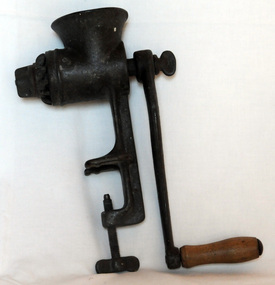
... This domestic kitchen appliance is typical of the period when food processing was done at home. It would have been before the time of mass food processing factories. food-preparation mincer appliance kitchen domestic MODEL No 2 A cast iron food mincer with a wooden handle. ...This mincer was donated to the Slab Hut (Visitor Information Centre) as a display item.This domestic kitchen appliance is typical of the period when food processing was done at home. It would have been before the time of mass food processing factories.A cast iron food mincer with a wooden handle. It has a funnel shaped cup at the top through which the pieces of meat are pushed to come out of the side. The wooden handle is turned to help this action. It has one blade. The mincer clamps to a flat surface by a hand operated vice/screw. MODEL No 2food-preparation mincer appliance kitchen domestic -
 Orbost & District Historical Society
Coolgardie safe, first half 20th century
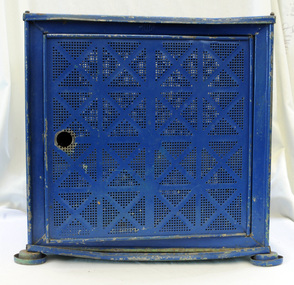
... (refs ABC-Home; Museum Victoria) The Coolgardie safe was an Australian invention used especially in country areas from the 1890s until the mid 20th century. It began to be replaced by ice chests from the turn of the twentieth century in cities and country towns which had ice works. This item is an example of a domestic appliance ...Without refrigeration, storage of meat was difficult. Flies were a problem, and it was important to keep meat cool and out of the way of pests. One way of doing this was to use a meat safe: a kind of cupboard designed to store meat and keep it fresh enough to eat. Meat safes are ventilated. They were sometimes made with sides of wire mesh or perforated metal, so that air could circulate around the meat while keeping flies and other animals out.The Coolgardie safe was invented in the late 1890s by Arthur Patrick McCormick, who used the same principle as explorers and travelers in the Outback used to cool their canvas water bags Originally they were handmade using materials to hand. In the early 20th century, Coolgardie Safes were manufactured commercially across Australia, and found their way into homes in both rural and urban areas. These safes incorporated shelving and a door, had metal or wooden frames and Hessian bodies. The feet of the safe were usually placed in a tray of water to keep ants away. (refs ABC-Home; Museum Victoria)The Coolgardie safe was an Australian invention used especially in country areas from the 1890s until the mid 20th century. It began to be replaced by ice chests from the turn of the twentieth century in cities and country towns which had ice works. This item is an example of a domestic appliance commonly used before electricity was widely available for domestic use.A cube-shaped metal Coolgardie safe painted blue. It has a triangular hook on the top for hanging or lifting. There are small feet at bottom . The sides are perforated in a Above the door; Inside a rhomboid shape "WILLOW"food-storage coolgardie-safe domestic -
 Orbost & District Historical Society
Coolgardie safe, first half 20th century
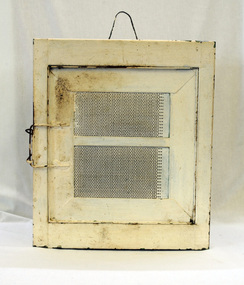
... (refs ABC-Home; Museum Victoria) This item is an example of a common domestic appliance used before the widespread connection of electricity to homes and refrigeration. ...Without refrigeration, storage of meat was difficult. Flies were a problem, and it was important to keep meat cool and out of the way of pests. One way of doing this was to use a meat safe: a kind of cupboard designed to store meat and keep it fresh enough to eat. Meat safes are ventilated. They were sometimes made with sides of wire mesh or perforated metal, so that air could circulate around the meat while keeping flies and other animals out.The Coolgardie safe was invented in the late 1890's by Arthur Patrick McCormick, who used the same principle as explorers and travelers in the Outback used to cool their canvas water bags Originally they were handmade using materials to hand. In the early 20th century, Coolgardie Safes were manufactured commercially across Australia, and found their way into homes in both rural and urban areas. These safes incorporated shelving and a door, had metal or wooden frames and Hessian bodies. The feet of the safe were usually placed in a tray of water to keep ants away. (refs ABC-Home; Museum Victoria)This item is an example of a common domestic appliance used before the widespread connection of electricity to homes and refrigeration. The Coolgardie meat safe is an Australian invention used widely in rural areas from the 1890's until the mid 20th century.A metal meat safe, painted white. It has a shelf inside. The door has two perforated rectangular sections metal framed in solid metal. The base is flat.storage domestic coolgardie-safe -
 Flagstaff Hill Maritime Museum and Village
Domestic object - Food Mincer, Landers, Frary & Clark , 1897-2000
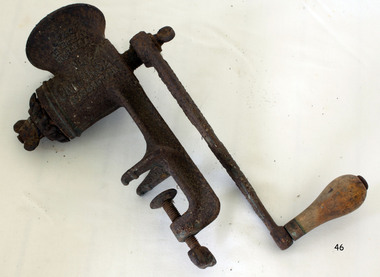
... An early domestic item its function was for use in the home kitchen that's the original patented design from 1897 is still being produced today under its brand name of Universal by Universal Trading Inc USA. warrnambool flagstaff-hill flagstaff-hill-maritime-museum shipwreck-coast flagstaff-hill-maritime-village shipwrecked-artefact mincer food mincer universal brand kitchen appliance food grinder lander frary & clark Marked "No. 2 Universal". ...Landers, Frary & Clark were a housewares company based in New Britain, Connecticut. It operated from 1865 until its assets were sold to the General Electric company in 1965. They manufactured a wide variety of products over the years, including stainless steel bull-nose rings and electric ranges, kitchen scales and vacuum bottles, window hardware and ice skates, mouse traps and percolators, can openers, corkscrews, cutlery, straight razors, aluminium cookware, and thousands of other products. Many of these items were marketed under the brand Universal. Some of the non-electric kitchenware assets were acquired from G.E. in 1984 by Universal Housewares, Inc./Universal Trading, Inc., who still market "Universal" meat grinders and coffee mills.An early domestic item its function was for use in the home kitchen that's the original patented design from 1897 is still being produced today under its brand name of Universal by Universal Trading Inc USA.Food mincer cast iron with wooden handle & thumbscrew for bench attachment.Marked "No. 2 Universal".warrnambool, flagstaff-hill, flagstaff-hill-maritime-museum, shipwreck-coast, flagstaff-hill-maritime-village, shipwrecked-artefact, mincer, food mincer, universal brand, kitchen appliance, food grinder, lander frary & clark -
 Kiewa Valley Historical Society
Booklet - S.E.C.V, Cooking for Christmas
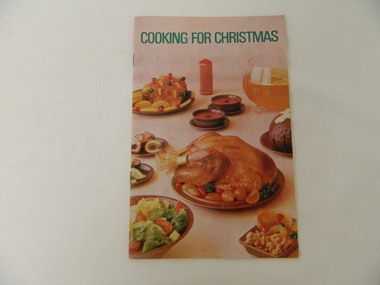
... recipes. christmas. state electricity commission of victoria. sec home advisory service. electrical appliances....They also assisted with advice and information on the best use of electricity in the home. The S.E.C. sold electrical appliances at their showrooms, one of which was located in Mt Beauty where this booklet came from....Showroom which sold electrical appliances and gave advice on their use along with recipe booklets for cooking on the new electrical appliances. recipes. christmas. state electricity commission of victoria. sec home advisory service. electrical appliances. ...The State Electricity Commission of Victoria's Home Advisory Service prepared this collection of recipes. They also assisted with advice and information on the best use of electricity in the home. The S.E.C. sold electrical appliances at their showrooms, one of which was located in Mt Beauty where this booklet came from.The S.E.C.V. constructed the Kiewa Hydro Electric Scheme employing many workers. They built the townships of Bogong and Mt Beauty and assisted with the infrastructure required to support the influx of population. In the Mt Beauty shopping centre, one of the shops was the S.E.C. Showroom which sold electrical appliances and gave advice on their use along with recipe booklets for cooking on the new electrical appliances.Small 12 page booklet with soft cover and two staples binding it. Cover has coloured photos of plates of food with the title in green at the top.recipes. christmas. state electricity commission of victoria. sec home advisory service. electrical appliances. -
 Kiewa Valley Historical Society
Booklet - S.E.C.V, How to Prepare & Store Frozen Food
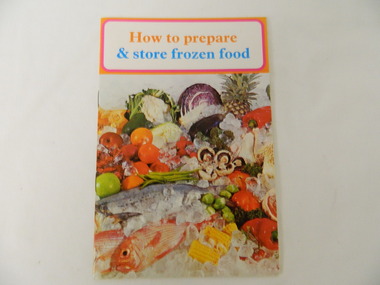
... The SECV's Home Advisory Service prepared this book to advise customers on the use of home freezers.They also assisted with advice and information on other electrical appliances. ...The SECV's Home Advisory Service prepared this book to advise customers on the use of home freezers.They also assisted with advice and information on other electrical appliances. ...The SECV's Home Advisory Service prepared this book to advise customers on the use of home freezers.They also assisted with advice and information on other electrical appliances. The SEC had Showrooms in regional Victoria including one at Mt Beauty where this booklet came from.The S.E.C.V. constructed the Kiewa Hydro Electric Scheme employing many workers. They built the townships of Mt Beauty and Bogong and assisted with the infrastructure required to support the influx of population. In the Mt Beauty shopping centre, one of the shops was the SEC Showroom which sold electrical appliances and gave advice on their use. This book gives advise on the use of freezers.Booklet with 22 pages held together with two staples. The cover has an orange and then blue title at the top and below, a coloured picture of fruit and vegetables. state electricity commission of victoria. food. freezer. cooking. electrical appliance. -
 Kiewa Valley Historical Society
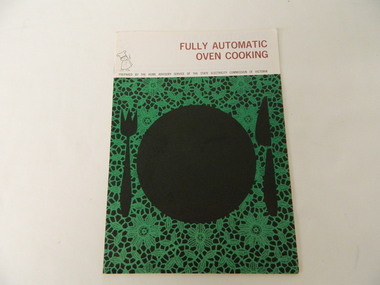
Booklet - S.E.C.V, Fully Automatic Oven Cooking
... The SECV's Home Advisory Service prepared this booklet to advise & inform women on the use of cooking with a fully automatic oven. The SECV sold electrical appliances...The SECV's Home Advisory Service prepared this booklet to advise & inform women on the use of cooking with a fully automatic oven. The SECV sold electrical appliances ...The SECV's Home Advisory Service prepared this booklet to advise & inform women on the use of cooking with a fully automatic oven. The SECV sold electrical appliances at their showrooms throughout regional Victoria, one of which was located in Mt Beauty.The SECV constructed the Kiewa Hydro Electric Scheme employing many workers. They built the townships of Bogong and Mt Beauty and assisted with the infrastructure required to support the influx of population. In the Mt Beauty shopping centre, one of the shops was the SEC Showroom which sold electrical appliances and gave advice on their use. This booklet gives advice and information on automatic ovens. Green, black and white 12 page booklet with a cardboard cover and held together with 2 staples. The brown title is at the top of the cover and below, in black, a plate, knife and fork with a green and black lace background.Cover: Prepared by the Home Advisory Service of the State Electricity Commission of Victoriaautomatic oven. state electricity commission of victoria. cooking. electrical appliances. -
 Kiewa Valley Historical Society
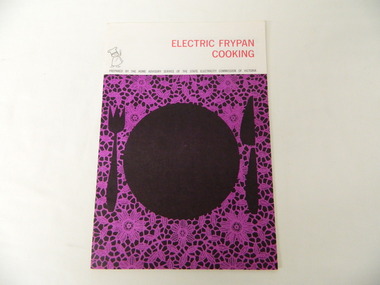
Booklet - S.E.C.V, Electric Frypan Cooking
... The State Electricity Commission of Victoria's Home Advisory Service prepared this booklet to advise and inform women on the use of cooking with an electric frying pan. The SECV sold electrical appliances...The State Electricity Commission of Victoria's Home Advisory Service prepared this booklet to advise and inform women on the use of cooking with an electric frying pan. The SECV sold electrical appliances ...The State Electricity Commission of Victoria's Home Advisory Service prepared this booklet to advise and inform women on the use of cooking with an electric frying pan. The SECV sold electrical appliances at their showrooms throughout regional Victoria, one of which was located at Mt Beauty.The SECV constructed the Kiewa Hydro Electric Scheme employing many workers. They built the township of Bogong and Mt Beauty and assisted with the infrastructure to support the influx of population. In the Mt Beauty shopping centre, one of the shops was the SEC Showroom which sold electrical appliances and gave advice on their uses. This booklet gives advice and information on electric frypans.Purple, black and white 16 page booklet with a cardboard cover and held together with 2 staples. The red title is at the top of the cover and below, in black, a plate, knife and fork with a purple and black lace background.Cover: Prepared by the Home Advisory Service of the SECV.state electricity commission of victoria. cooking. electrical appliance. food. electric frypan. -
 Kiewa Valley Historical Society
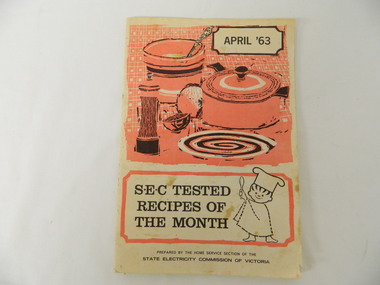
Book - S.E.C.V, S.E.C. Tested Recipes of the Month. April '63, April 1963
... s Home Service Section prepared this book to encourage women to cook with electricity especially with the later appliances. ...s Home Service Section prepared this book to encourage women to cook with electricity especially with the later appliances. ...The S.E.C.V.'s Home Service Section prepared this book to encourage women to cook with electricity especially with the later appliances. Part of their advertising suggested that they go to their electricity showroom for advice on purchasing a new appliance. The S.E.C. had showrooms in regional Victoria including one at Mt Beauty.The SECV constructed the Kiewa Hydro Electric Scheme employing many workers. They built the townships of Bogong and Mt Beauty and assisted with the infrastructure required to support the influx of population. In the Mt Beauty shopping centre, one of the shops was the S.E.C. Showroom, which sold electrical appliances and gave advice on their use and the latest models available. This book is a promotion to encourage women to cook using the latest electrical appliances.The cover is white, black and pinkish book showing a sketch of the top of a stove in the top half and below, the title with a cartoon chef. Along the bottom of the cover "Prepared by the Home Service Section of the / State Electricity Commission of Victoria. The book has 20 pages held by two staples. The book consists of recipes but has some electricity advertising in it as does the back cover.secv. recipes. cooking. electricity. electrical appliances. -
 Kiewa Valley Historical Society
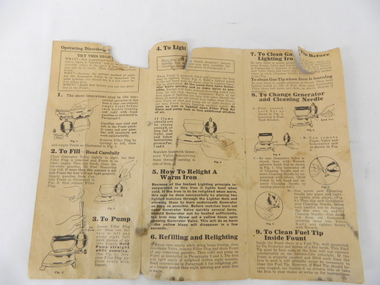
Document Instruction and Parts Sheet, Instructions for Operating the Coleman Self Heating Iron Model No. 4 Instant Lighting, circa 1950
... The rate of development within the home appliance field has mushroomed during the time period post 1950. ...This operating and parts information sheet was supplied to consumers to help users of this kerosene iron, not only understand the operation of this self lighting iron, but also to be able to order any replacement parts that may be required for this high level usage appliance. At this period in time(1950's), this item was at the leading edge of ironing technology. During the earlier 1900's and before "the throw away" culture evolved(circa 1950's), reliability and long term application of domestic appliances was a necessity above all costs, especially in isolated rural areas. The construction of these appliances was geared to a longer service life and not to a cheaper two to three year life warranty. With levels of world wide technology at an ever increasing pace, long term reliability of any appliance was no longer sought after. Appliance upgrades and new improved model accessibility especially in rural areas has changed rural consumer's buying patterns. Although the concept of instructional and parts/warranty information booklets has not become obsolete, the ability to access information via electronic means has vastly improved the ability to obtain qualified technical help through local avenues. This access was not available in the time period(circa 1950), when the appliance covered by this document was issued. The rate of development within the home appliance field has mushroomed during the time period post 1950. The costs and the increased levels of product choices and consumer awareness has provided rural areas (once isolated e.g. Kiewa Valley) with a greater ability to satisfy their needs because of a greater diverse range of domestic appliances offered.This discoloured, sepia paper has black print and is folded into three equal pages. The information contained covers operational and part numbers for the kerosene fired hand held iron. there are kerosene stains on the last page and these have soaked through onto the second page. The form no.-3-3C- McACO.-4363Printed in U.S.A.instructions, household appliances, ironing, domestic ironing
