
Showing 82 items matching " home furnishings"
-
 Women's Art Register
Archive (Collection) - Frances Burke Artist Archive
... ... Home Furnishings...1904 -1994 Interior Design Theatre Colour Nature Flora & Fauna George Bell School Selwyn Chambers Burway Prints Morris Holloway Textiles Printmaking Linocut Silkscreen Home Furnishings Archive Frances Burke Artist Archive ...interior design, theatre, colour, nature, flora & fauna, george bell school, selwyn chambers, burway prints, morris holloway, textiles, printmaking, linocut, silkscreen, home furnishingsinterior design, theatre, colour, nature, flora & fauna, george bell school, selwyn chambers, burway prints, morris holloway, textiles, printmaking, linocut, silkscreen, home furnishings -
Women's Art Register
Archive (Series) - Burke, Frances. Artist File 1
... ... Home Furnishings...Interior Design Theatre Colour Nature Flora & Fauna George Bell School Selwyn Chambers Burway Prints Morris Holloway Textiles Printmaking Linocut Silkscreen Home Furnishings Foolscap white archival 4 flap folder or document wallet Archive Burke, Frances. ...Biography, Newspaper Clippings, Artwork Images, Articlesinterior design, theatre, colour, nature, flora & fauna, george bell school, selwyn chambers, burway prints, morris holloway, textiles, printmaking, linocut, silkscreen, home furnishingsinterior design, theatre, colour, nature, flora & fauna, george bell school, selwyn chambers, burway prints, morris holloway, textiles, printmaking, linocut, silkscreen, home furnishings -
Women's Art Register
Archive (Series) - Frances Burke. Duplicate File 1
... ... Home Furnishings...Textiles Printmaking Linocut Silkscreen Home Furnishings Interior Design Theatre Colour Nature Flora & Fauna George Bell School Selwyn Chambers Burway Prints Morris Holloway Foolscap manilla file Archive Frances Burke. ...Biography, Newspaper Clippings, Artwork Images, Articlestextiles, printmaking, linocut, silkscreen, home furnishings, interior design, theatre, colour, nature, flora & fauna, george bell school, selwyn chambers, burway prints, morris hollowaytextiles, printmaking, linocut, silkscreen, home furnishings, interior design, theatre, colour, nature, flora & fauna, george bell school, selwyn chambers, burway prints, morris holloway -
 Bendigo Historical Society Inc.
Document - The Story of Stilwell's, Bendigo Advertiser, January 1951, 9/11/23
... The shop further developed and advertised as selling furniture, home furnishings and Hardware...The shop further developed and advertised as selling furniture, home furnishings and Hardware Stilwell Centenary 1951 A 1951 Bendigo Advertiser story on the history of the Stilwell building on the 100th centenary of the city of Bendigo. ...Brothers Frederick and Ernest Stillwell opened a hardware and general ironmongery in Hargreaves St Bendigo in 1895. They were later joined by Roy Stillwell. The shop further developed and advertised as selling furniture, home furnishings and HardwareA 1951 Bendigo Advertiser story on the history of the Stilwell building on the 100th centenary of the city of Bendigo.stilwell, centenary, 1951 -
 Bendigo Historical Society Inc.
Flyer - Stilwells, Hargreaves Street
... The shop further developed and advertised as selling furniture, home furnishings and Hardware...The shop further developed and advertised as selling furniture, home furnishings and Hardware Stilwell's Wallpaper Paint Stillwells, Hargreaves Street, Bendigo - flyer for paint, varnish and wallpaper; includes prices in pre-decimal currency. ...Brothers Frederick and Ernest Stillwell opened a hardware and general ironmongery in Hargreaves St Bendigo in 1895. They were later joined by Roy Stillwell. The shop further developed and advertised as selling furniture, home furnishings and HardwareStillwells, Hargreaves Street, Bendigo - flyer for paint, varnish and wallpaper; includes prices in pre-decimal currency. Single sided printing in B&W on thin paper. Unknown date of issue.stilwell's, wallpaper, paint -
 Bendigo Historical Society Inc.
Document - STILWELL'S INVOICE, 21/12/1948
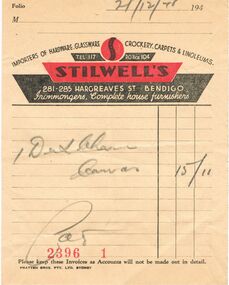
... The shop further developed and advertised as selling furniture, home furnishings and Hardware...The shop further developed and advertised as selling furniture, home furnishings and Hardware BUSINESS Retail house furnishings Stilwell's Pratten Bros. ...Brothers Frederick and Ernest Stillwell opened a hardware and general ironmongery in Hargreaves St Bendigo in 1895. They were later joined by Roy Stillwell. The shop further developed and advertised as selling furniture, home furnishings and HardwareStilwell's Invoice: Cream Paper with black and red print, dated 21/12/1948. Invoice No. 2396 1. Importers of hardware, Glassware, Crockery, Carpets & Linoleums. Tel 117. P.O. Box 104. Stilwell's. 281-285 Hargreaves St. Bendigo. Ironmongers. Complete House Furnishers. Please keep these Invoices as Accounts will not be made out in detail. Box 625Pratten Bros. Pty. Ltd. Sydneybusiness, retail, house furnishings, stilwell's -
 Bendigo Historical Society Inc.
Document - STILWELL'S INVOICE, 09/08/1929
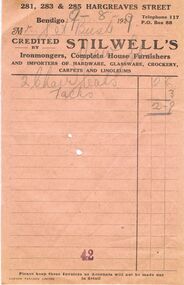
... The shop further developed and advertised as selling furniture, home furnishings and Hardware...The shop further developed and advertised as selling furniture, home furnishings and Hardware BUSINESS Retail house furnishings Stilwell's. ...Brothers Frederick and Ernest Stillwell opened a hardware and general ironmongery in Hargreaves St Bendigo in 1895. They were later joined by Roy Stillwell. The shop further developed and advertised as selling furniture, home furnishings and HardwareStilwell's Invoice: Pink paper with black print. Hole in the centre. No. 42 Dated 09/08/1929. 281,283 & 285 Hargreaves Street. Bendigo. Telephone 117. P.O. Box 88. Mr S.A. Bush. Credited by Stilwell's. Ironmongers, Complete House Furnishers and importers of hardware, Glassware, Crockery, Carpets and Linoleums. Invoice for 2 Chair Seats, Tacks. Please keep these Invoices as Accounts will not be made out in detail. Box 625Lamson Paragon Limitedbusiness, retail, house furnishings, stilwell's. s.a. bush -
 Bendigo Historical Society Inc.
Newspaper - JENNY FOLEY COLLECTION: SERVICE WITH A SMILE
... The shop further developed and advertised as selling furniture, home furnishings and Hardware...The shop further developed and advertised as selling furniture, home furnishings and Hardware NEWSPAPER Bendigo advertiser the way we were Bendigo Advertiser ''The way we were'' from 2001. ...Brothers Frederick and Ernest Stillwell opened a hardware and general ironmongery in Hargreaves St Bendigo in 1895. They were later joined by Roy Stillwell. The shop further developed and advertised as selling furniture, home furnishings and HardwareBendigo Advertiser ''The way we were'' from 2001. Service with a smile: the staff of Stillwell's Hardware store in Hargreaves Street. Circa 1947. The clip is in a folder.newspaper, bendigo advertiser, the way we were -
 Bendigo Historical Society Inc.
Photograph - JORDAN COLLECTION: PHOTO OF 5 MALES IN FRONT OF STILLWELL'S FURNITURE STORE
... The shop further developed and advertised as selling furniture, home furnishings and Hardware...The shop further developed and advertised as selling furniture, home furnishings and Hardware BENDIGO Streetscape stillwell's furniture store Black and white photo of 5 males standing in front of Stillwell's furniture store, located at 293 Hargreaves Street Bendigo (circa) 1930. ...Brothers Frederick and Ernest Stillwell opened a hardware and general ironmongery in Hargreaves St Bendigo in 1895. They were later joined by Roy Stillwell. The shop further developed and advertised as selling furniture, home furnishings and HardwareBlack and white photo of 5 males standing in front of Stillwell's furniture store, located at 293 Hargreaves Street Bendigo (circa) 1930. Stillwell's also had a shop at 281 Hargreaves street selling iron mongery. This information was listed in Bendigo directory dated 1930.bendigo, streetscape, stillwell's furniture store -
 Wycheproof & District Historical Society Inc.
Cabinet, Book Cabinet
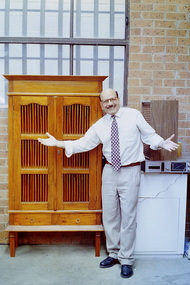
... The Book Cabinet was part of the home furnishings of Robert's parents Mr & Mrs Charles Elston of Wycheproof, kindly loaned by Robert to the society for their use. ...The Book Cabinet was part of the home furnishings of Robert's parents Mr & Mrs Charles Elston of Wycheproof, kindly loaned by Robert to the society for their use. ...The Book Cabinet was part of the home furnishings of Robert's parents Mr & Mrs Charles Elston of Wycheproof, kindly loaned by Robert to the society for their use. Robert's family gifted the cabinet on his passing. The society dedicated the cabinet in memory of Robert, a former member.Mahogany stain timber four shelf cabinet. Double three hinge timber framed full length doors featuring lead light glazing.In memory of Robert Elston Donated by his familycabinet, timber, lead light -
 Bendigo Historical Society Inc.
Flyer - Three flyers for Stilwell's
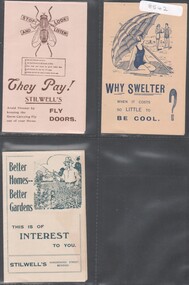
... The shop further developed and advertised as selling furniture, home furnishings and Hardware...The shop further developed and advertised as selling furniture, home furnishings and Hardware Stilwells Window furnishings Flyers Three flyers for Stilwell's, a local Hargreaves Street Bendigo business, for Fly wire doors, internal house blinds and lawn mowers, Postcard sized flyers for aspects of home improvements. ...Business flyers for products to improve homes and gardens. Brothers Frederick and Ernest Stillwell opened a hardware and general ironmongery in Hargreaves St Bendigo in 1895. They were later joined by Roy Stillwell. The shop further developed and advertised as selling furniture, home furnishings and HardwareThree flyers for Stilwell's, a local Hargreaves Street Bendigo business, for Fly wire doors, internal house blinds and lawn mowers, Postcard sized flyers for aspects of home improvements. Flyers dated around 1950s.stilwells, window furnishings, flyers -
 Warrnambool and District Historical Society Inc.
Label, Patersons Pty Ltd, Mid 20th century
... This label comes from a Patersons Furniture and Home Furnishings Store. This company dates from the early 20th century with the first store in Smith Street, Fitzroy, Melbourne. ...This label comes from a Patersons Furniture and Home Furnishings Store. This company dates from the early 20th century with the first store in Smith Street, Fitzroy, Melbourne. ...This label comes from a Patersons Furniture and Home Furnishings Store. This company dates from the early 20th century with the first store in Smith Street, Fitzroy, Melbourne. One of the company’s many branch stores was in Warrnambool, based at 177-179 Liebig Street in the 1960s. At that time Patersons Pty Ltd had 70 branch stores.This label is of minor interest as a memento of a 1960s business in Warrnambool – Patersons Furniture Store.This is a buff-coloured thick card with two corners slightly cut away. It has blue printing and an inserted eyelet for attaching the label by string or cord to a parcel or piece of furniture.From Patersons Pty Ltdfurniture stores, patersons pty ltd, history of warrnambool -
 Melbourne Tram Museum
Photograph - Black and White - Swan Street track lowering, John Alfred, 1957
... In the background is a large advertisement for Pattersons home furnishings. Photo dated 1957....In the background is a large advertisement for Pattersons home furnishings. Photo dated 1957. Yields information about alterations to tram services during road reconstruction project. tramways tramcars Swan Street Richmond route 77 railways bridges tram 330 tram 339 Has details handwritten on rear, date stamp and John Alfred Stamp. ...Photo shows - works in Swan Street Richmond to lower the tram tracks under the Railway bridge which were later replaced by an open web girder truss bridge. The track on the left has been completed while on the right, the original road surface can be seen as well as the temporary track. Shows the abutment for a new railway bridge on the right, for the six tracks to South Yarra. Tram W2 330 (left, Camberwell Depot, route 76) and 339 (City, route 77) are passing each other. In the background is a large advertisement for Pattersons home furnishings. Photo dated 1957.Yields information about alterations to tram services during road reconstruction project.Photograph - Black and White - Swan Street track lowering Has details handwritten on rear, date stamp and John Alfred Stamp. tramways, tramcars, swan street, richmond, route 77, railways, bridges, tram 330, tram 339 -
 City of Moorabbin Historical Society (Operating the Box Cottage Museum)
Clothing - Clothing, lady’s half petticoat, c1970
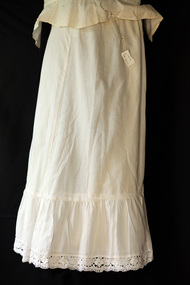
... In 1970 they opened franchises in Australia, Canada, Japan, San Francisco that sold their range of fabrics, dresses and accessories. In 1980 home furnishings were added to the range. Laura died in an accident 1985, Bernard retired in1993 and the company is now Public Listed on Stock Exchange....In 1970 they opened franchises in Australia, Canada, Japan, San Francisco that sold their range of fabrics, dresses and accessories. In 1980 home furnishings were added to the range. Laura died in an accident 1985, Bernard retired in1993 and the company is now Public Listed on Stock Exchange. ...Laura and Bernard Ashley began printing fabric in their London kitchen in 1953. Commencing with head scarves and place-mats they gradually developed table-ware and bed sheets. In 1960 they entered the Fashion world with blouses and smocks . The ‘swinging sixties’ saw them in great demand for the feminine florals and flounces of the ‘maxi’ fashions and they opened in smart South Kensington, London. In 1970 they opened franchises in Australia, Canada, Japan, San Francisco that sold their range of fabrics, dresses and accessories. In 1980 home furnishings were added to the range. Laura died in an accident 1985, Bernard retired in1993 and the company is now Public Listed on Stock Exchange.‘Laura Ashley’ clothing, fabric and accessories were very popular in Melbourne in 1970’s.A lady’s white cotton half petticoat with crocheted flounce, Laura Ashley Pty Ltdclothing, brighton, moorabbin, dressmaking, market gardeners, early settlers, craftwork, textiles, laura ashley -
 Bendigo Historical Society Inc.
Document - BUS SERVICE TIME TABLE, 1960
... Advertising of the tri Fold Brochure is the Bendigo Fashion House 270-272 Hargreaves Street Bendigo Phone 3-47496. Mamouney's home furnishings, Williamson & Queen Streets Phone 3-0496.Fletchers International Food Store 344a Hargreaves St (Opp State Savings Bank) Phone 3-5684. ...Advertising of the tri Fold Brochure is the Bendigo Fashion House 270-272 Hargreaves Street Bendigo Phone 3-47496. Mamouney's home furnishings, Williamson & Queen Streets Phone 3-0496.Fletchers International Food Store 344a Hargreaves St (Opp State Savings Bank) Phone 3-5684. ...BHS CollectionBus Service Time Table: Quarry Hill Bus Service operated by R. Houlden's Bus Service Pty Ltd. Phone Bendigo 424. Buses Available for Charter - Picnics - Tours. Time Table Effective March 1960. Advertising of the tri Fold Brochure is the Bendigo Fashion House 270-272 Hargreaves Street Bendigo Phone 3-47496. Mamouney's home furnishings, Williamson & Queen Streets Phone 3-0496.Fletchers International Food Store 344a Hargreaves St (Opp State Savings Bank) Phone 3-5684. Prime Poultry and Continental and Australian Delicacies. T. Chamberlin canvas and sporting goods. Monumental & Building Masons, Northern Terrazzo Co. Suttons Music Store. Ashman's Men's Shop. Reg. V. Brock Photography. Gillies Bros. Bakery. Miller Bros Deborah Stores Groceries. Box 625Arthur Hocking, Print, Bendigotransport, bus, quarry hill -
 Sunshine and District Historical Society Incorporated
Photograph - Batavia Imports 160 McIntyre Road Sunshine North 2000 Photographs, Chris Scott, 2000
... These photographs, taken by The Advocate, feature the staff and merchandise of Batavia Imports, a furniture and home furnishings retailer located at 160 McIntyre Road, Sunshine North. ...These photographs, taken by The Advocate, feature the staff and merchandise of Batavia Imports, a furniture and home furnishings retailer located at 160 McIntyre Road, Sunshine North. ...These photographs, taken by The Advocate in 2000, were published as part of the newspaper’s ongoing column profiling local traders and businesses throughout the district. These photographs, taken by The Advocate, feature the staff and merchandise of Batavia Imports, a furniture and home furnishings retailer located at 160 McIntyre Road, Sunshine North. These photographs document the range of imported furniture, homewares, and decorative products offered by Batavia Imports, providing a record of the diverse businesses that operated within Sunshine North's commercial and industrial precinct during this period. The business name, "Batavia", references the historic Dutch name for Jakarta, Indonesia, reflecting the company's focus on imported furnishings and decorative items inspired by, or sourced from, Indonesia and the broader Southeast Asian region.The Advocate’s feature on local traders was a modest yet well‑liked column that played a meaningful role in strengthening community identity. Through these regular profiles, the newspaper promoted local businesses and helped shape Sunshine’s understanding of its developing commercial district.7748.01 - Batavia Imports 160 McIntyre Road Sunshine North 2000 Photographs (Advocate 131 And 146).JPG 7748.02 - Batavia Imports 160 McIntyre Road Sunshine North 2000 Photographs (Advocate 131 And 146).JPG 7748.03 - Batavia Imports 160 McIntyre Road Sunshine North 2000 Photographs (Advocate 131 And 146).JPG 7748.04 - Batavia Imports 160 McIntyre Road Sunshine North 2000 Photographs (Advocate 131 And 146).JPG 7748.05 - Batavia Imports 160 McIntyre Road Sunshine North 2000 Photographs (Advocate 131 And 146).JPG 7748.06 - Batavia Imports 160 McIntyre Road Sunshine North 2000 Photographs (Advocate 131 And 146).JPG 7748.07 - Batavia Imports 160 McIntyre Road Sunshine North 2000 Photographs (Advocate 131 And 146).JPG 7748.08 - Batavia Imports 160 McIntyre Road Sunshine North 2000 Photographs (Advocate 131 And 146).JPG 7748.09 - Batavia Imports 160 McIntyre Road Sunshine North 2000 Photographs (Advocate 131 And 146).JPGbatavia imports, mcintyre road, sunshine north -
 Embroiderers Guild, Victoria
Domestic object - Embroidered Turkish Hand Towel
... In wealthy households, as soon as a girl was old enough she would learn embroidery and start preparing for her trousseau and her home furnishings....In wealthy households, as soon as a girl was old enough she would learn embroidery and start preparing for her trousseau and her home furnishings. Example of Ottoman Embroidery Flower floral Tseure (Turkish towel), embroidered both ends with floral motifs in pink, blue, green and yellow thread Domestic object Embroidered Turkish Hand Towel ...Purchased in Athens from antiques dealer (Pandrossou St, Monastirki) by donors sister in the 1970's. Guests in Turkey would be offered water to wash their hands and yagliks to wipe them. When everyone sat crossed legged at low tables, yagliks were also used to cover their laps from spills. They were also used to wrap items such as an important letter, sum of money, present, jewellery, gift of fruits or sweets, an article of clothing - all wrapped in an embroidered yaglik or bocha (square cloth). The richer the wrapping the greater the compliment. In wealthy households, as soon as a girl was old enough she would learn embroidery and start preparing for her trousseau and her home furnishings.Example of Ottoman EmbroideryTseure (Turkish towel), embroidered both ends with floral motifs in pink, blue, green and yellow threadflower, floral -
 Embroiderers Guild, Victoria
Domestic object - Embroidered Turkish Hand Towel
... In wealthy households, as soon as a girl was old enough she would learn embroidery and start preparing for her trousseau and her home furnishings....In wealthy households, as soon as a girl was old enough she would learn embroidery and start preparing for her trousseau and her home furnishings. Example of Ottoman Embroidery Flower floral geometric Tseure (Turkish towel), embroidered both ends with floral motifs Domestic object Embroidered Turkish Hand Towel ...Purchased in Athens from antiques dealer (Pandrossou St, Monastirki) by donors sister in the 1970's. Guests in Turkey would be offered water to wash their hands and yagliks to wipe them. When everyone sat crossed legged at low tables, yagliks were also used to cover their laps from spills. They were also used to wrap items such as an important letter, sum of money, present, jewellery, gift of fruits or sweets, an article of clothing - all wrapped in an embroidered yaglik or bocha (square cloth). The richer the wrapping the greater the compliment. In wealthy households, as soon as a girl was old enough she would learn embroidery and start preparing for her trousseau and her home furnishings.Example of Ottoman EmbroideryTseure (Turkish towel), embroidered both ends with floral motifsflower, floral, geometric -
 Embroiderers Guild, Victoria
Domestic object - Embroidered Turkish Hand Towel
... In wealthy households, as soon as a girl was old enough she would learn embroidery and start preparing for her trousseau and her home furnishings....In wealthy households, as soon as a girl was old enough she would learn embroidery and start preparing for her trousseau and her home furnishings. Example of Ottoman Embroidery Flower floral Yaglik (Turkish towel), embroidered both ends with geometric motifs in grey, blue, red and metallic thread Domestic object Embroidered Turkish Hand Towel ...Purchased in Athens from antiques dealer (Pandrossou St, Monastirki) by donors sister in the 1970's. Guests in Turkey would be offered water to wash their hands and yagliks to wipe them. When everyone sat crossed legged at low tables, yagliks were also used to cover their laps from spills. They were also used to wrap items such as an important letter, sum of money, present, jewellery, gift of fruits or sweets, an article of clothing - all wrapped in an embroidered yaglik or bocha (square cloth). The richer the wrapping the greater the compliment. In wealthy households, as soon as a girl was old enough she would learn embroidery and start preparing for her trousseau and her home furnishings.Example of Ottoman EmbroideryYaglik (Turkish towel), embroidered both ends with geometric motifs in grey, blue, red and metallic threadflower, floral -
 Flagstaff Hill Maritime Museum and Village
Coat rack
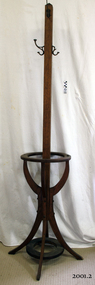
... The front hall was the introduction to the house, and as such was an important part of the Victorian home. Furnishings were selected not only to make it a useful place to hang a hat and coat, store an umbrella and leave a calling card but also to show family wealth, social position and knowledge of current styles. ...The front hall was the introduction to the house, and as such was an important part of the Victorian home. Furnishings were selected not only to make it a useful place to hang a hat and coat, store an umbrella and leave a calling card but also to show family wealth, social position and knowledge of current styles. ...A hat coat and umbrella stand is a device used to store hats and often coats on, and umbrellas within. Some catalogues in Europe marketed this furniture as a portmanteau from the French words Porter (carry) and Manteau (cloak). The front hall was the introduction to the house, and as such was an important part of the Victorian home. Furnishings were selected not only to make it a useful place to hang a hat and coat, store an umbrella and leave a calling card but also to show family wealth, social position and knowledge of current styles. A hall stand or a hat rack was the most important piece of furniture in homes at this time. New and more elaborate designs began to appear about 1840, as homes became larger and social visits became more structured. Usually made of wood and standing at least 1.5 meters tall, they have a single-pole making up most of the height, with a sturdy base to prevent toppling, and an array of lengthy pegs or hooks at the top for placement of hats. Smaller houses had smaller front halls, so a single-pole type as by the 1920s houses had become smaller. A household furniture item possibly from the 1920s that was common in houses from the early 1840s, it's significance is social, demonstrating how furniture trends change over time with the more elaborate the item the more social standing was attributed to the owners' position in society. even today persons association and ownership with inanimate objects tend to represent their social standing along with their financial and community acceptability. Coat rack with four curved legs, circular holder for umbrellas and walking sticks. Four metal hooks, screwed onto main column of stand. Condition: one curved leg broken. 2 hooks broken.Noneflagstaff hill, warrnambool, shipwrecked-coast, flagstaff-hill, flagstaff-hill-maritime-museum, maritime-museum, shipwreck-coast, flagstaff-hill-maritime-village -
 Duldig Studio museum + sculpture garden
Furniture, Sigmund Jaray et al, Viennese bedroom suite manufactured by Sigmund Jaray Kunstmobelfabrik 1931, 1931
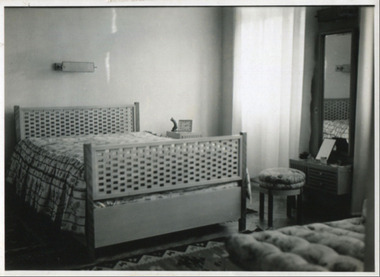
... The Wiener Werkstätte (Viennese workshops) established by Josef Hoffman and Kolomon Moser in 1903 are today celebrated for their work in promoting the involvement of artists, designers and craftspeople in the manufacture of home furnishings; however Sigmund Járay’s firm was also an important, although today lesser-known, Viennese manufacturer of Kunstmöbel (art furniture). ...The Wiener Werkstätte (Viennese workshops) established by Josef Hoffman and Kolomon Moser in 1903 are today celebrated for their work in promoting the involvement of artists, designers and craftspeople in the manufacture of home furnishings; however Sigmund Járay’s firm was also an important, although today lesser-known, Viennese manufacturer of Kunstmöbel (art furniture). ...The Wiener Werkstätte (Viennese workshops) established by Josef Hoffman and Kolomon Moser in 1903 are today celebrated for their work in promoting the involvement of artists, designers and craftspeople in the manufacture of home furnishings; however Sigmund Járay’s firm was also an important, although today lesser-known, Viennese manufacturer of Kunstmöbel (art furniture). An Austro-Hungarian designer of Jewish descent, Sigmund Járay (1838-1908) established his Kunstmöbelfabrik (art furniture factory) in Vienna in the 1870s in partnership with his brother Sándro Járay (1845-1916), a sculptor. The firm with its team of cabinet makers, modellers, sculptors, upholsterers, painters and gilders, manufactured bespoke furnishings and decorated interiors for public and private clients, including the Imperial court. Such was the prominence of the work of this factory, that in 1899 one of the first purchases of the newly formed Austrian Museum of Applied art was a suite of furniture designed by Sigmund Járay for a married worker. In commissioning the furniture, Slawa was adopting the custom of Viennese couples to furnish their homes with bespoke furniture from the interior design firms that flourished in early 20th century in Vienna. Comparative material is held in the National Gallery of Victoria collection; a suite of furniture by Josef Hoffman commissioned by the Gallia family in 1912; and a suite of furniture by Adolf Loos commissioned by the Langer family in 1903. Ann Carew 2016The bedroom suite is aesthetically significant for the quality of its craftsmanship and design. It is a significant example of domestic interior design in Vienna during the 1930s. The bedroom suite is intact, and has been preserved in its entirety – double bed and side tables, wardrobe and linen press, stool and day bed. It has the potential to be displayed in situ in the place where it was last in use. It is of historical significance. Many Jewish families had all their possessions lost or destroyed during the war years. The story of the furniture’s journey from Austria to Australia is relevant to the study of the experience of émigré families during the Holocaust, and the importance of return of their property. It is rare, as it and the furniture in the living and dining room, are the only known examples in Australia of furniture manufactured by the firm of Sigmund Jàray. The provenance of the furniture is excellent, and is demonstrated by photographs taken in Vienna; correspondence with the donor’s sister, Rella; and the quotation from Sigmund Járay Kunstmöbelfabrik. It is in excellent condition. Ann Carew 2016Bedroom suite consisting of a double bed, two side tables, an upholstered stool and upholstered day bed, and a wardrobe and linen press. Made of Maple and Rosewood. Designed by the firm of Sigmund Jaray with Slawa Horowitz-Duldig. -
Ringwood and District Historical Society
Document - Property Rental Records, Midway Arcade Tenancies, Ringwood, Victoria - 1956-60
... Garrett & Sons … Home Furnishings Shop 5 – Mrs C. E. Peacock & Mrs C. ...Garrett & Sons … Home Furnishings Shop 5 – Mrs C. E. Peacock & Mrs C. ...Nine pages of yellowed handwritten notes and typed carbon copies summarising tenancies and rental arrangements for shops and offices in with Midway Arcade, 145-147 Whitehorse Road, Ringwood for various occupancies - 1956-60.Agents: C.E. Carter & Son Summary of Tenant Lists (sic.) Shop 1 – V. Gordon & H. Kwong) … Cafe Shop 2 – B. T. Purser / L. C. Bartling … Shoe Shop Shop 3 – N. Maller … Chemist Shop 4 – Mrs J. A. Davies / C. H. Garrett & Sons … Home Furnishings Shop 5 – Mrs C. E. Peacock & Mrs C. M. Pullen / L. E. Gibson ... Children’s Wear Shop 6 – Rona Industries Pty Ltd … Sewing Machines & Frock Materials Shop 7 – J. & B. Russo … Greengrocers Shop 8 – W. H. Oliver … Butcher Shop 9 – Rankin & Pyke / C. O. Isbel … Cake Shop Shop 10 – W. Hanlon & J. Owen (Owen Radio) … Radio & Electrical Shop 11 – H. F. Gill (Faye French) … Ladies Beauty Salon Shop 12 – W. Hall … Corsetry Salon Shop 13 – C. H. Garrett & Sons ("Checkles") … Frock Shop Shop 14 – J. W. Gillespie / Alexanders … Tailor & Mercer Shop 15 – Alexanders … Mens Clothing Store Office 1 – F. D. Ray & Assoc. / M. A. Gibson … Accountant Office 2 – E. L. Moran … Solicitor Office 3 – Aust. Pastoral Equipment Co. / Progress Press … Pastoral Equipment / Printing Office 4 – D. R. James & Johnston … Solicitors Office 5 & 6 – Geoffrey Baker / J. Johnston … Solicitor Office 7 – T. W. Peters & D. Lush … Dentist Office 8 – Dunn & Schroder / Hillcrest Constructions … Real Estate / Builders Office 9 – J. Crittenden & C. S. Pascoe / Whitaker … Accountants Office 10 – Strobel Construction Pty Ltd / D. J. Hughes … Solicitor Office 11 – L. H. Reid … Drafting Office Office 12, 13 & 14 – Department of the Interior … Government Office Office 15 – H. S. Dixon …Solicitor -
 Eltham District Historical Society Inc
Photograph, 5/32 Bridge Street, Eltham, 16 May 2010, 16/05/2010
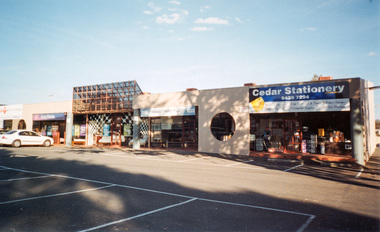
... For more than 50 years, Diamond Valley Drapes has been measuring, making and installing window furnishings for home owners throughout the region. ...For more than 50 years, Diamond Valley Drapes has been measuring, making and installing window furnishings for home owners throughout the region. ...For more than 50 years, Diamond Valley Drapes has been measuring, making and installing window furnishings for home owners throughout the region. This local business is managed by the Jones family. See Also : Designs to suit home from any era, Diamond Valley Leader, July 20, 2005 Cedar Stationery was established in Eltham in 1990, owned and operated by local resident Ron Jordan and his family. As of September 2019 it is noted that the business has been re-branded as Eltham Office Choice. "Office Choice Limited is the leading Australian owned independent dealer group comprising stationery and office product resellers. Established in 1993 as a small buying group, our member-owned national network now services over 180 locations across Australia"Both these local businesses have had long term connections to the local community.Two colour photographsindustries, bridge street, diamond valley drapes, forty winks bedding, yeomans tiles, cedar stationery -
 City of Melbourne Libraries
Photograph, Bull, Hugh Jones, 1897-1993, Commercial Travellers' Association, Victoria, Board Room
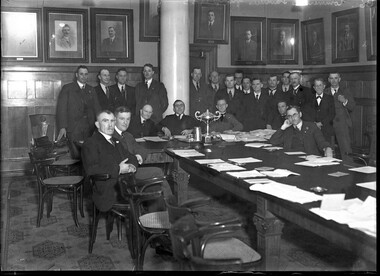
... There was a “Home Page For The Ladies” showcasing the latest fashions in women’s clothing, millinery and hairstyles and tips and trends in home furnishings.“Children’s Corner for Dear Little Folks” which featured puzzles, jokes and stories and members could send in photographs of their children. ...There was a “Home Page For The Ladies” showcasing the latest fashions in women’s clothing, millinery and hairstyles and tips and trends in home furnishings.“Children’s Corner for Dear Little Folks” which featured puzzles, jokes and stories and members could send in photographs of their children. ...Seven seated and fifteen standing men dressed in suits around a long table in a panelled room hung with formal portraits of men. A trophy sits on the long table amongst loose paper sheets. Research by project volunteer, Fiona Collyer: The Commercial Travellers’ Association of Victoria (CTA) was formed at a meeting of 40 commercial travellers held at the Duke of Rothesay Hotel, 24 Elizabeth Street on 1 December 1880. Their charter was to advocate for better working conditions for commercial travelling salesmen, including improved accommodation at discounted rates and travel concession fares. At first by locomotive, horse and buggy, steamers and horseback, later also by motor car and motorcycle, “The Man on the Road” went into the back-blocks of the country to extend the interests of commerce to the stores and households of Australian regional towns and isolated settlements. Affiliated organisations existed in all states and New Zealand and in 1895 they integrated to form the United Commercial Travellers’ Association of Australasia (UCTAA). By the turn of the 20th century, the Victorian branch of the CTA had 421 Association Members and 520 Club members. The CTA continued to hold meetings in leased rooms in hotels and offices until 1898 when they commissioned purpose-built premises at 190-192 Flinders Street (extant, now the Macstore, next to former Metropolitan Gas Company Buildings). Designed by leading architectural firm of brothers H.W. & F.B.Tompkins (Dimmey’s Model Store, Swan Street, London Stores, Herald and Weekly Times, Myer building, Diamond House, Centreway Arcade, Manton’s Store) in the Queen Anne Revival style at the cost of £20,000, the four storey building had a facade of red Northcote bricks and an entrance of Pyrmont stone. It was very modern for the time, featuring elevators, offices, bars, kitchen, dining, card and billiard rooms and 31 bedrooms with shared bathrooms for the footsore travellers. However, despite adding two storeys in 1901, and another storey and a basement in 1905, they soon outgrew their premises, and in 1912 the CTA commissioned a new building at 328 Flinders Street. At this time, buildings in Melbourne were constrained by the city height limit of 132 feet (40 metres)- the maximum height of firefighting ladders. The new CTA building was the tallest building in Melbourne until 1932 when regulations changed allowing the Manchester Unity Building to be built. The new CTA headquarters was the epitome of comfort and luxury with cutting edge facilities to ease the fatigued salesman and prepare him for another stint on the road. General Secretary, James Davies travelled to Britain and America to acquire the very best and latest innovations. After visiting the new premises, Punch magazine 11 June 1914 reported “furnishings, appliances, and labour-saving conveniences which were more than up to date- they were up to-morrow.” The Edwardian Baroque style building was again designed by architects H.W. & F.B. Tompkins at the cost of £100,000 and built by contractors F.E. Shillabeer and Sons (Nicholas Building, Kellow-Falkiner Pty Ltd car showroom). The nine storey plus basement building is of steel frame construction with concrete floors. The ground floor facade is of grey granite and above that it is faced with cream glazed bricks chosen to combat discolouration from the pollution emitted by Flinders Street Station trains across the road. The facade is decorated with mascarons, gum leaf trim and balconies with classical style balustrade. The club was entered through revolving doors into a two storey high, circular, domed lobby with white columns, American oak panelled walls and intricate mosaic flooring. The ceiling is festooned with plaster gum leaf and gum nut detail, a theme that is repeated throughout the building. The basement kitchen had modern, labour saving appliances that would be the envy of any Edwardian housewife, including an electric toaster, a potato peeling machine, heated dumb waiter, dishwashing machine and electric refrigeration and cooking. It serviced the commodious second floor dining room which seated 200 people and the cafe/breakfast room, 80 people. Members were permitted to entertain their lady friends there for afternoon tea between the hours of 3 and 5 pm every day, except Sunday. The members’ facilities included a barbershop, clothes pressing machine, boot cleaning chair, pipe and cigar stall with electric humidor, public telephones, lockers and safe deposit. The building was serviced with five elevators, a built in vacuum cleaning plant, hot water radiators and linen and postal chutes. The first floor was devoted to business and relaxing, containing the Board, Writing, Reading and four Business Rooms. The board room had Queensland maple panelling with huge blackwood tables topped with blue morocco and golden tortoise-shell trim and cane bottomed chairs. Large framed photographs of past presidents since 1884 lined the walls. The Reading Room ran the whole width of the building. Arthur Streeton’s painting “Between the Lights, Princes Bridge 1888” and Frederick McCubbin’s “Looking North from Mount Macedon” were hung there, as well as paintings by renowned Australian artists Hans Heysen, Walter Withers, John Mather, Jan Hendrik Scheltema. The Argus 30 May 1914 quipped “Around the walls hang evidences that the commercial traveller's soul has not been killed in his pursuit of commerce”. The blackwood panelled room was furnished with Queen Anne style tables and chairs and green leather armchairs with inviting rocker foot rests allowing weary travellers to relax after traversing the railways and dusty roads of Victoria while planning their next sales trip. “The Australasia Traveller” Volume 10, Number 2, April 1914 page 35 noted “An attendant will be constantly employed on this floor to take care of the stationary supply, to tidy up newspapers, and generally study the convenience of members.” The third floor was for amusements with billiards, a bar and four rooms for playing cards, dominoes and chess. The huge billiard room had seven Alcock billiard tables including a table in a partitioned match-room for tournaments, exhibitions and matches. The walls were lined with members’ cues and for spectators, comfortable lounges with marble topped tables and electric bell pushes for drinks service. There were 150 bedrooms over five floors, each with their own telephone and wash basin and five suites with a private sitting room attached. There were four bathrooms per bedroom floor and capacious, well-lighted shaving rooms. Top rate club tariff for bed and breakfast - 6 shillings, if called for a country train leaving Melbourne before 8am - 4 shillings, suite and breakfast- 9 shillings, sixpence. “The Australasia Traveller” Volume 10, Number 2, April 1914 page 35 reported “All “early calls” will be made from the Club Office to Bedrooms by means of the Telephone, so that instead of waking everybody else up on the corridor, only the member concerned will know that it is his unpleasant duty to get up.” The new CTA premises was widely regarded as the finest club in the Southern Hemisphere. The CTA also built the adjacent six storey Commerce House with 52 sample rooms for travellers to display their wares with the remainder rented to retail businesses and a post and telegraph office. After the CTA moved into their new, larger premises in 1914, neighbouring department store Ball & Welch expanded into the former CTA. The CTA saw themselves in a nation building role and were an influential lobby group to the Government. They advocated for inter city trunk telephone lines, standard gauge railway lines between NSW and Victoria, improved roads and highways, the Murray River water scheme and maintaining the White Australia Policy. They were very active in fund raising for the war efforts. The CTA offered its members support in other ways with benevolent funds for widows and orphans, mortuary, accident, sickness and an annuities fund for members over 65 years. There were scholarships for members’ children and home purchase scheme to assist with home ownership. A secondary membership scheme provided access to non commercial travellers (men only) to its exclusive club premises. They also organised social events and activities such as billiard tourneys, golf tournaments, dances and an annual “Smoke Social” which was a social event where men gathered for a formal dinner, community singing, lectures, speeches and of course, to smoke! Daylesford born James Davies OBE, (1865-1931) worked at the CTA for 50 years, starting as an office boy and working his way up to General Secretary and editor of the monthly trade journal for UCTAA members, “The Traveller” (1890-1905, later “The Australasian Traveller” 1905-1924 and then “The Australian Traveller” 1925-1976) and the annual colour supplement magazine “Australia To-Day” (1904-1973). “The Australasia Traveller” featured commentary on the issues of the day like wars, tariffs and trade, articles on new products and hotel recommendations and their rates and lots of advertising, especially alcohol, tobacco and accommodation in regional hotels. There were regular columns, each illustrated with a line drawing and these included “Our Immigration Record” a state by state summary of arrivals of “desirable immigrants” to Australia, while bemoaning the declining (white) birth rate. The column followed the arrival of British boys sent to Australia as agricultural apprentices to work on rural properties which were short of labour. Between 1913-1928, 1750 “Barwell Boys”, some as young as 14 years of age arrived in South Australia to work. NSW had a similar program known as the Dreadnaught Boys Scheme where 5595 boys immigrated between 1911-1939. The boys were considered of “good British stock”. There was a “Home Page For The Ladies” showcasing the latest fashions in women’s clothing, millinery and hairstyles and tips and trends in home furnishings.“Children’s Corner for Dear Little Folks” which featured puzzles, jokes and stories and members could send in photographs of their children. “Road Echoes” devoted to “The Man On The Road” and his doings. “Face Massage, Smiling is the Best Face Massage”, the humour page full of jokes and funny stories. “Railway Rumbles” news of innovations, timetables, tickets and grumbles about lavatories, food and drinking water on trains and at railway stations. And in case we forget that members had a home away from their CTA home, gardening tips with “The C.T. as Gardener”column. The annual magazine “Australia To-Day” was a vehicle to promote Australia here and overseas as a modern, prosperous country with abundant opportunities and pleasant climate. It sought to showcase its manufacturing, agriculture and tourism and encourage British immigration to Australia. The magazine featured articles about recently arrived migrants at work, quirky native flora and fauna, beach culture, recreation and the Australian way of life in the settler nation. Many of the articles were written by politicians of the day, including Robert Menzies. The UCTAA commissioned original artwork for the front covers and feature articles of “Australia To-day” from leading Australian artists. These included Norman Lindsay, Frederick McCubbin, Napier Waller, Lionel Lindsay, Hans Heysen, C Dudley Wood, Louis McCubbin, Penleigh Boyd, Louis Buvelot, Christian Waller and Ellis Rowan and her Australian wildflowers. Some of the photographs in “Australia To-Day” were provided by state and federal government departments as well as manufacturers, newspapers and mining companies. Amongst of the credited photographers was Helmut Newton who later earned world acclaim as a fashion photographer and architectural and industrial photographer Wolfgang Sievers (unfortunately their photographs remain in copyright and aren’t available online). Also featured was Richard C. Strangman, a professional photographer from Canberra, William Howieson of Melbourne, who has 22 photographs in the collection of NGV, Tasmanian wilderness photographer Frederick Smithies, Athol Shmith, portrait photographer and educator from Melbourne, Gordon de Lisle, a Melbourne commercial, industrial, aerial and society portrait photographer. (One of Gordon’s assignments was as the stills photographer for the 1959 movie “On The Beach” filmed in Melbourne). Photographs taken by acclaimed Antarctic and official war photographer Captain Frank Hurley OBE for Adelaide’s Centenary were also featured. The Australian Government was keenly aware of the influence and quality of the UCTAA publications. On 1 June 1914 The Age reported that to advertise Australia in Great Britain and elsewhere, the Department of External Affairs purchased 6500 copies of “Australia To-Day” magazine for £515 to distribute free to “places where they are most likely to come under the notice of a desirable class of immigrants.” In 1950, the office of Prime Minister Robert Menzies ordered 2550 copies of that year’s issue of “Australia To-Day” for the Department of Commerce and Information to distribute. The CTA donated their archives to University of Melbourne Archives which includes original artworks and photos used in “Australia To-Day” (Melbourne University has digitised 1114 photos) and sundry items including trophies, ashtrays, commemorative souvenirs, menus, a rare “Safechek” sovereign changer, a bust of James Davies and even a CTA embossed wash bowl and chamber pot. After the death of General Secretary James Davies in 1931, the CTA held the annual “James Davies Memorial Cup” golf tournament at various Melbourne golf courses, the winner receiving a splendid silver cup. “Table Talk” magazine photographs from 29 June 1933 depict the travellers beautifully (and I would say correctly) attired in tweedy plus fours, Fair Isle knitwear, flat caps and of course fringed brogues. I have been unable to ascertain whether the trophy in our photo is for golf or another CTA social activity. The CTA Victoria membership peaked in 1951 with 4,672 Aassociation members and 3,693 Club members. In 1959, Hollywood came to Melbourne when film stars Gregory Peck, Ava Gardner, Anthony Perkins and Fred Astaire descended to film ‘On the Beach,’ directed by Stanley Kramer. The film is based on the bestselling Neville Shute novel about the aftermath of World War Three, a nuclear war that has obliterated most of the Northern Hemisphere. Radioactive dust is heading toward Australia and everyone is preparing for death. Scenes with Anthony Perkins were filmed in the CTA billiards room as the exclusive Pastoral Club. Anthony Perkins’ character, Lieutenant Commander Peter Holmes of RAN tells Gregory Peck’s character, Commander Dwight Lionel, that The Pastoral Club is…”A mahogany and polished brass sort of place-some people claim it was the stuffiest club in the Commonwealth” before assuring him that despite shortages, the club is likely to have some Scotch left. In a scene at the Pastoral Club two, old (probably red faced) codgers discuss the challenge of drinking all of the 400 bottles of Gould Campbell vintage port in the club wine cellar before they succumb to radiation sickness in five months time. The NGV has 12 photographs in their collection of wardrobe stills of Ava Gardner modelling costumes designed by the Fontana Sisters of Rome for “On The Beach”, taken by Italian photographer G.B.Poletto. During the filming, Gregory Peck and his family stayed at “Kurneh” 206 Domain Road, South Yarra, the former home of three times Grand Slam winner Norman Brookes. Through the decades, Australian society was changing and in order to stay relevant, the CTA had to change too. In 1971, two women were elected for club membership, although they were only granted limited access to the club’s facilities and in 1972, women were invited for the first time to participate in the previously men only annual “Smoke Social”. In 1975, dwindling membership forced the closure of The Commercial Travellers’ Association building and in 1977, the building was sold, with the CTA ceasing to operate in 2014. It was the end of the road for the “Knights of the Road”. In 1992, the CTA building at 328 Flinders Street was placed on the Victorian Heritage Register in recognition of its architectural and cultural significance. The building has been meticulously restored with many of the original fittings, decorative plasterwork, mosaic flooring, stained glass windows, columns, chandeliers and the panelling made from Australian timbers retained. After renovations the building became first the Euro Asia Hotel, then the Duxton Hotel and in 2005 The Rendezvous Hotel, Melbourne. In tribute to the history of the building and the film “On The Beach”, the Rendezvous Hotel has the Ms Ava Bar, Perkins room, Mr Tompkins restaurant, Commerce Room and the Davies Room. References: COMMERCIAL TRAVELLERS' ASSOCIATION OF VICTORIA. (1899, May 27). The Australasian (Melbourne, Vic. : 1864 - 1946), p. 25. Retrieved February 21, 2025, from http://nla.gov.au/nla.news-article138615498 COMMERCIAL TRAVELLERS. (1914, May 30). The Argus (Melbourne, Vic. : 1848 - 1957), p. 8. Retrieved February 13, 2025, from http://nla.gov.au/nla.news-article7272511 NEWS OF THE DAY. (1914, June 1). The Age (Melbourne, Vic. : 1854 - 1954), p. 8. Retrieved February 19, 2025, from http://nla.gov.au/nla.news-article189414314 COMMERCIAL TRAVELLERS' "AT HOME." (1914, June 11). Punch (Melbourne, Vic. : 1900 - 1918; 1925), p. 32. Retrieved March 19, 2025, from http://nla.gov.au/nla.news-article129699692 https://archives.library.unimelb.edu.au/nodes/view/69669 https://vhd.heritagecouncil.vic.gov.au/places/757 http://www.pikitiapress.com/blog/2015/1/26/australia-today Commercial Travellers at Yarra Yarra (1933, June 29). Table Talk (Melbourne, Vic. : 1885 - 1939), p. 6. Retrieved February 28, 2025, from http://nla.gov.au/nla.news-article149547845 https://archives.library.unimelb.edu.au/nodes/view/537460 https://viewer.slv.vic.gov.au/?entity=IE7420895&file=FL19171568&mode=browse https://www.history.sa.gov.au/wp-content/uploads/2021/03/Barwell_Boys_Catalogue-compressed-compressed-compressed.pdf Australia Today," 1927 (1926, December 11). Weekly Times (Melbourne, Vic. : 1869 - 1954), p. 15. Retrieved March 17, 2025, from http://nla.gov.au/nla.news-article223844810 https://blogs.unimelb.edu.au/librarycollections/2020/12/19/an-inhabited-space-helmut-newtons-lovers/ https://www.ngv.vic.gov.au/explore/collection/artist/2075/ https://www.ngv.vic.gov.au/?s=Poletto+&type=collection https://rendezvousmelbourne.com.au/digital-history-tour/Photographer notations on slide: "Commercial Travellers Group B6".clubs, department stores, 1930-1939, commerce, manufacturing, federation/edwardian style architecture, railways, tourism, games, agriculture -
 Greensborough Historical Society
Book, Peter Cuffley, Chandeliers and billy tea: a catalogue of Australian life 1880-1940, by Peter Cuffley, 1984
... homes from 1880-1940. Includes items as diverse as jewellery to household furnishings and farm equipment. 224 p., Black and white illustrations. ...This book is a catalogue of items used in Australian homes from 1880-1940. Includes items as diverse as jewellery to household furnishings and farm equipment.224 p., Black and white illustrations.non-fictionThis book is a catalogue of items used in Australian homes from 1880-1940. Includes items as diverse as jewellery to household furnishings and farm equipment.catalogues, household equipment, farm implements -
 Flagstaff Hill Maritime Museum and Village
Clothing - Petticoat, late 19th century to early 20th century
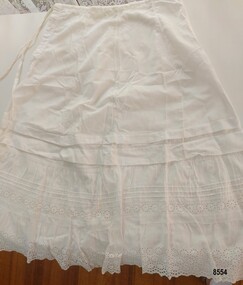
... homes. They were able to produce broderie anglaise for export. By the early 20th century, machine made lace, fabric, ribbons etc. were being sold in drapers shops all over England and Wales to women who were making clothes and furnishings for their families. ...homes. They were able to produce broderie anglaise for export. By the early 20th century, machine made lace, fabric, ribbons etc. were being sold in drapers shops all over England and Wales to women who were making clothes and furnishings for their families. ...This petticoat was one of several items donated from the estate of Susan Henry OAM nee Vedmore (1944 - 2021). It is in very good condition and appears to be from the Edwardian era - early 20th century. A petticoat is a lady's undergarment - worn under a skirt or dress. They provided warmth, modesty and shape to the dress. In the middle of the 19th century, petticoats were worn over hoops, bustles or in layers. Petticoats varied according to the style of the outside skirt or dress. Plain petticoats tended to be worn with everyday wear whilst better dresses (party dresses or silk gowns) were worn with petticoats that often had more trim and embellishments. Edwardian petticoats had less volume than Victorian era petticoats and they had a "dust ruffle" or lining under a lace flounce. The "dust ruffle" protected the lace flounce and gave the petticoat more flare at the bottom, greater freedom when walking as well as saving the flounce (which was often made of finer material) from everyday wear and tear. Tucks are another feature of Edwardian petticoats - when the lace at the bottom became worn, it could be cut off and the tucks released. This extended the life of the petticoat. This petticoat features an intricate trim of broderie anglaise. Although broderie anglaise was a lace that could be made by hand, it was very time consuming to make. St Gallen was a city in Switzerland that had become known for producing quality textiles. At the beginning of the 19th century, the first embroidery machines were developed in St Gallen. Factories used embroidery machines but people also had them in their homes. They were able to produce broderie anglaise for export. By the early 20th century, machine made lace, fabric, ribbons etc. were being sold in drapers shops all over England and Wales to women who were making clothes and furnishings for their families. It is highly likely that the lady who made this petticoat brought the lengths of broderie anglaise already made to embellish and personalise her petticoat. Susan's family (Harold and Gladys Vedmore) immigrated to Australia from Wales in 1955 and settled in Warrnambool. Susan was well known in the Warrnambool community for her work supporting children and families across the district - particular those with disabilities, or those who were homeless, unemployed or isolated. Susan was the founding trustee of the "Vedmore Foundation" - a Warrnambool philanthropic trust set up in 2010 to support a range of charitable and not-for-profit causes by providing grant assistance. In 2021, she was awarded a Medal of the Order of Australia for services to the community.This item is an example of the needlework skills of women in the late 19th century - creating pintucks and adding lace to personalise and embellish a practical item of clothing. It is also significant as an example of a practical solution to the difficulties that women of this era faced with regard to the washing of clothes and household linens.A white lawn petticoat with a 22.5 cm opening that fastens with 2 small buttons and a drawstring tie. It is decorated with two wide pintucks followed by two gathered frills (or flounces) - one decorated with three rows of narrow pintucks and a single row of broderie anglaise and the bottom frilled hem finished with 3 rows of broderie anglaise in a flower design. The two bottom frills are lined with plain white cotton fabric.flagstaff hill maritime museum and village, great ocean road, petticoat, lady's petticoat, undergarment, lady's undergarment, lingerie, edwardian petticoat, broderie anglaise, lace, machine made lace, hand sewn, machine sewn, draper's shop, susan henry oam, vedmore foundation -
 Flagstaff Hill Maritime Museum and Village
Textile - Floor Rug, 1940s
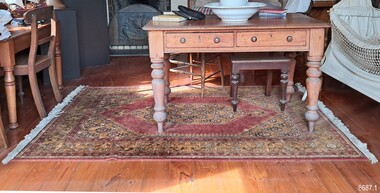
... furnishings of the Williamstown chapel to be transferred to Flagstaff Hill. The St Nicholas Seamen’s Church was officially opened on October 11, 1981, and closely resembles the Williamstown chapel. The connection of this floor rug to the Mission to Seamen and to the Ladies Lightkeepers’ Auxiliary highlights the strong community awareness of the life of people at sea, their dangers and hardships, and their need for physical, financial, spiritual and moral support. This floor rug is representative of rugs used for furnishing homes ...This patterned floor rug has the added feature of a fringe or tassel trim, and its size suits a dining table for four to six people. Originally, the rug was donated to the St Nicholas' Mission to Seamen's Church, Williamstown, by the Williamstown Lighthouse Keepers' Association, which had raised funds to furnish the church. Floor rugs were often part of Victorian furnishings. They were less expensive than wall-to-wall carpets, easier to clean and added colour and warmth. Rugs were a practical way for immigrants to bring memories from their homeland. THE MISSIONS TO SEAMEN (Brief History): - The Missions to Seamen was an Anglican charity that had served seafarers of the world since 1856 in Great Britain. Its symbol is a Flying Angel, inspired by a Bible verse. Today, there are centres in over 200 ports worldwide where seamen of all backgrounds are offered a warm welcome and provided with a wide range of facilities. In Victoria, the organisation began in Williamstown in 1857 as a Sailors’ Church, also known as ‘Bethel’ or the ‘Floating Church’ in an old hulk floating in Hobson’s Bay, Port of Melbourne. It soon became part of the Missions to Seamen, Victoria. In the year 2000, the organisation, now named Mission to Seafarers, still operated locally in Melbourne, Portland, Geelong and Hastings. The Ladies’ Harbour Lights Guild was formed in 1906 to support the Missions to Seamen in Melbourne and other centres, such as Williamstown. Two of the most significant ladies of the Guild were founder Ethel Augusta Godfrey and foundation member Alice Sibthorpe Tracy (who established a branch of the Guild in Warrnambool in 1920). The Guild continued its work until the 1960s. In 1943, a former Williamstown bank was purchased for the Missions to Seamen Club. The chapel was named St Nicholas’ Seamen’s Church and was supported by the Ladies’ Harbour Lights Guild, the Williamstown Lightkeepers’ Auxiliary and the League of Soldiers’ and Sailors’ Friends. It ceased operation in 1966. A Missions to Seamen Chapel and Recreation Room was a significant feature of ports during the late 1800s and into the 1900s. It seemed appropriate for Flagstaff Hill to include such a representation within the new Maritime Village, so the Melbourne Board of Management of Missions to Seamen Victoria gave its permission on 21st May 1979 for the entire furnishings of the Williamstown chapel to be transferred to Flagstaff Hill. The St Nicholas Seamen’s Church was officially opened on October 11, 1981, and closely resembles the Williamstown chapel.The connection of this floor rug to the Mission to Seamen and to the Ladies Lightkeepers’ Auxiliary highlights the strong community awareness of the life of people at sea, their dangers and hardships, and their need for physical, financial, spiritual and moral support. This floor rug is representative of rugs used for furnishing homes in the late 19th and early 20th centuries times.Rug: rectangular floor rug with white tassel trim on short sides, in reds and yellows. This rug is part of the St Nicholas Seamen's Church Collection. flagstaff hill, warrnambool, shipwrecked coast, flagstaff hill maritime museum, maritime museum, shipwreck coast, flagstaff hill maritime village, great ocean road, floor rug, rectangular rug, domestic furnishings, floor cover, domestinc rug, floor covering, williamstown lighthouse keepers' auxiliary, flagstaff hill maritime museum and village, maritime village, religion, religious service, religious worship, worship service, st nicholas seamen’s church, williamstown, missions to seamen victoria, mission to seafarers, st nicholas missions to seamen’s church williamstown, missions to seamen, st nicholas missions to seamen’s church flagstaff hill, 139 nelson place williamstown, anglican church, ladies harbour light guild, harbor lights guild, joy club for fighters, ladies lightkeepers’ auxiliary, flying angel’s club, carpet, furnishing -
 Flagstaff Hill Maritime Museum and Village
Textile - Petticoat, circa 1900
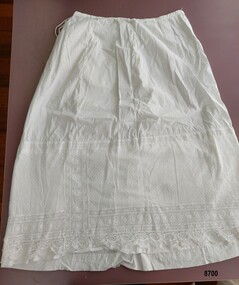
... homes. They were able to produce broderie anglaise for export. By the early 20th century, machine made lace, fabric, ribbons etc. were being sold in drapers shops all over England and Wales to women who were making clothes and furnishings for their families. ...homes. They were able to produce broderie anglaise for export. By the early 20th century, machine made lace, fabric, ribbons etc. were being sold in drapers shops all over England and Wales to women who were making clothes and furnishings for their families. ...This item is one of a collection of clothing items that belonged to the Stephenson family who lived at 22 McCracken Street, Kensington, Melbourne. Matthew Stephenson (1861 – 1943) who had grown up on the Bendigo goldfields and shifted to Melbourne in the early 1900’s was a train driver and later, a fireman with the railways. His wife Elizabeth Jane (Betsy) Wigley (1865 – 1953) also grew up on the goldfields around Majorca and Bendigo. They married in 1885 in Bendigo. They had two daughters – Ethel Evelyn Stephenson (1886 – 1956) and Lillian or Lila (1891 – 1977) who were milliners and dressmakers and who continued to live in the family home after the death of their parents. The family are recorded as living at 22 McCracken Street, Kensington, as early as 1914. It is not known who made or owned the clothing that makes up this collection but as it appears to be from the late Victorian and early Edwardian era, the different pieces were probably made and worn by any of the three ladies of the house – Betsy, Ethel and/or Lila. During W.W.2, a local Warrnambool couple (Meryl and Tony Everard) boarded with them – Tony was in the airforce training paratroopers to jump into (and survive) enemy territory and his wife Meryl worked in the Methodist baby Home. The Everards developed a close friendship with the Stephensons and were responsible for clearing out the house (and finding this clothing collection) after Lila died in 1977. A petticoat is a lady's undergarment - worn under a skirt or dress. They provided warmth, modesty and shape to the dress. In the middle of the 19th century, petticoats were worn over hoops, bustles or in layers. Petticoats varied according to the style of the outside skirt or dress. Plain petticoats tended to be worn with everyday wear whilst better dresses (party dresses or silk gowns) were worn with petticoats that often had more trim and embellishments. Edwardian petticoats had less volume than Victorian era petticoats and they had a "dust ruffle" or lining under a lace flounce. The "dust ruffle" protected the lace flounce and gave the petticoat more flare at the bottom, greater freedom when walking as well as saving the flounce (which was often made of finer material) from everyday wear and tear. Tucks are another feature of Edwardian petticoats - when the lace at the bottom became worn, it could be cut off and the tucks released. This extended the life of the petticoat. This petticoat features an intricate trim of broderie anglaise. Although broderie anglaise was a lace that could be made by hand, it was very time consuming to make. St Gallen was a city in Switzerland that had become known for producing quality textiles. At the beginning of the 19th century, the first embroidery machines were developed in St Gallen. Factories used embroidery machines but people also had them in their homes. They were able to produce broderie anglaise for export. By the early 20th century, machine made lace, fabric, ribbons etc. were being sold in drapers shops all over England and Wales to women who were making clothes and furnishings for their families. It is highly likely that the lady who made this petticoat brought the lengths of broderie anglaise already made to embellish and personalise her petticoat.This item is an example of the needlework skills of women in the late 19th century - creating pintucks and adding lace to personalise and embellish a practical item of clothing. A lady's fine cotton and lace ankle length petticoat featuring a deep decorative hem made from sheer pinspot fabric and bands of eyelet lace. The top section of the petticoat is made from five sections of fine cotton sewn together with french seams and gathered with pleats and darts into the waistband. The waistband opening has two button holes and one button (the top button is missing) and a front section with a drawstring. The lace hem is lined with the same fine cotton as the top of the petticoat. There are three different lace bands - a narrow one featuring small flowers, a similar wider band with larger flowers and it is finished at the bottom with a broad band of lace with an intricate leaf design.flagstaff hill maritime museum and village, great ocean road, warrnambool, shipwreck coast, petticoat, lady's petticoat, broderie anglaise, decorative petticoat, draw string waist, machine sewn, dressmaker, stephenson family, pintucks, needlework -
 Flagstaff Hill Maritime Museum and Village
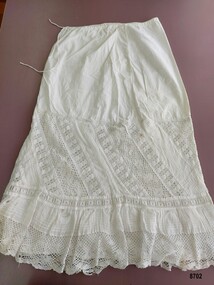
Textile - Petticoat, circa 1910
... homes. They were able to produce broderie anglaise for export. By the early 20th century, machine made lace, fabric, ribbons etc. were being sold in drapers shops all over England and Wales to women who were making clothes and furnishings for their families. ...homes. They were able to produce broderie anglaise for export. By the early 20th century, machine made lace, fabric, ribbons etc. were being sold in drapers shops all over England and Wales to women who were making clothes and furnishings for their families. ...This item is one of a collection of clothing items that belonged to the Stephenson family who lived at 22 McCracken Street, Kensington, Melbourne. Matthew Stephenson (1861 – 1943) who had grown up on the Bendigo goldfields and shifted to Melbourne in the early 1900’s was a train driver and later, a fireman with the railways. His wife Elizabeth Jane (Betsy) Wigley (1865 – 1953) also grew up on the goldfields around Majorca and Bendigo. They married in 1885 in Bendigo. They had two daughters – Ethel Evelyn Stephenson (1886 – 1956) and Lillian or Lila (1891 – 1977) who were milliners and dressmakers and who continued to live in the family home after the death of their parents. The family are recorded as living at 22 McCracken Street, Kensington, as early as 1914. It is not known who made or owned the clothing that makes up this collection but as it appears to be from the late Victorian and early Edwardian era, the different pieces were probably made and worn by any of the three ladies of the house – Betsy, Ethel and/or Lila. During W.W.2, a local Warrnambool couple (Meryl and Tony Everard) boarded with them – Tony was in the airforce training paratroopers to jump into (and survive) enemy territory and his wife Meryl worked in the Methodist baby Home. The Everards developed a close friendship with the Stephensons and were responsible for clearing out the house (and finding this clothing collection) after Lila died in 1977. A petticoat is a lady's undergarment - worn under a skirt or dress. They provided warmth, modesty and shape to the dress. In the middle of the 19th century, petticoats were worn over hoops, bustles or in layers. Petticoats varied according to the style of the outside skirt or dress. Plain petticoats tended to be worn with everyday wear whilst better dresses (party dresses or silk gowns) were worn with petticoats that often had more trim and embellishments. Edwardian petticoats had less volume than Victorian era petticoats and they had a "dust ruffle" or lining under a lace flounce. The "dust ruffle" protected the lace flounce and gave the petticoat more flare at the bottom, greater freedom when walking as well as saving the flounce (which was often made of finer material) from everyday wear and tear. Tucks are another feature of Edwardian petticoats - when the lace at the bottom became worn, it could be cut off and the tucks released. This extended the life of the petticoat. This petticoat features an intricate trim of broderie anglaise. Although broderie anglaise was a lace that could be made by hand, it was very time consuming to make. St Gallen was a city in Switzerland that had become known for producing quality textiles. At the beginning of the 19th century, the first embroidery machines were developed in St Gallen. Factories used embroidery machines but people also had them in their homes. They were able to produce broderie anglaise for export. By the early 20th century, machine made lace, fabric, ribbons etc. were being sold in drapers shops all over England and Wales to women who were making clothes and furnishings for their families. It is highly likely that the lady who made this petticoat brought the lengths of broderie anglaise already made to embellish and personalise her petticoat.This item is an example of the needlework skills of women in the late 19th century - creating pintucks and adding lace to personalise and embellish a practical item of clothing.A lady's ankle length petticoat made in three sections. The top section is made from three rectangles of fine cotton (batiste) joined into a round with narrow french seams and inserted into a simple drawstring waistband with a small opening. The second section is made with rows of alternating strips of fine pin tucked lawn, white cotton cut work embroidery and a wider cotton lace design all joined in a diagonal pattern and lined with fine lawn. The bottom section of the petticoat has a horizontal strip of eyelet lace followed by a wider strip of fine pin tucked lawn and is finished with a deep hem of white cotton crocheted lace fabric and has the same lawn lining as the section above.flagstaff hill maritime museum and village, great ocean road, shipwreck coast, warrnambool, petticoat, lady's petticoat, needlework, sewing, broderie anglaise, stephenson family, drawstring waistband -
 Flagstaff Hill Maritime Museum and Village
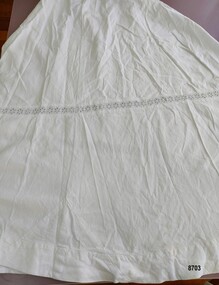
Textile - Skirt, circa 1910
... homes. They were able to produce broderie anglaise for export. By the early 20th century, machine made lace, fabric, ribbons etc. were being sold in drapers shops all over England and Wales to women who were making clothes and furnishings for their families. ...homes. They were able to produce broderie anglaise for export. By the early 20th century, machine made lace, fabric, ribbons etc. were being sold in drapers shops all over England and Wales to women who were making clothes and furnishings for their families. ...This item is one of a collection of clothing items that belonged to the Stephenson family who lived at 22 McCracken Street, Kensington, Melbourne. Matthew Stephenson (1861 – 1943) who had grown up on the Bendigo goldfields and shifted to Melbourne in the early 1900’s was a train driver and later, a fireman with the railways. His wife Elizabeth Jane (Betsy) Wigley (1865 – 1953) also grew up on the goldfields around Majorca and Bendigo. They married in 1885 in Bendigo. They had two daughters – Ethel Evelyn Stephenson (1886 – 1956) and Lillian or Lila (1891 – 1977) who were milliners and dressmakers and who continued to live in the family home after the death of their parents. The family are recorded as living at 22 McCracken Street, Kensington, as early as 1914. It is not known who made or owned the clothing that makes up this collection but as it appears to be from the late Victorian and early Edwardian era, the different pieces were probably made and worn by any of the three ladies of the house – Betsy, Ethel and/or Lila. During W.W.2, a local Warrnambool couple (Meryl and Tony Everard) boarded with them – Tony was in the airforce training paratroopers to jump into (and survive) enemy territory and his wife Meryl worked in the Methodist baby Home. The Everards developed a close friendship with the Stephensons and were responsible for clearing out the house (and finding this clothing collection) after Lila died in 1977. This skirt features broderie anglaise trim. Although broderie anglaise was a lace that could be made by hand, it was very time consuming to make. St Gallen was a city in Switzerland that had become known for producing quality textiles. At the beginning of the 19th century, the first embroidery machines were developed in St Gallen. Factories used embroidery machines but people also had them in their homes. They were able to produce broderie anglaise for export. By the early 20th century, machine made lace, fabric, ribbons etc. were being sold in drapers shops all over England and Wales to women who were making clothes and furnishings for their families. It is highly likely that the lady who made this skirt brought the lengths of broderie anglaise already made to embellish and personalise her skirt.This item is an example of the needlework skills of women in the late 19th century - creating pintucks and adding lace to personalise and embellish a practical item of clothing. A full length lady's skirt of heavy textured ribbed twill cotton. The top of the skirt is made from five pieces of fabric, sewn together and inserted into a simple waistband. It has an opening with room for 6 hook and eyes (but only the middle three remain). The top section of the skirt is separated from the bottom section by a strip of eyelet embroidery that has been inserted in a horizontal line at the back but becomes slightly diagonal at the front causing the two ends to cross in a decorative X fashion. The bottom of the skirt is the same heavy cotton as the top and one seam features a V shaped insert or patch.flagstaff hill maritime museum and village, great ocean road, shipwreck coast, warrnambool, broderie anglaise, needlework, sewing, stephenson family, skirt, lady's skirt
