
Showing 131 items matching " international (germany"
-
 Women's Art Register
Archive (Collection) - Hannah Höch Artist Archive
... International (Germany)...1889-1978 International (Germany) Surrealism Photomontage Collage Collage Photography Archive Hannah Höch Artist Archive ...international (germany), surrealism, photomontage, collage, collage, photographyinternational (germany), surrealism, photomontage, collage, collage, photography -
Women's Art Register
Archive (Collection) - Rebecca Horn Artist Archive
... International (Germany)...1944- International (Germany) Body Techology Nature Installation Sculpture Archive Rebecca Horn Artist Archive ...international (germany), body, techology, nature, installation, sculptureinternational (germany), body, techology, nature, installation, sculpture -
Women's Art Register
Archive (Collection) - Ilse Bing Artist Archive
... ... International (Germany...1899-1998 Bauhaus International (Germany France USA) Photography Painting Archive Ilse Bing Artist Archive ...bauhaus, international (germany, france, usa), photography, paintingbauhaus, international (germany, france, usa), photography, painting -
Women's Art Register
Archive (Collection) - Monika Morgenstern Artist Archive
... ... International (Germany)...Landscape International (Germany) Painting Watercolour Archive Monika Morgenstern Artist Archive ...landscape, international (germany), painting, watercolourlandscape, international (germany), painting, watercolour -
Women's Art Register
Archive (Collection) - Hedda Morrison Artist Archive
... International (Germany)...1908-1991 International (Germany) Landscape Portraiture Asia Sarawak China Photography Journalism Archive Hedda Morrison Artist Archive ...international (germany), landscape, portraiture, asia, sarawak, china, photography, journalisminternational (germany), landscape, portraiture, asia, sarawak, china, photography, journalism -
Women's Art Register
Archive (Series) - Bing, Ilse. Artist File 1
... ... International (Germany...Bauhaus International (Germany France USA) Photography Painting Foolscap white archival 4 flap folder or document wallet Archive Bing, Ilse. ...Newspaper Clippingsbauhaus, international (germany, france, usa), photography, paintingbauhaus, international (germany, france, usa), photography, painting -
Women's Art Register
Archive (Collection) - Eleanore Lange Artist Archive
... ... International (Germany)...1893-1990 Figurative Modernism Crowley-Fizelle Studio Grace Crowley Rah Fizelle International (Germany) Sculpture Writer Plaster Archive Eleanore Lange Artist Archive ...figurative, modernism, crowley-fizelle studio, grace crowley, rah fizelle, international (germany), sculpture, writer, plasterfigurative, modernism, crowley-fizelle studio, grace crowley, rah fizelle, international (germany), sculpture, writer, plaster -
Women's Art Register
Archive (Collection) - Katrin Koenning Artist Archive
... International (Germany)...1978- International (Germany) Photography Video Archive Katrin Koenning Artist Archive ...international (germany), photography, videointernational (germany), photography, video -
Women's Art Register
Archive (Series) - Höch, Hannah. Artist File 1
... International (Germany)...International (Germany) Surrealism Photomontage Collage Collage Photography Foolscap white archival 4 flap folder or document wallet Archive Höch, Hannah. ...Newspaper Clippings, Articlesinternational (germany), surrealism, photomontage, collage, collage, photographyinternational (germany), surrealism, photomontage, collage, collage, photography -
Women's Art Register
Archive (Series) - Horn, Rebecca . Artist File 1
... International (Germany)...International (Germany) Body Techology Nature Installation Sculpture Foolscap white archival 4 flap folder or document wallet Archive Horn, Rebecca . ...Article.international (germany), body, techology, nature, installation, sculptureinternational (germany), body, techology, nature, installation, sculpture -
Women's Art Register
Archive (Series) - Morgenstern, Monika. Artist File 1
... ... International (Germany)...Landscape International (Germany) Painting Watercolour Foolscap white archival 4 flap folder or document wallet Archive Morgenstern, Monika. ...Newspaper Clippings, Promotional Materiallandscape, international (germany), painting, watercolourlandscape, international (germany), painting, watercolour -
Women's Art Register
Archive (Series) - Morrison, Hedda. Artist File 1
... International (Germany)...International (Germany) Landscape Portraiture Asia Sarawak China Photography Journalism Foolscap white archival 4 flap folder or document wallet Archive Morrison, Hedda. ...Newspaper Clippingsinternational (germany), landscape, portraiture, asia, sarawak, china, photography, journalisminternational (germany), landscape, portraiture, asia, sarawak, china, photography, journalism -
Women's Art Register
Archive (Series) - Rebecca Horn. Duplicate File 1
... ... International (Germany)...Installation Sculpture International (Germany) Body Techology Nature Foolscap manilla file Archive Rebecca Horn. ...Article.installation, sculpture, international (germany), body, techology, natureinstallation, sculpture, international (germany), body, techology, nature -
Women's Art Register
Archive (Series) - Katrin Koenning. Duplicate File 1
... ... International (Germany)...Photography Video International (Germany) Foolscap manilla file Archive Katrin Koenning. ...photography, video, international (germany)photography, video, international (germany) -
Women's Art Register
Archive (Series) - Eleanore Lange. Duplicate File 1
... ... International (Germany)...Sculpture Writer Plaster Figurative Modernism Crowley-Fizelle Studio Grace Crowley Rah Fizelle International (Germany) Foolscap manilla file Archive Eleanore Lange. ...Biography, Newspaper Clippings, Correspondence, Articlessculpture, writer, plaster, figurative, modernism, crowley-fizelle studio, grace crowley, rah fizelle, international (germany)sculpture, writer, plaster, figurative, modernism, crowley-fizelle studio, grace crowley, rah fizelle, international (germany) -
Women's Art Register
Archive (Series) - Monika Morgenstern. Duplicate File 1
... ... International (Germany)...Painting Watercolour Landscape International (Germany) Foolscap manilla file Archive Monika Morgenstern. ...Newspaper Clippings, Promotional Materialpainting, watercolour , landscape, international (germany)painting, watercolour , landscape, international (germany) -
Women's Art Register
Archive (Series) - Hedda Morrison. Duplicate File 1
... ... International (Germany)...Photography Journalism International (Germany) Landscape Portraiture Asia Sarawak China Foolscap manilla file Archive Hedda Morrison. ...Newspaper Clippingsphotography, journalism, international (germany), landscape, portraiture, asia, sarawak, chinaphotography, journalism, international (germany), landscape, portraiture, asia, sarawak, china -
Women's Art Register
Archive (Series) - Lange, Eleanore. Artist File 1
... ... International (Germany)...Figurative Modernism Crowley-Fizelle Studio Grace Crowley Rah Fizelle International (Germany) Sculpture Writer Plaster Foolscap white archival 4 flap folder or document wallet Archive Lange, Eleanore. ...Biography, Newspaper Clippings, Correspondence, Articlesfigurative, modernism, crowley-fizelle studio, grace crowley, rah fizelle, international (germany), sculpture, writer, plasterfigurative, modernism, crowley-fizelle studio, grace crowley, rah fizelle, international (germany), sculpture, writer, plaster -
Women's Art Register
Archive (Series) - Koenning, Katrin. Artist File 1
... International (Germany)...International (Germany) Photography Video Foolscap white archival 4 flap folder or document wallet Archive Koenning, Katrin. ...international (germany), photography, videointernational (germany), photography, video -
Women's Art Register
Archive (Series) - Ilse Bing. Duplicate File 1
... ... International (Germany...Photography Painting Bauhaus International (Germany France USA) Foolscap manilla file Archive Ilse Bing. ...Newspaper Clippingsphotography, painting, bauhaus, international (germany, france, usa)photography, painting, bauhaus, international (germany, france, usa) -
 Australian Multicultural Community Services
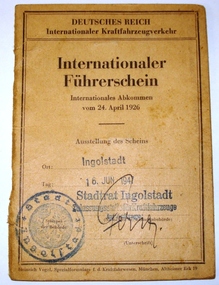
internationaler führerschein (international license)
... international license...migration...Germany...It was issued according to international agreement from 24 April 1926; this document belonged to deceased Marian Dabrowski, ex-soldier, migrant from Poland who came to Australia as a refugee after II World War one of a few items of this kind which has survived to present days international license migration Germany document front cover: stamp and signature of authorised person page 3: stamp, photo of holder Marian Dabrowski and handwritten info about holder of license page 38; 2 stamps which identify the category of license (A&B), handwritten info about holder brownish paper, 42 pages, back cover blank, page 37&38 folded page 2 contains list of countries where this license could be used page 4 - internationaler führerschein (international license) ...international license (internationaler führerschein) was issued on 16 June 1947 in Ingolstadt. It was issued according to international agreement from 24 April 1926; this document belonged to deceased Marian Dabrowski, ex-soldier, migrant from Poland who came to Australia as a refugee after II World Warone of a few items of this kind which has survived to present daysbrownish paper, 42 pages, back cover blank, page 37&38 folded page 2 contains list of countries where this license could be used page 4 - front cover: stamp and signature of authorised person page 3: stamp, photo of holder Marian Dabrowski and handwritten info about holder of license page 38; 2 stamps which identify the category of license (A&B), handwritten info about holderinternational license, migration, germany, document -
 Lakes Entrance Historical Society
Postcard - View Lakes Entrance from Kalimna Heights. Lakes Entrance Victoria c1980, Engelander John & Co Pty Ltd
... Panoramic view of Lakes Entrance taken by Melbourne firm for West Germany A.F.K. International Publishers of world's most famous beauty spots...Panoramic view of Lakes Entrance taken by Melbourne firm for West Germany A.F.K. International Publishers of world's most famous beauty spots Waterways Topography Township Lakes Entrance, Victoria, Australia (on back) Colour postcard with serrated edge, of the township, situated between Cunninghame Arm and North Arm. ...Panoramic view of Lakes Entrance taken by Melbourne firm for West Germany A.F.K. International Publishers of world's most famous beauty spotsColour postcard with serrated edge, of the township, situated between Cunninghame Arm and North Arm. Boats moored at jetties and beside boat ramps in North Arm. Photo taken from Kalimna Heights. Dredged sand dumped in North Arm bight. Lakes Entrance VictoriaLakes Entrance, Victoria, Australia (on back) waterways, topography, township -
 Ballarat Tramway Museum
Negative, Bruce Herbert, "Bendigo and Ballarat Trams (AETA Convention) 30 Mar 1975", 30/03/1975 12:00:00 AM
... Negative folder - made by ROW1 International of West Germany containing 40 No. 35 mm negatives of the AETA 1975 Convention visit to Ballarat and Bendigo on 30-3-1975. 17 photos of Ballarat and 23 of Bendigo. ...Trams tramways BTPS Ballarat AETA Bendigo Bendigo Trust Wendouree Parade Depot Gardens Loop Motor vehicles tram 40 tram 27 tram 26 tram 14 tram 28 Negative folder - made by ROW1 International of West Germany containing 40 No. 35 mm negatives of the AETA 1975 Convention visit to Ballarat and Bendigo on 30-3-1975. 17 photos of Ballarat and 23 of Bendigo. ...Negative folder - made by ROW1 International of West Germany containing 40 No. 35 mm negatives of the AETA 1975 Convention visit to Ballarat and Bendigo on 30-3-1975. 17 photos of Ballarat and 23 of Bendigo. Ballarat photos: 1 - 40 at the Wendouree Parade crossing loop showing trams stop signage and AETA members standing at the front of the tram. 2 - distant view of 27 in the loop and the "wide roadway" 3 - view of 40 northbound about to nearing loop with various cars in the view. 4 - 40 about to enter loop with 27 in background. 5 - 40 and 27 at loop 6 - 40 at St Aidans Drive 7 - 14 and 27 at loop with 40 in the background 8 - 27 leaving loop 9 - 14 leaving loop 10 - General view showing cars and 40 in the loop, looking north. 11 - as for 1 12 - ditto 13 - 40 northbound, 27 southbound at loop 14 - 27 at loop 15 - 26, 14 and 28 at depot including 1 road. 16 - ditto with people viewing the trams - shows the overhead on 1 road. 17 - X41 and B80 on train at Spencer St, probably the train the group travelled on. trams, tramways, btps, ballarat, aeta, bendigo, bendigo trust, wendouree parade, depot, gardens loop, motor vehicles, tram 40 tram 27 tram 26 tram 14 tram 28 -
 Ballarat Tramway Museum
Negative, Bruce Herbert, "Bendigo and Ballarat Trams (AETA Convention) 30 Mar 1975", 30/03/1975 12:00:00 AM
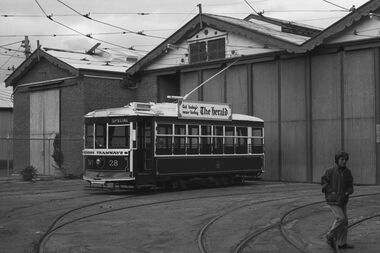
... Negative folder - made by ROW1 International of West Germany containing 40 No. 35 mm negatives of the AETA 1975 Convention visit to Ballarat and Bendigo on 30-3-1975. 17 photos of Ballarat and 23 of Bendigo. ...Trams tramways BTPS Ballarat AETA Bendigo Bendigo Trust Depot McCrae St tram 28 tram 19 tram 30 tram 18 tram 24 tram 3 tram 12 tram 17 tram Scrubber Negative folder - made by ROW1 International of West Germany containing 40 No. 35 mm negatives of the AETA 1975 Convention visit to Ballarat and Bendigo on 30-3-1975. 17 photos of Ballarat and 23 of Bendigo. ...Negative folder - made by ROW1 International of West Germany containing 40 No. 35 mm negatives of the AETA 1975 Convention visit to Ballarat and Bendigo on 30-3-1975. 17 photos of Ballarat and 23 of Bendigo. Bendigo photos: 1 - No. 28 at the depot 2 - ditto 3 - 24 and another bogie tram in side the depot 4 - No. 3? inside the depot 5 - 12, scrubber - 17 and two bogie trams 6 - scrubber and other bogie trams. 7 - general view with 24 and other bogie trams 8 - ditto 9 - Four trams at the Gold Mine, lead by 28. 10 - 19 at the Gold Mine 11 - single trucker with "tram tours" sign on the front 12 - 28 and two other cars at the Joss House, North Bendigo 13 - 19 and two other cars at the Joss House 14 - 30 at depot junction and loop 15 - 28 and 18 16 - 18 in the loop 17 - 28 and 18 McCrae St 18 - 28, 18 and 30 ditto 19 - 19 20 - No. 18 and 28 in Pall Mall with The Beehive in the background. Outside the building is an American Doughnut Kitchen van. The junction trackwork for the Eaglehawk lines remain in position. 21 - No. 30 northbound, with the City Family Hotel and other shops in the background. 22 - ditto and the cenotaph, 23 - B74 on a train at Spencer St. trams, tramways, btps, ballarat, aeta, bendigo, bendigo trust, depot, mccrae st, tram 28 tram 19 tram 30 tram 18 tram 24 tram 3 tram 12 tram 17 tram scrubber -
 Federation University Art Collection
Ceramic, John Dermer, Salt Glazed Stoneware Pot by John Dermer, 1977
... Yars of research and experience in salt glazing were rewarded in 2006 when John Dermerwon the highly prestigious Saltzbrand Keramik International Award in Koblenz, Germany. Another avenue of ceramics for which John is renowned is in the field of terra sigillata. ...Yars of research and experience in salt glazing were rewarded in 2006 when John Dermerwon the highly prestigious Saltzbrand Keramik International Award in Koblenz, Germany. Another avenue of ceramics for which John is renowned is in the field of terra sigillata. ...John DERMER (1949- ) Born Melbourne, Victoria John Dermer studied Ceramics at the Royal Melbourne Institute of Technology and Hawthorne State College (Diploma of Education), before working in potteries in England. Upon his return to Australia he established "Kirby's Flat Pottery" studio at Yackandandah, Victoria in 1974. John is proudly a product of the Leach/Hamada movement in ceramics. He sees this as a tradition that for him represents the essence of working with clay. The lines are pure and balanced while the forms are honest, proud and passionate. Yars of research and experience in salt glazing were rewarded in 2006 when John Dermerwon the highly prestigious Saltzbrand Keramik International Award in Koblenz, Germany. Another avenue of ceramics for which John is renowned is in the field of terra sigillata. This passion had its foundation back in 1987 when he received a major commission from Romaldo Giurgola and Pamille Berg for the new Parliament House in Canberra. During the completion of these massive pieces for the Prime Minister’s suite and Cabinet entry he had to invent and develop methods for decorating and firing the pots successfully. The completed pieces are still regarded by John as some of his finest works. John Dermer was a visiting lecturer to the Gippsland Centre of Art and Design (GCAD). This work is part of the Jan Feder Memorial Ceramics Collection. Jan Feder was an alumna of the Gippsland Campus who studied ceramics on the campus. She passed away in the mid 1980s. Her student peers raised funds to buy ceramic works in her memory. They bought works from visiting lecturers who became leading ceramic artists around the world, as well as from many of the staff who taught there.Salt glazed stoneware pot This work is part of the Jan Feder Memorial Ceramics Collection. Jan Feder was an alumna of the Gippsland Campus who studied ceramics on the campus. She passed away in the mid 1980s. Her student peers raised funds to buy ceramic works in her memory. They bought works from visiting lecturers who became leading ceramic artists around the world, as well as from many of the staff who taught there.Signed on base 'John Dermer'john dermer, ceramics, artwork, artists, gippsland campus, jan feder memorial ceramics collection, salt glaze, kirby's flat pottery, stoneware -
 Flagstaff Hill Maritime Museum and Village
Machine - Guillotine, c. 1880's
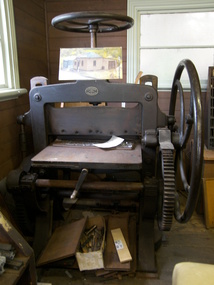
... It represents communication methods and processes used in the time before electrically powered equipment became common in industry. flagstaff hill warrnambool shipwrecked coast flagstaff hill maritime museum maritime museum shipwreck coast flagstaff hill maritime village great ocean road printing machinery printer’s guillotine paper guillotine paper cutter machine oscar friedheim ltd london friedheim international ltd bookbinding industry printing industry Maker’s plaque inscribed "O. FRIEDHEIM / London / German Manufacture" Guillotine (or paper cutter), hand operated. ...This guillotine is a hand operated machine specifically designed to cut through multiple sheets of paper or card. It has a very heavy and sharp single blade knife mounted between vertical guides or runners. The main users of a machine like this is in by the printing and publication binding industry. Book binding companies use a guillotine to evenly trim the pages of a book after it has been bound. The way the guillotine is used is - paper or card is stacked squarely on the flat table and pushed firmly against the back guide - the handle below the table at the front of the machine is wound around, which brings the back guide forward, pushing the paper stack forward and positioning the centre of the stack below the vertical frame - the upper wheel is wound around, which brings the clamp and firmly in position on top of the paper, to hold it very firmly - the large wheel on the side of the machine is turned around to lower the long sharp blade down onto the pages and cut them through. The sharp edge of the blade is protected somewhat from becoming blunt; a block of wood sits in the table under the stack of paper An early model of a guillotine was patented in 1837 by Thirault, who built a model with a fixed blade. Guillotines similar in principal to this one were patented by Guillaume Massiquot in 1844 and 1852. Over the years many improvements have been made and operation has moved from man power to electricity. Oscar Friedheim Ltd. was the importer and wholesaler of a large range of machinery and equipment for the printing and bookbinding industry. He sold most of his equipment under his own name. On this guillotine or paper cutter he refers to the origin of the guillotine’s manufacture only as “German Manufacrure”. A reference book “Commercial Bookbinding: a description of the processes and the various machines used" by Geo. Stephen, 1910, recommends Oscar Friedheim, amongst others, for the supply of “reliable cutting machines for hand or power”. It also recommends Oscar Friedheim’s for a wide range of other printing machinery and processes. OSCAR FRIEDHEIM LIMITED, LONDON Oscar Friedheim Ltd. was established in 1884 and operated from Ludgate in London. The company was an importer and wholesale supplier in the 1880’s, offering machinery and equipment for the printing and packaging industry for the UK and Ireland. The company became incorporated in 1913. An advertisement of 1913 includes a telegraphic code plus two telephone numbers for Oscar Friedheim Ltd and invites readers to call at the Ludgate, London, showrooms to see the machines working. The company later became Friedheim International Ltd. The book titled “Friedheim, A Century of Service 1884-1984 by Roy Brewer, celebrates Oscar Friedheim’s achievements. Friedheim International currently operates from Hemel Hempstead, on the northern outskirts of London UK. It promotes itself as “… the leading supplier of finishing, converting and packaging machinery to the printing, graphic arts, and highly varied packaging industries in the UK and Ireland. The company’s policy is simple – “employ the best people, work with the best equipment manufacturers in the world, and treat our customers as partners!” The company still sells guillotines. The guillotine is significant for its ability to represent aspects of the printing trade in Warrnambool and in a typical port town circa 1850 to 1910. It represents communication methods and processes used in the time before electrically powered equipment became common in industry.Guillotine (or paper cutter), hand operated. Metal framework with vertical guides, stand and metal mechanical parts including wheels and gears. Table with back guide; handle below front of table winds to move the back guide. A wheel at top of machine winds to adjust pressure of the clamp on the work on the table below it. The cutting blade fits between vertical guides; a timber insert in the table below the blade helps minimise the loss of sharpness of the blade. A handle on the side of the machine turns a large spoked wheel, which rotates a large gear, causing the blade to move up and down. Makers details are on a small oval plaque with embossed maker’s details is screwed onto main body. Maker is O Friedheim, London, and the machine is of German manufacture, circa late 1880’s.Maker’s plaque inscribed "O. FRIEDHEIM / London / German Manufacture"flagstaff hill, warrnambool, shipwrecked coast, flagstaff hill maritime museum, maritime museum, shipwreck coast, flagstaff hill maritime village, great ocean road, printing machinery, printer’s guillotine, paper guillotine, paper cutter machine, oscar friedheim ltd london, friedheim international ltd, bookbinding industry, printing industry -
 Flagstaff Hill Maritime Museum and Village
Functional object - Porthole Frame, Russell & Co, 1888
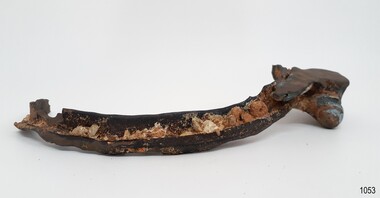
... Germans had arrived off the coast as he had seen them firing off shells and rockets, but his story was passed off as a joke. These rockets were most likely the distress signals from the stricken ship. The Italian barque, clipper, Antares was sometime later reported as overdue. The wreck of the ship was later found at the base of a cliff at the Bay of Islands near Warrnambool in November 1914; there were no survivors. The Antares is significant as it was a sail trader carrying international ...This portion of the porthole frame was part of the fittings of the Antares. The Italian barque “Antares” was an iron three-masted sailing ship built in 1888 by Russell & Co of Port Glasgow. The ship was originally named the “Sutlej” but was renamed the “Antares” in 1907 when sold to the Semider Bros of Genoa, Italy, where it was registered. The vessel left Marseilles on the 18th of December 1913 with its master Captain Gazedo destined for Mullaly & Byrne of Melbourne with a cargo of roofing tiles but failed to arrive. The wreckage was found near the Bay of Islands, twenty-two miles east of Warrnambool, after a body had washed ashore. Some of the timbers washed up were charred by fire, and a small boat's stern board with the name "Sutlej" led to the identification of the wreck as Antares, which had been reported missing. According to later reports, the Antares wrecking was overshadowed by war news at the time. A young local boy had remarked that the Germans had arrived off the coast as he had seen them firing off shells and rockets, but his story was passed off as a joke. These rockets were most likely the distress signals from the stricken ship. The Italian barque, clipper, Antares was sometime later reported as overdue. The wreck of the ship was later found at the base of a cliff at the Bay of Islands near Warrnambool in November 1914; there were no survivors.The Antares is significant as it was a sail trader carrying international inbound cargo during the early part of the 20th century. It is part of the Great Ocean Road Historic Shipwreck Trail and as such is registered as a protected wreck in the Victorian Heritage Database VHS S34 .Porthole frame section, brass, large part corroded away. Hing is still visible on the end. The underside is shaped to allow the fitting of the glass. Recovered from the wreck of the Antares. Noneflagstaff hill, warrnambool, shipwrecked-coast, flagstaff-hill, flagstaff-hill-maritime-museum, maritime-museum, shipwreck-coast, flagstaff-hill-maritime-village, antares, tall ship, sailing ship, peterborough, phillip le couteur, peter mathieson, constable stainsbury, sutlej, antares rock., bay of islands, porthole, ship fitting, 1914 shipwreck, porthole frame -
 Flagstaff Hill Maritime Museum and Village
Functional object - Crucible, The Patent Plumbago Crucible Company, circa 1878
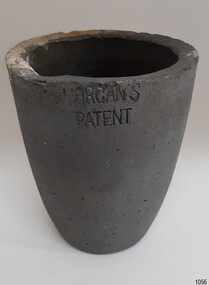
... Germany. They were successful exhibitors of their crucibles and furnaces at the London Exhibition held in 1861 (Class 1, Mining, quarrying, metallurgy and mineral products, Exhibit 265, Patent Plumbago Crucible Co). The range of sizes represented by the six crucibles retrieved from the LOCH ARD, suggests they may have been part of a sample shipment intended for similar promotion in the Australian colonies ― at Melbourne’s International Exhibition to be held in 1880. ...Germany. They were successful exhibitors of their crucibles and furnaces at the London Exhibition held in 1861 (Class 1, Mining, quarrying, metallurgy and mineral products, Exhibit 265, Patent Plumbago Crucible Co). The range of sizes represented by the six crucibles retrieved from the LOCH ARD, suggests they may have been part of a sample shipment intended for similar promotion in the Australian colonies ― at Melbourne’s International Exhibition to be held in 1880. ...This crucible was raised from the wreck of the LOCH ARD. It is one of six similar relics, in a range of sizes, now in the Flagstaff Hill collection. All bear markings to indicate their manufacture by the Morgan brothers of Battersea, trading as the Patent Plumbago Crucible Co. A crucible is a container used for purifying and melting metals so that they can be cast in a mould to a predetermined shape and use. They must withstand extremely high temperatures, and abrupt cooling, and shed their contents with minimal adherence. The addition of graphite to the traditional firing clays greatly enhanced the durability of industrial crucibles in mid-Victorian Britain, a significant technological advance at a time of great activity in foundries and expansion of demand for refined metals. The Morgans first noticed the advantages of graphite crucibles at the Great Exhibition held in London in 1851. Initially, they contracted to be sole selling agents for the American-made products of Joseph Dixon and Co. from New Jersey, but in 1856 they obtained that firm’s manufacturing rights and began producing their own graphite crucibles from the South London site. The Morgans imported crystalline graphite in 4-5 cwt casks from the British colony of Ceylon (now Sri Lanka) and mixed it with conventional English (Stourbridge) clays to be fired in kilns. Their products were purchased by the Royal Mints in London and India, and exported to official mints in France and Germany. They were successful exhibitors of their crucibles and furnaces at the London Exhibition held in 1861 (Class 1, Mining, quarrying, metallurgy and mineral products, Exhibit 265, Patent Plumbago Crucible Co). The range of sizes represented by the six crucibles retrieved from the LOCH ARD, suggests they may have been part of a sample shipment intended for similar promotion in the Australian colonies ― at Melbourne’s International Exhibition to be held in 1880. The summary of the LOCH ARD cargo manifest, by Don Charlwood in ‘Wrecks and Reputations’, does not mention any crucibles, implying that they were not a large consignment of uniform items. A newspaper account of an 1864 tour of the Morgan brothers’ ‘Black Potteries’ at Battersea indicates: “All the pots were numbered according to their contents, each number standing for one kilogram, or a little over two pounds; a No. 2 crucible contains two kilogrammes; a No. 3, three kilogrammes, and so on.” These numbers are obscured by marine sediment on three of the crucibles in the Flagstaff Hill collection, but those legible on the remaining three are 5, 6, and 8. None of the six is of the same size from a visual appraisal. A brief history of the Loch Ard (1873-1878): - The sailing ship Loch Ard was one of the famous Loch Line of ships that sailed the long voyage from England to Australia. Barclay, Curdle and Co. built the three-masted iron vessel in Glasgow in 1873. It had sailed three trips to Australia and one trip to Calcutta before its fateful voyage. Loch Ard left England on March 2, 1878, under the command of recently married, 29-year-old Captain Gibbs. It was bound for Melbourne with a crew of 37, plus 17 passengers. The general cargo reflected the affluence of Melbourne at the time. Onboard were straw hats, umbrellas, perfumes, clay pipes, pianos, clocks, confectionery, linen and candles, and a heavier load of railway irons, cement, lead and copper. Other cargo included items intended for display in the Melbourne International Exhibition of 1880. The Loch Ard had been sailing for three months and was close to its destination on June 1, 1878. Captain Gibbs had expected to see land at about 3 am but the Loch Ard ran into a fog that greatly reduced visibility and there was no sign of land or the Cape Otway lighthouse. The fog lifted at 4 am and the sheer cliffs of Victoria's west coast were much closer to them than Captain Gibbs expected. He tried to manage the vessel but failed and the ship struck a reef at the base of Mutton Bird Island, near Port Campbell. The top deck loosened from the hull, and the masts and rigging crashed down, knocking passengers and crew overboard. The lifeboat was launched by Tom Pearce but crashed into the side of Loch Ard and capsized. He clung onto its overturned hull and sheltered under it. He drifted out to sea and the tide brought him back to what is now called Loch Ard Gorge. He swam to shore and found a cave for shelter. A passenger, Eva Carmichael, had raced onto the deck to find out what was happening and was confronted by towering cliffs above the ship. She was soon swept off the ship by a huge wave. Eva saw Tom Pearce on a small rocky beach and yelled to attract his attention. He swam out and dragged her to the shelter of the cave. He revived her with a bottle of brandy from a case that had washed up on the beach. Tom scaled a cliff in search of help and followed some horse hoof prints. He came from two men from Glenample Station, three and a half miles away. He told the men of the tragedy and then returned to the gorge while the two men rode back to the station to get help. They reached Loch Ard Gorge and took the two shipwreck survivors to Glenample Station to recover. Eva stayed at the station for six weeks before returning to Ireland by steamship. In Melbourne, Tom Pearce received a hero's welcome and was presented with a medal and some money. Of the 54 crew members and passengers on board, only two survived: the apprentice, Tom Pearce and the young woman passenger, Eva Carmichael, who lost her family in the tragedy. The shipwreck of the LOCH ARD is of State significance ― Victorian Heritage Register S417. Flagstaff Hill’s collection of artefacts from LOCH ARD is significant for being one of the largest collections of artefacts from this shipwreck in Victoria. It is significant for its association with the shipwreck, which is on the Victorian Heritage Register (VHR S417). The collection is significant because of the relationship between the objects, as together they have a high potential to interpret the story of the LOCH ARD. The LOCH ARD collection is archaeologically significant as the remains of a large international passenger and cargo ship. The LOCH ARD collection is historically significant for representing aspects of Victoria’s shipping history and its potential to interpret sub-theme 1.5 of Victoria’s Framework of Historical Themes (living with natural processes). The collection is also historically significant for its association with the LOCH ARD, which was one of the worst and best-known shipwrecks in Victoria’s history.A Morgan’s Patent graphite crucible No.8 (i.e. 8kgs capacity), one of a set. It was recovered from the wreck of the LOCH ARD. It is in its original grey colouring with minimal sediment accretion on the top rim. It rises in a slight curve from a flat circular base to a wider rim with a pouring lip. Maker’s marks on the side of the container clearly identify the manufacturer. The maker's details are stamped into the base around and within a circle. A white sticker is attached. Made by the Patent Plumbago Crucible Company at the Battersea Works in London. Number “8”. Letters “MORGAN’S PATENT”. Details on the base "MORGAN'S PATENT" "THE PATENT PLUMBAGO CRUCIBLE COMPANY" Symbol [8] above "BATTERSEA WORKS LONDON" Handwritten on a white sticker in black pen "LA/89"flagstaff hill, warrnambool, maritime museum, shipwreck coast, great ocean road, loch line, loch ard, captain gibbs, eva carmichael, tom pearce, glenample station, mutton bird island, loch ard gorge, graphite crucible, plumbago crucible, morgans crucible company, flagstaff hill maritime museum and village, fluxing pots, crucible, morgan’s patent, morgan brothers, patent plumbago crucible co, battersea works, london, port campbell -
 Flagstaff Hill Maritime Museum and Village
Functional object - Pulley Sheave, Russell & Co, 1888
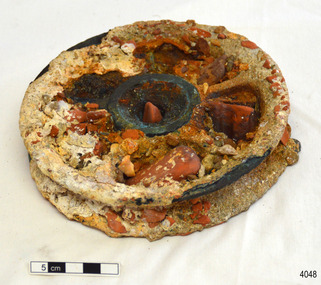
... Germans had arrived off the coast as he had seen them firing off shells and rockets, but his story was passed off as a joke. These rockets were most likely the distress signals from the stricken ship. The Italian barque/clipper Antares was sometime later reported as overdue. The wreck of the ship was later found at the base of a cliff at the Bay of Islands near Warrnambool in November 1914, there were no survivors. The Antares is significant as it was a sail trader carrying an international ...This ship's pully sheave was part of the Antares rigging. A pulley sheave is a circle on a shaft that is manufactured to hold up movement and change of way of a cable or/and rope, or transfer of power between the shaft and cable or/and rope. A pulley is a unique mechanism that is used to leverage the lifting of heavy loads to required heights. The Italian barque Antares was an iron three-masted sailing clipper built in 1888 by Russell & Co of Port Glasgow originally named the “Sutlej” and renamed in 1907 the “Antares” when sold to the Semider Bros of Genoa Italy. The vessel left Marseilles on the 18th of December 1913 with its master captain Gazedo destined for Mullaly & Byrne of Melbourne with a cargo of roofing tiles but failed to arrive. The wreckage was found near the Bay of Islands twenty-two miles east of Warrnambool after a body had washed ashore. Some of the timbers washed up were charred by fire, and a small boat's stern board with the name "Sutlej" led to the identification of the wreck as Antares which had been reported missing. According to later reports, the Antares wrecking was overshadowed by war news at the time. A young local boy had remarked that the Germans had arrived off the coast as he had seen them firing off shells and rockets, but his story was passed off as a joke. These rockets were most likely the distress signals from the stricken ship. The Italian barque/clipper Antares was sometime later reported as overdue. The wreck of the ship was later found at the base of a cliff at the Bay of Islands near Warrnambool in November 1914, there were no survivors.The Antares is significant as it was a sail trader carrying an international inbound cargo during the early part of the 20th century. It is part of the Great Ocean Road Historic Shipwreck Trail and as such is registered as a protected wreck in the Victorian Heritage Database VHS S34.Pulley sheave; brass, with recesses full of concretion. The metal has some blue-green colouration due to exposure to sea water. Recovered from the wreak of the Antares. Noneflagstaff hill, warrnambool, flagstaff-hill-maritime-museum, shipwreck-coast, flagstaff-hill-maritime-village, pulley sheave, antares, tall ship, peterborough, 1914 shipwreck, phillip le couteur, peter mathieson, constable stainsbury, sutlej, bay of islands, pully sheave, pulley, lifting equipment -
 Flagstaff Hill Maritime Museum and Village
Instrument - Compass and Housing, 1880-1900
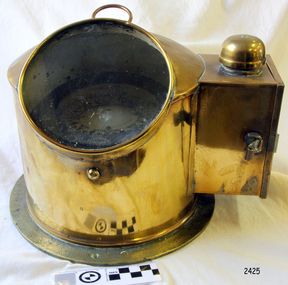
... Germany some of his compasses are marked “Gehna” and “Nautica”. There is no information available regards W Hartmann, his successor in the business was “Georg Hechelmann” a marine instrument maker of which Gehna is an acronym of his name. In 1874 he patented an improved version of “Lord Kelvin Thomson’s” compass design of a paper rose with magnets hung on silk threads. It appears he worked in his shop from around 1878 until probably 1905. The company he founded "Gehna" is today a substantial international...Germany some of his compasses are marked “Gehna” and “Nautica”. There is no information available regards W Hartmann, his successor in the business was “Georg Hechelmann” a marine instrument maker of which Gehna is an acronym of his name. In 1874 he patented an improved version of “Lord Kelvin Thomson’s” compass design of a paper rose with magnets hung on silk threads. It appears he worked in his shop from around 1878 until probably 1905. The company he founded "Gehna" is today a substantial international ...This compass was used to determine directions using a free-moving magnetised needle, indicating north and south. W Hartmann was a compass maker located in Hamburg Germany some of his compasses are marked “Gehna” and “Nautica”. There is no information available regards W Hartmann, his successor in the business was “Georg Hechelmann” a marine instrument maker of which Gehna is an acronym of his name. In 1874 he patented an improved version of “Lord Kelvin Thomson’s” compass design of a paper rose with magnets hung on silk threads. It appears he worked in his shop from around 1878 until probably 1905. The company he founded "Gehna" is today a substantial international marine corporation and is still based in Hamburg. A rare example of an early binnacle and compass probably used on a sailing vessel. It is a significant item not only for it’s rarity but also because it demonstrates the progress of marine navigational instrument development in the late 19th century. The item was made by an early pioneer and innovator of marine navigation and instrument making. Compass and Housing; the brass housing, with side light box, insides a fluid dampening gimble compass. The maker is W Hermann/Georg Hechelmann, of Hamburg, Germany. The inscription ioncludes the number of the compass.Made by W Hartmann/Georg Hechelmann of Hamburg, No 7208flagstaff hill, warrnambool, shipwrecked-coast, flagstaff-hill, flagstaff-hill-maritime-museum, maritime-museum, shipwreck-coast, flagstaff-hill-maritime-village, compass and housing, w hartmann, binnacle, georg hechelmann, navigational instrument, ship compass
