
Showing 481 items matching " joseph s."
-
 Bendigo Historical Society Inc.
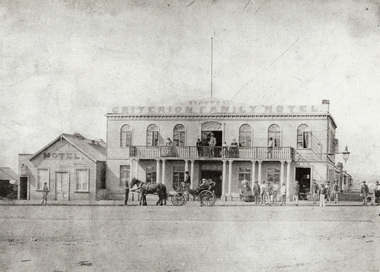
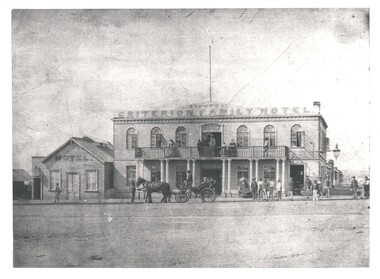
Photograph - SYMONDS' CRITERION FAMILY HOTEL BENDIGO, 1861 ?
... ... Joseph S....See Mosaic no. 2402.49 for further details and research information. (Joseph S. Symonds the licensee 1858-1862, see 2402.49 for reference]...Princess Theatre. Symonds Joseph S. Batchelder Black and white photo: Criterion Family Hotel, cnr. ...Black and white photo: Criterion Family Hotel, cnr. Mundy and Lyttleton Terrace, Bendigo. Two storey building with 6 arched windows on top, with balcony and doorway. Balcony supported by ten pillars. On LH side of building, weather board building with two windows and doorway 'hotel' printed in between gable roof. Horse and carriage at front of hotel. See Mosaic no. 2402.49 for further details and research information. (Joseph S. Symonds the licensee 1858-1862, see 2402.49 for reference]Batchelderorganization, business, criterion hotel, criterion family hotel. mundy street hargreaves street. market square. princess theatre. symonds, joseph s. -
 Torquay and District Historical Society
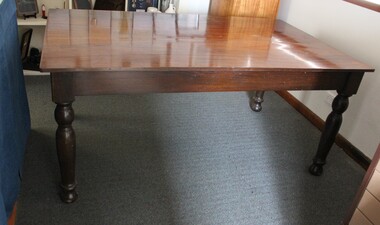
Furniture - Table, wooden
... Table from the SS Joseph S Scammell. ...Shipwrecks Great Ocean Road Victoria Scammell Collection Table from the SS Joseph S Scammell. Furniture Table, wooden ...The table was retrieved from the beach by James Austin (1844-1916) when the Joseph H Scammell ran aground at Point Danger in May 1891. The table remained in the Austin family for several generations before being donated to the Society.Table from the SS Joseph S Scammell. shipwrecks great ocean road victoria, scammell collection -
 Victorian Aboriginal Corporation for Languages
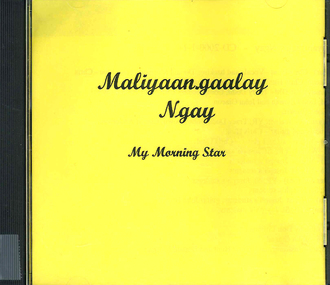
Audio CD, Maliyaan-gaalay ngay = my morning star, 2000
... Collection of songs and music performed by the students of St. Joseph?s School....Yuwaalaraay Walgett St Josephs School CD Collection of songs and music performed by the students of St. Joseph?s School. Maliyaan-gaalay ngay = my morning star Audio CD Students of St Josephs School ...Collection of songs and music performed by the students of St. Joseph?s School.CDyuwaalaraay, walgett, st josephs school -
 Federation University Historical Collection
Book - Ledger, Ballarat School of Mines Council Minute Books
... ...joseph s. vickery...(bill) rowe john brittain albert steane henry peacock w.d. hill joseph s. vickery richard w. richards dick richards effie holmes joan johnson barry mossop reginald callister d.o. taylor v.h. dorran g. holmes john james hillingham w. kenneth moss ken moss lorraine vickery i.e.h. brown edwin trennery john rowell r.j. crick v. gilchrist c.w. rowe peter dalhaus john dulfer kevin murray peter clothier r. fellows w. bradford hugh gray s.h. mayo roy lukeis william a. bradford robert russell d. robertson alfred jameshiggin maurice copland donna robertson w. figgis, peter lumley w. lakeland b. william frederick allsop f.c. knapp Handwritten minutes of the Ballarat School of Mines Council in a large ledger. ...Handwritten minutes of the Ballarat School of Mines Council in a large ledger. The Minutes Include: 1921 - Former Ballarat Gaolballarat gaol, charles beanland, c.w. (bill) rowe, john brittain, albert steane, henry peacock, w.d. hill, joseph s. vickery, richard w. richards, dick richards, effie holmes, joan johnson, barry mossop, reginald callister, d.o. taylor, v.h. dorran, g. holmes, john james hillingham, w. kenneth moss, ken moss, lorraine vickery, i.e.h. brown, edwin trennery, john rowell, r.j. crick, v. gilchrist, c.w. rowe, peter dalhaus, john dulfer, kevin murray, peter clothier, r. fellows, w. bradford, hugh gray, s.h. mayo, roy lukeis, william a. bradford, robert russell, d. robertson, alfred jameshiggin, maurice copland, donna robertson, w. figgis,, peter lumley, w. lakeland, b. william, frederick allsop, f.c. knapp -
 Bendigo Historical Society Inc.
Photograph - WES HARRY COLLECTION: SYMONDS' CRITERION FAMILY HOTEL, BENDIGO
... ... Joseph S....Princess Theatre. Symonds Joseph S. Batchelder Photograph of a double storied stone building, it has a three quarters length open verandah along the first floor. ...Photograph of a double storied stone building, it has a three quarters length open verandah along the first floor. The name 'Symonds Criterion Family Hotel' is painted above the first floor. There is a large lamp on a bracket on the right-hand side of the building. To the left of the main structure there is a smaller weatherboard building with the word 'Hotel' painted along the top. There are several groups of people both on the ground and on the balcony, also in front of the hotel is a very up market buggy/wagonette with a coachman? Driving. This hotel was on the corner of Mundy and Hargreaves Streets and is significant as centre of events as it overlooked the original Market Square. Original photo is part of the Batchelder Collection owned by the State Library of Victoria. Published in 'An American on the Goldfields' p. 38-39 with description and details. See also Mosaic No. 1232. *See Research field for further details. Symonds operated the Criterion Hotel 1858 - 1862.Batchelderbuildings, hotel, criterion family hotel, criterion family hotel. mundy street hargreaves street. market square. princess theatre. symonds, joseph s. -
 Bendigo Historical Society Inc.
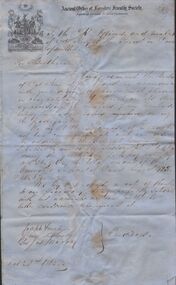
Document - ANCIENT ORDER OF FORESTERS NO. 3770 COLLECTION: CORRESPONDENCE
... ... Joseph French... Charles S...Signed by Joseph French, Charles? S. Smith and Geo? Jas. Murray, Auditors. ...Signed by Joseph French, Charles? S. Smith and Geo? Jas. Murray, Auditors. ...Letter written on blue, watermarked, folded paper with printed letterhead and Ancient Order of Foresters crest. The Auditors congratulate the Court on the increase of new members during the last quarter. There was no increase of Funds. Sick Pay amounted to £36.9.6. They also thank the Secretary. Signed by Joseph French, Charles? S. Smith and Geo? Jas. Murray, Auditors. Letter dated Oct 2nd 1865.societies, aof, correspondence, ancient order of foresters no. 3770 collection - correspondence, court king of the forest, court king of the forest, joseph french, charles s smith, geo? jas murray -
 Bendigo Historical Society Inc.
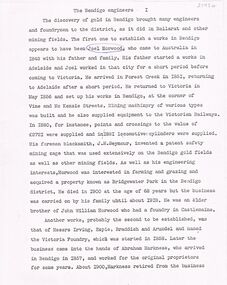
Document - HORWOOD COLLECTION: SHORT PAPER 'THE BENDIGO ENGINEERS'
... .; George Grip (City Foundry (1862) - managed by James Watt- owned by Watt in partnership with Joseph Watt and S Osborne (1872) - W Ruddock....; George Grip (City Foundry (1862) - managed by James Watt- owned by Watt in partnership with Joseph Watt and S Osborne (1872) - then by W Ruddock, then by Dunn and Redpath. ....; George Grip (City Foundry (1862) - managed by James Watt- owned by Watt in partnership with Joseph Watt and S Osborne (1872) - W Ruddock Dunn and Redpath. ...Short paper re 'The Bendigo Engineers' by unknown author, no date. Three typed pages mentioning; Joel Horwood (ca. 1856);, brother of John William Horwood (Castlemaine); Irving, Espie, Braddish and Arundel (of Victoria Foundry, 1858 and then bought by Abraham Harkness.; A Roberts of Roberts & Sons (1861) with sons William Roberts, Abraham Roberts and Robert Roberts.; George Grip (City Foundry (1862) - managed by James Watt- owned by Watt in partnership with Joseph Watt and S Osborne (1872) - then by W Ruddock, then by Dunn and Redpath. T Horsfield (works in Long Gully).bendigo, industry, bendigo engineers, joel horwood (ca. 1856); brother of john william horwood (castlemaine); irving, espie, braddish and arundel (of victoria foundry, 1858 and then bought by abraham harkness.; a roberts of roberts & sons (1861) with sons william roberts, abraham roberts and robert roberts.; george grip (city foundry (1862) - managed by james watt- owned by watt in partnership with joseph watt and s osborne (1872) - w ruddock, dunn and redpath. t horsfield (works in long gully). -
 Bendigo Historical Society Inc.
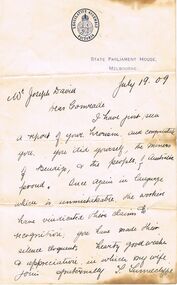
Document - JOSEPH DAVIES COLLECTION: LETTER OF CONGRATULATIONS, 19/07/1909
... ... Joseph Davies... S...GOVERNMENT State Joseph Davies Joseph Davies Collection - Letter of Congratulations Joseph Davies S Sumiecliffe? S. Sumiecliffe? Handwritten letter on paper with Legislative Assembly, Victoria paper with State Parliament House, Melbourne also printed on it. ...Handwritten letter on paper with Legislative Assembly, Victoria paper with State Parliament House, Melbourne also printed on it. Letter congratulates Mr Davies on his heroism.S. Sumiecliffe?government, state, joseph davies, joseph davies collection - letter of congratulations, joseph davies, s sumiecliffe? -
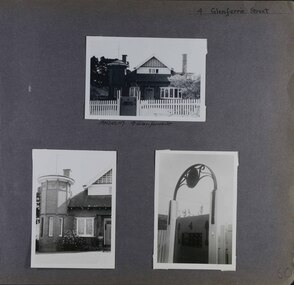 Glen Eira Historical Society
Album - Album page, Glenferrie Street, 4, Circa 1972
... ...robert joseph haddon...1900's...Anselm is substantially intact although the double casement window immediately to the south of the front door was originally circular.... trevor hart anselm art nouveaux arts and crafts tower bay window glenferrie street robert joseph haddon 1900's terra cotta tiles double storey caulfield north corner tower gates cast iron work Hand written: 4 Glenferrie Street [top right] / ANSELM 4 Glenferrie St [under top photo] / 60 [bottom right] Page 60 of Photograph Album with three exterior photographs (one portrait and two landscape) of Anselm. ...This photograph is part of the Caulfield Historical Album 1972. This album was created in approximately 1972 as part of a project by the Caulfield Historical Society to assist in identifying buildings worthy of preservation. The album is related to a Survey the Caulfield Historical Society developed in collaboration with the National Trust of Australia (Victoria) and Caulfield City Council to identify historic buildings within the City of Caulfield that warranted the protection of a National Trust Classification. Principal photographer thought to be Trevor Hart, member of Caulfield Historical Society. Most photographs were taken between 1966-1972 with a small number of photographs being older and from unknown sources. All photographs are black and white except where stated, with 386 photographs over 198 pages. From Glen Eira Heritage Management Plan 1996 by Andrew Ward: In 1905, most of portion 27 was vacant land, however Glenferrie Street had been formed and the land subsequently subdivided. In 1906, Robert Joseph Haddon, architect and painter, designed and built for his private residence, a brick house on the west side. Haddon named the house "Anselm". Also built on the property were a garage and fibro cement studio. "Anselm" is architecturally important at the State level as a substantially intact, highly personalised and boldly expressed house expressive the Arts and Crafts movement and incorporating Art Nouveaux enrichment in a variety of forms, the use of ornamental terra cotta tiles to the comer tower being of special note. Its importance at the State level is strengthened by its place as the home of the noted architect and Melbourne's most influential exponent (Freeland, J.M., Architecture in Australia, p. 213) of the Art Nouveaux movement.https://vhd.heritagecouncil.vic.gov.au/places/4442 Victorian Heritage Register: What is significant? Anselm was designed by noted English born architect Robert Joseph Haddon(1866-1929) as his own house and constructed in 1906. A single storey Arts and Crafts influenced red brick house with attic, Anselm has a pyramidal slate roof with prominent chimney stacks. There is a octagonal corner tower with saucer shaped domed roof surmounted by a weather vane, and the tower has decorative terracotta panels immediately below the eaves line. The front door opens immediately into a large living or common room, screened from view by a timber and bottle glass screen. The large room was designed to function as a drawing and dining room. The house is rich with hand crafted details including door and window furniture, wrought iron gutter brackets, fireplaces (one with built in wood box), and fire tools. The interior decoration includes hand painted frieze of Port Phillip in the study, and a hand painted frieze of turbulent sea with sailing boats in the tiled bathroom. There is a small hand painted tile at the base of the tower which states ?This building was erected AD1906 from designs by Robt J Haddon FRIBA,Lond FRIVA Melb Architect?. He also designed an attic addition which was constructed in 1927. Anselm is substantially intact although the double casement window immediately to the south of the front door was originally circular....Page 60 of Photograph Album with three exterior photographs (one portrait and two landscape) of Anselm.Hand written: 4 Glenferrie Street [top right] / ANSELM 4 Glenferrie St [under top photo] / 60 [bottom right] trevor hart, anselm, art nouveaux, arts and crafts, tower, bay window, glenferrie street, robert joseph haddon, 1900's, terra cotta tiles, double storey, caulfield north, corner tower, gates, cast iron work -
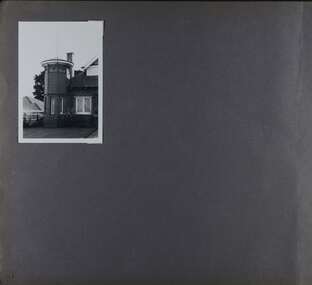 Glen Eira Historical Society
Album - Album page, Glenferrie Street, 4, Circa 1972
... ...robert joseph haddon...1900's...Anselm is substantially intact although the double casement window immediately to the south of the front door was originally circular.... trevor hart anselm art nouveaux arts and crafts tower bay window glenferrie street robert joseph haddon 1900's terra cotta tiles double storey caulfield north corner tower brick house attics Hand written: 61 [bottom left] Page 61 of Photograph Album with one exterior photograph (portrait) of Anselm. ...This photograph is part of the Caulfield Historical Album 1972. This album was created in approximately 1972 as part of a project by the Caulfield Historical Society to assist in identifying buildings worthy of preservation. The album is related to a Survey the Caulfield Historical Society developed in collaboration with the National Trust of Australia (Victoria) and Caulfield City Council to identify historic buildings within the City of Caulfield that warranted the protection of a National Trust Classification. Principal photographer thought to be Trevor Hart, member of Caulfield Historical Society. Most photographs were taken between 1966-1972 with a small number of photographs being older and from unknown sources. All photographs are black and white except where stated, with 386 photographs over 198 pages. From Glen Eira Heritage Management Plan 1996 by Andrew Ward: In 1905, most of portion 27 was vacant land, however Glenferrie Street had been formed and the land subsequently subdivided. In 1906, Robert Joseph Haddon, architect and painter, designed and built for his private residence, a brick house on the west side. Haddon named the house "Anselm". Also built on the property were a garage and fibro cement studio. "Anselm" is architecturally important at the State level as a substantially intact, highly personalised and boldly expressed house expressive the Arts and Crafts movement and incorporating Art Nouveaux enrichment in a variety of forms, the use of ornamental terra cotta tiles to the comer tower being of special note. Its importance at the State level is strengthened by its place as the home of the noted architect and Melboume's most influential exponent (Freeland, J.M., Architecture in Australia, p. 213) of the Art Nouveaux movement. Victorian Heritage Register https://vhd.heritagecouncil.vic.gov.au/places/4442 What is significant? Anselm was designed by noted English born architect Robert Joseph Haddon(1866-1929) as his own house and constructed in 1906. A single storey Arts and Crafts influenced red brick house with attic, Anselm has a pyramidal slate roof with prominent chimney stacks. There is a octagonal corner tower with saucer shaped domed roof surmounted by a weather vane, and the tower has decorative terracotta panels immediately below the eaves line. The front door opens immediately into a large living or common room, screened from view by a timber and bottle glass screen. The large room was designed to function as a drawing and dining room. The house is rich with hand crafted details including door and window furniture, wrought iron gutter brackets, fireplaces (one with built in wood box), and fire tools. The interior decoration includes hand painted frieze of Port Phillip in the study, and a hand painted frieze of turbulent sea with sailing boats in the tiled bathroom. There is a small hand painted tile at the base of the tower which states ?This building was erected AD1906 from designs by Robt J Haddon FRIBA,Lond FRIVA Melb Architect?. He also designed an attic addition which was constructed in 1927. Anselm is substantially intact although the double casement window immediately to the south of the front door was originally circular....Page 61 of Photograph Album with one exterior photograph (portrait) of Anselm.Hand written: 61 [bottom left] trevor hart, anselm, art nouveaux, arts and crafts, tower, bay window, glenferrie street, robert joseph haddon, 1900's, terra cotta tiles, double storey, caulfield north, corner tower, brick house, attics -
 Glen Eira Historical Society
Letter - MURRUMBEENA FOOTBALL CLUB
... S.... Burrows H.... Hudson B.... Hall B.... Dent D.... Randall V.... Tocknell W.... Brewster L.... Cochrane H.... Weir F.... Randall T. (mascot)... Weir F.... O’Shea B.... Sweetman D.... Crasswell J.... Sorrell M.... Armstrong D.... Hanley G.... Voutier C.... Murphy J.... Collister E.... Whittinsen D.... Mawby K.... Cotham J.... McKercher J.... Hunot L.... Lambden L.... Bremner I.... Rennie W.... Muldoon H.... Fleming W.... Burrows H.... Hall B.... Tocknell W.... Cugley A.... Shaw R.... Longney G.... Parker G.... Joseph...S. Burrows H. Hudson B. Hall B. Dent D. Randall V. Tocknell W. Brewster L. Cochrane H. Weir F. Randall T. (mascot) Weir F. O’Shea B. Sweetman D. Crasswell J. Sorrell M. Armstrong D. Hanley G. Voutier C. Murphy J. Collister E. Whittinsen D. Mawby K. Cotham J. McKercher J. Hunot L. Lambden L. Bremner I. Rennie W. Muldoon H. Fleming W. Burrows H. Hall B. Tocknell W. Cugley A. Shaw R. Longney G. Parker G. Joseph ...This file contains 2 items: 1/A letter to Caulf Historical Society, requesting any history of Murrumbeena Football Club, from R. Gould. Reply from T.J. Hart advising that no information on the club is held by the society. 2/A fifty page book on the history of Murrumbeena Football Club, from foundation in 1927 to 1976. Includes 7 team photocopied photographs and one of the pavilion after completion in 1922, book written by R. Gould.gould ross, murrumbeena football club, football, football clubs, ‘dick’s horse paddock’, butchers, murrumbeena, great dandenong road, murrumbeena road, n.r. cooper, market gardens, orchards, carnegie rovers, oakleigh juniors, oakleigh district junior, football association, committees of management, murrumbeena junior football club, dick r., armstrong j., silverman dr. i., phillips r. cr., mudge les, truman v., bristow l., richardson , truman t., robertson, carnegie rovers, bentleigh, oakleigh juniors, ted pelling’s horse stables, stables, kangaroo road, moore george, armstrong fred, tinsley roy, naylor reg, ward bill, hunter mr., cox mr., scivenor mr., marian mr., wilde mr., townley mr., mudge mr., hay mr , ferguson mr., wilde wal, pelling e., watkins e., giles mr., young mr., paterson mr., reid mr., ross mr., walker mr., lyre mr., cannon mr., ronaldson tom, pearson , hall , collaghan jack, dennis, wlash, cannon, rickets, ferguson, wotes, hay, washbrooke, wilde , phillipson, welch, brown, cox, sharp, thomas, palmer, harris e., dick a., caulfield-dandenong, junior football association, metropolitan amateurs, pavilions, caulfield city council, murrumbeena amateurs, miss football queen, ralph miss, welch vic, emmins ‘titch’ g., bone r., havell, ellis r. (bob), pew t., stock a., riley wal, harris ‘codger’ roy, biddington j., nicholson a., bernes a.c., healey g., riley w., summerfield d., lee e., harris j., bass j., denning j., phillips c., king f., weatheral n.w., stewart s., rolfe h., dalgleish s., malone l., simpson e., kain a., rennie w., sloan a., painter e., bernes c., biddington g., parker c., willmott n., murrumbeena cricket club, corbett, murrumbeena districts, holden ‘rusty’, crundy, dean, taylor, bourke, moore, stewart, hause, clarke, gear, page, rowe bill, mathers alf, awards, farrell r., oakley r., escott l., callaghan t., mathers r., andrew j., halfpenny j., howland w., m -
Unions Ballarat
Portraits of power (Don Woodward Collection), 1979
... Joseph...Truman, Harry S...BTLC Ballarat Trades Hall ballarat trades and labour council Hitler, Adolf Churchill, Winston Gandhi, Mohandas Karamchand Roosevelt, Franklin Stalin, Joseph Truman, Harry S Hirohito, Emperor Franco, Francisco Adenauer, Konrad Hermann Joseph de Gaulle, Charles Eisenhower, Dwight Tito - Josip Broz Nasser, Gamal Abdel Ben-Gurion, David Khrushcev, Nikita Kennedy, JF Queen Elizabeth II Shah of Iran - Mohammad Reza Pahlavi mao tse-tung Politics and government - international History - world leadership Book; 288 pages. ...Overview of various leaders in the 20th century: Hitler, Churchill, Gandhi, Roosevelt, Stalin, Truman, Hirohito, Franco, Adenauer, Gaulle, Eisenhower, Tito, Nasser, Ben-Gurion, Khrushchev, JF Kennedy, Queen Elizabeth II, Shah of Iran, Mao Tse-Tung.Historical and political relevance.Book; 288 pages. Cover: brown background; two-tone portrait photographs of Hitler, Churchill, Gandhi, Roosevelt, Stalin, Truman, Hirohito, Franco, Adenauer, Gaulle, Eisenhower, Tito, Nasser, Ben-Gurion, Khrushchev, JF Kennedy, Queen Elizabeth II, Shah of Iran, Mao Tse-Tung; black and red lettering; title and compiler's name. btlc, ballarat trades hall, ballarat trades and labour council, hitler, adolf, churchill, winston, gandhi, mohandas karamchand, roosevelt, franklin, stalin, joseph, truman, harry s, hirohito, emperor, franco, francisco, adenauer, konrad hermann joseph, de gaulle, charles, eisenhower, dwight, tito - josip broz, nasser, gamal abdel, ben-gurion, david, khrushcev, nikita, kennedy, jf, queen elizabeth ii, shah of iran - mohammad reza pahlavi, mao tse-tung, politics and government - international, history - world leadership -
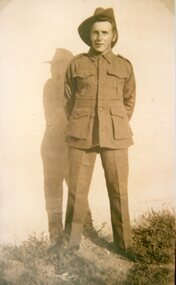 Stawell Historical Society Inc
Photograph, Mr Joseph Lawrence Mitchell in WW2 in uniform c1940's
... Mr Joseph Lawrence Mitchell in WW2 in uniform c1940's...Portrait Joseph Lawrence Mitchell 1940’s in WW2 in uniform....Portrait Joseph Lawrence Mitchell 1940’s in WW2 in uniform. Stawell Deep Lead Mr Joseph Lawrence Mitchell in WW2 in uniform c1940's Photograph ...Portrait Joseph Lawrence Mitchell 1940’s in WW2 in uniform.stawell deep lead -
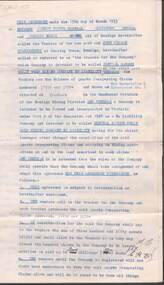 Bendigo Historical Society Inc.
Document - MCCOLL, RANKIN AND STANISTREET COLLECTION: CENTRAL GARDEN GULLY GOLD MINING CO NL, AGREEMENTS, c1933
... Dated 15.3.1933 Signed: J J Stanistreet, E R Grelis, Joseph S Trevan, A Ceresa, C H Brown, ?? Leed, Angus Mackay, // //, ? ...Dated 15.3.1933 Signed: J J Stanistreet, E R Grelis, Joseph S Trevan, A Ceresa, C H Brown, ?? Leed, Angus Mackay, // //, ? ...McColl Rankin & Stanistreet, Central Garden Gully Gold Mining Co NL, agreements. All agreements were signed on 16.5.1933. a/ Claims numbered 31850 & 32794. Signed Joseph Samuel Trevan, Alexander Ceresa, Charles Henry Brown, John Jepson Stanistreet in the presence of ?? Leed. Attached to Agreement is and Indenture dated 16.5.1933 between John Jepson Stanistreet, Joseph Samuel Revan, Alexander Ceresa & Charles Henry Brown and Central Garden Gully Gold Mining Co NL discharging John Jepson Stanistreet from all liability in respect of said agreement. Dated 15.3.1933 Signed: J J Stanistreet, E R Grelis, Joseph S Trevan, A Ceresa, C H Brown, ?? Leed, Angus Mackay, // //, ? Stanistreet. b/ Date: 29.3.1933 , application for mining lease No. 9993 Agreement between Albert Oliver Morgan & John Jepson Stanistreet. Signed A O Morgan, J Stanistreet, ?? Leed & G R Grelis. Attached An Indenture dated 16.5.1933 signing over all benefits advantages and burdens thereof and all remedies. Signed J Stanistreet, A O Morgan, E R Grelis, ? Leed, Angus Mackay, J Michelson & Stanistreet. 4 pages. c/ Agreement dated 29.3.1933 is a copy of (b/)organization, business, central garden gully gm co nl, mccoll rankin & stanistreet, central garden gully gold mining co nl, agreements indenture joseph samuel trevan, alexander ceresa, charles henry brown, john j stanistreet, joseph samuel revan, charles henry brown, a o morgan, mining lease no. 9993 -
 Bendigo Historical Society Inc.
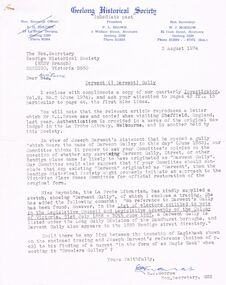
Document - CORRESPONDENCE RE: DERWENT (DERWENT) GULLY, 1974/75
... Mention of the possibility that township of Eaglehawk be connected with Joseph Darwent/s reference to his finding a nugget ''in the form of an Eagle Hawk'' when working in ''Gowlers Gulley''. 2. ...Mention of the possibility that township of Eaglehawk be connected with Joseph Darwent/s reference to his finding a nugget ''in the form of an Eagle Hawk'' when working in ''Gowlers Gulley''. 2. ...Correspondence between Geelong HS and BHS 1974/1975 re Derwent (Darwent) Gully. 1. Letter from W J Morrow (GHS) dated 2/8/1974 re the name Derwent Gully (or Derwent street or other Bendigo place-name) being originally Darwent - on basis of claim of Joseph Darwent in a letter copied from Sheffield, England (details in GHS letter). Mention of the possibility that township of Eaglehawk be connected with Joseph Darwent/s reference to his finding a nugget ''in the form of an Eagle Hawk'' when working in ''Gowlers Gulley''. 2. Attached tracing of gullies and associated townships; 3. Reply dated 5/5/1975 stating that only references that can be found relate to 'Derwent'.eaglehawk, history, gowlers gully, derwent gully, gowlers gully, josseph darwent, long gully township -
 Ringwood and District Historical Society
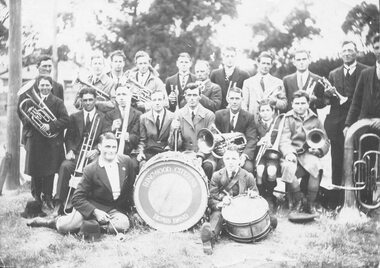
Photograph, Ringwood Citizens Brass Band, 1921
... Burns, M. Joseph, H. Hammond, S. Brown, T. Mackey, H. McLoone, W. ...Burns, M. Joseph, H. Hammond, S. Brown, T. Mackey, H. McLoone, W. ...Black and white photographRingwood Band (formed 19th September 1921). Photo taken at Reserve, 27th November 1921. Back: C. French, C. Morgan, M. Hodgkins, G. Burns, M. Joseph, H. Hammond, S. Brown, T. Mackey, H. McLoone, W. Fitzell, M. Leach. Middle: N. Wieland, W. Guy, H. Willis, L. Little, H. Bradley (Conductor), E. Homewood, W. Brown, G. Davis. Front: L. Hall, S. Hyden. (Information contained in Hugh Anderson's book- 'Place of Many Eagles'). -
 Bendigo Historical Society Inc.
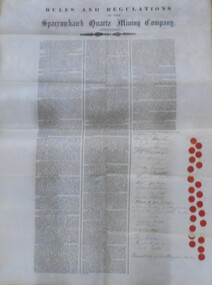
Document - SPARROWHAWK QUARTZ MINING COMPANY RULES AND REGULATIONS
... Document signed by Joseph Millin, J. Woodward, S? Heogy?, J. Walker, John? ...Document signed by Joseph Millin, J. Woodward, S? Heogy?, J. Walker, John? ...Rules and regulations of the Sparrowhawk Quartz Mining company dated 27th. May 1865. Operations carried out at Wilson's Reef, Sparrowhawk Gully, Sandhurst (Bendigo). Document signed by Joseph Millin, J. Woodward, S? Heogy?, J. Walker, John? Geo Lansell, Wm. Drivar, J. Creeth, D. Watson, Alex Graham, David Sterry, George Wills, James …? Chas Colley, Thomas Molloy, Robert Hollis, John Charles, William Gibbs, Robert Grieve, …Hay, …. Jones, Henry Hattam, James Hosking, Carl Roeder, Thomas M..ulloy, by his attorney, John Scanlon. (some names faded, difficult to decipher)bendigo, mining, sparrowhawk quartz mining company -
 City of Moorabbin Historical Society (Operating the Box Cottage Museum)
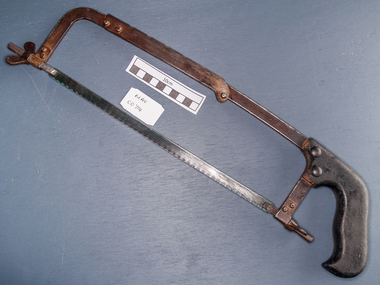
Tools, steel hacksaw 'Marples', 20thC
... Joseph Marples & Son Pty Ltd Traditional Craftsmans Hand Tools made in Sheffield. The finest quality hand made tools, backed by over 170 years of manufacturing heritage. .In the 1840’s Joseph Marples was one of several ‘Marples’ (most of which were related) in Sheffield manufacturing joiners tools, such as brass inlaid rosewood & ebony braces, boxwood spokeshaves, beech planes, gauges and squares. ...Joseph Marples & Son Pty Ltd Traditional Craftsmans Hand Tools made in Sheffield. The finest quality hand made tools, backed by over 170 years of manufacturing heritage. .In the 1840’s Joseph Marples was one of several ‘Marples’ (most of which were related) in Sheffield manufacturing joiners tools, such as brass inlaid rosewood & ebony braces, boxwood spokeshaves, beech planes, gauges and squares. ...A hacksaw is a fine-toothed saw, originally and principally for cutting metal. They can also cut various other materials, such as plastic and wood; for example, plumbers and electricians often cut plastic pipe and plastic conduit with them. On hacksaws, as with most frame saws, the blade can be mounted with the teeth facing toward or away from the handle, resulting in cutting action on either the push or pull stroke. In normal use, cutting vertically downwards with work held in a bench vice, hacksaw blades should be set to be facing forwards. Joseph Marples & Son Pty Ltd Traditional Craftsmans Hand Tools made in Sheffield. The finest quality hand made tools, backed by over 170 years of manufacturing heritage. .In the 1840’s Joseph Marples was one of several ‘Marples’ (most of which were related) in Sheffield manufacturing joiners tools, such as brass inlaid rosewood & ebony braces, boxwood spokeshaves, beech planes, gauges and squares. The business has remained within the family to this date, and has been based in Sheffield since those early days. Although modern technology has been used in some instances, many of the traditions of manufacturing fine hand tools has remained the same using selected materials and hand finishing, indeed the same threads are used in the gauges as were used over 100 years ago. A steel hacksaw. 'Marples' with bladeMARPLEStools, woodwork, metalwork, carpentry, pioneers, market gardeners, early settlers, moorabbin, cheltenham, bentleigh, ormond, joseph marples & son pty ltd, sheffield , england, -
 Bendigo Historical Society Inc.
Photograph - Historical Society Field Trip to the Springs at Sedgwick, Abt 2009
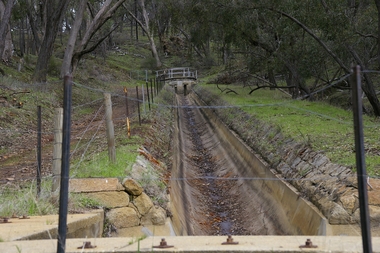
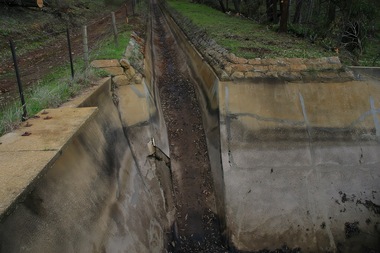
... Joseph Young owned and Managed the Standard Brewery which was located at Campbells Creek during the late 1800’s early 1900’s. ...Joseph Young owned and Managed the Standard Brewery which was located at Campbells Creek during the late 1800’s early 1900’s. ...The Phil Wilkin Collection contains a series of 11 Items. The related items can be found by clicking on the reference link below. The following history of the Young family and their descendants who lived at the Springs is provided by Phil Wilkin. His Great Grandparents were Frances Young and August Wirth. Phil has also provided notes on the Wilkin Family and some history of the gold mining in Sedgwick. Frances Young's parents Joseph and Margaret Young owned the property called "The Old Place, Preston Vale or Wellington Flat" at Sedgwick near the Springs. Joseph Young owned and Managed the Standard Brewery which was located at Campbells Creek during the late 1800’s early 1900’s. Joseph and Margaret are buried in the Harcourt cemetery. In 1880 August Wirth lived at Mosquito Creek (Lake Eppalock, Victoria) when he married Frances Young. In 1902 they moved to part of Joseph Young's property. They milked cows and sold cattle for a living. One of their children Charles Wirth (Phil Wilkin's Grandfather) bought the land in 1935 after his parents had died. Charles Wirth was a councillor and also was president of the Shire of Strathfieldsaye. The "Old Place" was part of the property owned by members of the family. The old house at the Springs was burnt out by bushfire in January 1944 and much of the stonework was later vandalized by campers. The original Coliban Water Works were designed in 1863 by the Irish engineer Joseph Brady. The system included 70 kilometres of open water channels, aqueducts, syphons and tunnels to carry water (by gravity) from the Coliban River at Malmsbury, north to Castlemaine and Bendigo. Sedgwick is a locality in Central Victoria, Australia. It is located in the City of Greater Bendigo. Facilities include a public hall that opened in 1958 and CFA Rural fire station. It was named Upper Emu Creek until 1901 when it was renamed as Sedgwick after British geologist Adam Sedgwick.Twenty nine photos taken on a field trip by the Bendigo Historical Society to "The Springs" on the main Coliban water channel from Malmsbury to the Sandhurst Reservoir in Bendigo. The water race descends through a concrete chute, and continues sharply around the contour of the hills. Once it descended into a syphon across the gully. The are 182 photos in this series and can be found at 8683.1 to 8683.11. The series also includes photos of the surrounding farming land and the remains of an old house. There are also some notes on the pioneers of the district.history, bendigo, coliban water, joseph brady, irrigation, the springs, sedgwick -
 Bendigo Historical Society Inc.
Photograph - Historical Society Field Trip to the Springs at Sedgwick, Abt 2009
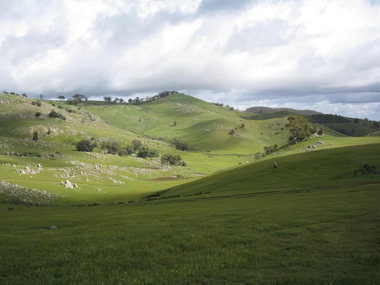
... Joseph Young owned and Managed the Standard Brewery which was located at Campbells Creek during the late 1800’s early 1900’s. ...Joseph Young owned and Managed the Standard Brewery which was located at Campbells Creek during the late 1800’s early 1900’s. ...The Phil Wilkin Collection contains a series of 11 Items. The related items can be found by clicking on the reference link below. The following history of the Young family and their descendants who lived at the Springs is provided by Phil Wilkin. His Great Grandparents were Frances Young and August Wirth. Phil has also provided notes on the Wilkin Family and some history of the gold mining in Sedgwick. Frances Young's parents Joseph and Margaret Young owned the property called "The Old Place, Preston Vale or Wellington Flat" at Sedgwick near the Springs. Joseph Young owned and Managed the Standard Brewery which was located at Campbells Creek during the late 1800’s early 1900’s. Joseph and Margaret are buried in the Harcourt cemetery. In 1880 August Wirth lived at Mosquito Creek (Lake Eppalock, Victoria) when he married Frances Young. In 1902 they moved to part of Joseph Young's property. They milked cows and sold cattle for a living. One of their children Charles Wirth (Phil Wilkin's Grandfather) bought the land in 1935 after his parents had died. Charles Wirth was a councillor and also was president of the Shire of Strathfieldsaye. The "Old Place" was part of the property owned by members of the family. The old house at the Springs was burnt out by bushfire in January 1944 and much of the stonework was later vandalized by campers. The original Coliban Water Works were designed in 1863 by the Irish engineer Joseph Brady. The system included 70 kilometres of open water channels, aqueducts, syphons and tunnels to carry water (by gravity) from the Coliban River at Malmsbury, north to Castlemaine and Bendigo. Sedgwick is a locality in Central Victoria, Australia. It is located in the City of Greater Bendigo. Facilities include a public hall that opened in 1958 and CFA Rural fire station. It was named Upper Emu Creek until 1901 when it was renamed as Sedgwick after British geologist Adam Sedgwick.Twenty five photos taken on a field trip by the Bendigo Historical Society to "The Springs" on the main Coliban water channel from Malmsbury to the Sandhurst Reservoir in Bendigo. The water race descends through a concrete chute, and continues sharply around the contour of the hills. Once it descended into a syphon across the gully. The are 182 photos in this series and can be found at 8683.1 to 8683.11. The series also includes photos of the surrounding farming land and the remains of an old house. There are also some notes on the pioneers of the district.history, bendigo, coliban water, joseph brady, irrigation, the springs, sedgwick -
 Bendigo Historical Society Inc.
Photograph - Historical Society Field Trip to the Springs at Sedgwick, Abt 2009
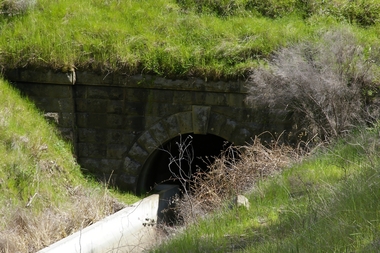
... Joseph Young owned and Managed the Standard Brewery which was located at Campbells Creek during the late 1800’s early 1900’s. ...Joseph Young owned and Managed the Standard Brewery which was located at Campbells Creek during the late 1800’s early 1900’s. ...The Phil Wilkin Collection contains a series of 11 Items. The related items can be found by clicking on the reference link below. The following history of the Young family and their descendants who lived at the Springs is provided by Phil Wilkin. His Great Grandparents were Frances Young and August Wirth. Phil has also provided notes on the Wilkin Family and some history of the gold mining in Sedgwick. Frances Young's parents Joseph and Margaret Young owned the property called "The Old Place, Preston Vale or Wellington Flat" at Sedgwick near the Springs. Joseph Young owned and Managed the Standard Brewery which was located at Campbells Creek during the late 1800’s early 1900’s. Joseph and Margaret are buried in the Harcourt cemetery. In 1880 August Wirth lived at Mosquito Creek (Lake Eppalock, Victoria) when he married Frances Young. In 1902 they moved to part of Joseph Young's property. They milked cows and sold cattle for a living. One of their children Charles Wirth (Phil Wilkin's Grandfather) bought the land in 1935 after his parents had died. Charles Wirth was a councillor and also was president of the Shire of Strathfieldsaye. The "Old Place" was part of the property owned by members of the family. The old house at the Springs was burnt out by bushfire in January 1944 and much of the stonework was later vandalized by campers. The original Coliban Water Works were designed in 1863 by the Irish engineer Joseph Brady. The system included 70 kilometres of open water channels, aqueducts, syphons and tunnels to carry water (by gravity) from the Coliban River at Malmsbury, north to Castlemaine and Bendigo. Sedgwick is a locality in Central Victoria, Australia. It is located in the City of Greater Bendigo. Facilities include a public hall that opened in 1958 and CFA Rural fire station. It was named Upper Emu Creek until 1901 when it was renamed as Sedgwick after British geologist Adam Sedgwick.Twenty six photos taken on a field trip by the Bendigo Historical Society to "The Springs" on the main Coliban water channel from Malmsbury to the Sandhurst Reservoir in Bendigo. The water race descends through a concrete chute, and continues sharply around the contour of the hills. Once it descended into a syphon across the gully. The are 182 photos in this series and can be found at 8683.1 to 8683.11. The series also includes photos of the surrounding farming land and the remains of an old house. There are also some notes on the pioneers of the district.history, bendigo, coliban water, joseph brady, irrigation, the springs, sedgwick -
 Bendigo Historical Society Inc.
Photograph - Historical Society Field Trip to the Springs at Sedgwick, Abt 2009
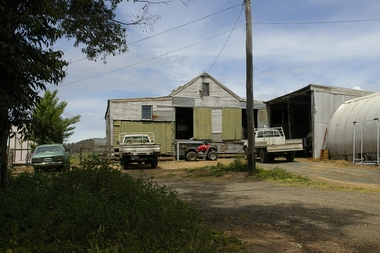
... Joseph Young owned and Managed the Standard Brewery which was located at Campbells Creek during the late 1800’s early 1900’s. ...Joseph Young owned and Managed the Standard Brewery which was located at Campbells Creek during the late 1800’s early 1900’s. ...The Phil Wilkin Collection contains a series of 11 Items. The related items can be found by clicking on the reference link below. The following history of the Young family and their descendants who lived at the Springs is provided by Phil Wilkin. His Great Grandparents were Frances Young and August Wirth. Phil has also provided notes on the Wilkin Family and some history of the gold mining in Sedgwick. Frances Young's parents Joseph and Margaret Young owned the property called "The Old Place, Preston Vale or Wellington Flat" at Sedgwick near the Springs. Joseph Young owned and Managed the Standard Brewery which was located at Campbells Creek during the late 1800’s early 1900’s. Joseph and Margaret are buried in the Harcourt cemetery. In 1880 August Wirth lived at Mosquito Creek (Lake Eppalock, Victoria) when he married Frances Young. In 1902 they moved to part of Joseph Young's property. They milked cows and sold cattle for a living. One of their children Charles Wirth (Phil Wilkin's Grandfather) bought the land in 1935 after his parents had died. Charles Wirth was a councillor and also was president of the Shire of Strathfieldsaye. The "Old Place" was part of the property owned by members of the family. The old house at the Springs was burnt out by bushfire in January 1944 and much of the stonework was later vandalized by campers. The original Coliban Water Works were designed in 1863 by the Irish engineer Joseph Brady. The system included 70 kilometres of open water channels, aqueducts, syphons and tunnels to carry water (by gravity) from the Coliban River at Malmsbury, north to Castlemaine and Bendigo. Sedgwick is a locality in Central Victoria, Australia. It is located in the City of Greater Bendigo. Facilities include a public hall that opened in 1958 and CFA Rural fire station. It was named Upper Emu Creek until 1901 when it was renamed as Sedgwick after British geologist Adam Sedgwick.Twenty six photos taken on a field trip by the Bendigo Historical Society to "The Springs" on the main Coliban water channel from Malmsbury to the Sandhurst Reservoir in Bendigo. The water race descends through a concrete chute, and continues sharply around the contour of the hills. Once it descended into a syphon across the gully. The are 182 photos in this series and can be found at 8683.1 to 8683.11. The series also includes photos of the surrounding farming land and the remains of an old house. There are also some notes on the pioneers of the district.history, bendigo, coliban water, joseph brady, irrigation, the springs, sedgwick -
 Bendigo Historical Society Inc.
Photograph - Phil Wilkin Collection - The Springs at Sedgwick 11 Items
... Joseph Young owned and Managed the Standard Brewery which was located at Campbells Creek during the late 1800’s early 1900’s. ...Joseph Young owned and Managed the Standard Brewery which was located at Campbells Creek during the late 1800’s early 1900’s. ...The Phil Wilkin Collection contains a series of 11 Items. The related items can be found by clicking on the reference link below. The following history of the Young family and their descendants who lived at the Springs is provided by Phil Wilkin. His Great Grandparents were Frances Young and August Wirth. Phil has also provided notes on the Wilkin Family and some history of the gold mining in Sedgwick. Frances Young's parents Joseph and Margaret Young owned the property called "The Old Place, Preston Vale or Wellington Flat" at Sedgwick near the Springs. Joseph Young owned and Managed the Standard Brewery which was located at Campbells Creek during the late 1800’s early 1900’s. Joseph and Margaret are buried in the Harcourt cemetery. In 1880 August Wirth lived at Mosquito Creek (Lake Eppalock, Victoria) when he married Frances Young. In 1902 they moved to part of Joseph Young's property. They milked cows and sold cattle for a living. One of their children Charles Wirth (Phil Wilkin's Grandfather) bought the land in 1935 after his parents had died. Charles Wirth was a councillor and also was president of the Shire of Strathfieldsaye. The "Old Place" was part of the property owned by members of the family. The old house at the Springs was burnt out by bushfire in January 1944 and much of the stonework was later vandalized by campers. The original Coliban Water Works were designed in 1863 by the Irish engineer Joseph Brady. The system included 70 kilometres of open water channels, aqueducts, syphons and tunnels to carry water (by gravity) from the Coliban River at Malmsbury, north to Castlemaine and Bendigo. Sedgwick is a locality in Central Victoria, Australia. It is located in the City of Greater Bendigo. Facilities include a public hall that opened in 1958 and CFA Rural fire station. It was named Upper Emu Creek until 1901 when it was renamed as Sedgwick after British geologist Adam Sedgwick.The Phil Wilkin Collection contains a series of eleven Items about the Young family and their descendants who lived at the Springs and is provided by Phil Wilkin. His Great Grandparents were Frances Young and August Wirth. Phil has also provided notes on the Wilkin Family and some history of the gold mining in Sedgwick. The are 182 photos in this series and can be found at 8683.1 to 8683.11. The series also includes photos of the surrounding farming land and the remains of an old house. There are also some notes on the pioneers of the district. On DVDhistory, bendigo, coliban water, joseph brady, irrigation, the springs, sedgwick -
 Flagstaff Hill Maritime Museum and Village
Book - Bible, Thomas Kelly & Sons, The Holy Bible - Douay Bible and Rheims Testament, 1880
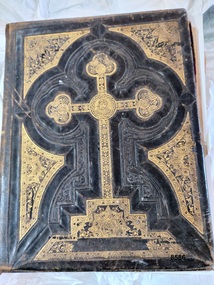
... The Kermonds were an old Warrnambool family with ties to the district going back to the mid 1840's. Joseph Kermond's mother, Catherine (1818 - 1895) and her husband John Kermond,, an ex-convict (1809 - 1877), had moved from Tasmania around 1843 and were living in the Warrnambool area in 1844 where their eldest son was born. ...The Kermonds were an old Warrnambool family with ties to the district going back to the mid 1840's. Joseph Kermond's mother, Catherine (1818 - 1895) and her husband John Kermond,, an ex-convict (1809 - 1877), had moved from Tasmania around 1843 and were living in the Warrnambool area in 1844 where their eldest son was born. ...The Douay (Douai) Rheims Bible is an English translation of the Latin Vulgate Bible (which had been the Latin Bible used by the Catholic Church since the 4th century). It was produced by Roman Catholic scholars in exile from Elizabethan Protestant England at the English College of Douai (then in the Spanish Netherlands but later part of France). The New Testament translation was published in 1582 at Rheims where the English College had temporarily located in 1578. The Old Testament was translated shortly afterwards but was not published until 1609-1610 in Douay (which makes it older than the King James version). The completed work was the only authorized Bible in English for Roman Catholics until the 20th Century. Its purpose was to uphold the Catholic tradition in the face of the Protestant Reformation and was produced as an alternative to the several Protestant translations then in existence. Prior to it being published, the Roman Catholic practice had restricted personal use of the Bible, in the Latin Vulgate, to the clergy. Bishop Richard Challoner issued a series of revisions (1749 - 1772) intended to make the translation more easily understandable and subsequent editions (including this one) were based upon this revision. In 1871, an edition of the Douay - Rheims Bible was published by Thomas Kelly & Sons of Philadelphia (and later, New York). Thomas Kelly described himself as a "Publisher, Printer, Binder, Lithographer and Steel Plate Engraver". In 1876, Thomas Kelly won an award (a Diploma of Honor and a Medal of Merit) for "the Best Catholic Bibles and Prayer Books" at the International Centennial Exhibition held in Philadelphia and his firm continued to print editions of the Bible throughout the 1870's but little is known of him after 1880 when this edition was published. This Bible has been in the Kermond family from 1888 until 1984 when Laurence Kermond (its last owner) died. The Kermonds were an old Warrnambool family with ties to the district going back to the mid 1840's. Joseph Kermond's mother, Catherine (1818 - 1895) and her husband John Kermond,, an ex-convict (1809 - 1877), had moved from Tasmania around 1843 and were living in the Warrnambool area in 1844 where their eldest son was born. They had six more children born at Port Fairy (or Belfast as it was then called). Catherine is buried at the Tower Hill cemetery. The last owner of the Bible was Laurence Kermond (1918 - 1984). He was the great grandson of John and Catherine Kermond and was a well known painter who lived in the Merimbula and Paynesville areas of N.S. W. and Victoria during the 1970's and early 1980's. The story of Joseph Kermond finding the Bible on a beach on the Shipwreck Coast near Peterborough on the southern coast of Victoria, Australia is plausible as it was not uncommon for items from shipwrecks to be washed ashore. However this Bible would not have come from the wreck of the Loch Ard as the dates don't align. The Loch Ard was wrecked in 1878 and this Bible was printed in 1880. It appears to have been printed for the Australian market as there is a page (with an engraved portrait) dedicated to the "Most Rev. Roger Bede Vaughan, O. S. B. Archbishop of Sydney, N. S. W.". It may also have been aimed at the Irish immigrants as the four "Family Register" pages are decorated with borders of shamrocks. The donor found the Bible in a box of secondhand books on a market stall in Gippsland and recognised its links to the Shipwreck Coast through the name of previous owners (a well-known Warrnambool name) and the story of it being found on a beach near Peterborough. This Bible is a rare example of Douay and Reims Catholic Bible of the late 19th century that was once a treasured item belonging to the Kermond family - one of Warrnambool's early settlers. It also has a most unusual story attached to it - being found (and rescued) washed up on a local beach and almost one hundred years later, being rescued again from a secondhand book stall.This Catholic Bible is an 1880 edition of a "Douay Bible and Rheims Testament", printed and published by Thomas Kelly of New York. Its full title is "The Holy Bible translated from the Latin Vulgate Diligently Compared with The Hebrew, Greek and Other Editions in Various Languages". It is revised with annotations by the Right Rev. R. Challoner D.D. The Bible has brown leather embossed front and back covers decorated with identical ornate gilt patterns and a central picture of a cross. It has two coloured illustrations and numerous black and white lithographs and engravings including portraits of past popes, events and places from Bible stories and decorative borders. The Bible includes the Old and New Testaments, approbations from Pope Pius the Sixth and Archbishops of the United States and other countries (including Archbishop Vaughan of Sydney), a Family Register with handwritten notes on births, deaths and marriages from the Kermond family (as well as a description of how they obtained the bible), a Catholic dictionary of the Bible, a history of the Holy Scriptures, a chronological list of heretics (Theological history) and a description of the "Centennial Award - Diploma of Honor and medal of Merit" won by Thomas Kelly (for the "Best Catholic Bible") at the Centennial Exhibition at Philadelphia in 1876. The Records section has a note on the Memoranda page written by William John Kennard in 1920.Spine: HOLY BIBLE Title Page: THE/ HOLY BIBLE /TRANSLATED FROM/ THE LATIN VULGATE/ DILIGENTLY COMPARED WITH/THE HEBREW, GREEK AND OTHER EDITIONS/ IN VARIOUS LANGUAGES/ THE OLD TESTAMENT WAS FIRST PUBLISHED BY THE ENGLISH COLLEGE AT DOUAY, A.D. 1600 / AND THE NEW TESTAMENT, BY THE ENGLISH COLLEGE AT RHEIMS, A.D. 1582./ REVISED WITH ANNOTATIONS/ BY THE RIGHT REV. R. CHALLONER D.D./ TOGETHER WITH REFERENCES, AND AN HISTORICAL AND CHRONOLOGICAL INDEX./ NOW CAREFULLY CORRECTED ACCORDING TO THE CLEMENTINE EDITION OF THE SCRIPTURES/ NEW YORK / THOMAS KELLY, PUBLISHER/ 17 BARCLAY STREET. / 1880 Dedication Page: DEDICATION OF THE ORIGINAL EDITION/ TO/ THAT LOYAL, RELIGIOUS AND ENLIGHTENED BODY OF MEN / THE/ CATHOLICS OF THE UNITED STATES OF AMERICA/ IN ADMIRATION OF THE STEADY ZEAL WITH WHICH THEY HAVE KEPTTHE/DEPOSIT OF FAITH/ BEQUEATHED THEM BY THEIR FOREFATHERS/ AND HANDED DOWN, WITHOUT INTERRUPTION OT ADULTERATION, TO THEIR GRATEFUL POSTERITY/ THIS EDITION/ OF THE/DOUAY BIBLE AND RHEIMS TESTAMENT/ IS / WITH GRATITUDE FOR PAST FAVORS AND HOPES OF FUTURE ENCOURAGEMENT/ MOST RESPECTFULLY ENSCRIBED. Handwritten note: ""This Holy Book was found . on the beach . near Peterborough Vic. having been washed ashore . from the wreck of the Loch Ard, (sailing ship) in the year 1888 . By .Joseph . Kermond; and presented to . his mother . Catherine Kermond , who in turn passed it - on . to her youngest . son ; one Jacob Kermond. He in turn presented . it to his son . William John Kermond , (the writer), 23/3/20)" [Original punctuation]flagstaff hill maritime museum and village, warrnambool, shipwreck coast, peterborough, kermond, kermond family, loch ard, bible, douay and rheims bible, catholic bible, thomas kelly and sons publiisher, douai, rheims, holy bible, religious bible, catherine kermond, john kermond, william john kermond' -
Bendigo Historical Society Inc.
Document - SPECIMEN COTTAGE COLLECTION: VARIOUS DOCUMENTS
... Historical record. 4029.16 Journal of Thomas Llewellyn Raston. 4029.17 Recollections of Sandhurst in the 1850's - Joseph Anderson Panton, 22 segments from Panton manuscript by Terry Davidson. ...Historical record. 4029.16 Journal of Thomas Llewellyn Raston. 4029.17 Recollections of Sandhurst in the 1850's - Joseph Anderson Panton, 22 segments from Panton manuscript by Terry Davidson. ...In 1853, Bendigo Miners protested against the 30 shilling miners licence the had to pay the government. They wore red ribbons to show their protest and shopkeepers hung red ribbons outside their premises in support. Thousands of miners signed a petition to Governor LaTrobe to no avail. A protest gathering in Pall Mall marched to the Government camp on Camp Hill but this was a peaceful event again to no real avail.Various documents. The topics are: 4029.1 Public donations and organised charities in Bendigo (1850's to 1900's by Carol Holsworth. 4029.2 The spirit of Bendigo R711 and the loco driver on the return trip from Bendigo by Rod Giri, also several photographs of the train. 4029.3 Diary of a new chum - Johnny Greenfield Gill. 4029.4 Family history by Pat Hocking. 4029.5 The story of the Gaylards as told by Ella Gaylard. 4029.6 Journalism- History first draft by Wayne Gregson. 4029.7 List of residents of Thistle Street, Bendigo approx. 1950's compiled by Cynthia Stringer. 4029.8 Sandhurst club history by David Cotton. 4029.9 Sandhurst boys centre compiled by Brian Dillon. 4029.10 Lily Street Walk 24/04/2018 notes by Jim Evans. 4029.11 Document - All things Bendigo, wine food and music fest. 4029.12 White Hills Sandhurst copies of maps and two pages of district directory1908. 4029.13 Draft report of interview with Noel Smith of 5 Summit Drive, Kennington. 4029.14 Three brothers from Scotland by Rae Alexander Anderson. Also, seven newspaper articles by James Lerk on William, Alexander Rae and John Rae. 4029.15 St. John Presbyterian church, Bendigo. Historical record. 4029.16 Journal of Thomas Llewellyn Raston. 4029.17 Recollections of Sandhurst in the 1850's - Joseph Anderson Panton, 22 segments from Panton manuscript by Terry Davidson. Also, a photographs of a portrait of Joseph Panton. 4029.18 Photocopy of letter of Chinese storekeepers, miners and residents to Joseph Anderson Panton esquire, resident warden of Bendigo dated August 28th, 1858, with transcription and the reply from Esquire Panton dated 29 August, 1858. 4029.19 View street reborn, tours of inspection ''welcome to View Street'' view Street properties part of stage 1 of the project: National Trust Chambers, Temperance Hall, Art Gallery Annexe, Trades Hall, Bendigo Regional Arts Centre, Bendigo Regional Performing Arts Centre, Dudley House. 4029.20 View Street early 1900's in between and now. From handwritten notes by Mr. Bob Carr written in 1989. The handwriting has been transcribed by Beverly Ellis. 4029.21 Transcription of ''Diary of a voyage to the colony of Victoria and back'' June1856-September 1858 by Charles Groves. 4029.22 Adelaide Vale historic homestead built by Cr. John Harney. Tour notes prepared by the Central Victorian Branch of the National Trust. 4029.23 Four pages essay titled Spanish Tomato Growers. 2440.29. Eight pages of notes compiled by Leonard Henderson title: Trade token issuers of Bendigo district. The issuers mentioned are: Grieve, Hodgson, Stead and Williams. 4029.25 City of Bendigo tourist promotion Committee. Eight pages document describing the formation of committee for the promotion of tourism in the City of Bendigo. 4029.26 Article ''The Birdman of Bendigo'' Bendigo Advertiser 17th January 1968 detailing the life of Mr. Redvers James Eddy. 4029.27 Speech presented by Miss Margaret Brennan on the occasion of the Drechsler family reunion, Sunday 5th April 1987. 4029.28 Robert Gray Ford - A man before his time! Talk by James Lerk to the Bendigo Historical Society 3 February 2006. 4029.29 Copy of an article from The Bendigonian Annual from November 16, 1910. The demand for good music, how a Bendigo firm has met it. The article is about the life of Oscar Flight. 4029.30 Five photocopies of the Bendigonian masthead showing the changes through the years, plus the notice of the final issue on April 8th, 1920. 4029.31 The red ribbon rebellion & the Bendigo petition, a proposal to commemorate a significant event in Bendigo. Also three different sizes poster for the August 26, 2016 re-enactment and two invitations to join the red ribbon agitation memorial. 4029.32 Two handwritten pages of notes on the red ribbon rebellion. 4029.33 Three pages of typewritten notes on the Creeth and Howie families. 4029.34 An Australian Edward Medallist - Joseph Davies honoured by Paul Street. 4029.35 A. H. Chisholm obituary. 4029.36 Catalogue auction sale of the entire collection of antique furniture, objects d'art etc of Mr. and Mrs S. Cragg. 4029.37 Two coloured photographs of Cherry Tree Hotel in Melbourne Road just north of Tuckerman's lane, Big Hill. Photos taken March 2000 by Joan Paynter. bendigo, red ribbon rebellion -
 Flagstaff Hill Maritime Museum and Village
Nibs & box, late 19th to early 20th century
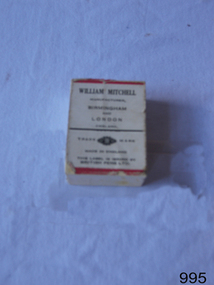
... The company was particularly strong in the American market, prompting Elihu Burrit, the American consul, to write “In ten thousand school houses across the American continent between two oceans, a million children are as familiarly acquainted with Joseph Gillott as with Noah Webster” (The compiler of the famous American dictionary). The company consequently received visits from many notable Americans, including president Ulysses S Grant. ...The company was particularly strong in the American market, prompting Elihu Burrit, the American consul, to write “In ten thousand school houses across the American continent between two oceans, a million children are as familiarly acquainted with Joseph Gillott as with Noah Webster” (The compiler of the famous American dictionary). The company consequently received visits from many notable Americans, including president Ulysses S Grant. ...Box of dip pen nibs made by William Mitchell Calligraphy dating back to late 19th or early 20th century when dip pens with steel nibs were the main writing instruments. The pen nibs are shaped to fit into a slot in the base of a wooden or Bakelite pen holder. The hole at the front of the nib is for collecting ink from a well, which is then stored in a reservoir at the back of the nib. The nibs are stamped with their nib size and Pedigree (what type of nib it is) and maker’s details. William Mitchell Calligraphy still makes these nibs today with a slightly difference finish. (ref: Sales and Marketing Director of William Mitchell Calligraphy in 2016). HISTORY of the Ink Pen Quills and ink were common writing tools until the early 19th century when the pen trade began mass producing steel nibs and pens. The steel nibs each have a hole in the middle that acts like a well for the ink. When the nib is dipped into the ink well the writer needs to ensure that it is dipped to only just past that well. India Ink was one of the most popular inks used with the nib pens, notable for its satin-like smooth flow. This ink is composed of a particularly fine carbon mixed with water; it can also be obtained as a dry stick that is then crushed and mixed with water as required. The Jewellery Quarter of Birmingham had the largest concentration of independent jewellers in Europe. Birmingham became the centre of the world’s pen trade for many years -, during the 1800’s over 100 factories, employing 1000s of skilled workers, manufactured the ‘Birmingham Pen’. ABOUT WILLIAM MITCHELL CALLIGRAPHY LTD.* (*The following text is quoted from the William Mitchell Calligraphy website) British based William Mitchell Calligraphy has been designing and manufacturing exceptional pens for almost 200 years. The William Mitchell heritage in making pen nibs began whilst working with his brother John Mitchell in the early 1820s. William Mitchell established his own business in 1825 to become one of the leading nib manufacturers and famous for lettering pens. Almost 100 years later William Mitchell merged with Hinks, Wells & Co, another pen manufacturer, to form British Pens, employing around 1000 people in the Bearwood Road area of Birmingham. During the early 1960s British Pens acquired the pen business of other pen manufacturers Perry & Co and John Mitchell, once again reuniting the two brothers. Joseph Gillott, who were famous for their artist drawing and mapping nibs, amalgamated with British pens in 1969. William Mitchell and Joseph Gillott established in Birmingham during the early part of the nineteenth century and [their products] are still proudly made here. British Pens were subsequently purchased by its current owner Byron Head, the owner of William Mitchell (Sinkers) in 1982, and was subsequently renamed William Mitchell (calligraphy) Ltd. Established in 1827 Joseph Gillott was one of the pioneers of mass steel pen nib manufacturing. The company was particularly strong in the American market, prompting Elihu Burrit, the American consul, to write “In ten thousand school houses across the American continent between two oceans, a million children are as familiarly acquainted with Joseph Gillott as with Noah Webster” (The compiler of the famous American dictionary). The company consequently received visits from many notable Americans, including president Ulysses S Grant. Email on file, from Mike Chappell, Sales and Marketing Manager, William Mitchell Calligraphy, “20161122 - William Mitchell re pen nibs” How to use a dip pen to create modern calligraphy, https://thepostmansknock.com/how-to-use-a-dip-pen-to-create-modern-calligraphy/ India Ink, Wikipedia https://en.wikipedia.org/wiki/India_ink birmingham Pen Trade, Wikipedia, https://en.wikipedia.org/wiki/Birmingham_pen_trade The Pen Museum, http://penmuseum.org.uk/ The early 19th century invention and later mass production of pen nibs such these in our collection had a large impact on education and literacy because the nibs could be produced in great numbers and affordable prices.Box of patent Mitchell nibs containing 48 "Pedigree" nibs. Box depicts picture of William Mitchell on lid, and picture of nib pen on lid and side. Made in Birmingham, England. Nib “0505 Wm MITCHELLS PEDIGREE ENGLAND” Box “PEDIGREE / MAINFOLD SLIP”, “WILLIAM MITCHELL / BIRM - - - - - - LOND” flagstaff hill, warrnambool, shipwrecked-coast, flagstaff-hill, flagstaff-hill-maritime-museum, maritime-museum, shipwreck-coast, flagstaff-hill-maritime-village, william mitchell calligraphy ltd, pen nib, writing implement, writing accessories, dip pen, birmingham manufacturer, communication in writing, mass produced pen nibs -
 Flagstaff Hill Maritime Museum and Village
Book, The Works of Alfred Lord Tennyson
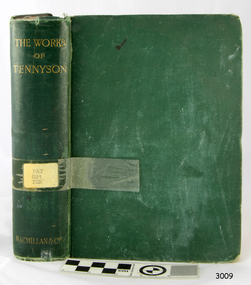
... In the 1860's the Mechanics' Institute struggled as membership waned but in 1866, after a series of fundraising efforts, the committee was able to purchase land in Liebig Street, on a site then called Market Square, between the weighbridge and the fire station. A Mechanics' Institute building was opened at this site in August 1871. The following year four more rooms were added to the main Reading Room and in 1873 the Artisan School of Design was incorporated into the Institute. The same year Joseph...In the 1860's the Mechanics' Institute struggled as membership waned but in 1866, after a series of fundraising efforts, the committee was able to purchase land in Liebig Street, on a site then called Market Square, between the weighbridge and the fire station. A Mechanics' Institute building was opened at this site in August 1871. The following year four more rooms were added to the main Reading Room and in 1873 the Artisan School of Design was incorporated into the Institute. The same year Joseph ...This item is from the ‘Pattison Collection’, a collection of books and records that was originally owned by the Warrnambool Mechanics’ Institute, which was founded in Warrnambool in 1853. By 1886 the Warrnambool Mechanics’ Institute (WMI) had grown to have a Library, Museum and Fine Arts Gallery, with a collection of “… choice productions of art and valuable specimens in almost every branch and many wonderful national curiosities are now to be seen there, including historic relics of the town and district.” It later included a School of Design. Although it was very well patronised, the lack of financial support led the WMI in 1911 to ask the City Council to take it over. In 1935 Ralph Pattison was appointed as City Librarian to establish and organise the Warrnambool Library as it was then called. When the WMI building was pulled down in 1963 a new civic building was erected on the site and the new Warrnambool Library, on behalf of the City Council, took over all the holdings of the WMI. At this time some of the items were separated and identified as the ‘Pattison Collection’, named after Ralph Pattison. Eventually, the components of the WMI were distributed from the Warrnambool Library to various places, including the Art Gallery, Historical Society and Flagstaff Hill. Later some were even distributed to other regional branches of Corangamite Regional Library and passed to and fro. It is difficult now to trace just where all of the items have ended up. The books at Flagstaff Hill Maritime Village generally display stamps and markings from Pattison as well as a variety of other institutions including the Mechanics’ Institute itself. RALPH ERIC PATTISON Ralph Eric Pattison was born in Rockhampton, Queensland, in 1891. He married Maude Swan from Warrnambool in 1920 and they set up home in Warrnambool. In 1935 Pattison accepted a position as City Librarian for the Warrnambool City Council. His huge challenge was to make a functional library within two rooms of the Mechanics’ Institute. He tirelessly cleaned, cleared and sorted a disarrayed collection of old books, jars of preserved specimens and other items reserved for exhibition in the city’s museum. He developed and updated the library with a wide variety of books for all tastes, including reference books for students; a difficult task to fulfil during the years following the Depression. He converted all of the lower areas of the building into a library, reference room and reading room for members and the public. The books were sorted and stored using a cataloguing and card index system that he had developed himself. He also prepared the upper floor of the building and established the Art Gallery and later the Museum, a place to exhibit the many old relics that had been stored for years for this purpose. One of the treasures he found was a beautiful ancient clock, which he repaired, restored and enjoyed using in his office during the years of his service there. Ralph Pattison was described as “a meticulous gentleman whose punctuality, floorless courtesy and distinctive neat dress were hallmarks of his character, and ‘his’ clock controlled his daily routine and his opening and closing of the library’s large heavy doors to the minute.” Pattison took leave from 1942 to 1945 to serve in the Royal Australian Navy, Volunteer Reserve as Lieutenant. A few years later he converted one of the Museum’s rooms into a Children’s Library, stocking it with suitable books for the younger generation. This was an instant success. In the 1950’s he had the honour of being appointed to the Victorian Library Board and received more inspiration from the monthly conferences in Melbourne. He was sadly retired in 1959 after over 23 years of service, due to the fact that he had gone over the working age of council officers. However, he continued to take a very keen interest in the continual development of the Library until his death in 1969. WARRNAMBOOL MECHANICS’ INSTITUTE Warrnambool's Mechanics' Institute (or Institution as it was sometimes called) was one of the earliest in Victoria. On 17th October 1853, a meeting was held where it was resolved to request the Lieutenant Governor of the Colony to grant land for the erection of a Mechanics' Institutes building. A committee was formed at the meeting and Richard Osburne chaired the first meeting of this committee. The land on the North West corner of Banyan and Merri Streets was granted but there were no funds to erect the building. The Formal Rights of the Warrnambool Mechanics' Institute's encompassed its aims and these were officially adopted in1859; "This Institution has for its object the diffusion of literary, scientific, and other useful knowledge amongst its members, excluding all controversial subjects, religious or political. These objects are sought to be obtained by means of a circulating library, a reading room, the establishment of classes, debates, and the occasional delivery of lectures on natural and experimental philosophy, mechanics, astronomy, chemistry, natural history, literature, and the useful and ornamental arts, particularly those which have a more immediate reference to the colony." The Warrnambool Mechanics' Institute opened its first reading room in November 1884 in the National School building at the corner of Banyan and Timor Streets. The Institute was funded by member subscription, payable on a quarterly, half-yearly or yearly basis. Samuel Hannaford, the Manager of the Warrnambool Bank of Australasia, was the first Honorary Secretary of the Mechanics' Institutes, and an early President and Vice-President. He also gave several of the early lectures in the Reading Room. Another early Secretary, Librarian and lecturer was Marmaduke Fisher, the teacher at the National School. Lecture topics included The Poets and Poetry of Ireland', 'The Birth and Development of the Earth', 'The Vertebrae - with Remarks on the pleasures resulting from the study of Natural History' and 'Architecture'. In 1856 the Reading Room was moved to James Hider's shop in Timor Street, and by 1864 it was located in the bookshop of Davies and Read. In the 1860's the Mechanics' Institute struggled as membership waned but in 1866, after a series of fundraising efforts, the committee was able to purchase land in Liebig Street, on a site then called Market Square, between the weighbridge and the fire station. A Mechanics' Institute building was opened at this site in August 1871. The following year four more rooms were added to the main Reading Room and in 1873 the Artisan School of Design was incorporated into the Institute. The same year Joseph Archibald established a Museum; however, it deteriorated when he was transferred to Bendigo in 1877. In 1880, with Archibald's return to Warrnambool, the Museum was re-established, and in 1885 a new building was built at the back of the Institute to accommodate the re-created School of Design, the Art Gallery and the Museum. In 1887 the Museum section was moved to the former courthouse in Timor Street (for some time the walls of the building formed part of the TAFE cafeteria but all is now demolished)). In 1911 the Museum was transferred back to the original building and the management of the Mechanics' Institute was handed over to the Warrnambool City Council. The Museum and Art Gallery became one and housed many fine works of art, and the Library continued to grow. The building was well patronised, with records showing that at the beginning of the 20th century there were between 500 and 800 visitors. During World War One the monthly figures were in the thousands, with 3,400 people visiting in January 1915. The Museum was a much-loved Institution in Warrnambool until the contents of the Museum and Art Gallery were removed to make room for the Warrnambool City Council Engineers' Department. The contents were stored but many of the items were scattered or lost. When the original building was demolished the site became occupied by the Civic Centre, which included the new City Library. (The library was temporarily located in the old Palais building in Koroit Street.) In the process of reorganisation the Collection was distributed amongst the community groups: -The new City Library took some of the historical books and some important documents, historic photographs and newspapers. -The Art Gallery kept the 19th Century art collection and some of the artefacts from the museum. -The Historical Society has some items -The State Museum has some items -Some items were destroyed -Flagstaff Hill Maritime Village has old newspapers, Government Gazettes, most of the Mechanics' Institute Library, ledgers and documents connected to the Mechanics' Institute Library, some framed and unframed artworks and some photographs. The Warrnambool Mechanics' Institute Library book collection is deemed to be of great importance because it is one of the few collections in an almost intact state, and many of the books are now very rare and of great value. The Pattison Collection, along with other items at Flagstaff Hill Maritime Village, was originally part of the Warrnambool Mechanics' Institute’s collection. The Warrnambool Mechanics’ Institute Collection is primarily significant in its totality, rather than for the individual objects it contains. Its contents are highly representative of the development of Mechanics' Institute libraries across Australia, particularly Victoria. A diversity of publications and themes has been amassed, and these provide clues to our understanding of the nature of and changes in the reading habits of Victorians from the 1850s to the middle of the 20th century. The collection also highlights the Warrnambool community’s commitment to the Mechanics’ Institute, reading, literacy and learning in the regions, and proves that access to knowledge was not impeded by distance. These items help to provide a more complete picture of our community’s ideals and aspirations. The Warrnambool Mechanics Institute book collection has historical and social significance for its strong association with the Mechanics Institute movement and the important role it played in the intellectual, cultural and social development of people throughout the latter part of the nineteenth century and the early twentieth century. The collection of books is a rare example of an early lending library and its significance is enhanced by the survival of an original collection of many volumes. The Warrnambool Mechanics' Institute’s publication collection is of both local and state significance. The Works of Alfred Lord Tennyson Author: Alfred, Lord Tennyson - Poet Laureate Publisher: Macmillan And Co Date: 1892The label on spine cover has typed text PAT 821 TEN Pastedown front endpaper has a sticker from Warrnambool Mechanics Institute and Free Library Front loose endpaper has a sticker from Corangamite Regional Library Service Front loose endpaper has a stamp from Corangamite Regional Library Service Flyleaf has a stamp from Warrnambool Public Museumshipwrecked-coast, flagstaff-hill, flagstaff-hill-maritime-museum, warrnambool, maritime-museum, shipwreck-coast, flagstaff-hill-maritime-village, shipwrecked-artefact, book, pattison collection, warrnambool library, warrnambool mechanics’ institute, ralph eric pattison, corangamite regional library service, warrnambool city librarian, mechanics’ institute library, victorian library board, warrnambool books and records, warrnambool children’s library, the works of alfred lord tennyson, alfred, lord tennyson, poet laureate, alfred tennyson -
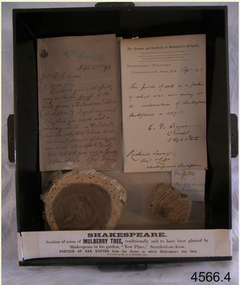 Flagstaff Hill Maritime Museum and Village
Wood Samples, 1891
... Joseph Archibald was Curator: he catalogued the case in 1894. THE LETTERS IN THE CASE The two letters contained within the display case confirm the authenticity of the oak wood sample. The first letter in the case includes the text; "[Stamped Header on banner] High Street, Stratford on Avon [Hand written] Sept. 22nd / 91. Mr. R. S...Joseph Archibald was Curator: he catalogued the case in 1894. THE LETTERS IN THE CASE The two letters contained within the display case confirm the authenticity of the oak wood sample. The first letter in the case includes the text; "[Stamped Header on banner] High Street, Stratford on Avon [Hand written] Sept. 22nd / 91. Mr. R. S ...The timber display case was presented to Mr Richard Standcombe Harris of Warrnambool (1831-1923). He was a councillor (1875-1891) and predominant businessman. Mr C F Loggin had met Mr Harris while on a trip to Stratford upon Avon in the United Kingdom. Upon his return to Warrnambool, Mr Harris donated the item to the Warrnambool Museum and Art Gallery, (established 1886) where Joseph Archibald was Curator: he catalogued the case in 1894. THE LETTERS IN THE CASE The two letters contained within the display case confirm the authenticity of the oak wood sample. The first letter in the case includes the text; "[Stamped Header on banner] High Street, Stratford on Avon [Hand written] Sept. 22nd / 91. Mr. R. S. Harris, Dear Sir, Enclosed you will find [underlined next 3 words] every authentic proof of the Oak from Shakespeare's House (Birth place). I regret very much Sir, that you made a short-day at S. on A. I should have been delighted to have had the honour, & pleasure, of showing you around our Beautiful Country. You did not give [next 3 words underlined] me or yourself a fair chance. But however I hope that we may again some day have more time to go quietly around. With kind regards, and wishing you, Sir, a pleasant voyage, I remain, Dear Sir, Yours very truly, C.F. Loggin. P.S. A paper will be always acceptable to be as how you Jolly Warrnamboolites are desporting yourselves. “ The second letter includes text; “[Printed Letterhead with stamped impression] The Trustees and Guardians of Shakespeare’s Birthplace Incorporated by Act of 54 and 55, Vict. 1891 Secretary and Librarian - Richard Savage Shakespeare’s Birthplace Stratford-upon-Avon [handwritten] 22 Sept 1891 This piece of oak is a portion of what was cut away at at the restoration of Shakespeare’s Birthplace in 1857-58. C. F. Loggins Chemist 3 High Street Richard Savage Sec. – Shakespeare’s Birthplace Mr C F Loggin was connected with the Shakespeare Trust as the person who had originally donated a scion of Shakespeare's mulberry tree to the "Shakespearean Birthday Committee" in 1842. (The scion that was given to the Shakespearean Birthday Committee, from which the Mulberry sample is derived, still grows today in "New Place" garden.) Mr Richard Savage was the Secretary and Liberian of the then renamed “Trustees and Guardians of Shakespeare’s Birthplace when the display case was given to Mr Harris in 1891 by Mr Loggin. WILLIAM SHAKESPEARE Shakespeare was born in 1564 in Stratford-upon-Avon, where he also grew up. He married at 18 years and he and his wife, Anne Hathaway, had three children: They moved to London where he became successful as an actor, writer, and part-owner of a playing company. He later returned to Stratford and purchased his last home, which he called "New Place" in 1602 where he later died in 1616. For the next 150 years, it was known that there existed a black mulberry tree in the garden. At the time there was a fashion for planting mulberry trees. It was the early 17th century after King James had come to the throne, and he imported tens of thousands of saplings in an attempt to get landowners to start a silk industry in England. Unfortunately for posterity, Shakespeare's mulberry was felled around 1756, by the then owner of “New Place" the Reverend Francis Gastrell, who was apparently tired of continual visits by pilgrims asking to see the tree, so he chopped it down. Gastrell had applied for local permission to extend the garden but the application was rejected and his tax was increased. Gastrell retaliated by demolishing the house in 1759, this greatly outraged the local inhabitants. Gastrell was eventually forced to leave town having provoked the wrath of Stratford residents for committing such an act. Today only the garden remains where “New House" used to stand with a scion from the original mulberry tree still growing there. The wood from the felled mulberry tree at “New House" was purchased by an enterprising local clock-maker Thomas Sharp and he spent the next 40 years or so years making souvenirs from the wood. These became early tourist souvenirs and subsequently developed into a profitable sideline for various other makers, including George Cooper and John Marshall. These objects range from relatively small domestic wooden objects, such as snuff boxes and weight scales to large tea caddies and even tables. C. F. Loggin donated a scion or cutting from Shakespeare's mulberry tree to the Shakespeare Birthplace Trust in 1862, he was a chemist who lived and worked in Stratford. There is a note on the frame of the donation that the mulberry sample is from this scion, research shows that from Richard Savage's diary notes that there must have been a lot of wood taken from that scion over the years which was planted in the garden of “New Place” and is still growing there today. The "Trustees and Guardians of Shakespeare’s Birthplace" (1847 -1964) was formed after the house where Shakespeare is believed to have been born fell into disrepair. Subsequently in 1846 after the death of Thomas Court's widow the last owner. Interest in the house was revived when PT Barnum, the American showman, wanted to buy it and ship the house back to America. In response to this, the Shakespeare Birthday Committee was established (by a private Act of Parliament) with the help of such luminaries as Charles Dickens, the Committee of Trustees raised the necessary £3,000 and purchased the house the following year. Once the Committee had acquired the building, restoration work began. Originally the Birthplace formed part of a terrace with later houses built either side. The first stage in its conservation was their destruction. At the time it was thought necessary to avoid the risk of fire spreading to Shakespeare's birthplace. Reconstruction was carried out by the Shakespeare Trust between 1857 and 1864 that restored the outside of the building to its original 16th-century state. It is from this restoration that the donated piece of oak is derived, originally from a beam that was in the house. Communication from The Shakespeare Birthplace Trust, dated April 11th, 2019, confirms that the pieces displayed in this case have good provenance. The wood samples are significant for their association with the history of William Shakespeare. The display case and its content is significant to Warrnambool local history for its association with the establishment in 1886 of the Warrnambool Museum and Art Gallery. However, it should be noted that the letters of authentication that accompany the wood samples are only applicable to the oak sample. None the less, all the pieces have very good provenance, with Richard Savage's certificate of authenticity for the oak, and the mulberry sample with the letter to Mr Harris from Mr CF Loggin having also been the donor of the scion of mulberry in 1862 to the Shakespeare Birthplace Trust. This scion was then established at Shakespeare's garden at "New Home" that had been demolished by Rev Francis Gastrell in 1759. Two wood samples associated with William Shakespeare, presented in a hanging, timber and glass display case with metal trim around the frame. The case also contains two letters and a label printed on a card that refers to the contents, their origins and the donor. A card label with a printed number and a round adhesive label are attached on the back of the case. The left round section of wood is from a donated scion (or shoot) derived from the original mulberry tree planted by William Shakespeare at his last home "New Place", Stratford-upon-Avon. The outer section is light brown coloured while the centre is dark grain. The right wood sample in the case is a section of oak rafter from the house where Shakespeare was born in 1564. The wood is mid brown with a distinct grain. The included letters, each dated 22/9/1891, refer to only the oak sample. - The letter on the left comprises two handwritten pages from Mr CF Loggin to Mr Richard Standcombe Harris. The paper has the printed letterhead address of High Street, Stratford on Avon. - The letter on the right is a handwritten certificate of authenticity signed by Mr CF Loggin and counter signed by Mr Richard Savage, Secretary and Liberian of the Shakespeare Trust. It is on the printed letterhead of The Trustees and Guardians of Shakespeare’s Birthplace Cardboard label inside the glass case “Shakespeare Section of Mulberry Tree, traditionally said to have been planted by Shakespeare in his garden, “New Place,” Stratford-on-Avon. PORTION OF OAK RAFTER from the house in which Shakespeare was born. (Presented by R S Harris 1891.) Printed label on the back of the case “3 2 “ The handwritten adhesive label “0566” flagstaff hill, warrnambool, shipwrecked coast, flagstaff hill maritime museum, maritime museum, shipwreck coast, flagstaff hill maritime village, great ocean road, shakespeare display case, wood samples, oak from shakespeare's birthplace, mulberry from shakespeare's home "new place", stratford-upon-avon, shakespeare's birthplace, the trustees and guardians of shakespeare's birthplace &c., shakespeare trust, shakespeare birthday committee, r.s. harris, brunswick, victoria, richard s harris, brunswick, victoria, c.f. loggins, chemist, 3 high street stratford-on-avon, richard savage, warrnambool museum and art gallery, thomas court, pt barnum, charles dickins, anne hathaway, black mulberry tree, reverend francis gastrell -
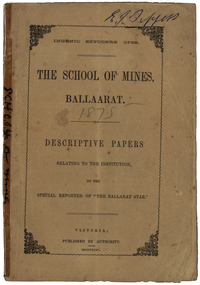 Federation University Historical Collection
Booklet, The School of Mines Ballaarat: Descriptive papers relating to the institution by the special reporter of "The Ballarat Star", 1875 (exact)
... s m b...judge rogers...somerville learmonth...charles gavan duffy...gavan duffy...john macpherson...william mclellan...duncan gillies...f mccoy...university...john bleasdale...henry richards caselli...henry caselli...p chauncy...j m davey...joseph...S. Keast. It then lists some text books used in the school. Section V mentions the School Council, lack of funds, future directions, mining laboratory. Vi- Describes the land and out buildings, and the proposed building for metal and wood turning, brass foundry, blacksmith, working engine, etc. This section describes some large donations to the school - 50 pounds from the Misses Meglin of Melbourne, 10 pounds 10 shillings to the 'Pyrites fund' by the Walhalla and Long Tunnel Companies in Gippsland. Section VII covers the teaching of chemistry by Joseph...Joseph Flude, R.F. Hudson, Robert Lewis, James Oddie, Robert M. Serjeant, J. F. Usher, John Walker, J. Williamson, Mayor of the City of Ballaarat, chairman (for the time being) of each of the seven Mining Boards of Victoria. The President of Examiners was Judge Rogers, and the Honorary Auditor was Richard Ford. melbourne mla ballarat school of mines redmond barry j f usher james bickett w f hopkins rivett henry bland s m b judge rogers somerville learmonth charles gavan duffy gavan duffy john macpherson william mclellan duncan gillies f mccoy university john bleasdale henry richards caselli henry caselli p chauncy j m davey joseph flude r f hudson robert lewis james oddie robert m serjeant john walker j williamson richard ford ballarat court house assay john victor grenville college trinity college dublin c w thomas jonathan robinson union foundry s keast blessdale john day r evan day w w evans j y fishburne felice giordano julius von haast james hector charles a la trobe archibald liversidge j j macgregor j t mckenna henry rosales harrie wood john walthew fees Frederick McCoy W.H. ...The booklet comprises of a series of papers published in the Ballarat Star, with some revisions. The Administrative Council hoped the publication would increase interest in Technical Education, especially the Art of Mining. He would also hope the public would recognise the Ballarat School of Mines as an institution adapted to supply technical education. The Ballarat School of Mines Council listed at the front of the book includes: Redmond Barry (President and Trustee), Judge Rogers (Vice-President), Somerville Livingstone Learmonth (Trustee), Rivett Henry Bland (Trustee), Charles Gavan Duffy, John A. MacPherson (MLA), William McLellan (MLA), Duncan Gillies (MLA), F. McCoy (University of Melbourne), John I. Bleasdale, W.H. Barnard, James M. Bickett, Henry Richards Caselli, P. Chauncy, J.M. Davey, Joseph Flude, R.F. Hudson, Robert Lewis, James Oddie, Robert M. Serjeant, J. F. Usher, John Walker, J. Williamson, Mayor of the City of Ballaarat, chairman (for the time being) of each of the seven Mining Boards of Victoria. The President of Examiners was Judge Rogers, and the Honorary Auditor was Richard Ford.Stapled, brown soft covered booklet of 48 pages. Section I outlines the establishment of the Ballarat School of Mines, the buildings and land used by the school, describes in detail the former Ballarat Circuit Court and describes the lecture rooms. Section II describes the Ballarat School of Mines Museum, including a description of exhibits. Section III describes the lecture hall, and the apartments on either side of the hall, including the office of the registrar W.H. Barnard, mathematical classroom, chemical laboratory, and metallurgical laboratory. Section IV outlines the subjects offered by the Ballarat School of Mines, including Mathematics taught by John Victor of Grenville College, who had been educated at Trinity College Dublin. Mining and Land Surveying was taught by C.W. Thomas. Mr Croll taught mechanical drawing, followed by Jonathan Robinson of the Union Foundry, and finally S. Keast. It then lists some text books used in the school. Section V mentions the School Council, lack of funds, future directions, mining laboratory. Vi- Describes the land and out buildings, and the proposed building for metal and wood turning, brass foundry, blacksmith, working engine, etc. This section describes some large donations to the school - 50 pounds from the Misses Meglin of Melbourne, 10 pounds 10 shillings to the 'Pyrites fund' by the Walhalla and Long Tunnel Companies in Gippsland. Section VII covers the teaching of chemistry by Joseph Flude. Section VIII outlines the metallurgy classes and the process of assaying. Section IX covers telegraphy taught by Mr Bechervaise Section X describes the examination process at the Ballarat School of Mines. Examiners in mathematics were G.J. Russell (Buninyong) and John Lynch (Smythesdale), mining and land surveying John Lynch and P.C. Fitzpatrick (Ballarat), Principles and Practice of Mining R.M. Serjeant (Band and Albion Consols), Mechanical Engineering John Lewis (New North Company Clunes, Mineralogy and Geology G.H. F. Ulrich, Assayign and Chemistry J. Cosmo Newberry, and Telegraphy R.L.J. Ellery (government astronomer) and Sam W. Macgowan. Underground managers and captains in quart mining was examined by Henry Rosales (Walhalla Company), and alluvial mines by Messrs Bockett, Kent, Martin and Mitchell. Engineers and Engine driving was examined by W.H. Keast,Peter Matthews, Jonathan Robinson and J.M. Troup. Section XI - Covers Annual reports of the school, and honorary correspondents of the school including: John Day (Geelong); R. Evan Day (London); W.W. Evans, M.J.C.E. of New York; J.Y. Fishburne, M.B. of Ararat; Felice Giordano, Inspector of Mines, Italy; Julius Von Haast, Ph. D.F.R.S., Government Geologist of Canterbury; James Hector, M.D., F.R.S., Government Geologist of Wellington, New Zealand, W.F. Hopkins (Grant); Charles A. La Trobe, C.E. (Engineer-in-Chief International Railway Plant, London); Archibald Liversidge, F.G.S. (Professor of Mineralogy and Reader in geology at Sydney University; J.J. Macgregor, M.D. (Creswick); J.T. McKenna (1st class of SMB underground management - Northern Territory); Henry Rosales, M.E. and M. (Walhalla); Harrie Wood (SMB founder and Under-secretary for Mines, Sydney); John Walthew (Stockport, England) .2) Signed 'E.J. Tippett', former President of the Ballarat School of Mines Council melbourne, mla, ballarat school of mines, redmond barry, j f usher, james bickett, w f hopkins, rivett henry bland, s m b, judge rogers, somerville learmonth, charles gavan duffy, gavan duffy, john macpherson, william mclellan, duncan gillies, f mccoy, university, john bleasdale, henry richards caselli, henry caselli, p chauncy, j m davey, joseph flude, r f hudson, robert lewis, james oddie, robert m serjeant, john walker, j williamson, richard ford, ballarat court house, assay, john victor, grenville college, trinity college dublin, c w thomas, jonathan robinson, union foundry, s keast, blessdale, john day, r evan day, w w evans, j y fishburne, felice giordano, julius von haast, james hector, charles a la, trobe, archibald liversidge, j j macgregor, j t mckenna, henry rosales, harrie wood, john walthew, fees, frederick mccoy, w.h. barnard -
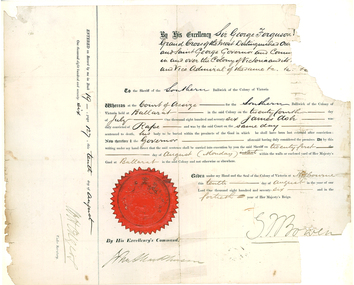 Federation University Historical Collection
Certificates, Death Sentence certificates for Ballarat Gaol
... S Bowen) * Denis Murphy (murder), 1867 (Robert Wallace-Ballarat Sherriff, Sutton, Maurice Sutton, Moore) * Charles Bushbee alias Charles Baker (intent to murder) (Henry Brougham Loch, H. Moore * John Wilson (carnal knowledge - girl under 10) (John Adrian Loius, H. Moore) * James Jones (murder) - (Robert Wallace Ballarat Sherriff - Charles Darling) * Charles Henry Deutschmann ( Murder 1908) - (Reginald Arthur James Talbot, W.A. Callaway) * Cornelius Bourke (Murder 1891) John Adrian Louis, H. Moore) * John Wilson, 1891 (carnal knowledge - girl under 10) *James Johnston, 1891 (murder) * James Jones, 1866 (murder) * Joseph...The certificates related to hangings at the Former Ballarat Gaol hangings ballarat gaol death penalty james ash death sentence george ferguson ferguson bowen henry loch loch charles baker h. moore moore bushbee charles bushbee james jones charles darling robert wallace arthur talbot w.a. callaway callaway james johnson joseph ballan george searle Death Sentence Certificate for: * James Ash (Rape), 1876 (George Ferguson - signed S Bowen) * Denis Murphy (murder), 1867 (Robert Wallace-Ballarat Sherriff, Sutton, Maurice Sutton, Moore) * Charles Bushbee alias Charles Baker (intent to murder) (Henry Brougham Loch, H. ...The certificates related to hangings at the Former Ballarat GaolDeath Sentence Certificate for: * James Ash (Rape), 1876 (George Ferguson - signed S Bowen) * Denis Murphy (murder), 1867 (Robert Wallace-Ballarat Sherriff, Sutton, Maurice Sutton, Moore) * Charles Bushbee alias Charles Baker (intent to murder) (Henry Brougham Loch, H. Moore * John Wilson (carnal knowledge - girl under 10) (John Adrian Loius, H. Moore) * James Jones (murder) - (Robert Wallace Ballarat Sherriff - Charles Darling) * Charles Henry Deutschmann ( Murder 1908) - (Reginald Arthur James Talbot, W.A. Callaway) * Cornelius Bourke (Murder 1891) John Adrian Louis, H. Moore) * John Wilson, 1891 (carnal knowledge - girl under 10) *James Johnston, 1891 (murder) * James Jones, 1866 (murder) * Joseph Ballan and George Searle, 1868 (murder) James Ash, 1876 (rape) Robert Wallace, 1866 (murder) hangings, ballarat gaol, death penalty, james ash, death sentence, george ferguson, ferguson, bowen, henry loch, loch, charles baker, h. moore, moore, bushbee, charles bushbee, james jones, charles darling, robert wallace, arthur talbot, w.a. callaway, callaway, james johnson, joseph ballan, george searle
