
Showing 27 items matching " kitchen sink"
-
 Musculoskeletal Health Australia (now held by the Glen Eira Historical Society)
Photograph - Solo photo, Circa November 1989
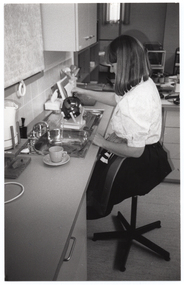
... ... kitchen sink...She is sitting on a swivel chair on castors, at the kitchen sink. A similar photo appears in the Vol 3 No 1, Autumn 1990 issue of the Arthritis Foundation of Victoria's quarterly magazine, Arthritis Update. ...B&W photo of a woman sitting on a swivel chair on castors, at a kitchen sink. She is pouring water from a kettle into the sink. ...B&W photo of a woman sitting on a swivel chair on castors, at a kitchen sink. She is pouring water from a kettle into the sink. ...Through its quarterly newsletters, the Arthritis Foundation of Victoria (AFV), formerly the Rheumatism and Arthritis Association of Victoria (RAAV), was able to inform its members about the latest arthritis-friendly kitchen appliances and aids, and how to use them. In this photo, a woman demonstrates how to use a kettle pourer. She is sitting on a swivel chair on castors, at the kitchen sink. A similar photo appears in the Vol 3 No 1, Autumn 1990 issue of the Arthritis Foundation of Victoria's quarterly magazine, Arthritis Update. The photo in the magazine is captioned: " 'Sit-Stand Chair' in use at a pull-out workbench. It's [sic] adjustable height makes it a useful piece of household equipment." In the published photo, the woman is depicted sitting on the sit-stand chair, about to cut an apple on a small chopping board. The photo accompanies an article titled, 'Living with Arthritis', with the subtitle 'Independent Living Centre', 'A service of the Yooralla Society of Victoria'. According to an earlier article appearing on page 3 of the No 33, August 1984 edition of RAAV's quarterly newsletter, News Review, the Independent Living Centre was the venue for the launch of Arthritis Week in May 1984.B&W photo of a woman sitting on a swivel chair on castors, at a kitchen sink. She is pouring water from a kettle into the sink. The kettle is sitting on a device which enables her to pour from the kettle without having to lift it. The sink is recessed into an L-shaped kitchen bench, upon which a cup and saucer can be seen sitting near the edge of the sink. There are several miscellaneous kitchen appliances on the bench. There are cupboards and drawers beneath the bench, and one set of cupboards above the sink.[On a yellow sticky note, in blue ink] November - December, 1989 Independent Living Centre?arthritis foundation of victoria, afv, rheumatism and arthritis association of victoria, raav, independent living centre, demonstration kitchen, arthritic aids, kitchen aids, kitchen gadgets, kitchen appliances, kitchen sink, kettle pourer, tea, coffee, hot drinks, swivel chair, sit-stand chair, pull-out workbench, retractable bench top, sliding bench top, adaptive kitchens, accessible kitchens, disability-friendly kitchens, modified kitchens, yooralla society of victoria, living with arthritis, pain management, 1989, arthritis update, 1990, news review, 1984 -
 Australian National Surfing Museum
Surfboard, 1/1/1959 (estimated)
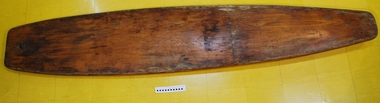
... The surfboard is made from marine ply, ureal/resorcinal glue, marine varnish, copper nails, the skeg (fin) is Huon Pine made from an old kitchen sink drain board....Skeg made from old kitchen sink (Huon Pine)....Skeg made from old kitchen sink (Huon Pine). Hollow Wooden Plywood Surfboard. ...This Ockanui Hollow Plywood Surfboard was shaped by Peter Watson and his father at their family home in Murrumbeena in 1959 (Peter was aged 16 at the time). The surfboard was based on a series of full size plans purchased from the USA. The surfboard is made from marine ply, ureal/resorcinal glue, marine varnish, copper nails, the skeg (fin) is Huon Pine made from an old kitchen sink drain board.This surfboard is an excellent example of the type of hollow wooden surfboards being made in the USA and Australia in 1959. Hollow Wooden Plywood Surfboard. Hand made Ockanui, single fin. 9' 11" x 21 1/2" x 4 1/2" Nose 17 3/4" Tail 13" Fin 4 3/4" Base 1 3/4"No distinct inscriptions or markings. Skeg made from old kitchen sink (Huon Pine).ockanui, peter watson, hollow wooden surfboard, -
 Robin Boyd Foundation
Document, Robin Boyd
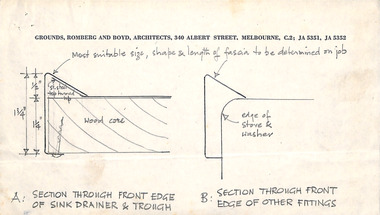
... Robin Boyd sketch of variation to the kitchen sink....Walsh St construction John Murphy Robin Boyd sketch of variation to the kitchen sink. Document Robin Boyd ...Robin Boyd has drawn a variation on the sink and trough for Walsh Street construction. This documents are owned by the Murphy family and were provided to the Robin Boyd Foundation for digitisation.Robin Boyd sketch of variation to the kitchen sink.walsh st construction, john murphy -
 Musculoskeletal Health Australia (now held by the Glen Eira Historical Society)
Photograph - Solo photo, November to December 1989
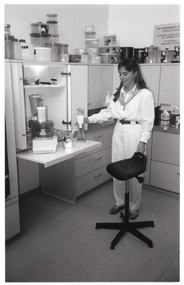
... ... kitchen sink...According to an earlier article appearing on page 3 of the No 33, August 1984 edition of RAAV's quarterly newsletter, News Review, the Independent Living Centre was the venue for the launch of Arthritis Week in May 1984. arthritis foundation of victoria afv rheumatism and arthritis association of victoria raav independent living centre demonstration kitchen arthritic aids kitchen aids kitchen gadgets kitchen appliances kitchen sink food processor blender immersion blender stick blender kitchen canisters food storage pantry storage containers swivel chair sit-stand chair pull-out workbench retractable bench top sliding bench top adaptive kitchens accessible kitchens disability-friendly kitchens modified kitchens yooralla society of victoria living with arthritis pain management arthritis update news review 1990 1984 [On a yellow sticky note, in blue ink] The aid (crossed out) 'Sit Stand Chair' can be wheeled into position and easily adjusted to a suitable height. ...Through its quarterly newsletters, the Arthritis Foundation of Victoria (AFV), formerly the Rheumatism and Arthritis Association of Victoria (RAAV), was able to inform its members about the latest arthritis-friendly kitchen appliances and aids, and how to use them. In this photo, a woman stands beside a Sit-Stand Chair (a high mobile stool on castors) and a pull-out shelf, on which sit various electric kitchen appliances (such as a food processor and an immersion blender). The photo was taken at the Independent Living Centre, which contained a specially designed demonstration kitchen through which innovative designs and aids for people living with arthritis could be showcased. According to an earlier article appearing on page 3 of the No 33, August 1984 edition of RAAV's quarterly newsletter, News Review, the Independent Living Centre was the venue for the launch of Arthritis Week in May 1984.B&W photo of a woman standing beside a pull-out kitchen shelf and a high stool on castors. On top of the shelf are some kitchen appliances, such as a food processor and a hand-held immersion blender. On top of the kitchen cupboards, there are several round plastic food storage containers of various sizes stacked upon one another.[On a yellow sticky note, in blue ink] The aid (crossed out) 'Sit Stand Chair' can be wheeled into position and easily adjusted to a suitable height. [On a yellow sticky note, in blue ink] Joan - Use whichever of these is (crossed out) gives the clearer idea. This one perhaps - Jenny.arthritis foundation of victoria, afv, rheumatism and arthritis association of victoria, raav, independent living centre, demonstration kitchen, arthritic aids, kitchen aids, kitchen gadgets, kitchen appliances, kitchen sink, food processor, blender, immersion blender, stick blender, kitchen canisters, food storage, pantry storage containers, swivel chair, sit-stand chair, pull-out workbench, retractable bench top, sliding bench top, adaptive kitchens, accessible kitchens, disability-friendly kitchens, modified kitchens, yooralla society of victoria, living with arthritis, pain management, arthritis update, news review, 1990, 1984 -
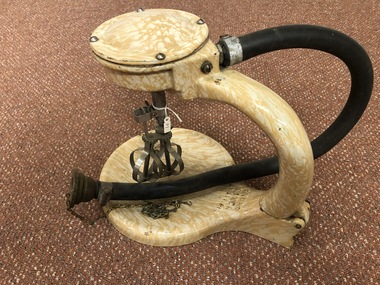 Mont De Lancey
Hydro Mixer, Circa 1920
... Connects to a kitchen sink tap....Connects to a kitchen sink tap. Whisks Food processing equipment Hydro Mixer Pat. ...Connects to a kitchen sink tap.Hydro Mixer water powered whisk, with marble patterning on body of enamelled cast iron mechanism.Hydro Mixer Pat. App.whisks, food processing equipment -
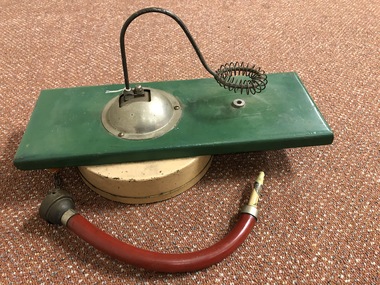 Mont De Lancey
Whisk, Circa 1920
... Water powered whisk, which connects to a kitchen sink tap....Water powered whisk, which connects to a kitchen sink tap. Whisks Water powered whisk on green wooden board, mounted on a metal drum. ...Water powered whisk, which connects to a kitchen sink tap.Water powered whisk on green wooden board, mounted on a metal drum.whisks -
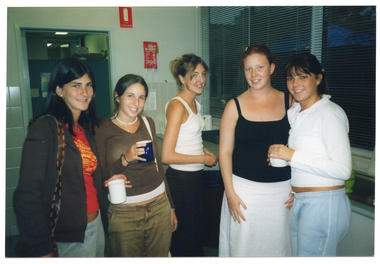 Musculoskeletal Health Australia (now held by the Glen Eira Historical Society)
Photograph - Group photo, Circa late 1990s
... Behind them, there is a large window with thin venetian blinds above the kitchen sink....Behind them, there is a large window with thin venetian blinds above the kitchen sink. Photograph Group photo ...In the late 1990s, Arthritis Victoria undertook a challenge to increase its membership. Consequently, a telemarketing team was engaged to help reach the proposed membership target. This photo depicts some of the telemarketing team on a tea/coffee break in the kitchen at Arthritis Victoria.Colour photo of five young women standing next to one another in a large kitchen. Three of the women are holding a mug in their hands. Behind them, there is a large window with thin venetian blinds above the kitchen sink.arthritis victoria, av, arthritis foundation of victoria, afv, membership drive, telemarketing team, c1990s -
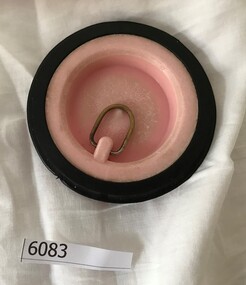 Greensborough Historical Society
Sink Plug, Double T Product Pty Ltd, Plastic plug, 1960s
... Kitchen sink plug, a souvenir of GHS kitchen, replaced by Banyule Council in December 2018....Kitchen sink plug, a souvenir of GHS kitchen, replaced by Banyule Council in December 2018. sink plugs Double T Product Pat App No 92838762 Pink plastic plug with neoprene rubber seal Plastic plug Sink Plug Double T Product Pty Ltd ...Kitchen sink plug, a souvenir of GHS kitchen, replaced by Banyule Council in December 2018.Pink plastic plug with neoprene rubber sealDouble T Product Pat App No 92838762sink plugs -
 Vision Australia
Photograph - Image, Two teenagers washing up
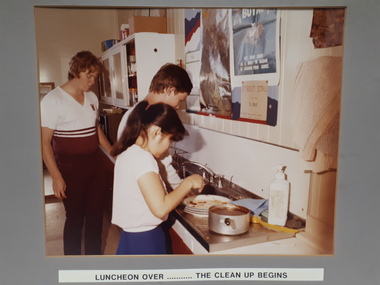
... A male at a kitchen sink, tap running and starting to wash up. ...A male at a kitchen sink, tap running and starting to wash up. ...A male at a kitchen sink, tap running and starting to wash up. Next to him, closer to camera, a female has her hand over some scraped plates that sit next to a soaking saucepan. Another male approaches the sink area from the far side. Poster hang above the sink, whilst to the left of the sink are white overhead cupboards holding kitchen items and below the white bench top are dark orange cupboard doors. Between the two males, there is possibly a microwave. Below the picture are the words "Luncheon over ... the clean up begins".Digital image of three people in a kitchen arealife skills, rvib burwood school -
 Orbost & District Historical Society
wash tub, 1900-1910
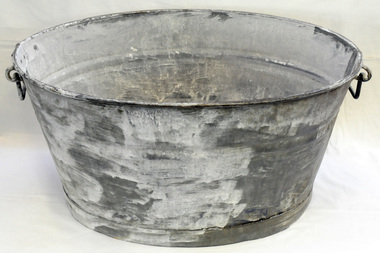
... Thus the washing for the family of five daughters was done with this tub. .Tubs of this type vary in size and were used for washing dishes (It was the “ kitchen sink”) or for washing smaller items of clothing “the delicates”. ...Thus the washing for the family of five daughters was done with this tub. .Tubs of this type vary in size and were used for washing dishes (It was the “ kitchen sink”) or for washing smaller items of clothing “the delicates”. ...This item was bought by George Henry Douglas Russell when he married Hilda Raymond, a parson's daughter, in 1920. This galvanised metal wash tub was manufactured for domestic use prior to household plumbing, running water or waste removal in Australian homes. On farms in the late 19th / early 20th centuries there were no built-in coppers and concrete troughs with reticulated water. Thus the washing for the family of five daughters was done with this tub. .Tubs of this type vary in size and were used for washing dishes (It was the “ kitchen sink”) or for washing smaller items of clothing “the delicates”. This tub could also have been used to bathe the children. The water was heated on a wood fired stove, then carried to the tub. This could be a lengthy and physically demanding exercise. Much more labor intensive than loading the dishwasher. After use the water may have been “recycled”by being poured onto vegetable gardens and fruit trees. Later at harvesting this tub held maize and beans to top up the three bushel bags of the threshing machines. This was before the hand sewing of the top of the bags with needle and twine.This tub is an indication that items for domestic use in the early 20th century were “made to last” and not manufactured for planned obsolescence.A large galvanized iron was tub, circular with the sides tapering slightly to the flat base. It is seamed on both sides, made from two shets of iron. The base has been soldered on. and the top rim is folded. On either side handles are rivetted on.domestic laundry was-tub galvanized-iron -
 Coal Creek Community Park & Museum
Bottle, glass, Australian Glass Manufacturers, c. 1916-1923
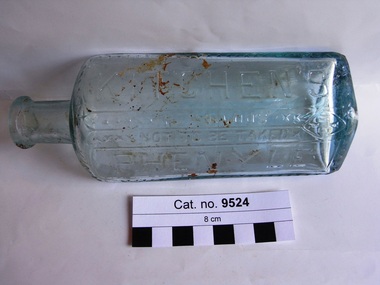
... TROVE : The Australasian, Saturday 1 October 1921, page 11, Article. 'Kitchen's Phenyle for sinks and drains....'...TROVE : The Australasian, Saturday 1 October 1921, page 11, Article. 'Kitchen's Phenyle for sinks and drains....' poison phenyle Kitchen 'KITCHEN PHENYLE', 'POISONOUS', NOT TO BE TAKEN' between panels of stippled crosses on sides. ...Haines, Gregory, 1994, Á History of Pharmacy in Victoria, The Australian Pharmaceutical Publishing Company in association with the Pharmaceutical Society of Australia (Victoria) Ltd, Melbourne, Australia. Page 41 '..................Although John Kitchen and his sons began their soap making business in South Melbourne in 1855, these low standards of hygiene and the overcrowding in Melbourne and on the diggings helped to cause significant health problems.........''. TROVE : The Age, Monday 6 October 1919, page 10, Advertisement. 'J Kitchen and Sons Pty Ltd, 10 Queen Street Melbourne......Kitchen's .....Phenyle...' TROVE : The Australasian, Saturday 1 October 1921, page 11, Article. 'Kitchen's Phenyle for sinks and drains....'Aqua blue tinted glass, diamond shaped in section, poison bottle with embossed text and pattern around two panels containing text with bottle manufacturers monogram on base.'KITCHEN PHENYLE', 'POISONOUS', NOT TO BE TAKEN' between panels of stippled crosses on sides. In a diamond shaped cartouche, the letter 'V' over 'D M' over 'A'. AGM monogram on base.poison, phenyle, kitchen -
 City of Moorabbin Historical Society (Operating the Box Cottage Museum)
Kitchen Equipment, cutlery butter knife, c1930
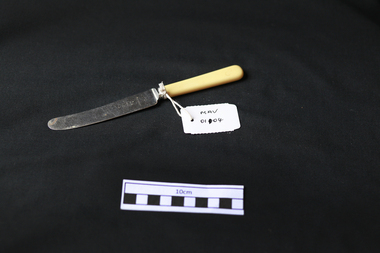
... Mytton’s were heavy manufacturing engineers producing a large range of stainless steel products including: kitchen sinks of various design, beer barrels [9 and 18 gallon kegs] for the breweries, milk vats for cooling and storing milk on dairy farms, a large range of dairy and industrial vessels, road transport tanks, LPG tanks, low pressure pre-mix vessels for the soft drink industry. ...Mytton’s were heavy manufacturing engineers producing a large range of stainless steel products including: kitchen sinks of various design, beer barrels [9 and 18 gallon kegs] for the breweries, milk vats for cooling and storing milk on dairy farms, a large range of dairy and industrial vessels, road transport tanks, LPG tanks, low pressure pre-mix vessels for the soft drink industry. ...Rodd's was established by George & Ernest Rodd in Melbourne in 1919.They were manufacturers and wholesalers of precious metal jewellery. Later they began to manufacture high quality silver plated cutlery under the brand name “Rodd”. They then expanded into holloware when they took over Platers Pty. Ltd. who produced a very high quality range of silver plated Sheffield Reproduction Silverware, under the brand name “Hecworth”. Rodd’s established a large factory at 150 Barkly St., St. Kilda, Melbourne. During WW2 with a staff some 200, the factory produced ordnance components to help with the war effort. Rodd’s established sales offices in the main city centres of all States. The company prospered. In December, 1960, Rodd [Australia] Ltd. was merged with Mytton’s Ltd., Melbourne, and became part of the newly formed company Mytton Rodd [Australia] Ltd. Mytton’s were also producers of silver plated cutlery under the brand name “Grosvenor” and were strong competitors to the Rodd brand of cutlery Australia wide. It was a friendly take over and the Directors of Rodd [Aust.] Ltd. were appointed to the board of Mytton Rodd [Aust.] Ltd., and some to the Holding Company Mytton’s Ltd. Mytton’s were heavy manufacturing engineers producing a large range of stainless steel products including: kitchen sinks of various design, beer barrels [9 and 18 gallon kegs] for the breweries, milk vats for cooling and storing milk on dairy farms, a large range of dairy and industrial vessels, road transport tanks, LPG tanks, low pressure pre-mix vessels for the soft drink industry. They also produced a range of domestic bathes, steel railway sleepers, using their 3000 ton hydraulic presses. Mytton’s also had their own non ferrous foundry and rolling mill which produced nickel silver sheet used in the manufacturer of their silver plated cutlery. They also produced copper sheet for their own and industrial use. Mytton’s had factories in York St., South Melbourne and Port Melbourne. Rodd [Aust.] Ltd. set up a manufacturing, distribution plant in Auckland, New Zealand, circa 1960. This company began producing precious metal jewellery in a rented space in the premises of Matthey Garret Ltd., Bullion Merchants, in Drake St., Auckland. Later they moved into their own building in Sale St., Auckland. The company prospered and purchased land and built a factory at 121 Apirana Ave. Glen Innes, Auckland, circa 1964. ( B. McCulloch Rodd Pty Ltd)A butter knife with stainless steel blade and bone handle c1930on blade; RODD / STAINLESScutlery, stainless steel, cheltenham, moorabbin, bentleigh, early settlers, rodd aust ltd, mytton rodd pty ltd, aukland, port melbourne -
![Photograph - Colour Print, Harry Gilham [Attrib.], Living and Learning Centre, Main Road, Eltham, Aug 1988](/media/collectors/4f729f7b97f83e03086018a5/items/6a1ccb54e43e4200865b4676/item-media/6a1ccbd3e43e4200865b58ed/item-fit-380x285.jpg?cb=6) Eltham District Historical Society Inc
Eltham District Historical Society IncPhotograph - Colour Print, Harry Gilham [Attrib.], Living and Learning Centre, Main Road, Eltham, Aug 1988
... The former northeast room was divided into bathroom/toilet and passageway with cupboards to access the extension. Kitchen stove and sink was removed (they fell apart) and a slow-combustion stove with hot water heater installed. ...The former northeast room was divided into bathroom/toilet and passageway with cupboards to access the extension. Kitchen stove and sink was removed (they fell apart) and a slow-combustion stove with hot water heater installed. ...North face of house viewed from the current (1990) pottery area (now pathed) The kitchen was separate from the house as a safety measure in the late 1800s. A detailed history of the site and early development of the Eltham Living and Learning Centre can be found in EDHS_04870 - Folder, Shire of Eltham Living and Learning Centre, 1996 The original property was part of Josiah Holloways subdivision of Little Eltham. It had a 70 foot frontage to Maria Street and stretched down to the Diamond Creek. John Perason, a Tanner, purchased the property in 1857 for £100 and he built a solid brick house which over the years was modified significantly by various owners and which is the basis of the present-day Living and Learning Centre. Claire Fitzpatrick and her husband Alfred, a retired chemical engineer, bought it in the early 1950's. Claire's interest in farming and animal husbandry and breeding saw her modify and establish buildings on the property to house goats and poultry with a horse stable and storage sheds for the animal food. She also built the coach house with its horse box and tack room and built an adjoining garage for their car. Structural alterations to the house were also carried out during the period of their ownership. Their house renovations removed the four fireplaces and chimneys and added a wider verandah, a fibro cement extension on the north wall requiring a doorway to be made in the brick wall for access. Part of a passage wall was removed to join the northwest room, now the "sitting room". A new jarrah floor was put in as the old one was rotten with borer. The verandahs, front and back, were re-organised in design and the front door had its leadlighting panels removed to allow more light into the house. During this period the water catchment well was filled in. This well had a concrete slab fitted onto a collar around its top. The well is 12 feet deep and 8 feet in diameter. Septic sewerage was installed and an internal toilet fitted in the house. The former northeast room was divided into bathroom/toilet and passageway with cupboards to access the extension. Kitchen stove and sink was removed (they fell apart) and a slow-combustion stove with hot water heater installed. Basins and hot water were connected to the new bathroom. In the early 1970s Eltham Shire Council, Councillors Frank Maas and Don Maling, were proposing an extended communities activities program be set up and the Commonwealth Grants Commission was approached for financial assistance to such a scheme. During 1974 a $50,000 Commonwealth Government grant was received by the Shire Council to acquire the Fitzpatrick property as part of the Shire's planning to establish an "extended community activities program". Council's Committee recommended an annual budget of $26,950 for the program and the project was named the Living and Learning Centre and in charge of the program was the first co-ordinator, Carina Hack. The activities were planned to cover "practical skills for living" and included cooking, preserving, gardening, animal husbandry, home economics, electronics, carpentry, hairdressing, making children's clothes and car maintenance. Hobbies and arts and crafts that would include amongst other future items, winemaking, music spinning and weaving and painting. 739 main road eltham, eltham living and learning centre, living and learning centre, living and learning nillumbik (eltham), main road eltham -
 Eltham District Historical Society Inc
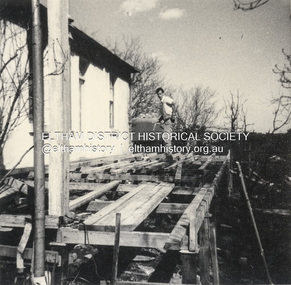
Photograph - Black and White Print, Widening of the verandah of 'Rosebank,' now Living and Learning Centre, Main Road, Eltham, c.1965
... The former northeast room was divided into bathroom/toilet and passageway with cupboards to access the extension. Kitchen stove and sink was removed (they fell apart) and a slow-combustion stove with hot water heater installed. ...The former northeast room was divided into bathroom/toilet and passageway with cupboards to access the extension. Kitchen stove and sink was removed (they fell apart) and a slow-combustion stove with hot water heater installed. ...Restructure of the front verandah of 'Rosebank' by widening, c.1965. It was glassed in at a later date. The west facing front verandah was widened and enclosed for additional class room use by the Living and Learning Centre. A detailed history of the site and early development of the Eltham Living and Learning Centre can be found in EDHS_04870 - Folder, Shire of Eltham Living and Learning Centre, 1996 The original property was part of Josiah Holloways subdivision of Little Eltham. It had a 70 foot frontage to Maria Street and stretched down to the Diamond Creek. John Perason, a Tanner, purchased the property in 1857 for £100 and he built a solid brick house which over the years was modified significantly by various owners and which is the basis of the present-day Living and Learning Centre. Claire Fitzpatrick and her husband Alfred, a retired chemical engineer, bought it in the early 1950's. Claire's interest in farming and animal husbandry and breeding saw her modify and establish buildings on the property to house goats and poultry with a horse stable and storage sheds for the animal food. She also built the coach house with its horse box and tack room and built an adjoining garage for their car. Structural alterations to the house were also carried out during the period of their ownership. Their house renovations removed the four fireplaces and chimneys and added a wider verandah, a fibro cement extension on the north wall requiring a doorway to be made in the brick wall for access. Part of a passage wall was removed to join the northwest room, now the "sitting room". A new jarrah floor was put in as the old one was rotten with borer. The verandahs, front and back, were re-organised in design and the front door had its leadlighting panels removed to allow more light into the house. During this period the water catchment well was filled in. This well had a concrete slab fitted onto a collar around its top. The well is 12 feet deep and 8 feet in diameter. Septic sewerage was installed and an internal toilet fitted in the house. The former northeast room was divided into bathroom/toilet and passageway with cupboards to access the extension. Kitchen stove and sink was removed (they fell apart) and a slow-combustion stove with hot water heater installed. Basins and hot water were connected to the new bathroom. In the early 1970s Eltham Shire Council, Councillors Frank Maas and Don Maling, were proposing an extended communities activities program be set up and the Commonwealth Grants Commission was approached for financial assistance to such a scheme. During 1974 a $50,000 Commonwealth Government grant was received by the Shire Council to acquire the Fitzpatrick property as part of the Shire's planning to establish an "extended community activities program". Council's Committee recommended an annual budget of $26,950 for the program and the project was named the Living and Learning Centre and in charge of the program was the first co-ordinator, Carina Hack. The activities were planned to cover "practical skills for living" and included cooking, preserving, gardening, animal husbandry, home economics, electronics, carpentry, hairdressing, making children's clothes and car maintenance. Hobbies and arts and crafts that would include amongst other future items, winemaking, music spinning and weaving and painting. 739 main road eltham, eltham living and learning centre, living and learning centre, living and learning nillumbik (eltham), main road eltham -
![Photograph - Colour Print, Harry Gilham [Attrib.], Living and Learning Centre, Main Road, Eltham, c.1988](/media/collectors/4f729f7b97f83e03086018a5/items/6a1cdaf8e43e4200865c849d/item-media/6a1cdb13e43e4200865c85b6/item-fit-380x285.jpg?cb=6) Eltham District Historical Society Inc
Eltham District Historical Society IncPhotograph - Colour Print, Harry Gilham [Attrib.], Living and Learning Centre, Main Road, Eltham, c.1988
... The former northeast room was divided into bathroom/toilet and passageway with cupboards to access the extension. Kitchen stove and sink was removed (they fell apart) and a slow-combustion stove with hot water heater installed. ...The former northeast room was divided into bathroom/toilet and passageway with cupboards to access the extension. Kitchen stove and sink was removed (they fell apart) and a slow-combustion stove with hot water heater installed. ...The 'back door' which faced the Main Road entrance to the office, Eltham Living and Learning Centre, herb garden at its peak, late 1980s A detailed history of the site and early development of the Eltham Living and Learning Centre can be found in EDHS_04870 - Folder, Shire of Eltham Living and Learning Centre, 1996 The original property was part of Josiah Holloways subdivision of Little Eltham. It had a 70 foot frontage to Maria Street and stretched down to the Diamond Creek. John Perason, a Tanner, purchased the property in 1857 for £100 and he built a solid brick house which over the years was modified significantly by various owners and which is the basis of the present-day Living and Learning Centre. Claire Fitzpatrick and her husband Alfred, a retired chemical engineer, bought it in the early 1950's. Claire's interest in farming and animal husbandry and breeding saw her modify and establish buildings on the property to house goats and poultry with a horse stable and storage sheds for the animal food. She also built the coach house with its horse box and tack room and built an adjoining garage for their car. Structural alterations to the house were also carried out during the period of their ownership. Their house renovations removed the four fireplaces and chimneys and added a wider verandah, a fibro cement extension on the north wall requiring a doorway to be made in the brick wall for access. Part of a passage wall was removed to join the northwest room, now the "sitting room". A new jarrah floor was put in as the old one was rotten with borer. The verandahs, front and back, were re-organised in design and the front door had its leadlighting panels removed to allow more light into the house. During this period the water catchment well was filled in. This well had a concrete slab fitted onto a collar around its top. The well is 12 feet deep and 8 feet in diameter. Septic sewerage was installed and an internal toilet fitted in the house. The former northeast room was divided into bathroom/toilet and passageway with cupboards to access the extension. Kitchen stove and sink was removed (they fell apart) and a slow-combustion stove with hot water heater installed. Basins and hot water were connected to the new bathroom. In the early 1970s Eltham Shire Council, Councillors Frank Maas and Don Maling, were proposing an extended communities activities program be set up and the Commonwealth Grants Commission was approached for financial assistance to such a scheme. During 1974 a $50,000 Commonwealth Government grant was received by the Shire Council to acquire the Fitzpatrick property as part of the Shire's planning to establish an "extended community activities program". Council's Committee recommended an annual budget of $26,950 for the program and the project was named the Living and Learning Centre and in charge of the program was the first co-ordinator, Carina Hack. The activities were planned to cover "practical skills for living" and included cooking, preserving, gardening, animal husbandry, home economics, electronics, carpentry, hairdressing, making children's clothes and car maintenance. Hobbies and arts and crafts that would include amongst other future items, winemaking, music spinning and weaving and painting. 739 main road eltham, eltham living and learning centre, living and learning centre, living and learning nillumbik (eltham), main road eltham -
![Photograph - Black and White Print, Harry Gilham [Attrib.], Living and Learning Centre, Main Road, Eltham, 1990](/media/collectors/4f729f7b97f83e03086018a5/items/6a1cdbffe43e4200865c95df/item-media/6a1cdc19e43e4200865c975d/item-fit-380x285.jpg?cb=6) Eltham District Historical Society Inc
Eltham District Historical Society IncPhotograph - Black and White Print, Harry Gilham [Attrib.], Living and Learning Centre, Main Road, Eltham, 1990
... The former northeast room was divided into bathroom/toilet and passageway with cupboards to access the extension. Kitchen stove and sink was removed (they fell apart) and a slow-combustion stove with hot water heater installed. ...The former northeast room was divided into bathroom/toilet and passageway with cupboards to access the extension. Kitchen stove and sink was removed (they fell apart) and a slow-combustion stove with hot water heater installed. ...The 'back door' which faced the Main Road entrance to the office, Eltham Living and Learning Centre - Shows original sandstone blocks in back verandah floor A detailed history of the site and early development of the Eltham Living and Learning Centre can be found in EDHS_04870 - Folder, Shire of Eltham Living and Learning Centre, 1996 The original property was part of Josiah Holloways subdivision of Little Eltham. It had a 70 foot frontage to Maria Street and stretched down to the Diamond Creek. John Perason, a Tanner, purchased the property in 1857 for £100 and he built a solid brick house which over the years was modified significantly by various owners and which is the basis of the present-day Living and Learning Centre. Claire Fitzpatrick and her husband Alfred, a retired chemical engineer, bought it in the early 1950's. Claire's interest in farming and animal husbandry and breeding saw her modify and establish buildings on the property to house goats and poultry with a horse stable and storage sheds for the animal food. She also built the coach house with its horse box and tack room and built an adjoining garage for their car. Structural alterations to the house were also carried out during the period of their ownership. Their house renovations removed the four fireplaces and chimneys and added a wider verandah, a fibro cement extension on the north wall requiring a doorway to be made in the brick wall for access. Part of a passage wall was removed to join the northwest room, now the "sitting room". A new jarrah floor was put in as the old one was rotten with borer. The verandahs, front and back, were re-organised in design and the front door had its leadlighting panels removed to allow more light into the house. During this period the water catchment well was filled in. This well had a concrete slab fitted onto a collar around its top. The well is 12 feet deep and 8 feet in diameter. Septic sewerage was installed and an internal toilet fitted in the house. The former northeast room was divided into bathroom/toilet and passageway with cupboards to access the extension. Kitchen stove and sink was removed (they fell apart) and a slow-combustion stove with hot water heater installed. Basins and hot water were connected to the new bathroom. In the early 1970s Eltham Shire Council, Councillors Frank Maas and Don Maling, were proposing an extended communities activities program be set up and the Commonwealth Grants Commission was approached for financial assistance to such a scheme. During 1974 a $50,000 Commonwealth Government grant was received by the Shire Council to acquire the Fitzpatrick property as part of the Shire's planning to establish an "extended community activities program". Council's Committee recommended an annual budget of $26,950 for the program and the project was named the Living and Learning Centre and in charge of the program was the first co-ordinator, Carina Hack. The activities were planned to cover "practical skills for living" and included cooking, preserving, gardening, animal husbandry, home economics, electronics, carpentry, hairdressing, making children's clothes and car maintenance. Hobbies and arts and crafts that would include amongst other future items, winemaking, music spinning and weaving and painting. 739 main road eltham, eltham living and learning centre, living and learning centre, living and learning nillumbik (eltham), main road eltham -
![Photograph - Black and White Print, Harry Gilham [Attrib.], Living and Learning Centre, Main Road, Eltham, c.1990](/media/collectors/4f729f7b97f83e03086018a5/items/6a1cddabe43e4200865cee41/item-media/6a1cddbbe43e4200865cf696/item-fit-380x285.jpg?cb=6) Eltham District Historical Society Inc
Eltham District Historical Society IncPhotograph - Black and White Print, Harry Gilham [Attrib.], Living and Learning Centre, Main Road, Eltham, c.1990
... The former northeast room was divided into bathroom/toilet and passageway with cupboards to access the extension. Kitchen stove and sink was removed (they fell apart) and a slow-combustion stove with hot water heater installed. ...The former northeast room was divided into bathroom/toilet and passageway with cupboards to access the extension. Kitchen stove and sink was removed (they fell apart) and a slow-combustion stove with hot water heater installed. ...Brick storage shed, south wall entry. This cool room, half set down in the soil still standing at time but with a more modern galvanised tin roof. A detailed history of the site and early development of the Eltham Living and Learning Centre can be found in EDHS_04870 - Folder, Shire of Eltham Living and Learning Centre, 1996 The original property was part of Josiah Holloways subdivision of Little Eltham. It had a 70 foot frontage to Maria Street and stretched down to the Diamond Creek. John Perason, a Tanner, purchased the property in 1857 for £100 and he built a solid brick house which over the years was modified significantly by various owners and which is the basis of the present-day Living and Learning Centre. Claire Fitzpatrick and her husband Alfred, a retired chemical engineer, bought it in the early 1950's. Claire's interest in farming and animal husbandry and breeding saw her modify and establish buildings on the property to house goats and poultry with a horse stable and storage sheds for the animal food. She also built the coach house with its horse box and tack room and built an adjoining garage for their car. Structural alterations to the house were also carried out during the period of their ownership. Their house renovations removed the four fireplaces and chimneys and added a wider verandah, a fibro cement extension on the north wall requiring a doorway to be made in the brick wall for access. Part of a passage wall was removed to join the northwest room, now the "sitting room". A new jarrah floor was put in as the old one was rotten with borer. The verandahs, front and back, were re-organised in design and the front door had its leadlighting panels removed to allow more light into the house. During this period the water catchment well was filled in. This well had a concrete slab fitted onto a collar around its top. The well is 12 feet deep and 8 feet in diameter. Septic sewerage was installed and an internal toilet fitted in the house. The former northeast room was divided into bathroom/toilet and passageway with cupboards to access the extension. Kitchen stove and sink was removed (they fell apart) and a slow-combustion stove with hot water heater installed. Basins and hot water were connected to the new bathroom. In the early 1970s Eltham Shire Council, Councillors Frank Maas and Don Maling, were proposing an extended communities activities program be set up and the Commonwealth Grants Commission was approached for financial assistance to such a scheme. During 1974 a $50,000 Commonwealth Government grant was received by the Shire Council to acquire the Fitzpatrick property as part of the Shire's planning to establish an "extended community activities program". Council's Committee recommended an annual budget of $26,950 for the program and the project was named the Living and Learning Centre and in charge of the program was the first co-ordinator, Carina Hack. The activities were planned to cover "practical skills for living" and included cooking, preserving, gardening, animal husbandry, home economics, electronics, carpentry, hairdressing, making children's clothes and car maintenance. Hobbies and arts and crafts that would include amongst other future items, winemaking, music spinning and weaving and painting. 739 main road eltham, eltham living and learning centre, living and learning centre, living and learning nillumbik (eltham), main road eltham -
![Photograph - Colour Print, Harry Gilham [Attrib.], Living and Learning Centre, Main Road, Eltham, 1995](/media/collectors/4f729f7b97f83e03086018a5/items/6a1cde5de43e4200865d0c81/item-media/6a1cde8be43e4200865d1127/item-fit-380x285.jpg?cb=6) Eltham District Historical Society Inc
Eltham District Historical Society IncPhotograph - Colour Print, Harry Gilham [Attrib.], Living and Learning Centre, Main Road, Eltham, 1995
... The former northeast room was divided into bathroom/toilet and passageway with cupboards to access the extension. Kitchen stove and sink was removed (they fell apart) and a slow-combustion stove with hot water heater installed. ...The former northeast room was divided into bathroom/toilet and passageway with cupboards to access the extension. Kitchen stove and sink was removed (they fell apart) and a slow-combustion stove with hot water heater installed. ...New Pavilion at left has plants appearing. Grass area needs a mow - verandah with repainted stool/forms - early spring 1995 A detailed history of the site and early development of the Eltham Living and Learning Centre can be found in EDHS_04870 - Folder, Shire of Eltham Living and Learning Centre, 1996 The original property was part of Josiah Holloways subdivision of Little Eltham. It had a 70 foot frontage to Maria Street and stretched down to the Diamond Creek. John Perason, a Tanner, purchased the property in 1857 for £100 and he built a solid brick house which over the years was modified significantly by various owners and which is the basis of the present-day Living and Learning Centre. Claire Fitzpatrick and her husband Alfred, a retired chemical engineer, bought it in the early 1950's. Claire's interest in farming and animal husbandry and breeding saw her modify and establish buildings on the property to house goats and poultry with a horse stable and storage sheds for the animal food. She also built the coach house with its horse box and tack room and built an adjoining garage for their car. Structural alterations to the house were also carried out during the period of their ownership. Their house renovations removed the four fireplaces and chimneys and added a wider verandah, a fibro cement extension on the north wall requiring a doorway to be made in the brick wall for access. Part of a passage wall was removed to join the northwest room, now the "sitting room". A new jarrah floor was put in as the old one was rotten with borer. The verandahs, front and back, were re-organised in design and the front door had its leadlighting panels removed to allow more light into the house. During this period the water catchment well was filled in. This well had a concrete slab fitted onto a collar around its top. The well is 12 feet deep and 8 feet in diameter. Septic sewerage was installed and an internal toilet fitted in the house. The former northeast room was divided into bathroom/toilet and passageway with cupboards to access the extension. Kitchen stove and sink was removed (they fell apart) and a slow-combustion stove with hot water heater installed. Basins and hot water were connected to the new bathroom. In the early 1970s Eltham Shire Council, Councillors Frank Maas and Don Maling, were proposing an extended communities activities program be set up and the Commonwealth Grants Commission was approached for financial assistance to such a scheme. During 1974 a $50,000 Commonwealth Government grant was received by the Shire Council to acquire the Fitzpatrick property as part of the Shire's planning to establish an "extended community activities program". Council's Committee recommended an annual budget of $26,950 for the program and the project was named the Living and Learning Centre and in charge of the program was the first co-ordinator, Carina Hack. The activities were planned to cover "practical skills for living" and included cooking, preserving, gardening, animal husbandry, home economics, electronics, carpentry, hairdressing, making children's clothes and car maintenance. Hobbies and arts and crafts that would include amongst other future items, winemaking, music spinning and weaving and painting. 739 main road eltham, eltham living and learning centre, living and learning centre, living and learning nillumbik (eltham), main road eltham -
![Photograph - Colour Print, Harry Gilham [Attrib.], Living and Learning Centre, Main Road, Eltham, 1995](/media/collectors/4f729f7b97f83e03086018a5/items/6a1cdf36e43e4200865d43d6/item-media/6a1cdf50e43e4200865d4778/item-fit-380x285.jpg?cb=6) Eltham District Historical Society Inc
Eltham District Historical Society IncPhotograph - Colour Print, Harry Gilham [Attrib.], Living and Learning Centre, Main Road, Eltham, 1995
... The former northeast room was divided into bathroom/toilet and passageway with cupboards to access the extension. Kitchen stove and sink was removed (they fell apart) and a slow-combustion stove with hot water heater installed. ...The former northeast room was divided into bathroom/toilet and passageway with cupboards to access the extension. Kitchen stove and sink was removed (they fell apart) and a slow-combustion stove with hot water heater installed. ...New verandah Eltham Living and Learning Centre on the western face looking down over the Tannery site and Diamond Creek. Pavilion in place (LH Side). The verandah with its upgrade of curtains 1995. Originally 4 feet 6 inches wide. A detailed history of the site and early development of the Eltham Living and Learning Centre can be found in EDHS_04870 - Folder, Shire of Eltham Living and Learning Centre, 1996 The original property was part of Josiah Holloways subdivision of Little Eltham. It had a 70 foot frontage to Maria Street and stretched down to the Diamond Creek. John Perason, a Tanner, purchased the property in 1857 for £100 and he built a solid brick house which over the years was modified significantly by various owners and which is the basis of the present-day Living and Learning Centre. Claire Fitzpatrick and her husband Alfred, a retired chemical engineer, bought it in the early 1950's. Claire's interest in farming and animal husbandry and breeding saw her modify and establish buildings on the property to house goats and poultry with a horse stable and storage sheds for the animal food. She also built the coach house with its horse box and tack room and built an adjoining garage for their car. Structural alterations to the house were also carried out during the period of their ownership. Their house renovations removed the four fireplaces and chimneys and added a wider verandah, a fibro cement extension on the north wall requiring a doorway to be made in the brick wall for access. Part of a passage wall was removed to join the northwest room, now the "sitting room". A new jarrah floor was put in as the old one was rotten with borer. The verandahs, front and back, were re-organised in design and the front door had its leadlighting panels removed to allow more light into the house. During this period the water catchment well was filled in. This well had a concrete slab fitted onto a collar around its top. The well is 12 feet deep and 8 feet in diameter. Septic sewerage was installed and an internal toilet fitted in the house. The former northeast room was divided into bathroom/toilet and passageway with cupboards to access the extension. Kitchen stove and sink was removed (they fell apart) and a slow-combustion stove with hot water heater installed. Basins and hot water were connected to the new bathroom. In the early 1970s Eltham Shire Council, Councillors Frank Maas and Don Maling, were proposing an extended communities activities program be set up and the Commonwealth Grants Commission was approached for financial assistance to such a scheme. During 1974 a $50,000 Commonwealth Government grant was received by the Shire Council to acquire the Fitzpatrick property as part of the Shire's planning to establish an "extended community activities program". Council's Committee recommended an annual budget of $26,950 for the program and the project was named the Living and Learning Centre and in charge of the program was the first co-ordinator, Carina Hack. The activities were planned to cover "practical skills for living" and included cooking, preserving, gardening, animal husbandry, home economics, electronics, carpentry, hairdressing, making children's clothes and car maintenance. Hobbies and arts and crafts that would include amongst other future items, winemaking, music spinning and weaving and painting. 739 main road eltham, eltham living and learning centre, living and learning centre, living and learning nillumbik (eltham), main road eltham -
 City of Moorabbin Historical Society (Operating the Box Cottage Museum)
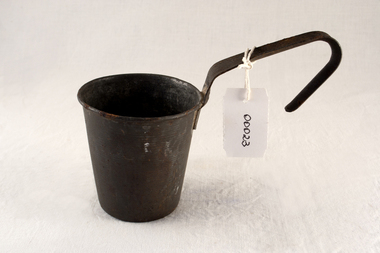
Functional object - Kitchen equipment, water-dipper, c1920
... sink wells on their land and build water pumps in order to obtain water. This tin dipper would have been used for drinking at the water pump . In 1846 Lachlan and Charles Mackinnon bought 117 acres of land in the 'Dendy's Special Survey' from J.B.Were This area is now known as the suburb of 'McKinnon' and may have been named after them. moorabbin wells water supply pioneers ormond bentleigh mckinnon market gardeners early settlers kitchen equipment water pumps mackinnon jessie mackinnon donald mackinnon lachlan mackinnon charles mackinnon daniel A tin water-dipper for obtaining drinking water from water pump Functional object Kitchen equipment, water-dipper Mackinnon family ...Early settlers could only obtain clean water by sinking a well on their land. A pump was built to draw water for use by the family and this tin dipper would have been used for drinking water. The Lachlan Mackinnon family were early settlers in Moorabbin ShireEarly settlers had to sink wells on their land and build water pumps in order to obtain water. This tin dipper would have been used for drinking at the water pump . In 1846 Lachlan and Charles Mackinnon bought 117 acres of land in the 'Dendy's Special Survey' from J.B.Were This area is now known as the suburb of 'McKinnon' and may have been named after them.A tin water-dipper for obtaining drinking water from water pumpmoorabbin, wells, water supply, pioneers, ormond, bentleigh, mckinnon, market gardeners, early settlers, kitchen equipment, water pumps, mackinnon jessie, mackinnon donald, mackinnon lachlan, mackinnon charles, mackinnon daniel -
 Bendigo Historical Society Inc.
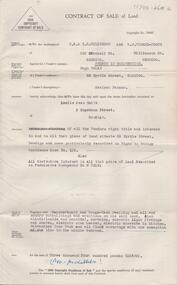
Document - H. A. & S. R. WILKINSON COLLECTION: CONTRACT OF SALE
... W70141, together with weatherboard and rough cast dwelling and all sundry outbuildings, also blinds, curtains, electric light fittings and shades, electric sink heater, electric stovette in kitchen, galvanised iron tank and all floor coverings with the exception of the lino in the middle bedroom. ...W70141, together with weatherboard and rough cast dwelling and all sundry outbuildings, also blinds, curtains, electric light fittings and shades, electric sink heater, electric stovette in kitchen, galvanised iron tank and all floor coverings with the exception of the lino in the middle bedroom. ...Contract of sale of land dated 14th may, 1956 between Mr. H Nolan (vendor) and Mrs. L. J. Smith (purchaser). Property: land situate 55 Myrtle Street, Bendigo land described in Right to Occupy residence area no. 125 - Also land described in Permissive Occupancy No. W70141, together with weatherboard and rough cast dwelling and all sundry outbuildings, also blinds, curtains, electric light fittings and shades, electric sink heater, electric stovette in kitchen, galvanised iron tank and all floor coverings with the exception of the lino in the middle bedroom. Price: 3,400 pounds.organization, business, h.a. & s.r wilkinson real estate -
 Bendigo Historical Society Inc.
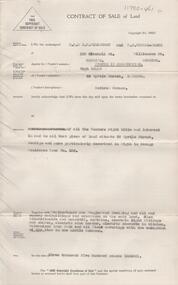
Document - H. A. & S. R. WILKINSON COLLECTION: CONTRACT OF SALE
... Property: land situate 55 Myrtle Street, Bendigo land described in Right to Occupy residence area no. 125, together with weatherboard and rough cast dwelling and all sundry outbuildings, also blinds, curtains, electric light fittings and shades, electric sink heater, electric stovette in kitchen, galvanised iron tank and all floor coverings with the exception of the lino in the middle bedroom. ...Property: land situate 55 Myrtle Street, Bendigo land described in Right to Occupy residence area no. 125, together with weatherboard and rough cast dwelling and all sundry outbuildings, also blinds, curtains, electric light fittings and shades, electric sink heater, electric stovette in kitchen, galvanised iron tank and all floor coverings with the exception of the lino in the middle bedroom. ...Contract of sale of land dated 14th may, 1956 between Mr. H Nolan (vendor) and ? Property: land situate 55 Myrtle Street, Bendigo land described in Right to Occupy residence area no. 125, together with weatherboard and rough cast dwelling and all sundry outbuildings, also blinds, curtains, electric light fittings and shades, electric sink heater, electric stovette in kitchen, galvanised iron tank and all floor coverings with the exception of the lino in the middle bedroom. Price: 3,500 pounds.organization, business, h.a. & s.r wilkinson real estate -
 Bendigo Historical Society Inc.
Document - LONG GULLY HISTORY GROUP COLLECTION: THE BENDIGO POST OFFICE
... sinking costs. Also mentioned is Bendigo and Eaglehawk - 60 years ago and the role the pubs played in daily living. They were where theatres, concerts and dances were held, and the meeting rooms for clubs and lodges, even church benefits. Listed is a number of Bendigo hotels. Some even had a few names. Names of the pubs are: The Freemasons, The Courthouse, The Commercial Law Courts, The Hamburg, The European, The Prince Bismark, The Lord Kitchener...sinking costs. Also mentioned is Bendigo and Eaglehawk - 60 years ago and the role the pubs played in daily living. They were where theatres, concerts and dances were held, and the meeting rooms for clubs and lodges, even church benefits. Listed is a number of Bendigo hotels. Some even had a few names. Names of the pubs are: The Freemasons, The Courthouse, The Commercial Law Courts, The Hamburg, The European, The Prince Bismark, The Lord Kitchener ...Article titled The Bendigo Post Office, compiled by L C Bennetts. Mentioned is the history of the Bendigo Post Office and postmarks, some information on mining, Bendigo foundries, Underground connections of mines, expenses and shaft sinking costs. Also mentioned is Bendigo and Eaglehawk - 60 years ago and the role the pubs played in daily living. They were where theatres, concerts and dances were held, and the meeting rooms for clubs and lodges, even church benefits. Listed is a number of Bendigo hotels. Some even had a few names. Names of the pubs are: The Freemasons, The Courthouse, The Commercial Law Courts, The Hamburg, The European, The Prince Bismark, The Lord Kitchener, The Bendigo, The Rosalind Park, The Showgrounds, Atheneum Club, Olivers, Bridge Hotel, Bourkes, The Globe, The Hibernia, Albert, Albion, Abbotts, Australian, Belvidere, Beehive, British Queen, Black Eagle, British and American, Brian Boru, Bakers Arms, Butchers Arms, Brick Layers Arms, Bull and Mouth, Cresent, Clarence, Back Creek Bridge, Cape Clear, Crooked Billet, Cambridgeshire Arms, Camp, Coach and Horses, Cricketers Arms, Diggers Rest, Ellesmere, Five Lions, Franklyn, Golden Square, Golden Gate, Golden Gully, Golden Age, Golden Vine, Gumtree, Glasgow Reef, Great Britain, Haymarket, Daniel O'Connell, Half Way House, Fleece Inn, Ironbark, Johnsons Reef, Lancashire, Live and Let Live, Manchester Arms, Gold Mines, Metropolitan, Crown, National, New Chum, Honeysuckle Street, Pavilion, Napier Arms, Quartz Miners Arms, Retreat Inn, Rainbow, Rose of Australia, Lake View, Robin Hood, Fountain, Southern Cross, Bath, Berlin, Spring Gully, Star, Sir Charles Hotham, Silvermines, Royal Oak, Suburban, Town Hall, Temperance, Ship Inn, View Point, View Bend, Victoria, Exchange, American, Arcade, Belfast, All Nations, Union, United Kingdom, Union Jack, Westend, Washington, Waterloo, Wellington, Whitehorse, Wheat Sheaf, Yorkshire, Niagra and Noahs Ark.bendigo, history, long gully history group, the long gully history group - the bendigo post office, l c bennetts, mt alexander post office, porcupine inn, cenotaph, pike or pyke, baby health centre, sandhurst post office, government survey office, queen elizabeth oval, sandhurst trustees company, mr h b briston, savings bank, telegraph office, the sub-treasury, sir henry brougham lock kcb, sir john nimmo mla, prince of wales group of mines, the new prince of wales, eaglehawk golf links, new prince of wales no 2, the whip and jersey, mines department, lansell's big 180, new chum and victoria mine and battery, new chum railway, koch's pioneer, south new moon, catherine reef united, new moon, the virginia, south bell vue, central nell gwynne, north nell gwynne, miner's phthisis, hercules engine house, ironbark, new chum syncline, hercules energetic, roberts & sons, harkness & co, horwoods, great southern, ulster, carlisle, lansells big 180, victoria quartz, new st mungo, duchess tribute, south devonshire, hopewell mine, saxby mine, mcnair & co, shamrock, mr king, burke and wills expedition, sandhurst hotel, courthouse, hiberian, the freemasons, the courthouse, the commercial law courts, the hamburg, the european, the prince bismark, the lord kitchener, the bendigo, the rosalind park, the showgrounds, atheneum club, olivers, bridge hotel, bourkes, the globe, the hibernia, albert, albion, abbotts, australian, belvidere, beehive, british queen, black eagle, british and american, brian boru, bakers arms, butchers arms, brick layers arms, bull and mouth, cresent, clarence, back creek bridge, cape clear, crooked billet, cambridgeshire arms, camp, coach and horses, cricketers arms, diggers rest, ellesmere, five lions, franklyn, golden square, golden gate, golden gully, golden age, golden vine, gumtree, glasgow reef, great britain, haymarket, daniel o'connell, half way house, fleece inn, ironbark, johnsons reef, lancashire, live and let live, manchester arms, gold mines, metropolitan, crown, national, new chum, honeysuckle street, pavilion, napier arms, quartz miners arms, retreat inn, rainbow, rose of australia, lake view, robin hood, fountain, southern cross, bath, berlin, spring gully, star, sir charles hotham, silvermines, royal oak, suburban, town hall, temperance, ship inn, view point, view bend, victoria, exchange, american, arcade, belfast, all nations, union, united kingdom, union jack, westend, washington, waterloo, wellington, whitehorse, wheat sheaf, yorkshire, niagra, noahs ark -
 Wangaratta Urban Fire Brigade
4x photograph - auxiliary
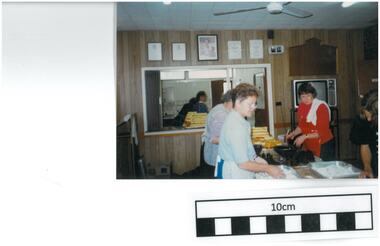
... 2 x colour photographs of the auxiliary members making lamingtons at the Ely St fire station meeting room and kitchen. Photo 1 L-R: unknown person at sink, Dianne Mills(in kitchen), Pat Prendergast, Beryl Nolan, Annette Norley, unknown person on right edge. ...2 x colour photographs of the auxiliary members making lamingtons at the Ely St fire station meeting room and kitchen. Photo 1 L-R: unknown person at sink, Dianne Mills(in kitchen), Pat Prendergast, Beryl Nolan, Annette Norley, unknown person on right edge. ...2 x colour photographs of the auxiliary members making lamingtons at the Ely St fire station meeting room and kitchen. Photo 1 L-R: unknown person at sink, Dianne Mills(in kitchen), Pat Prendergast, Beryl Nolan, Annette Norley, unknown person on right edge. Photo .2 L_R: Dianne Mills, Annette Norley, Pat Prendergast. .3 - front L to front R around table - Pat Prendegast, Dorothy Wise, ? , ? , Pat Briese, Jean Brown back table L-R - , ? , Sue Read( half a head showing), ? , .4 - front L to front R around table - Pat Prendegast, Dorothy Wise, ? , ? , Pat Briese, Jean Brown back table L-R - Sue Read, ? , ? ,2 x colour photographs of the auxiliary making lamingtons. 2 x black and white photographs of the auxiliary making lamingtons. lamington drive - top left .3 and .4 have "lamington drive Ladies Aux 1985 on back in the middle in penauxiliary, dianne mills, pat prendergast, beryl nolan, annette norley, dorothy wise, pat briese, jean brown, sue read, lamington drive -
 Ballarat Tramway Museum
Photograph - Colour Photograph/s - set of 10, Carolyn Dean and John Phillips, 30/07/2001 12:00:00 AM
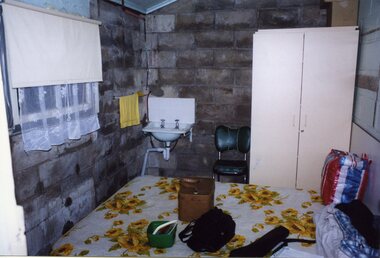
... On Kodak Paper. 1859.1 - Old bathroom, now a bedroom .2 - New toilet area .3 - New bathroom area .4 - ditto .5 - extended kitchen .6 - dining area .7 - close up of extended kitchen - 15/7/01 .8 - close up of sink in old bathroom, now a bedroom - 15/7/01 .9 - Looking to the south from outside house, towards sheds and plenty of cows - 14/07/01 .10 - Looking at north end of house - 14/07/01....On Kodak Paper. 1859.1 - Old bathroom, now a bedroom .2 - New toilet area .3 - New bathroom area .4 - ditto .5 - extended kitchen .6 - dining area .7 - close up of extended kitchen - 15/7/01 .8 - close up of sink in old bathroom, now a bedroom - 15/7/01 .9 - Looking to the south from outside house, towards sheds and plenty of cows - 14/07/01 .10 - Looking at north end of house - 14/07/01. ...Set of 10 colour photographs taken by John Phillips or Carolyn Dean of Bungaree House, property and works being carried out. Taken on 30.07.01 unless noted otherwise. On Kodak Paper. 1859.1 - Old bathroom, now a bedroom .2 - New toilet area .3 - New bathroom area .4 - ditto .5 - extended kitchen .6 - dining area .7 - close up of extended kitchen - 15/7/01 .8 - close up of sink in old bathroom, now a bedroom - 15/7/01 .9 - Looking to the south from outside house, towards sheds and plenty of cows - 14/07/01 .10 - Looking at north end of house - 14/07/01.In blue ink on rear, date of photograph, and photographer.bungaree, houses -
 Vision Australia
Photograph (item) - Image, Woman taking casserole dish out of over
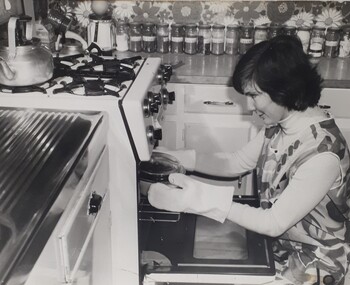
... kitchen, a woman with low vision removes a dish hot from the oven of an upright cooker. Dressed in a pinafore and oven gloves, she carefully maneouvres the dish outwards. Above her, a tea kettle sits on the hob, next to the sink...kitchen, a woman with low vision removes a dish hot from the oven of an upright cooker. Dressed in a pinafore and oven gloves, she carefully maneouvres the dish outwards. Above her, a tea kettle sits on the hob, next to the sink ...Cooking often requires skill and adaptation. In this kitchen, a woman with low vision removes a dish hot from the oven of an upright cooker. Dressed in a pinafore and oven gloves, she carefully maneouvres the dish outwards. Above her, a tea kettle sits on the hob, next to the sink. In the background, spice jars are lined up on the bench, each with a large written label on them. Woman is not named, but possibly Joy Kerr, who gave talks and wrote a book on cookery for people who are blind or vision impaired.royal blind society of nsw, education -
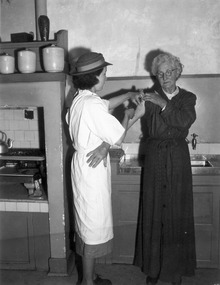 Royal District Nursing Service (now known as Bolton Clarke)
Photograph - Photograph, black and white:, 1952
... sink with cupboards below is behind the lady. To the left is fireplace which is now tiled at the rear and has a gas stove with kettle on a jet in the space. A row of three pale coloured kitchen...sink with cupboards below is behind the lady. To the left is fireplace which is now tiled at the rear and has a gas stove with kettle on a jet in the space. A row of three pale coloured kitchen ...This photograph is taken in the home of the lady and shows MDNS Sister J. Faust giving an injection, using a glass syringe, into the right upper arm of the lady. This type of syringe was re sterilized. These syringes remained in use until the mid 1960s when disposable plastic syringes took their place. This photograph was used in a video on the history of RDNS which is held by the organization. It is a record of the type of care given by Melbourne District Nursing Society (MDNS) Trained nurses in a patient's home.The Trained nurses of the Melbourne District Nursing Society (MDNS), later known as Royal District Nursing Service (RDNS), visited patients in their home and gave best practice care in many fields of nursing, and to people of many cultures, throughout its 130 years of expansion. Initial visits not only assessed the specific nursing situation but the situation as a whole. Their patients ranged in age from babes, children, adults to the elderly and referrals were taken from Hospitals, General Practitioners and allied Health facilities. Some of the care the Sisters provided is as follows: – Post-Natal care given to mother and babe, Wound Care following various types of surgery, accidents, burns, cancer, leg ulcers etc. Supervising and teaching Diabetic Care, including teaching and supervising people with Diabetes to administer their own Insulin, and administering Insulin to those unable to give their own injections. Administering other injections and setting up weekly medication boxes. The Sisters performed Catheterizations on adults suffering from conditions such as Quadriplegia, Paraplegia, Multiple Sclerosis (MS), Motor Neurone Disease (MND) and Guillan-Barre Syndrome, and when required at school on children for e.g. those with Spina Bifida. The Sisters visited those requiring Cystic Fibrosis support and care; those requiring Haemo-Oncology care, including visiting children at school; those requiring Home Enteral Feeding care, and those requiring IV therapy at home and home Dialysis. Palliative Care was given including pain relief with the use of syringe drivers, personal care as needed, and advice and support to both patient and family. The Sisters provided Stoma management to those needing Urostomy, Ileostomy and Colostomy care and those requiring Continence care. HIV/AIDS nursing care was provided; visits to Homeless Persons were made. Personal care was given to patients ranging in age and with varying mobility problems, such as those with MS, MND, Guillan-Barre Syndrome, Quadriplegia, Paraplegia, Acquired Brain Injury, to those following a Cerebrovascular Accident (Stroke), those with severe Arthritis and those with a form of Dementia. When necessary the elderly were assisted with personal care and advice given on safety factors with the use of hand rails, bath or shower seats, and hand showers. Rehabilitation with an aim towards independence remained at the forefront of the Sister’s minds and when possible using aids and instruction on safe techniques enabled the person to become fully independent. All care included giving advice and support to the patient and their Carers. The Sisters liaised with the persons Doctor, Hospital and allied Health personal when necessary.Black and white photograph of Melbourne District Nursing Society (MDNS), Sister J. Faust who is wearing her grey brimmed uniform hat over her dark curled hair and is wearing a white gown over her grey uniform which is seen below her gown. In her right hand, she is holding a syringe, with needle against the lady's skin, and her left hand is on the upper right arm of the lady above the needle site. The lady, who has light coloured curled hair and is wearing a dark coloured long frock, is standing to the right of the Sister and is holding the right sleeve of her dress up with her left hand. A metal sink with cupboards below is behind the lady. To the left is fireplace which is now tiled at the rear and has a gas stove with kettle on a jet in the space. A row of three pale coloured kitchen canisters in decreasing size sit on the mantle piece. On a shelf above these sit a dark coloured box and a tall thin vase. Staff members name is written on the back of the photograph.melbourne district nursing society, nursing care, royal district nursing service, rdns, mdns, nursing care - medications, mdns uniforms, j. faust
