
Showing 12 items matching " men’s brotherhood"
-
 Glen Eira Historical Society
Drawing - St. Stephen’s Presbyterian Church, Caulfield
... ... Men’s Brotherhood...P.B.A. P.G.A. Men’s Brotherhood Soldier’s Welfare Association Youth Executive Women’s League Dramatic Club Halls Committees of Management Building Construction Fundraising Events Business and Finance Festivals and celebrations Religious Ceremonies Architects Choirs Christian Religion Drawing St. ...Two copies of a sixteen page booklet titled First Fifty Years, detailing a brief history, researched by John Watson, of St. Stephen’s Presbyterian Church, Balaclava Road Caulfield, between 1910-1960. The booklet includes several images, including two photographs, one of the interior of the church, the other of the interior of the main hall. There is also a set of six portrait photographs of the ministers of St. Stephen’s from 1913-1960. There is also a photograph of the front view of the first church and a sketch by Haddon and Henderson architects of the design for the present, 1960, church dated to the early-mid 1920s. There is a list of names of office-bearers for the year 1960. That list has been photocopied and is included in the file. Finally, there are two pages of handwritten notes, undated and unattributed, of information about St. Stephen’s derived from the First Fifty Years booklet.caulfield, st. stephen’s presbyterian church, presbyterian church, balaclava road, caulfield west, oulton street, watson john, kerry gordon f.g. rev., currie george, kinross george, haddon robert, thomson william rev., pollard mr., hunter c. hay m.a. rev., burns hugh m.m.a.b.d. rev., tamagno f. rev., simpson w.l. rev., goddard s.a.m.a.b.d. rev., robinson e.b. rev., adamson j. mr., jamieson r.f. mr., fraser w. mr., tannahill a.s. mr., mcilroy r. mr., smith f.b. mr., josephs a. mr., mac callum d. mr., darby g. mr., watson t.c. mr., attwood w.b. mr., wells organisation, land subdivisions, clergy residences, churches, settlements, community services, sunday schools, religious structures and establishments, architectural features, stained glass, paintings, farms, religious groups, ministers, monuments and memorials, clubs and associations, sporting clubs, p.w.m.u., presbyterian women’s missionary union, p.f.a., p.b.a., p.g.a., men’s brotherhood, soldier’s welfare association, youth executive, women’s league, dramatic club, halls, committees of management, building construction, fundraising events, business and finance, festivals and celebrations, religious ceremonies, architects, choirs, christian religion -
 Glen Eira Historical Society
Newsletter - St. Stephen’s Presbyterian Church, Caulfield
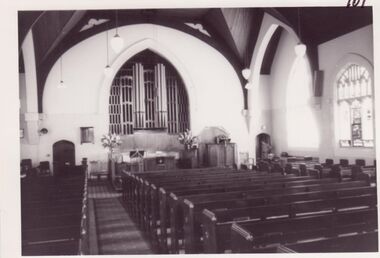
... ... Men’s Brotherhood...Stephen’s Players Men’s Brotherhood Tennis Club Cricket Club Architectural Features Gothic Revival Architecture Church Furniture Stained Glass Clergy Residences Religious Ceremonies Choirs Religious Festivals Religious Groups Clergy Religious Structures and Establishments Social Clubs Clubs and Associations Construction Events and Activities Theatre Groups Performers Fundraising Events Community Services Festivals and Celebrations Sunday Schools Organs Postcards Newsletter St. ...Featuring two photocopies of a sixteen page pamphlet by Della Hilton titled 75 Years at St. Stephen’s – Including Union with Bambra Road Methodist Church. This details a brief history of both the Bambra Road Church and especially the St. Stephen’s Presbyterian Church, Balaclava Road, Caulfield between 1910-1985. These churches united in 1976 to form the St. Stephen’s Uniting Church in Balaclava Road, Caulfield. The pamphlet includes copies of photographs of the interior, exterior and windows. There is a black and white photograph of the interior, undated and unattributed. There is a Christmas postcard from the church’s sponsor child, Paulus Lobo, dated post-1988. Finally, there is a copy of a fourteen page newsletter dated March 1986, edited by Ethel Phillips, regarding news of the St. Stephen’s Uniting Church Community.st. stephen’s church, presbyterian church, methodist church, uniting church, caulfield, balaclava road, bambra road, dulton street, kooyong road, hilton della, thomson w. rev., hunter c. hay rev., burns h.m. rev., simpson w. l. rev., goddard s.a. rev., tamagno f. rev., robinson e.b. rev., kerry g.f.g. rev., williamson j. rev., mclean d. rev., heazlewood vere rev., adamson j.c., pollard w.g. mr., alday rev., alday mrs., everett l.d. mrs., emms, ladies guild, presbyterian women’s missionary union, p.w.m.u., presbyterian girls’ association, presbyterian boys’ association, adult group, st. stephen’s players, men’s brotherhood, tennis club, cricket club, architectural features, gothic revival architecture, church furniture, stained glass, clergy residences, religious ceremonies, choirs, religious festivals, religious groups, clergy, religious structures and establishments, social clubs, clubs and associations, construction, events and activities, theatre groups, performers, fundraising events, community services, festivals and celebrations, sunday schools, organs, postcards -
 Bendigo Historical Society Inc.
Document - KEN HESSE COLLECTION: ST. JOHN'S PRESBYTERIAN MENS BROTHERHOOD NOTE BOOK
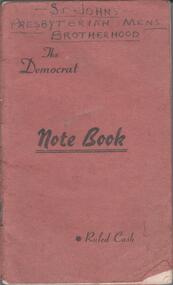
... John's Presbyterian Men's Brotherhood. It contains the membership fees 1947- 48. ...JOHN'S PRESBYTERIAN MENS BROTHERHOOD NOTE BOOK ...A damaged brown cash note book owned by St. John's Presbyterian Men's Brotherhood. It contains the membership fees 1947- 48. Item part of Mr. Ken Hesse Collection donated by Mr. James Lerk.church, history, presbyterian church forest st bendigo, ken hesse collection, collection, bendigo, religions, christianity, history, note book, organisation, st. john's bendigo, presbyterian church -
 Uniting Church Archives - Synod of Victoria
Plaque, c1956
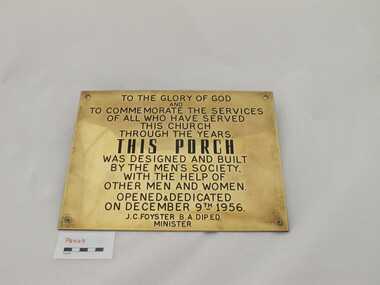
... The front porch was reconstructed by the Men's Brotherhood under the direction of John Connell, Architect....The front porch was reconstructed by the Men's Brotherhood under the direction of John Connell, Architect. ...From St David's Uniting Church, Cramer St, Preston, 3072. Formerly St David's Presbyterian Church. The front porch was reconstructed by the Men's Brotherhood under the direction of John Connell, Architect.Oblong brass memorial plaque with black text.st david's uniting church preston victoria, rev john c foyster, architect john connell -
 Bendigo Historical Society Inc.
Book - ST JOHN'S PRESBYTERIAN CHURCH, c1972
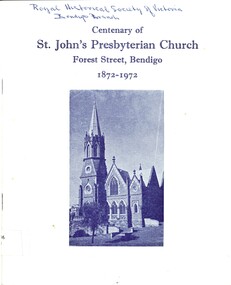
... The history goes on detailing the growth of the organisations in the church; Choir, Sunday School Sunday School Ladies Auxiliary, PWMU, Afernoon Fellowship, Ladies Guild, PGF, Men's Club and Brotherhood, Bible Class, Sporting Clubs, PFA, Mission Band, Creche, Cradle Roll, Board of Management. ...The history goes on detailing the growth of the organisations in the church; Choir, Sunday School Sunday School Ladies Auxiliary, PWMU, Afernoon Fellowship, Ladies Guild, PGF, Men's Club and Brotherhood, Bible Class, Sporting Clubs, PFA, Mission Band, Creche, Cradle Roll, Board of Management. ...Centenary of St. John's Presbyterian Church Forest Street, Bendigo 1872-1972. List of former Ministers of St. John's Church. A brief account of the history of the church is given. Extracts from minutes of Presbytery Church of Castlemaine 2/7/1872 states that they had not yet held any Sabbath Services in Sandhurst a grant not exceeding Twenty Pounds to meet the expenses of such Services necessary to establish a Second Charge in Sandhurst. Services were conducted in the Albion Hall, collections were obtained were liberal, Memorial signed by 104 members and adherents who expressed their desire to be recognized as a Congregation. St. John's first met at the Orderly Room (site of the Art Gallery), then at the Albion Hall (site of the Royal Princess Theatre), they then moved to St. James Hall (now Myer Store). In 1874 a weatherboard church in Forest St. was erected seating 550 persons, and named St. John's Presbyterian Church. It then became known as St John's Free Church and in 1880 it was admitted into the Presbyterian Church of Victoria and named Chalmer's Church. History accounts goes on to explain the further changes which happened within the church to 1972. Many other details have been included in the book such as the costs of the pews the 'Ladies Work Committee', a monthly church paper, Anniversary platform, securing a Manse, the year of the 'black-out', food parcels, the purchase of a building, the pioneering of religious films in church services, renovations, Sunday School, Stewardship Campaign, electronic organ. The history goes on detailing the growth of the organisations in the church; Choir, Sunday School Sunday School Ladies Auxiliary, PWMU, Afernoon Fellowship, Ladies Guild, PGF, Men's Club and Brotherhood, Bible Class, Sporting Clubs, PFA, Mission Band, Creche, Cradle Roll, Board of Management. A list of 'Memorials and Other Gifts Through the Years' from 1904 to 1972. Present 'Office Bearers of the Church'. Photo of present church on front cover, on rear cover is the church erected in 1897. With Indexchurch, centenary, st john's bendigo, st john's presbyterian church forest street bendigo centenary -
 Federation University Historical Collection
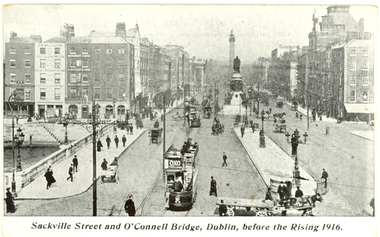
Postcard - Postcards - black and white, Coleman & Co, Dublin before and after the Rising, 1916, c1916
... men were traitors, to others they became heroes. (http://www.historylearningsite.co.uk/1916_easter_rising.htm, accessed 16 April 2014) Organised by seven members of the Military Council of the Irish Republican Brotherhood,[3] the Rising began on Easter Monday, 24 April 1916, and lasted for six days. ...men were traitors, to others they became heroes. (http://www.historylearningsite.co.uk/1916_easter_rising.htm, accessed 16 April 2014) Organised by seven members of the Military Council of the Irish Republican Brotherhood,[3] the Rising began on Easter Monday, 24 April 1916, and lasted for six days. ...The Easter Uprising took place in April 1916 in Dublin and is one of the pivotal events in modern Irish history. At the end of the Easter Uprising, 15 men identified as leaders were executed at Kilmainham Jail. To some, these men were traitors, to others they became heroes. (http://www.historylearningsite.co.uk/1916_easter_rising.htm, accessed 16 April 2014) Organised by seven members of the Military Council of the Irish Republican Brotherhood,[3] the Rising began on Easter Monday, 24 April 1916, and lasted for six days. Members of the Irish Volunteers — led by schoolmaster and Irish language activist Patrick Pearse, joined by the smaller Irish Citizen Army of James Connolly, along with 200 members of Cumann na mBan — seized key locations in Dublin and proclaimed the Irish Republic independent of the United Kingdom. There were some actions in other parts of Ireland: however, except for the attack on the Royal Irish Constabulary barracks at Ashbourne, County Meath, they were minor. With vastly superior numbers and the use of artillery, the British army quickly suppressed the Rising, and Pearse agreed to an unconditional surrender on Saturday 29 April. Most of the leaders were executed following courts-martial, but the Rising succeeded in bringing physical force republicanism back to the forefront of Irish politics. (http://en.wikipedia.org/wiki/Easter_Rising, accessed 16/04/2014) Sackville Street Dublin is now known a O'Connell Street.Seven black and white postcards showing photographic scenes before and after the Rising in Dublin.chatham family archive, chatham, holmes, ireland, dublin, uprising, sackville street, o'connell bridge, citizen army, liberty hall, henry street, nelson's pillar, post office, arnott's, abbey street, ruins, hotel metropole, the rising, easter uprising, easter rebellion, o'connell, chatham family archive, chatham, holmes, ireland, dublin, uprising, sackville street, o'connell bridge, citizen army, liberty hall, henry street, nelson's pillar, post office, arnott's, abbey street, ruins, hotel metropole, the rising, easter uprising, easter rebellion, o'connell -
Federation University Historical Collection
Photograph, Ian Brian and John Sharpham, 06/09/1991
... Ian Brian is the Directir of the Brotherhood of St Laurence ian brian john sharpham brotherhod of st laurence Two men seated behind a table Ian Brian and John Sharpham Photograph ...Ian Brian is the Directir of the Brotherhood of St LaurenceTwo men seated behind a tableian brian, john sharpham, brotherhod of st laurence -
 Kiewa Valley Historical Society
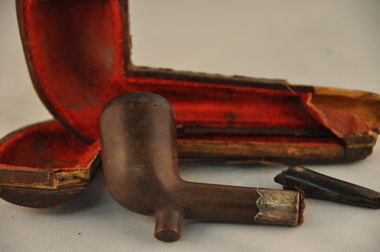
Pipe Tobacco Smoking, Circa 1889
... brotherhood not only socially but also politically and economically. This type of pipe lends itself well to the rural setting of the Kiewa Valley and although it is a very exclusive pipe it blended into the tobacco industrial environment of the Kiewa Valley and its surrounding districts. The Kiewa Valley region was up until the late 1900s part of the Australian Tobacco industry and the levels of men ...Pipe smoking has been in vogue for centuries, and in Australia it was a symbol of the "discerning smoker" such as the landed gentry or men of professional status. This pipe, of the Standard Canadian style, would have emigrated to Australia with its owner, a reasonable young professional or executive of the Hudson Bay Tobacco Company in the late 1800s or early 1900s. It is the type of pipe well suited to a harsh rural backdrop and with its owner found the Kiewa Valley a more relaxed environment than the Canadian Indian locations. The value of this pipe to the original owner, who would have sealed many trade contracts during the Canadian Indian smoke rituals In the late 1800s, is indicated by the long voyage to Australia and the Kiewa Valley. However with the health related restrictions placed on public smoking in the early 2000s, these tobacco pipes were not immune from the legislation, and even though the pipe smoke was not as offensive as cigarette smoke it still came under the umbrella of smoking. Pipes were also used in the process of inhaling illicit drugs i.e. marijuana, but this use was limited to a very few and not with this pipe. Smoking in the second millennium is being phased out as a social habit in Australia but may affect the few "private" smoker and has, as the United States prohibition era (alcoholic drinks) did, spawn an illicit trade in cheap contraband tobacco. Pipes such as this item show that smoking was not only part of the lifestyle of the era but also that it was part of a ritual (especially to the Indians of the Canada Hudson Bay region) that sealed a brotherhood not only socially but also politically and economically.This type of pipe lends itself well to the rural setting of the Kiewa Valley and although it is a very exclusive pipe it blended into the tobacco industrial environment of the Kiewa Valley and its surrounding districts. The Kiewa Valley region was up until the late 1900s part of the Australian Tobacco industry and the levels of men smoking pipes was enhanced by the readily supply, "off the fields", of tobacco leaves and the attitude to city based smoking restrictions was one of resentment.This pipe has a straight shank and stem and its style is 'standard Canadian'. The pipe has a permanent filter and a stainless steel band with the initials of the Hudson Bay Tobacco Company and its seals stamped on it.. The bowl and shank are one piece of appropriate shaped wood. The bit and bore are made from bakelite (dark brown in colour). The pipe is fashioned in the form of the clay pipes used by trappers, in the late 1800s early 1900s. It has a "rest" lug at the bottom of the bowl similar to clay pipes. This pipe has its own pipe case with wood reinforcement running the entire pipe shaped contour.On the stainless steel at the mortise and tenon junction is stamped "HP" and below that are stamped symbols of a ship's anchor, a lion and a tobacco leaf.tobacco, pipe smoking, smoking accessories -
 Ithacan Historical Society
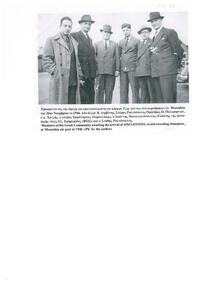
Photograph, Greek wrestler Jim Londros comes to Melbourne, 26 November 1946
... Born in Crete he also served as President of Melbourne's Cretan Brotherhood, wrestling jim londros Written under the photograph in Greek: MEMBERS OF THE GREEK COMMUNITY AWAITING THE ARRIVAL OF JIM LONDROS/ WORLD WRESTLING CHAMPION/ AT MOORABIN AIRPORT IN 1946. (PH. BY THE AUTHOR) A black and white photograph of six men ...The photograph was taken at arrival of the champion Greek wrestler, Jim Londros at Moorabin Airport on 26 November 1946. He was welcomed by members of the Greek community in Melbourne which included Stathi Raftopoulos, B. Dervenis, Spiro Raftopoulo -President of Greek Returned Soldierss, Mr Hatzis, Dr. Haralambos Paroulakis and Ioannis Panagiotopoulos. Jim Londros visited Australia after his retirement from wrestling in 1946. In retirement he worked for various charitable organizations especially for the Greek orphans of World War II. The photograph was published in the Greek newspaper 'Fos'.Greeks have enjoyed the sport of wrestling since ancient times. So the visit to Australia of a former Greek wrestling champion, and one who also devoted his time to helping others, would have been an important event for members of Melbourne's Greek community in 1946. Mr Ioannis Panagiotopoulos was publisher of the 'Fos' newspaper, the only Greek newspaper at the time. Dr Paroulakis arrived in Australia late 1930s and practised 55 Collins Street till 1987. He was Head of Outpatients and Physician at St, Vincent's Hospital for 22 years. Born in Crete he also served as President of Melbourne's Cretan Brotherhood, A black and white photograph of six men standing outdoors. All the men are dressed in suits. One is also wearing a tweed coat and four are wearing hats. Written under the photograph in Greek: MEMBERS OF THE GREEK COMMUNITY AWAITING THE ARRIVAL OF JIM LONDROS/ WORLD WRESTLING CHAMPION/ AT MOORABIN AIRPORT IN 1946. (PH. BY THE AUTHOR)wrestling, jim londros -
Clunes Museum
Booklet, PRESBYTERIAN BOARD OF RELIGIOUS EDUCATION, THE ORDER OF THE BURNING BUSH - RULES AND RITUAL OF THE FIRST DEGREE
... THIS CLUB WAS CONDUCTED AS A BROTHERHOOD TO PROMOTE FRATERNITY, LINKING IN FELLOWSHIP PRESBYTERIAN CHURCH CLUNES WORSHIP STUDY RECREATION SERVICE RULES AND RITUAL FOR THE ORDER OF THE BURNING BOOK CLUB FOR YOUNG BOYS AND MEN FORMED BY THE PRESBYTERIAN CHURCH PRINTED ON BANNER: NEC TAMEN CONSUMBATURE .1 WRITTEN IN PENCIL ON FRONT COVER: E KINNERSLY .2 WRITTEN IN PENCIL ON FRONT COVER: NORMAN HYETT. ...RULES AND RITUAL FOR THE ORDER OF THE BURNING BOOK CLUB FOR YOUNG BOYS AND MEN FORMED BY THE PRESBYTERIAN CHURCHBLUE COVERED BOOKLET WITH STYLISED IMAGE OF THE BURNING BUSH ABOVE A BANNER 4 COPIESnon-fictionRULES AND RITUAL FOR THE ORDER OF THE BURNING BOOK CLUB FOR YOUNG BOYS AND MEN FORMED BY THE PRESBYTERIAN CHURCHpresbyterian church clunes, worship study recreation service -
Old Colonists' Association of Ballarat Inc.
Ceremonial object - Trowel, William Bennett, Silver Trowel, c1887
... With respect to the objects of the association, they were to form a bond of brotherhood among those whose past experience in commercial or in mining pursuits so intimately associated them with the early history of the goldfields; men, to whose indomitable energy and perseverance Ballarat and other mining centres in the colony were so largely indebted for their development and commercial prosperity. ...With respect to the objects of the association, they were to form a bond of brotherhood among those whose past experience in commercial or in mining pursuits so intimately associated them with the early history of the goldfields; men, to whose indomitable energy and perseverance Ballarat and other mining centres in the colony were so largely indebted for their development and commercial prosperity. ...The silver trowel was used for the laying of the foundation stone of the Ballarat Old Colonists' Hall. It was donated to the Old Colonists' Associaiton in 1906. The Old Colonists' Association minutes noted 'Mrs Murray handed to the Secretary the silver trowel presented to the late President on the occasion of the laying of the foundation stone of the Hall.' The silver trowel was used for the laying of the foundation stone of the Ballarat Old Colonists' Hall. It was donated to the Old Colonists' Associaiton in 1906. The Old Colonists' Association minutes noted 'Mrs Murray handed to the Secretary the silver trowel presented to the late President on the occasion of the laying of the foundation stone of the Hall.' "THE OLD COLONISTS' HALL. The foundation-stone of the building to be erected by the Old Identities’ Association, in Lydiard street, was next laid with the usual ceremonies. This was immediately adjoining the foundation-stone of the Mining Exchange building. Mr J. Graham presented Mr Murray with a silver trowel, bearing the following inscription:—“ Queen Victoria’s Jubilee. Presented to J. P. Murray, Esq., president of the Old Colonists’ Association, on the occasion of his laying the foundation stone of their new hall, Ballarat, 21st June, 1887.” Mr Graham said he thought the pioneers of such a city were quite right in erecting a building that would be a home for them while they lived, and a memorial of them when they were no more. Mr J. Fraser, secretary, read the followin'- report:— “Mr Chairman, ladies, and gentlemen,—The bottle about to be deposited under this foundation contains documents in which are written particulars of the founding of the Old Colonists' Association at Ballarat; its financial and numerical position at the present time, the names of its officers and committee of management for the current term: a complete list of the names of its members, a copy of the rules and regulations of the association: copies of The Star, Evening Star, Courier, and Ballarat Advertiser newspapers, programme of to-day's proceedings as far as they relate to the laying of the foundation-stone, together with a brief summary of the aims and objects of this philanthropic institution. That the nature of these objects are considered worthy of encouragement and support is amply proved when we see on the Association's roll of membership the names of so many of our most prominent citizens and public men, "and from the fact that the Government of the colony have recognised the just claim of the old colonists'of Ballarat to be placed in possession of this valuable and central site, upon which to erect a building that will, be a credit to them and an ornament to the city, and which will enable them to still further extend the sphere of their benevolence and usefulness iu this district. The following is a copy of the signed and sealed memorial document:—*The foundation-stone of the hall of the Old Colonists’ Association of Ballarat; was laid on Her Majesty Queen Victoria's Jubilee Day,- Tuesday, 21st June, 1887, by John Paul Murray, Esq., J.P., president of the association. Under the foundation stone is deposited a copy of the constitution and rules of the association, the names of the officers, and a complete list of the names of ail the members to date; also a copy each of The Star, Courier, Evening Post, and the Advertiser, local newspapers. At this date the association numbers 319 members—accumulated funds, £203 10s 3d. The land upon which the hall is to he erected was granted by the Government to the association for that, purpose. (Signed) John P. Murray, President; W. B. Perry, Samuel Delpratt, Vice-presidents; Daniel Fern, Treasurer; John Fraser, Secretary. Committee—J. W. Graham, J. W. Lee, James M'Merkin, Andrew Lister, James Ward. Trustees—J. W. Graham, Wm. Irwin, John M'Cafferty ” Mr Murray said he was proud to lay the foundation stone of this building. The association was started in I883, and he might say they were a purely philanthropic institution. They formed an association whose creed was to assist one another in every shape and form. They had now 319 members, and were daily increasing in number.-. They were very fairly off as regarded their financial position. With respect to the objects of the association, they were to form a bond of brotherhood among those whose past experience in commercial or in mining pursuits so intimately associated them with the early history of the goldfields; men, to whose indomitable energy and perseverance Ballarat and other mining centres in the colony were so largely indebted for their development and commercial prosperity. Some of whose names were also closely identified with the memorable and sanguinary struggle 'for freedom and constitutional liberty in 1883. Their object was, further, to gather together within one fold those who survive those stirring times, to meet occasionally in friendly and social intercourse; to relieve their brethren who were overtaken by sickness or affliction; to provide the shelter of a home for those Pioneers of the goldfields whom the reverses of fortune had deprived of the means of procuring the comforts of life in their declining years; to assist the widow and succor the orphan; to mutually cheer and support each other in their temporary troubles and vicissitudes as they journeyed onward to the grave; and lastly, to tender a tribute of respect to the memory of a departed brother, by following his remains to their final resting place. Such were some of the principal objects of the “ Old Colonists' Association.” It was an institution for the good of their fellow man, and he hoped it would be successful, he hoped that the young people who came after them would appreciate what the Old Colonists had left them. He hoped they would all assist in making the institution one that would he worthy of the place. He would hand a small donation to the secretary, and hoped others would do the same. (Cheers.) The secretary, amid cheering, announced that the cheque handed over by Mr Murray was for £2O. Archdeacon Julius, who was asked to speak, said nothing could have been more fitting than the laying of the foundation-stone of the Old Identities’ Association on the Queen's Jubilee. They were a link between the past of 50 years gone by and today. Many of them remembered well enough perhaps the time when it took a man five and twenty minutes to light his pipe with tinder and steel, and when the small boys went, up the chimneys to sweep them. (Laughter.) They were building something now that people would look upon in years to come, and speak of in connection with the Old Colonists, if the young men were' half as good as their fathers they would be uncommon good fellows, and he did not think they would be. (Laughter, and interjection.) ''An old fellow said it was very true, and he knew it. (Laughter.) The Old Identities would agree with him to a man. (Laughter.) If the young men walked in their steps Ballarat in another 50 years would be 50 percent, better than it was now. There was not a man there that wished that more strongly, than 'he’ did. The Old Identities were laying this stone on the jubilee day of Her Majesty, and there never sat on the throne a worthier or nobler Queen than she who held her jubilee that day. There was not a man present, whatever his views of government may be, who did not say “God bless our Queen.” (Cheers.) The proceedings closed with the singing of the National Anthem and cheers for the Queen. (Ballarat Star, 23 June 1887)Silver trowel used during the laying of a foundation Stone for the Ballarat Old Colonists' Association building in Lydiard Street North, Ballarat.ballarat old colonists' association, ballarat old colonists' club, trowel, silver trowel, foundation stone, mrs j. murray, william bennett, j. fraser, john murray, w. lee, william irwin, john m'cafferty, john mccafferty -
 Wodonga & District Historical Society Inc
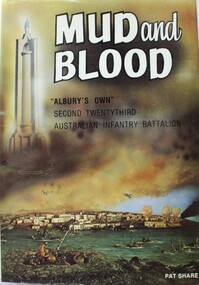
Book - MUD AND BLOOD: Albury's Own 23rd Australian Infantry Battalion, Pat Share, 1978
... men of the 2/23 rd Battalion served with honour in the Middle East, including at the Siege of Tobruk and El Alamein. After returning to Queensland for training in jungle warfare conditions, they were then deployed to New Guinea and Tarakan. This book tells the story of the service and brotherhood ...The 2/23rd Infantry Battalion was raised at the Albury Showgrounds in New South Wales in June 1940, as part of the 26th Brigade. Initially the brigade belonged to the 7th Division but in early 1941 moved to the 9th Division. The need for larger quarters saw the battalion transferring to a new camp at Bonegilla to complete their training before sailing for the Middle East in November. Most of those enlisted in this Battalion were volunteers from the Albury Wodonga area and an Aldermen of Albury expressed the wish that the unit be given the title of "Albury's Own". This was accepted on its behalf by the commanding officer. The men of the 2/23 rd Battalion served with honour in the Middle East, including at the Siege of Tobruk and El Alamein. After returning to Queensland for training in jungle warfare conditions, they were then deployed to New Guinea and Tarakan. This book tells the story of the service and brotherhood demonstrated by the men of "Albury's Own." Written and composed by officers and men of the 2/23 Battalion, A.I.F. 9th Division, while on active service, Palestine, Tobruk, Syria and El Alamein.non-fictionThe 2/23rd Infantry Battalion was raised at the Albury Showgrounds in New South Wales in June 1940, as part of the 26th Brigade. Initially the brigade belonged to the 7th Division but in early 1941 moved to the 9th Division. The need for larger quarters saw the battalion transferring to a new camp at Bonegilla to complete their training before sailing for the Middle East in November. Most of those enlisted in this Battalion were volunteers from the Albury Wodonga area and an Aldermen of Albury expressed the wish that the unit be given the title of "Albury's Own". This was accepted on its behalf by the commanding officer. The men of the 2/23 rd Battalion served with honour in the Middle East, including at the Siege of Tobruk and El Alamein. After returning to Queensland for training in jungle warfare conditions, they were then deployed to New Guinea and Tarakan. This book tells the story of the service and brotherhood demonstrated by the men of "Albury's Own." Written and composed by officers and men of the 2/23 Battalion, A.I.F. 9th Division, while on active service, Palestine, Tobruk, Syria and El Alamein.world war 11, rats of tobruk, tobruk
