
Showing 212 items matching " military person"
-
 Returned Nurses RSL Sub-branch
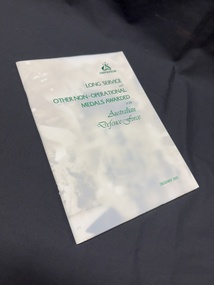
Book - Illustrated paperback booklet, Department of Defence, Long service and other non-operational medals awarded to the Australian Defence Force, 2002
... Staple bound booklet with opaque cover containing green metallic writing over card cover collage of photographs of military persons and equipment...(From message by Danna Vale p. 1) Staple bound booklet with opaque cover containing green metallic writing over card cover collage of photographs of military persons and equipment Long service and other non-operational medals awarded to the Australian Defence Force Book Illustrated paperback booklet Department of Defence R P Horton ...For over a century the men and women of the Australian Defence Force have developed a rich history of service both on and off the battlefield. Many Australians have not been required to serve in battle but have contributed exemplary service in both operational and non-operational roles and have been integral in making the Australian Defence Force one of the most professional military forces in the world. To recognise their contribution, a number of long service and other non-operational medals have been awarded for their efforts. (From message by Danna Vale p. 1)Staple bound booklet with opaque cover containing green metallic writing over card cover collage of photographs of military persons and equipmentnon-fictionFor over a century the men and women of the Australian Defence Force have developed a rich history of service both on and off the battlefield. Many Australians have not been required to serve in battle but have contributed exemplary service in both operational and non-operational roles and have been integral in making the Australian Defence Force one of the most professional military forces in the world. To recognise their contribution, a number of long service and other non-operational medals have been awarded for their efforts. (From message by Danna Vale p. 1)australian defence forces, medals -
 Bendigo Historical Society Inc.
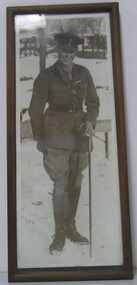
Photograph - PRINCE OF WALES IN MILITARY UNIFORM, 1917
... ... Military Person...History House 11 Mackenzie Street Bendigo goldfields PERSON Individual portrait Military Uniform Military Person Military Black and White photograph of a young H.R.H. ...Black and White photograph of a young H.R.H. Prince of Wales in a military uniform with walking stick & cigarette in hand, standing in the snow, mounted under glass in a slim brown wooden frame, markings on rear of photo read 'Arcade Art Gallery Bendigo Art Pictures and Framing, L Pattern (Late AIF)'person, individual, portrait, military uniform, military person, military -
 Returned Nurses RSL Sub-branch
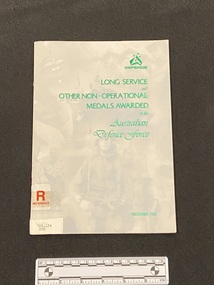
Book - Illustrated paperback booklet, R P Horton, Long service and other non-operational medals awarded to the Australian Defence Force, 2002
... Staple bound booklet with opaque cover containing green metallic writing over card cover collage of photographs of military persons and equipment. There is a reference sticker on the front and a spine label sticker below it....Staple bound booklet with opaque cover containing green metallic writing over card cover collage of photographs of military persons and equipment. There is a reference sticker on the front and a spine label sticker below it. ...For over a century the men and women of the Australian Defence Force have developed a rich history of service both on and off the battlefield. Many Australians have not been required to serve in battle but have contributed exemplary service in both operational and non-operational roles and have been integral in making the Australian Defence Force one of the most professional military forces in the world. To recognise their contribution, a number of long service and other non-operational medals have been awarded for their efforts. (From message by Danna Vale p. 1) Includes an attached printout of 'A basic guide to ribbons, etc. for Orders, Decorations, Medals and Awards earned by Australians' inside the front cover. Inside the back cover is an attached printout of 'Australian War Badges' from the Central Army Records Office, 2003.Staple bound booklet with opaque cover containing green metallic writing over card cover collage of photographs of military persons and equipment. There is a reference sticker on the front and a spine label sticker below it.non-fictionFor over a century the men and women of the Australian Defence Force have developed a rich history of service both on and off the battlefield. Many Australians have not been required to serve in battle but have contributed exemplary service in both operational and non-operational roles and have been integral in making the Australian Defence Force one of the most professional military forces in the world. To recognise their contribution, a number of long service and other non-operational medals have been awarded for their efforts. (From message by Danna Vale p. 1) Includes an attached printout of 'A basic guide to ribbons, etc. for Orders, Decorations, Medals and Awards earned by Australians' inside the front cover. Inside the back cover is an attached printout of 'Australian War Badges' from the Central Army Records Office, 2003.australian defence forces, medals -
 Returned Nurses RSL Sub-branch
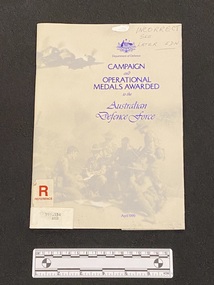
Book - Illustrated paperback booklet, R P Horton, Campaign and Operational Medals awarded to the Australian Defence Force, 1999
... Staple bound booklet with opaque cover containing blue metallic writing over card cover collage of photographs of military persons and equipment. There is a reference sticker on the front and a spine label sticker below it....'INCORRECT / SEE / LATER EDN' [handwritten in blue ink on the front cover] 'VICTORIAN BRANCH / LIBRARY / ANZAC HOUSE' [stamped in red ink on the first page and inside back cover] Staple bound booklet with opaque cover containing blue metallic writing over card cover collage of photographs of military persons and equipment. There is a reference sticker on the front and a spine label sticker below it. ...Campaign and operational medals awarded to the Australian Defence Force.Staple bound booklet with opaque cover containing blue metallic writing over card cover collage of photographs of military persons and equipment. There is a reference sticker on the front and a spine label sticker below it.non-fictionCampaign and operational medals awarded to the Australian Defence Force.australian defence forces, medals -
 Trafalgar Holden Museum
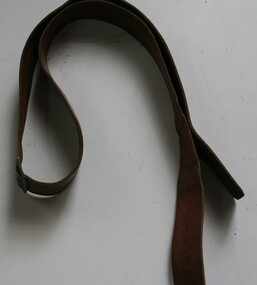
Functional object - Belt, 1916
... Used by military persons to carry ammunition pouches, either around waist or over shoulder...Trafalgar Holden Museum 74 Waterloo Rd Trafalgar gippsland Used by military persons to carry ammunition pouches, either around waist or over shoulder Manufactured and distributed by Holden and Frost ,military leather belt Holden and Frost 1916 Tan leather belt, holes both ends and in the middle brass adjustment tool in centre with holes Functional object Belt ...Used by military persons to carry ammunition pouches, either around waist or over shoulderManufactured and distributed by Holden and FrostTan leather belt, holes both ends and in the middle brass adjustment tool in centre with holesHolden and Frost 1916,military, leather, belt -
 Geelong RSL Sub Branch
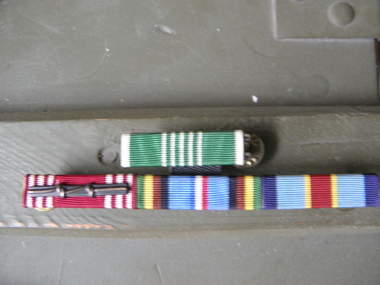
Ribbon Bars - US Military Decorations, No makers mark, Late 20th Century
... The decoration ribbons have belonged to a US Military Service Person....Geelong RSL Sub Branch 50 Barwon Heads Road Belmont geelong-and-the-bellarine-peninsula The decoration ribbons have belonged to a US Military Service Person. These decorations are the originals that have belonged to a US Military Service Person. ...The decoration ribbons have belonged to a US Military Service Person.These decorations are the originals that have belonged to a US Military Service Person.Four Coloured Cloth Ribbons mounted for wearing on Uniform. The ribbons correspond to the Army Commendation Medal, Good Conduct Medal, Armed Forces Expeditionary Medal and Overseas Service Ribbon. The bronze clasp on the Good Conduct Medal indicates that the decoration has been awarded more than once.There are no inscriptions or markings. us military medal ribbons -
 Trafalgar Holden Museum
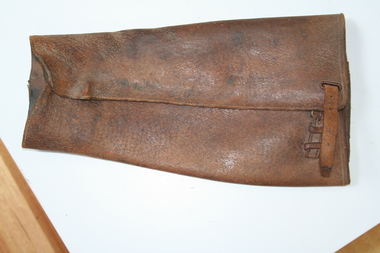
Functional object - Buckle Gaiter, Ca 1900
... Leather gaiter used by both military and civilian persons whilst riding or walking...Trafalgar Holden Museum 74 Waterloo Rd Trafalgar gippsland Leather gaiter used by both military and civilian persons whilst riding or walking Manufactured and distributed by GMH Gaiter Leather Plain brown leather gaiter top buckle for fastening onto leg in place, lower buckle missing Functional object Buckle Gaiter ...Leather gaiter used by both military and civilian persons whilst riding or walkingManufactured and distributed by GMHPlain brown leather gaiter top buckle for fastening onto leg in place, lower buckle missinggaiter, leather -
 Bendigo Military Museum
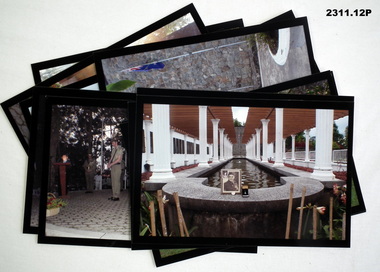
Photograph - PHOTOGRAPHS, SANDAKAN, C. Post 2000
... All colour photographs - Borneo (Sandakan) .1) Black metal boiler. .2) 4 Flags on flag poles. .3) Pool under pergola & collonade. .4) Pool under pergola & collonade. .5) Pool under pergola & collonade. .6) Wreaths at base of memorial. .7) Pebble map of Australia encircled with plants & Australian flags in lawn area. .8) Granite war memorial & military person. .9) Australian Army soldiers standing around war memorial. .10) War memorial. .11) View of countryside adjacent to war memorial. .12) 2 Women standing at base of memorial holding a framed photo of male servicemen....Bendigo Military Museum 37 - 39 Pall Mall Bendigo goldfields photography-photographs military history Sandakan All colour photographs - Borneo (Sandakan) .1) Black metal boiler. .2) 4 Flags on flag poles. .3) Pool under pergola & collonade. .4) Pool under pergola & collonade. .5) Pool under pergola & collonade. .6) Wreaths at base of memorial. .7) Pebble map of Australia encircled with plants & Australian flags in lawn area. .8) Granite war memorial & military person. .9) Australian Army soldiers standing around war memorial. .10) War memorial. .11) View of countryside adjacent to war memorial. .12) 2 Women standing at base of memorial holding a framed photo of male servicemen. ...All colour photographs - Borneo (Sandakan) .1) Black metal boiler. .2) 4 Flags on flag poles. .3) Pool under pergola & collonade. .4) Pool under pergola & collonade. .5) Pool under pergola & collonade. .6) Wreaths at base of memorial. .7) Pebble map of Australia encircled with plants & Australian flags in lawn area. .8) Granite war memorial & military person. .9) Australian Army soldiers standing around war memorial. .10) War memorial. .11) View of countryside adjacent to war memorial. .12) 2 Women standing at base of memorial holding a framed photo of male servicemen.photography-photographs, military history, sandakan -
 Bendigo Military Museum
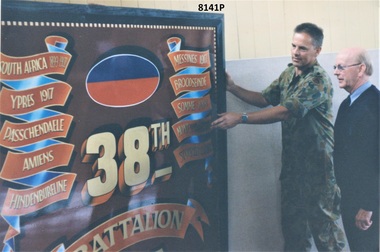
Photograph - 38th BATTALION BATTLE HONOURS, C. Jan 1999
... Photograph colour showing one person in military uniform and another in civilian clothes, the Officer is steadying the 38th Battalion Battle honours board....Photograph colour showing one person in military uniform and another in civilian clothes, the Officer is steadying the 38th Battalion Battle honours board. ...The Officer in Uniform was Major Phil Chapman OC of 15th Transport Sqd based in Bendigo in the old Passchendaele Barracks depot in Mollison Street where the Battle Honour board was held. The other in civilian clothes is Cliff Richards who was Junior Vice President of the Bendigo RSL Sub Branch at the time. The photo relates to the Board being donated to the Bendigo RSL Museum in the SMI building in January 1999. The 38th Battalion AIF was known as Bendigo's own, raised in Bendigo in 1916 for service in the Great War. Due to its size it was placed high up in what was the Billiard Room in the Museum. After a major renovation to the BDRSL Inc Club in Havilah Rd in 2013 it was then placed over the foyer front entrance. Due to another up grade it was placed in storage for awhile and is now on display in the rear foyer patrons entrance. Refer Cat No 8176.Photograph colour showing one person in military uniform and another in civilian clothes, the Officer is steadying the 38th Battalion Battle honours board.On rear in black pen, "Jan 99 C Richards Jnr Vice - Major Chapman OC 15th Tpt Platoon".brsl, smirsl, 38th -
 Vision Australia
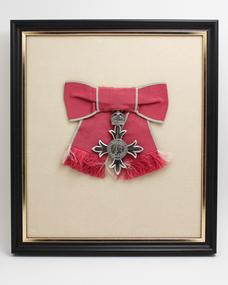
Medal - Object, Member of the Most Excellent Order of the British Empire, 1974
... To recognise the dedication and service of non-military persons, the Member of the Most Excellent Order of the British Empire (civil order) was established. ...Vision Australia 454 Glenferrie Road Kooyong melbourne To recognise the dedication and service of non-military persons, the Member of the Most Excellent Order of the British Empire (civil order) was established. ...To recognise the dedication and service of non-military persons, the Member of the Most Excellent Order of the British Empire (civil order) was established. Shortened to MBE, the award consists of a silver cross with a circular centre and a fleur de lis attached on four sides. Above the north facing fleur de lis is a crown which is connected to a rose pink crossgrain ribbon with pearl grey edges, and tied into a bow. In the central part is the profile of King George V and Queen Mary, and the words 'For God and Empire' in raised letters against a roughened background edging the portrait. On the rear are the copperplate letters 'GRI' (which stand for Georgius Rex Imperator) and an image of a crown directly above this. It is designed to be worn on the left hand side by the female recipient. In 1974 this medal was awarded to Miss Elsie May Henderson for services to blind persons.1 silver coloured medallion in black frame association for the blind, medals, elsie henderson -
 Vision Australia
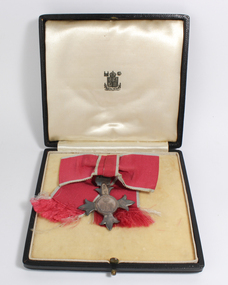
Medal - Object, Member of the Most Excellent Order of the British Empire, 1937
... To recognise the dedication and service of non-military persons, the Member of the Most Excellent Order of the British Empire (civil order) was established. ...Vision Australia 454 Glenferrie Road Kooyong melbourne To recognise the dedication and service of non-military persons, the Member of the Most Excellent Order of the British Empire (civil order) was established. ...To recognise the dedication and service of non-military persons, the Member of the Most Excellent Order of the British Empire (civil order) was established. Shortened to MBE, the award consists of a silver cross with a circular centre and a fleur de lis attached on four sides. Above the north facing fleur de lis is a crown which is connected to a rose pink crossgrain ribbon with pearl grey edges, and tied into a bow. In the central part is the profile of King George V and Queen Mary, and the words 'For God and Empire' in raised letters against a roughened background edging the portrait. On the rear are the copperplate letters 'GRI' (which stand for Georgius Rex Imperator) and an image of a crown directly above this. It is designed to be worn on the left hand side by the female recipient. In 1937 this medal was awarded to Miss Millicent Frances Ritchie for her service as Secretary of the Braille Association of Australia.1 silver coloured medallion attached to ribbon in black case millicent ritchie, victorian association of braille writers, medals -
 Vision Australia
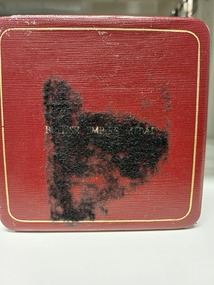
Medal - Object, Member of the Most Excellent Order of the British Empire (box only), 1975
... To recognise the dedication and service of non-military persons, the Member of the Most Excellent Order of the British Empire (civil order) was established. ...Vision Australia 454 Glenferrie Road Kooyong melbourne To recognise the dedication and service of non-military persons, the Member of the Most Excellent Order of the British Empire (civil order) was established. ...To recognise the dedication and service of non-military persons, the Member of the Most Excellent Order of the British Empire (civil order) was established. Shortened to MBE, the award consists of a silver cross with a circular centre and a fleur de lis attached on four sides. Above the north facing fleur de lis is a crown which is connected to a rose pink crossgrain ribbon with pearl grey edges, and tied into a bow. In the central part is the profile of King George V and Queen Mary, and the words 'For God and Empire' in raised letters against a roughened background edging the portrait. On the rear are the copperplate letters 'GRI' (which stand for Georgius Rex Imperator) and an image of a crown directly above this. It is designed to be worn on the left hand side by the female recipient. The medal from this box was presented to Katharine (Kitty) Margaret Rose in 1975 for her tireless work with the aged blind, and is on display at the Bendigo office.1 burgundy box (with silver medal on display at Bendigo VA office)association for the blind, medals, katharine (kitty) rose -
 Warrnambool and District Historical Society Inc.
Leisure object - Sheet music, On the road to victory, 1941
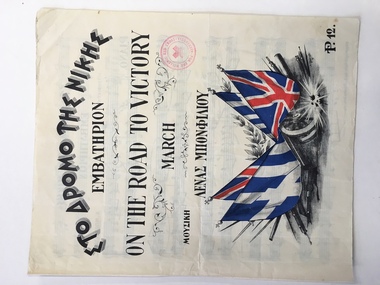
... It is not known if this piece of music was bought in Australia or brought back to Australia by an Australian military person during World War Two....It is not known if this piece of music was bought in Australia or brought back to Australia by an Australian military person during World War Two. This is an interesting piece of music. ...This piece of music has been produced during World War Two (1941) as a propaganda and fund-raising piece for the people of Alexandria in Egypt. It has both Greek and British backing with the headings on the cover in both languages. The music is a march and the title suggests that victory is on the way so the emotions are being stirred to keep up the morale. Egypt in World War Two was still under British influence and Alexandria is a port in Egypt at the mouth of the Nile River. In 1941 British battleships were based in the Alexandria harbor and two of them were disabled by Italian Navy divers. Hence it is not clear why it was the Hellenic (Greek) Red Cross raising funds for Alexandria through the sale of this music which was produced in that city by the Moharrem Press (founded 1938) and composed by Lena Bonfiliou, probably a Greek person. It is not known if this piece of music was bought in Australia or brought back to Australia by an Australian military person during World War Two.This is an interesting piece of music. Its connection to Warrnambool is not known but it is an example of the type of music produced during World War Two to help the war effort. This is a four page piece of music, ‘On the Road to Victory’ (a march) with a front cover, a blank end page and two pages of musical notation. The latter pages have black printing on white pages. The front cover has both Greek and English printing and a colour image of four British and Greek flags resting on a gun carriage with armaments underneath and indications of an explosion. There is a red stamp on the cover (Hellenic Red Cross). The pages are in good condition. English printing: ‘On the Road to Victory, March, P12’ Stamp: ‘For the Hellenic Red Cross, Alexandria’ alexandria, hellenic red cross, warrnambool, on the road to victory music -
 Bendigo Military Museum
Book - ANTHYOLOGY, MILITARY MYTHS, Craig Stockings, 'ANZAC'S DIRTY DOZEN", 2012
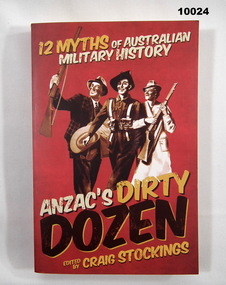
... Illustrated - sepia drawings from Military posters. Front - three persons, two holding rifles, one in uniform. ...Illustrated - sepia drawings from Military posters. Front - three persons, two holding rifles, one in uniform. ...From Title Page, "ANZAC'S DIRTY/ DOZEN/ 12 MYTHS OF AUSTRALIAN MILITARY HISTORY"Soft cover book. Cover - cardboard, red colour background with white, yellow and black print on front, spine and back. Illustrated - sepia drawings from Military posters. Front - three persons, two holding rifles, one in uniform. Back - two persons, one in uniform, second holding a rifle. 335 pages - cut, plain, white colour paper. No illustrations. publications, books, military history, anthology -
 Warrnambool and District Historical Society Inc.
Medal, 60th Anniversary of the end of WW11, 2005
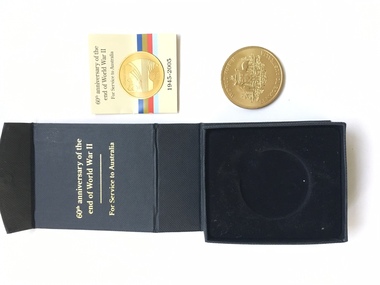
... Military Forces and from July 1942 to September 1944 in the Australian Imperial Forces. His reason for discharge was reserved occupation. He held the rank of corporal in 26th Motor regiment. He was born in Colac 19/11/1919 to Ernest Swan and Daisy Johnson. He died 04/08/2009 and is buried at the Warrnambool cemetery. During his life he farmed a soldiers’ settlers block in the Grasmere area, north of Warrnambool. A common object with over 300000 minted but with a link to a local person ...This medal was issued to commemorate the end of World War 2 and was issued to eligible living veterans or their widows/widowers.It comes in a black card and fabric lined box. It has been issued by the Department of Veterans Affairs.This medal was awarded to Ernest Henry Swan. He served from December 1941 to July 1942 in the Citizen Military Forces and from July 1942 to September 1944 in the Australian Imperial Forces. His reason for discharge was reserved occupation. He held the rank of corporal in 26th Motor regiment. He was born in Colac 19/11/1919 to Ernest Swan and Daisy Johnson. He died 04/08/2009 and is buried at the Warrnambool cemetery. During his life he farmed a soldiers’ settlers block in the Grasmere area, north of Warrnambool. A common object with over 300000 minted but with a link to a local person and commemorating an event of world importance.Gold metal round medal with Australian coat of Arms on one side and stylised image of outline of Australia on the obverse side. Mounted in black card box.World War 11 Service to Australia. World War 11 60years 1945-2005warrnambool, ernest swan, 60th anniversary medallion ww2 -
 Warrnambool and District Historical Society Inc.
Morse code key, Mid 20th century
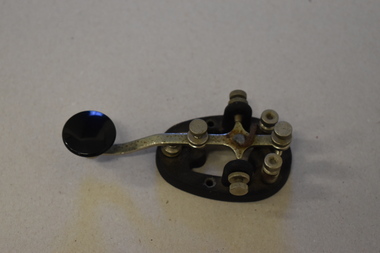
... It was used extensively in the 1890s for early radio communication before it was possible to transmit voice and continued to be used in the 20th century along with voice transmission , especially by amateur radio persons. It was also used in military and naval communication but not so much today. ...It was used extensively in the 1890s for early radio communication before it was possible to transmit voice and continued to be used in the 20th century along with voice transmission , especially by amateur radio persons. It was also used in military and naval communication but not so much today. ...This is a Morse Code key. Morse Code is a method of transmitting text information using short and long signals (‘dots and dashes’). It is named after Samuel Morse, the inventor of the telegraph and was developed in the 1860s. It was used extensively in the 1890s for early radio communication before it was possible to transmit voice and continued to be used in the 20th century along with voice transmission , especially by amateur radio persons. It was also used in military and naval communication but not so much today. It is believed that this Morse Code key belonged to Ted Salamy, a jeweller and the first person in Warrnambool to hold an amateur radio licence (1924 Call Sign A3AJ, the 35th licence issued in Victoria).This Morse Code key is of interest as an object more used in the past, especially by amateur radio persons. It is believed to have been the property of Ted Salamy, the first person in Warrnambool to hold an amateur radio licence. This is a metal Morse Code key with an oval metal base. It has three screws inserted in the base and two more screws attached to the sides of the base. There is a key lever on top of the base and this is adjustable. The hinge on which the key lever sits is missing. The lever has a round black knob at one end. ‘Made in U.S.A. H15.682’ Wm.M. Nye Co Inc. Bellevue W.A.’ morse code key, ted salamy,, history of warrnambool -
 Warrnambool and District Historical Society Inc.
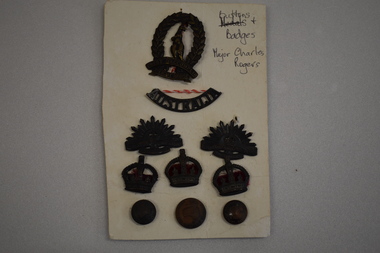
Buttons and Badges, Major Charles Rogers
... He died in 1961, These items are of interest as they belonged to Major Charles Rogers an important 20th century Army person. major charles rogers light horse australian military forces On cardboard in hand writing Buttons & Badges Major Charles Rogers .1 PREST D 'ACCOMPLIER LIGHT HORSE .2 AUSTRALIA .3 , .4 AUSTRALIAN COMMONWEALTH MILITARY FORCES .5,.6,.7 Nil .8, .9, .10 AUSTRALIAN MILITARY FORCES. ...These badges and buttons belonged to Major Charles Rogers, a well known Warrnambool personality of the 1930s, 40s and 50s. He was a Light horseman who was in the Guard of Honour for the Duke of Gloucester in 1934 when he opened the Melbourne Shrine of Remembrance during the Victorian Centenary Celebrations. In Warrnambool he was a well known horseman leading parades and celebrations and judging equine events for the Warrnambool Agricultural Show. He died in 1961, These items are of interest as they belonged to Major Charles Rogers an important 20th century Army person. Rectangular piece of white cardboard through which the badges and buttons are secured with variously string and clear adhesive tape. 002261.1 Brass wreath of leaves and berries surrounding an upright kangaroo links to an arc shaped band with text . The wreath has an inverted arc with text at its base. 002261.2 An inverted brass arc with AUSTRALIA between two narrow bands 002261.3, .4 Brass rising sun badge with crown ,two scrolls with text, and inverted band 002261.5, .6, .7 Brass crown featuring raised decoration including fleur- de- lis and small small knobs. The crown has an open section through which red velvet like material is visible. 002261.8 Brass button featuring a raised map of Australia and crown with text 002261.9 As for .8 but larger 002261.10 Identical with .8 On cardboard in hand writing Buttons & Badges Major Charles Rogers .1 PREST D 'ACCOMPLIER LIGHT HORSE .2 AUSTRALIA .3 , .4 AUSTRALIAN COMMONWEALTH MILITARY FORCES .5,.6,.7 Nil .8, .9, .10 AUSTRALIAN MILITARY FORCES. major charles rogers, light horse, australian military forces -
 Bendigo Military Museum
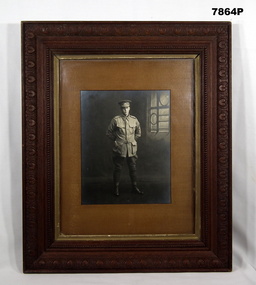
Photograph - PORTRAIT, FRAMED, c WW1
... Bendigo Military Museum 37 - 39 Pall Mall Bendigo goldfields Framed photographs 7864P and 7865P. Both unknown persons. ...Framed photographs 7864P and 7865P. Both unknown persons. Photograph - black and white full length portrait photograph of a soldier in uniform. Studio type photograph with wall and window in the background. C.WW1. Frame - timber with dark brown stain. decorative moulding with inner edge of gold colour plain timber. Mount - timber ply wood with light brown finish and glass front. Backing - cardboard (replaced).On back of photograph - handwritten grey lead pencil "Mrs Long/ 20 Irvine St/ 3 1/2 Oak ??? 3/4 ???/ Dark oak 10/-"framed accessories, portrait, army, coates family 1 -
 Bendigo Military Museum
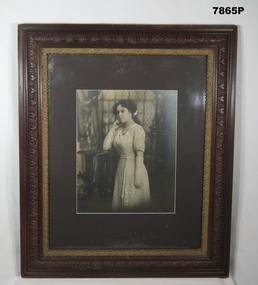
Photograph - PORTRAIT, FRAMED, c.WW1
... Bendigo Military Museum 37 - 39 Pall Mall Bendigo goldfields Framed photographs 7864P and 7865P - both unknown persons. ...Framed photographs 7864P and 7865P - both unknown persons.Photograph - black and white mid length portrait photograph of a woman dressed in evening wear. Studio type photograph with window, plants and plant stand in background. c.WW1. Frame - timber with dark brown stain. Decorative moulding with inner edge of gold colour decorative timber. Mount - dark brown cardboard, glass front and cardboard backing.framed accessories, portrait, coates family 1 -
 Bendigo Military Museum
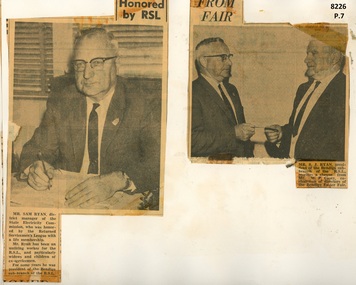
Mixed media - SCRAPBOOK BENDIGO RSL, C. 1967 - 1972
... Military Museum 37 - 39 Pall Mall Bendigo goldfields This is the 2nd set of 6 pages from Scrap book Cat No 8225. Page 7a. Photo and article re Sam Ryan receiving a Life Membership of the RSL. Refer Cat No 8225. Page 7b. Photo and Article of Sam Ryan President Bendigo RSL receiving a cheque from Mr W.P. Casey Chairman of Directors of the Bendigo Easter Fair. Page 8. Phot and article 1969 re the planting of an Aleppo Pine tree from the original on Gallipoli. On the Left is Jack Plant President Bendigo RSL, the other two persons ...This is the 2nd set of 6 pages from Scrap book Cat No 8225. Page 7a. Photo and article re Sam Ryan receiving a Life Membership of the RSL. Refer Cat No 8225. Page 7b. Photo and Article of Sam Ryan President Bendigo RSL receiving a cheque from Mr W.P. Casey Chairman of Directors of the Bendigo Easter Fair. Page 8. Phot and article 1969 re the planting of an Aleppo Pine tree from the original on Gallipoli. On the Left is Jack Plant President Bendigo RSL, the other two persons unknown as section of the text is missing. Page 9a. Anzac Appeal 1969, Mr John Ogden pins an Anzac token on the coat of Phillip Rice. Page 9b. From the "Mufti" RSL Magazine showing Delegates to the RSL State Conference 1969. Three of the six are known, W.B. Nicholls, D.J. Osborn, J. Hipworth State Councillor. Page 9c & d. Jack PLant in both photos on the left, other man unknown as well as place. Page 10. From the bendigo Advertiser relating to the Bendigo RSL Annual Dinner held on Saturday 10th 1971. From the left is G. Garth President Kangaroo Flat RSL, Lt Col W. Howarth Commanding Officer AHQ Survey Regiment, T. Shaw State Executive of the RSL, J Plant President Bendigo RSL, T Stephens Deputy Commissioner Repatriation Department and Cr N.J. Oliver the Mayor of Bendigo. Page 11a. Photo from a Bendigo RSL Annual Dinner year unknown, 2nd from the left is Bruce Ruxton State President of the Victorian RSL, 2nd from the right is possibly W.B. Nicholls, others onknown. Page 11b. This is a photo of RSL Annual Dinner 1971, same as per Page 10 for details. Page 12. Photograph of Bendigo RSL Annual Dinner year unknown. 2nd from the left is Jack Plant, the man to the left of man standing is possibly W. Howarth CO Survey Regiment.Six articles and Spiroflex sketch book. Page 7. Photo and article re the award of a Life Membership. Page 8. Photo and article re planting a Lone Pine tree. Page 9. Two articles and two photos re Appeals and State Conference. Page 10. Photo and article re RSL Annual Dinner. Page 11. Two photos re RSL Annual Dinners. Page 12. One photo re RSL Annual Dinner. Page 8 hand written, "1969". Page 9, hand written names as per "Context"brsl, smirsl, scrapbook -
 Bendigo Military Museum
Mixed media - SCRAPBOOK BENDIGO RSL, C. 1963 - 73
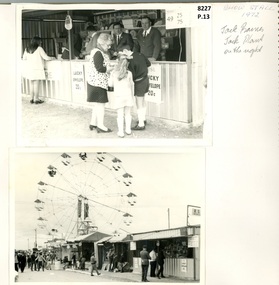
... Military Museum 37 - 39 Pall Mall Bendigo goldfields This is the 3rd section of 4 pages from Scap book Cat No 8225. Page 13a. Photo shows 4 people at the Bendigo RSL Show stall buying Lucky envelopes. The two men facing the camera are Jack Barnes and Jack Plant. Page 13b. Photo shows the RSL Show Stall on the right with a Ferris wheel in the background. Page 14a. Photo showing shelves of goods to be won with lucky envelopes. The man on the right is Jack Plant. Page 14b. Photo showing the Show Stall itself, only person ...This is the 3rd section of 4 pages from Scap book Cat No 8225. Page 13a. Photo shows 4 people at the Bendigo RSL Show stall buying Lucky envelopes. The two men facing the camera are Jack Barnes and Jack Plant. Page 13b. Photo shows the RSL Show Stall on the right with a Ferris wheel in the background. Page 14a. Photo showing shelves of goods to be won with lucky envelopes. The man on the right is Jack Plant. Page 14b. Photo showing the Show Stall itself, only person identifiable is Jack Plant. Page 15. Article with photo of 6 Ladies. The article covers a donation of $1517.00 from the Bendigo RSL Womens Auxiliary to the President of the RSL Mr Jack Plant at a Dinner at the Captain Cook Motel. The article covered a wide range of functions that the Ladies catered for from weddings, dinners, reunions and cabarets to raise funds. They also catered for four Golden wedding anniversaries of their members during the year. Mrs Morey was presented with a "Certificate of Merit" for her outstanding work as President over 14 years. Vice President of the RSL Mr Bob Temple presided over the election of Office Bearers of the Auxiliary with the Photo showing elected Office Bearers. Front row. Mrs L Browning Treasure, Mrs I Hudson President, Mrs J Plant Secretary. Back row. Mrs H Hocking Vice President, Mrs H Simms Assistant Secretary, Mrs T Metcalf Vice President. Page 16. Photo of 3 people at the Anzac Day Service in 1973. The article describes the address given by Dr B.J. Doran (centre) being "Negotiation is the way to prevent War", he is the Director of Medical Services at the Repatriation Department. On the left is the Mayor of Bendigo Cr J.P. Pearce, on the right is Mr R. Temple President of the Bendigo RSL. Four articles and photographs from Spiroflex sketch book continued on. Page 13. Two B & W photos of people at an RSL Show stall. Page 14. Two photos of a RSL Show stall. Page 15. Article and photo B & W of a group of Ladies at a meeting. Page 16. Photo and article with 3 people at Anzac day 1973.on page 1 in blue pen, "Show Stall 1972", page 4 in blue pen, "Anzac day 1973".brsl, smirsl, scrapbook, wabrsl -
 Bendigo Military Museum
Award - MEDAL SET, WW2, Post 1945
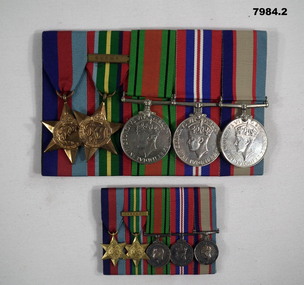
... Military Museum 37 - 39 Pall Mall Bendigo goldfields Medals belonging to Pte L.A. Murray, No. VX61585, 22 Australian Brigade WKSP (Workshops). Also known as Lawrence Arthur McCormack, Part of the Cooper Collection. Burma clasp issued to those service personnel who received the Pacific Star but also qualified for the Burma Star. A person ...Medals belonging to Pte L.A. Murray, No. VX61585, 22 Australian Brigade WKSP (Workshops). Also known as Lawrence Arthur McCormack, Part of the Cooper Collection. Burma clasp issued to those service personnel who received the Pacific Star but also qualified for the Burma Star. A person could not receive both stars.1. Court mounted WW2 medal set consisting of five medals and ribbons; 1939-1945 Star, Pacific Star with Burma clasp, Defence Medal, British War medal 1939-1945, Australian Service Medal 1939 - 45 2. Court mounted WW2 miniature medal set consisting of five medals as per 1.Inscribed on back of stars and rims of disc shaped medals: “VX61585 L.A. Murray”cooper collection, l.a. mccormick, ww2, medal set, miniature medals -
 Bendigo Military Museum
Book - BOOK, CHILDRENS, Kerry BROWN et al, "LEST WE FORGET", 2015
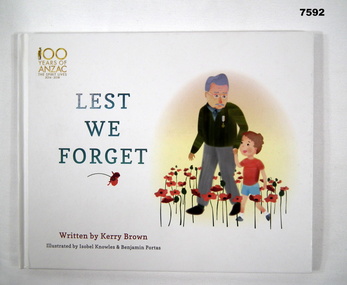
... Military Museum 37 - 39 Pall Mall Bendigo goldfields "LEST WE FORGET" "100/YEARS OF/ANZAC/ THE SPIRIT LIVES/ 2014-2018" THIS IS A STORY BOOK FOR CHILDREN. Books ANZAC Day Children Hard cover book. Cover - cardboard with adhered white paper cover. Gold, blue, red and black print on front, spine and back. Illustrated, front in colour of elderly person ..."LEST WE FORGET" "100/YEARS OF/ANZAC/ THE SPIRIT LIVES/ 2014-2018" THIS IS A STORY BOOK FOR CHILDREN.Hard cover book. Cover - cardboard with adhered white paper cover. Gold, blue, red and black print on front, spine and back. Illustrated, front in colour of elderly person with a child surrounded by red poppies. Back, elderly person seated in armchair with a child seated on his knee. No page numbers, cut, plain white paper. Illustrations in colour.books, anzac day, children -
 Bendigo Military Museum
Certificate - CITIZENS OF BENDIGO, Bendigo City Council, C. 1945 onwards
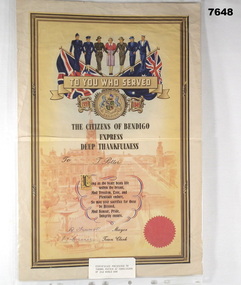
... Bendigo Military Museum 37 - 39 Pall Mall Bendigo goldfields Often after a Service person returning from War, the Local Council would present them with a Certificate of Appreciation for their sacrifice's. ...Often after a Service person returning from War, the Local Council would present them with a Certificate of Appreciation for their sacrifice's. In this case was to "Thomas Potter" after WW2. This is possibly 54610 Potter - Thomas RAAF, enlisted 27.4.1942 age 44. Discharged 22.3.1946 with the rank of Cpl in Air Defence HQ Townsville.Large Certificate on cream colour paper. Gold frame edges drawn inside of paper edge. Pictures of series of different service people standing over British & Australian flag and emblem of "City of Bendigo". Message of thanks and the name of returned soldier, followed by a poem and signature of Mayor and Town Clerk and stamp of Council. All overlaid over an image of Bendigo CBD.Signed by Mayor and Town Clerk. Says " The Citizens of Bendigo express deep Thankfulness to T. Potter"bendigo city council, certificate, thomas potter -
 Bendigo Military Museum
Pamphlet - SOUVENIR PROGRAM, SOLDIERS MEMORIAL INSTITUTE 2018, City of Greater Bendigo, C. Nov 2018
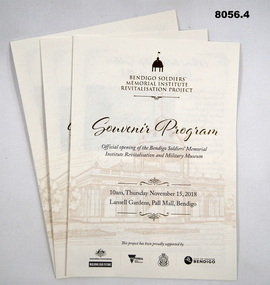
... Military Museum 37 - 39 Pall Mall Bendigo goldfields When the SMI was opened in Nov 1921 the Bendigo RSL Sub - Branch had occupancy from that day on. The Building became a Museum opened to the public in 1998 by the RSL. The origins of this project goes back to 2011 with a letter to the City of Greater Bendigo of the possibility of an upgrade to the SMI from the Bendigo District RSL Sub - Branch Inc. Some renovations had already taken place and some structural work. After initial talks a sub - committee of 3 persons ...When the SMI was opened in Nov 1921 the Bendigo RSL Sub - Branch had occupancy from that day on. The Building became a Museum opened to the public in 1998 by the RSL. The origins of this project goes back to 2011 with a letter to the City of Greater Bendigo of the possibility of an upgrade to the SMI from the Bendigo District RSL Sub - Branch Inc. Some renovations had already taken place and some structural work. After initial talks a sub - committee of 3 persons from the RSL was elected to work with the Council along with other bodies who would be involved. Plans eventuated by 2015 and were put to the RSL for approval. From there the fund raising began from the State/Federal Govt's, RSL, the Public and Council itself. This was achieved and finally in Sept 2016 the SMI/Museum was packed up completely and the Renovations began in 2017. Souvenir program, card yellow colour folding, front page is in gold and black writing with an image of the Dome on the SMI followed by in gold, "Bendigo Soldiers Memorial Institute Revitalisation Project" then in gold, "Souvenir Program", in the centre has details re time, date, place. At the bottom are the logo's of the Federal & State Governments, RSL and City of Greater Bendigo Page 2 is titled "About the Bendigo Soldiers Memorial Institute" with a photo showing the "Hustlers Royal Reserve Mine No 2" which was on the site where the SMI now stands. Page 3 has details of the program, music, Official welcome, speakers, ribbon cutting, the ODE, Last Post, National Anthem, close of formalities and light refreshments. Page 4 has a photo of the original souvenir pamphlet used at the original opening on November 15th 1921, 97 years to the day. at the bottom, "Thankyou section to all those involved in the project""Official opening of the Bendigo Soldiers Memorial Institute Revitalisation and Military Museum 10am Thursday November 15, 2018, Lansell gardens, Pall, Mall Bendigo"brsl, smirsl, program -
 Bendigo Military Museum
Card - INVITATION 2018, City of Greater Bendigo, C. Nov 2018
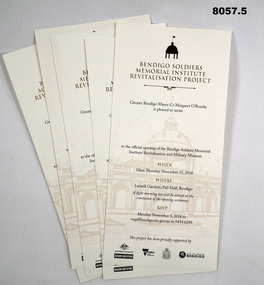
... Military Museum 10am Thursday 15, 2018 Lansell Gardens Pall Mall Bendigo". Invitation card, one sided yellow colour to the "Bendigo Soldiers Memorial Institute Revitalisation Project. A space is blank for the person ...Refer Cat No 8056.4 for more details of this project, history and re opening.Invitation card, one sided yellow colour to the "Bendigo Soldiers Memorial Institute Revitalisation Project. A space is blank for the person invited's name followed by time, place, date & RSVP, at the bottom are 4 logos representing State/Federal Govt's, RSL and City of Greater Bendigo.Main points; "Greater Bendigo Mayor Cr Margaret O'Rourke is pleased to invite - to the official opening of the Bendigo Soldiers Memorial Institute Revitalisation and Military Museum 10am Thursday 15, 2018 Lansell Gardens Pall Mall Bendigo".brsl, smirsl, invitaion -
 Bendigo Military Museum
Card - CARD, BCOF SUBSCRIBER
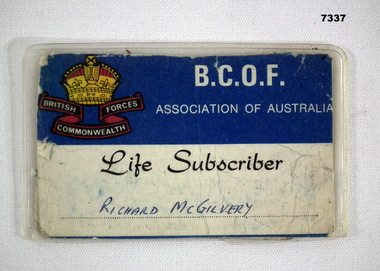
... Bendigo Military Museum 37 - 39 Pall Mall Bendigo goldfields Australian Membership card Occupational Forces from Commonwealth in Japan. A life Subscriber was a person ...Australian Membership card Occupational Forces from Commonwealth in Japan. A life Subscriber was a person who paid many years of membership ahead usually at a cheaper membership amount. Re collection of Richard William McGILVERY, RAAF. Refer Cat No.7287P for his service details, photos and awards.Small card, blue and white on front, wrapped in hard plastic. On front emblem of British Forces Commonwealth. Richard McGILVERY name on front. On back - membership No. and name and address of Mrs. W.E. McGILVERY and her signature.Titles "BCOF Association of Australia, Life Subscriber" and Richard McGILVERY's name. On back membership No. 16343.bcof, japan, richard william mcgilvery -
 Bendigo Military Museum
Book - MILITARY, REFERENCE, Terry GANDER, "MILITARY ARCHAEOLOGY", 1979
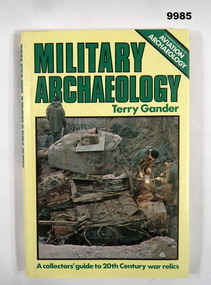
... Military History Archaeology Retailer's information black print. "TECHNICAL BOOK & MAG. CO/ 289-299 SWANSTON STREET/ MELBOURNE 3000 663 3951" Hardcover book with dust cover. Hardcover - cardboard with yellow colour buckram. Gold colour print on spine. Dust cover - paper, with green and black colour print on front, spine and back. Illustrated - colour photographs - Front - three persons ...Hardcover book with dust cover. Hardcover - cardboard with yellow colour buckram. Gold colour print on spine. Dust cover - paper, with green and black colour print on front, spine and back. Illustrated - colour photographs - Front - three persons working on a tank relic. Back - display of an army vehicle. 156 pages - cut, plain, white colour paper. Illustrated black and white photographs, maps and diagrams. Retailers gold colour adhesive label - front endpaper. Retailer's information black print. "TECHNICAL BOOK & MAG. CO/ 289-299 SWANSTON STREET/ MELBOURNE 3000 663 3951"publication, book, military history, archaeology -
 Bendigo Military Museum
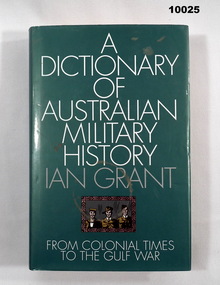
Book - DICTIONARY, MILITARY, Ian Grant, "A DICTIONARY OF AUSTRALIAN MILITARY HISTORY", 1992
... Military History ' Hard cover book with dust cover. Hardcover - cardboard, green colour buckram, white colour print on spine. Dust cover - paper, green colour background, white and grey print on front and spine. Small illustration on front - three service persons ...From Dust cover front - "A/DICTIONARY/ OF AUSTRALIAN/ MILITARY/ HISTORY/ FROM COLONIAL TIMES/ TO THE GULF WAR".Hard cover book with dust cover. Hardcover - cardboard, green colour buckram, white colour print on spine. Dust cover - paper, green colour background, white and grey print on front and spine. Small illustration on front - three service persons in half portrait drawing. Brown, grey, pink colours. 414 pages - cut, plain, off white colour paper. No illustrations.publication, book, dictionary, military history, ' -
 Bendigo Military Museum
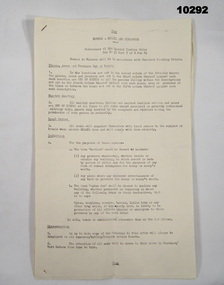
Document - SPECIAL ROUTINE ORDER, 1964
... Military Museum 37 - 39 Pall Mall Bendigo goldfields Collection re G.A. Jones 3790932, refer Cat No 10053.2P for his service details. The front page has 6 listings giving an outline. Following pages give a listing of locations - places - areas "Out of Bounds" - persons ...Collection re G.A. Jones 3790932, refer Cat No 10053.2P for his service details. The front page has 6 listings giving an outline. Following pages give a listing of locations - places - areas "Out of Bounds" - persons forbidden to enter "Out of Bounds' places. The last pages give a listing of the places/areas in Malaya, Penang, Singapore, Cameron Highlands, Ipoh, Kuala Lumpur, Seremban, Mallacca. These cover some 65 establishments not including statements like, All brothels, Opium dens etc.Document 6 pages copy, yellowed paper, all print in black, stapled together in top RH corner.On front sheet, "Reference 17 Div Special Routine Order - Ser No 22 Sect 7 of 8 June 64"documents, orders, routine, g a jones, malaya
