
Showing 14 items matching " moderne style"
-
 Glen Eira Historical Society
Document - CAULFIELD RSL
... ... Moderne Style...George’s Road Elsternwick English Domestic Revival Style Moderne Style Brick Houses Bay Windows Architectural Features Prendergast Ellen Mrs. ...This file contains two items pertaining to the property housing the Caulfield RSL: 1/A photocopy (2 pages) of an assessment of the property, dated 01/1997, by Andrew Ward, for purposes of ascertaining its historical significance. The assessment describes the architectural features of the property, offers a brief history of it, specifies why it should be considered significant, and recommends that it be added to the National Estate Register. Included is a black-and-white photograph of the exterior of the building. 2/An assessment (17 long pages plus appendix) of the car parking issues procured as a result of the decision to refurbish the Caulfield RSL. Prepared by Grogan Richards Pty Ltd, dated 13/11/2002, reviewed by Joanna Gauetty, and authorised by Rody Jude. Included is a description of the Club’s location and surrounding motorways as they existed at the time, a description of the Club itself (eg its opening hours and rate of patronage as per each opening hour), occupancy surveys, descriptions of other recent car parking construction within the same area, a description of the extensions the RSL is aiming to construct, and descriptions of the considerations any new construction must take into account. Included is a black-and-white map of Caulfield noting the RSL’s location, and two black-and-white photographs showing the view to the north and south of St. George’s Road, respectively.caulfield, caulfield returned servicemen league (rsl), exservice organisations, clubs and associations, ward andrew, glen eira heritage management plan, historic buildings, architectural, styles, national trust company, st. leonard’s, elsternwick club, grogan richards pty ltd, returned servicepeople, armed forces, soldiers, aged people, senior citizens centres, st. george’s road, elsternwick, english domestic revival style, moderne style, brick houses, bay windows, architectural features, prendergast ellen mrs., ford grylis, dl design group, gauetty joanna, jude rody, parking, glen eira planning scheme -
Glen Eira Historical Society
Book - Caulfield Institute of Technology
... ... Moderne style...Boykett Building Railway Avenue Dandenong Road Queens Road Princes Avenue Phillip Law Building Carnegie Caulfield East School Boards Library School of Industrial Studies Counselling Services Computer Centre Financial Statement Degrees Diploma and Graduate Diplomas Certificates School of Engineering School of General Studies Administration Services Colleges Moderne style Student Union Building Construction Building Sites Budget Task Force Partridge Committee (Post Secondary Education) Williams Committee (Education and Training) Saxe Committee (Nurse Education) School of Business Education Tertiary Education Book Caulfield Institute of Technology ...Three items of Annual Reports: 1/ Caulfield Institute of Technology Annual Report 1973. Including attached page of Council members and staff. Includes introduction giving history of the Educational establishment. 2/ Caulfield Institute of Technology Annual Report 1974. Includes photocopied sheet of staff and board names. 3/ Caulfield Institute of Technology Annual Report 1977. Includes two photocopied lists of staff and board members.ward t., boykett kenneth, whitlam gough prime minister, abbot pam, horne donald, k.h. boykett building, railway avenue, dandenong road, queens road, princes avenue, phillip law building carnegie, caulfield east, school boards, library, school of industrial studies, counselling services, computer centre, financial statement, degrees, diploma and graduate diplomas, certificates, school of engineering, school of general studies, administration services, colleges, moderne style, student union, building construction, building sites, budget task force, partridge committee (post secondary education), williams committee (education and training), saxe committee (nurse education), school of business, education, tertiary education -
 City of Melbourne Libraries
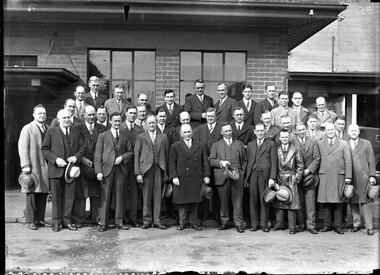
Photograph, Bull, Hugh Jones, 1897-1993, Steel manufacturers, McPherson's Ltd, Melbourne
... ...Moderne style architecture...u=12430d30453a77059b7d10d49006a521 Robyn Annear, Bearbrass: imagining early Melbourne, Black Inc., 2014 (originally published 1995 by Mandarin) 'Company details', Ajax Fasteners, http://www.minesuppliersonline.com.au/australia/braeside/hardware/ajax-fasteners 'Former McPherson's Building', Victorian Heritage Database, https://vhd.heritagecouncil.vic.gov.au/places/741 1930-1939 industrial workers clothing and dress 1930 Iron and steel industry Businesses Bridges Industry Melbourne Gold Rush Moderne style architecture Photographer notations on slide: "Steel manuf'rs at McPherson's Ltd 1933 B5". ...Photographer notations on slide: Steel Manuf’rs at McPherson’s Ltd 1933 Published: The Age, 30 August 1933 BUREAU OF STEEL MANUFACTURERS OF AUSTRALIA. (1933, August 30). The Age (Melbourne, Vic. : 1854 - 1954), p. 11. Retrieved January 25, 2026, from http://nla.gov.au/nla.news-article204372874 Published title: Bureau of Steel Manufacturers of Australia Published caption: A group of Inter-State Visitors, from the Bureau of Steel Manufacturers of Australia, on a tour of inspection at the Bolt Works of McPhersons Pty. Ltd., Burnley-Richmond, yesterday. Research by Project Volunteer, Louise McKenzie: The photo shows a line up of 36 men, in three rows, in front of a building. They are mostly dressed in dark 3-piece suits, or camel coats. But one gentleman stands out in his full length leather coat! Striped ties are popular, and they are all holding hats. One man, at the rear towards the right, looks a bit younger with his thick, black, brylcreamed hair.. These interstate gentlemen are described in the newspaper caption as representatives of the Bureau of Steel Manufacturers "...on a tour of inspection at the Bolt Works of McPhersons Pty Ltd, Burnley, Richmond." Interestingly, the Bureau of Steel Manufacturers of Australia (BOSMA) still exists, and is the industry body for major Australian steel producers like BlueScope, Liberty, and InfraBuild, representing their interests, engaging with government, and participating in standards setting for the domestic steel market, with a history dating back to 1923. While BOSMA focuses on primary manufacturing, the Australian Steel Institute (ASI) serves as the broader peak body for the entire steel supply chain, from mills to end-users, promoting and supporting the industry. But at the time of this photo, the Australian steel industry was just starting to make headway. As the AST website explains, "Steelmaking in Australia began just a decade prior to the start of the 1851 Gold Rush whilst Australia was still divided into colonies. Iron ore deposits were discovered in 1840 at Iron Knob, South Australia but a lack of equipment meant that the process of producing steel was impossible. Even attempts at smelting the iron ore in a blast furnace to create pig iron were unsuccessful due to the poor quality of iron ore and coke available to the budding industry. In the other colonies at the time, such as Victoria, Tasmania, and New South Wales, there were minor discoveries of iron ore but poor technical expertise and limited quantity meant that the quality of steel was poor. Compared to the far superior steel being imported from Britain at the time, the steel manufacturing industry simply couldn’t compete and was unviable. By the 1870s, almost all steel production in Australia had been abandoned. The situation began to change at the turn of the century. Rapid growth sparked higher demand for industrial machinery made from steel and infrastructure such as rail. It became apparent that there was a need for locally manufactured steel and soon there would be an answer. In 1901, the year Australia united into a federation, the nation’s first blast furnace went into production at Eskbank near Lithgow in New South Wales. The development was spearheaded by William Stafford and his son Esk, and Stafford is known as the father of Australian steel production. In 1915, production expanded with another steel mill in Newcastle that was opened by BHP. It sourced coke from local mines and iron ore from South Australia, creating a domestic loop for steel manufacturing. In the following years, more steelworks opened in Whyalla, South Australia and Port Kembla in NSW. Steel manufacturing in Australia was now underway." The company mentioned in the photo’s notation and in the newspaper caption, was McPhersons, "...an Australian hardware firm, for many years a leading merchant of woodworking and metal-working machinery... [and founded by] Thomas McPherson (c.1823–1888) who had a home "Dudley House" at 142 Dudley Street, West Melbourne. [The] ironmongery business [was located] in 1860 at 149 Spencer Street, Melbourne. Merchandise carried included bells, lathes, horseshoes and steam engines." (Wikipedia - McPherson's Pty Ltd) Anyone who has read Robyn Annear’s excellent award-winning 2014 book Bearbrass – the name for early Melbourne - will remember only too well her description of West Melbourne, from where the city of Melbourne as we know it, emerged. Her book resurrects the village that was early Melbourne – from the arrival of white settlers in 1835 until the first gold rushes shook the town – and brings it to life in vivid colour. The McPherson family, whose arrival in Bearbrass coincides with this period (Thomas arrived in 1852), became intimately involved in the growth and development of Melbourne. Thomas was Mayor of Melbourne (1870-1871); his eldest son Hunter became a successful Sydney businessman; second son Edward and third son William inherited the company, and ran it together until 1896 when Edward killed himself. William had a notable career in politics as treasurer of Victoria 1917-1923, in which year he was knighted. 1928-1929 he was Premier of Victoria, and a noted philanthropist. The family were significant property owners in the city of Melbourne: 149 Spencer Street, 582-588 Collins Street, 554-566 Collins Street, together with a property on Jeffcott Street, West Melbourne, and factories in Sunshine, Tottenham, Kensington and Richmond – all by the mid 1940s. By that time they also had controlling interests in several Australasian industries, including Ajax Bolt and Rivet Pty Ltd of NZ, F W Hercus Manufacturing Co Ltd, manufacturers in South Australia of lathes, guillotines and other heavy machinery, also of Patience and Nicholson (P & N), manufacturers in Maryborough, Victoria, of twist drills and thread-forming tools; also Wiltshire Files on Sunshine Road, Tottenham, manufacturing files and rasps. The Acme Machine Tool Company became a branch of McPhersons, and the company claimed to have supplied, from their own manufacture, all five million rivets (some 3,600 tonnes) used in the building of the Sydney Harbour Bridge – described as a steel through arch bridge, which opened in 1932; the tallest of its kind in the world (Wikipedia – Sydney Harbour Bridge) McPherson’s was also innovative in other ways. It published a comprehensive catalogue, extensively detailed with prices, available free of charge to farmers and other businesses. In 1908 it had 148 pages. By 1937 it had grown to 372 pages. The University of Melbourne’s Archives entry on McPherson’s Limited notes: "After the outbreak of the Second World War, McPherson’s factories worked at full capacity and were crucial to Australia’s war efforts. On 5 December 1944 McPherson's converted to a public company named McPherson's Ltd, with William Edward as Chairman of Directors. By the start of the 1950s the company had a very different Board of Directors; in 1947 the Managing Director Oliver Addison died, and his replacement Marshall Eady died only six months later. Both had been Directors since McPherson’s became a proprietary company in 1913. Another Director, Philip Bevan, died in 1948 and this was followed by the death of William Edward in 1950. S.B Holder, F.G. Thorpe, H.L. Hastie, F. Grassick and D.G. Syme all joined the Board before 1950. The company continued to prosper for many years after the death of William Edward. His son, William David, was invited to join the McPherson’s Ltd Board in 1951. He married Angela Cumming in 1955 and soon after was sent to Brisbane as Director in Charge to oversee the building of a new warehouse. The opening of this warehouse in Queensland meant that the company now had major outlets in five states. As time went on, manufacturing in Australia began to decline and imports of everyday tools began arriving from Asia. These tools were being produced with much lower labour costs and could be sold at cheaper prices. William David retired in 1984 and eventually parts of the company were divested, such as the Richmond Bolt Works which closed in the early 1990s. Since the 1980s, McPherson's has diversified into housewares, printing, and health and beauty care products." This article also contains photos, one of which is a photograph of 'Bolt works picnic' 1920, showing workers in their shirt sleeves participating in a tug of war in a rural "picnic" setting. McPherson’s premises at 554-566 Collins Street more than lasted the test of time and is listed as historically significant. The magnificent art deco building from the 1930s in the heart of Melbourne was first commissioned in 1934 and completed in 1937. It is an imposing building fronting almost a quarter of the city block between Spencer Street and King Street, and was designed to be a warehouse, office and showroom for the hardware empire. International architects Stuart P Calder, and Reid and Pearson designed the four-storey building with a basement level and a stair tower at the centre that provides access to what was a tennis court on the roof. It is considered an example of the streamlined modern style in Melbourne and shows how the McPherson company, protected from taxes after World War I, was able to manufacture goods without being affected by the competition. The building has survived, and its current iteration is as the home to il Mercato Centrale – an Italian style artisan market concept. The University of Melbourne Archives hold a particularly good image of the building from its heyday, complete with Collins Street lamps on the pavement outside the store. And to return to our image, sited at "Bolt Works of McPhersons". Today this segment of McPhersons is still very well known - Ajax. A good summary of the company’s history, and the development of the name and business, can be found on the Mine Suppliers Online website: "AJAX Fasteners can trace its heritage back to 1900, when the Acme Bolt Company was established in West Melbourne, Victoria. In 1909, William McPherson used the company as the basis for establishing McPherson’s Bolt Works – adopting the brand ‘Ajax’ – and moved it to Richmond. Over the years, the company changed many times in response to industry needs to ensure that it remained the premier manufacturer of high quality fasteners in Australia. Many other names in the industry, such as Firth Cleveland, Spurway Cooke and Nettlefolds were merged or acquired into the company. McPhersons ended their 80-year ownership of Ajax in the early 90s when they sold their shares to National Consolidated, which was also a major shareholder at the time. In 1997, Ajax Fasteners moved to new purpose-built premises in Braeside, Victoria. Soon after, National Consolidated was taken over by the diversified manufacturer Austrim. The group soon acquired the iconic Nylex, and adopted the name Nylex Corporation. In January 2007, ACME Operations Pty Ltd acquired Ajax Fasteners and continues to operate the business today from the Braeside plant. The name ACME provides a nostalgic return by the new owners to the company’s heritage, when the Acme Bolt Company was founded in July 1900." REFERENCES: BUREAU OF STEEL MANUFACTURERS OF AUSTRALIA. (1933, August 30). The Age (Melbourne, Vic. : 1854 - 1954), p. 11. Retrieved January 25, 2026, from http://nla.gov.au/nla.news-article204372874 Wikipedia, McPherson’s Pty Ltd, https://en.wikipedia.org/wiki/McPherson%27s_Pty_Ltd Wikipedia, Richmond, Victoria, https://en.wikipedia.org/wiki/Richmond,_Victoria Industry: From the mid-19th century, Richmond was a centre of manufacturing industry, including many large complexes such as the Bryant & May match factory, Jaques Limited engineering works, the Wertheim Piano factory and Pelaco. Wikipedia, Sydney Harbour Bridge, https://en.wikipedia.org/wiki/Sydney_Harbour_Bridge eMelbourne, Manufacturing, https://www.emelbourne.net.au/biogs/EM00896b.htm 'New life for Melbourne's McPherson Building', The Urban Developer, https://www.theurbandeveloper.com/articles/mcphersons-building-melbourne-il-mercato-centrale-food-retail-destination Bureau Of Steel Manufacturers Of Australia Limited, http://www.bosma.org.au/ 'A Brief History of Steel Manufacturing in Australia', AST, https://astraders.com.au/a-brief-history-of-steel-manufacturing-in-australia/ 'Steel manufacturing in Australia: a brief history', Hard Bakka Steel Fabrication, https://www.hardbakka.com.au/component/virtuemart/steel-manufacturing-in-australia-a-brief-history?Itemid=494 McPherson's Limited, University of Melbourne Archives, https://archives.library.unimelb.edu.au/nodes/view/58364 Source of Description: 'Nuts and Bolts: A story of a family and a firm', Barbara Hamer (2006), McPherson’s Printing Group 'Photograph of 'Bolt works picnic' 1920', University of Melbourne Archives, https://archives.library.unimelb.edu.au/assets/display/1287217-max?u=dea2e4d2fd07ac822e624f1e7d39adb3 'Photograph of the exterior of the McPhersons Department store at 546 Collins Street, Melbourne.', University of Melbourne Archives, https://archives.library.unimelb.edu.au/assets/display/1287215-max?u=12430d30453a77059b7d10d49006a521 Robyn Annear, Bearbrass: imagining early Melbourne, Black Inc., 2014 (originally published 1995 by Mandarin) 'Company details', Ajax Fasteners, http://www.minesuppliersonline.com.au/australia/braeside/hardware/ajax-fasteners 'Former McPherson's Building', Victorian Heritage Database, https://vhd.heritagecouncil.vic.gov.au/places/741Photographer notations on slide: "Steel manuf'rs at McPherson's Ltd 1933 B5".1930-1939, industrial workers, clothing and dress, 1930, iron and steel industry, businesses, bridges, industry, melbourne, gold rush, moderne style architecture -
 Port Melbourne Historical & Preservation Society
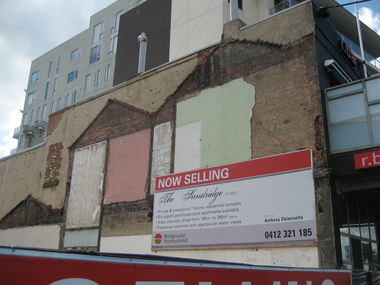
Photograph - Demolition of Sandridge Hotel, Port Melbourne, David Thompson, 2007
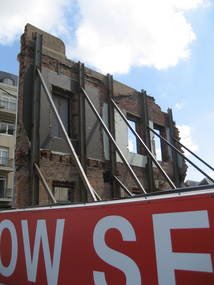
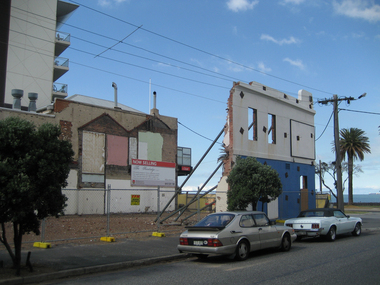
... It became the Sandridge Hotel in the 1940s by which time the building had been remodelled in a moderne style. The Sandridge Hotel was demolished in early 2007 except for a single wall in Stokes Street that remained, propped up, before it too was demolished in March, 2007. ...It became the Sandridge Hotel in the 1940s by which time the building had been remodelled in a moderne style. The Sandridge Hotel was demolished in early 2007 except for a single wall in Stokes Street that remained, propped up, before it too was demolished in March, 2007. ...The Freemason's Tavern was established on the corner of Beach and Stokes Streets in 1859 next to the Masonic Hall used by the Sandridge Marine Lodge No 21 at 18 Stokes Street. It became the Sandridge Hotel in the 1940s by which time the building had been remodelled in a moderne style. The Sandridge Hotel was demolished in early 2007 except for a single wall in Stokes Street that remained, propped up, before it too was demolished in March, 2007. A reconstructed 'Victorian' version of the hotel was incorporated into the apartments built on the site.Digital colour photograph of the demolition of the Sandridge Hotel on the corner of Beach and Stokes Streets showing the outline of the hotel on the next door building.business and traders - hotels, built environment - commercial, sandridge hotel, freemason's tavern, demolitions, beach street, stockes street -
 Port Melbourne Historical & Preservation Society
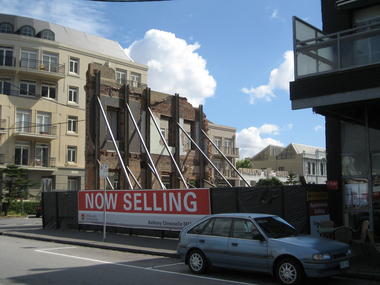
Photograph - Demolition of Sandridge Hotel, Port Melbourne, David Thompson, 2007
... It became the Sandridge Hotel in the 1940s by which time the building had been remodelled in a moderne style. The Sandridge Hotel was demolished in early 2007 except for a single wall in Stokes Street that remained, propped up, before it too was demolished in March, 2007. ...It became the Sandridge Hotel in the 1940s by which time the building had been remodelled in a moderne style. The Sandridge Hotel was demolished in early 2007 except for a single wall in Stokes Street that remained, propped up, before it too was demolished in March, 2007. ...The Freemason's Tavern was established on the corner of Beach and Stokes Streets in 1859 next to the Masonic Hall used by the Sandridge Marine Lodge No 21 at 18 Stokes Street. It became the Sandridge Hotel in the 1940s by which time the building had been remodelled in a moderne style. The Sandridge Hotel was demolished in early 2007 except for a single wall in Stokes Street that remained, propped up, before it too was demolished in March, 2007. A reconstructed 'Victorian' version of the hotel was incorporated into the apartments built on the site.Digital colour photograph of the demolition of the Sandridge Hotel on the corner of Beach and Stokes Streets showing a single wall remaining in Stokes Street.business and traders - hotels, built environment - commercial, sandridge hotel, freemason's tavern, demolitions, beach street, stockes street -
 Port Melbourne Historical & Preservation Society
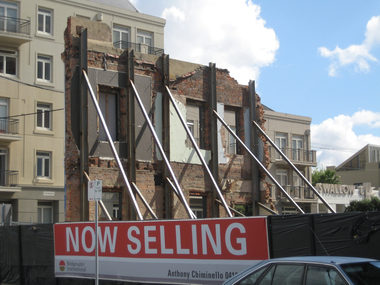
Photograph - Demolition of Sandridge Hotel, Port Melbourne, David Thompson, 2007
... It became the Sandridge Hotel in the 1940s by which time the building had been remodelled in a moderne style. The Sandridge Hotel was demolished in early 2007 except for a single wall in Stokes Street that remained, propped up, before it too was demolished in March, 2007. ...It became the Sandridge Hotel in the 1940s by which time the building had been remodelled in a moderne style. The Sandridge Hotel was demolished in early 2007 except for a single wall in Stokes Street that remained, propped up, before it too was demolished in March, 2007. ...The Freemason's Tavern was established on the corner of Beach and Stokes Streets in 1859 next to the Masonic Hall used by the Sandridge Marine Lodge No 21 at 18 Stokes Street. It became the Sandridge Hotel in the 1940s by which time the building had been remodelled in a moderne style. The Sandridge Hotel was demolished in early 2007 except for a single wall in Stokes Street that remained, propped up, before it too was demolished in March, 2007. A reconstructed 'Victorian' version of the hotel was incorporated into the apartments built on the site.Digital colour photograph of the demolition of the Sandridge Hotel on the corner of Beach and Stokes Streets showing a single wall remaining in Stokes Street.business and traders - hotels, built environment - commercial, sandridge hotel, freemason's tavern, demolitions, beach street, stockes street -
 Port Melbourne Historical & Preservation Society
Photograph - Demolition of Sandridge Hotel, Port Melbourne, David Thompson, 2007
... It became the Sandridge Hotel in the 1940s by which time the building had been remodelled in a moderne style. The Sandridge Hotel was demolished in early 2007 except for a single wall in Stokes Street that remained, propped up, before it too was demolished in March, 2007. ...It became the Sandridge Hotel in the 1940s by which time the building had been remodelled in a moderne style. The Sandridge Hotel was demolished in early 2007 except for a single wall in Stokes Street that remained, propped up, before it too was demolished in March, 2007. ...The Freemason's Tavern was established on the corner of Beach and Stokes Streets in 1859 next to the Masonic Hall used by the Sandridge Marine Lodge No 21 at 18 Stokes Street. It became the Sandridge Hotel in the 1940s by which time the building had been remodelled in a moderne style. The Sandridge Hotel was demolished in early 2007 except for a single wall in Stokes Street that remained, propped up, before it too was demolished in March, 2007. A reconstructed 'Victorian' version of the hotel was incorporated into the apartments built on the site.Digital colour photograph of the demolition of the Sandridge Hotel on the corner of Beach and Stokes Streets showing a single wall remaining in Stokes Street.business and traders - hotels, built environment - commercial, sandridge hotel, freemason's tavern, demolitions, beach street, stockes street -
 Port Melbourne Historical & Preservation Society
Photograph - Demolition of Sandridge Hotel, Port Melbourne, David Thompson, 2007
... It became the Sandridge Hotel in the 1940s by which time the building had been remodelled in a moderne style. The Sandridge Hotel was demolished in early 2007 except for a single wall in Stokes Street that remained, propped up, before it too was demolished in March, 2007. ...It became the Sandridge Hotel in the 1940s by which time the building had been remodelled in a moderne style. The Sandridge Hotel was demolished in early 2007 except for a single wall in Stokes Street that remained, propped up, before it too was demolished in March, 2007. ...The Freemason's Tavern was established on the corner of Beach and Stokes Streets in 1859 next to the Masonic Hall used by the Sandridge Marine Lodge No 21 at 18 Stokes Street. It became the Sandridge Hotel in the 1940s by which time the building had been remodelled in a moderne style. The Sandridge Hotel was demolished in early 2007 except for a single wall in Stokes Street that remained, propped up, before it too was demolished in March, 2007. A reconstructed 'Victorian' version of the hotel was incorporated into the apartments built on the site.Digital colour photograph of the demolition of the Sandridge Hotel on the corner of Beach and Stokes Streets showing a single wall remaining in Stokes Street.business and traders - hotels, built environment - commercial, sandridge hotel, freemason's tavern, demolitions, beach street, stockes street -
 Greensborough Historical Society
Booklet - Report, RBA Architects, Stubley's Hay and Grain Store (Former), 2021
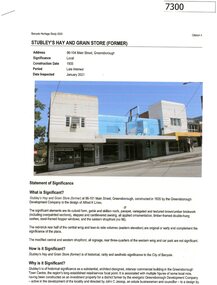
... Lines, a rare example for Banyule of Moderne influenced style, Citation 4 in the Banyule Heritage Study 2020...Lines, a rare example for Banyule of Moderne influenced style, Citation 4 in the Banyule Heritage Study 2020 main street greensborough banyule heritage study 2020 stubleys hay and grain store 15 p. text and colour photographs, stapled Stubley's Hay and Grain Store (Former) Booklet Report RBA Architects ...Stubley's Main Street building was constructed in 1935 by the Greensborough Development Company, designed by A. K. Lines, a rare example for Banyule of Moderne influenced style, Citation 4 in the Banyule Heritage Study 202015 p. text and colour photographs, stapledmain street greensborough, banyule heritage study 2020, stubleys hay and grain store -
 Sunshine and District Historical Society Incorporated
Photograph - Sunshine Technical School Girls Building Photograph
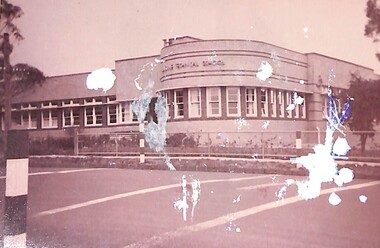
... It was designed in a Moderne architectural style, a streamlined, interwar look that still stands out in Sunshine’s built heritage. ...It was designed in a Moderne architectural style, a streamlined, interwar look that still stands out in Sunshine’s built heritage. ...A dedicated girls’ building opened in 1937 on Derby Road, expanding the original 1913 boys’ technical school into a co‑educational institution. It was designed in a Moderne architectural style, a streamlined, interwar look that still stands out in Sunshine’s built heritage. This photograph shows a rare view of the western elevation of this building.sunshine technical school, derby road, sunshine -
Glen Eira Historical Society
Document - CAULFIELD TECHNICAL SCHOOL
... Dated March 1995. Moderne style for one entry and Classical Revival forthe other...Dated March 1995. Moderne style for one entry and Classical Revival forthe other. (5 pages) 3/'Gryphon' - Annual Magazine Caulfield Technical School 1954. 80 page book which includes photos and reports on activities, classes and students plus many pages of advertisements. ...Three items about this school: 1/Pamphlet for 'Caulfield Technical School - Open Nights, Exhibition of Students Work and Working Display', November 1928. admission: a Shrine Button for the School's Shrine of Remembrance Fund subscription. Reverse has courses and conditions for enrolment. 2/Photocopy of Andrew Ward's Caulfield Conservation Study of Caulfield Technical School, which later became Monash University Caulfield Campus. Dated March 1995. Moderne style for one entry and Classical Revival forthe other. (5 pages) 3/'Gryphon' - Annual Magazine Caulfield Technical School 1954. 80 page book which includes photos and reports on activities, classes and students plus many pages of advertisements. Noted 'Lynette Lamb' on front cover.caulfield technical school, railway avenue, dandenong road, monash university caulfield campus, art and applied science wing, technical schools, education, universities, architectural features, modern style, classical revival style, architectural styles, windows, stairs, shows and exhibitions, ward andrew, towers, millard kenneth (editor), coleman john, vizard richard, isaac cynthia, rooke graham, russon john, magazine committee, 'gryphon', advertisements, caulfield technical college, caulfield institute of technology -
 Mission to Seafarers Victoria
Photograph - Photograph, Colour, 1988
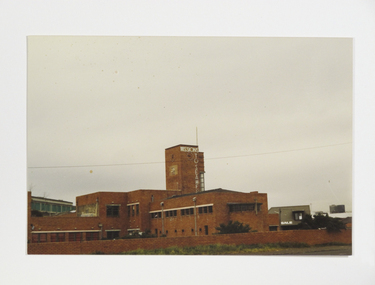
... Architect Harry A Norris, one of Melbourne's early designers in the Moderne style had a strong relationship with the wealthy Nicholas family who made their fortune on the production of Aspro, a replacement for the German Aspirin when it was made unavailable during WWI. ...The photograph taken in 1988 before it was demolished shows the Art Deco style building also known as the King George V memorial Building, commissioned by merchant and philanthropist, Alfred Michael Nicholas (1881-1937) and designed by prolific Melbourne-based architect Harry A. Norris (1888-1966) in 1937 best known for his commercial work in Melbourne city centre. Architect Harry A Norris, one of Melbourne's early designers in the Moderne style had a strong relationship with the wealthy Nicholas family who made their fortune on the production of Aspro, a replacement for the German Aspirin when it was made unavailable during WWI. After the Nicholas Building on Swanson Street (1926), the Nicholas Factory in South Melbourne, and the mansion 'Burnham Beeches' in the Dandenongs (1931), the former Missions to Seamen building in Port Melbourne (1937) was a gift from Alfred Nicholas to the Church of England. “The new Institute will be a modern two story building in brick, with a high clock-tower, a memorial chapel, a hall for talking pictures, lounges, and billiard-rooms. It will stand in about an acre of ground between the two piers at Port Melbourne. The building of the mission has been made possible by a bequest of about£15,000 by the late Mr. A. M. Nicholas.” – The Argus 19th May, 1937. The building had a cruciform floor plan which contains a chapel, a large hall, other recreation rooms, sleeping accommodation on the first floor and a sundeck and living quarters for the chaplain and the caretaker. After being left derelict for years, it was demolished in 1994 to Colour photograph of Port Melbourne Missions to Seamen demolished in 1995.harry a. norris, alfred m. nicholas, art deco, 1937, missions to seamen, brick, king george v memorial building, 1988, zeitgeist, arts centre -
Glen Eira Historical Society
Document - Linlithgow Ave, 4 Caulfield North
... Linlithgow Linlithgow Avenue Linlithgow Co-Ed College Caulfield North Ward Andrew Streamline Moderne Art Deco Duncan William Melbourne Jockeys Premiership Melbourne Cup Slaney H Glen Eira Road Wood Samuel Wood Muriel Bambra Road Jackson Archibald Golding Elizabeth Inkerman Hotel Stables Horse racing Horse training City of Glen Eira Heritage Management Plan Haase Eva NM Favelle Bessie Bain Favelle Jack Joseph Architectural styles Architectural features Document Linlithgow Ave, 4 Caulfield North ...A heritage study from the City of Glen Eira Heritage Management Plan by Andrew Ward, 1996 on Linlithgow, 4 Linlithgow Avenue, Caulfield North. Report details the building’s significance, history and exterior and interior features. Includes references and a photocopied black and white photograph of the exterior.linlithgow, linlithgow avenue, linlithgow co-ed college, caulfield north, ward andrew, streamline moderne, art deco, duncan william, melbourne jockeys premiership, melbourne cup, slaney h, glen eira road, wood samuel, wood muriel, bambra road, jackson archibald, golding elizabeth, inkerman hotel, stables, horse racing, horse training, city of glen eira heritage management plan, haase eva nm, favelle bessie bain, favelle jack joseph, architectural styles, architectural features -
 Bendigo Historical Society Inc.
Slide - Images by Arthur Pulfer, 1957-1970
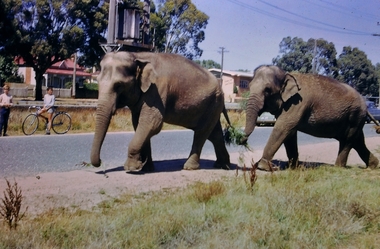
... It is one of the few Streamline Moderne houses in the Central Goldfields region, and was one of the earliest constructed in the Bendigo region. It is an outstanding example of this style of housing. ...It is one of the few Streamline Moderne houses in the Central Goldfields region, and was one of the earliest constructed in the Bendigo region. It is an outstanding example of this style of housing. ...Arthur William Pulfer was born on 18 April 1918, in Bendigo, Victoria, Australia, his father, Harold Victor Pulfer, was 30 and his mother, Elsie Maud Rumball, was 26. He married Norma Stewart in Bendigo, Victoria, Australia. He died on 6 March 2001, in his hometown, at the age of 82, and was buried in the Bendigo Cemetery. ROSEVIEW 407 High Street, Golden Square Bendigo "Roseview" was designed by Godfrey Eathorne and constructed in 1939. It is one of the few Streamline Moderne houses in the Central Goldfields region, and was one of the earliest constructed in the Bendigo region. It is an outstanding example of this style of housing. It resembles an ocean liner, and reflects the emphasis on the streamlining of methods of transportation. It utilizes both flat and curved surfaces and has little external ornamentation. The use of materials such as rounded glass windows and metal window and door frames reflects an innovative approach to construction consistent with the style. "Roseview" was constructed on a large scale, with large and spacious rooms. It reflects the prominent social status and wealth of the original owner, together with the desire for a building in 'the latest' style which was sure to attract attention and prominence in the region. It has been maintained largely in original condition. CARALULUP HOTEL 'The Sun' dated January 17, 1941 on the back. It states that 'The licence of Caralulup Hotel, near Talbot, has been surrendered, thus severing an 80 year association with the district' State Library of Victoria TOLMER GOLD ESCORT ROUTE The gold rush in New South Wales and Victoria left few able miners in South Australia. Bad economic conditions saw more than 15,000 men leave the Kapunda and Burra mines by the end of 1851. Alexander Tolmer, Commissioner of Police in 1852 proposed that the gold won by South Australians should be brought back to South Australia under an escort consisting of only a few men. In March a Gold Escort was on its way back to Adelaide with almost 6,000 ounces of gold for the vaults of the Treasury Building. After this successful trip Tolmer led two other escorts before handing over his duties. A total of eighteen gold escorts were made, the last one during November and December 1853 when Inspector Wyndham was in charge. You’ll find Gold Escort Route Monuments between Meningie, Coonalpyn and Tintinara.Many images from by Arthur Pulfer copied to slides. Twenty Slides of Bendigo: 7795.5a Market Gardens - possibly North Bendigo 7795.5b North Deborah Mine photo taken from Breen Street 1958 7795.5c Laying the track to get the engine into the park, looking down Mitchell Street Bendigo 7795.5d R766 in the Victorian Railways Institute Park Railway Place Bendigo 7795.5e On the Methodist Church Steps Arnold street Bendigo 7795.5f Caralulup Hotel near Talbot Victoria 7795.5g Miner's Hut at Moliagul 7795.5h Tolmer's Gold Route Victoria to South Australia 7795.5i Basket Lunch - White Hills Botanical Gardens - St johns 100 year celebrations 7795.5j White Hills Swimming Pool February 1970 7795.5k White Hills Botanical Gardens Bendigo 7795.5l Bendigo Show Parade 1958 7795.5n Bullens Circus Bendigo February 1966 7795.5o The old Lockup Eaglehawk Bendigo September 1967 7795.5p The old Golden Gully Hotel Diamond Hill Road, Bendigo 7795.5q Roseview Pethards Home 407 High Street Golden Square Bendigo 25th March 1957 7795.5r House - possibly on the Midland Highway Epsom, Bendigo - 8 April 1955 7795.5s The Big Tree Sedgwick Road March 1972 7795.5t Kangaroo Flat Bus Lines mini bus 7795.5m The Arrival of the Cobb and Co Coach in Bendigo September 1963 7795.5n Bullens Circus Bendigo February 1966 - two elephants walking along the Bendigo Creekhistory, bendigo, james lerk collection, golden square high school, dragon loong, white hill botanical gardens, 407 high street bendigo, r766 engine, bullens circus, caralulup, moligual, bendigo show, tolmer's gold route, kangaroo flat bus lines, eaglehawk lockup, arnold street methodist church, elephants, arthur pulfer
