
Showing 33 items matching " mr wellington"
-
 Whitehorse Historical Society Inc.
Document, Mines report, 1894
... Mr Wellington states he obtained colours of gold. ...Mimes Registrar's unpublished report 1894/5913 on inspection along the railway line between Blackburn and Box Hill and on Canterbury Road. Mr Wellington states he obtained colours of gold. ...Mr Wellington states he obtained colours of gold. ...Mimes Registrar's unpublished report 1894/5913 on inspection along the railway line between Blackburn and Box Hill and on Canterbury Road.Mimes Registrar's unpublished report 1894/5913 on inspection along the railway line between Blackburn and Box Hill and on Canterbury Road. Mr Wellington states he obtained colours of gold. Signed James Stirling With previous related file papers.Mimes Registrar's unpublished report 1894/5913 on inspection along the railway line between Blackburn and Box Hill and on Canterbury Road.miming, stirling, james -
Merbein District Historical Society
Document, The Story of Merbein, 1909-1950s
... ... Mr Wellington...Menlove St Albans Church of England - Birdwoodton Mr Wellington Progress Association Elwood Mead Merbein Race Course Rowing Club Royal Hall J. ...d.j. tulloch (author), cliffs white, h.w. hollis, james aif philpott, mr arnold, willie bennett, peter lee, alex bruce, state rivers and water supply commission, angus mccormick, yelta, merbein golf club, mrs e. spargo, merbein brass band, e.s. donaldson, f.a. deacon, william crosbie, e. fisher, j.h. hudson, c. bennett, w. adams, w.j. smith, e.s. collins, j.a. braidie, lake hawthorn, merbein train, mrs delahoy, c.j. sheridan, mrs delaney, mr bennett, picture theatres, post office, barney o'connor, dalmura, r.g. cameron, f.c. kane, myoora, h.g. lloyd, s.j. whiting, v. allen, r. allen, pioneer brick works, methodist church, methodist sunday school, h.c. lapthorne, merbein railway station, c. james, j.c. rose, n. treadwell, mrs wynne, miss troon, v. miss jarrett, miss e. bennett, miss cole, miss n. pearce, miss eva hollis, miss jean hollis, miss hazel hollis, miss kath hollis, mrs w.f. reeves, mrs r.m. voullaire, miss e. bannister, mr j. avery, mr l. holland, mr l.c. lapthorne, mr reeves, merbein public hall, mr j. worthington, merbein ana, mildura winery, research station, a.v. lyon, presbyterian church, s. thompson, a.s. lloyd, j.c. wishart, f. woods, e. smith, a.b. bruce, s. mcmeekin, finley fraser, a. fonder, e.w. wallis, james legge, gordon raff, g.l. hardie, p. murray, r.i. morris, james jones, v.f. hadleu, e. new, d.m. smith, charles weir, brigade fire, traders' association merbein, ratepayers' association merbein, p.v. appleby, a.j. chislett, w. bennett, d.w. peel, h. blaby, w. hazel, a.h. lee, w. grant, a.j. baldock, j. west, e. kelly, j.a. braidie, a.w. lee, j.h. russell, f. mckenzie, r.r. spence, p. swain, w.j. jones, i.w. heatherington, w.g. millhouse, e.w. smith, f.e.d. rankin, mr mcdonell, g. campaign, a. roots, friendly union of soldiers' wives and mothers, red cross society, merbein progress league, hugh a. leslie, a. hayles, j.p. power, j. davis, w.h. chaffey, f.j. walsh, a. roberts, d. richards, r.s. drury, a. robert, j.w. marrows, st john's church of england, r.b. davison, h.e. noltenius, g.e. menlove, st albans church of england - birdwoodton, mr wellington, progress association, elwood mead, merbein race course, rowing club, royal hall, j. lomax, f.j.p. pierson, c.h. foster, n. lumb, f.c. pierson., t. lumb, r. smith, w. quinsey, d. mctaggart, j. storer, l. mctaggart, j. walters, f.a. carmichael, n. smith, j.a. williams, d. walters, a. lever, l.u. alley -
 Whitehorse Historical Society Inc.
Photograph, Wellington Family
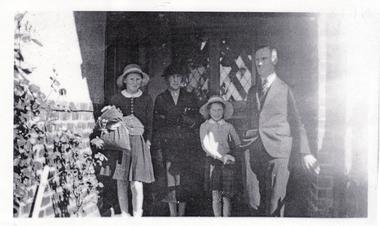
... L - R- Judith, Mrs Wellington's Mother, Sue, Keith Wellington, outside their residence which adjoined Mr. Wellington's pharmacy. on the south side of Whitehorse Road between Mitcham, Road and Station Street....L - R- Judith, Mrs Wellington's Mother, Sue, Keith Wellington, outside their residence which adjoined Mr. Wellington's pharmacy. on the south side of Whitehorse Road between Mitcham, Road and Station Street. ...Black and white photo of Wellington Family. L - R- Judith, Mrs Wellington's Mother, Sue, Keith Wellington, outside their residence which adjoined Mr. Wellington's pharmacy. on the south side of Whitehorse Road between Mitcham, Road and Station Street.wellington, judith, sue, keith pharmacies, wellington pharmacy -
 Bendigo Historical Society Inc.
Postcard - ELMA WINSLADE WELLS COLLECTION: POSTCARD MR. BARSBY (?)
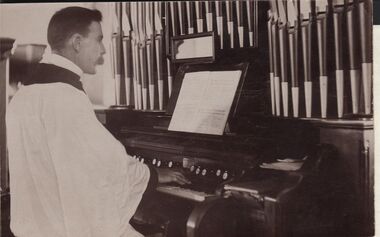
... A black and white photo postcard of Mr. Barsly (?) at the Wellington organ. No date...PERFORMING ARTS Music Organ A black and white photo postcard of Mr. Barsly (?) at the Wellington organ. No date Postcard ELMA WINSLADE WELLS COLLECTION: POSTCARD MR. ...A black and white photo postcard of Mr. Barsly (?) at the Wellington organ. No dateperforming arts, music, organ -
 Federation University Historical Collection
Letter, Letters written by Richard Squire to his son Tom Squire 1937
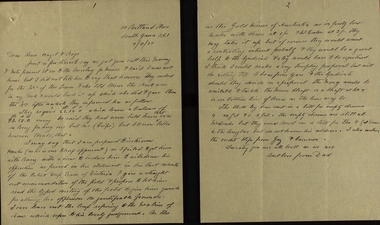
... Mr. Ross...O'Connor...C. McGrath...Alfred Mica Smith...Henderson Ross...Angus Kelly...A. R. Dodson...Duke of Wellington...Mr. Ross O'Connor C. McGrath Alfred Mica Smith Henderson Ross Angus Kelly A. R. Dodson Duke of Wellington Plant The Moorabool Lead Williams Paralysis Woodlock Squire Whipp Joe Williams Peacock Moran Buchanan Hoare Bree Kutchel Kohinoor Band and Alluvian Star of the East Bonshaw Epidemic Polio Mining A variety of Letters written by Richard Squire to his son Tom Squire about the goings on at Mt Mercer Mine 1937 Letters written by Richard Squire to his son Tom Squire 1937 Letter ...In 1905 Richard Squire was manager of the West Berry Consols at Allendale, and developed an improved system of mine ventilation, which was supported in "The Age."[4] He was successful in combating and remedying the gas and ventilation troubles of the Deep Mines of Creswick and Allendale Districts after all had failed. MINE MANAGERS’ ASSOCIATION. Ballarat Branch. ... Mr R. B. Squire, manager of the West Berry Consols, at Allendale, submitted a paper detailing what he had done tor the betterment of ventilation in the alluvial mines of Smeaton and Mary borough districts- Members gave Mr Squire every credit for the results that he claimed to have effected; the adoption of his ideas had testified to their value to mine-owners. It was painted out, however, that for want of a thorough debate of the subject with experienced men the author had unwittingly included some general statements that required modifying in some points and extending in others, in justice to other workers among the earlier and the present day managers of mines. It was decided to invite the author to meet a sub-committee on this subject!A variety of Letters written by Richard Squire to his son Tom Squire about the goings on at Mt Mercer Mine 1937richard squire, tom squire, hazel squire, jack squire, jim squire, ned, mt mercer, plant, skids, pump, poppet, carburetor, shaft, balance weight, pulleys, syndicate, suction, lease, reports, estimates, flat fields, reef, trucks, pipeclay, sandstone, suction pipe, valves, honeycomb rock, yarrowee, ballarat, reef combs, cheques, yellow slate, leigh river, dyke, quartz, ballarat deep leads, ballarat deep leads extension, bore, reads, bedrock, cemented sand, g m of a, gold mines of australia, liz the car, geoff squire, lode, cameron and sutherland, hayes timber, alan squire, ethel, ross creek field, ross creek gold mining co., frank herman, lillas, jack hayes, eyres brothers, g.gay & co, buninyong, glenfine, the star mine of avoca fields, talbot alluvials, guildford plateau, a.b.c. special supply store, geological branch, shell coy, lawaluk, almanac, mcbinny, bingley's paddock, cargaire valley and lead, stand and deliver demands, sheehan's, smeaton hotel, john charleson, aleck charleson, ted brown, billy jordan, mr banks, ballarat main lead, binney, goon, illabrook, mrs trenery, bre, max, june, mary, len, barry, hunter, herman, martin, aunt annie, bella, pitfield coy, mcnaughtons, donaldson, dereel, hogan, the bay leads, avoca field, ballarat alluvials, neil cameron, haddon field, courier, tom cotton, llewellen, stanley hunter, mr leonard, tom mitchell, school of mines, bryant, a.c. connely, dodson, constable mcmullins, adam ronaldson, bewick mining & co., reginald murray, r.c. selwyn, craig's hotel, broken hill syndicate, morrison's lead, wilkinson, j. hayes, mr nichol, burglary, baragwanath, wilkinson ross, creswick, seville, mr. ross, o'connor, c. mcgrath, alfred mica smith, henderson ross, angus kelly, a. r. dodson, duke of wellington plant, the moorabool lead, williams, paralysis, woodlock, squire, whipp, joe williams, peacock, moran, buchanan, hoare, bree kutchel, kohinoor band and alluvian, star of the east, bonshaw, epidemic, polio, mining -
 Federation University Historical Collection
Letter, Letters written by Richard Squire to his son Tom Squire 1938
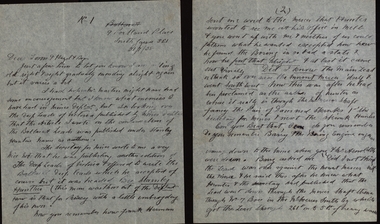
... Wellington Plant...The Moorabool Lead...Kohinoor Band and Alluvian...Star of the East...Bonshaw...Epidemic...Polio...K.W. Steedman...Mr...Broken Hill Syndicate Morrison's Lead Baragwanath Creswick Duke of Wellington Plant The Moorabool Lead Kohinoor Band and Alluvian Star of the East Bonshaw Epidemic Polio K.W. Steedman Mr ...In 1905 Richard Squire was manager of the West Berry Consols at Allendale, and developed an improved system of mine ventilation, which was supported in "The Age."[4] He was successful in combating and remedying the gas and ventilation troubles of the Deep Mines of Creswick and Allendale Districts after all had failed. MINE MANAGERS’ ASSOCIATION. Ballarat Branch. ... Mr R. B. Squire, manager of the West Berry Consols, at Allendale, submitted a paper detailing what he had done tor the betterment of ventilation in the alluvial mines of Smeaton and Mary borough districts- Members gave Mr Squire every credit for the results that he claimed to have effected; the adoption of his ideas had testified to their value to mine-owners. It was painted out, however, that for want of a thorough debate of the subject with experienced men the author had unwittingly included some general statements that required modifying in some points and extending in others, in justice to other workers among the earlier and the present day managers of mines. It was decided to invite the author to meet a sub-committee on this subjectHandwritten letters written by Richard Squire to his son Tom Squire 1938 on lined paperrichard squire, tom squire, hazel squire, jack squire, jim squire, ned, mt mercer, plant, skids, pump, poppet, carburetor, shaft, balance weight, pulleys, syndicate, suction, lease, reports, estimates, flat fields, reef, trucks, pipeclay, sandstone, suction pipe, valves, honeycomb rock, yarrowee, ballarat, reef combs, cheques, yellow slate, leigh river, dyke, quartz, ballarat deep leads, ballarat deep leads extension, bore, reads, bedrock, cemented sand, g m of a, gold mines of australia, liz the car, geoff squire, lode, hayes timber, ethel, ross creek field, ross creek gold mining co., frank herman, lillas, jack hayes, eyres brothers, g.gay & co, buninyong, glenfine, the star mine of avoca fields, talbot alluvials, guildford plateau, a.b.c. special supply store, geological branch, shell coy, lawaluk, almanac, mcbinny, bingley's paddock, cargaire valley and lead, stand and deliver demands, sheehan's, smeaton hotel, john charleson, ballarat main lead, goon, dereel, the bay leads, avoca field, ballarat alluvials, haddon field, courier, school of mines, bewick mining & co., broken hill syndicate, morrison's lead, baragwanath, creswick, duke of wellington plant, the moorabool lead, kohinoor band and alluvian, star of the east, bonshaw, epidemic, polio, k.w. steedman, mr newman, allendale mines, professor mica smith, alfred mica smith, mr hodge, w. taylor, mcpherson's reward coy, mr mitchell, billy thomas, john bull, albert, nina, stanley hunter, frederick the great, ross creek south, bislolo, brilolo, birlolo, ballarat east coy, maxwells, reginald murray, bob allan, vendetta, john lynch, dodson, mnster of mines, e.j. hogan, jonah ward, mcnaughton's paddock, bellesby, alec peacock, jenkins, h.c. jenkins, conspiracy, argus, mr ellerby, dr lawrence, occulist, mining -
 Federation University Historical Collection
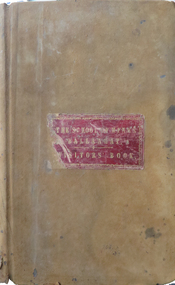
Book, Ballarat School of Mines Visitors' Book, 1879-1890, 1879-1890
... Wellington, New Zealand May 7 Frank E. Lawrence, Lake River, Tasmania May 9 M. Richter Engineer Germany May 9 Dr Wilhelm Landall naturalist Berlin, Germany May 10 William Ralph Heaton Mercantile Birmingham May 11 Arthur I. Traill Grazier Llanpollen, New South Wales May 10 Marian Traill 1882 July 10 Arthur W.W. Brown London July 10 Benjamin Spargo Mining Mananger and owner Snowy Creek July 10 Thomas Cooke Miner Ballarat July 14 Robert H. Kenny July 14 Mr...Wellington, New Zealand May 7 Frank E. Lawrence, Lake River, Tasmania May 9 M. Richter Engineer Germany May 9 Dr Wilhelm Landall naturalist Berlin, Germany May 10 William Ralph Heaton Mercantile Birmingham May 11 Arthur I. Traill Grazier Llanpollen, New South Wales May 10 Marian Traill 1882 July 10 Arthur W.W. Brown London July 10 Benjamin Spargo Mining Mananger and owner Snowy Creek July 10 Thomas Cooke Miner Ballarat July 14 Robert H. Kenny July 14 Mr ...James Redmond Gilbert (sr) was born in 1837 at Hamilton, Ontario, Canada. He married Ellen Spouse. He , James Gilbert died on 26 July 1900 at Melbourne, and is buried at Boroondara Cemetery (Kew). J.R Gilbert lived at Running Creek (later Havilah) for some time, and during that time was employed in one of the bigger mines in the district. (Research by Ren at Havilah Research, 2019) Leatherbound ledger with hand written names, professions, residence and remarks relating to visitors to the Ballarat School of Mines. Sample Names: 1881 May 2 David Kerr Diamond Miner South Africa May 2 S. R. Dodds Diamond Miner South Africa May 3 Albert E. King Accountant Adelaide, South Australia "see signature 6 leaves back" May 6 William Morley Wesleyan Minister Auckland, New Zealand May 6 Rainsford Ravin Wellington, New Zealand May 7 Frank E. Lawrence, Lake River, Tasmania May 9 M. Richter Engineer Germany May 9 Dr Wilhelm Landall naturalist Berlin, Germany May 10 William Ralph Heaton Mercantile Birmingham May 11 Arthur I. Traill Grazier Llanpollen, New South Wales May 10 Marian Traill 1882 July 10 Arthur W.W. Brown London July 10 Benjamin Spargo Mining Mananger and owner Snowy Creek July 10 Thomas Cooke Miner Ballarat July 14 Robert H. Kenny July 14 Mr and Mrs Buston, [Indigo Planter?] Bengal, Indonesia July 14 Samuel H. Halker Ballarat July 14 Charles Phelan Talbot July 14 E. Walker Ballarat 1884 June 30 M.N. Cooper Dunedin, new Zealand June 30 Richard Hosking gardiner Gong Gong Well pleased with School June 30 Humphrey John Ballarat July 1 Cecily Gilbert Melbourne July 1 Florence Shrivall Melbourne July 1 [W.N. Marsh?] Colonial Secretary Hong Kong July 1 Louis Fause Engine Driver Dunolly July 1 John L. Bertram Blacksmith Melbourne July 1 Thomas Eardley Coachmaker London "Exceedingly obliged to Mr Oddie for a very pleasant instruction time spent in inspection of the various scientific appliances in the Ballarat School of Mines." (Donation 2/6) July 4 E. Goodwin [David?] Artist Spellbound July 4 W. Glumley Station Master Murtoa July July 4 James Thomas Miner Corrinondie, New Zealand "Very pleased with the School in all its branches. I hope to contribute to the specimen department. J.T." July 8 Robert Wall Engine Driver 1885 September 16 J.W. Springthorpe, M.D., Melbourne (very much pleased in every way) September 26 M. Oddie, Ballarat 1886 January 12 William Piekard, Leicester, England January 12 Robert Linford, Norwich, England January 12 H. Tipping, Draughtsman, Adelaide (Very instructive and should be taken advantage of by all who can) January 12 Fred H.K. Dreslecher, London (ditto) January 23 Walter Redgate, Manchester (ditto) April 7 Annie Bellingham, Richmond April 9 Fred Kruger, Landscape Photo, Geelong April 14 Mary Barry, Murtoa April 19 N.J. Tabuteau Accountant Napier, New Zealand April 19 George N. [Baroft?] Gentleman Cheshire, England April 21 Hon. George D'Almaine, Peer of England, London April 21 Lord Augustus Honour April 21 William Holt, South Melbourne April 21 H. Bartell, Gentleman, Smythes April 21 Fred Musgrove, Gentleman April 21 A. Chirnside, Squatter April 23 Alice Cravino, student, Buninyong April 24 East Melbourne Bicycle Club April 28 J. Kinnear, Kyneton April 28 J.P. Kinnear, Kyneton May 19 Bob Selby, Doctor, Ballarat May 19 J.W.M.. Quiggin, globe trotter, Picton (NS Wales) May 25 Arthur Night, Sutton Hotel, Ballarat (very fair) May 28 D. Kelly, attendant, China May 28 J. Kelly, schoolboy, China June 1 Joseph Jelbart, Blacksmith, Harrow September 9 David Ham, M.L.C. Ballarat ( A right to be pleased) September 9 J.J. Green, Merchant, Adelaide (Very much pleased with my visit to this intitiution it has my hearty sympathy and appreciation, Much pleased at what I have seen its value to the community) 9 December James H. Tappin, Agent, Ballarat (very pleased with instruction 1887 March 20 Thomas Bath Learmonth March 20 James R. Gilbert= Miner Running Creek March 20 C. Holtermann Out of business Adelaide 1890 21 May Mr and Mrs Fairchild, gentleman. Yarra house, Dalgety St, St Kildaballarat school of mines, visitors, j.w. springthorpe, chinese visitors, visitors' book, running creek, james redmond gilbert sr, havilah -
 Ringwood and District Historical Society
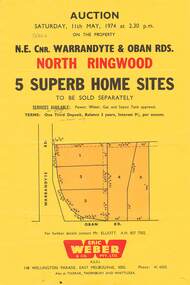
Flyer, Land Auction, Cnr Warrandyte and Oban Roads, North Ringwood, Vic. - 1974
... Ltd., 148 Wellington Parade, East Melbourne, 3002, Phone: 416025, Mr Elliott A.H. 8577502. ...Ltd., 148 Wellington Parade, East Melbourne, 3002, Phone: 416025, Mr Elliott A.H. 8577502. ...Single yellow page advertising Auction of five home sites to be sold separately on Saturday, 11th May, 1974. Details include vendor terms, subdivision services, and location map (north-east corner of Warrandyte and Oban Roads).(Agent) Eric Weber & Co. Pty. Ltd., 148 Wellington Parade, East Melbourne, 3002, Phone: 416025, Mr Elliott A.H. 8577502. Later handwritten notation suggests vendor was possibly Country Roads Board (VicRoads) after completion of road widening works. -
 Mission to Seafarers Victoria
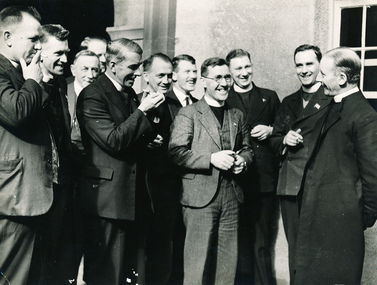
Photograph - Digital copy, Black and white, Herald Weekly Times, September 1936
... Oliver ( Melbourne MTS) F W Melbourne (Archbishop F W Head 1929- 1942) Mr J.C. Grahame (Hobart) Rev B.J. Williams ((Wellington NZ) Rev J.C. ...Oliver ( Melbourne MTS) F W Melbourne (Archbishop F W Head 1929- 1942) Mr J.C. Grahame (Hobart) Rev B.J. Williams ((Wellington NZ) Rev J.C. ...This photograph was taken at the Triennial Congress, Melbourne. Frank Leslie Oliver served as chaplain at the Mission to Seafarers Melbourne for 30 years from 1930 - 1960. He is in this photograph, second from right, with a cigarette in his hand. Also in this photograph, at the far right, is the Most Reverend F. Head, Archbishop of Melbourne. The photograph is a record of a historic conference of MTS representatives from Australia and New Zealand. , September 1-3 , 1936: Revd Wm Hoog (Brisbane) Revd W.H. Terry (Port Pirie) Revd H.C Cuthbertson (Adelaide) Revd W.R. Tyler (Melbourne) Mr J.W. Neill (Melbourne) Revd. F. J. Evans (Sydney) Revd Frank L. Oliver ( Melbourne MTS) F W Melbourne (Archbishop F W Head 1929- 1942) Mr J.C. Grahame (Hobart) Rev B.J. Williams ((Wellington NZ) Rev J.C. Clift (Fremantle)Frank Leslie Oliver served as chaplain at the Mission to Seafarers Melbourne for 30 years from 1930 - 1960, including time served as chaplain with the Royal Australia Navy aboard HMAS Australia. He was a live-in chaplain and was supported by his entire family, including wife Moira, for whom a memorial window exists in the chapel. The Chaplains' Conference was held in 1936.Black and white photograph of a group of chaplains outside the Mission to Seafarers building in Flinders Street, Melbourne. Frank Oliver is second from right holding a cigarette in his right hand.Top left in blue ink (written by Padre Oliver): Australian MTS, Chaplains gathered in Triennal Congress, with most Rev.J Head, Abp of Melbourne. Top right corner in black ink: prior to 1939 In black and blue ink some names: Archbishop Head, Dad, Bill Tyler Port Melbourne, Padre Williams Wellington, Pat Neil Layreader Faded stamp in pink ink: Herald Feature Service, Melbourne A sticker with: Ret to B Kentroyal australian navy, mission to seafarers, anglican, frank leslie oliver, archbishop head, triennial conference, chaplains, herald newspaper, cigarette, robin kent, beverley kent nee oliver, chaplains conference, padre oliver, new zealand, pat neil, lay reader, bill tyler, port melbourne, reverend william wellington, chaplains group -
 Mission to Seafarers Victoria
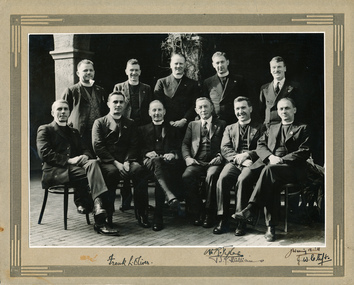
Photograph - Photograph, Black and white, Conference of Australasian Chaplains, Melbourne, 1936, 1936
... Oliver ( Melbourne MTS) F W Melbourne (Archbishop F W Head 1929- 1942) Mr J.C. Grahame (Hobart) Rev B.J. Williams ((Wellington NZ) Rev J.C. ...Mr J.C. Grahame (Hobart); Rev B.J. Williams ((wellington NZ).; Rev J.C. ...Mr J.C. Grahame (Hobart); Rev B.J. Williams ((wellington NZ).; Rev J.C. ...The photograph is a record of a historic conference of MTS representatives from Australia and New Zealand. , September 1-3 , 1936: Revd Wm Hoog (Brisbane) Revd W.H. Terry (Port Pirie) Revd H.C Cuthbertson (Adelaide) Revd W.R. Tyler (Melbourne) Mr J.W. Neill (Melbourne) Revd. F. J. Evans (Sydney) Revd Frank L. Oliver ( Melbourne MTS) F W Melbourne (Archbishop F W Head 1929- 1942) Mr J.C. Grahame (Hobart) Rev B.J. Williams ((Wellington NZ) Rev J.C. Clift (Fremantle) From the Argus (Melbourne, Vic. : 1848 - 1957), Saturday 5 September 1936, page 34: "For three days this week chaplains of missions to seamen in different ports of Australia and New Zealand met in conference in Melbourne. Bishop Stephen, chairman of the executive committee of the mission in Melbourne, presided over the conference, which was opened by Archbishop Head celebrating Holy Communion in the Chapel of St. Peter at the mission. Among the questions considered was the problem of foreign vessels, from which nothing is contributed toward the support of the missions. It was felt that there was great scope for work of an international character, and that every effort should be made by the chaplains to bring men from the ships of different countries together. The chaplains said that many thousands of men from foreign ships attended the mission institutes. Efforts will be made for more contact to be made with men on coastal ships, and commendation of men from one port to the next will ensure that the needs of men are cared for as well as possible. An ordained chaplain will be sent from London for a new mission at Geraldton (WA), and a new mission will also be opened at Port Kembla (N.SW.). The chaplains will endeavour to obtain police cooperation in keeping docks and wharves free from undesirable persons. It is hoped that an effort will be made to seek the co-operation of the port authorities in order to ensure the pos-sibility of ships being allowed to be alongside during week-ends and public holidays without having to face the full port charges. To avoid the heavy charges the ships now anchor in the bay during week-ends and public holidays. Melbourne was chosen as the central port for Australia for supplies for mis-sions to seamen, and it was decided that the conference should be held every three years, in Melbourne. The last was held 11 years ago." The photograph was published in the 1936 Annual ReportThis photograph is representative of the relationship between the Mission to Seafarers Victoria and the Anglican Church. Reverend Frank Oliver served as Chaplain at the Mission to Seafarers Victoria from 1930 - 1960. A gift of £20,000 for the rebuilding of the Port Melbourne institute, which was old and dilapidated, was announced at the conference. Black and white photograph mounted on cardboard with border detail on the front. The photograph is of eleven men, five standing behind six seated. Nine of the men are wearing clerical collars and two are in suit and ties. The photograph appears to have been taken in the courtyard of the Mission to Seafarers Victoria, at 717 Flinders St. Each of the people in the photograph appears to have hand inscribed their names/ signatures on the lower edge of the mountboard.Top edge of mountboard title of occasion and photo in Black ink all upper case: (see title details this record); Lwr edge first line corresponding to back row of group: 'REv Wm Hoog (Brisbane); Revd W.H. Terry (Port Pirie); Rev H.C Cuthbertson (Adelaide) ; Rev W.R. Tyler (Melbourne) ; Mr J.W. Neill (Melbourne) : / Lwr edge second line corresponding to front row seated: "Revd. F. J. Evans (Sydney) ; Revd Frank L. Oliver ( Melbourne MTS); F W Melbourne (Archbishop F W Head 1929- 1942); Mr J.C. Grahame (Hobart); Rev B.J. Williams ((wellington NZ).; Rev J.C. Clift (Fremantle); courtyard, chaplains, archbishop melbourne, mission to seafarers, flinders street, frank leslie oliver, conference, australasian chaplains, anglican church, reverends, australia, new zealand, 1936, seamen's mission, chaplains group, chaplain conferences -
 Ringwood and District Historical Society
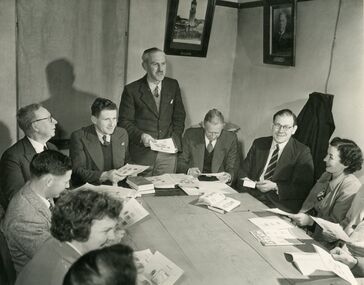
Photograph, John Gallagher Photography, Ringwood Philatelic Society meeting in supper room Ringwood Town Hall, 7th August, 1953 (2 Photos)
... Mr. & Mrs. Wenn, J.K. McCaskill (Glasses), Stan Griffiths, K. Wellington, Paddy Miles, Phil Duerdoth, Edith McEwin"....Mr. & Mrs. Wenn, J.K. McCaskill (Glasses), Stan Griffiths, K. Wellington, Paddy Miles, Phil Duerdoth, Edith McEwin". 2 copies of Black and White Photograph . ...2 copies of Black and White Photograph . VC1634-1 is the fill photo, VC1634-2 is a slightly cropped imageWritten on backing sheet of VC1634-1: "Ringwood Philatelic Society meeting in supper room Ringwood Town Hall, 7th August, 1953. L. to R. Mr. & Mrs. Wenn, J.K. McCaskill (Glasses), Stan Griffiths, K. Wellington, Paddy Miles, Phil Duerdoth, Edith McEwin". -
 Bendigo Historical Society Inc.
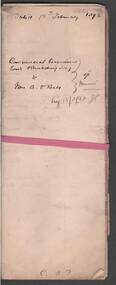
Document - CONNELLY, TATCHELL, DUNLOP COLLECTION: MRS. A.O. BELL COMMERCIAL PERMANENT LAND SOCIETY
... Wellington Street, Kerang. And at Bendigo, Echuca and Melbourne. Trust Moneys to lend. In sums of 100 and upwards on Freehold or Crown Leasehold Securities. Mr...Wellington Street, Kerang. And at Bendigo, Echuca and Melbourne. Trust Moneys to lend. In sums of 100 and upwards on Freehold or Crown Leasehold Securities. Mr ...Buff coloured document. On front in black ink' dated 15th. February 1892' Commercial Permanent Land (? Not able to read ) Socy to Mrs. A.O. Bell, memo 15/2/91' Inside folded document page from Kerang Observor, Saturday February 13, 1892. On page advertisement from 'Messrs Connelly and Tatchell, Solicitors, Eldon Chambers, Wellington Street, Kerang. And at Bendigo, Echuca and Melbourne. Trust Moneys to lend. In sums of 100 and upwards on Freehold or Crown Leasehold Securities. Mr. Rogers-Davidson, a commissioner for taking affidavits and declaration, private address Nolan Street.'organisation, union, connelly, tatchell and dunlop, connelly, tatchell and dunlop, kerang, a.l. bell, kerang observor -
 Bendigo Historical Society Inc.
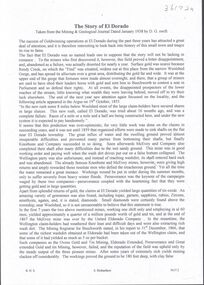
Document - ELDORADO - THE STORY OF EL DORADO
... ... Wellington Company... Mr...DOCUMENT Gold eldorado Eldorado The Story of El Dorado Mining & Geological Journal January 1938 D G Swift The Argus 19/10/1855 Kneebone & Company Wellington Party McEvoy Mine Kneebone Mine Tin Oxide Gemstones United Eldorado Company Mining Registrar Ovens Gold and Tin Mining Eldorado Extended Perserverance Great Extended Gold and Tin Mining Wellington Company Mr William Dunstan United Ovens Gold and Tin The Warrior Try Again Company McEvoy Disaster Cock's Pioneer Electric Gold and Tin Sluicing Company Mr H Falsoner Cock's Pioneer Gold and Tin Mines N L Company State Electricity Commission Hydraulic Sluicing Gold Dredge Cock's Eldorado Company L G Schilling Typed notes titled 'The Story of El Dorado' taken from the Mining & Geological Journal, dated January 1938 by D. ...Typed notes titled 'The Story of El Dorado' taken from the Mining & Geological Journal, dated January 1938 by D. G. Swift. Notes typed by L. G. Schilling, 13/10/69. Notes mention the disappointments, difficulties with water and the ground and floods, As well as gold they also found large quantities of tin oxide and a large variety of gemstones. A powerful jet of water was used for the mining.document, gold, eldorado, eldorado, the story of el dorado, mining & geological journal january 1938, d g swift, the argus 19/10/1855, kneebone & company, wellington party, mcevoy mine, kneebone mine, tin oxide, gemstones, united eldorado company, mining registrar, ovens gold and tin mining, eldorado extended, perserverance, great extended gold and tin mining, wellington company, mr william dunstan, united ovens gold and tin, the warrior, try again company, mcevoy disaster, cock's pioneer electric gold and tin sluicing company, mr h falsoner, cock's pioneer gold and tin mines n l company, state electricity commission, hydraulic sluicing, gold dredge, cock's eldorado company, l g schilling -
Glen Eira Historical Society
Book - Moorabbin Hospital
... Mr.... Allen Syd Dr.... Bartlett Jenny Dr.... Wellington...Scott David Associate Professor Stoelwinder Just Deakin Rick Putt Carl Edward Gordon Cox John Mr. Allen Syd Dr. Bartlett Jenny Dr. Wellington Clive Dr. Ruckett Elvira Mrs. ...This file contains two items about Moorabbin Hospital, as part of Monash Medical Centre: 1/The Agenda of the first Annual General Meeting of Contributors to Monash Medical Centre, held 28/09/1987 at the Clayton Campus. The business of the meeting is outlined and those who are contributing to the meeting are named, including guest speaker The Honourable David White, Minister for Health. 2/Two copies of the Monash Medical Centre Annual Report 1986–87. The Annual Report outlines how the creation of the Monash Medical Centre involved the incorporation of three existing hospitals, including the Moorabbin Hospital. The Report also outlines the plans of the Centre of the future, including the relocation of Prince Henry’s Hospital to Clayton and Moorabbin. The Report contains updates on recent purchases by the Centre, breakthroughs in health research, and ends with a financial report. The Board of Management and Executive Co-ordinating Committee are named, with the Executive Co-ordinating Committee also pictured. The Report also contains a number of black-and-white photographs of the Centre at work.monash medical centre, moorabbin hospital, moorabbin, centre road, bentleigh east, prince henry’s hospital, hospitals, annual reports, parliamentary representatives, committees of management, brooke graham mr., sander harold mr., sims eileen ms., ferres ian mr., wilson peter mr., white david the honourable, barker ann mrs., caldwell f. jack mr., logan malcolm i. professor, white lindsay mr., sciftan lynnette r. judge, koval ramona ms., scott david associate professor, stoelwinder just, deakin rick, putt carl, edward gordon, cox john mr., allen syd dr., bartlett jenny dr., wellington clive dr., ruckett elvira mrs., grieve ane miss, wilkes elwyn miss, edwards gordon mr., paterson peter mr., mushin gordon dr., lewis elizabeth miss, isaacs mrs. -
Box Hill Historical Society
Book, City of Box Hill, Spring Street and Environs study submissions, c.June 1986
... Wellington Road...Elgar Road...Thames Street...Rodgerson Street...Kingsley Crescent...Spring Street...Box Hill...Long> C.H....Beard> F....Box Hill Bowls Club...Dawson> D....Dawson> W....Earl> K.L. (Mr...Poplar Street Severn Street Nelson Road Harriett Court Whitehorse Road Tyne Street Wellington Road Elgar Road Thames Street Rodgerson Street Kingsley Crescent Spring Street Box Hill Long> C.H. Beard> F. Box Hill Bowls Club Dawson> D. Dawson> W. Earl> K.L. (Mr ...An index of submissions received by the Council in relation to the Spring Street and Environs Study.Approx. 114p.An index of submissions received by the Council in relation to the Spring Street and Environs Study.poplar street, severn street, nelson road, harriett court, whitehorse road, tyne street, wellington road, elgar road, thames street, rodgerson street, kingsley crescent, spring street, box hill, long> c.h., beard> f., box hill bowls club, dawson> d., dawson> w., earl> k.l. (mr.), earl> l.i., earl> w., darbyshire> b., fowler> d., lindsay, j.d., eisenbise> h., eisenbise> s., mills> e.w., harper> b., bradley> r., box hill hospital, r.s.l., atkinson> a.p., ward> l., ward motors, lloyd> r.g., parker> i. (mrs.), marroyen> g., marroyen> h., rodgers> n. (mr.), gardner> p. (ms.), robin> t., robin> , r., ferdinands> b., curry> m. (mrs.), box hill college of tafe, hine> w.f. (mr.), macdonald> m., phillips> r., hine> l., hine> p., pysing> j., mcinnes> a.j., lloyd> m., lloyd> r., montgomery> l., dugan> s., clark> j., olde-wolbers> r., hood> e., hood> h., adams> h. (mrs.), gas and fuel corporation, land use, town planning -
 Ballarat Tramway Museum
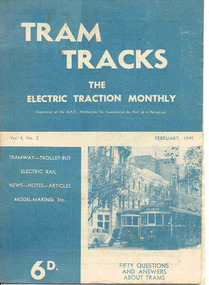
Magazine, Jack Richardson, "Tram Tracks - The Electric Traction Monthly", Feb. 1949 to August 1949
... Mr. Bell), Bendigo, Perth, Christchurch, Wellington, Wanganui, Bourke St construction work (photo of poles), Brisbane tramway history, map of CBD Melbourne, Melbourne and Sydney suburban railways, AETA News. 2467.3 - Vol 4, No. 6 - June 1949 - 16 pages - green pages, tramways and private cats, news from Sydney, Newcastle, Melbourne, Launceston, Hobart, article "Scrap Sydney Tams by 1960 - Newcastle this years say London experts", buses tackle football crowds (Sydney), Fremantle (Wal Jack letter), and Melbourne and Sydney suburban railways, AETA News. 2467.4 - Vol 4, No. 7 - July 1949 - 16 pages - tramways and the public, news from Sydney, Newcastle, Melbourne, appointment of R. ...Mr. Bell), Bendigo, Perth, Christchurch, Wellington, Wanganui, Bourke St construction work (photo of poles), Brisbane tramway history, map of CBD Melbourne, Melbourne and Sydney suburban railways, AETA News. 2467.3 - Vol 4, No. 6 - June 1949 - 16 pages - green pages, tramways and private cats, news from Sydney, Newcastle, Melbourne, Launceston, Hobart, article "Scrap Sydney Tams by 1960 - Newcastle this years say London experts", buses tackle football crowds (Sydney), Fremantle (Wal Jack letter), and Melbourne and Sydney suburban railways, AETA News. 2467.4 - Vol 4, No. 7 - July 1949 - 16 pages - tramways and the public, news from Sydney, Newcastle, Melbourne, appointment of R. ...2467.1 - Vol. 4 No. 2, February 1949 of "Tram Tracks - The Electric Traction Monthly" of the Australian Electric Traction Association. Magazine consists of 16 printed pages with a 12 page supplement titled "Fifty Questions and Answers about trams in Australia". Has a single staple on the saddle. Incorporated within the magazine are articles or editorials on Tramways and Tramway Experts (Sydney and bus replacement), Interurban to St Kilda (conversion of VR St. Kilda line). General news items on Brisbane, Geelong, Launceston closure, Hobart, Bourke St routes, Perth, Adelaide, NSW, Christchurch, Overseas tramways and railways. Also has letters to the Editor, plans of a Birney tram for model makers and AETA Notes. Issue has advertisements for the Model Dockyard, ARLHS, The Hobby Shop, Barnes Tennis Centre, Fleet, Christie Model Railway Equipment of Sydney, Meadmore Model Engineering, Austral Bronze, Wattle Park, Traction Publications and Robilt "O" gauge locomotives. 2467.2 - Vol 4, No. 5 - May 1949 - 20 pages - red cover, 4th year, article by Peter Duckett with photos of Board members, "PCC Trucks here", MMTB advert for staff, news from Sydney, Newcastle, Melbourne (applications for new Chairman to replace Mr. Bell), Bendigo, Perth, Christchurch, Wellington, Wanganui, Bourke St construction work (photo of poles), Brisbane tramway history, map of CBD Melbourne, Melbourne and Sydney suburban railways, AETA News. 2467.3 - Vol 4, No. 6 - June 1949 - 16 pages - green pages, tramways and private cats, news from Sydney, Newcastle, Melbourne, Launceston, Hobart, article "Scrap Sydney Tams by 1960 - Newcastle this years say London experts", buses tackle football crowds (Sydney), Fremantle (Wal Jack letter), and Melbourne and Sydney suburban railways, AETA News. 2467.4 - Vol 4, No. 7 - July 1949 - 16 pages - tramways and the public, news from Sydney, Newcastle, Melbourne, appointment of R. Risson as new chairman, Perth, Adelaide, Launceston, tramcar solenoid brakes, National City Lines USA, and Melbourne and Sydney suburban railways, AETA News. 2467.5 - Vol 4, No. 8 - August 1949 - 8 pages - tramways and politics, photo of new points for Latrobe and William Sts, East Hills Line by C. C. Singleton, general tramway news, and advertisement for Robilt model railways. .2 to .4 added 15-2-2016 from the collection of Ian Stanley. .5 added 24-3-18 - from consolidation of Melbourne Tram Museum and BTM collections)trams, tramways, electric traction, aeta, australian tramways, mmtb, pcc, closure, sydney, newcastle, brisbane -
Kew Historical Society Inc
Booklet, The Galleon Press, The Pickwick Portfolio, Vol.1 No.1, 1904
... Wellington Street Kew. Members of the club adopted pseudonyms based on characters in Dickens' novels. Contents of The Pickwick Portfolio, Vol.1, No.1 - Frontispiece [Illustration] Pickwick Portfolio / Mark Tapley (Alice Bale); Foreword / Mantalini (Mr A. ...Pickwick Clubs were established around the world in the nineteenth and twentieth centuries, inspired by the first novel of Charles Dickens. A Kew branch was formed in 1897 and lasted until c.1912. Its membership was drawn from a number of notable Kew families. The club published two booklets, the first in 1904 and the second in 1912. In addition to holding meetings, club members performed in productions of Shakespearian plays in the Recreation Hall in Wellington Street Kew. Members of the club adopted pseudonyms based on characters in Dickens' novels.Literary publication of of artistic (literary) significance recording the social and cultural activities of a group of residents of Kew and its environs that operated from 1897 to c.1912. Copies of volume 1 are held by the State Libraries of Queensland and New South Wales.Contents of The Pickwick Portfolio, Vol.1, No.1 - Frontispiece [Illustration] Pickwick Portfolio / Mark Tapley (Alice Bale); Foreword / Mantalini (Mr A. Barlow); D. Copperfield (Mr H. Brown); Sonnet to celebrate Pickwick Club's birthday's eight and to congratulate it on its happy fate / John Jarndyce (Mr G. Bell); A new planet / Mikawber (Mr H. Mollard); The melancholy heart / Samuel Weller (Mr P. Vines); Time / Florence Dombey (Miss C. Turner); A day in Japan / Miss Moucher (Dr G. Halley); His yellow affability / Mark Tapley (Alice Bale); A tragedy / N. Nickleby (Mrs J.T. Dill, nee Miss Pullar); Bill Sykes [Illustration] / (Micawber (Mr H. Mollard); The norseman's song / Pickwick (Rev W. Slack); The maker of the soul / Squeers (Mr N. Brown); Glory / Jingle (Mr H.M. King); My first conquest / Agnes Wickfield (Miss A. Vines); The mosquito / D. Copperfield (Mr H. Brown); The blind baggage / Mantlini (Mr A. Barlow); The Pickwick Tree [Illustration] / Mark Tapley (Alice Bale); The freedom of life / Toots (Mr W. Shum)fictionthe pickwick club - kew, literary clubs, pickwick clubs, charles dickens -
Kew Historical Society Inc
Booklet, Arbuckle, Waddell & Fawckner, The Pickwick Portfolio, Vol.1 No.2, 1912
... Wellington Street Kew. Members of the club adopted pseudonyms based on characters in Dickens' novels. Literary publication of of artistic (literary) significance recording the social and cultural activities of a group of residents of Kew and its environs that operated from 1897 to c.1912. Another copy is held by the State Library of New South Wales the pickwick club - kew literary clubs pickwick clubs Charles dickens Contents of The Pickwick Portfolio, Vol.1, No.2 - Frontispiece / Mark Tapley (Alice Bale); Editorial; To Pickwick / John Jarndyce (Mr G. ...Pickwick Clubs were established around the world in the nineteenth and twentieth centuries, inspired by the first novel of Charles Dickens. A Kew branch was formed in 1897 and lasted until c.1912. Its membership was drawn from a number of notable Kew families. The club published two booklets, the first in 1904 and the second in 1912. In addition to holding meetings, club members performed in productions of Shakespearian plays in the Recreation Hall in Wellington Street Kew. Members of the club adopted pseudonyms based on characters in Dickens' novels.Literary publication of of artistic (literary) significance recording the social and cultural activities of a group of residents of Kew and its environs that operated from 1897 to c.1912. Another copy is held by the State Library of New South WalesContents of The Pickwick Portfolio, Vol.1, No.2 - Frontispiece / Mark Tapley (Alice Bale); Editorial; To Pickwick / John Jarndyce (Mr G. Bell); A sonnet / BarkisThe Pickwick Portfolio being the magazine of The Pickwick Club, Kew, Vol.1, No.2 January 1, 1912 (Mr McCowan); Nikko / Barnaby Rudge (Mr H. Gaze); The lady or the tiger? / Nathaniel Winkle (Mr J.A. Richardson); Why? / Alfred Jingle (Mr H.M. King); The autobiography of Richard Pitt Cobden Slugger / Sam Weller (Mr P Vines); A new natural history; A kerosene tin / Wardle (Mr Veitch); Peter, or butt me no butts / Henrietta Boffin (Mrs J.A. Richardson); Laughter: can it be cured? / Cap'n Cuttle (Mr E. Vines)fictionthe pickwick club - kew, literary clubs, pickwick clubs, charles dickens -
 Kew Historical Society Inc
Plan, Melbourne & Metropolitan Board of Works : Borough of Kew : Detail Plan No.1571, 1904
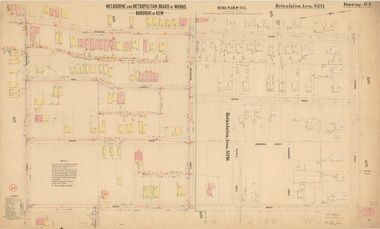
... Mr Poulter, City Engineer of the City of Kew in 1989. When the contracts were let for surveyors to identify and record the extant houses and landscapes within an area for the Board of Works, the contracts were let at separate times, hence the anomaly where two copies of Plan No.1571 exist in our collection. The first of these plans identifies the building materials used in houses bordering Fitzwilliam Street, Edgevale Road, May Street, Malin Street, Davis Street and Wellington...Mr Poulter, City Engineer of the City of Kew in 1989. When the contracts were let for surveyors to identify and record the extant houses and landscapes within an area for the Board of Works, the contracts were let at separate times, hence the anomaly where two copies of Plan No.1571 exist in our collection. The first of these plans identifies the building materials used in houses bordering Fitzwilliam Street, Edgevale Road, May Street, Malin Street, Davis Street and Wellington ...The Melbourne and Metropolitan Board of Works (MMBW) plans were produced from the 1890s to the 1950s. They were crucial to the design and development of Melbourne's sewerage and drainage system. The plans, at a scale of 40 feet to 1 inch (1:480), provide a detailed historical record of Melbourne streetscapes and environmental features. Each plan covers one or two street blocks (roughly six streets), showing details of buildings, including garden layouts and ownership boundaries, and features such as laneways, drains, bridges, parks, municipal boundaries and other prominent landmarks as they existed at the time each plan was produced. (Source: State Library of Victoria)This plan forms part of a large group of MMBW plans and maps that was donated to the Society by the Mr Poulter, City Engineer of the City of Kew in 1989. Within this collection, thirty-five hand-coloured plans, backed with linen, are of statewide significance as they include annotations that provide details of construction materials used in buildings in the first decade of the 20th century as well as additional information about land ownership and usage. The copies in the Public Record Office Victoria and the State Library of Victoria are monochrome versions which do not denote building materials so that the maps in this collection are invaluable and unique tools for researchers and heritage consultants. A number of the plans are not held in the collection of the State Library of Victoria so they have the additional attribute of rarity.Digital copy of the original survey plan, issued by the MMBW to a contractor with responsibility for constructing sewers in the area identified on the plan within the Borough of Kew. The plan was at some stage hand-coloured, possibly by the contractor, but more likely by officers working in the Engineering Department of the Borough and later Town, then City of Kew. The hand-coloured sections of buildings on the plan were used to denote masonry or brick constructions (pink), weatherboard constructions (yellow), and public buildings (grey). This plan is part of a large and historically significant group of MMBW plans and maps that was donated to the Society by the Mr Poulter, City Engineer of the City of Kew in 1989. When the contracts were let for surveyors to identify and record the extant houses and landscapes within an area for the Board of Works, the contracts were let at separate times, hence the anomaly where two copies of Plan No.1571 exist in our collection. The first of these plans identifies the building materials used in houses bordering Fitzwilliam Street, Edgevale Road, May Street, Malin Street, Davis Street and Wellington Street. The cut off point for the survey was the south side of Wellington Street. By 1903 when the survey was undertaken many of the sites were already built on, particularly those facing Edgevale Road. The plan identifies the preponderance of weatherboard houses in the area. The other version of the plan identifies the buildings between Wellington Street and Cotham Road.melbourne and metropolitan board of works, detail plans, mmbw 1571, cartography -
 Kew Historical Society Inc
Award, Commemorative Trophy : Kew Bowling Club Season 1885-86
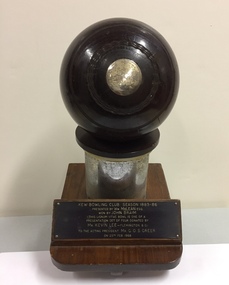
... The collection illuminates two of the Victorian historic themes - 'Building community life' through forming community organisations and 'Shaping cultural and creative life' by participating in sport and recreation. kew bowling club - wellington street - kew (vic) clubs - lawn bowls - kew (vic) lawn bowls - trophies [Metal plaque] KEW BOWLING CLUB SEASON 1885-86 / PRESENTED BY WM MCLEAN ESQ / WON BY JOHN BRAIM / THE LIGNUM VITAE BOWL IS ONE OF A / PRESENTATION SET OF FOUR DONATED BY / MR KEVIN LEE - FLEMINGTON B C / TO THE ACTING PRESIDENT MR G O S GREER / ON 25TH FEB 1968 Trophy commemorating the Kew Bowling Club's season 1885-86. ...Sports Clubs in Kew in the final decades of the 19th century and in the early 20th century were often umbrella organisations with facilities for a number of sports. Typically in Kew, this included teams in lawn bowls, tennis and croquet. The Kew Bowling Club was formed in 1880 while the privately owned Auburn Heights Recreation Club was opened in 1904. By 1998, the two Clubs decided to amalgamate at the Auburn Heights site in Barkers Road, forming the Kew Heights Sports Club. The combined club was itself taken over by the Melbourne Cricket Club in 2012 becoming MCC Kew Sports Club. In 2017 MCC Kew closed and its landholding was subsequently sold to Carey Baptist Grammar School. Both the Kew and Auburn Heights Clubs assembled important collections. These historically significant and large collections were donated to the Society in 2020. The collections include manuscripts, pictures, trophies, plans, honour boards etc. References Barnard FGA 1910, 'Sports and Pastimes' in Jubilee History of Kew Victoria: Its origin & progress 1803-1910. Nixon NV 1980, The History of the Kew Bowling Club 1880-1980. Reeve S 2012, City of Boroondara: Thematic Environmental History, p.216.The combined collections of the four sporting clubs making up the collection number hundreds of items that are historically significant locally. They are also significant to the sporting history of the greater Melbourne area and to the sports of lawn bowls and tennis in Australia in the 19th and 20th centuries. The collection illuminates two of the Victorian historic themes - 'Building community life' through forming community organisations and 'Shaping cultural and creative life' by participating in sport and recreation.Trophy commemorating the Kew Bowling Club's season 1885-86. The trophy includes a Lignum Vitae Bowl used in the 1885-6 season. It was presented to the Acting President in 1968. [The item is part of the large historic Kew Bowling Club collection (1880-1988) gifted to the Kew Historical Society in 2020].[Metal plaque] KEW BOWLING CLUB SEASON 1885-86 / PRESENTED BY WM MCLEAN ESQ / WON BY JOHN BRAIM / THE LIGNUM VITAE BOWL IS ONE OF A / PRESENTATION SET OF FOUR DONATED BY / MR KEVIN LEE - FLEMINGTON B C / TO THE ACTING PRESIDENT MR G O S GREER / ON 25TH FEB 1968kew bowling club - wellington street - kew (vic), clubs - lawn bowls - kew (vic), lawn bowls - trophies -
 Surrey Hills Historical Society Collection
Photograph, Beatrice Mary Stalker, later Mrs Howard Breedon Everard, at the beach, 1930s
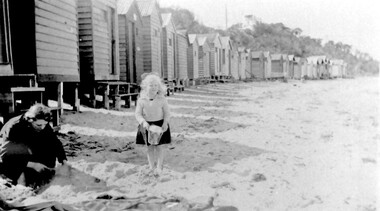
... Mr & Mrs A M Stalker of Montlare [Monclair] Avenue, North Brighton. It announces her engagement to ”Cr Howard Breedon Everard JP Ev-Ron, Woori Yallock, Youngest son of Hon WH Everard Wellington St Kew and the late Mrs Everard.” ...Mr & Mrs A M Stalker of Montlare [Monclair] Avenue, North Brighton. It announces her engagement to ”Cr Howard Breedon Everard JP Ev-Ron, Woori Yallock, Youngest son of Hon WH Everard Wellington St Kew and the late Mrs Everard.” ...Mary Stalker’s engagement notice in The Argus in July 1947 indicates that she was the youngest daughter of Mr & Mrs A M Stalker of Montlare [Monclair] Avenue, North Brighton. It announces her engagement to ”Cr Howard Breedon Everard JP Ev-Ron, Woori Yallock, Youngest son of Hon WH Everard Wellington St Kew and the late Mrs Everard.” Beatrice Mary Stalker was born in 1919. Her parents were Alexander MacLaren Stalker (1885-1970/1973) and Charlotte Eleanor Hayward (1884-1953) who were married in 1911. Her sisters were Joan Winnock Stalker, Betty Neil Stalker and Ruth McLaren Stalker. Charlotte was a teacher prior to her marriage. Alexander, an accountant, lived in Wattle Valley Road, Canterbury in 1910. From 1912-1931 they are listed at ‘Benwerrin’, Wandsworth Road, Surrey Hills. Mary Stalker married in 1949 and by 1954 she and Howard were living at 44 Wandsworth Road, Surrey Hills, which was their home for decades. Howard was born in 1914 and died in October 2010: "EVERARD. - Howard Breedon. In loving memory of Howard, who lived life to the full to the very end of his 96 years. Greatly loved and honoured by Mary, Rosemary, David, Elizabeth, John and extended families." Beatrice Mary Everard died on 25 September 2019, aged 93. it is assumed that the woman in the photo is Mary's mother, Charlotte Eleanor Stalker (nee Hayward). The photo taken at the beach in 1930's may have been at Brighton, given the family’s later association with the suburb. This photo documents part of the social history of a family with a long and strong association with Surrey Hills. The backdrop of the typical bathing boxes used for changing into swimsuits, for lunch and for storing sports and beach gear, documents beach recreation and culture of the 1930s. Given the family's later residence in Brighton, this may well have been taken at Brighton Beach. For many years in the late nineteenth century, Brighton was Melbourne's favourite seaside destination. The now iconic bathing boxes were a response to Victorian ideas of morality and sea bathing. There are 82 Brighton bathing boxes, which protected by a heritage overlay because of their uniform scale and proportion, building materials, sentry order alignment. All retain their classic Victorian architectural features with timber framing, weatherboards and corrugated iron roofs. They remain as they did over one hundred years ago, as licensed bathing boxes. Service amenities such as electricity or water were never connected.A black and white photograph of a lady and little girl on the beach. There is a row of bathing boxes behind them.(miss) mary stalker, bathing boxes, (mrs) mary everard, (miss beatrice mary stalker, (mrs) beatrice mary everard, (mrs) charlotte eleanor stalker, (miss) charlotte eleanor hayward -
 Kew Historical Society Inc
Programme, Kew Arts Festival Committee, Kew Arts Festival, 1945
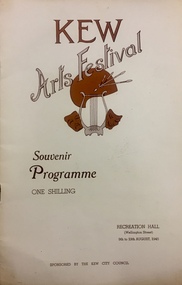
... The Herald on 10 August described the Festival offerings as: "Varied 10-Day Programme For Kew Arts Festival Opened last night, the Kew Arts Festival in the Recreation Hall, Wellington Street, provides an interesting and varied programme for the next 10 days. Today at 8.15 p.m. Mr...The Herald on 10 August described the Festival offerings as: "Varied 10-Day Programme For Kew Arts Festival Opened last night, the Kew Arts Festival in the Recreation Hall, Wellington Street, provides an interesting and varied programme for the next 10 days. Today at 8.15 p.m. Mr ...The Herald on 10 August described the Festival offerings as: "Varied 10-Day Programme For Kew Arts Festival Opened last night, the Kew Arts Festival in the Recreation Hall, Wellington Street, provides an interesting and varied programme for the next 10 days. Today at 8.15 p.m. Mr George Bell and Mr Colin Badger will have a public discussion on "What Is Modern Art?" The Vice-chancellor of the Melbourne University of Melbourne (Mr JDG Medley) will preside. Tomorrow at 10.30 a.m. Junior students of the Methodist Ladies College, directed by Dorothy Dwyer. will show how they learn to speak and move on the stage, and will present three short plays. Tomorrow night Elise Steele and Violet Ewart (violin and piano) Beryl Batten (songs) and Edith Parnell (accompanist) will give a concert. Paintings and other works of art will be on show from 2.30 to 5.30 p.m. on Sunday. On Monday night. Mr Colin Badger will speak on "Dead Wood and Green Shoot: Australian Literature Today" and on Tuesday night there will be "Ballet in Story and Action"— the story told by Norman Macgeorge, with Joan Burnett as ballerina and Fred Manners-Sutton at the piano. Wednesday night will have an illustrated lecture "Contemporary Art Education." by John Bechervaise. Remaining nights will be taken up with a performance of Somerset Maugham's "The Circle" presented by the Little Theatre, a youth concert, and another concert with songs and piano. On Saturday morning, August 18, there will be a special concert for young people. The festival will end on Sunday week with a chamber music programme in the afternoon."Important local arts festival initiated during the Second World War and continuing till the early 1950s. The souvenir programmes produced for successive festivals are historically and artistically significant records of visual and performing arts practice in Melbourne during this period.11 page souvenir program for the Kew Arts Festival, held in the Recreation Hall, Wellington Street, Kew from the 9th to the 19th August 1945. The content of the program can be viewed through the image carousel.kew arts festival - 1945, visual arts - kew (vic), performing arts - kew (vic) -
 Kew Historical Society Inc
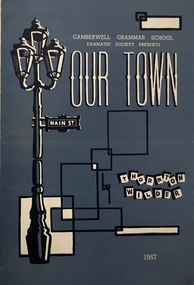
Programme, 'Our Town' / by Thornton Wilder, 1957
... Mr. Bagsworth, The Shirt, 1951 - Richard of Bordeaux, 1952 - Ned Kelly, 1953 - Saint Joan, 1954 - Treasure Island 1955 - Toad of Toad Hall, and 1956 School for Scandal. Arthur Henry Dear was an employee of the City of Kew, acting as Hall Keeper of the Kew Recreation Hall in Wellington Street, and later the new Kew City Hall in Cotham Road. ...Mr. Bagsworth, The Shirt, 1951 - Richard of Bordeaux, 1952 - Ned Kelly, 1953 - Saint Joan, 1954 - Treasure Island 1955 - Toad of Toad Hall, and 1956 School for Scandal. Arthur Henry Dear was an employee of the City of Kew, acting as Hall Keeper of the Kew Recreation Hall in Wellington Street, and later the new Kew City Hall in Cotham Road. ...The back page of the programme includes details of previous productions: 1950 - The Resignation of Mr. Bagsworth, The Shirt, 1951 - Richard of Bordeaux, 1952 - Ned Kelly, 1953 - Saint Joan, 1954 - Treasure Island 1955 - Toad of Toad Hall, and 1956 School for Scandal. Arthur Henry Dear was an employee of the City of Kew, acting as Hall Keeper of the Kew Recreation Hall in Wellington Street, and later the new Kew City Hall in Cotham Road. The Arthur Dear Collection contains memorabilia - tickets, programmes, invitations - as well as his identification badge. Items in the collection dates from the 1940s to the 1960s. The Kew Recreation Hall (Wellington Street) and later the Kew City Hall (Cotham Road) were major locations in suburban Melbourne in the postwar period for civic and private events including theatre productions and exhibitions. The Arthur Dear Collection (in conjunction with the scrapbooks compiled by Marion Tilley) provide a comprehensive snapshot of performing arts in Kew during the 1940s, 1950s and 1960s. The collection includes valuable data about performances, performers, directors etc., during this period. Theatre programme for a production of Our Town by the Camberwell Grammar School Dramatic Society. The 4-page programme includes a cast list and information about supernumeraries. arthur dear collection, performing arts -- kew -- victoria, kew recreation hall -- wellington street, theatre memorabilia, camberwell grammar school dramatic society -
 Kew Historical Society Inc
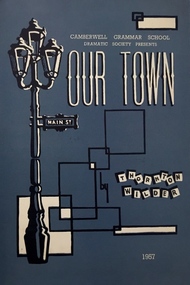
Programme, Camberwell Grammar School Dramatic Society, 'Our Town' / by Thornton Wilder, 1957
... Mr. Bagsworth, The Shirt, 1951 - Richard of Bordeaux, 1952 - Ned Kelly, 1953 - Saint Joan, 1954 - Treasure Island 1955 - Toad of Toad Hall, and 1956 School for Scandal. The Kew Recreation Hall (Wellington ...The back page of the programme includes details of previous productions: 1950 - The Resignation of Mr. Bagsworth, The Shirt, 1951 - Richard of Bordeaux, 1952 - Ned Kelly, 1953 - Saint Joan, 1954 - Treasure Island 1955 - Toad of Toad Hall, and 1956 School for Scandal.The Kew Recreation Hall (Wellington Street) and later the Kew City Hall (Cotham Road) were major locations in suburban Melbourne in the postwar period for civic and private events including theatre productions and exhibitions. The Arthur Dear Collection (in conjunction with the scrapbooks compiled by Marion Tilley) provide a comprehensive snapshot of performing arts in Kew during the 1940s, 1950s and 1960s. The collection includes valuable data about performances, performers, directors etc., during this period. Theatre programme for a production of Our Town by the Camberwell Grammar School Dramatic Society. The 4-page programme includes a cast list and information about supernumeraries. arthur dear collection, theatre memorabilia, theatre programmes, camberwell grammar school dramatic society -
 Kew Historical Society Inc
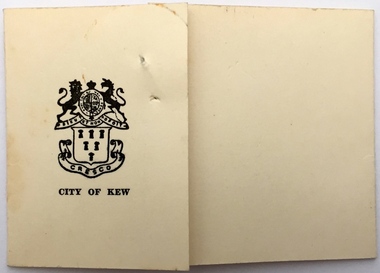
Document - Invitation, Invitation to Meet Mr Menzies and Dame Pattie Menzies, City of Kew, 1955, 1955
... Wellington Street. The Arthur Dear Collection is a comprehensive collection of theatrical ephemera relating to performances by theatrical and musical organisations from within and outside the former City of Kew who typically performed at venues in Kew during the 1950s and 1960s. arthur dear collection robert menzies dame pattie menzies kew recreation hall city of kew - invitations Card formally acknowledging the acceptance of an invitation to an event in the Kew Recreation Hall. The printed response was issued by the Town Clerk - W.D. Birrell - on behalf of the Mayor - Cr. Marie Dalley. The event was held to meet Mr ...Robert (later Sir Robert) Menzies was the member for Kooyong from 1934 to 66, and Australian Prime Minister from 1939 to 41, and again from 1949 to 66. The City of Kew was within the boundaries of his electorate. Civic events, before the opening of the new Kew City Hall in 1960 were frequently held at the Kew Recreation Hall (demolished 1960) in Wellington Street.The Arthur Dear Collection is a comprehensive collection of theatrical ephemera relating to performances by theatrical and musical organisations from within and outside the former City of Kew who typically performed at venues in Kew during the 1950s and 1960s.Card formally acknowledging the acceptance of an invitation to an event in the Kew Recreation Hall. The printed response was issued by the Town Clerk - W.D. Birrell - on behalf of the Mayor - Cr. Marie Dalley. The event was held to meet Mr Menzies and Dame Pattie Menzies.arthur dear collection, robert menzies, dame pattie menzies, kew recreation hall, city of kew - invitations -
 Kew Historical Society Inc
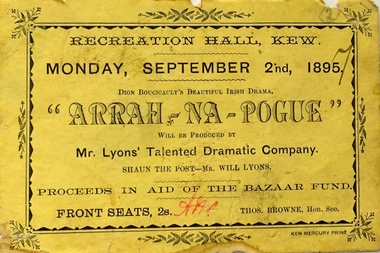
Document - Entrance Ticket, Kew Mercury, Arrah-Na-Pogue / by Dion Boucicault, 1895
... .) -- kew mercury performing arts -- kew -- victoria kew recreation hall -- wellington street theatre memorabilia Admission ticket (sic) to a performance of Arrah-Na-Pogue, a beautiful Irish drama by Dion Boucicault, at the Kew Recreation Hall on Monday 2 September 1895. The yellow ticket includes details of the performance including the name of the company performing the play - Mr ...Arthur Henry Dear was an employee of the City of Kew, acting as Hall Keeper of the Kew Recreation Hall in Wellington Street, and later the new Kew City Hall in Cotham Road. The Arthur Dear Collection contains memorabilia - tickets, programmes, invitations - as well as his identification badge. Items in the collection dates from the 1940s to the 1970s. Some items in the collection predate his period of service and must have been in the archives of the Hall. The Kew Recreation Hall (Wellington Street) and later the Kew City Hall (Cotham Road) were major locations in suburban Melbourne in the postwar period for civic and private events including theatre productions and exhibitions. The Arthur Dear Collection (in conjunction with the scrapbooks compiled by Marion Tilley) provide a comprehensive snapshot of performing arts in Kew. The collection includes valuable data about performances, performers, directors etc. Admission ticket (sic) to a performance of Arrah-Na-Pogue, a beautiful Irish drama by Dion Boucicault, at the Kew Recreation Hall on Monday 2 September 1895. The yellow ticket includes details of the performance including the name of the company performing the play - Mr. Lyons Talented Dramatic Company. Proceeds are advertised as being for a Bazaar Fund. arthur dear collection, arrah-na-pogue, dion boucicault, printers -- kew (vic.) -- kew mercury, performing arts -- kew -- victoria, kew recreation hall -- wellington street, theatre memorabilia -
 Kew Historical Society Inc
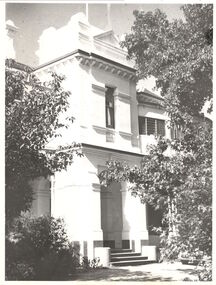
Photograph, 'Roberts House', Trinity Grammar School, c. 1965
... "The council of Trinity Grammar School, Kew, has purchased Elsinore, the residence of the late Mr. V. J. Saddler, at the corner of Wellington street, Stanley street, and Charles street, Kew, which adjoins the property recently purchased from Mr. ..."The council of Trinity Grammar School, Kew, has purchased Elsinore, the residence of the late Mr. V. J. Saddler, at the corner of Wellington street, Stanley street, and Charles street, Kew, which adjoins the property recently purchased from Mr. ...The Argus in November 1924 reported the purchase of Elsinore by Trinity Grammar School. "The council of Trinity Grammar School, Kew, has purchased Elsinore, the residence of the late Mr. V. J. Saddler, at the corner of Wellington street, Stanley street, and Charles street, Kew, which adjoins the property recently purchased from Mr. J. Henning Thompson (known as 'Trinity Lodge), and is directly opposite the Headmaster's house and main school grounds.This work forms part of the collection assembled by the historian Dorothy Rogers, that was donated to the Kew Historical Society by her son John Rogers in 2015. The manuscripts, photographs, maps, and documents were sourced by her from both family and local collections or produced as references for her print publications. Many were directly used by Rogers in writing ‘Lovely Old Homes of Kew’ (1961) and 'A History of Kew' (1973), or the numerous articles on local history that she produced for suburban newspapers. Most of the photographs in the collection include detailed annotations in her hand. The Rogers Collection provides a comprehensive insight into the working habits of a historian in the 1960s and 1970s. Together it forms the largest privately-donated collection within the archives of the Kew Historical Society.The central tower of Roberts House (originally 'Elsinore'), Wellington Street, Kew. Part of Trinity Grammar School since 1924.4. Roberts House. Trinity Grammar School.roberts house, trinity grammar school, elsinore -
 Kew Historical Society Inc
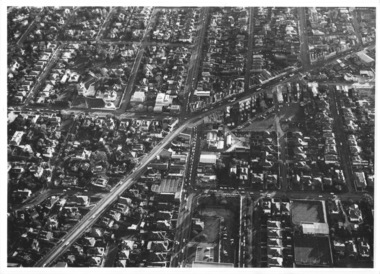
Photograph - Kew Junction, Herald & Weekly Times, 1962
... It also shows a building on the land now known as the Raoul Wallenberg Reserve, the Kew Municipal Offices in Walpole Street, and St Paul's School for the Blind in Fernhurst Grove, and Kew Bowling Club in Wellington Street. kew junction aerial photograph (kew) oblique aerial st paul's school for the blind kew municipal offices high street kew studley park road kew war memorial kew post office kew police station kew court house high street south, kew wellington street kew denmark street kew " Annotation on reverse: "Kew Historical Society from Mr L. ...This is an aerial oblique image looking north. It shows Kew Junction before construction of VicRoads (Country Roads Board), Murphy's (Leo's) supermarket, and office towers. It also shows a building on the land now known as the Raoul Wallenberg Reserve, the Kew Municipal Offices in Walpole Street, and St Paul's School for the Blind in Fernhurst Grove, and Kew Bowling Club in Wellington Street.An aerial photograph of Kew Junction, showing the intersection of High Street South, Studley Park Road, Princess Street, High Street and Denmark Street. A number of buildings, now demolished can be identified in the photo, including Jellis’ Bakeries on the corner of Princess Street and Studley Park Road." Annotation on reverse: "Kew Historical Society from Mr L. H. Chinner".kew junction, aerial photograph (kew), oblique aerial, st paul's school for the blind, kew municipal offices, high street kew, studley park road, kew war memorial, kew post office, kew police station, kew court house, high street south, kew, wellington street kew, denmark street kew -
 Kew Historical Society Inc
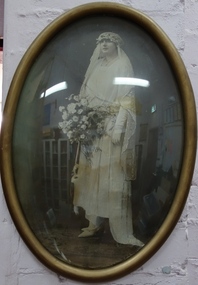
Photograph - Framed Wedding Photograph, Kathleen Cook (nee Currucan), 1923, 1923
... Father Manley, Reginald Walter, son of Mrs. and the late Charles Cook, of Wellington, Somerset, England, to Kathleen, eldest daughter of Mr. and Mrs. ...Father Manley, Reginald Walter, son of Mrs. and the late Charles Cook, of Wellington, Somerset, England, to Kathleen, eldest daughter of Mr. and Mrs. ...The Argus on 15 September 1923 reported: COOK—CARRUCAN.—On the 11th August, at the Sacred Heart Church, Kew, bv the Rev. Father Manley, Reginald Walter, son of Mrs. and the late Charles Cook, of Wellington, Somerset, England, to Kathleen, eldest daughter of Mr. and Mrs. J. Carrucan, Derby street, Kew.The Carrucan family were a notable family in Kew.Oval photograph of a bride in an oval frame with curved glass. The bride is Kathleen Carrucan at her marriage to Reginald Cook in 1923.Inscription on reverse: "Kathleen Cook [nee Carrucan] lived at 129 Derby Street Kew. Jack Carrucan family home. Married 1923 to Reginald Cook". kathleen cook, kathleen carrucan, reginald cook, wedding photograph -
![Badge - Our Heroes Carnival, Kew [1918]](/media/collectors/550653872162f11fb04854aa/items/648c3523c76a1db1226d587f/item-media/648c3b98c76a1db1226dd081/item-fit-380x285.jpg?cb=6) Kew Historical Society Inc
Kew Historical Society IncBadge, Stokes & Sons, Our Heroes Carnival, Kew, 1918
... Wellington Street on the weekend of 9 and 10 August 1918. The event was held to gain financial support for the Lady Mayoresses' Patriotic League. Three press reports [see references] describe or illustrate the event. Organisation of the event was led by the Mayoress, Mrs Wynne, with the assistance of Mrs. H. Dodd and Mr...Wellington Street on the weekend of 9 and 10 August 1918. The event was held to gain financial support for the Lady Mayoresses' Patriotic League. Three press reports [see references] describe or illustrate the event. Organisation of the event was led by the Mayoress, Mrs Wynne, with the assistance of Mrs. H. Dodd and Mr ...There were numerous events in Kew, held during World War I, to support the War Effort. The 'Our Heroes' Carnival was held in the Kew Recreation Hall [dem. 1960], Wellington Street on the weekend of 9 and 10 August 1918. The event was held to gain financial support for the Lady Mayoresses' Patriotic League. Three press reports [see references] describe or illustrate the event. Organisation of the event was led by the Mayoress, Mrs Wynne, with the assistance of Mrs. H. Dodd and Mr. Hamilton Wilson. Stalls were operated by women selling items donated or created by individuals, organisations or institutions. While the badge is not mentioned in the references, it was clearly able to be purchased as a symbol of support for the event and for the cause for which it raised funds.The badge appropriates cultural symbols for political purposes. It is a rare example of a three-dimensional badge created to support Australian soldiers abroad during WW1. It is unusual in that the inscription is localised to the municipality rather than using a generic label. Badge - Small silvered metal kookaburra standing on a boomerang inscribed in capital letters with the words "Our Heroes Carnival, Kew". The badge has a pin on the reverse."Our Heroes Carnival, Kew"patriotic badges, world war 1, national symbols, cultural appropriation, badges, first world war -- fundraising, kew recreation hall
