
Showing 115 items matching " mrs bush"
-
 Stawell Historical Society Inc
Photograph, Mr. Alf Bush & Mrs. Rosina Bush nee Marshall
... Mr. Alf Bush & Mrs. Rosina Bush nee Marshall...Albert (Alf) & Mrs. Rosina Agnes Bush nee Marshall. Albert is dressed in a suit with a dark hat. ...Rosina has a long white formal dress with a decorative hat and carrying a purse & umbrella. Mr. Alf Bush & Mrs. Rosina Bush nee Marshall Photograph ...Alfred (Alf) Bush & Rosina Agnes Bush ne Marshall. He was a butcher at Chaponnel. Bush and Allen. Lodge Master IOOF c 1893. Photographic copy of black & white image of Mr. Albert (Alf) & Mrs. Rosina Agnes Bush nee Marshall. Albert is dressed in a suit with a dark hat. Rosina has a long white formal dress with a decorative hat and carrying a purse & umbrella. stawell portrait clothing -
 Bendigo Historical Society Inc.
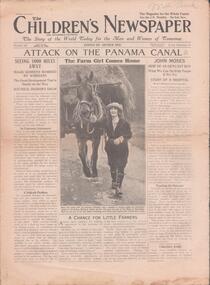
Newspaper - THE CHILDREN'S NEWSPAPER (10 ISSUES), 1924
... ... Mrs Bush...Handwritten in pencil on the top of each front page 'Mrs Bush'...NEWSPAPER Newspaper children Arthur Mee Mrs Bush Australia's first Parliament House Handwritten in pencil on the top of each front page 'Mrs Bush' Newspaper. ...The Children's Newspaper was a long-running newspaper published by the Amalgamated Press (later Fleetway Publications) aimed at pre-teenage children founded by Arthur Mee in 1919. It ran for 2,397 weekly issues before being merged with Look and Learn in 1965.Newspaper. Ten issues of 'The Children's Newspaper', from April 19 to July 26, 1924. A weekly issue edited by Arthur Mee. Each 12 pages. Price Twopence. Illustrated with B & W photographs. Printed and published by The Amalgamated Press, London. Page 7 of issue No. 266 has a photo of Australia's new Parliament House under construction.Handwritten in pencil on the top of each front page 'Mrs Bush'newspaper, newspaper, children, arthur mee, mrs bush, australia's first parliament house -
 Bendigo Historical Society Inc.
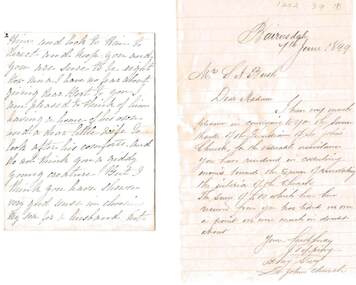
Document - BUSH COLLECTION: COLLECTION OF LETTERS TO MRS S. A. (NINA) BUSH), 1888 - 1891
... BUSH COLLECTION: COLLECTION OF LETTERS TO MRS S. A. (NINA) BUSH)...Bush, 'Lansdowne'; Jan 14th, 1891 e: to Mrs S. A. Bush from J. ...Bush, 'Lansdowne'; Jan 14th, 1891 e: to Mrs S. A. Bush from J. ...a: to Mr & Mrs Bush from R? Andrews, Nicholson St; Ist Oct. 1891 b: to 'my dear Nina' from Nellie Bath, Methodist Ladies' College; Feb 22nd, 1889 c; to 'My very dear Nina' from ?? Nellie Bush (by handwriting?), Wesleyan Parsonage; July 14th, 1888 d: to 'My dear Nina' from Jane? Bush, 'Lansdowne'; Jan 14th, 1891 e: to Mrs S. A. Bush from J. Tipping, St. John's Church, Bairnsdale. 7th June, 1899.person, individual, bush collection - personal -
 Allan Doney Collection, Bendigo Historical Society Inc.
Negative - Holiday House - Mrs Doney - Bush, Allan Doney, 1950 -1970
... Holiday House - Mrs Doney - Bush...Negative Holiday House - Mrs Doney - Bush Allan Doney ...In the years of Allan Doney’s photography, landmark buildings succumbed to fire, neglect and redevelopment. He photographed the grey sand hills from Bendigo’s mining past, the streetscapes, poppet heads, miners’ cottages, gracious homes with ornate verandahs, trams and much more. Above all, his photographs show how much of the city has survived from the 19th century – and how much has not. Through two decades of great change, Allan Doney was there to capture ways people interacted with it. Although he travelled to many other places in Northern Victoria and beyond in search of subjects for his art, he seemed to always return to Bendigo for inspiration. -
 Bendigo Historical Society Inc.
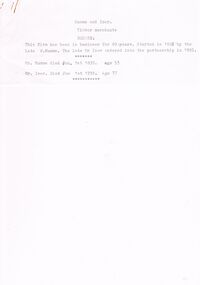
Document - HUMME AND ISER AND DIAMOND HILL RESIDENCE
... ... James Bush... Mrs...DOCUMENT Names of bendigo pioneers diamond hill Humme and Iser and Diamond Hill Residence Mr Humme Mr Iser James Bush Mrs Elizabeth Bush Mrs Ellen Day Mrs Nellie Eddy Mrs Dorothy Guild James Holiday Mrs Rebecca Hoching David H Richards James Riley Miss Sophie Rowe Mrs Gertrude Rushmeyer Mrs Augusta Weseloh (Post Mistress) Mary Andrews Mrs Crawford Bill Rowe Sophy Rowe Miss Le Clare Zephyr Deason (Mrs Peter Mulqueen) Leaflet Deason (Mrs Ruth Mulqueen) Mrs & Miss Mable Budge ? ...First part page is a very brief history of Humme and Iser, Timber Merchants. Also mentions when Mr. Humme and Mr. Iser died and their ages. The next two pages list the residence of Diamond Hill in 1955 and in the 1920's. Also no. Residence in 1981. 5. Notes are typed with additional information handwritten.document, names of bendigo pioneers, diamond hill, humme and iser and diamond hill residence, mr humme, mr iser, james bush, mrs elizabeth bush, mrs ellen day, mrs nellie eddy, mrs dorothy guild, james holiday, mrs rebecca hoching, david h richards, james riley, miss sophie rowe, mrs gertrude rushmeyer, mrs augusta weseloh, (post mistress), mary andrews, mrs crawford, bill rowe, sophy rowe, miss le clare, zephyr deason (mrs peter mulqueen), leaflet deason (mrs ruth mulqueen), mrs & miss mable budge ?, sidstrip ?, teasedale ?, andy brookfield, ? brookfield, schrunck, dempster, miss rose herbel (mrs luke murphy), dean. herman, andy erwin, mrs augusta wescloh (postmistress), roy shilling -
 Bendigo Historical Society Inc.
Document - BUSH COLLECTION: ACCOUNT AND RECEIPT, 1902
... Alsop, Bairnsdale) for professional attendance on Mrs Bush. Stamp Duty (1d.) - 'Received with thanks'....Alsop, Bairnsdale) for professional attendance on Mrs Bush. Stamp Duty (1d.) - 'Received with thanks'. ...Account for doctor's fees (Dr. C. J. Alsop, Bairnsdale) for professional attendance on Mrs Bush. Stamp Duty (1d.) - 'Received with thanks'.person, individual, bush collection - personal -
 Bendigo Historical Society Inc.
Document - BUSH COLLECTION: ASSORTED CORRESPONDENCE RE BUSH FAMILY, a:1904 b: 1912?
... A letter-card to Mrs Bush (Nine?) from Lil....A letter-card to Mrs Bush (Nine?) from Lil. Document BUSH COLLECTION: ASSORTED CORRESPONDENCE RE BUSH FAMILY ...Assorted correspondence re Bush family. A telegram to S.A. Bush at 'Whitehall' from Reg ? A letter-card to Mrs Bush (Nine?) from Lil.person, individual, bush collection - personal -
 Surrey Hills Historical Society Collection
Book, Raheen: a house and its people, 2007
... ...(mr) george h w bush...(mrs...Mrs Jeanne Pratt commissioned the book and this copy was presented to Sue Barnett on a visit by members of the Boroondara Historical Societies. The visit was organised by local member Mr Josh Frydenburg. 92p. ill. bibliog., Raheen was a grand two-storey red brick house in the Italianate Style, with a prominent tower and an arcaded loggia on two levels. This book explores its history, restoration and further development over many years. (mr) ian allen oam (mr) william lawrence bailieu ehud barak (dr) james broadbent (mr) robert bruce (mr) george h w bush ...Raheen is a 120 year old Victorian house owned by Richard and Jeanne Pratt. Mrs Jeanne Pratt commissioned the book and this copy was presented to Sue Barnett on a visit by members of the Boroondara Historical Societies. The visit was organised by local member Mr Josh Frydenburg. 92p. ill. bibliog., Raheen was a grand two-storey red brick house in the Italianate Style, with a prominent tower and an arcaded loggia on two levels. This book explores its history, restoration and further development over many years. 92p. ill. bibliog., Raheen was a grand two-storey red brick house in the Italianate Style, with a prominent tower and an arcaded loggia on two levels. This book explores its history, restoration and further development over many years.Endpaper: Surrey Hills Historical Society / Jeanne Pratt / 27/7/2013(mr) ian allen oam, (mr) william lawrence bailieu, ehud barak, (dr) james broadbent, (mr) robert bruce, (mr) george h w bush, (mrs) barbara pierce bush, (mr) arthur calwell, (ms) jane dennithorne, (mr) eamon de valera, (sir) james augustine gobbo, (mr) lloyd hill, (mr) william morris hughes, (lord) (mr) immanuel jakobovits, (mr) philip johnson, (cardinal) (mr) walter kaspar, moshe katsav, (mr) james robert knox, (mr) terence lane, (mr) edward latham, (mr) michael lehany, (dr) (mr) miles lewis, (mr) sam lipski am, (sir) (mr) thomas francis little, (mr) peter lovell, (mr) egidio lunardon, (mr) (cardinal) jean-marie lustiger, (mr) daniel patrick mannix, (sir) (mr) robert gordon menzies, (mr) henry miller, (mr) glen murcutt ao, (mr) benjamin netanyahu, (mr) ngo dinh diem, (mr) phillip nikolitsis, i (eoh) m(eng) pei, (mr) shimon peres, (mr) joseph reed, (mr) yves st laurent, (mr) william salway, (mr) james henry scullin, jessie serle, (mr) justin david simonds, (mrs) heliose waislitz, (miss) heliose pratt, (mr) john wren, (sir) (mr) henry john wrixon, (mr) richard pratt, (mrs) jeanne pratt, raheen, historical buildings, kew, victoria, italianate style, house names -
 Bendigo Historical Society Inc.
Newspaper - JOHN JONES COLLECTION: ST PAUL'S RED CROSS CIRCLE
... ... Mrs A M Bush...ESSENTIAL SERVICES Red cross Ephemera John Jones Collection - St Paul's Red Cross Circle Mrs E H Pickford Mrs A L Beischer Miss Hobson Mrs F Jones Mrs M Webster Mrs W I Jones Mrs A J Secombe Mrs W Webster Mrs E Vains Mr W B Murdock Mrs Allot Mrs Sanson Mrs Smith Mrs B F Pidgeon Mrs A W Nankervis Mrs A E Brown Mrs R Wallace Mrs A M Bush Miss Wooltorton Miss W Hobson Miss Barbara Marsh Mrs M Jenkin Mrs Wright Canon E H Pickford Mr T Hall Mrs K Emonson Marea Bendigo Advertiser Bendigo Advertiser Two newspaper cuttings from the Bendigo Advertiser, no date. ...Two newspaper cuttings from the Bendigo Advertiser, no date. One cutting refers to the fourth annual meeting and mentions the officers re-elected. The second one mentions office bearers elected, and the success of their trading tables.Bendigo Advertiseressential services, red cross, ephemera, john jones collection - st paul's red cross circle, mrs e h pickford, mrs a l beischer, miss hobson, mrs f jones, mrs m webster, mrs w i jones, mrs a j secombe, mrs w webster, mrs e vains, mr w b murdock, mrs allot, mrs sanson, mrs smith, mrs b f pidgeon, mrs a w nankervis, mrs a e brown, mrs r wallace, mrs a m bush, miss wooltorton, miss w hobson, miss barbara marsh, mrs m jenkin, mrs wright, canon e h pickford, mr t hall, mrs k emonson, marea, bendigo advertiser -
 Bendigo Historical Society Inc.
Book - BUSH COLLECTION : LEDGER BOOK 1888 TO 1920
... ... Bush Mrs Albert...Australian Producers & Traders Ltd Bush S A Bush Albert Broome SP Brealey W H Blogg Bros B'daleDistrict Farmers Co-op Coy Ltd Bush and Hopkins Berry Henry Brockhoff & Co Bush Mrs Albert Colonial Bank Corden I S & Co Crosby H M Cannon J E Dudgeon and Arnell Drevermann & Coy Fry Bros Felton Grimwade & Coy Fyansford Maunfacturing Coy Gearing Jas Hawthorn Rhodes & Coy Henebery John Harper R & Co Holford's Contract Jack A & Co Kellie Wm Kitchen & Co Kronheimer & Co Miller D Lewis & Whitty Levy Bros and Coy Melbourne Chilled Butter Coy Mooney I Mitchell & Coy Mann Mrs McEacharn & Son MacRobertson McKenzie I & Co Parsons Bros & Coy Ltd Peterson & Coy Phoenix Biscuit Coy Reddie G P Estate Ross Bros Gippsland News Rosella Preserving Coy Rolfe and Coy Robur Tea Coy Ross Ryan W Russo and Santamria Sniders I ? ...a. Book with a mottled blue-grey cover with brown leather spine and extends 5.5 cm to front and back. Corner edges also had the leather, two are missing and the other two are dilapidated. A red stuck on tape near the top of the spine had Ledger printed with some gold edging, most of which is worn off. Inside the front and back covers is a red, blue and white marble pattern. Front and back covers have been reinforced with white tape. 542 page Ledger Book for a general produce merchant. Probably Albert Bush. Alphabetical index at front. Entries in black ink on all pages and date from 1888 to 1920. Loose 4 page foolscap inside front cover listing Rolling Stock and Value. b. A pocket in the back of the book contains 6 pieces of paper relating to business and finance. Items include Discounts and Commission from 1888 to 1899, a note on insurance, a note dated June 2/90 headed Mr A Bush Sandhurst Dr to S A Bush & Co listing monthly amounts of money from Jan 1890 and 1889. Some amounts are with the name G P Reddie.Another one is a Building A/C dated 1889. Another is a balance sheet written on a page with another one written on the back and dated 1893. One written on paper headed Bush's Stores, Main Street, Bairnsdale and printed S.A.Bush & Co. It looks like a list of repayments listed in 8 bills. The other side of the page refers to Bill of Sales for Yeates & Baker and Bill of Sales held by the Bank of New South Wales. There is also a copy of two letters addressed to A Bush, one dated Oct 17.06 from H Hopkins referring to the late Mr Baker's property in Sale. The other is addressed to A Bush Esq and signed Harry Hopkins and also signed by Albert Bush and dated Nov 28 1906 in reference to the sale of a property.business, retail, bushs, bush collection - ledger book 1888 to 1920, abbott & co, allcock ?, australian producers & traders ltd, bush s a, bush albert, broome sp, brealey w h, blogg bros, b'daledistrict farmers co-op coy ltd, bush and hopkins, berry henry, brockhoff & co, bush mrs albert, colonial bank, corden i s & co, crosby h m, cannon j e, dudgeon and arnell, drevermann & coy, fry bros, felton grimwade & coy, fyansford maunfacturing coy, gearing jas, hawthorn rhodes & coy, henebery john, harper r & co, holford's contract, jack a & co, kellie wm, kitchen & co, kronheimer & co, miller d, lewis & whitty, levy bros and coy, melbourne chilled butter coy, mooney i, mitchell & coy, mann mrs, mceacharn & son, macrobertson, mckenzie i & co, parsons bros & coy ltd, peterson & coy, phoenix biscuit coy, reddie g p estate, ross bros, gippsland news, rosella preserving coy, rolfe and coy, robur tea coy, ross, ryan w, russo and santamria, sniders i ? b, swallow and ariell ltd, sutherland john, service & co jas, smallman mrs, thomas w c, sandhurst & n d trustees coy, voght george, victoria soap & candle coy, vogt k, vickers and gardner's contract, west z, west h m, water and kerang roller mill coy, yeates and watson, yeates and baker, yates and c ? arthur, yeates jas -
 Bendigo Historical Society Inc.
Photograph - FEMALE PORTRAIT, 1899
... 'with very kind regards to Mr. and Mrs. Bush, July, 1899'...'with very kind regards to Mr. and Mrs. Bush, July, 1899' Photograph FEMALE PORTRAIT ...BHS Collectionsepia photoghraph on cream board. Adult female, seated and holding rolled paper, left arm resting on cushion with hand at chin. Wearing brocade dress, velvet cape with fur collar. Ward Bros. Paris panel. Photo, Bairnsdale and Sale, written on base of photo board in brown print. 'with very kind regards to Mr. and Mrs. Bush, July, 1899'Ward Bros., Bairnsdale and Sale.person, individual, portrait female, related to bush family ? -
 Stawell Historical Society Inc
Photograph, Stawell Ladies Cricket Club Premiers of the Wimmera District 1908
... Hawes, E. Heal (capt), Mrs Bush (pres.), Mrs Proctor, Mrs Neilson THIRD ROW - A. ...Hawes, E. Heal (capt), Mrs Bush (pres.), Mrs Proctor, Mrs Neilson THIRD ROW - A. ...Stawell Ladies Cricket Team 1908 From Article Published Weekly Times, Sat 20 June 1908, P25Group portrait of ten ladies in matching white blowers with neck ribbon and older lady in darker dress seated at centre holding what appears to be a trophy. Two men at back.STAWELL LADIES CRICKET CLUB : PREMIERS OF THE WIMMERA DISTRICT FRONT ROW from left to right - M. Ross, M. Llewellyn SECOND ROW - J. Hawes, E. Heal (capt), Mrs Bush (pres.), Mrs Proctor, Mrs Neilson THIRD ROW - A. Lugar, E. Llewellyn, H. Hartley, H. Llewellyn, R. Heal MESSRS C. Proctor (scorer) W. Maddocks (umpire)stawell sport -
 Bendigo Historical Society Inc.
Document - BUSH COLLECTION: CARDS/LETTERS (SYMPATHY), July 1902
... Letters and sympathy cards relating to the death of Mrs. S. A. (Nina) Bush. Approx 70 letters or cards....PERSON Family bush collection (family Letters and sympathy cards relating to the death of Mrs. ...Letters and sympathy cards relating to the death of Mrs. S. A. (Nina) Bush. Approx 70 letters or cards.person, family, bush collection (family -
 Bendigo Historical Society Inc.
Photograph - HARRIS COLLECTION: MALE PHOTO, Nineteenth Century
... Hand written caption reverse. To Mr & Mrs J A Bush, with kind regards from J A Bain. ...Hand written caption reverse. To Mr & Mrs J A Bush, with kind regards from J A Bain. ...Black & White studio Photograph. Male aged in forties. Bartlett Bros Bendigo printed on Front. Head & Shoulders , suit & vest. Large silver badge on lapel. Lyre tails musical? Hand written caption reverse. To Mr & Mrs J A Bush, with kind regards from J A Bain. J A Bain believed purchased Williamson Street produce store from J A Bush ?Bartlett Bros Bendigophotograph, person, male -
 Federation University Historical Collection
Correspondence, Correspondence concerning the Burke Family, 1954, 20/05/1954
... The letter requests information on a Mrs Burke of Ballarat, whose husband was lost in the Bush. Mrs Burke ran a boading house. ...The letter requests information on a Mrs Burke of Ballarat, whose husband was lost in the Bush. Mrs Burke ran a boading house. ...Some possibility the author is writing about Robert O'Hara Burke, but he was not married.Two letters typed .1) An air letter form J.L. Lonergan of Eastern Pensylvania addressed to Ballaratt University, and eventuallty delivered to the Ballarat School of Mines. The letter requests information on a Mrs Burke of Ballarat, whose husband was lost in the Bush. Mrs Burke ran a boading house. The author worked for Morris Machine Works and remembered a Chief Engineery from Ballarat visiting the plant at the beginning of World War One. .2) A letter on University of Melbourne letterhead redurecting the letter to Ballarat. The letter was signed by F.G. Elford for F.H. Johnston (Registrar)/j.l. lonergan, robert o'hara burke, mrs burke, kearney, f.g. elford, letterhead, f.h. johnston, morris machine works, air letter, aerograme -
 Federation University Historical Collection
Book, Victoria Education Gazette and Teachers' Aid, 1900-1910, 1900-1910
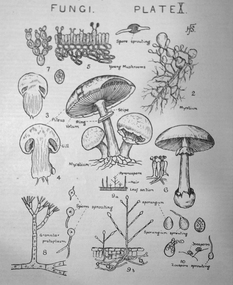
... School Children's Competitions, school garden awards, Teacher Training College, Nature Study - A page from a Teacher's Diary, A Mushroom, Mrs Bush's Kindergarten Christmas Images: Dookie Agricultural College, George R. ...School Children's Competitions, school garden awards, Teacher Training College, Nature Study - A page from a Teacher's Diary, A Mushroom, Mrs Bush's Kindergarten Christmas Images: Dookie Agricultural College, George R. ...The Federation University Historical Collection holds a full range of Victoria Education Gazette and Teachers' Aid from 1900-1968.Ten black hard covered volumes with red tape spine, covering 1900 to 1910. The gazettes include Education Department appointments, transfers, resignations and retirements, notices, queries, notices of books, examination papers, original articles, lesson plans, suggestions for lessons, drawing, obituaries, notes on nature study, mathematics, music, sloyd woodwork, English grammar, Victorian State School Swimming Clubs, Geography, penmanship, science, History, Latin, Geography; The School Garden - Shean's Creek .1) Arbour Day (pg 135) Images: Melbourne Teachers' College 1888 Building (p.8); Union Jack (p. 80); Gasometer (p. 132) .2) Plant Life lesson plans, The Antarctic in 1910, Model Nature Lesson - what plants live on , Superannuation Fund, Saluting the Flag, A.N.A. School Children's Competitions, school garden awards, Teacher Training College, Nature Study - A page from a Teacher's Diary, A Mushroom, Mrs Bush's Kindergarten Christmas Images: Dookie Agricultural College, George R. Button, training college students attending the university, Sloyd teachers, Staff at the Summer School, Outside Wilson Hall, Watt's River Weir, Fungi .3) Images: Walhalla State School; Francis W. Parker (p. 18); Freearm Drawing- Sale State School (p.71) .5) Images: Map of Australia (p.33); Formalin lamps for disinfecting rooms (p. 80); Melbourne Teachers Training College (p. 167) .6) Werribee Gorge Supplement (p. 3, 4, 11, 12, 13) .7) First Exhibition of Women's Work (p. 7, 73-76) .8) Images: Franco-British Exhibition; Memorial to William H. Nichols (p. 191) .9) Temperance Teaching; Birds native to Australia (p.4) Images: Royal Agricultural Show State Schools Exhibit (p. 5-18); Leonard's Hill School; Visit of the American Fleet .10) Funeral of Edward VII Images: Portsea Quarantine Station (p. 33-35)w.o. ryan, f. thomas, a.a. tipping, t.n. considine, w.c. fordyce, e.e. bull, h.w. byrne, j.t. flynn, r.t. smith, a.w. steane, james bagge, theo fink, frank tate, siede, nature, garden, education, school, teacher, teaching, arbor day, arbour day -
 City of Melbourne Libraries
Photograph, Bull, Hugh Jones, 1897-1993, Vice-regal visit to zoo: Governor (Lord Huntingfield) and koala
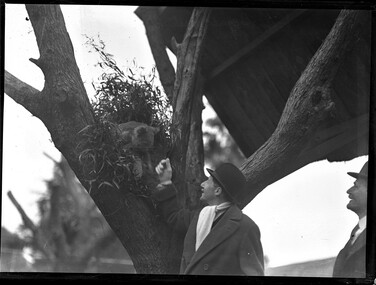
... The baby koala’s health deteriorates and the alarmed trapper returns her to the bush. Mrs. Grunty tells Mrs. Koala that she and Blinky are the only bears that she has seen for ten years: “I remember well the little girl’s father telling her... that not so many years ago the bush was alive with us bears, from Queensland to the south of Victoria. ...The baby koala’s health deteriorates and the alarmed trapper returns her to the bush. Mrs. Grunty tells Mrs. Koala that she and Blinky are the only bears that she has seen for ten years: “I remember well the little girl’s father telling her... that not so many years ago the bush was alive with us bears, from Queensland to the south of Victoria. ...Published: (1934, June 26). The Age (Melbourne, Vic. : 1854 - 1954), p. 11. Published title: VICE-ROYALTY GREETS THE KING OF THE BEASTS AT THE ZOO. Published caption: Lord Huntingfield experienced a pleasant “induction ceremony” as Patron of the Royal Zoological and Acclimatisation Society yesterday, when he made a tour of the Zoological Gardens. The picture shows the Governor, accompanied by Lady Huntingfield, inspecting the King of Beasts, who is submitting to a little playful treatment from the Director of the Gardens, Mr. Wilkie, while the Director whispers in his ear that a distinguished visitor has come to see him. (Inset), is a picture of Lord Huntingfield greeting one of the Koalas. Trove article identifier: http://nla.gov.au/nla.news-article204818472 Description: A man wearing a hat, scarf and overcoat reaches up to pat a koala in a tree watched by a man in a hat and suit. Research by project volunteer, Fiona Collyer: In 1932, the Zoo built an Australian native animal enclosure which visitors could enter and closely view koalas, wallabies, kookaburras and magpies all placed together. The branches of the trees in the enclosure were cut so that visitors could easily see and feed the koalas sitting in them. The cost to feed each koala fresh gum leaves was fifteen shillings per week. By 1924, Queensland was the last stronghold in Australia for the koala. They were functionally extinct in South Australia, only a few hundred in NSW, and an estimated population of 1000 animals remained in Victoria. There had been a six-month open season on koalas in Queensland in 1919 where over a million had been slaughtered, however with its vast, dense forests it was impossible to accurately know their numbers. Koala fur is tough, warm and waterproof and was in high demand from consumers in Canada, Britain and the US to make hats and gloves and for lining greatcoats. In 1927, with Queensland suffering a crippling drought and high unemployment, the cash-strapped McCormack Labor Government declared an “Open Season” on koalas and “opossums” for their skins, for the month of August. (Possums were often called “opossums” at this time but they are actually possums). There were widespread protests from many groups including the Nature Lovers League, Wild Life Preservation Society of Australia, Queensland Museum, C.W.A. Royal Australian Ornithologist Union, Boy Scouts, religious and women’s groups. There were letters to newspapers from ordinary people, editorials and pleas to women to refuse to wear or purchase koala fur. People questioned the masculinity of koala hunters as it was felt that no proper bushman or sportsman would kill such a defenceless creature. The Brisbane Courier newspaper led the campaign, devoting six columns a day to “Spare the Bear”. Author Vance Palmer sent an impassioned letter to the editor of the The Brisbane Courier, 19 July 1927: “Sir- It is be hoped that the disgust which all humane people have felt at the declaration of an open season for native bears in August will not be allowed to fade away until some protest... so overwhelming and effective that the question will never be raised again. For the shooting of our harmless and loveable native bear is nothing less than barbarous. His case is entirely different from that of other furred animals. No one has ever accused him of spoiling the farmers’ wheat, eating the squatters’ grass or even spreading the prickly pear. There is not a social vice that can be put down to his account. In addition, he is comparatively defenceless. He affords no sport to the gunman, and can be trusted to present a sitting target to the creature mean enough to aim at him. For this reason he has been almost blotted out already from some areas, in days when our fauna and flora were held in such little regard that the settlers’ first instinct was to shoot every strange animal and to sink his axe into every unfamiliar tree.” The Anglican Archbishop of Brisbane, Gerald Sharp, had his letter published in The Brisbane Courier on 16 July 1927: “Sir... The extermination of fauna so distinctive of our country, especially of such harmless and pretty creatures as our native bears, seems to me a shameful thing, and this is likely to mean their extermination.” But it was all to no avail. Known as “Black August”, the government was unmoved by the public’s outrage. 10,000 licences were issued to hunters and “the slaughter of the innocents” went ahead. The newspapers were full of stories of dreadful cruelty against the helpless, benign creatures by the heartless hunters who not only used guns and spotlights but wire snares and cyanide baits so that pelts wouldn’t be damaged. Infant koalas were left orphaned and unlikely to survive without their mothers. Top quality pelts were sold at an average price of 56 shillings and 9 pence per dozen, poor quality skins for as little as 2 1/2 pence each. In December 1927, the Minister for Agriculture and Stock, Mr W. Forgan Smith told the Parliament that during the August open season 597,985 koala pelts worth £139,595 had netted the state’s coffers £6000. 952,194 “opossum” pelts were sold and £9000 made for the State. The backlash that followed helped topple the Queensland Labor Government in 1929. The Wild Life Preservation Society of Australia lobbied the Prime Minister Mr Stanley Bruce to refuse to issue exportation permits for koala pelts and from 10 November 1927 the Commonwealth Government suspended the issuing of permits. In 1930, the Society made a direct appeal to USA President Herbert Hoover and he signed an order prohibiting the importation of koala and wombat fur to USA, eliminating a major market. Koala pelts were often deliberately mislabelled “wombat” to get around restrictions. The ban most likely saved the koala from probable extinction. Three years later the Australian Federal Government banned the export of koala products. This movement against koala killing was really the first conservation campaign in Australia. It raised awareness of the vulnerability of a beloved animal and eventually brought about national parks and national laws for their protection. By 1936, community opposition to possum open seasons was beginning. The koala was made a Protected Species in all states in 1937, meaning no one is allowed to harm a koala, however the laws protecting the gum trees they rely on for food and shelter are weak. The Australian Government estimates the wild koala population in Australia is between 225,000 and 500,000 in 2024. The Australian Koala Foundation estimates the national population at less than 60,000 in 2021 with a 30% decline in three years. Habitat loss from land clearing, dog attacks, road deaths, chlamydia, bushfires and drought exacerbated by climate change, continues to cause their decline. Over eight million koalas were killed for their pelts between 1888 and 1927. Any one of the annual harvests killed more koalas than are alive now. At this time, children were also being taught to appreciate Australian native animals. In 1933, “Blinky Bill: The Quaint Little Australian” book for children was published by Angus and Robertson. It was written and illustrated by New Zealand-born author Dorothy Wall and “Dedicated to my son Peter and all other Peters and Johns and Bobs and Toms and Marys and Bettys and Joans and Pats and all kind children.” The book tells the story of Blinky Bill - a mischievous, patched knickerbocker-wearing koala and his mother and father. The story has messages of conservation and instances of human unkindness and cruelty. Mr. and Mrs. Koala and young Blinky lead a mostly idyllic family life amongst a variety of other animals in the forest. However it all changes in chapter two, when Blinky Bill’s father is distressingly shot by a hunter. There is a harrowing description of Mr. Koala’s shooting and eventual death. “The Koala family lived so happily; never thinking of harm, or that anything could happen to disturb their little home, as all they asked for were plenty of fresh gum-leaves and the warm sun. They had no idea such things as guns were in the world or that a human being had a heart so cruel that he would take a pleasure in seeing a poor little body riddled with bullets hanging helplessly from the tree-top... That same being might just as well take his gun and shoot baby kookaburras, so helpless were they all and so trusting.” “Poor Mr. Koala one day was curled up asleep in his favourite corner, when the terrible thing happened. Bang! He opened his eyes in wonder. What was that? Did the limb of the tree snap where that young cub of his was skylarking? ... bang! again. This time he felt a stinging pain in his leg... Peering over the bough of the tree he saw a man on the ground with something long and black in his arms... Another bang and his ear began to hurt. Bang! again and now his little body was stinging all over. He grunted loudly and slowly climbed up the tree, calling Mrs. Koala and Blinky as he went. He managed to reach the topmost branch... Tears were pouring down his poor little face. He brushed them away with his front paws and cried just like a baby. Fortunately Mrs. Koala and Blinky Bill were hiding in the leaves quite motionless, and the shadows of the tree made them appear as part of it. The man with the gun stood and waited a long time, then walked away, whistling as he went - the only sound to be heard in the bush except the cries of the little bear far up in the tree.” Blinky and his mother quietly and fearfully wait for Mr. Koala to wake. In the morning, grunting and crying, they feel his lifeless body with their paws. Eventually Mrs. Koala realises that her husband is dead and that they need to move to a safe place. After travelling deeper into the forest, Mrs. Koala and Blinky meet koalas Mrs. Grunty and her son Snubby and she describes how she was captured as a baby by koala fur trappers to be a pet for a little girl. The trapper forgot to bring gum leaves for the koala so they try to feed her cake, milk and bananas, making her sick. The little girl’s father relays something he read in the paper: “During the year 1920 to 1921, two hundred and five thousand six hundred and seventy-nine koalas were killed and their skins sold to the fur market, under the name of wombat.” They place the koala in a box with a teddy bear for company. The baby koala’s health deteriorates and the alarmed trapper returns her to the bush. Mrs. Grunty tells Mrs. Koala that she and Blinky are the only bears that she has seen for ten years: “I remember well the little girl’s father telling her... that not so many years ago the bush was alive with us bears, from Queensland to the south of Victoria. Now, we are so rare that we have become a curiosity, something to put in zoos, for children to see; and actually in museums. I believe our grandparents sit there in glass cases, stuffed with something inside to make them appear alive, and, oh dear, glass eyes. In New South Wales, I think we could wander for miles from one corner to another and never meet a bear. I don’t know why we were all killed. As you know, we don’t eat the farmers’ crop or ruin their orchards. All we asked for were our own gum-trees.” At the end of the book, Dorothy tells her readers - “The kindest action of all would be to leave the koala baby in his own bushland, among his own playmates, with the sun, the sky, the birds, and the gum-trees, where he will grow to manhood and live for many years - happy as he should be.” In 1934, a “Wild Zoo”, the Sir Colin Mackenzie Sanctuary, opened on 32 hectares of land, formerly part of Coranderrk Aboriginal Reserve in the Yarra Valley, exclusively displaying Australian native animals, birds and reptiles. It was later renamed Healesville Sanctuary and is now managed by Melbourne Zoo and home to over 200 species of Australian native fauna. The Sanctuary is committed to rescuing, breeding, researching and raising awareness of the vulnerability of Australian animals. Andrew Arthur Wellesley Wilkie, 1853-1948, was Director of the Melbourne Zoo from 1923 to 1936 and was associated with the zoo for 70 years. He first worked as a horticultural assistant to Government botanist Baron Ferdinand von Mueller at the Botanical Gardens at the age of 13, along with his older brother David. One of Andrew’s jobs was to capture moths for the National Herbarium. In 1857, a group of prominent Melburnians assembled at St. Patrick’s Hall to form the Zoological Society of Victoria, with the aim of introducing animals and plants from overseas. It was conceived, “For the purposes of science and for that of affording the public the advantages of studying the habits of the animal creation in properly arranged zoological gardens.” The Victorian Government granted 32 acres (13 hectares) of land to the Zoological Society at the southern end of Richmond Paddock on the opposite bank to the Botanical Gardens. (This is where AAMI Stadium and Collingwood Football Club now stand.) In 1861, the Zoological Society of Victoria was renamed The Acclimatisation Society of Victoria. Unfortunately the Yarra River frontage was damp, swampy and subject to flooding, so the animals were briefly housed at the Botanical Gardens until in 1862, the City of Melbourne donated 55 acres (22 hectares) of land at Royal Park for the fledgling zoo. Baron von Mueller secured employment at Royal Park for Andrew and David and they helped to lay out the gardens, plant trees and take care of a collection of deer, pheasants, hares and partridges. Initially the zoo was used for the acclimatisation of animals recovering from the long voyage to Australia and for breeding them for sport. In 1872, the zoo bought two lions, a leopard and a cheetah that had been seized from circus showmen Keith and Phillips when they were unable to pay the bill of butcher Mr T K Bennet of Bourke Street. The first zoo director, Mr. Albert Le Souef, negotiated with captains of ships to buy animals at overseas ports they visited and soon a multitude of exotic species arrived, including a ten-year-old Indian elephant in 1878. In 1923, after being head keeper for some years, Andrew was appointed director of the zoo. By 1933, the zoo had 110 different species of animals, 200 species of birds and 72 species of reptiles under Andrew’s care. He had personally planted all but six trees and laid out the garden beds. As director he lobbied authorities for funds to build more humane enclosures for the animals. In June 1928, Table Talk magazine wrote of Andrew Wilkie: “Up at the Zoo there is a humble gentleman who is a lion among the lions, who knows the proper specific to employ when the boa constrictor has chilblains, and who is a friend and confidant of Queenie the elephant. His fount of zoological lore has never been plumbed. It is bottomless, like his good fellowship and geniality. Every day he may be seen somewhere in the grounds of that growing sanctuary for the strange and arresting fauna and creeping things of the world, and I assure you as one who is privy to his passion that that area and its inhabitants are rarely out of his thoughts.” Andrew retired from the zoo in 1936 at the age of 83 and in 1948 died at his home in Brunswick aged 94. He and his wife Josephine had six children. The Victorian Acclimatisation Society was founded in 1861 by Edward Wilson, 1813-1878, then owner and editor of The Argus newspaper. He said that Australian indigenous animals were practically useless, providing only “a little sport and an occasional meal”. The Society believed that Australia’s plants and animals were vastly inferior to those in Europe. They wanted to introduce and acclimatise to Victoria “all innoxious animals, birds, fishes, insects and vegetables, whether useful or ornamental” for sport and for the table, and to spread indigenous animals and plants from the colony around the world. Their motto was “if it lives, we want it”. The Society was primarily responsible for introducing sparrows, starlings, sambar and hog deer, ostriches, brown trout, blackberries, and carp to the Murray River. They released the European songbirds, thrush and blackbird to quell the homesickness of British settlers. The Society also sent Australian animals like platypus, echidnas, kangaroos and koalas to Europe for scientific and novelty purposes. Thomas Austin, a wealthy sheep farmer of Barwon Park, Winchelsea (property now owned by the National Trust) was a member and in 1859 he introduced hares, blackbirds, thrushes and partridges onto his property. He is probably best known for introducing 24 breeding rabbits onto his estate as game for shooting parties. Thomas quipped, “The introduction of a few rabbits could do little harm and might provide a touch of home, in addition to a spot of hunting." In 2022, genomic data confirmed that Australia’s feral rabbit population is entirely descended from these rabbits. Biological control has brought the rabbit population down from an estimated high of 10 billion rabbits in the 1920s to approximately 200 million today, inhabiting 70% of Australian landmass (5.3 million square kilometres). In 1872, the Acclimatisation Society was renamed The Zoological and Acclimatisation Society of Victoria and they focused on importing exotic animals for display purposes to the zoo. In 1937, the Royal Acclimatisation Society of Victoria was recreated as the Zoological Board of Victoria with a focus on research of native animals threatened with extinction. In an editorial for The Argus newspaper, 16 March 1856, Edward Wilson lamented: "...this country has been shamelessly stolen from the blacks. Had they been like the New Zealanders or the North American Indians, we should have bought their land, and supplied them with the means of living when we took it... In less than twenty years we have nearly swept them off the face of the earth. We have shot them down like dogs. In the guise of friendship we have issued corrosion sublimate in their damper, and consigned whole tribes to the agonies of an excruciating death. We have made them drunkards, and infected them with disease which has rotted the bones of their adults, and made such few children as are born amongst them a sorrow and a torture from the very instant of their birth. We have made them outcasts on their own land, and are rapidly consigning them to entire annihilation. There are but a few of them left, comparatively. This is what we would do for that few. We would feed and clothe every one of them.” [Note: this last sentence is italicized in the original newspaper article text]. Lord Huntingfield, (William Charles Arcedeckne Vanneck) 1883-1969, Governor of Victoria 1934-1939, was a British Conservative Party politician and the first ever Australian-born Governor of an Australian state (although he was always considered British). He was patron of the Royal Zoological and Acclimatisation Society of Victoria and was acting Governor-General for six months during the absence of Lord Gowie in 1938. Lady Huntingfield (née Margaret Eleanor Crosby) 1884-1943, his American-born wife showed great interest in social welfare and the advancement of women and children. She was president of the City Newsboys Society and Patroness of the Girls Friendly Society. In 1937, rose breeder Alister Clark named a yellow hybrid tea rose for her. In 1940, the City of Melbourne opened the Lady Huntingfield Free Kindergarten in North Melbourne, now the Lady Huntingfield Early Learning and Family Services Centre. Lady Huntingfield died in London in 1943 after her house was bombed during a German airstrike. The Lady Huntingfield Memorial Scholarship was established after the City of Melbourne raised £1000 in a public appeal conducted in her memory for students undertaking a Social Work degree at the University of Melbourne. It is awarded annually to this day. The Queen Victoria Hospital named a bed in her honour. References: VICE-ROYALTY GREETS THE KING OF BEASTS AT THE ZOO. (1934, June 26). The Age (Melbourne, Vic. : 1854 - 1954), p. 11. Retrieved August 23, 2024, from http://nla.gov.au/nla.news-article204818472 Prominent Personalities ANDREW WILKIE (1928, June 7). Table Talk (Melbourne, Vic. : 1885 - 1939), p. 15. Retrieved August 29, 2024, from http://nla.gov.au/nla.news-article146562949 'Edward Wilson (journalist)', Wikipedia, https://en.wikipedia.org/wiki/Edward_Wilson_(journalist) 'Thomas Austin (pastoralist)', Wikipedia, https://en.wikipedia.org/wiki/Thomas_Austin_(pastoralist) 'The Acclimatisation Society was driven by misguided ideals about 'fixing nature' in Australia', ABC News, https://www.abc.net.au/news/2022-11-04/acclimatisation-society-introduced-species-history-listen/101588262?utm_campaign=abc_news_web&utm_content=link&utm_medium=content_shared&utm_source=abc_news_web Blinky Bill: the quaint little Australian (eBook); by Dorothy Wall, 1933, 2023, Project Gutenberg Australia, https://gutenberg.net.au/ebooks04/0400571h.html "Black August": Queensland's Open Season on koalas in 1927 (thesis); Glenn Fowler, 1993, Australian National University, https://www.savethekoala.com/wp-content/uploads/2018/11/Black-August.pdf Unfair game: Queensland's Open Season on koalas in 1927; Jacqui Donegan, 2000, University of Queensland, https://mesto-ku.narod.ru/koalas.pdf OPEN SEASON CONDEMNED. (1927, July 19). The Brisbane Courier (Qld. : 1864 - 1933), p. 15. Retrieved September 5, 2024, from http://nla.gov.au/nla.news-article21863465 COUNTRY WOMEN'S ASSOCIATION. (1927, July 30). The Brisbane Courier (Qld. : 1864 - 1933), p. 25. Retrieved September 20, 2024, from http://nla.gov.au/nla.news-article21866965 AUSTRALIA: Barnardo's children at Melbourne Park Zoo (1929), British Pathé, YouTube, https://www.youtube.com/watch?v=_Wcrbo_cHpI 'Kodak Cinegraph Compilation No 8', ACMI Collection, https://www.youtube.com/watch?v=MCrBng5RwFI KOALA SKINS. EXPORT BAN SOUGHT. (1927, August 4). The Brisbane Courier (Qld. : 1864 - 1933), p. 10. Retrieved September 15, 2024, from http://nla.gov.au/nla.news-article21868746 THE ABORIGINES. (1856, March 16). The Argus (Melbourne, Vic. : 1848 - 1957), p. 5. Retrieved September 28, 2024, from http://nla.gov.au/nla.news-article4833244 Koala Bears (1937), British Pathé, YouTube, https://www.youtube.com/watch?v=XbqgMtyuzwE Australian Koala Bear (Earliest Archive Footage: 1929), Pond5, https://www.pond5.com/stock-footage/item/152767491-australian-koala-bear-earliest-archive-footage-1929Photographer notations on slide: "Vice Regal visit to zoo B42".1930-1939, zoos, governors, koalas, conservation, possums, botanic gardens -
The Beechworth Burke Museum
Audio - Oral History, Jennifer Williams, Mr and Mrs Don Hayes, 20th May 2000
... Mrs Hayes was born in Beechworth to a blacksmith and a teacher who had moved to the area not long before she was born in 1925. She discusses her family and the struggle her mother had being a city woman relocated to the bush and into a family who didn't accept her for her Methodist religious beliefs as they were a staunch Catholic family. ...Mrs Hayes was born in Beechworth to a blacksmith and a teacher who had moved to the area not long before she was born in 1925. She discusses her family and the struggle her mother had being a city woman relocated to the bush and into a family who didn't accept her for her Methodist religious beliefs as they were a staunch Catholic family. ...In this interview we hear from Don and Bobbie Hayes who met and were married in Beechworth. Mrs Hayes was born in Beechworth to a blacksmith and a teacher who had moved to the area not long before she was born in 1925. She discusses her family and the struggle her mother had being a city woman relocated to the bush and into a family who didn't accept her for her Methodist religious beliefs as they were a staunch Catholic family. After working in the Tannery when they first moved to Beechworth from Melbourne, Don got a job in the 1950's at the Beechworth Mental hospital known as Mayday Hills (est. 1862) and continued working there for the next thirty six years. Starting as a nurse Don would be one of three or four staff known then as attendants, who would oversee up to forty patients in a ward taking them out to work the land and gardens or chop wood on the grounds. Mrs Hayes also worked in the Hospital and discusses the need at the time to be earning to pay for large medical bills that came from two of their children, one having a congenital heart problem which was not covered by hospital benefits and the other displaced hips that required surgery. By the end of his time working at the hospital, Don was in charge of the patient training centre where those destined for discharge would be trained on how to cope in the world outside of the hospital grounds they were so used to. Both talk openly and with heartfelt candour, recalling their years spent among the patients of the hospital community, their sense of humour and compassion are evident and although the times and the jobs were definitely hard and the wages low, this couple cared deeply about the people they worked with and sit among those people from the local area who established Beechworth as a significant social welfare region. This oral history recording was part of a project conducted by Jennifer Williams in the year 2000 to capture the everyday life and struggles in Beechworth during the twentieth century. This project involved recording seventy oral histories on cassette tapes of local Beechworth residents which were then published in a book titled: Listen to what they say: voices of twentieth century Beechworth. These cassette tapes were digitised in July 2021 with funds made available by the Friends of the Burke.The significance of this oral history lies in the firsthand accounts from two people who were directly involved in the significant nursing work undertaken at Mayday Hills Mental hospital from the 1950's. Hearing the stories from those who were there and had lived experience, adds depth and we gain valuable insight into how and what the asylum was like for those who worked there and colourful details about the kinds of patients they encountered too, it adds human and personal context to what could otherwise become statistic and abstract information about a historic site. This oral history account is socially and historically significant as it is a part of a broader collection of interviews conducted by Jennifer Williams which were published in the book 'Listen to what they say: voices of twentieth-century Beechworth.' While the township of Beechworth is known for its history as a gold rush town, these accounts provide a unique insight into the day-to-day life of the town's residents during the 20th century, many of which will have now been lost if they had not been preserved.This is a digital copy of a recording that was originally captured on a cassette tape. The cassette tape is black with a horizontal white strip and is currently stored in a clear flat plastic rectangular container. It holds up 40 minutes of recordings on each side.listen to what they say, beechworth, oral history, burke museum, mayday hills hospital, may day hills, beechworth mental asylum, mental hospital, asylum, nursing, hospital, patient training centre, patients, social welfare -
 Upper Yarra Museum
PH Timber Fellers, Fallers in Powelltown bush including George Potter
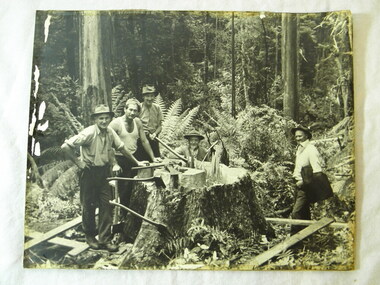
... Mr George Potter Manager of the Victorian Hardwood Company mill at Powelltown is sitting in centre of photograph axe ferns powelltown timber fallers george potter victorian hardwood company rear of photo, writen description; central figure is Mr George Potter Manager VHC Powelltown Died c1949 presented by Mrs A G Potter daughter in-law of above 76 Bluff Rd Black Rock Image of three fallers with axes and two others around stump of large tree. Black and white photograph A3 mounted on cardboard Fallers in Powelltown bush including George Potter PH Timber Fellers ...Mr George Potter Manager of the Victorian Hardwood Company mill at Powelltown is sitting in centre of photograph Image of three fallers with axes and two others around stump of large tree. Black and white photograph A3 mounted on cardboardrear of photo, writen description; central figure is Mr George Potter Manager VHC Powelltown Died c1949 presented by Mrs A G Potter daughter in-law of above 76 Bluff Rd Black Rock axe, ferns, powelltown, timber, fallers, george potter, victorian hardwood company -
 Marysville & District Historical Society
Book, Charles Kenneth Thompson, Old Bob's Birds, 1950
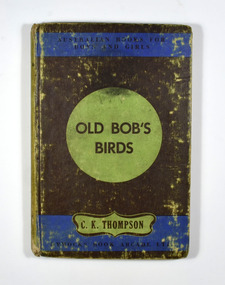
... Mrs. BERTHA LAWSON, in/ appreciation of the assistance she gave me by relating personal/ experiences with her feathered friends./ Like her husband, the immortal Henry Lawson was, this graci-/ ous lady is a passionate lover of the bush and its creatures and she/ has honored me by developing a special affection for Old Bob's/ Birds....bush he has gained during a lifetime of wandering. Bruce Thompson Stamp of the Marysville & District/ Historical Society Inc/ P.O. Box 22/ Marysville 3779 OLD BOB'S BIRDS By C. K. Thomson/ (Author of "King of the Ranges," etc) Illustrated by RON MADDEN SYDNEY/ DYMOCK'S BOOK ARCADE LTD./ 1950 Registered at the G.P.O. Sydney for/ Transmission throught the Post as a Book. Wholly Set Up and Printed by/ E. S. Perry & Sons, 182 Elizabeth Street, Sydney. DEDICATION/ To my revered friend, Mrs ...This is a delightful book that will appeal to children of all ages, and especially those of the tenderer years. Old Bob the sundowner is a character who will endear himself to young readers. So will his two small friends, Roddy and Susan, to whom he imparts all the vast lore of the bush he has gained during a lifetime of wandering.There is no dust cover. Front cover shows the series name, the title of the book, the author's name and the publisher's name.fictionThis is a delightful book that will appeal to children of all ages, and especially those of the tenderer years. Old Bob the sundowner is a character who will endear himself to young readers. So will his two small friends, Roddy and Susan, to whom he imparts all the vast lore of the bush he has gained during a lifetime of wandering.australia, nature, birds, c.k. thompson, fiction, old bob -
 Marysville & District Historical Society
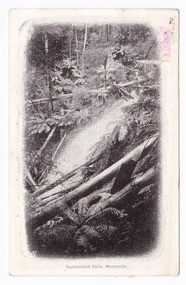
Postcard (item) - Black and white postcard, Nicholas John Caire, Cumberland falls, Marysville, 1858-1918
... Caire gave up his city work and made his home in South Yarra and devoted the rest of his life to outdoor photography, specializing in the bush, the gullies and the mountains of south-eastern Victoria. marysville victoria nicholas john caire postcard souvenir cumberland falls Victorian one penny postage stamp Post Card The Address to be written on this side This space may be used for Correspondence/ within the Commonwealth at 1d rate./ Foreign, charged ordinary letter rate. AFFIX STAMP/ HERE Dear Mum/ Will you bring me/ over some/ milk. I cannot/ get any here./ Love to all/ from all/ Hilda Mrs ...One of a series of postcards of photographs taken by socialite photographer Nicholas John Caire. N.J. Caire had a great love for the area and in the late 1800's took many photographs of Marysville and its surrounds.One of a series of postcards of photographs taken by socialite photographer Nicholas John Caire. N.J. Caire had a great love for the area in and surrounding Marysville and in the late 1800's took many photographs of Marysville and its surrounds. N.J. Caire was born in 1837 in Guernsey. He arrived in Adelaide about 1860 along with his parents who encouraged his early interest in photography. He opened a studio in Adelaide in 1867 after traveling extensively throughout the Gippsland taking photographs. After marrying in 1870 he moved to Talbot in Victoria until 1876 when he opened a studio in the Royal Arcade in Melbourne. After 1885 N.J. Caire gave up his city work and made his home in South Yarra and devoted the rest of his life to outdoor photography, specializing in the bush, the gullies and the mountains of south-eastern Victoria. Victorian one penny postage stamp Post Card The Address to be written on this side This space may be used for Correspondence/ within the Commonwealth at 1d rate./ Foreign, charged ordinary letter rate. AFFIX STAMP/ HERE Dear Mum/ Will you bring me/ over some/ milk. I cannot/ get any here./ Love to all/ from all/ Hilda Mrs Gregory/ Bay View Hotel/ Frankstonmarysville, victoria, nicholas john caire, postcard, souvenir, cumberland falls -
 Marysville & District Historical Society
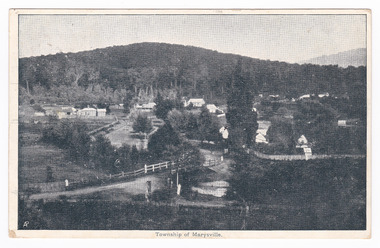
Postcard (item) - Black and white postcard, Nicholas John Caire, Township of Marysville, 1858-1918
... Caire gave up his city work and made his home in South Yarra and devoted the rest of his life to outdoor photography, specializing in the bush, the gullies and the mountains of south-eastern Victoria. marysville victoria nicholas john caire postcard souvenir POST CARD The Address to be written on this side This space may be used for Correspondence/ within the Commonwealth at 1d. rate./ Foreign, charged ordinary letter rate. St. Fillans/ Narbethong This is the/ little village we/ visited last week/ E.L. Mrs ...One of a series of postcards of photographs taken by socialite photographer Nicholas John Caire. N.J. Caire had a great love for the area and in the late 1800's took many photographs of Marysville and its surrounds.One of a series of postcards of photographs taken by socialite photographer Nicholas John Caire. N.J. Caire had a great love for the area in and surrounding Marysville and in the late 1800's took many photographs of Marysville and its surrounds. N.J. Caire was born in 1837 in Guernsey. He arrived in Adelaide about 1860 along with his parents who encouraged his early interest in photography. He opened a studio in Adelaide in 1867 after traveling extensively throughout the Gippsland taking photographs. After marrying in 1870 he moved to Talbot in Victoria until 1876 when he opened a studio in the Royal Arcade in Melbourne. After 1885 N.J. Caire gave up his city work and made his home in South Yarra and devoted the rest of his life to outdoor photography, specializing in the bush, the gullies and the mountains of south-eastern Victoria. POST CARD The Address to be written on this side This space may be used for Correspondence/ within the Commonwealth at 1d. rate./ Foreign, charged ordinary letter rate. St. Fillans/ Narbethong This is the/ little village we/ visited last week/ E.L. Mrs R.D. Cole/ Mozart Villa/ Bethanga One penny Victorian postage stamp Date Stamp/ Illegible Date Stamp/ JA 16/ 6/ VICTORIA/ Illegiblemarysville, victoria, nicholas john caire, postcard, souvenir -
Glenelg Shire Council Cultural Collection
Postcard - Postcard - Casterton, Victoria, c. 1909
... Mrs E.S Page, 5 Essy St. Norwich England Coloured postcard, from hand coloured photograph. Several small huts and a dwelling in a cleared area of bush Postcard Postcard - Casterton, Victoria ...Coloured postcard, from hand coloured photograph. Several small huts and a dwelling in a cleared area of bushFront: 'A SETTLER'S HOME, VICTORIA' - white print lower left front corner Back: Red ID stamp post mark of ('Casterton Victoria 24 Feb 1909) Hand written message and addressed to Mrs E.S Page, 5 Essy St. Norwich Englandpostcard, communication, settlers home -
 Greensborough Historical Society
Photograph - Digital image, House St Helena and Diamond Creek Roads [Greensborough], 02/05/2013
... These photographs of the house on the corner of St Helena and Diamond Creek Roads was taken in 2013 to show changes over 40 years, based on Ron Reynold's sketches in the 1973 publication 'Greensborough and Greenhills' published by Cypress Books... which states "Built on a steep hill in a bush setting in the early 1920s, for a Dr Wood, the weatherboard house now overlooks an area of activity and change. The owners, Mr and Mrs...These photographs of the house on the corner of St Helena and Diamond Creek Roads was taken in 2013 to show changes over 40 years, based on Ron Reynold's sketches in the 1973 publication 'Greensborough and Greenhills' published by Cypress Books... which states "Built on a steep hill in a bush setting in the early 1920s, for a Dr Wood, the weatherboard house now overlooks an area of activity and change. The owners, Mr and Mrs ...These photographs of the house on the corner of St Helena and Diamond Creek Roads was taken in 2013 to show changes over 40 years, based on Ron Reynold's sketches in the 1973 publication 'Greensborough and Greenhills' published by Cypress Books... which states "Built on a steep hill in a bush setting in the early 1920s, for a Dr Wood, the weatherboard house now overlooks an area of activity and change. The owners, Mr and Mrs E. 'Bluey' Blackburn, remember when their 3/4 acre building block dropped to the edge of a dirt road. Today the view from the high verandah encompasses the Main Street shopping centre, new and old bridges, new roads and houses, the Plenty River, natural bush, hills and sports grounds."Digital copy of colour photograph.greensborough and greenhills, st helena road greensborough, diamond creek road greensborough, wood family, ron reynolds -
 Orbost & District Historical Society
black and white photograph, 1939
... Mrs D. Petterson, only track to Buldah School in winter 1939...." A black / white photograph of a bush track in a forest. ...Buldah School was No. 4555. Mrs L. Petterson made application for a school at Buldah during 1936. It was opened on 8th of August 1937 by Herbert H. Eynstone acting as Head Teacher. He held this position for only about two weeks. The school closed during 1941. The Petterson brothers were early settlers in Cann River - late 19th century. This is a pictorial record of a school route in the first half of the 20th century. The Buldah School no longer exists.A black / white photograph of a bush track in a forest. There is water running across the track.on back - Don. by Mrs D. Petterson, only track to Buldah School in winter 1939...."buldah-east-gippsland -
 Orbost & District Historical Society
black and white photograph, C1933
... The two boys were lost in the bush near Orbost for three days. The had been sent by their mother, Mrs Parker, to borrow tea and sugar from a neighbour but became lost on the way home. ...The two boys were lost in the bush near Orbost for three days. The had been sent by their mother, Mrs Parker, to borrow tea and sugar from a neighbour but became lost on the way home. ...The two boys in this photograph are Stanley (7) and Maurice (5) Kelly. The two boys were lost in the bush near Orbost for three days. The had been sent by their mother, Mrs Parker, to borrow tea and sugar from a neighbour but became lost on the way home. They were found, scratched and with clothes torn, by a woodcutter, Mr W. Morell. There was a newspaper article on the front page of the Adelaide Mail , Saturday 22 July 1933,This photograph is linked with an event in Orbost's history.A small black / white photograph / postacrd of two small boys standing side by side in a paddock.on back - "The Kelly Kids, lost near L. Curlip"kelly-maurice kelly-stanley -
 Orbost & District Historical Society
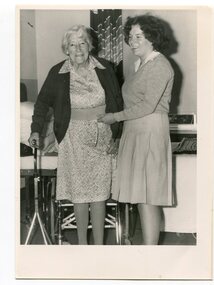
Photograph - photograph - Mrs Hazel Trewin
... bush. Pigs went to Dandenong Bacon Factory where they were processed into Dandy Ham. This photograph is significant because is of a member of the Trewin family of Jarrahmond. farming Jarrahmond Trewin family none B/W photograph of two women standing. The older woman on the left hand side has her hand on a walking stick, and the other woman appears to be helping her and has her hand outstretched. Behind the two women is a bed an pillows. Photograph photograph - Mrs ...The older lady in this photograph is Hazel Trewin, wife of Abby Trewin of Jarrahmond. The Trewins were a foundation settler/farmer family at Jarrahmond and many members of this family still live in this district. (2025). Albert (Abby) Trewin (b.21.03.1876 d. 01.07.1970) was part of the Trewin family who were early settlers at Jarrahmond near Orbost. Albert was born at Kingston near Ballarat, shifted to Jarrahmond where the house was called "Hillview", located 3 miles from Orbost on the B Road. The Trewin selection at Jarrahmond had many big trees on it and because these looked a bit like Jarrah trees from Western Australia, they names their property Jarrahmond (which became the district location and the name of Jarrahmond School). He cleared the land with bullocks, horses, crosscut saws, burned the stumps, burying some logs which were too big to burn. Then they milked cows, planted maize, had pigs, drove the pigs to Bairnsdale or to Waygara (c. 1915 when the train reached Waygara) on a buggy track through the bush. Pigs went to Dandenong Bacon Factory where they were processed into Dandy Ham. This photograph is significant because is of a member of the Trewin family of Jarrahmond.B/W photograph of two women standing. The older woman on the left hand side has her hand on a walking stick, and the other woman appears to be helping her and has her hand outstretched. Behind the two women is a bed an pillows. nonefarming, jarrahmond, trewin family -
Ringwood and District Historical Society
Tickets (2), Salvation Army, Salvation Army Ringwood, Tickets. (years unknown), Feb - Aug
... Two tickets from Salvation Army to Mr & Mrs McCaskill, inviting them to the official opening of the Bush Fair.|2. ...Two tickets from Salvation Army to Mr & Mrs McCaskill, inviting them to the official opening of the Bush Fair.|2. ...1. Two tickets from Salvation Army to Mr & Mrs McCaskill, inviting them to the official opening of the Bush Fair.|2. A ticket to the Harvest Festival Thanksgiving with the Mayor J. K. McCaskill presiding over a program by the Bayswater Boys' Home.1. Green ticket with black printing and fruit motif.; 2. Buff coloured ticket with black printing.Salvation Army Ringwood
