
Showing 21 items matching " nationhood"
-
 Monbulk RSL Sub Branch
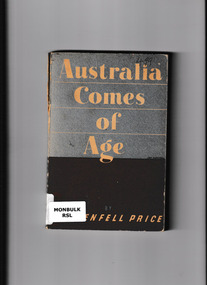
Book, Georgian House, Australia comes of age : a study of growth to nationhood and of external relations, 1945
... Australia comes of age : a study of growth to nationhood and of external relations ...Australia comes of age : a study of growth to nationhood and of external relations Book Georgian House Grenfell Price ...Examines the growth of the Commonwealth to independent Dominion status; the use made of that status when Japan attacked; developments in policy up to 1944; and problems of future security ... also progress in the Pacific, the acquisition of New Guinea, the White Australia policy and Australian-American relationsIndex, p.159.non-fictionExamines the growth of the Commonwealth to independent Dominion status; the use made of that status when Japan attacked; developments in policy up to 1944; and problems of future security ... also progress in the Pacific, the acquisition of New Guinea, the White Australia policy and Australian-American relationsaustralian - foreign relations - 20th century, australia - foreign relations - asia - pacific region -
 Sunshine and District Historical Society Incorporated
Certificate - 100 Years Of Nationhood 1901 - 2001 Certificate of Appreciation Sunshine & District Historical Society, 2001
... ... Nationhood...100 Years Of Nationhood 1901 - 2001 Certificate of Appreciation Sunshine & District Historical Society...The Sunshine & District Historical Society was award this certificate for its outstandinh contribution to the Victorian Federation Grants Scheme and playing a valuable role in commenmorating and celebrating our Centenary of Federation Sunshine & District Historical Society Nationhood 100 Years Of Nationhood 1901 - 2001 Certificate of Appreciation Sunshine & District Historical Society A4 Certiciate Certificate 100 Years Of Nationhood 1901 - 2001 Certificate of Appreciation Sunshine & District Historical Society ...The Sunshine & District Historical Society was award this certificate for its outstandinh contribution to the Victorian Federation Grants Scheme and playing a valuable role in commenmorating and celebrating our Centenary of Federation100 Years Of Nationhood 1901 - 2001 Certificate of Appreciation Sunshine & District Historical Societysunshine & district historical society, nationhood -
 Whitehorse Historical Society Inc.
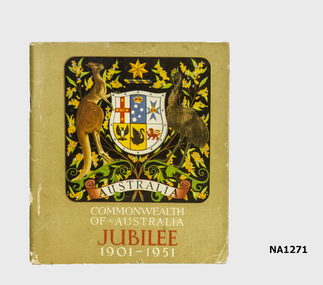
Book, Commonwealth of Australia Jubilee 1901-1951
... Book presented to school children on the occasion of 50 years of nationhood...Book presented to school children on the occasion of 50 years of nationhood books history/local history Book with soft cover and Australian Coat of Arms on front. ...Book presented to school children on the occasion of 50 years of nationhoodBook with soft cover and Australian Coat of Arms on front. 'Commonwealth of Australia Jubilee 1901-1951'books, history/local history -
 Bendigo Historical Society Inc.
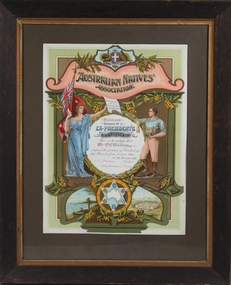
Certificate - A. N. A. Ex-President's Certificate
... The Australian Natives' Association was established in Melbourne in 1871 as a non-partisan and non-sectarian friendly society for Australian-born, white men seeking to shape Australia's nationhood and identity. ...The Australian Natives' Association was established in Melbourne in 1871 as a non-partisan and non-sectarian friendly society for Australian-born, white men seeking to shape Australia's nationhood and identity. Australian Natives Association Bendigo No 5 P. ...The Australian Natives' Association was established in Melbourne in 1871 as a non-partisan and non-sectarian friendly society for Australian-born, white men seeking to shape Australia's nationhood and identity. A framed certificate behind glass. the certificate is surrounded by a brown matt with light brown bead and a dark brown wooden frame. The certificate has white and green border, green and yellow floral drawings and numerous Australian images. AUSTRALIAN NATIVES' ASSOCIATION printed at top under that there is a lady in a full-length blue gown holding a red Australian flag and a piece of paper with CONSTITUTION OF THE AUSTRALIAN COMMONWEALTH written on it. There is a man dressed like an early settler. Between them printed in a white circle - BENDIGO BRANCH No 5 EX-PRESIDENT'S CERTIICATE this is to certify that F. G. Griffiths occupied the position of President of this branch from 1st June, 1935 to 30th November, 1935 signed- J R Stonehouse President and (unreadable) Secretary.australian natives association bendigo no 5, p. g. griffiths, j. r. stonehouse -
 Bendigo Military Museum
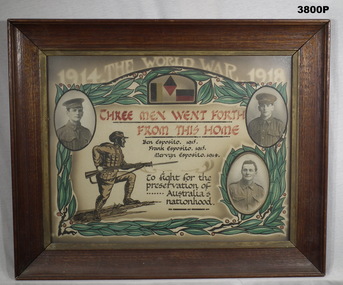
Memorabilia - PHOTOGRAPH, FRAMED, Post 1918
... Across the top in white: 1914 THE WORLD WAR 1918 In centre in red: THREE MEN WENT FORTH FROM THIS HOME In centre in black: Ben Esposito, 1915 Frank Esposito, 1915 Mervyn Esposito, 1915 To fight for the preservation of .... Australia's nationhood...Memorabilia framed brothers Across the top in white: 1914 THE WORLD WAR 1918 In centre in red: THREE MEN WENT FORTH FROM THIS HOME In centre in black: Ben Esposito, 1915 Frank Esposito, 1915 Mervyn Esposito, 1915 To fight for the preservation of .... Australia's nationhood Portrait photos, head & shoulders, of 3 soldiers in uniform, 2 with peaked caps. ...Benjamin Francis Esposito No 368 enlisted on 23.1.1915 in the 21st Bn age 25 years, embarked for Eygpt 10.5.1915 then to Gallipoli, embarked for France 19.3.1916, awarded the “MM” at Moquet Farm 26.8.1916, WIA 11.2. 1917 GSW to Face & L/Hand, promoted to 2nd Lt 1.1.1919, Lt 1.4.1919, discharged from the AIF 6.10.1919. Francis Stacey Esposito No 535 enlisted on 14.7.1915 age 22 years in B Coy 29th Bn, embarked for Eygpt 10.11.1915, embark for France 16.6.1916, WIA 26.11.1916 GSW to Neck, rejoin unit 18.3.1917, transfer to the 32nd Bn 12.10.1918, discharged from the AIF 25.7.1919. Mervyn Harold No 781 enlisted on 18.8.1914 age 20 years in C Coy 7th Bn, embark for Eygpt 19.10.1914, embark for Gallipoli 5.4.1915, admitted to Hospital Ship 2.7.1915 with Influenza, later classified as Enteric serious, Died of Disease 8.8.1915.Portrait photos, head & shoulders, of 3 soldiers in uniform, 2 with peaked caps. Oval photos mounted on cream backing with 3 battalion patches in the centre. On LHS is a drawing of a soldier with rifle surrounded by green leaf edging. Photos have brown wooden frames with gold inner edge, glass front & wooden ply backing.Across the top in white: 1914 THE WORLD WAR 1918 In centre in red: THREE MEN WENT FORTH FROM THIS HOME In centre in black: Ben Esposito, 1915 Frank Esposito, 1915 Mervyn Esposito, 1915 To fight for the preservation of .... Australia's nationhoodmemorabilia, framed, brothers -
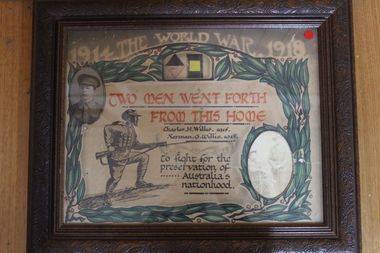 Lara RSL Sub Branch
framed picture 1914-1918 Willis, Two men forth from this home - Charles H. Willis 1915 & Norman G. Willis 1915
... To fight for the preservation of Australia's nationhood. Titled - 1914 The World War . 1918. ...To fight for the preservation of Australia's nationhood. Titled - 1914 The World War . 1918. ...Wooden framed World War 1 memorial - Two Men Went Forth From This Home - Charles H. Willis 1915 & Norman G. Willis 1915. To fight for the preservation of Australia's nationhood. Titled - 1914 The World War . 1918. Photo inserts of Charles H. Willis 1915 & Norman G. Willis 1915. Grey colored title band. Green wreath encircling with a stylized Australian Soldier with rifle and bayonet.Memorial for Charles H. Willis 1915 & Norman G. Willis 1915. Two men went forth from this home. -
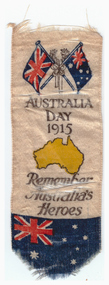 Linton and District Historical Society Inc
Ribbon, Australia Day, July 1915, 1915
... This was not the celebration of nationhood as we know it today, but a national fundraising effort during World War I. ...This was not the celebration of nationhood as we know it today, but a national fundraising effort during World War I. ...The ribbon is a souvenir of the first 'Australia Day', held 30 July 1915. This was not the celebration of nationhood as we know it today, but a national fundraising effort during World War I. Across Australia, this day was set aside for fundraising to assist wounded soldiers returning to Australia during WWI. In Linton Australia Day 1915 was celebrated with a jumble sale, raffles, and the collection of donations. There was also a stall outside the Shire Offices, attended by a group of girls dressed as Red Cross nurses, which sold flowers, postcards, toys and souvenirs. Mrs Surman, then Stella Todd, was one of this group of girls, along with her sister Millie Todd. (See photograph, Registration no. 055.) Presumably the souvenir ribbon was purchased by one of the Todd family on this day.Small white-blue silk ribbon. Printed - black writing - flags - Australia and Britain. Map of Australia. This ribbon was part of a collection of historical items belonging to Mrs. Stella Surman (formerly Stella Todd), of Linton."Australia-Day-1915" "Remember Australia's Heroes"australia day 1915, world war 1914-1918, souvenirs -
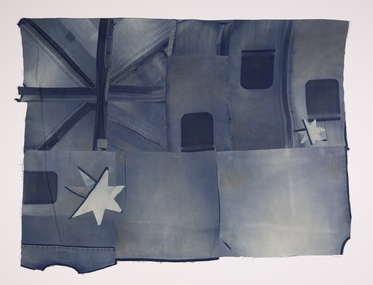 Ararat Gallery TAMA
Raquel Ormella, Workers Blues # 2, 2016
... Flags are one of the most powerful uses of fabric; Ormella is echoing the flag design to explore tensions between aspirational nationhood and the personal effect of this has on individuals, marginalised social groups and the environment. ...Flags are one of the most powerful uses of fabric; Ormella is echoing the flag design to explore tensions between aspirational nationhood and the personal effect of this has on individuals, marginalised social groups and the environment. ...Raquel Ormella is an artist working at the intersections of art and activism, with a diverse practice that includes textiles, video, installation, drawings, and zines. Ormella explores how contemporary art can prompt viewers to reflect on their own beliefs and values regarding political consciousness and social action. Her art practice is also grounded in exploring the nature of the relationship between humans and the natural environment. This artwork, Workers Blues #2, reimagines the Australian National Flag, constructing a rough-hewn approximation of it from blue workers shirts. Flags are one of the most powerful uses of fabric; Ormella is echoing the flag design to explore tensions between aspirational nationhood and the personal effect of this has on individuals, marginalised social groups and the environment. Ormella’s choice of material – blue cotton workers shirts - also references gendered associations with cloth, with masculine nationalism symbolised by the workers shirts, including in the mining industry. The work is an example of the symbolic power of cloth as a marker of identity, including gender and class. -
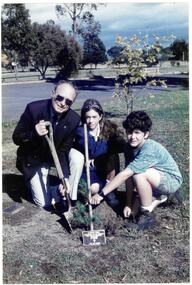 Melbourne Legacy
Photograph - Tree Planting, Legacy Lone Pines, 1995
... Presentations are made to schools, ex-service organisations and interested bodies by Legacy Clubs in the hope that they will be cherished as a symbol of nationhood and of its just pride, devotion, courage, selflessness and sense of service to others....Presentations are made to schools, ex-service organisations and interested bodies by Legacy Clubs in the hope that they will be cherished as a symbol of nationhood and of its just pride, devotion, courage, selflessness and sense of service to others. ...A planting of a pine tree by Legatee Mal Huffman and two children at Aberfeldie Primary School. It appear in The Answer in June 1995. From the early 1970s Legacy had a commemorative programme of providing trees grown from seeds from Gallipoli to various towns and schools throughout Australia. This may be part of that project (see the Lone Pine brochure at 00593) or subsequent propagation undertaken by Legacy. Melbourne Legacy’s Commemoration Committee was responsible for the collection, propagation, presentation and dedication of Lone Pines from the 24th Battalion tree at the Shrine of Remembrance. On the 14th September 1989 further seedlings were collected with the hope to raise 1,000 trees from the seeds. Thus, Legacy is helping to keep the memory of the Gallipoli “Lone Pine” alive – its spirit living on today. Presentations are made to schools, ex-service organisations and interested bodies by Legacy Clubs in the hope that they will be cherished as a symbol of nationhood and of its just pride, devotion, courage, selflessness and sense of service to others.A record of a tree planting of a Lone Pine tree.Colour photo of a Legatee and two children planting a tree.On the back "Copyright of Community News.", stamped in red ink.tree planting, lone pine -
 Melbourne Legacy
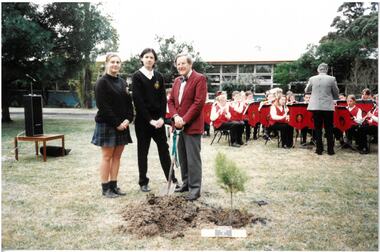
Photograph - Tree Planting, Legacy Lone Pines
... Presentations are made to schools, ex-service organisations and interested bodies by Legacy Clubs in the hope that they will be cherished as a symbol of nationhood and of its just pride, devotion, courage, selflessness and sense of service to others....Presentations are made to schools, ex-service organisations and interested bodies by Legacy Clubs in the hope that they will be cherished as a symbol of nationhood and of its just pride, devotion, courage, selflessness and sense of service to others. ...A planting of a pine tree by a man and two school children at what could be a school. There was a service with speeches and a band playing. The venue, names and date are unknown. In the early 1970s Legacy had a commemorative programme of providing trees grown from seeds from Gallipoli to various towns throughout Australia. This may be part of that project (see the Lone Pine brochure at 00593) or subsequent propagation undertaken by Legacy. Melbourne Legacy's Commemoration Committee was responsible for the collection, propagation and dedication of Lone Pines from the 24th Battalion tree at the Shrine of Remembrance. On the 14th September 1989 further seedlings were collected with the hope to raise 1,000 trees from then seeds. Thus, Legacy is helping to keep the memory of the Gallipoli "Lone Pine" alive - its spirit living on today. Presentations are made to schools, ex-service organisations and interested bodies by Legacy Clubs in the hope that they will be cherished as a symbol of nationhood and of its just pride, devotion, courage, selflessness and sense of service to others.A record of a tree planting of a Lone Pine tree.Colour photo x 8 of a tree planting at a school.tree planting, lone pine -
 Melbourne Legacy
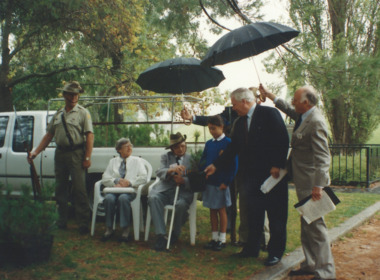
Photograph - Tree Planting, Legacy Lone Pines, 1993
... Presentations are made to schools, ex-service organisations and interested bodies by Legacy Clubs in the hope that they will be cherished as a symbol of nationhood and of its just pride, devotion, courage, selflessness and sense of service to others....Presentations are made to schools, ex-service organisations and interested bodies by Legacy Clubs in the hope that they will be cherished as a symbol of nationhood and of its just pride, devotion, courage, selflessness and sense of service to others. ...These photos are of a gathering at the Shrine of Legatees and a delivery of lone pine saplings on the back of a ute. Legatee George Woodward was present, also a school girl and a veteran. These photos were in an album of photos from 1993. These are the saplings grown from the seeds collected by President Chas Wilks in 1989 (item 01426). From an article in The Answer in June 1994 the event was the official handing over of the seedlings that were propagated. Present were Minister for Natural Resources, The Hon Geoffrey Coleman and Gallipoli veteran Tom Brain. Legacy has run a programme since the 1970s of propagating saplings taken from seeds of pine descended from a pine tree from Gallipoli and giving them to various clubs, schools and town councils. Legacy is helping to keep the memory of the Gallipoli "Lone Pine" alive - its spirit living on today. Presentations are made to schools, ex-service organisations and interested bodies by Legacy Clubs in the hope that they will be cherished as a symbol of nationhood and of its just pride, devotion, courage, selflessness and sense of service to others.A record of Legacy being involved with distributing saplings in 1993. The lone pine programme was a type of work done by Legatees to keep the memory of Gallipoli and fallen comrades alive.Colour photo x 4 of an event at the Shrine with lone pine tree saplings.tree planting, lone pine, george woodward -
 Melbourne Legacy
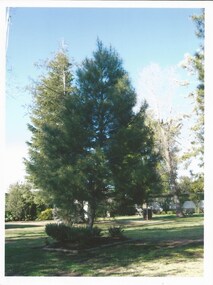
Photograph - Photo, tree planting, Legacy Lone Pines, 2008
... Presentations are made to schools, ex-service organisations and interested bodies by Legacy Clubs in the hope that they will be cherished as a symbol of nationhood and of its just pride, devotion, courage, selflessness and sense of service to others....Presentations are made to schools, ex-service organisations and interested bodies by Legacy Clubs in the hope that they will be cherished as a symbol of nationhood and of its just pride, devotion, courage, selflessness and sense of service to others. ...A letter from Mrs Alwyn Drysdale on behalf of her husband Bob, to accompany photos of pine trees planted by him over time in various towns and schools. The trees had been organised by Legacy as part of their Lone Pine programme and he wanted to provide an update of their growth. Since the early 1970s Legacy had a commemorative programme of providing trees grown from seeds from Gallipoli to various towns throughout Australia. See the Lone Pine brochure at 00593. These trees were planted in the early 2000s. Melbourne Legacy's Commemoration Committee was responsible for the collection, propagation and dedication of Lone Pines from the 24th Battalion tree at the Shrine of Remembrance. On the 14th September 1989 further seedlings were collected with the hope to raise 1,000 trees from the seeds. Thus, Legacy is helping to keep the memory of the Gallipoli "Lone Pine" alive - its spirit living on today. Presentations are made to schools, ex-service organisations and interested bodies by Legacy Clubs in the hope that they will be cherished as a symbol of nationhood and of its just pride, devotion, courage, selflessness and sense of service to others.A record of tree planting of Lone Pine trees and their progress.Colour photo x 10 of pine trees and a letter.00746.1 Letter to Carmel at Legacy from Mrs Alwyn Drysdale of Kyabram. 00746.2 Kyabram Secondary College. Planted 10/9/1998. 00746.3 St Augustine's College, Kyabram. Planted 11/11/1998 00746.4 Girgarre Primary School. Planted 11/11/1999 00746.5 Tongala Aged Care Hostel. Planted 25.4.2000 00746.6 Merrigum Primary School. Planted 1.9.2000 00746.7 Kyabram and District Memorial Hospital. Planted 19/1/2001 00746.8 Tongala Primary School "Lone Pine" planted 2/9/2003, taken 31/7/2008 00746.9 "Warramunda" Village for Aged. Planted 13/9/2003 00746.10 St. Pat's College Tongala. Planted 11/11/2004 00746.11 Stanhope Primary School. Lone Pine planted 15/8/2005, taken 27/7/2008 tree planting, lone pine -
 Melbourne Legacy
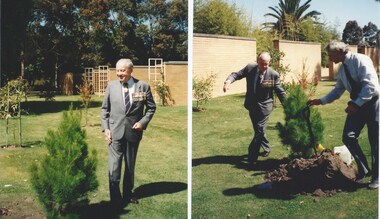
Photograph, Planting a lone pine sapling at Springvale Garden of Remembrance, 1993
... Presentations are made to schools, ex-service organisations and interested bodies by Legacy Clubs in the hope that they will be cherished as a symbol of nationhood and of its just pride, devotion, courage, selflessness and sense of service to others....Presentations are made to schools, ex-service organisations and interested bodies by Legacy Clubs in the hope that they will be cherished as a symbol of nationhood and of its just pride, devotion, courage, selflessness and sense of service to others. ...Legacy has a programme of donating trees grown from seeds descended from a pinecone of a Lone Pine in Gallipoli. One photo shows President John Stevenson by the newly planted tree, and making a speech, also Legatee Lucky Luscombe speaking. The plaque shown is now known to be incorrect. The species of tree is not an Aleppo Pine but a Pinus Brutia (also known as Turkish Pine). From the early 1970s Legacy had a commemorative programme of providing trees grown from seeds from Gallipoli to various towns throughout Australia. This may be part of that project (see the Lone Pine brochure at 00593) or subsequent propagation undertaken by Legacy. Melbourne Legacy‚ Commemoration Committee was responsible for the collection, propagation, presentation and dedication of Lone Pines from the 24th Battalion tree at the Shrine of Remembrance. On the 14th September 1989 further seedlings were collected with the hope to raise 1,000 trees from the seeds. Thus, Legacy is helping to keep the memory of the Gallipoli 'Lone Pine' alive, its spirit living on today. Presentations are made to schools, ex-service organisations and interested bodies by Legacy Clubs in the hope that they will be cherished as a symbol of nationhood and of its just pride, devotion, courage, selflessness and sense of service to others.The planting of Lone Pine trees, donated by Legacy, has promoted the memory of Australian servicemen in many places around Australia.Colour photo x 6 of a planting of a Lone Pine by President John Stevenson at Springvale Garden of Remembrance.lone pine, tree planting -
 Melbourne Legacy
Photograph, Back to Caulfield 1995, 1995
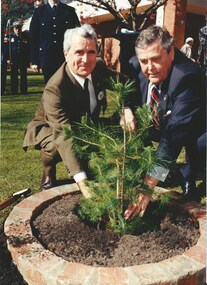
... Presentations are made to schools, ex-service organisations and interested bodies by Legacy Clubs in the hope that they will be cherished as a symbol of nationhood and of its just pride, devotion, courage, selflessness and sense of service to others....Presentations are made to schools, ex-service organisations and interested bodies by Legacy Clubs in the hope that they will be cherished as a symbol of nationhood and of its just pride, devotion, courage, selflessness and sense of service to others. ...For many years Legacy had a "Back to Caulfield Race Day" for Legatees, widows and their families. 1995 was the 50th anniversary of the end of World War 2 and the race day was part of the "Australia Remembers" commemorations. Also a Legacy 'Lone Pine' was planted. The article in the Answer says: "Over 800 members of the Legacy family (past and present) reunite at the "Australia Remembers" Back to Caulfield Commemorative Race Day held on August 12th. It was a special day which incorporated a wide range of activities, including a display of military vehicles, a flyover, a parachute jump by the Red Berets, military bands, and displays of memorabilia when the racecourse was used as an army camp. An official ceremony also included the presentation of a Legacy 'Lone Pine' (a descendant of the Gallipoli 'Lone Pine') by the President of the Melbourne Legacy, Legatee David Millie, which was very warmly received by the Chairman of the V.A.T.C., Mr Peter Lawrence. " Official guest was the Premier of Victoria Jeff Kennett who is seen being greeted as he arrives. And photos of the planting of the 'Lone Pine'. See also photos at 01003 and 01092 and 01093. Legacy is helping to keep the memory of the Gallipoli "Lone Pine" alive - its spirit living on today. Presentations are made to schools, ex-service organisations and interested bodies by Legacy Clubs in the hope that they will be cherished as a symbol of nationhood and of its just pride, devotion, courage, selflessness and sense of service to others.Legacy retains a tie with Caulfield racecourse as it was once an army camp and staging post of young men going overseas to war and now it is the site of a lone pine. The annual gathering at Caulfield racecourse was an event that gets the Legacy family together.Colour photo x 8 of an event at Caulfield racecourse, and an article in The Answer.Printed on the back film number 783, 786, 787, various frame numbersanswer, events, lone pine, wreath laying ceremony -
 Melbourne Legacy
Photograph - Photo, Legacy Lone Pines, 1989
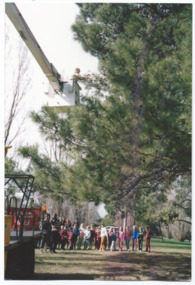
... Presentations are made to schools, ex-service organisations and interested bodies by Legacy Clubs in the hope that they will be cherished as a symbol of nationhood and of its just pride, devotion, courage, selflessness and sense of service to others....Presentations are made to schools, ex-service organisations and interested bodies by Legacy Clubs in the hope that they will be cherished as a symbol of nationhood and of its just pride, devotion, courage, selflessness and sense of service to others. ...Photos of President Chas Wilks collecting pine cones from the Lone Pine descendant at the Shrine of Remembrance, the 24th Battalion tree. The cones dropped to the ground and school children are seen collecting them. Legacy has run a programme since the 1970s of propagating saplings taken from seeds of pine descended from a pine tree from Gallipoli and giving them to various clubs, schools and town councils. The photo appeared in the President's Highlights report in 1989. The caption says '1,000 seedlings from the historic Lone Pine tree near the Shrine of Remembrance will be propagated on behalf of Melbourne Legacy by the Department of Conservation Forests and Lands. Melbourne President Legatee Chas Wilks, along with the Minister for CFL, Ms Kay Setches and pupils from South Yarra Primary School helped to collect the seeds. The trees, once grown will be distributed to schools by Melbourne Legacy. Also see item at 01334 in 1993 when President Woodward was giving out saplings, it was three years later was when the saplings grown from these seeds were distributed. Legacy is helping to keep the memory of the Gallipoli "Lone Pine" alive - its spirit living on today. Presentations are made to schools, ex-service organisations and interested bodies by Legacy Clubs in the hope that they will be cherished as a symbol of nationhood and of its just pride, devotion, courage, selflessness and sense of service to others.A record of the way Legacy was propagating Lone Pine saplings for schools and organisations. The Lone Pine programme show the type of work done by Legatees to keep the memory of Gallipoli and fallen comrades alive.Colour photo x 4 of President Chas Wilks in a crane collecting pine cones at the Shrine and children collecting the cones.Handwritten '10' in a circle in blue pen.tree planting, lone pine -
 Melbourne Legacy
Photograph - Tree Planting, Legacy Lone Pines, 1991
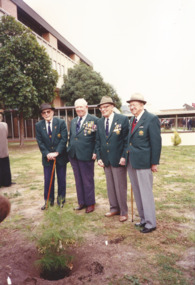
... Presentations are made to schools, ex-service organisations and interested bodies by Legacy Clubs in the hope that they will be cherished as a symbol of nationhood and of its just pride, devotion, courage, selflessness and sense of service to others. ...Presentations are made to schools, ex-service organisations and interested bodies by Legacy Clubs in the hope that they will be cherished as a symbol of nationhood and of its just pride, devotion, courage, selflessness and sense of service to others. ...A planting of a pine tree at Heidelberg Repatriation Hospital on 17 April 1991. Legacy had a programme of donating trees grown from seeds from Lone Pine in Gallipoli. One photo shows 4 Gallipoli veterans standing by the newly planted pine tree. One shows President John Sullivan with the shovel. Also with representatives of John Allison / Monkhouse who provided the plaques for the tree. A different photo was used in the July 1991 issue of the Widows' Newsletter (later called The Answer) and explained two small Lone Pine trees were donated in appreciation of the care extended by the hospital to widows and dependents of veterans. Special guests included WW1 Gallipoli veterans who had revisited Gallipoli for its 75th Anniversary. White paper labels say: "Gallipoli 'Lone Pine' Lives on. Two lone pine trees, propagated from Gallipoli Lone Pines, were presented on behalf of Melbourne Legacy to the Heidelberg Repatriation Hospital by the President, Legatee John Sullivan. The trees were presented in appreciation of the care extended by the Hospital to widows and dependants of veterans." "Commemorative plaques. Managing Director of John Allison / Monkhouse, Mr Clive Allison and Legatee Rob Allison presented bronze commemorative plaques which will be installed by the trees." "Gallipoli veterans were special guests at the presentation." The Heidelberg Repatriation Hospital has a proud history of caring for Veterans and War Widows. From the early 1970s Legacy had a commemorative programme of providing trees grown from seeds from Gallipoli to various towns throughout Australia. This may be part of that project (see the Lone Pine brochure at 00593) or subsequent propagation undertaken by Legacy. Melbourne Legacy’s Commemoration Committee was responsible for the collection, propagation, presentation and dedication of Lone Pines from the 24th Battalion tree at the Shrine of Remembrance. On the 14th September 1989 further seedlings were collected with the hope to raise 1,000 trees from the seeds. Thus, Legacy is helping to keep the memory of the Gallipoli 'Lone Pine' alive – its spirit living on today. Presentations are made to schools, ex-service organisations and interested bodies by Legacy Clubs in the hope that they will be cherished as a symbol of nationhood and of its just pride, devotion, courage, selflessness and sense of service to others. Photos were taken by the publicity officer Susie Howard.A record of a tree planting of a Lone Pine tree.Colour photo x 6 of a tree planting at Heidelberg Repatriation Hospital.On the back 'Lone Pine Heidelberg Repat.', handwritten in black ink. White paper labels with black type captioned group of photos.tree planting, answer, lone pine -
 Melbourne Legacy
Document - Speech, ANZAC Commemoration Ceremony for Students
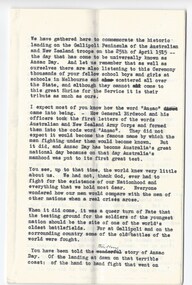
... We had not, thank God, ever had to fight for the existence of our Nationhood and everything we hold most dear. Everyone wondered how our men would compare with the men of other nations when a real crises arose. . . . ...We had not, thank God, ever had to fight for the existence of our Nationhood and everything we hold most dear. Everyone wondered how our men would compare with the men of other nations when a real crises arose. . . . ...A copy of an Anzac Day Address at the Anzac Commemoration Ceremony for Students, the year is unknown but it is presumably the address given by the President of Legacy. It seems to be one of the earlier ceremonies. It was stored with documents about the building of the Shrine and another speech from the 1939 service. The presenter had probably served in World War 1 so was very close to the events he was talking about. The ceremony provides a valuable opportunity for students to gain an appreciation of the Anzac spirit, the significance of the Shrine and the meaning of Anzac Day. The ceremony is usually attended by representatives from schools throughout the state and the Governor of Victoria. The text says: 'We have gathered here too commemorate the historic landing on the Gallipoli Peninsula of the Australian and New Zealand troops on the 25th of April 1915 - the day that has come to be universally known as Anzac Day. . . I expect most of you know how the word 'Anzac' came into being. How General Birdwood and his officers took the first letters of the words Australian and New Zealand Army Corps and formed them into the code word "Anzac". They did not expect it would become the famous name by which the men fighting under them would become known. But it did, and Anzac Day has become Australia's greatest national day because on that day Australia's manhood was put to its first great test. You see up to that that time, the world knew very little about us. We had not, thank God, ever had to fight for the existence of our Nationhood and everything we hold most dear. Everyone wondered how our men would compare with the men of other nations when a real crises arose. . . . You have been told there thrilling story of Anzac Day. Of the landing at dawn on that terrible coast: the hand to hand fighting that went on continuously all that day and through the days and nights that followed. How the Anzacs - outnumbered, exhausted and tortured by thirst held on, and how during the terrible nine months that ensued all the efforts of a brave enemy to dislodge them failed. Such was their gallantry that a British Officer described the Australian soldier as "The bravest thing God ever made". What a wonderful tribute that was; and how proud we should be of the men who earned it. . . . These men carried on all the traditions of the Anzacs and made a wonderful name for Australia and New Zealand in France, in Belgium, in Egypt and Palestine and in all the theatres of war in which they served. And this great Shrine was build by the people of Victoria, not in any boastful sense of Victory, not in any attempt to glorify war - which is a horrible, dreadful thing, but in memory of those thousands of Victorian sailors and soldiers who so loved their country that they laid down their lives in her service. . . All of them were brave, but do not think that a soldier who is brave need alway be a great warrior. I hope when you have passed through the Shrine you will go and see a little bronze statue near the road yonder. A statue of a man leading a donkey which carries a wounded comrade. You will see the soldier leading the donkey carries no weapons. Yet he was a hero indeed, for he saved the lives of scores of his comrades at Anzac by carrying wounded from the battle to safety and the hospital. And in the end he too gave his life for his friends. . . Let us all try to help each other in peace as they did in war. Instead of divisions, let us have unity. If we think of no one but ourselves we shall not achieve anything nor shall we deserve to. Let those of you who are strong help those who are not so strong - all through life - like John Simpson, the man with the donkey did. Be proud of your country and do nothing to dishonour it. If you get an order from one in authority, obey it, even if you do not understand it.A good solider always obeys his orders. If he did not, he may bring disaster and cause harm to his fellow soldiers. Remember that those thousands of men died so that we could still live here in freedom. A country is judged by its citizens. Let us be worthy of those great citizens who have left us the legacy of their fame and devotion to duty. And when you file through the Shrine and look down on the Rock of Remembrance, read the inscription on it, "Greater Love Hath No Man", remember those wonderful words written in the greatest book in the world nearly two thousand years ago, "Greater love hath no man than this, that a man lay down his life for his friend."A record of a ceremony at the Shrine for school students. The text of the speech is significant in that it was written by a man who had served in World War 1 and knew first hand what it meant to be part of the first Anzacs. White quarto paper x 4 pages with black type of a speech at one of the Annual Anzac Commemoration Service for Students.Handwritten in blue pen 'Shrine, Children's Service'anzac commemoration for students, wreath laying ceremony, speech -
 Melbourne Legacy
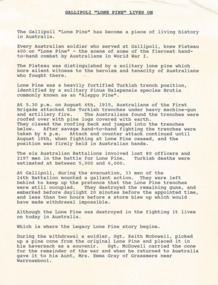
Document, Gallipoli's 'Lone Pine' Lives On
... Presentations are made to schools, ex-service organisations and interested bodies by Legacy Clubs in the hope that they will be cherished as a symbol of Australian nationhood and of its just pride, devotion, courage, selflessness and sense of service to others...Presentations are made to schools, ex-service organisations and interested bodies by Legacy Clubs in the hope that they will be cherished as a symbol of Australian nationhood and of its just pride, devotion, courage, selflessness and sense of service to others. " The Legacy Lone Pine program helped promote the Anzac story throughout Australia. lone pine gallipoli White A4 paper with black type x 3 pages recounting the story of Legacy's propagation of Lone Pine seedlings. ...A detailed account of the story of Lone Pine in Gallipoli and how seedlings were grown from a pine cone brought back by Sgt. Keith McDowell. The author and date of this account is not known but was post 1989. The text says: " Gallipoli Lone Pine Lives On The Gallipoli Lone Pine has become a piece of living history in Australia. Every Australian solider who served at Gallipoli, knew Plateau 400 or ‘Lone Pine’ – the scene of some of the fiercest hand-to-hand combat by Australian in World War 1. The Plateau was distinguished by a solitary lone pine which bore silent witness to the heroism and tenacity of Australians who fought there. Lone Pine was a heavily fortified Turkish trench position, identified by a solitary Pinus Halepensis species commonly known as an ‘Aleppo Pine’. (** NB this has since been corrected and the species is not an 'Aleppo pine' but Pinus Brutia, commonly called Turkish pine) At 5.30 pm on August 6th, 1915, Australians of the First Brigade attacked the Turkish trenches under heavy machine-gun and artillery fire. The Australians found the trenches were roofed over with pine logs covered with earth. They clawed the roofing back and jumped into the trenches below. After savage hand-to-hand fighting the trenches were taken by 6 pm. Attack and counter attack continued until August 10, when fighting at Lone Pine ceased, and the position as firmly held in Australian hands. The six Australian Battalions involved lost 80 officers and 2197 men in the battle for Lone Pine. Turkish deaths were estimated at between 5,000 and 6,000. At Gallipoli during the evacuation, 33 men of the 24th Battalion mounted a gallant action. They were left behind to keep up the pretence that the Lone Pine trenches were still occupied. They destroyed the remaining guns, and embarked before daylight 20 minutes before the appointed time, and less than two hours before a storm blew up which would have made withdrawal impossible. Although the Lone Pine was destroyed in the fighting it lives on today in Australia. Which is where the Legacy Lone Pine story begins. During the withdrawal a soldier, Sgt. Keith McDowell, picked up a pine cone from the original Lone Pine and placed it in his haversack as a souvenir. Sgt. McDowell carried the cone for the remainder of the war and when he returned to Australia gave it to his Aunt, Mrs Emma Gray of Grassmere near Warrnambool. “Here Aunty, you’ve got a green thumb, see if you can grow something out of this”, the late Mrs Gray’s son, Alexander, recalled. But it wasn’t until some 12 years later that Mrs Gray planted the few seeds from the cone, five of which sprouted and grew into little trees. One of the pines eventually died but the remaining four survived. In May, 1933, one was planted in Wattle Park on the occasion of the Trooping of the Colour by the 24th Battalion. On the 11th June 1933, the second tree was planted with full military honours by S G Savige of the 24th Battalion, at the Shrine of Remembrance in Melbourne, where it now shades the well-loved statue of Simpson and his donkey. The late Lieutenant-General Sir Stanley Savige KBE, CB, DSO, MC, ED, was the founder of Melbourne Legacy. Formed in 1923, the Melbourne Legacy Club was the first such Club to be established. On the 18 June 1933 the third tree was planted at the Sisters, near Terang, just north east of Warrnambool. This is the area Mrs Gray’s family lived and the home of several Gallipoli veterans. The fourth tree was planted in the Warrnambool Gardens on 23 January 1934. In 1964 Legatee Tom Griffiths, then President of Warrnambool Legacy, put forward the idea that more seedlings should be raised in the Jubilee Year of Gallipoli from the established trees with the object of planting memorial trees throughout Australia in memory of those who fell in action at Lone Pine in 1915. The project was outlined in a paper presented to the Perth Conference in 1965 and was strongly supported. Two batches of cones were sent to Melbourne, one from the tree at ‘The Sisters’ and another from the tree at the Warrnambool Gardens, and the full cooperation of the (then) Forests Commission of Victoria, was guaranteed by the Chief Commissioner, Mr Benallack. Unfortunately, these cones had been gathered too late as the seeds had already been cast, and the few seeds that survived failed to germinate. However, Melbourne Legacy then undertook the propagation and distribution of seedlings. With the assistance of the Shrine of Remembrance Trustees, permission was granted by the Melbourne City Parks and gardens Curator to harvest a limited number of cones from the 24th Battalion tree at the Shrine and these were gathered by the Forest Commission and after the necessary preparatory treatment were planted in the Commission’s nursery at Macedon. Approximately 150 seedlings were raised from these cones by Dr Grose, Director and Silviculture. Melbourne Legacy’s Commemoration Committee was responsible for the collection, propagation, presentation and dedication of Lone Pines from the 24th Battalion tree at the Shrine of Remembrance. One the 14 September 1989 further cones were collected with the hope to raise 1000 trees from the seeds. This could not have been done without the invaluable assistance of the Department of Natural Resources and Dr Peter May at the Victorian College of Agriculture and Horticulture in Richmond, Victoria. Thus, Legacy is helping to keep the memory of the Gallipoli ‘Lone Pine’ alive – its spirit living on today. Presentations are made to schools, ex-service organisations and interested bodies by Legacy Clubs in the hope that they will be cherished as a symbol of Australian nationhood and of its just pride, devotion, courage, selflessness and sense of service to others. "The Legacy Lone Pine program helped promote the Anzac story throughout Australia.White A4 paper with black type x 3 pages recounting the story of Legacy's propagation of Lone Pine seedlings. lone pine, gallipoli -
 Monbulk RSL Sub Branch
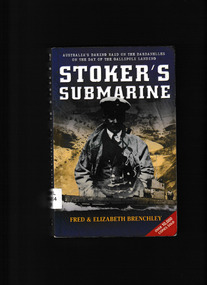
Book, Harper Collins et al, Stoker's submarine, 2003
... And the AE2 itself, still lying intact on the floor of the Sea of Marmara, is celebrated as the most tangible relic of Australia's role at Gallipoli, the crucible of nationhood. Index, bibliography, notes, ill. (some col.), maps, ports, p.318. ...On 25 April 1915 - the day the Anzacs landed at Gallipoli - Lieutenant Commander Dacre Stoker set out as captain of the Australian submarine AE2 on a mission to breach the treacherous Dardanelles Strait with the intention of disrupting Turkish supply lines to the isolated Gallipoli peninsula. Facing dangerous currents, mines and withering enemy fire, Stoker and his men succeeded where British and French submarines had come to grief." "Stoker's achievement meant much in military terms, and even more emotionally in boosting the morale of embattled Allied troops. But what was proclaimed at the time as 'the finest feat in submarine history' has since sunk into oblivion. Few Australians even know their country had a submarine at Gallipoli, much less that it achieved daring feats, sank an enemy craft, and possibly played a pivotal role in Anzac troops staying on the beachhead for eight months." "Now, finally, Stoker's Submarine tells the story of a remarkable naval hero and the men under his command. And the AE2 itself, still lying intact on the floor of the Sea of Marmara, is celebrated as the most tangible relic of Australia's role at Gallipoli, the crucible of nationhood.Index, bibliography, notes, ill. (some col.), maps, ports, p.318.non-fictionOn 25 April 1915 - the day the Anzacs landed at Gallipoli - Lieutenant Commander Dacre Stoker set out as captain of the Australian submarine AE2 on a mission to breach the treacherous Dardanelles Strait with the intention of disrupting Turkish supply lines to the isolated Gallipoli peninsula. Facing dangerous currents, mines and withering enemy fire, Stoker and his men succeeded where British and French submarines had come to grief." "Stoker's achievement meant much in military terms, and even more emotionally in boosting the morale of embattled Allied troops. But what was proclaimed at the time as 'the finest feat in submarine history' has since sunk into oblivion. Few Australians even know their country had a submarine at Gallipoli, much less that it achieved daring feats, sank an enemy craft, and possibly played a pivotal role in Anzac troops staying on the beachhead for eight months." "Now, finally, Stoker's Submarine tells the story of a remarkable naval hero and the men under his command. And the AE2 itself, still lying intact on the floor of the Sea of Marmara, is celebrated as the most tangible relic of Australia's role at Gallipoli, the crucible of nationhood.world war 1914-1918 - campaigns - gallipoli, gallipoli campaign - naval operations, submarine ae2 -
 Monbulk RSL Sub Branch
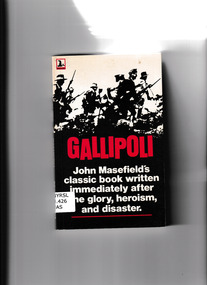
Book, John Masefield, Gallipoli, 1978
... It was to be Australia's test of nationhood. The Allied soldiers landed in the dark, crossing beaches tangled with barbed wire, passing mines and scaled the precipitous cliffs under machine-gun fire. ...The Gallipoli campaign began one fateful Sunday morning in April 1915. It was to be Australia's test of nationhood. The Allied soldiers landed in the dark, crossing beaches tangled with barbed wire, passing mines and scaled the precipitous cliffs under machine-gun fire. An intense five-month campaign ensued, the lines so close that there was no respite from battle. With access to military documents, the poet John Masefield published this moving account of the Allied efforts in the Dardanelles less than a year after the defeat. The book was a huge success, as it gave glory to the bravery and determination of the young men who endured heat, toil, thirst, disease and pestilence but were always ready and willing to die in exultation for their cause.. Moving account of the Allied efforts in Dardanelles after the defeat.Ill, map, p.183non-fictionThe Gallipoli campaign began one fateful Sunday morning in April 1915. It was to be Australia's test of nationhood. The Allied soldiers landed in the dark, crossing beaches tangled with barbed wire, passing mines and scaled the precipitous cliffs under machine-gun fire. An intense five-month campaign ensued, the lines so close that there was no respite from battle. With access to military documents, the poet John Masefield published this moving account of the Allied efforts in the Dardanelles less than a year after the defeat. The book was a huge success, as it gave glory to the bravery and determination of the young men who endured heat, toil, thirst, disease and pestilence but were always ready and willing to die in exultation for their cause.. Moving account of the Allied efforts in Dardanelles after the defeat. world war 1914-1918 - campaigns - gallipoli, anzac corps -
 Mrs Aeneas Gunn Memorial Library
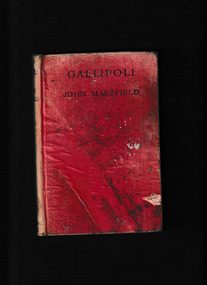
Book, John Masefield, Gallipoli, 1916
... It was to be Australia's test of nationhood. The Allied soldiers landed in the dark, crossing beaches tangled with barbed wire, passing mines and scaled the precipitous cliffs under machine-gun fire. ...The Gallipoli campaign began one fateful Sunday morning in April 1915. It was to be Australia's test of nationhood. The Allied soldiers landed in the dark, crossing beaches tangled with barbed wire, passing mines and scaled the precipitous cliffs under machine-gun fire. An intense five-month campaign ensued, the lines so close that there was no respite from battle. With access to military documents, the poet John Masefield published this moving account of the Allied efforts in the Dardanelles less than a year after the defeat. The book was a huge success, as it gave glory to the bravery and determination of the young men who endured heat, toil, thirst, disease and pestilence but were always ready and willing to die in exultation for their cause.. Moving account of the Allied efforts in Dardanelles after the defeat.Ill, maps, p.183.non-fictionThe Gallipoli campaign began one fateful Sunday morning in April 1915. It was to be Australia's test of nationhood. The Allied soldiers landed in the dark, crossing beaches tangled with barbed wire, passing mines and scaled the precipitous cliffs under machine-gun fire. An intense five-month campaign ensued, the lines so close that there was no respite from battle. With access to military documents, the poet John Masefield published this moving account of the Allied efforts in the Dardanelles less than a year after the defeat. The book was a huge success, as it gave glory to the bravery and determination of the young men who endured heat, toil, thirst, disease and pestilence but were always ready and willing to die in exultation for their cause.. Moving account of the Allied efforts in Dardanelles after the defeat. world war 1914-1918 -campaigns - gallipoli, world war - campaigns - dardenalles.
