
Showing 155 items matching " north western victoria"
-
 Victorian Aboriginal Corporation for Languages
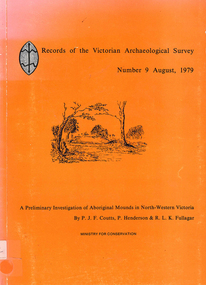
Book, PJF Coutts et al, Records of the Victorian Archaeological Survey : number 9, August 1979 : a preliminary investigation of Aboriginal mounds in North-Western Victoria, 1979
... Records of the Victorian Archaeological Survey : number 9, August 1979 : a preliminary investigation of Aboriginal mounds in North-Western Victoria...Victoria Archaeological Survey Murray Valley Grampians Maps, charts, graphs, b&w photographs, diagrams Records of the Victorian Archaeological Survey : number 9, August 1979 : a preliminary investigation of Aboriginal mounds in North-Western Victoria Book PJF Coutts P Henderson ...Maps, charts, graphs, b&w photographs, diagramsvictoria archaeological survey, murray valley, grampians -
 Musculoskeletal Health Australia (now held by the Glen Eira Historical Society)
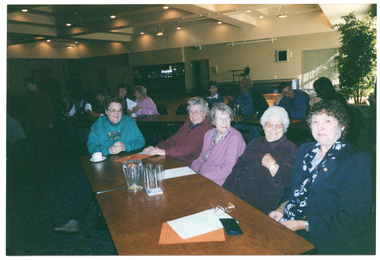
Photograph - Group photo, 12/07/2002
... ... north western victoria...From the 12th to 13th of July 2002, Arthritis Victoria (AV) held a Health Professionals and Consumers Seminar and a Health Professionals' Dinner in Robinvale (north western Victoria) as part of its Rural And Regional Education (RARE) Program. ...From the 12th to 13th of July 2002, Arthritis Victoria (AV) held a Health Professionals and Consumers Seminar and a Health Professionals' Dinner in Robinvale (north western Victoria) as part of its Rural And Regional Education (RARE) Program. ...From the 12th to 13th of July 2002, Arthritis Victoria (AV) held a Health Professionals and Consumers Seminar and a Health Professionals' Dinner in Robinvale (north western Victoria) as part of its Rural And Regional Education (RARE) Program. The keynote speaker was Rheumatologist, Dr Mano Thevathasan (Victorian President, Australian Rheumatology Association). There were also presentations made by Arthritis Victoria's Education and Services staff. This photo depicts a group of seminar attendees at their table.COL photo of numerous people seated at long rectangular tables in a large room. In the foreground, four women are seated at one of the tables. On top of the table, there are a jug and some glasses, a cup and saucer, some orange and some white papers, a pen, and some spectacles with their case.[On a yellow sticky note, handwritten in black ink] Consumers at the Robinvale Community Seminar July 2002arthritis foundation of victoria, afv, osteoporosis victoria, ov, arthritis victoria, av, rural and regional education, rare, outreach, health professionals and consumers seminar, attendees, robinvale, north western victoria, 2002 -
 Musculoskeletal Health Australia (now held by the Glen Eira Historical Society)
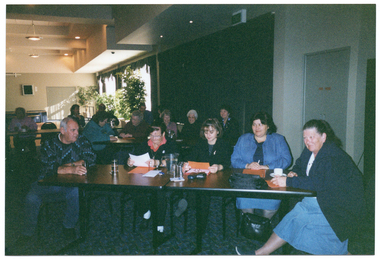
Photograph - Group photo, 12/07/2002
... ... north western victoria...From the 12th to 13th of July 2002, Arthritis Victoria (AV) held a Health Professionals and Consumers Seminar and a Health Professionals' Dinner in Robinvale (north western Victoria) as part of its Rural And Regional Education (RARE) Program. ...From the 12th to 13th of July 2002, Arthritis Victoria (AV) held a Health Professionals and Consumers Seminar and a Health Professionals' Dinner in Robinvale (north western Victoria) as part of its Rural And Regional Education (RARE) Program. ...From the 12th to 13th of July 2002, Arthritis Victoria (AV) held a Health Professionals and Consumers Seminar and a Health Professionals' Dinner in Robinvale (north western Victoria) as part of its Rural And Regional Education (RARE) Program. The keynote speaker was Rheumatologist, Dr Mano Thevathasan (Victorian President, Australian Rheumatology Association). There were also presentations made by Arthritis Victoria's Education and Services staff. This photo depicts a small group seminar attendees at their table.COL photo of numerous people seated at long rectangular tables in a large room. In the foreground, five people are seated at one of the tables. On top of the table, there are a jug and some glasses, a cup and saucer, some orange and some white papers, some spectacles with their cases, and a black shoulder bag. There is another black shoulder bag under the table.arthritis foundation of victoria, afv, osteoporosis victoria, ov, arthritis victoria, av, rural and regional education, rare, outreach, health professionals and consumers seminar, attendees, robinvale, north western victoria, 2002 -
 Musculoskeletal Health Australia (now held by the Glen Eira Historical Society)
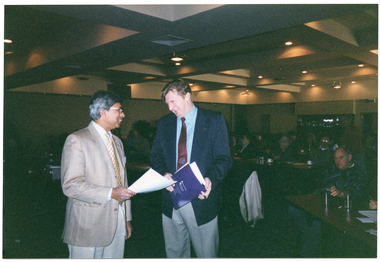
Photograph - Group photo, 12/07/2002
... ... north western victoria...From the 12th to 13th of July 2002, Arthritis Victoria (AV) held a Health Professionals and Consumers Seminar and a Health Professionals' Dinner in Robinvale (north western Victoria) as part of its Rural And Regional Education (RARE) Program. ...From the 12th to 13th of July 2002, Arthritis Victoria (AV) held a Health Professionals and Consumers Seminar and a Health Professionals' Dinner in Robinvale (north western Victoria) as part of its Rural And Regional Education (RARE) Program. ...From the 12th to 13th of July 2002, Arthritis Victoria (AV) held a Health Professionals and Consumers Seminar and a Health Professionals' Dinner in Robinvale (north western Victoria) as part of its Rural And Regional Education (RARE) Program. The keynote speaker was Rheumatologist, Dr Mano Thevathasan (Victorian President, Australian Rheumatology Association). There were also presentations made by Arthritis Victoria's Education and Services staff. This photo depicts Dr Thevathasan and CEO of Robinvale Health Service, Graem Kelly, at the Community Seminar.COL photo of two men standing next to one another, chatting. One of the men is holding some papers, while the other is holding a blue printed booklet or program. In the background, numerous people are seated at tables in a large dark room. Several downlights in the ceiling are evident.[On a yellow sticky note, handwritten in black ink] Dr. Mano Thevathasan Rheumatologist & Graem Kelly - CEO Robinvale Health Service at The community seminar Robinvale July 2002arthritis foundation of victoria, afv, osteoporosis victoria, ov, arthritis victoria, av, rural and regional education, rare, outreach, health professionals and consumers seminar, dr mano thevathasanm, rheumatologist, australian rheumatology association victorian president, keynote speaker, graem kelly, ceo, robinvale regional health service, robinvale, north western victoria, 2002 -
 Musculoskeletal Health Australia (now held by the Glen Eira Historical Society)
Photograph - Group photo, 12/07/2002
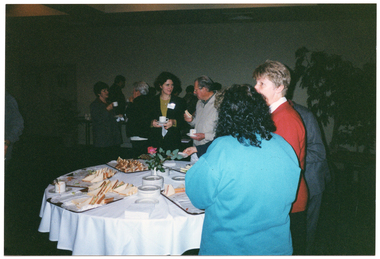
... ... north western victoria...From the 12th to 13th of July 2002, Arthritis Victoria (AV) held a Health Professionals and Consumers Seminar and a Health Professionals' Dinner in Robinvale (north western Victoria) as part of its Rural And Regional Education (RARE) Program. ...From the 12th to 13th of July 2002, Arthritis Victoria (AV) held a Health Professionals and Consumers Seminar and a Health Professionals' Dinner in Robinvale (north western Victoria) as part of its Rural And Regional Education (RARE) Program. ...From the 12th to 13th of July 2002, Arthritis Victoria (AV) held a Health Professionals and Consumers Seminar and a Health Professionals' Dinner in Robinvale (north western Victoria) as part of its Rural And Regional Education (RARE) Program. The keynote speaker was Rheumatologist, Dr Mano Thevathasan (Victorian President, Australian Rheumatology Association). There were also presentations made by Arthritis Victoria's Education and Services staff. This photo depicts both speakers and seminar attendees enjoying some refreshments.COL photo of a large group of people gathered around a room. In the foreground, several people are standing around a round table, on which there are platters of sandwiches, several stacks of small plates, paper napkins, a coffee cup and saucer, and a pink rose inside a small vase. In the background, there are people chatting to one another while holding cups and saucers.arthritis foundation of victoria, afv, osteoporosis victoria, ov, arthritis victoria, av, rural and regional education, rare, outreach, health professionals and consumers seminar, speakers, attendees, refreshments, sandwiches, food platters, robinvale, north western victoria, 2002 -
 Musculoskeletal Health Australia (now held by the Glen Eira Historical Society)
Photograph - Group photo, 12/07/2002
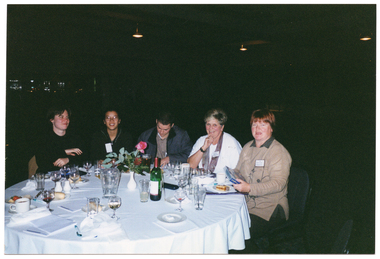
... ... north western victoria...From the 12th to 13th of July 2002, Arthritis Victoria (AV) held a Health Professionals and Consumers Seminar and a Health Professionals' Dinner in Robinvale (north western Victoria) as part of its Rural And Regional Education (RARE) Program. ...From the 12th to 13th of July 2002, Arthritis Victoria (AV) held a Health Professionals and Consumers Seminar and a Health Professionals' Dinner in Robinvale (north western Victoria) as part of its Rural And Regional Education (RARE) Program. ...From the 12th to 13th of July 2002, Arthritis Victoria (AV) held a Health Professionals and Consumers Seminar and a Health Professionals' Dinner in Robinvale (north western Victoria) as part of its Rural And Regional Education (RARE) Program. The keynote speaker was Rheumatologist, Dr Mano Thevathasan (Victorian President, Australian Rheumatology Association). There were also presentations made by Arthritis Victoria's Education and Services staff. This photo depicts a small group of people seated at their table at the Health Professionals Dinner.Colour photo of five people seated at a large round dinner table. On the table, there is a bottle of wine, a glass jug, wine and juice glasses, some food on small plates, printed booklets and pens, and a video cassette in its plastic case. The background is dark, except for a few downlights hanging from the ceiling.[On a violet blue sticky note, handwritten in black ink] Health Professional Dinner at Robinvale July 2002arthritis foundation of victoria, afv, osteoporosis victoria, ov, arthritis victoria, av, rural and regional education, rare, outreach, health professionals dinner, robinvale, north western victoria, 2002 -
 Musculoskeletal Health Australia (now held by the Glen Eira Historical Society)
Photograph - Group photo, 12/07/2002
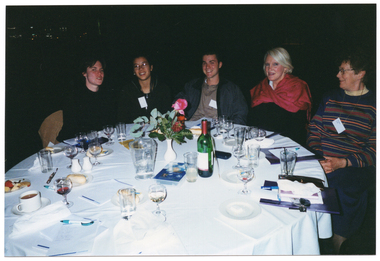
... ... north western victoria...From the 12th to 13th of July 2002, Arthritis Victoria (AV) held a Health Professionals and Consumers Seminar and a Health Professionals' Dinner in Robinvale (north western Victoria) as part of its Rural And Regional Education (RARE) Program. ...From the 12th to 13th of July 2002, Arthritis Victoria (AV) held a Health Professionals and Consumers Seminar and a Health Professionals' Dinner in Robinvale (north western Victoria) as part of its Rural And Regional Education (RARE) Program. ...From the 12th to 13th of July 2002, Arthritis Victoria (AV) held a Health Professionals and Consumers Seminar and a Health Professionals' Dinner in Robinvale (north western Victoria) as part of its Rural And Regional Education (RARE) Program. The keynote speaker was Rheumatologist, Dr Mano Thevathasan (Victorian President, Australian Rheumatology Association). There were also presentations made by Arthritis Victoria's Education and Services staff. This photo depicts a small group of people seated at their table at the Health Professionals Dinner.Colour photo of five people seated at a large round dinner table. On the table, there is a bottle of wine, a glass jug, wine and juice glasses, some food on small plates, printed booklets and pens, and a video cassette in its plastic case. The background is dark.[On a yellow sticky note, handwritten in black ink] Health Professionals & Mrs. Thevathasan 2nd R . ['R' is circled] at the Health Professional July 2002arthritis foundation of victoria, afv, osteoporosis victoria, ov, arthritis victoria, av, rural and regional education, rare, outreach, health professionals dinner, robinvale, north western victoria, 2002 -
 Musculoskeletal Health Australia (now held by the Glen Eira Historical Society)
Photograph - Group photo, 12/07/2002
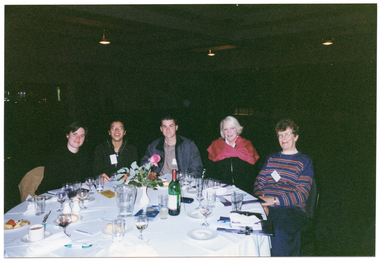
... ... north western victoria...From the 12th to 13th of July 2002, Arthritis Victoria (AV) held a Health Professionals and Consumers Seminar and a Health Professionals' Dinner in Robinvale (north western Victoria) as part of its Rural And Regional Education (RARE) Program. ...From the 12th to 13th of July 2002, Arthritis Victoria (AV) held a Health Professionals and Consumers Seminar and a Health Professionals' Dinner in Robinvale (north western Victoria) as part of its Rural And Regional Education (RARE) Program. ...From the 12th to 13th of July 2002, Arthritis Victoria (AV) held a Health Professionals and Consumers Seminar and a Health Professionals' Dinner in Robinvale (north western Victoria) as part of its Rural And Regional Education (RARE) Program. The keynote speaker was Rheumatologist, Dr Mano Thevathasan (Victorian President, Australian Rheumatology Association). There were also presentations made by Arthritis Victoria's Education and Services staff. This photo depicts a small group of people seated at their table at the Health Professionals Dinner.Colour photo of five people seated at a large round dinner table. On the table, there is a bottle of wine, a glass jug, wine and juice glasses, some food on small plates, printed booklets and pens, and a video cassette in its plastic case. The background is dark, except for a few downlights hanging from the ceiling.[On a violet blue sticky note, handwritten in black ink] Health Professional Dinner Robinvale July 2002arthritis foundation of victoria, afv, osteoporosis victoria, ov, arthritis victoria, av, rural and regional education, rare, outreach, health professionals dinner, robinvale, north western victoria, 2002 -
 Musculoskeletal Health Australia (now held by the Glen Eira Historical Society)
Photograph - Group photo, 12/07/2002
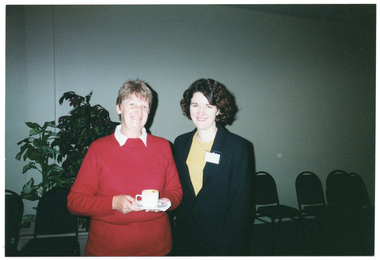
... ... north western victoria...From the 12th to 13th of July 2002, Arthritis Victoria (AV) held a Health Professionals and Consumers Seminar and a Health Professionals' Dinner in Robinvale (north western Victoria) as part of its Rural And Regional Education (RARE) Program. ...From the 12th to 13th of July 2002, Arthritis Victoria (AV) held a Health Professionals and Consumers Seminar and a Health Professionals' Dinner in Robinvale (north western Victoria) as part of its Rural And Regional Education (RARE) Program. ...From the 12th to 13th of July 2002, Arthritis Victoria (AV) held a Health Professionals and Consumers Seminar and a Health Professionals' Dinner in Robinvale (north western Victoria) as part of its Rural And Regional Education (RARE) Program. The keynote speaker was Rheumatologist, Dr Mano Thevathasan (Victorian President, Australian Rheumatology Association). There were also presentations made by Arthritis Victoria's Education and Services staff. This photo depicts Robinvale Regional Health Service physiotherapist, Judy Lee, and AV's Liz Bongetti having some refreshments and a chat.COL photo of two women standing next to one another, smiling. One of the women is holding a cup and saucer in her hands. Behind them, there is a row of chairs against the wall, and a large potted plant.[On a yellow sticky note, handwritten in black ink] Judy Lee physio - Robinvale Liz Bongetti Community Seminar July 2002arthritis foundation of victoria, afv, osteoporosis victoria, ov, arthritis victoria, av, rural and regional education, rare, outreach, health professionals and consumers seminar, judy lee, physiotherapist, robinvale regional health service, robinvale, north western victoria, 2002 -
 Musculoskeletal Health Australia (now held by the Glen Eira Historical Society)
Photograph - Group photo, 12/07/2002
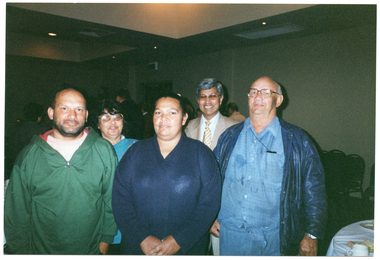
... ... north western victoria...From the 12th to 13th of July 2002, Arthritis Victoria (AV) held a Health Professionals and Consumers Seminar and a Health Professionals' Dinner in Robinvale (north western Victoria) as part of its Rural And Regional Education (RARE) Program. ...From the 12th to 13th of July 2002, Arthritis Victoria (AV) held a Health Professionals and Consumers Seminar and a Health Professionals' Dinner in Robinvale (north western Victoria) as part of its Rural And Regional Education (RARE) Program. ...From the 12th to 13th of July 2002, Arthritis Victoria (AV) held a Health Professionals and Consumers Seminar and a Health Professionals' Dinner in Robinvale (north western Victoria) as part of its Rural And Regional Education (RARE) Program. The keynote speaker was Rheumatologist, Dr Mano Thevathasan (Victorian President, Australian Rheumatology Association). There were also presentations made by Arthritis Victoria's Education and Services staff. In this photo, a small group of people pose for a photo at the seminar. A slightly cropped version of the photo appears on page 17 of the Vol 15 Issue 3, Spring 2002 edition of the Arthritis Foundation of Victoria's quarterly magazine, Update. It is captioned: "ARA Victorian President and keynote speaker at the Robinvale Community seminar, Dr Mano Thevathasan (back right) with members of the Murray Valley Aboriginal Health Co-Operative."COL photo of a small group of people standing in a crowded room. They are facing the camera. Numerous other people, tables, and chairs are evident in the background.arthritis foundation of victoria, afv, osteoporosis victoria, ov, arthritis victoria, av, rural and regional education, rare, outreach, health professionals and consumers seminar, dr mano thevathasanm, rheumatologist, australian rheumatology association victorian president, keynote speaker, murray valley aboriginal health cooperative, robinvale, north western victoria, 2002 -
 Musculoskeletal Health Australia (now held by the Glen Eira Historical Society)
Photograph - Group photo, 12/07/2002
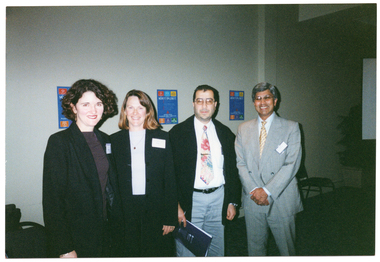
... ... north western victoria...From the 12th to 13th of July 2002, Arthritis Victoria (AV) held a Health Professionals and Consumers Seminar and a Health Professionals' Dinner in Robinvale (north western Victoria) as part of its Rural And Regional Education (RARE) Program. ...From the 12th to 13th of July 2002, Arthritis Victoria (AV) held a Health Professionals and Consumers Seminar and a Health Professionals' Dinner in Robinvale (north western Victoria) as part of its Rural And Regional Education (RARE) Program. ...From the 12th to 13th of July 2002, Arthritis Victoria (AV) held a Health Professionals and Consumers Seminar and a Health Professionals' Dinner in Robinvale (north western Victoria) as part of its Rural And Regional Education (RARE) Program. The keynote speaker was Rheumatologist, Dr Mano Thevathasan (Victorian President, Australian Rheumatology Association). There were also presentations made by Arthritis Victoria's Education and Services staff. This photo depicts four people posing for a photo at the seminar. A slightly cropped version of the photo appears on page 17 of the Vol 15 Issue 3, Spring 2002 edition of the Arthritis Foundation of Victoria's quarterly magazine, Update. It is captioned: "(Left to right) SMU's Lisa [sic] Bongetti, Robinvale DHS nurse Kris Hogg, Dr Emad Hanna and Dr Mano Thevasathan." Note: Liz (not Lisa) Bongetti was an AV staff member.COL photo of four people standing next to one another in a row. In the background, there are some chairs and several 'Move It Or Lose It' posters on the wall behind them.arthritis foundation of victoria, afv, osteoporosis victoria, ov, arthritis victoria, av, rural and regional education, rare, outreach, health professionals and consumers seminar, liz bongetti, kris hogg, robinvale dhs nurse, dr emad hanna, dr mano thevathasanm, rheumatologist, australian rheumatology association victorian president, keynote speaker, robinvale, north western victoria, 2002 -
 Musculoskeletal Health Australia (now held by the Glen Eira Historical Society)
Photograph - Group photo, 12/07/2002
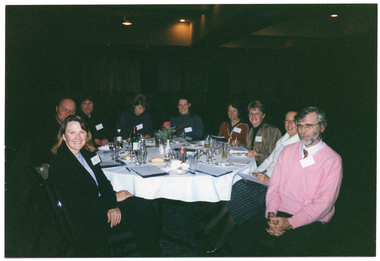
... ... north western victoria...From the 12th to 13th of July 2002, Arthritis Victoria (AV) held a Health Professionals and Consumers Seminar and a Health Professionals' Dinner in Robinvale (north western Victoria) as part of its Rural And Regional Education (RARE) Program. ...From the 12th to 13th of July 2002, Arthritis Victoria (AV) held a Health Professionals and Consumers Seminar and a Health Professionals' Dinner in Robinvale (north western Victoria) as part of its Rural And Regional Education (RARE) Program. ...From the 12th to 13th of July 2002, Arthritis Victoria (AV) held a Health Professionals and Consumers Seminar and a Health Professionals' Dinner in Robinvale (north western Victoria) as part of its Rural And Regional Education (RARE) Program. The keynote speaker was Rheumatologist, Dr Mano Thevathasan (Victorian President, Australian Rheumatology Association). There were also presentations made by Arthritis Victoria's Education and Services staff. This photo depicts a group of people seated at their table at the Health Professionals Dinner, including Robinvale DHS nurse, Kris Hogg, on the far left. Note: the Post-It note on the verso of another Photograph (Collection Item number 0794C - relating to a Health Professionals’ Seminar in Orbost, in October of the same year) was incorrectly affixed to that photo. The note should have been attached to the verso of this photo (Collection Item number 0810).Colour photo of nine people, seated at a large round dinner table. On the table, there is a bottle of wine, wine and juice glasses, a bottle and a can of soft drink, printed booklets and pens, and a video cassette in its plastic case. The background is dark, except for a few downlights hanging from the ceiling.arthritis foundation of victoria, afv, osteoporosis victoria, ov, arthritis victoria, av, rural and regional education, rare, outreach, health professionals dinner, kris hogg, robinvale dhs nurse, robinvale, north western victoria, 2002 -
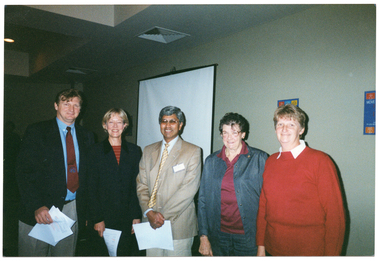 Musculoskeletal Health Australia (now held by the Glen Eira Historical Society)
Photograph - Group photo, 12/07/2002
... ... north western victoria...From the 12th to 13th of July 2002, Arthritis Victoria (AV) held a Health Professionals and Consumers Seminar and a Health Professionals' Dinner in Robinvale (north western Victoria) as part of its Rural And Regional Education (RARE) Program. ...From the 12th to 13th of July 2002, Arthritis Victoria (AV) held a Health Professionals and Consumers Seminar and a Health Professionals' Dinner in Robinvale (north western Victoria) as part of its Rural And Regional Education (RARE) Program. ...From the 12th to 13th of July 2002, Arthritis Victoria (AV) held a Health Professionals and Consumers Seminar and a Health Professionals' Dinner in Robinvale (north western Victoria) as part of its Rural And Regional Education (RARE) Program. The keynote speaker was Rheumatologist, Dr Mano Thevathasan (Victorian President, Australian Rheumatology Association). There were also presentations made by Arthritis Victoria's Education and Services staff. This photo depicts (from left to right) Graem Kelly (CEO Robinvale Regional Health Service), Helen Stead (Arthritis Victoria), keynote speaker Dr Mano Thevathasan, Shirley Irvine (Robinvale Arthritis Self Help Group), and Judy Lee (Physiotherapist, Robinvale Regional Health Service). A similar photo, (depicting only three people from this group), appears on page 17 of the Vol 15 Issue 3, Spring 2002 edition of the Arthritis Foundation of Victoria's quarterly magazine, Update. It is captioned: "(Left to right) Mr Graem Kelly CEO Robinvale District Community, SMU's Helen Stead, Dr Mano Thevathasan." In the accompanying article, it is stated that Graem Kelly is the CEO of the Robinvale District Health Service.COL photo of five people, standing next to one another in a row. Three of them are holding some papers in their hands. In the background, there is a slide projector screen on a stand and some posters on the wall.[On a yellow sticky note, handwritten in black ink] L to R. Robinvale Community Seminar July 2002 Graham ["Graham" is crossed out] Graem Kelly - CEO Robinvale Regional Health Service, Heal ["Heal" is crossed out] Helen Stead - AV Dr. Mano Thevathasan Rheumatologist ARA President (Vic Branch) Shirley Irvine - Robinvale Arthritis S. Help Group. Judy Lee - physio Robinvale Healtharthritis foundation of victoria, afv, osteoporosis victoria, ov, arthritis victoria, av, rural and regional education, rare, outreach, health professionals and consumers seminar, graem kelly, ceo, robinvale regional health service, helen stead, dr mano thevathasanm, rheumatologist, australian rheumatology association victorian president, keynote speaker, shirley irvine, robinvale arthritis self help group, judy lee, physiotherapist, robinvale regional health service, robinvale, north western victoria, 2002 -
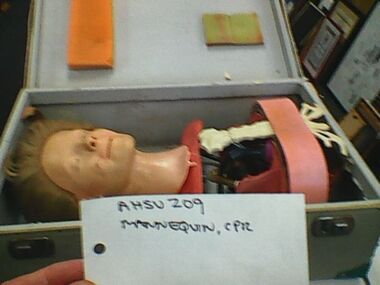 Ambulance Victoria Museum
Mannequin, CPR training, unknown
... ...victoria north western region...Used by the Ambulance Service Victoria North Western Region station at 135 Arnold Street Bendigo...Used by the Ambulance Service Victoria North Western Region station at 135 Arnold Street Bendigo first aid victoria north western region head and chest mannequin in a light green travelling case Mannequin, CPR training ...Used by the Ambulance Service Victoria North Western Region station at 135 Arnold Street Bendigohead and chest mannequin in a light green travelling casefirst aid, victoria north western region -
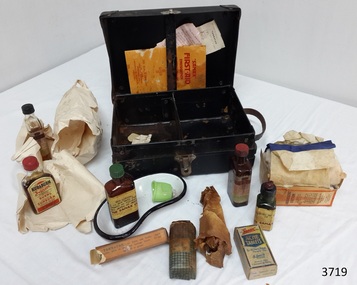 Flagstaff Hill Maritime Museum and Village
Equipment - First Aid Case, Thomas Urquhart & Son Pty Ltd (Thos. Urquhart), 1930-1939
... (Annuello is a remote wheat growing area in the Mallee region of North Western Victoria, which became a soldier settlement area after World War I. ...(Annuello is a remote wheat growing area in the Mallee region of North Western Victoria, which became a soldier settlement area after World War I. ...This small, portable 1930s Sanax First Aid Case has been strongly constructed, with corners reinforced with metal to take knocks and bumps, so it could be quickly transported to the site of an emergency. Having these supplies organised into a kit made them easily accessible and reduces time to take them to the site of the accident. It was possibly designed for use in factories because the booklet in the case states that the kit complies with “Part 1, Victorian Factories Regulations”. The text of the printed brand “Sanax First Aid Case” is right-way up when the case stands vertically on its hinged side. In modern times people are well aware of the importance of quick treatment when accident and injury occur. However, before the first commercial First Aid Kit was made by Johnson & Johnson in 1888, people had little knowledge about treating injuries and lacked information about suitable supplies to keep on hand for emergencies. They were often unaware of how to help in that critical time before the doctor or other assistance arrived, a particularly important time for the many people living in remote areas. A quote from Johnson’s & Johnson’s 1888 price list explains “It is a fact, which is everywhere being recognized, that many lives are lost and much suffering entailed in such accidents on account of the lack of the simple but necessary articles required to afford prompt assistance to the wounded.” One example of the value of First Aid assistance to community groups is shown in an article from the Weekly Times, 29th November 1930. It records a report from the Annuello Branch of the Younger Set (a Country Women’s Organisation), telling that on Armistice Day their president Mrs Jamieson, presented the Annuello School with the gift of a Sanax Red Cross First Aid outfit, which was accepted as being “of great practical use to the scholars.” (Annuello is a remote wheat growing area in the Mallee region of North Western Victoria, which became a soldier settlement area after World War I. There is a strain of wheat named ‘Annuello’ due to its suitability for that area. ) The Sanax Case in our Collection contains instructions, equipment and medical items suitable for use in emergency situations. The Case was one of 42 patterns available from Sanax that conformed to ‘Part 1, Victorian Factories Regulations’. It includes items made by Sanax Company and by Burroughs Wellcome & Co. (Australia) Ltd., Sydney, NSW. A quote at the back of the First Aid Emergency Instructions booklet says: “Sanax products are made in Australia by or under the supervision of qualified chemists, from the highest quality materials. They are dependable for the purposes written on labels.” BOOKLET included in First Aid Case: “SANAX” First-Aid Emergency Instructions has orange cover and white pages, joined in the centre by two staples. Booklet contains First Aid Instructions for general events listed in alphabetical order. It also contains an indexed sections headed “Poisoning, and what to do” written by S.A. Burrows, Ph.C., Vuc and N.Z. There are instructions and diagrams on how to perform Artificial Respiration. There are advertisement for Sanax products throughout the booklet that include; - Sanax Ambulance Stretcher for timber mills, mines, ships and quarries - Saw dust masks (porous rubber) for workers in dust, paint or duco sprayers Inside cover lists Sanax’s Australian made products including - tablets and powders for headaches, neuralgia, influenza, colds - snuff for Catarrh that is “quite harmless” - First Aid Cases that come in a range of 42 patterns - sunburn preventatives and treatments - healing salve for carbuncles, pock, pimples, boils, varicose ulcers etc. - snake bite outfits and kits LEAFLETS included in First Aid Case: (1) Tannafax Tannic Acid Jelly. Tannafax should be kept at hand in every home. It should be applied direct from the tube and used with neither oil nor grease. Where a large area has to be covered the clamped end may be torn or cut off to give a wider mouth to the tube. Collapsible tubes of different sizes. Made in Australia. Burroughs Wellcome & Co. (Australia) Ltd. (Incorporated in England). Sydney, NSW. Assorted Houses, London, New York, Montreal, Cape Town, Milan, Bombay, Shanghai, Buenos Aires. Copyright A. 1817, J. 9463 (2) Tabloid. The strong thing is the just - - . Tabloid marks the wor - - Burroughs Wellcome & Comp. The use of the word is to enab – the prescriber, dispenser and patient to get the right thing with one short word, instead of the firm’s long name. If another maker apply the word to his product, the act is unlawful. Tabloid is our trade mark and brand. If a vendor disregard it in dispensing or selling, the act is unlawful for the same reason. We prosecute both offenders rigorously, in the interest of prescribers, dispensers, patients and the owners of the trade mark. Please inform us of any instance of either offence. Burroughs Wellcome & Co. (Australia) Ltd. (Incorporated in England). Telephone Number - M 4184 (4 lines) All communications to G.P.O. Box No. 1185 DD. Copyright Sy. 20. & J 9894. Medicines and Equipment included in First Aid Case: - Absorbent Cotton, Sanax, for absorbing blood or drying a wound. As a swab for washing wounds; to place above a compress to keep the heat in: or as a pad to protect wounds or fractures. The Sanax Co. Manuf. Chemists, Melbourne. Regd. Office: 5 Brunswick St, Fitzroy. N.6. - ACHE tablets, Sanax, for all aches, pains, fevers etc. Dose: 2 to 3 tablets with a draught of water, every 3 hours. Children in proportion. For influenza or colds, take the bedtime dose with a hot lemon drink or toddy. Recommended for Headaches, Colds, Influenza, Fevers, Neuralgia, Rheumatism, Nerve Pains, Sleeplessness, and Seasickness. Three Sanax Ache tablets equals one Sanax Ache powder. Each tablet contains 1.75grs. each Phenacotinum and Acety acSzilcyl, and .75grs Ammon Brom. Etc.. Sanax brand specialties are prepared by highly qualified pharmaceutical chemists and may be accepted as safe and effective for the purpose indicated on the label. The Sanax Co. Melbourne - Eye lotion, Sanax, “in eye bath full strength or diluted with equal parts of water. Sanax Co. Brunswich St, Fitzroy, Melbourne. - Iodine, Sanax, POISON, with instructions for what to do if swallowed. - Kuraburn, Sanax, Applied to the burn and allowed to dry, the pain and heat instantly disappear, and blistering is prevented. If necessary, apply again in an hours. To safeguard against burning when sunbathing, apply before exposure to the sun. If already sunburnet, use Kuraburn as directions above. Safe and harmless. Sole makers, The Sanax Co. Brunswick St. - - Vic. - Sal Volatile, Sanax, - - stimulant for - - nervous aches - - or as smelling salts Dose - - - - Solution of A- - - 5%, . The Sanax Co. Brunswick St, Melbourne. - Tannafax, Burroughs Wellcome & Co. Australia Ltd. Sydney, N.S.W., 20gm. Approx., Tannic Acid Jelly, (Tannic Acid with 0.5% Phenol in a water-soluble base) for burns and scalds. A.N. 15050, p188, logo of a unicorn. Apply lightly, allow to dry, and bandage loosely. Do not apply oil or grease. - bottle wrapped in brown paper, unknown contents, paper adhered to bottle. - dish, kidney shaped, metal, white enamel with black rim - eye bath, green, plastic or Bakelite SANAX COMPANY The Sanax Company was at the address of 5 Brunswick Street, Fitzroy [Melbourne] at least as early as November 1924, as shown by its advertisement of Ache Powder in the Weekly Times, 8th November 1924. It was still at this address in September 1951, when it advertised First Aid outfits and components in the Post Master General’s section of the Commonwealth of Australia Gazette. REFERENCES: Annuello, Victoria; Wikipedia, https://en.wikipedia.org/wiki/Annuello,_Victoria Annuello Younger Set, Branch Activities and Local Reports, Country Women’s Organisations, Weekly Times, 29 November 1930, Trove http://trove.nla.gov.au/newspaper/article/224921009?searchTerm=%22sanax%22%20and%20%22melbourne%22&searchLimits=# Commonwealth of Australia Gazette, Issue 32, 24th April 1915, https://www.legislation.gov.au/file/1915GN32 [Johnson & Johnson Price List, September 1, 1888, p. 20. From our archives], Celebrating the 125th Birthday of the First Aid Kit , The Story of Johnson & Johnson, , http://www.kilmerhouse.com/2013/06/from-1888-to-2013-celebrating-the-125th-birthday-of-the-first-aid-kit/ Post Master General’s section of the Commonwealth of Australia Gazette, Issue No. 73, Thursday 27th September 1951 http://trove.nla.gov.au/newspaper/article/232185299?searchTerm=%22sanax%22%20and%20%22fitzroy%22&searchLimits= Sanax First Aid Emergency Instructions, by S.A. Burrows, publisher Sanax Ltd. Fitzroy, Victoria, 1930-1939 English, book, Illustrated edition, Trove http://trove.nla.gov.au/version/40948895 Access to emergency medical help in early settlement days of Victoria could take quite some time, especially in remote areas. From 1888 First Aid Kits and instructions became available for work sites, offices, community groups and individuals, helping to bridge the gap between the accident and the arrival of medical assistance. This portable Sanax First Aid Case is an example of portable medical equipment made in Melbourne, Australia, in the 1930’s and available to the public. It contains a range of items plus information to be used in a variety of injuries and emergencies in in factories, households, businesses and local communities, and instructions on their use. First Aid Case, portable, Sanax First Aid Case. First Aid kit in strong black cardboard carry case with metal reinforced corners, metal hinges on lid, metal catch and leather carry handle. Inside lid is a vertical strap with narrow gap behind it. Base is divided into two compartments. Manufactured by Sanax, Fitzroy, Melbourne, C. 1930-1939 Contents include "Sanax" First Aid instructions booklet, 2 leaflets, metal kidney dish enamelled in white with black trim on edge, green plastic or Bakelite eye bath, eye lotion, Tannafax tannic acid jelly, Sal Volitile, Kuraburn, Iodine, Argyrol, ACHE tablets, absorbent cotton in cardboard box, gauze bandage, and UNKNOWN wrapped bottle. Printed in gold on lid of case “SANAX” FIRST AID CASE. Most of the contents, as well as the case, show the “SANAX” brand. Some contents are inscribed Burroughs Wellcome & Co. (Australia) Ltd., flagstaff hill, warrnambool, shipwrecked coast, flagstaff hill maritime museum, maritime museum, shipwreck coast, flagstaff hill maritime village, great ocean road, first aid items, first aid kit, emergency first aid, medical emergency kit, home emergency kit, industrial emergency kit, sanax company fitzroy melbourne, burroughs wellcome & co. (australia) ltd, thos. urquhart & son pty. ltd. melbourne, sanax first aid case, sanax first-aid emergency instructions, part 1 victorian factories regulations, tabloid medical supplies -
 Bendigo Historical Society Inc.
Document - PETER ELLIS COLLECTION: ORDER OF AUSTRALIA
... Most of his recording has been in North Western and Central Victoria. Peter collected a lot of his material from Harry McQueen ( Castlemaine), which led to a double CD of Harry's music. ...Most of his recording has been in North Western and Central Victoria. Peter collected a lot of his material from Harry McQueen ( Castlemaine), which led to a double CD of Harry's music. ...4 page A4 printed document. Achievements of Peter Ellis (for consideration for the Order of Australia) Peter is regarded as one of the leading collectors and presenters of traditional dance tunes, dances and musical instruments in Australia. At the 2005 National Folk Festival it was announced by Robyn Holmes that he has the largest selection of dance related material collected in the National Library Archives in Canberra. Peter has been collecting for many years and has collected with the late John Meredith (AM), Shirley Andrews (AM), Rob Willis and Dave Di Santi amongst others. Peter has literally travelled Australia collecting over the past thirty years. He has extensive field recordings from Western Australia and Tasmania in addition to his Victorian collection, for example. Most of his recording has been in North Western and Central Victoria. Peter collected a lot of his material from Harry McQueen ( Castlemaine), which led to a double CD of Harry's music. Harry had played in dance bands for over sixty years in Central Victoria. Harry had a number of tunes from Bill McGlashan who had taken Harry under his wing as a young man. Through Peter's efforts much valuable material and knowledge from almost a century ago was saved for posterity. Founder, Charter member and life member of the Bush Dance and Music Club of Bendigo. Life Member of the Victorian Folk Music Club. Recipient of the Graham Squance award (for the person who has done the most to promote folk dance and music in Victoria)) from the Folk Song and Dance Society of Victoria. Member of the famous Wedderburn Old Timers Band for over twenty-eight years (two platinum and several gold recordings in that time). Founder and leader of the Emu Creek Bush Band (twenty-nine years old in 2010) Emu Creek has made many CDs of dance music as listed. Friday Night at the Spring Gully Hop, Three double CDs called 'Quadrille Mania' which contain many rare dances and tunes which have been learnt and recorded, under Peter's guidance, so they would not be lost to posterity. A triple CD called 'Take Me Back To Bendigo' with heritage songs and music from the Gold Rush to Federation (solely organised and financed by Peter) These CDs show the multicultural heritage in Bendigo and include music and groups from the Koorie, Chinese, Cornish, German, Irish, Italian, Scots, English and Welsh communities of Bendigo and district. Upon his recovery of costs Peter has handed over copyright to the Bendigo Community so future profits go back into the community. Three double CDs called 'The Merry Country Dance' with dances and tunes going back to the time of Governor Lachlan Macquarie's Ball in 1804. Most of the tracks are performed by Emu Creek Following much practice under Peter's tutelage. For further authenticity Peter liaised with other musicians to record some tracks which were revived from almost two hundred years ago and have now been recorded using the instruments of the time. A three volume set of Bush Concert recordings (Vol 1 Goornong (launched Australia Day 2006 with any profits going to the Soldier's Memorial Hall Committee), Vol 2 Heywood and Vol 3 Maldon/Sutton Grange, already recorded and to be released as money from other projects becomes available. NOTE: None of these CDs have led to any profit. All money raised is put back into the community and further heritage recordings, books and videos through the Bush Dance and Music Club of Bendigo Inc. In 2009 a full collection of all Peter's book and CDs was donated to the John Gorton Library as part of the recognition of the fifty year career of the Gay Charmers Dance Band from Lake Charm. 'Music of the Diggings' (4 tracks by Peter or Emu Creek). In addition the Emu Creek Band, under Peter's leadership, has appeared on a CD backing Bruce Watson on his song, 'The Old Bush Dance'. Emu Creek has performed at National Folk Festivals in four states and several times at the National Folk Festival in Canberra. They have also been mainstays of the Maldon Folk Festival for over twenty years as well as doing dance programs for the Port Fairy Folk Festival on two occasions. Peter has written and published many books related to traditional music and dance. These include Three volumes of 'Collectors Choice' which is musical notation for bush dances coupled with much dance history which would have been lost without Peter's efforts. 'Two Hundred Dancing Years - How to run a Colonial Ball: (co-authored with Shirley Andrews (A.M.), 'Music Makes Me Smile - The Music of the Nariel Valley' (co-authored with Harry Gardner). The Merry Country Dance' (292 pages) a companion to the three double CDs. He has also been a contributor to Verandah Music' authors Rob Willis and Graham Seal and 'The Oxford Companion to Australia Folklore' Ed Graham Seal. Peter is also a regular contributor to 'Trad and Now' Magazine. His latest completed book is titled 'The Merry Country Dance' and is over three hundred pages of social history, recipes and dance instructions. It was completed with the assistance of a Victorian Government Heritage Grant. The first edition sold out in only a few weeks. Peter has taught many children about old time musicianship through the junior bands which have functioned over the years with many children joining Emu Creek and then going on to follow their own musical inclinations. He has trained several young concertina and button accordion players over the years. Peter has been a regular tutor with Continuing Education in tin whistle, harmonica and old time dancing for many years. Peter has conducted workshops in music dance at National Folk Festivals in Perth, Alice Springs, Maleny, Melbourne, Adelaide, Kuranda and more recently at several Canberra National folk Festivals. He has also done this at Maldon for many years, Port Fairy, Glen Innes, Jamberoo and Kiama Festivals. For over thirty years Peter has been a guest player and MC for the dances at the Nariel Folk Festival (Australia's oldest continuing Folk Festival) Peter is very well known in the Corryong area as a collector and the co-author of the book, Music Makes Me Smile, about the Klippel/Simpson dynasty in the Nariel Creek Band. This book is currently being revised for re-issue as more material has come to light since the original publication. For many years Peter trained Debutante Sets in the Bendigo District. Peter was an instigator of the annual Dinki Di Ball held each September in Eaglehawk for the past thirteen years. At this ball three bands play for a quarter of the night and then join together for the final part of the evening. The bands are Emu Creek, The Wedderburn Old Timers and the Gay Charmers. Up to four hundred dancers, many in heritage costumes have attended this dance. The ball also pays tribute to, and involves, the old MC's. Through this example their skills have been passed down to a younger generation of MC's. All profits are returned to the Dance Club to foster our musical heritage. Each Ball includes presentations designed to promote social dancing in Australia. Over the years several young musicians have been presented with musical instruments at the Ball, libraries have been given copies of Peter's books and CDs and one year a keen young dancer was presented a pair of dancing shoes. Peter is a trained ballroom dancer and has gained gold medal status in this field. Peter is an accomplished musician and is one of Australia's foremost button accordion players. He is also highly accomplished on the tin whistle, bones and harmonica. He is the only exponent of the Swanee whistle that I have seen. Peter also plays the piano and ukulele. Thirty six years membership of the Bendigo Field Naturalists Club, Secretary in the 1970s and actively involved in campaigns to save Lake Pedder and establish the Whipstick and Kamarooka State Parks (now part of the Bendigo National Park). Peter was also extremely active in the establishment of the Salomon's Gully and Jackass Flat Flora Reserves in Bendigo which have now been saved for posterity. Peter has also been involved in efforts to save One Tree Hill and this area has now been included in the Greater Bendigo National Park. He has discovered and named new plant species in the Whipstick Forest and propagates Australian plants. Peter takes regular guided tours of interested people through the Whipstick each Spring on wild flower educational tours. He is a keen and gifted photographer of local plant species. Life member of the Bendigo Field Naturalists. Peter contributed text and photographs to their publication 'Wildflowers of Bendigo'. When the Victorian State Parliament had its first historical sitting outside Melbourne Emu Creek played during lunch for the guests and public. They have also played at functions such as the Centenaries of Federation, the Bendigo Post Office, the Shamrock Hotel and the opening of the new Melbourne Museum and the Federation Museum in Bendigo. The band regularly plays for Seniors week and at homes for the aged such as Bethlehem, Mirridong, Bignold Park, Bendigo Village and others. Peter has been instrumental in getting the band to play for fundraisers such as schools, scouts and environmental groups. The band plays many charitable 'gigs'. The band supports the Bendigo Easter Fair and the Eaglehawk Fair when able and has appeared in several parades over the years. The above list shows the invaluable contribution that Peter Ellis has made towards the collecting and distributing of Australia's musical and dance heritage. No one has done more than Peter in this area. He has also been active locally and nationally in his endeavours towads saving the natural environment. He has put many years of time and energy into both area's and has many on going projects in mind for the years ahead. The awarding of an honour from Australia would be just reward for a man who has preserved so much of our musical and dance heritage for future generations. Knowing Peter I have no doubt he would treasure such an honour as he has given so much to preserve Australia's music and dance heritage over most of his sixty plus years. Compiled by John Williams. Handwritten notes at bottom of last page reads: Referees Jacinta Allan MLA Steve Gibbons MHR Willie Carney ex Mayor of Bendigo Supporting letter Mary Smith Sec. Bush Dance + Music Club.person, individual, peter ellis oam -
 Flagstaff Hill Maritime Museum and Village
Document, 12-01-1882
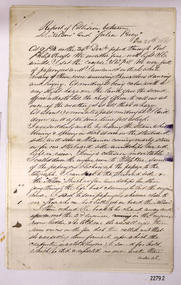
... Victoria’s western district. She was first registered in Warrnambool, Victoria in 1876. The Julia Percy changed hands several times. Her next owner was the Western Steam Navigation Co (1887), managed by Mr. T.H. Osborne (the company’s office was on the corner of Timor and Liebig Streets, Its north...Victoria’s western district. She was first registered in Warrnambool, Victoria in 1876. The Julia Percy changed hands several times. Her next owner was the Western Steam Navigation Co (1887), managed by Mr. T.H. Osborne (the company’s office was on the corner of Timor and Liebig Streets, Its north ...This hand written letter, in black ink script on blue lined paper, is impressed with the official stamp of the Victoria Steam Navigation Board. The left margin has the reference “S82/12" It is transcribed: "Victoria Steam Navigation Board, Melbourne, January 12th 1882 To Frederick Chapman, Master, S.S. "Julia Percy" You are herewith furnished with a copy of the report of the Official Court which assembled to enquire into the circumstances attending the collision between the steamers "Julia Percy" and "Nelson" off Apollo Bay near Cape Otway on the morning of the 25th December 1881, and you are hereby expected to attend at the Board Room, Custom House, Melbourne, at 2pm, on 13th January instant to show cause why you should not be censured accordingly. [Signature] Secretary" This document refers to the matter of a collision between two steamships, the Julia Percy and the Nelson, on 25th December 1881. The Julia Percy was at that time owned by her first owners, the Warrnambool Steam Packet Company, and she sailed under the command of Captain Chapman. She had left Melbourne the evening of 24th December, with about 150 passengers, sailing in fine weather through Port Phillip Heads around 9pm. She was headed for Warrnambool, Belfast (now named Port Fairy) and Portland. The Julia Percy was off Apollo Bay when Captain Chapman was woken by the ship’s whistle after midnight, the steamer Nelson being on a collision course with the Julia Percy.[See Link.] The Nelson struck Julia Percy midship. Boats were lowered from the ship (apart from a damaged lifeboat) and about 30-40 of the passengers boarded the Nelson. The engine room and the forehold were checked and found clear of water. The company manager, Mr Evans, had been on the Nelson, so he boarded and inspected the Julia Percy and the decision was made to continue on to Warrnambool with the passengers as there appeared to be no immediate danger. However, Captain Thomas Smith said the Nelson was taking on water, so Julia Percy followed her for about an hour towards Melbourne on standby in case of need. Then Julia Percy turned around towards Warrnambool again. Shortly afterwards the Nelson turned to follow her, the ships stopped and passengers were returned to Julia Percy, and three from Julia Percy boarded the Nelson. Both ships proceeded on their way. Julia Percy passed Cape Otway light afterwards, signalling that there had been a collision. It was discovered later that one of the passengers was missing, then thought to have boarded the Nelson but later thought to have fallen into the sea and drowned while trying to jump from Julia Percy to Nelson. There had been 3 tickets purchased under the same name of that passenger “Cutler”; a father, son and friend named Wordsworth, which had caused quite some confusion. No further mishap occurred to either ship and both the Julia Percy and the Nelson reached their destinations safely. An enquiry was instigated by the Victoria Steam Navigation Board regarding the cause of the accident between the two steamships, in connection with the death of Cutler who was supposed to have lost his life by the collision. The enquiry resulted in the following decision: "The Victorian Steam Navigation Board having taken into consideration the points urged by Captain Thos [Thomas] Smith and also by his legal advisers, is of opinion that the charge prepared against him has been sustained, but taking into consideration Captain Smith’s previous good conduct and character, the board suspends his master’s certificate No 227 issued by this board for a period of six calendar months from this date – Robert Fullarton, Chairman. “The Victorian Steam Navigation Board having beard the statement of Captain Frederick Chapman urged in his defense to the charge of dereliction of duty as master of the Julia Percy, in having no standing order on board that vessel to be called in the event of any approaching steamer’s lights being seen, find such charge sustained, and censure him accordingly – Robert Fullarton, Chairman.” ABOUT “JULIA PERCY” The S.S. Julia Percy (later named Leeuwin ) was an iron passenger-cargo steam ship built in 1876. At one point in time the Julia Percy would sail from Warrnambool to Melbourne every Friday and return from Melbourne to Warrnambool every Tuesday. The cost of a return ticket for a Saloon Fare was £1.0.0. She would sail “if practical and weather permitting”. Shipping was the cheapest and most practical means of carrying produce and goods during the period 1840-1890. Regular domestic steamer services commenced in the Warrnambool district in the late 1850’s and by 1870 the passenger trade was booming. Produce was loaded from the jetty into ‘lighters’ (small boats), which took it to the ships at anchorage in the bay. Passengers were taken to the ship’s side then climbed aboard up ladders or gangways. The coming of the railway in October 1889 meant the gradual decline and end of the steam shipping era. The Julia Percy was built in Glasgow by Thomas Wingate & Company, Whiteinch, in 1876 for the Warrnambool Steam Packet Company, which commissioned her for trade in Victoria’s western district. She was first registered in Warrnambool, Victoria in 1876. The Julia Percy changed hands several times. Her next owner was the Western Steam Navigation Co (1887), managed by Mr. T.H. Osborne (the company’s office was on the corner of Timor and Liebig Streets, Its north-western wall is now part of the current Warrnambool Regional Art Gallery. ) The Melbourne Steamship Co became the next owners (1890), followed by William Howard Smith and Sons (1901) for use in Queensland coastal trades, then she was bought by George Turnbull in 1903 and used for local mail contract in Western Australia. The Julia Percy was sold to the Melbourne Steamship Company Ltd. (1906) and re-named the “Leeuwin” but continued in her Western Australian coastal run. She was converted into a coal hulk in Melbourne in 1910 as a result of damaged caused when she was driven against the jetty at Dongara during a gale. The ship was eventually dismantled and scuttled in Bass Strait on 28 December 1934. The document is significant for its association with the wreck of the Leeuwin (Julia Percy), which is on the Victorian Heritage Register, VHR S413. . It is historically significant for being a rare artefact that has potential to interpret aspects of Western Victoria’s 19th century steamship trade and Victorian cultural history. The Leeuwin (Julia Percy) is listed on the Victorian Heritage Register as being historically significant ‘as one of only four wrecks of steamships in Victorian waters associated with the western district of Victoria’s coastal steamship trade. Reports of Victoria Steam Navigation Board about the collision on 25th December 1881 between the steamers " Julia Percy" and "Nelson". Letter from Victoria Steam Navigation Board, Melbourne to Frederick Chapman, Master, S.S. "Julia Percy", dated January 12th 1882. reference on letter in left margin "S82/12"flagstaff hill, flagstaff hill –maritime museum, maritime museum, shipwreck coast, flagstaff hill maritime village, victoria steam navigation board, captain frederick chapman, captain thomas smith, thomas wingate & company, steamer julia percy, steamer leeuwin, steamer nelson, steam ship, warrnambool steam packet company, t. h. ostorne, western steam navigation co., charles cutler -
 Federation University Historical Collection
Photograph, Solomon and Bardwell, Western Fire Brigade Ballarat, c1861, c1861
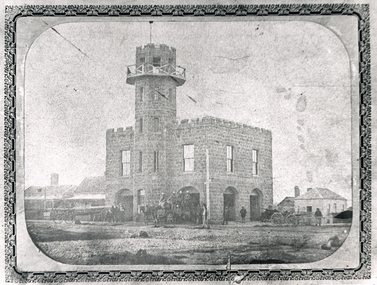
... The former Ballarat West Fire Brigade is one of the oldest fire stations still standing in Victoria. ballarat west fire brigade western fire brigade Bluestone Black and white photograph showing a double storey bluestone building with tower known as the Ballarat West Fire Brigade on the corner of Sturt Street and Raglan (north) Street. ...The former Ballarat West Fire Brigade is one of the oldest fire stations still standing in Victoria. Black and white photograph showing a double storey bluestone building with tower known as the Ballarat West Fire Brigade on the corner of Sturt Street and Raglan (north) Street. A number of fire carriages and uniformed men are evident in front of the fire station. ballarat west fire brigade, western fire brigade, bluestone -
 The Beechworth Burke Museum
Animal specimen - New Holland Honeyeater, 1860-1880
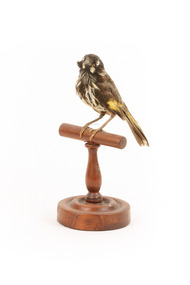
... north of Perth, Western Australia. They are native to Australia and are named after Australia's first name (new Holland). This specimen is mounted correctly but looks different to the typical images of this bird because it is a younger New Holland Honeyeater and is; therefore, brown in colour instead of the typical black. This specimen is part of a collection of almost 200 animal specimens that were originally acquired as skins from various institutions across Australia, including the Australian Museum in Sydney and the National Museum of Victoria...north of Perth, Western Australia. They are native to Australia and are named after Australia's first name (new Holland). This specimen is mounted correctly but looks different to the typical images of this bird because it is a younger New Holland Honeyeater and is; therefore, brown in colour instead of the typical black. This specimen is part of a collection of almost 200 animal specimens that were originally acquired as skins from various institutions across Australia, including the Australian Museum in Sydney and the National Museum of Victoria ...The New Holland Honeyeater can be found throughout southern Australia, from about Brisbane, Queensland to just north of Perth, Western Australia. They are native to Australia and are named after Australia's first name (new Holland). This specimen is mounted correctly but looks different to the typical images of this bird because it is a younger New Holland Honeyeater and is; therefore, brown in colour instead of the typical black. This specimen is part of a collection of almost 200 animal specimens that were originally acquired as skins from various institutions across Australia, including the Australian Museum in Sydney and the National Museum of Victoria (known as Museums Victoria since 1983), as well as individuals such as amateur anthropologist Reynell Eveleigh Johns between 1860-1880. These skins were then mounted by members of the Burke Museum Committee and put-on display in the formal space of the Museum’s original exhibition hall where they continue to be on display. This display of taxidermy mounts initially served to instruct visitors to the Burke Museum of the natural world around them, today it serves as an insight into the collecting habits of the 19th century.This specimen is part of a significant and rare taxidermy mount collection in the Burke Museum. This collection is scientifically and culturally important for reminding us of how science continues to shape our understanding of the modern world. They demonstrate a capacity to hold evidence of how Australia’s fauna history existed in the past and are potentially important for future environmental research. This collection continues to be on display in the Museum and has become a key part to interpreting the collecting habits of the 19th century.The Young New Holland Honeyeater is brown in colouring and has grey glass eyes (like this one) while adults are black and white with white eyes. Both have a large yellow wing patch and yellow sides on the tail. It has a small white ear patch, a thin white whisker at the base of the bill. This honeyeater is an active bird, and rarely sits still long enough to give an extended view. Sexes are similar in looks, but females are slightly smaller in size.taxidermy mount, taxidermy, animalia, burke museum, beechworth, australian museum, skin, reynell eveleigh johns, bird, new holland honeyeater, brown, black, yellow, australia, new holland -
 Marysville & District Historical Society
Book - Hardcover book, McCarron, Bird & Co, Victoria and its Metropolis-Past and Present-Volume 2, 1888
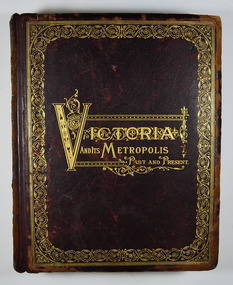
... victoria...pioneers...colonisation...history...fauna...flora...banking...finance...medicine...western district...south-western district...wimmera district...geelong district...ballarat district...avoca district...coliban district...campase district...loddon district...lower goulburn district...upper goulburn district...ovens district...north...A history of the various colonies and districts of Victoria from the time of the discovery of Australia through until 1888. melbourne victoria pioneers colonisation history fauna flora banking finance medicine western district south-western district wimmera district geelong district ballarat district avoca district coliban district campase district loddon district lower goulburn district upper goulburn district ovens district north-east district gippsland district mornington district westernport district upper yarra district evelyn district bourke district A history of the various colonies and districts of Victoria from the time of the discovery of Australia through until 1888. ...A history of the various colonies and districts of Victoria from the time of the discovery of Australia through until 1888.Hardback. Dark brown cover with the title in gold lettering. There is also a border in gold decorating the outer edge of the front cover. The spine is also decorated in gold along with the title and the volume number.non-fictionA history of the various colonies and districts of Victoria from the time of the discovery of Australia through until 1888.melbourne, victoria, pioneers, colonisation, history, fauna, flora, banking, finance, medicine, western district, south-western district, wimmera district, geelong district, ballarat district, avoca district, coliban district, campase district, loddon district, lower goulburn district, upper goulburn district, ovens district, north-east district, gippsland district, mornington district, westernport district, upper yarra district, evelyn district, bourke district -
 Federation University Historical Collection
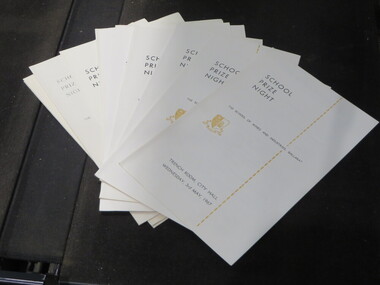
Booklet - Printed Programme, Ballarat School of Mines Prize Night Programs, 1961-1975, 1960-1975
... Victoria 1969 W.J. Anderson, General Manager, Bendix Mintex Pty LtdS. Martin-Brown, Managing Director, Firth Cleveland Pty Ltd 1971 S.F. Newman, Manager Director, Engineering Products Pty Ltd, Employer Representative, Metal Trades Division, Apprenticeship Commission 1972 R.J. Dobell, Regional Directorof Education, Ballarat 1973 B.J. McCulloch, Manager, ELectrical Supply, Mid-Western Regions, State Electricty Commission. 1974 W.J.C. North...Victoria 1969 W.J. Anderson, General Manager, Bendix Mintex Pty LtdS. Martin-Brown, Managing Director, Firth Cleveland Pty Ltd 1971 S.F. Newman, Manager Director, Engineering Products Pty Ltd, Employer Representative, Metal Trades Division, Apprenticeship Commission 1972 R.J. Dobell, Regional Directorof Education, Ballarat 1973 B.J. McCulloch, Manager, ELectrical Supply, Mid-Western Regions, State Electricty Commission. 1974 W.J.C. North ...The Ballarat School of Mines Prize Night was held at the Ballarat Town Hall Trench Room from 1960-1971, the Lower Civic Hall 1972, Wendouree Municipal Hall 1973-1975. The prizes awarded were for the work done in the previous year. Guest speakers: 1960 J. Lonsdale, Production Manager, M.B. John & Hattesley Ltd. 1961 E.J. Neale, Manager Ballaarat Gas Company 1962 W.G. Smith, Director, Myer Empirium (Ballarat) Pty Limited and Member of the School of Mines Council 1963 K.C. Webb, Member of the School of Mines Council 1964 A.E. Stohr Vice-President of the School of Mines Council 1965 B.J. Nicholson, Factory Manager, Australian Timken Pty Ltd and Chairman of the Ballarat PRoductivity Group 1966 L.C. Yandell, District Inspector of Schools 1967 J.L. Trevenen, Vice-President, Victorian Automobile Chamber of Commerce 1968 A.C. Eldridge, Assistant Director of Technical Commission of Victoria 1969 W.J. Anderson, General Manager, Bendix Mintex Pty LtdS. Martin-Brown, Managing Director, Firth Cleveland Pty Ltd 1971 S.F. Newman, Manager Director, Engineering Products Pty Ltd, Employer Representative, Metal Trades Division, Apprenticeship Commission 1972 R.J. Dobell, Regional Directorof Education, Ballarat 1973 B.J. McCulloch, Manager, ELectrical Supply, Mid-Western Regions, State Electricty Commission. 1974 W.J.C. North, Managing Director, Australian Timken Pty Ltd 1975 I.D. McCoy, Managing Director, James Selkirk Pty Ltd Four page booklets listing students who won a trade prize at the Ballarat School of Mines. From 1960 to 1971 the awards were held at the Ballarat Town Hall Trench Room, in 1972 it was held at the Lower Civic Hall, and from 1973 to 1975 it was held at the Wendouree Municipal Hall. ballarat school of mines, prize night, ballarat town hall, trench room, lower civic hall, wendouree municipal hall, commercial, awards, dressmaking, woolclassing, turning and fitting, tool and die-making, oxywelding, electric welding, boiler making, panel beeting, motor mechanics, electrical mechanics, arpentry and joinery, plumbing and gasftting, m.b. john, h.e. arblaster, harry arblaster, w.g. smith, a.e. stohr, ken webb -
 Federation University Historical Collection
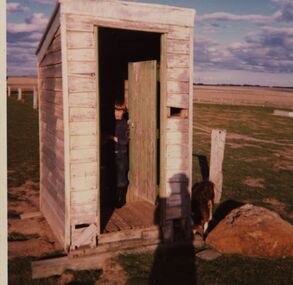
Photograph - Colour, Chatham-Holmes Collection: Andrew Chatham in the Out House, Kur-a-ruc South, Rokewood, Vic. {circa 1976)
... The photo was taken at Rokewood, Victoria on his parent's Western District property, "Kur-a-ruc South" a former part of the Kur-a ruc Station, Rokewood, Victoria purchased by Philip and Elizabeth Chatham in 1964. The family lived at Ascot, 15 miles north...The photo was taken at Rokewood, Victoria on his parent's Western District property, "Kur-a-ruc South" a former part of the Kur-a ruc Station, Rokewood, Victoria purchased by Philip and Elizabeth Chatham in 1964. The family lived at Ascot, 15 miles north ...Andrew Chatham, the youngest of Philip and Elizabeth Chatham's 5 children, was born in 1968. In this photo, he looks about 8 - 10 years old. The photo was taken at Rokewood, Victoria on his parent's Western District property, "Kur-a-ruc South" a former part of the Kur-a ruc Station, Rokewood, Victoria purchased by Philip and Elizabeth Chatham in 1964. The family lived at Ascot, 15 miles north of Ballarat, and had regular weekend day trips and Easter holidays picnicking, droving sheep, feeding stock, checking water troughs and dams, hand-weeding Patterson curse, repairing fences, collecting paddock rocks and sugar-gum wood at "Kur-a-ruc South'. Home base for these excursions was either a car, the shearing shed, sometimes a 6-berth caravan and by the mid-1980s a shearer's quarters with an inside toilet. [Jane Dyer (nee Chatham).15 June 2024] chatham-holmes collection, andrew chatham, outdoor shed, toilet facility, rokewood, kur-a-ruc south, rokewood -
 Flagstaff Hill Maritime Museum and Village
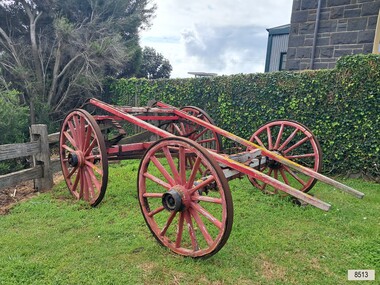
Vehicle - Wagon, Circa 1909
... north-eastern Victoria, an area popular with hawkers. In September 1909, near Thowgla, he was thrown from his wagon while attempting to navigate a deep rut and was run over by one of its wheels. Although he suffered bruising to his chest, his injuries were not serious. The following year, he was granted a Hawker’s Licence in Corryong. By 1916, Singh was living and working at Garvoc in western...north-eastern Victoria, an area popular with hawkers. In September 1909, near Thowgla, he was thrown from his wagon while attempting to navigate a deep rut and was run over by one of its wheels. Although he suffered bruising to his chest, his injuries were not serious. The following year, he was granted a Hawker’s Licence in Corryong. By 1916, Singh was living and working at Garvoc in western ...This wagon was used in towns across south-west Victoria during the first half of the twentieth century by Pooran Singh, an Indian-born immigrant. Singh arrived in Australia alone in 1899 at the age of 30. The following year, at the Colac Licensing Court in western Victoria, he was one of 78 hawkers granted a Hawker’s Licence. According to the Colac Herald, all but two of the applicants appeared to be Asian. While some hawkers registered horse-drawn carts, Singh was one of nineteen licensed to trade on foot, selling door to door. Applicants were encouraged to contribute to a collection for the Colac Hospital. Over time, Pooran Singh came to own his own wagon—a top-of-the-range light delivery vehicle—and a horse named Prince. His work often took him along rough country roads, and for a period, he worked in the Corryong district of north-eastern Victoria, an area popular with hawkers. In September 1909, near Thowgla, he was thrown from his wagon while attempting to navigate a deep rut and was run over by one of its wheels. Although he suffered bruising to his chest, his injuries were not serious. The following year, he was granted a Hawker’s Licence in Corryong. By 1916, Singh was living and working at Garvoc in western Victoria, where that year, he lost his paper licence on Cooramook Road, and he placed a notice in The Standard. In 1918, at the Warrnambool Petty Sessions Court, he was one of four applicants granted renewal of their hawkers’ licences, and each donated ten shillings to Warrnambool Hospital. Throughout these years, Singh became well known to farmers and their families as he travelled across Victoria’s Western District, living and working from his covered wagon. In his later years, Pooran Singh formed a close friendship with John Jandes Moore and his wife, Vera, of Russells Creek, Warrnambool. They offered him the use of their property as a base for his travels and cared for him during his final illness. John Moore was later appointed one of the two executors of Singh’s will. Pooran Singh died in Warrnambool on 8 June 1947, aged 77. His final wish was to be cremated and for his ashes to be returned to India for immersion in the Ganges. The cremation was arranged by Guyett’s Funerals in Warrnambool. Having never married, Singh left his estate to his four nephews, enabling them to buy land and build homes; one later installed a memorial plaque in his honour. In the late 1980s, Guyett’s Funerals placed his ashes in the niche wall at Warrnambool Cemetery as a memorial, while continuing to hope that family instructions might eventually arrive. Nearly 63 years after his death, renewed enquiries brought public attention to the long and respectful care given to his ashes. As a result, the renowned Indian cricketer Kapil Dev travelled to Warrnambool to collect them and escort them to India, helping to fulfil Singh’s final wish. He was joined by one of Singh’s grand-nephews, Harmel Uppal, who had travelled from England. At a formal ceremony on 25 July 2010 commemorating Singh’s life, the ashes were handed to Dev and Uppal, and local resident Avis Quarrell, who had known Singh as a child, read a poem she had written in his memory. She still owned a shell necklace that Singh had made for her mother. Some Warrnambool locals who had been closely involved also travelled to India, where they joined Uppal’s family from the village of Uppal Bhopa, near Jalandhar. On 31 July 2010, Pooran Singh’s ashes were immersed in the Ganges, fulfilling the wish he had expressed more than six decades earlier. After Pooran Singh’s death, his horse and wagon remained on John Moore’s property. When Prince died, he was buried on the beach at Warrnambool. The wagon remained with the Moore family and was occasionally used as a cubby house. In about 1997, John Moore, the son of John Jandes Moore, donated it to Flagstaff Hill. After restoration, the wagon became an attraction in the village, where volunteer Pat and his Clydesdale horse, Duke, offered visitors rides around Flagstaff Hill’s lake. This wagon is significant for its association with an Indian emigrant who used it to earn an income in Australia. It also reflects the vital role of hawkers, who travelled through rural and regional communities in the late nineteenth and early twentieth centuries, supplying food, goods and news. The wagon is also historically significant as a former Flagstaff Hill attraction, offering visitors the experience of horse-drawn rides around the lake.Wagon: a light delivery vehicle once used as a hawker's wagon. It is a four-wheel, horse-drawn vehicle with iron tyres, brakes, spoked wheels painted red with decorative yellow strips on the hubs, a timber shaft, and springs on the undercarriage. It was once a covered wagon, fitted with green, wooden sideboards, a front seat with leather-padded backrest and mounting steps. The late-19th to early-20th-century wagon was once owned by Pooran Singh, a local Indian hawker. flagstaff hill, warrnambool, maritime village, maritime museum, flagstaff hill maritime museum and village, shipwreck coast, great ocean road, southwest victoria, northwest victoria, western district, colac, colac hospital, colac licensing court, thowgla, corryong, garvoc, cooramook road, warrnambool petty sessions court, warrnambool hospital, russells creek road, ganges, warrnambool cemetery, uppal bhopa, jalandhar, hawker’s licence, covered wagon, wagon, hawker's wagon, horse-drawn cart, hawker's cart, light delivery vehicle, hawker, travelling salesman, travelling hawker, door-to-door sales, rural salesman, rural commerce, prince, duke, clydesdale horse, 1997, pooran singh, indian immigrant, pat, john james moore, vera moore, john and vera moore, john moore, guyatt’s funerals, kapil dev, harmel uppal, avis quarrell -
 Flagstaff Hill Maritime Museum and Village
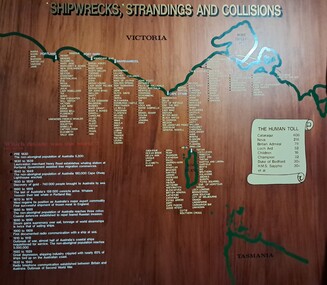
Artwork, other - Shipwreck Board, The Eye of the Needle: Shipwrecks, Stranding's and Collisions, ca 2002
... North West Tasmania...South Coast of Victoria...Cape Otway...Victorian Lighthouse...King Island Lighthouse...Strandings...coastal tracers...emigrant ships...sea trade...1930s-1940s...Shipwreck board...The Eye of the Needle...collosions...Alex O'Flynn...Alex O’Flynn Computer Signs...Shipwrecks of Western...Victoria. It tells of the vast number of lives lost. It lists the names of many infamous shipwrecks and significant events. Flagstaff Hill Maritime Museum Maritime Village Shipwreck Coast Eye of the Needle Shipwreck locations Bass Strait Basses Strait King Island North West Tasmania South Coast of Victoria Cape Otway Victorian Lighthouse King Island Lighthouse Strandings coastal tracers emigrant ships sea trade 1930s-1940s Shipwreck board The Eye of the Needle collosions Alex O'Flynn Alex O’Flynn Computer Signs Shipwrecks of Western Victoria The large stained and lacquered timber board is mounted in a timber, frame. ...The Shipwreck Board is a feature of Flagstaff Hill Maritime Museum and Village/ its subject is explained briefly in the Museum's handbook, The Flagstaff Hill Navigator, published in 2008: - "Known as the ‘Eye of the Needle’ the treacherous entrance to Bass Strait is littered with the wreckage of large international vessels and smaller sail and steam craft used in coastal trade. The vessels bringing emigrants and cargo to Australia found the western entrance to Bass Strait the most dangerous part of their voyage. They had to thread their way between the southern point of Victoria (Cape Otway) and the northern point of King Island, a stretch of water less than 90 km wide. Many smaller coastal vessels were lost at Portland, Port Fairy, Warrnambool and Apollo Bay which are not safe harbours in certain weather conditions. "The Shipwreck Board shows shipwrecks, strandings and collisions which occurred in this area up to the year 1940. Wrecks are identified by a yellow light and collisions/strandings by a green light. These lights also identify the decade the wreck occurred by lighting up when the relevant decade button is pushed. Interesting happenings of the decades are listed next to the buttons." The Shipwreck Board's demonstration of The Eye of the Needle is an interactive visual display that helps teach the perils and dangers faced by early settlers in Victoria. It tells of the vast number of lives lost. It lists the names of many infamous shipwrecks and significant events.The large stained and lacquered timber board is mounted in a timber, frame. It is painted with a small sketch of Australia, and an enlarged outline of the southern coast of Victoria, King Island and the North West coast of Tasmania. The interactive display highlights the shipwrecks, standings and collisions suffered by many vessels as they navigated the 'Eye of the Needle', a narrow stretch of Bass Strait. The locations of the Lighthouses are pinpointed. Lists of groups of ships are below the coastlines. A painted scroll shows eight major shipwrecks with the number of lives lost for each one. A table shows historical facts associated with the decades from pre-1830 to 1940. A system of coloured lights compares the decades with the vessels that suffered damage. The board was created by artist and signwriter, Alex O'Flynn Computer Signs.flagstaff hill, maritime museum, maritime village, shipwreck coast, eye of the needle, shipwreck locations, bass strait, basses strait, king island, north west tasmania, south coast of victoria, cape otway, victorian lighthouse, king island lighthouse, strandings, coastal tracers, emigrant ships, sea trade, 1930s-1940s, shipwreck board, the eye of the needle, collosions, alex o'flynn, alex o’flynn computer signs, shipwrecks of western victoria -
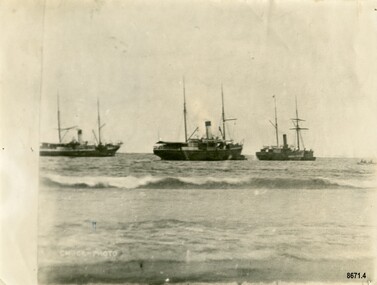 Flagstaff Hill Maritime Museum and Village
Photograph - Steamers - Julia Percy, Dawn and Coorong, Chuck Photo Ballarat, Circa 1885
... Victoria Steam Navigation Board regarding the cause of the accident between the two steamships, in connection with the death of Cutler who was supposed to have lost his life by the collision. The enquiry resulted in Captain Thomas Smith having his master's certificate suspended for six months. The Julia Percy changed hands several times. Its next owner was the Western Steam Navigation Co (1887), managed by Mr. T.H. Osborne (the company’s office was on the corner of Timor and Liebig Streets - its north...Victoria Steam Navigation Board regarding the cause of the accident between the two steamships, in connection with the death of Cutler who was supposed to have lost his life by the collision. The enquiry resulted in Captain Thomas Smith having his master's certificate suspended for six months. The Julia Percy changed hands several times. Its next owner was the Western Steam Navigation Co (1887), managed by Mr. T.H. Osborne (the company’s office was on the corner of Timor and Liebig Streets - its north ...This photograph was one of ten photographs donated to Flagstaff Hill Maritime Museum and Village by Fred Trewartha. Frederick John Fox Trewartha (Fred) was a well-known Warrnambool businessman. He was born in Beeac near Geelong in 1920 and came to Warrnambool with his family as a very young child. He was apprenticed to his father John, as a saddler and later opened his own shop on Raglan Parade. He then moved into working with tarpaulins and canvases for the trucking industry. Fred was keenly interested in photography (and was a member of the Warrnambool Cine Club), yachting and boat building. He kept his yacht moored at Port Fairy for many years and participated in sailing events locally and interstate. He also built boats with his sons. He had the opportunity to meet many older sailors and it's thought this photo (and others in the set) may have been given to him by one of these men. Fred Trewartha died in 2016 in Warrnambool. Shipping was the cheapest and most practical means of carrying produce and goods during the period 1840-1890. Regular domestic steamer services commenced in the Warrnambool district in the late 1850’s and by 1870 the passenger trade was booming. Four coastal traders made regular stops at Warrnambool in the 1880's - S. S. Julia Percy, S. S. Dawn, S. S. Nelson and S. S. Casino. The S.S. Julia Percy (later named Leeuwin) was an iron passenger-cargo steam ship built in 1876. At one point in time the Julia Percy would sail from Warrnambool to Melbourne every Friday and return from Melbourne to Warrnambool every Tuesday. The cost of a return ticket for a Saloon Fare was £1.0.0. The Julia Percy was built in Glasgow by Thomas Wingate & Company, Whiteinch, in 1876 for the Warrnambool Steam Packet Company, which commissioned it for trade in Victoria’s western district. It was first registered in Warrnambool, Victoria in 1876. Two steamships, the Julia Percy and the Nelson, collided on 25th December 1881. The Julia Percy was at that time owned by its first owners, the Warrnambool Steam Packet Company, and she sailed under the command of Captain Chapman. It had left Melbourne the evening of 24th December, with about 150 passengers, sailing in fine weather through Port Phillip Heads around 9pm. It was headed for Warrnambool, Belfast (now named Port Fairy) and Portland. The Julia Percy was off Apollo Bay when Captain Chapman was woken by the ship’s whistle after midnight, the steamer Nelson being on a collision course with the Julia Percy. The Nelson struck Julia Percy midship. Boats were lowered from the ship (apart from a damaged lifeboat) and about 30-40 of the passengers boarded the Nelson. The engine room and the forehold were checked and found clear of water. The company manager, Mr. Evans, had been on the Nelson, so he boarded and inspected the Julia Percy and the decision was made to continue on to Warrnambool with the passengers as there appeared to be no immediate danger. However, Captain Thomas Smith said the Nelson was taking on water, so Julia Percy followed it for about an hour towards Melbourne on standby in case of need. Then Julia Percy turned around towards Warrnambool again. Shortly afterwards the Nelson turned to follow her, the ships stopped and passengers were returned to Julia Percy, and three from Julia Percy boarded the Nelson. Both ships proceeded on their way. Julia Percy passed Cape Otway light afterwards, signaling that there had been a collision. It was discovered later that one of the passengers was missing, then thought to have boarded the Nelson but later thought to have fallen into the sea and drowned while trying to jump from Julia Percy to Nelson. There had been 3 tickets purchased under the same name of that passenger “Cutler”; a father, son and friend named Wordsworth, which had caused quite some confusion. No further mishap occurred to either ship and both the Julia Percy and the Nelson reached their destinations safely. An enquiry was instigated by the Victoria Steam Navigation Board regarding the cause of the accident between the two steamships, in connection with the death of Cutler who was supposed to have lost his life by the collision. The enquiry resulted in Captain Thomas Smith having his master's certificate suspended for six months. The Julia Percy changed hands several times. Its next owner was the Western Steam Navigation Co (1887), managed by Mr. T.H. Osborne (the company’s office was on the corner of Timor and Liebig Streets - its north-western wall is now part of the current Warrnambool Regional Art Gallery.) The Melbourne Steamship Co became the next owners (1890), followed by William Howard Smith and Sons (1901) for use in Queensland coastal trades and then it was bought by George Turnbull in 1903 and used for local mail contract in Western Australia. The Julia Percy was sold to the Melbourne Steamship Company Ltd. (1906) and re-named the “Leeuwin” but continued in her Western Australian coastal run. It was converted into a coal hulk in Melbourne in 1910 as a result of damaged caused when it was driven against the jetty at Dongara during a gale. The ship was eventually dismantled and scuttled off Port Phillip Heads on 28 December 1934. The steamship "Dawn" was a 522-ton coastal trader built in 1876 and the vessel operated around the Victorian west coast from 1877 until 1898 for the Portland & Belfast Steam Navigation Co. sailing between Melbourne and Portland, via Warrnambool. The vessel was then owned in October 1885 by the renamed company, Belfast & Koroit Steam Navigation Co., until March 1896 when its ownership moved to W Howard Smith & Sons Ltd. This Melbourne company used the ship to service most ports around Australia. Captain F. Chapman took over from Captain Jones and served on the SS Dawn from 1898 until 1900 when he took command of the SS Casino. On September 4th 1880, the three masted clipper ship, "Eric the Red" struck Otway Reef, near Cape Otway. The S. S. Dawn, under the command of Captain Jones, was returning to Warrnambool from Melbourne, its sailing time different to its usual schedule. The provedore of the Dawn, Benjamin Lear, heard cries of distress coming through the portholes of the saloon. He gave the alarm and the engines were stopped. Cries could be heard clearly, coming from the land. Captain Jones sent out crew in two boats, and fired off rockets and blue lights to illuminate the area. They picked up the three survivors who were in the long boat from "Eric the Red". Two men were picked up out of the water, one being the owner’s son who was clinging to floating kerosene boxes. At daylight the Dawn then rescued the 18 men from the floating portion of the deckhouse, which had drifted about 4 miles from where they’d struck the reef. Shortly after the rescue the deckhouse drifted onto breakers and was thrown onto rocks at Point Franklin, about 2 miles east of Cape Otway. Captain Jones had signalled to Cape Otway lighthouse the number of the Eric the Red and later signalled that there was a wreck at Otway Reef but there was no response from the lighthouse. The captain and crew of the Dawn spent several more hours searching unsuccessfully for more survivors, even going back as far as Apollo Bay. On board the Dawn the exhausted men received care and attention to their needs and wants, including much needed clothing. Four men (three crew and one passenger) died. A week after the shipwreck, the Australian Government had also conveyed its thanks to the Captain and crew of the S.S. Dawn - “Captain Griffith Jones, S.S. Dawn, The Hon. Mr Clark desires that the thanks of the Government should be conveyed to you for the prompt, persevering and seamanlike qualities displayed by you, your officers and crew in saving the number of lives you did on the occasion referred to. The Hon. The Commissioner has also been pleased to award you a souvenir in commemoration of the occasion, and a sum of 65 pounds to be awarded to your officers and crew according to annexed scale. I am, &c, W Collins Rees, for and in the absence of the Chief Harbour Master.” The Awards are as follows: - Crew of DAWN'S lifeboat-Chief Officer, Mr G. Peat, 15 pounds; boat's crew-G. Sterge, A.B., 5 pounds; T. Hammond, A.B., 5 pounds; J. Black, A.B., 5 pounds; H. Edwards, A.B., 5 pounds. Dinghy's Crew-Second Officer, Mr Christie, 10 pounds; boat's crew -F. Lafer, A.B., 5 pounds; W. Johnstone, A.B., 5 pounds; Mr Lear, provedore, 5 pounds; Mr Dove, purser, 5 pounds. Captain Jones receives a piece of plate. (from “Wreck of the ship Eric the Red” by Jack Loney). Medals of Bravery were awarded to the Captain and crew of the S.S. Dawn by the President of the United States, through the Consul-general (Mr Oliver M. Spencer), in July 1881 “ … in recognition of their humane efforts in rescuing the 23 survivors of the American built wooden sailing ship, the Eric the Red, on 4th September 1880.” The men were also presented with substantial monetary rewards and gifts. The city of Warrnambool’s care of the survivors was also mentioned by the President at the presentation, saying that “the city hosted and supported the crew ‘most graciously’. The Medal of Bravery awarded to Nelson Johnson is in the collection at Flagstaff Hill Maritime Museum and Village in Warrnambool. Prior to 1882, and the arrival of the S. S. Casino, the "Dawn" was the only steamer to be able to navigate up the Moyne River at Port Fairy and unload at the wharf. The other regular steamers had to anchor in the bay instead. In February 1891 (as reported in The Age newspaper) the "Dawn" became the first vessel to berth alongside the newly completed Warrnambool Breakwater. The occasion was celebrated with a number of prominent townspeople assembling on board to "participate of a glass of wine". In 1895 the owners of the S.S. Dawn, the Portland and Belfast Steam Navigation Co., wound up and sold out to the Belfast Company who took over the Dawn for one year before selling it to Howard Smith. It took over the Melbourne to Warrnambool run in 1906 when the S. S. Flinders was sold. The S. S. Dawn was condemned and sunk in Suva in 1928. The State Library of Victoria has a lithograph in its collection depicting the steamer Dawn and the shipwrecked men, titled. "Wreck of the ship Eric the Red, Cape Otway: rescue of the crew by the Dawn". The third ship depicted in the photograph was thought to be the S. S. Coorong but there was a question mark next to its name. The photograph was thought to have been taken in 1885 and it's possible the S.S. Coorong was working in Clarence River, N. S. W. by this time. The steamer "Coorong" was built in 1862 by J. G. Lawrie of Glasgow. It was an "iron screw" steamer of 304 tons. It had many owners including Joseph Darwent of Adelaide (1863 - 1871), McMeckan Blackwood and Company, Melbourne (1871 - 1877), Mount Gambier Steamship Company Ltd. (1877 - 1881). William Whineham, Port Adelaide (1882), John See and Company, Sydney (1884 - 1892) and the North Coast Steam Navigation Company Ltd, Sydney (1892 - 1910). In 1911 it was hulked in Sydney Harbour and in 1921 it was being used as a coal hulk at Sydney. It had been originally imported into South Australia for the Port Augusta trade (primarily transporting goods needed by the early settlers) however the owners recognized that it had too much space for that purpose, so it was moved to work on the Adelaide to Melbourne line. Its passenger accommodation was enlarged and it enjoyed a "first class reputation" and by 1874 had made 313 voyages between Melbourne and Adelaide. Its captains included Captain McLean, Captain Ashton and Captain Dowell. In 1867, when 25 miles west of Cape Otway, while travelling from Adelaide to Melbourne, it came across the crew of the schooner "Black Watch" who had abandoned ship after it began quickly taking on water. The crew (six men) were able to get away in a small boat with a compass, chart and few candles. They were "excessively cold from exposure to the weather" when the S. S. Coorong picked them up. In 1877 the Coorong ran aground when entering the Outer Harbour at Adelaide (but was not damaged) and in 1882 it was stranded (for a short time) near Curdies Inlet (Victoria) with some slight damage to its bottom plates. Note - A ship with the same name "Coorong" (a coal carrying barque) was often on the Newcastle / Wollongong to Adelaide route also stopped several times in Warrnambool in the mid 1880's. The photograph has the label "Chuck Photos" printed on the front. Thomas Foster Chuck (born 1826 in London) was a photographer and entrepreneur who arrived in Victoria in 1861. The following year he produced and toured a "Grand Moving Diarama" of dramatic painted scenes from the Burke and Wills expedition. By 1866 he had established a photography studio in Daylesford and later he returned to Melbourne where he opened a studio in the Royal Arcade. In 1874 a collection of Chuck's photographs won a gold medal at the Annual International Exhibition in London. Throughout the 1870's he took over 700 individual photographs of prominent citizens for his historical photographic montage titled "Historical Pictures of the Explorers and Early Colonists of Victoria" which is now in the collection of the National Library of Australia. By 1888 he had sold his Melbourne studio and had established a studio in Ballarat (with his son Thomas Henry Chuck). In 1886 they produced an album titled "Warrnambool and District 1886, Western Hotel - J. Fox proprietor" containing over sixty large photographs of local coastal scenes and seascapes, for the use of patrons of the Western Hotel. This photo (of the three steamers in Lady Bay) was taken at this time and is in the album. Thomas Chuck died on December 7th, 1898, in Albert Park, Melbourne and his son Thomas Henry continued to operate the photography studio in Ballarat into the 1920's.This photograph is a significant record of several of the well-known coastal traders (S. S. Julia Percy, S. S. Dawn and possibly S. S. Coorong) that sailed along the southwest coast of Victoria for many years - transporting goods and passengers between Melbourne and Warrnambool in the 1880's. They are also significant in the role they played in the history of Warrnambool and the other coastal ports they visited as well as being examples of the dangers and hazards associated with navigating the waters along the southern coast of Australia. It is also a good example of a photograph taken by a well-known and significant photographer of that era.Black and white photograph of three steam ships anchored in Lady Bay, Warrnambool. They each have a funnel and two masts and are side on to the beach. A small rowboat with a crew can be seen on the far right. The words "CHUCK-PHOTO" are on the bottom left of the photograph. On the back of the photograph is the name and telephone number of the donor (handwritten in black ball point pen) and the names of the three steamships and date written in uppercase letters in dark blue ink. There is a four-figure number stamped in the centre of the back.Front - "CHUCK-PHOTO" Back - Name of donor and telephone number "6944" "JULIA PERCY, DAWN & KOORONG(?) IN LADY BAY 1885"flagstaff hill maritime museum and village, warrnambool, great ocean road, fred trewartha, s. s. julia percy, s. s. dawn, s. s. nelson, s. s. casino, leeuwin, steamer, steamship, coastal trader, warrnambool steam packet company, captain chapman, victorian steam navigation board, western steam navigation company, melbourne steamship company, william howard smith and sons, portland and belfast steam navigation company, w howard smith and sons ltd, eric the red, captain jones, medal of bravery, rescue, moyne river, warrnambool breakwater, lady bay, s. s. coorong, mount gambier steamship company, black watch, thomas foster chuck, chuck photos, chuck photography -
 Glenelg Shire Council Cultural Collection
Map - Map - Western Victoria, n.d
... Fold-out map of the western section of Victoria- Melbourne to Mt. Gambier and north to NSW border. ...map western victoria Melbourne Mount Gambier Victoria South Australia Fold-out map of the western section of Victoria- Melbourne to Mt. Gambier and north ...Fold-out map of the western section of Victoria- Melbourne to Mt. Gambier and north to NSW border. Has been detached from its cover and glued to brown paper.map, western victoria, melbourne, mount gambier, victoria, south australia -
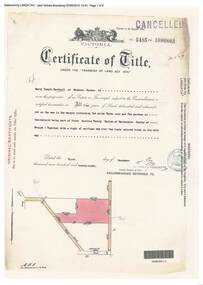 Ringwood and District Historical Society
Document, Certificate of Title - Harry Temple Marshall, Wesburn Farmer, Vic. - part of Crown Section 20, Parish of Warrandyte, County of Evelyn - 1928
... Subdivision map includes un-named roads - western side is Wonga Road (later Warranwood Road), and eastern side is Grandview Grove (later Bemboka Road), both north of Plymouth Road, Ringwood, Vic. Transfers include Harold Claude Howship, 1st December, 1928 James Bell McAlpin, 26th March, 1939. A4 copies of Landata Victoria ...A4 copies of Landata Victoria Historical Search documents - Vol 5485 Fol 1096803. Harry Temple Marshall is now the proprietor of an Estate in Fee-simple subject to the Encumbrances notified hereunder ... 10 acres 3 roods 10 perches or thereabouts, together with a right of carriage way over roads coloured brown. Subdivision map includes un-named roads - western side is Wonga Road (later Warranwood Road), and eastern side is Grandview Grove (later Bemboka Road), both north of Plymouth Road, Ringwood, Vic. Transfers include Harold Claude Howship, 1st December, 1928 James Bell McAlpin, 26th March, 1939. -
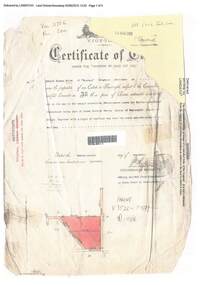 Ringwood and District Historical Society
Document, Certificate of Title - Edward Thomas Miles, Gentleman, "Woorara", Ringwood - part of Crown Section 20, Parish of Warrandyte, County of Evelyn - 1913
... western side is Wonga Road (later Warranwood Road), and eastern side is Grandview Grove (later Bemboka Road), both north of Plymouth Road, Ringwood, Vic. Transfers include (illegible) Dobbs, November, 1927 - 5 acres Harry Temple Marshall, 1st December, 1928 - 10ac 3r David Edward Meyland, 4th October, 194-? (illegible). A4 copies of damaged Landata Victoria ...A4 copies of damaged Landata Victoria Historical Search documents - Vol 3726 Fol 200 - incomplete proprietor and transfer details.Edward Thomas Miles is now the proprietor of an Estate in Fee-simple subject to the Encumbrances notified hereunder ... 27 acres 19 perches or thereabouts, together with a right of carriage way over roads coloured brown. Subdivision map includes un-named roads - western side is Wonga Road (later Warranwood Road), and eastern side is Grandview Grove (later Bemboka Road), both north of Plymouth Road, Ringwood, Vic. Transfers include (illegible) Dobbs, November, 1927 - 5 acres Harry Temple Marshall, 1st December, 1928 - 10ac 3r David Edward Meyland, 4th October, 194-? (illegible). -
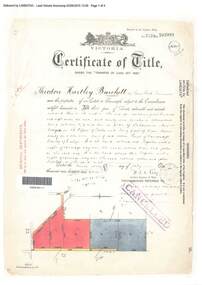 Ringwood and District Historical Society
Document, Certificate of Title - Theodore Hartley Burchett - part of Crown Section 20, Parish of Warrandyte, County of Evelyn - 1911
... western side is Wonga Road (later Warranwood Road), and eastern side is Grandview Grove (later Bemboka Road), both north of Plymouth Road, Ringwood, Vic. Transfers include Anna Maria Wicks and Henry James Trowbridge, 3rd October, 1911 Elizabeth Ann Walden, 18th September, 1912 - 28ac 3rds 5per. Edward Thomas Miles, 22nd September, 1913 - 27ac 19per. Samuel Styles, 10th October, 1916 - balance. A4 copies of Landata Victoria ...A4 copies of Landata Victoria Historical Search documents - Vol 3520 Fol 703991.Theodore Hartley Burchett of Lara Lake, Farmer, is now the proprietor of an Estate in Fee-simple subject to the Encumbrances notified hereunder ... 180 acres 01 rood 27 perches or thereabouts, being lots 1, 8, 9 and 10 on plan of subdivision no.4315. Subdivision map includes un-named roads - lower western side is Wonga Road (later Warranwood Road), and eastern side is Grandview Grove (later Bemboka Road), both north of Plymouth Road, Ringwood, Vic. Transfers include Anna Maria Wicks and Henry James Trowbridge, 3rd October, 1911 Elizabeth Ann Walden, 18th September, 1912 - 28ac 3rds 5per. Edward Thomas Miles, 22nd September, 1913 - 27ac 19per. Samuel Styles, 10th October, 1916 - balance. -
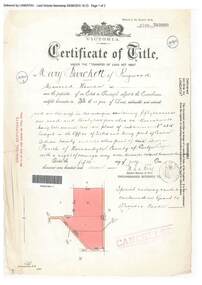 Ringwood and District Historical Society
Document, Certificate of Title - Mary Burchett, Lilydale Road, Ringwood - part of Crown Section 20, Parish of Warrandyte, County of Evelyn - 5th July, 1911
... Subdivision map includes un-named roads - western side is Wonga Road (later Warranwood Road), and eastern side is Grandview Grove (later Bemboka Road), both north of Plymouth Road, Ringwood, Vic. Title transferred to Theodore Hartley Burchett, 27th July, 1911. Encumbrance comment "Special railway condition contained in Grant to Francis Cooke." A4 copies of Landata Victoria ...A4 copies of Landata Victoria Historical Search documents - Vol 3520 Fol 703990.Mary Burchett of Ringwood, Married Woman, is now the proprietor of an Estate in Fee-simple subject to the Encumbrances notified hereunder ... 50 acres 1 rood 32 perches or thereabouts, being lots 1 and 10 on plan of subdivision no.4315. Subdivision map includes un-named roads - western side is Wonga Road (later Warranwood Road), and eastern side is Grandview Grove (later Bemboka Road), both north of Plymouth Road, Ringwood, Vic. Title transferred to Theodore Hartley Burchett, 27th July, 1911. Encumbrance comment "Special railway condition contained in Grant to Francis Cooke."
