
Showing 201 items matching " photo of young men"
-
 Bendigo Historical Society Inc.
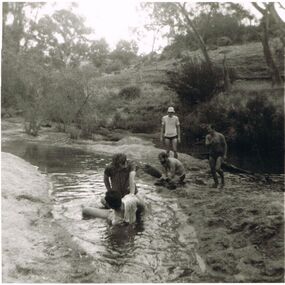
Photograph - PETER ELLIS COLLECTION: GROUP OF YOUNG MEN
... ... Photo of Young Men...Black and white photo of a group of young men at a stream. Two of them are in the water, one at the water's edge and two standing behind him. ...PHOTO Group male Peter Ellis Collection Photo of Young Men Black and white photo of a group of young men at a stream. ...Black and white photo of a group of young men at a stream. Two of them are in the water, one at the water's edge and two standing behind him. Bush in the background. Written on the back: John, Bruce, Ken, Garry, Wayne.photo, group, male, peter ellis collection, photo of young men -
 Halls Gap & Grampians Historical Society
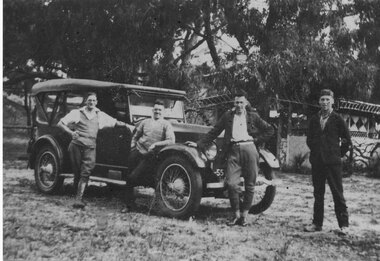
Photograph - B/W, C 1924
... Photo shows 3 young men known as the cook brothers stading beside Charles Knight (far right)...Photo shows 4 young men standing beside a car (Essex?) ...Photo shows 3 young men known as the cook brothers stading beside Charles Knight (far right) PEOPLE Knight Charles and 3 Cook boys Stoack exchange Melbourne Photo shows 4 young men standing beside a car (Essex?) ...Photo shows 3 young men known as the cook brothers stading beside Charles Knight (far right)Photo shows 4 young men standing beside a car (Essex?) outside Knights HenhamCharles and 3 Cook boys Stoack exchange Melbournepeople, knight -
 Bendigo Historical Society Inc.
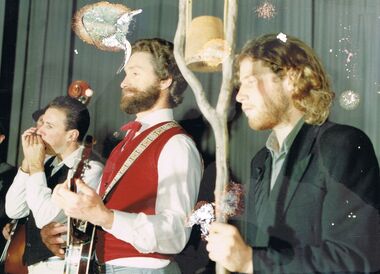
Photograph - PETER ELLIS COLLECTION: MEN PLAYING
... Some damage evident on front of photo. 3 young men playing instruments. Harmonica. ...Some damage evident on front of photo. 3 young men playing instruments. Harmonica. ...Colour photograph. Some damage evident on front of photo. 3 young men playing instruments. Harmonica. Banjo. Adhesive still evident on back of photo.entertainment, music, musicians -
 Uniting Church Archives - Synod of Victoria
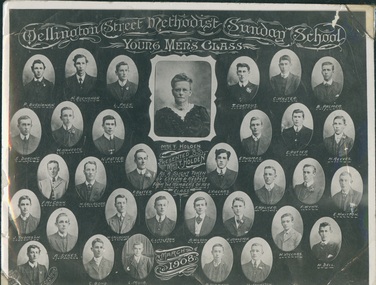
Photograph, 1908
... B & W composite photo of the Young Men's Class at Ashby Methodist Sunday School in Wellington Street, comprising 30 oval head and shoulders photos of the young men, and 1 rectangular head and shoulders photo of their teacher, Mrs T. ... of the Young Men's Class at Ashby Methodist Sunday School in Wellington Street, comprising 30 oval head and shoulders photos of the young men, and 1 rectangular head and shoulders photo of their teacher, Mrs T. ...Mrs Mary Holden (1843 - 1930) was the mother of the Rev Albert Thomas Holden CBE V.D., B.A., D.D. Director of the Methodist Inland Missions, Chaplain-General of the A.I.F. and President-General of the Methodist Conference of Australasia. She was the mother-in-law of the Rev. Samuel HobanB & W composite photo of the Young Men's Class at Ashby Methodist Sunday School in Wellington Street, comprising 30 oval head and shoulders photos of the young men, and 1 rectangular head and shoulders photo of their teacher, Mrs T. Holden."Wellington Street Methodist Sunday School Young Men's Class. Presented to Mrs T. Holden as a slight token of esteem and respect from the members of her class. March 1908. P. Buchanan,N. Buchanan, L. Pash, T. Cortous, C. Walter, B. Palmer, S. Dorling, W. Hancock, N. Potter, E. Thomas, E. Potter, H. Reeves, R. McCann, H. Gallagher, P. Baxter, L. Viccars, F. Walker, F. Wynn, E. Whitton, J. Thomson, A. Sykes, W. Gallagher, G. Littleton, A. Wilson, N. Johnston, H. Viccars, H. Bell, C. Cortous, C. Bond, L. Muir, R. Thomson, H. Johnston.mary holden, rev albert thomas holden, rev samuel hoban, ashby methodist, sunday school -
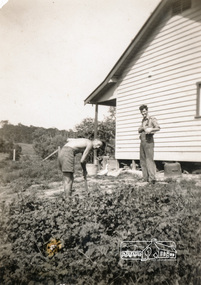 Eltham District Historical Society Inc
Photograph, Keith and Geoff (surname Baddeley?)
... Photo depicting two young men standing and working in a garden beside a new-looking weatherboard house - the back of this photo has the names Keith and Geoff and possibly the surname Baddeley. ...Photo depicting two young men standing and working in a garden beside a new-looking weatherboard house - the back of this photo has the names Keith and Geoff and possibly the surname Baddeley. ...Photo depicting two young men standing and working in a garden beside a new-looking weatherboard house - the back of this photo has the names Keith and Geoff and possibly the surname Baddeley. Black and white photograph printed with white borders (one of a set of five). -
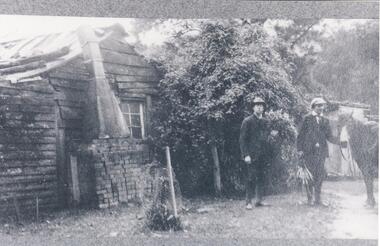 Halls Gap & Grampians Historical Society
Photograph - B/W, C 1950s or early 1950s
... Photo of three young men an a young lady sitting on edge of a pool with large trees and five vehicles in the background. ...RECREATION Swimming Pool Photo of three young men an a young lady sitting on edge of a pool with large trees and five vehicles in the background. ...The swimming pool at Hall's Gap.Photo of three young men an a young lady sitting on edge of a pool with large trees and five vehicles in the background. A wooden railing fence can be seen in the background. A depth indicator of 2 feet is painted on the side of the pool.recreation, swimming pool -
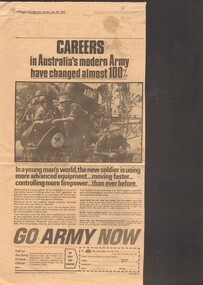 National Vietnam Veterans Museum (NVVM)
Newspaper - Recruitment advertisement
... Yellowed newspaper Army recruitment article from The Sun 20/01/1969. Photo of 3 young men in Australian Army uniform a Sioux helicopter with a kangaroo emblem. ...Yellowed newspaper Army recruitment article from The Sun 20/01/1969. Photo of 3 young men in Australian Army uniform a Sioux helicopter with a kangaroo emblem. ...This item contributes to an understanding of the experience of Australian society and attitudes to the war in Vietnam.Yellowed newspaper Army recruitment article from The Sun 20/01/1969. Photo of 3 young men in Australian Army uniform a Sioux helicopter with a kangaroo emblem. Beneahan article are the words 'Go Army Now" and a coupon to be detached, filled and posted.The Sun newspaper Jan 20 1969. Careers/in Australia's modern army/changed almost 100%. Picture of Australian helicopter with pilot inside and two soldiers beside the helicopter. Flying kangaroo on the side of the helicopter.careers, army, recruitment, vietnam -
 Glenelg Shire Council Cultural Collection
Photograph - Photograph - Port of Portland Offices, n.d
... Black & white photo of 4 young men, standing outside the PPA Offices. ...Port of Portland Authority Archives Port of Portland Archives Port of Portland offices staff Black & white photo of 4 young men, standing outside the PPA Offices. ...Port of Portland Authority Archivesport of portland archives, port of portland offices, staff -
Bendigo Historical Society Inc.
Photograph - VAL CAMPBELL COLLECTION: PHOTOGRAPH OF FOUR YOUNG MEN IN CASUAL ATTIRE, 1993
... Colour photo of four young men standing in front of a metal fence. ...RECREATIONS Sports Swimming Colour photo of four young men standing in front of a metal fence. ...Colour photo of four young men standing in front of a metal fence. They are dressed in shorts, swim suits and shirts. Written on the front of the photo: Left to Right Gavin Martin, Russell Martin, Peter Daley, Travis Mitchell 1993. Written on the back of the photo: 1993 Mens Relay Travis Mitchell Peter Daley Russell Martin Gavin Martin.recreations, sports, swimming -
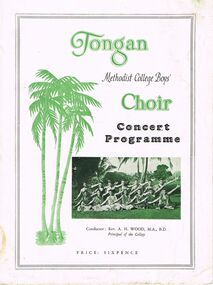 Bendigo Historical Society Inc.
Document - LYDIA CHANCELLOR COLLECTION; TONGAN METHODIST COLLEGE BOYS' CHOIR CONCERT PROGRAMME
... It also includes a photo of the young men in their traditional clothing. ...It also includes a photo of the young men in their traditional clothing. ...A cream programme with green and black print on the cover and the words, ' Tongan Methodist College Boys' Choir Concert Programme. Conductor : Rev. A.H. Wood, M.A., B.D. Principal of the College. Price sixpence.' It also includes a photo of the young men in their traditional clothing. Inside the programme is some information on Tonga and the Choir including photos. On the back of the programme is a list of the 'Personnel of the choir.' C. 1933.program, music, singing, lydia chancellor, collection, music, entertainment, performing arts, singing, programme, program, event, tonga -
Bendigo Historical Society Inc.
Photograph - VAL CAMPBELL COLLECTION: PHOTOGRAPH OF FOUR MEN IN SWIM ATTIRE, 1993
... Colour photo of four young men standing in front of a metal fence. ...RECREATIONS Sports Swimming Colour photo of four young men standing in front of a metal fence. ...Colour photo of four young men standing in front of a metal fence. They are dressed in shorts, swim suits and shirts. Around their feet are towels, bags and a drink flask. Written on the front of the photo: Gavin Martin, Russel Martin, Peter Daley, Travis Mitchell 1993. Written on the back of the photo: 1993 Travis Mitchell Peter Daley Russell Martin Gavin Martin 18/0 Mens Relayrecreations, sports, swimming -
Surrey Hills Historical Society Collection
Photograph, Wyclif Congregational Church Sunday School Picnic 1921 (2), 1921
... A sepia photo of 6 young men standing on a grassy bank. Four are wearing jackets or blazers, 2 have hats and one is wearing a cap. ...Photos have been numbered 1-7 in black marker pen at a later date. Individual identification of two men in blue biro - "Right: Ken Shearer" and " R - Harry James" in Jocelyn Hall's writing. On the back of the mount card in Jocelyn Hall's writing: L top: "No 2 - On Right Ken Shearer / Photo No 6 .. At Right: HARVEY JAMES / No 4: Back row holding Tray: / Hillier (Bill) Bayley" L bottom: "Donated by W. Dempsey / Photographer may have been / W. T. Hill of Pembroke St." A sepia photo of 6 young ...Harry James is thought to be a transcription error for Harvey James. See photo 2485 - Man on LHS is possibly Harvey James. See photo 2494 which ? identifies man as ? Breeden - Man 2nd from left in this photo may also be this man.A sepia photo of 6 young men standing on a grassy bank. Four are wearing jackets or blazers, 2 have hats and one is wearing a cap. Notations identify the individual on the RHS as Ken Shearer.Sepia photo, one of 7, mounted on what appears to be a page from a photo album. The page is olive-brown and it has been ruled into sections using a white ink. This measures 29.75 cm x 24.2 cm. This is mounted on card. This photo measures 8.25 cm x 5.6 cm."WYCLIF S. S. PICNIC AT HAMPTON 1921." in white ink with gold highlights. Photos have been numbered 1-7 in black marker pen at a later date. Individual identification of two men in blue biro - "Right: Ken Shearer" and " R - Harry James" in Jocelyn Hall's writing. On the back of the mount card in Jocelyn Hall's writing: L top: "No 2 - On Right Ken Shearer / Photo No 6 .. At Right: HARVEY JAMES / No 4: Back row holding Tray: / Hillier (Bill) Bayley" L bottom: "Donated by W. Dempsey / Photographer may have been / W. T. Hill of Pembroke St."wyclif congregational church, picnics, sunday schools, hampton, ken shearer, harry james, harvey james, bill dempsey, w dempsey -
 Eltham District Historical Society Inc
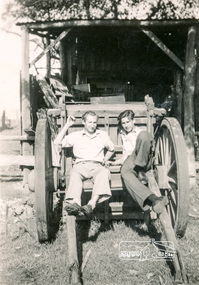
Photograph, Peter Alford and Den(?) Braithwaite
... Peter Alford and Den Braithwaite are named on the back of the photo, which depicts two young men sitting on the back of a cart with harness (normally attached to a horse). ...Peter Alford and Den Braithwaite are named on the back of the photo, which depicts two young men sitting on the back of a cart with harness (normally attached to a horse). ...Peter Alford and Den Braithwaite are named on the back of the photo, which depicts two young men sitting on the back of a cart with harness (normally attached to a horse). The person on the right appears to be the same as the one denoted "Don" sitting on the same cart in another photo in the set. Den is believed to be the son of Geoff Braithwaite who drew a map of Eltham c.1920 from his memory - see EDHS_04977-2Black and white photograph printed with white borders (one of a set of five).peter alford, den braithwaite -
 Bendigo Historical Society Inc.
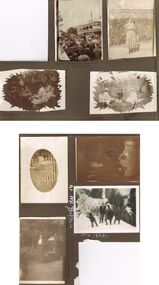
Photograph - HILDA HILL COLLECTION: BLACK AND WHITE PHOTOS, 1918-1923
... Three women and young boy all seated on the ground, the ladies are all in white and two wearing white hats, young boy is dressed in suit with white shirt and dark tie and his right hand is pointing to his open mouth, to their right is a wooden structure and distant background more people can be seen, dinner time Hibernian picnic Axedale 13 November 1918. Overdeveloped photo of two young men...Three women and young boy all seated on the ground, the ladies are all in white and two wearing white hats, young boy is dressed in suit with white shirt and dark tie and his right hand is pointing to his open mouth, to their right is a wooden structure and distant background more people can be seen, dinner time Hibernian picnic Axedale 13 November 1918. Overdeveloped photo of two young men ...Series of Black & White Photos of Hill Family and Friends during the war and post war life. Total 8 Photos. Welcome Parade General Pa n Bendigo October 21, 1918, tram wiring post in street, large two storey building in the background named Stanley's Coffee palace at corner of Mitchell and Mollison streets, Large crowd on roadway, Covered wagon among crowd with Good Shepherd laundry written on the side, foreground shows General Pau being driven through the crowd, General Pan is wearing a Napoleon style hat. Doreen dressed in a light coloured dress with white collar standing before a hedge, at rear is part of a corrugated iron roof gable, S.H.L.C. 27 September 1918. Group of four ladies three dressed in white and other a darker colour all seated on the ground, distant background a row of trees along a fence line, tea time Hibernian picnic Axedale 13 November 1918. Three women and young boy all seated on the ground, the ladies are all in white and two wearing white hats, young boy is dressed in suit with white shirt and dark tie and his right hand is pointing to his open mouth, to their right is a wooden structure and distant background more people can be seen, dinner time Hibernian picnic Axedale 13 November 1918. Overdeveloped photo of two young men standing between two shrubs and in front of a full length external window blind, 'The Ranche' February 1918. Group of four males dressed in dark coats and grey trouser at the snow Mt. Buffalo July 1923. Baby Irene clothed in white with bonnet seated in an English style pram with large wheels, picket fence and shrubbery in background, may 1918. Gert dressed in white shirt dark cardigan and dark skirt standing in front of hedged garden and trees, a small part of a roof can be seen between the trees, Railway Reserve 1918.Hilda Hill Personal Collectionaustralia, history, post war life -
 Federation University Historical Collection
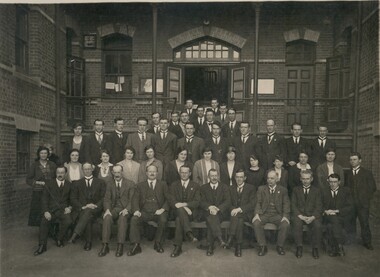
Photograph - Photograph - black and white, Ballarat School of Mines Staff, 1923
... Robinson Young McIlvena Duncan Leroux Jolly Malin King Maddison Gordon Wakeling Tunbridge Williamson Bell Elston Robertson Smith Jones Lonie Mackie Coates Trengrove McConnon Sutherland Steane Heseltine Robinson Kenneth Archibald University Women Ruby Lonie Verso: an incomplete list of names of the people in the photo. Also :"Archives TB14" and dates "1923 or 1924" Black and white photograph of men ...The earliest possible date is 1923 because J. B. Robinson was appointed Registrar on 27 April 1923. Names on verso: Leask, Johnston, Richards, Peterson, Murphy, Third row - from left: Young, McIlvena, Duncan, Leroux, Jolly, Malin, King, Maddison, Gordon, Sam Mayo, Wakeling, Second row - from left: Tunbridge, Williamson, Bell, Elston, Robertson, Hester Darby, Smith, Jones, Lonie, McIlvena, Mackie, Coates, Front Row - from left: Trengrove, McConnon, Sutherland, Steane, Heseltine, Smith, Robinson, Steane, Kenneth, ArchibaldBlack and white photograph of men sitting in front of a building. The photograph is attached to a grey cardboard mountVerso: an incomplete list of names of the people in the photo. Also :"Archives TB14" and dates "1923 or 1924"smb, staff, ballarat school of mines, ballarat, education, building, donald johnston, j.b. robinson, harold wakeling, sam mayo, hester darby, leask, johnston, richards, peterson, murphy, j. b. robinson, young, mcilvena, duncan, leroux, jolly, malin, king, maddison, gordon, wakeling, tunbridge, williamson, bell, elston, robertson, smith, jones, lonie, mackie, coates, trengrove, mcconnon, sutherland, steane, heseltine, robinson, kenneth, archibald, university women, ruby lonie -
 Federation University Historical Collection
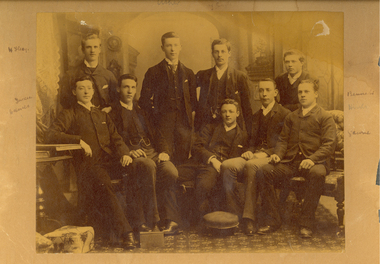
Photograph - Photograph - Sepia, Ballarat School of Mines Students, c1900
... photo surrounds "H. Fleahy, Jewkes, James, Usher, T. Sayle, Bennett, Hicks, Gacone" Photograph of a group of nine young men, thought to be students of the Ballarat School of Mines. ...The following information relates to enrollments at the Ballarat School of Mines. H . Fleay studied assaying in 1896 John, Spencer, Wallace and Walter Jewkes were enrolled at the Ballarat School of Mines in the late 1880s. J.F., J. Noble, Joseph F., Joseph E., Joseph F. Jnr, Noble Luke, and Patrick Usher were enrolled at the Ballarat School of Mines in the late 1880s and early 1890s. Thomas Sayle was enrolled in Materia Medica, Chemistry, Botany and Astronomy between 1884 and 1891. James, John, Thomas and William Hicks were enrolled at the Ballarat School of Mines in the late 1880s. Photograph of a group of nine young men, thought to be students of the Ballarat School of Mines. Names written in pen on the photo surrounds "H. Fleahy, Jewkes, James, Usher, T. Sayle, Bennett, Hicks, Gacone"ballarat school of mines fleahy, jewkes, james, usher, sayle, benneli, hist, gacone, alumni -
 Federation University Historical Collection
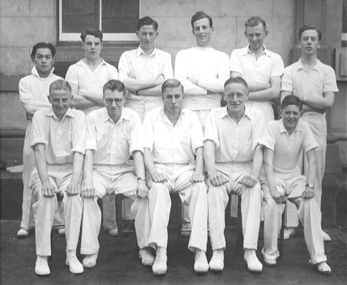
Photograph - Photograph - Black and White, Ballarat School of Mines Cricket Team, 1941, 1941
... Black and white photograph of 11 young men dressed in white. The photo depicts the Ballarat School of Mines Cricket team, 1941. ...Rowe ballarat school of mines cricket On back in pencil "1941" Black and white photograph of 11 young men dressed in white. The photo depicts the Ballarat School of Mines Cricket team, 1941. ...This photograph is reproduced on page 19 of the 1941 Ballarat School of Mines Students' Magazine. The 1941 Cricket team had a successful season, but owing to the weather and conflicting arrangements only three matches were played. Scores: Ballarat School of Mines 130 defeated Ballarat High School 114 Ballarat School of Mines 53 defeated Ballarat Church of England Grammar School 34 Ballarat School of Mines 102 defeated Ballarat Church of England Grammar School 101 Eric William Goon was the son of Chinese Herbalist F.S. Goon of Peel Street, Ballarat Black and white photograph of 11 young men dressed in white. The photo depicts the Ballarat School of Mines Cricket team, 1941. Back Row: Eric Goon, D. Eltringham, K. Richard, L. Evans, I. McLachlan, Philip Kempe. Front Row: M. Laurence, J. Elliott, J. Gibbs (capt), Gordon Hale (vice-captain). W. RoweOn back in pencil "1941"eric goon, d. eltringham, k. richard, l. evans, i. mclachlan, philip kempe., m. laurence, j. elliott, j. gibbs, gordon hale, w. rowe, ballarat school of mines, cricket -
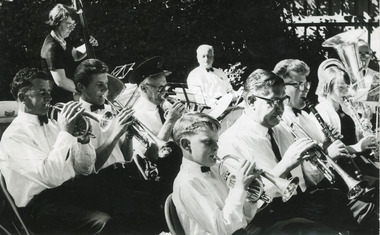 The Beechworth Burke Museum
Photograph, c1997
... This photo was taken in 1997 and highlights the diversity of the band members, which includes both young and old men and women all working together to deliver a performance. ...This photo was taken in 1997 and highlights the diversity of the band members, which includes both young and old men and women all working together to deliver a performance. ...This photograph contains an array of different musical instruments being used by a band in a performance. The instruments visible in the photo include the Cymbals, Double bass, Trumpets, Trumbones, Tuba and Clarinets. Given the assortment of instruments present it is clear that this ensemble is an orchestral band. All of these instruments require the musician to be sitting while performing as depicted in the photograph. This photo was taken in 1997 and highlights the diversity of the band members, which includes both young and old men and women all working together to deliver a performance. While the details of the event are still unknown, it is safe to assume that this was taken during a formal performance due to the formal attire worn by the band members. This photo captures a specific time and event in amazing detail while showcasing the historic use of these intruments in a social setting. This photograph carries great historic significance as it depicts the historic use of these instruments within the context of an orchestral band performance. With this knowledge, one can track the importance and use of these instruments across time as well as understand the type of events and activities associated with the people and communities that attended these gatherings, as both performers and audience members. Black and white rectangular photograph printed on matte photographic paper, unmounted.reverse: 2671 / 1997.00007 / Agfo [watermark]band, band members, instruments, musical instruments, trumpet, black and white, formal attire, musical performance, 1997, brass instruments, percussion instruments, woodwind instruments, orchestra -
Federation University Historical Collection
Photograph - Gladstone Procter Collection, Scott's For Snap Shots, Collection of Gladstone Procter photographs and motorcycle Licence, c 1910 - 1920
... .1 Sepia photograph with the words; Be your own draughtsman, learn your trade thoroughly, classes held at Prahran Technical School. with a photo of a student. . 2a & 2b Two Small black and white photogrpah of metal box .3 portrait photograph of Gladstone Procter with pipe in his mouth .4 Sepia photograph of mantlepiece with ornaments & clock .5 Black and white photograph of trophy on stand .6 Black and white photogrpah of chandelier .7 Postcard sent by Gladstone to his father with photograph of Gladstone on the front. .8 Black and white photograph of inside Methodist Church 1932 Burnbank St .9 Photograph of four young men including Glad and Roy Proctor. ...Glad centre front. .12 L-R Glad, Roy Proctor written on the back .1 Sepia photograph with the words; Be your own draughtsman, learn your trade thoroughly, classes held at Prahran Technical School. with a photo of a student. . 2a & 2b Two Small black and white photogrpah of metal box .3 portrait photograph of Gladstone Procter with pipe in his mouth .4 Sepia photograph of mantlepiece with ornaments & clock .5 Black and white photograph of trophy on stand .6 Black and white photogrpah of chandelier .7 Postcard sent by Gladstone to his father with photograph of Gladstone on the front. .8 Black and white photograph of inside Methodist Church 1932 Burnbank St .9 Photograph of four young men including Glad and Roy Proctor. ...Frederick Gladstone PROCTER (1898-1977) The Ballarat Technical Art School was well known for its art metal work which was applied to product, interior and commemorative designs. Students undertook many commissions. A small jewellery and enamelling class was also introduced in 1922..1 Sepia photograph with the words; Be your own draughtsman, learn your trade thoroughly, classes held at Prahran Technical School. with a photo of a student. . 2a & 2b Two Small black and white photogrpah of metal box .3 portrait photograph of Gladstone Procter with pipe in his mouth .4 Sepia photograph of mantlepiece with ornaments & clock .5 Black and white photograph of trophy on stand .6 Black and white photogrpah of chandelier .7 Postcard sent by Gladstone to his father with photograph of Gladstone on the front. .8 Black and white photograph of inside Methodist Church 1932 Burnbank St .9 Photograph of four young men including Glad and Roy Proctor. Has been clipped to oval shape. .10 Photograph of Glad and Roy Procter and ? sent to Glad's Grandmother Jess 16th April 1917 .11 Photograph of School of Mines Cadet team Glad is centre front - Sepia .12 Photograph Sepia, including Glad and Roy Procter .13 Photograph of Gladstone shaking hands with another man .14 Motorcycle drivers licence issued to T.R. Procter .4 F.G. Procter stamped on the back. .5 Barnes the Chemist Warnambool, stamped on the back .7 To Dad With Love from Glad. Taken at Bailey's Prahran written in lead pencil on the back. .8 March 20th 1932, Meth Ch Burnbank Street written in lead pencil on the back .9 Written on the back in lead pencil far right Glad Proctor to his left Roy Proctor .10 Written on the back in lead pencil from Glad to Jess G. Mother 16/4/17 L-R Roy, Glad, ? .11 Written in lead pencil on the back, School of Mines Ballarat, Cadet Team 1916, South Street Competitions, Second Place, Beaten by High School Ballarat by 9 points. Glad centre front. .12 L-R Glad, Roy Proctor written on the backfrederick gladstone procter, ballarat technical art school, roy procter, photographs, motorcycle licence, school of mines ballarat, cadet team, methodist church -
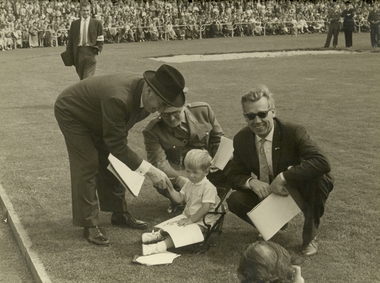 Federation University Historical Collection
Photograph - Black and White, Foto: Vinders, Frank Wright, Officials and Child at Kerkrade, 1960's
... men and a child. A man, Frank Wright, is bending down to shake the hand of a young boy who is seated on a small chair in the middle of a sports ground. Squatting next to him is another man, possibly his father and behind the child is a man dressed in a uniform. At the bottom of the photo...men and a child. A man, Frank Wright, is bending down to shake the hand of a young boy who is seated on a small chair in the middle of a sports ground. Squatting next to him is another man, possibly his father and behind the child is a man dressed in a uniform. At the bottom of the photo ...Frank Wright was a renown resident of Smeaton, where he was born. He lived at Laura Villa, and attended Smeaton State School. His father William was a gold miner and his mother's name was Sarah. Their family won many singing and instrumental awards. Frank was tutored by Percy Code and was awarded a gold medal for the highest marks in the ALCM examinations in the British Colonies at the age of seventeen years. He became the Australian Open Cornet Champion by the age of eighteen. A year later, Frank conducted the City of Ballarat Band, and later the Ballarat Soldiers’ Memorial Band. He formed the Frank Wright Frisco Band and Frank Wright and his Coliseum Orchestra. These bands won many South Street awards, and Frank as conductor won many awards in the Australian Band Championship contest. In 1933 Frank Wright sailed to England to conduct the famous St Hilda’s Band and was later appointed Musical Director of the London County Council, where he organized many amazing concerts in parks, in and around the London district. He was made Professor of Brass and Military Band Scoring and conducted at the Guildhall of Music and Drama. Frank was often invited to adjudicate Brass Band Championships around Europe, in Australia, including South Street and in New Zealand. The Frank Wright Medal at the Royal South Street competition is awarded to an individual recognized as making an outstanding contribution to brass music in Australia.Black and white photograph of three men and a child. A man, Frank Wright, is bending down to shake the hand of a young boy who is seated on a small chair in the middle of a sports ground. Squatting next to him is another man, possibly his father and behind the child is a man dressed in a uniform. At the bottom of the photo, the head of another photographer can just be seen. In the background can be seen a large audience in the stands and several officials are standing watching the interaction between Frank and the child. The place is Kerkrade, the Netherlands.Hand written on the front of the mounting board - Foto Vindersfrank wright, foto vinders, kerkrade -
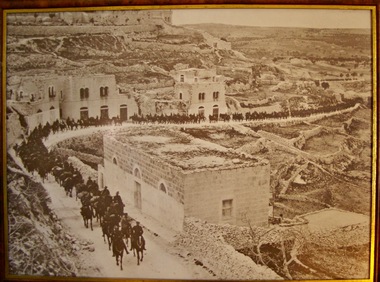 Lara RSL Sub Branch
Photograph, Regiment of the Australian Light Horse on the March in Jerusalem in Palestine
... The Light Horse were seen as the “national arm of Australia’s defence” and young men, most from the country, flocked to join. ww1 world war 1 australian light horsemen palestine lara r.s.l. "A Regiment of the Australian Light Horse on the March in Jerusalem in Palestine." Framed and glass covered photo ...By 1914, when Australia joined the war against Germany, there were 23 Light Horse regiments of militia volunteers. Many men from these units joined the Light Horse regiments of the Australian Imperial Force (AIF). Initially Australia promised four regiments of Light Horse, 2000 men, to fight in the British cause. By the end of the war, 16 regiments would be in action.The Light Horse were seen as the “national arm of Australia’s defence” and young men, most from the country, flocked to join. Framed and glass covered photo of a Regiment of the Australian Light Horse on the March in Jerusalem in Palestine"A Regiment of the Australian Light Horse on the March in Jerusalem in Palestine."ww1, world war 1, australian light horsemen, palestine, lara r.s.l. -
 Federation University Historical Collection
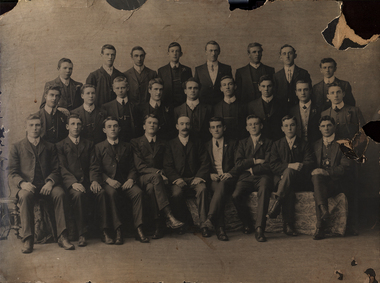
Photograph - Black and White, Dawson Street Baptist Young Men's Club, 1908, 06/1908
... Large mounted photo of 26 members of the Dawson Street Baptist Young Men's Club....young men's club a.e. ewins Presented to A.E. Ewins Esq By the members of the Dawson St Baptist Young Men's Club as a token of esteem. Large mounted photo ...Large mounted photo of 26 members of the Dawson Street Baptist Young Men's Club.Presented to A.E. Ewins Esq By the members of the Dawson St Baptist Young Men's Club as a token of esteem.dawson street baptist young men's club, a.e. ewins -
 Flagstaff Hill Maritime Museum and Village
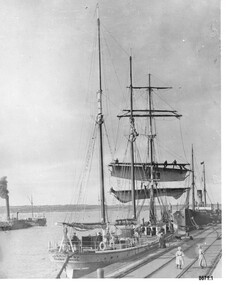
Photograph - Vessels Speculant and S. S. Flinders, Between 1902 and 1907
... men can be seen at the wheel, on the deck and on the bottom two booms where they appear to be furling the sails. The sails of the top booms are already furled. A small boy can be seen on the deck and a young girl, two women and a dog are on the Breakwater. There is a steam ship (the S. S. Flinders) tied up behind the "Speculant" and an unidentified steam ship (with smoke coming from its smokestack) in the bay. There is a blue and black handwritten label on the back of the photo...men can be seen at the wheel, on the deck and on the bottom two booms where they appear to be furling the sails. The sails of the top booms are already furled. A small boy can be seen on the deck and a young girl, two women and a dog are on the Breakwater. There is a steam ship (the S. S. Flinders) tied up behind the "Speculant" and an unidentified steam ship (with smoke coming from its smokestack) in the bay. There is a blue and black handwritten label on the back of the photo ...This photograph was one of ten photographs donated to Flagstaff Hill Maritime Museum and Village by Fred Trewartha. Frederick John Fox Trewartha (Fred) was a well-known Warrnambool businessman. He was born in Beeac near Geelong in 1920 and came to Warrnambool with his family as a very young child. He was apprenticed to his father John, as a saddler and later opened his own shop on Raglan Parade. He then moved into working with tarpaulins and canvases for the trucking industry. Fred was keenly interested in photography (and was a member of the Warrnambool Cine Club), yachting and boat building. He kept his yacht moored at Port Fairy for many years and participated in sailing events locally and interstate. He also built boats with his sons. He had the opportunity to meet many older sailors and it's thought this photo (and others in the set) may have been given to him by one of these men. Fred Trewartha died in 2016 in Warrnambool. The two identifiable ships in this picture are the "Speculant" and the "S. S. Flinders" - both coastal trading vessels that regularly came and went from Warrnambool. The third steamer on the left hasn't been identified The barquentine SPECULANT was a steel, three-masted sailing ship built in 1895 in Inverkeithing, Scotland, registered in Warrnambool, Victoria and wrecked at Cape Paton, Victoria, 10th February 1911. The SPECULANT had been involved in the timber trade between the United Kingdom and Russia, until sold to its Warrnambool owners and timber merchants Messrs. P.J. McGennan & Co. (Peter John McGennan) in 1902 for 3000 pounds and had her sailed to Warrnambool as her new port. Peter John McGennan was born in 1844 and worked as a builder and cooper in Holyhead, Anglesea, Wales. He immigrated to Australia in 1869 as a free settler and arrived in Warrnambool in 1871 and undertook management of a property in Grassmere for Mr. Palmer. Peter met his wife Emily in South Melbourne and they married in 1873. They had ten children including Harry who lived to 1965, and Andrew who lived until 1958. (The other children were their four brothers - John who was killed in the Dardenalles aged 35, Frederick who died aged 8, Peter who died aged 28, Frank who died aged 5 weeks - and four sisters - Beatrice who died age 89, Edith who died aged 49, Blanche who died aged 89 and Eveline who died aged 48.) In 1874 Peter starting a boating establishment on the Hopkins River. In 1875 he opened up a Coopers business in Kepler Street next to what was Bateman, Smith and Co., moving to Liebig Street, next to the Victoria Hotel, in 1877. In 1882 he then moved to Lava Street (which in later years was the site of Chandlers Hardware Store). He was associated with the establishment of the Butter Factory at Allansford. He started making Butter Boxes to his own design and cheese batts for the Butter Factory. In 1896 established a Box Factory in Davis Street Merrivale, employing 24 people at its peak, (it was burnt down in 1923); and in Pertobe Road from 1912 (now the Army Barracks building). Peter was a Borough Councillor for Albert Ward from 1885 to 1891, he commenced the Foreshore Trust (including the camping grounds along Pertobe Road), and he was an inaugural Director of the Woollen Mill in Harris Street, buying an extensive share-holding in 1908 from the share trader Edward Vidler. They lobbied the Town Hall to have a formal ‘Cutting’ for the waters of the Merri River to be redirected from its natural opening south of Dennington, to its existing opening near Viaduct Road, in order to have the scourings from the wool at the Woollen Mill discharged into the sea. He sold Butter Boxes around the state, and had to ship them to Melbourne by rail. Peter’s purchase of the SPECULANT in 1902 enabled him to back-load white pine from Kaipara, New Zealand to Warrnambool to make his butter boxes then, to gain profitability, buy and ship potatoes and other primary produce bound to Melbourne. (McGennan & Co. had also owned the LA BELLA, which had traded in timber as well, until she was tragically wrecked with the loss of seven lives, after missing the entrance channel to Warrnambool harbour in 1905. It appears that the SPECULANT was bought to replace the LA BELLA.) In 1911 the SPECULANT had been attempting to depart Warrnambool for almost the entire month of January to undergo docking and overhaul in Melbourne. A month of east and south-easterly winds had forced her to remain sheltered in Lady Bay, Warrnambool apart from one morning of northerlies, when an attempt was made to round Cape Otway; she had to return to shelter in Portland after failing to make any headway. With only 140 tons of sand ballast aboard, the ship would not have been easy to handle. Captain Jacobsen and his crew of nine, mainly Swedes, decided to make for Melbourne, leaving Portland Harbour on 5th February 1911. By the 9th they had reached Cape Otway, where they encountered a moonless night, constant heavy rain, and a heavy sea with a south-easterly wind blowing. After safely rounding Cape Otway the course was changed to east, then north-east to take the vessel to a point six miles off Cape Patton, following the orders of Captain Jacobsen, who told the crew to be very careful with the steering, as the wind and sea was running to leeward. The patent log (used to measure speed) had been out of order for the last four months as no-one in Warrnambool was able to fix it: it was intended to have it repaired in Melbourne. In the meantime the crew measured the vessel's speed by looking over the side and estimating wind strength. This compounded the difficulties of imprecise positioning, as the strong cross wind and sea were acting on the lightly laden vessel to steadily drive it towards the shore. At 3.30am on Friday 10 February 1911 Captain Jacobsen and the first mate were looking over the side of the vessel when they heard the sound of breakers and suddenly struck the rocks. The crew immediately knew they had no chance of getting the SPECULANT off, and attempted to rescue themselves by launching the lifeboat, which was instantly smashed to pieces. One of the crew then volunteered to take a line ashore, and the rest of the crew were all able to drag themselves to shore, some suffering hand lacerations from the rocks. Once ashore they began to walk along the coast towards Lorne, believing it was the nearest settlement. Realising their mistake as dawn broke they returned westwards to Cape Patton, and found a farm belonging to Mr C. Ramsden, who took them in and gave them a change of clothes and food. After resting for a day and returning to the wreck to salvage some of their personal possessions, at 10am on Saturday they set out for Apollo Bay, a voyage that took six hours, sometimes wading through flooded creeks up to their necks. The Age described the wreck as "listed to starboard. All the cabin is gutted and the ballast gone. There is a big rock right through the bottom of her, and there is not the slightest hope of getting her off". A Board of Marine inquiry found that Captain Jacobson was guilty of careless navigation by not taking steps to accurately verify the position of the vessel with respect to Cape Otway when the light was visible and by not setting a safe and proper course with respect to the wind and sea. It suspended his certificate for 6 months and ordered him to pay costs. The location of the wreck site was marked for a long time by two anchors on the shoreline, until in 1970 the larger of the two anchors was recovered by the Underwater Explorers' Club and mounted on the foreshore at Apollo Bay. The bell from the wreck was also donated to the Apollo Bay Surf Lifesaving Club but is recorded to have been stolen. Rusting remains of the wreck can still be found on the shoreline on the southern side of, and directly below Cape Patton. Parts of the SPECULANT site have been buried by rubble from construction and maintenance works to the Great Ocean Road, as well as by naturally occurring landslides. Peter J McGennan passed away in 1920. The Gates in the western wall of the Anglican Church in Henna Street/Koroit St are dedicated to him for his time of community work, which is matched with other prominent Warrnambool citizens; Fletcher Jones, John Younger, J.D.E (Tag) Walter, and Edward Vidler. After Peter J McGennan's death Harry, Andrew and Edith continued to operate the family business until July 11th 1923 when the company was wound up. (Andrew lived in Ryot Street Warrnambool, near Lava Street.) Harry McGennan (Peter and Emily’s son) owned the Criterion Hotel in Kepler Street Warrnambool (now demolished). His son Sid and wife Dot lived in 28 Howard Street (corner of Nelson Street) and Sid managed the Criterion until it was decided by the family to sell, and for he remained Manager for the new owners until he retired. Harry commenced the Foreshore Trust in Warrnambool around 1950. The McGennan Carpark in Pertobe Road is named after Harry and there are Memorial-Stone Gates in his memory. (The Gates were once the original entrance to the carpark but are now the exit.). The Patent Log (also called a Taffrail log) from the SPECULANT, mentioned above, and a number of photographs, are now part of the Collection at Flagstaff Hill Maritime Village.. The S. S. Flinders was built by A. J. Inglis, Ltd, Pointhouse, Glasgow in 1878 for the "Tasmanian Steam Navigation Company', Hobart which merged with the "Union Steamship Company" of New Zealand and it was later sold to the firm "McIlwraith, McEacham and Company". It was built of iron and was 1000 tons and 227 feet, 1 inch long. It was described as "splendidly fitted up for the carriage of passengers and her cargo space was also very large". In the saloon about 130 passengers could be accommodated while the second class had sufficient room for one hundred passengers. In 1890, the S. S. Flinders would leave Melbourne on Mondays and Thursdays at 5 pm and reach Warrnambool the following morning at 8 am. On the return it would leave Warrnambool on Wednesdays and Saturdays at 5 pm and reach Melbourne the following morning. In 1896, the Weekly Times described the "steamer Flinders (otherwise known as "the Warrnambool mailboat") as "as good a sample of a seagoing steamer as there is trading on the Victorian Coast at the present time". In April 1896 newspaper reports noted the S. S. Flinders took 2915 bags of potatoes from Warrnambool to Melbourne (the largest shipment of that season) as well as 50 tons of tinned rabbits from the Hamilton Preserving Factory. It was also noted that particularly during the Christmas period, there were excessive demands for berths from holiday makers wanting to enjoy a holiday in Warrnambool. In May 1903, the S. S. Flinders narrowly escaped destruction when an explosion and subsequent fire occurred during the passage from Melbourne to Warrnambool. A drum (which apparently contained carbide of calcium) exploded and blew off a hatch cover. As the steamer got to within a mile or two of Warrnambool, smoke was seen coming out of the hold and (unknown to the passengers) flames had taken hold. The crew quickly got to work - closing down all the hatches and pumping water into the hold through a hole in the saloon floor. There were 30 or 40 cases of kerosene on board. The Flinders continued on to Warrnambool and berthed at the Breakwater. The passengers all went ashore - many unaware of the danger they had been in. A telephone message was sent to the local Fire Brigade Station however the fire was extinguished before the firemen and their equipment arrived. After the hold was checked, the Flinders was certified as seaworthy and left for Portland. The Flinders continued to transport Western District produce as well as passengers from Warrnambool to Melbourne until 1906 when (due to a decrease in shipping trade during the Winter and the availability of train services) the Flinders was replaced by the smaller steamer "Dawn" and in 1907 when it was sold to the "Adelaide Steamship Company" for use in the Western Australia coastal trade, it was replaced by the "S. S. Barrabool".This photograph is a significant record of two of the well known coastal traders (the "Speculant" and the "Flinders") that sailed along the south west coast of Victoria for many years - transporting goods and passengers between Melbourne and Warrnambool.Black and white photograph of the Breakwater in Warrnambool with two ships docked and another in the bay. On the front boat (the Speculant), men can be seen at the wheel, on the deck and on the bottom two booms where they appear to be furling the sails. The sails of the top booms are already furled. A small boy can be seen on the deck and a young girl, two women and a dog are on the Breakwater. There is a steam ship (the S. S. Flinders) tied up behind the "Speculant" and an unidentified steam ship (with smoke coming from its smokestack) in the bay. There is a blue and black handwritten label on the back of the photo - naming the ships and the owner of the photo.Speculant and Flinders / Passenger ship in / Lady Bay / name of donor and phone numberflagstaff hill maritime museum and village, warrnambool, great ocean road, shipwreck coast, speculant, barque speculant, flinders, s. s. finders, steamship flinders, coastal trader, passenger ship, goods, steamer, breakwater, lady bay, warrnambool mailboat, p. j. mcgennan, peter john mcgennan, butter boxes, captain jacobsen, cape patton, tasmanian steam navigation company -
 Flagstaff Hill Maritime Museum and Village
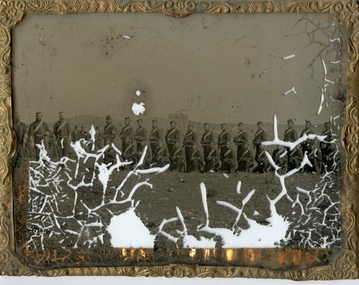
Photograph - Glass plate, circa 1866
... young township. There are other well-dressed citizens behind them. The three men with frogging on their sleeves were commanders were likely to be commanders. The men are facing north with Cannon Hill and the fortification area in the background. It dates from the 1860s. The firearms held appear to be 1853 pattern Lee Enfield muskets used by the British army in Crimea at this time and in Australia, rather than the later Martini Henry cartridge rifles. The uniforms match other photos...young township. There are other well-dressed citizens behind them. The three men with frogging on their sleeves were commanders were likely to be commanders. The men are facing north with Cannon Hill and the fortification area in the background. It dates from the 1860s. The firearms held appear to be 1853 pattern Lee Enfield muskets used by the British army in Crimea at this time and in Australia, rather than the later Martini Henry cartridge rifles. The uniforms match other photos ...This glass plate photograph shows good detail of members of the Warrnambool Garrison posing for their photograph in front of a young township. There are other well-dressed citizens behind them. The three men with frogging on their sleeves were commanders were likely to be commanders. The men are facing north with Cannon Hill and the fortification area in the background. It dates from the 1860s. The firearms held appear to be 1853 pattern Lee Enfield muskets used by the British army in Crimea at this time and in Australia, rather than the later Martini Henry cartridge rifles. The uniforms match other photos of the Warrnambool Garrison Militia and Band in our Collection, taken up until the 1880s. The three storey building in the photograph is likely to be the Manifold & Bostock flour mill, built in 1854 near the ‘cutting’ in Merri Street, which was one of the main streets at the time; if one faced the building’s front from a vantage point and looked south to south-east, the hills around Flagstaff Hill and Cannon Hill would be behind that mill, and the Harbour behind the hills. This is the area of the Fortifications. The glass plate method of photography was widely used during the mid-19th to early-20th century. The donor and maker of the photograph are unknown. Around this time the citizens of Victoria were prospering from the gold rush but felt isolated and uneasy about their security in the colony. In 1854 the Volunteer Act was passed to provide some military defence. In 1858 the Warrnambool Volunteer Rifle Corps was established, disbanded in 1863, then a new Warrnambool Detachment was formed in September 1866. Legislation was passed in 1884 that replaced the volunteers’ corps with a partly paid, permanent Militia Defence Force. The batteries manning the coastal forts of Victoria were termed Garrison Artillery Companies. When the Army was federated in 1901 there were eight Militia Companies in Victoria. Warrnambool and Port Fairy together were known as 8 Coy AGA (Australian Garrison Artillery). Changes to formation and name continued into the 20th century.This photograph is a record of the very early local defence force, circa 1866. The photograph signifies the connection of the colony in Victoria to the growing need for security due to the unrest in Europe at that time. The photograph is also locally significant to the industry of the young township of Warrnambool, showing what is likely to be one of the first flour mills in the town. The photograph is also the only example of the early methods of glass plate photography in our collection. Photograph, rectangular glass plate, positive sepia image. Photograph has brass framed edges that fold over to the back, with mitred corners. The front edges are pressed with a decorative floral pattern. The photograph shows a group of thirty military men, standing or kneeling, in dark uniforms with pillbox forage caps, round-collared jackets with light buttons, light sashes worn from top left shoulder to bottom right side of waist belt, and long, straight-legged trousers. Three of these men have light braid around the buttons on the front of their jackets, light frogging on their sleeve cuffs and stripes on the outside seams of their trousers. The other twenty-seven men have plain uniforms and are holding firearms in their right hands, steadied with their left hands. Other figures are standing behind this group of soldiers, including three or four men wearing top hats, jackets and ties. In the background is a row of buildings. The central building is three stories high. Bare hills are in the far background. The foreground is uneven ground with patches of short grass. Photographer looking towards the south east and Cannon Hill, with the Warrnambool Garrison facing north, ca.1860s.flagstaff hill, warrnambool, shipwrecked coast, flagstaff hill maritime museum, maritime museum, shipwreck coast, flagstaff hill maritime village, great ocean road, glass plate, photography 19th century, colonial forces, military defence, volunteer act 1854, volunteer rifle, garrison artillery, volunteer corps, militia, militia garrison band, pillbox forage caps, helpmann, manifold and bostock, 1853 lee enfield musket, tintype, warrnambool garrison, 1860s, cannon hill, manifold & bostock, flour mill, 3-storey building -
 Greensborough Historical Society
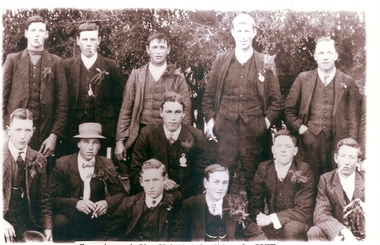
Photograph, Greensborough Glee Club 1912, 1912_
... photo: 'Greensborough Glee Club 1912. Candidates for QUIT' [refers to the men holding cigarettes] Black and white group photograph of 12 young men. ...Not much is known about this photo or the group. [Mentioned in Evelyn Observer and Bourke East Record Friday 26 September 1913 page 3]2013 update. All members of the group have been identified. Photo is now believed to be taken 1922.Black and white group photograph of 12 young men.Caption pasted across bottom of photo: 'Greensborough Glee Club 1912. Candidates for QUIT' [refers to the men holding cigarettes]glee club, greensborough, mcdowell, iredale, poulter eley, elliott, barrett -
 Greensborough Historical Society
Photograph - Digital Image, Diamond Creek boys, 1910c
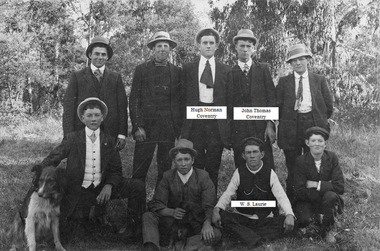
... A group of young men from Diamond Creek, including Hugh Norman Coventry, John Thomas Coventry and W.S. Laurie. Names supplied by Bruce McDowell. hugh norman coventry john thomas coventry Some names have been added to photo. ...A group of young men from Diamond Creek, including Hugh Norman Coventry, John Thomas Coventry and W.S. Laurie. Names supplied by Bruce McDowell.Digital copy of black and white photographSome names have been added to photo.hugh norman coventry, john thomas coventry -
 Greensborough Historical Society
Photograph - Digital image, Charles Marshall et al, Light Horse recruits in Seymour 1917, 1917_
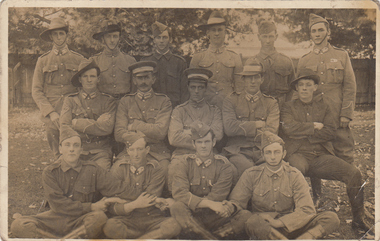
... young men, possibly Light Horse recruits. The back of the postcard has a Seymour address. charles marshall world war 1 No caption on this photo, back has a postcard layout. ...This photograph shows a group of young men, possibly Light Horse recruits. The back of the postcard has a Seymour address.Digital copy of black and white photograph. No caption on this photo, back has a postcard layout.charles marshall, world war 1 -
 City of Moorabbin Historical Society (Operating the Box Cottage Museum)
Album - Kodak album 24pp WW1 1914-1919, c1914-1918
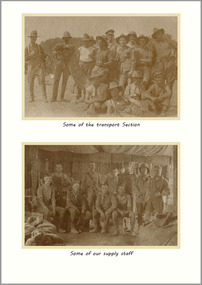
... The photos in this album show the carefree, adventurous spirit of the young men soon to be ANZACS Many young men from the market garden, dairy, poultry and fruit farms as well local businesses enlisted c 1914 at the beginning of WWI. ...The photos in this album show the carefree, adventurous spirit of the young men soon to be ANZACS Many young men from the market garden, dairy, poultry and fruit farms as well local businesses enlisted c 1914 at the beginning of WWI. ...The photos in this album show the carefree, adventurous spirit of the young men soon to be ANZACS Many young men from the market garden, dairy, poultry and fruit farms as well local businesses enlisted c 1914 at the beginning of WWI. The older men, women and children then had to manage the farms while they worried about the dangers facing their beloved family members. A record of some of the experiences of men from Moorabbin Shire who enlisted c1914 and were sent to Egypt at the beginning of WW1 1914-19A thick cardboard album of 24 pages with inserts for 2 small black and white photographs per page . Scenes from Egypt c 1914 - 1918 showing Australian soldiers, naval vessels, horses, carts, pyramids, houses, buildings, camels, local inhabitants and countryside. Inscriptions on the back of some of the photographs mention Arthur (Ebsary), Clarrie (Burgess), Reg (Marriott), and a horse named Nell.Front cover KODAK Inside back cover KODAK LTD. / SERIES D / ALBUM Some photographs have inscriptions on the backww1 1914-1918, photographs, australian light horse battalion, egypt, 1st australian infantry force, war horses, kodak ltd, wwi, moorabbin, marriott, harry beach -
City of Moorabbin Historical Society (Operating the Box Cottage Museum)
Newsletter - CMHS Moorabbin Mirror Vol 6 April 2016, Moorabbin Mirror Vol 6 April 2016, April 2016
... This issue of the Moorabbin Mirror is dedicated to all the young, and not so young, men and women from the former City of Moorabbin who served ‘King and Country’ during the Great War. Especially those who never came home including a photo of WW1 Mordialloc Memorial and the 2016 Local Commemorative Services. ...This issue of the Moorabbin Mirror is dedicated to all the young, and not so young, men and women from the former City of Moorabbin who served ‘King and Country’ during the Great War. Especially those who never came home including a photo of WW1 Mordialloc Memorial and the 2016 Local Commemorative Services. ...This is Vol. 6 of the Moorabbin Mirror produced by CMHS members Fran & Holger Bader , Valma Sharp April 2016 The Moorabbin Mirror reflects the history and heritage of the former City of Moorabbin — derived from Mooroobin, ‘a resting place’ in the Bunurrung spoken language. In 1994, the City of Moorabbin was integrated into the Cities of Bayside, Glen Eira, Kingston and Monash. This issue of the Moorabbin Mirror is dedicated to all the young, and not so young, men and women from the former City of Moorabbin who served ‘King and Country’ during the Great War. Especially those who never came home including a photo of WW1 Mordialloc Memorial and the 2016 Local Commemorative Services. Valma Sharp CMHS President 'officially opened' the new WC and thanked GECC for this amenity. Members and Guests then shared light refreshments before welcoming visitors to the BCM Extra Open Day. Unfortunately Lorna Thatcher was unable to attend due to a sudden illness and Committee and members sent Get Well wishes via Frank. The Diary informs members of the Extra Open Days, upcoming publicity events , Meetings and Community Group visits to BCM, Local interest items include Lees Nursery, Market Gardening Heritage, Westall UFO, Joyce Park Playground Solar System., Moorabbin Ten Pin Bowl and the School Amateur Radio Special Event. The Committee is very grateful for the help provided by David Hardham GEHS to set up our new CMHS website. An informative article re the 2012 GESAC that replaced the 1964 Olympic Pool. Information is requested for the Roving Curator August Rietman display 2017.This is Vol. 6 of the Moorabbin Mirror, Newsletter of CMHS April 2016A4 x 3 paper folded to A5 x 6pp with colour photographs. Moorabbin / Mirror / April 2016 Vol 6moorabbin mirror, bader fran, bader holger, sharp valma, hardham david, thatcher lorna, anzac memorial mordialloc, anzac, lees nursery thomas st brighton east, gesac, moorabbin ten pin bowling, joyce park playground ormond, bentleigh, moorabbin, mckinnon, roving curator program mav, westall ufo, -
 Greensborough Historical Society
Book, Susie Cooper et al, The Happy Hermits and Diary of a trip to Evelyn, 1908o
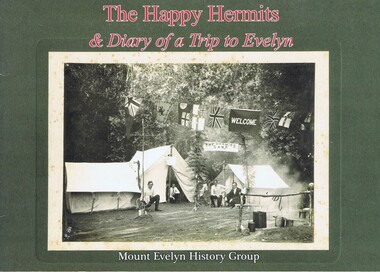
... The "Hermits" were a group of young men from Collingwood who had camping holidays at Evelyn (now Mount Evelyn) between 1908 and 1911. They took photographs, and were mentioned in a diary kept by two girls who spent their holidays in the area in 1911. The diary and photos...The "Hermits" were a group of young men from Collingwood who had camping holidays at Evelyn (now Mount Evelyn) between 1908 and 1911. They took photographs, and were mentioned in a diary kept by two girls who spent their holidays in the area in 1911. The diary and photos ...The "Hermits" were a group of young men from Collingwood who had camping holidays at Evelyn (now Mount Evelyn) between 1908 and 1911. They took photographs, and were mentioned in a diary kept by two girls who spent their holidays in the area in 1911. The diary and photos were found in a collection belonging to Dorothy Higgs, a sister of one of the Hermits, following her death in 1978. Some of the photos and a facsimile of the diary form this publication.The photos and diary provides direct evidence of turn-of-the-century holiday and tourist activity32 p. black & white and colour illus.mount evelyn, tourism
