
Showing 20 items matching " prentice hall"
-
 Moorabbin Air Museum
Book - PARACHUTES AND PARACHUTING, BUD SELLICK, 1971
... ...PRENTICE-HALL INC...PARACHUTES AND PARACHUTING Book PARACHUTES AND PARACHUTING BUD SELLICK PRENTICE-HALL INC ... -
Moorabbin Air Museum
Book - SHIELD OF DAVID, Murray Rubenstein & Richard Goldman, 1978
... ...Prentice-Hall International Inc...SHIELD OF DAVID Book SHIELD OF DAVID Murray Rubenstein & Richard Goldman Prentice-Hall International Inc ... -
 Lilydale RSL Sub Branch
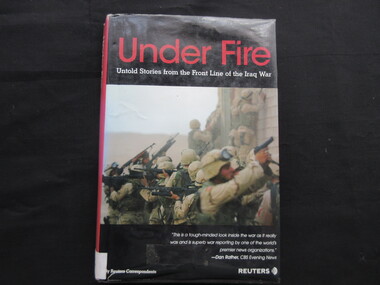
Book, Reuters Prentice Hall, Under Fire - Untold stories if the Front Line of the Iraq War, 2004
... Reuters Prentice Hall...Book Under Fire - Untold stories if the Front Line of the Iraq War Book Book Reuters Prentice Hall ...Book -
 Flagstaff Hill Maritime Museum and Village
Book, Farm Organization and Management
... Farm Organization and Management Author: G W Forster Publisher: Prentice-Hall Inc Date: 1941...The Warrnambool Mechanics' Institute’s publication collection is of both local and state significance. warrnambool shipwrecked-coast flagstaff-hill flagstaff-hill-maritime-museum maritime-museum shipwreck-coast flagstaff-hill-maritime-village shipwrecked-artefact book warrnambool mechanics’ institute pattison collection warrnambool library ralph eric pattison warrnambool city librarian mechanics’ institute library victorian library board warrnambool books and records warrnambool children’s library farm organization and management g w forster Label on spine cover with typed text PAT 631 FOR Pastedown end page has sticker from Warrnambool Mechanics Institute and Free Library Front loose endpaper has a sticker from Corangamite Regional Library Service Farm Organization and Management Author: G W Forster Publisher: Prentice-Hall Inc Date: 1941 Farm Organization and Management Book ...This item is from the ‘Pattison Collection’, a collection of books and records that was originally owned by the Warrnambool Mechanics’ Institute, which was founded in Warrnambool in 1853. By 1886 the Warrnambool Mechanics’ Institute (WMI) had grown to have a Library, Museum and Fine Arts Gallery, with a collection of “… choice productions of art, and valuable specimens in almost every branch and many wonderful national curiosities are now to be seen there, including historic relics of the town and district.” It later included a School of Design. Although it was very well patronised, the lack of financial support led the WMI in 1911 to ask the City Council to take it over. In 1935 Ralph Pattison was appointed as City Librarian to establish and organise the Warrnambool Library as it was then called. When the WMI building was pulled down in 1963 a new civic building was erected on the site and the new Warrnambool Library, on behalf of the City Council, took over all the holdings of the WMI. At this time some of the items were separated and identified as the ‘Pattison Collection’, named after Ralph Pattison. Eventually the components of the WMI were distributed from the Warrnambool Library to various places, including the Art Gallery, Historical Society and Flagstaff Hill. Later some were even distributed to other regional branches of Corangamite Regional Library and passed to and fro. It is difficult now to trace just where all of the items have ended up. The books at Flagstaff Hill Maritime Village generally display stamps and markings from Pattison as well as a variety of other institutions including the Mechanics’ Institute itself. RALPH ERIC PATTISON Ralph Eric Pattison was born in Rockhampton, Queensland, in 1891. He married Maude Swan from Warrnambool in 1920 and they set up home in Warrnambool. In 1935 Pattison accepted a position as City Librarian for the Warrnambool City Council. His huge challenge was to make a functional library within two rooms of the Mechanics’ Institute. He tirelessly cleaned, cleared and sorted a disarrayed collection of old books, jars of preserved specimens and other items reserved for exhibition in the city’s museum. He developed and updated the library with a wide variety of books for all tastes, including reference books for students; a difficult task to fulfil during the years following the Depression. He converted all of the lower area of the building into a library, reference room and reading room for members and the public. The books were sorted and stored using a cataloguing and card index system that he had developed himself. He also prepared the upper floor of the building and established the Art Gallery and later the Museum, a place to exhibit the many old relics that had been stored for years for this purpose. One of the treasures he found was a beautiful ancient clock, which he repaired, restored and enjoyed using in his office during the years of his service there. Ralph Pattison was described as “a meticulous gentleman whose punctuality, floorless courtesy and distinctive neat dress were hallmarks of his character, and ‘his’ clock controlled his daily routine, and his opening and closing of the library’s large heavy doors to the minute.” Pattison took leave during 1942 to 1942 to serve in the Royal Australian Navy, Volunteer Reserve as Lieutenant. A few years later he converted one of the Museum’s rooms into a Children’s Library, stocking it with suitable books for the younger generation. This was an instant success. In the 1950’s he had the honour of being appointed to the Victorian Library Board and received more inspiration from the monthly conferences in Melbourne. He was sadly retired in 1959 after over 23 years of service, due to the fact that he had gone over the working age of council officers. However he continued to take a very keen interest in the continual development of the Library until his death in 1969. The Pattison Collection, along with other items at Flagstaff Hill Maritime Village, was originally part of the Warrnambool Mechanics' Institute’s collection. The Warrnambool Mechanics’ Institute Collection is primarily significant in its totality, rather than for the individual objects it contains. Its contents are highly representative of the development of Mechanics' Institute libraries across Australia, particularly Victoria. A diversity of publications and themes has been amassed, and these provide clues to our understanding of the nature of and changes in the reading habits of Victorians from the 1850s to the middle of the 20th century. The collection also highlights the Warrnambool community’s commitment to the Mechanics’ Institute, reading, literacy and learning in the regions, and proves that access to knowledge was not impeded by distance. These items help to provide a more complete picture of our community’s ideals and aspirations. The Warrnambool Mechanics Institute book collection has historical and social significance for its strong association with the Mechanics Institute movement and the important role it played in the intellectual, cultural and social development of people throughout the latter part of the nineteenth century and the early twentieth century. The collection of books is a rare example of an early lending library and its significance is enhanced by the survival of an original collection of many volumes. The Warrnambool Mechanics' Institute’s publication collection is of both local and state significance. Farm Organization and Management Author: G W Forster Publisher: Prentice-Hall Inc Date: 1941Label on spine cover with typed text PAT 631 FOR Pastedown end page has sticker from Warrnambool Mechanics Institute and Free Library Front loose endpaper has a sticker from Corangamite Regional Library Service warrnambool, shipwrecked-coast, flagstaff-hill, flagstaff-hill-maritime-museum, maritime-museum, shipwreck-coast, flagstaff-hill-maritime-village, shipwrecked-artefact, book, warrnambool mechanics’ institute, pattison collection, warrnambool library, ralph eric pattison, warrnambool city librarian, mechanics’ institute library, victorian library board, warrnambool books and records, warrnambool children’s library, farm organization and management, g w forster -
 Bendigo Historical Society Inc.
Book - LONG GULLY HISTORY GROUP COLLECTION: CONFRONTING AGEISM
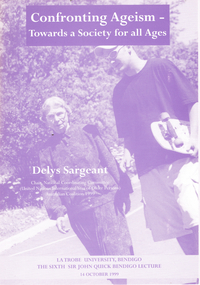
... ... Prentice Hall...BENDIGO History long gully history group The Long Gully History Group - Confronting Ageism - Towards a Society for all Ages Delys Sargeant United nations International year of Older Persons La Trobe University The Sixth Sir John Quick Bendigo Lecture Kofi Annan Institute of Family Studies Ageism & Nursing Practice in Australia John Stevens Jan Herbert Valerie Braithwaite Robert Lynd-Stevenson Derek Pigrak Paul Coulthard D G Le Couteur A S Bansal D A Price University of Queensland Victor Minichiello Colette Browning Rosalie Aroni Loris Alexander Deidre ones Prentice Hall Beissner Luscz Palmore Chris Phillipson Alan Walker John Stevens Jan Herbert Royal College of Nursing Bradley Fisher Constance Peterson Lindsay Gething University of Melbourne Social Biology Resources Centre now the Centre for Social Health Allen & Unwin John Sargeant Book titled Confronting Ageism - Towards a Society for all Ages. ...Book titled Confronting Ageism - Towards a Society for all Ages. By Delys Sargeant, Chair, National Coordinating Committee (United Nations International Year of Older Persons) Australian Coalition 1999. La Trobe University, Bendigo. The Sixth Sir John Quick Bendigo Lecture 14 October 1999. Book has a purple tone front cover with an older lady and a young man with a skateboard walking along a path. The book mentions the attitudes to aging from various members of the community including health care workers, nurses and nursing teachers and doctors.bendigo, history, long gully history group, the long gully history group - confronting ageism - towards a society for all ages, delys sargeant, united nations international year of older persons, la trobe university, the sixth sir john quick bendigo lecture, kofi annan, institute of family studies, ageism & nursing practice in australia, john stevens, jan herbert, valerie braithwaite, robert lynd-stevenson, derek pigrak, paul coulthard, d g le couteur, a s bansal, d a price, university of queensland, victor minichiello, colette browning, rosalie aroni, loris alexander, deidre ones, prentice hall, beissner, luscz, palmore, chris phillipson, alan walker, john stevens, jan herbert, royal college of nursing, bradley fisher, constance peterson, lindsay gething, university of melbourne, social biology resources centre now the centre for social health, allen & unwin, john sargeant -
University of Melbourne, Burnley Campus Archives
Book, Plant Propagation Principles and Practices, 1959
... ...prentice-hall...hudson t. hartmann dale e. kester prentice-hall 1961 Inscribed, "Presented to the Burnley College of Horticulture by the author, Dr. hartmann 1961." ...Inscribed, "Presented to the Burnley College of Horticulture by the author, Dr. hartmann 1961."hudson t. hartmann, dale e. kester, prentice-hall, 1961 -
Port Melbourne Historical & Preservation Society
Document - Agreement, Erect single storey office building, J Kitchen & Sons Pty Ltd and Swanson Bros Pty Ltd, 17 Dec 1953
... HALL...D C SWANSON...L ROBINSON...Russell C STEWART...R PRENTICE...Industry - Manufacturing Built Environment - Industrial J Kitchen & Sons Pty Ltd Swanson Brothers Pty Ltd Ingles Street Harry A NORRIS P HALL D C SWANSON L ROBINSON Russell C STEWART R PRENTICE No. 56218 Pale green agreement between J Kitchen & sons Pty Ltd and Swanson Bros Pty Ltd of 663 Chapel St South Yarra to erect a single storey office building, Schedule of conditions of building contract Document Agreement, Erect single storey office building, J Kitchen & Sons Pty Ltd and Swanson Bros Pty Ltd Royal Australian Institute of Architects ...Pale green agreement between J Kitchen & sons Pty Ltd and Swanson Bros Pty Ltd of 663 Chapel St South Yarra to erect a single storey office building, Schedule of conditions of building contractNo. 56218industry - manufacturing, built environment - industrial, j kitchen & sons pty ltd, swanson brothers pty ltd, ingles street, harry a norris, p hall, d c swanson, l robinson, russell c stewart, r prentice -
 Glen Eira Historical Society
Article - ELSTERNWICK CLASSIC CINEMA
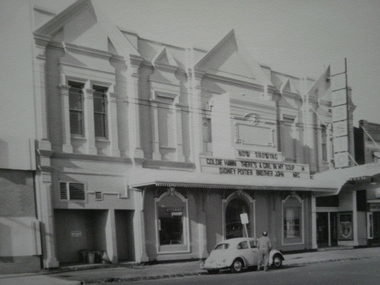
... Hall... Skating Rink Company Limited... Selwyn Street... Victorian Permanent Building Society... Community Centres... Films... shows and exhibitions... film projectors... Amalgamate Picture Company Ltd.... Richardson Frank G.... architecture... stairs... Associated Theatres Limited... Ballantyne and Hared... balconies... architectural features... entrances... Depression 1929-1939... Astor... dancehalls... Esquire Theatre... Prentice...Elsternwick Classic Cinema Gordon Street Elsternwick Dorchester Dance Hall National Trust of Australia National Trust Register Elsternwick Theatre Pausacker Ian Classic Cinema entertainment cinemas theatres Victorian style Elsternwick Public Hall Skating Rink Company Limited Selwyn Street Victorian Permanent Building Society Community Centres Films shows and exhibitions film projectors Amalgamate Picture Company Ltd. Richardson Frank G. architecture stairs Associated Theatres Limited Ballantyne and Hared balconies architectural features entrances Depression 1929-1939 Astor dancehalls Esquire Theatre Prentice George Plottel Joseph architects Cowper Murphy and Associates Sharon Cinema Tamir Eddie Readings Free Classical Style plans business people Njoo Alex Tamir family Article ELSTERNWICK CLASSIC CINEMA ...This file contains 4 items relating to the Elsternwick Classic Cinema: 1/1 original black and white photograph of the Elsternwick Classic Cinema, 9 Gordon Street Elsternwick. Date and photographer unknown. 2/ 2 photocopied photos of the Elsternwick Classic Theatre in its various stages of operation. One photo is of it as the Dorchester Dance Hall between 1938 and 1946 and the other is of the Classic Cinema in 1994. Photographers unknown. 3/National Trust of Australia (Victoria) Classification Report on Elsternwick Theatre with attached cover letter addressed to the Manager of the Planning Section, City of Glen Eira Council, from Ian Pausacker from the National Trust dated 04/10/2000. The report includes a statement of significance, history, description, context and floor plans of the theatre. 4/1 newspaper article written by Alex Njoo from the Caulfield/Port Philip Leader, 31/01/2012, congratulating the Tamir family on their conservation of the Elsternwick Classic Cinema. Includes a colour photo of the Tamirs, photographer unknown.elsternwick classic cinema, gordon street, elsternwick, dorchester dance hall, national trust of australia, national trust register, elsternwick theatre, pausacker ian, classic cinema, entertainment, cinemas, theatres, victorian style, elsternwick public hall, skating rink company limited, selwyn street, victorian permanent building society, community centres, films, shows and exhibitions, film projectors, amalgamate picture company ltd., richardson frank g., architecture, stairs, associated theatres limited, ballantyne and hared, balconies, architectural features, entrances, depression 1929-1939, astor, dancehalls, esquire theatre, prentice george, plottel joseph, architects, cowper murphy and associates, sharon cinema, tamir eddie, readings, free classical style, plans, business people, njoo alex, tamir family -
 Ballarat Tramway Museum
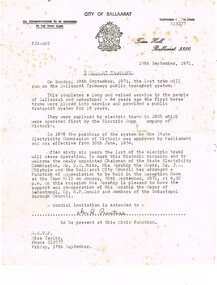
Ephemera - Invitation, City of Ballaarat, "Ballarat Tramways", 13/09/1971
... Prentice to a Civic Function at the Town Hall to mark the closure of the Ballarat Tramway system and to welcome the newly appointed SEC Chairman, Mr. ...Prentice to a Civic Function at the Town Hall to mark the closure of the Ballarat Tramway system and to welcome the newly appointed SEC Chairman, Mr. ...Yields information about a Civic Function at the time of the closure of the tramways and method of invitations. Invitation or letter on quarto paper, dated 13/9/1971 from the City of Ballaarat to Mr. R. Prentice to a Civic Function at the Town Hall to mark the closure of the Ballarat Tramway system and to welcome the newly appointed SEC Chairman, Mr. N. R. White. Mayor Cr Chisholm and Mayor of Sebastopol Cr N F Donald. Addressed to Mr. R PrenticeOn rear in red ink "Max Scott". The invitee's name has been hand written.trams, tramways, civic functions, city of ballaarat, closure, sec -
 Bayside Gallery - Bayside City Council Art & Heritage Collection
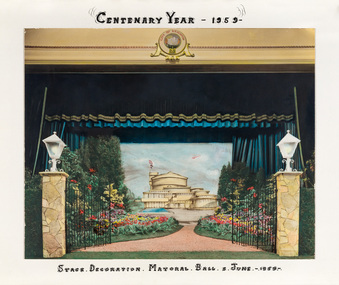
Photograph - hand-coloured photograph, Brighton Centenary Year, Stage decoration, Mayoral Ball, c. 1959
... Prentice Builders Pty Ltd. The foundation stone was laid on 13 February 1959 and the building was opened on 21 July 1961. The interior decoration and furniture was by Grant Featherston. Brighton centenary Brighton Town Hall ...This work was presented to The Mayor and Mayoress, Cr. and Mrs R.G. Ward, by the citizens of Brighton to commemorate the Brighton Centenary in 1959. Brighton was first incorporated as a borough on 18 January 1859, it became a town on 18 March 1887 and was proclaimed a city on 12 March 1919. The new Brighton Municipal Offices were designed by Kevin Knight of Oakley and Parkes with the engineers John Connell and Associates and were erected by Prentice Builders Pty Ltd. The foundation stone was laid on 13 February 1959 and the building was opened on 21 July 1961. The interior decoration and furniture was by Grant Featherston.brighton centenary, brighton town hall, stage decoration, mayoral ball, brighton municipal offices, civic centre, oakley and parkes, kevin knight, r.g. ward, mayor -
 Bayside Gallery - Bayside City Council Art & Heritage Collection
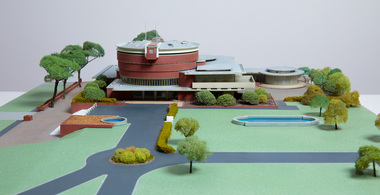
Model, Alan W. Chandler, Brighton Municipal Complex, 1959
... Prentice Builders Pty Ltd. The foundation stone was laid on 13 February 1959 and the building was opened on 21 July 1961. The interior decoration and furniture was by Grant Featherston. As is common practice, an architectural model was prepared to present the final concept of the building for approval to the Brighton City Council. In February 1959 festivities occurred to celebrate the centenary of the municipality of Brighton. A garden party attended by two hundred Brighton residents was held in the grounds of the Brighton Town Hall...Prentice Builders Pty Ltd. The foundation stone was laid on 13 February 1959 and the building was opened on 21 July 1961. The interior decoration and furniture was by Grant Featherston. As is common practice, an architectural model was prepared to present the final concept of the building for approval to the Brighton City Council. In February 1959 festivities occurred to celebrate the centenary of the municipality of Brighton. A garden party attended by two hundred Brighton residents was held in the grounds of the Brighton Town Hall ...This model of the Brighton Municipal Offices was made by Alan W. Chandler. The Brighton Municipal Offices were designed by Kevin Knight of Oakley and Parkes with the engineers John Connell and Associates and were erected by Prentice Builders Pty Ltd. The foundation stone was laid on 13 February 1959 and the building was opened on 21 July 1961. The interior decoration and furniture was by Grant Featherston. As is common practice, an architectural model was prepared to present the final concept of the building for approval to the Brighton City Council. In February 1959 festivities occurred to celebrate the centenary of the municipality of Brighton. A garden party attended by two hundred Brighton residents was held in the grounds of the Brighton Town Hall. This model graced the centre of the lily pond during the event. The following day the foundation stone of the Brighton Municipal Offices was laid.Architectural model of a large public building in orange brick, the main cylindrical tower is set within a rectangular structure, with circular and oval roof structures. The model is set within landscaped grounds with paths, a water feature, several trees and bushes, lawns and flower beds.brighton municipal complex, brighton civic centre, brighton chambers, architectural model, model, alan w. chandler, kevin knight, oakley and parkes, architecture, municipal offices, municipal building, scale model -
 Box Hill Historical Society
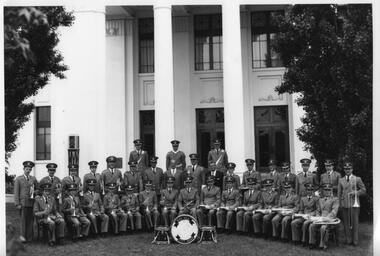
Photograph - Box Hill City Band
... Hall...Uniforms...Musical instruments...Clarke> Fred...Bett> Randolph...Cockerell> Brian...Morrison> Geoff...Krahe> Kevin...Edwards> Peter...Glover> Peter...Gilbert> George...Richards> L....Woolan> Len...McCreddan> Les...Green> Jack (Drum Major)...Anderson> John...Windridge> G....Krahe> Brian...Polkinghorne> Vin...De Tracey> Owen...Prentice...Bands Box Hill City Band Box Hill Town Hall Uniforms Musical instruments Clarke> Fred Bett> Randolph Cockerell> Brian Morrison> Geoff Krahe> Kevin Edwards> Peter Glover> Peter Gilbert> George Richards> L. Woolan> Len McCreddan> Les Green> Jack (Drum Major) Anderson> John Windridge> G. Krahe> Brian Polkinghorne> Vin De Tracey> Owen Prentice ...Box Hill City Band, seated on the lawn at the front of the Box Hill Town Hall. Many of the band members' names are written on the back of the pale copy of the photo.Black and white photobands, box hill city band, box hill town hall, uniforms, musical instruments, clarke> fred, bett> randolph, cockerell> brian, morrison> geoff, krahe> kevin, edwards> peter, glover> peter, gilbert> george, richards> l., woolan> len, mccreddan> les, green> jack (drum major), anderson> john, windridge> g., krahe> brian, polkinghorne> vin, de tracey> owen, prentice> c., clarke> ollie, mcintosh> bob, morrison> ray, madden> f., bartlett> eri, thorpe> b., belt> graham, anderson> ian, richards> j., belt> ron (bandmaster), cockerell> bill, stomann> graham, dosser> eric, thompson> r., jackson> c., dosser> max, sestak> joe -
 Slovenian Association Melbourne
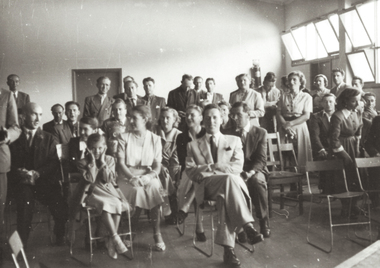
Photo, Photo of the very first meeting of Slovenians in Melbourne, St Albans 1954, 1954
... hall at Theodore Street, St Albans. Slovenians at the meeting were enthused at the prospect of developing closer ties and a committee was formed to organise the next dance. This humble beginning laid the groundwork for the establishment of the first Slovenian organisation in Melbourne, Victoria. On 5 December 1954 the first meeting of the club’s preparatory committee was held at 36 Prentice ...On Sunday 19 December 1954 at 3.30 pm, 52 people attended the inaugural general meeting, which was held in the Catholic church hall at Theodore Street, St Albans. Slovenians at the meeting were enthused at the prospect of developing closer ties and a committee was formed to organise the next dance. This humble beginning laid the groundwork for the establishment of the first Slovenian organisation in Melbourne, Victoria.On 5 December 1954 the first meeting of the club’s preparatory committee was held at 36 Prentice Street, East St Kilda with 26 people in attendance. The group prepared a list of regulations and decided on the name Slovenski klub Melbourne – Slovenian Club Melbourne (SCM). The first Minutes of the Meeting announced the club’s statement of purpose: • to assist migrants of Slovenian origin; • to assist assimilation to the Australian way of life; • to help Slovenian migrants in every possible way, especially financially; • to help Slovenian refugees in Europe, especially those who wanted to find a a new and free life in Australia; • to offer members and their friends healthy intellectual and physical activities in the cultural, social and sports arenas; and • to cultivate a Slovenian cultural heritage while also making contributions to their Australian community.A sepia photo of the Slovenians attending the first meeting in St. Albans, 1954 Some in attendance included: Ljubo Pirnat, Paule Postarenko, Ivan Gerbec, Tinka Verbic, Zladko Verbic, Viktor Ferfolia, Tusek, Joze Pekolj, Mrs Potocnik, Joze Potocnik, Janezic, Fanc Novina, Joze Golenko.first slovenian club, slovenians in melbourne, slovenian club, regulations of first slovenian club -
 Vision Australia
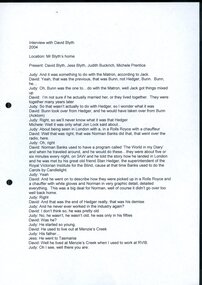
Audio - Sound recording, Interview with David Blyth by Judith Buckrich, 2004
... Prentice...Jess Blyth...S.W. Hedger...Bill Casey...Jack Murphy...Sid Daley...Employment...Bill Williams...David Ditchfield...Blind hostels...Frank Turley...Dr Charles Bennett...Lady Nell Seeing Eye Dog School...Doug Kent...Vision Australia Foundation...Merger...Ormond Hall...Prentice Jess Blyth S.W. Hedger Bill Casey Jack Murphy Sid Daley Employment Bill Williams David Ditchfield Blind hostels Frank Turley Dr Charles Bennett Lady Nell Seeing Eye Dog School Doug Kent Vision Australia Foundation Merger Ormond Hall Fundraising Simon von Saldern Ross Johnstone Augusta Tutton Trojan Club Reuben Ryan 4 audio recordings of recollections from former RVIB attendees Interview with David Blyth by Judith Buckrich Audio Sound recording ...Oral history interview and partial transcript of David Blyth by Judith Buckrich, with Jess Blyth and Michele Prentice. Recorded as part of 'Lighthouse on the Boulevard'. Former students and staff recall their days at RVIB, the impact of what they learned and experienced there, and how the attitudes to blindness and low vision changed over the years. 4 audio recordings of recollections from former RVIB attendeesroyal victorian institute for the blind, david blyth, oral history, judith buckrich, michele prentice, jess blyth, s.w. hedger, bill casey, jack murphy, sid daley, employment, bill williams, david ditchfield, blind hostels, frank turley, dr charles bennett, lady nell seeing eye dog school, doug kent, vision australia foundation, merger, ormond hall, fundraising, simon von saldern, ross johnstone, augusta tutton, trojan club, reuben ryan -
 Vision Australia
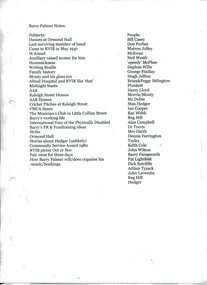
Audio - Sound recording, Interview with Barry Palmer by Michele Prentice, 4/8/2004
... Prentice...Barry Palmer...RVIB orchestra...Bill Casey...Daphne Wills...Donald Forbes...George Findlay...Harry Lloyd...Buildings...S.W. Hedger...Association for the Advancement of the Blind...Raleigh Street Hostel...Ian Cooper...Ray Webb...Reg Hill...Alan Campbell...Employment...Vision Australia Foundation...Frank Turley...Keith Cole...Ormond Hall...Prentice Barry Palmer RVIB orchestra Bill Casey Daphne Wills Donald Forbes George Findlay Harry Lloyd Buildings S.W. Hedger Association for the Advancement of the Blind Raleigh Street Hostel Ian Cooper Ray Webb Reg Hill Alan Campbell Employment Vision Australia Foundation Frank Turley Keith Cole Ormond Hall Arthur Tyzack Dick Sutcliffe John Leversha Larry Kean 2 audio recordings of recollections from former RVIB attendees Interview with Barry Palmer by Michele Prentice Audio Sound recording ...Oral history interview with Barry Palmer by Michele Prentice. Recorded as part of 'Lighthouse on the Boulevard'. Former students and staff recall their days at RVIB, the impact of what they learned and experienced there, and how the attitudes to blindness and low vision changed over the years. 2 audio recordings of recollections from former RVIB attendeesroyal victorian institute for the blind, oral history, michele prentice, barry palmer, rvib orchestra, bill casey, daphne wills, donald forbes, george findlay, harry lloyd, buildings, s.w. hedger, association for the advancement of the blind, raleigh street hostel, ian cooper, ray webb, reg hill, alan campbell, employment, vision australia foundation, frank turley, keith cole, ormond hall, arthur tyzack, dick sutcliffe, john leversha, larry kean -
 Rutherglen Historical Society
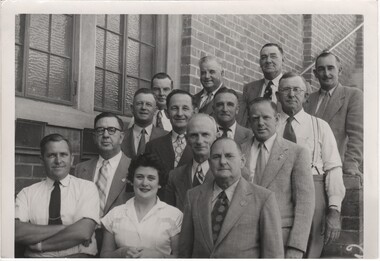
Image, Herald & Weekly Times, 1954
... hall...meekcoms...ricketts...kendall...schue...campbell...forbes...terrill...bales...jaspar...morris...gill...prentice...rutherglen shire councillors soldiers' memorial hall meekcoms ricketts kendall schue campbell forbes terrill bales jaspar morris gill prentice williams francis Written on back of photo: "In W.T. ...Black and white photograph of a group of people posing on the stairs outside the Memorial Hall, RutherglenWritten on back of photo: "In W.T. Mar 10. 1954. page 54. Shire Crs. & Staff of Rutherglen. Messrs. K.P. Meekcoms (Eng.) C.A. Ricketts sec. Miss F.M. Kendall. Crs. F. Schue. A.D. Campbell. A. Forbes. J. Terrill. Mr. J.L. Bales 'Pres.' Crs. W. Jaspar. C.J.G. Morris. Pres. H.C. Gill. S.J. Prentice. S.G. Williams. J.P. Francis." At top right on back: "3/6" On back: rubber stamp with copyright details.rutherglen shire councillors, soldiers' memorial hall, meekcoms, ricketts, kendall, schue, campbell, forbes, terrill, bales, jaspar, morris, gill, prentice, williams, francis -
 Rutherglen Historical Society
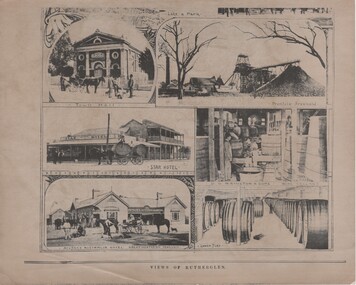
Newspaper - Image, The Leader, Views of Rutherglen, 21/04/1894
... hall...star hotel...d g hamilton...advance australia hotel...prentice...Date of issue confirmed on TROVE. main street hotels gold mines rutherglen town hall star hotel d g hamilton advance australia hotel prentice freehold wine cellars great northern township On back of photo: "The Leader, April 21 1894" Black and white photographic reproduction of an illustrations taken from the Leader, Saturday 21 April 1894, page 31 (bottom half of page). ...Date of issue confirmed on TROVE.Black and white photographic reproduction of an illustrations taken from the Leader, Saturday 21 April 1894, page 31 (bottom half of page).On back of photo: "The Leader, April 21 1894"main street, hotels, gold mines, rutherglen town hall, star hotel, d g hamilton, advance australia hotel, prentice freehold, wine cellars, great northern township -
 Melbourne Tram Museum
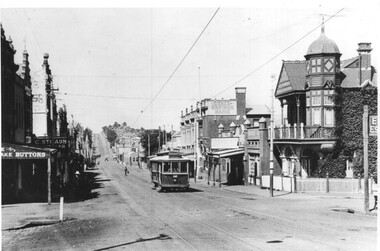
Photograph - Black & White Photograph/s, Bob Prentice, c1915
... hall and a button shop. Photograph features on page 59 of Ian Brady's book on the PMTT, "Melbourne's Foremost Municipal Tramway". Photograph from the Bob Prentice...hall and a button shop. Photograph features on page 59 of Ian Brady's book on the PMTT, "Melbourne's Foremost Municipal Tramway". Photograph from the Bob Prentice ...Black and white photograph of PMTT No. 57 in Burke Road Camberwell c1915. Tram showing route No. 12. Possibly at Mayston St. In the view is the State Savings Bank, a Real Estate agent, a snooker hall and a button shop. Photograph features on page 59 of Ian Brady's book on the PMTT, "Melbourne's Foremost Municipal Tramway". Photograph from the Bob Prentice Collection - from the Rose Series post-card P3639. Two copies held.Has caption on the photo "Burke Road, Camberwell c1920's" and in pencil on the rear 'RSCP 325", C1916 and in red ink "H57"trams, tramways, pmtt, burke road, camberwell, tram 59 -
 Melbourne Tram Museum
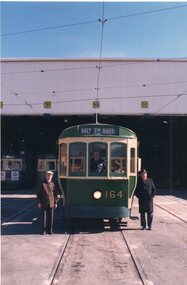
Photograph - Colour Photograph/s, Don English, 9/1987?
... Colour photograph of Keith Kings and Bob Prentice standing either side of S164 during a tour at Malvern Tram Depot. Tram has destination of "Malv Tn Hall". ...Trams tramways Tours Malvern Depot S Class Malvern Town Hall tram 164 Colour photograph of Keith Kings and Bob Prentice standing either side of S164 during a tour at Malvern Tram Depot. ...Colour photograph of Keith Kings and Bob Prentice standing either side of S164 during a tour at Malvern Tram Depot. Tram has destination of "Malv Tn Hall". Keith noted on an envelope received from Don English 20/9/1987.trams, tramways, tours, malvern depot, s class, malvern town hall, tram 164 -
 City of Melbourne Libraries
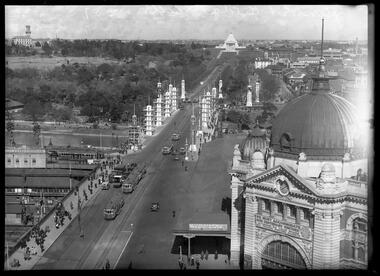
Photograph, Bull, Hugh Jones, 1897-1993, Princes Bridge Centenary pylons under construction
... Hall closed in 1950, and the remainder of the Wirth buildings on site were destroyed by fire in December 1953. The feature of the photo is the pylons erected along Princes Bridge to mark Melbourne’s Centenary in 1934. The sixteen plastered pylons were designed by Roy Prentice...Hall closed in 1950, and the remainder of the Wirth buildings on site were destroyed by fire in December 1953. The feature of the photo is the pylons erected along Princes Bridge to mark Melbourne’s Centenary in 1934. The sixteen plastered pylons were designed by Roy Prentice ...Princes Bridge Centenary pylons under construction Possibly taken from Young and Jacksons Hotel (formerly Princes Bridge Hotel) on the corner of Flinders and Swanston streets, Flinders Street Station’s clocks and main entrance dominate, along with its distinctive copper dome and decorative façade. The time on the main clock is 1.40pm, and the sign underneath, reflecting Melbourne’s upcoming Centenary reads, “We must accommodate our Centenary visitors! Citizens! Do your share by taking paying guests.” At left is the original Princes Bridge Station, today the site of Federation Square. The riverside tram terminus advertises a Café/Tobacconist/Refreshment Room selling cigars & cigarettes, fountain drinks & confectionery, and in smaller text: “Leave your boot repairs here”. Nearly everyone is dressed in dark suits, coats and hats. The footpaths are wide and there are no traffic lights. The roadway stretches towards the Shrine of Remembrance, not yet dedicated but very dominant on the skyline. Government House is clearly visible across the wide parkland that would come to be known as Kings Domain and that is an area of deep importance to the people of the Eastern Kulin. Originally, Birrarung was part of a network of swamps and lagoons linked to the course of the river. From 1896, Public Works Department engineer Carlo Catani, oversaw a new channel to straighten the river and the swamps and lagoons were filled with spoil from the channel works. From the same vantage point today, only the top of the tower of Government House would be visible. The photo captures the pylons along Princes Bridge, mid-construction and being installed to mark Melbourne’s Centenary. The pylons were not without controversy. Both The Argus and The Age bemoaned them for being “made almost entirely of imported softwood timber”, denying work to native hardwood timber workers and sawmillers, and leading visitors to think Australia did not have its own exceptional native hardwoods. The pylons were also variously described in their incomplete state, as unimaginative and resembling an oilfield. Published: The Age 5 September 1934 Featured in "Newsworthy: Melbourne in photographs 1933-1936" exhibition at East Melbourne Library, October to December 2023. Exhibition caption by project volunteer, Louise McKenzie Photographer notations on slide: "Pylons + St Kilda Rd C57" Published: Age (Melbourne, Vic. : 1854 - 1954), Wednesday 5 September 1934, page 11 Published title: DECORATIONS -- THEN AND NOW. Published caption: "Although not completed yet, some impression of the effect of the decorations on Princes-bridge may be obtained from the first picture which shows the majestic sweep of St Kilda road with the Shrine of Remembrance and Government House dominating the horizon. The area to the left of St. Kilda-road and in front of Government House is portion of the area which it is proposed to call the King's Domain, which extends to Domain-road and Anderson-street..." Description: East-facing, elevated view of Flinders Street Station and Princes Bridge, featuring partially completed pylons erected for Melbourne's Centenary celebrations. The Shrine of Remembrance and Government House can be seen in the distance. In the foreground are trams, cars and trucks, pedestrians, Batman Avenue tram terminus and refreshment rooms. Signage on Flinders Street Station encourages citizens to accommodate Centenary visitors. The Melbourne Centenary was held 1934-35 in celebration John Batman's proclamation that Melbourne "the place for a village". Centenary events included a visit by Prince Henry, Duke of Gloucester. A Centenary Cake measuring 50 feet in height and ten tons in weight was cut into 250,000 pieces and sold at 1 shilling per piece for charity. Spectacular floodlighting of city landmarks, the creation of the Pioneer Women's Memorial Garden, and the MacRobertson Air Race from London, were other notable activities. Research by project volunteer, Louise McKenzie: The photo in The Age collage of 5 September 1934 has a slightly cropped foreground. The original photo has been taken from an elevated vantage point, most probably the roof of the Nicholas Building on the corner of Flinders and Swanston streets. The right foreground is dominated by the main “clocks” entrance to Flinders Street Station, showing its distinctive copper dome and decorative façade. The time on the main clock is 1.40 pm. The main sign on the front of the Station reads, "We Must Accommodate our Centenary Visitors! Citizens! Do your share by taking paying guests. Write to The Official Centenary Accommodation Bureau, 436 Collins St. City. Tel M 4671”. Another sign at eye level at the main entrance says: “Cheap Trips on Sundays”. The sign on the end of the roof along the eastern side of the station reads, “The Babies Need Your Help! Support Broadmeadows Foundling Hospital Appeal. July and August”. Run by the Sisters of St Joseph of the Sacred Heart, St Joseph’s Foundling Hospital was a purpose built infants’ home for up to 300 babies, plus accommodation for expectant mothers, mainly single women. In the early 1930s, the department (Victorian Children’s Welfare Department) contracted St Joseph’s Foundling Hospital to care for an additional 60 infant state wards, and up to 175 non wards at any given time. In 1931 it also operated a mothercraft training school. The centre foreground shows the commencement of Princes Bridge. Beneath the left side of the bridge was the site of the original Princes Bridge Station, by this time incorporated into Flinders Street Station, and today the area is the site of Federation Square. It was linked to Flinders Street station by the railway tracks that ran underneath the northern approach to the bridge. This photo shows a tram terminus which has a Café/Tobacconist/Refreshment Room, selling cigars & cigarettes, fountain drinks & confectionary, and a sign: Leave your boot repairs here. In the foreground is a wide roadway running south/north, comprising two vehicle lanes each heading north/south, and a central section containing two sets of tram tracks. There are cars, buses and delivery vans on the roadway. The trams visible are Glen Iris (Route No. 6; tram no. 448), Toorak (Route No. 8, tram no. 333), ? (No. 7), ? (No. 1), and ? (No. 2A). The footpaths are extremely wide. There is a square newspaper/magazine stand on the eastern side footpath. And also a “Ferry” sign. There are no traffic lights, but a policeman is visible on the roadway. There are pedestrians – men, women, children, a porter with trolley, women with prams. Clothing comprises dark suits, coats and hats for nearly everyone. There are double headed “Collins Street” lights along the side of the roadway, and along the northern riverbank. The roadway in the foreground is an extension of Swanston Street, which becomes Princes Bridge, then St Kilda Road, stretching towards the Shrine of Remembrance, and diverting past it. The Shrine had not yet been officially dedicated, and looks very white and dominant on the skyline. On the LHS of St Kilda Road, Government House is clearly visible across the wide parkland to be known as Kings Domain. The Kings Domain area is important to the people of the Eastern Kulin nation, and also has historical importance for its association with the early settlement of Melbourne and the foundation of British colonial administration in Victoria. On the southern side of the Yarra River (Birrarung) an historic rowing boathouse is visible, located adjacent to the Alexandra Gardens. Originally Birrarung was part of a network of swamps and lagoons linked to the course of the river. From 1896, under the guidance of engineer Carlo Catani* a new channel to straighten the river was created and the swamps and lagoons were filled with spoil from the channel works. The gardens were then created and completed in time for a Royal visit by the Duke of York in May 1901. The gardens are named after Alexandra of Denmark, the wife of King Edward VII. Both these areas, plus the Royal Botanic Gardens Victoria, Shrine of Remembrance Reserve, Sidney Myer Music Bowl, Government House, and the Queen Victoria Gardens together form the Domain Parklands. The extent of the subsequent plantings is evident today, where from the same vantage point only the top of the tower of Government House would be visible. *Catani was born in Florence in 1852, but after arriving in Melbourne worked as a civil engineer for the Victorian Government. His last major project was the reclamation of the foreshore of St Kilda, envisaged in the style of a European resort, complete with a split level esplanade, bathing pavilions, dance halls, amusements and a French-Italian style of landscape complete with palms. The gardens at the end of Fitzroy Street, St Kilda, now bear his name. The historic boathouse visible across the Yarra is another glimpse into Melbourne’s past. “Boathouse Row” comprises 7 amateur rowing clubs, the first established in 1859 (Melbourne University Boat Club). Other Clubs were Richmond, Melbourne, Banks, Melbourne Grammar School, Yarra Yarra and Mercantile. South of the river and west of the bridge is an area today developed into the Melbourne arts precinct of Hamer Hall and the Arts Centre. But at this time it was the home of Wirths Olympia Circus, which comprised Wirths Pleasure Park (an amusement park), a 5,000 seat auditorium – Hippodrome, a roller skating rink, a glaciarium, a cinema, and the Green Mill Dance Hall. Dog shows were also held at Olympia. The Green Mill Dance Hall closed in 1950, and the remainder of the Wirth buildings on site were destroyed by fire in December 1953. The feature of the photo is the pylons erected along Princes Bridge to mark Melbourne’s Centenary in 1934. The sixteen plastered pylons were designed by Roy Prentice, the second person to qualify as an architect at The University of Melbourne’s Bachelor of Architecture degree, in 1933, aged 27. Simon Reeves in his article marking the 100th birthday of Roy Prentice on 20 June 2006 reports that the State Electricity Commission sponsored this work, and the Argus reported that “… the pylons were “illuminated from within to give the effect of soft radiance”. Australia Home Beautiful 1 Oct 1934 reports in a very detailed and comprehensive article: The 10 taller pylons, including flagpole, were 48 ft, with a base of 8 ft. Timber-framed and faced with fibrous plaster and galvanised sheet iron, each structure was securely bolted to a concrete foundation three feet in depth. Panels of glass let into the shaft of each pylon were indirectly lit by 40, 100 watt lamps, and the upper bank of internal lamps were dyed so as to flood the panels with a deep red light. The decorative painted shields and flagpoles/pennants were illuminated by three 200 watt projectors concealed in the roof of each pylon, and were part of an electric night light decoration scheme involving 28 miles of wire to supply more than 20,000 lights. An article in the Argus on 18 October 1934 provided minute detail of the lighting erected in Melbourne for the Centenary, converting it “… into a coloured fairyland by night.” The estimated cost of 10 pounds per hour the lights were on. The display included 800 standard light poles 30 feet high which were tiered with electric bulbs concealed in inverted cones, 138 specially designed “Venetian poles” draped in flags trophies and streamers. The streets included in the electric night light decoration scheme were Bourke Street from Spring to William, the entire length of Collins Street, Flinders Street from Elizabeth to Spring, Lonsdale Street from Elizabeth to Swanston, Swanston and Elizabeth Streets from Flinders to Lonsdale, and parts of Springs and Spencer Streets. Together with the Princes Bridge pylons, approximately 28 miles of wire was required to supply power to the more than 20,000 lights. And that is just in the city of Melbourne. It was estimated the same amount of lighting was duplicated among other local councils. The pylons were not without controversy. The Argus on 28 August 1934 in an article headed “Imported Timber in Pylons” reported that the Princes Bridge pylons are “made almost entirely of imported softwood timber”, and have therefore denied work to native hardwood timber workers and sawmillers. The same day the Melbourne Age ran a similar story, bemoaning the fact that foreign oregon had been used which may lead tourists to think Australia did not have its own exceptional native hardwoods. A Camberwell City Councillor described the pylons as unimaginative, and the Herald reported that skeletons of pylons for the Centenary decorations in their present form led the area to resemble an oilfield! The Yarra River and Princes Bridge have long been a focal point of Melbourne life. In the early days of European settlement in Melbourne a rope-hauled punt carried people across the Yarra River. A surge in population and increased shipping traffic created a need for a bridge. There was difficulty in agreeing on a suitable site for the bridge (options were crossing at Elizabeth, Swanston, Queen or Market Streets), but the NSW Government favoured Swanston Street and the Melbourne Town Council decided on a temporary bridge across the Yarra spanning from the foot of Swanston Street. This first bridge was a single span timber toll bridge designed by Scottish born bridge designer David Lennox, and completed in 1845. It was 120 feet long, had a roadway of 17 feet wide, and a footpath on one side of 4 feet. It was leased to the Melbourne Bridge Company in the name of Robert A Balbirnie. The tollhouse was on the north side of the river and the toll keeper, Patrick Doherty, was credited with saving nine lives during the four years he was in charge of the toll station. The second bridge was stone (completed 1850), and named Prince’s Bridge after the HRH Prince of Wales, later Edward VII. It was designed with an elliptical single arc and an exceedingly small rise in proportion to the span. However, this design created an obstacle for flood waters, and together with Melbourne’s increasing population it was quickly apparent that a new bridge was required. At its opening on 15 November 1850 coincided with the imminent declaration of Victoria as a separate colony, it provided a moment of great celebration for Melbournians and “The opening ceremony was described as the grandest processional display witnessed in the colony.” (ToMelbourne.com.au) Princes Bridge in its present form, as depicted in this photograph, was designed by Jenkins, D’Ebro and Grainger, and constructed in 1886-88 by David Munro. John Grainger (father of Australian composer Percy Grainger) did the majority of the design work for the bridge. The structure was to have three arches each 96 feet wide measured across the river, and the banks on both sides were raised to allow more space for floodwater to flow. St Kilda Road was originally many feet below the current level. The bridge is of architectural significance for its substantial size, giant half columns, extensive use of wrought and cast iron, decorative elements (cast-iron lamps) and the skilled stonemasonry in the construction of the abutments and piers. Its main design features are similar to those of Blackfriars Bridge in London (1870). The bluestones were quarried from Footscray, the Malmsbury stones were from quarries at Kyneton, and the granite from Harcourt. The cost was met by the State of Victoria, City of Melbourne, and six out of seven of its municipalities, and their coats of arms feature on the bridge. The building of the bridge reflected the boom period of Melbourne, including the Victorian gold rush 1851- late 1860s, and its contractor, David Munro, was also responsible for the construction of Queens Bridge and Sandridge Railway Bridge. The Centenary pylons are no longer in place, but today this intersection still plays a major part in Melbourne’s daily life: people still meet “under the clocks” at Flinders Street station, and the route in and out of the city along St Kilda Road is often a feature of parades such as Moomba, the Grand Final Parade, and of course the Anzac Day Parade which commences at the Princes Bridge intersection and finishes at the Shrine of Remembrance. There are many tram routes, which cross the Bridge, and it directs pedestrians towards the Arts Precinct, the various components of Domain Park, plus the Southbank restaurant and rowing precincts. Even though this is a street scene, it feels very intimate; the viewer is instantly immersed in the activity of a Melbourne afternoon, looking down St Kilda Road from a viewpoint near today’s Federation Square. References: DECORATIONS -- THEN AND NOW. (1934, September 5). The Age (Melbourne, Vic. : 1854 - 1954), p. 11. Retrieved September 21, 2023, from http://nla.gov.au/nla.news-article205880269 'Flinders Street railway station', Wikipedia, https://en.wikipedia.org/wiki/Flinders_Street_railway_station 'St Joseph’s Foundling Hospital (1901-75)', Finding Records, Department of Health and Human Services, State of Victoria, https://www.findingrecords.dhhs.vic.gov.au/collectionresultspage/St-JosephsFoundling-Hospital-Babies-Home#departmental-administration 'Alexandra Gardens', City of Melbourne, https://www.melbourne.vic.gov.au/community/parks-open-spaces/major-parks-gardens/Pages/alexandra-gardens.aspx 'Wirths Circus', Wikipedia, https://en.wikipedia.org/wiki/Wirth's_Circus 'Roy Prentice: Centenary Architect', Built Heritage Pty Ltd, Simon Reeves, https://www.builtheritage.com.au/downloads/prentice.pdf 'Princes Bridge', Heritage Council Victoria, https://vhd.heritagecouncil.vic.gov.au/places/817 PORT PHILLIP. (1846, April 1). The Sydney Morning Herald (NSW : 1842 - 1954), p. 3. Retrieved September 21, 2023, from http://nla.gov.au/nla.news-article12886251 'Edward VII', Wikipedia, https://en.wikipedia.org/wiki/Edward_VII 'Princes Bridge', ToMelbourne.com, https://tomelbourne.com.au/princes-bridge/ 'Princes Bridge', eMelbourne, https://www.emelbourne.net.au/biogs/EM01189b.htm 'Princes Bridge', Australia for everyone, http://australiaforeveryone.com.au/files/melbourne/princes-bridge.html 'Victorian gold rush', Wikipedia, https://en.wikipedia.org/wiki/Victorian_gold_rush IMPORTED TIMBER IN PYLONS (1934, August 28). The Argus (Melbourne, Vic. : 1848 - 1957), p. 9. Retrieved September 21, 2023, from http://nla.gov.au/nla.news-article10952507 Princes-Bridge Pylons. (1934, August 28). The Age (Melbourne, Vic. : 1854 - 1954), p. 7. Retrieved September 21, 2023, from http://nla.gov.au/nla.news-article205532235 Pylons Appear Near Princes Bridge (1934, August 18). The Herald (Melbourne, Vic. : 1861 - 1954), p. 1. Retrieved September 21, 2023, from http://nla.gov.au/nla.news-article243104375 PRINCES-BRIDGE PYLONS. (1934, September 20). The Age (Melbourne, Vic. : 1854 - 1954), p. 10. Retrieved September 21, 2023, from http://nla.gov.au/nla.news-article205873535 28 Miles of Wire (1934, October 18). The Argus (Melbourne, Vic. : 1848 - 1957), p. 1 (The Junior Argus). Retrieved September 21, 2023, from http://nla.gov.au/nla.news-article10977836 'Historical references for Boathouse Row, Melbourne', http://boathouserowmelbourne.com.au/history/ 'ITALIAN DELEGATION TO HONOUR CARLO CATANI, DESIGNER OF THE ST KILDA FORESHORE, St Kilda Historical Society, 2001, https://web.archive.org/web/20070928061938/http://www.skhs.org.au/~SKHSarticles/articles/Carlo_Catani.html# HISTORY IN LIGHTS (1934, July 12). The Herald (Melbourne, Vic. : 1861 - 1954), p. 16. Retrieved September 21, 2023, from http://nla.gov.au/nla.news-article243172436 'Dressing Melbourne for the Duke', The Australian home beautiful: a journal for the home builder. Vol 12 No. 10 (1 October 1934), page 21, 58. Retrieved September 14, 2023, from http://nla.gov.au/nla.obj-2950922209Photographer notations on slide: "Pylons + St Kilda Rd C57".centenaries, bridges, lighting, flinders street railway station
