
Showing 44 items matching " register of claims "
-
 Bendigo Historical Society Inc.
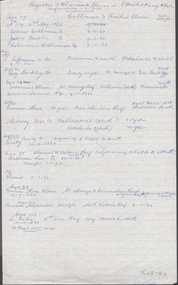
Document - MINING REPORTS - REGISTER OF CLAIMS & SHARES IN EAGLEHAWK & KANGAROO FLAT
... MINING REPORTS - REGISTER OF CLAIMS & SHARES IN EAGLEHAWK & KANGAROO FLAT...... Register of Claims & Shares in E'hawk & Kang Flat...Handwritten list of a Register of Claims & Shares in Eaglehawk and Kangaroo Flat commencing 1/3/1863. ...Document MINING REPORTS - REGISTER OF CLAIMS & SHARES IN EAGLEHAWK & KANGAROO FLAT ...Handwritten list of a Register of Claims & Shares in Eaglehawk and Kangaroo Flat commencing 1/3/1863. Listed is the page number, name of mine, number of yards, owners name and transfer date. Page 2 mentions the new St. Mungo Mine, its dividends, calls and yield.document, gold, mining reports, register of claims & shares in e'hawk & kang flat, collman & tacchi's claim, morris collmann, john tacchi, colmann collmann, luffsman & co, endeavour, wittscheibe, lady barkley co, st mungo, gov barkley, wearne's claim, st mungo reef, williams, freemantle, samson wearne, princess alice, carshalton reef, ryal dane, waterloo, midway, ballerstedt, passby (pass by co), j cooper, victoria reef, william rae, phoenix, princess alice claim, devonshire reef, young's claim, princess alexandra amalg'd, north victoria reef, la belle, nth dev. reef, todd & co north, new st mungo, 3 m d a r 1910 -
 Tarnagulla History Archive
Transcript: Register of Claims, Dunolly & Tarnagulla Division, 1869-1880
... Transcript: Register of Claims, Dunolly & Tarnagulla Division...A typed transcript of part of the Register of Mining Claims for Dunolly & Tarnagulla Division. ...Transcript: Register of Claims, Dunolly & Tarnagulla Division ...Donald Clark Collection.A typed transcript of part of the Register of Mining Claims for Dunolly & Tarnagulla Division. Date range 1869-1880. Original item is in Public Record Office of Victoria (VPRS 1648). Gives names of claimants and locations of claims. -
Stawell Historical Society Inc
Archive - Book, Stawell Shire, Registration Of Residence Sites & Index 20-11-1924 - 28-7-1931, 1924
... Register of Claims 11P ...Residence Area Miners Right used by Stawell Shire Local government miners right Register of Claims 11P Large Brown Covered Leather Ledger with Red Covered Label on Spine Registration Of Residence Sites & Index 20-11-1924 - 28-7-1931 Archive Book Stawell Shire ...Residence Area Miners Right used by Stawell ShireLarge Brown Covered Leather Ledger with Red Covered Label on SpineRegister of Claims 11P local government, miners right -
 Upper Yarra Museum
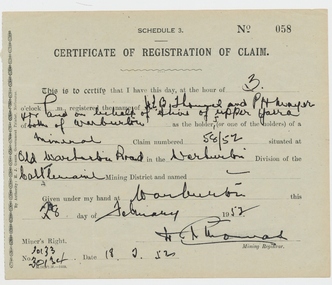
Document, Circa 1952
... A person wanting to dig for Gold or any other precious metal were required to register a claim on the land to be mined, the claim had to be measured & pegged to be specific as to its size and shape....A person wanting to dig for Gold or any other precious metal were required to register a claim on the land to be mined, the claim had to be measured & pegged to be specific as to its size and shape. gold document certificate miners claim Certificate Miners Claim No 058 Document ...A person wanting to dig for Gold or any other precious metal were required to register a claim on the land to be mined, the claim had to be measured & pegged to be specific as to its size and shape.Certificate Miners Claim No 058gold, document, certificate, miners claim -
 Bendigo Historical Society Inc.
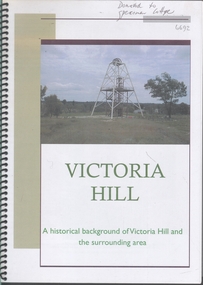
Booklet - Victoria Hill
... Between 1853 and 1861 there were 16 claims registered on Victoria Hill. Between 1908 and 1910 it was the site of the world's deepest shaft (1365-1406 meters)Today it provides interpretive walks that include sites such as an open-cut mine (1850's), poppet head, quartz crushing battery (1930's) and the foundations of George Lancell's 180 mine. ...Between 1853 and 1861 there were 16 claims registered on Victoria Hill. Between 1908 and 1910 it was the site of the world's deepest shaft (1365-1406 meters)Today it provides interpretive walks that include sites such as an open-cut mine (1850's), poppet head, quartz crushing battery (1930's) and the foundations of George Lancell's 180 mine. ...Victoria Hill, accessed from Marong Road, was one of the richest areas on the Bendigo goldfields and was the beginning of reef mining as opposed to alluvial mining. Between 1853 and 1861 there were 16 claims registered on Victoria Hill. Between 1908 and 1910 it was the site of the world's deepest shaft (1365-1406 meters)Today it provides interpretive walks that include sites such as an open-cut mine (1850's), poppet head, quartz crushing battery (1930's) and the foundations of George Lancell's 180 mine. It is registered as a site of historical significance.Clear plastic cover spiral bound booklet of 25 pages. 'Victoria Hill'. A historical background of Victoria Hill and the surrounding area. A colour photo of a poppet head on front. Original story written by Albert Richardson in 1971. This is a revised edition by Philip Wilkin in 2012. Illustrated with colour and B&W photos. Pages 13 to 25 have been inadvertently inserted upside down. A single page A4 leaflet 'Victoria Hill Self-Guided Tour' has been put inside after page 1Handwritten in ink on front page 'Donated to Specimen Cottage'victoria hill, gold mine -
 Bendigo Historical Society Inc.
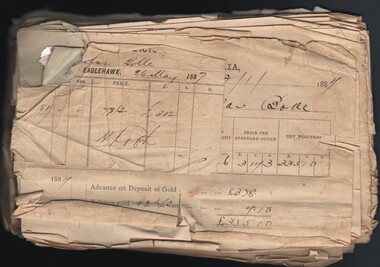
Document - GOLD SALE NOTES FOR NICHOLAS BOLLE, 1868 - 1887
... In March 1863 Nicholas registered his first mining claim, naming it Bolle’s Reef. ...In March 1863 Nicholas registered his first mining claim, naming it Bolle’s Reef. ...Nicholas John Bolle was born in Dorstadt, Germany in 1836 to parents Heinrich (Johannes Heinrich Wilhelm) and Friederike Hartmann (Anne Marie Friedericke). Around the age of 20 he immigrated to Australia and made his way, most likely on foot, 150km in a northerly direction to the Bendigo goldfields. In March 1863 Nicholas registered his first mining claim, naming it Bolle’s Reef. Having worked this reef until it no longer paid, he went on a prospecting tour of the area and found another gold reef towards Elysian Flat, staked a claim and registered it under the name of his beloved wife ‘Rosanna’. Sadly, as was often the case, the cost of hiring men to get the gold out of the ground, and removing it from the clay and quartz, outweighed the amount of profit he was making from his discoveries. In November 1863 while living and working at Old Tom Gully, Nicholas appeared in the Government Gazette as insolvent. Nicholas continued to struggle on, scoping out the surrounding area in the Whipstick Forest, and having some little success and by 1869 he was given a government reward of 25 pounds for discovering a new area of gold in the Whipstick. The Government Gazette records this reward – 'for the discovery of the Whipstick, 25 pounds' (Government Gazette 1869) By 1872 Nicholas had established a quartz crushing plant at his mine in Old Tom Gully, (the Old Tom mine) a remote place in the middle of the Whipstick. Mining was a dangerous business, and in 1875 Nicholas was called as a witness in a coroner’s inquest into the death of a John Bashton who was accidentally killed in a mining accident at nearby Easter Claim in December. In 1881, he was again called to give evidence when one of his employees Mr Thomas Garrett was killed while working at his claim at Old Tom Reef. So we are fortunate to have Nicholas describing his day’s work in his own words. Reference: Michelle Dennis Family History http://www.michelledennis.com.au/?page_id=1067) The Old Tom Mine site is situated between Old Tom Road, Scotsman Road, Eaglehawk-Neilborough Road and an unnamed road, Whipstick VIC 3556. The Marong Heritage Study, Mining Sites ( City of Greater Bendigo) describes the former mine site as follows: '40 metre-long mullock heap with one dumping line running north from a filled shaft. The heap has been partially quarried. 20 metres south is a scatter of red hand-made bricks and rough concrete rubble. Further south there are smaller mullock dumps and a line of shallow reef workings Surface workings 30 metres west of the mullock dump, running north, is a line of small mullock paddocks, terminating in a shallow open cut. On the same line to the south, in an area north and west of the most southerly section of reef workings there is an area of hydraulic sluicing. West of the cyanide works and along Scotchman Gully there are patches of shallow alluvial workings. Battery site On the eastern side of the open-cut is a small mullock paddock, below which is a spread of hand-made red bricks and fire bricks. Near this rubble is a dry dam, with traces of battery sand nearby. Puddling machine site 10 metres north of the water race is the outline of a 20 foot diameter puddling machine. The central mound retains its wooden post and fragments of timber side-boarding are still present in the puddling trench. Water was fed to the puddling machine from the race by a pipe, now largely buried. The dumps are weathered and partially quarried, but the puddling machine is in good con 40 metre-long mullock heap with one dumping line running north from a filled shaft. The heap has been partially quarried. 20 metres south is a scatter of red hand-made bricks and rough concrete rubble. Further south there are smaller mullock dumps and a line of shallow reef workings Surface workings 30 metres west of the mullock dump, running north, is a line of small mullock paddocks, terminating in a shallow open cut. On the same line to the south, in an area north and west of the most southerly section of reef workings there is an area of hydraulic sluicing. West of the cyanide works and along Scotchman Gully there are patches of shallow alluvial workings'. Reference: https://www.goldfieldsguide.com.au/explore-location/553/old-tom-mine/ Document. Gold Sale notes for Nicholas Bolle. Papers pinned together covering the years 1868 - 1887 being statement of gold melted and assayed for Nicholas Bolle from the Eaglehawk branch of the Bank of Victoria. A few of the papers are from the Bank of New South Wales - Eaglehawk Branch, Bank of Australasia, Bank of Australasia Gold Office. The earliest statement dated 3 Jul 1868 is for Messrs Harrison & Bashton. Other early ones are for Derbyshire Reef. The Bank of Victoria cards mention R. H. Andrews, Agent on the back. The Bank of Australasia Gold Office statement contains an ink picture of the building on the back.gold sale notes for nicholas bolle, bank of victoria - eaglehawk branch, bank of new south wales, bank of australasia, bank of australasia gold office, messrs harrison & bashton, derbyshire reef, r. h. andrews -
 Flagstaff Hill Maritime Museum and Village
Furniture - Shelves, A. Englander & Searle, Late 19th Century (1898)
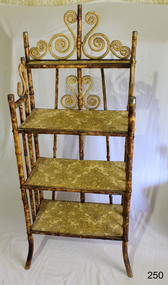
... registered bamboo furniture producers in Britain. The earliest recorded firm was Hubert Bill of 14 Little Camden St, London N.W., who claimed to have been established in (1869 the first bamboo furniture maker), while Daniel Jacobs & Sons of Hackney Road, London, were still in business in 1915, after 45 years of production. ...registered bamboo furniture producers in Britain. The earliest recorded firm was Hubert Bill of 14 Little Camden St, London N.W., who claimed to have been established in (1869 the first bamboo furniture maker), while Daniel Jacobs & Sons of Hackney Road, London, were still in business in 1915, after 45 years of production. ...This music stand set of shelves is one of many 19th century items of furniture, linen and crockery donated to Flagstaff Hill Maritime Village by, Vera and Aurelin Giles. The items are associated with the Giles Family and are known as the “Giles Collection”. Many of the items of furniture, linen and crockery in the Lighthouse Keeper’s Cottage were donated by Vera and Aurelin Giles and mostly came from the simple home of Vera’s parents-in-law, Henry Giles and his wife Mary Jane (nee Freckleton) whose photos are in the parlour. They married in 1880. Henry, born at Tower Hill in 1858, was a labourer on the construction of the Breakwater before leaving in 1895 to build bridges in N.S.W. for about seven years. Mary Jane was born in 1860 at Cooramook. She attended Mailor’s Flat State School where she was also a student teacher before, as family legend has it, she became a governess at “Injemiara” where her grandfather, Francis Freckleton, once owned land. Henry and Mary’s family of six, some of whom were born at Mailor’s Flat and later children at Wangoom, lived with their parents at Wangoom and Purnim west, where Henry died in 1933 and Mary Jane in 1940. THE SHELVES During the years 1869-1935 there were well over 250 registered bamboo furniture producers in Britain. The earliest recorded firm was Hubert Bill of 14 Little Camden St, London N.W., who claimed to have been established in (1869 the first bamboo furniture maker), while Daniel Jacobs & Sons of Hackney Road, London, were still in business in 1915, after 45 years of production. Design, quality, price and methods of construction were fairly consistent throughout the whole period, but it was the imaginative and often eccentric choice of subject matter that marked the differentiation between the various firms. While most produced standard tables, stands and fire-screens, the more adventurous offered for sale items such as Corner shelve units, charcoal barbecue grills and musical tea tables. Shelves were often covered with embossed leather paper designs, at first imported from Japan and then later produced in England. Some firms incorporated the knobbly roots of the bamboo stems into their designs, generally to form feet. Occasionally handles to drawers and cupboards were made with these roots although they were more commonly carved as imitations. Handles were mostly of cheap metal or brass. The ends of the bamboo canes were capped with stamped metal or turned bone, ivory or wooden discs. Methods of construction fell into three categories. First and most common is that of pegging. Bamboo stems being hollow, thick dowels can easily be glued into the joints. Some firms farmed out this work of `plugging' the ends of the canes to part-time workers at home. The second method, that of pinning, was far less satisfactory as bamboo tends to split lengthwise and therefore the jointed pieces eventually disintegrated. The most efficient method was that patented in 1888 (patent No 2383) by the firm of W. F. Needham in Birmingham. It consisted of metal shoes and covers for all joints which were made by wrapping a metal strip around the stems and soldering the overlapping ends. Some joints were further strengthened by a small pin or screw. Needham was by far the largest and most successful manufacturer and their individual and superior method of construction undoubtedly gained them their reputation. A. Englander & Searle of 34 Gt Eastern St and 31 Mare St, Hackney, London, were a firm particularly concerned with methods of construction. Although they seem to have entered the bamboo furniture market at a comparatively late date, about 1898, they produced inexpensive bamboo, aimed particularly at the export trade. The company stated in their catalogue that bamboo furniture “can be exported in one piece or it can be exported in pieces and put together again. The fixing up is much facilitated by a system of marking and numbering. Further, no glue is required for putting together as the screw system only is applied”. This method of construction best fits the Etagere in the Flagstaff collection and it is believed to have been made by A Englander & Searle, exported in a knock down form to Australia, purchased in kit form from a dealer hear and put together by the owner. The Etagere is a significant item as it highlight furniture fashion of the late Victorian era. This item was highly sort after in its time and although mass produced, not many examples remain, so this example is a valuable addition to the Flagstaff collection. It is believed that the construction method used is by a notable and respected maker of bamboo furniture and that its production was aimed at the export market and probably came to Australia in kit form.Bamboo shelves: decorative free standing Etagere comprising three large shelves and one small shelf. Shelves are made of wood used to store either orange or bacon boxes (as there are no knots in the wood, imported from South America and cheap to recycle). Shelves are covered with embossed leather paper. Frame is made from tortoise shell bamboo (brown lacquer applied to simulate tortoise shell appearance). Ends of bamboo canes are covered with metal shoes and fixed with a pin. Other bamboo joints are fixed with round head steel screws. This item is part of the Giles Collection.Noneflagstaff hill, warrnambool, shipwrecked-coast, flagstaff-hill, flagstaff-hill-maritime-museum, maritime-museum, shipwreck-coast, flagstaff-hill-maritime-village, bamboo shelves, bamboo etagere, victorian furniture, furniture, bamboo furniture, embossed leather paper, simulated bamboo, tortise shell, a englander & searle, giles collection, henry giles, tower hill, cooramook, warrnambool breakwater, mailor’s flat, wangoom, 19th century furniture -
 Flagstaff Hill Maritime Museum and Village
Accessory - Diamond ring, about 1855
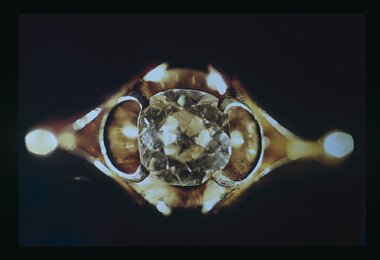
... claim the valuable diamond. The Schomberg Diamond is currently on display in the Great Circle Gallery. Flagstaff Hill Maritime Village along with the rest of the communion set. Other artefacts salvaged from the wreck include ship fittings and equipment, personal effects, a lithograph, tickets and photographs from the Schomberg. One of the Schomberg bells is in the Warrnambool Library. The Schomberg Diamond is particularly significant in that it played a crucial part in having the legislation changed to protect shipwrecks, with far tighter control over the salvaging of items from wreck sites. This ring is registered ...In 1975, 120 years after the sailing ship Schomberg was wrecked, Flagstaff Hill divers (Peter Ronald, Colin Goodall and Gary Hayden) found an ornate communion set amongst the wreckage. The set comprised a jug, ciborium, lid, chalice and plate. The items, apart from the lid, were then displayed at Flagstaff Hill Maritime Village. The lid had etchings that did not match the chalice and sat in storage for several years. Then in 1978, while the marine concretion inside the lid was being examined, a surface layer came loose and revealed a glint of gold that was assumed to be a piece of brass. The layers of concretion were carefully removed and a ring-like band emerged. Further treatment exposed a 'large faceted stone in an intricate gold setting. Weeks later a detailed examination estimated the value of the ring, known as the Schomberg Diamond, to be $7000. When the Schomberg was launched in 1855, she was considered the "Noblest” ship that ever floated on the water. Schomberg's owners, the Black Ball Line had commissioned the ship for their fleet of passenger liners. She was built by Alexander Hall of Aberdeen at a cost of £43,103 and constructed with 3 skins. One planked fore and aft and two diagonally planked, fastened together with screw-threaded trunnels (wooden rails). Her First Class accommodation was simply luxurious with velvet pile carpets, large mirrors, rosewood, birds-eye maple and mahogany timbers throughout, soft furnishings of satin damask, an oak-lined library with a piano. Overall she had accommodation for 1000 passengers. At the launch, the Schomberg's 34-year-old master, Captain 'Bully' Forbes, had promised to reach Melbourne in sixty days stating, "with or without the help of God." Captain James Nicol Forbes was born in Aberdeen in 1821 and rose to fame with his record-breaking voyages on the famous Black Ball Line ships; Marco Polo and Lightning. In 1852 in the Marco Polo, he made the record passage from London to Melbourne in 68 days. Unfortunately there were 53 deaths on the voyage, but the great news was off the record passage by Captain Forbes. In 1854 he took the clipper “Lighting” to Melbourne in 76 days and back in 63 days, this record was never beaten by a sailing ship. He often drove his crew and ship to breaking point to beat his previous records. He cared little for the comfort of the passengers. On this, the Schomberg's maiden voyage, he was determined to break existing records. Schomberg departed Liverpool on her maiden voyage on 6th October 1855 flying a sign that read "Sixty Days to Melbourne". She departed with 430 passengers and 3000 tons cargo including iron rails and equipment intended to build the Melbourne to Geelong Railway and a bridge over the Yarra from Melbourne to Hawthorn. She also carried a cow for fresh milk, pens for fowls and pigs, 90,000 gallons of water for washing and drinking. She also carried 17,000 letters and 31,800 newspapers. The ship and cargo were insured for $300,000 a fortune for the time. The winds were poor as she sailed across the equator, slowing Schomberg's journey considerably. Land was first sighted on Christmas Day, at Cape Bridgewater near Portland, Captain Forbes followed the coastline towards Melbourne. Forbes was said to be playing cards when called by the third mate Henry Keen, who reported land about 3 miles off. Due in large part to the captain's regarding a card game as more important than his ship, it eventually ran aground on a sand spit near Curdie's Inlet (about 56 km west of Cape Otway) on 26th December 1855, 78 days after leaving Liverpool. The sand spit and the currents were not marked on Forbes's map. Overnight, the crew launched a lifeboat to find a safe place to land the ship’s passengers. The scouting party returned to Schomberg and advised Forbes that it was best to wait until morning because the rough seas could easily overturn the small lifeboats. The ship’s Chief Officer spotted the SS Queen at dawn and signaled the steamer. The master of the Queen approached the stranded vessel and all of Schomberg’s passengers and crew disembarked safely. The Black Ball Line's Melbourne agent sent a steamer to retrieve the passengers' baggage from the Schomberg. Other steamers helped unload her cargo until the weather changed and prevented the salvage teams from accessing the ship. Later one plunderer found a case of Wellington boots, but alas, all were for the left foot. Local merchants Manifold & Bostock bought the wreck and cargo but did not attempt to salvage the cargo still on board the ship. They eventually sold it on to a Melbourne businessman and two seafarers. In 1864 after two of the men drowned when they tried to reach Schomberg, salvage efforts were abandoned. In 1870, nearly 15 years after the wreck parts of the Schomberg had washed ashore on the south island of New Zealand. The wreck now lies in almost 9 meters of water and although the woodwork is mostly disintegrated the shape of the ship can still be determined due to the remaining railway irons, girders and the ship’s frame. A variety of goods and materials can be seen scattered about nearby. The actual lid in which the ring was found has not yet been completely identified and could belong to a coffee pot, sugar bowl or maybe a jug or something similar. Although all survived the wreck no-one came forward to claim the valuable diamond. The Schomberg Diamond is currently on display in the Great Circle Gallery. Flagstaff Hill Maritime Village along with the rest of the communion set. Other artefacts salvaged from the wreck include ship fittings and equipment, personal effects, a lithograph, tickets and photographs from the Schomberg. One of the Schomberg bells is in the Warrnambool Library.The Schomberg Diamond is particularly significant in that it played a crucial part in having the legislation changed to protect shipwrecks, with far tighter control over the salvaging of items from wreck sites. This ring is registered as Artefact S/105 in the Schomberg collection, the Schomberg collection as a whole is of historical and archaeological significance at a State level. Flagstaff Hill’s collection of artefacts from the Schomberg is also significant for its association with the Victorian Heritage Registered shipwreck (VHR S 612). The collection is of prime significant because of the relationship between the objects salvaged, as together they help us to interpret the story of the Schomberg. The collection as a whole is historically significant for representing aspects of Victoria's maritime history and its potential to interpret social and historical themes. A mid-Victorian gentleman's solitaire diamond dress ring with a Brazilian cut diamond (cushion cut), one and one-third carat set within an 18 carat yellow gold ring consisting of four claws within an open scroll setting and a divided scroll shank. Colour is classified as 'J', clarity SII. The setting is handmade. warrnambool, shipwrecked-coast, flagstaff-hill, flagstaff-hill-maritime-museum, maritime-museum, shipwreck-coast, flagstaff-hill-maritime-village, schomberg, shipwrecked-artefact, clipper ship, black ball line, 1855 shipwreck, aberdeen clipper ship, captain forbes, peterborough shipwreck, ss queen, ciborium, ring, schomberg-diamond, schomberg-ring, gentleman's ring, dress ring -
 Federation University Historical Collection
Book - Register, Berry Anderson & Co, Ballarat School of Mines Gold Entry Book. 1908-1976, 01/06/1908-01/12/1976
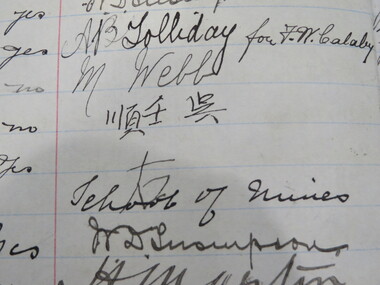
... registering receipt of gold. Columns include date, nature of transaction (eg assaying/purchase), age, where employed, business (eg mining, fossicking, assayer, etc), Abode, Signature, Witness, Claim, Mining Division, District, Where Obtained, Character of Gold (eg alluvial, smelted, quartz, etc), Weight, Value, How Gold Treated, To whom delivered after assay or smelting, Date of Assayer's Certificate. ...registering receipt of gold. Columns include date, nature of transaction (eg assaying/purchase), age, where employed, business (eg mining, fossicking, assayer, etc), Abode, Signature, Witness, Claim, Mining Division, District, Where Obtained, Character of Gold (eg alluvial, smelted, quartz, etc), Weight, Value, How Gold Treated, To whom delivered after assay or smelting, Date of Assayer's Certificate. ...The Ballarat School of Mines had a model mine used by students, and to conduct assays for a fee. The Register of Gold Entry Book had to be kept by the Licensed Gold Buyer or Assayer under the Gold Buyers Act.Brown half leather bound register registering receipt of gold. Columns include date, nature of transaction (eg assaying/purchase), age, where employed, business (eg mining, fossicking, assayer, etc), Abode, Signature, Witness, Claim, Mining Division, District, Where Obtained, Character of Gold (eg alluvial, smelted, quartz, etc), Weight, Value, How Gold Treated, To whom delivered after assay or smelting, Date of Assayer's Certificate. ballarat school of mines, model mine, battery, assay, smelting, gold, robinson, frederick martell, r. callister, a. garrard, peter tong, lee sue, ah lung, chinese, f.w. calaby, ah kit, charlie ah lung, ah sung, ah chee, dep choon, charlie ah hing, frederick greaves, peter fong, george ah ki, ah hing, william mong, thomas bell and party, brown hill, dentist, amalgam, albert sydney sergeant, plumber, plumbing, george spence, plumber, commonwealth bank, j. hutton-jones, golden duke mining syndicate, blackwood, d.e.j. grant, eganstown, linton gold mining company, mining, d. bernard, g. peron, john page, david bernard, harry webb, ah fou, w.d. thompson, a.b. tolliday, m. webb -
Federation University Historical Collection
Letter - Correspondence, S.J. (Joe) Czynski, Correspondence on S.J. Czynski letterhead, 1958, 04/06/2015
... registered electrical contractor. The letter relates to the Ballarat Debating Association of which Joe Czynski was the secretary. Ballarat School of Mines Principal, Dick Richards, responded with advice that he has publicised the event, but believes mid year exams with claim the full attention of Diploma students, ...registered electrical contractor. The letter relates to the Ballarat Debating Association of which Joe Czynski was the secretary. Ballarat School of Mines Principal, Dick Richards, responded with advice that he has publicised the event, but believes mid year exams with claim the full attention of Diploma students, Correspondence on S.J. ...Joe Czynski was an electrician who made contact with the American Science Fiction (SF) editor Hugo Gernsback while undertaking his electrical apprenticeship in Chicago, USA. Some of Czynski's short stories were subsequently published in the SF periodical Amazing Stories in the 1920s and 1930s. He admitted to using a number of pseudonyms in Amazing Stories, but only acknowledged one, H. M. Crimp. On his return to Australia, Czynski's career as an electrician took precedence over his SF writing. He worked for some time on the Woomera rocket range and was an active member of the Ballarat Astronomical Society. (Austlit) In 1958 Joe Czynski was Secretary of the Ballarat Debating Association, and describes is electrical business as 'Ballarat Olympic Electricians'Correspondence on green letterhead for S.J. Czynski, registered electrical contractor. The letter relates to the Ballarat Debating Association of which Joe Czynski was the secretary. Ballarat School of Mines Principal, Dick Richards, responded with advice that he has publicised the event, but believes mid year exams with claim the full attention of Diploma students, czynski, s.j. czynski, joe czynski, debating, ballarat debating association, ballarat olympics, olympics, ballarat school of mines, r.w. richards, dick richards, letterhead -
 Flagstaff Hill Maritime Museum and Village
Textile - Flour bag - Moran & Cato's
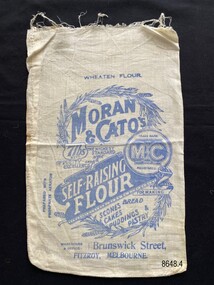
... Flagstaff Hill Maritime Museum and Village Great Ocean Road Shipwreck Coast calico domestic object textile food storage Moran & Cato's flour bag self-raising flour Front - Wheaten Flour, Moran & Cato's, Trade mark The M & C Brand Registered, 7lbs Nett, The Highest Standard of Purity and Excellence, prepared with phosphate aerator, Self-raising Flour, For making scones bread cakes puddings & pastry, Warehouse & Office- Brunswick Street, Fitzroy, Melbourne Back - Moran & Cato's, Cleaned Fruits are Perfection, (advertising text), The Same High Quality, The Same Prices at all our Branches. Small calico flour bag for self-raising flour (7lb) supplied from Moran & Cato's in Brunswick Street, Fitzroy, Melbourne. The front of the bag includes not only the detail of the business but ideas for baking, images of wheat and claims ...The flour bag is an example of packaging from the grocery store, Moran & Cato's. Moran & Cato's were a large chain of grocery stores operating from the late nineteenth century to the mid twentieth century across Victoria, Tasmania and New South Wales. The address on the flour bag is for the warehouse (wholesale depot) of the business which was a significant building in Brunswick St, Fitzroy.The flour bag provides a snapshot of packaging for a well known grocery store of the early twentieth century. The advertisement on the back for 'Cleaned Fruits' is an example of advertising that highlighted important facts relevant to that time (e.g. "latest Special Machinery" and "with running water").Small calico flour bag for self-raising flour (7lb) supplied from Moran & Cato's in Brunswick Street, Fitzroy, Melbourne. The front of the bag includes not only the detail of the business but ideas for baking, images of wheat and claims as to its excellence. The back of the bag has a written advertisement for 'Cleaned Fruits' another product of the company.Front - Wheaten Flour, Moran & Cato's, Trade mark The M & C Brand Registered, 7lbs Nett, The Highest Standard of Purity and Excellence, prepared with phosphate aerator, Self-raising Flour, For making scones bread cakes puddings & pastry, Warehouse & Office- Brunswick Street, Fitzroy, Melbourne Back - Moran & Cato's, Cleaned Fruits are Perfection, (advertising text), The Same High Quality, The Same Prices at all our Branches.flagstaff hill maritime museum and village, great ocean road, shipwreck coast, calico, domestic object, textile, food storage, moran & cato's, flour bag, self-raising flour -
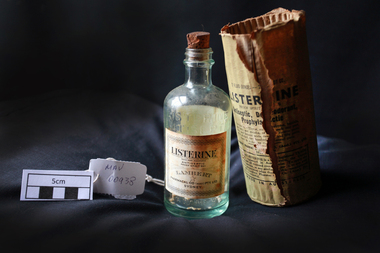 City of Moorabbin Historical Society (Operating the Box Cottage Museum)
Manufactured Glass, bottle 'Listerine' with wrapper, 20thC
... In 1976, the Federal Trade Commission ruled that these claims were misleading, Originally marketed by the Lambert Pharmacal Company (which later became Warner-Lambert), since 2006 it is manufactured and distributed by Johnson & Johnson In 2009, Johnson and Johnson launched a new alcohol-free version of the product called Listerine Zero. The screw top indicates that the bottle was manufactured post-1920s pharmacy listerine lister joseph lawrence dr. joseph lambert jordan wheat missouri glasgow royal infirmary infectious diseases johnson & johnson ltd. surgery antiseptics medicine pasteur louis france Front Label: LISTERINE / TRADE MARK REGISTERED / ANTISEPTIC / PROOF SPIRIT 50% / LAMBERT / a star / PHARMACAL COMPANY (AUST.) ...Listerine is a brand of antiseptic mouthwash product named after Sir Joseph Lister, Bt. FRS (1827 – 1912), who was a British surgeon and a pioneer of antiseptic surgery. By applying Louis Pasteur's advances in microbiology, he promoted the idea of sterile surgery while working at the Glasgow Royal Infirmary. 1865 Lister successfully introduced carbolic acid (now known as phenol) to sterilise surgical instruments, clean wounds, and for washing surgeons hands before and after operations. These measures led to a reduction in post-operative infections and made surgery safer for patients. “Listerine” was formulated by Dr. Joseph Lawrence and Jordan Wheat Lambert in St. Louis, Missouri, in 1879 as surgical antiseptic, it was given to dentists for oral care in 1895 It was later sold, in distilled form, as both a floor cleaner and a cure for gonorrhoea. But it wasn't a runaway success until the 1920s, when it was advertised as a solution for "chronic halitosis"— a then obscure medical term for bad breath.. In just seven years, the company's revenues rose from $115,000 to more than $8 million.. In 1885, Lawrence sold his share to the Lambert Pharmacal Company. Listerine was packaged in a glass bottle inside a corrugated cardboard tube for nearly 80 years before the first revamps were made to the brand. In 1992, Cool Mint Listerine was introduced in addition to the original Listerine Antiseptic formula and, in 1994, both brands were introduced in plastic bottles for the first time. . From 1921 until the mid-1970s, Listerine was also marketed as a preventive and remedy for colds and sore throats. In 1976, the Federal Trade Commission ruled that these claims were misleading, Originally marketed by the Lambert Pharmacal Company (which later became Warner-Lambert), since 2006 it is manufactured and distributed by Johnson & Johnson In 2009, Johnson and Johnson launched a new alcohol-free version of the product called Listerine Zero. The screw top indicates that the bottle was manufactured post-1920sA clear glass bottle, with a rubber stopper, wrapped in corrugated cardboard containing 'Listerine' mouth rinse .Front Label: LISTERINE / TRADE MARK REGISTERED / ANTISEPTIC / PROOF SPIRIT 50% / LAMBERT / a star / PHARMACAL COMPANY (AUST.) PTY LTD / SYDNEY Back Label : Instructions for use .......... on bottle : LISTERINE ANTISEPTIC / LAMBERT on cardboard wrapper ; 7 FLUID OZ. / LISTERINE / PROOF SPIRIT 50% / ANTISEPTIC, DEODORANT, / PROPHYLACTICpharmacy, listerine, lister joseph, lawrence dr. joseph, lambert jordan wheat, missouri, glasgow royal infirmary, infectious diseases, johnson & johnson ltd., surgery, antiseptics, medicine, pasteur louis, france -
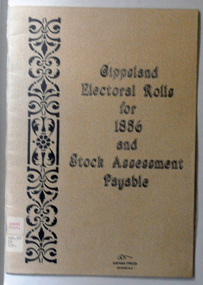 Orbost & District Historical Society
book, E-Gee Printers, Gippsland Electoral Rolls for 1856 and Stock Assessment Payable, 1985
... registers-victoria A 16 pp paper back book which has a clear plastic cover. The covers are beige coloured with the title "Gippsland Electoral Rolls for 1856 and Stock Assessment Payable" in blak print. On the left hand side is a vertical pattern in black print. The book contains an alphabetical list of persons claiming ...The Electoral Act 1856 was passed through Parliament o March 13, 1856. Victoria was the first Australian colony, and the first legislature anywhere in the world, to adopt the practice of the secret ballot. Victoria's constitution prescribed that the Parliament was to be bicameral, consisting of an upper house, the Legislative Council and a lower house, Legislative Assembly. Men were entitled to vote according to the qualifications described in this book - the right to vote in each house was dependent on status - educational qualifications, income and for either literacy. Two names are registered for the Orbost district: James Dickson and J.C. McLeod.This item is a useful research tool.A 16 pp paper back book which has a clear plastic cover. The covers are beige coloured with the title "Gippsland Electoral Rolls for 1856 and Stock Assessment Payable" in blak print. On the left hand side is a vertical pattern in black print. The book contains an alphabetical list of persons claiming or supposed to be entitled to Vote in the Election of a Member for the District. It lists the needed qualifications of electors followed by the Voters Roll for Legislative Assembly, 1856 and the Voters Roll for Legislative Council, 1856 . It then lists the Stock Assessments, 1856.voting-registers-victoria -
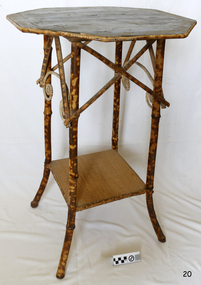 Flagstaff Hill Maritime Museum and Village
Furniture - Plant Stand, 1880
... registered bamboo furniture producers in Britain. The earliest recorded firm was Hubert Bill of 14 Little Camden St, London N.W., who claimed to have been established in 1869, while Daniel Jacobs & Sons of Hackney Road, London, were still in business in 1915, after 45 years of production. ...registered bamboo furniture producers in Britain. The earliest recorded firm was Hubert Bill of 14 Little Camden St, London N.W., who claimed to have been established in 1869, while Daniel Jacobs & Sons of Hackney Road, London, were still in business in 1915, after 45 years of production. ...During the years 1869-1935, there were well over 250 registered bamboo furniture producers in Britain. The earliest recorded firm was Hubert Bill of 14 Little Camden St, London N.W., who claimed to have been established in 1869, while Daniel Jacobs & Sons of Hackney Road, London, were still in business in 1915, after 45 years of production. Design, quality, price and methods of construction were fairly consistent throughout the whole period, but it was the imaginative and often eccentric choice of subject matter that marked differentiation between the various firms. While most produced standard tables, stands and fire-screens, the more adventurous offered for sale items such as corner shelve units, charcoal barbecue grills and musical tea tables. Shelves were often covered with embossed leather paper designs, at first imported from Japan and then later produced in England. Some firms incorporated the knobbly roots of the bamboo stems into their designs, generally to form feet. Occasionally, handles to drawers and cupboards were made with these roots, although they were more commonly carved as imitations. Handles were mostly of cheap metal or brass. The ends of the bamboo canes were capped with stamped metal or turned bone, ivory or wooden discs. Methods of construction fell into three categories. First and most common is that of pegging. Bamboo stems being hollow, thick dowels can easily be glued into the joints. Some firms farmed out this work of `plugging' the ends of the canes to part-time workers at home. The second method, that of pinning, was far less satisfactory as bamboo tends to split lengthwise and therefore the jointed pieces eventually disintegrated. The most efficient method was that patented in 1888 (patent No. 2383) by the firm of W. F. Needham in Birmingham. It consisted of metal shoes and covers for all joints, which were made by wrapping a metal strip around the stems and soldering the overlapping ends. Some joints were further strengthened by a small pin or screw. Needham was by far the largest and most successful manufacturer, and their individual and superior method of construction undoubtedly gained them their reputation. A. Englander & Searle of 34 Gt Eastern St and 31 Mare St, Hackney, London, were a firm particularly concerned with methods of construction. Although they seem to have entered the bamboo furniture market at a comparatively late date, about 1898, they produced inexpensive' bamboo, aimed particularly at the export trade. Stating in their catalogue that bamboo furniture “can be exported in one piece or it can be exported in pieces and put together again. The fixing up is much facilitated by a system of marking and numbering. Further, no glue is required for putting together as the screw system is applied”. This method of construction best fits the Etagere and this item in the Flagstaff collection, and it is believed to have been made by A Englander & Searle, exported in a knock-down form to Australia, purchased in kit form from a dealer here and put together by the purchaser. The bamboo plant stand is a significant item as it highlight furniture fashion of the late Victorian era. This item was highly sort after in its time and although mass produced, not many examples remain because the item is so fragile so this example is a valuable addition to the Flagstaff collection. It is believed,the construction method used is by a notable and respected maker in England of bamboo furniture that was aimed specifically at the export market and probably came to Australia in kit form to be assembled by the purchaser.Plant stand: a bamboo plant stand with a hexagonal pine timber top edged with tortoise shell bamboo. The top is supported on four tortoise shell bamboo legs joined at the base by a square cane-covered shelf. The tortoise shell appearance is brown lacquer. This stand is part of the Giles Collection. flagstaff hill, warrnambool, shipwrecked coast, flagstaff hill maritime museum, shipwreck coast, furniture, plant stand, bamboo furniture, etagere, victorian furniture, simulated bamboo, tortise shell, a englander & searle, domestic furniture, giles collection, henry giles, cooramook, mailor’s flat, wangoom, 19th century household goods -
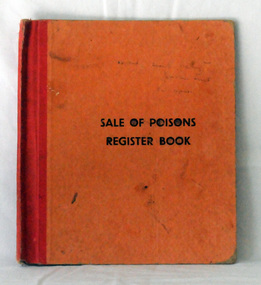 Orbost & District Historical Society
register, Felton, Grimwade & Duerden's, Sale of Poisons Register Book, 1951
... claims for these product sand the Commonwealth strengthened controls on imported biological products. This item reflects the history of pharmaceutical practices. Until the mid 1950s there was no government co-ordinated record-keeping of the sales of poisons. This item is indicative of that period. ledger-sale-of-poisons Turley-chemist Zimmer-John pharmacies-Orbost A thin cardboard covered book - orange cover with red cloth binding. It contains information -dates, names, addresses, occupations, witnesses and name and purpose of poison. The details are hand-written. Sale of Poisons Register ...This item was used at J.D, Torley, Nicholson Street in Orbost by Mr H.A. Murray.. Chemists who worked in Orbost included Henry Cottman; James Alfred Dubois Williams; Harry Arthur Murray; Miss P.E .Mason (Phyllis Estelle?); Miss Sybil Monica Buzza; Thomas James Frayer; Australia Shaw; James David Torley; John William Zimmer; Dalkeith William Steele; William Thomas Hollingsworth; E.E. Cohen; R.S. Anderson; Frances John Perry Faith Everard Pardew and Charles Anthony Wurf. From POISONS ACT. Act No. 54, 1952. "1 2 . (1) Every person who sells any poison included in the first part of Schedule One of the Poisons List shall, before delivery thereof to the purchaser, inquire his name, place of abode, and occupation and the purpose for which such poison is required or stated to be required. (2) Such person shall thereupon make a faithful entry of such sale, specifying the poison and the quantity thereof, and all such particulars so given by the purchaser, together with the day of the month and year of such sale, in a book to be kept by the vendor for that purpose in the form prescribed. (3) Every such entry shall be signed by the person making the same, and shall, subject to sections thirteen and fourteen of this Act, be also signed by the purchaser, unless he declares himself unable to write, in which case the person making the entry shall add thereto the words "Purchaser cannot write". (4) Whenever a witness to the sale is required by this Act, such entry shall be signed by such witness, and shall also state his place of abode. (5) The book referred to in subsection two of this section shall be preserved by the vendor for at least five years from the date on which the final entry in the book is made." Before these ledgers were used there had an increasing number of proprietary medicines appearing on an unregulated market, with many products regarded as ‘quack’ medicines with amazing therapeutic claims.State governments moved to control claims for these product sand the Commonwealth strengthened controls on imported biological products. This item reflects the history of pharmaceutical practices. Until the mid 1950s there was no government co-ordinated record-keeping of the sales of poisons. This item is indicative of that period.A thin cardboard covered book - orange cover with red cloth binding. It contains information -dates, names, addresses, occupations, witnesses and name and purpose of poison. The details are hand-written.ledger-sale-of-poisons turley-chemist zimmer-john pharmacies-orbost -
 Eltham District Historical Society Inc
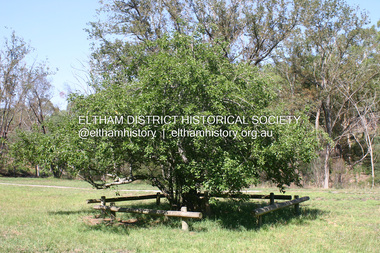
Photograph - Digital Photograph, Alan King, Heritage apple tree, 24 January 2008
... Register of Significant Trees, as the oldest apple tree in Victoria. It is ‘Believed to have been planted by either John Batman, (c1837) or Martin Batey (1841)’.2 In 1966 a Horticultural Adviser, Mr Rolfe, after extensive questioning of aged Greensborough residents, wrote: ‘it thus seems fairly certain that the old tree on the banks of the Plenty River is an original Batman apple tree’. Mr Rolfe said that the tree stood on a spot formerly called Wattle Bend: ‘one of the sites claimed...Register of Significant Trees, as the oldest apple tree in Victoria. It is ‘Believed to have been planted by either John Batman, (c1837) or Martin Batey (1841)’.2 In 1966 a Horticultural Adviser, Mr Rolfe, after extensive questioning of aged Greensborough residents, wrote: ‘it thus seems fairly certain that the old tree on the banks of the Plenty River is an original Batman apple tree’. Mr Rolfe said that the tree stood on a spot formerly called Wattle Bend: ‘one of the sites claimed ...This old apple tree situated beside the Plenty River Trail at Greensborough has been associated with Melbourne Founder John Batman. Known as Batman's Tree, this apple tree is on the bank of the Plenty River near Leischa Court, Greensborough. It is said that Melbourne Founder John Batman may have planted the tree and later signed his treaty here with the Aboriginal people. It still bears fruit and its recorded on the National Trust's Register of Significant Trees, as the oldest apple tree in Victoria. Published: Nillumbik Now and Then / Marguerite Marshall 2008; photographs Alan King with Marguerite Marshall.; p7 Was This John Batman's Tree? An apple tree on the bank of the Plenty River near Leischa Court, Greensborough, is believed to have belonged to Melbourne’s founder, John Batman. It could also stand where John Batman signed his famous treaty with the Aboriginal people.1 Known as Batman’s Tree, it still bears fruit and is recorded on the National Trust’s Register of Significant Trees, as the oldest apple tree in Victoria. It is ‘Believed to have been planted by either John Batman, (c1837) or Martin Batey (1841)’.2 In 1966 a Horticultural Adviser, Mr Rolfe, after extensive questioning of aged Greensborough residents, wrote: ‘it thus seems fairly certain that the old tree on the banks of the Plenty River is an original Batman apple tree’. Mr Rolfe said that the tree stood on a spot formerly called Wattle Bend: ‘one of the sites claimed to be where John Batman signed his famous treaty with the aboriginals. ‘My main source of information has been interviews with people who attended school in the Greensborough area from 70 to 80 years ago. Their parents were close to the days when Melbourne was founded so information passed on by word of mouth.’ Around 1920 the tree was struck by lightning and a concrete block was placed in the split. The concrete is inscribed with the date 1841 when the tree was thought to have been planted. Not everyone agrees with Mr Rolfe however. Former secretary of the Nillumbik Historical Society, Kevin Patterson, said there was no written evidence to support the claim. But he said the tree had been known to locals for decades as Batman’s Tree. In the 1920s a holiday resort in the area advertised: ‘Come to Greensborough and see John Batman’s tree’. Mr Patterson said it was thought that when Batman died in 1839 his land was sold and a Greensborough man Frederick Flintoff bought seedlings from his orchard for £1 each. This was the only one left.3 Mr Rolfe said: ‘If planted in 1837, or even a few years later, it undoubtedly is the oldest living apple tree in Victoria. Title records of the property on which the tree grows show that the land was a crown grant of F D Wickham in 1840. Mr Wickham was reputed to be a friend of John Batman. All the early settlers prior to the crown grants were squatters, by virtue of Batman’s treaty. This treaty was revoked by the then New South Wales Government, so it is likely that Wickham or an agent was in occupation before 1840. ‘According to Mrs Mavis Latham (John Batman – Great Australian Series, Oxford University Press) when Batman came to Port Phillip in 1835 he brought fruit trees with him. He failed to get a crown grant for his selection on Collins Street, which included 20 acres (eight ha) of orchard and cultivation. His residence became the Government Office and Melbourne grew from wild bushland in 1835 to a town of over 20,000 people by 1841. It is possible Batman visited Wickham and presented him with a tree.’ However a Flintoff descendant in 1933 said Frederick Flintoff ordered his bailiff Martin Batey to transplant the Batman Tree from the Spencer Street orchard to its present site as a memorial to his friend Batman.4 Mr Rolfe spoke to many people, including descendants of the Bateys and Flintoffs and pupils at the Greensborough Primary School. Many had gained their information from a ‘very highly respected’ head master Lewis Amiet at the Greensborough School from 1895 to 1917. He must have gained this information from residents in the district and had this information been incorrect, the parents of the children would have promptly corrected him.’ One woman who attended the school before Mr Amiet’s appointment, said the previous teacher also taught that the tree on the Plenty River was a Batman tree, Mr Rolfe said.This collection of almost 130 photos about places and people within the Shire of Nillumbik, an urban and rural municipality in Melbourne's north, contributes to an understanding of the history of the Shire. Published in 2008 immediately prior to the Black Saturday bushfires of February 7, 2009, it documents sites that were impacted, and in some cases destroyed by the fires. It includes photographs taken especially for the publication, creating a unique time capsule representing the Shire in the early 21st century. It remains the most recent comprehenesive publication devoted to the Shire's history connecting local residents to the past. nillumbik now and then (marshall-king) collection, greensborough, john batman tree, plenty river trail -
 Eltham District Historical Society Inc
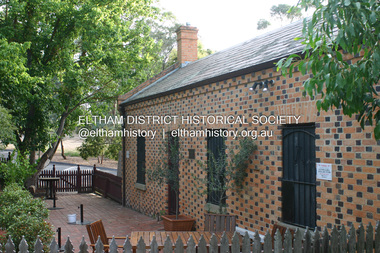
Photograph - Digital Photograph, Alan King, Shillinglaw Cottage, 6 January 2008
... Registers. The cottage was constructed with handmade bricks in the Flemish Bond style, typical of cottages and farmhouses in Flanders, Europe. It features burnt ‘header’ bricks over the façade, which gives a chequered effect. The roof is made of slate, while the windows are 12-paned sash with relieving arches. It is not clear who were the first owners of the cottage. The National Trust claims...Registers. The cottage was constructed with handmade bricks in the Flemish Bond style, typical of cottages and farmhouses in Flanders, Europe. It features burnt ‘header’ bricks over the façade, which gives a chequered effect. The roof is made of slate, while the windows are 12-paned sash with relieving arches. It is not clear who were the first owners of the cottage. The National Trust claims ...Covered under National Estate, National Trust of Australia (Victoria) Local Significance and Heritage Overlay, Nillumbik Planning Scheme. Published: Nillumbik Now and Then / Marguerite Marshall 2008; photographs Alan King with Marguerite Marshall.; p95 Thanks to an Australia first effort by local residents, the historic Shillinglaw Cottage still survives. The cottage at Panther Place, Eltham, once stood about 100 metres away on Main Road. But in 1963 it faced demolition to make room for the Eltham Shire Offices (since demolished). However residents rallied to save Shillinglaw Cottage and became the first in Australia to remove and reconstruct an early settler’s brick building. A fundraiser was the residents’ compilation of loved recipes into the cookery book, Flavour of Eltham. The cottage, built in the late 1870s by noted pioneer builder George Stebbing, is one of Eltham’s earliest buildings and associated with significant early settlers. It is on the National Estate and National Trust Registers. The cottage was constructed with handmade bricks in the Flemish Bond style, typical of cottages and farmhouses in Flanders, Europe. It features burnt ‘header’ bricks over the façade, which gives a chequered effect. The roof is made of slate, while the windows are 12-paned sash with relieving arches. It is not clear who were the first owners of the cottage. The National Trust claims that Stebbing built it for farmer Thomas Cochrane.1 Others say Cochrane first owned the land but Stebbing was Shillinglaw’s first owner and remained so until 1887. The Shillinglaw family then bought it and lived there for around 80 years until 1963 when they sold it to the Eltham Council.2 Farmer Thomas Cochrane bought the Shillinglaw Cottage site from land developer Josiah Holloway. The site was the largest in what Holloway called Little Eltham, of some 30 acres (12 ha), extending along the creek from Henry Street to Luck Street. In 1874 Cochrane sold the land to George Stebbing. Meanwhile in 1861, Stebbing was the owner and occupier of a house at Pitt Street, Eltham, which he had built. Evelyn Observer journalist James Rossiter rented the Pitt Street house, then in 1881 Phillip Shillinglaw occupied it. Stebbing constructed several buildings of note in the area, including the Uniting Church at John Street, the building beside it – a former bank – and St Margaret’s Church of England in Pitt Street. Stebbing was also an Eltham Shire Councillor from 1871 to 1873 and a trustee and treasurer of the Eltham Wesleyan Church.3 In the 1870s he is recorded as the owner of up to five houses. Earlier he had been described as a bricklayer and later became a farmer. In 1882 Stebbing returned to the Pitt Street house and Shillinglaw occupied the new house in Main Road, which he owned from 1887. Shillinglaw was a prolific poet and preached at the Eltham Primitive Methodist Church, where he also served as Sunday School superintendent and led the Young People’s Society Christian Endeavour. The Shillinglaws saw many changes in their property’s boundaries – the major one occurring at the turn of the century when land for the railway and Eltham station was acquired from their holding. The northern part of the remaining land was then used for some of the first commercial developments in what was to become the Eltham Shopping Centre. Later still, the land immediately north of the cottage was bought by the Eltham War Memorial Trust for the War Memorial Buildings and the fire station. The Trust’s land eventually passed to the council. The council bought the remaining two acres (0.8 ha) with the house, and with the exception of the commercial development between the fire station and the post office, all of the former Shillinglaw land is owned by the council or government instrumentalities.4 Since the late 20th century, the cottage has had varied uses, such as a handcrafts store and as a restaurant.This collection of almost 130 photos about places and people within the Shire of Nillumbik, an urban and rural municipality in Melbourne's north, contributes to an understanding of the history of the Shire. Published in 2008 immediately prior to the Black Saturday bushfires of February 7, 2009, it documents sites that were impacted, and in some cases destroyed by the fires. It includes photographs taken especially for the publication, creating a unique time capsule representing the Shire in the early 21st century. It remains the most recent comprehenesive publication devoted to the Shire's history connecting local residents to the past. nillumbik now and then (marshall-king) collection, shillinglaw cottage -
 Bendigo Historical Society Inc.
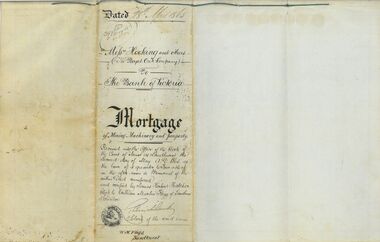
Legal record - Hartnell Legal Documents: Hocking Mortgage of Mining Machinery and property 1865
... Document dated 28th April 1865 "All that the amalgamated alluvial claim at Pottery Flat aforesaid registered Number 881 in the Books of the Mining Register for the Mining District of Sandhurst known as the Royal Oak Company's claim." ...Document dated 28th April 1865 "All that the amalgamated alluvial claim at Pottery Flat aforesaid registered Number 881 in the Books of the Mining Register for the Mining District of Sandhurst known as the Royal Oak Company's claim." ...Document dated 28th April 1865 "All that the amalgamated alluvial claim at Pottery Flat aforesaid registered Number 881 in the Books of the Mining Register for the Mining District of Sandhurst known as the Royal Oak Company's claim." Listed in "The Bendigo goldfield registry" 1872 as Royal Oak Company: Bignell's Reef, Derwent Gully. Capital £24000., in £24,000 20s. shares. Manager, W. Barker. Newspaper articles dating from 11 Jan 1867 refer to the company as "Royal Oak Mining Company". Both names appear to be used interchangeably. This A3 document is made up of 3 pieces of heavy stock lined paper. The document is bound on the left side with glue and string creating a book which comprises the legal contract of mortgage for mining equipment. The document is handwritten in black ink across 4 pages (2 double sided pages) with the last page acting as the documents cover when folded down into a pamphlet. The signature page includes 9 red wax seals. When held up to the light, the cover page and internal page show an indentation reading G. Wilmot 1862. The first page of the contract shows an indentation of a crest and the initials GW.joseph hocking, alfred inkson gillman, benjamin lean, absalom brewer, donald fraser, william seed, john rowe, william collier, george drake, mining, royal oak company, the bank of victoria, g. wilmot -
 Bendigo Historical Society Inc.
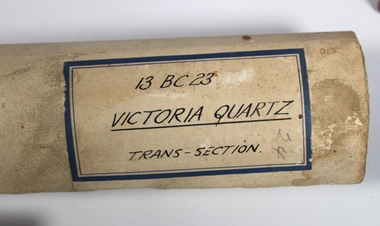
Plan - Victoria Quartz Gold Mine
... claim, flooding the shaft and halting operations. The company baled water for six months then handed the mine over to the tributers who worked the upper levels for the share of the profits. The mine closed in 1913, having produced over 48,000 ounces of gold and paid dividends of £99,600. (Source, Goldfield Guide https://www.goldfieldsguide.com.au/explore-location/400/victoria-hill-mining-reserve/) Victorian Heritage Register...claim, flooding the shaft and halting operations. The company baled water for six months then handed the mine over to the tributers who worked the upper levels for the share of the profits. The mine closed in 1913, having produced over 48,000 ounces of gold and paid dividends of £99,600. (Source, Goldfield Guide https://www.goldfieldsguide.com.au/explore-location/400/victoria-hill-mining-reserve/) Victorian Heritage Register ...The Victoria Quartz Gold Mine was situated on Victoria Hill, Ironbark, (1877 - 1913). At the turn of the century, this was the site of one of the premier mines on the Bendigo goldfield. In 1908, it boasted the world's deepest shaft - 4,478 feet (1,365 metres). The shaft reached a depth of 4,613 feet (1,406 metres) in 1910. In 1857 eight small claims in this area had been merged to form the Victoria Reef Quartz Mining Co. Another merger in 1877 led to the formation of the Victoria Quartz Co. For the next three decades, the mine produced consistent profits. In 1910, water burst into the claim, flooding the shaft and halting operations. The company baled water for six months then handed the mine over to the tributers who worked the upper levels for the share of the profits. The mine closed in 1913, having produced over 48,000 ounces of gold and paid dividends of £99,600. (Source, Goldfield Guide https://www.goldfieldsguide.com.au/explore-location/400/victoria-hill-mining-reserve/) Victorian Heritage Register information on mine: Statement of Significance Last updated on - July 14, 2005 The story of quartz mining on Victoria Hill lies at the heart of Bendigo's historical status as the world's richest and deepest reefing field. Gold was discovered on Victoria Hill in 1854, and by early 1855 claims had been taken up over its entire extent. Shafts were first worked by windlass, whip or whim, and primitive crushing batteries were in operation. By 1861, Victoria Hill had yielded at least 1,200,000oz in gold. One of the early claims on Victoria Hill was owned by Prussian immigrants, Christopher Ballerstedt and his son Theodore. In 1854, they bought a claim on the hill for £80, to which they subsequently added other claims, and from the quartz veins (called spurs), worked both by shafts and a large open cut, obtained gold worth nearly £200,000. Christopher Ballerstedt was dubbed 'Father of the Hill' and has been credited as the first to debunk the theory at that time prevalent on the Bendigo field, that the gold content of reefs would diminish at depth. As his shafts plunged below the 200-foot level, the quartz remained rich in gold. His success inspired others, and so led the way to Bendigo's later status as the world's deepest and richest goldfield. The Ballerstedt's built Bendigo's grandest mansion, Fortuna. Theodore continued to work Victoria Hill after his father's death, but in 1871, convinced that his claim was exhausted, he sold both mine and mansion to George Lansell for £60,000. Lansell's mine on Victoria Hill was called the 180, and operated under his ownership until his death in 1906. The mine supplied the initial wealth that made Lansell Bendigo's 'Quartz King'. George Lansell was such a force in Bendigo's mining history that his death was cited as one of the reasons for the decline of Bendigo as a quartz mining centre, The Victoria Hill Quartz Gold Mines are of historical, archaeological and scientific importance to the State of Victoria. The Victoria Hill Quartz Gold Mines are historically significant as the symbolic heart of Bendigo's famous goldfield. The mines are linked to nineteenth-century individuals (Christopher Ballerstedt and George Lansell) who played prominent roles in the evolution of Bendigo. Both men's fortunes and their influence on Bendigo, originated from mining operations carried out on the hill. The Victoria Hill Quartz Gold Mines are historically and scientifically important as characteristic examples of an important form of gold mining. Gold mining sites are of crucial importance for the pivotal role they have played since 1851 in the development of Victoria. As well as being a significant producer of Victoria's nineteenth century wealth, quartz mining, with its intensive reliance on machinery, played an important role in the development of Victorian manufacturing industry. The Victoria Hill Quartz Gold Mines are important as a manifestation of this aspect of gold mining. The Victoria Hill Quartz Gold Mines are scientifically important, as they contain relics span nearly sixty years of mining (1854 to 1913), documenting the richest and most significant years of Bendigo's world-famous quartz mining industry. Enhancing the significance of the place are relics from the Victoria Quartz Company operations, ncluding, at 4,870 feet, the world's deepest nineteenth-century gold mining shaft. As a postscript to the chronology of gold mining is the surviving crushing machinery (formerly part of the Bendigo Crushing Works) which was erected near the foundations of Lansell's 180 mine in 1932, to crush quartz for nearby mines. The place has a potential to yield artefacts and evidence which will be able to provide significant information about the technological history of gold mining. [Source: Victorian Heritage Register] Hermes Number 8506 https://vhd.heritagecouncil.vic.gov.au/index.php/places/8506/download-report Hand drawn plan of the bottom section of the Victoria Quartz Gold Mine. Mine shaft shown from 2706 feet to 5200 (potential) feet shown, with annotation regarding geological features and gold obtained from different level crushings. Blue border sticker on outside of plan: '13 BC 23 Victoria Quartz Trans-Section'. Plan is not dated. The Victoria Quartz plan is part of the Margaret Roberts Collection.victoria hill quartz gold mine, victoria hill -
 Bendigo Historical Society Inc.
Plan - New Moon Co
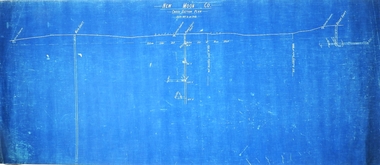
... claim being south and adjoining the Robin Hood Co. Capital consisted of 16 shares of £75 each. In a short time, after only £160 had been called up, payable quartz from a depth of 173 feet enabled dividends of £2,778 ... In 1870 a registered...claim being south and adjoining the Robin Hood Co. Capital consisted of 16 shares of £75 each. In a short time, after only £160 had been called up, payable quartz from a depth of 173 feet enabled dividends of £2,778 ... In 1870 a registered ...This mine was in Sailors Gully; the closest intersection Growler and Crook Streets. The most successful mine of the Moon Reef was the New Moon Company. The mine commenced operations in 1867, their claim being south and adjoining the Robin Hood Co. Capital consisted of 16 shares of £75 each. In a short time, after only £160 had been called up, payable quartz from a depth of 173 feet enabled dividends of £2,778 ... In 1870 a registered company was formed with capital of £24,000 ... There were two shafts on the lease, each 280 feet in depth, while work had commenced on a new engine shaft and the erection of a winding plant. The company purchased the Robin Hood's lease and plant in 1878. The Robin Hood shaft became the New Moon main shaft and was eventually deepened to 2,400 feet. The New Moon Company was re-registered in 1886 as a No Liability Company with capital of £12,000 ... and the mine developed into one of the best-managed and most economically worked mines on the Bendigo goldfield ... This company, at the close of 1906 declared its 200th dividend ... From 1878 to 1890 had been lean years for the company when many calls were made to shareholders, while for a period of 6 years the mine was let tributors who crushed 6417 tons for 415 0zs ... dividends were paid from 1892 to 1913 ... mine closed down in 1917 Apart from public crushing, the company crushed 545,289 tons of stone during its existence, all dug from its own mine ... yielded 230,601 ozs of gold, and paid shareholders the sum of £377,400. The former great mine was taken over by the Bendigo Amalgamated Company from 1917 to 1922. It was re-opened in 1928 only to close in 1932 Later, cyaniders treated the sand, and this great dump was removed from its original position and dumped across the road into Napoloen Gully, where it buried the site of the New Moon Company's original, as it was better known, south shaft. Source: https://www.mindat.org/loc-98781.htmlDrawn on blue waxed paper, white text, plan of New Moon mine. Written on top of plan: ' New Moon Co., cross section plan' '40ft to an inch' Marked on plan 'Paddy's Gully, Centre Country. Plan forms part of the Margaret Roberts Collection.gold mining, gold, bendigo, new moon co, sailors gully, moon reef line -
 Bendigo Historical Society Inc.
Document - HANRO COLLECTION: LIQUIDATION
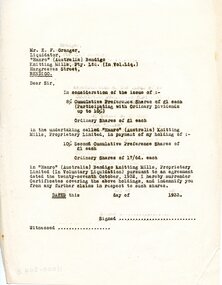
... HANRO Clothing Share Register Hanro Collection - Liquidation Mr E F Granger Typed letter headed Mr E F Granger, Liquidator, unsigned with no date in the year 1933 in reference to an agreement dated the 27th October, 1932 to surrender Certificates covering mentioned holdings and to indemnify against any further claims to such shares. ...Typed letter headed Mr E F Granger, Liquidator, unsigned with no date in the year 1933 in reference to an agreement dated the 27th October, 1932 to surrender Certificates covering mentioned holdings and to indemnify against any further claims to such shares. (two copies)hanro, clothing, share register, hanro collection - liquidation, mr e f granger -
 Bendigo Historical Society Inc.
Book - HANRO COLLECTION: SHARE REGISTER A & B ORDINARY 1929 - 1930
... She undertakes to indemnify Hanro against any claims or losses if the share certificate is presented for Dividend payments or for capital returned. Signed by Edith Lansell. Witness signature unreadable. Book HANRO COLLECTION: SHARE REGISTER ...LIght brown and cream patterned book with a brown cloth tape spine with an index of shareholders at the front of the book. Book dated from 1929 to 1930 with name, address and occupation of shareholder. Columns for particulars, no of transfer, Distinctive Nos From and To, Dr, Cr, Balance of Shares Held, Distinctive Nos Held From and To,Dr date and amount and Cr date and amount. Many blank pages. Names of shareholders are: Eugen Cloch, Mary Anderson, John Raeburn Balmer, Katie Bloch, Consortium Hanro, William Crowley, William Reddish Cook, Favaloro Bros, Favaloro Domeric, Charles Handschin, Catherine HUnter, a. Alex Lewis Robertson Goldie, Mabel Gittins, Handschin Alice, William Dill Hunter, Annie Chambers Hunter, Mary Elizabeth Hunter, Herbert Keck, Harry Francis Longstaff, Geo Victor Lansell, Edith Lansell, Audrey Edith Lansell, Marie Gwendoline Lansell, Patrica Hope Lansell, Lillie Goudie McGregor, William Bowman hanna Neill, Evelyn Adrienne Neill, Elizabeth Neill, William ?all Russell, Ronald Alexander Rankin, William John Stephens, Smalley Balmer & Cook, John Jepson Stanistreet, Kenneth Smalley and William Wright. Pasted in the back of the book is a typed letter from Mrs Edith Lansell, dated 1 May 1931 to The Secretary, Hanro (Aust) Bendigo Knitting Mills Pty Ltd in reference to a new share certificate to replace a lost or destroyed one. She undertakes to indemnify Hanro against any claims or losses if the share certificate is presented for Dividend payments or for capital returned. Signed by Edith Lansell. Witness signature unreadable.hanro, clothing, share register, hanro collection - a & b ordinary share register 1929 - 1030, harry francis longstaff, william ?all russell, charles handschin, consortinum hanro, catherine hunter, favaloro bros, george victor lansell, denderah, edith lansell, fortuna, william wright, advertiser office, william john stephens, audrey edith lansell, marie gwendoline lansell, patrica hope lansell, alexander lewis robertson goldie, llillie goudie mcgregor, herbert keck, smalley balmer & cook, william bowman hanna neill, rosemont, ronald alexander rankin, john jepson stanistreet, eugen bloch, william crowley, william ball russell, mabel gittins, mary anderson, kenneth smalley, john raeburn balmer, william reddish cook, domeric favaloro, katie bloch, evelyn adrienne neill, elizabeth neill, alice handschin, william dill hunter, annie chambers hunter, mary elizabeth hunter -
 Bendigo Historical Society Inc.
Document - NEW CHUM & VICTORIA LINES OF REEF - PRODUCTION OF MINES
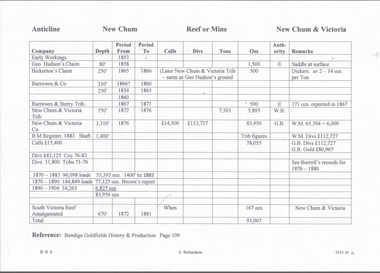
... Claim... Burrowes & Co... Burrowes & Sterry Trib... New Chum & Victoria Trib... New Chum & Victoria Co... B M register...Mines mentioned: Geo Hudson's Claim, Bickerton's Claim, Burrowes & Co, Burrowes & Sterry Trib, New Chum & Victoria Trib, New Chum & Victoria Co, B. M. Register...DOCUMENT Gold New Chum & Victoria Lines of Reef Production of Mines Early Workings Geo Hudson's Claim Bickerton's Claim Burrowes & Co Burrowes & Sterry Trib New Chum & Victoria Trib New Chum & Victoria Co B M register 1883 W Burrell Handwritten notes showing name of mine, depth, period, calls, dividends, tons, ounces and remarks. ...Handwritten notes showing name of mine, depth, period, calls, dividends, tons, ounces and remarks. Mines mentioned: Geo Hudson's Claim, Bickerton's Claim, Burrowes & Co, Burrowes & Sterry Trib, New Chum & Victoria Trib, New Chum & Victoria Co, B. M. Register 1883, South Victoria Reef Amalgamated. Reference: Bendigo Goldfields History & Production Page 109.document, gold, new chum & victoria lines of reef, production of mines, early workings, geo hudson's claim, bickerton's claim, burrowes & co, burrowes & sterry trib, new chum & victoria trib, new chum & victoria co, b m register 1883, w burrell -
 National Vietnam Veterans Museum (NVVM)
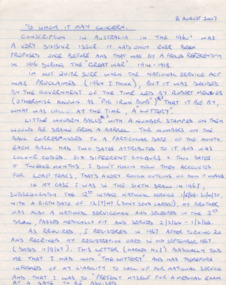
Memorabilia - Letter reflecting on Conscription by Robert John Williams, Williams, Robert John
... register for National Service. He gives an unusual and unverified description of the actual draws, claiming that the ballot balls were 6 different colours representing 2 dates = 12 months, but draws were only of birthdays within 6 months....register for National Service. He gives an unusual and unverified description of the actual draws, claiming that the ballot balls were 6 different colours representing 2 dates = 12 months, but draws were only of birthdays within 6 months. ...These are the personal reflections of National Serviceman Robert John Williams on the process of being conscripted. He served in Detachment, 1st Forward Delivery Troop from 18 Jun 1969 -21 Jul 1969, B Squadron, 1st Armoured Regiment from 22 Jul 1969-22 Dec 1969, and A Squadron, 1st Armoured Regiment from 23 Dec 1969-18 Mar 1970. His brother had also been conscripted, serving in 1966-8. Six-page hand-written letter in blue ink, titled "to Whom It May Concern' written by Robert John Williams that describes what happened to him when he turned 20 and had to register for National Service. He gives an unusual and unverified description of the actual draws, claiming that the ballot balls were 6 different colours representing 2 dates = 12 months, but draws were only of birthdays within 6 months.australian national serviceman, ballot box, trooper robert john williams, 3793407, royal australian armoured corps, 1st forward delivery troop, b squadron, 1st armoured regiment, a squadron, trooper, conscription, nasho, national service -
 Narre Warren and District Family History Group
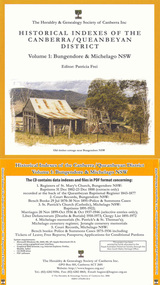
Document, Patricia M Frei, Historical indexes of the Canberra/Queanbeyan district, 2006
... Free Reports 1846-1847; Small Debts Register 1849-1864 (incl Return of Ticket of Leave Holders); Court of Requests-Judgement book Sep 1854- May 1859 (to Jan 1864) & Cash Book: Sep 1844-Aug 1846 12. Selective notes from the Court of Claims ...Historical Indexes of the Canberra Queanbeyan District in 4 volumes Volume 1: Bungendore & Michelago NSW contains: 1. Registers of St. Mary's Church, Bungendore NSW: Baptisms 31 Dec 1882-23 Dec 1888 (extracts only) recorded at the back of the Queanbeyan Baptismal Register 1843-1877 2. Court Records, Bungendore NSW: Bench Books 29 Jul 1870-30 Nov 1891-Police & Summons Cases 3. St. Patrick's Church (Catholic), Michelago NSW: Baptisms 1891-1922; Marriages 20 Nov 1899-Oct 1936 & Oct 1937-1946 (selective entries only); Liber Defunctorum [Deaths & Burials] 1910-1973; Clergy List 1891-1972 4. Michelago memorials (St. Patrick's & St. Thomas's); Michelago cemetery register; Jerangle cemetery memorials 5. Court Records, Michelago NSW: Bench books: Police & Summons Cases 1875-1936 including Tickets of Leave; Free Reports; Passports; Applications for Conditional Pardons Volume 2: Council & Court Records, Queanbeyan NSW contains: 6. Selective notes from the: Minutes of meetings of Queanbeyan Municipal Council 1885-1926; Borough Council Record Book; Halloran & Co. vs Queanbeyan Municipal Council; Commons Trust Minute Book 1899-1916 7. Notes transcribed from the District Council Papers 1843-1847 8. Notes transcribed from the Yarrowlumla Shire Council Minutes Apr 1907-Feb 1950 9. Courthouse Records: Minutes of Proceedings in Court of Review, Queanbeyan (selective 1899-1903); Bailiffs Execution Book (selective entries 1897-1918) 10. Notes transcribed from the Bench of Magistrates Correspondence 1833-1851 11. Free Reports 1846-1847; Small Debts Register 1849-1864 (incl Return of Ticket of Leave Holders); Court of Requests-Judgement book Sep 1854- May 1859 (to Jan 1864) & Cash Book: Sep 1844-Aug 1846 12. Selective notes from the Court of Claims: Register of Cases from 1835 13. Publicans Licences 1841-1862 recorded in the Deposition Book from 1838 14. Bench Records-Queanbeyan 1838-1896 Volume 3: Land and Other Records contains: 15. Research notes from the: Queanbeyan Conditional Purchase Registers 1862-1872, 1874-1877; Selections made 1870-1879 under the Volunteers Regulation Act 1867; Conditional Purchase Registers, Queanbeyan 1862-1878; Dates of Birth-Juvenile Selectors 1872-1878 (selective) 16. Alienation of Lands 1812-1853 (selective Queanbeyan & district) incl. County Register 1829-1839 (King, St. Vincent, Murray Counties) 17. Land Selection 1869-1872, 1874-1876 (selective research notes on Queanbeyan & district) 18. Selective notes from the Royal Commission on the Site for a Federal Capital (site proposed at Queanbeyan: Wanniassa, Canberra, Lake George 1899-1902) 19. Teachers in Public Schools 1884 (selective Queanbeyan & district) 20. Notes transcribed from the Queanbeyan School of Arts Minute Book 21 Jul 1925-22 Jul 1935 21. Index to Obituaries & Personal Notices circa 1820s-2001 Volume 4: Parish Registers & Burial Records contains: 22. Deaths registered at Queanbeyan NSW 1856-1901 & Burials in outlying cemeteries 1856-1907 23. Queanbeyan NSW-Gemetery records transferred from denominational trustees 24. Supreme Crt of NSW-Probate Index 1800-1901 (extracts relating to the Queanbeyan district) 25. Supreme Crt of NSW-Wills & Administrations 1800-1901 (extracts only) 26. Cemetery transcriptions—Michelago, Riverside-Queanbeyan, Gundaroo, Upper Gundaroo, Barnsdale-Gundaroo, St.Thomas-Carwoola, Ss Peter & Paul—Hoskingtown (all NSW), Weetangerra, Hall, Tharwa (all ACT) 27. Anglican Church of St. John the Baptist, Canberra: baptisms 1845-1900; marriages 1845-1877; burials 1844-1915 (selective Gundaroo entries only) 28. Christ Church (Anglican), Queanbeyan (selective): baptisms 1838-1866; marriages 1838-1909, burials 1838-1880,1913-1917,1920-1968 29. St. Gregory's (Catholic), Queanbeyan: baptisms 1843-1920; marriages 1843-1857,1856-1898, 1881; burials 1844-1877,1937-1967 (selective) 30. Ministrations by RevT Hassall, Diocese of Goulburn: baptisms 1836; baptisms by T Hassall 1827-1834,1836; marr 1827-1833; burials 1827,1829 31. Fr. J.J. Therry's registers (Catholic baptisms, marriages & burials), Queanbeyan district 1820-1838 32. Anglican Church of St. Clement's, Yass NSW (Gundaroo entries only): baptisms 1839-1863; marriages 1839-1853; burials 1839-1875 33. Parish Registers, Gunning NSW, (Gundaroo entries only): baptisms 1839-1930; marriages 1840-1850; burials 1842-18554 optical discsnon-fictionHistorical Indexes of the Canberra Queanbeyan District in 4 volumes Volume 1: Bungendore & Michelago NSW contains: 1. Registers of St. Mary's Church, Bungendore NSW: Baptisms 31 Dec 1882-23 Dec 1888 (extracts only) recorded at the back of the Queanbeyan Baptismal Register 1843-1877 2. Court Records, Bungendore NSW: Bench Books 29 Jul 1870-30 Nov 1891-Police & Summons Cases 3. St. Patrick's Church (Catholic), Michelago NSW: Baptisms 1891-1922; Marriages 20 Nov 1899-Oct 1936 & Oct 1937-1946 (selective entries only); Liber Defunctorum [Deaths & Burials] 1910-1973; Clergy List 1891-1972 4. Michelago memorials (St. Patrick's & St. Thomas's); Michelago cemetery register; Jerangle cemetery memorials 5. Court Records, Michelago NSW: Bench books: Police & Summons Cases 1875-1936 including Tickets of Leave; Free Reports; Passports; Applications for Conditional Pardons Volume 2: Council & Court Records, Queanbeyan NSW contains: 6. Selective notes from the: Minutes of meetings of Queanbeyan Municipal Council 1885-1926; Borough Council Record Book; Halloran & Co. vs Queanbeyan Municipal Council; Commons Trust Minute Book 1899-1916 7. Notes transcribed from the District Council Papers 1843-1847 8. Notes transcribed from the Yarrowlumla Shire Council Minutes Apr 1907-Feb 1950 9. Courthouse Records: Minutes of Proceedings in Court of Review, Queanbeyan (selective 1899-1903); Bailiffs Execution Book (selective entries 1897-1918) 10. Notes transcribed from the Bench of Magistrates Correspondence 1833-1851 11. Free Reports 1846-1847; Small Debts Register 1849-1864 (incl Return of Ticket of Leave Holders); Court of Requests-Judgement book Sep 1854- May 1859 (to Jan 1864) & Cash Book: Sep 1844-Aug 1846 12. Selective notes from the Court of Claims: Register of Cases from 1835 13. Publicans Licences 1841-1862 recorded in the Deposition Book from 1838 14. Bench Records-Queanbeyan 1838-1896 Volume 3: Land and Other Records contains: 15. Research notes from the: Queanbeyan Conditional Purchase Registers 1862-1872, 1874-1877; Selections made 1870-1879 under the Volunteers Regulation Act 1867; Conditional Purchase Registers, Queanbeyan 1862-1878; Dates of Birth-Juvenile Selectors 1872-1878 (selective) 16. Alienation of Lands 1812-1853 (selective Queanbeyan & district) incl. County Register 1829-1839 (King, St. Vincent, Murray Counties) 17. Land Selection 1869-1872, 1874-1876 (selective research notes on Queanbeyan & district) 18. Selective notes from the Royal Commission on the Site for a Federal Capital (site proposed at Queanbeyan: Wanniassa, Canberra, Lake George 1899-1902) 19. Teachers in Public Schools 1884 (selective Queanbeyan & district) 20. Notes transcribed from the Queanbeyan School of Arts Minute Book 21 Jul 1925-22 Jul 1935 21. Index to Obituaries & Personal Notices circa 1820s-2001 Volume 4: Parish Registers & Burial Records contains: 22. Deaths registered at Queanbeyan NSW 1856-1901 & Burials in outlying cemeteries 1856-1907 23. Queanbeyan NSW-Gemetery records transferred from denominational trustees 24. Supreme Crt of NSW-Probate Index 1800-1901 (extracts relating to the Queanbeyan district) 25. Supreme Crt of NSW-Wills & Administrations 1800-1901 (extracts only) 26. Cemetery transcriptions—Michelago, Riverside-Queanbeyan, Gundaroo, Upper Gundaroo, Barnsdale-Gundaroo, St.Thomas-Carwoola, Ss Peter & Paul—Hoskingtown (all NSW), Weetangerra, Hall, Tharwa (all ACT) 27. Anglican Church of St. John the Baptist, Canberra: baptisms 1845-1900; marriages 1845-1877; burials 1844-1915 (selective Gundaroo entries only) 28. Christ Church (Anglican), Queanbeyan (selective): baptisms 1838-1866; marriages 1838-1909, burials 1838-1880,1913-1917,1920-1968 29. St. Gregory's (Catholic), Queanbeyan: baptisms 1843-1920; marriages 1843-1857,1856-1898, 1881; burials 1844-1877,1937-1967 (selective) 30. Ministrations by RevT Hassall, Diocese of Goulburn: baptisms 1836; baptisms by T Hassall 1827-1834,1836; marr 1827-1833; burials 1827,1829 31. Fr. J.J. Therry's registers (Catholic baptisms, marriages & burials), Queanbeyan district 1820-1838 32. Anglican Church of St. Clement's, Yass NSW (Gundaroo entries only): baptisms 1839-1863; marriages 1839-1853; burials 1839-1875 33. Parish Registers, Gunning NSW, (Gundaroo entries only): baptisms 1839-1930; marriages 1840-1850; burials 1842-1855queanbeyan nsw, canberra district (act), parish registers, burial records -
 Eltham District Historical Society Inc
Book - Cook Book, Mary Rundell, A New System of Domestic Cookery; formed upon principles of economy and adapted to the use of private families. With Ten Illustrations. By a Lady, 1849
... claimed that Rundell had infringed on his copyright by publishing a new edition of the book without his permission. The case was brought to court, and after much debate, it was ruled that Rundell had indeed infringed on Murray's copyright. The court ordered her to pay damages and to stop publishing the book without Murray's consent. This ruling was significant as it established the legal precedent that copyright law applied to books and other written works. - Based on an article from The Edinburgh Annual Register...claimed that Rundell had infringed on his copyright by publishing a new edition of the book without his permission. The case was brought to court, and after much debate, it was ruled that Rundell had indeed infringed on Murray's copyright. The court ordered her to pay damages and to stop publishing the book without Murray's consent. This ruling was significant as it established the legal precedent that copyright law applied to books and other written works. - Based on an article from The Edinburgh Annual Register ...First published in 1806 by John Murray and written by Maria Rundell, later editions were "By a Lady". https://en.wikipedia.org/wiki/A_New_System_of_Domestic_Cookery A legal dispute arose between Murray and Rundell over the copyright of the cookery book titled "A New System of Domestic Cookery" by Mary Eliza Rundell. The book, which was published in 1806, gained immense popularity over the years. In 1821, Murray claimed that Rundell had infringed on his copyright by publishing a new edition of the book without his permission. The case was brought to court, and after much debate, it was ruled that Rundell had indeed infringed on Murray's copyright. The court ordered her to pay damages and to stop publishing the book without Murray's consent. This ruling was significant as it established the legal precedent that copyright law applied to books and other written works. - Based on an article from The Edinburgh Annual Register, 1821 Robert William Whatmough (1815 Heywood, Lancashire-1887 Diamond Creek, Victoria) and his wife Mary Hill ( 1813 Rochdale, Lancashire - 1881 Greensborough, Victoria) were pioneer settlers on the Plenty River at Greensborough. Their daughter, Jemima Whatmough (1840-1926) married Robert Fielding (1820-1891) who were the parents of Thomas Edmund Fielding and great grandparents of Tom FieldingInscribed inside front leaf facing page in ink: Robert Whatmough Plenty River 1858tom fielding collection -
 Sunshine and District Historical Society Incorporated
Archive - Sunshine Beautification Group
... Flyer and Badge from What Can I do to Help Clean up the future|Flyer Clean Up Day Warning You must Register|Folder for Clean up Australia|1st Sunshine Beautification Group Garden Competition Pennant|Minutes of Sunshine Beautification Group 6th February 1986 at Sunshine Municipal Offices Alexandra Avenue Sunshine|Newspaper Article Star Weekly 11 January 2005 Brimbank is filthy dirty pigsty claim|Newspaper Article Brimbank Messenger 21 March 2000 Clean up not just single day|Newspaper Article Herald Sun 13 October 1994 Scribble scrapped|Newspaper Article 21 December 2004 Council rubbished for removing litter bins|Typed Letter 25 April 1991 Clean up Australia Day|Typed Letter 31 March 1981 The Sunshine Advocate Pruning of street trees|Typed Letter 21 June 1983 Sunshine International Womens Year Action Committee beautify the Ballarat Road Land|Typed Letter 6 June 1986 Conduct a Tidy Street|Typed Minutes Sunshine Beautification Group 5 June 1986|Typed Minutes Sunshine Beautification Group 7 August 1986|Typed Letter from 9 July 1986 RJ Cantrill Plant Advisory Officer Department of Agriculture Parasitic Wasp|Typed Letter 21 October 1987 to Mr Bill Fogarty Harzardous Materials Storage and Transport Strategies for Local Government in Melbourne's Western Region|Typed Letter 4 May 1988 Mr John James Town Clerk Saving Trees|Typed Minutes Sunshine Beautification Group 12 May 1988|Typed Minutes Sunshine Beautification Group 2 June 1988|Notices of Motion 14 June 1988 Litter|Typed Letter from IC Patience Deputy Town Clerk 13 June 1988 Nomination suggestion for Mrs Beth Argle for the 1988 Women's Award|Typed Letter 23 June 1988 Mr B Griffin Chief Health Surveyor New Litter Act|Typed Letter 23 June 1988 Mr J James The Town Clerk request for $500|Typed Minutes Sunshine Beautification Group 7 July 1988|Typed Minutes Sunshine Beautification Group 3 November 1988|Typed Report Metropolitan Area Improvement Programs General Information on funding conditions March 1991|Typed Minutes Sunshine Beautification Group 4 April 1991|Typed Letter to Gwen about Tidy Street Competition and Keep Australia Beautiful|Flyer Sunshine Beautification Group Keep Australia Beautiful program March 1993|Typed Minutes Sunshine Beautification Group 1 September 1994|Typed Minutes Sunshine Beautification Group 6 October 1994|Typed Minutes Sunshine Beautification Group 3 November 1994|Handwritten Minutes Sunshine Beautification Group 3 October 1996|Typed Minutes Sunshine Beautification Group 5 November 1998|Typed Minutes Sunshine Beautification Group 4 February 1999|Typed Minutes Sunshine Beautification Group 5 April 2001|Typed Minutes Sunshine Beautification Group 5 June 2003|Typed Minutes Sunshine Beautification Group 3rd February 2005|Letter to Sheryl Ashley 30 December 2004 Removal of Rubbish Bins at Bus Stops and Public places|Handwritten Letter to Gwen Goedecke 1 February 1999|Newsletter December 1998 Tootgarook Wetlands|Sash for 1st prize in Sunshine Beutification Group Garden Competition...Sunshine Beautification Group Flyer and Badge from What Can I do to Help Clean up the future|Flyer Clean Up Day Warning You must Register|Folder for Clean up Australia|1st Sunshine Beautification Group Garden Competition Pennant|Minutes of Sunshine Beautification Group 6th February 1986 at Sunshine Municipal Offices Alexandra Avenue Sunshine|Newspaper Article Star Weekly 11 January 2005 Brimbank is filthy dirty pigsty claim|Newspaper Article Brimbank Messenger 21 March 2000 Clean up not just single day|Newspaper Article Herald Sun 13 October 1994 Scribble scrapped|Newspaper Article 21 December 2004 Council rubbished for removing litter bins|Typed Letter 25 April 1991 Clean up Australia Day|Typed Letter 31 March 1981 The Sunshine Advocate Pruning of street trees|Typed Letter 21 June 1983 Sunshine International Womens Year Action Committee beautify the Ballarat Road Land|Typed Letter 6 June 1986 Conduct a Tidy Street|Typed Minutes Sunshine Beautification Group 5 June 1986|Typed Minutes Sunshine Beautification Group 7 August 1986|Typed Letter from 9 July 1986 RJ Cantrill Plant Advisory Officer Department of Agriculture Parasitic Wasp|Typed Letter 21 October 1987 to Mr Bill Fogarty Harzardous Materials Storage and Transport Strategies for Local Government in Melbourne's Western Region|Typed Letter 4 May 1988 Mr John James Town Clerk Saving Trees|Typed Minutes Sunshine Beautification Group 12 May 1988|Typed Minutes Sunshine Beautification Group 2 June 1988|Notices of Motion 14 June 1988 Litter|Typed Letter from IC Patience Deputy Town Clerk 13 June 1988 Nomination suggestion for Mrs Beth Argle for the 1988 Women's Award|Typed Letter 23 June 1988 Mr B Griffin Chief Health Surveyor New Litter Act|Typed Letter 23 June 1988 Mr J James The Town Clerk request for $500|Typed Minutes Sunshine Beautification Group 7 July 1988|Typed Minutes Sunshine Beautification Group 3 November 1988|Typed Report Metropolitan Area Improvement Programs General Information on funding conditions March 1991|Typed Minutes Sunshine Beautification Group 4 April 1991|Typed Letter to Gwen about Tidy Street Competition and Keep Australia Beautiful|Flyer Sunshine Beautification Group Keep Australia Beautiful program March 1993|Typed Minutes Sunshine Beautification Group 1 September 1994|Typed Minutes Sunshine Beautification Group 6 October 1994|Typed Minutes Sunshine Beautification Group 3 November 1994|Handwritten Minutes Sunshine Beautification Group 3 October 1996|Typed Minutes Sunshine Beautification Group 5 November 1998|Typed Minutes Sunshine Beautification Group 4 February 1999|Typed Minutes Sunshine Beautification Group 5 April 2001|Typed Minutes Sunshine Beautification Group 5 June 2003|Typed Minutes Sunshine Beautification Group 3rd February 2005|Letter to Sheryl Ashley 30 December 2004 Removal of Rubbish Bins at Bus Stops and Public places|Handwritten Letter to Gwen Goedecke 1 February 1999|Newsletter December 1998 Tootgarook Wetlands|Sash for 1st prize in Sunshine Beutification Group Garden Competition Sunshine Beautification Group Archive Sunshine Beautification Group ...Came from the Gwen Goedecke|The pennant was donated to the society when the Municipal Offices in Alexandra Ave was being cleaned out.Flyer and Badge from What Can I do to Help Clean up the future|Flyer Clean Up Day Warning You must Register|Folder for Clean up Australia|1st Sunshine Beautification Group Garden Competition Pennant|Minutes of Sunshine Beautification Group 6th February 1986 at Sunshine Municipal Offices Alexandra Avenue Sunshine|Newspaper Article Star Weekly 11 January 2005 Brimbank is filthy dirty pigsty claim|Newspaper Article Brimbank Messenger 21 March 2000 Clean up not just single day|Newspaper Article Herald Sun 13 October 1994 Scribble scrapped|Newspaper Article 21 December 2004 Council rubbished for removing litter bins|Typed Letter 25 April 1991 Clean up Australia Day|Typed Letter 31 March 1981 The Sunshine Advocate Pruning of street trees|Typed Letter 21 June 1983 Sunshine International Womens Year Action Committee beautify the Ballarat Road Land|Typed Letter 6 June 1986 Conduct a Tidy Street|Typed Minutes Sunshine Beautification Group 5 June 1986|Typed Minutes Sunshine Beautification Group 7 August 1986|Typed Letter from 9 July 1986 RJ Cantrill Plant Advisory Officer Department of Agriculture Parasitic Wasp|Typed Letter 21 October 1987 to Mr Bill Fogarty Harzardous Materials Storage and Transport Strategies for Local Government in Melbourne's Western Region|Typed Letter 4 May 1988 Mr John James Town Clerk Saving Trees|Typed Minutes Sunshine Beautification Group 12 May 1988|Typed Minutes Sunshine Beautification Group 2 June 1988|Notices of Motion 14 June 1988 Litter|Typed Letter from IC Patience Deputy Town Clerk 13 June 1988 Nomination suggestion for Mrs Beth Argle for the 1988 Women's Award|Typed Letter 23 June 1988 Mr B Griffin Chief Health Surveyor New Litter Act|Typed Letter 23 June 1988 Mr J James The Town Clerk request for $500|Typed Minutes Sunshine Beautification Group 7 July 1988|Typed Minutes Sunshine Beautification Group 3 November 1988|Typed Report Metropolitan Area Improvement Programs General Information on funding conditions March 1991|Typed Minutes Sunshine Beautification Group 4 April 1991|Typed Letter to Gwen about Tidy Street Competition and Keep Australia Beautiful|Flyer Sunshine Beautification Group Keep Australia Beautiful program March 1993|Typed Minutes Sunshine Beautification Group 1 September 1994|Typed Minutes Sunshine Beautification Group 6 October 1994|Typed Minutes Sunshine Beautification Group 3 November 1994|Handwritten Minutes Sunshine Beautification Group 3 October 1996|Typed Minutes Sunshine Beautification Group 5 November 1998|Typed Minutes Sunshine Beautification Group 4 February 1999|Typed Minutes Sunshine Beautification Group 5 April 2001|Typed Minutes Sunshine Beautification Group 5 June 2003|Typed Minutes Sunshine Beautification Group 3rd February 2005|Letter to Sheryl Ashley 30 December 2004 Removal of Rubbish Bins at Bus Stops and Public places|Handwritten Letter to Gwen Goedecke 1 February 1999|Newsletter December 1998 Tootgarook Wetlands|Sash for 1st prize in Sunshine Beutification Group Garden Competitionsunshine beautification group -
 Bellarine Historical Society Museum
Functional object - Rolls razor
... The Rolls trademark, "The Whetter", was registered in the US in 1950; the claimed first use was 1922. ...The Rolls trademark, "The Whetter", was registered in the US in 1950; the claimed first use was 1922. ...The eponymous product was a sophisticated safety-razor which promoted with the slogan "The razor that is stropped and honed in its case". The Rolls trademark, "The Whetter", was registered in the US in 1950; the claimed first use was 1922. The US patent for the method of attaching the blade to the handle was filed in 1925 and issued in 1930. The name "Rolls Razor (1927) Ltd." was used in advertising. The razor was still manufactured and sold until 1958, when the company was purchased by entrepreneur/corporate raider John Bloom, who decided to focus on washing machines rather than the razor.The company's principal market was a 21st birthday present for a young man. Sales declined with the rise of electric shaving. Though not made by the Rolls-Royce company, the name was chosen to evoke the "Rolls" image of luxury and quality. Rectangular chrome plated case with rounded edges and a latched lid on each side, with the lids bearing a repeating three row Greek key design. Each lid is released via a round patterned knob on each short side. Opening one side of the case reveals a razor blade contained within a roller rack with attached operating handle - all nickel plated - designed to slide along a track. Employing a back and forward sliding action sharpens the razor against a red leather strop sheet attached to the inside of the opposite lid. The strop is impressed at one end 'Strop. Made in England'. Utilising the opposite lid brings the razor against a black honing stone. The blade is removable. A separate nickel plated razor handle is included in the case and can be stored either in the side channel, or (for travelling) attached to the strop handle.A small circular maker's impressed mark appears on each side, with one side reading 'Rolls Razor / The Whetter' accompanied by an image of a kneeling man sharpening a razor, while the other side reads: 'Rolls Razor (1927) Ltd / Made in England / Patented in England and Abroad / English Patents numbers: 108531, 184514, 184515, 184754, 224578, 242717, 242716 and pending.' Additionally, one side of the case is engraved 'B016301'. -
 Melton City Libraries
Pamphlet, Thoroughbred Country, c.1985
... claiming the national harness racing record for the most wins in a single season.The following year, the first Melton Plate was held at Moonee Valley Racecourse, cementing the district’s importance in the harness racing industry. The inaugural winner was Victorys Phil, owned by local Danny Mullan. By the 1990s, Melton had earned the title of the ‘Home of Harness Racing in Victoria’. State-of-the-art, world-class harness racing facility and entertainment complex Tabcorp Park opened in Melton in 2009. In 2011, the Shire of Melton was home to over 140 registered...claiming the national harness racing record for the most wins in a single season.The following year, the first Melton Plate was held at Moonee Valley Racecourse, cementing the district’s importance in the harness racing industry. The inaugural winner was Victorys Phil, owned by local Danny Mullan. By the 1990s, Melton had earned the title of the ‘Home of Harness Racing in Victoria’. State-of-the-art, world-class harness racing facility and entertainment complex Tabcorp Park opened in Melton in 2009. In 2011, the Shire of Melton was home to over 140 registered ..."Melton has a long and celebrated history of horse breeding and racing. Draught horses were a crucial aspect of life in the early days of European settlement, and were heavily depended upon for both transport and agricultural labour. Peppercorn trees at the corner of Station and Brooklyn roads have been associated with a horse trough installed there to provide a drink to workhorses carting produce to the chaff mills and railway station south of Melton.20 Breeders, trainers and harness drivers in the area later became such an influential force in the equine industry that this came to be a defining aspect of the district’s identity and reputation.Pioneer of the Victorian horse racing industry and early Rockbank squatter William Cross Yuille was one of the earliest importers of stud racehorses in the district in the 1850s. A leading sports editor and writer, Yuille established bloodstock auctioning agency W. C. Yuille & Co. and was involved in the compilation of the first Australian Stud Book, which ensures the integrity of thoroughbred breeding in Australia. According to early Melton chronicler Alexander Cameron, horse races were first organised in the area by Rockbank farmer William Keating. Keating owned racehorses of his own, and many brought horses from Melbourne for the events, which ‘drew large gatherings’.22 Melton Racing Club meetings were held on the Exford Estate with the permission of H. W. Staughton, who built a small wooden grandstand in 1882. Other early races and sports meetings are said to have been held in the vicinity of the current-day Melton golf course.23 An 1884 article reported that Melton’s ‘race programme … equals any put forth by country towns of far greater size’. Ernest Clarke was another important figure in the early horse racing industry in Melton. He established the Melton Stud in 1902, which bred numerous successful racehorses. Perhaps most notably The Welkin, one of the most famous stallions in Australian horse racing in the early twentieth century. The Welkin sired Gloaming, bred by Clarke at the Melton stud in 1915 and one of Australia’s greatest champion racehorses. During a long and prestigious career in both Australia and New Zealand, Gloaming achieved a triumphant 57 wins out of 67 starts and won a record amount of prize money. Ken Cox purchased the Stockwell Stud in Diggers Rest in 1957 and developed it into one of the largest and most renowned thoroughbred breeders in Australia. With its top-class facilities, international design standards and scientific methods, Stockwell became ‘the flagship of the Victorian breeding industry’.26 As well as racing studs, numerous trotting tracks were established on the flat plains around Melton in the 1960s.27 Other studs to play a leading role in the development of Melton as thoroughbred country were Cornwall Park and Merrywood at Toolern Vale, St John’s Lane Stud at Diggers Rest and Birchwood, Teppo Park and Dreelburn in the far north-east of the shire, near Sunbury. By 1985, thoroughbred horse breeding was such big business in Melton that the shire council adopted the slogan ‘The Heart of Thoroughbred Country’, which was used throughout its promotional material.29 But the slogan contained deeper meaning and was not just about Melton’s great equine industry and thoroughbred champions, the council explained: ‘“Thoroughbred Country” should be seen as a new concept of Melton, as a place where people can achieve the “Thoroughbred” ideal, excellence in all aspects of life’. The aim of the council in promoting ‘The Heart of Thoroughbred Country’, was ‘to instil in present and future residents the feeling that this is a place that is better than others. A place to be proud of’. In 1988, Melton’s champion reinsman Gavin Lang won his 176th race of the season, claiming the national harness racing record for the most wins in a single season.The following year, the first Melton Plate was held at Moonee Valley Racecourse, cementing the district’s importance in the harness racing industry. The inaugural winner was Victorys Phil, owned by local Danny Mullan. By the 1990s, Melton had earned the title of the ‘Home of Harness Racing in Victoria’. State-of-the-art, world-class harness racing facility and entertainment complex Tabcorp Park opened in Melton in 2009. In 2011, the Shire of Melton was home to over 140 registered trainers and over 1,200 horses. The municipality’s continuing leadership and influence in the industry today is a testament to the skills, talents and leadership of the local community over its history".Shire of Melton pamphlet of a map and information of the equine industry in Meltoncouncil -
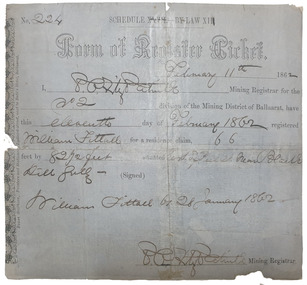 Old Colonists' Association of Ballarat Inc.
Document, Form of Register Ticket made out to William Fittall, 1862
... Form of Register Ticket No. 224 Schedule XXVII By Law XIII February 11th 1862 I, P.P.FitzPatrick Mining Registrar for the No 2 division of the Mining District of Ballaarat, have this eleventh day pf February 1862 registered Willia Fittall for a residence claim, 66 feet by 82 1/2 feet situated east of Peel Steeet near Black Hill Gully (signed) William Fittall on 28 January 1862...Sailor immigration Thomas Paterson Greenock George Dempster Chevalier Form of Register Ticket No. 224 Schedule XXVII By Law XIII February 11th 1862 I, P.P.FitzPatrick Mining Registrar for the No 2 division of the Mining District of Ballaarat, have this eleventh day pf February 1862 registered Willia Fittall for a residence claim, 66 feet by 82 1/2 feet situated east of Peel Steeet near Black Hill Gully (signed) William Fittall on 28 January 1862 Small ticket stub for a Form of Register Ticket Form of Register Ticket made out to William Fittall, 1862 Document ...Small ticket stub for a Form of Register TicketForm of Register Ticket No. 224 Schedule XXVII By Law XIII February 11th 1862 I, P.P.FitzPatrick Mining Registrar for the No 2 division of the Mining District of Ballaarat, have this eleventh day pf February 1862 registered Willia Fittall for a residence claim, 66 feet by 82 1/2 feet situated east of Peel Steeet near Black Hill Gully (signed) William Fittall on 28 January 1862sailor, immigration, thomas paterson, greenock, george dempster, chevalier
