
Showing 14 items matching " richmond stables"
-
 Women's Art Register
Archive (Collection) - Julia Church Artist Archive
... ... Richmond Stables...1959- Community Art Another Planet Jill Posters Richmond Stables George Paton Gallery Printmaking Posters Archive Julia Church Artist Archive ...community art, another planet, jill posters, richmond stables, george paton gallery, printmaking, posterscommunity art, another planet, jill posters, richmond stables, george paton gallery, printmaking, posters -
Women's Art Register
Archive (Series) - Church, Julia. Artist File 1
... ... Richmond Stables...Community Art Another Planet Jill Posters Richmond Stables George Paton Gallery Printmaking Posters Foolscap white archival 4 flap folder or document wallet Archive Church, Julia. ...Biiography, Newspaper Clippings, Promotional Material, Artist Statement, Artwork Images, Interviews, Newsletterscommunity art, another planet, jill posters, richmond stables, george paton gallery, printmaking, posterscommunity art, another planet, jill posters, richmond stables, george paton gallery, printmaking, posters -
Women's Art Register
Archive (Series) - Julia Church. Duplicate File 1
... ... Richmond Stables...Printmaking Posters Community Art Another Planet Jill Posters Richmond Stables George Paton Gallery Foolscap manilla file Archive Julia Church. ...Biiography, Newspaper Clippings, Promotional Material, Artist Statement, Artwork Images, Interviews, Newslettersprintmaking, posters, community art, another planet, jill posters, richmond stables, george paton galleryprintmaking, posters, community art, another planet, jill posters, richmond stables, george paton gallery -
 City of Melbourne Libraries
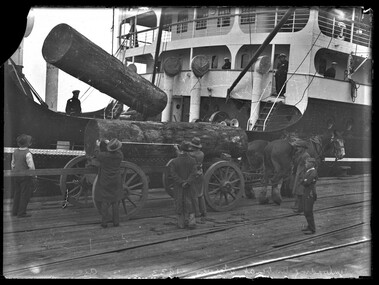
Photograph (item), Bull, Hugh Jones, 1897-1993, Unloading timber at Victoria Dock, 1933
... Kellet Pty Ltd sold its 250 horses and converted its Richmond stables to storage. In the 1950s at Station and Princes piers, wharf labourers refused to work with the six draught horses still being used to haul trolleys and which were soon superseded by the fork lift, semi-trailer and mobile crane. ...Kellet Pty Ltd sold its 250 horses and converted its Richmond stables to storage. In the 1950s at Station and Princes piers, wharf labourers refused to work with the six draught horses still being used to haul trolleys and which were soon superseded by the fork lift, semi-trailer and mobile crane. ...Photographer notations on slide: "Unloading Timber at Wharves 1933 Age B5" Published: Age (Melbourne, Vic.: 1854- ), Tuesday 15 August 1933 MAHOGANY FROM MANILA. (1933, August 15). The Age (Melbourne, Vic. : 1854 - 1954), p. 11. Retrieved January 16, 2026, from http://nla.gov.au/nla.news-article204377024 Published title: MAHOGANY FROM MANILA Published Caption: Age Tue 15 Aug 1933 Caption: Unloading Mahogany Logs brought from Manila, Philippine Islands, by the steamer Taiping, which berthed yesterday at Victoria Dock. The vessel discharged twenty logs, each weighing three tons, the first shipment of this type of timber landed in Melbourne. Research by Project Volunteer, Louise McKenzie: This photograph in many ways epitomises Melbourne in the 1930s. It is a time of enormous growth, development and change. But before delving into that, the photo itself is very powerful. The huge mahogany logs being unloaded appear to be so heavy that the ship itself seems to list to port as they are craned over the side. They are being levered into a cart to which two large and sturdy Clydesdale horses are hitched. In contrast to the traditional horses, the wharf is crisscrossed with modern railway tracks. Unloading is both mechanical and manual, and the scene is one of intense interest to a young boy bystander. The ship appears to be squat and solid, but the whole image also gives a feeling of movement and intensity. The mahogany being delivered to Melbourne would be intended for high quality furniture. In the 1930s Australia actually had a growing timber industry, but much of the eucalyptus wood was being utilised for mass produced furniture, and much of this furniture would then have had a veneer applied to it. The fact that it was economic to import this timber from the “Philippine Islands” – not a traditional trading market for Australia – reflects a Victorian economy that was strong enough to support a growing demand for good quality furniture Mahogany was described as a classic, strong hardwood, often used for dark opulent furniture. In the 1930s the importation of timber from Manila (Philippines) to Australia was a notable trade, particularly in Philippine Lauan (often referred to as Philippine Mahogany), which was used as a cheaper alternative to other hardwoods. 1930s furniture, dominated by the art deco style, used a mix of luxurious exotic woods like mahogany, macassar and ebony for high-end pieces, often veneered over less expensive woods such as walnut, birch and poplar, and with plywood, chrome and lacquer also popular for more practical, streamlined designs during the Depression era. By the mid 1930s timber mills were being relocated away from the immediate dock area, but the fact that these logs were being transported by horse-drawn cart implies that the load would not have had to be taken too far for milling. 1885 the Melbourne Harbour Trust Commissioners had decided that land in or near the city was far too valuable to be used as timber yards. Furthermore, large stacks of timber posed a fire risk. The Trust asked the Victorian Government to reserve a site on the east side of the Yarra River opposite Yarraville and Spotswood. Here, in 1889, the Trust began building six jetties and a wharf specifically for the landing of timber. Clydesdale horses were initially brought to Victoria from Tasmania in the 1830s, and with the 1850s gold rush they were imported direct from Scotland. Melbourne was from its earliest years an important centre of horse-breeding from both imported and colonial-bred stock, providing the well-built draught horse for pulling heavily loaded wagons, the harness horse for delivery work and drawing coaches, and the saddle-horse used for riding. Stud breeding facilities were advertised from the early 1840s. By the 1870s the horse export trade was thriving, and the Port of Melbourne was the country's busiest exporter of horses to Indian, Asian and New Zealand markets. Kirk's Melbourne Horse and Carriage Bazaar in Bourke Street first advertised for business in 1840, and by the 1850s Bourke Street West was famed for its horse bazaars and saleyards. The Victorian Clydesdale Horse Society reports that Clydesdale working horses were a vital part of Melbourne's infrastructure and agricultural industry in the 1930s, when they reached the peak of their popularity despite the increasing competition from mechanization. Their main roles and usage at this time were: • City Delivery: Clydesdales were a common sight for metropolitan deliveries, particularly for breweries (such as Carlton & United Breweries), milk runs, and bread deliveries. • Industrial Work: They were heavily used for hauling cargo at the docks, in construction, and at specialized sites like the Truganina Explosives Reserve, where they pulled wagons. • Agriculture: In surrounding rural areas, they were the primary power source for ploughing and agricultural machinery. • Specialization: By the 1930s, the Clydesdale was smaller and more compact than the Shire or Percheron breeds, making them ideal for navigation in urban environments. After the 1930s their numbers decreased due to the onset of WWI and mechanisation. Wartime petrol rationing led to a brief revival for the working horse, as suburban tradesmen, now used to motor delivery, took their old jinkers out of mothballs. By 1947, however, only 1.5% of city traffic was horse-drawn. In 1952 the large horse cartage company A. Kellet Pty Ltd sold its 250 horses and converted its Richmond stables to storage. In the 1950s at Station and Princes piers, wharf labourers refused to work with the six draught horses still being used to haul trolleys and which were soon superseded by the fork lift, semi-trailer and mobile crane. Where carefully trained horses had once shunted trains in city goods yards, a few hundred a week were now being killed at the abattoirs for pet and human consumption. The last MCC dray horse was withdrawn from service in 1958, but some of the few remaining working animals are used by the mounted police for crowd control at demonstrations and football games. The death knell had also sounded for the associated trades of farrier, saddler and blacksmith. Our photo, therefore, showing the wharf with both the haulage Clydesdales and the rail lines, is a strong visual summary of the social and economic changes experienced in Victoria in the 1930s and on towards the 1950s. Our photo is located at Victoria Dock (also known as Victoria Harbour) which is still an active component of Melbourne’s port system. In 1892 the West Melbourne Dock (later Victoria Dock) was opened, downstream and immediately west of the Spencer Street railway shunting yards. It contained a swing basin for ships, replacing the one which had been provided on the south side of the river, later to be the Duke and Orr dry dock, west of the Charles Grimes Bridge. Further west was the South Wharf along the river bank. The history of Victoria Dock is extremely well described by Ashley Smith in his 2 March 2022 article in Docklands News, and its accompanying aerial photo of the Dock taken in 1934. He writes: "In the early 1930s Victoria Dock was one of the biggest sites for trade and export in Melbourne. A constant queue of ships sailed in, unloaded their cargo, recharged and reloaded, then left for the next port. Around the time this photo was taken (found in a 1934 photo book), the trapezium-shaped basin had been through some changes since its construction in the 1890s. The 497-metre-long Central Pier, finished in 1919, now featured six sheds to house the ever-increasing volume of cargo. The entrance had also been widened in the 1920s to allow better access. Some of the berths featured three-ton jib electric cranes to help with loading cargo and a rail network connected to the State Railway service. By the time construction was completed, the dock was 39 hectares and hailed as the second-largest dock in the world (behind Cavendish Dock, Barrow-in-Furness). To further save costs, excavations were dug to a more reasonable seven metres below low water, instead of British engineer Sir John Coode’s recommended 8.3 metres. Even then, the costs were still around £900,000. It was envisaged, with the extra wharfage, that around thirty 90-metre ships could berth inside. On March 22, 1892, Victoria Dock was opened by Victoria’s Governor, the Earl of Hopetoun (later Australia’s first Governor-General) who opened the sluice to let the Yarra in. It took six days to fill the basin with The Leader newspaper estimating that it would take another six months to completely fill (March 26, 1892). In the end, it took nearly a year before the first ship was allowed to enter on February 20, 1893, when the steamer Hubbuck sailed in to unload 1200 tonnes of cargo in 15 hours. The Argus (February 23, 1893) reported that the ship’s captain, J. R. Brodie, called the Yarra “better than the Thames”, and compared Victoria Dock favourably to the Albert Dock (Liverpool)." This would be a good time to move our focus on to the Taiping, which is the transporter of these giant mahogany logs. The Taiping was a steel-hulled, single-screw passenger-cargo Chinese steamer, which today has the dubious legacy of being involved in a collision headlined as “The Chinese Titanic”. It was constructed by the Hong Kong and Shampoa Dock Company at its facility in Hong Kong, with completion in 1926 for service under the Australia Oriental Line. Her gross register tonnage measured 4,324 tons, reflecting her design for inter-island and coastal trade routes, accommodating both passengers and freight. She operated routes connecting Australian ports with East Asian destinations. As World War II approached, Taiping continued predominantly working the trade routes between China and Australia, until December 1941, when she evacuated women and children from Hong Kong to Manila just before Japanese forces overran the region. She then safely reached Australia despite enemy air raids. Taiping was then requisitioned by the Royal Navy and repurposed as a victualling stores issuing ship for the Eastern Fleet, supporting logistical needs in the Pacific and Indian oceans. Returned to the Australian Oriental Line in 1947, she underwent refitting and by mid-1948 was chartered to the Shanghai Shipping Company, and modified for greater passenger accommodation – approximately 500 passengers. In 1948/49 the Chinese Civil War took place. The Taiping departed Shanghai on 26 January 1949 as one of the final vessels evacuating civilians from to Keelung Harbour in Taiwan. Reports indicate that the Taiping carried double the rated capacity of passengers i.e. 1000. The ship carried families, military personnel, civilians, carrying personal belongings, gold and valuables in hope of resettlement in Nationalist Taiwan. It also held heavy cargo in the form of silver and gold bullion loaded by the Central Bank of China. Because of the risk of patrols, and to conserve fuel, the Captain took the ship away from the usual open-sea passage, and instead navigated along the coast. He also extinguished navigation lights to avoid detection. Shortly after midnight on 27 January 1949 the Taiping collided with the smaller cargo steamer Chien Yuan in the East China Sea near the Zhoushan Archipelago. The Chien Yuan was also operating in darkness. The subsequent collision was catastrophic. The Chien Yuan sank with in 5 minutes, with the loss of 72 of its 74 crew. The Taiping sustained severe structural compromise from the broadside strike and initially remained afloat, then made a swift descent into the freezing water, with no attempt at an organised evacuation. No formal recovery process was instigated, however a distress signal went out. 32 survivors were picked up by the Australian destroyer HMAS Warramunga (on patrol nearby), a passing US vessel found 2 more, and local Zhoushan fishermen retrieved others. In the end, only 37 people survived. The event is remembered as a poignant moment in the mass migration to Taiwan, with families tragically separated. A memorial to the disaster exists at the Keelung Harbour naval base on Taiwan. With its total of over 1,500 deaths, it constituted one of the worst peacetime maritime losses. It is sometimes referred to as the “Oriental Titanic” because of the similarly large loss of life and speed of demise with the RMS Titanic in 1912. A fictional depiction of this event appears in the John Woo movies “The Crossing (Part 1) (2014), and The Crossing II (2015), known in Chinese as “Taiping Wheel”. The narrative weaves a story around pre-disaster romances and wartime turmoil among passengers, culminating in the ship’s rapid sinking. “The production, a high-budget Sino-Taiwanese-Hong Kong co-effort, portrays the event as a microcosm of the 1940s Sino-Japanese and civil war legacies, though critics noted the melodramatic style prioritizing spectacle over historical precision.” In conclusion, it is nice to return to our photo, and observe the people involved in this moment. The dockworkers are, so typical of the 1930s, dressed in what looks to us like formal clothing – dark suits or coats, white shirts, and black hats. I am particularly drawn to the young boy, bare-headed, arms crossed, and so intent on the unloading process. He too is wearing a white shirt, black trousers and jacket, and black shoes. This is 1933 Melbourne – but the haircut he is sporting is now very “hipster” and modern in 2026 Melbourne. References: MAHOGANY FROM MANILA. (1933, August 15). The Age (Melbourne, Vic. : 1854 - 1954), p. 11. Retrieved January 30, 2026, from http://nla.gov.au/nla.news-article204377024 Wikipedia, Taiping steamer, https://en.wikipedia.org/wiki/Taiping_(steamer) Wikipedia, Victoria Dock, https://en.wikipedia.org/wiki/Victoria_Dock_(Melbourne) Docklands News, Ashley Smith, 2 Mar 2022, https://www.docklandsnews.com.au/victoria-dock/ Living Histories: Heritage Council of Victoria, Jill Barnard, 2008, Jetties and Piers, https://livinghistories.net.au/wp-content/uploads/2015/11/Jetties-ONL-intro_Part-1.pdf eMelbourne, Wharves and Docks, https://www.emelbourne.net.au/biogs/EM01612b.htm Australian Academy of Technological Sciences – Harvesting Wood, https://www.austehc.unimelb.edu.au/tia/225.html Old Treasury Building, On the Water – The Docks, https://tinyurl.com/3wkbk66m Old Treasury Building, On The Road, https://tinyurl.com/dw44yr3t Port of Melbourne, Victorian Places, https://www.victorianplaces.com.au/port-of-melbourne Docklands Heritage Study - Environmental History, https://mvga-prod-files.s3.ap-southeast-4.amazonaws.com/public/2024-05/docklands-heritage-review-thematic-environmental-history-1991.pdf eMelbourne, Horses, https://www.emelbourne.net.au/biogs/EM00723b.htm Victorian Clydesdale Horse Society, https://www.clydesdalesvic.org.au/history The Crossing, https://letterboxd.com/film/the-crossing-i/Photographer notations on slide: "Unloading Timber at Wharves 1933 Age B5"ships, shipping, timber industry, shipwrecks, horses, docks, wharves, 1930-1939, wars, docklands -
 Federation University Historical Collection
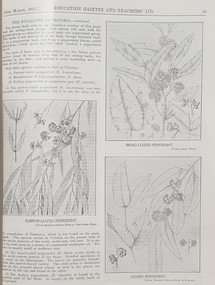
Book, Victoria Education Gazette and Teachers' Aid, 1921-1930, 1921-1930
... Richmond Technical School, Farewell to Messrs C.R. Long and Ponsonby Carew-Smyth, Frank Tate, Phyiscal Training, Arbor Day, ANZAC Day, Shakespeare Day,Bendigo Junior Techncial School, Musical Appreciation, Motor Dental Unit, School Camps, Education Act of 1872: Mr Angus McKay's Part (George Mackay), A Bush Fire Experience (Irene Stable), Black Sunday, Californian Red Pine, Women's Education in America, Farewell to Lord and Lady Stradbroke, Grevilia Robusta, Silky Oak, Redwood, John E. ...Richmond Technical School, Farewell to Messrs C.R. Long and Ponsonby Carew-Smyth, Frank Tate, Phyiscal Training, Arbor Day, ANZAC Day, Shakespeare Day,Bendigo Junior Techncial School, Musical Appreciation, Motor Dental Unit, School Camps, Education Act of 1872: Mr Angus McKay's Part (George Mackay), A Bush Fire Experience (Irene Stable), Black Sunday, Californian Red Pine, Women's Education in America, Farewell to Lord and Lady Stradbroke, Grevilia Robusta, Silky Oak, Redwood, John E. ...The Victoria Education Gazette and Teachers' Aid was published for Victoria's teachers and was sent to all school on the state. In 1920 The Ballarat School of Mines had donated 136 pounds 14 shillings and 10 pence to the Victorian Education Department's War Relief Account, and the Ballarat Junior Technical School had donated 10 pounds 6 shillings and 10 pence.Ten black hard covered volumes with red tape spine, covering 1921 to 1930. The gazettes include Education Department appointments, transfers, resignations and retirements, vacancies, notices, queries, notices of books, examination papers, original articles, lesson plans, suggestions for lessons, drawing, obituaries, notes on nature study, mathematics, music, sloyd woodwork, English grammar, Victorian State School Swimming Clubs, Geography, penmanship, science, History, Latin, Geography, The School Garden, horticulture, singing, World War One; ANZAC Day, lifesaving, Astronomy, Empire Day, ANZAC Buffet London, Victorian Education Department's War Relief Fund .1) 1928. Articles include: New Caledonia, Swimming and Lifesaving, School forestry, a visit to the pyramids, Exploration of Gippsland, paul de Strezelecki, Angus McMillan, Villers Bretonneux Memorial School, American Black Walnut, Red Gum, Messmate Stringybark, The Great Barrier Reef, retirement of Frank Tate, Stawell High School, Report on Some Aspects of Education in the United States, Jubilee Education Exhibition , New School Readers; measured Drawing Images include: Macarthur Street School's Plantation, Maryborough School Plantation, Pinus Insignis (Radiata) ready for Milling, Creswick State Forest, Metalwork, Daylesford Pine Plantation four years old, Henry Harvey (art Inspector); Omeo School Endowment Plantation; Frank Tate; Stawell High School Drawings From Casts; Lake Tyers School Endowment Plantation, measured drawing, Thomas H. Stuart, GEorge Swinburne. J.R. Tantham-Fryer, Cookery Class, John Edward Thomas. .3) War Savings Stampsm Swimming and Life-saving, Teh Rural School System of Victoria, Imaginative Composition, ANZAC Day, Retardation, Teh Bright Child Hudson Hard Obituary, Leeches, Relief for Distress in Europe, Dental, Teachers' Library, History of Portarlington, J.E. Stevens Obituary, Victorian Teachers in England Images: Swimming and Life-Saving Medallion .3) Swimming and Lifesaving, Bronze medallion, Victoria Leage of Victori, War Savings Stamps, Rural School Sytem of Victoria, .4) War Relief, Talbot Colony for Epileptics Masonmeadows, Discipline New and Old (Percy Samson), Soldier teachers, Preservation of Australian Birds, Arbor Day, Jubilee of Free Education, Teaching Geography, Poery in Schools, School Committees, Shelter Pavilion, Mysia Memorial School, Clovers, Jubilee Exhibition, Domestic Arts, Louis Pasteur, .5) Victoria League of Victoria, An Endowment Scheme (Pine Plantations), School Endowment Plantations, Protecting our trees by Owen Jones,. Victorian State Schools Horticultural Society, Sloyd Woodwork, School Forestry, Thomas Brodribb Obituary and portrait, Imperial Education Conference London, school Management and Method, School plantations, Eucalypt plantations in the Bendix and Heathcote District, Junior Red Cross, Jubilee Education Exhibition, Gould League Competitions, handwriting, The School Magazine, Frank Tate in London, Victorian beetles, Council of Public Education, Villers Bretonneux and its new School, Death of Samuel Summons, Woodwork Summer School, Swimming, Japanese Relief Fund, Retirement of John Cross, reminiscences of the Late Mr Albert Mattingley .6) Thomas H. Trengrove and the Villers Bretonneux School hall and pilaster carvings, forestry, visit of Maryborough teachers to Ballarat Water Reserves, noxious weeds, relief for Distressed Europe, The Dalton Plan, Empire Day, Retirement of Mr Fussell, Centenary of Hume and Hovell Expedition, League of Kindness, Effective Nature Study in a Rural School, Some Facts About Paper and their Bearing Upon School Plantations, Council of the Working Men's College Melbourne, Maria Montessori, University Vacation School, Horticulture in State Schools, An Informal Chat About French Schools (C.R. McRae), The Vacation School, Johann Heinrich Pestalozzi, Inspector's Report on a 5th-class School, Can Children Write Verse, John Adams, Victoria League of Victoria, R.F. Toutcher, Sir James Barbie's Address to High-School Girls, Impressions of a High School Teacher Abroad (R.D. Collman), The Spirit of the School Plantation Scheme, Monument of the Late Mr and Mrs A.T. Sharp at Box Hill Cemetery, The Teaching of Geography, The Treatment of Poetry in Class, Two Difficult Arithmetic Lessons, Location of Principal Australian Timbers, Dr John Smyth, Stammering and its Influence on Education, Wireless Broadcasting as an Educational Medium, Boys School at Villers Brettonneux, The New School at Villers Brettonneux, Bird Day, Messmate or Stringybark, What Every Woman Knows, Director's Report on Denmark .7)1925 . Includes: School Forestry, horticulture, J.H. Betheras retirement, Ivanhoe School, Coburg School, Moorabool Junior Technical School, Villers Bretonneux School hall and pilaster carvings, Francis Ormond, William Charles Kernot, Corsican Pnes at Creswick, Ballarat High School Plantation, Workin Men's College, RMIT, Naorrow LEafed Peppermint, Education and World Peace, Eucalypts of Victoria, John C. Eccles, Blue Gum. Manners, Giving the Poorly Nourished Boy A Chance, Native Ferns, Marybourough Technical School, Memorial School at Villers-Brettonneux .8) Experimental Plots in Country Schools (W.W. Gay), Villers Bretonneaux and its Memorial School. nominated classes for Art Teachers, The Teachers Act 1925, Horsham High School, Richmond Technical School, Farewell to Messrs C.R. Long and Ponsonby Carew-Smyth, Frank Tate, Phyiscal Training, Arbor Day, ANZAC Day, Shakespeare Day,Bendigo Junior Techncial School, Musical Appreciation, Motor Dental Unit, School Camps, Education Act of 1872: Mr Angus McKay's Part (George Mackay), A Bush Fire Experience (Irene Stable), Black Sunday, Californian Red Pine, Women's Education in America, Farewell to Lord and Lady Stradbroke, Grevilia Robusta, Silky Oak, Redwood, John E. Grant, The Need for Research (Donald Clark), Junior Drama, Ida D. Marshall, John Pounds, Australian Books, Fish Creek School, State Boundaries, History in the Curriculum, Ceramic Art in Australia (Percy E. Everett), Choice of School Songs, Tasmanian Beech, Should History be Taught on a National or an International Basis, Hydatid Disease, James Holland Obituary, Florrie Hodges, Queensland Maple, Post Bushfire Ruins at Fumina, Arbor Day at Fumina, Queensland Rosewood, Omeo Endowment Plantation, Bird Day, Junior Red Cross, Pioneers' Day, Edward Henty, Junior Technical Schools, Yellow Pine, History and Progress of Needlework, A.B.C. of Astronomy, Northumberland Mental tests, Queensland Red Cedar, Teh Globe Theatre, .9) 1927 includes The ABC of Astronomy, Atr Theatre, English Beech, Angus McMillan Art Pottery, School Singing, State Schools' Nursery, School endowment plantations, Making a Man, experimental proof of Charles's Law, John Smyth obituary and portrait, Linton Pine Planation, motivation of arithmetic, Women's Classes at Dookie, Swimming and Lifesaving, Pioneers Day, Drawing, Ballarat High School planation, biting fly, Tir-Na-N'og, John Byatt retirement and portrait, Technical Schools Conference at Daylesford, Ethel Osborne and portrait, library. Francis Thompson portrait, Adam Lindsay Gordon, Solar movement, motor transport, Liverpool Cathedral, Teh Story of the Cathedral, Bendigo School of Mines, Omeo School pine plantation, Egypt and the Nile, Self-Criticism Images include Ballarat High School Pine Plantation, Vale Park, Francis Ormond, Woking Men's College (RMIT), W.N. Kernot, A Stand of Corsican Pines at Creswick, Victoria .10) Some Remarks on the Relationship of the technical Schools to the University (Donald Clark) , Present Day Education in England , Memorial to Joseph Cornwall, Spelling, motivation, Singing, State Scholarships, Agriculture, T.W. Bothroyd, The Swimmer - A Summer School Sketch (H.H. Croll), Swimming woodwork, Farewell to Dr Sutton. ,Drowning, War Savings Movement, White Beech. George S. Browne , Example of School Honor Book, Blackwood, Optimistic teacher, Soldier settlement around Shapparton, Oral Hygiene, Cinema Machines, Basketball, Wakter M. Camble obituary, ANZAC day Pilgrimage in England, Froebel's System, Montessori Method, War Relief Fund, New Zealand Kauri Tree, Bat Tenis at a Bush School., Advice to Australian Girls, Chrysanthemums, Royal Visit, National Parks of Victoria, Maurice Copland Obituary, total eclipse of the Moon, School libraries, The teacher and the COmmunity (A.M. Barry), The Reading Lesson, Swimming and Life-saving, MElbourne Teachers' College War Memorial Windows Old Trainees War Memorial, Cultivating a Natinoal Art education gazette, school, education, teaching, teacher, world war one, school plantations, macarthur street pine plantation, school forestry, creswick state forest, anzac day, armistance celebrations, frank tate, frank tate retirement, drawing from cast, education department school readers, lake tyers pine plantation, w.n. kernot, rmit, working men's college, francis ormond, pine plantations, calenbeem park, creswick, villers-brettonneux school hall and carvings, thomas trengrove, corsican pines, creswick, pine endowment plantations, mccarthur st primary school pine plantation, ballarat high school pine plantation, vale park, mount pleasant primary school pine plantation, golden point pine plantation, angus macmillan, paul de strzelecki, gippsland, villers-bretonneaux memorial school, francis thompson, english ash, pestalozzi centenary, shakespeare day, swimming classes, clear pine, cinema in education, american black walnut, red gum, thomas wolliam bothroyd obituary, and portrait, physical training displays, teaching of spelling, ohm's law, blue gum -
 Bendigo Historical Society Inc.
Memorabilia - TRADE TOKEN
... Richmond, Reverse: Victoria 1862 ''In Vino Veritas''. The token is very well worn and difficult to read. It has an hole for possibly been worn around the neck. It was found at the back of 191 (?) Arnold Street, milkbar shop in a dilapidated stable...Richmond, Reverse: Victoria 1862 ''In Vino Veritas''. The token is very well worn and difficult to read. It has an hole for possibly been worn around the neck. It was found at the back of 191 (?) Arnold Street, milkbar shop in a dilapidated stable ...Copper token on obverse R.B. Ridler 187 Bridge Road, Richmond, Reverse: Victoria 1862 ''In Vino Veritas''. The token is very well worn and difficult to read. It has an hole for possibly been worn around the neck. It was found at the back of 191 (?) Arnold Street, milkbar shop in a dilapidated stable.numismatics, tokens, r.b. ridler -
 Ballaarat Mechanics' Institute (BMI Ballarat)
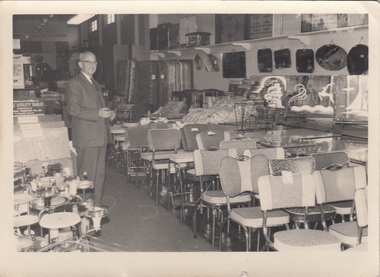
George Richmond in Hames and Woodward
... Mr Richmond said Fridays were very busy then as it was market day for hundreds of farmers in the area. “The hotels put on extra groomsmen for the stables, and standing in the store I could smell the beer and tobacco drifting down from the hotels.”...Mr Richmond said Fridays were very busy then as it was market day for hundreds of farmers in the area. “The hotels put on extra groomsmen for the stables, and standing in the store I could smell the beer and tobacco drifting down from the hotels.” ballarat, hames, woodward, furniture, richmond, armstrong st nth, shop George Richmond in Hames and Woodward George Richmond in Hames and Woodward ...This photograph is held in the Ballaarat Mechanics' Institute Audio Visual Collection. Please contact BMI for all print and usage inquiries. BMI librarian Rosemary McInerney's father George Richmond ran this furnitue business on Armstrong St Nth. Here are his reminiscences of that shoppping area from The Courier March 1st 1978 THE GOOD OLD DAYS IN ARMSTRONG ST. NORTH Mr George Richmond began work in Armstrong street north as a lad in knickerbockers in 1926. He started with Hames and Woodward, a piano, music and record shop, which he took over when both Hames and Woodward died during the war. Mr Richmond was guest speaker at an informal dinner of the Armstrong St North Traders Association held at the Victoria Hotel on Monday night. At the meeting he was made a life member of the association, with which he had been involved since its inception in 1930. “I can remember when a man on a bicycle with a little ladder on his backrode up the street with a long stick and turned on the gas lights under the verandahs,” he said. “It was around that time when there used to be a little man with a broom walking up and down the street, sweeping away what was left behind by horses. “There also used to be a bellringer who would walk up and down Armstrong street announcing a sale in a shop. He used to have a tall black hat, a large black frock coat and had a large mustache.” “Up to 1936, there used to be regular visits by street musicians, who were usually good for a few laughs.” “The last musicians to come through were an Italian trio, who were very good.” Mr Richmond said the depression was a sad time for Armstrong street. “A lot of people had to put their properties up for sale, because not many people could afford to buy things like records then,” he said. Mr Richmond said Fridays were very busy then as it was market day for hundreds of farmers in the area. “The hotels put on extra groomsmen for the stables, and standing in the store I could smell the beer and tobacco drifting down from the hotels.”ballarat, hames, woodward, furniture, richmond, armstrong st nth, shop -
 Ballaarat Mechanics' Institute (BMI Ballarat)
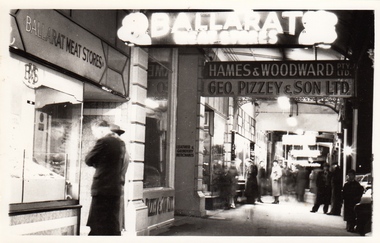
Hames and Woodward Pty Ltd
... Mr Richmond said Fridays were very busy then as it was market day for hundreds of farmers in the area. “The hotels put on extra groomsmen for the stables, and standing in the store I could smell the beer and tobacco drifting down from the hotels.”...Mr Richmond said Fridays were very busy then as it was market day for hundreds of farmers in the area. “The hotels put on extra groomsmen for the stables, and standing in the store I could smell the beer and tobacco drifting down from the hotels.” ballarat, hames, woodward, furniture, richmond, armstrong st nth, shop street, night Hames and Woodward Pty Ltd Hames and Woodward Pty Ltd ...This photograph is held in the Ballaarat Mechanics' Institute Audio Visual Collection. Please contact BMI for all print and usage inquiries. BMI librarian Rosemary McInerney's father George Richmond ran this furnitue business on Armstrong St Nth. Here are his reminiscences of that shoppping area from The Courier March 1st 1978 THE GOOD OLD DAYS IN ARMSTRONG ST. NORTH Mr George Richmond began work in Armstrong street north as a lad in knickerbockers in 1926. He started with Hames and Woodward, a piano, music and record shop, which he took over when both Hames and Woodward died during the war. Mr Richmond was guest speaker at an informal dinner of the Armstrong St North Traders Association held at the Victoria Hotel on Monday night. At the meeting he was made a life member of the association, with which he had been involved since its inception in 1930. “I can remember when a man on a bicycle with a little ladder on his backrode up the street with a long stick and turned on the gas lights under the verandahs,” he said. “It was around that time when there used to be a little man with a broom walking up and down the street, sweeping away what was left behind by horses. “There also used to be a bellringer who would walk up and down Armstrong street announcing a sale in a shop. He used to have a tall black hat, a large black frock coat and had a large mustache.” “Up to 1936, there used to be regular visits by street musicians, who were usually good for a few laughs.” “The last musicians to come through were an Italian trio, who were very good.” Mr Richmond said the depression was a sad time for Armstrong street. “A lot of people had to put their properties up for sale, because not many people could afford to buy things like records then,” he said. Mr Richmond said Fridays were very busy then as it was market day for hundreds of farmers in the area. “The hotels put on extra groomsmen for the stables, and standing in the store I could smell the beer and tobacco drifting down from the hotels.”ballarat, hames, woodward, furniture, richmond, armstrong st nth, shop, street, night -
 Ballaarat Mechanics' Institute (BMI Ballarat)
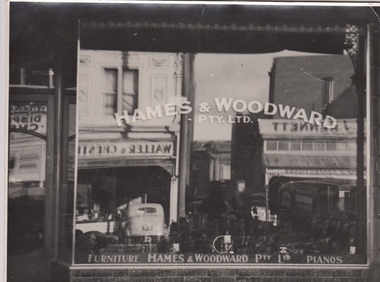
Hames and Woodward window Armstrong St Nth
... Mr Richmond said Fridays were very busy then as it was market day for hundreds of farmers in the area. “The hotels put on extra groomsmen for the stables, and standing in the store I could smell the beer and tobacco drifting down from the hotels.”...Mr Richmond said Fridays were very busy then as it was market day for hundreds of farmers in the area. “The hotels put on extra groomsmen for the stables, and standing in the store I could smell the beer and tobacco drifting down from the hotels.” ...This photograph is held in the Ballaarat Mechanics' Institute Audio Visual Collection. Please contact BMI for all print and usage inquiries. BMI librarian Rosemary McInerney's father George Richmond ran this furnitue business on Armstrong St Nth. Here are his reminiscences of that shoppping area from The Courier March 1st 1978 THE GOOD OLD DAYS IN ARMSTRONG ST. NORTH Mr George Richmond began work in Armstrong street north as a lad in knickerbockers in 1926. He started with Hames and Woodward, a piano, music and record shop, which he took over when both Hames and Woodward died during the war. Mr Richmond was guest speaker at an informal dinner of the Armstrong St North Traders Association held at the Victoria Hotel on Monday night. At the meeting he was made a life member of the association, with which he had been involved since its inception in 1930. “I can remember when a man on a bicycle with a little ladder on his backrode up the street with a long stick and turned on the gas lights under the verandahs,” he said. “It was around that time when there used to be a little man with a broom walking up and down the street, sweeping away what was left behind by horses. “There also used to be a bellringer who would walk up and down Armstrong street announcing a sale in a shop. He used to have a tall black hat, a large black frock coat and had a large mustache.” “Up to 1936, there used to be regular visits by street musicians, who were usually good for a few laughs.” “The last musicians to come through were an Italian trio, who were very good.” Mr Richmond said the depression was a sad time for Armstrong street. “A lot of people had to put their properties up for sale, because not many people could afford to buy things like records then,” he said. Mr Richmond said Fridays were very busy then as it was market day for hundreds of farmers in the area. “The hotels put on extra groomsmen for the stables, and standing in the store I could smell the beer and tobacco drifting down from the hotels.” -
 Ballaarat Mechanics' Institute (BMI Ballarat)
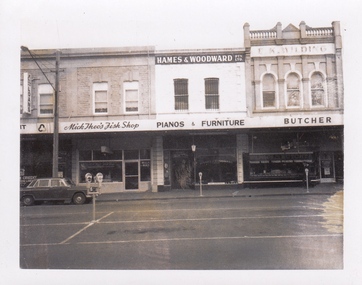
Hames and Woodward
... Mr Richmond said Fridays were very busy then as it was market day for hundreds of farmers in the area. “The hotels put on extra groomsmen for the stables, and standing in the store I could smell the beer and tobacco drifting down from the hotels.”...Mr Richmond said Fridays were very busy then as it was market day for hundreds of farmers in the area. “The hotels put on extra groomsmen for the stables, and standing in the store I could smell the beer and tobacco drifting down from the hotels.” ...This photograph is held in the Ballaarat Mechanics' Institute Audio Visual Collection. Please contact BMI for all print and usage inquiries. BMI librarian Rosemary McInerney's father George Richmond ran this furnitue business on Armstrong St Nth. Here are his reminiscences of that shoppping area from The Courier March 1st 1978 THE GOOD OLD DAYS IN ARMSTRONG ST. NORTH Mr George Richmond began work in Armstrong street north as a lad in knickerbockers in 1926. He started with Hames and Woodward, a piano, music and record shop, which he took over when both Hames and Woodward died during the war. Mr Richmond was guest speaker at an informal dinner of the Armstrong St North Traders Association held at the Victoria Hotel on Monday night. At the meeting he was made a life member of the association, with which he had been involved since its inception in 1930. “I can remember when a man on a bicycle with a little ladder on his backrode up the street with a long stick and turned on the gas lights under the verandahs,” he said. “It was around that time when there used to be a little man with a broom walking up and down the street, sweeping away what was left behind by horses. “There also used to be a bellringer who would walk up and down Armstrong street announcing a sale in a shop. He used to have a tall black hat, a large black frock coat and had a large mustache.” “Up to 1936, there used to be regular visits by street musicians, who were usually good for a few laughs.” “The last musicians to come through were an Italian trio, who were very good.” Mr Richmond said the depression was a sad time for Armstrong street. “A lot of people had to put their properties up for sale, because not many people could afford to buy things like records then,” he said. Mr Richmond said Fridays were very busy then as it was market day for hundreds of farmers in the area. “The hotels put on extra groomsmen for the stables, and standing in the store I could smell the beer and tobacco drifting down from the hotels.”ballarat, hames, woodward, furniture, richmond, armstrong st nth, shop -
 Plutarch Project
Film magazine, Κινηματογραφικός Αστήρ, 18/01/1959
... The story is that in May 1963 at the National Theatre in Richmond when the film titled "KRYSTALLO" ("Κρυστάλλω") was about to be screened for the first time "Cosmopolitan Motion Pictures" thought of a very unique way of promoting it. Apart from the usual publications to the "Kinimatografikos Astir" (Film Star) magazine and the flyers, they decided to display on the theatre roof 25 live sheep in a scene from a typical Greek village stable with a shepherd etc. ...The story is that in May 1963 at the National Theatre in Richmond when the film titled "KRYSTALLO" ("Κρυστάλλω") was about to be screened for the first time "Cosmopolitan Motion Pictures" thought of a very unique way of promoting it. Apart from the usual publications to the "Kinimatografikos Astir" (Film Star) magazine and the flyers, they decided to display on the theatre roof 25 live sheep in a scene from a typical Greek village stable with a shepherd etc. ...This magazine was first published in January 1959 and was a fortnightly edition which was distributed for free. The story is that in May 1963 at the National Theatre in Richmond when the film titled "KRYSTALLO" ("Κρυστάλλω") was about to be screened for the first time "Cosmopolitan Motion Pictures" thought of a very unique way of promoting it. Apart from the usual publications to the "Kinimatografikos Astir" (Film Star) magazine and the flyers, they decided to display on the theatre roof 25 live sheep in a scene from a typical Greek village stable with a shepherd etc. They also assigned the task of creating a large banner sized 2 metres by 8 meters approx. to an Australian artist (name unknown) to adorn the front of the National Theatre. When these sheep and the banner were finally displayed before the first screening there was so much traffic congestion created in front of the theatre that it became a standstill. Very quickly the police was informed and the RSPCA who attended and ordered the organisers to dismantle the setup of sheep on the roof as it was considered cruelty to the animals and that it was organised without a proper license. Nevertheless the film had so much success, that it was unprecedented for the times. First showing was 9th May 1963Primary historic significance to the Greek Film and Entertainment industries in Australia. Secondary Social and Rarity publication significance.Bi-weekly magazine size A4, published in black and white by "Cosmopolitan Motion Pictures" for the purposes of film shows and distributed free of charge."Κινηματογραφικός Αστήρ" magazine, entertainment, film, greek, language, publication, plutarch, yiannoudes -
 Melbourne Tram Museum
Drawing - Cable system, Melbourne & Metropolitan Tramways Board (MMTB), "Plans of car shed layouts:, c1925
... stable, offices, turntable, battery charging area and tables and on some, the horse stall. Contains drawings for Brunswick, Brighton Road, Carlton, Clifton Hill, Esplande (Acland St), Fitzroy, Nicholson St, North Carlton, North Melbourne, Northcote, Port Melbourne, Prahran, Richmond, South Melbourne, Toorak, and Victoria St,...stable, offices, turntable, battery charging area and tables and on some, the horse stall. Contains drawings for Brunswick, Brighton Road, Carlton, Clifton Hill, Esplande (Acland St), Fitzroy, Nicholson St, North Carlton, North Melbourne, Northcote, Port Melbourne, Prahran, Richmond, South Melbourne, Toorak, and Victoria St, Yields information on each cable tram car house or depot - prepared by the MMTB in the 1920s tramways trams cable trams car house car depot car sheds drawings depots Set of 16 blue prints + covers, folded, contained with a cover stapled on the left hand edge. ...A folder containing a floor plan for each cable tram car house or car shed, showing tracks, entry, workshop it, car wash stable, offices, turntable, battery charging area and tables and on some, the horse stall. Contains drawings for Brunswick, Brighton Road, Carlton, Clifton Hill, Esplande (Acland St), Fitzroy, Nicholson St, North Carlton, North Melbourne, Northcote, Port Melbourne, Prahran, Richmond, South Melbourne, Toorak, and Victoria St,Yields information on each cable tram car house or depot - prepared by the MMTB in the 1920sSet of 16 blue prints + covers, folded, contained with a cover stapled on the left hand edge.tramways, trams, cable trams, car house, car depot, car sheds, drawings, depots -
 Victorian Harness Racing Heritage Collection at Lord's Raceway Bendigo
Clothing - Race Colours, John Phyland and Ced McLean
... But, undeterred by distance, Phyland purchased his first trotter in 1882 and proceeded to acquire expensive, high quality standardbred mares and stallions and embark on a venture that saw him: • Breed and race winners of major races including The Melbourne Thousand, Bendigo JC Handicap (raced almost continuously on the grass track at Epsom, Bendigo, from 1867 to 1946), Boort Cup and numerous races at the Melbourne metropolitan tracks at Richmond and Ascot; • Acquire Soultline Villa and training stables adjacent to the Royal Melbourne Showgrounds so he could race at metropolitan tracks; • Develop a large self-contained training facility (including resident blacksmith) and home at 19 Raleigh St, Essendon; • Become the chair of the Victorian Trotting Horse Owners and Breeders’ Association, which lobbied strenuously for night trotting in the 1930s; • Breed from imported and locally bred mares that left families that are still active today. ...But, undeterred by distance, Phyland purchased his first trotter in 1882 and proceeded to acquire expensive, high quality standardbred mares and stallions and embark on a venture that saw him: • Breed and race winners of major races including The Melbourne Thousand, Bendigo JC Handicap (raced almost continuously on the grass track at Epsom, Bendigo, from 1867 to 1946), Boort Cup and numerous races at the Melbourne metropolitan tracks at Richmond and Ascot; • Acquire Soultline Villa and training stables adjacent to the Royal Melbourne Showgrounds so he could race at metropolitan tracks; • Develop a large self-contained training facility (including resident blacksmith) and home at 19 Raleigh St, Essendon; • Become the chair of the Victorian Trotting Horse Owners and Breeders’ Association, which lobbied strenuously for night trotting in the 1930s; • Breed from imported and locally bred mares that left families that are still active today. ...John Phyland It was during 1890 to 1918 that John Phyland, son of Irish immigrants, born in 1866, ran a 2000-acre sheep station. The property, Lake Vale, was south of Balranald, towards the Murray River town of Swan Hill. This would seem to be an unlikely location for a harness racing breeding operation, being more than 400km from Melbourne, where harness racing was centred on the Richmond track. But, undeterred by distance, Phyland purchased his first trotter in 1882 and proceeded to acquire expensive, high quality standardbred mares and stallions and embark on a venture that saw him: • Breed and race winners of major races including The Melbourne Thousand, Bendigo JC Handicap (raced almost continuously on the grass track at Epsom, Bendigo, from 1867 to 1946), Boort Cup and numerous races at the Melbourne metropolitan tracks at Richmond and Ascot; • Acquire Soultline Villa and training stables adjacent to the Royal Melbourne Showgrounds so he could race at metropolitan tracks; • Develop a large self-contained training facility (including resident blacksmith) and home at 19 Raleigh St, Essendon; • Become the chair of the Victorian Trotting Horse Owners and Breeders’ Association, which lobbied strenuously for night trotting in the 1930s; • Breed from imported and locally bred mares that left families that are still active today. Heaven Rocks, the Ballarat Cup, New Zealand Jewels three and four-year-winner, and 1:49.6 ($554,529) export to the US, is six generations on from the Phyland bred mare Dusky Ribbons; • Saw the start of the training career of colourful and controversial Cedric (Ced) McLean, Phyland’s son-in-law, with a mare left when Phyland died.Blue with yellow starsbalranald, trotting, phyland, richmond trotting -
 The Beechworth Burke Museum Research Collection
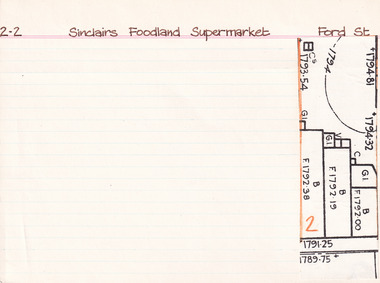
Card (Series) - Index Card, George Tibbits, Ford Street, Beechworth, 1976
... Manson land + prem as 1861 £190 1871 - Richmond, J. draper, same. land 22'x165' shop 22'x45' deal front WB slabs + sh. rf. prem in rear as 1861 £90 1876 - Younger, James, grocer, Geo Wilson, land + prem as in 1871 £70 1876 - Brown, J. draper, same. land + prem as 1861 "prem" inst. stable £144 1876 - Dawborn, Benjamin - Moffat, John Thomas - Schultze, George, drapers same, land + prem as 1866 no kitchen £70 1884 - unoccupied, Wilson. ...Manson land + prem as 1861 £190 1871 - Richmond, J. draper, same. land 22'x165' shop 22'x45' deal front WB slabs + sh. rf. prem in rear as 1861 £90 1876 - Younger, James, grocer, Geo Wilson, land + prem as in 1871 £70 1876 - Brown, J. draper, same. land + prem as 1861 "prem" inst. stable £144 1876 - Dawborn, Benjamin - Moffat, John Thomas - Schultze, George, drapers same, land + prem as 1866 no kitchen £70 1884 - unoccupied, Wilson. ...George Tibbits, University of Melbourne. Faculty of Architecture, Building and Town & Regional PlanningIndex system that support the research for Beechworth : historical reconstruction / [by] George Tibbits ... [et al]Arranged by street names of BeechworthEach index card includes: street name and number of property, image of property, allotment and section number, property owners and dates of ownership, description of the property according to rate records, property floor plan with dimensions.beechworth, george tibbitsbeechworth, george tibbits
