
Showing 51 items matching " singer building"
-
 Bendigo Historical Society Inc.
Document - CAMBRIDGE PRESS COLLECTION: LETTER PAPER - HAROLD CURNOW, ACCOUNTANT
... ... Singer Building...Harold Curnow, Accountant & Auditor, Singer Building, 45 Pall Mall, Bendigo. Date line ends 193-....Harold Curnow, Accountant & Auditor, Singer Building, 45 Pall Mall, Bendigo. Date line ends 193-. ...Cream letter paper with printed letterhead. Harold Curnow, Accountant & Auditor, Singer Building, 45 Pall Mall, Bendigo. Date line ends 193-.business, printers, cambridge press, cambridge press collection, harold curnow, singer building, australian provincial assurance association limited -
 Glenelg Shire Council Cultural Collection
Certificate - Certificate - Historic Buildings, Portland Town Hall, 1974
... A4 sized certificate demonstrating Portland Town Hall's special significance to the state of Victoria & inclusion on the Historic Building Register. Singed by Robert Maclellan, Minister for planning & Historic Buildings Council Chairperson. ...Portland Town Hall History House heritage register historic buildings certificate A4 sized certificate demonstrating Portland Town Hall's special significance to the state of Victoria & inclusion on the Historic Building Register. Singed by Robert Maclellan, Minister for planning & Historic Buildings Council Chairperson. ...From the Victorian Heritage Register: The foundation stone of the original Portland Town Hall was laid by William Learmonth on 21st September, 1863 following a competition and subsequent public controversy over the permitted entry of architect John Barrow. The conservative classical design of municipal surveyor Alexander Ross was preferred and this axially planned design with central council chamber and side offices fronted by a fine axed pedimented gable entablature of basalt and Tuscan Doric pilasters was completed by 24th may 1864. The old Town Hall is one of a distinguished group of public buildings in Portland and an interesting example of conservative classical architecture of the first years of settlement in western Victoria. The basalt structure was partially erected of stone from the Portland stockade and has significant historical associations with local Government administration in the district. The Town Hall is the most impressive work of Alexander Ross, a surveyor architect whose career remains largely undocumented. The old Town Hall at Portland has been discreetly extended at the rear to provide additional meeting room accommodation. The premises are no longer used for local government administration.A4 sized certificate demonstrating Portland Town Hall's special significance to the state of Victoria & inclusion on the Historic Building Register. Singed by Robert Maclellan, Minister for planning & Historic Buildings Council Chairperson. Red seal attached, bottom right.portland town hall, history house, heritage register, historic buildings, certificate -
 Warrnambool and District Historical Society Inc.
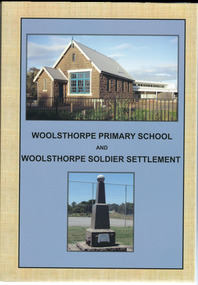
Book, Woolsthorpe Primary School and Woolsthorpe Soldier Settlement
... building erected in 1864 still survives today. From 1893 to 1910 the Head Teacher was W.F. Jamieson and Ada Crossley, the concert singer, sang her first song in public at a school concert in Woolsthorpe. ...building erected in 1864 still survives today. From 1893 to 1910 the Head Teacher was W.F. Jamieson and Ada Crossley, the concert singer, sang her first song in public at a school concert in Woolsthorpe. ...History of the Woolsthorpe Primary School and Woolsthorpe Soldier SettlementThis is a soft-cover book with a blue and buff- coloured front cover featuring photographs of the Woolsthorpe Primary School and the Woolsthorpe War Memorial. The back cover has photographs of the R.S.L. Badge and the Woolsthorpe Primary School. It has 160 pages. non-fictionHistory of the Woolsthorpe Primary School and Woolsthorpe Soldier Settlementwarrnambool, woolsthorpe, soldier settlement -
 Glen Eira Historical Society
Article - CAULFIELD CITY CHOIR
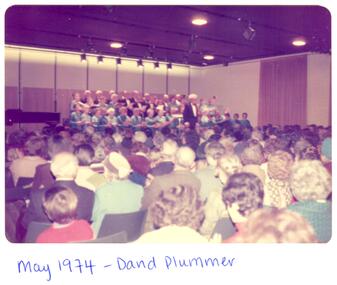
... Plummer David Caulfield City Choir Caulfield Arts Centre Lees Ian Southern Cross Newspaper Brown Murray Caulfield Council Caulfield Choir Franklin Dorothy Hankin A Caulfield Contact Cylich Sam Balaclava Road Mayors Celebrations St Stephen’s Uniting Church Hall Anniversaries Campbell J Caulfield Heywood Douglas Shewan Joan Sneddon Marj Mrs Snowden Avenue Caulfield City Choir Inc Caulfield Historical Society Heywood Doug Lee Ian Caulfield South Caulfield City Council Ingram Rene Ford Del Musicians Conductors (music) Uniting Church Official Buildings Singers Choirs Music People Associated with Culture Jeffries Carla Duncan Dorothy Roberts Christine Port Maureen Stanley-Low Dorothy Nicholas Norma Mealy Melville Howells Connie Glasson Margaret Griffin Betty Walshe Gaye Holmes Win Sneddon Marj Kuca Marie Fraser Glad Rose Ruth Provelsen Marcia Copley Marie Granger Thea Dobbin Leo Platt Eric Campbell Scott Franklin Clyde Newbold Ron Prebble Ron Barnett Margaret Alcock Judy Davis-Ward Amanda McAsey Francine McAlpine Carol Cook Doll Musical events and activities Clubs and associations Festivals and celebrations Religious structures and establishments McConchie Christine Heywood Joan Nutt Tony Warden Nelson Ingram Bert Henderson Vic Beeson Barbara Eggington Edna Article CAULFIELD CITY CHOIR ...This file contains 5 items: 1/4 Colour Photographs of the Caulfield City Choir and the farewell of its retiring conductor David Plummer, dating from May 1974 to 16/08/1978. 2/1 Black and white article taken from Southern Cross newspaper dated October 1975. The article relates the retirement of Caulfield City Choir’s foundation conductor David Plummer and the subsequent appointment of their new conductor Murray Brown. 3/1 black and white photograph of a choir taken by Sam Cylich for the Caulfield Contact newspaper regarding Ethnic Radio in Melbourne. 4/1 black and white photograph of the Caulfield City Choir dated September 1986 for the 40th anniversary concert taken at St Stephen’s Uniting Church Hall. 5/1 colour photograph of the Caulfield City Choir taken for their 40th anniversary concert on 07/09/1986 at St Stephen’s Church, Caulfield. Attached to the back is a letter to the Mayor, J. Campbell from Mrs Marj Sneddon dated 16/03/1987 as well as a list of the choir members photographed.plummer david, caulfield city choir, caulfield arts centre, lees ian, southern cross newspaper, brown murray, caulfield council, caulfield choir, franklin dorothy, hankin a, caulfield contact, cylich sam, balaclava road, mayors, celebrations, st stephen’s uniting church hall, anniversaries, campbell j, caulfield, heywood douglas, shewan joan, sneddon marj mrs, snowden avenue, caulfield city choir inc, caulfield historical society, heywood doug, lee ian, caulfield south, caulfield city council, ingram rene, ford del, musicians, conductors (music), uniting church, official buildings, singers, choirs, music, people associated with culture, jeffries carla, duncan dorothy, roberts christine, port maureen, stanley-low dorothy, nicholas norma, mealy melville, howells connie, glasson margaret, griffin betty, walshe gaye, holmes win, sneddon marj, kuca marie, fraser glad, rose ruth, provelsen marcia, copley marie, granger thea, dobbin leo, platt eric, campbell scott, franklin clyde, newbold ron, prebble ron, barnett margaret, alcock judy, davis-ward amanda, mcasey francine, mcalpine carol, cook doll, musical events and activities, clubs and associations, festivals and celebrations, religious structures and establishments, mcconchie christine, heywood joan, nutt tony, warden nelson, ingram bert, henderson vic, beeson barbara, eggington edna -
Glen Eira Historical Society
Document - CAULFIELD CITY CHOIR
... Miss Quaife Merlyn Ashton-Smith David Lukey Desmond Reither Charles Caulfield Town Hall Hirst Susan Anderson Peter Town Halls Orchestras Music People Associated With Culture Singers Choirs Official Buildings Uniting Church Festivals and Celebrations Musical Events and Activities Cultural Events and Activities Musicians Conductors (Music) Operas Religious Festivals Christmas Official Buildings Clubs and Associations Document CAULFIELD CITY CHOIR ...This file contains five items: 1/A program of the ‘Second Folk Song Festival’ presented by Caulfield City Choir conducted by David Plummer. Date unknown. 2/Three musical score sheets transcribed by Michael Finnissy for the Caulfield City Choir, dated 1983. 3/A black and white program for the Caulfield City Choir’s Christmas Celebrations at St. John’s Uniting Church on 06/12/1986, conducted by Douglas Heywood. 4/Two black and white programs of presentations given by the Caulfield City Choir and the Camberwell Chorale with the Camerata Orchestra, conducted by Douglas Heywood, at the Camberwell Centre. The first is of the Verdi Requiem on 03/05/1987; the second is ‘The Creation’ by Joseph Haydn on 14/05/1988. 5/A black and white program of the Caulfield City Choir Inc.’s presentation of Victorian Lollipops, conducted by Douglas Heywood at St. Stephen’s Uniting Church Hall on 13/09/1987.emms betty miss, kooyong road, caulfield, caulfield city choir, plummer david, law bernard, butler eric, finnissy michael, murrumbeena, harries rita, st. john’s uniting church, glenhuntly road, glen huntly road, elsternwick, hopetown gardens, heywood douglas, shewan joan, st. margaret’s anglican church caulfield, baptist church murrumbeena, church of christ carnegie, st. james’ lutheran church moorabbin, st. andrew’s presbyterian church caulfield south, holy cross roman catholic church caulfield south, st. john’s uniting church elsternwick, baker tim, sneddon j.f. mrs., snowdon avenue, caulfield city council, caulfield philharmonic society, sneddon marjorie, snedden marjorie, north road, ormond, barnard j., cook d., copley m., duncan d., field b., ford r., fraser g., granger t., greenhaugh h., howells c., jefferies c., kuca m., lockett j., mcalpine c., mcconchie c., mealy m., moorees j., nicholas n., nixon v., polites s., pope m., port m., provelsen m., provelson m., rose r., simmons h., terkuile k., alcock j., bannister j., barnett m., beeson b., cinaglia c., glasson m., griffon b., holmes w., sneddon m., weickhardt j., henderson v., ingram h., ketels m., nutt a., polites c., warden n., dobbin l., mccaffrey p., newbold r., prebble r, shewan j., st. stephen’s uniting church hall, balaclava road, hawthorn road, kooyong road, dobbin leo, heywood thomas, ford dellys, the scotsglen players, caulfield city hall, glen eira road, new city hall, st. stephen’s uniting church, glasson m. mrs, new caulfield city hall, nicholas n. miss, quaife merlyn, ashton-smith david, lukey desmond, reither charles, caulfield town hall, hirst susan, anderson peter, town halls, orchestras, music, people associated with culture, singers, choirs, official buildings, uniting church, festivals and celebrations, musical events and activities, cultural events and activities, musicians, conductors (music), operas, religious festivals, christmas, official buildings, clubs and associations -
 Mission to Seafarers Victoria
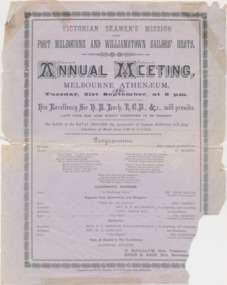
Flyer, Annual Meeting, 1886
... Concerts free to all seamen, given by amateur singers, are held weekly on both sides of the bay, and are largely attended and much appreciated. The building...Concerts free to all seamen, given by amateur singers, are held weekly on both sides of the bay, and are largely attended and much appreciated. The building ...The Annual Meeting presenting the Annual Report was held on the 21st of September 1886 at the Melbourne Athenaeum. In the Standard (Port Melbourne, Vic. : 1884 - 1914), Saturday 25 September 1886, page 2 VICTORIAN SEAMEN'S MISSION. This institution held its annual meeting in the Melbourne Athenæum on Tuesday evening under the most favourable auspices. The hall was filled in every part, a very large pro portion of the audience being seamen. The half hour previous to the com mencement of the meeting was very pleasantly occupied bv listening to the capital playing of the band of the Naval Brigade, and precisely at eight o'clock the musicians heralded the entrance of the vice-regal party by playing ' The National Anthem.' Sir Henry and Lady Loch were received by the Mayor of Melbourne (Mr. Stewart), the Hon. F. T. Derham, Captain Pasco, Mr. H. R. Reid (hon. secretary), and Lieutenant - Colonel Templeton, and His Excellency imme diately took the chair. The venerable ex-chaplain, the Rev. Kerr Johnson, was present, but as he did not feel equal to taking part in the proceedings, the Rev. E. T. Miles opened the meeting with prayer. Nothing could have been more cal culated to give a distinctive character to the meeting than the singing of the Sailors' Hymn by the 300 odd seamen present. The rugged yet tuneful voices of the men blending with those of the ladies present, who heartily joined in, gave a most spirit-stirring effect to the beautiful words of the refrain : — Rocks and streams I'll fear no more, When on that eternal shore; Drop the anchor ! furl the sail ! I am safe within the vail. Next followed His Excellency's address as chairman. The Governor threw himself heartily into the pro ceedings, and his remarks, expressive of the utmost sympathy with the sea men of the empire, were applauded to the echo. In fact from the start all the speakers struck the right key-note. The institution was not held up as a charity on which Jack was more or less dependent. According to the gentlemen who one and all welcomed him as a friend, and a right useful friend too, the thing was all the other way. To the sailor it was, they de clared, that they owed all that the colony possessed, and more — the great ness and prosperity of the Empire, He was the sort of man who never turned his back on a fellow creature, or refused to give a hand to a comrade in distress. Therefore it was deter mined that Jack should not come to these shores and think there were none to care for the comfort of his body or the welfare of his soul, and with the object of greeting the sailor on his arrival, of grasping his hand as a friend, beguiling his hours on shore, and saving him from the scores of dangers and temptations which beset a sea-faring man's stay in port, the institution had in '57 been started. Its claims on the Victorian public, not as a charity, but as a means of show ing some recognition of the services of the brave men who man our mercan tile marine, were ably put before the meeting. The Rev. G. D. Buchanan de clared that if the Melbourne merchants contributed to the mission a tithe of the amount they spent in insurance, they would find their goods better looked after by the seamen than by the insurance companies. Captain McCallum, the treasurer, read the following report of the com mittees of the Port Melbourne and Williamstown Rests : — In no part of the Queen's dominions have there been more changes during the last thirty years than in the colony bearing her gracious name ; and it is therefore all the more pleasant to report that the Victorian Mission to seamen, which started so long ago as 1857, still pursues an active career of usefulness, holding out a helping hand to mariners of all nations, without distinction of colour, race or creed. Eight years ago, some of the supporters of the Mission, feeling the want of a Temperance Club, where the crews of the various ships might recreate themselves and enjoy the three ' C's' — Coffee — Comfort — Company, appealed to the public for assistance, resulting in sufficient funds being obtained to justify the establishment of Sailors' Rests at Sandridge and Williamstown. Both these institutions were opened by a distinguished gentleman who has always taken a practical interest in sea men, and who, but for illness, would have been present at this meeting — Sir W. F. Stawell — and the result jof several years' experience fully justifies the statement that these institutions have supplied a felt want — the attendance of visitors reaching now about 30,000 per annum ; whilst so economically are they managed, that the annual cost to the public is less than L150 The thanks of the committee are specially due to those ladies and gentlemen who so kindly made a special and successful effort to supply both of the Bests with new piano fortes, to the great enjoyment of ' Jack ashore.' The instrument which was pre sented to the Port Melbourne institution by Mr. J. M. Bruce, on behalf of the sub scribers, the funds having been collected by his daughter yet in her teens, being espec ially one of great value. Concerts free to all seamen, given by amateur singers, are held weekly on both sides of the bay, and are largely attended and much appreciated. The building at Port Melbourne, which, being of wood, is merely of a temporary character, is free from debt ; but there is a mortgage of L500 on the Williamstown institution, which cripples its usefulness. The committee have regretfully to report that during the year under review they have lost, through the weakness of increas ing years, tbe loving services of the Rev. Kerr Johnston, their venerable friend and chaplain, whose life is, indeed, the history of the Mission, for he has been connected with it from the commencement of the work. Mr. Johnston has proved himself a true disciple of his Divine Master, and the com mittee trust that in the evening of his days he may enjoy that peace and rest which he lias so well earned. The com mittee presented Mr. Johnston, on retiring, with an honorarium of L100. Mr. E. James has been appointed iu Mr. JohuBton'u room, and the committee believe that their choice lias been a fortunate one. The Mission aud Sailors' Bests have been kept afloat by the unwearied and self -deny-ing exertions of the Ladies1 Committee, who have personally collected nearly the whole of the income ; but it may fairly be asked whether, in this great seaport, where last year there entered in at Her Majesty's Customs 1711 ships, manned by 61,256 men, the mercantile community of Melbourne should net take a more active interest in the welfare of the thousands of brave men who, for a few weeks, temporary sojourners on our shores, away from friends and relatives, have a special claim on our sympathy and help. We are of the old land, ' that gem sunk in the silver sea and we can re-echo Mr. Gladstone's recent words to the crew of the yacht Sunbeam, ' The calling which you follow is a noble one, and is calculated to bring forth the highest qualities of our common nature ; ana if it is possible for any occupation to make a man, in the highest and wideBt sense of the word, it is ' the occupation to which your lives are given. How closely it is connected with the the prosperity and fame of tbi» great nation ; how closely, indeed, it is connected with advancement of civilisation, and tiie general welfare of the world, it needs no words of mine to tell yon, for in your work and life you know it well, and feel it truly.' Look ing at what we Victorians owe to the British sailor, the committee earnestly trust that, with the blessings of the Almighty God, increased success will attend the work of the Mission and Rests. Mr. James read the chaplain's re port: — Since my appointment as chaplain to tbe Seamens' Mission, I have met with greater success than I anticipated. I have visited all the ships that have come into port, also many of the vessels on the Yarra, and am pleased with the civil and courteous manner in which I have been received by captains, officers and men, and in most cases my invitations to them to attend our meetings have been most heartily responded to. . The attendance at the services in the Bethel has much improved — on some occasions scarcely sitting room is to be found. The services have proved a great blessing to many Christian seamen ; whilst several who have come into port caring for nothing of a religious nature, have left praying. God fearing men, with the request that those left behind would remember them in their supplications, that they should be kept through all the trials and temptations to which seamen are exposed. The weekly Tuesday evening concerts got up bj the ladies of the committee and others, have proved a great benefit to the Mission, and a source of great enjoyment to the seamen in port. The programmes are excellent; and are spoken of by the sailors as the best they have heard in any port. The Sailors* Rest is provided with a library, the daily papers, and illustrated literature, with games of chess, draughts, dominoes, quoits, and other amusements, which are much taken advantage of during the evenings. Seamen ' are alio provided with writing materials, free, bo that everyone may have any opportunity of writing to their friends; for many an anxious parent is counting the days and hoping for .the time to come when they shall get a line from their sons in the far distant land, and many a son is reminded of his obligation by the opportunity thus afforded. I am much pleased at this time to acknowledge the kindness of the committee, and the great help I have received from them, also from Mr. Douglas, the manager of the Best. I do not think I could have been blest with a better co-worker. I have no hesitation in recommending the seamen to go to the Best, and telling them that they will receive a most hearty welcome, to which they can all testify ; my thanks are due to the voluntary workers, who have given every assistance ft their power, especially to Miss Lloyd, who is an invaluable help, attending in all weathers, and playing the organ at every service. The Sunday School is progressing, and we aie now about to make another addition to the library, of good readable books. The work at Williamstown is also pro gressing well, the Wednesday night concerts being well attended, and the singing and reciting supplied by local talent really good; the sailors contributing largely to the programmes. Captain McCallum is the backbone of the work at Williamstown, well supported by many warm friends of the sailors. The services held every Sunday night are productive of mnch good. The work here, too, is very encouraging, having much improved of late. I am thank ful to God that He has so blessed the efforts of His people, and hope they may be long spared to carry on the work. The Rev. G. D. Buchanan in an eloquent speech proposed the first re solution : — ' That the Reports now read be adopted, and that the following ladies and gentlemen be the Committee for the ensuing year : — SEAMEN'S MISSION. Ladies Committee. — Mesdames Templeton, Campbell, Chamberlin, Elworthy, Lormer, Gourlay, Gowan, B. Johnston, Webb, Young, Plummer, Misses Elwortny, Webb, Gowan, and M. Hastie. Gentlemen's Committee. — Captains Pasco, R. N., Adams, McCallum, J.P., Dalgarno, Garside, Messrs. Courtis, A. J. Smith, Macpherson, H. R. Reid, J.P., Henry Berry, J.P., Revs. Kerr Johnston, and A. R. Edgar.' Captain Pasco seconded, and in formed the audience that Baron Von Mueller had written regretting his inability to attend, but had sent a substantial cheque. (Applause.) A collection was then taken up and liberally responded to, the band mean-time playing airs suitable to the occa sion, such as ' The Death of Nelson' and ' Rocked in the Cradle of the Deep.' The hon. F. T. Derham next pro posed the second resolution : — ' That the success which has attended the working of the Port Melbourne Sailors' Rest justifies this meeting in taking imme diate steps to raise the funds necessary to erect a Seamen's Institute worthy of the in creasing trade and commerce of Victoria.' This was seconded by the Rev. A. R. Edgar, and both were carried by ac clamation. The Mayor of Melbourne moved a vote of thanks to His Excellency, and Sir Henry in the course of his reply said his sympathies were not only with sailors because he had been much brought into contact with them, but because he had been a sailor himself and had had the honour and privilege of serving in Her Majesty's navy. At this the men sprang to their feet and gave three deafening cheers for the Governor and another for Lady Loch, who bowed her acknowledgment and appeared very pleased at the hearty reception accorded to her. During the evening Mrs. Pearce, and Messrs. Walsh, Woods, and Robinson, members of the Liedertafel, contributed songs. The lady, who has sung at the Tuesday evening concerts, sang ' When the Tide comes in' so charmingly that an encore, although against the rule of the evening, was insisted upon, which was responded to by a beautiful rendering of the old ballad ' Robin Adair,' Altogether the meeting was a com plete success, and will doubtless afford the committee fresh encouragement in their well-directed efforts. Printed programme for the 1886 annual meeting taking place in the Melbourne AthenaeumWritten in black ink at the back by WHC Darvall: annual meeting, melbourne athenaeum, 1886, baron ferdinand von mueller, sailors' rest, hugh ronald reid, captain fullarton, captain mccallum, henry loch, captain pasco, reverend kerr johnston -
 Eltham District Historical Society Inc
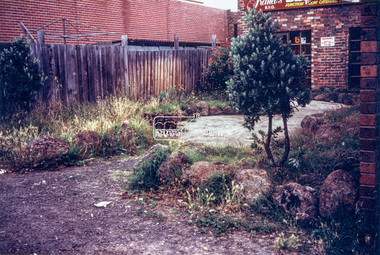
Photograph - Colour Print, Eltham Shire Council, Rear entrance to Franco's Pizzeria Restaurant, Commercial Place, Eltham, c.1988
... Downstairs originally had a female pianist/singer and the walls were a peachy pink colour with horse shoe shapes in the plaster, upstairs was a full function room with dance floor. It was renovated in the early 90s and a full bar added downstairs. They sold up and then opened a take away pizza shop on Bolton Street. The Penguin Drycleaners building...Downstairs originally had a female pianist/singer and the walls were a peachy pink colour with horse shoe shapes in the plaster, upstairs was a full function room with dance floor. It was renovated in the early 90s and a full bar added downstairs. They sold up and then opened a take away pizza shop on Bolton Street. The Penguin Drycleaners building ...The main entrance to Franco's was from Main Road. It was run by Sammy and another family member. Franco's was a 2 story restaurant. Pizza take away downstairs. Licensed, BYO upstairs. Downstairs originally had a female pianist/singer and the walls were a peachy pink colour with horse shoe shapes in the plaster, upstairs was a full function room with dance floor. It was renovated in the early 90s and a full bar added downstairs. They sold up and then opened a take away pizza shop on Bolton Street. The Penguin Drycleaners building was an extension built right over the entrance garden; the building to the left the former Volumes now Missing Gorilla. One of a series of 6 images taken by Eltham Shire Council officers recording litter being prevalent around the shopping precinct and carparks spreading from Luck Street through Commercial Place top Arthur Street, Elthamarthur street, car park, carparks, commercial place, eltham shopping centre, eltham shops, litter, luck street, franco's pizzeria, missing gorilla, volumes, penguin drycleaners -
 Victorian Interpretive Projects Inc.
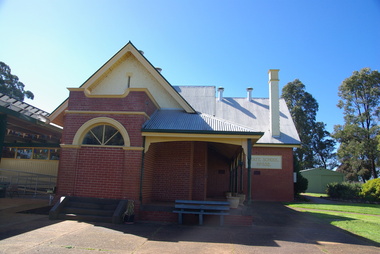
Photograph - Colour, Smeaton Primary School
... building accommodated 122 children. Among notable ex-pupils are Major-General Bridgeford, Frank Wright ( Musical Director of the London County Council), Alex Wright, (AKA singer Andre Navarre), and Les Brooks. ...building accommodated 122 children. Among notable ex-pupils are Major-General Bridgeford, Frank Wright ( Musical Director of the London County Council), Alex Wright, (AKA singer Andre Navarre), and Les Brooks. ...In 1860 Smeaton residents appealed for funds to establish a school. Patrick Curtain, and his co-workers raised more than £150 plus a land grant (Allot A, Sect 2, Township of Smeaton). Head Teacher John Forbes, with assistant Zillah North, opened a timber school building which measured 36ftx18ft (11.0x5.5m) on 1 September 1861 with 44 children. Rising enrolment to 65 in 1868 made building alterations necessary. During 1870-1 a residence of four rooms was supplied and in October 1882 a 20ftx18ft (6.1x5.5m) classroom. In 1907 a new brick building accommodated 122 children. Among notable ex-pupils are Major-General Bridgeford, Frank Wright ( Musical Director of the London County Council), Alex Wright, (AKA singer Andre Navarre), and Les Brooks. (Visions and Realisations) In 2013 it was announced that Smeaton Primary School would close. The Hepburn advocate reported: "A Department of Education spokesman has confirmed the Smeaton Primary School council recently voted unanimously to recommend the school close at the end of the year. The school currently has 12 students with enrollments dwindling during the past few years and no prep students to its boost numbers or its future. The school’s imminent closure comes as the Smeaton community gears up for the town’s 175th anniversary which will be celebrated later this year. School council member Kristi Pedretti said it had not been a decision made lightly. “There are 12 students – only one in grade 6, about eight in grade 5, two in grade 3, and one in grade 1 – and there’s only one girl in the school,” she said. “So it was a combination of everything – having that big group through in grade 5, but no preps coming through, and only one girl. “It’s hard for parents to see a future in the school.” Ms Pedretti has a son in grade 6, Jack, and is herself a former Smeaton Primary School student." .1) Red brick building .2) Smeaton Primary School logo .3) Smeaton Primary School Bell .4) Smeaton Primary School pakyground, including concrete cricket pitch.smeaton, school, education, bell, cricket, state school no. 552 -
 Bendigo Historical Society Inc.
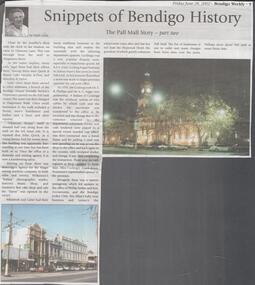
Newspaper - JENNY FOLEY COLLECTION: SNIPPETS OF BENDIGO
... Moving on there was Betteridge's Agency for the Singer sewing machine company, Wilkinson's photographic studio, Sutton's music shop and Favaloro's cake shop and café the ''Savoy'' was opened in the 1920's. Whitelock and Carter had their men outfitters business in the building...Moving on there was Betteridge's Agency for the Singer sewing machine company, Wilkinson's photographic studio, Sutton's music shop and Favaloro's cake shop and café the ''Savoy'' was opened in the 1920's. Whitelock and Carter had their men outfitters business in the building ...BHS CollectionBendigo Weekly from Friday, June 28, 2002 - Snippets of Bendigo history, the Pall Mall story, part two - by Edith Lunn. Close to the jeweller's shop, we came to Chancery Lane. Many early legal firms had their offices there. Among them were: Quick&Rymer, Luke Murphy&Don and Macoboy&Taylor. A branch of the Bendigo united Friendly Society's Dispensary opened on the corner. Other small business in the walk included a florist, men's hairdresser and a boot and shoes repairer. Moving on there was Betteridge's Agency for the Singer sewing machine company, Wilkinson's photographic studio, Sutton's music shop and Favaloro's cake shop and café the ''Savoy'' was opened in the 1920's. Whitelock and Carter had their men outfitters business in the building, Cocking's was a very popular drapery store. After Cocking's closed down, Stoneman's supermarket opened in the premises. Alongside there was a passageway that led upstairs to the office of Phillip Secher and Son, Accountants and the Bendigo jockey club. Mrs Allan's baby wear business and Lenten's the tobacconist came after and last but not least the Shamrock Hotel enhances Pall Mall. The clip is in a folder.newspaper, bendigo, bendigo weekly -
Bendigo Historical Society Inc.
Document - SPECIMEN COTTAGE COLLECTION: VARIOUS DOCUMENTS
... Anderson and Sons business in Mitchell Street 'Fancy goods'' history of the family. 4027.16 Handwritten notes on Florence Anderson. 4027.17 Document family history of Hamlet Smart Appleby. 4027.18 Document - Amy Castles ''The Little Bendigonian singer'' 4027.19 Quentin Clifford (Cliff Binks words in remembrance, Bendigo Monday 23rd November 2015. 4027.20 Background report on Vahland drinking fountain, list of William Vahland buildings, copies of photos of Vahland descendants and two brochures celebrating Vahland. 4027.21 Blank invoice for the Taraxdale Brewing Co. of Golden Square - G. ...Anderson and Sons business in Mitchell Street 'Fancy goods'' history of the family. 4027.16 Handwritten notes on Florence Anderson. 4027.17 Document family history of Hamlet Smart Appleby. 4027.18 Document - Amy Castles ''The Little Bendigonian singer'' 4027.19 Quentin Clifford (Cliff Binks words in remembrance, Bendigo Monday 23rd November 2015. 4027.20 Background report on Vahland drinking fountain, list of William Vahland buildings, copies of photos of Vahland descendants and two brochures celebrating Vahland. 4027.21 Blank invoice for the Taraxdale Brewing Co. of Golden Square - G. ...Various documents in plastic folders. Topics are: 4027.1 Rocky Vale Villa in Maiden Gully built by William Beebe Snr, historical information and significance assessment. 4027.2 The powder magazines of Bendigo and Eaglehawk. Talk given by Ralph Birrell. 4027.3 Ralph Birrell obituary. 4027.4 Early Surveyors on the Bendigo goldfields 1852-1860 three pages essay by Ralph Birrell. 4027.5 History of Eaglehawk courthouse and log lock up with four photographs. 4027.6 Submission from the National Trust regarding Bendigo Pottery. 4027.7 Fistcuffs, Diamonds and Lace synopsis of a novel by Ann Rayner on the boxer Abednego Thompson after whom the name of the City of Bendigo is said (by same to be derived. 4027.8 Historical facts and dates on Bendigo by the Royal historical society of Victoria, Bendigo branch. 4027.9 Arcades of Bendigo, by Tom Luke. 4027.10 Benedict Branch family history with picture. Benedict invented a Miners Safety cage in 1883 and was awarded a medal, photos of the cage and medal included. 4027.11 Burke & Wills 150 years on pamphlet, Jim Evans newspaper article, notes and photos of the monument at the Bendigo cemetery. 4027.12 Marlborough House document on the history of this house. 4027.13 Codicil to the last will and testament of William Beebe of Inglewood Road, Sandhurst. 18th September 1891. 4027.14 Document outlining the life of Sister Jessie Aitken 4027.15 Document - W. Anderson and Sons business in Mitchell Street 'Fancy goods'' history of the family. 4027.16 Handwritten notes on Florence Anderson. 4027.17 Document family history of Hamlet Smart Appleby. 4027.18 Document - Amy Castles ''The Little Bendigonian singer'' 4027.19 Quentin Clifford (Cliff Binks words in remembrance, Bendigo Monday 23rd November 2015. 4027.20 Background report on Vahland drinking fountain, list of William Vahland buildings, copies of photos of Vahland descendants and two brochures celebrating Vahland. 4027.21 Blank invoice for the Taraxdale Brewing Co. of Golden Square - G. A. Pethard, manager.bendigo, buildings -
 Bendigo Historical Society Inc.
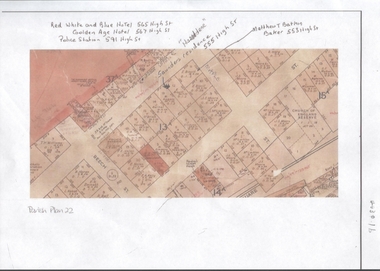
Document - SPECIMEN COTTAGE COLLECTION: VARIOUS DOCUMENTS
... Email from Hans Tracksdorf to Andy Walker and Ana Hilson updating on the Charlton Building at 60-62 Mundy Street, June 2015, several coloured photos attached. 4030.8. Notes on the family of Elizabeth Ann Butler. 4030.9. The Amy Castles story, a narrative on the life of the singer Amy Castles. ...Email from Hans Tracksdorf to Andy Walker and Ana Hilson updating on the Charlton Building at 60-62 Mundy Street, June 2015, several coloured photos attached. 4030.8. Notes on the family of Elizabeth Ann Butler. 4030.9. The Amy Castles story, a narrative on the life of the singer Amy Castles. ...Various documents in plastic folders. The topics are: 4030.1 – 4300.25 Various documents in plastic folders. Various documents in plastic folders. The topics are: 4030.1 Photocopy of an article titled Saunders' Victoria House. Also a map of the Saunders residence in High Street. 4030.2. Article titled What I saw in gaol July 1889 (written by Gilbert Rule.. 4030.3. Eleven pages essay: H. M. Prison Bendigo after a short history of the prison there are details of several criminal cases. Also brochure H.M. Prison Bendigo 1861-2006, Official decommissioning ceremony 5 January 2006. 4030.4. The Temple Builders, talk by Alex H. Stone 10th May, 1998. 4030.5. The German contribution to early Bendigo by Frank Cusack. 4030.6. Children's games played during and prior to the great depression, Interviews conducted by James Lerk. People interviewed are: Stella Banfield, Mary Pickles, Geoff Newman, Vel Newman, Joan O'Donahue, Peg Schlotterlein, James Gallagher, Jack Larkin, Ken Maes. 4030.7. Email from Hans Tracksdorf to Andy Walker and Ana Hilson updating on the Charlton Building at 60-62 Mundy Street, June 2015, several coloured photos attached. 4030.8. Notes on the family of Elizabeth Ann Butler. 4030.9. The Amy Castles story, a narrative on the life of the singer Amy Castles. Also a booklet ''I lived for the art'' The story of Amy Castles concert program. 4030.10. Harcourt Valley Heritage & Tourist Centre ''Granite houses of Faraday and Harcourt'' by George Milford, March 2010. 4030.11. The story of Knipe's castle and the man who built it, John Hanlon Knipe. A paper presented by Mrs. Edith Lunn 2nd April, 1987. Also some photographs of graves and various documents. 4030.12. Report: Victorian Heritage database place details 15/07/2014 former Kahland winery and cellars. Also two coloured photographs from Tony Robinson' s walk around Bendigo, Kahland street - Lynden house built 1873 wine cellar. 4030.13. several letters from James and Dinah Jeal to their parents detailing their travels on the goldfields dates from 1855 to 1865. 4030.14. Photocopy of a six pages hand written letter to a Walter Edis (?. in England from a J. Wharton (?. from Woodstock on Loddon, detailing his boat trip to Melbourne and the train trip to Marong where he is working. Letter dated July 9th, 1923. 4030.15. The history of T.C. Watts & Son, real estate agents in Bendigo by Edith Lunn. September 30th, 2000. 4030.16. Medals created by Messrs Joseph and Co. Pall Mall, Sandhurst and Melbourne with special reference to ''Champion Medals'' created for the Bendigo Rifles and other Victorian forces. 1858 to 1885. Compiled by Angus Pearson December 2012. 4030.17. Talk by Jim Evans at September 202 meeting of the Bendigo Historical Society. The Inimitable Charles Thatcher, colonial minstrel. 4030.18. Six pages typewritten document titled: C.R. Thatcher, the local songster. Date and author unknown. 4030.19. Music sheet. The Chinaman. Thatcher's colonial songs as written and sung by Charles Robert Thatcher during the goldrushes in the Shamrock hotel, Bendigo. 4030.20. Heidi Teague young historian award two pages detailing the criteria for the award, a newspaper obituary for Heidi Teague and a twenty five pages transcribe interview of Heidi Teague, Heidi was interviewed by Ines Tyson and transcribed by Carol Woolman in 2009. 4030.21. Photograph of Richard Bertram Taylor in military uniform, Richard was killed in action in WWI. Also a brief family history 4030.22. Six pages typewritten letter from John Stuart, Assistant Surgeon Royal Navy to chief Secretary The Honourable C. Haines dated Sandhurst 27th May, 1857 regarding Chinese protectorate. 4030.23. Eight pages biography with photos of Sister Clara Stewart. 4030.24. Two pages biography on John Boyd Watson (and sons. by Rob Upson 4030.25. History of Alick Wilkinson & other grocers 1930 onwards. Compiled by Vernon and Garran Wilkinson. bendigo, commerce, business, buildings -
 Bendigo Historical Society Inc.
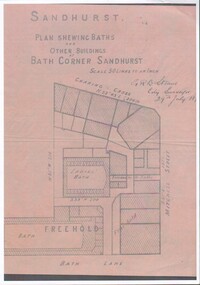
Document - Plan of Buildings and Baths at Bath corner, 19/09/2023
... singed GRB Steane, City Surveyor 29th July 18?? Photographic copy of Shop layout at Bath corner Sandhurst (Charing Cross, Mitchell Street & Bath Lane); including Men's and Women's public baths dated 29 July 18?? Document Plan of Buildings ...Photographic copy of Shop layout at Bath corner Sandhurst (Charing Cross, Mitchell Street & Bath Lane); including Men's and Women's public baths dated 29 July 18??Includes singed GRB Steane, City Surveyor 29th July 18??city baths, bath corner, charing cross -
 Bendigo Historical Society Inc.
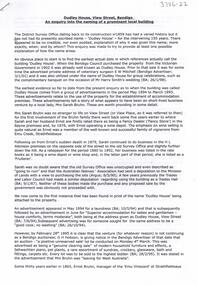
Document - The naming of Dudley House Bendigo, 2/11/2023
... singer, Jenny Lind, in 1861, when she sang to raise money for charity. Dudley House View Street Bruhn Serah Bruhn A nine page document theorizing the history behind the name of the Dudley House building. ...Dudley House at 60 View St, Bendigo was built by builders, Gretchen and Cooper for the public Works Department in 1858-59. It was originally built for the district surveyor, Richard Larritt, who designed the Bendigo street layout. One of its earliest claims to fame was the hosting of world famous singer, Jenny Lind, in 1861, when she sang to raise money for charity.A nine page document theorizing the history behind the name of the Dudley House building. Written and presented by Terry Davidson.dudley house, view street, bruhn, serah bruhn -
 Flagstaff Hill Maritime Museum and Village
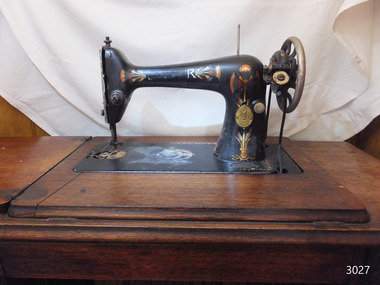
Domestic object - Sewing Machine, Singer Sewing Machine Company, 1922
... In 1882 George McKenzie, the soon to become President of the Singer Sewing Machine Company undertook the ground breaking ceremony on 46 acres of farmland at Kilbowie, Clydebank and the largest Singer factory in the world started to be built. Originally two main buildings were constructed. ...In 1882 George McKenzie, the soon to become President of the Singer Sewing Machine Company undertook the ground breaking ceremony on 46 acres of farmland at Kilbowie, Clydebank and the largest Singer factory in the world started to be built. Originally two main buildings were constructed. ...In 1867 the Singer Company decided that the demand for their sewing machines in the UK was sufficiently high to open a local factory. Glasgow was selected for its iron-making industries, cheap labour, and possibly because at the time the General Manager of the US Singer Sewing Machine Company was George McKenzie, who was of Scottish descent. The company obtained a lease on land near Queen Street Station and machinery and machine parts were shipped over from the US. Demand for sewing machines outstripped production at the new plant and by 1873 a new larger factory was completed near Bridgeton Cross. By now Singer employed over 2,000 people in Scotland but still, they could not produce enough machines. In 1882 George McKenzie, the soon to become President of the Singer Sewing Machine Company undertook the ground breaking ceremony on 46 acres of farmland at Kilbowie, Clydebank and the largest Singer factory in the world started to be built. Originally two main buildings were constructed. Built above the middle wing of the factory was a huge clock tower with the 'Singer' name displayed for all to see from miles around. Many miles of railway lines were laid throughout the factory to connect the different departments and to aid in the shipping of their goods. Railway lines from the factory connected Glasgow, Dumbarton, and Helensburgh stations. The factory was regarded as the most modern facility in Europe at that time. As different departments in the factory were completed, the workers moved from the old sites to the new one at Kilbowie and the factory was finally finished in 1885. With nearly a million square feet of space and almost 7,000 employees producing on average 13,000 machines a week, making it the largest sewing machine factory in the world. The Clydebank factory was so productive that in 1905 the US Singer Company set up the Singer Manufacturing Company Ltd. as a UK registered company. The invention of the sewing machine had several very significant impacts on the lives of many people. It changed the domestic life of many women as more households began to own sewing machines, women as the ones who traditionally stayed home to do chores including making and repairing clothing, found themselves with more free time. Previously several days a week would be dedicated to sewing clothing for herself and her family, a housewife could now complete her sewing in merely several hours, allowing for more free time to pursue hobbies and attain new skills. Sewing and clothing production, in general, became more industrialized activities, taking place less in the home and more in large factories. Industrial sewing machines, in combination with the cotton gin, the spinning jenny, and the steam engine, made clothing production much easier and much cheaper. Sewing machine, treadle operated, "Branded Premier" 5-7-9-2-0-0-" Serial Number Y6243048 (denotes 1922 year of manufacture) flagstaff hill, warrnambool, shipwrecked-coast, flagstaff-hill-maritime-museum, maritime-museum, shipwreck-coast, flagstaff-hill-maritime-village, sewing machine, hand operated, dressmaking, textile machinery, portable, premier sewing machine, premier, singer treadle sewing machine -
 Flagstaff Hill Maritime Museum and Village
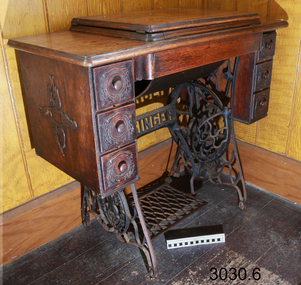
Domestic object - Sewing Machine, Singer Sewing Machine Company, 1907 -1920 (see note section this document for further information regards model identification)
... In 1882 George McKenzie, the soon to become President of the Singer Sewing Machine Company undertook the ground breaking ceremony on 46 acres of farmland at Kilbowie, Clydebank and the largest Singer factory in the world started to be built. Originally two main buildings were constructed. ...In 1882 George McKenzie, the soon to become President of the Singer Sewing Machine Company undertook the ground breaking ceremony on 46 acres of farmland at Kilbowie, Clydebank and the largest Singer factory in the world started to be built. Originally two main buildings were constructed. ...In 1867 the Singer Company decided that the demand for their sewing machines in the UK was sufficiently high to open a local factory. Glasgow was selected for its iron-making industries, cheap labour, and possibly because at the time the General Manager of the US Singer Sewing Machine Company was George McKenzie, who was of Scottish descent. The company obtained a lease on land near Queen Street Station and machinery and machine parts were shipped over from the US. Demand for sewing machines outstripped production at the new plant and by 1873 a new larger factory was completed near Bridgeton Cross. By now Singer employed over 2,000 people in Scotland but still, they could not produce enough machines. In 1882 George McKenzie, the soon to become President of the Singer Sewing Machine Company undertook the ground breaking ceremony on 46 acres of farmland at Kilbowie, Clydebank and the largest Singer factory in the world started to be built. Originally two main buildings were constructed. Built above the middle wing of the factory was a huge clock tower with the 'Singer' name displayed for all to see from miles around. Many miles of railway lines were laid throughout the factory to connect the different departments and to aid in the shipping of their goods. Railway lines from the factory connected Glasgow, Dumbarton, and Helensburgh stations. The factory was regarded as the most modern facility in Europe at that time. As different departments in the factory were completed, the workers moved from the old sites to the new one at Kilbowie and the factory was finally finished in 1885. With nearly a million square feet of space and almost 7,000 employees producing on average 13,000 machines a week, making it the largest sewing machine factory in the world. The Clydebank factory was so productive that in 1905 the US Singer Company set up the Singer Manufacturing Company Ltd. as a UK registered company. The invention of the sewing machine had several very significant impacts on the lives of many people. It changed the domestic life of many women as more households began to own sewing machines, women as the ones who traditionally stayed home to do chores including making and repairing clothing, found themselves with more free time. Previously several days a week would be dedicated to sewing clothing for herself and her family, a housewife could now complete her sewing in merely several hours, allowing for more free time to pursue hobbies and attain new skills. Sewing and clothing production, in general, became more industrialized activities, taking place less in the home and more in large factories. Industrial sewing machines, in combination with the cotton gin, the spinning jenny, and the steam engine, made clothing production much easier and much cheaper. Singer sewing machine treadle type wooden stand with six drawers plus instruction manual Lotus decoration to machinewarrnambool, shipwrecked-coast, flagstaff-hill, flagstaff-hill-maritime-museum, shipwreck-coast, flagstaff-hill-maritime-village, sewing-machine, clothes repair, singer sewing machine -
 Federation University Historical Collection
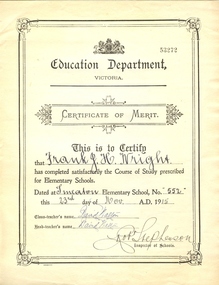
Certificate, Education Department Victoria, Education Department Elementary Certificate made out to Frank Wright at Smeaton State School No 53272, 23/11/1915 (exact)
... building accommodated 122 children. Among notable ex-pupils are Major-General Bridgeford, Frank Wright ( Musical Director of the London County Council), Alex Wright, (AKA singer Andre Navarre), and Les Brooks. ...building accommodated 122 children. Among notable ex-pupils are Major-General Bridgeford, Frank Wright ( Musical Director of the London County Council), Alex Wright, (AKA singer Andre Navarre), and Les Brooks. ...In 1860 Smeaton residents appealed for funds to establish a school. Patrick Curtain, and his co-workers raised more than £150 plus a land grant (Allot A, Sect 2, Township of Smeaton). Head Teacher John Forbes, with assistant Zillah North, opened a timber school building which measured 36ftx18ft (11.0x5.5m) on 1 September 1861 with 44 children. Rising enrolment to 65 in 1868 made building alterations necessary. During 1870-1 a residence of four rooms was supplied and in October 1882 a 20ftx18ft (6.1x5.5m) classroom. In 1907 a new brick building accommodated 122 children. Among notable ex-pupils are Major-General Bridgeford, Frank Wright ( Musical Director of the London County Council), Alex Wright, (AKA singer Andre Navarre), and Les Brooks. (Visions and Realisations). Frank Wright was a renown resident of Smeaton, where he was born in 1901. He lived at Laura Villa, and attended Smeaton State School. His father William was a gold miner and his mother's name was Sarah. He was the youngest of eleven children. Their family won many singing and instrumental awards. Frank was tutored by Percy Code and was awarded a gold medal for the highest marks in the ALCM examinations in the British Colonies at the age of seventeen years. He became the Australian Open Cornet Champion by the age of eighteen. A year later, Frank conducted the City of Ballarat Band, and later the Ballarat Soldiers’ Memorial Band. He formed the Frank Wright Frisco Band and Frank Wright and his Coliseum Orchestra. These bands won many South Street awards, and Frank as conductor won many awards in the Australian Band Championship contest. In 1933 Frank Wright sailed to England to conduct the famous St Hilda’s Band and was appointed in 1934 as the Musical Director of the London County Council (the GLC or Greater London Council), where he organized many amazing concerts in most of the 150 parks, in and around the London district. He was also responsible for some of London’s major concerts at Kenwood, the Crystal Palace and Holland Park. He was made Professor of Brass and Military Band Scoring and Conducting and was a Fellow of the Guildhall School of Music and Drama. Frank was often invited to adjudicate Brass Band Championships around Europe, in Australia, including South Street and in New Zealand. Frank was awarded an M.B.E. in 1967 and he died in November 1970. The Frank Wright Medal at the Royal South Street competition is awarded to an individual recognized as making an outstanding contribution to brass music in Australia.Cream printed certificate with hand written additions.Handwritten additions in caps: This is to Certify that FRANK J.H. WRIGHT has completed satisfactorily the Course of Study prescribed for Elementary Schools. Dated at SMEATON Elementary School, No. 552 this 23RD day of NOV. A.D. 1915 Class-teacher's name: DAVID WALTON Head-teacher's name: DAVID WALTON Robt STEPHENSON Inspector of Schools frank wright, smeaton state school, victorian education department elementary certificate -
 Federation University Historical Collection
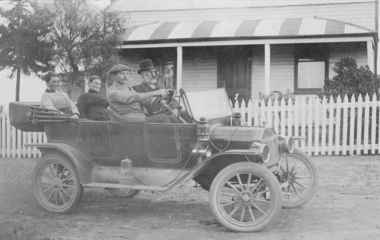
Photograph, Harold Hauson, Members of the Wright family outside "Laura Villa" Smeaton, (estimated); early 1930's
... building accommodated 122 children. Among notable ex-pupils are Major-General Bridgeford, Frank Wright ( Musical Director of the London County Council), Alex Wright, (AKA singer Andre Navarre), and Les Brooks. ...building accommodated 122 children. Among notable ex-pupils are Major-General Bridgeford, Frank Wright ( Musical Director of the London County Council), Alex Wright, (AKA singer Andre Navarre), and Les Brooks. ...In 1860 Smeaton residents appealed for funds to establish a school. Patrick Curtain, and his co-workers raised more than £150 plus a land grant (Allot A, Sect 2, Township of Smeaton). Head Teacher John Forbes, with assistant Zillah North, opened a timber school building which measured 36ftx18ft (11.0x5.5m) on 1 September 1861 with 44 children. Rising enrolment to 65 in 1868 made building alterations necessary. During 1870-1 a residence of four rooms was supplied and in October 1882 a 20ftx18ft (6.1x5.5m) classroom. In 1907 a new brick building accommodated 122 children. Among notable ex-pupils are Major-General Bridgeford, Frank Wright ( Musical Director of the London County Council), Alex Wright, (AKA singer Andre Navarre), and Les Brooks. (Visions and Realisations) Sepia photograph showing 4 people sitting in a 1914 Ford Model T Touring Car outside The Wright Familys' "Laura Villa" property at Smeaton. Left hand back seat - Mrs W. Wright, Mrs Kelso Front seat: F.L.Redman (driving), W. WrightTaken at "Laura Villa" Smeaton by Harold Hausenfrank wright, laura villa, smeaton, car, 1914 ford model t touring car -
 Federation University Historical Collection
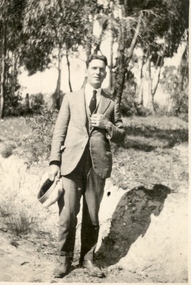
Photograph - Photo, Bill Fargher, Frank Wright at Daylesford, 1/1/1924 (exact); 1924
... building accommodated 122 children. Among notable ex-pupils are Major-General Bridgeford, Frank Wright ( Musical Director of the London County Council), Alex Wright, (AKA singer Andre Navarre), and Les Brooks. ...building accommodated 122 children. Among notable ex-pupils are Major-General Bridgeford, Frank Wright ( Musical Director of the London County Council), Alex Wright, (AKA singer Andre Navarre), and Les Brooks. ...In 1860 Smeaton residents appealed for funds to establish a school. Patrick Curtain, and his co-workers raised more than £150 plus a land grant (Allot A, Sect 2, Township of Smeaton). Head Teacher John Forbes, with assistant Zillah North, opened a timber school building which measured 36ftx18ft (11.0x5.5m) on 1 September 1861 with 44 children. Rising enrolment to 65 in 1868 made building alterations necessary. During 1870-1 a residence of four rooms was supplied and in October 1882 a 20ftx18ft (6.1x5.5m) classroom. In 1907 a new brick building accommodated 122 children. Among notable ex-pupils are Major-General Bridgeford, Frank Wright ( Musical Director of the London County Council), Alex Wright, (AKA singer Andre Navarre), and Les Brooks. (Visions and Realisations) Frank Wright, aged 22, in a bush location at Daylesford - possibly at a mineral water spring.frank wright, daylesford -
 Ballarat Tramway Museum
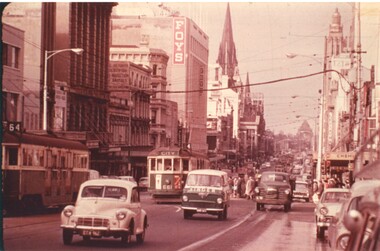
Photograph - Colour Print/s, Ron Scholten, early 1960's
... Has many vehicles in the street, including a Morris Minor and a van with word "Singer" across the front. In the photo is the Foys building, and a sign for the "Victorian Society for Protection of Animals". ...Has many vehicles in the street, including a Morris Minor and a van with word "Singer" across the front. In the photo is the Foys building, and a sign for the "Victorian Society for Protection of Animals". ...Colour print of Swanston St Melbourne looking south with W3 661 northbound, route 4, showing "City" as a destination at the intersection of Lonsdale St Another W3 is southbound. Has many vehicles in the street, including a Morris Minor and a van with word "Singer" across the front. In the photo is the Foys building, and a sign for the "Victorian Society for Protection of Animals". Photographer - possibly Ron Scholten. Printed on Kodak paper - from a slide.trams, tramways, mmtb, swanston st, tram 661 -
 Vision Australia
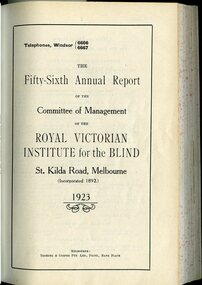
Administrative record - Text, Royal Victorian Institute for the Blind annual report 1923, 1923
... Articles in this annual report include: re-opening of Ormond Hall by the Governor of Victoria with the first concert given by the orchestra and singers from the RVIB, need to add another storey to part of the existing workshop building to accommodate demand, three students have won scholarships, donation by E.M. ...Articles in this annual report include: re-opening of Ormond Hall by the Governor of Victoria with the first concert given by the orchestra and singers from the RVIB, need to add another storey to part of the existing workshop building to accommodate demand, three students have won scholarships, donation by E.M. ...Articles in this annual report include: re-opening of Ormond Hall by the Governor of Victoria with the first concert given by the orchestra and singers from the RVIB, need to add another storey to part of the existing workshop building to accommodate demand, three students have won scholarships, donation by E.M. Fairhall of 400 pounds to the Education Department with directions that the interest must be expended on the higher education of a blind student, mention of the policy to admit pupils at the age of 4 if they are unable to be cared for by their families, Donald Forbes is the Dux of the year and will be appointed as a teacher's assistant whilst he continues his education, a jazz orchestra was formed this year and has been in constant demand, more pupils are learning Piano Tuning under Alex Johnston, the introduction of machine knitting as an industry, assistance provided to people who have left the Institute and require financial or material aid to assist them in setting up or establishing their business, the passing of K. Crohan, Mrs W. Morrall and C. Whittaker and retirement of Joseph Morris at the age of 81.1 volume bound with illustrations.royal victorian institute for the blind, annual report, ormond hall, william rule, fred sutcliffe, francis harmsworth, walter miller, norman dennis, carl woess, e.m. fairhall, donald forbes, kate crohan, charles whittaker, joseph morris -
 Vision Australia
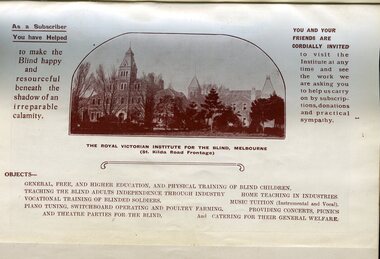
Administrative record - Text, Royal Victorian Institute for the Blind annual report 1922, 1922
... singers (W. Rule and F. Sutcliffe) won the Duet section of the A.N.A. Competitions, the Institute's orchestra of 20 artists is growing in popularity under the conductor of Mr Palmer, and the loss of Basket Instructor Carl Woess as well as workers F. Harmsworth, W. Miller and N. Dennis. Royal Victorian Institute for the Blind Annual Report Ormond Hall William Rule Fred Sutcliffe Francis Harmsworth Walter Miller Norman Dennis Carl Woess Buildings ...Articles in this annual report include: three modern workshops have been built, with schoolrooms, dormitories, dining-hall, music and lounge rooms renovated, the Concert Hall will no longer be used as storage for material and goods and the old sloping floor will be replaced with a flat floor with springs to encourage dancing, with cloak rooms and conveniences also being added, record number of admissions with 16 children being admitted, Norman Rees passed his Scholarship exam and will join two peers at Gardiner Elementary School for higher education, lessons in domestic economy are now being added for girls and technical trades for boys to better prepare them for life, swimming classes are also now established for pupils, the children were treated to a special outing to Queenscliffe, two singers (W. Rule and F. Sutcliffe) won the Duet section of the A.N.A. Competitions, the Institute's orchestra of 20 artists is growing in popularity under the conductor of Mr Palmer, and the loss of Basket Instructor Carl Woess as well as workers F. Harmsworth, W. Miller and N. Dennis.1 volume bound with illustrations.royal victorian institute for the blind, annual report, ormond hall, william rule, fred sutcliffe, francis harmsworth, walter miller, norman dennis, carl woess, buildings -
 Vision Australia
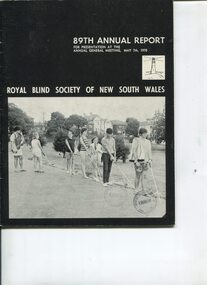
Administrative record - Text, 89th Annual Report Royal Blind Society of N.S.W. (1970), 1970
... Benning, presentation of a silver cigarette box to Roy Kippax for his 50th year of service, aim to move out of old William Street building by the second half of 1971, Mark IV Talking Book machine began to be circulated, first library advisory committee on book selection was convened, images of the Alexis Albert, Helen Keller and Lighthouse hostels, formation of Nepean, Lighthouse Younger Set, Ryde and Hornsby auxiliaries, the use of a swear jar by the 'Blind Club' of the Queensland Hotel (cnr Erskine & Kent St) to top up the RBS donation box, the various blind bowling and cricket clubs, the use of the Main Hall by the Boomerang Singers, and various volunteers who assist departments with their work....Benning, presentation of a silver cigarette box to Roy Kippax for his 50th year of service, aim to move out of old William Street building by the second half of 1971, Mark IV Talking Book machine began to be circulated, first library advisory committee on book selection was convened, images of the Alexis Albert, Helen Keller and Lighthouse hostels, formation of Nepean, Lighthouse Younger Set, Ryde and Hornsby auxiliaries, the use of a swear jar by the 'Blind Club' of the Queensland Hotel (cnr Erskine & Kent St) to top up the RBS donation box, the various blind bowling and cricket clubs, the use of the Main Hall by the Boomerang Singers, and various volunteers who assist departments with their work. ...Articles in the annual report include: the awarding of an O.B.E. to Vice President H.F. Benning, presentation of a silver cigarette box to Roy Kippax for his 50th year of service, aim to move out of old William Street building by the second half of 1971, Mark IV Talking Book machine began to be circulated, first library advisory committee on book selection was convened, images of the Alexis Albert, Helen Keller and Lighthouse hostels, formation of Nepean, Lighthouse Younger Set, Ryde and Hornsby auxiliaries, the use of a swear jar by the 'Blind Club' of the Queensland Hotel (cnr Erskine & Kent St) to top up the RBS donation box, the various blind bowling and cricket clubs, the use of the Main Hall by the Boomerang Singers, and various volunteers who assist departments with their work.1 volume of text and imagesroyal blind society of new south wales, alexis albert, lady albert, sandy robertson kindergarten, australian national council of and for the blind, balmain blind bowling combination, william street blind women's bowling club, helen keller hostel, braille writers association, h.f. benning, r.w. alkin, roy kippax, victor maxwell kindergarten, w.a. davis, k. bruce, lighthouse hostel, alexis albert hostel, r wellsmore, h.c. standen, ray watson, paul cullen, ian burnet, nola dekyvere, alan wotherspoon, ron frazer, annual report, cricket -
 Vision Australia
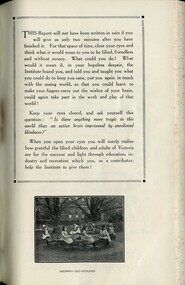
Administrative record - Text, Royal Victorian Institute for the Blind annual report 1925, 1925
... singers, the commitment to obtain Wireless sets remains however no particular set has been decided upon yet, the passing of W. Cole and R.P. Nightingale, and the cricket final was won by the Braille team. Royal Victorian Institute for the Blind Annual Report George Findlay Ada Bosworth Donald Forbes Norman Rees Ormond Hall Walter Cole Buildings Cricket 1 volume bound with illustrations. ...Articles in this annual report include: the need for additional workshop space to accommodate the growing number of workers, the refurbishment of Ormond Hall has proven successful with it being hired out regularly and the Board of Health requesting the Committee expand the cloak room accommodation due the number of attendees, fancy dancing is now being taught by Miss Ada Bosworth and typewriting by Donald Forbes, a space has now been provided for a school library with Norman Rees as the first librarian, an approach was made to the Federal Treasurer requesting that the pension be available to all workers irrespective of earnings on property or income, the Orchestra and Concert Party are still proving popular, 3LO has broadcasted the first Wireless Concert in Australia by blind musicians and singers, the commitment to obtain Wireless sets remains however no particular set has been decided upon yet, the passing of W. Cole and R.P. Nightingale, and the cricket final was won by the Braille team.1 volume bound with illustrations.royal victorian institute for the blind, annual report, george findlay, ada bosworth, donald forbes, norman rees, ormond hall, walter cole, buildings, cricket -
 Vision Australia
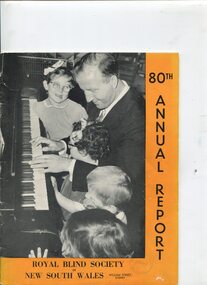
Administrative record - Text, 80th Annual Report Royal Blind Society of N.S.W. (1960), 1960
... Davis Alexis Albert Noel McCaw Buildings Talking books Blind Book Library Kenneth Bruce Frank Clune Dame Mary Gilmore Roy Young Braille Writers Association of New South Wales Transcription T Brockhoff Zita Ainsworth L Farrell A Faulks Percy Cooper M Duncan Dorothy Juleff Margaret Green Victor Maxwell Kindergarten Light House Home Alexis Albert Hostel Helen Keller Hostel Waimea Singers Nellie Sweeney Ken Curtis Cricket Julian Lee Percy Roberts George Herrmann Irene Alexander Maurice Chevalier Nola Dekyvere Betty Hatherley L C Haynes Fundraising L Atkins L A Maurer J Lamond J Wishart Jill Hamer W. ...Articles in the annual report include: a brief history of the organisation on it's 80th anniversary, resignation of Herbert Thompson who had provided over 50 years of voluntary service in the library, Braille teacher and Council member with a plaque commemorating him in the Library, the addition of Reverend Noel McCaw on the Council as Mr Thompson's replacement and A.F. Albert's appointment as Vice President, the unexpected demolition of 'Heathfield; in Woollahra due to it's condition and a rethinking of strategy given the demand for a kindergarten in the western suburbs, intention to rebuild the lower hall in William St to accommodate studios, offices, repair and storage facilities to satisfy the growing demand for tapes, outline of the Blind Book Society and how it became an auxiliary to the Society so that the assets and goodwill of the BBS were transferred to the RBS, support for this action by Frank Clune and other authors, transcription work done by the Braille Writers Association of NSW includes Leaving Certificate exams, knitting patterns, recipes and musical compositions, references to the change in talking book machines and teachers checking transcribers work to ensure mild censorship does not occur, two examples of how the support can change the life of a blind person, the assembling of a giant flower basket (10 x 15 feet) for the Town Hall Float in the Waratah Festival which was filled with 25,000 sweet peas and a bow of 6 foot wide satin - sadly the truck carrying this would not start and the float was not seen, dropping of sales due to plastic goods and imported products, 17 First Prizes and 12 Second Prizes in various handicrafts at the Royal Easter Show, the work of Margaret Green in providing services to blind children across the state, a visit by world-famous blind pianist George Shearing, pictures of the opening of the "Light House" home for Aged Blind Women and the Alexis Albert Hostel for Aged Blind Men, renovations have occurred at the Helen Keller Hostel and drama and singing classes are held as well as the local choir Waimea Singers directed by Nellie Sweeney, cricketer Ken Curtis took a hat trick - the first in Australian blind cricket history - in the third match between NSW and Victoria at Kooyong in December 1960, three musicians (Julian Lee, Percy Roberts and George Herrmann) were in contact with pianist Percy Shearing before his television appearance, drama classes provided by Irene Alexander have been well attended with some students giving dramatic presentations on radio stations, monthly musical concerts continue to be held in the Society's hall, the continued success of the Black and White Ball, the huge success of the 2UW Blind Appeal providing much needed funds, the addition of the Silver Lighthouse to the group of Auxiliaries, the passing of E K Gordon who was a Foundation Member of the Committee as well as roles with the Newcastle branch and Nursery for Blind Babies, the ACT Liaison Group obtained free passes for bus services within the Territory, the 'Glow Worm' sessions ended in its 21st year on 2GB with Goodie Reeve now reading news excerpts and Betty Hatherley's session on 2UW have been replaced by recorded announcements.1 volume of text and imagesroyal blind society of new south wales, annual report, justice maxwell, paul cullen, h.f. benning, herbert thompson, c d darvall, ken bunn, e t herford, roy kippax, k. g hunter-kerr, phyllis bourke, w.a. davis, alexis albert, noel mccaw, buildings, talking books, blind book library, kenneth bruce, frank clune, dame mary gilmore, roy young, braille writers association of new south wales, transcription, t brockhoff, zita ainsworth, l farrell, a faulks, percy cooper, m duncan, dorothy juleff, margaret green, victor maxwell kindergarten, light house home, alexis albert hostel, helen keller hostel, waimea singers, nellie sweeney, ken curtis, cricket, julian lee, percy roberts, george herrmann, irene alexander, maurice chevalier, nola dekyvere, betty hatherley, l c haynes, fundraising, l atkins, l a maurer, j lamond, j wishart, jill hamer, w. cannington, e k gordon, j blair, b macleay, lions club of mayfield, lions club of sydney, lions club of burwood, apex, lions club of bondi, n g wilson, j v brickwood, goodie reeve, 2uw, 2gb -
 City of Melbourne Libraries
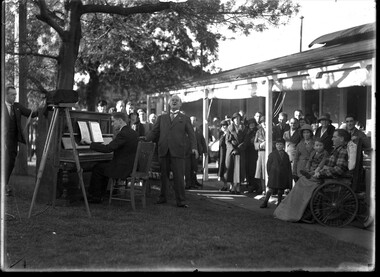
Photograph, Bull, Hugh Jones, 1897-1993, Garden music performance
... Outdoor performance of a male singer taking place on lawn under a large tree in front of a single storey building. ...The audience is under the verandah of the building and includes one man in a wheelchair. The singer is accompanied by a male piano player. ...Outdoor performance of a male singer taking place on lawn under a large tree in front of a single storey building. The audience is under the verandah of the building and includes one man in a wheelchair. The singer is accompanied by a male piano player. The location is unknown.Photographer notations on slide: "B5".entertainment, singers, 1930-1939, pianos, clothing and dress, wheelchairs -
 City of Melbourne Libraries
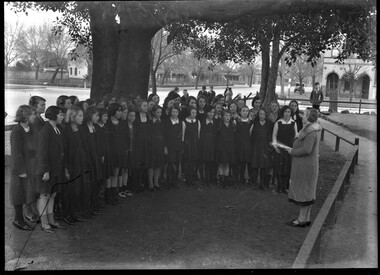
Photograph (item), Bull, Hugh Jones, 1897-1993, Miss Ida Park conducts the North Fitzroy State School Choir
... building was designed by architectural firm Bogle & Banfield Associates and named for the original tenant of the offices, French oil company, Total Oil Products P/L. The Lido Theatre Restaurant was managed by former Tivoli dancer and promoter David Hamilton McIlwraith, presenting dinner and a glamorous cabaret floor show of showgirls, (some topless) to accompany variety acts by local and international actors, singers, comedians and magicians. ...building was designed by architectural firm Bogle & Banfield Associates and named for the original tenant of the offices, French oil company, Total Oil Products P/L. The Lido Theatre Restaurant was managed by former Tivoli dancer and promoter David Hamilton McIlwraith, presenting dinner and a glamorous cabaret floor show of showgirls, (some topless) to accompany variety acts by local and international actors, singers, comedians and magicians. ...The pupils of Falconer Street Central School No.3918 in North Fitzroy rehearse with conductress Miss Ida Park for their performance at the Temperance Hall, Russell Street Melbourne with proceeds going to the Lord Mayor’s Fund. The house on the right of the photograph is Jubilee House, 126 Michael Street North Fitzroy and is extant. Photographer notations on slide: Choir At Fitzroy State School 1933 B5 While this photograph appears not to have been published, a photograph taken from a different angle of the same event was published in The Age 21 July 1933. SCHOOL CHILDREN SING IN THE OPEN AIR. “A choir of children at North Fitzroy practise their songs for a Pantomime, to be given in the Temperance Hall for the Lord Mayor's Fund on Wednesday next. On the extreme left is the conductress of the Choir (Miss Ida Park).” Reference: http://nla.gov.au/nla.news-article204368572 Research by project volunteer, Fiona Collyer: Children of The Falconer Street Central School Choral Society, trained by conductress Miss Ida Park, along with dance and gymnastics pupils of Misses Dorothy Gibb and Inez Ellis, performed in the “Cinderella” pantomime at the Temperance Hall in Russell Street, Melbourne on 26 July, 1933. The proceeds went to the Lord Mayor’s Fund. Conductress Miss Ida Park (1904- 1952) lived in the North Fitzroy and Clifton Hill area all her life. She was immersed in the music world of Melbourne and was a member of the Musical Society of Victoria. Ida graduated from Melbourne University Conservatorium with a Bachelor of Music degree in 1929 before departing for London where she studied piano and organ at the Royal Academy of Music. Ida returned to Melbourne in 1931, and billed as “The Gifted Young Australian Pianist”, held pianoforte recitals of classical music at Assembly Hall, Collins Street. She also played the organ for services at St Paul’s Independent Church in Delbridge Street, North Fitzroy and later St Luke’s, North Fitzroy. Ida conducted the children of the Falconer Street Central School Choral Society as they competed in the State School Choral Championships and the 85 children of the Fitzroy City Centenary Choir who sang at Melbourne’s Centenary celebrations of 1934/35. In 1945, Ida married Charles Hazeldine, a tenor and returned digger who had served in two world wars. The pair performed together in many concerts over the years. Tragically, both Ida and Charles were badly injured when struck by a car while crossing Queens Parade Clifton Hill in June 1952, with Ida dying from head injuries at St Vincent’s Hospital soon after. She was 48 years old. Charles wrote on Ida’s death notice - “Called home.” The choir were pupils of Falconer Street Central School No. 3918 in North Fitzroy which was built in 1915 to provide upper primary education for grades 5 to 8 for the area. In 1957 it became Fitzroy High School. In 1992, the Kennett Government swept to power, embarking on a program of fiscal austerity and privatisation of government services. 390 government schools were closed, with the land proposed to be sold to developers. 7000 teachers were sacked: 10% of Victoria’s public school teachers. Auxiliary school staff also lost their jobs. Amongst the first to close was Fitzroy High School. Fearful that the land would be sold, hundreds of students, parents, teachers and local residents occupied the building around-the-clock in four hour shifts and overnight for 14 months, sleeping on gym mats in the principal’s office and administrators’ wing. The blockade was lifted when a arrangement was reached to allow Kangan Batman TAFE to use the school from 1993 until 1998. With the election of the Bracks Government in 1999, and construction of new buildings, Fitzroy High School was reopened in 2004 after a 12 year battle. Temperance Hall, at 172 Russell Street, where the children performed “Cinderella”, was built in 1872 by the Melbourne Total Abstinence Society as a venue for lectures, meetings and alcohol-free community concerts and events. From 1934, Temperance Hall was fitted out as a cinema and renamed the Imperial Theatre, showing popular Hollywood films, before closing in 1939 for renovations and reopening as the Savoy Theatre, Melbourne’s first “Continental” talkies cinema. At this time, Australian cinema programming was dominated by American and British films. The lessees, Continental Film Art Theatre began negotiating for theatre properties in Melbourne, Sydney, Adelaide, Brisbane, Perth and Auckland to screen foreign language films, hoping to present the finest productions from France, Germany, Holland and Italy. At the cost of £6000, the theatre was fitted with the latest Mirrophonic sound and projection system and enlarged to seat 800 patrons with luxurious, ultra modern fittings and furnishings in a colour palette of rust and beige. Instead of usherettes, General Manager Peter Dawson, hoping to bring a sophisticated European atmosphere to the theatre, employed attractive, multilingual “Continental hostesses” to assist guests (not patrons) and answer queries relating to the films. Collectively the hostesses spoke English, French, Dutch, German, Russian and Italian. The Age 20 May 1939- “Atmosphere is a very important part of the theatre's scheme. Ushers in the ordinary sense will not be employed; hostesses will look upon patrons as guests. They will be dressed in full evening dress, and the only indication that they are not guests is the little medallion pinned to their evening dress, on which their names are inscribed.” The hostesses were dressed in evening gowns of olive-green velvet, the full skirts embroidered with gold loops, wine velvet bolero jackets and long white kid gloves with silvery tiaras in their hair. For guests worried that they may not understand the plot, the management assured patrons that- “By means of superimposed English translations on the bottom of the screen, the dialogue is perfectly understandable and the whole witty story can be followed with ease.” The Gala opening of the Savoy Theatre, on 31 May 1939 was attended by a “who’s who” of Melbourne Society, the women wearing beautiful gowns, headdresses and furs. Amongst the guests were former premier Sir Stanley Argyle and Lady Argyle, former Lord Mayor Sir Harold Gengoult-Smith and his wife Cynthia, Field Marshall Thomas Blamey and Lady Blamey and Miss Jessie Brookes. The Vice Consul for France, Monsieur Frank Puaux and his wife attended, Madame Puaux dressed in a black satin gown and a musquash fur cape. She was presented with a beautiful bouquet of scarlet carnations and lily of the valley tied with the tricolour of France. In his speech Monsieur Puaux stated that “from the cultural, linguistic and artistic points of view it was excellent that the Australian public should have an opportunity to see foreign film in the original language.” “Letty” writing in Table Talk magazine described the atmosphere of “Continental” gaiety that had permeated Melbourne - “The Letters of Letty”, Table Talk 8 June 1939 “The “foreign influence” is definitely obtruding itself into the even tenor of Melbourne life these days…. but in the pleasantest manner possible! Included in the great number of Continental people who have recently made their homes here, we have stars of the Russian ballet settling in our midst…. and now… we have been presented with our own Continental picture theatre in the attractive shape of The Savoy, which opened its doors on Wednesday night for the exclusive release of foreign films. One could hardly recognise the old Temperance Hall in its adaptation to the smart, comfortable and thoroughly-intriguing Savoy Theatre. Where once this rather draughty old building stood in Russell Street there now greets us an unmistakable “Continental” edifice, living up to its exterior by sustaining within its walls its overseas’ atmosphere. Indeed, one feels as though one has crossed the threshold into a European city, stepping out of the unmistakably Australian street that is Russell into The Savoy lounge to be greeted by polite “messieurs” from the attractive, Continental-looking usherettes and to gaze upon a film as delightfully French in story and presentation as “La Kermesse Heroique.” But successful though “La Kermesse Heroique” proved on its initial presentation inside the theatre, the debut was no more triumphal than that made by the winning and pretty little French lass who had charge of the booking office outside in the foyer. With her attractive accent and Continental flair for making one “feel at home” she was undoubtedly one of the hits of the night-especially with the susceptible males, who spent very much longer in the lounge than is customary, racking their brains for excuses for making conversation with the attractive Parisienne! Those French girls certainly have a way with them!” The opening film, the 1935 French comedy “La Kermesse Heroique”, (The Heroic Sex) starring Francoise Rosay and Jean Murat (film now called “Carnival in Flanders”) was the winner of the Grand Prix du Cinema Francais as the finest picture of 1936 and described in the advertisement as “The Gay French Comedy of Laughter and Romance” The film is set during the 17th century Spanish occupation of Flanders in the Flemish town of Boom at the time of their annual festival. Hearing news of a pending visit to Boom by the commander, the Duke of Olivares and his army, and fearing rape and pillage, the boorish burgomaster feigns his own death, hoping the Spaniards will bypass the grieving town out of respect. The army arrives and the cowardly men of the town flee. The womenfolk decide on a different approach. Lead by the burgomaster’s beautiful wife Cornelia, they set out to to preserve the peace with grace and hospitality only to find the Spaniards attractive and virile, unlike their own husbands. The Sun newspaper described the film as “Mellow as a Stilton cheese, and as ripely suited to adult taste.” Preceding “La Kermesse Heroique” was a Gaumont British newsreel of King George VI and Queen Elizabeth departing for a tour of Canada and the Soviet documentary “Nine Months on a Drifting Ice Floe” During the war “Continental” films became difficult to source, so the Savoy screened Hollywood movies and held fund raisers for the war effort. After World War Two, the Savoy continued to screen “Continental” films, catering to post-war immigrants from Europe and bohemian Melburnians. In 1953, the Savoy had a wildly popular season with queues winding around the block to see Swedish summer romance “One Summer of Happiness” (Hon dansade en sommar) with its nude swimming scenes. The Chief Commonwealth Censor declined to cut the film on the grounds that although it displayed nudity, it was genuinely artistic. According to Wikipedia, film director Fred Schepisi was first exposed to European films such as “Bicycle Thieves”, “Rocco and His Brothers” and “The Wages of Fear” at the Savoy as a teenager, leading to his long career in filmmaking. In 1955, in response to the massive rise in car ownership, the Melbourne City Council recommended that parking stations be built on every block. The Savoy Theatre and adjacent buildings, which included the Golden Fleece Hotel were demolished in 1963 and replaced with Total House, a Brutalist commercial building consisting of a seven storey car park crowned by a four storey office block, shops at street level, and a basement theatre which housed the Lido Theatre Restaurant-Cabaret from 1965. The building was designed by architectural firm Bogle & Banfield Associates and named for the original tenant of the offices, French oil company, Total Oil Products P/L. The Lido Theatre Restaurant was managed by former Tivoli dancer and promoter David Hamilton McIlwraith, presenting dinner and a glamorous cabaret floor show of showgirls, (some topless) to accompany variety acts by local and international actors, singers, comedians and magicians. The interior of the Lido was opulently decorated in deep, lush green with old world gold trim and chandeliers. Handily, patrons could enter and leave via an elevator, straight from the building’s own car park! A four course gourmet dinner with show and dancing cost $8.00 in 1968. The Lido advertised in 1966 that “Every visitor to Melbourne soon discovers the brightest entertainment spot in the Southern Hemisphere with its million dollar decor, dining delights and spectacular stage productions.” Australian Jewish News - 21 April 1967 - “Superb decor and atmosphere, cuisine and service have been readily recognised as the contributing factors to the excellence of stage presentations, staging, costumes, decor and, of course, the actual choice of artists.” The bedazzling ensemble of 40 high-kicking, feathered and sequinned showgirls were advertised as the “Fabulous Lido girls and the controversial Baretop Lido Goddesses” who were described as “Statuesque Beauty as Nature intended” and “…a host of glamorous gals whose favourite shade is flesh pink.” Some of the acts who performed at the Lido were- -Broken Hill’s own - opera singer June Bronhill -1967. -Versatile singer Lovelace Watkins known as “Black Sinatra - 1967. -“Queen of the five-fingered boogie", honky-tonk and rollicking rag-time pianist, Winifred Atwell - 1967. -New Zealand pop duo, Bill and Boyd -1968. -American actress and soprano Kathryn Grayson -1968. -Denise Drysdale in “Say It With Music” -1968. -“Catwoman” Eartha Kitt -1969. -Internationally recognised female impersonator, Sydneysider Tracey Lee, (Maxwell Richie) billed as "controversial impressionist and singing personality from the famous Carousel Nightspot in Paris". -Frances Faye, American comedienne and show-tune singer and pianist-1969. -“Cry Guy” histrionic singer Johnnie Ray -1970. -Risqué revue “Oh Calcutta!” with some segments and the “four letter” words removed-1970. In 1970, under new management, the Lido was renovated with claret and gold wallpaper, midnight blue ceiling and a computerised fountain with fairy lights and relaunched by “The Tigress from Tiger Bay”, Shirley Bassey. The relaunch was short lived however, as later that year the venue became El Toro Espana, a Spanish restaurant and nightclub offering a four course meal for $4.50 while you watched the floorshow. The venue then briefly became the Red Garter Music Hall Theatre from 1972, then in 1974 the site became the 600 seat Total Theatre comprising of a cinema with a stage for live acts. There were also three bars to choose from - the Crush Bar, the Bleachers and the Snake Pit. Total Theatre had the unusual concept of a live music act, or plays, musicals and magicians followed by a film. In 1975 soprano Suzanne Steele featured, followed by the film “The Voyage” starring Sophia Loren and Richard Burton. In 1975, the Total held a rock film festival showing a Jimi Hendrix documentary, “Monterey Pop Festival”, “Pink Floyd in Pompeii” and more. In 1976, 17 year old Chrissy Amphlett, later of rock band Divinyls, played the role of Linda Lips for nine months in the Australian stage production of R-rated “sexual musical”, “Let My People Come” at the Total Theatre. The Total Theatre closed in 1979 and from 1980 to 2014 the venue became Billboard Nightclub, hosting local and international acts, including INXS, Tina Turner and John Farnham, and in 2009, 18 year old Taylor Swift. The venue is now called 170 Russell and presents hundreds of live local and international acts every year. In 2014, after being under threat of demolition, Total House was listed on the Victorian Heritage Register as “a landmark of post-World War II modernist design and…one of the earliest and best expressions of Brutalist architecture in Victoria”. References: RICHARD CROOKS ARRIVES SCHOOL AGAIN VENUE OF ROYAL VISIT (1939, May 31). The Age (Melbourne, Vic. : 1854 - 1954), p. 17. Retrieved November 21, 2025, from http://nla.gov.au/nla.news-article205629696 AMUSEMENTS. (1933, July 27). The Age (Melbourne, Vic. : 1854 - 1954), p. 12. Retrieved September 19, 2025, from http://nla.gov.au/nla.news-article204378853 https://larzra.wordpress.com/origins/ CONTINENTAL HOSTESSES, (1939, May 31). The Sun News-Pictorial (Melbourne, Vic. : 1922 - 1954; 1956), p. 27. Retrieved November 21, 2025, from http://nla.gov.au/nla.news-article278189387 The Letters of Letty (1939, June 8). Table Talk (Melbourne, Vic. : 1885 - 1939), p. 12. Retrieved October 29, 2025, from http://nla.gov.au/nla.news-article149320966 SAVOY THEATRE (1939, June 1). The Age (Melbourne, Vic. : 1854 - 1954), p. 7. Retrieved September 19, 2025, from http://nla.gov.au/nla.news-article205639035 NEW THEATRE OPENED (1939, June 1). The Argus (Melbourne, Vic. : 1848 - 1957), p. 8. Retrieved September 21, 2025, from http://nla.gov.au/nla.news-article12134234 https://en.wikipedia.org/wiki/Total_House Page [?] TOUCH OF SPAIN (1970, December 18). The Australian Jewish News (Melbourne, Vic. : 1935 - 1999), p. 35. Retrieved September 23, 2025, from http://nla.gov.au/nla.news-article262493757 No title (1935, June 11). The Herald (Melbourne, Vic. : 1861 - 1954), p. 27. Retrieved September 29, 2025, from http://nla.gov.au/nla.news-article244840169 Dine, wine, and watch a stage show (1966, November 16). The Australian Women's Weekly (1933 - 1982), p. 6. Retrieved November 9, 2025, from http://nla.gov.au/nla.news-article44025050 http://jonathanbollen.net/2011/02/26/tracey-lee/ LIDO ‘ART’ (1967, April 21). The Australian Jewish News (Melbourne, Vic. : 1935 - 1999), p. 8. Retrieved November 9, 2025, from http://nla.gov.au/nla.news-article263003136 THE FABULOUS LIDO (1965, October 22). The Australian Jewish News (Melbourne, Vic. : 1935 - 1999), p. 17. Retrieved November 9, 2025, from http://nla.gov.au/nla.news-article262983995 No title (1939, May 31). The Argus (Melbourne, Vic. : 1848 - 1957), p. 6. Retrieved November 21, 2025, from http://nla.gov.au/nla.news-article12134144 #NEW THEATRE OPENED (1939, June 1). The Argus (Melbourne, Vic. : 1848 - 1957), p. 8. Retrieved September 29, 2025, from http://nla.gov.au/nla.news-article12134234 https://en.wikipedia.org/wiki/Tracey_Lee_(female_impersonator) https://citycollection.melbourne.vic.gov.au/35b-40h-image-of-a-model-for-the-total-house-offices-and-car-park-on-russell-street/ https://www.theage.com.au/national/victoria/from-the-archives-1990-s-hundreds-of-school-closures-hit-victoria-20190801-p52cwj.html http://jonathanbollen.net/2011/05/29/the-lido-melbourne/Photographer notations on slide: primary schools, schools, music, education, choirs, fitzroy, cars, theatre restaurants, venues, films -
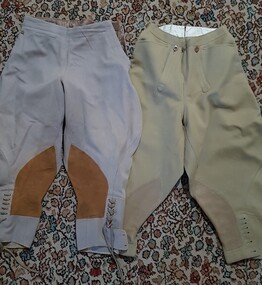 Numurkah & District Historical Society
Woollen jodpurs
... Numurkah & District Historical Society Old Bank Building cnr Melville and Knox Street (118-120 Melville St) Numurkah the-murray Donated to the Numurkah Singers for their productions, then donated to Museum jodpurs, Numurkah Singers, horse-riding 2 pairs of vintage woollen jodpurs Woollen jodpurs ...Donated to the Numurkah Singers for their productions, then donated to Museum 2 pairs of vintage woollen jodpursjodpurs, numurkah singers, horse-riding -
 Numurkah & District Historical Society
Equipment - Sewing machine - Singer (Child's)
... Numurkah & District Historical Society Old Bank Building cnr Melville and Knox Street (118-120 Melville St) Numurkah the-murray sewing machine children sewing hobby see photo Orange coloured plastic cover on a cream plastic children's Singer Sewing Machine Equipment Sewing machine - Singer (Child's) ...Orange coloured plastic cover on a cream plastic children's Singer Sewing Machine see photosewing machine, children, sewing, hobby -
Clunes Museum
Domestic object - SEWING MACHINE, Singer Manufacturing Co
... Clunes Museum 36 Fraser Street enter building through Collins Place Clunes goldfields LOCAL HISTORY DOMESTIC ITEMS SEWING HAND OPERATED SEWING MACHINE, SINGER BRAND, BLACK ENAMELED, ON WOODEN BASE. ...HAND OPERATED SEWING MACHINE, SINGER BRAND, BLACK ENAMELED, ON WOODEN BASE.local history, domestic items, sewing, -
Clunes Museum
Functional object - SEWING MACHINE/MINIATURE
... Clunes Museum 36 Fraser Street enter building through Collins Place Clunes goldfields MINATURE SEWING MASHINE WAS GIVEN TO JOAN SANDWITH BY HER MOTHER, WHO HAD SAVED "EGG MONEY" FOR ABOUT A YEAR TO BUY IT AS A BIRTHDAY PRESENT. local history domestic sewing . SINGER ...MINATURE SEWING MASHINE WAS GIVEN TO JOAN SANDWITH BY HER MOTHER, WHO HAD SAVED "EGG MONEY" FOR ABOUT A YEAR TO BUY IT AS A BIRTHDAY PRESENT.MINIATURE "SINGER" SEWING MACHINE & COTTON REEL AND PACKET OF NEEDLES. GREEN FELT BASE. "TRADE MARK" SHUTTLE WITH NEEDLES AND THREADSINGER STENCILLED ON TOP OF MACHINElocal history, domestic, sewing, .
