
Showing 12 items matching " spiller> family"
-
 Canterbury History Group
Photograph - Women of the Rayner family c1893, c1893
... ... Spiller Family...Canterbury Rayner Family Spiller Family Butler Family Daphne Street Clothing and dress Sepia photograph Photograph Women of the Rayner family c1893 ...Rayner family (8 women) taken whilst living at 8 Daphne Street Canterbury about 1893.Sepia photographcanterbury, rayner family, spiller family, butler family, daphne street, clothing and dress -
Canterbury History Group
Photograph - Assorted committee ribbons belonging to James Butler
... ... Spiller Family...Canterbury Camberwell Convalescent Home Red Cross Enlist or Assist City of Camberwell Butler> James Spiller Family World War 1914-1918 Commonwealth Day Coloured photograph of ribbons of three local committees (1914-1917) of which James Butler was a member of. ...Coloured photograph of ribbons of three local committees (1914-1917) of which James Butler was a member of. Donated by his grand-daughter Marion J. Millett (nee Spiller)canterbury, camberwell convalescent home, red cross, enlist or assist, city of camberwell, butler> james, spiller family, world war 1914-1918, commonwealth day -
Canterbury History Group
Photograph - Souvenir ribbons belonging to James Butler
... ... Spiller> Family...Canterbury ANZAC Fire Brigades Commonwealth Day Butler> James Spiller> Family World War 1914-1918 ANZAC and Empire Day 1916 souvenir ribbons, also an insignia of foreman for the local Fire Brigade (believed to belong to James Butler) donated by his grand-daughter Marion Millett (nee Spiller) Photograph Souvenir ribbons belonging to James Butler ...ANZAC and Empire Day 1916 souvenir ribbons, also an insignia of foreman for the local Fire Brigade (believed to belong to James Butler) donated by his grand-daughter Marion Millett (nee Spiller)canterbury, anzac, fire brigades, commonwealth day, butler> james, spiller> family, world war 1914-1918 -
Canterbury History Group
Photograph - Prizewinning daffodil blooms, c1937
... ... Spiller Family...Canterbury Soldiers Memorial Hall Canterbury Road Horticultural Shows Spiller Family Copy of a photograph from an unknown newspaper showing Marion Spiller admiring the daffodils at a horticultural show in the Soldiers Memorial Hall Canterbury. ...Copy of a photograph from an unknown newspaper showing Marion Spiller admiring the daffodils at a horticultural show in the Soldiers Memorial Hall Canterbury. (about 1937)canterbury, soldiers memorial hall, canterbury road, horticultural shows, spiller family -
Canterbury History Group
Photograph - Balwyn State School no 1026 Grade.4, 1900-2
... ... Spiller Family...Canterbury Balwyn State School Primary Schools Balwyn Road Bennett> Gordon (Major General) Spiller Family Boer War Photo taken about 1900-2 during the Boer War of Grade 4 at Balwyn State School Headmaster was Mr Bennett father of Major General Gordon Bennett. ...Photo taken about 1900-2 during the Boer War of Grade 4 at Balwyn State School Headmaster was Mr Bennett father of Major General Gordon Bennett. Gordon Bennett appears in the photograph in cadet uniform, another student is Ruby Kathleen Butler mother of Marion Millett (nee Spiller)canterbury, balwyn state school, primary schools, balwyn road, bennett> gordon (major general), spiller family, boer war -
Canterbury History Group
Photograph - Rayner Family, 1872
... ... Spiller Family...Canterbury Isle of Wight Rayner Family Millett Family Spiller Family Clothing and dress Sepia photograph Photograph Rayner Family ...three generations of the Rayner family 1872.Sepia photographcanterbury, isle of wight, rayner family, millett family, spiller family, clothing and dress -
Canterbury History Group
Photograph - Selina Jane and William Rayner, 8 March 1886, March 1886
... ... Spiller Family...Canterbury Rayner Family Millett Family Spiller Family Daphne Street Isle of Wight S.S.Garonne Portraits Clothing and dress Sepia photograph Photograph Selina Jane and William Rayner, 8 March 1886 ...Selina Jane and William Rayner taken before they left Shanklin, Isle of Wight on 8 March 1886 on the S.S.Garonne, as free settlers. William Rayner was the owner and builder of 8 Daphne Street Canterbury.Sepia photographcanterbury, rayner family, millett family, spiller family, daphne street, isle of wight, s.s.garonne, portraits, clothing and dress -
 Flagstaff Hill Maritime Museum and Village
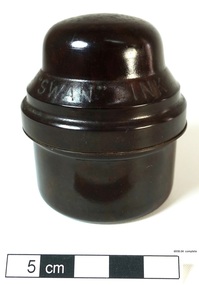
Container - Ink Bottle & Case, 1934 – Mid 1950’s
... family requested his practitioner’s plate, medical instruments and some personal belongings be displayed in the Port Medical Office surgery at Flagstaff Hill Maritime Village, and be called the “W. R. Angus Collection”. The ink bottle case is significant for its association with writing methods commonly used during the colonisation of Australia until the mid-20th century. The protective Bakelite case demonstrates the value placed on caring for the user’s supply of ink and protecting other belongings of the user, enabling writers to easily carry and safely transport their ink without the concern of spilling ...Pens, nib pens and later fountain pens, with suitable inks, were commonly used for writing communications from the 18th century to the mod 20th century. Fountain pens continue to be used and enjoyed. Dip pens with a wide variety of nibs are used for calligraphy writing, a hobby enjoyed by many people. The quality of the pen handle, the nib and the ink all work together to produce fine handwriting that expresses the character and mood of the writer. This Bakelite ink case has been specifically moulded to snugly contain an ink bottle, with just enough room to wrap the bottle with a padding or card or blotting paper. The screw top lid fits the case well and this container would be a good way to travel with ink because any spillage would be kept within the waterproof case. The Bakelite material is lightweight and strong. Ink bottle cases, or travelling cases, have been made as an accessory for nib pen writers. The first patent for a “pocket-case for bottles”, a wooden case, was applied for in the US in 1891. Other materials such as steel, pewter and aluminum as well as Bakelite have also been used. The British Museum has an elaborately decorated bronze ink pot holder that is inlaid with turquoise. Today ink bottle cases are even available in fabric with loops to attach to a belt. Bakelite, the material used for this ink bottle case, is made from synthetic materials and is an early form of plastic, developed in 1907 and used extensively until the 1940’s. It is still in used today for specific applications but has been largely replaced by more modern forms of plastics. This ink bottle case carries the imprint of Mabie, Todd & Co. (Aust.) Pty. Ltd. This form of company name was used from 1938 to the mid 1950’s. The Swan ink bottle’s information says it was made by Mabie, Todd & Co. Ltd., London and Sydney, so dates the ink bottle from about 1908 until 1934. (Australian newspapers display advertisements dated 1908 until 1934 for Sydney wholesalers and agents for Mabie, Todd & Co. Ltd.) ABOUT PERSONAL FOUNTAIN PENS (FOUNT PENS) A 1917 newspaper advertisement recommends that the owner of a “Swan” doesn’t lend it to anyone else to use due to its qualities of it personalised to the owner. It reads “Don’t lend your “Swan” fountpen, recommend it, but don’t let other people use it. You see, a good pen doesn’t wear, but its “tamper” (or spring) works into the writer’s pressure and manner of holding. Another person with a dashing style of writing may strain it do that it will no longer feel just like your own.” This personalisation of nib pens may be the reason that legal documents in the past being acceptable only if they were signed using a ‘wet ink’ pen. Forgeries of signatures could be easily detected as the nib takes on the character of the pen’s owner. A ballpoint pen was not acceptable. This is a strong contrast to modern times when a digital signature is widely accepted. ABOUT MABIE TODD Pty Ltd. The American company Mabie Todd began by making pencil cases in New York in the 1860’s. The Bard Brothers, makers of Gold nibs, joined Mabie Todd and the company was established in the 1870’s as Mabie Todd and Bard. In 1878 the company filed a patent for the design of a fountain pen and in 1884 the first Swan fountain pen was released. In 1884 a Mabie Todd and Bard office and showroom was established in London. In 1906 the company’s name changed to Mabie Todd & Co, New York. The UK offices also used this new name and in 1907 the UK began producing their own Swan pens. Manufacturing was going so well in England that New York sold their rights to European and Colonial business to the new Mabie Todd & Company Ltd of England. By the end of the 1930’s all components for the pens were being made in the UK; the pens in the London factory, the gold nibs in Birmingham and the ink in Liverpool. Newspaper articles from 1934 stated that Mabie Todd were large buyers of Tasmanian iridium, which had been welded with gold and used since 1834 for the tips of nib and fountain pens. Fountain pen points were the largest market buyers for Tasmanian iridium, which was classed as “the best in the world”. Production growth continued up until WWII times, when the headquarters and main factory were destroyed. Mabie Todd & Company Ltd of England rebuilt out of the inner city and by 1946 pen production began again. The market for nib and fountain pens was diminishing by this time, with people beginning to use the new ballpoint ‘Biro’ pens. The Mabie Todd bought shares in Biro Pens and in 1952 became Biro Swan. They went on to make more ballpoint pens than any other manufacturer in Britain. The ink refills that Biro-Swan produced came in five different viscosity or thickness xhoices, depending on the season and location of where the pen would be used . Along with the ballpoint pens, Biro-Swan also introduced a range of Calligraph pens to attract those following the new trend for italic writing. In 1948 Mr. T. Burke, a director for Mabie Todd & Co. (Aust.) Pty Ltd., announced that there would be a £40,000 factory built in Sydney in 1949 for the manufacture of ink. The plant for the factory would be imported from overseas. Sadly the company struggled against competition and in 1956 Mabie Todd closed business and no more Swan pens were produced. The ink bottle and container was donated to Flagstaff Hill Maritime Village by the family of Doctor William Roy Angus, Surgeon and Oculist. It is part of the “W.R. Angus Collection” includes historical medical equipment, surgical instruments and material once belonging to Dr Edward Ryan and Dr Thomas Francis Ryan, (both of Nhill, Victoria) as well as Dr Angus’ own belongings. The Collection’s history spans the medical practices of the two Doctors Ryan, from 1885-1926 plus that of Dr Angus, up until 1969. ABOUT THE “W.R.ANGUS COLLECTION” Doctor William Roy Angus M.B., B.S., Adel., 1923, F.R.C.S. Edin.,1928 (also known as Dr Roy Angus) was born in Murrumbeena, Victoria in 1901 and lived until 1970. He qualified as a doctor in 1923 at University of Adelaide, was Resident Medical Officer at the Royal Adelaide Hospital in 1924 and for a period was house surgeon to Sir (then Mr.) Henry Simpson Newland. Dr Angus was briefly an Assistant to Dr Riddell of Kapunda, then commenced private practice at Curramulka, Yorke Peninsula, SA, where he was physician, surgeon and chemist. In 1926, he was appointed as new Medical Assistant to Dr Thomas Francis Ryan (T.F. Ryan, or Tom), in Nhill, Victoria, where his experiences included radiology and pharmacy. In 1927 he was Acting House Surgeon in Dr Tom Ryan’s absence. Dr Angus had become engaged to Gladys Forsyth and they decided he further his studies overseas in the UK in 1927. He studied at London University College Hospital and at Edinburgh Royal Infirmary and in 1928, was awarded FRCS (Fellow from the Royal College of Surgeons), Edinburgh. He worked his passage back to Australia as a Ship’s Surgeon on the on the Australian Commonwealth Line’s T.S.S. Largs Bay. Dr Angus married Gladys in 1929, in Ballarat. (They went on to have one son (Graham 1932, born in SA) and two daughters (Helen (died 12/07/1996) and Berenice (Berry), both born at Mira, Nhill ) According to Berry, her mother Gladys made a lot of their clothes. She was very talented and did some lovely embroidery including lingerie for her trousseau and beautifully handmade baby clothes. Dr Angus was a ‘flying doctor’ for the A.I.M. (Australian Inland Ministry) Aerial Medical Service in 1928 . Its first station was in the remote town of Oodnadatta, where Dr Angus was stationed. He was locum tenens there on North-South Railway at 21 Mile Camp. He took up this ‘flying doctor’ position in response to a call from Dr John Flynn; the organisation was later known as the Flying Doctor Service, then the Royal Flying Doctor Service. A lot of his work during this time involved dental surgery also. Between 1928-1932 he was surgeon at the Curramulka Hospital, Yorke Peninsula, South Australia. In 1933 Dr Angus returned to Nhill and purchased a share of the Nelson Street practice and Mira hospital (a 2 bed ward at the Nelson Street Practice) from Dr Les Middleton one of the Middleton Brothers, the current owners of what previously once Dr Tom Ryan’s practice. Dr Tom and his brother had worked as surgeons included eye surgery. Dr Tom Ryan performed many of his operations in the Mira private hospital on his premises. He had been House Surgeon at the Nhill Hospital 1902-1926. Dr Tom Ryan had one of the only two pieces of radiology equipment in Victoria during his practicing years – The Royal Melbourne Hospital had the other one. Over the years Dr Tom Ryan had gradually set up what was effectively a training school for country general-practitioner-surgeons. Each patient was carefully examined, including using the X-ray machine, and any surgery was discussed and planned with Dr Ryan’s assistants several days in advance. Dr Angus gained experience in using the X-ray machine there during his time as assistant to Dr Ryan. When Dr Angus bought into the Nelson Street premises in Nhill he was also appointed as the Nhill Hospital’s Honorary House Surgeon 1933-1938. His practitioner’s plate from his Nhill surgery is now mounted on the doorway to the Port Medical Office at Flagstaff Hill Maritime Village, Warrnambool. When Dr Angus took up practice in the Dr Edward and Dr Tom Ryan’s old premises he obtained their extensive collection of historical medical equipment and materials spanning 1884-1926. A large part of this collection is now on display at the Port Medical Office at Flagstaff Hill Maritime Village in Warrnambool. In 1939 Dr Angus and his family moved to Warrnambool where he purchased “Birchwood,” the 1852 home and medical practice of Dr John Hunter Henderson, at 214 Koroit Street. (This property was sold in1965 to the State Government and is now the site of the Warrnambool Police Station. and an ALDI sore is on the land that was once their tennis court). The Angus family was able to afford gardeners, cooks and maids; their home was a popular place for visiting dignitaries to stay whilst visiting Warrnambool. Dr Angus had his own silk worm farm at home in a Mulberry tree. His young daughter used his centrifuge for spinning the silk. Dr Angus was appointed on a part-time basis as Port Medical Officer (Health Officer) in Warrnambool and held this position until the 1940’s when the government no longer required the service of a Port Medical Officer in Warrnambool; he was thus Warrnambool’s last serving Port Medical Officer. (Masters of immigrant ships arriving in port reported incidents of diseases, illness and death and the Port Medical Officer made a decision on whether the ship required Quarantine and for how long, in this way preventing contagious illness from spreading from new immigrants to the residents already in the colony.) Dr Angus was a member of the Australian Medical Association, for 35 years and surgeon at the Warrnambool Base Hospital 1939-1942, He served with the Australian Department of Defence as a Surgeon Captain during WWII 1942-45, in Ballarat, Victoria, and in Bonegilla, N.S.W., completing his service just before the end of the war due to suffering from a heart attack. During his convalescence he carved an intricate and ‘most artistic’ chess set from the material that dentures were made from. He then studied ophthalmology at the Royal Melbourne Eye and Ear Hospital and created cosmetically superior artificial eyes by pioneering using the intrascleral cartilage. Angus received accolades from the Ophthalmological Society of Australasia for this work. He returned to Warrnambool to commence practice as an ophthalmologist, pioneering in artificial eye improvements. He was Honorary Consultant Ophthalmologist to Warrnambool Base Hospital for 31 years. He made monthly visits to Portland as a visiting surgeon, to perform eye surgery. He represented the Victorian South-West subdivision of the Australian Medical Association as its secretary between 1949 and 1956 and as chairman from 1956 to 1958. In 1968 Dr Angus was elected member of Spain’s Barraquer Institute of Barcelona after his research work in Intrasclearal cartilage grafting, becoming one of the few Australian ophthalmologists to receive this honour, and in the following year presented his final paper on Living Intrasclearal Cartilage Implants at the Inaugural Meeting of the Australian College of Ophthalmologists in Melbourne In his personal life Dr Angus was a Presbyterian and treated Sunday as a Sabbath, a day of rest. He would visit 3 or 4 country patients on a Sunday, taking his children along ‘for the ride’ and to visit with him. Sunday evenings he would play the pianola and sing Scottish songs to his family. One of Dr Angus’ patients was Margaret MacKenzie, author of a book on local shipwrecks that she’d seen as an eye witness from the late 1880’s in Peterborough, Victoria. In the early 1950’s Dr Angus, painted a picture of a shipwreck for the cover jacket of Margaret’s book, Shipwrecks and More Shipwrecks. She was blind in later life and her daughter wrote the actual book for her. Dr Angus and his wife Gladys were very involved in Warrnambool’s society with a strong interest in civic affairs. He had an interest in people and the community They were both involved in the creation of Flagstaff Hill, including the layout of the gardens. After his death (28th March 1970) his family requested his practitioner’s plate, medical instruments and some personal belongings be displayed in the Port Medical Office surgery at Flagstaff Hill Maritime Village, and be called the “W. R. Angus Collection”. The ink bottle case is significant for its association with writing methods commonly used during the colonisation of Australia until the mid-20th century. The protective Bakelite case demonstrates the value placed on caring for the user’s supply of ink and protecting other belongings of the user, enabling writers to easily carry and safely transport their ink without the concern of spilling it. The case’s design is a good example of the use of new technology. The properties of Bakelite have enabled its moulded design and make it waterproof and lightweight, easily cleaned, closely fitted to the shape of the ink bottle within and lid and base join together using a smooth screwing action. The maker’s marks have also been moulded into the Bakelite, therefore not distracting from the simple but elegant design. This ink bottle case also represents the period of early to mid-20th century when handwriting materials for writers using ink and nib pens were imported into Australia and developed for the Australian market and sold by wholesalers on behalf of overseas companies. Vintage brown Bakelite travelling ink bottle case (or holder, pot, well) containing glass ink bottle and original textured cardboard liner, made by Swan Ink, Mabie, Todd & Co. (Aust) Pty.. Ltd. The Bakelite container is shaped to fit snugly around the ink bottle. It still retains its original shiny finish, the lid screws on and off perfectly. The maker’s name is embossed on lid and base of the Bakelite container. The inkwell contains a glass Ink bottle with a tiny amount of dried up ink Swan triple filtered ink inside. The bottle is cylindrical with curved shoulders tapering to a neck of around 2cm. The white metal screw-on lid and the white and red paper label on the side of the bottle both have a printed description of the ink and maker. Circa 1934-1950’sBAKELITE INK CASE - embossed on either side of the lid “ “SWAN” INK / ”SWAN” INK “ - embossed into base, written in a circle “MABIE TODD & Co (Aust.) PTY. LTD.” GLASS BOTTLE – printed on lid “SWAN”/ [corporate logo combining letters ‘M, T, co’]/TRIPLE FILTERED/ INK.” - printed on label “SWAN” INK /FOR FOUNTAIN & / STEEL PENS / A BLUE BLACK INK OF/ THE FINEST QUALITY/ MADE IN ENGLAND/ MABIE. TODD & CO LTD …….. LONDON. SYDNEY/ Makers of “SWAN” Pens, Gold Pens & Ink“ - moulded into the base of the ink bottle and written around the bottom outside edge of the bottle are the words “THIS BOTTLE ALWAYS REMAINS THE PROPERTY OF/ MABIE TODD/AUST”flagstaff hill, warrnambool, shipwrecked coast, flagstaff hill maritime museum, maritime museum, shipwreck coast, flagstaff hill maritime village, great ocean road, ink bottle holder, ink bottle case, ink bottle pot, travelling inkwell, portable inkwell, travelling ink pot, travelling ink bottle case, ink bottle, inkwell, ink well, swan ink, bakelite, dip pen ink, nib pen ink, fountain pen, fontpen, writing methods, stationery, mabie todd & co, swan fountain pens, biro-swan -
 Bendigo Historical Society Inc.
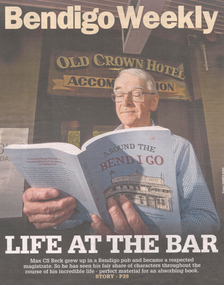
Newspaper - Bendigo Advertiser Article "Life the bar" and "the day a severed finger was in a pub", Sat Aug 08 2022
... spills and, humorously, to recover lost coins and even a diamond ring. The influx of American soldiers during the war brought new customs and challenges to local pubs, including currency confusion and overcrowding. Beck's father previously ran the Canadian Hotel in Seymour, which was popular with American troops. Beck recounts his mischievous childhood, including borrowing his father's car underage and the influence of hotel patrons on his upbringing. The narrative touches on the loneliness of having parents who worked long hours and hints at family...spills and, humorously, to recover lost coins and even a diamond ring. The influx of American soldiers during the war brought new customs and challenges to local pubs, including currency confusion and overcrowding. Beck's father previously ran the Canadian Hotel in Seymour, which was popular with American troops. Beck recounts his mischievous childhood, including borrowing his father's car underage and the influence of hotel patrons on his upbringing. The narrative touches on the loneliness of having parents who worked long hours and hints at family ...This document is a personal and nostalgic account by Max CS Beck, reflecting on his childhood and Bendigo's social history during the 1950s and 1960s. Beck's father, Reg, owned and ran The Crown Hotel, which became a central social hub in Bendigo after World War II. The hotel was known for its lively atmosphere, especially during the '6 o'clock swill' when patrons rushed to buy and consume drinks before the 6 pm closing time. Colorful anecdotes, such as the story of a severed finger prank involving a tobacco tin, illustrate the camaraderie and humor among patrons. Drinking was a standing-only affair, with heavy smoking and loud conversation common. The ritual of last drinks and the clearing of the bar at closing time were daily highlights. Sawdust was used on the bar floor to manage spills and, humorously, to recover lost coins and even a diamond ring. The influx of American soldiers during the war brought new customs and challenges to local pubs, including currency confusion and overcrowding. Beck's father previously ran the Canadian Hotel in Seymour, which was popular with American troops. Beck recounts his mischievous childhood, including borrowing his father's car underage and the influence of hotel patrons on his upbringing. The narrative touches on the loneliness of having parents who worked long hours and hints at family struggles, particularly related to alcohol. Beck expresses a sense of loss for the Bendigo of his youth, noting how much the city and its culture have changed.He emphasizes the importance of treasuring memories of the past without grieving for what is gone.Bendigo Advertiser "Life the bar" and "the day a severed finger was in a pub" Sat Aug 08 2022 3486.56a Max C S Beck in front of the Old Crown Hotel 3486.56b Colour Photo Beck's Hotel Hargeaves St Bendigo in about 1980 3486.56c Article from the Bendigo Advertiser "Life the bar" and "the day a severed finger was in a pub"bendigo, beck's crown hotel, max c s beck -
 Bendigo Historical Society Inc.
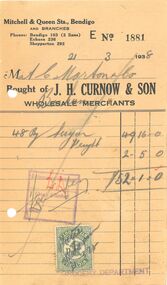
Financial record - INVOICE COLLECTION: J. H. Curnow & Son
... family affairs were marred by tragedy. His father was killed in a mining accident in 1881; his first wife and three of their five children died in the measles epidemic of 1893. His second wife Mary Jordan died in 1909 after spilling...family affairs were marred by tragedy. His father was killed in a mining accident in 1881; his first wife and three of their five children died in the measles epidemic of 1893. His second wife Mary Jordan died in 1909 after spilling ...See below for an article by Jim Evans of the Bendigo Historical Society: From the Bendigo Miner Number 9 - 1 March 2007 Cock-eyed Curnow - James Henry Curnow Cornishman and famous Bendigonian By Jim Evans Five-time Mayor of Bendigo, James Henry Curnow of Eumana , was for fifty years associated with almost every progressive movement in the life of the city. He was born in Ludgvan, Cornwall, in 1861, the son of Sampson Curnow, tin-miner and later mine-manager. His parents brought him to Bendigo when he was two years old and settled at Long Gully. He was educated at the state school and St Andrew s College. In 1883, he married Jane Corbel in the Congregational Church. Curnow joined the Post-Master-General s Department in 1881. Taking leave in 1887, he acted as secretary of the Australian Natives Association (ANA) exhibition at Geelong. He became a clerk with Connelly and Tatchell's, Bendigo solicitors, leaving in 1894 to establish an accountancy and real estate business. Considered shrewd and hard-working, Curnow prospered; he later added an auctioneering section and formed the company J.H. Curnow & Son (now Curnow & Dyett). The ANA provided the grounding for Curnow s public life. He joined the Sandhurst branch in 1881 and was secretary in 1883-1891. He helped form new branches in northern Victoria. With (Sir) John Quick, he set up the first Federation League in the colony in 1893. Curnow was secretary of the League in that year and again in 1898-99. He was elected to the Bendigo City Council in 1901 and, apart from 1906-09 remained a very energetic councillor. He was Mayor in 1902-03, 1903-04, 1912-13, 1919-20 and 1927-28. It was during his second term as Mayor in 1904, that he had William Beebe design a home - Eumana in Flora Hill. (Local historian Betty Jackman informs me that Curnow s house at 75 Wills Street where he lived before moving to Flora Hill, was also called Eumana ). He took a leading role in the installation of sewerage and was later Chairman of the city s Sewerage authority when that body was being subjected to a great deal of criticism. He was an executive member of The Municipal Association of Victoria and president in 1919. Curnow was very interested in politics, but his four attempts to enter parliament failed. He was Justice of the Peace for the states of New South Wales and Victoria, deputy coroner for the city of Bendigo, a guardian of minors and registrar of marriages. Curnow was managing director of the Bendigo Pottery, director of the Bendigo Gas Co. and the Bendigo and Eaglehawk Star Building Society and chairman of directors of the Bendigo Boot and Shoe factory. He was a life member of both the Bendigo Base Hospital and the Benevolent Asylum (Anne Caudle Centre). Curnow s family affairs were marred by tragedy. His father was killed in a mining accident in 1881; his first wife and three of their five children died in the measles epidemic of 1893. His second wife Mary Jordan died in 1909 after spilling carbolic acid on her hip, leaving three young children. He married Amy McLean in 1911and they had one daughter. When the Prince Edward visited Bendigo in 1920, Curnow made a speech, telling his audience: I will now merely ask you to drink his health as the Prince of Wales and also as the Duke of Cornwall. In this district there are a tremendous number of Cornishmen and I need not tell His Royal Highness that it was the Cousin Jacks who made Bendigo, who found the gold and developed the mines. They have added more to the riches of the Commonwealth than any other class of people. When he visits the mines today, he will find that ninety per cent of the miners are Cornishmen and descendants of Cornishmen. His remarks were greeted by loud applause. J.H. Curnow was known locally as Cock-eyed because of an eye defect. He died on Anzac Day 1932 at his then home, The Knoll in Wattle Street. He was 71. He was cremated at the new Fawkner Cemetery and his ashes were buried in the Bendigo Cemetery. His grave is close to that of another famous Cornishman and Bendigonian, Sir John Quick, who died in the same year. The Curnow memorial drinking fountain in Rosalind Park was unveiled in 1938 by Mayor Taylor. The distinguished Bendigo born sculptress Ola Cohn designed the memorial and made the bust and other plaques of terracotta. The plaques were damaged in the 1950s and a restoration program was undertaken, with bronze plaques replacing the original terracotta ones.10934.33a: A small, aged sheet of yellow paper with two clean punch holes on the left side and a perforated edge. The paper is thin, but sturdy. Printed in black ink is the business name and details: Bought of J.H. Curnow & Son Wholesale Merchants. The address: Mitchell & Queen Sts. Bendigo and branches. Phones: Bendigo 103. The receipt is handwritten in grey lead pencil. Dated 21 March 1938. Below the header is neat, ruled lines for listing items with prices listed in British Pounds, totaling 52 pounds 1 shillings. Receipt number 1881. There is also a Victorian 3 pence stamp duty stamp printed in green ink. 10934.33b: A small, aged sheet of yellow paper with two clean punch holes on the left side and a perforated edge. The paper is thin, but sturdy. Printed in black ink is the business name and details: Bought of J.H. Curnow & Son Wholesale Merchants. The address: Mitchell & Queen Sts. Bendigo and branches. Phones: Bendigo 103. The receipt is handwritten in grey lead pencil. Dated 25 May 1938. Below the header is neat, ruled lines for listing items. Receipt number 14291. The Receipt is crossed out in blye pencil. The top left corner is folded and slightly torn. 10934.33c: A small, aged sheet of yellow paper with two clean punch holes on the left side and a perforated edge. The paper is thin, but sturdy. Printed in black ink is the business name and details: Bought of J.H. Curnow & Son Wholesale Merchants. The address: Mitchell & Queen Sts. Bendigo and branches. Phones: Bendigo 103. The receipt is handwritten in grey lead pencil. Dated 27 June 1938. Below the header is neat, ruled lines for listing items with prices listed in British Pounds, totaling 2 pounds. Receipt number 1466. The receipt is crossed out in blue pencil and indicates and credit. 10934.33d: A small, aged sheet of yellow paper with two clean punch holes on the left side and a perforated edge. The paper is thin, but sturdy. Printed in black ink is the business name and details: Bought of J.H. Curnow & Son Wholesale Merchants. The address: Mitchell & Queen Sts. Bendigo and branches. Phones: Bendigo 103. The receipt is handwritten in grey lead pencil. Dated 7 March 1938. Below the header is neat, ruled lines for listing items with prices listed in British Pounds, totaling 34 pounds 14 shillings. Receipt number 1627. There is also a Victorian 3 pence stamp duty stamp printed in green ink.ac morton, jh curnow & son -
 National Wool Museum
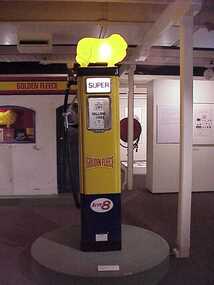
Petrol Bowser, Golden Fleece petrol bowser with ram and hose
... family. Single brand service stations did not appear until the 1950s, and distinctive trademarks and logos were used to differentiate and promote the brands. This bowser is a fully restored example of a 'Wayne' model (a typical bowser from the 1950s). H.C. Sleigh Pty Ltd Golden Fleece Petroleum Company Logo Merino: sheep in Australian art and design - Exhibition (29/07/2000 - 04/02/2001) SUPER / Wayne / GOLDEN FLEECE / ACTIV-8 / Contains / LEAD / TETRA-ETHYL / To be used as motor / fuel only and not for / other purposes. Avoid spilling ...The Golden Fleece Petroleum Company was established by H.C. Sleigh in 1913 importing petroleum from California, and was acquired by Caltex in 1981. The Golden Fleece ram trademark was created in 1951 when Golden Fleece petroleum became a single-brand service. The Golden Fleece ram was based on an actual prize winning merino ram named 'David of Dalkeith' from Boonoke Stud, run by the Falkiner family. Single brand service stations did not appear until the 1950s, and distinctive trademarks and logos were used to differentiate and promote the brands. This bowser is a fully restored example of a 'Wayne' model (a typical bowser from the 1950s).Image of Golden Fleece bowser installed in Logo Merino exhibition at the National Wool Museum. Information and pictures from various websites re: Golden Fleece. Golden Fleece and Caltex information from the Caltex website.SUPER / Wayne / GOLDEN FLEECE / ACTIV-8 / Contains / LEAD / TETRA-ETHYL / To be used as motor / fuel only and not for / other purposes. Avoid spilling. Wayne / DOLLARS CENTS / GALLONS / AT / CENTS PER GALLON THIS GLASS / MUST BE FULL / BEFORE AND AFTER / DELIVERY Wayne / GOLDEN FLEECE / ACTIV-8 / Contains / Lead / TETRA-ETHYL / To be used as motor / fuel only and not for / other purposes. Avoid spilling.h.c. sleigh pty ltd golden fleece petroleum company, logo merino: sheep in australian art and design - exhibition (29/07/2000 - 04/02/2001) -
 Melbourne Tram Museum
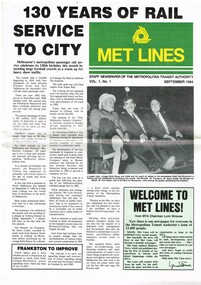
Magazine, Metropolitan Transit Authority (MTA), "Met Lines", September 1984 to June 1985
... families on the job - Kimber, Sutton and Luciews, AVM at Nicholson St Engine house. The magazine continues to an A4 version ,see Reg item 1059 and onwards. "Met Lines" Magazine Metropolitan Transit Authority (MTA) Howard Smith, Geoff Ashby, Brian Spilleer, Satendra Sharma, Ray Farrugia, Don Racovales, Tony Pennacchia, Glen Franklin, Ross Bebbington, Giordano Merlich, F Trantino, Alan Edwards, Geoff Foster, John Weighman, Daryl Mead, Don Everard, Beppie Hedditch, Geoff Neicno, Bruce Smith, Charles Kimber, George Sutton, Keith Sutton, Horrie Taig, Kerry Luciew, Jennie Luciew ...Magazine, published by the Metropolitan Transit Authority of Victoria "Met Lines" (Metlines) - A3 when folded, printed on white gloss paper, with the MTA logo or symbol. Issued under the name of L. A. Strouse as Chairman. Continues from Reg Item 1040 - "Headway News" Major tram and bus items listed. Tramway and bus names only listed, not railway. .1 - Vol 1 No. 1 - September 1984 - 8 pages - 130 years of rail service. Has note about former name, station revitalisation, Met Miles achieved, travel club, Centre page spread of photos of Preston workshop activities, names in Key Associations, repainting of Scrubber 8W, 8, 745, Vic Tramways Bowls Association, Alan Edwards retirement, item on Hawthorn Clothing Workshop (with photo), Munitions bus 301 - Geoff Foster, John Weighman and Daryl Mead and sporting news, - Preston Workshops Soccer team. .2 - Vol 1 No. 2 - 8 pages - Christmas Issue 1984 - Intermodal - Box Hill, Royal Show, A class tram introduced - Driver Don Everard, new tourist guide, Neighbourhood bus revamp in Ringwood, Westona station, Bundoora extension, Transit brass band, Beppie Hedditch - Occupational Welfare Service at Hawthorn, B class trams, sporting news and restored Tacit train. .3 - Vol 1 No. 3, March 1985 - 8 pages - introduction of AVM, bus driver Geoff Neicno, Communications Technician Bruce Smith with MTA Posters or advertisements, Bundoora extension opened, exporting tramway expertise, bus neighboured planning, English on the Job, Met card travel competition, 130 new B class trams and auction sale of Tait Trains. .4 - Vol 1 No. 4 June 1985 - 8 pages - Flagstaff opened, Men at Work band, investigation Officers, library moves to Queen St, first annual report, families on the job - Kimber, Sutton and Luciews, AVM at Nicholson St Engine house. The magazine continues to an A4 version ,see Reg item 1059 and onwards.trams, tramways, mta, preston workshops, hawthorn, buses, sports, box hill, a class, tramway band, welfare, b class, posters, advertisements, metcard, competition, new trams, flagstaff station, nicholson st, tram 8, tram 745, tram 8w
