
Showing 61 items matching " tasmanian museum "
-
 Robin Boyd Foundation
Booklet, Centenary of the Opening of the Tasmanian Museum and Art Gallery Building January 1863, 1963
... Centenary of the Opening of the Tasmanian Museum and Art Gallery Building January 1863...Walsh St library Univ of Melb card - with compliments of Prof Joseph Burke Gallery Catalogue Centenary of the Opening of the Tasmanian Museum and Art Gallery Building January 1863 Booklet ...Gallery CatalogueUniv of Melb card - with compliments of Prof Joseph Burkewalsh st library -
 Women's Art Register
Archive (Collection) - Completing the Picture, Women Artists and the Heidelberg Era Compliation Archive
... ... Tasmanian Museum and Art Gallery...Ervin Gallery Sydney; Carrick Hill Gallery Adelaide; Queen Victoria museum and Art Gallery Launceston; Tasmanian museum and Art Gallery Hobart; and Art Gallery of Western Australia Perth over a period from March 3-June 27 1993. ...artmoves, merren ricketson, helen vivian, victoria hammond, juliette peers, heidelberg school, ballarat fine art gallery, castlemaine art gallery, benalla art gallery, heide museum of modern art, s.h.ervin gallery, carrick hill gallery, margaret whitlam, queen victoria museum and art gallery , tasmanian museum and art gallery, art gallery of western australia, cristina asquith baker, alice bale, emma minnie boyd, alice chapman, florence fuller, portia geach, ina gregory, grace joel, dora meeson, mary meyer, josephine muntz adams, helen peters, jane price, iso rae, dora serle, clara southern, jane sutherland, violet teague, may vale., educational slide kit and catalogue of an exhibition held at heide park and art gallery; ballarat fine art gallery; castlemaine art gallery; benalla art gallery; s.h. ervin gallery, sydney; carrick hill gallery, adelaide; queen victoria museum and art gallery, launceston; tasmanian museum and art gallery, hobart; and art gallery of western australia, perth over a period from march 3-june 27 1993. dewey number 759.994/082, 759.994074, libraries australia id 136929780, 10412431artmoves, merren ricketson, helen vivian, victoria hammond, juliette peers, heidelberg school, ballarat fine art gallery, castlemaine art gallery, benalla art gallery, heide museum of modern art, s.h.ervin gallery, carrick hill gallery, margaret whitlam, queen victoria museum and art gallery , tasmanian museum and art gallery, art gallery of western australia, cristina asquith baker, alice bale, emma minnie boyd, alice chapman, florence fuller, portia geach, ina gregory, grace joel, dora meeson, mary meyer, josephine muntz adams, helen peters, jane price, iso rae, dora serle, clara southern, jane sutherland, violet teague, may vale., educational slide kit and catalogue of an exhibition held at heide park and art gallery; ballarat fine art gallery; castlemaine art gallery; benalla art gallery; s.h. ervin gallery, sydney; carrick hill gallery, adelaide; queen victoria museum and art gallery, launceston; tasmanian museum and art gallery, hobart; and art gallery of western australia, perth over a period from march 3-june 27 1993. dewey number 759.994/082, 759.994074, libraries australia id 136929780, 10412431 -
Women's Art Register
Archive (Series) - Completing the Picture, Women Artists and the Heidelberg Era. Slide Kit
... Launceston; Tasmanian museum and Art Gallery...Ervin Gallery Sydney; Carrick Hill Gallery Adelaide; Queen Victoria museum and Art Gallery Launceston; Tasmanian museum and Art Gallery Hobart; and Art Gallery of Western Australia Perth over a period from March 3-June 27 1993. ...educational slide kit and catalogue of an exhibition held at heide park and art gallery; ballarat fine art gallery; castlemaine art gallery; benalla art gallery; s.h. ervin gallery, sydney; carrick hill gallery, adelaide; queen victoria museum and art gallery, launceston; tasmanian museum and art gallery, hobart; and art gallery of western australia, perth over a period from march 3-june 27 1993. dewey number 759.994/082, 759.994074, libraries australia id 136929780, 10412431, artmoves, merren ricketson, helen vivian, victoria hammond, juliette peers, heidelberg school, ballarat fine art gallery, castlemaine art gallery, benalla art gallery, heide museum of modern art, s.h.ervin gallery, carrick hill gallery, margaret whitlam, queen victoria museum and art gallery , tasmanian museum and art gallery, art gallery of western australia, cristina asquith baker, alice bale, emma minnie boyd, alice chapman, florence fuller, portia geach, ina gregory, grace joel, dora meeson, mary meyer, josephine muntz adams, helen peters, jane price, iso rae, dora serle, clara southern, jane sutherland, violet teague, may vale.educational slide kit and catalogue of an exhibition held at heide park and art gallery; ballarat fine art gallery; castlemaine art gallery; benalla art gallery; s.h. ervin gallery, sydney; carrick hill gallery, adelaide; queen victoria museum and art gallery, launceston; tasmanian museum and art gallery, hobart; and art gallery of western australia, perth over a period from march 3-june 27 1993. dewey number 759.994/082, 759.994074, libraries australia id 136929780, 10412431, artmoves, merren ricketson, helen vivian, victoria hammond, juliette peers, heidelberg school, ballarat fine art gallery, castlemaine art gallery, benalla art gallery, heide museum of modern art, s.h.ervin gallery, carrick hill gallery, margaret whitlam, queen victoria museum and art gallery , tasmanian museum and art gallery, art gallery of western australia, cristina asquith baker, alice bale, emma minnie boyd, alice chapman, florence fuller, portia geach, ina gregory, grace joel, dora meeson, mary meyer, josephine muntz adams, helen peters, jane price, iso rae, dora serle, clara southern, jane sutherland, violet teague, may vale. -
Women's Art Register
Archive (Series) - Completing the Picture, Women Artists and the Heidelberg Era, Digitised Slide Kit
... Launceston; Tasmanian museum and Art Gallery...Ervin Gallery Sydney; Carrick Hill Gallery Adelaide; Queen Victoria museum and Art Gallery Launceston; Tasmanian museum and Art Gallery Hobart; and Art Gallery of Western Australia Perth over a period from March 3-June 27 1993. ...educational slide kit and catalogue of an exhibition held at heide park and art gallery; ballarat fine art gallery; castlemaine art gallery; benalla art gallery; s.h. ervin gallery, sydney; carrick hill gallery, adelaide; queen victoria museum and art gallery, launceston; tasmanian museum and art gallery, hobart; and art gallery of western australia, perth over a period from march 3-june 27 1993. dewey number 759.994/082, 759.994074, libraries australia id 136929780, 10412431, artmoves, merren ricketson, helen vivian, victoria hammond, juliette peers, heidelberg school, ballarat fine art gallery, castlemaine art gallery, benalla art gallery, heide museum of modern art, s.h.ervin gallery, carrick hill gallery, margaret whitlam, queen victoria museum and art gallery , tasmanian museum and art gallery, art gallery of western australia, cristina asquith baker, alice bale, emma minnie boyd, alice chapman, florence fuller, portia geach, ina gregory, grace joel, dora meeson, mary meyer, josephine muntz adams, helen peters, jane price, iso rae, dora serle, clara southern, jane sutherland, violet teague, may vale.educational slide kit and catalogue of an exhibition held at heide park and art gallery; ballarat fine art gallery; castlemaine art gallery; benalla art gallery; s.h. ervin gallery, sydney; carrick hill gallery, adelaide; queen victoria museum and art gallery, launceston; tasmanian museum and art gallery, hobart; and art gallery of western australia, perth over a period from march 3-june 27 1993. dewey number 759.994/082, 759.994074, libraries australia id 136929780, 10412431, artmoves, merren ricketson, helen vivian, victoria hammond, juliette peers, heidelberg school, ballarat fine art gallery, castlemaine art gallery, benalla art gallery, heide museum of modern art, s.h.ervin gallery, carrick hill gallery, margaret whitlam, queen victoria museum and art gallery , tasmanian museum and art gallery, art gallery of western australia, cristina asquith baker, alice bale, emma minnie boyd, alice chapman, florence fuller, portia geach, ina gregory, grace joel, dora meeson, mary meyer, josephine muntz adams, helen peters, jane price, iso rae, dora serle, clara southern, jane sutherland, violet teague, may vale. -
Women's Art Register
Archive (Collection) - Anne Connors Artist Archive
... ... Tasmanian Museum & Art Gallery...1954- Portraiture Self-Portraits Gertrude Tasmanian Museum & Art Gallery Bernie Art Gallery Printmaking Lithography Drawing Painting Collage Watercolour Archive Anne Connors Artist Archive ...portraiture, self-portraits, gertrude, tasmanian museum & art gallery, bernie art gallery, printmaking, lithography, drawing, painting, collage, watercolourportraiture, self-portraits, gertrude, tasmanian museum & art gallery, bernie art gallery, printmaking, lithography, drawing, painting, collage, watercolour -
Women's Art Register
Archive (Series) - Connors, Anne. Artist File 1
... ... Tasmanian Museum & Art Gallery...Portraiture Self-Portraits Gertrude Tasmanian Museum & Art Gallery Bernie Art Gallery Printmaking Lithography Drawing Painting Collage Watercolour Foolscap white archival 4 flap folder or document wallet Archive Connors, Anne. ...List of Images, Catalogues, Promotional Materialportraiture, self-portraits, gertrude, tasmanian museum & art gallery, bernie art gallery, printmaking, lithography, drawing, painting, collage, watercolourportraiture, self-portraits, gertrude, tasmanian museum & art gallery, bernie art gallery, printmaking, lithography, drawing, painting, collage, watercolour -
Women's Art Register
Archive (Series) - Anne Connors. Duplicate File 1
... ... Tasmanian Museum & Art Gallery...Printmaking Lithography Drawing Painting Collage Watercolour Portraiture Self-Portraits Gertrude Tasmanian Museum & Art Gallery Bernie Art Gallery Foolscap manilla file Archive Anne Connors. ...List of Images, Catalogues, Promotional Materialprintmaking, lithography, drawing, painting, collage, watercolour, portraiture, self-portraits, gertrude, tasmanian museum & art gallery, bernie art galleryprintmaking, lithography, drawing, painting, collage, watercolour, portraiture, self-portraits, gertrude, tasmanian museum & art gallery, bernie art gallery -
Women's Art Register
Archive (Series) - Completing the Picture, Women Artists and the Heidelberg Era. Women's Art Register History File 1
... ... Tasmanian Museum and Art Gallery...Artmoves Merren Ricketson Helen Vivian Victoria Hammond Juliette Peers Heidelberg School Ballarat Fine Art Gallery Castlemaine Art Gallery Benalla Art Gallery Heide Museum of Modern Art S.H.Ervin Gallery Carrick Hill Gallery Margaret Whitlam Queen Victoria Museum and Art Gallery Tasmanian Museum and Art Gallery Art Gallery of Western Australia Cristina Asquith Baker Alice Bale Emma Minnie Boyd Alice Chapman Florence Fuller Portia Geach Ina Gregory Grace Joel Dora Meeson Mary Meyer Josephine Muntz Adams Helen Peters Jane Price Iso Rae Dora Serle Clara Southern Jane Sutherland Violet Teague May Vale. ...Project documents, Documentation, Ephemera, Promotional Material, Educational Booklet, Slidesartmoves, merren ricketson, helen vivian, victoria hammond, juliette peers, heidelberg school, ballarat fine art gallery, castlemaine art gallery, benalla art gallery, heide museum of modern art, s.h.ervin gallery, carrick hill gallery, margaret whitlam, queen victoria museum and art gallery , tasmanian museum and art gallery, art gallery of western australia, cristina asquith baker, alice bale, emma minnie boyd, alice chapman, florence fuller, portia geach, ina gregory, grace joel, dora meeson, mary meyer, josephine muntz adams, helen peters, jane price, iso rae, dora serle, clara southern, jane sutherland, violet teague, may vale.artmoves, merren ricketson, helen vivian, victoria hammond, juliette peers, heidelberg school, ballarat fine art gallery, castlemaine art gallery, benalla art gallery, heide museum of modern art, s.h.ervin gallery, carrick hill gallery, margaret whitlam, queen victoria museum and art gallery , tasmanian museum and art gallery, art gallery of western australia, cristina asquith baker, alice bale, emma minnie boyd, alice chapman, florence fuller, portia geach, ina gregory, grace joel, dora meeson, mary meyer, josephine muntz adams, helen peters, jane price, iso rae, dora serle, clara southern, jane sutherland, violet teague, may vale. -
Women's Art Register
Archive (Series) - Anne Connors. Slide Kit
... ... Tasmanian Museum & Art Gallery...Printmaking Lithography Drawing Painting Collage Watercolour Portraiture Self-Portraits Gertrude Tasmanian Museum & Art Gallery Bernie Art Gallery Set of slides in Polypropylene sleeves, within a Polypropyline binder and slipcase. ...printmaking, lithography, drawing, painting, collage, watercolour, portraiture, self-portraits, gertrude, tasmanian museum & art gallery, bernie art galleryprintmaking, lithography, drawing, painting, collage, watercolour, portraiture, self-portraits, gertrude, tasmanian museum & art gallery, bernie art gallery -
Women's Art Register
Archive (Series) - Anne Connors, Digitised Slide Kit
... ... Tasmanian Museum & Art Gallery...Printmaking Lithography Drawing Painting Collage Watercolour Portraiture Self-Portraits Gertrude Tasmanian Museum & Art Gallery Bernie Art Gallery Archive Anne Connors, Digitised Slide Kit ...printmaking, lithography, drawing, painting, collage, watercolour, portraiture, self-portraits, gertrude, tasmanian museum & art gallery, bernie art galleryprintmaking, lithography, drawing, painting, collage, watercolour, portraiture, self-portraits, gertrude, tasmanian museum & art gallery, bernie art gallery -
 Bendigo Historical Society Inc.
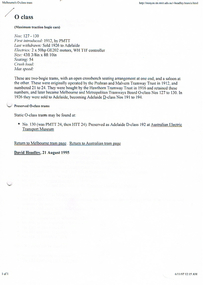
Document - LONG GULLY HISTORY GROUP COLLECTION: TRAMS INFORMATION
... Museum... Scienceworks... Tasmanian...BENDIGO History long gully history group The Long Gully History Group - Trams Information Prahan and Malvern tramway Trust Hawthorn Tramway Trust Melbourne and Metropolitan tramways Board Australian Electric Transport Museum David Hoadley Tramway Musuem of Victoria Hawthorn Tram Depot David Bromage Sydney Tramway Museum Bendigo Tramways Museum of Transport and Technology NZ Whiteman Park Tramway Museum Haddon Tramway Museum The Old Canberra Tram Company Ballarat Vintage Tramway Bendigo Toastrack Tram Kilmore Cable Tramway Railway Museum Scienceworks Tasmanian Transport Museum Launceston Tramway Museum Society Ballarat Vintage Tramway Central Deborah Gold Mine Chinese Joss House Castleton Sandhurst Shamrock Hotels Dai Gum San Wax Museum Post Office Law Courts Alexandra Fountain Beehive Store Fortuna Villa Sandhurst Town Information on O Class Trams, First introduced, Last Withdrawn, Electrics, Size and Seating, W2 with a small photo, where they can be found, some went to the USA, W5 with a small photo, W6 and the Bendigo Toastrack Tram with Nos, Introduced, Withdrawn, Electrics, Size and Seating/Crush Load. ...Information on O Class Trams, First introduced, Last Withdrawn, Electrics, Size and Seating, W2 with a small photo, where they can be found, some went to the USA, W5 with a small photo, W6 and the Bendigo Toastrack Tram with Nos, Introduced, Withdrawn, Electrics, Size and Seating/Crush Load. Also listed is where other trams can be seen. Also mentioned some early history of Bendigo, The Heritage Walk, The Central Deborah, Sandhurst Town, the early route from Melbourne to Bendigo, Creswick, Castlemaine and the Old Market. (7 pages).bendigo, history, long gully history group, the long gully history group - trams information, prahan and malvern tramway trust, hawthorn tramway trust, melbourne and metropolitan tramways board, australian electric transport museum, david hoadley, tramway musuem of victoria, hawthorn tram depot, david bromage, sydney tramway museum, bendigo tramways, museum of transport and technology nz, whiteman park tramway museum, haddon tramway museum, the old canberra tram company, ballarat vintage tramway, bendigo toastrack tram, kilmore cable tramway, railway museum, scienceworks, tasmanian transport museum, launceston tramway museum society, ballarat vintage tramway, central deborah gold mine, chinese joss house, castleton, sandhurst, shamrock hotels, dai gum san wax museum, post office, law courts, alexandra fountain, beehive store, fortuna villa, sandhurst town -
 Kew Historical Society Inc
Book, Holy Bible, c.1871
... A collection of artefacts relating to Dakin is held in the Tasmanian Museum. There is also a trophy held in the Kew Historical Society collection....A collection of artefacts relating to Dakin is held in the Tasmanian Museum. There is also a trophy held in the Kew Historical Society collection. ...A family bible belonging to the Dakin family of Kew. Arthur Dakin who is listed in the front pages was a member of the Ross Sea Rescue Expedition. A collection of artefacts relating to Dakin is held in the Tasmanian Museum. There is also a trophy held in the Kew Historical Society collection.This bible has historical significance because of its association with Arthur Dakin of the Ross Sea Rescue Expedition.Bible owned by the Dakin family of Kew. The front pages list dates of birth of family members.Names and dates of births and deaths insidedakin -
 Geoffrey Kaye Museum of Anaesthetic History
Decorative object - Vase, Glassware, Robert Wynne, c.2012
... Public collections include the Tasmanian Museum and Art Gallery, Artbank and the Queensland Contemporary Art Gallery. ...Public collections include the Tasmanian Museum and Art Gallery, Artbank and the Queensland Contemporary Art Gallery. ...Dr Briscoe was appointed Dean of the Faculty of Pain Medicine in 2008 and gifted the vase at the end of her term in 2010. Dr Briscoe was the first woman to be appointed Dean of the Faculty. The artist Robert Wynne is an accomplished glass artist in Australia. His artworks are held in significant public and private collections nation wide and overseas. Public collections include the Tasmanian Museum and Art Gallery, Artbank and the Queensland Contemporary Art Gallery. Wynne's artworks are also part of the private collections of Bill Clinton, Sir Elton John and the Royal Family Collection of Japan.Tear shaped, emerald green, hand-blown glassEtched on base - DENIZENdr briscoe, penelope (penny), wynne, robert, dean, faculty of pain medicine, fpm -
 Ballarat Tramway Museum
Book, Tasmania Transport Museum, "Proceedings of the 13th Conference of the Australasian Tramway Museums, Hobart - Tasmania August September 1996", 2000
... Details the Proceedings of the 13th Conference of the Australasian Tramway Museums (COTMA), Hobart Tasmania, 31 August to 7th September 1996. Produced by the Tasmanian Transport Museum Inc. ...Details the Proceedings of the 13th Conference of the Australasian Tramway Museums (COTMA), Hobart Tasmania, 31 August to 7th September 1996. Produced by the Tasmanian Transport Museum Inc. ...122 page A4 size book with white heat bound clear plastic front cover and glossy white heavy paper rear cover. Details the Proceedings of the 13th Conference of the Australasian Tramway Museums (COTMA), Hobart Tasmania, 31 August to 7th September 1996. Produced by the Tasmanian Transport Museum Inc. Includes a list of contents -page 3 and list of delegates - page 4. For full pdf file - see COTMA website, conference pages.BTM received Stamp on inside front cover, dated 14 April 2000 and item number 9149.trams, tramways, cotma, conferences, tasmania transport museum -
 Ballarat Tramway Museum
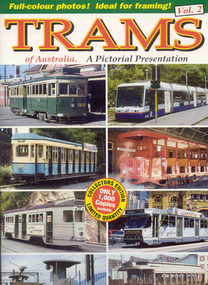
Book, Topmill Pty Ltd, "Trams of Australia Vol 2 - A pictorial Presentation", 2008/09
... Text written by Michael McGowan, internal photos, both Museum and pre-museum operational systems of Ballarat, Sydney, Brisbane, Melbourne (VR & MMTB), Geelong, Freemantle, reproduced postcards, Scrubber 8W in Swanston St, Ballarat Tramway Museum, Perth, Tasmanian Transport Museum, Perth Electric Tramway Society (PETS), Archer Park Rockhampton, Sydney Tramway Museum, Adelaide, Ballarat Santa Tram (1970)...Text written by Michael McGowan, internal photos, both Museum and pre-museum operational systems of Ballarat, Sydney, Brisbane, Melbourne (VR & MMTB), Geelong, Freemantle, reproduced postcards, Scrubber 8W in Swanston St, Ballarat Tramway Museum, Perth, Tasmanian Transport Museum, Perth Electric Tramway Society (PETS), Archer Park Rockhampton, Sydney Tramway Museum, Adelaide, Ballarat Santa Tram (1970) "Trams of Australia Vol 2 - A pictorial Presentation" Book Topmill Pty Ltd ...Book featuring photographs of Australian and Museum tramcars, includes Ballarat, Bendigo and Geelong.Full colour book, 32 pages plus card cover, titled "Trams of Australia Vol 2 - A pictorial Presentation", published by Topmill Pty Ltd, Silverwater NSW c2008/9. Features colour photos of trams from Melbourne (VR and MMTB), Sydney, Rockhampton, Brisbane on the front cover and Ballarat and Bendigo on rear. Text written by Michael McGowan, internal photos, both Museum and pre-museum operational systems of Ballarat, Sydney, Brisbane, Melbourne (VR & MMTB), Geelong, Freemantle, reproduced postcards, Scrubber 8W in Swanston St, Ballarat Tramway Museum, Perth, Tasmanian Transport Museum, Perth Electric Tramway Society (PETS), Archer Park Rockhampton, Sydney Tramway Museum, Adelaide, Ballarat Santa Tram (1970)trams, tramways, ballarat, bendigo, geelong, melbourne, sydney, brisbane, fremantle, hobart, adelaide, perth, santa tram, myers -
 Ballarat Tramway Museum
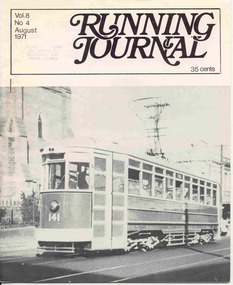
Magazine, Tramway Museum Society of Victoria (TMSV), "Running Journal Vol. 8, No. 4, August 1971", Aug. 1971
... Museum Society of Victoria. Sheets have been stapled into the folded covers. Features on front cover a photo of Hobart tram 141, an article on the Tasmanian Transport Museum at Glenorchy, last tram mail for Ballarat, the art of rostering in the tramway and bus industry, R. ...Demonstrates aspects of publication of material in an enthusiast based magazine for a Melbourne based organisation, with an article on the Tasmanian Transport Museum at Glenorchy, last tram mail for Ballarat, the art of rostering in the tramway and bus industry. ...Demonstrates aspects of publication of material in an enthusiast based magazine for a Melbourne based organisation, with an article on the Tasmanian Transport Museum at Glenorchy, last tram mail for Ballarat, the art of rostering in the tramway and bus industry.August 1971 issue of "Running Journal", consisting of formally printed cover on gloss paper which has been folded, containing eight quarto size stencil cut, duplicated sheets, pages 3 to 16. Published by the Tramway Museum Society of Victoria. Sheets have been stapled into the folded covers. Features on front cover a photo of Hobart tram 141, an article on the Tasmanian Transport Museum at Glenorchy, last tram mail for Ballarat, the art of rostering in the tramway and bus industry, R. C. Drummond, MMTB Traffic Manager and Museum Muses.Has Graeme Breydon's name/address stamp on front cover.trams, tramways, tmsv, running journal, tasmania transport museum, rosters -
Ballarat Tramway Museum
Document - Folder with papers, Warren Doubleday, Feb. 1995
... Following papers enclosed within binder: Proposed programme Listing of background information within folder Copy of Tasmanian Transport Museum Society's Management Plan of 1994 Copy of Len Millar's notes of planning considerations Copy of BTPS Mission Statement and goals used in Museum Accreditation submission Draft revision of goals prepared in July 1994 Outline of worked to be done as part of: Museum Accreditation Rail Safety Accreditation Draft Incorporation documents - from a company to a incorporated association. ...Following papers enclosed within binder: Proposed programme Listing of background information within folder Copy of Tasmanian Transport Museum Society's Management Plan of 1994 Copy of Len Millar's notes of planning considerations Copy of BTPS Mission Statement and goals used in Museum Accreditation submission Draft revision of goals prepared in July 1994 Outline of worked to be done as part of: Museum Accreditation Rail Safety Accreditation Draft Incorporation documents - from a company to a incorporated association. ...Black based folder with clear front holding papers for the 25/2/1995 planning meeting of the BTM. Following papers enclosed within binder: Proposed programme Listing of background information within folder Copy of Tasmanian Transport Museum Society's Management Plan of 1994 Copy of Len Millar's notes of planning considerations Copy of BTPS Mission Statement and goals used in Museum Accreditation submission Draft revision of goals prepared in July 1994 Outline of worked to be done as part of: Museum Accreditation Rail Safety Accreditation Draft Incorporation documents - from a company to a incorporated association. Loose is a copy of how to get to the venue - sitting room at the Lodge at Sovereign Hill. Scans of two docs added 2/9/12trams, tramways, btps, meetings, planning -
 Ararat Gallery TAMA
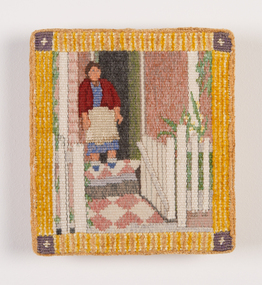
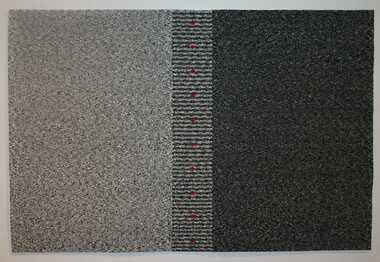
Sara Lindsay, Rosa, 1978
... Alongside her art practice, Lindsay has lectured at the Tasmanian School of Art, held the role of Curator of Textiles at the Tasmanian Museum and Art Gallery, then the position of Production Manager at the Australian Tapestry Workshop. ...Alongside her art practice, Lindsay has lectured at the Tasmanian School of Art, held the role of Curator of Textiles at the Tasmanian Museum and Art Gallery, then the position of Production Manager at the Australian Tapestry Workshop. ...Sara Lindsay is a Melbourne-based artist, curator and educator. She worked as a weaver at the Victorian Tapestry Workshop (now the Australian Tapestry Workshop) from its foundation in 1976 until 1990. Alongside her art practice, Lindsay has lectured at the Tasmanian School of Art, held the role of Curator of Textiles at the Tasmanian Museum and Art Gallery, then the position of Production Manager at the Australian Tapestry Workshop. Since 2013 she has mentored three Karen refugee women from Myanmar, assisting in their professional development and furthering their tapestry skills. In 2023 Lindsay began the Ararat New Settlement Weaving Program, teaching and mentoring culturally diverse settlers from refugee and migrant backgrounds in the Ararat region. The artwork exhibited here is part of body of work exploring Lindsay’s family’s historical ties to Sri Lanka. Her British grandfather managed a tea plantation in Ceylon’s hill country during the 1920s and 30s, where her mother was born before returning to England after his early death in 1937. After her first visit to Sri Lanka in 2005, Lindsay developed works that responded to this journey. She chose a quiet, contemplative approach to reflect on the complexity of colonial histories. Research into her family history led her to delve deeper into Sri Lanka’s complex history as a trading nation and to expand her materials to speak to this layered past. The use of cinnamon in this work connects to the story of 17th-century weavers from Southern India who were displaced from the Kingdom of Kandy and sent to the southwest coast to become cinnamon peelers under Portuguese and later Dutch rule. The finely woven ticking strips seen here reference the thick cotton fabric once used to cover mattresses and pillows aboard cargo ships transporting spices from Sri Lanka - a subtle reminder of the human stories woven into trade routes and colonial histories. -
 Ararat Gallery TAMA
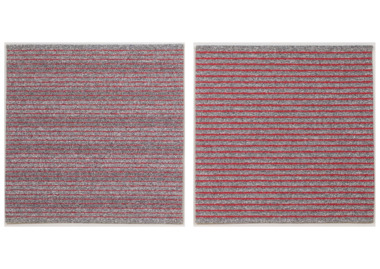
Sara Lindsay, In-Between #2, 1999
... Alongside her art practice, Lindsay has lectured at the Tasmanian School of Art, held the role of Curator of Textiles at the Tasmanian Museum and Art Gallery, then the position of Production Manager at the Australian Tapestry Workshop. ...Alongside her art practice, Lindsay has lectured at the Tasmanian School of Art, held the role of Curator of Textiles at the Tasmanian Museum and Art Gallery, then the position of Production Manager at the Australian Tapestry Workshop. ...Sara Lindsay is a Melbourne-based artist, curator and educator. She worked as a weaver at the Victorian Tapestry Workshop (now the Australian Tapestry Workshop) from its foundation in 1976 until 1990. Alongside her art practice, Lindsay has lectured at the Tasmanian School of Art, held the role of Curator of Textiles at the Tasmanian Museum and Art Gallery, then the position of Production Manager at the Australian Tapestry Workshop. Since 2013 she has mentored three Karen refugee women from Myanmar, assisting in their professional development and furthering their tapestry skills. In 2023 Lindsay began the Ararat New Settlement Weaving Program, teaching and mentoring culturally diverse settlers from refugee and migrant backgrounds in the Ararat region. The artwork exhibited here is part of body of work exploring Lindsay’s family’s historical ties to Sri Lanka. Her British grandfather managed a tea plantation in Ceylon’s hill country during the 1920s and 30s, where her mother was born before returning to England after his early death in 1937. After her first visit to Sri Lanka in 2005, Lindsay developed works that responded to this journey. She chose a quiet, contemplative approach to reflect on the complexity of colonial histories. Research into her family history led her to delve deeper into Sri Lanka’s complex history as a trading nation and to expand her materials to speak to this layered past. The use of cinnamon in this work connects to the story of 17th-century weavers from Southern India who were displaced from the Kingdom of Kandy and sent to the southwest coast to become cinnamon peelers under Portuguese and later Dutch rule. The finely woven ticking strips seen here reference the thick cotton fabric once used to cover mattresses and pillows aboard cargo ships transporting spices from Sri Lanka - a subtle reminder of the human stories woven into trade routes and colonial histories. -
 Ararat Gallery TAMA
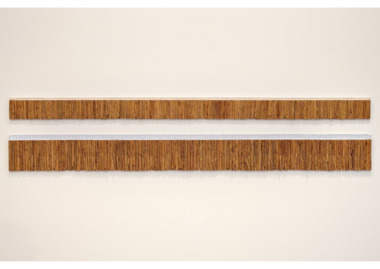
Sara Lindsay, Pulse (diptych), 2001-2002
... Alongside her art practice, Lindsay has lectured at the Tasmanian School of Art, held the role of Curator of Textiles at the Tasmanian Museum and Art Gallery, then the position of Production Manager at the Australian Tapestry Workshop. ...Alongside her art practice, Lindsay has lectured at the Tasmanian School of Art, held the role of Curator of Textiles at the Tasmanian Museum and Art Gallery, then the position of Production Manager at the Australian Tapestry Workshop. ...Sara Lindsay is a Melbourne-based artist, curator and educator. She worked as a weaver at the Victorian Tapestry Workshop (now the Australian Tapestry Workshop) from its foundation in 1976 until 1990. Alongside her art practice, Lindsay has lectured at the Tasmanian School of Art, held the role of Curator of Textiles at the Tasmanian Museum and Art Gallery, then the position of Production Manager at the Australian Tapestry Workshop. Since 2013 she has mentored three Karen refugee women from Myanmar, assisting in their professional development and furthering their tapestry skills. In 2023 Lindsay began the Ararat New Settlement Weaving Program, teaching and mentoring culturally diverse settlers from refugee and migrant backgrounds in the Ararat region. The artwork exhibited here is part of body of work exploring Lindsay’s family’s historical ties to Sri Lanka. Her British grandfather managed a tea plantation in Ceylon’s hill country during the 1920s and 30s, where her mother was born before returning to England after his early death in 1937. After her first visit to Sri Lanka in 2005, Lindsay developed works that responded to this journey. She chose a quiet, contemplative approach to reflect on the complexity of colonial histories. Research into her family history led her to delve deeper into Sri Lanka’s complex history as a trading nation and to expand her materials to speak to this layered past. The use of cinnamon in this work connects to the story of 17th-century weavers from Southern India who were displaced from the Kingdom of Kandy and sent to the southwest coast to become cinnamon peelers under Portuguese and later Dutch rule. The finely woven ticking strips seen here reference the thick cotton fabric once used to cover mattresses and pillows aboard cargo ships transporting spices from Sri Lanka - a subtle reminder of the human stories woven into trade routes and colonial histories. -
 Ararat Gallery TAMA
Sara Lindsay, Cinnamon and Ticking #9, 2008
... Alongside her art practice, Lindsay has lectured at the Tasmanian School of Art, held the role of Curator of Textiles at the Tasmanian Museum and Art Gallery, then the position of Production Manager at the Australian Tapestry Workshop. ...Alongside her art practice, Lindsay has lectured at the Tasmanian School of Art, held the role of Curator of Textiles at the Tasmanian Museum and Art Gallery, then the position of Production Manager at the Australian Tapestry Workshop. ...Sara Lindsay is a Melbourne-based artist, curator and educator. She worked as a weaver at the Victorian Tapestry Workshop (now the Australian Tapestry Workshop) from its foundation in 1976 until 1990. Alongside her art practice, Lindsay has lectured at the Tasmanian School of Art, held the role of Curator of Textiles at the Tasmanian Museum and Art Gallery, then the position of Production Manager at the Australian Tapestry Workshop. Since 2013 she has mentored three Karen refugee women from Myanmar, assisting in their professional development and furthering their tapestry skills. In 2023 Lindsay began the Ararat New Settlement Weaving Program, teaching and mentoring culturally diverse settlers from refugee and migrant backgrounds in the Ararat region. The artwork exhibited here is part of body of work exploring Lindsay’s family’s historical ties to Sri Lanka. Her British grandfather managed a tea plantation in Ceylon’s hill country during the 1920s and 30s, where her mother was born before returning to England after his early death in 1937. After her first visit to Sri Lanka in 2005, Lindsay developed works that responded to this journey. She chose a quiet, contemplative approach to reflect on the complexity of colonial histories. Research into her family history led her to delve deeper into Sri Lanka’s complex history as a trading nation and to expand her materials to speak to this layered past. The use of cinnamon in this work connects to the story of 17th-century weavers from Southern India who were displaced from the Kingdom of Kandy and sent to the southwest coast to become cinnamon peelers under Portuguese and later Dutch rule. The finely woven ticking strips seen here reference the thick cotton fabric once used to cover mattresses and pillows aboard cargo ships transporting spices from Sri Lanka - a subtle reminder of the human stories woven into trade routes and colonial histories. -
 Mission to Seafarers Victoria
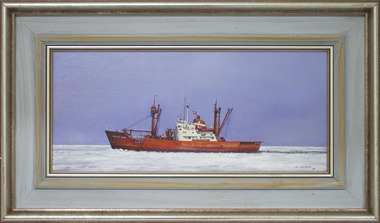
Painting, Ib Odfeldt, MS Nella Dan 1961, 1995
... In 2002 Ib was awarded the Southern Ocean Maritime Art Prize and this acquisition of the Nella Dan is presented in the foyer of the Tasmanian Maritime Museum in Hobart." (The ASMA 2019 National Exhibition - Maritime Museum of Tasmania catalogue). ...In 2002 Ib was awarded the Southern Ocean Maritime Art Prize and this acquisition of the Nella Dan is presented in the foyer of the Tasmanian Maritime Museum in Hobart." (The ASMA 2019 National Exhibition - Maritime Museum of Tasmania catalogue). ...A depiction of the MS Nella Dan an active primary vessel built in 1961 by the Aarlborg Shipyard PTY Ltd, and regularly chartered by the Australian National Antarctic Research Expeditions (ANARE) in the 20th C. The ship ran aground in December 1987 and unable to be salvaged, had to be scuttled in deep water off Macquarie Island. See link above, this record. The ship was named after Nel Law wife of the Director of the Antarctic Division, DR Phil Law. "Ib Odfeldt (b. 1944) is a self-taught painter and sculptor spending many years inspired by and interest in ships and marine art whilst working as an engineer in the Danish Merchant Navy. His paintings demonstrate a keen eye for technical accuracy and skill. The balance and setting of his works have attracted interest in many commissions by lovers of marine and shipping works. In 2002 Ib was awarded the Southern Ocean Maritime Art Prize and this acquisition of the Nella Dan is presented in the foyer of the Tasmanian Maritime Museum in Hobart." (The ASMA 2019 National Exhibition - Maritime Museum of Tasmania catalogue). According to the artist, the painting was part of an exhibition he held at "Melbourne maritime museum " (Polly Woodside) to celebrate ANARE (ARTIC SHOW). He donated two paintings of the Nella Dan. Ib Odfledt has also entered the Maritime Art Prize several times. (2012)Maritime ArtFramed , oil on board painting depicting a red hulled , single funnel ship cutting through sea iceArtist signature at lwr right corner PAINTED.: IB ODFELDT 95 At the back: Square loose label: 3076 Leonard Joel Bottom corner on the frame in Pencil: POW 2894 (National Trust accession number)nella dan, anare, antarctica, icebreakers, explorations, merchant vessels, artwork, maritime art, ib odfeldt, artwork-paintings, australian national antarctic research expeditions (anare), hobbies, asma, australian society of maritime artists -
 Flagstaff Hill Maritime Museum and Village
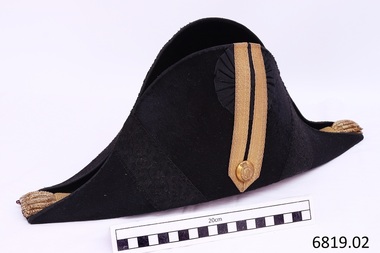
Uniform - Bicorn Hat and Hat Box, late 19th - early 20th century
... His hat and epaulettes are in the Tasmanian Maritime Museum's collection. The Australian War Memorial has a hat that is very similar in design, described as an “Artillery Staff Officer’s cocked had with plume, worn by Volunteer Artillery Staff in the Victorian Colonial Military Forces”. ...His hat and epaulettes are in the Tasmanian Maritime Museum's collection. The Australian War Memorial has a hat that is very similar in design, described as an “Artillery Staff Officer’s cocked had with plume, worn by Volunteer Artillery Staff in the Victorian Colonial Military Forces”. ...This hat and hat box was donated to Flagstaff Hill Maritime Village by the family of Doctor William Roy Angus, Surgeon and Oculist. It is part of the “W.R. Angus Collection” which includes historical medical equipment, surgical instruments and material once belonging to Dr Edward Ryan and Dr Thomas Francis Ryan, (both of Nhill, Victoria) as well as Dr Angus’ belongings. The Collection’s history spans the medical practices of the two Doctors Ryan, from 1885-1926 plus that of Dr Angus, up until 1969. McDade is the surname of Dr Angus’ daughter Berry (Berenice) McDade nee Angus. This had belonged to her father Dr William Roy Angus, Surgeon and Oculist (1901 –1970), who wore it on the ship T.S.S. LARGS BAY when travelling from Australia to Scotland for extended studies to be a “Fellow” of the Royal College of Surgeons in Edinburgh in 1929. This bicorn, cocked hat was worn with narrow points towards the front and back. It is decorated with flat gold braid or ‘lace’ with a geometrical design. Regimental lace was worn on the uniform and headdress of regimental officers in the 19th century. Gold lace chevrons were worn on coats to signify rank. Drummers and Foot Guards also wore regimental lace to distinguish them from other military personnel. In the late 19th century the English and Welsh infantry officers’ uniforms displayed a rose-pattern lace. The gold bullion and underlying crimson ‘eyes’ have been used to signify the rank of the owner. Crimson eyes were used for military personnel, and blue eyes were used for naval personnel. Different numbers and colours of the bullion and eyes may have been used to represent different military ranks. The Regulations specify nine tassels and eleven underlying eyes but there could have been variations. We have not yet identified the rank for this particular hat but hats such as this were part of the Australian and British naval uniforms in the early 20th century. The gold button’s emblem features a cross with five stars, a crown, and the motto “AUT PACE AUT BELLO,” which translates as “either in peace or in war.” Museum Victoria has a similar button and writes that buttons with this design were used by the Victorian Volunteers in the nineteenth century. The Australian War Memorial Curator of Military Heraldry advised Museum Victoria that these buttons dated from 1880 to 1892 and were worn by regular, unranked soldiers. Tasmanian Midshipman Alan Casey, who served the British and Australian Navy from 1919 to 1933 and retired as a Lieutenant Commander, owned a similar officer's bicorn hat. His hat and epaulettes are in the Tasmanian Maritime Museum's collection. The Australian War Memorial has a hat that is very similar in design, described as an “Artillery Staff Officer’s cocked had with plume, worn by Volunteer Artillery Staff in the Victorian Colonial Military Forces”. That hat is different in that it has a plume and the braid and button are silver. Berry MdDade, the donor, has used the hat many times as a dress-up hat but doesn’t know the origin of it. The hat seems to fit the design of the Staff Officers in Victorian Volunteers in Colonial times, but the button on this hat was used for unranked volunteers. Also, military uniforms usually have very clear manufacturer’s labels, as they are made by reputable companies under contract to the Defence Department. The manufacturer’s mark is not discernible on this hat. The origin, original wearer and use of this particular hat is unclear. The military bicorn cockade hat belonged to Dr William Roy Angus and is part of the W.R. Angus Collection. It is significant for still being located at the site connected to Doctor Angus being the last Port Medical Officer in Warrnambool. The collection of medical instruments and other equipment is culturally significant, as an historical example of medicine from late 19th to mid-20th century. Dr Angus assisted Dr Tom Ryan, a pioneer in the use of X-rays and in ocular surgery. Black bicorn cocked hat and case. It appears to be part of a 19th-century Colonial full-dress naval officer's uniform. The long, narrow crescent-shaped hat is made of beaver fabric and the crown is lined with crimson silk and finished with a hand-stitched leather sweatband. On one flat side is a pleated black silk, lace cockade woven in the pattern of oak leaves and acorns. The cockade is overlaid with a double row of gold lace braiding secure with a Victorian Volunteer’s gold button. Wide diagonal bands of black lace braid trim are on each side of the gold braiding. The other side of the hat is plain. The front and back points of the hat each have seven gold bullion tassels with nine underlying twists of crimson ‘eyes’. The fitted metal carry case has a catch and a plaque on one side. The button bears a crown and cross with five stars and a motto. Inside the hat is a white name tag with clear adhesive over it, with black printed text with the name “Mc Dade”. The hat is part of the W.R. Angus Collection.The hat has no maker’s marks although there is a darker colour in the centre where there could have been a label. Inside the hat is taped a printed label; “Mc DADE 801 1032” Button’s emblem- a cross with five stars, under a crown, all within a buckled belt with the motto “AUT PACE AUT BELLO” [either in peace or in war] The plaque on the case has no legible marks.flagstaff hill, warrnambool, shipwrecked coast, flagstaff hill maritime museum, maritime museum, shipwreck coast, flagstaff hill maritime village, great ocean road, dr w r angus, t.s.s. largs bay, berry mcdade, 19th century colonial military uniform, artillery staff officer’s cocked had, victorian volunteers, victorian colonial military forces, colonial militia, aut pace aut bello, cocked hat, cockade hat, bicorn hat, military bullion, oak leaves and acorns pattern, gold bullion tassels, military heraldry, w.r. angus collection., australian navy, british navy, uniform -
 Flagstaff Hill Maritime Museum and Village
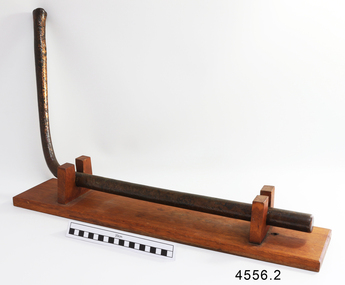
Nail, circa 1810
... The incident of the fire on board and the bravery of the convicts in making the gun powder safe is an example of the social character of the people in early Tasmanian colonisation. flagstaff hill warrnambool shipwrecked coast flagstaff hill maritime museum maritime museum shipwreck coast flagstaff hill maritime village great ocean road george iii ship construction ship nail 1835 shipwreck 19th century shipwreck william moxey d'entrecasteaux channel convict transportation copper nail dumpy bolt spike keel nail Copper nail (also called a Dumpy bolt or spike) from the convict ship George III, wrecked in 1835. ...This copper nail, sometimes known as a ‘Dumpy Bolt’ or spike, was salvaged from the hull of the wreck of the “George III”. It dates back to at least 1810. It was found by an abalone diver on the south east coast of Tasmania. The nail would have been used to hold the layers of the ship’s keel frame and the planking together. The nail has been passed from the abalone diver to an interested business man on a trip to the south of Hobart, on again to the business man’s close friend who then donated it to Flagstaff Hill Maritime Village. The metal of nails such as this one, after being in the sea for a long time, become affected by the natural reaction of the sea water, causing it to degenerate and thin, and the stress from the force of the sea over the years alters its shape. Iron nails had been used on ships previously, but they quickly corroded in the salt; ships needed regular, costly and time-consuming maintenance to replace the iron nails. Towards the end of the 18th century the British Navy trialled the use of copper nails, finding them to be very successful. Merchant ships began to adopt this process in the early 19th century, although it made ship building very expensive and was more often used for ships such as the “George III” that sailed on long voyages. The three masted sailing ship “George III” was a convict transport ship built in Deptford, England, in 1810. On 14th December 1834 she left Woolwich, England, bound for Hobart Town, Van Diemen’s Land (Tasmania), under Captain William Hall Moxey. She was carrying 220 male convicts plus crew, guards and their families, totalling 294 persons (another 2 were during the voyage). Amongst the cargo were military stores including several copper drums of gun powder. On 27th January 1835 the “George III” was near the Equator, about half way into her journey. A fire broke out and the gun powder was in danger of explosion, threatening the whole ship. Two convicts braved the heat and smoke, entered the store and seized the gun powder drums, suffering burns for their efforts but saving a probable disaster. The fire destroyed some of the provisions and food was scarce. Many became ill with scurvy and some died during the journey. Nearing the end of their journey on 10th April 1835 the “George III” was headed through the D'Entrecasteaux Channel, south east Tasmania, between the mainland and Bruny Island. She was sailing in the moonlit night to hasten her arrival in port due to the great number of sick on board. She struck uncharted rocks, known only to the local whalers, between Actaeon Reef and Southport Lagoon and within hours began to break up. The ship’s boats were used to first rescue the women and children. Firearms were used to help quell the panic of the convicts below decks and some were killed by the shots. Many convicts, including the sick, were drowned. In all, 133 lives were lost including 5 of the crew, guards and their families. It was the third worst shipping disaster in Tasmanian waters. A monument in honour of the prisoners who perished in the “George III” has been erected, noting the date of the wreck as “Friday 10th April 1835.” (NOTE: there are a few differences between sources regarding dates of the shipwreck, some saying March and others April 1835. There are also differences in the figures of those on board and the number of lives lost.) The copper nail is significant as an example of sailing ship construction; fasteners used in the early 19th century on ships carrying convicts to Australia. The nail is also significant for its association with the ship “George III”. The “George III” is registered on the Australian National Shipwreck Database, ID 7195 as an Historic Shipwreck. She is the third worst shipwreck in Tasmanian waters. She is also associated with Early Australian History and the transportation of convicts to Australia. The incident of the fire on board and the bravery of the convicts in making the gun powder safe is an example of the social character of the people in early Tasmanian colonisation. Copper nail (also called a Dumpy bolt or spike) from the convict ship George III, wrecked in 1835. Nail is long, bent in an ‘L’ shape about 3/5ths along, tapering from both ends to the bend. Both ends are flat and do not taper to a point, nor have a thread. The shorter end has been polished, showing bright copper. There is pitting along the nail and virdigris is evident on the longer, unpolished end. The nail is displayed with the longer section resting on a wooden board between two ‘U’ shaped uprights, the shorter section upright. flagstaff hill, warrnambool, shipwrecked coast, flagstaff hill maritime museum, maritime museum, shipwreck coast, flagstaff hill maritime village, great ocean road, george iii, ship construction, ship nail, 1835 shipwreck, 19th century shipwreck, william moxey, d'entrecasteaux channel, convict transportation, copper nail, dumpy bolt, spike, keel nail -
 Flagstaff Hill Maritime Museum and Village
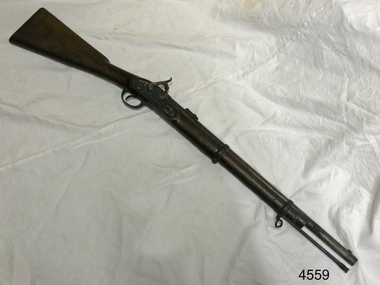
Weapon - Gun, ISAAC HOLLIS & SONS, Mid 19th Century
... Museum...Maritime Village...Warrnambool...Great Ocean Road...Shipwreck Coast...Firearm...gun...percussion...carbine....577 cal...Colonial Tasmanian...Flagstaff Hill Maritime Museum Maritime Village Warrnambool Great Ocean Road Shipwreck Coast Firearm gun percussion carbine .577 cal Colonial Tasmanian Issue Artillery Carbine Military gun Pattern 1861 muzzle-loading muzzle-loading musket cap and ball musket wood stock 1861 percussion breech-loading guns Richard and William Hillis Herbert & Co. ...The Hollis Brothers were first recorded as operating from 11 Weaman Row in 1840, although evidence suggests that the business may have commenced prior to this date. Over time, the firm evolved and became known as Isaac Hollis & Sons, with claims of its establishment dating back to 1814. This earlier date is supported by records of Richard and William Hollis trading in Bath Street, Birmingham, between 1814 and 1818, which raises the possibility that Isaac and Frederick Hollis were their descendants. The principal brothers involved in the business were Isaac Hollis, born in 1815, and Frederick Hollis, whose birth date remains unknown. Frederick’s life was cut short when he died on 20 December 1839. According to the 1841 census, Isaac Hollis resided in Weaman Row and was listed as a 25-year-old gun and pistol maker. He was married to Emma, who was born in 1821, and together they had two children: Isaac, born in 1837, and Henry, born in 1839. Following Frederick’s death, Isaac continued to operate under the name Hollis Brothers until 1845, after which he renamed the business Hollis Brothers & Co. This entity remained active up to 1848. In 1844, Isaac Hollis entered a brief partnership with William Tranter at 10 & 11 Weaman Row, likely to fulfil a specific contract or to supply particular parts. This partnership continued until 1849. In 1848, Isaac Hollis formed a partnership with Isaac Brentnall Sheath, establishing the firm of Hollis & Sheath and expanding their operations into 10 Weaman Row. The partnership saw Hollis & Sheath become licensed manufacturers of percussion breech-loading guns, positioning the company as a notable presence in the industry. In 1861, Sheath left the partnership and emigrated to New Zealand, where he conducted several enterprises and was elected as a provincial councillor. He died in Christchurch on 19th May 1897. Following the departure of Isaac Sheath in 1861, the business underwent a name change to Isaac Hollis & Sons. By approximately 1870, Isaac Hollis and Henry Hollis had assumed responsibility for the daily management of the firm, with Isaac overseeing the overall management and marketing of the company's products, while Henry managed the manufacturing processes. During this period, the company became known for producing large volumes of affordable trade guns and sporting guns, catering to customers in South Africa and the British colonies. In 1870, Isaac Hollis & Sons opened a retail location at 44a Cannon Street in London, subsequently relocating to 83 Cheapside in 1871. Isaac Hollis Jnr passed away in October 1875 in Birmingham at the age of 37, having never married. In 1876/1877, Henry Hollis registered a limited liability company under the name Isaac Hollis & Sons Ltd. However, by 1879, trading resumed under the name Isaac Hollis & Sons, and the London shop moved to 6 Great Winchester Street. From 1932 to 1933, the business operated in London as Hollis, Bentley & Playfair. The final closure of Hollis, Bentley & Playfair occurred in Birmingham in 1953. This firearm serves as an exemplary representation of the type of weapon distributed to the colony’s military forces in 1861. It was specifically manufactured by Isaac Hollis & Sons, a prominent gunmaker of the period, to meet the requirements of military use. Distribution was facilitated through Hebbert & Sons, an established military supplier based in London. Before it arrived in Tasmania, Australia, around 1861, the firearm was likely issued from the Hythe Armoury, which functioned as a British military training facility. Probably, the gun was originally allocated to British troops or police before being transferred for use in the colony. Gun: Percussion Carbine, .577 Cal. Colonial Tasmanian issue Artillery carbine, Pattern 1861. Muzzle-loading "Cap and Ball" musket. Wood stock and ramrod. Inscriptions are on the stock and breech. Gun was made for Herbert & Co., London, by Isaac Hollis & Sons, Birmingham.Stamped on stock "SOLD 95", " ISAAC HOLLIS & SONS" "GUN & PISTOL MANUFACTURES" "BIRMINGHAM" "J ASTON ARMOURER HYTHE" "MANUFACTURED EXPRESSLY FOR HEBBERT & CO LONDON". Stamped on breech "25", and "25C ---05"flagstaff hill, maritime museum, maritime village, warrnambool, great ocean road, shipwreck coast, firearm, gun, percussion, carbine, .577 cal, colonial tasmanian issue, artillery carbine, military gun, pattern 1861, muzzle-loading, muzzle-loading musket, cap and ball, musket, wood stock, 1861, percussion breech-loading guns, richard and william hillis, herbert & co., herbert & co. london, hollis & sons, isaac hollis & sons, isaac hillis & sons ltd., hollis bentley & playfair., isaac hollis, frederick hollis, isaac brentnall sheath, isaac sheath, william tranter, gun manufacturer, pistol manufacturer, gun and pistol maker, birmingham, j aston armourer, hythe, hythe armoury, military supplies -
 Flagstaff Hill Maritime Museum and Village
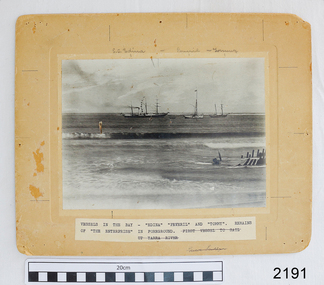
Photograph - Vessels, Steam and Sail, Vessels in the bay, 1890's
... “In 1985 a piece of timber from the local Enterprise, which had been kept at the Warrnambool Museum since 1892, was identified histologically as a New Zealand timber, not Tasmanian timber such as blue gum, from which Fawkner’s Enterprize would have been built in 1830. ...“In 1985 a piece of timber from the local Enterprise, which had been kept at the Warrnambool Museum since 1892, was identified histologically as a New Zealand timber, not Tasmanian timber such as blue gum, from which Fawkner’s Enterprize would have been built in 1830. ...The photograph, taken in the 1890s, shows sailing ships and a wreck in Lady Bay, Warrnambool. Lady Bay was once a very busy port of trade in Warrnambool and was also called the Port of Warrnambool or Warrnambool Harbour. ENTERPRISE (1847-1850) NOTE: The “Enterprise” wrecked in 1850 in Warrnambool should not be confused with John Pascoe Faulkner’s ‘Enterprise’, which was wrecked in NSW in 1847. The 58-ton schooner Enterprise was built by David Hay in Waiheke, New Zealand in 1847 and registered by owners John Watson and Edward Byam in Melbourne, Australia. She was a single-deck sailing ship with two masts, used for carrying cargo such as local agricultural produce and general commodities between Melbourne and other colonial ports. On September 14th, 1850 the Enterprise had sailed from Melbourne under the control of the ship’s Master, James Gardiner Caught, and was moored in at the Tramway Jetty in Lady Bay, laden with wheat and potatoes. The vessel rode out a south-easterly gale but eventually dragged anchor and was beached, bow first and then broadside. Buckwall, a local indigenous man, braved the heavy surf and reached the stricken vessel with a rescue line, saving all five crew on board. There were no passengers on board. The Enterprise wreck was in an area called Tramway Jetty in Lady Bay. Since then the area has become the location of Lady Bay Hotel and now, in 2019, it is in the grounds of the Deep Blue Apartments. In fact, with the constantly changing coastline through built-up sand, the wreck site is now apparently under the No 2 Caravan Park on Pertobe Road, perhaps 150 metres from the high tide. Its location was found by Ian McKiggan (leader of the various searches in the 1980s for the legendary Mahogany Ship). The Warrnambool Wreck Enterprise is listed on the Victorian Heritage Database VHR S238. DIFFERENTIATING the New Zealand Schooner “Enterprise” from John Fawkner’s “Enterprize“ Dr Murray Johns, Melbourne, says in his article The Mahogany Ship Story, “…the Enterprise, wrecked in Lady Bay, Warrnambool in 1850 ... was soon covered by sand but was exposed again after several storms in 1887. “Samples of timber were then cut from the wreck, which would then have been buried for 37 years. In November 1887 the Warrnambool Standard reported that “the timber looks sound and hard, a penknife scarcely making any impression.” “For many years there was confusion about the identity of that ship in Lady Bay. Most people believed it was the wreck of John Pascoe Fawkner’s Enterprize, which had sailed from Tasmania to Victoria bringing the pioneer settlers to Melbourne in 1835. “In fact, as I documented in 1985, the Warrnambool wreck was of an entirely different ship, also called Enterprize [Enterprise], but built in New Zealand in 1847. Fawkner’s ship had already been sold to Captain Sullivan in 1845 and was wrecked on the Richmond Pier in northern New South Wales early in 1847. “In 1985 a piece of timber from the local Enterprise, which had been kept at the Warrnambool Museum since 1892, was identified histologically as a New Zealand timber, not Tasmanian timber such as blue gum, from which Fawkner’s Enterprize would have been built in 1830. This confirmed the identity of the Warrnambool Enterprize.”[Dr. M.W. Johns later wrote an article called “The Schooner Enterprise: A Final Word on a Historic Wreck.”] ABOUT THE S S EDINA The three-masted iron screw steamer SS Edina was built in Glasgow, Scotland, in 1854 by Barclay and Curle. She was adorned with the figurehead of the ‘fair maid of Judea’. The many years of service made SS Edina famous worldwide as the longest-serving screw steamer. (The term screw steamer comes from being driven by a single propeller, sometimes called a screw, driven by a steam engine.) SS Edina’s interesting history includes English Chanel runs, serving in the Crimean Ware carrying ammunition, horses and stores to the Black Sea, and further service in the American Civil War and later, serving in the western district of Victoria as well as in Queensland and carried gold, currency and gold prospectors Australia to New Zealand. SS Edina had the privilege of being an escort vessel to H.R.H. the Duke of Edinburgh during his visit to Australia in 1867. In March 1863 SS Edina arrived in Port Phillip Bay, Melbourne and was bought by Stephen Henty, of Portland fame, to work the cargo and passenger run from Melbourne – Warrnambool – Port Fairy - Portland. After a short time of working the run from Australia to New Zealand, with passengers and cargo that included gold and currency, she returned to her Melbourne - Warrnambool – Port Fairy run, with cargo including bales of wool produced in the western district of Victoria. The Warrnambool Steam Packet Company purchased SS Edina in 1867; she was now commanded by Captain John Thompson and Chief Engineer John Davies. She survived several mishaps at sea, had a complete service and overhaul and several changes of commanders. In 1870 SS Edina was in Lady Bay, Warrnambool, when a gale sprung up and caused a collision with the iron screw steamer SS Dandenong. SS Edina’s figurehead was broken into pieces and it was not ever replaced. SS Edina was re-fitted in 1870 and was then used as a coastal trader in Queensland for a period. She was then brought to Melbourne to carry cargo and passengers between Melbourne and Geelong and performed this service from 1880-1938. During this time (1917) she was again refitted with a new mast, funnel, bridge and promenade deck, altering her appearance. In 1938, after more collisions, SS Edina was taken out of service. However, she was later renamed Dinah and used as a ‘lighter’ (a vessel without an engine or superstructure) to be towed and carry wool and general cargo between Melbourne and Geelong. In 1957, after 104 years, the SS Edina was broken up at Footscray, Melbourne. Remains of SS Edina’s hull can be found in the Maribyrnong River, Port Phillip Bay. This photograph is significant for its association with the screw steamer SS Edina, heritage listed on the Victorian Heritage Database VHR S199. She had endeared herself to the people of Port Phillip Bay as a passenger ferry, part of their history and culture. She played a significant role in the Crimean War, the American Civil War and the gold rush in New Zealand. She also served western Victoria for many years in her cargo and passenger runs. The SS Edina is famous for being the longest-serving screw steamer in the world. After spending her first nine years overseas she arrived in Melbourne and her work included running the essential service of transporting cargo and passengers between Melbourne and the western Victoria ports of Warrnambool, Port Fairy and Portland. The SS Edina was purchased in the late 1860s by the local Warrnambool business, the Warrnambool Steam Packet Co. and continued trading from there as part of the local business community. Her original ‘fair maid of Judea’ figurehead was broken to pieces in a collision with another vessel (the SS Dandenong) in a gale off Warrnambool, Victoria, in 1870. The photograph is significant for its association wreck of the Victorian Heritage Listed schooner Enterprise, VHR S238, being a New Zealand-built but Australian-owned coastal trader. The wreck was also significant for its association with the local indigenous hero, Buckawall, who saved the lives of the five crew on board. Photograph "Vessels in the Bay". Black and white photograph of several vessels in Lady Bay, Warrnambool, including some small vessels and "S.S. Edina", the "Peveril" and "Tommy", plus the remains of the wrecked vessel "Enterprise" in the foreground. Photograph is mounted on beige card with label describing the vessels, plus pencilled vessel names. There are several pin holes in each corner of the photograph. Typed label under the photograph “VESSELS IN THE BAY – “EDINA” “PEREVIL” AND “TOMMY”. / REMAINS OF “THE ENTERPRISE” IN FOREGROUND. (Also crossed out on the label “FIRST VESSEL TO SAIL UP YARRA RIVER). In pencil script above the vessels on the photograph “S.S. Edina”, “Peveril” “Tommy”. On the reverse is a printed sticker with “F-Ph 59/2 74”, red felt-tip pen “88”, green pen script repeating the text that is under the photograph on the front.flagstaff hill, warrnambool, shipwrecked-coast, flagstaff-hill, flagstaff-hill-maritime-museum, maritime-museum, shipwreck-coast, flagstaff-hill-maritime-village, enterprize, port of warrnambool, warrnambool harbour, peveril, tommy, ss edina, lighter dinah, warrnambool steam packet company, lady bay, pleasure steamer, edina, trade, travel, screw ship, coastal trader, cargo, victoria, buckawall, indigenous rescue, indigenous hero -
 The Beechworth Burke Museum
Photograph, August 2008
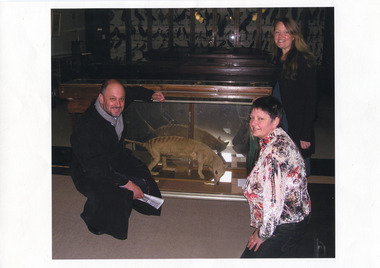
... A man and two women surround the case of the extinct Tasmanian Thylacine at the Burke Museum. They have been identified as Tim Flannery, Linda Peacock and Pam Magennis. ...A man and two women surround the case of the extinct Tasmanian Thylacine at the Burke Museum. They have been identified as Tim Flannery, Linda Peacock and Pam Magennis. ...A man and two women surround the case of the extinct Tasmanian Thylacine at the Burke Museum. They have been identified as Tim Flannery, Linda Peacock and Pam Magennis. Tim Flannery was an orator at the Kerferd Oration and spoke on "The Climate Change Challenge".This photograph is significant both socially and historically. The Kerferd Oration is held every year and speaks on topics that both challenges and encourages members of the community. In 2008 the speaker was Tim Flannery pictured in this photograph. Flannery spoke on the issue of climate change, and how we can better manage the earth and her resources. This makes this photograph particularly interesting as the Tasmanian Thylacine is extinct because of the acts of man (hunting and introduction of foreign species), this photograph therefore sends a message about climate change and subsequent extinction, which makes it a significant item to the community of Beechworth and to the Burke Museum.Coloured rectangular photograph printed on photographic paper.Reverse: 6854burke museum, beechworth, 2008, event, thylacine, taxidermy, late 2000s fashion, museum display, recreation, arts, community, 2008 kerferd oration, the climate change challenge, extinction -
 The Beechworth Burke Museum
Animal specimen - Grey Butcher Bird, Trustees of the Australian Museum, 1860-1880
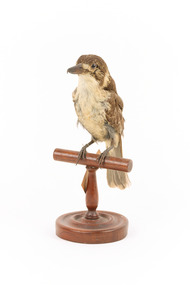
... museum...skin...australian birds...butcher bird...butcherbird...grey butcher bird...collared crow-shrike...australian butcherbird...tasmanian...Many birds in the collection were originally donated in male/female pairs, but at least one specimen has been lost, leaving these as one of the few surviving sets. taxidermy mount taxidermy animalia burke museum beechworth australian museum skin australian birds butcher bird butcherbird grey butcher bird collared crow-shrike australian butcherbird tasmanian butcherbird tasmania bird pair 18a. / Collared Crow. ...Grey Butcherbirds live in wooded habitats, including suburban areas, from the north of Western Australia, across different parts of the top of the country, through to mid-eastern Queensland, and then south along the eastern side of the country all the way down to Tasmania. They have a 'lovely, lilting song', and are fiercely protective of their nests and chicks, swooping at presumed attackers with enough strength to sometimes draw blood. Adult Grey Butcher Birds are typically a light grey colour with dark heads and white underparts. The brown colouring on this animal suggests that it is a young bird, with its grey adult feathers coming in. This bird appears thinner than most Grey Butcher Birds, but it is unclear if this is because of its age or because of inaccurate taxidermy. This specimen is part of a collection of almost 200 animal specimens that were originally acquired as skins from various institutions across Australia, including the Australian Museum in Sydney and the National Museum of Victoria (known as Museums Victoria since 1983), as well as individuals such as amateur anthropologist Reynell Eveleigh Johns between 1860-1880. These skins were then mounted by members of the Burke Museum Committee and put-on display in the formal space of the Museum’s original exhibition hall where they continue to be on display. This display of taxidermy mounts initially served to instruct visitors to the Burke Museum of the natural world around them, today it serves as an insight into the collecting habits of the 19th century.This specimen is part of a significant and rare taxidermy mount collection in the Burke Museum. This collection is scientifically and culturally important for reminding us of how science continues to shape our understanding of the modern world. They demonstrate a capacity to hold evidence of how Australia’s fauna history existed in the past and are potentially important for future environmental research. This collection continues to be on display in the Museum and has become a key part to interpreting the collecting habits of the 19th century. This specimen is particularly special in the Burke Museum Collection as it is part of a male/female pair (see Relationships). Many birds in the collection were originally donated in male/female pairs, but at least one specimen has been lost, leaving these as one of the few surviving sets.This Grey Butcher Bird (likely female, based on size) has a light grey and brown bill with a sharp hook. The majority of the feathers on its back and tail are an olive-brown colour. The feathers of its underparts, the patches on either side of its bill, and two stripes coming up either side of its neck are a yellow-white colour. There are some light grey feathers coming through in small patches, particularly across the back, the top of the underparts, and along the upper half of the legs. The eyes are brown. The bird stands on a brown, wooden perch with a circular bar, curved stand, and circular base. It has an identification tag tied around its right leg.18a. / Collared Crow. Shrike / See Catalogue; Page 10. /taxidermy mount, taxidermy, animalia, burke museum, beechworth, australian museum, skin, australian birds, butcher bird, butcherbird, grey butcher bird, collared crow-shrike, australian butcherbird, tasmanian butcherbird, tasmania, bird pair -
 The Beechworth Burke Museum
Animal specimen - Grey Butcherbird, Trustees of the Australian Museum, 1860-1880
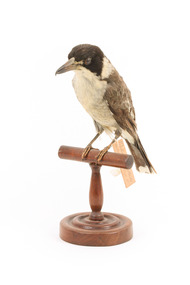
... museum...skin...australian birds...butcher bird...butcherbird...grey butcherbird...collared crow-shrike...australian butcherbird...tasmanian...Many birds in the collection were originally donated in male/female pairs, but at least one specimen has been lost, leaving these as one of the few surviving sets. taxidermy mount taxidermy animalia burke museum beechworth australian museum skin australian birds butcher bird butcherbird grey butcherbird collared crow-shrike australian butcherbird tasmanian butcherbird tasmania bird pair 19a / Collared Crow. ...Grey Butcherbirds live in wooded habitats, including suburban areas, from the north of Western Australia, across different parts of the top of the country, through to mid-eastern Queensland, and then south along the eastern side of the country all the way down to Tasmania. They have a 'lovely, lilting song', and are fiercely protective of their nests and chicks, swooping at presumed attackers with enough strength to sometimes draw blood. Adult Grey Butcher Birds are typically a light grey colour with dark heads and white underparts, while their young are typically olive-brown. The mix of these two types of colouring on this animal suggests that it is a younger bird. This bird appears thinner than most Grey Butcher Birds, but it is unclear if this is because of its age or because of inaccurate taxidermy. This specimen is part of a collection of almost 200 animal specimens that were originally acquired as skins from various institutions across Australia, including the Australian Museum in Sydney and the National Museum of Victoria (known as Museums Victoria since 1983), as well as individuals such as amateur anthropologist Reynell Eveleigh Johns between 1860-1880. These skins were then mounted by members of the Burke Museum Committee and put-on display in the formal space of the Museum’s original exhibition hall where they continue to be on display. This display of taxidermy mounts initially served to instruct visitors to the Burke Museum of the natural world around them, today it serves as an insight into the collecting habits of the 19th century.This specimen is part of a significant and rare taxidermy mount collection in the Burke Museum. This collection is scientifically and culturally important for reminding us of how science continues to shape our understanding of the modern world. They demonstrate a capacity to hold evidence of how Australia’s fauna history existed in the past and are potentially important for future environmental research. This collection continues to be on display in the Museum and has become a key part to interpreting the collecting habits of the 19th century. This specimen is particularly special in the Burke Museum Collection as it is part of a male/female pair (see Relationships). Many birds in the collection were originally donated in male/female pairs, but at least one specimen has been lost, leaving these as one of the few surviving sets.This Grey Butcherbird (likely male, based on size) has a bill that is dark grey at the front with a sharp hook but becomes lighter towards the face. The majority of the feathers on its back are light brown with some grey feathers around the lower half. It's crown area is a dark black colour and its tail is a dark grey. The feathers of its underparts and a small patch on either side of the neck are a yellow-white colour. There are also grey feathers coming through on its underparts. The eyes are brown. The bird stands on a brown, wooden perch with a circular bar, curved stand, and circular base. It has an identification tag tied around its left leg.19a / Collared Crow. Shrike / See Catalogue, Page 10 /taxidermy mount, taxidermy, animalia, burke museum, beechworth, australian museum, skin, australian birds, butcher bird, butcherbird, grey butcherbird, collared crow-shrike, australian butcherbird, tasmanian butcherbird, tasmania, bird pair -
 The Beechworth Burke Museum
Animal specimen - Australian masked owl, Trustees of the Australian Museum, 1860-1880
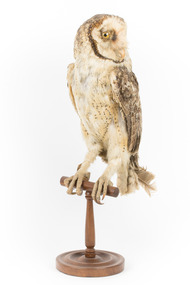
... museum...owls...birds of prey...heart-shaped faced owl...nocturnal birds...predator birds...barn owl...carnivore...tyto novaehollandiae...australian masked owl...tytonidae...tyto...territorial owl...threatened species...animalia...australian owls...tasmanian...Tasmanian Masked Owl is the largest. Female Masked Owls are markedly larger than males. Masked Owls prefer forested, woodland, or timbered waterway habitats to open country, and nest in tall trees with suitable hollows and adjacent areas for foraging. They are territorial and hunt small mammals, rodents, rabbits, reptiles and small marsupials. Population numbers are in decline on the mainland and in Victoria the species is considered threatened. This specimen is part of a collection of almost 200 animal specimens that were originally acquired as skins from various institutions across Australia, including the Australian Museum...This collection continues to be on display in the Museum and has become a key part to interpreting the collecting habits of the 19th century. taxidermy taxidermy mount masked owl burke museum australian museum owls birds of prey heart-shaped faced owl nocturnal birds predator birds barn owl carnivore tyto novaehollandiae australian masked owl tytonidae tyto territorial owl threatened species animalia australian owls tasmanian masked owl 12. / Delicate Owl / See Catalogue, page, 3 / This Masked Owl specimen is medium sized with a large head and distinctive heart-shaped facial markings. ...Australian masked owls are an Australian barn owl species ranging across most of mainland Australia and Tasmania, generally within 300 km of coastline. Masked Owls are a medium sized bird averaging 390-500mm in length with wing spans up to 1250mm. There are several subspecies across Australia and the Tasmanian Masked Owl is the largest. Female Masked Owls are markedly larger than males. Masked Owls prefer forested, woodland, or timbered waterway habitats to open country, and nest in tall trees with suitable hollows and adjacent areas for foraging. They are territorial and hunt small mammals, rodents, rabbits, reptiles and small marsupials. Population numbers are in decline on the mainland and in Victoria the species is considered threatened. This specimen is part of a collection of almost 200 animal specimens that were originally acquired as skins from various institutions across Australia, including the Australian Museum in Sydney and the National Museum of Victoria (known as Museums Victoria since 1983), as well as individuals such as amateur anthropologist Reynell Eveleigh Johns between 1860-1880. These skins were then mounted by members of the Burke Museum Committee and put-on display in the formal space of the Museum’s original exhibition hall where they continue to be on display. This display of taxidermy mounts initially served to instruct visitors to the Burke Museum of the natural world around them, today it serves as an insight into the collecting habits of the 19th century.This specimen is part of a significant and rare taxidermy mount collection in the Burke Museum. This collection is scientifically and culturally important for reminding us of how science continues to shape our understanding of the modern world. They demonstrate a capacity to hold evidence of how Australia’s fauna history existed in the past and are potentially important for future environmental research. This collection continues to be on display in the Museum and has become a key part to interpreting the collecting habits of the 19th century. This Masked Owl specimen is medium sized with a large head and distinctive heart-shaped facial markings. The plumage is mostly brown, patterned with flecks and patches of white, chestnut and light grey. The tail is short and largely concealed by long wing feathers. The face, feathered tarsi and underparts are much paler in contrast to the dorsal plumage, and the facial mask is edged by a distinct dark brown line. The eyes are large and yellow. This specimen stands on a wooden perch pedestal with identification tags attached to its leg. 12. / Delicate Owl / See Catalogue, page, 3 /taxidermy, taxidermy mount, masked owl, burke museum, australian museum, owls, birds of prey, heart-shaped faced owl, nocturnal birds, predator birds, barn owl, carnivore, tyto novaehollandiae, australian masked owl, tytonidae, tyto, territorial owl, threatened species, animalia, australian owls, tasmanian masked owl
