
Showing 89 items matching " theatre royal melbourne"
-
 Bendigo Historical Society Inc.
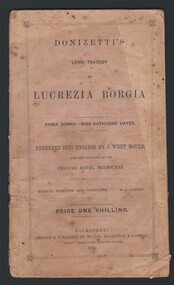
Document - WES HARRY COLLECTION: DONIZETTI'S LUCREZIA BORGIA, 1855
... ... Theatre Royal Melbourne...Wrey Mould, and now produced at the Theatre Royal, Melbourne. Musical Director and Conductor -- M. ...Wrey Mould, and now produced at the Theatre Royal, Melbourne. Musical Director and Conductor -- M. ...Booklet of 24 pages containing the score of ' Donizetti's lyric Tragedy of Lucrezia Borgia, Prima Donna -- Miss Catherine Hayes. Rendered into English by J. Wrey Mould, and now produced at the Theatre Royal, Melbourne. Musical Director and Conductor -- M. L. Lavenu. Printed and published by Wilson Mackinnon & Fairfax 'Argus' Mercantile Printing Office.entertainment, opera, donizetti, lucrezia borgia, catherine hayes, j. wrey mould, theatre royal melbourne, wilson mackinnon and fairfax, argus mercantile printing office -
 Bendigo Historical Society Inc.
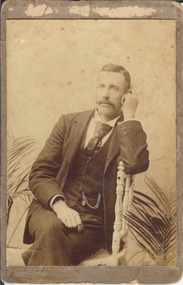
Photograph - MALE PORTRAIT, approx. 1920
... Yeoman & Co., next to Theatre Royal, Melbourne....PERSON Individual portrait male Yeoman & Co., next to Theatre Royal, Melbourne. sepia toned photo of male seated on cane and wooden chair. ...sepia toned photo of male seated on cane and wooden chair. Dressed in pin striped 3 piece suit. Fob watch chain to vest. 2 buttons on sleeve, cravat at neck of shirt with horse shoe pin in knot. Signet ring on left hand little finger. Palms beside chair. 467 in lead pencil on back.Yeoman & Co., next to Theatre Royal, Melbourne.person, individual, portrait male -
 Cinema and Theatre Historical Society of Australia Inc.
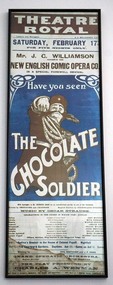
The Chocolate Soldier Poster
... Framed advertising poster for The Chocolate Soldier at the Theatre Royal, Melbourne Saturday 17 February 1912...Framed advertising poster for The Chocolate Soldier at the Theatre Royal, Melbourne Saturday 17 February 1912 The Chocolate Soldier Poster ...Framed advertising poster for The Chocolate Soldier at the Theatre Royal, Melbourne Saturday 17 February 1912 -
 Whitehorse Historical Society Inc.
Article, Colton, Ada, 1991 - 1993
... Theatre...Melbourne...Princess Theatre...Melbourne...Theatre Royal...Colton Ada Alma Terrace Newport No 74 Jamieson Norma Lucas Georgina Elizabeth Bijou Theatre Melbourne Princess Theatre Melbourne Theatre Royal Melbourne Performing Arts Museum Melbourne Colton James Article from 'Women of Williamstown' re Ada Colton, wardrobe mistress and dress maker written by niece Norma Jamieson. ...Article from 'Women of Williamstown' re Ada Colton, wardrobe mistress and dress maker written by niece Norma Jamieson.Article from 'Women of Williamstown' re Ada Colton, wardrobe mistress and dress maker written by niece Norma Jamieson. Ada's father worked as a diver at Williamstown, her mother was a mid-wife. In the 1890's moved to Vermont, bought an orchard and the children attended Vermont Primary School at the beginning of the century. Some of Ada's costumes are held by the Performing Arts Museum. She died 1965 and is buried at Williamstown Cemetery. Also letter to Norma Jamieson from Performing Arts Museum. Photocopy of photo of James Colton 1900 - 1910. Copy of photo of family - Georgina with James and Ada.Article from 'Women of Williamstown' re Ada Colton, wardrobe mistress and dress maker written by niece Norma Jamieson. colton, ada, alma terrace newport, no 74, jamieson, norma, lucas, georgina elizabeth, bijou theatre, melbourne, princess theatre, melbourne, theatre royal, melbourne, performing arts museum, melbourne, colton, james -
 Deaf Children Australia
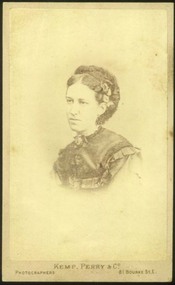
Photograph, Portrait of a woman, 1873-1875
... ./2 doors East of/THEATRE ROYAL/MELBOURNE' / 'PHOTOGRAPHIC COPIES & PORTRAITS IN OILS & WATER COLORS/CAN BE HAD FROM THIS CARD.' ..../2 doors East of/THEATRE ROYAL/MELBOURNE' / 'PHOTOGRAPHIC COPIES & PORTRAITS IN OILS & WATER COLORS/CAN BE HAD FROM THIS CARD.' ...A sepia coloured portrait of a woman on card. On back 'KEMP, PERRY & CO/Artists and Photographers./81 BOURKE ST. EAST./2 doors East of/THEATRE ROYAL/MELBOURNE' / 'PHOTOGRAPHIC COPIES & PORTRAITS IN OILS & WATER COLORS/CAN BE HAD FROM THIS CARD.' deaf children australia, victorian deaf & dumb institution -
 Victoria Police Museum
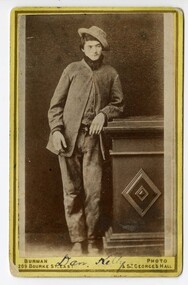
Carte de Visite (Dan Kelly standing), Dan Kelly (standing)
... St Georges Hall Next to Theatre Royal Melbourne. Portraits Enlarged, Copied or Colored. ...St Georges Hall Next to Theatre Royal Melbourne. Portraits Enlarged, Copied or Colored. ...Carte-de-visite is a small black and white photograph stuck to a card. It was invented by French photographer Andre Disderi in 1854 as a method for producing multiple images on a single glass plate, a format for mounting the resulting images on cards. The card on which the photograph was mounted displayed the name of the photographer on the front and back. The back was often a showy piece of lithographic printing with the photographer's name decorated with culicues.Sepia toned photograph on card showing Dan Kelly with left arm resting on a pillar."Burman Photo 200 Bourke St - East & St Georges Hall" (under photograph). "From Burman's Photographic Rooms 209 Bourke Street. East Near parliament Houses. St Georges Hall Next to Theatre Royal Melbourne. Portraits Enlarged, Copied or Colored. Views taken in any part of Victoria. Copies of this can be had at any time: (on rear) "Dan Kelly" (handwritten in ink underneath image on front of card)dan kelly, kelly gang, ned kelly, carte-de-visite, burman -
 Victoria Police Museum
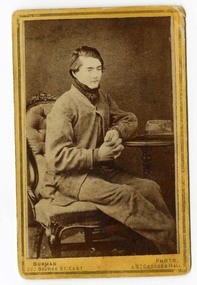
Carte de Visite (Dan Kelly seated), Dan Kelly
... "Burman Photo 200 Bourke St East & St Georges Hall (under photograph), "From Burman's Photographic Rooms 209 Bourke Street, East Near Parliament Houses. st Georges Hall Next to Theatre Royal Melbourne. Portraits Enlarged, Copied or Colored. ...The back was often a showy piece of lithographic printing with the photographer's name decorated with culicues. dan kelly kelly gang ned kelly carte-de-visite burman "Burman Photo 200 Bourke St East & St Georges Hall (under photograph), "From Burman's Photographic Rooms 209 Bourke Street, East Near Parliament Houses. st Georges Hall Next to Theatre Royal Melbourne. Portraits Enlarged, Copied or Colored. ...Carte-de-visite is a small black and white photograph stuck to a card. It was invented by French photographer Andre Disderi in 1854 as a method for producing multiple images on a single glass plate, a format for mounting the resulting images on cards. The card on which the photograph was mounted displayed the name of the photographer on the front and back. The back was often a showy piece of lithographic printing with the photographer's name decorated with culicues.Sepia toned photograph on cardboard showing Dan Kelly sitting "Burman Photo 200 Bourke St East & St Georges Hall (under photograph), "From Burman's Photographic Rooms 209 Bourke Street, East Near Parliament Houses. st Georges Hall Next to Theatre Royal Melbourne. Portraits Enlarged, Copied or Colored. Views taken in any part of Victoria. Copies of this can be had at any time" (on rear), "Dan Kelly" (on rear along left side in black ink), "204" (written in pencil at top left corner)dan kelly, kelly gang, ned kelly, carte-de-visite, burman -
 City of Melbourne Libraries
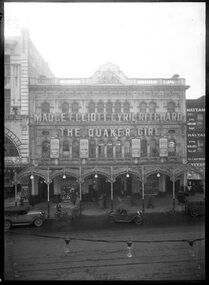
Photograph, Bull, Hugh Jones, 1897-1993, Theatre Royal, Bourke Street
... Melbourne...Manton's department store...Theatre Royal...Closing time for the Theatre Royal Melbourne’s Theatre Royal opened 16 July 1855 at 236 Bourke Street, between Swanston and Russell, in the heart of the city’s entertainment district and it was comparable in size to London’s Drury Lane and Covent Garden. ...Closing time for the Theatre Royal Melbourne’s Theatre Royal opened 16 July 1855 at 236 Bourke Street, between Swanston and Russell, in the heart of the city’s entertainment district and it was comparable in size to London’s Drury Lane and Covent Garden. ...Closing time for the Theatre Royal Melbourne’s Theatre Royal opened 16 July 1855 at 236 Bourke Street, between Swanston and Russell, in the heart of the city’s entertainment district and it was comparable in size to London’s Drury Lane and Covent Garden. It was rebuilt in 1872 following a fire, remodelled in 1904, and demolished in 1933, due in part to the Great Depression, and also to the growing popularity of moving pictures. On the site was erected Manton’s department store, then Coles, Target, and now Kmart. The Quaker Girl, a 1910 Edwardian musical comedy with long running success in London, Paris and Broadway, opened in Melbourne at the Theatre Royal on 22 July 1933. Stars Cyril Ritchard and Madge Elliott were to become husband and wife, their Sydney wedding photograph now an iconic Australian image of that time. The theatre closed 13 November 1933. MCK080 Published: The Age 4 November 1933 Featured in "Newsworthy: Melbourne in photographs 1933-1936" exhibition at East Melbourne Library, October to December 2023. Exhibition caption by project volunteer, Louise McKenzie. THEATRE ROYAL (1933, November 4). The Age (Melbourne, Vic. : 1854 - 1954), p. 5. Retrieved October 16, 2025, from http://nla.gov.au/nla.news-article203364238 Additional research by project volunteer, Fiona Collyer and librarian, Fiona Campbell: The Theatre Royal closed on 13 November 1933. During demolition in December, a worker was pinned by the legs under two tons of collapsing ceiling concrete. Miraculously he escaped with only a broken leg. A commemorative plaque was unveiled in 1937, displayed at the front of Manton's department store. The event was covered in The Age on 20 Dec 1937. It was a beautiful blue enamel and brass with the comedy and tragedy masks, one crying and one laughing, at the top with a timeline of the theatre underneath. Its whereabouts became unknown after the multiple changes with department stores on the site. In 2019 Greg Sampson set out on a mission to find it and in 2021 eventually tracked it down, on a wall behind the door of a staff tea room in Kmart. After much arduous lobbying by Greg it was eventually relocated to the Kmart arcade on the site where the Theatre Royal was originally located. Annette Cooper's history of Manton's and the Bourke Street site described the process of acquisition and demolition of the theatre: "Around 1933, the theatre came on the market – ‘a gift from heaven’ for its enterprising neighbours. Manton’s acquired the theatre and started planning for its demolition to enable the expansion of the store. William Manton and his sons, Jack and Ivor, watched the final production at the theatre, Harold Fraser-Simson’s musical comedy The Maid of the Mountains. 'It was, for the theatre-goers, a nostalgic last appearance, an emotional night, the end of an era. There were those who were mortified at the prospect of a store taking the place of their palace of dreams.' Even Whelan the Wrecker sensed the importance of the occasion and donated four bricks from the theatre to the National Museum of Victoria. They are the oldest bricks in the museum’s collection and form part of its Whelan the Wrecker collection." UNDER BIG FALL OF CONCRETE (1933, December 8). The Herald (Melbourne, Vic. : 1861 - 1954), p. 1. Retrieved April 14, 2026, from http://nla.gov.au/nla.news-article243215969 The Relocation of the Theatre Royal Plaque, Greg Sampson, https://theatreheritage.org.au/on-stage-magazine/news/item/989-the-relocation-of-the-theatre-royal-plaque Photo of theatre interior, Arts Centre Melbourne, https://collections.artscentremelbourne.com.au/#details=ecatalogue.184409 OLD THEATRE ROYAL (1937, December 20). The Age (Melbourne, Vic. : 1854 - 1954), p. 10. Retrieved March 25, 2026, from http://nla.gov.au/nla.news-article205554847 AMATEUR ATHLETICS -- LIFE SAVING DISPLAY MEMORIAL PLAQUE UNVEILED (1937, December 20). The Age (Melbourne, Vic. : 1854 - 1954), p. 15. Retrieved March 25, 2026, from http://nla.gov.au/nla.news-article205554863 It's smart to be thrifty: the story of Manton's department store, Annette Cooper, https://www.slv.vic.gov.au/sites/default/files/3%20Annette%20Cooper%20-%20It%E2%80%99s%20smart%20to%20be%20thrifty%2C%20the%20story%20of%20Manton%27s%20department%20store.pdfPhotographer notations on slide: "Theatre Royale 1933 B4". theatres, 1930-1939, fires, musicals, films, department stores, demolished buildings, commemorative plaques, incidents, concrete, whelan the wrecker, bricks, kmart, bourke street melbourne, manton's department store, theatre royal, coles, target -
 Federation University Historical Collection
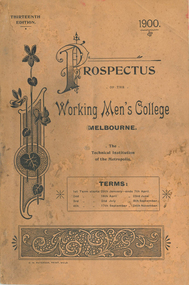
Book - Book - Prospectus, The Working Men's College Melbourne, Prospectus,1900, 1900
... Royal Melbourne Institute of Technology [RMIT]). It inlcudes the following photographic images: Main Building, Assaying, 1899 council (W.C. Kernot, W.H. Embling, Thomas smith, F.H. Bromley, John Reid, R.H. Solly, E. Findley, D. McIvor, James Robb, John Hancock, C.E. Oliver, A.J. Arnot, James Smith, Joseph Nixon, R.L.Jellery. C.S. Paterson), UNveiling the Ormond Statue, Victorian Lead and Shot Works, Francis Ormond, Telegraphy room, Lecture Theatre...Royal Melbourne Institute of Technology [RMIT]). It inlcudes the following photographic images: Main Building, Assaying, 1899 council (W.C. Kernot, W.H. Embling, Thomas smith, F.H. Bromley, John Reid, R.H. Solly, E. Findley, D. McIvor, James Robb, John Hancock, C.E. Oliver, A.J. Arnot, James Smith, Joseph Nixon, R.L.Jellery. C.S. Paterson), UNveiling the Ormond Statue, Victorian Lead and Shot Works, Francis Ormond, Telegraphy room, Lecture Theatre ...The Working Men’s College was founded in 1881 by a prominent grazier and philanthropist, The Hon. Francis Ormond, who donated £5000 towards the establishment of the college. The Council of the Melbourne Trades Hall then matched Ormond's initial donation by rallying its members. On 4 June 1887, the college opened in its purpose-built building on the corners of Bowen Street and La Trobe Street in Melbourne, with a gala ceremony. It became the third official provider of higher education in the new Colony of Victoria (the Melbourne Athenaeum was founded in 1839 and the University of Melbourne in 1853). The college was the predecessor to the current-day Royal Melbourne Institute of Technology (RMIT University). Adjoining the college in the 1890s were the Supreme Court of Victoria (later the Melbourne Magistrates' Court) and the Melbourne Gaol - both which are now part of RMIT today. A list of Scholarship Governors and Life Governors is included. The former have donated 250 Pounds Sterling and upwards, the later have donated 20 Pounds and over but less than 250 Pounds Sterling. The Patron of The Working Men's College was His Excellency The Right Honourable Lord Brassey. The President of the Council was Professor W C Kernot. The majority of classes were at night and on Saturdays. Tan soft covered book of 112 pages. The thirteenth edition of the Working Men's College (later Royal Melbourne Institute of Technology [RMIT]). It inlcudes the following photographic images: Main Building, Assaying, 1899 council (W.C. Kernot, W.H. Embling, Thomas smith, F.H. Bromley, John Reid, R.H. Solly, E. Findley, D. McIvor, James Robb, John Hancock, C.E. Oliver, A.J. Arnot, James Smith, Joseph Nixon, R.L.Jellery. C.S. Paterson), UNveiling the Ormond Statue, Victorian Lead and Shot Works, Francis Ormond, Telegraphy room, Lecture Theatre, photography, painting class, wool sorting, plumbing, Remington typewriter, W. Ison, H.D. Evans, library, Verdon prize, Denton Hat Mills. working men's college melbourne, rmit, w.c. kernot, w.h. embling, ormond statue, f. ormond, electricity, surveying, architecture, photography, assaying, dressmaking, veterinary science, plumbing, letterpress printing, w. ison, h.d. evans, library, denton hat mills, literary and commercial department, typewriting department, languages, telegraphy, department of music, department of mathematics, department of engineering, 'department of architecture, department of art and applied art, department of mining and metallurgy, department of chemistry, department of household economy, department of agriculture and rural industries, woodworking, carpentry and joinery, turning and fitting, coachbuilding and carriagedrafting -
B-24 Liberator Memorial Restoration Australia Inc
Oral History, 356 Wings Over Salbani, 2002-2005
... Theatre flying B-24 Liberator aircraft. Oral History RAAF World War II 356 Wings Over Salbani. Pilot Officer Geoffrey Charles Piper 410373. Royal Australian Air Force Date of Enlistment: 6 December 1941 Melbourne Per Ardua Ad Astra " Through Difficulties to the Stars" on a Printed map background. ...G. Piper was in the RAAF from December 1941 until March 1946 and was a B-24 Liberator pilot between May 1944 and July 1945 with 356 Squadron.This oral history of Geoffrey Piper is of historical significance because it provides a first hand account of the individual's experience during World War II as a member of the RAAF who trained at Benalla, Deniliquin,Essendon,Mallala,Long Newnton,Harwell and Kolar.He saw active service in the ACSEA Theatre flying B-24 Liberator aircraft.Paper printed transcript booklet with central staples.356 Wings Over Salbani. Pilot Officer Geoffrey Charles Piper 410373. Royal Australian Air Force Date of Enlistment: 6 December 1941 Melbourne Per Ardua Ad Astra " Through Difficulties to the Stars" on a Printed map background.oral history raaf world war ii -
 Bendigo Historical Society Inc.
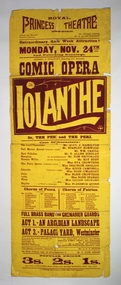
Ephemera - Royal Princes Theatre poster, 1902
... Royal Princess Theatre in Bendigo on Monday November 24th, 1902, and following evenings for a week. Lessee and manager Mr Hyman White. General Director Allen Bindley Performers Mr Alex J Hamilton, Stanley Horwood, William Cahill, E Allen Bindley, Tom Pritchard, Roy Eddy, Eva Crother, Beatrice English, Addie Campbellm, Rose O'Mahony, Elsie Crowther, Rose Spargo, Lilian Orchard, Florence Quinn. Printed by J. J. Miller Show Print Co. off Post Office Place Melbourne...Royal Princess Theatre Iolanthe Comic Opera Deep yellow poster with maroon printing, advertising a performance of "Iolanthe" at the Royal Princess Theatre in Bendigo on Monday November 24th, 1902, and following evenings for a week. Lessee and manager Mr Hyman White. General Director Allen Bindley Performers Mr Alex J Hamilton, Stanley Horwood, William Cahill, E Allen Bindley, Tom Pritchard, Roy Eddy, Eva Crother, Beatrice English, Addie Campbellm, Rose O'Mahony, Elsie Crowther, Rose Spargo, Lilian Orchard, Florence Quinn. Printed by J. J. Miller Show Print Co. off Post Office Place Melbourne ...Deep yellow poster with maroon printing, advertising a performance of "Iolanthe" at the Royal Princess Theatre in Bendigo on Monday November 24th, 1902, and following evenings for a week. Lessee and manager Mr Hyman White. General Director Allen Bindley Performers Mr Alex J Hamilton, Stanley Horwood, William Cahill, E Allen Bindley, Tom Pritchard, Roy Eddy, Eva Crother, Beatrice English, Addie Campbellm, Rose O'Mahony, Elsie Crowther, Rose Spargo, Lilian Orchard, Florence Quinn. Printed by J. J. Miller Show Print Co. off Post Office Place Melbourneadvertising, royal princess theatre, iolanthe, comic opera -
 Bendigo Historical Society Inc.
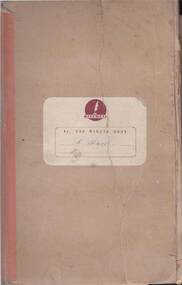
Book - BENDIGO REPERTORY SOCIETY SCRAP BOOK
... Melbourne to found a drama group here. In 1930 the group took the name of Bendigo Repertory Society and presented its first public production, 'The Rat Trap' by Noel Coward. Page 3 and 4 have black white photos taken from 1929 Illustrated Tasmanian Mail -of the play The Vortex -at the Theatre Royal by Noel Coward...Melbourne to found a drama group here. In 1930 the group took the name of Bendigo Repertory Society and presented its first public production, 'The Rat Trap' by Noel Coward. Page 3 and 4 have black white photos taken from 1929 Illustrated Tasmanian Mail -of the play The Vortex -at the Theatre Royal by Noel Coward Book BENDIGO REPERTORY SOCIETY SCRAP BOOK ...Cardboard backed , cloth bound , Ritewell No 248 Minute Book (M ?) Hall written in blue ink The Bendigo Repertory Society, paper cuttings from 1929- 1970's was formed in 1929 when at the invitation of Mr. G. Hall, Mr.J.Beresford Fowler came up from Melbourne to found a drama group here. In 1930 the group took the name of Bendigo Repertory Society and presented its first public production, 'The Rat Trap' by Noel Coward. Page 3 and 4 have black white photos taken from 1929 Illustrated Tasmanian Mail -of the play The Vortex -at the Theatre Royal by Noel CowardH.Hallbendigo repertory society, j. beresford fowler, g. hall -
 Bendigo Historical Society Inc.
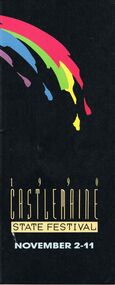
Document - CASTLEMAINE STATE FESTIVAL, CASTLEMAINE, 2 November 1990
... Melbourne Symphony Orchestra... Condustor - Hiroyuki Iwaki... Soloist - Dong -Suk Kang. Royal Variety Club Grand Final Theatre Royal...Melbourne Symphony Orchestra, Conductor - Hiroyuki Iwaki, Soloist - Dong -Suk Kang. Royal Variety Club Grand Final Theatre Royal, Town Crier Mr Neville Stonehouse. ...Melbourne Symphony Orchestra Condustor - Hiroyuki Iwaki Soloist - Dong -Suk Kang. Royal Variety Club Grand Final Theatre Royal Town Crier Mr Neville Stonehouse. ...Castlemaine State Festival, Castlemaine. 2 November 1990. Programme. From the Chairmen - Mr Bereck Segan. Melbourne Committee: B R Segan, O.B.E. (Chairman), M Besen, A.O. (Deputy Chairman), Mrs H Dore (Hon. Sec.), C Anzarut, N Bourke, Ms M Coillet, Prof. C Duckworth, G Fairfax, A.M., K MacKenzie-Forbes, A.M., Mrs B Margetts, Dr F R Moulds, I.S.O., R Nordlinger, J Parker, M.B.E., A Porter, Ms M Prendergast, C Pyett, Ms D Reilly, Mrs, Ms L Schiftan, P M Schiftan, D Segan, B J Stewart, Ms S Walker, Dr R Wlikie. Melbourne Committee: I O'Halloran, (Chairman), Mrs M Rilen (Hon.Sec.), Miss R Wood (Treas), Mrs L Bennet, Mrs M Bock, S Cox, Cr T Daniell, Mrs H Griffiths, B Heydon, N Jennings, Mrs C McKellar, Miss M Oliver, L O'Toole, F Ransome-Smith, J Shortal, Dr D Silver, Mrs V Victor-Gordon, Mes E Warren, Miss L Waters. Welcome to the 1990 Castlemaine State Festival. As one festival closes, planning for the next commences immediately.. . Mr Ian O'Halloran, Chairman, Castlemaine. Castlemaine State Festival Administration, Festival Manager: Phee Broadway, Manager's Assistant: Mary Harris, Technical Manager: Lis Pain, Drawing Prize Co-ordinator: Bev Singleton, Farnham Concert Co-Ordinator: Noel Jennings with Victorian Rock Foundation. Event Listings: Opening by Hon. Jim Kennan M.P., Deputy Premier and Minister for the Arts Castlemaine Stadium. Melbourne Symphony Orchestra, Conductor - Hiroyuki Iwaki, Soloist - Dong -Suk Kang. Royal Variety Club Grand Final Theatre Royal, Town Crier Mr Neville Stonehouse. Kilmna Wildflower Walk. 'Melbourne: Architecture Today and the year 2000' Professor Peter McIntyre, A.O. Wine tasting. Selected Antique Fair. Organ Recital, organist Michael Bottomly. Mickleford Tour. A Closer Look at Castlemaine, Castlemaine Historical Society. 'Local Brew' Love Letters by A R Gurney, Starring Julia Blake and Terry Norris Directed by George Fairfax A.M. The Noel Watson Show. John Pringle and Miriam Gormley sing Operatic Gems with the Rantos Collegium and conductor Nicholas Braithwaite. The Incredible Shrinking Mortgage Show', Pat Wilson and Adrian Barnes. Festival Nightcap, Mr P P an acrobatic delight. Breakfast with Potts in the Park. A Stroll Around Town, Historical Society guide. Gardens Open. Selected Antique Fair. Festive Family Fun, musician Natasha Moszenin, Fratellini Brothers, Tim Hurley, Wally Fair Ground Organ, Foundry Band, Megan Jones, Mr P P. A guided Tour, Mrs Marjorie Rilen. Goetz Richter - Violin, Jeanett Carrigan - Piano. 'King Lear', Berenice Kavanagh and Suzanne Kersten. The Chagell Ensemble, Rita Reichman, Piano, Semmy Stalhammer, Violin. Trevor Jones, Viola. David Pereira, Cello. Steven Reeves, Double Bass. 'The Incredible Shrinking Mortagage Show' Pat Wilson and Adrian Barnes. Festival Hymns. 'Recital' Hellen Noonan, Douglas Horton, David Chesworth, Jacqui Everett, Jude Gunson. Music for Flute and Piano, Dereck Jones - Flute, Jeanell Carrigan - Piano. 'Brass With Class' William Evans - trumpet, David Farrend - trumpet, Russell Davis - french horn, Ken McClimont - trombone, Eric Klay - bass trombone. Piano Recital - Richard Mapp. Chris Ludwick's Society Synocopators - Cup Eve Cabaret, Chris Ludowyk - trombone, Peter Gaudion- Trumpet, Richard Miller - reeds, Pip Avent - tuba, Cal Duffy's - drums. 'Cup Eve Comedy' Rachel Berger and Richard Stubbs. Festival Nightcap Mr P P. Botanical Gardens Tour Kevin Walsh. Alice's Adventures in Wonderland Glenn Elston. By arrangement with Feipp and Park Projects and Elston, Hocking and Woods Pty Ltd. Family Concert, Piano for 4 hands Jocelyn Abbott and Richard Mapp, actor Justin Shortal. Cup Day Sports Carnival. Fashion Parade, luncheon available at Georgians in George Clark Place. The Melba Trio, Carolyn Hayes - Oboe, Jane Stacvy - cor anglais, Seng Tong - Oboe. 'Images' Prudence Davis - flute, Jeffrey Crellin - oboe, Peter Lynch - guitar. 'Sounds in Time' Andree Cozens - soprano, Berenice Kavanagh - words, Dudley - Simons - piano, John Snowden - Guitar, Peter Taylor - Set design & lighting. 'Music for Celestial Voices' Laurence - Jenkins - organ, Mary Anderson - harp, Margot Anderson - harp, Margot Cory - soprano. 'Proms for Preps' Nehama Patkin. Organ Recital Keeith Bottomley. Kaweka Walk, Kaweka Reserve Committee. 'Camille Claudel'. The Tudor Choristers Musical Director - John O'Donnell. 'Something for Everyone' Nehama Patkin - piano, guitar and voice, Peter Clinch - saxaphone and clarinet, major Australian Orchastras. 'The Dock Brief' & 'What Shall We Tell Caroline' Neville Stonehouse, Kay Barker, David Bickart, Angela Walter. 'Bluebeard' The Rag & Bone Theatre Company. Poedijono and the Javanese Gamelan, Poedijono (Teacher), musician, dancer and puppeteer. Botanical Gardens Tour, Kevin Walsh, horticulturist and garden writer. 'Music through the Ages' 'Pizzicato' - classical guitar ensemble, Castlemaine Courthouse, Bruce Millar, Meryl Wilkinson, Greg Wilkinson, Greg James, Joan Maher, Danny Silver. Bach and Vivaldi - Elysium Ensemble Greg Dikmans - Art Director, flute & recorder, Julie Hewison - violin, Lucinda Moon - violin, Janet Ferandez - viola, Miriam Morris - cello, Rosemanry Westbrook - double bass, John O'Donnell - harpsichord. 'Handle by Candle' Laurence Jenkins. Sarah Grunstein at the Piano, Sarah Grunstein. 'Let the Children Sing' Castlemaine Children's Choir, director Michael Bottomley, soloist Peter Bottomley. 'Made in Australia' Phillip Day, Bruce Waston, & 'Twankydillo'. The Dancers Company of the Australian Ballet, Les Sylphides, Dame Peggy van Praagh, Sir John Betjeman, Robert Ray. 'The Wooden Child' Handspan Theatre, Douglass Horton, Ken Evans, Andre Greenwell, Peter J Wilson, Philip Lethean. Botanic Gardens Tour Kevin Walsh. Divine Accidents and Heavenly Venues' William (Bill) Akers, A.M., Director of Productions, Australian Ballet. Jazz at the Jail. Another Stroll round Castlemaine, Historical Society. Muckleford Tour, Naturalists Club. 'Sketches' The Argus Guitar Quartet, Jochen Sxhubert, Tania Ravbar, Samantha Tout, Chi Ly.Scores for Instruments and Voices, Phylis Bachelor. Fred Shade, flute; Mara Miller, Violin; Len Vorster, piano; Loris Synan, soprano; and the students of the Faculty of Music, Melbourne University. Music for Four Hands at One Keyboard, Jocelyn Abbot and Richard Mapp. Paul Grabowsky and the Groovematics, Paul Graboesky, piano. Andrew Gander, Drums. Doug de Vries, guitar. Bob Venier, Trumpet, Flugelhorn. Ian Chaplin, saxophone. Garry Costello, double bass. Shelley Scown, vocals. 'My Most Loved Songs' David Bickart - Basso. Chapliapin, McEachern, Pinza, Robeson, Dawson. A Stroll Around Town, Historical Society. Breakfast at Buda. Garden Open. Festival Eucharist, choir and orchestra Directed by Kevin Bottomley. Music, Madness, Magic. Itchy Feet Pep Band, 'Sound Steppers', 'Legs on the Wall', Andrew Elliot, Antebodies. A Guided Tour of Angligan Parish Church. John Farnham in Concert, The Chain Reaction Tour. John Farnham. Exhibitions: Aspects of France: The Australian Artist's View. Artsits include John Russell, Lloyd Rees, David Davies, John Dent, Eric Wilson, E Phillips Fox, Ethal Carrick, Rupert Bunny, Max Meldrum, Will Ashton, George Bell and others. Annemieke Mein: Embroidery and Applique. Castlemaine Artists Incorporated 6th Biennial Exhibition. Dominique Segan Castlemaine State Festival Drawing Prize 1990. 'Provocative Pieces'. 'Feathered Friends' Barbara Muir. Through the Looking Glass. Handmade - For Pleasure, Julie Cook - dolls and puppets; Traude Beilharz - hats; Gwen Cook - embroidery; Erika Beilharz - woven pieces. 'High Art' students of Castlemaine. 'Works in Wood' Laurie Vella. Old Telegraph Station, Pioneers and Old Residents Association, Jubilee booklet on sale. Studio Exhibition, Juliana Hilton: Prints, paintings decorated screens and furniture. Val Restarick: Pottery and outdoor planters. 2nd Biennial Ernest Leviny Commemorative Silver Exhibition, leading contemporary silversmiths; Hendrick Foster, Tony Kean, Mike Wilson, Flynn Bros, Andrew Last, Mark Edgoose, Peter Gerter, Beatrice Schlabowsly, Marian Hoskings, Karyn Kirby, Chris Sherwin, Peter McBride, Fran Allison. Ray Stanyer - Ceramic Paintings. Norman Anderson - Water Colour Studies. 'Australian & Baroque' David Terry. 'Mediterranean Images' Val Restarick. Framing Shop, Brian Harding. Exhibition of Women Artists, Liz Caffin, Mary Quinlton, Debra Watkins, Lorraine Le Plastrier. Maine Images, Jacki Bickart, Valarie Blake, Sue Breeney, Kate Burtchell, Janet Chapman, Diana Davidson, Betty Hall, Deidre Hull, Molly Maddox, Norma McKenzie, Beth Oag, Rhyll Plant, Michell Phillipson, Diane Thompson. Ceramics, Ian Drumond. 'The Esplanade of Palms' (Brickworks Exhibition), John Wilkins. Han Built Pottery, George Butcher. Hollis Gallery, Richard Hollis, Kathy Hollis. 'End of an Era', Castlemaine Technical College Student Exhibition. 'Building A Country', Commissioned by the Latrobe Library, the Australian State Library of Victoria. The Festival Exhibition. 'Colour - Three Way's, Alice Clague, Geoffrey Clague, Howard Tozer. Tonal Oil Painters and Tapestry Exhibition by a group of local artists, Albert Pollard, Shirley Anderson, Valerie Blake, Ivy Brown, Marjorie Byrne, Janet Chapman, Frances Cree, Colleen Hall, Loretta Harris, Phyllis McClure, Lorraine McDowell, Norma McLean, Margaret Maher, Winsome Morrat, Jean Perry, Martha Phillips, Alison Ross, Norma Sneddon, Val Story, Irene Szabo, Jean Wells, and Alan Winzor. Roma Dodson.'BarleyTwist Cottage', Bill Davies, Linda Long, Fred Kuhnl. Photography Exhibition: Faces and Souls. Children's Books and Illustrations, Meet the authors and illustrators. Burnett Gallery and Garden, Drew Lawson, photographer of Eaglehawk. Decorated Cakes & Sugar Craft Exhibition, Barbara Porter. Sponsored by Marong Hotel. The Central Victorian Unique Design & Restoration Centre, historical photographs, sketches, etc. Badger's Keep Nursery & Mr Badger's Shop, Margaret Lees, Bill Jackson. Carriage Builders & Restorers. 'Harmonious Inspirations X Four' Kristina Browning, Catherine Tait, Rod Pitt, Lindy McAboy, Castle Mice by Sonia. Historic Cottage, 'Orvil Dean Stud', John and Anne Murdock, Judy Dean. The Heritage of Maldon, Geoffery Stocks. Stanyer's Pottery, Dragon Magic, Annett Annand, Ellan Hansa. 2(two) copies of this program.event, entertainment, castemaine state festival, castlemaine state festival, castlemaine 1990. programme. chairmen - mr bereck segan. committee:b r segan, o.b.e. (chairman), m besen, a.o. (deputy chairman), mrs h dore (hon. sec.), c anzarut, n bourke, ms m coillet, prof. c duckworth, g fairfax, a.m., k mackenzie-forbes, a.m., mrs b margetts, dr f r moulds, i.s.o., r nordlinger, j parker, m.b.e., a porter, ms m prendergast, c pyett, ms d reilly, mrs, ms l schiftan, p m schiftan, d segan, b j stewart, ms s walker, dr r wlikie. melbourne committee: i o'halloran, (chairman), mrs m rilen (hon.sec.), miss r wood (treas), mrs l bennet, mrs m bock, s cox, cr t daniell, mrs h griffiths, b heydon, n jennings, mrs c mckellar, miss m oliver, l o'toole, f ransome-smith, j shortal, dr d silver, mrs v victor-gordon, mes e warren, miss l waters. mr ian o'halloran, chairman, castlemaine. castlemaine state festival administration, festival manager: phee broadway, manager's assistant: mary harris, technical manager: lis pain, drawing prize co-ordinator: bev singleton, farnham concert co-ordinator: noel jennings with victorian rock foundation. event listings: opening by hon. jim kennan m.p., deputy premier and minister for the arts castlemaine stadium. melbourne symphony orchestra, condustor - hiroyuki iwaki, soloist - dong -suk kang. royal variety club grand final theatre royal, town crier mr neville stonehouse. kilmna 'melbourne: professor peter mcintyre, a.o. organist michael bottomly. mickleford tour. castlemaine historical society. love letters by a r gurney, starring julia blake terry norris directed by george fairfax a.m. the noel watson show.john pringle and miriam gormley operatic rantos collegium and conductor nicholas braithwaite. the incredible shrinking mortgage show', pat wilson and adrian barnes., mr p p an acrobatic delight. potts in the park. a stroll around town, historical society guide. selected antique fair. festive family fun, musician natasha moszenin, fratellini brothers, tim hurley, wally fair ground organ, foundry band, megan jones, . a guided tour, mrs marjorie rilen. goetz richter - violin, jeanell carrigan - piano. 'king lear', berenice kavanagh and suzanne kersten. the chagell ensemble, rita reichman, piano, semmy stalhammer, violin. trevor jones, viola. david pereira, cello.steven reeves, double bass. pat wilson and adrian barnes. festival hymns. 'recital' hellen noonan, douglas horton, david chesworth, jacqui everett, jude gunson. music for flute and piano, dereck jones - flute, jeanell carrigan - piano. 'brass with class' william evans - trumpet, david farrend - trumpet, russell davis - french horn, ken mcclimont - trombone, eric klay - bass trombone. piano recital - richard mapp. chris ludwick's society synocopators - cabaret, chris ludowyk - trombone, peter gaudion- trumpet, richard miller - reeds, pip avent - tuba, cal duffy's - drums. 'cup eve comedy' rachel berger and richard stubbs. festival nightcap mr p p. botanicla gardens tour kevin walsh. alice's adventures in wonderland glenn elston. by arrangemnent with feipp and park projects and elston, hocking and woods pty ltd. family concert, piano for 4 hands jocelyn abbott richard mapp, actor justin shortal. cup day sports carnival. fashion parade, lucheon available ar georgians in george clark place. the melba trio, carolyn hayes - oboe, jane stacvy - cor anglais, seng tong - oboe. 'images' prudence davis - flute, jeffrey crellin - oboe, peter lynch - guitar. 'sounds in time' andree cozens - soprano, berenice kavanagh - words, dudley - simons - piano, john snowden - guitar, peter taylor - set design & lighting. 'music for celestial voices' laurence - jenkins - organ, mary anderson - harp, margot anderson - harp, margot cory - soprano. 'proms for preps' nehama patkin. organ recital keeith bottomley. kaweka walk, kaweka reserve committee. 'camille claudel'. the tudor choristers musical director - john o'donnell. 'something for everyone' nehama patkin - piano, guitar and voice, peter clinch - saxophone and clarinet, major australian orchastras.'the dock brief' & 'what shall we tell caroline' neville stonehouse, kay barker, david bickart, angela walter. 'bluebeard' the rag & bone theatre company. poedijono and the javanese gamelan, poedijono (teacher), musician, dancer and puppeteer. botanical gardens tour, kevin walsh, horticulturist and garden writer. 'music through the ages' 'pizzicato' - classical guitar ensemble, courthouse, bruce millar, meryl wilkinson, greg wilkinson, greg james, joan maher, danny silver. bach and vivaldi - elysium ensemble greg dikmans - art director, flute & recorder, julie hewison - violin, lucinda moon - violin, janet ferandez - viola, miriam morris - cello, rosemanry westbrook - double bass, john o'donnell - harpsichord. 'handle by candle' laurence jenkins. sarah grunstein at the piano, sarah grunstein. 'let the children sing' castlemaine children's choir, director michael bottomley, soloist peter bottomley. 'made in australia' phillip day, bruce waston, & 'twankydillo'. the dancers company of the australian ballet, les sylphides, dame peggy van praagh, sir john betjeman, robert ray. 'the wooden child' handspan theatre, douglass horton, ken evans, andre greenwell, peter j wilson, philip lethlean. botanic gardens tour kevin walsh. divine accidents and heavenly venues' william (bill) akers, a.m., director of productions, australian ballet. jazz at the jail. stroll round castlemaine, historical society. muckleford tour, naturalists club. 'sketches' the argus guitar quartet, jochen sxhubert, tania ravbar, samantha tout, chi ly.scores for instruments and voices, phylis bachelor. fred shade, flute; mara miller, violin; len vorster, piano; loris synan, soprano; students of the faculty of music, melbourne university. music for four hands at one keyboard, jocelyn abbot and richard mapp. paul grabowsky and the groovematics, paul graboesky, piano. andrew gander, drums. doug de vries, guitar. bob venier, trumpet, flugelhorn. ian chaplin, saxophone. garry costello, double bass. shelley scown, vocals. 'my most loved songs' david bickart - basso. chapliapin, mceachern, pinza, robeson, dawson. stroll around town, historical society. breakfast at buda. garden open. festival eucharist, choir and orchestra directed by kevin bottomley. music, madness, magic. itchy feet pep band, 'sound steppers', 'legs on the wall', andrew elliot, antebodies. a guided tour of angligan parish church. john farnham in concert. exhibitions: aspects of france: the australian artist's view. artsits include john russell, lloyd rees, david davies, john dent, eric wilson, e phillips fox, ethal carrick, rupert bunny, max meldrum, will ashton, george bell and others. annemieke mein: embroidery and applique. castlemaine artists incorportated 6th biennieal exibition. dominique segan castlemaine state festival drawing prize 1990. 'provocative pieces'.'feathered friends' barbara muir. through the looking glass. handmade - for pleasure, julie cook - dolls and puppets; traude beilharz - hats; gwen cook - embroidery; erika beilharz - woven pieces. 'high art' students of castlemaine. 'works in wood' laurie vella. old telegraph station, pioneers and old residents association, jubilee booklet on sale. studio exhibition, juliana hilton: prints, paintings decorated screens and furniture. val restarick: pottery and outdoor planters. 2nd biennial ernest leviny commemorative silver exhibition, leading contemporary silversmiths; hendrick foster, tony kean, mike wilson, flynn bros, andrew last, mark edgoose, peter gerter, beatrice schlabowsly, marian hoskings, karyn kirby, chris sherwin, peter mcbride, fran allison. ray stanyer - ceramic paintings. norman anderson - water colour studies. 'australian & baroque' david terry. 'mediterranean images' val restarick. framing shop, brian harding. exhibition of women artists, liz caffin, mary quinlton, debra watkins, lorraine le plastrier. maine images, jacki bickart, valarie blake, sue breeney, kate burtchell, janet chapman, diana davidson, betty hall, deidre hull, molly maddox, norma mckenzie, beth oag, rhyll plant, michell phillipson, diane thompson. ceramics, ian drumond. 'the esplanade of palms' (brickworks exhibition), john wilkins.han built pottery, george butcher. hollis gallery, richard hollis, kathy hollis. 'end of an era', castlemaine technical college student exhibition. 'building a country', commissioned by the latrobe library, the australian state library of victoria. the festival exhibition. 'colour - three way's, alice clague, geoffery clague, howard tozer. tonal oil painters and taperstry exhibition by a group of local artists, albert pollard, shirley anderson, valerie blake, ivy brown, marjorie byrne, janet chapman, frances cree, colleen hall, loretta harris, phyllis mcclure, lorraine mcdowell, norma mclean, margaret maher, winsome morrat, jean perry, martha phillips, alison ross, norma sneddon, val story, irene szabo, jean wells, and alan winzor. roma dodson.'barleytwist cottage', bill davies, linda long, fred kuhnl. photogralhy exhibition: faces and souls. children's books and illustrations, meet the authors and illustrators. burnett gallery and garden, drew lawson, photographer of eaglehawk. decorated cakes & sugar craft exhibition, barbara porter. sponsored by marong hotel. the central victorian unique design & restoration centre, historical photographs, sketches, etc. badger's keep nursery & mr badger's shop, margaret lees, bill jackson. carriage builders & restorers. 'harmonious inspirations x four' kristina browning, catherine tait, rod pitt, lindy mcaboy, castle mice by sonia. historic cottage, 'orvil dean stud', john and anne murdock, judy dean. the heritage of maldon, geoffery stocks. stanyer's pottery, dragon magic, annett annand, ellan hansa. -
 Bendigo Historical Society Inc.
Document - LYDIA CHANCELLOR COLLECTION: PICTURES
... Royal Family... royalty... coronation... motor car history... automobile history... vintage cars... veteran cars... birds... art history... architecture... theatre... buildings... geography... Adam Lindsay Gordon... Australian poetry... children's games... Australian art... Albert Namatjira... Melbourne...EPHEMERA Mementoes history Lydia Chancellor collection photos pictures ephemera botany plants flowers Royal Yacht Britannia history British Royal Family royalty coronation motor car history automobile history vintage cars veteran cars birds art history architecture theatre buildings geography Adam Lindsay Gordon Australian poetry children's games Australian art Albert Namatjira Melbourne christianity religion advertisements London Tower of London Thames River Thames Brisbane Sydney boats ships events entertainment exploration heritage The Illustrated London News,' 'The Sun' and 'Woman's Day and Home A large folder containing many pictures taken from a variety of sources. ...A large folder containing many pictures taken from a variety of sources. Sources include 'The Illustrated London News,' 'The Sun' and 'Woman's Day and Home.' 1933 - 1963.The Illustrated London News,' 'The Sun' and 'Woman's Day and Homeephemera, mementoes, history, lydia chancellor, collection, photos, pictures, ephemera, botany, plants, flowers, royal yacht britannia, history, british royal family, royalty, coronation, motor car history, automobile history, vintage cars, veteran cars, birds, art history, architecture, theatre, buildings, geography, adam lindsay gordon, australian poetry, children's games, australian art, albert namatjira, melbourne, christianity, religion, advertisements, london, tower of london, thames, river thames, brisbane, sydney, boats, ships, events, entertainment, exploration, heritage -
 Bendigo Historical Society Inc.
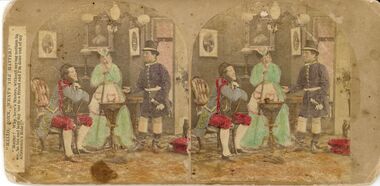
Leisure object - STEREOSCOPE CARD
... S.S.Hough & Co Importers of Fancy Novelties 75 Bourke St East Melbourne Theatre Royal...PHOTOGRAPHY Viewers stereoscope S.S.Hough & Co Importers of Fancy Novelties 75 Bourke St East Melbourne Theatre Royal Card for stereoscope viewer showing domestic scene of 2 men and 1 woman in period costume. ...Card for stereoscope viewer showing domestic scene of 2 men and 1 woman in period costume.S.S.Hough & Co Importers of Fancy Novelties 75 Bourke St East Melbourne Theatre Royalphotography, viewers, stereoscope -
 Bendigo Historical Society Inc.
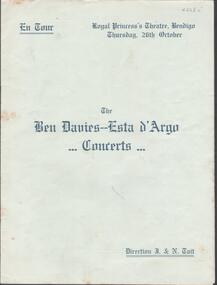
Document - ROYAL PRINCESS'S THEATRE, BENDIGO-BEN DAVIES, ESTA D'ARGO CONCERTS, 26 Oct, 1911
... PROGRAM Music bendigo Royal Princess Theatre Lake Sons & Cowell, 34 Queen Street, Melbourne Royal Princess's Theatre, Bendigo. ...Royal Princess's Theatre, Bendigo. Thursday, 26th October 1911. The Ben Davies - Esta d'Argo Concerts, Direction J & N Tait. Solo Pianist - Herr Edward Goll. Accompanist - Mr. William Conway. Pictures of Mr. Ben Davies and Miss Esta d'Argo on page 1. Program on page 3 to 6. Program of Pianoforte Solos, Recitative & Cavatina, Recitative & Air, Songs: Pastorale, Menuette Vecchio, Capriccio, Ernani, involame, Deaper and Deeper Still, Waft her Angels, Study, Schuerzo, Where the Bee Sucks, Mu Mother bids me Bind my Hair, The Bonnie Blue 'Kerchief, Drink to Me only with Thine eyes, O a' the Airts, Y Gnew Fach, It is not because your Heart is Mine, My Dreams, Una Notte a Venezia (words to all songs included). Advertising on inside front cover, page 2, 7,8, inside back cover and back cover. Advertising for Melbourne businesses and The Victorian Railways and Allan's Cover is blue, all print is blue. Cover plus pages 8. Marking none.Lake Sons & Cowell, 34 Queen Street, Melbourneprogram, music, bendigo, royal princess theatre -
Bendigo Historical Society Inc.
Document - ROYAL PRINCESS THEATRE COLLECTION: VICTORIAN SYMPHONY ORCHESTRA, 15 July
... Melbourne. Railway. Victorian Symphony Orchestra, Royal Princess Theatre, Bendigo. ...Victorian Symphony Orchestra, Royal Princess Theatre, Bendigo. Conducted by Juan Jose Castro. Soloist: Isador Goodman (pianist). This series of concerts is arranged by the Australian Broadcasting Commission in conjunction with the Government of Victoria. Royal Princess Theatre, Bendigo. Thur., 1st May. Star Theatre, Shepparton, Friday, 2nd May at 8pm. Direction: Australian Broadcasting Commission. Juan Jose Castro (write up on the life of). Harmony and Home. Linking 'Home and Family Week' with this Visit. Bendigo faces the challenge brought through the medium of 'Home and Family Week.' Issues arising out of the relationship of Marriage, Parenthood and the family have been discussed by possible solution. Rather than compete with the Concert, negotiations were effected with the A.B.C., resulting in the acknowledgement of this function as part of our week, and the reciprocal arrangement of space in this booklet. Music, as truly as Education and other Culture, influences the outlook and the stability of the home. Ancient Jewish history gave common paternity . . . Programme. Programme notes. Page 6: photo of Isador Goodman. Page 7: photo of John Brownlee. Associate Artist: Raymond Lambert (pianist). Conductor: Juan Jose Castro. First violins: Jorgensen B, Hutchins H, Schieblich F, Deerson N, O'Brien P, Glassford W, Michael R, Burlakov A. Second violins: Lenzer H, Badley R, Pattison B, Whitelaw M, Pietruschka I, Braithwaite N. Violas: Kerr C, Kogan M, Roberts W. 'Cellos: Howley D, Touzeau H, Awburn V, Neri E. Basses: Howley T, Shiffron S, Morton W. Flutes: Chugg R, Barklamb L. Oboes: Richmond E, Woolley D. Clarinets: White T, Crowley C. Bassoons: Wightman T, Hunt. Horns: White R, Miller G, Grieve G, Bickford G. Trumpets: Simpson M, Roberts S. Trombones: Code S, McGlade J, Willis H. Tuba: Coram C. Tympani: Craig G. Percussion: Crawford B, McManamny T. Harp: Bendall A. Musical Autobiographies The London Daily Graphic's record critic praised Eugene Goossen's musical autobiography, Overture and Beginners, as excellent Story . . . Photographs of Elena Nikolaidi and Michael Rabin along with a write up on each. Advertisements: Georges, Melbourne. Railway.program, theatre, concert, victorian symphony orchestra, royal princess theatre, bendigo. conducted by juan jose castro. soloist: isador goodman (pianist). this series of concerts is arranged by the australian broadcasting commission in conjunction with the government of victoria. royal princess theatre, bendigo. thur., 1st may. star theatre, shepparton. juan jose castro harmony and home. linking 'home and family. family week.' issues arising out of the relationship of marriage, a.b.c., resulting in the acknowledgement of this function as part of our week, and the reciprocal arrangement of space in this booklet. music, as truly as education and other culture. ancient jewish history gave common paternity. programme notes. page 6: photo of isador goodman. page 7: photo of john brownlee. associate artist: raymond lambert (pianist). first violins: jorgensen b, hutchins h, schieblich f, deerson n, o'brien p, glassford w, michael r, burlakov a. second violins: lenzer h, badley r, pattison b, whitelaw m, pietruschka i, braithwaite n. violas: kerr c, kogan m, roberts w. 'cellos: howley d, touzeau h, awburn v, neri e. basses: howley t, shiffron s, morton w. flutes: chugg r, barklamb l. oboes: richmond e, woolley d. clarinets: white t, crowley c. bassoons: wightman t, hunt. horns: white r, miller g, grieve g, bickford g. trumpets: simpson m, roberts s. trombones: code s, mcglade j, willis h. tuba: coram c. tympani: craig g. percussion: crawford b, mcmanamny t. harp: bendall a. musical autobiographies the london daily, eugene goossen's, photographs of elena nikolaidi and michael rabin along with a write. advertisements: georges, melbourne. railway. -
 Bendigo Historical Society Inc.
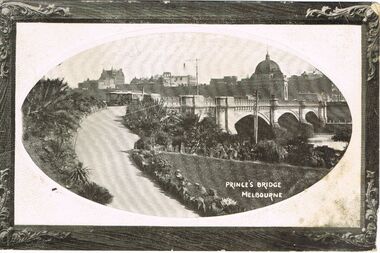
Postcard - POST CARD BLACK AND WHITE PHOTOGRAPH OF PRINCE'S BRIDGE MELBOURNE
... POST CARD BLACK AND WHITE PHOTOGRAPH OF PRINCE'S BRIDGE MELBOURNE /ONE PENNY RED STAMP ON REVERSE OF CARD. Addressed to a miss Palmer, theatre Royal Adelaide S. ...POSTCARD Photograph melbourne POST CARD BLACK AND WHITE PHOTOGRAPH OF PRINCE'S BRIDGE MELBOURNE POST CARD BLACK AND WHITE PHOTOGRAPH OF PRINCE'S BRIDGE MELBOURNE /ONE PENNY RED STAMP ON REVERSE OF CARD. Addressed to a miss Palmer, theatre Royal Adelaide S. ...POST CARD BLACK AND WHITE PHOTOGRAPH OF PRINCE'S BRIDGE MELBOURNE /ONE PENNY RED STAMP ON REVERSE OF CARD. Addressed to a miss Palmer, theatre Royal Adelaide S. Aust.postcard, photograph, melbourne, post card black and white photograph of prince's bridge melbourne -
 Bendigo Historical Society Inc.
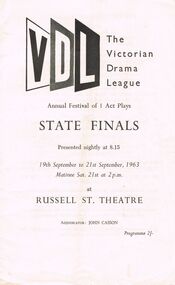
Document - LYDIA CHANCELLOR COLLECTION; VICTORIAN DRAMA LEAGUE STATE FINALS PROGRAMME
... Theatre. Adjudicator : John Casson. Programme 2/-. On the inside is the 7 page programme and on the back cover is a list of the 1963 Regional Festival Winners. Printed by Melbourne University Press, Carlton N. 3. Victoria. Included in the programme are two fliers,( 1) ' A.E.A. Drama Group Shakespeare's Antony & Cleopatra Production: Gavin Dyer Russell Street Theatre October 17, 18, 19.' and, (2) 'Council of Adult Education Residential Summer School of Drama January 6th -17th, 1964. Royal...Theatre. Adjudicator : John Casson. Programme 2/-. On the inside is the 7 page programme and on the back cover is a list of the 1963 Regional Festival Winners. Printed by Melbourne University Press, Carlton N. 3. Victoria. Included in the programme are two fliers,( 1) ' A.E.A. Drama Group Shakespeare's Antony & Cleopatra Production: Gavin Dyer Russell Street Theatre October 17, 18, 19.' and, (2) 'Council of Adult Education Residential Summer School of Drama January 6th -17th, 1964. Royal ...A 7 page programme with black print against a white background. On the front cover, ' VDL The Victorian Drama League Annual Festival of 1 Act Plays State Finals. Presented nightly at 8.15 19th September to 21st September, 1963. Matinee Sat. 21st at 2 p.m. at Russell St. Theatre. Adjudicator : John Casson. Programme 2/-. On the inside is the 7 page programme and on the back cover is a list of the 1963 Regional Festival Winners. Printed by Melbourne University Press, Carlton N. 3. Victoria. Included in the programme are two fliers,( 1) ' A.E.A. Drama Group Shakespeare's Antony & Cleopatra Production: Gavin Dyer Russell Street Theatre October 17, 18, 19.' and, (2) 'Council of Adult Education Residential Summer School of Drama January 6th -17th, 1964. Royal Commonwealth Society, 22 Queens Road, Melbourne, S.C. 2.'performing arts, elocution, drama, lydia chancellor, collection, programme, program, drama, theatre, event, entertainment, ephemera, performing arts -
 Bendigo Historical Society Inc.
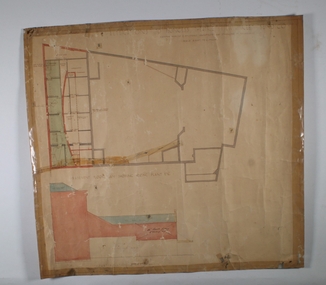
Document - ROYAL PRINCESS THEATRE COLLECTION: PLAN OF ALTERATIONS TO PRINCESS THEATRE, No date on Plan
... BUILDINGS Commercial princess theatre Princess Theatre Alterations Cowper Murphy and Appleford Cowper, Murphy and Appleford, Architects, 440 Little Collins St melbourne Plan: Alterations to the Princess Theatre. Architects drawing by Cowper, Murphy and Appleford, Architects, 440 Little Collins St melbourne Document ROYAL PRINCESS THEATRE COLLECTION: PLAN OF ALTERATIONS TO PRINCESS THEATRE ...Plan: Alterations to the Princess Theatre. Architects drawing by Cowper, Murphy and Appleford, Architects, 440 Little Collins St melbourneCowper, Murphy and Appleford, Architects, 440 Little Collins St melbournebuildings, commercial, princess theatre, princess theatre, alterations, cowper murphy and appleford -
![Hardcover illustrated book. Dust jacket has orange toned front cover with historic images (Melbourne Hospital laundry [ca.1917] and a theatre nurse), a black and white photo of entrance to hospital, Lonsdale St site and a coloured photo of hospital at current site {ca.1997].
Contains a history of the Royal Melbourne Hospital, the first public hospital in Victoria, from its opening in 1848 in Lonsdale St up to 1998, contains over 100 historical photographs and illustrations.](/media/collectors/50187a8f023fd7201471f198/items/67639f847a79e07be7f8b278/item-media/6763a5eb7a79e07be7f8dda8/item-fit-380x285.jpg?cb=6) Alfred Hospital Nurses League - Nursing History Collection
Alfred Hospital Nurses League - Nursing History CollectionBook - Illustrated book, Alan Gregory, The ever open door: a history of the Royal Melbourne Hospital 1848-1998, 1998
... The book also mentions June Allen, Alfred DON, a RMH graduate, who had been operating theatre supervisor and deputy DON at RMH. Royal Melbourne Hospital-history Hospitals-Victoria-History History of the Royal Melbourne Hospital, the first public hospital in Victoria, from its opening in 1848 in Lonsdale St up to 1998, contains over 100 historical photographs and illustrations. ...History of the Royal Melbourne Hospital, the first public hospital in Victoria, from its opening in 1848 in Lonsdale St up to 1998, contains over 100 historical photographs and illustrations.Illustrated book with dustjacket. Book is bound in dark blue fabric with hospital crest on front in gilt. title and publisher's mark printed in gilt on spinenon-fictionHistory of the Royal Melbourne Hospital, the first public hospital in Victoria, from its opening in 1848 in Lonsdale St up to 1998, contains over 100 historical photographs and illustrations.royal melbourne hospital-history, hospitals-victoria-history -
 Alfred Hospital Nurses League - Nursing History Collection
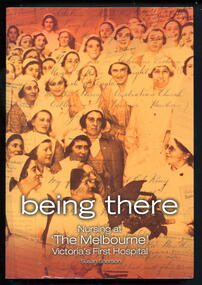
Book - Illustrated book, Susan Sherson, being there: Nursing at "The Melbourne" Victoria's First Hospital, 2005
... The book also mentions June Allen, Alfred DON, a RMH graduate, who had been operating theatre supervisor and deputy DON at RMH. Royal Melbourne Hospital-history Royal Melbourne Hospital-Nursing-History Nursing-Victoria-History Hospitals-Victoria -History Melbourne School of Nursing-History The story starts in the 1840's when Melbourne was a small settlement, and funds were raised to care for the sick and poor and interweaves the theme of nursing with the history of Melbourne and Victoria over more than 150 years. ...The story starts in the 1840's when Melbourne was a small settlement, and funds were raised to care for the sick and poor and interweaves the theme of nursing with the history of Melbourne and Victoria over more than 150 years. It also includes an appendix of all nurses who graduated (RMH and MSN - Melbourne School of Nursing) in the formal training years of 1890-1993.Illustrated book with orange toned photograph of Miss Jane Bell (Lady Superintendent 1910-1934) with her nursing staff on retirement in 1934, with handwriting overlay on cover. Title and author's name appear in white print on front cover and spine. Hospital crest on base of spine.non-fictionThe story starts in the 1840's when Melbourne was a small settlement, and funds were raised to care for the sick and poor and interweaves the theme of nursing with the history of Melbourne and Victoria over more than 150 years. It also includes an appendix of all nurses who graduated (RMH and MSN - Melbourne School of Nursing) in the formal training years of 1890-1993.royal melbourne hospital-history, royal melbourne hospital-nursing-history, nursing-victoria-history, hospitals-victoria -history, melbourne school of nursing-history -
 Alfred Hospital Nurses League - Nursing History Collection
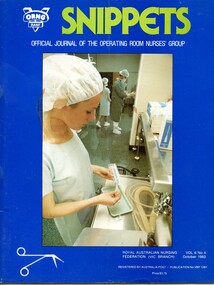
Magazine - Illustrated magazine, Pamela Atkinson, Snippets - Official journal of the operating room nurses group, 1983
... Front cover has title [white light and light green print] the journal logo - angled scissors [white print] operating room nurses group logo [ORG RANF overprinted on V] and a coloured photograph of an operating room nurse holding a syringe and packet in anaethetic room with operating theatre and other theatre personnel in the back ground [Nurse Suzie Kendall Royal Children's Hospital, Melbourne...Front cover has title [white light and light green print] the journal logo - angled scissors [white print] operating room nurses group logo [ORG RANF overprinted on V] and a coloured photograph of an operating room nurse holding a syringe and packet in anaethetic room with operating theatre and other theatre personnel in the back ground [Nurse Suzie Kendall Royal Children's Hospital, Melbourne Snippets - Official journal of the operating room nurses group Magazine Illustrated magazine Pamela Atkinson Research Publications ...Magazine containing articles and advertisements of interest to operating room nursesIllustrated magazine with blue cover. Front cover has title [white light and light green print] the journal logo - angled scissors [white print] operating room nurses group logo [ORG RANF overprinted on V] and a coloured photograph of an operating room nurse holding a syringe and packet in anaethetic room with operating theatre and other theatre personnel in the back ground [Nurse Suzie Kendall Royal Children's Hospital, Melbournenon-fictionMagazine containing articles and advertisements of interest to operating room nurses perioperative nursing, operating room nurses-victoria-history -
 Sunshine and District Historical Society Incorporated
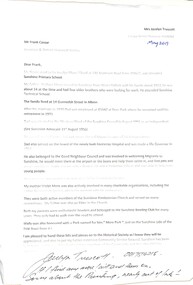
Letter - Wallace 'Wal/Wally' More Collection
... Letter to Frank Cassar from Jocelyn Truscott nee More May 2019|Program of Gala Performance Sixty glorious Years The Barclay Theatre Melbourne 16th April 1972 Synopsis The film opens with Queen Victoria's announcement of her betrothal to Prince Albert a pronouncement far from enthusiastically received by Parliament Thence to Englands antipathy towards the Prince Consort. The birth of the Princess Royal...These documents were donated to the Society by his daughter Jocelyn Truscott More Letter to Frank Cassar from Jocelyn Truscott nee More May 2019|Program of Gala Performance Sixty glorious Years The Barclay Theatre Melbourne 16th April 1972 Synopsis The film opens with Queen Victoria's announcement of her betrothal to Prince Albert a pronouncement far from enthusiastically received by Parliament Thence to Englands antipathy towards the Prince Consort. The birth of the Princess Royal ...Wallace 'Wal/Wally' More documents from when he served as an independant Councillor for the City of Sunshine (Elected 1956). He lived at 14 Gunnedah Street Albion. More Park Ardeer is named after him. These documents were donated to the Society by his daughter Jocelyn TruscottLetter to Frank Cassar from Jocelyn Truscott nee More May 2019|Program of Gala Performance Sixty glorious Years The Barclay Theatre Melbourne 16th April 1972 Synopsis The film opens with Queen Victoria's announcement of her betrothal to Prince Albert a pronouncement far from enthusiastically received by Parliament Thence to Englands antipathy towards the Prince Consort. The birth of the Princess Royal. The opening of the Great Exhibition at Crystal Palace. The Charge of the Light Brigade at Balaclava. The death of the Prince Consort. The poignancy of Victoria's protracted retirement from public life. The misguided honour of her husband's memory. Later in happier circumstances during her Diamond Jubilee Celebrations. The control of the Suez Canal by Disraeli. The assassination of General Gordon Kitchener's conquest of Khartoum. The death of the Queen These are the highlights of This Magnificent Motion Picture|3 Notice paper for Centenary Commemoration meeting of the Council Wednesday 18th May 1960|Religious Program for City of Sunshine who were celebrating the Centenary Civic Thanksgiving Service 1860 - 1960 at the Town Hall Sunshine 1st May 1960 in the presence of His Worship the Mayor Cr D B Dempster JP Address by The Right Reverend Doctor A C Watson Moderator General of the Presbyterian Church of Australia|Typed Report City of Sunshine Mayors Report 1962 to 1963 Cr D F Thompson JP Mayor 2 September 1963|Typed Report City of Sunshine Mayors Report 1955 to 1956 Cr Henry B Dempster JP|Newspaper Article Footscray and District Hospital Annual Report 1972|Newspaper Article Its hard times for the kind ladies of Sunshine Sunshine Ladis Benevolent Society members Flo Morley Glad Crick Sadie Parsons and Connie Parsons With remaining members Edna Hopkins and Violet More the women have given a total of 130 years service to Sunshine's needy|Newspaper Article The Sun 30 June 1981 Baby Di|Newspaper Article Sunshine Advocate 31 August 1956 Who will be Mayor?more -
 Dandenong & District Historical Society
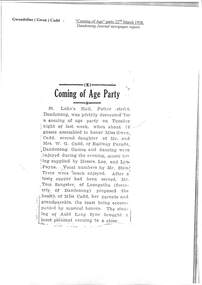
Cadd Family, Gwendoline Cadd ; Lorraine Cadd ; Roger Cadd ; William Cadd ; William George Cadd - Various Newspaper Articles, ID Cards, Other
... Royal Melbourne Hospital...Keith Cadd...Keith William Cadd...Beatrice May Craven...Dandenong Journal...Gwen Cadd...Gwendoline Cadd Hartley...Gwendoline Hartley...Boomerang Theatre...Gwendoline Cadd ; Lorraine Cadd ; Roger Cadd ; William Cadd ; William George Cadd - Various Newspaper Articles, ID Cards, Other Gwendoline Cadd Lorraine Cadd Roger Cadd William Cadd William George Cadd Dandenong Agricultural Society Murray House Dandenong West Primary School Dandenong Show Dandenong Art Club Royal Melbourne Hospital Keith Cadd Keith William Cadd Beatrice May Craven Dandenong Journal Gwen Cadd Gwendoline Cadd Hartley Gwendoline Hartley Boomerang Theatre Gwendoline Cadd ; Lorraine Cadd ; Roger Cadd ; William Cadd ; William George Cadd - Various Newspaper Articles, ID Cards, Other Gwendoline Cadd ; Lorraine Cadd ; Roger Cadd ; William Cadd ; William George Cadd - Various Newspaper Articles, ID Cards, Other Cadd Family ...Gwendoline Cadd ; Lorraine Cadd ; Roger Cadd ; William Cadd ; William George Cadd - Various Newspaper Articles, ID Cards, Othergwendoline cadd, lorraine cadd, roger cadd, william cadd, william george cadd, dandenong agricultural society, murray house, dandenong west primary school, dandenong show, dandenong art club, royal melbourne hospital, keith cadd, keith william cadd, beatrice may craven, dandenong journal, gwen cadd, gwendoline cadd hartley, gwendoline hartley, boomerang theatre -
 Ararat Gallery TAMA
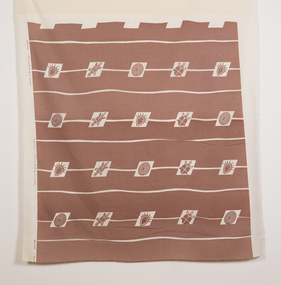
Frances Burke, Goanna, c. early 1950s
... Melbourne’s fashionable Georges Department store, printing them on linen using lino blocks, she was an early adopter of the screen-printing process and during the war years began printing on cotton. Burke’s furnishing fabrics took their place in influential modern buildings Australia-wide through collaborations with leading architects and interior designers. They included Robin Boyd’s 1949 House of Tomorrow, Roy Grounds’ Quamby flats, Guilford Bell’s Royal Hayman Island Resort for Ansett Airlines, and Yuncken, Freeman Brothers, Griffiths and Simpson’s Canberra Civic Centre Theatre...Melbourne’s fashionable Georges Department store, printing them on linen using lino blocks, she was an early adopter of the screen-printing process and during the war years began printing on cotton. Burke’s furnishing fabrics took their place in influential modern buildings Australia-wide through collaborations with leading architects and interior designers. They included Robin Boyd’s 1949 House of Tomorrow, Roy Grounds’ Quamby flats, Guilford Bell’s Royal Hayman Island Resort for Ansett Airlines, and Yuncken, Freeman Brothers, Griffiths and Simpson’s Canberra Civic Centre Theatre ...Frances Burke: Designer of Modern Textiles Australia’s most influential and celebrated textile designer of the mid-20th century, Frances Burke (1904-1994), employed Australian native flora, garden flowers, marine subjects, Indigenous culture and increasingly, abstract motifs in her stunning modern fabrics. A confident, determined designer and businesswoman; Burke made the shift from fine art to design in 1937. While she began by designing dress fabrics for Melbourne’s fashionable Georges Department store, printing them on linen using lino blocks, she was an early adopter of the screen-printing process and during the war years began printing on cotton. Burke’s furnishing fabrics took their place in influential modern buildings Australia-wide through collaborations with leading architects and interior designers. They included Robin Boyd’s 1949 House of Tomorrow, Roy Grounds’ Quamby flats, Guilford Bell’s Royal Hayman Island Resort for Ansett Airlines, and Yuncken, Freeman Brothers, Griffiths and Simpson’s Canberra Civic Centre Theatre. In the post-war period, Burke made regular trips to the United States and Europe, on her return advising homeowners and manufacturers on the latest trends in products, colours and home design in lectures and interviews. At New Design her fabric showroom and interior design consultancy Burke introduced furniture by emerging designers Clement Meadmore and Grant Featherston in the early 1950s and presented local and imported homewares, mostly from the United States. She was enthusiastic about the convenient and comfortable lifestyle experienced by ordinary American women. Her fabrics and advice were regularly featured in Australian Home Beautiful, Australian House and Garden and the newspapers of the day. Some of Burke’s designs had remarkable longevity. Tiger Stripe (1938) for example, continued to be produced in a wide range of colours until 1970 and Crete (1946) remained a popular choice for interiors into the 1960s. Drawing from a rich variety of sources including Indigenous culture in Goanna (c.1954) and Pacific Island tapa cloth designs in Bird and Tree (1940), Burke also looked to Japan in designs such as Plum Blossom (1948) and Zen (1965). She loved exploring the potential of native flora, seen in designs including Waratah (1955) and Flannel Flower (1955), while garden flowers were the source for many other designs including Belladonna (1940), Periwinkle (n.d.) and Rose (1947). Burke’s clever interplay of a single striking printed colour with lively gestural lines revealing the white base fabric, gave her designs a vibrancy that characterised the optimistic post-war era. This can be seen in Burke’s fabrics for Hayman Island including Angel Fish and Seapiece (both 1949) which expressed the freshness and excitement of the luxurious new tropical resort and led to further commissions. Burke’s three decades in business (1937-1970) were an unparalleled success in the story of Australian design. Her fabrics have been collected by the NGA, the Powerhouse Museum, NGV, RMIT Design Archives and Sydney Living Museums in addition to Ararat Gallery TAMA. Written by Nanette Carter and Robyn Oswald-Jacobs. -
 Ararat Gallery TAMA
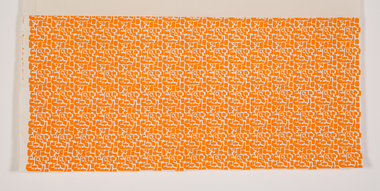
Frances Burke, Mosaic, c. 1962
... Melbourne’s fashionable Georges Department store, printing them on linen using lino blocks, she was an early adopter of the screen-printing process and during the war years began printing on cotton. Burke’s furnishing fabrics took their place in influential modern buildings Australia-wide through collaborations with leading architects and interior designers. They included Robin Boyd’s 1949 House of Tomorrow, Roy Grounds’ Quamby flats, Guilford Bell’s Royal Hayman Island Resort for Ansett Airlines, and Yuncken, Freeman Brothers, Griffiths and Simpson’s Canberra Civic Centre Theatre...Melbourne’s fashionable Georges Department store, printing them on linen using lino blocks, she was an early adopter of the screen-printing process and during the war years began printing on cotton. Burke’s furnishing fabrics took their place in influential modern buildings Australia-wide through collaborations with leading architects and interior designers. They included Robin Boyd’s 1949 House of Tomorrow, Roy Grounds’ Quamby flats, Guilford Bell’s Royal Hayman Island Resort for Ansett Airlines, and Yuncken, Freeman Brothers, Griffiths and Simpson’s Canberra Civic Centre Theatre ...Frances Burke: Designer of Modern Textiles Australia’s most influential and celebrated textile designer of the mid-20th century, Frances Burke (1904-1994), employed Australian native flora, garden flowers, marine subjects, Indigenous culture and increasingly, abstract motifs in her stunning modern fabrics. A confident, determined designer and businesswoman; Burke made the shift from fine art to design in 1937. While she began by designing dress fabrics for Melbourne’s fashionable Georges Department store, printing them on linen using lino blocks, she was an early adopter of the screen-printing process and during the war years began printing on cotton. Burke’s furnishing fabrics took their place in influential modern buildings Australia-wide through collaborations with leading architects and interior designers. They included Robin Boyd’s 1949 House of Tomorrow, Roy Grounds’ Quamby flats, Guilford Bell’s Royal Hayman Island Resort for Ansett Airlines, and Yuncken, Freeman Brothers, Griffiths and Simpson’s Canberra Civic Centre Theatre. In the post-war period, Burke made regular trips to the United States and Europe, on her return advising homeowners and manufacturers on the latest trends in products, colours and home design in lectures and interviews. At New Design her fabric showroom and interior design consultancy Burke introduced furniture by emerging designers Clement Meadmore and Grant Featherston in the early 1950s and presented local and imported homewares, mostly from the United States. She was enthusiastic about the convenient and comfortable lifestyle experienced by ordinary American women. Her fabrics and advice were regularly featured in Australian Home Beautiful, Australian House and Garden and the newspapers of the day. Some of Burke’s designs had remarkable longevity. Tiger Stripe (1938) for example, continued to be produced in a wide range of colours until 1970 and Crete (1946) remained a popular choice for interiors into the 1960s. Drawing from a rich variety of sources including Indigenous culture in Goanna (c.1954) and Pacific Island tapa cloth designs in Bird and Tree (1940), Burke also looked to Japan in designs such as Plum Blossom (1948) and Zen (1965). She loved exploring the potential of native flora, seen in designs including Waratah (1955) and Flannel Flower (1955), while garden flowers were the source for many other designs including Belladonna (1940), Periwinkle (n.d.) and Rose (1947). Burke’s clever interplay of a single striking printed colour with lively gestural lines revealing the white base fabric, gave her designs a vibrancy that characterised the optimistic post-war era. This can be seen in Burke’s fabrics for Hayman Island including Angel Fish and Seapiece (both 1949) which expressed the freshness and excitement of the luxurious new tropical resort and led to further commissions. Burke’s three decades in business (1937-1970) were an unparalleled success in the story of Australian design. Her fabrics have been collected by the NGA, the Powerhouse Museum, NGV, RMIT Design Archives and Sydney Living Museums in addition to Ararat Gallery TAMA. Written by Nanette Carter and Robyn Oswald-Jacobs. -
 Ararat Gallery TAMA
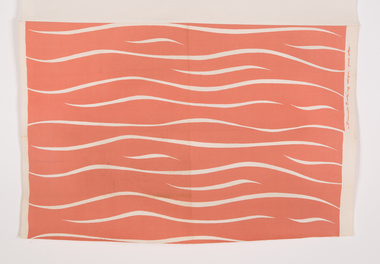
Frances Burke, Tiger Stripe, c. 1939
... Melbourne’s fashionable Georges Department store, printing them on linen using lino blocks, she was an early adopter of the screen-printing process and during the war years began printing on cotton. Burke’s furnishing fabrics took their place in influential modern buildings Australia-wide through collaborations with leading architects and interior designers. They included Robin Boyd’s 1949 House of Tomorrow, Roy Grounds’ Quamby flats, Guilford Bell’s Royal Hayman Island Resort for Ansett Airlines, and Yuncken, Freeman Brothers, Griffiths and Simpson’s Canberra Civic Centre Theatre...Melbourne’s fashionable Georges Department store, printing them on linen using lino blocks, she was an early adopter of the screen-printing process and during the war years began printing on cotton. Burke’s furnishing fabrics took their place in influential modern buildings Australia-wide through collaborations with leading architects and interior designers. They included Robin Boyd’s 1949 House of Tomorrow, Roy Grounds’ Quamby flats, Guilford Bell’s Royal Hayman Island Resort for Ansett Airlines, and Yuncken, Freeman Brothers, Griffiths and Simpson’s Canberra Civic Centre Theatre ...Frances Burke: Designer of Modern Textiles Australia’s most influential and celebrated textile designer of the mid-20th century, Frances Burke (1904-1994), employed Australian native flora, garden flowers, marine subjects, Indigenous culture and increasingly, abstract motifs in her stunning modern fabrics. A confident, determined designer and businesswoman; Burke made the shift from fine art to design in 1937. While she began by designing dress fabrics for Melbourne’s fashionable Georges Department store, printing them on linen using lino blocks, she was an early adopter of the screen-printing process and during the war years began printing on cotton. Burke’s furnishing fabrics took their place in influential modern buildings Australia-wide through collaborations with leading architects and interior designers. They included Robin Boyd’s 1949 House of Tomorrow, Roy Grounds’ Quamby flats, Guilford Bell’s Royal Hayman Island Resort for Ansett Airlines, and Yuncken, Freeman Brothers, Griffiths and Simpson’s Canberra Civic Centre Theatre. In the post-war period, Burke made regular trips to the United States and Europe, on her return advising homeowners and manufacturers on the latest trends in products, colours and home design in lectures and interviews. At New Design her fabric showroom and interior design consultancy Burke introduced furniture by emerging designers Clement Meadmore and Grant Featherston in the early 1950s and presented local and imported homewares, mostly from the United States. She was enthusiastic about the convenient and comfortable lifestyle experienced by ordinary American women. Her fabrics and advice were regularly featured in Australian Home Beautiful, Australian House and Garden and the newspapers of the day. Some of Burke’s designs had remarkable longevity. Tiger Stripe (1938) for example, continued to be produced in a wide range of colours until 1970 and Crete (1946) remained a popular choice for interiors into the 1960s. Drawing from a rich variety of sources including Indigenous culture in Goanna (c.1954) and Pacific Island tapa cloth designs in Bird and Tree (1940), Burke also looked to Japan in designs such as Plum Blossom (1948) and Zen (1965). She loved exploring the potential of native flora, seen in designs including Waratah (1955) and Flannel Flower (1955), while garden flowers were the source for many other designs including Belladonna (1940), Periwinkle (n.d.) and Rose (1947). Burke’s clever interplay of a single striking printed colour with lively gestural lines revealing the white base fabric, gave her designs a vibrancy that characterised the optimistic post-war era. This can be seen in Burke’s fabrics for Hayman Island including Angel Fish and Seapiece (both 1949) which expressed the freshness and excitement of the luxurious new tropical resort and led to further commissions. Burke’s three decades in business (1937-1970) were an unparalleled success in the story of Australian design. Her fabrics have been collected by the NGA, the Powerhouse Museum, NGV, RMIT Design Archives and Sydney Living Museums in addition to Ararat Gallery TAMA. Written by Nanette Carter and Robyn Oswald-Jacobs. -
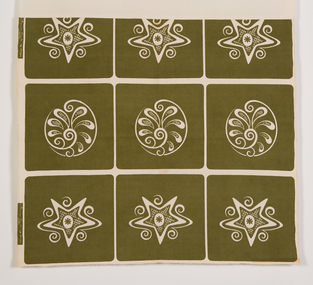 Ararat Gallery TAMA
Frances Burke, Crete, 1948
... Melbourne’s fashionable Georges Department store, printing them on linen using lino blocks, she was an early adopter of the screen-printing process and during the war years began printing on cotton. Burke’s furnishing fabrics took their place in influential modern buildings Australia-wide through collaborations with leading architects and interior designers. They included Robin Boyd’s 1949 House of Tomorrow, Roy Grounds’ Quamby flats, Guilford Bell’s Royal Hayman Island Resort for Ansett Airlines, and Yuncken, Freeman Brothers, Griffiths and Simpson’s Canberra Civic Centre Theatre...Melbourne’s fashionable Georges Department store, printing them on linen using lino blocks, she was an early adopter of the screen-printing process and during the war years began printing on cotton. Burke’s furnishing fabrics took their place in influential modern buildings Australia-wide through collaborations with leading architects and interior designers. They included Robin Boyd’s 1949 House of Tomorrow, Roy Grounds’ Quamby flats, Guilford Bell’s Royal Hayman Island Resort for Ansett Airlines, and Yuncken, Freeman Brothers, Griffiths and Simpson’s Canberra Civic Centre Theatre ...Frances Burke: Designer of Modern Textiles Australia’s most influential and celebrated textile designer of the mid-20th century, Frances Burke (1904-1994), employed Australian native flora, garden flowers, marine subjects, Indigenous culture and increasingly, abstract motifs in her stunning modern fabrics. A confident, determined designer and businesswoman; Burke made the shift from fine art to design in 1937. While she began by designing dress fabrics for Melbourne’s fashionable Georges Department store, printing them on linen using lino blocks, she was an early adopter of the screen-printing process and during the war years began printing on cotton. Burke’s furnishing fabrics took their place in influential modern buildings Australia-wide through collaborations with leading architects and interior designers. They included Robin Boyd’s 1949 House of Tomorrow, Roy Grounds’ Quamby flats, Guilford Bell’s Royal Hayman Island Resort for Ansett Airlines, and Yuncken, Freeman Brothers, Griffiths and Simpson’s Canberra Civic Centre Theatre. In the post-war period, Burke made regular trips to the United States and Europe, on her return advising homeowners and manufacturers on the latest trends in products, colours and home design in lectures and interviews. At New Design her fabric showroom and interior design consultancy Burke introduced furniture by emerging designers Clement Meadmore and Grant Featherston in the early 1950s and presented local and imported homewares, mostly from the United States. She was enthusiastic about the convenient and comfortable lifestyle experienced by ordinary American women. Her fabrics and advice were regularly featured in Australian Home Beautiful, Australian House and Garden and the newspapers of the day. Some of Burke’s designs had remarkable longevity. Tiger Stripe (1938) for example, continued to be produced in a wide range of colours until 1970 and Crete (1946) remained a popular choice for interiors into the 1960s. Drawing from a rich variety of sources including Indigenous culture in Goanna (c.1954) and Pacific Island tapa cloth designs in Bird and Tree (1940), Burke also looked to Japan in designs such as Plum Blossom (1948) and Zen (1965). She loved exploring the potential of native flora, seen in designs including Waratah (1955) and Flannel Flower (1955), while garden flowers were the source for many other designs including Belladonna (1940), Periwinkle (n.d.) and Rose (1947). Burke’s clever interplay of a single striking printed colour with lively gestural lines revealing the white base fabric, gave her designs a vibrancy that characterised the optimistic post-war era. This can be seen in Burke’s fabrics for Hayman Island including Angel Fish and Seapiece (both 1949) which expressed the freshness and excitement of the luxurious new tropical resort and led to further commissions. Burke’s three decades in business (1937-1970) were an unparalleled success in the story of Australian design. Her fabrics have been collected by the NGA, the Powerhouse Museum, NGV, RMIT Design Archives and Sydney Living Museums in addition to Ararat Gallery TAMA. Written by Nanette Carter and Robyn Oswald-Jacobs. -
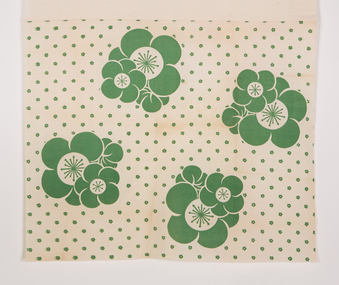 Ararat Gallery TAMA
Frances Burke, Plum Blossom, 1948
... Melbourne’s fashionable Georges Department store, printing them on linen using lino blocks, she was an early adopter of the screen-printing process and during the war years began printing on cotton. Burke’s furnishing fabrics took their place in influential modern buildings Australia-wide through collaborations with leading architects and interior designers. They included Robin Boyd’s 1949 House of Tomorrow, Roy Grounds’ Quamby flats, Guilford Bell’s Royal Hayman Island Resort for Ansett Airlines, and Yuncken, Freeman Brothers, Griffiths and Simpson’s Canberra Civic Centre Theatre...Melbourne’s fashionable Georges Department store, printing them on linen using lino blocks, she was an early adopter of the screen-printing process and during the war years began printing on cotton. Burke’s furnishing fabrics took their place in influential modern buildings Australia-wide through collaborations with leading architects and interior designers. They included Robin Boyd’s 1949 House of Tomorrow, Roy Grounds’ Quamby flats, Guilford Bell’s Royal Hayman Island Resort for Ansett Airlines, and Yuncken, Freeman Brothers, Griffiths and Simpson’s Canberra Civic Centre Theatre ...Frances Burke: Designer of Modern Textiles Australia’s most influential and celebrated textile designer of the mid-20th century, Frances Burke (1904-1994), employed Australian native flora, garden flowers, marine subjects, Indigenous culture and increasingly, abstract motifs in her stunning modern fabrics. A confident, determined designer and businesswoman; Burke made the shift from fine art to design in 1937. While she began by designing dress fabrics for Melbourne’s fashionable Georges Department store, printing them on linen using lino blocks, she was an early adopter of the screen-printing process and during the war years began printing on cotton. Burke’s furnishing fabrics took their place in influential modern buildings Australia-wide through collaborations with leading architects and interior designers. They included Robin Boyd’s 1949 House of Tomorrow, Roy Grounds’ Quamby flats, Guilford Bell’s Royal Hayman Island Resort for Ansett Airlines, and Yuncken, Freeman Brothers, Griffiths and Simpson’s Canberra Civic Centre Theatre. In the post-war period, Burke made regular trips to the United States and Europe, on her return advising homeowners and manufacturers on the latest trends in products, colours and home design in lectures and interviews. At New Design her fabric showroom and interior design consultancy Burke introduced furniture by emerging designers Clement Meadmore and Grant Featherston in the early 1950s and presented local and imported homewares, mostly from the United States. She was enthusiastic about the convenient and comfortable lifestyle experienced by ordinary American women. Her fabrics and advice were regularly featured in Australian Home Beautiful, Australian House and Garden and the newspapers of the day. Some of Burke’s designs had remarkable longevity. Tiger Stripe (1938) for example, continued to be produced in a wide range of colours until 1970 and Crete (1946) remained a popular choice for interiors into the 1960s. Drawing from a rich variety of sources including Indigenous culture in Goanna (c.1954) and Pacific Island tapa cloth designs in Bird and Tree (1940), Burke also looked to Japan in designs such as Plum Blossom (1948) and Zen (1965). She loved exploring the potential of native flora, seen in designs including Waratah (1955) and Flannel Flower (1955), while garden flowers were the source for many other designs including Belladonna (1940), Periwinkle (n.d.) and Rose (1947). Burke’s clever interplay of a single striking printed colour with lively gestural lines revealing the white base fabric, gave her designs a vibrancy that characterised the optimistic post-war era. This can be seen in Burke’s fabrics for Hayman Island including Angel Fish and Seapiece (both 1949) which expressed the freshness and excitement of the luxurious new tropical resort and led to further commissions. Burke’s three decades in business (1937-1970) were an unparalleled success in the story of Australian design. Her fabrics have been collected by the NGA, the Powerhouse Museum, NGV, RMIT Design Archives and Sydney Living Museums in addition to Ararat Gallery TAMA. Written by Nanette Carter and Robyn Oswald-Jacobs.
