
Showing 113 items matching " wall henry"
-
 Federation University Historical Collection
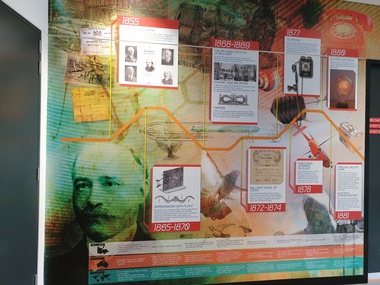
Photograph - Photograph - Colour, Clare Gervasoni, Henry Sutton Wall Mural at the Ballarat School of Mines TAFE, 2019, 2019
... Henry Sutton Wall Mural at the Ballarat School of Mines TAFE, 2019...Colour photographs of the Henry Sutton Timeline on the wall at the Ballarat School of Mines TAFE bullding (S Building) in Grant St....Henry Sutton Wall Mural at the Ballarat School of Mines TAFE, 2019 Photograph Photograph - Colour Clare Gervasoni ...Colour photographs of the Henry Sutton Timeline on the wall at the Ballarat School of Mines TAFE bullding (S Building) in Grant St.henry sutton, ballarat school of mines, old chemistry building, timeline, mural -
 Glen Eira Historical Society
Document - Fairfield Hall, North Road, 225, Caulfield South
... ... Wall Henry...North Road Manair Fairfield Hall Caulfield South Caulfield Italianate style Victorian style Architectural styles McCombie T Keys R Kooyong Road Curwan Frederick Wallis Knight C Aitkin Whiting and Aitkin Solicitors Wall Henry Wragge and Hearne Younger Alexander Younger family Younger Avenue Fairfield Grove Mansions Ward Andrew Document Fairfield Hall, North Road, 225, Caulfield South ...A three page photocopy from the Caulfield Conservation Study by Andrew Ward in 01/1995, on Fairfield Hall at 225 North Road, Caulfield South. The study provides a brief description of the building, its history, a statement of significance and includes two photographs (99mm x 152mm) of the exterior of the building.north road, manair, fairfield hall, caulfield south, caulfield, italianate style, victorian style, architectural styles, mccombie t, keys r, kooyong road, curwan frederick wallis, knight c, aitkin whiting and aitkin solicitors, wall henry, wragge and hearne, younger alexander, younger family, younger avenue, fairfield grove, mansions, ward andrew -
Glenelg Shire Council Cultural Collection
Photograph - Photograph - Henry House Daycare Centre Portland, Henry House Portland, n.d
... Henry House Day Care Centre. Front of building, garden and paving, from Glenelg Street. Plaque on front wall of building 'Henry House Day Care Centre'....Henry House Day Care Centre. Front of building, garden and paving, from Glenelg Street. Plaque on front wall of building 'Henry House Day Care Centre'. ...Colour photograph of Henry House Day Care Centre. Front of building, garden and paving, from Glenelg Street. Plaque on front wall of building 'Henry House Day Care Centre'. -
 Flagstaff Hill Maritime Museum and Village
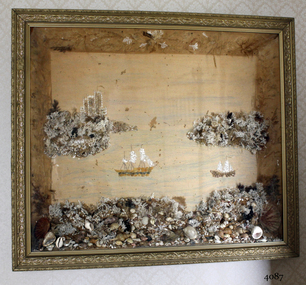
Artwork, other - Wall decoration, late 19th century
... henry giles...tower hill...cooramook...warrnambool breakwater...mailor’s flat...wangoom...19th century household goods...19th century decor...19th century handcraft...handcraft...wall...This unusual wall decoration was created by Anna Wilson (nee Henry), daughter of pioneer John Stephenson Henry, who arrived in Australia from Ireland with his children in 1851. ...Artwork, other Wall decoration Anna Wilson (nee Henry) ...This unusual wall decoration was created by Anna Wilson (nee Henry), daughter of pioneer John Stephenson Henry, who arrived in Australia from Ireland with his children in 1851. Family documents confirm that Anna most probably made the diorama for her sister-in-law, who married a member of the Giles family. The diorama was later given to Vera Giles who was a family friend and possibly related to Anna’s sister-in-law by marriage. The diorama is now part of the Giles Collection. Anna married William Wilson in 1860, who had arrived in Australia from County Tarrane in about 1850, aged 19. In 1869 they moved to their new property called ‘Glenlyall’ in Cooramook, north of Grassmere, Victoria, where he lived for 49 years until his death in 1918. He left behind a family of four sons and a daughter. The Giles Family There are many 19th century items of furniture, linen and crockery donated to Flagstaff Hill Maritime Village by Vera and Aurelin Giles. The items are associated with the Giles Family and are known as the “Giles Collection”. These items mostly came from the simple home of Vera’s parents-in-law, Henry Giles and his wife Mary Jane (nee Freckleton), whose photos are in the parlour. They married in 1880. Henry Giles was born at Tower Hill in 1858. He was a labourer on the construction of the Breakwater before leaving in 1895 to build bridges in N.S.W. for about seven years. Mary Jane was born in 1860 at Cooramook. She attended Mailor’s Flat State School where she was also a student teacher before, as family legend has it, she became a governess at “Injemiara” where her grandfather, Francis Freckleton, once owned land. Henry and Mary’s family of six, some of whom were born at Mailor’s Flat and later children at Wangoom, lived with their parents at Wangoom and Purnim west, where Henry died in 1933 and Mary Jane in 1940. The family of the creator Anna Wilson nee Henry and her husband William Wilson are of significance to the early history of Victoria and the South West of Victoria in particular, being pioneer families who farmed the land, built the towns and cities and contributed to their communities. The Giles family collection has social significance at a local level, because it illustrates the level of material support the Warrnambool community gave to Flagstaff Hill when the Museum was established. Wall decoration, diorama with decorative gild frame and glass front. The 3-dimensional seascape includes sailing boats, land and sea, all made from materials such as shells, coral and seaweed. The work was made by Anna Wilson. It is part of the Giles Collection.Noneflagstaff hill, warrnambool, shipwrecked-coast, flagstaff-hill, flagstaff-hill-maritime-museum, maritime-museum, shipwreck-coast, flagstaff-hill-maritime-village, giles collection, henry giles, tower hill, cooramook, warrnambool breakwater, mailor’s flat, wangoom, 19th century household goods, 19th century decor, 19th century handcraft, handcraft, wall hanging, diorama of a seascape -
 Federation University Historical Collection
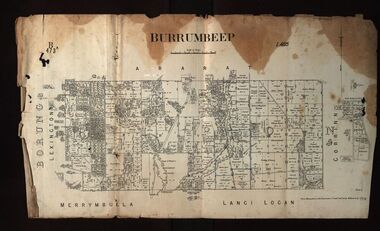
Plan, Burrumbeep, 1884, 16/10/1884
... Bond, Colin Johnson, John Charles Webb, Henry Withycombe, William Henry Barbridge, John Wall, Thomas Flatelly, William Jenkinson, Elisia Radford, V. ... Withycombe, William Henry Barbridge, John Wall, Thomas Flatelly, William Jenkinson, Elisia Radford, V. ...Auctions of Crown land were introduced in the Colony of Victoria from 1851 to encourage settlers to occupy and work the land. Many squatters purchased land at auction at the upset (minimum) price of £1 per acre. In some areas where demand was high, such as the goldfields, the price realised at auction was much more. Land was put up for sale in the study area on the Burrumbeep run in May 1855, on the Lexington run in 1857, and on the Gorrinn run in 1858. (http://www.ararat.vic.gov.au/library/document/thermatics.pdf, accessed 27 January 2015) For 70 years or more, Yalla-y-Poora, Burrumbeep, Edgarley, Mount William and Narrapumelap ranked in the leading wool producers in Victoria. 1 Stud owners at Yalla-y-Poora, Eurambeen, Burrumbeep and Challicum crossed merino sheep with sheep descended from John Macarthur's Camden Park in New South Wales. (http://www.ararat.vic.gov.au/library/document/thermatics.pdf, accessed 27 January 2015) In what was to become the Ararat Mining Division, gold was discovered in May 1854 on the Burrumbeep run at a place that became known as Pinky Point on the Mount William goldfield. By 21 June 1854, between 600 and 1,000 people had arrived. (http://www.ararat.vic.gov.au/library/document/thermatics.pdf, accessed 27 January 2015)\ Town allotment plan for Burrumbeep. Merrymbuela, Borung, Lexington and Langi Logan are neighbouring areas. The plan includes the Burrumbeep Pre-Emptive Right (Roger and Wright); licensed land holders including Stephen Young, John Carroll, William Walsh, Thomas Purcell, Martha M. Bond, Colin Johnson, John Charles Webb, Henry Withycombe, William Henry Barbridge, John Wall, Thomas Flatelly, William Jenkinson, Elisia Radford, V. Radford, Denis Byrne, George Cook. Land holders included Andrew Maloney, Richard Wingfield Harrocks, W. Sporton, Terence Lynch, F. S. Falkiner, A. Millman, H. Morris, George Upham, J. McCLure, S. Fletcher, W. Parker, Thomas Myers, William wright, W.C. Winter, C. Wordman, Oliver A. Winter This plan is associated with former Ballarat School of Mines student Richard Squire (1875-6) Gift of the Squire FamilyVerso written in pencil - Plan of Burrembeep Ararat Burrembeep Araratburrumbeep, corrinn, langi logan, merrymbuela, lexington, ararat, roger & wright, cook, rogers, upham, george upham, ross, parsans, morris, johnson, withycoombe, colin johnson, falkiner, dsporton, john carroll, donald gordon, denis bryne, maurice dooley, martha bond, william harricks, \william wingfield harricks, william l.c. harricks, michael houlihan, thomas purcell, martin ryan, michael cody, fletcher, mccaw, w. parker, j.m. clow, elisia radford, thomas radford, thomas myers, barbridge, e. wilde, j. wall, flatelly, g. wardman, w.c. winter, david ball, jenkinson, ballarat school of mines, richard squire, squire -
 Federation University Historical Collection
Booklet, Charles Boyd, The School of Mines Ballaarat Annual Report, 1882, 1882
... henry parkinson...h. b. de la poer wall...Francis Ormond MLC, Extracts from Visitors' Book, Fees, Form of Bequest, Life Governors, Museum open to Visitors, Office Bearers, Paper of Particulars, Report of the Curator of the Museum and Library (with plans), Report of the Superintendent of Laboratories, Report of the Lecturer in Telegraphy, Report of the Lecturer in Mechanical Engineering, Statement of Receipts and Expenditure for the year 1881, Subjects and Lecturers, Subjects and Examiners, Subscriptions and Donations from 1 January to 31 December 1881, The Lignite Deposit at Skipton (with Section and Plan) ballarat school of mines coal plan ballarat school of mines botanical gardens ballarat school of mines museum museum annual report james oddie w. p. bechervaise s. e. friggis f. j. martell w. h. nicholls, e. i. rosenblum h. r. caselli thomas mann theos. williams f. m. krause alf. mica smith walter d. campbell w. h. shaw charles kent andw. berry robert adam wm. lant carpenter henry parkinson h. b. de la poer wall w. h. brockenshire arthur parker c. davies simon richards c. r. blackett david jones wilberforce dyke kr. r. krauel duncan love william ralph heaton edward dowling octavius vaughan morgan william denton e. h. grimwade james hunter the honble. francis ormond ferdinand krause A.A. ...The School of Mines Ballaarat Annual Report 24 January 1882, Additional Examination Statute, Certificates Granted by Council, Copy of letter received from the Honble. Francis Ormond MLC, Extracts from Visitors' Book, Fees, Form of Bequest, Life Governors, Museum open to Visitors, Office Bearers, Paper of Particulars, Report of the Curator of the Museum and Library (with plans), Report of the Superintendent of Laboratories, Report of the Lecturer in Telegraphy, Report of the Lecturer in Mechanical Engineering, Statement of Receipts and Expenditure for the year 1881, Subjects and Lecturers, Subjects and Examiners, Subscriptions and Donations from 1 January to 31 December 1881, The Lignite Deposit at Skipton (with Section and Plan)Ballarat School of Mines Annual Report. Pale brown booklet of 64 pages. A plan of the Ballarat School of Mines shows the position of the Botanical Gardens, and the Ballarat School of Mines Museum. Geological Sketch Map of Country in the Neighbourhood of Skipton and Plan showing site of Coal Discovery. Skipton Coal Discovery - Section of Windlass Shaft. .2) is a leatherbound copyballarat school of mines, coal, plan, ballarat school of mines botanical gardens, ballarat school of mines museum, museum, annual report, james oddie, w. p. bechervaise, s. e. friggis, f. j. martell, w. h. nicholls,, e. i. rosenblum, h. r. caselli, thomas mann, theos. williams, f. m. krause, alf. mica smith, walter d. campbell, w. h. shaw, charles kent, andw. berry, robert adam, wm. lant carpenter, henry parkinson, h. b. de la poer wall, w. h. brockenshire, arthur parker, c. davies, simon richards, c. r. blackett, david jones, wilberforce dyke, kr. r. krauel, duncan love, william ralph heaton, edward dowling, octavius vaughan morgan, william denton, e. h. grimwade, james hunter, the honble. francis ormond, ferdinand krause, a.a. buley, j. cosmo newberry, w.c. kernot, john lewis, j.m. bickett, james bickett, fees, annie barnett, annette budden, isabel clinton, john dimsey, agnes pobjoy, charlotte shaw, bernard o'dowd, bernard patrick o'dowd, josiah wasley, ferdinand von mueller, william kernot, john lynch, william henderson, henry richards caselli, w.p. berchervaise, e.i. rosenblum, w.h. nicholls, lignate, samuel figgis, mary drury, w. longley, botanical reserve, botanical gardens, francis ormond, george russell, william foster stawell, w.j. clarke, rivett henry bland, john warrington rogers, j. lonie, s.e. figgis, r.f. hudson, w. robertson, e.l. rosenblum, theophilus williams, andrew berry, henry sutton, h. rosales, state school classes, calcutta international exhibition, examinations, h.b.m ship bounty, certicates, walter charles kernot, william tunbridge, mary skelton, cartherine moran, mary rose usher, margaret ellen brophy, william burbridge, andrea tuxen, elizabeth curnow, francis campigi, james s. morrison, arthur hogue -
 Federation University Historical Collection
Document, Establishment of the Ballarat School of Mines, 1870, 1870
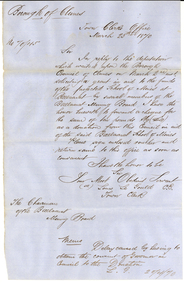
... henry bland...barry...redmond barry...mcculloch...phillips...john phillips...robson...gillies...duncan gillies...warrington rogers...melbourne public library...whitty...robert park...newman...william newman...charles abbott...janes baler...de la poer wall...Wall of Grenville College to R.W. Newman of the Ballarat School of Mines, 27/04/1971 .38) W.H. Odgers to the Ballarat East Town Clerk, 20/05/1870 .39) Correspondence to the Borough of Clunes for the Ballarat Mining Board requesting a grant to set of a school of mines at Ballarat. 25/03/1870 .40) Surveyor to Harrie Wood, Mining Registrar, 27/04/1870 .40) Letter to Judge Warrington Rogers re the contractor's account for satisfactory completion of work on the Ballarat School of Mines, 11/07/1870 .43) Desks for the Ballarat School of Mines by Henry Gough, 1870 .44) Ballarat Star Office to James Baker of the Ballarat School of Mines, 1870...Wall of Grenville College to R.W. Newman of the Ballarat School of Mines, 27/04/1971 .38) W.H. Odgers to the Ballarat East Town Clerk, 20/05/1870 .39) Correspondence to the Borough of Clunes for the Ballarat Mining Board requesting a grant to set of a school of mines at Ballarat. 25/03/1870 .40) Surveyor to Harrie Wood, Mining Registrar, 27/04/1870 .40) Letter to Judge Warrington Rogers re the contractor's account for satisfactory completion of work on the Ballarat School of Mines, 11/07/1870 .43) Desks for the Ballarat School of Mines by Henry Gough, 1870 .44) Ballarat Star Office to James Baker of the Ballarat School of Mines, 1870 Establishment of the Ballarat School of Mines, 1870 Document ...The Ballarat School of Mines was the first site of technical edducation in Australasia. It is now a predecessor institution of Federation University Australia. It's first president was Redmond Barry.Correspondence and planning documents relating to the setting up of the Ballarat School of Mines. it includes tenders for contractors for the refurbishment of the former Ballarat Circuit Court. .1) Rules for the pupils of the Mining School at Zurickau, 18/11/1870 (not translated by Emanuel Steinfeld, perhaps by W. Henderson) .2) Regulations of the Mining Academy at Frieberg, 18/11/1870 .3) Einrichtungen, Freiberg, 1870 (written in German) .4) Letter from Somerville Learmonth of Ercildoun to Harrie Wood, Clerk of the Board of Mines Ballarat, accepting a position as one of three trustees of the Ballarat School of Mines, along with Redmond Barry and R.H. Bland, 08/01/1870 .5) Printing order with Robert Wreford, 26/01/1870 .6) H. Waymouth to Mr Bickett re the Ballarat School of Mines, 1780 .7) Letter from R.H. Bland of Clunes to Harrie Wood of the Ballarat Mining Board, 27/01/1870 .8) Letter from Somerville Livingstone Learmonth of Ercildoun to Harrie Woods of the Ballarat Mining Board refusing the offer to be a Trustee of the Ballarat School of Mines, 28/01/1870 .9) Minutes of the meeting of the Ballarat School of Mines Executive Council, 05/02/1870 and Correspondence from Harrie Wood to J. Warrington Rogers re the lease of the building for the Ballarat School of Mines, 21/01/1870 .10) Chief Secretary's Office to Ballarat Mining Board re Life Membership of the Ballarat School of Mines, 02/02/1870 .10b) Letter from Redmond Barry, Carlton Gardens, Melbourne re the visit of the Governor of Victoria to the Ballarat School of Mines, 04/02/1870 .12) Letter from Charles Pucke on behalf of Mr McCulloch to H, Ainswood, Secretary of the Ballarat Mining Board, 11/07/1870 .13) Correspondence from Henry Rosales of Walhalla (Chairman of the Gippsland Mining Board) to James Baker of the Ballarat School of Mines, 28/12/1870 .11) Meeting of the Executive Council, Bickett, Eddy Downes, 08/02/1870 .14) Letter from John Phillips, contract surveyor of St Arnaud to Mr Newman, Vice-President of the Ballarat School of Mines, 15/12/1870 .15) Articles ordered and obtained for the Ballarat School of Mines, 03/01/1870 .16) Telegram from John Lewis of Clunes to the Ballarat School of Mines. .16b) Quote from painter Thomas Robson for painting the Ballarat School of Mines, 05/06/1870 .17) Note from Duncan Gillies to Harrie Wood re grant for the Ballarat School of Mines, 05/06/1870 .18) Correspondence re Grant to the Ballarat School of Mines, Duncan Gillies, 04/07/1870 .19) Correspondence concerning the Ballarat School of Mines from F. Valient to Harrie Wood, 14/05/1870 .19b) Correspondence from Somerville Livingstone Learmonth to Harrie Woods - an apology for a meeting with Judge Rogers, 23/05/1870 .20) Letter from R.H. Bland to Harrie Wood, 15/07/1870 .22) Telegraph from J. Warrington Rogers to Harrie Wood of the Ballarat Mining Board concerning tenders for the Ballarat School of Mines, which was established in 1870. .23) Letter from Ballarat Mining Board to Judge Warrington Rogers, 31/05/1870 .24) Telegraph to Harrie Wood of the Ballarat Mining Board from J. Warrington Rogers concerning Sir Redmond Barry. A note at the bottom of the telegraph notes ‘This telegram has been delayed through repairs on line. .25) Letter on Melbourne Public Library Letterhead from librarian Augustus Fulk, 05/08/1870 .26) Letter from R.H. Bland to Harrie Wood, 30/05/1870 .27) Letter from Robert Park re alteration of the former Ballarat Court House for use as the Ballarat School of Mines, 05/05/1870. .28) Letter from G. Whitty re painting of the former Ballarat Court House for use as the Ballarat School of Mines, 04/05/1870 .29) Letter from William Newman re plastering of the former Ballarat Court House for use as the Ballarat School of Mines, 05/05/1870 .30) Letter from Charles A. Abbott re teaching Mechanical Drawing at the Ballarat School of Mines, 04/04/1870 .32) Letter from Redmond Barry to the Ballarat School of Mines, 07/1870 .31) National Insurance Company of Australia insurance for the Ballarat School of Mines (former Ballarat Circuit Court), 01/05/1870 .33) Letter from R.H. Bland to Harrie Wood, 09/1870 .34) Letter from Somerville Livingstone Learmonth to Harrie Wood, 06/09/1870 .35) Letter to the Chief Secretary to the Ballarat School of Mines Library & Museum, 30/11/1870 .36) Parliament house (Kitto) to the Ballarat Mining Board, 15/11/1870 .37) H. de la Poer Wall of Grenville College to R.W. Newman of the Ballarat School of Mines, 27/04/1971 .38) W.H. Odgers to the Ballarat East Town Clerk, 20/05/1870 .39) Correspondence to the Borough of Clunes for the Ballarat Mining Board requesting a grant to set of a school of mines at Ballarat. 25/03/1870 .40) Surveyor to Harrie Wood, Mining Registrar, 27/04/1870 .40) Letter to Judge Warrington Rogers re the contractor's account for satisfactory completion of work on the Ballarat School of Mines, 11/07/1870 .43) Desks for the Ballarat School of Mines by Henry Gough, 1870 .44) Ballarat Star Office to James Baker of the Ballarat School of Mines, 1870ballarat school of mines, frieberg mining academy, learmonth, somerville learmonth, wreford, weymouth, bland, rivet henry bland, barry, redmond barry, mcculloch, phillips, john phillips, robson, gillies, duncan gillies, warrington rogers, melbourne public library, whitty, robert park, newman, william newman, charles abbott, janes baler, de la poer wall, odgers, louis le gould, wood, harrie wood, steinfeld, emanuel steinfeld, ainswood, pucke, thomas robson, telegraph, telegram, state library of victoria, fulks, architecture, reed, j. reed, rosales, abbott, charles a. abbott, mechanical drawing, drawing, ballarat circuit courthouse, ballarat courthouse, national insurance company of australia, grenville college, chief secretary's office, robert sandon, school of mines, schools of mines, establishment, ballarat school of mines establishment, germany, london, ercildoun -
 Federation University Historical Collection
Book, Ballarat Junior Technical School Certificates, 1914-1939, 1914-1939
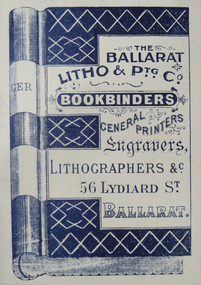
... P [Peter] Chatham was the brother of Philip Chatham's father, John [Jack] Chatham ballarat junior technical school certificates guido brelaz noel brelaz harold adair norman anstis howard beanland allan bernaldo g. g. callister francis capuano j.e. capuano peter chatham arthur coates leslie crouch richard dale francis davis henry dodds jack dulfer john dulfer donald furlong john garner bennett gluyas otto hauser r, haymes graham hopwood arthur h. hoskin r.m. kittelty carl krahnert larkin, michael leask, james leech, george fred longhurst john martin john mcnabb harold morton g.g. netherway harry o'bern h. pitman keith rash percival a. trompf percy trompf harold g. wakeling harold waller robert h. warnock thomas wasley george webb albert williams john a. garner walter button jack kopke b. bernaldo a. snowden g.c. callister a.l. brittain w.j. bassett j.k. kneeshaw ronald ditchfield l.a. chung Foolscap, charcoal green book with red leather binding and marbled edges. ...The Ballarat Junior Technical School was part of the Ballarat School of Mines.P [Peter] Chatham was the brother of Philip Chatham's father, John [Jack] ChathamFoolscap, charcoal green book with red leather binding and marbled edges. In date order each student who received a certificate from the Ballarat Junior Technical School between 1914 and 1939 is listed, along with their results. ballarat junior technical school, certificates, guido brelaz, noel brelaz, harold adair, norman anstis, howard beanland, allan bernaldo, g. g. callister, francis capuano, j.e. capuano, peter chatham, arthur coates, leslie crouch, richard dale, francis davis, henry dodds, jack dulfer, john dulfer, donald furlong, john garner, bennett gluyas, otto hauser, r, haymes, graham hopwood, arthur h. hoskin, r.m. kittelty, carl krahnert, larkin, michael, leask, james, leech, george, fred longhurst, john martin, john mcnabb, harold morton, g.g. netherway, harry o'bern, h. pitman, keith rash, percival a. trompf, percy trompf, harold g. wakeling, harold waller, robert h. warnock, thomas wasley, george webb, albert williams, john a. garner, walter button, jack kopke, b. bernaldo, a. snowden, g.c. callister, a.l. brittain, w.j. bassett, j.k. kneeshaw, ronald ditchfield, l.a. chung -
 Flagstaff Hill Maritime Museum and Village
Decorative object - Wall Decoration, Late 19th to early 20th centuries
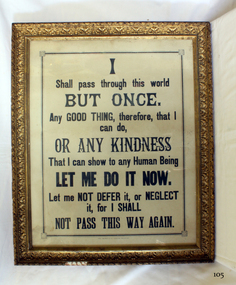
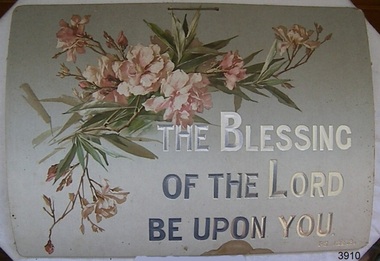
... wall decoration...print of proverb...scripture decoration...giles collection...henry...Henry died in 1933 and Mary Jane in 1940. The Giles family collection has social significance at a local level, because it illustrates the level of material support the Warrnambool community gave to Flagstaff Hill when the Museum was established. warrnambool shipwrecked coast flagstaff hill maritime museum wall decoration print of proverb scripture decoration giles collection henry giles tower hill cooramook warrnambool breakwater mailor’s flat wangoom 19th century household goods Printed proverb+ with Varied type face each line. ...There are many 19th century items of furniture, linen and crockery donated to Flagstaff Hill Maritime Village by Vera and Aurelin Giles. The items are associated with the Giles Family and are known as the “Giles Collection”. These items mostly came from the simple home of Vera’s parents-in-law, Henry Giles and his wife Mary Jane (nee Freckleton), whose photos are in the parlour. They married in 1880. Henry Giles was born at Tower Hill in 1858. He was a labourer on the construction of the Breakwater before leaving in 1895 to build bridges in N.S.W. for about seven years. Mary Jane was born in 1860 at Cooramook. She attended Mailor’s Flat State School where she was also a student teacher before, as family legend has it, she became a governess at “Injemiara” where her grandfather, Francis Freckleton, once owned land. Henry and Mary’s family of six, some of whom were born at Mailor’s Flat and later children at Wangoom, lived with their parents at Wangoom and Purnim west, where Henry died in 1933 and Mary Jane in 1940. The Giles family collection has social significance at a local level, because it illustrates the level of material support the Warrnambool community gave to Flagstaff Hill when the Museum was established.Wall decoration gilded gold ornate frame under glassPrinted proverb+ with Varied type face each line.warrnambool, shipwrecked coast, flagstaff hill maritime museum, wall decoration, print of proverb, scripture decoration, giles collection, henry giles, tower hill, cooramook, warrnambool breakwater, mailor’s flat, wangoom, 19th century household goods -
 Federation University Historical Collection
Book, Ballarat School of Mines Minute Book , 1876-1881, 1876-1881
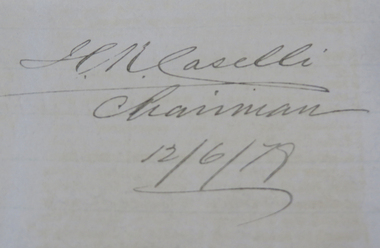
... henry obree...w.h. odgers...edward debois...james darby...redmond barry...pharmacy board...w.h. keast...george perry...f.w. niven...fedinand von mueller...benjamin trewhella...d. miliken...charles strachan...william wilson...r.a.f. murray...e.p. figgis...charles flude...laboratory...john richards...eyres brothers...john armstrong...h.b. de la poer wall...The first president of the Ballarat School of Mines was Redmond Barry. ballarat school of mines henry richards caselli w.h. barnard flude usher august hoelscher warrington rogers james oddie robert m. sergeant ferdinand krause curator w.p. bechervaise james flude school of mines exhibition committee james bickett hugh grey & son ballarat juvenile industrial exhibition charles shoppee g.o. preshaw alfred mica smith rivet henry bland r.w. newman noble wilson william burbidge marie barbour george hall susan cahir mary troy pharmacy botany f.f. bailliere richard viccars mary usher f. pinkerton pyrites works james campbell telegraphy william bailey judge rogers ballarat school of mines certificates william f. west j. bryant henry obree w.h. odgers edward debois james darby redmond barry pharmacy board w.h. keast george perry f.w. niven fedinand von mueller benjamin trewhella d. miliken charles strachan william wilson r.a.f. murray e.p. figgis charles flude laboratory john richards eyres brothers john armstrong h.b. de la poer wall c.f. crouch William H. ...The Ballarat School of Mines was established in 1870 and was a predecessor institution of Federation University. The first president of the Ballarat School of Mines was Redmond Barry.Half leather bound ledger containing handwritten minutes of the Ballarat School of Mines. Includes: * Foundation Class in Pharmacy and Botany (17/04/1979) * Female Telegraphy Students (12/06/1917)ballarat school of mines, henry richards caselli, w.h. barnard, flude, usher, august hoelscher, warrington rogers, james oddie, robert m. sergeant, ferdinand krause, curator, w.p. bechervaise, james flude, school of mines exhibition committee, james bickett, hugh grey & son, ballarat juvenile industrial exhibition, charles shoppee, g.o. preshaw, alfred mica smith, rivet henry bland, r.w. newman, noble wilson, william burbidge, marie barbour, george hall, susan cahir, mary troy, pharmacy, botany, f.f. bailliere, richard viccars, mary usher, f. pinkerton, pyrites works, james campbell, telegraphy, william bailey, judge rogers, ballarat school of mines certificates, william f. west, j. bryant, henry obree, w.h. odgers, edward debois, james darby, redmond barry, pharmacy board, w.h. keast, george perry, f.w. niven, fedinand von mueller, benjamin trewhella, d. miliken, charles strachan, william wilson, r.a.f. murray, e.p. figgis, charles flude, laboratory, john richards, eyres brothers, john armstrong, h.b. de la poer wall, c.f. crouch, william h. keast, frank pintkerton, hugh grey -
 Federation University Historical Collection
Book, Art Decoration Ornaments
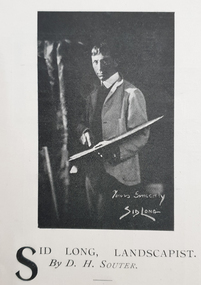
... henry parkes...pyrmont bridge...maori...ancient egypt...julian ashton...st andrew'e cathedral sydney...edmond thomas blacket...sydney university...comisariat stores circular quay...the rocks...w. lister-lister...sydney domestic architecture...james barnet...john horbury hunt...sidney long...maori art...wall...ballarat technical art school ballarat technical art school library bank of australasia mount kosciusko siry henry parkes pyrmont bridge maori ancient egypt julian ashton st andrew'e cathedral sydney edmond thomas blacket sydney university comisariat stores circular quay the rocks w. lister-lister sydney domestic architecture james barnet john horbury hunt sidney long maori art wall decoratoni paperhangings australian stained glass art and architecture stamped metalwork w.c. piguenit australian architecture rose bay convent chapel australian posters pottery cyril blacket bookbinding new south wales state library architecture oxford st sydney'tom roberts repousse sydney harbour bridge john longstaff women painters the great pyramid of egypt skyscraper comes to new south wales melbourne hospital plans governor bligh electric illumination Black cloth covered book with leather spine. ...Black cloth covered book with leather spine. Colour illustrationsballarat technical art school, ballarat technical art school library, bank of australasia, mount kosciusko, siry henry parkes, pyrmont bridge, maori, ancient egypt, julian ashton, st andrew'e cathedral sydney, edmond thomas blacket, sydney university, comisariat stores circular quay, the rocks, w. lister-lister, sydney domestic architecture, james barnet, john horbury hunt, sidney long, maori art, wall decoratoni, paperhangings, australian stained glass, art and architecture, stamped metalwork, w.c. piguenit, australian architecture, rose bay convent chapel, australian posters, pottery, cyril blacket, bookbinding, new south wales state library architecture, oxford st sydney'tom roberts, repousse, sydney harbour bridge, john longstaff, women painters, the great pyramid of egypt, skyscraper comes to new south wales, melbourne hospital plans, governor bligh, electric illumination -
 Federation University Historical Collection
Book - Artwork, Ivy Wilson, Album of original Ballarat Technical Art School folio by Ivy Wilson, c1922
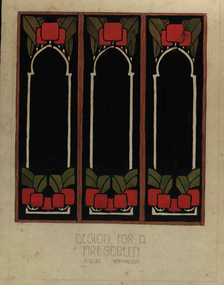
... wall friezes and murals. One of Wilson's examples, a wreath was subsequently translated into embroidered needlework. Wilson’s folio possibly consists of mostly junior technical work, as she appears to only have sat a single senior Education Department examination, Drawing Plant Forms from Nature. Alternatively, given her focus on textile-based arts, she may have been an evening trade student. Ivy Wilson married Frederick Henry...wall friezes and murals. One of Wilson's examples, a wreath was subsequently translated into embroidered needlework. Wilson’s folio possibly consists of mostly junior technical work, as she appears to only have sat a single senior Education Department examination, Drawing Plant Forms from Nature. Alternatively, given her focus on textile-based arts, she may have been an evening trade student. Ivy Wilson married Frederick Henry ...Ivy WILSON (1907-1998) Ballarat | Australia Ivy Wilson was born on 05 July 1907 to Charlotte and Edward Wilson of 167 Mair Street, Ballarat. She attended Humffray Street Primary School and the Ballarat Technical Art School (a division of the Ballarat School of Mines) in 1922. Wilson's student folio contains several stencils hand-cut from paper and card. Among them are stylised graphics of correa, waratah, gum, and kangaroo apple as well as kookaburras, cockatoos and a koala. With diverse applications, stencilling attracted a range of students at the Ballarat Technical Art School. Stencilling was applied to interior surfaces like cushions and curtains. Commercial briefs included wall friezes and murals. One of Wilson's examples, a wreath was subsequently translated into embroidered needlework. Wilson’s folio possibly consists of mostly junior technical work, as she appears to only have sat a single senior Education Department examination, Drawing Plant Forms from Nature. Alternatively, given her focus on textile-based arts, she may have been an evening trade student. Ivy Wilson married Frederick Henry Russell on 23 December 1933 at St Mary's Church of England Caulfield, and had one daughter - Nola, who gifted this folio to the University’s permanent Historical Collection. Ivy died on 17 November 1998 at Caulfield.Silver cloth covered photo album of artworks by Ivy Wilson. Gift of Nola Jones, daughter of Ivy Wilson, 2016 Contains original stencils, plus four photographs of a works kept by Ivy Wilson's family (2016).(Handwritten note) This art is the work of Ivy Wilson. born" 5th July 1907 to Charlotte & Edward Wilson of 17 Mair St. Ballarat. Attended Humffray St. Primary School and Ballarat School of Mines 1922. Married: Frederick Henry Russell December 23rd 1933 at St Marys CofE Caulfield Died 17th November 1998 at Caulfield. Mother of one daughter, Nola. ivy wilson, ballarat tecnical art school, artwork, dana street primary school, alumni, stencilling, stencils, embroidery, textiles, design -
Federation University Historical Collection
Document, Ballarat Identities Research Notes
... ...Henry B. De La Poer Wall...Deardem, Rochlitz, William Henry Shaw, William Collard Smith, Henry B. De La Poer Wall, William C. Weir, John Winter, Lauderdale House...Deardem, Rochlitz, William Henry Shaw, William Collard Smith, Henry B. De La Poer Wall, William C. Weir, John Winter, Lauderdale House Ballarat Identities Research Notes Document ...A folder of notes relating to the Ballarat Biographies including Martha Clendinning, George Clendinning, John Hepburn, Elizabeth Hepburn, Smeaton Estate, William Bailey, Egerton Mine, Redmond Barry, Thomas Bath, Graham Berry, Francis Cane, Thomas Bury, Thomas Carpenter, Charles Gavan Duffy, Henry Dunnsford, Charles Dyte, Stanley Elder, Archibald Fisken, Alexander Greenfield, William Henderson, William Irwin, King Billy, Mullawullah, Kopke, Rod Lacey, Peter Lalor, John Dunmore Lang, George Long, Thomas Learmonth, Evan Rowlands, Robert Lewis, F.W. Niven, Ochiltree, Alexander Ocheltree, W.B, Ochiltree, Edward G. Ochiltree, Lal Lal Estate, Count O'Loughlin, Martin O'Loughlin, Isiah Pearce, John Permewan, Emanual Steinfeld, James Pinnock, A.J. Pittard, J. Deardem, Rochlitz, William Henry Shaw, William Collard Smith, Henry B. De La Poer Wall, William C. Weir, John Winter, Lauderdale Housedianne campbell goldfields lawyers collection, martha clendinning, george clendinning, john hepburn, elizabeth hepburn, smeaton estate, william bailey, egerton mine, redmond barry, thomas bath, graham berry, francis cane, thomas bury, thomas carpenter, charles gavan duffy, henry dunnsford, charles dyte, stanley elder, archibald fisken, alexander greenfield, william henderson, william irwin, king billy, mullawullah, kopke, rod lacey, peter lalor, john dunmore lang, george long, thomas learmonth, evan rowlands, robert lewis, f.w. niven, ochiltree, alexander ocheltree, w.b, edward g. ochiltree, lal lal estate, count o'loughlin, martin o'loughlin, isiah pearce, john permewan, emanual steinfeld, james pinnock, a.j. pittard, j. deardem, rochlitz, william henry shaw, william collard smith, henry b. de la poer wall, william c. weir, john winter, lauderdale house -
 Federation University Historical Collection
Magazine - Booklet, Ballarat School of Mines Student's Magazine, July 1899, 1899
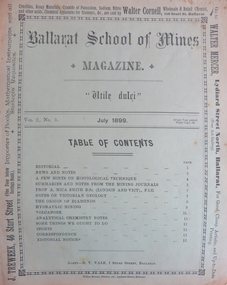
... Mica Smith B.Sc., Notes on Victorian geology, The origin of diamonds, Hydraulic mining, Volcanoes, Analytical chemistry notes, Some things we ought to do, Sports, Correspondence, Editorial notes. ballarat school of mines students' magazine g. e. saunder w. wallace j. booth f. farnell h. waller a. h. freeman w. e. hearman professor dawbarn e. gutheil a. selwyn brown h. watson a. w. k. peirce professor mica smith w. bradford henry watson mr e. faribault j. h. parsons j. holmes pollock t. s. hart thomas hart alfred mica smith a. e. c. kerr g. g. bonney histological technique diamonds victorian geology massey-harris bicycles adelaide school of mines ballarat school of mines colours ballarat school of mines motto ballarat school of mines badge w.hirt e. byron moore britannia gold mine visitors j. bryant premier mine coolgardie last chance gold mine g.e. saunder ivanhoe mine kalgoorlie black horse cyanide works, edgerton hercules mine, mount reid, tasmania f. parnell paul zeehan school of mines a.h. freeman crown point gold mining co w.e. hearman parker's range, southern cross, w.a. trappean rocks hydraulic mining a.e.c. kerr volcanoes f.g. bonney l.j. austine and co. downer and co carter and werner Pale green booklet of 10 pages. ...Table of contents: Editorial, News and Notes, A few hints on histological technique, Summaries and notes from the mining journals, Professor A. Mica Smith B.Sc., Notes on Victorian geology, The origin of diamonds, Hydraulic mining, Volcanoes, Analytical chemistry notes, Some things we ought to do, Sports, Correspondence, Editorial notes.Pale green booklet of 10 pages. ballarat school of mines, students' magazine, g. e. saunder, w. wallace, j. booth, f. farnell, h. waller, a. h. freeman, w. e. hearman, professor dawbarn, e. gutheil, a. selwyn brown, h. watson, a. w. k. peirce, professor mica smith, w. bradford, henry watson, mr e. faribault, j. h. parsons, j. holmes pollock, t. s. hart, thomas hart, alfred mica smith, a. e. c. kerr, g. g. bonney, histological technique, diamonds, victorian geology, massey-harris bicycles, adelaide school of mines, ballarat school of mines colours, ballarat school of mines motto, ballarat school of mines badge, w.hirt, e. byron moore, britannia gold mine, visitors, j. bryant, premier mine coolgardie, last chance gold mine, g.e. saunder, ivanhoe mine kalgoorlie, black horse cyanide works, edgerton, hercules mine, mount reid, tasmania, f. parnell paul, zeehan school of mines, a.h. freeman, crown point gold mining co, w.e. hearman, parker's range, southern cross, w.a., trappean rocks, hydraulic mining, a.e.c. kerr, volcanoes, f.g. bonney, l.j. austine and co., downer and co, carter and werner -
Federation University Historical Collection
Booklet - Annual Report 1878, The Ballarat Star, The School of Mines Ballaarat Annual Report, 31 January, 1878, 1878
... henry barnard...w. hy. barnard...certificates...subscriptions and donations...denjn...h. dods...count de zaba...john garbutt...w. campbell sleigh...f. coglan...michael o'connor - bishop of ballaarat...william kelly...j. e. bromby...wm. f. drummond jervois...h. b. de la poer wall...The School of Mines Annual Report, 23 December, 1878, Statements of Receipts and Expenditure for 1877-78, General Balance Sheet, List of Subscriptions and Donations, Bequest - form of, Certificates granted by the Council, Donations of Books, Specimens, facilities for forwarding, Examiners, Extracts from Visitors Book, Fees - table of, General Balance Sheet, Honorary Correspondents, Laboratories - cost of, Lecturers, Life Governors, Museums, Officer-Bearers, Receipts and Expenditure 1878 - General, Balance Sheet 1878 - Pyrites Fund, Receipts and Expenditure 1878 - Endowment Fund, Subscriptions and Donations, Visitors invited to inspect Ballaratschool of mines annual report life governors honorary correspondents office bearers subjects and lecturers subjects and examiners John noble Wilson j. noble wilson r. f. hudson fees george perry William henry barnard w. hy. barnard certificates subscriptions and donations denjn h. dods count de zaba john garbutt w. campbell sleigh f. coglan michael o'connor - bishop of ballaarat william kelly j. e. bromby wm. f. drummond jervois h. b. de la poer wall charles h. pearson redmond barry charles e. albrecht, William Jervois h. dodds White booklet of 36 pages - Ballarat School of Mines Annual Report 1878 The School of Mines Ballaarat Annual Report, 31 January, 1878 Booklet Annual Report 1878 The Ballarat Star ...The School of Mines Annual Report, 23 December, 1878, Statements of Receipts and Expenditure for 1877-78, General Balance Sheet, List of Subscriptions and Donations, Bequest - form of, Certificates granted by the Council, Donations of Books, Specimens, facilities for forwarding, Examiners, Extracts from Visitors Book, Fees - table of, General Balance Sheet, Honorary Correspondents, Laboratories - cost of, Lecturers, Life Governors, Museums, Officer-Bearers, Receipts and Expenditure 1878 - General, Balance Sheet 1878 - Pyrites Fund, Receipts and Expenditure 1878 - Endowment Fund, Subscriptions and Donations, Visitors invited to inspectWhite booklet of 36 pages - Ballarat School of Mines Annual Report 1878ballaratschool of mines, annual report, life governors, honorary correspondents, office bearers, subjects and lecturers, subjects and examiners, john noble wilson, j. noble wilson, r. f. hudson, fees, george perry, william henry barnard, w. hy. barnard, certificates, subscriptions and donations, denjn, h. dods, count de zaba, john garbutt, w. campbell sleigh, f. coglan, michael o'connor - bishop of ballaarat, william kelly, j. e. bromby, wm. f. drummond jervois, h. b. de la poer wall, charles h. pearson, redmond barry, charles e. albrecht,, william jervois, h. dodds -
 Federation University Historical Collection
Book - Annual Report 1880, The School of Mines Ballaarat Annual Report, 9 February, 1880, 1880
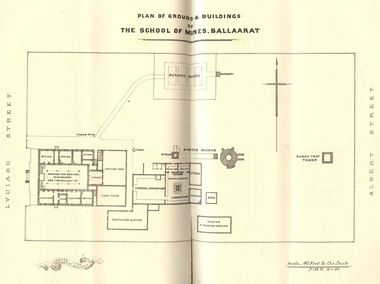
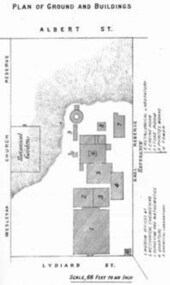
... wall...w. h. brokenshire...arthur parker...henry...The School of Mines Annual Report, 9 February, 1881, Additional Examination Statute 1880, Balance Sheet, Certificates Granted by Council, Donations and Fees - carriage of, Extracts from Visitors' Book, Fees, Form of Bequest, Honorary Correspondents, Life Governors, Mining and Mineral Contributions Invited - Paper of Particulars, Museum - open to visitors, Office Bearers, Obituary, Report of the Lecturer in Mathematics, Report of the Lecturer in Mining-Land- and Engineering-Surveying, Report of the Lecturer in Mechanical Engineering, Report of the Lecturer in Telegraphy, Report of the Curator of the Museum (with Plans), Report of the Superintendent of Laboratories, Subjects and Lecturers, Subjects and Examiners, Statement of Receipts and Expenditure for the year 1880, Subscriptions and Donations from 1 January to 31 December 1880, The Lal-Lal Iron Ore Deposits - (with Section and Plan) the school of mines annual report additional examination statute 1880 balance sheet certificates granted by council donations and fees - carriage of extracts from visitors' book fees form of bequest honorary correspondents life governors mining and mineral contributions invited-paper of particulars museum open to visitors office bearers obituary report of the lecturer in mathematics report of the lecturer in mining-land and engineering-surveying report of the lecturer in mechanical engineering report of the lecturer in telegraphy report of the curator of the museum (with plans) report of the superintendent of laboratories subjects and lecturers subjects and examiners statement of receipts and expenditure for the year 1880 subscriptions and donations from 1 january to 31 december 1880 the lal-lal iron ore deposits-(with section and plan) obituary - sir redmond barry - arthur leahy - jacob upfold - john day mr james oddie dr. r. f. hudson john victor chas. wm. thomas w. h. shaw walter d. campbell ferdinand m. krause joseph flude geo. perry w. hy. barnard examination statute his excellency sir wm. f. drummond jervois charles h. pearson t. brodribb professor pepper james mitchell robert adam wm. lant carperter h. b. de la poer wall w. h. brokenshire arthur parker henry parkinson c. davies simon richards c. v. gorton c. r. blackett david jones wilberforce dyke ferdinand krause ballarat school of mines museum ballarat school of mines museum plan lal lal ore deposits moorabool river William Land Carpenter William jervois William Henry TBarnard Pale green booklet of 70 pages, Annual Report 1880. ...The School of Mines Annual Report, 9 February, 1881, Additional Examination Statute 1880, Balance Sheet, Certificates Granted by Council, Donations and Fees - carriage of, Extracts from Visitors' Book, Fees, Form of Bequest, Honorary Correspondents, Life Governors, Mining and Mineral Contributions Invited - Paper of Particulars, Museum - open to visitors, Office Bearers, Obituary, Report of the Lecturer in Mathematics, Report of the Lecturer in Mining-Land- and Engineering-Surveying, Report of the Lecturer in Mechanical Engineering, Report of the Lecturer in Telegraphy, Report of the Curator of the Museum (with Plans), Report of the Superintendent of Laboratories, Subjects and Lecturers, Subjects and Examiners, Statement of Receipts and Expenditure for the year 1880, Subscriptions and Donations from 1 January to 31 December 1880, The Lal-Lal Iron Ore Deposits - (with Section and Plan)Pale green booklet of 70 pages, Annual Report 1880. Image of Guage Test Tower, Image of The School of Mines, Plan of Ground and Buildings - Albert Street, The School of Mines Ballaarat - The Museum - Plan of Groundfloor, Image of the Lal-Lal Iron Ore Deposits, Moorabool Riverthe school of mines, annual report, additional examination statute 1880, balance sheet, certificates granted by council, donations and fees - carriage of, extracts from visitors' book, fees, form of bequest, honorary correspondents, life governors, mining and mineral contributions invited-paper of particulars, museum open to visitors, office bearers, obituary, report of the lecturer in mathematics, report of the lecturer in mining-land and engineering-surveying, report of the lecturer in mechanical engineering, report of the lecturer in telegraphy, report of the curator of the museum (with plans), report of the superintendent of laboratories, subjects and lecturers, subjects and examiners, statement of receipts and expenditure for the year 1880, subscriptions and donations from 1 january to 31 december 1880, the lal-lal iron ore deposits-(with section and plan), obituary - sir redmond barry - arthur leahy - jacob upfold - john day, mr james oddie, dr. r. f. hudson, john victor, chas. wm. thomas, w. h. shaw, walter d. campbell, ferdinand m. krause, joseph flude, geo. perry, w. hy. barnard, examination statute, his excellency sir wm. f. drummond jervois, charles h. pearson, t. brodribb, professor pepper, james mitchell, robert adam, wm. lant carperter, h. b. de la poer wall, w. h. brokenshire, arthur parker, henry parkinson, c. davies, simon richards, c. v. gorton, c. r. blackett, david jones, wilberforce dyke, ferdinand krause, ballarat school of mines museum, ballarat school of mines museum plan, lal lal ore deposits, moorabool river, william land carpenter, william jervois, william henry tbarnard -
Federation University Historical Collection
Booklet, A. A. Herberte, "STAR' Printing Works, The School of Mines, Ballaarat, Annual Report 1884, 1885
... wall, lecturer in astronomy...Subscriptions...fonations...telegraphy...henry...Annual Report, Balance Sheet, Certificates Granted by the Council, Examination Papers - Elementary Science Classes (Appendix), Fees, Honorary Correspondents, Life Governors, Museum - open to Visitors', Office Bearers, Report of the Curator of the Museum and Library, Report of the Lecturer in Mathematics, Report of the Lecturer in Mechanical Engineering, Report of the Lecturer in Electricity and Magnetism, Report of the Lecturer in Telegraphy, Report of the Lecturer in Botany, Report of the Lecturer in Materia Medica and Physiology, Report of the Lecturer in Astronomy, Scale of Charges for Assays and Analyses, Examinations Held, Statement of Receipts and Expenditure for the year 1884, Statement of Receipts and Expenditure for Special Funds, Subjects and Lecturers, Subjects and Examiners, Subscriptions and Donations from 1st January to 31st December 1884, Time Table annual report balance sheet certificates granted by the council examination papers - elementary science fees honorary correspondents life governors museum officer bearers report of the curator of the museum and library report of the lecturer in telegraphy report of the lecturer in mechanical engineering report of the lecturer in astronomy scale of charges for assays and analyses examinations held statement of receipts and expenditure for the year 1884 statement of receipts and expenditure for special funds subjects and lecturers subjects and examiners subscriptions and donations from 1st january to 31st december 1884 time table james oddie, esq., j.p. alf. mica smith, lecturer in chemistry, natural philosophy and botany f. m. krause, lecturer in geology, scientific mining, land, mining and engineering surveying t. h. thompson, lecturer in practical mining j. sommers, lecturer in mechanical engineering h. sutton, lecturer in mechanical applied electricity and magnetism a. a. buley, lecturer in mathematics w. d. campbell, lecturer in telegraphy j. f. usher, lecturer in materia medica, pharmacy and physiology geo. day, lecturer in botany john wall, lecturer in astronomy Subscriptions fonations telegraphy henry sutton Usher george day Soft covered pale green booklet of 67 pages. ...The School of Mines Ballaarat Annual Report 1884. Annual Report, Balance Sheet, Certificates Granted by the Council, Examination Papers - Elementary Science Classes (Appendix), Fees, Honorary Correspondents, Life Governors, Museum - open to Visitors', Office Bearers, Report of the Curator of the Museum and Library, Report of the Lecturer in Mathematics, Report of the Lecturer in Mechanical Engineering, Report of the Lecturer in Electricity and Magnetism, Report of the Lecturer in Telegraphy, Report of the Lecturer in Botany, Report of the Lecturer in Materia Medica and Physiology, Report of the Lecturer in Astronomy, Scale of Charges for Assays and Analyses, Examinations Held, Statement of Receipts and Expenditure for the year 1884, Statement of Receipts and Expenditure for Special Funds, Subjects and Lecturers, Subjects and Examiners, Subscriptions and Donations from 1st January to 31st December 1884, Time TableSoft covered pale green booklet of 67 pages. The Ballarat School of Mines Annual Report for 1984.annual report, balance sheet, certificates granted by the council, examination papers - elementary science, fees, honorary correspondents, life governors, museum, officer bearers, report of the curator of the museum and library, report of the lecturer in telegraphy, report of the lecturer in mechanical engineering, report of the lecturer in astronomy, scale of charges for assays and analyses, examinations held, statement of receipts and expenditure for the year 1884, statement of receipts and expenditure for special funds, subjects and lecturers, subjects and examiners, subscriptions and donations from 1st january to 31st december 1884, time table, james oddie, esq., j.p., alf. mica smith, lecturer in chemistry, natural philosophy and botany, f. m. krause, lecturer in geology, scientific mining, land, mining and engineering surveying, t. h. thompson, lecturer in practical mining, j. sommers, lecturer in mechanical engineering, h. sutton, lecturer in mechanical applied electricity and magnetism, a. a. buley, lecturer in mathematics, w. d. campbell, lecturer in telegraphy, j. f. usher, lecturer in materia medica, pharmacy and physiology, geo. day, lecturer in botany, john wall, lecturer in astronomy, subscriptions, fonations, telegraphy, henry sutton, usher, george day -
Federation University Historical Collection
Document, Samuel Huyghue, How 'The Camp' saw 'The Riot': The hitherto unpublished story of a Camp Official - Samuel Douglas Smyth Huyghue, 1884, 1884
... wall...william webb...felix boyle...george webster...timothy Hayes...Henry...Samuel Huyghue Eureka Stockade Ballarat Government Camp Ballarat riots James Bentley military riot act digger hunt gilbert Amos robert nickle 12th regiment 40th regiment john king eureka flag michael roney joseph wall william webb felix boyle george webster timothy Hayes Henry wise Peter Lalor john Basson Humffray J.B. ...Samuel Huyghue was a Camp official at Ballarat during the Eureka Stockade. He was Canadian by birth. The manuscript was written some years after the Eureka Stockade and gives person views of what happened on the goldfields at that time. Typed transcript of a manuscript held in the Mitchell Library, Sydney, and transcribed from the original by Paul O'Brien.samuel huyghue, eureka stockade, ballarat government camp, ballarat riots, james bentley, military, riot act, digger hunt, gilbert amos, robert nickle, 12th regiment, 40th regiment, john king, eureka flag, michael roney, joseph wall, william webb, felix boyle, george webster, timothy hayes, henry wise, peter lalor, john basson humffray, j.b. humffray -
Federation University Historical Collection
Booklet, Report of the Board Appointed to Advise the Government as to the Best Mode of Developing the Auriferous and Mineral Resources of the Colony, 1879-80, 1880
... henry rosales...robert m. sergeant...a.w. howitt...deep leads...carisbrook...sebastopol...sebastopol plateau...r.m. harvey...james m. main...john wall...mineral resources mining mining districts ballarat mining district auriferous resources william collard smith rivett henry bland henry rosales robert m. sergeant a.w. howitt deep leads carisbrook sebastopol sebastopol plateau r.m. harvey james m. main john wall g. hale t.h. thompson james leckie e.h. uren james cotter p. matthews w.k. peden john sharp g.c. robinson dead horse lead william benson j. keith smythesdale charles thorne haddon linton little bendigo scarsdale blackwood daylesford owen jones james mcmillan h.h. sainsbury thomas bury White Foolscap printed Government document relating Victoria's mineral resources. ...White Foolscap printed Government document relating Victoria's mineral resources.mineral resources, mining, mining districts, ballarat mining district, auriferous resources, william collard smith, rivett henry bland, henry rosales, robert m. sergeant, a.w. howitt, deep leads, carisbrook, sebastopol, sebastopol plateau, r.m. harvey, james m. main, john wall, g. hale, t.h. thompson, james leckie, e.h. uren, james cotter, p. matthews, w.k. peden, john sharp, g.c. robinson, dead horse lead, william benson, j. keith, smythesdale, charles thorne, haddon, linton, little bendigo, scarsdale, blackwood, daylesford, owen jones, james mcmillan, h.h. sainsbury, thomas bury -
Federation University Historical Collection
Film - Microfilm Rolls, Microfilm of the Ballarat School of Mines Minute Books, 1870- 1883, 12/2020
... henry richards caselli...Borough Council of Ballarat West...f.c. downes...l.s. christie...j.d. wanliss...francis summers...thomas whitelaw...H.B. de la poer wall...Newman jphn edward bakman thomas gray borough council of clunes h.r. caselli henry richards caselli Borough Council of Ballarat West f.c. downes l.s. christie j.d. wanliss francis summers thomas whitelaw H.B. de la poer wall library donations roderick murchison Robert Brough Smyth Museum donation j.e. crocker p.c. fitzpatrick opening address j.f. usher edwin trenery c.s. reeves t.d. wanliss john edward bathman architect robert davidson 26 October 1870 ... ...The Ballarat School of Mines was established in 1870, the first of its kind in Australasia. It later became a part of the University of Ballarat , then Federation University Australia.A roll of microfilm containing digitised images of each page of the first four Ballarat School of Mines Minute Books. 26 October 1870 ... The originl intention of the founders of the School - as per resolution of the Mining Bord was to hold the School at the Mechanics Institite Ballaarat and to have special rooms in that building set apart for this purpose. The reasons for this was that the Mechanics Institute had already rooms which could be used for these purposes and the pupils had easy access to the Libary and Museum belonging to that instituions, but after more mature consideration it was deemed advisabke to establish an indpependent institution and obtain a seperate buidling for the School. His Honor J.W. Rogers suggested that an effort should be made to obtain from the Government a lease of teh Old Court House at a pepper corn rent. The building at that time being out of repait and not used by the Government ...ballarat school of mines, minute books, annual report, microfilm, former ballarat circuit court, redmond barry, james flude, mining laboratory, james bickett, william stawell, judge rogers, constitution, mining board of ballarat, duncan gillies, william mclennan, ballarat mechanics' institute, judge warrington rogers, pepper corn rent, harrie wood, professor mccoy, james mcculloch, john alexander macpherson, williammclellan, master, arithmatic, mensuration, surveying, drawing, book-keeping, algebra, euclid, mining, chemistry, somerville learmonth, somerville livingstone learmonth, robert lewis, j.m. bickett, walter cotchett, usher, john cumming, philip russell, andrew anderson, a.h. king, william robertson, band of hope and albion consols, robert gibbs'james mcdowall, r.w. newman, jphn edward bakman, thomas gray, borough council of clunes, h.r. caselli, henry richards caselli, borough council of ballarat west, f.c. downes, l.s. christie, j.d. wanliss, francis summers, thomas whitelaw, h.b. de la poer wall, library donations, roderick murchison, robert brough smyth, museum donation, j.e. crocker, p.c. fitzpatrick, opening address, j.f. usher, edwin trenery, c.s. reeves, t.d. wanliss, john edward bathman, architect, robert davidson -
 Federation University Historical Collection
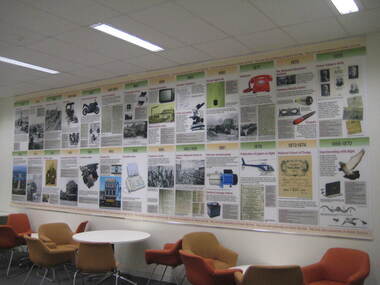
Photograph - Photograph - Colour, Henry Sutton Timeline at the Ballarat School of Mines Old Chemistry Building, 2012, 31/08/2012
... Colour photographs of the Henry Sutton Timeline on the wall at the Ballarat School of Mines Old Chemistry Building...This timeline was researched for the Ballarat Heritage Weekend by Lorayne Branch. henry sutton ballarat school of mines old chemistry building timeline Colour photographs of the Henry Sutton Timeline on the wall at the Ballarat School of Mines Old Chemistry Building Henry Sutton Timeline at the Ballarat School of Mines Old Chemistry Building, 2012 Photograph Photograph - Colour Clare Gervasoni ...This timeline was researched for the Ballarat Heritage Weekend by Lorayne Branch. Colour photographs of the Henry Sutton Timeline on the wall at the Ballarat School of Mines Old Chemistry Buildinghenry sutton, ballarat school of mines, old chemistry building, timeline -
Federation University Historical Collection
Magazine - Booklet, Ballarat School of Mines Students' Magazine, 1935, 1935
... Bickett, An Attitude to War, Some Impressions by a New Comer to New Guinea, Fumes from the Lab, Arts & Crafts Gossip, Sport, Commercial Notes, The Junior Tecs ballarat school of mines magazine f. t. wimble & co. ltd., sydney j. woolcock a. nye d. shore d. taylor j. elliott b. saunders w. williams a. moodie v. hunt j. shelton r. warnock dr. j. r. pound g. procter g. merlin j. b. robinson james pound peter wilson mr alexander mr creelman mr crouch h. steane j. sutherland a. bell. a. max wilson g. f. eric rumpff r. mcconnell t. byrne c. r. king p. marshman a. f. heseltine w. f. tucker j. m. bickett a. m. wilson f. whitworth w. tierney r. leigh g. berriman a. sneddon a. collins h. maddern d. flynn n. bayly m. rickey w. calaghan d. wright e. wallace b. lamb s. wise r. quick i. leviston b. chaplin j. coates n. dunstan d. mcarthy d. henderson j. mathes g. leviston e. mcdonald k. blackie j. mouton n. jelbart r. brown k. mathes a. pickering j. mcghie r. white w. dawson j. forrest m. hamill w. martin m. jeffs k. waller d. nolan l. baxter r. knight l. moy m. hunt j. henry a. goldby j. menhennet mr king w. nice k. pattie f. capuano l. g. r. crouch gilda gude valma jensen e. shaw lorna bailey marjorie john dorothy woolcock Yellow soft covered magazine of 70 pages, including advertisements. ...List of Full Course Students' 1935, Editorial, Obituary - J. B. Robinson, Personal Column, Personal Column, Editor's Notes, Old Boys: Personal, The "Head" - An Appreciation, The Late Dean - W. F. Tucker, A Tribute - J. M. Bickett, An Attitude to War, Some Impressions by a New Comer to New Guinea, Fumes from the Lab, Arts & Crafts Gossip, Sport, Commercial Notes, The Junior TecsYellow soft covered magazine of 70 pages, including advertisements. Artworks * Blocks and Inks supplied by F.T. Wimble and Co. Ltd Sydney - Printed by students of printing class School of Mines Ballarat * Mr G - By Valma Jenson * Miss G - By E.Shaw * Joker of the pack by Gilda Gude * Oh Mother - By Valma Jensen * Man Praying - By A.P. * Swell - By Valma Jensen * In his element - By E.Shaw * Our jazz band - By Valma Jensen * Spaghetti - By E.Shaw * The Peter Pan statue in Kensington Gardens - By Gilda Gude * Hunted - By Valma Jensen * Bridget & Vic - By Valma Jensen * Lady pointing a statue - By Gilda Gude * Hi first solo flight - By Dorothy Woolcock * Dear Me - a millionth of a milligram out ! - By E.Shaw * Marley & Paul - By Valma Jensen * Green Plan Print - By Hunt * Yes, but it doesn't read, it doesn't read - By E.Shaw * The Big Noise - By Valma Jensen * Bashful Barney - By Valma Jensen * Willowy Verna - By E.Shaw * Margaret - By Valma Jensen * Don - By Valma Jensen * Cyril - By Gilda Gude * Jack - By Gilda Gude * Nancy - By Valma Jensen * Off to English - By Valma Jensen * "A mag article today please or six tomorrow" By E. Shaw * "Oh you boys are awful" - By E. Shaw * Maureen - By Valma Jensen * Geggy - By Valma Jensen * Aw crikey - By Valma Jensen * The wheelbarrow crate reaches Africa - By J.W * Lady Dean - By Valma Jensen * Margery - By Valma Jensen * Bubba - By Lorna Bailey * Chook - By Marjorie John * Bunny - By Valma Jensen * Sixa - By Valma Jensen * Fish Print - By Hunt * Betty - By Lorna Bailey * Bessie - By Lorna Bailey * Janette - By Lorna Bailey * Butcher - By Valma Jensen * Minnow - By F.J.Hballarat school of mines, magazine, f. t. wimble & co. ltd., sydney, j. woolcock, a. nye, d. shore, d. taylor, j. elliott, b. saunders, w. williams, a. moodie, v. hunt, j. shelton, r. warnock, dr. j. r. pound, g. procter, g. merlin, j. b. robinson, james pound, peter wilson, mr alexander, mr creelman, mr crouch, h. steane, j. sutherland, a. bell., a. max wilson, g. f. eric rumpff, r. mcconnell, t. byrne, c. r. king, p. marshman, a. f. heseltine, w. f. tucker, j. m. bickett, a. m. wilson, f. whitworth, w. tierney, r. leigh, g. berriman, a. sneddon, a. collins, h. maddern, d. flynn, n. bayly, m. rickey, w. calaghan, d. wright, e. wallace, b. lamb, s. wise, r. quick, i. leviston, b. chaplin, j. coates, n. dunstan, d. mcarthy, d. henderson, j. mathes, g. leviston, e. mcdonald, k. blackie, j. mouton, n. jelbart, r. brown, k. mathes, a. pickering, j. mcghie, r. white, w. dawson, j. forrest, m. hamill, w. martin, m. jeffs, k. waller, d. nolan, l. baxter, r. knight, l. moy, m. hunt, j. henry, a. goldby, j. menhennet, mr king, w. nice, k. pattie, f. capuano, l. g. r. crouch, gilda gude, valma jensen, e. shaw, lorna bailey, marjorie john, dorothy woolcock -
 Federation University Historical Collection
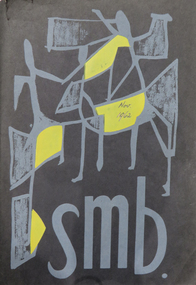
Magazine - Booklet, Ballarat School of Mines Students' Magazine, 1962, 1962
... , Sports Awards 1962, Sports, The BEAT Generation, University in Ballarat, Heads of Departments 1873 - , Associates ballarat school of mines students' magazine 1962 staff, sports stanley white kelvin whitford eric mcgrath ian weir gordon johnson kerry penna kevin oscar rogers robert coutts graeme waller anita bitans noel kelly john davis tony brauer sue davies h. e. arblaster w. h. reimann a. j. bethune william peter john huberts d. pollard john boermans james william beattie edward westlake doney john maxwell gilbert barbara anne o'conell helen margaret ross robert william tantau jeffery murrell barry thomas dunstan juris erdmanis sr. mary andre power james william john walter henry reimann donald james stewart ronald william furlong kenneth joseph howard allan graham rock robert geoffrey champneys denis richard colbourn wilhelmus peterus johannes huberts neil herbert andrews john barry gillick charles edwin goddard donald william pope william henry saggers ronald charles davis travers william duncan brian thomas hickey robert reginald archer kaspars bitans robert william lochhead tony white teng seong khoo robert frederic murrell john william faulkner harry w. goldsmith h. darby don holmes j. r. pound david james ross gray harold yates w. l. moore teddy gan m. moissinac c. gan b. tanthiem l. k. oh b. eng doug rash d. holmes t. c. poh b. saw s. wendt p. malins d. a. black g. biddington borom tanthiem edward elsbury w. lancaster mount isa mines eric mcgrath award ballarat school of mines revue electrolytic zinc companyof australasia limited m.b. john b. and g. myers broken hill associated smelters On one of the first two loose pages there is the inscription "Copy uncollected by student but paid for, used to cut our advertisers' copy, 15/08/63". ...Ballarat School of Mines Students' Magazine, 1962. Editorial, Prominent Personalities, The Principal's Pages, The Richard W. Richards Medal, The Challenge, Camera Portraits, Conferring of Diplomas, The Highest Distinction - the F. J. Pomeroy Cup, What is Mathematics?, Microliths, Begonia Festival Procession, In a Man's World, Retirement of Mr. Harold Yates, The Eric McGrath Award, Asian Students in the S.M.B., Austral-Asian Relationships, Originality - At What Price?, Sports Awards 1962, Sports, The BEAT Generation, University in Ballarat, Heads of Departments 1873 - , Associates Black soft cover with grey inscriptions and grey and yellow figures on front cover, 72 pagesOn one of the first two loose pages there is the inscription "Copy uncollected by student but paid for, used to cut our advertisers' copy, 15/08/63".ballarat school of mines students' magazine 1962, staff, sports, stanley white, kelvin whitford, eric mcgrath, ian weir, gordon johnson, kerry penna, kevin oscar rogers, robert coutts, graeme waller, anita bitans, noel kelly, john davis, tony brauer, sue davies, h. e. arblaster, w. h. reimann, a. j. bethune, william peter john huberts, d. pollard, john boermans, james william beattie, edward westlake doney, john maxwell gilbert, barbara anne o'conell, helen margaret ross, robert william tantau, jeffery murrell, barry thomas dunstan, juris erdmanis, sr. mary andre power, james william john, walter henry reimann, donald james stewart, ronald william furlong, kenneth joseph howard, allan graham rock, robert geoffrey champneys, denis richard colbourn, wilhelmus peterus johannes huberts, neil herbert andrews, john barry gillick, charles edwin goddard, donald william pope, william henry saggers, ronald charles davis, travers william duncan, brian thomas hickey, robert reginald archer, kaspars bitans, robert william lochhead, tony white, teng seong khoo, robert frederic murrell, john william faulkner, harry w. goldsmith, h. darby, don holmes, j. r. pound, david james, ross gray, harold yates, w. l. moore, teddy gan, m. moissinac, c. gan, b. tanthiem, l. k. oh, b. eng, doug rash, d. holmes, t. c. poh, b. saw, s. wendt, p. malins, d. a. black, g. biddington, borom tanthiem, edward elsbury, w. lancaster, mount isa mines, eric mcgrath award, ballarat school of mines revue, electrolytic zinc companyof australasia limited, m.b. john, b. and g. myers, broken hill associated smelters -
 Federation University Historical Collection
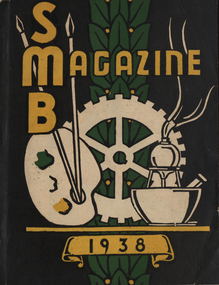
Magazine - Booklet, Ballarat School of Mines Students' Magazine, 1938, 1938
... henry kum yuen Fred J. Martell Old Boys' Association Literary Society J.A. Wilkie Cyril Callister G. Yorke Broken Hill Papua E. Macdonald J. Wilkinson BHP Cadet Training Scheme G.R. Crouch Salt Lake City Utah photography photographic class r.h.e. Ewins F. Jelbart N. crouch g. white f. hollioake p. Richards D. Jelbart A. VEale W. Walters E. Gribble R. McHutchison R. Menhennett I. Redford k. heriot j. graham J. Thomas R. Ewins K. Waller ...School Council, Members of Staff, Magazine Committee, List of Full Course Students 1938, Full Course Commercial Students, Editorial, Personal Column, Obituary - Roy S. Hall - F. J. Martell, S.M.B Old Boys' Association, The Literary Society, Centenary Jottings, Fumes from the Lab, Broken Hill, News from Papua, Sidelights on the B.H.P. Cadet Training Scheme, Arts & Crafts Gossip, Sport, Commercial Notes, The Junior Techs, Junior Technical SportingBlack soft covered magazine with yellow font, green and white images. 64 pages including advertisements. Artworks * Lino cut - By Maureen McRae * Lino Cut - By B. Delima * Lino Cut - By Bessie Martin * The dog you's like to kick - By Gordon Yorke * Harry - By Ernest Gribble * Digger - By Ernest Gribble * Lino cut - By Gordon Yorke * Our little girl - By Dorothy Woolcock * Miss W - By Ernest Gribble * Joan - By Ernest Gribble * Roma - By Gladys Bilney * Doing art for t'arts sake - By Gilda Gude * Una - By Dorothy Woolcock * My Bill - By Dorothy Woolcock * The Sec. - By Ernest Gribble * Hassell - By Dorothy Woolcock * Chief Engineer - By Dorothy Woolcock * Rusty - By Ernest Gribble * Lino Cut - By Jeff Wilkinson * Dick - By Dorothy Woolcock * Goosey - By Ernest Gribble * Pen Drawing - By Dorothy Woolcock * Parking 1 - By Max Coward * Miss King - By Dorothy Woolcock * Goal Umpire - By Ernest Gribble * To Prep Girls - Joe - By Ernest Gribble * Dreamy Dolan - By Ernest Gribble * Lino Cut - By Max Coward * Norma - By Dorothy Woolcock * Lino Cut - By A. Janetski * Dorothy - By Patsy Walsh * Jean - By Dorothy Woolcock * Lino Cut - By Joy Martin * Lino Cut - By Max Coward and A.2., * Ben - By Bob McHutchison * Polly - By Ernest Gribble * Dobber - By Ernest Gribble * Francies - By Ernest Gribble * Ad a line not a bite - By Dorothy Woolcock * Dulcie - By Dorothy Woolcock * Joan - By Ernest Gribble * Kitty - By Bob McHutchison * Stumpy - By Elva Brimacombe * Pegleg - By Dorothy Woolcock * Fat - By Gladys Bilney * Dawn - By Dorothy Woolcock * Joy - By Ernest Gribble * Nipper - By Ernest Gribble * Mac - By Ernest Gribble * Puss - By Bob McHutchison * Tinted Lino Cut - By W. Edward * Lino Cut by G.Day ballarat school of mines, magazine, maureen mcrae, b. delima, j. woolcock, herbert j. trevenan, n. palmer, olwyn williams, gordon yorke, bob mchutchinson, w. edward, keith heriot, sylvia wyres, jeff wilkinson, peter richards, d. gordon, f. morris, mr proctor, ernest gribble, dr. j. r. pound, muriel boyd, george downing, roy s. hall, f. j. martell, d. v. shore, ken wilkie, eoin macdonald, g. berriman, dorothy woolcock, russell h. s. ewins, v. e. greenhalgh, max coward, shelia moss, frank t. jelbart, neil crouch, graham white, mr cornell, francis hollioke, k. vaughan, david j. jelbart, arthur g. veale, bill walters, richard menhennett, james redford, w. monteith, mr hillman, john t. graham, james w. thomas, keith. walter, james m. martin, lyle s. dimsey, jean birch, margaret turner, lesley stapleton, marjorie day, una kersey, jean lonie, coral robertson, norma rowe, jean bridges, jean cox, a. janetski, d. ditchfield, j. harrison, gladys james, j. brimacombe, sheila moss, r. mathews, joy martin, joan ellsworth, e. salter, a. spence, m. may, f. coulson, i. clow, h. tonkin, l. taylor, s. harris, k. gingell, g. jones, william t. paterson, f. harland, w. harrison, j. pike, a. mcmillan, m. lee, e. mccann, j. harris, a. clack, f. osborne, e. stephens, s. nicol, d. eltringham, j. hosie, v. burt, w. rowe, wm. c. edward, j. donald, m. cox, n. dalton, gladys bilney, gilda gude, patsy walsh, elva brimacombe, g. day, francis hollyoake, centenary, betty brown, alan nye, victor greenhalgh, alan gilpin, george edward, e.h. schache, john dulfer, max bayley, eric rumpff, henry kum yuen, fred j. martell, old boys' association, literary society, j.a. wilkie, cyril callister, g. yorke, broken hill, papua, e. macdonald, j. wilkinson, bhp cadet training scheme, g.r. crouch, salt lake city, utah, photography, photographic class, r.h.e. ewins, f. jelbart, n. crouch, g. white, f. hollioake, p. richards, d. jelbart, a. veale, w. walters, e. gribble, r. mchutchison, r. menhennett, i. redford, k. heriot, j. graham, j. thomas, r. ewins, k. waller, j. martin, j. king, bena lamb, j. birch, m. turner, l. stapleton, m. day, u. kersey, j. lonie, c. robertson, n. rowe, j. bridges, m. mcrae, o. williams, j. cox, g. james, s. moss, b. martin, junior technical school old boys' association, des marks, cornell's little liver pills, ballarat wattle tea rooms, the modern dairy -
 Flagstaff Hill Maritime Museum and Village
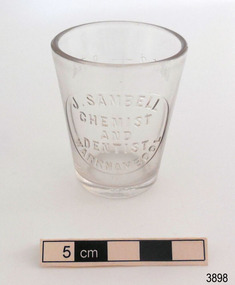
Container - Medicine Glass, W T & Co. (Whitall Tatum), late 1880's
... wall shows to older construction and design. William and Sibilla had five other children. By 1896 their sons William Jnr. and Henry operated the business as “Messrs Kucks Bros., Bakers & Confectioners”. ...wall shows to older construction and design. William and Sibilla had five other children. By 1896 their sons William Jnr. and Henry operated the business as “Messrs Kucks Bros., Bakers & Confectioners”. ...This medicine glass was previously owned by Sybilla Margaret Kucks (1904-1978), daughter of Henry and Julia Kucks, and granddaughter of William and Sibilia Kucks. Sibilla was born in Warrnambool and lived there until 1917 when she moved to Armadale, Victoria, with her family. The medicine glass was among her effects left to her nephew William when she passed away and has been looked after by his wife Eva and treasured as a memento of their Warrnambool heritage. Mrs Sibilla Kucks sold sweets and fancy cakes in her Liebig Street shop from 1873 until the 1880s. She operated one of Warrnambool’s earliest dedicated confectionery shops at a time when sweets were more commonly found in a fruiterer’s shop. Her window display would have been full of brightly coloured sweets in shiny glass jars tempting passers-by. Sibilla (née Leyendecker) married Johann Wilhelm Kucks in New York, USA in 1856. Both were originally from Prussia. They sailed to Australia on the Ocean Rover and arrived in Melbourne June 10th, 1858. Seventeen days later their second child, William Jnr., was born. Warrnambool’s population was around 2,000 in 1859 when Sibilla and Johann (known as “William”) settled here. William was employed as a tailor by Cramond & Dickson. In 1859 the couple bought George Fergusson’s bakery in Timor Street and opened it as “W. Kucks Baker”. Along with fancy breads and biscuits, he advertised baked dinners to order. William supplied bread to the Warrnambool Hospital until the 1880s. In 1873 William built a row of four shops at 140-146 Liebig Street, one of which became Sibilla’s confectionery shop, and another was the new home to W. Kucks Baker. In 1877 William constructed a building in Liebig Street for the Warrnambool Steam Packet Company, which has since been incorporated into the Warrnambool Art Gallery. Its western wall shows to older construction and design. William and Sibilla had five other children. By 1896 their sons William Jnr. and Henry operated the business as “Messrs Kucks Bros., Bakers & Confectioners”. They employed six staff and used three carts for deliveries over a thirty-mile radius. They catered for clubs and functions including the Exhibitors’ Picnic Luncheon for the Warrnambool Industrial and Arts Exhibition (1896-7). In 1907 Messrs Kucks Bros. baked a monster Pyramid Cake for a local bazaar. It contained coins of various sizes and weighed 84lbs (38kg). Everyone buying a slice hoped to be lucky enough to end up with a coin! William Kucks Jnr. also became licensee of Terang’s ”Wheatsheaf Hotel”, its name and logo connecting it to the family’s bakery in Warrnambool. William (1825-1911) and Sibilla (1833-1910) Kucks and three of their seven children are buried at the Warrnambool Cemetery in a family grave. John Sambell migrated from England and established his chemist and dentist business in Warrnambool around 1890 in his premises in Fairy Street. The business later included his son Herbert. The maker, Whitall Tatum & Co, is clearly marked on the base of the bottle. The company was a a well known maker of prescription bottles. He used the brand "W. T. & Co. from Mid-1870's until the late 1880's, moulded into his glassware. This medicine glass is significant as one of very few remaining items from the history of John Sambell, chemist and dentist, Warrnambool. It is also significant as an example of medical equipment that has a design still used today. It is also significant for its association with William and Sibilla Kucks, a colonial family in Warrnambool that was greatly involved in the community and commerce of early days in Warrnambool.Medicine glass, (measuring glass or dose cup), clear glass, round. The antique chemist measuring glass is wide at the top and tapers to a narrow base. The glass has side seams and an uneven base. The glass has imperfections ans bubbles. The base is uneven. The measuring scale lines have been scored into the glass and the measurements and other inscriptions have been moulded into the glass. Glass is from J. Sambell, chemist and dentist in Warrnambool. On the back there is a measuring scale in tablespoons and teaspoons. There is also an inscription of the maker on the base. The glass was made in the late 1880's by Whitall Tatum & Co., America.Embossed within a round border "J. SAMBELL / CHEMIST / AND / DENTIST / WARRNAMBOOL" The scale on the back has "TABLE" "1" and "2", and "TEA" "8", "4", "2" and "1" The base has "W.T. & CO." around the edge.flagstaff hill, warrnambool, shipwrecked coast, flagstaff hill maritime museum, maritime museum, shipwreck coast, flagstaff hill maritime village, great ocean road, medicine glass, measuring glass, dose cup, medicine dispensing, medicine measurement, sambell pharmacy warrnambool, sambell chemist and dentist, warrnambool chemist, history of warrnambool, early 20th century chemist, john sambell, medical equipment, warrnambool medical services, kucks family in warrnambool, william and sibilla kucks descendant, mrs kucks' confectionery, william kucks baker, warrnambool dentist, herbert sambell, whitall tatum & co, w. t. & co., warrnambool steam packet, warrnambool art gallery -
 Flagstaff Hill Maritime Museum and Village
Decorative object - Wall Decoration, 1850 to 1901
... Henry died in 1933 and Mary Jane in 1940. The Giles family collection has social significance at a local level, because it illustrates the level of material support the Warrnambool community gave to Flagstaff Hill when the Museum was established. This wall ...This item is part of the Giles Collection, dating back to the late Victorian era, from the 1880s to the early 1900s, in which Queen Victoria ruled England. The queen’s influence was felt throughout the world, including in the United States and Australia where Victorian values shaped society and style, especially in home décor. This period’s distinct style presents an eclectic mix of highly ornamented furniture, wallpaper, and knick-knacks. Particularly in terms of furniture, and the characteristic floral patterns and rich, contrasting colours, wall hangings that enjoyed the height of their popularity during the Victorian era were of the spiritual type with either embroidered or punched paper religious motto or bible quote. Mottoes were commonly hung high up on the wall or in an area of prominence, to remind the viewer of their important message, such as “He Leadeth Me” and “Honesty, Industry, and Sobriety.” Short and pithy, they embodied the ideals of Victorian society. Technological advances contributed to the boom of religious mottoes whereas before the Industrial Revolution home décor of this sort was handmade and therefore minimal, now consumers could purchase and fill their homes with all sorts of mass-produced ephemera goods similar to the subject item. Many of these mass-produced period pieces still exist today, often in their original frames, ceramic, enamelled or paper formats. Flagstaff maritime museum has many examples of mottoes on display that serve to reflect the period in which values of home, faith, and Christianity were very prominent in everyday Victorian society. The Giles Family There are many 19th century items of furniture, linen and crockery donated to Flagstaff Hill Maritime Village by Vera and Aurelin Giles. The items are associated with the Giles Family and are known as the “Giles Collection”. These items mostly came from the simple home of Vera’s parents-in-law, Henry Giles and his wife Mary Jane (nee Freckleton), whose photos are in the parlour. They married in 1880. Henry Giles was born at Tower Hill in 1858. He was a labourer on the construction of the Breakwater before leaving in 1895 to build bridges in N.S.W. for about seven years. Mary Jane was born in 1860 at Cooramook. She attended Mailor’s Flat State School where she was also a student teacher before, as a family legend has it, she became a governess at “Injemiara” where her grandfather, Francis Freckleton, once owned land. Henry and Mary’s family of six, some of whom were born at Mailor’s Flat and later children at Wangoom, lived with their parents at Wangoom and Purnim west, where Henry died in 1933 and Mary Jane in 1940.The Giles family collection has social significance at a local level, because it illustrates the level of material support the Warrnambool community gave to Flagstaff Hill when the Museum was established. This wall decoration reflects the social values and attitudes of the late Victorian era that was used to promote good Christian and moral values in many households. These items of decoration were very popular at this time and the subject item is significant as it gives a snapshot into the social norms of past generations. Printed card wall hanging with floral design. Religious text on the sign is embossed onto the card and highlighted in silver print. There is a handwritten ink inscription, and a pencil inscription, on the back. A string is attached to two holes on top of the card. Embossed"THE BLESSING / OF THE LORD/ BE UPON YOU." "PS 129.8." In pencil "H/S" In ink "To dear Granny with lots of love / from Dorothy. X X."flagstaff hill, warrnambool, shipwrecked coast, flagstaff hill maritime museum, shipwreck coast, great ocean road, paper wall decoration, religious, home decoration, societal values, victorian moral values, wall hanging, wall decoration, spiritual decoration, bible verse, giles collection -
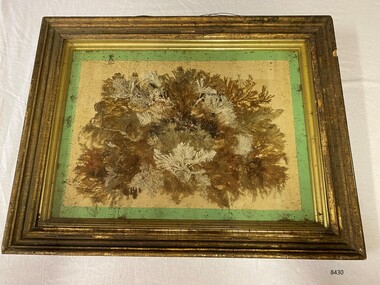 Flagstaff Hill Maritime Museum and Village
Artwork, other - Diorama with seaweed specimens, Richard Foster Norton, 1860
... Wall...Wangoom...Samuel Hannaford...Henry...Flagstaff Hill Warrnambool Maritime Museum Richard Foster Norton R.F Norton picture framers Melbourne Geelong Artwork and decorative furnishings Gold Rush seaweed botanical specimens 1860 Pigeon Hill District Surveyor Thomas Watson William Wall Wangoom Samuel Hannaford Henry Watts Victorian Exhibition 1861 Yelvertoft Northamptonshire Market Square Printed label; "RICHARD FOS --- Picture Framer and -- MANUF -- CARVER, GILDER, ---- PAINTINGS CLEANED, LINED AND --- GLASSES RESILVERED, FRAMES --- Architectual Decorations created to any design in Paper Mache, Carlton Pierre, or Composition, Country Orders promptly attended to, The Order Suppl ---, BRANCH ESTABLISHMENT, MARKET SQUARE, GEELONG" Diorama in deep wooden frame, behind glass. ...The diorama of mounted specimens of seaweed was framed by Richard Foster Norton for Thomas Watson and is dated 1860. Watson was the Warrnambool District Surveyor at the time (1860). The inscription on the back of the frame links the artwork to the Pigeon Hill property, which was located on Allansford Road (corner of Staffords Road – north side of the Princes Highway-A1). In the 1860s, the property known as Pigeon Hill was owned by William Wall who was a publican who ran several hotels in Warrnambool and district. In 1860 Wall, was running a hotel in Wangoom, near Pigeon Hill. Further research is required to determine the exact location, but Pigeon Hill could also have been the name for that area and may have had other people living there. Thomas Watson was a member of the local horticultural society. Another possible creator of the artwork is Samuel Hannaford, a biologist with a particular interest in collecting marine flora. Hannaford left Warrnambool in 1857 and went to Geelong, so it is possible he collected the specimens had them framed in Geelong, and then arranged for their return to Watson. The other known seaweed collector was Henry Watts, who lived in Warrnambool in the mid-19th century. The seaweed collection in this box was possibly one of Watts' and could have been prepared for the Victorian Exhibition of 1861, Richard Foster Norton, also known as R.F Norton, was one of only a handful of picture framers in 1850s Melbourne. Norton was born on the 24th of July 1822 in Yelvertoft, Northamptonshire and prior to his arrival in Australia, Norton is listed in England as having the occupation of a painter. It appears that he established his business in Melbourne in 1854 or 1855. Between 1855 and 1865 he operated from 87, then 83, and later 80 Collins Street. In the Argus newspaper, Norton advertised his business as a Print seller, Carver, Gilder and Picture Frame manufacturer, supplying the growing demand for artworks and decorative furnishings in the colony during the Gold Rush. Norton also had a Geelong branch in Market Square, where this work was produced. This framed work is highly significant. Previous research has found that only six frames are in existence that can be attributed to be made Norton, dating from the late 1850’s to the mid 1860’s. Moreover, Thomas Watson the owner of the artwork, is one of the government surveyors of the region during the mid-19th century.Diorama in deep wooden frame, behind glass. Seaweed specimens have been mounted within the frame. The back of the frame has handwritten inscriptions including the framer's label (portions missing). The diorama was framed by Richard Fraser Norton. Printed label; "RICHARD FOS --- Picture Framer and -- MANUF -- CARVER, GILDER, ---- PAINTINGS CLEANED, LINED AND --- GLASSES RESILVERED, FRAMES --- Architectual Decorations created to any design in Paper Mache, Carlton Pierre, or Composition, Country Orders promptly attended to, The Order Suppl ---, BRANCH ESTABLISHMENT, MARKET SQUARE, GEELONG" flagstaff hill, warrnambool, maritime museum, richard foster norton, r.f norton, picture framers, melbourne, geelong, artwork and decorative furnishings, gold rush, seaweed, botanical specimens, 1860, pigeon hill, district surveyor, thomas watson, william wall, wangoom, samuel hannaford, henry watts, victorian exhibition, 1861, yelvertoft, northamptonshire, market square -
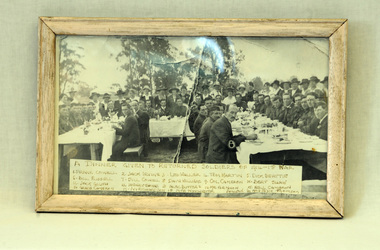 Orbost & District Historical Society
black and white photograph, W C RICE, C 1914 -1918
... Those in the photograph are: Frank Cowell; Jack Irving; Les Waller; Tom Martin; Dick Beattie; Bill Russell; Bill Cowell; Dave Williams; Col Cameron; Bert Shaw; Jack Gluth; Henry Thomas; Alec Butters; Mrs A. ...Those in the photograph are: Frank Cowell; Jack Irving; Les Waller; Tom Martin; Dick Beattie; Bill Russell; Bill Cowell; Dave Williams; Col Cameron; Bert Shaw; Jack Gluth; Henry Thomas; Alec Butters; Mrs A. ...This photograph shows a group of WW1 returned soldiers at a special dinner which was held at the old show ground. Those in the photograph are: Frank Cowell; Jack Irving; Les Waller; Tom Martin; Dick Beattie; Bill Russell; Bill Cowell; Dave Williams; Col Cameron; Bert Shaw; Jack Gluth; Henry Thomas; Alec Butters; Mrs A. G. Nixon; Nell Cameron; Grace Cameron; Ivy Richrdson; Nita WinchesterThis is a contemporary pictorial record of a significant event in Orbost. This item, associated with WW1 is a reminder of the involvement of the Orbost men who served in that conflict and the appreciation of their efforts by the Orbost communityA long black / white photograph of a large group of men sitting at tables having a meal . There are some women standing behind them. They are outdoors. The photo is in a light pink wooden frame under glass. 1010.2 is a copy.at front on paper label - "A DINNER GIVEN TO RETURNED SOLDIERS OF 1914 - 1918 WAR" and a list of names.armed-services ww1 orbost-soldiers -
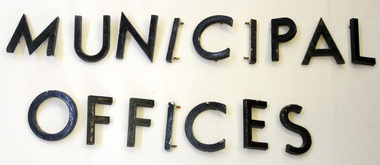 Orbost & District Historical Society
metal letters, Before 1969
... The Shire coat of arms was on the wall on the right of the front entrance to the building directly above the front doors. The current building was opened on Friday 28th February 1969 by the Premier of Victoria, The Hon. Sir Henry...The Shire coat of arms was on the wall on the right of the front entrance to the building directly above the front doors. The current building was opened on Friday 28th February 1969 by the Premier of Victoria, The Hon. Sir Henry ...These letters are from the Shire Office prior to its amalgamation to East Gippsland. They were located directly above the front doors at the front entrance to the building. The Shire coat of arms was on the wall on the right of the front entrance to the building directly above the front doors. The current building was opened on Friday 28th February 1969 by the Premier of Victoria, The Hon. Sir Henry E. Bolte, K.C.M.G., M.P. Originally, Orbost was part of the Bairnsdale Road District which was created on 30 April 1867. Splitting away as part of the Shire of Tambo in 1882, Orbost was first incorporated as a shire in its own right as the Shire of Croajingolong on 30 May 1892. It received its present name on 17 February 1893. On 3 January 1913 part of its western riding was annexed to Tambo as its Cunninghame Riding. On 2 December 1994, the Shire was abolished, and merged with City and Shire of Bairnsdale, Shire of Tambo, most of Shire of Omeo and the Boole Boole Peninsula from Shire of Rosedale into the Shire of East Gippsland. Sixteen metal letters - M U N I C I P A L O F F I C E S They are probably painted aluminium.municipal orbost-shire-council government -
 Orbost & District Historical Society
plaque
... The Shire coat of arms was on the wall on the right of the front entrance to the building and was removed from the current building when Orbost Shire Council was amalgamated into East Gippsland Shire in 1994.The current building was opened on Friday 28th February 1969 by the Premier of Victoria, The Hon. Sir Henry...The Shire coat of arms was on the wall on the right of the front entrance to the building and was removed from the current building when Orbost Shire Council was amalgamated into East Gippsland Shire in 1994.The current building was opened on Friday 28th February 1969 by the Premier of Victoria, The Hon. Sir Henry ...The Coat of Arms of the Shire of Orbost has been designed in the form of a cross in which five stars are set on a shield. This was typical of those used by many shires and cities throughout Victoria and the Commonwealth. A small crown above the cross indicates the loyalty of the President, Councillors and Ratepayers to the reigning King or Queen. The inner circle of the shield contains four figures, a sheaf of wheat, a factory, a cow, and a ship, which represents the activities of agriculture, fishing, industry and dairying undertaken in the district. Originally part of the Bairnsdale district, Orbost split away as part of the Shire of Tambo in 1882, and became a Shire in its own right as the Shire of Croajingolong on the 30th may 1892. The name changed to the Shire of Orbost on 17 February 1893. Orbost was divided into four ridings on 31st May 1895, they were the North, South, East and Central riding, which was represented by three elected councillors. The Shire coat of arms was on the wall on the right of the front entrance to the building and was removed from the current building when Orbost Shire Council was amalgamated into East Gippsland Shire in 1994.The current building was opened on Friday 28th February 1969 by the Premier of Victoria, The Hon. Sir Henry E. Bolte, K.C.M.G., M.P. Local governments play an important role in the lives of citizens in Australia. Local government authorities exist to provide services and amenities to local communities, and are also responsible for regulating and providing services for land and property in their district. This item is representative of a time when Orbost had its own Shire Council. A large round metal plaque with the words SHIRE OF ORBOST1892 in gold letters around a crown and shield divided into four sections to represent four industries : Shipping ; farming - maize ; dairy and mining.SHIRE OF ORBOST 1892government orbost-shire-council coat-of-arms plaque
