
Showing 67 items matching " women’s national service"
-
 Glen Eira Historical Society
Document - KOOYONG ROAD, 75, CAULFIELD NORTH
... ... Women’s National Service...Garden Vale Caulfield Railway Station Paddy’s Swamp Great Dandenong Road Glen Ferrie Road Dandenong Road East Caulfield Reserve Caulfield Military Hospital ‘Glen Eira’ Town Hall ‘War Office’ Caulfield District Road Board Shire of Caulfield Caulfield Recruiting Committee for Volunteers City Repatriation Committee Red Cross Emergency Service Women’s National Service Mayor’s Patriotic Fund Promotions Committee for War Savings Certificates War Savings Group Scheme ‘The Gazette’ Air Raid Precautions Committee Orrong Road Armed Forces World War 1939-1945 Local Government Parades and Processions Military Reserves World War 1914-1918 Councillors Events and Activities Historic Events Official Events Caulfield John Wyne Agar Murphy (Mayor) Hale P. ...Two copies of a pamphlet for the ceremony of the Third Ordnance Services Unit ‘Exercising the Right of the Freedom of Entry to the City of Caulfield’ held on 23/10/1983. The pamphlet includes a brief history of the unit’s association with the City of Caulfield, a list of individuals holding posts within the Unit, text of the scroll conferring the Freedom of Entry on the Unit, a program of the ceremony, a brief history of the Royal Australian Army Ordnance Corps including the Unit’s use of 75 Kooyong Road as their premises, a brief history of the City of Caulfield from 1937-postwar years, and an explanation of the tradition of conferring Freedom of Entry to a city. The pamphlet includes also: 1/A black and white photograph (47x35mm) of the Mayor of Caulfield, W.R. Walters, undated and unattributed. 2/A black and white photograph (81x69mm) of Major A.G. Storen, Commanding Officer of the Third Ordnance Services Unit, undated and unattributed. 3/A color photograph (88x84mm) of the Sovereign’s Banner, undated and unattributed. 4/A black and white copy (137x87mm) of the scroll conferring Freedom of Entry into the City of Caulfield, which was seated August 4 1978. 5/A color illustration (30x32mm) of the City of Caulfield Coat of Arms. 6/A color illustration (40x32mm) of the Third Ordnance Services Unit, Royal Australian Army Ordnance Corps Coat of Arms. 7/A black and white illustration (21x24mm) of the city of Caulfield Coat of Arms. 8/A black and white illustration (19x14mm) of the City of Caulfield badge. 9/A black and white illustration (22x31mm) of the City of Caulfield banner.walters w.r., storen a.g. major, finning d.j. captain, hately p.g. major, davidson j. (captain), swendson r. (second lieutenant), caulfield, city of caulfield, australian army, the third ordnance services unit royal australian army ordnance corps, caulfield park, caulfield council, north caulfield, campton e.j. (brigadier), walters w.r. mrs., calder g.k., calder g.k. mrs., mahon j. (chief superintendent), city hall, balaclava road, hawthorn road, glen eira road, hartley avenue, kooyong road, caulfield racecourse, caulfield town hall, alma road, red cheques cab company, army headquarters printing press, searchlight company, amenities store, armoured replacement unit, first base printing company r.a.a.o.c., garden vale, caulfield railway station, paddy’s swamp, great dandenong road, glen ferrie road, dandenong road, east caulfield reserve, caulfield military hospital, ‘glen eira’, town hall, ‘war office’, caulfield district road board, shire of caulfield, caulfield recruiting committee for volunteers, city repatriation committee, red cross emergency service, women’s national service, mayor’s patriotic fund, promotions committee for war savings certificates, war savings group scheme, ‘the gazette’, air raid precautions committee, orrong road, armed forces, world war 1939-1945, local government, parades and processions, military reserves, world war 1914-1918, councillors, events and activities, historic events, official events, caulfield john, wyne agar, murphy (mayor), hale p., ison (captain), fisher andrew, morris t.w. (mayor) -
Glen Eira Historical Society
Document - KOOYONG ROAD, 75, CAULFIELD NORTH
... ... Women’s National Service...Caulfield District Road Board Shire of Caulfield Caulfield Recruiting Committee for Volunteers City Repatriation Committee Red Cross Emergency Service Women’s National Service Mayor’s Patriotic Fund Promotions Committee for War Savings Certificates War Savings Group Scheme ‘The Gazette’ Air Raid Precautions Committee Armed Forces World War 1939-1945 Local Government Parades and Processions Military reserves World War 1914-1918 Councillors Events and Activities Historic Events Official Events Document KOOYONG ROAD, 75, CAULFIELD NORTH ...Three copies of a pamphlet for the ceremony of the Third Ordnance Services Unit ‘Exercising the Right of the Freedom of Entry to the City of Caulfield’, held on 13/07/1986. The pamphlet includes a brief history of the Unit’s association with the City of Caulfield, a list of individuals holding posts within the unit, text of the scroll conferring the Freedom of Entry on the Unit, a program of the ceremony, a brief history of the Royal Australian Army Ordnance Corps, including the Unit’s use of 75 Kooyong Road as their premises, a brief history of the city of Caulfield and an explanation of the tradition of conferring Freedom of Entry to a city. The pamphlet includes also: 1/A black and white photograph (61x66mm) of the Mayor of Caulfield, Maxwell Blair, undated and unattributed. 2/A black and white photograph (70x51mm) of Major P.G. Hateley, Commanding Officer of the Third Ordnance Services Unit, undated and unattributed. 3/A black and white photograph (91x90mm) of the Sovereign’s Banner, undated and unattributed. 4/A black and white copy (137-87) of the scroll conferring Freedom of Entry into the City of Caulfield which was seated August 4 1978. 5/A color illustration (30x32mm) of the City of Caulfield Coat of Arms. 6/A colour illustration (40x32mm) of the Third Ordnance Services Unit, Royal Australian Army Ordnance Corps Coat of Arms. 7/A black and white illustration (21x24mm) of the City of Caulfield Coat of Arms. 8/A black and white illustration (19x19mm) of the City of Caulfield badge. 9/A black and white illustration (22x31mm) of the City of Caulfield banner.blair maxwell (mayor), hateley p.g. (major), finning d.j. (captain), lowe g. (captain), barker l.a. (lieutenant), blair mrs., aylen d.r., aylan d.r. mrs., goltz m.h., compton e.j. (brigadier), goltz m.h. (chief superintendant), caulfield john, wynne agar, murphy (mayor), hate p., ison (captain), fisher andrew, morris t.w. (mayor), caulfield, kooyong road, caulfield park, north caulfield, city of caulfield, city hall, balaclava road, hawthorn road, glen eira road, hartley avenue, caulfield racecourse, caulfield town hall, alma road, orrong road, garden vale, caulfield railway station, paddy’s swamp, great dandenong road, glen ferrie road, dandenong road, east caulfield reserve, caulfield military hospital, ‘glen eira’, town hall, ‘war office’, red chequer cab company, caulfield council, third ordnance services unit royal australian army ordnance corps, australian army, army headquarters printing press, searchlight company, amenities store, armoured replacement unit, first base printing company r.a.a.o.c., caulfield district road board, shire of caulfield, caulfield recruiting committee for volunteers, city repatriation committee, red cross emergency service, women’s national service, mayor’s patriotic fund, promotions committee for war savings certificates, war savings group scheme, ‘the gazette’, air raid precautions committee, armed forces, world war 1939-1945, local government, parades and processions, military reserves, world war 1914-1918, councillors, events and activities, historic events, official events -
 Bendigo Military Museum
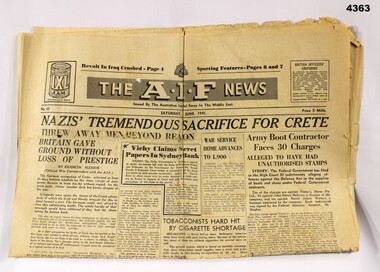
Newspaper - THE AIF NEWS, 1941, Australian Imperial Force, 7.6.1941
... The contents are mainly War news, maps, advertising and sports, rear page has photos of Women volunteers in the “WANS” Women’s Australian National Service....The contents are mainly War news, maps, advertising and sports, rear page has photos of Women volunteers in the “WANS” Women’s Australian National Service. The AIF News Middle East 1941 “The AIF News - Saturday June 7 1941” Newspaper, AIF news, Issued by the Australian Imperial Force Middle East, classed as 8 pages, yellowed, all print in black, illustrated with maps and photos. ...The contents are mainly War news, maps, advertising and sports, rear page has photos of Women volunteers in the “WANS” Women’s Australian National Service.Newspaper, AIF news, Issued by the Australian Imperial Force Middle East, classed as 8 pages, yellowed, all print in black, illustrated with maps and photos.“The AIF News - Saturday June 7 1941”the aif news, middle east, 1941 -
 Surrey Hills Historical Society Collection
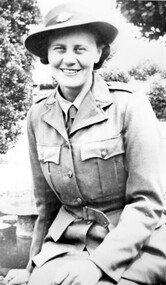
Photograph, Doris Wright, member of the Australian Women's Army Service
... Doris Lilian Wright of 214 Union Road was a milliner but joined the Australian Women's Army Service (AWAS) in the early war years. The Women’s Australian National Service (WANS) was inaugurated in 1940. ...Doris Lilian Wright of 214 Union Road was a milliner but joined the Australian Women's Army Service (AWAS) in the early war years. The Women’s Australian National Service (WANS) was inaugurated in 1940. ...Doris Lilian Wright of 214 Union Road was a milliner but joined the Australian Women's Army Service (AWAS) in the early war years. The Women’s Australian National Service (WANS) was inaugurated in 1940. Training for members of the WANS included air raid drills, first aid, basic military drills, and even shooting, signalling, and mechanics. AWAS on formed on 13 August 1941 with the objective of releasing more men into forward areas. The Army was particular with its recruiting and four references were required; another stipulation was that teeth were in good condition. Doris was located at Elwood. Their training area was along the foreshore and one day to their great surprise there were crowds of American Marines – "the cream of the American Army". These were the first Americans to arrive in Australia to strengthen the defence of the country. The Americans soon went north and the AWAS went off to Balcombe on the Mornington Peninsula. At this time there were no uniforms for the girls only ‘giggle’ dresses – of a non-descript colour. They were not expected to appear in public in these and wore civilian dress. Japan had just entered the war and there were more urgent demands on restricted supplies. The formal uniforms eventually arrived.A black and white photograph of a lady in an army uniform and wearing a hat.union road, surrey hills, uniforms, clothing and dress, (miss) doris wright, australian women's army service -
The Beechworth Burke Museum
Audio - Oral History, Jennifer Williams, Mr Graeme Gallus, 16 November 2000
... service. He talks about local businesses, government employment, community celebrations and clubs. Miss Amy Elizabeth Porrit's account of her life in Beechworth and the local area during the 20th century is historically and socially significant to the cultural heritage of the region. She details important historical events and hardships in the region's history that had a lasting local, regional and national impact, including Australia during war time, economic struggles, and women's ...Graeme Gallus was born on the Mornington Peninsular in a town called Sommerville, in 1938. His family was born in Germany and came to Australia in 1851. He arrived in Beechworth in 1981 after purchasing a taxi service. He talks about local businesses, government employment, community celebrations and clubs. Miss Amy Elizabeth Porrit's account of her life in Beechworth and the local area during the 20th century is historically and socially significant to the cultural heritage of the region. She details important historical events and hardships in the region's history that had a lasting local, regional and national impact, including Australia during war time, economic struggles, and women's societal roles in a rural area. This oral history account is socially and historically significant as it is a part of a broader collection of interviews conducted by Jennifer Williams which were published in the book 'Listen to what they say: voices of twentieth-century Beechworth.' While the township of Beechworth is known for its history as a gold rush town, these accounts provide a unique insight into the day-to-day life of the town's residents during the 20th century, many of which will have now been lost if they had not been preserved.This is a digital copy of a recording that was originally captured on a cassette tape. The cassette tape is black with a horizontal white strip and is currently stored in a clear flat plastic rectangular container. It holds up 40 minutes of recordings on each side.Mr Graeme Gallussommerville, gallus, graeme gallus, taxi, beechworth, real estate, christmas, lions club -
Marysville & District Historical Society
THE TRIANGLE NEWS-VOL 36 NO 26-JULY 17 2009
... marysville victoria australia marysville & district lions club new stage at marysville central what's on when community meetings upper goulburn food and wine culture group buxton community hall murrindindi shire council formcraft vic bushfire recovery technical officer positions thank you mobile vet services matdg report triangle material aid warehouse advertisements councillor comment church notices donation of church furniture alexandra clearing sale landmark embling marysville art show handknitted goods winter solstice dinner alexandra library marysville medical clinic donation of trees to marysville mayor's chair christmas in july marysville & district historical society national & international historical donations to marysville highway to heaven book beyond the bushfires rural women's network marysville real estate THE TRIANGLE NEWS-VOL 36 NO 26-JULY 17 2009 ...marysville, victoria, australia, marysville & district lions club, new stage at marysville central, what's on when, community meetings, upper goulburn food and wine culture group, buxton community hall, murrindindi shire council, formcraft vic, bushfire recovery, technical officer positions, thank you, mobile vet services, matdg report, triangle material aid warehouse, advertisements, councillor comment, church notices, donation of church furniture, alexandra clearing sale, landmark embling, marysville art show, handknitted goods, winter solstice dinner, alexandra library, marysville medical clinic, donation of trees to marysville, mayor's chair, christmas in july, marysville & district historical society, national & international historical donations to marysville, highway to heaven book, beyond the bushfires, rural women's network, marysville real estate -
 Flagstaff Hill Maritime Museum and Village
Functional object - Spectacles and case, c. 1969
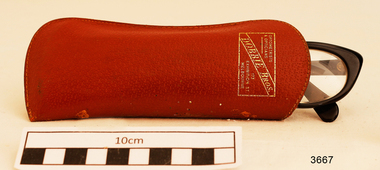
... Twentieth century spectacles Spectacle wearing continued to become more widespread, key developments being the supply of spectacles to troops in the First World War, cheaper spectacles being subsidised through insurance schemes arranged by friendly societies, and the beginning of the National Health Service in 1948, when free spectacles were made available to all who might benefit from them. This normalised spectacle wearing and led to a significant increase in the scale of production. Entirely separate categories of women’s...Twentieth century spectacles Spectacle wearing continued to become more widespread, key developments being the supply of spectacles to troops in the First World War, cheaper spectacles being subsidised through insurance schemes arranged by friendly societies, and the beginning of the National Health Service in 1948, when free spectacles were made available to all who might benefit from them. This normalised spectacle wearing and led to a significant increase in the scale of production. Entirely separate categories of women’s ...The history of spectacles The earliest form of spectacles are generally agreed to have been invented in Northern Italy in the thirteenth century. Over hundreds of years of innovation and refinement, they have been perfected into the stylish and functional designs you see today worn by millions of people to correct their eyesight. Here's a look at the key moments that defined the history of spectacles. Thirteenth century - Rivet spectacles The earliest form of spectacles was simply two mounted lenses riveted together at the handle ends. They had no sides and were secured to the face by clamping the nose between the rims, some of which had notches which may have been intended to improve the grip. Even then the wearer could only keep them in place by remaining relatively still and would normally support them with the hand. These spectacles contained convex lenses for the correction of presbyopic long-sightedness and were generally suited only to those few who lived beyond their forties and had the ability to read. Sixteenth century - Nose spectacles Nose spectacles were in more common use by the early sixteenth century. These often had a bow-shaped continuous bridge, almost of a modern appearance, that was sometimes flexible depending upon the material, for example leather or whalebone. The bridge was as much an area to be gripped as to rest on the nose. Spectacles were still usually held in place with the hand whilst being used temporarily for a brief period of reading or close inspection. By now the lenses could be used to correct both long and short sight. The general design changed little through the seventeenth century, though certain refinements increased the flexibility and comfort for some wearers. In some localised areas, notably in Spain, people experimented with ear loops made of string. This allowed them to walk around with their spectacles on. Eighteenth century - Temple glasses Only in the eighteenth century did the first modern eyewear, or ‘glasses’ as we would understand them, start to appear. The lenses might be glass, rock crystal or any other transparent mineral substance and were prone to smashing if the spectacles fell off, so there was an impetus to develop frames that could be worn continuously and would stay in place. London optician Edward Scarlett is credited with developing the modern style of spectacles which were kept in place with arms, known as ‘temples’. These were made of iron or steel and gripped the side of the head but did not yet hook over the ears because often the ears were concealed beneath a powdered wig, such as was fashionable at the time. As temples developed they were made with wide ring ends through which the wearer could pass a ribbon, thus tying the spectacles securely to the head. As spectacles were no longer primarily for use in sedentary activities, people began to be noticed out and about in their spectacles and might come to be identified as a ‘spectacle wearer’. By the end of the eighteenth century, people who needed correction for both distance and near could choose bifocals. Nineteenth century - Pince-nez Pince-nez were a nineteenth century innovation that literally translates as ‘pinching the nose’. They had a spring clip to retain the item in place under its own tension. Sometimes this clip was too tight and the wearer struggled to breathe. If it was too loose the pince-nez could fall off so, for safety and security, they were often connected to the wearer's clothing by a cord or a chain to avoid them being dropped or lost. Pince-nez were sometimes chosen by people who felt that large spectacles were too prominent and drew attention to a physical defect. They were also suitable for mounting lenses that could correct astigmatism. Twentieth century spectacles Spectacle wearing continued to become more widespread, key developments being the supply of spectacles to troops in the First World War, cheaper spectacles being subsidised through insurance schemes arranged by friendly societies, and the beginning of the National Health Service in 1948, when free spectacles were made available to all who might benefit from them. This normalised spectacle wearing and led to a significant increase in the scale of production. Entirely separate categories of women’s spectacles and sports eyewear both emerged in the 1930s. The latter half of the twentieth century saw spectacles become more fashionable and stylish as frames with different shapes, materials, and colours became available. Plastics frames, in particular, allowed a greater choice of colours and textured finishes. Plastic lenses were more durable and could be made lighter and thinner than glass, spurring a renewed interest in rimless designs. Designer eyewear bearing popular high-street brand names encouraged patients to regard spectacles as a desirable commodity, even as a fashion accessory, not just a disability aid. https://www.college-optometrists.org/the-british-optical-association-museum/the-history-of-spectacles These spectacles and case were used by Dr. Angus in his surgery in Warrnambool to test patients' eye sight. They were donated to Flagstaff Hill Maritime Village by the family of Doctor William Roy Angus, Surgeon and Oculist. It is part of the “W.R. Angus Collection” that includes historical medical equipment, surgical instruments and material once belonging to Dr Edward Ryan and Dr Thomas Francis Ryan, (both of Nhill, Victoria) as well as Dr Angus’ own belongings. The Collection’s history spans the medical practices of the two Doctors Ryan, from 1885-1926 plus that of Dr Angus, up until 1969. ABOUT THE “W.R.ANGUS COLLECTION” Doctor William Roy Angus M.B., B.S., Adel., 1923, F.R.C.S. Edin.,1928 (also known as Dr Roy Angus) was born in Murrumbeena, Victoria in 1901 and lived until 1970. He qualified as a doctor in 1923 at University of Adelaide, was Resident Medical Officer at the Royal Adelaide Hospital in 1924 and for a period was house surgeon to Sir (then Mr.) Henry Simpson Newland. Dr Angus was briefly an Assistant to Dr Riddell of Kapunda, then commenced private practice at Curramulka, Yorke Peninsula, SA, where he was physician, surgeon and chemist. In 1926, he was appointed as new Medical Assistant to Dr Thomas Francis Ryan (T.F. Ryan, or Tom), in Nhill, Victoria, where his experiences included radiology and pharmacy. In 1927 he was Acting House Surgeon in Dr Tom Ryan’s absence. Dr Angus had become engaged to Gladys Forsyth and they decided he would take time to further his studies overseas in the UK in 1927. He studied at London University College Hospital and at Edinburgh Royal Infirmary and in 1928, was awarded FRCS (Fellow from the Royal College of Surgeons), Edinburgh. He worked his passage back to Australia as a Ship’s Surgeon on the on the Australian Commonwealth Line’s T.S.S. Largs Bay. Dr Angus married Gladys in 1929, in Ballarat. (They went on to have one son (Graham 1932, born in SA) and two daughters (Helen (died 12/07/1996) and Berenice (Berry), both born at Mira, Nhill ) Dr Angus was a ‘flying doctor’ for the A.I.M. (Australian Inland Ministry) Aerial Medical Service in 1928 . The organisation began in South Australia through the Presbyterian Church in that year, with its first station being in the remote town of Oodnadatta, where Dr Angus was stationed. He was locum tenens there on North-South Railway at 21 Mile Camp. He took up this ‘flying doctor’ position in response to a call from Dr John Flynn; the organisation was later known as the Flying Doctor Service, then the Royal Flying Doctor Service. A lot of his work during this time involved dental surgery also. Between 1928-1932 he was surgeon at the Curramulka Hospital, Yorke Peninsula, South Australia. In 1933 Dr Angus returned to Nhill where he’d previously worked as Medical Assistant and purchased a share of the Nelson Street practice and Mira hospital from Dr Les Middleton one of the Middleton Brothers, the current owners of what was once Dr Tom Ryan’s practice. Dr L Middleton was House Surgeon to the Nhill Hospital 1926-1933, when he resigned. [Dr Tom Ryan’s practice had originally belonged to his older brother Dr Edward Ryan, who came to Nhill in 1885. Dr Edward saw patients at his rooms, firstly in Victoria Street and in 1886 in Nelson Street, until 1901. The Nelson Street practice also had a 2 bed ward, called Mira Private Hospital ). Dr Edward Ryan was House Surgeon at the Nhill Hospital 1884-1902 . He also had occasions where he successfully performed veterinary surgery for the local farmers too. Dr Tom Ryan then purchased the practice from his brother in 1901. Both Dr Edward and Dr Tom Ryan work as surgeons included eye surgery. Dr Tom Ryan performed many of his operations in the Mira private hospital on his premises. He too was House Surgeon at the Nhill Hospital 1902-1926. Dr Tom Ryan had one of the only two pieces of radiology equipment in Victoria during his practicing years – The Royal Melbourne Hospital had the other one. Over the years Dr Tom Ryan gradually set up what was effectively a training school for country general-practitioner-surgeons. Each patient was carefully examined, including using the X-ray machine, and any surgery was discussed and planned with Dr Ryan’s assistants several days in advance. Dr Angus gained experience in using the X-ray machine there during his time as assistant to Dr Ryan. Dr Tom Ryan moved from Nhill in 1926. He became a Fellow of the Royal Australasian College of Surgeons in 1927, soon after its formation, a rare accolade for a doctor outside any of the major cities. He remained a bachelor and died suddenly on 7th Dec 1955, aged 91, at his home in Ararat. Scholarships and prizes are still awarded to medical students in the honour of Dr T.F. Ryan and his father, Dr Michael Ryan, and brother, John Patrick Ryan. ] When Dr Angus bought into the Nelson Street premises in Nhill he was also appointed as the Nhill Hospital’s Honorary House Surgeon 1933-1938. His practitioner’s plate from his Nhill surgery states “HOURS Daily, except Tuesdays, Fridays and Saturday afternoons, 9-10am, 2-4pm, 7-8pm. Sundays by appointment”. This plate is now mounted on the doorway to the Port Medical Office at Flagstaff Hill Maritime Village, Warrnambool. Dr Edward Ryan and Dr Tom Ryan had an extensive collection of historical medical equipment and materials spanning 1884-1926 and when Dr Angus took up practice in their old premises he obtained this collection, a large part of which is now on display at the Port Medical Office at Flagstaff Hill Maritime Village in Warrnambool. During his time in Nhill Dr Angus was involved in the merging of the Mira Hospital and Nhill Public Hospital into one public hospital and the property titles passed on to Nhill Hospital in 1939. In 1939 Dr Angus and his family moved to Warrnambool where he purchased “Birchwood,” the 1852 home and medical practice of Dr John Hunter Henderson, at 214 Koroit Street. (This property was sold in1965 to the State Government and is now the site of the Warrnambool Police Station. ). The Angus family was able to afford gardeners, cooks and maids; their home was a popular place for visiting dignitaries to stay whilst visiting Warrnambool. Dr Angus had his own silk worm farm at home in a Mulberry tree. His young daughter used his centrifuge for spinning the silk. Dr Angus was appointed on a part-time basis as Port Medical Officer (Health Officer) in Warrnambool and held this position until the 1940’s when the government no longer required the service of a Port Medical Officer in Warrnambool; he was thus Warrnambool’s last serving Port Medical Officer. (The duties of a Port Medical Officer were outlined by the Colonial Secretary on 21st June, 1839 under the terms of the Quarantine Act. Masters of immigrant ships arriving in port reported incidents of diseases, illness and death and the Port Medical Officer made a decision on whether the ship required Quarantine and for how long, in this way preventing contagious illness from spreading from new immigrants to the residents already in the colony.) Dr Angus was a member of the Australian Medical Association, for 35 years and surgeon at the Warrnambool Base Hospital 1939-1942, He served as a Surgeon Captain during WWII 1941-45, in Ballarat, Victoria, and in Bonegilla, N.S.W., completing his service just before the end of the war due to suffering from a heart attack. During his convalescence he carved an intricate and ‘most artistic’ chess set from the material that dentures were made from. He then studied ophthalmology at the Royal Melbourne Eye and Ear Hospital and created cosmetically superior artificial eyes by pioneering using the intrascleral cartilage. Angus received accolades from the Ophthalmological Society of Australasia for this work. He returned to Warrnambool to commence practice as an ophthalmologist, pioneering in artificial eye improvements. He was Honorary Consultant Ophthalmologist to Warrnambool Base Hospital for 31 years. He made monthly visits to Portland as a visiting surgeon, to perform eye surgery. He represented the Victorian South-West subdivision of the Australian Medical Association as its secretary between 1949 and 1956 and as chairman from 1956 to 1958. In 1968 Dr Angus was elected member of Spain’s Barraquer Institute of Barcelona after his research work in Intrasclearal cartilage grafting, becoming one of the few Australian ophthalmologists to receive this honour, and in the following year presented his final paper on Living Intrasclearal Cartilage Implants at the Inaugural Meeting of the Australian College of Ophthalmologists in Melbourne In his personal life Dr Angus was a Presbyterian and treated Sunday as a Sabbath, a day of rest. He would visit 3 or 4 country patients on a Sunday, taking his children along ‘for the ride’ and to visit with him. Sunday evenings he would play the pianola and sing Scottish songs to his family. One of Dr Angus’ patients was Margaret MacKenzie, author of a book on local shipwrecks that she’d seen as an eye witness from the late 1880’s in Peterborough, Victoria. In the early 1950’s Dr Angus, painted a picture of a shipwreck for the cover jacket of Margaret’s book, Shipwrecks and More Shipwrecks. She was blind in later life and her daughter wrote the actual book for her. Dr Angus and his wife Gladys were very involved in Warrnambool’s society with a strong interest in civic affairs. Their interests included organisations such as Red Cross, Rostrum, Warrnambool and District Historical Society (founding members), Wine and Food Society, Steering Committee for Tertiary Education in Warrnambool, Local National Trust, Good Neighbour Council, Housing Commission Advisory Board, United Services Institute, Legion of Ex-Servicemen, Olympic Pool Committee, Food for Britain Organisation, Warrnambool Hospital, Anti-Cancer Council, Boys’ Club, Charitable Council, National Fitness Council and Air Raid Precautions Group. He was also a member of the Steam Preservation Society and derived much pleasure from a steam traction engine on his farm. He had an interest in people and the community He and his wife Gladys were both involved in the creation of Flagstaff Hill, including the layout of the gardens. After his death (28th March 1970) his family requested his practitioner’s plate, medical instruments and some personal belongings be displayed in the Port Medical Office surgery at Flagstaff Hill Maritime Village, and be called the “W. R. Angus Collection”. The W.R. Angus Collection is significant for still being located at the site it is connected with, Doctor Angus being the last Port Medical Officer in Warrnambool. The collection of medical instruments and other equipment is culturally significant, being an historical example of medicine from late 19th to mid-20th century. Dr Angus assisted Dr Tom Ryan, a pioneer in the use of X-rays and in ocular surgery. Spectacles and case, from the W.R. Angus Collection and used by Dr. Angus for testing the sight of his patients. Black rimmed spectacles in tan, open ended pouch. Inscription is stamped into frame and printed in gold lettering on the case. c. 1969 Inscriptions read on spectacles;“52 (square) 18” and “RODENSTOCK > ELBA < 130“ and printed in gold lettering on the pouch “DOBBIE BROS. / OPTOMETRISTS & OPTICIANS / 173 EXHIBITION ST. MELBOURNE”flagstaff hill, warrnambool, shipwrecked coast, flagstaff hill maritime museum, maritime museum, shipwreck coast, flagstaff hill maritime village, great ocean road, dr w r angus, dr ryan, surgical instrument, t.s.s. largs bay, warrnambool base hospital, nhill base hospital, mira hospital, flying doctor, medical treatment, spectacles and case, optical testing, optometrist examination, dobbie bros melbourne -
 Flagstaff Hill Maritime Museum and Village
Functional object - Spectacles and Case, 1930s - 1960s
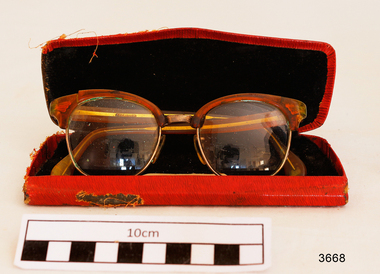
... Twentieth century spectacles Spectacle wearing continued to become more widespread, key developments being the supply of spectacles to troops in the First World War, cheaper spectacles being subsidised through insurance schemes arranged by friendly societies, and the beginning of the National Health Service in 1948, when free spectacles were made available to all who might benefit from them. This normalised spectacle wearing and led to a significant increase in the scale of production. Entirely separate categories of women’s...Twentieth century spectacles Spectacle wearing continued to become more widespread, key developments being the supply of spectacles to troops in the First World War, cheaper spectacles being subsidised through insurance schemes arranged by friendly societies, and the beginning of the National Health Service in 1948, when free spectacles were made available to all who might benefit from them. This normalised spectacle wearing and led to a significant increase in the scale of production. Entirely separate categories of women’s ...The history of spectacles The earliest form of spectacles are generally agreed to have been invented in Northern Italy in the thirteenth century. Over hundreds of years of innovation and refinement, they have been perfected into the stylish and functional designs you see today worn by millions of people to correct their eyesight. Here's a look at the key moments that defined the history of spectacles. Thirteenth century - Rivet spectacles The earliest form of spectacles was simply two mounted lenses riveted together at the handle ends. They had no sides and were secured to the face by clamping the nose between the rims, some of which had notches which may have been intended to improve the grip. Even then the wearer could only keep them in place by remaining relatively still and would normally support them with the hand. These spectacles contained convex lenses for the correction of presbyopic long-sightedness and were generally suited only to those few who lived beyond their forties and had the ability to read. Sixteenth century - Nose spectacles Nose spectacles were in more common use by the early sixteenth century. These often had a bow-shaped continuous bridge, almost of a modern appearance, that was sometimes flexible depending upon the material, for example leather or whalebone. The bridge was as much an area to be gripped as to rest on the nose. Spectacles were still usually held in place with the hand whilst being used temporarily for a brief period of reading or close inspection. By now the lenses could be used to correct both long and short sight. The general design changed little through the seventeenth century, though certain refinements increased the flexibility and comfort for some wearers. In some localised areas, notably in Spain, people experimented with ear loops made of string. This allowed them to walk around with their spectacles on. Eighteenth century - Temple glasses Only in the eighteenth century did the first modern eyewear, or ‘glasses’ as we would understand them, start to appear. The lenses might be glass, rock crystal or any other transparent mineral substance and were prone to smashing if the spectacles fell off, so there was an impetus to develop frames that could be worn continuously and would stay in place. London optician Edward Scarlett is credited with developing the modern style of spectacles which were kept in place with arms, known as ‘temples’. These were made of iron or steel and gripped the side of the head but did not yet hook over the ears because often the ears were concealed beneath a powdered wig, such as was fashionable at the time. As temples developed they were made with wide ring ends through which the wearer could pass a ribbon, thus tying the spectacles securely to the head. As spectacles were no longer primarily for use in sedentary activities, people began to be noticed out and about in their spectacles and might come to be identified as a ‘spectacle wearer’. By the end of the eighteenth century, people who needed correction for both distance and near could choose bifocals. Nineteenth century - Pince-nez Pince-nez were a nineteenth century innovation that literally translates as ‘pinching the nose’. They had a spring clip to retain the item in place under its own tension. Sometimes this clip was too tight and the wearer struggled to breathe. If it was too loose the pince-nez could fall off so, for safety and security, they were often connected to the wearer's clothing by a cord or a chain to avoid them being dropped or lost. Pince-nez were sometimes chosen by people who felt that large spectacles were too prominent and drew attention to a physical defect. They were also suitable for mounting lenses that could correct astigmatism. Twentieth century spectacles Spectacle wearing continued to become more widespread, key developments being the supply of spectacles to troops in the First World War, cheaper spectacles being subsidised through insurance schemes arranged by friendly societies, and the beginning of the National Health Service in 1948, when free spectacles were made available to all who might benefit from them. This normalised spectacle wearing and led to a significant increase in the scale of production. Entirely separate categories of women’s spectacles and sports eyewear both emerged in the 1930s. The latter half of the twentieth century saw spectacles become more fashionable and stylish as frames with different shapes, materials, and colours became available. Plastics frames, in particular, allowed a greater choice of colours and textured finishes. Plastic lenses were more durable and could be made lighter and thinner than glass, spurring a renewed interest in rimless designs. Designer eyewear bearing popular high-street brand names encouraged patients to regard spectacles as a desirable commodity, even as a fashion accessory, not just a disability aid. https://www.college-optometrists.org/the-british-optical-association-museum/the-history-of-spectacles The company Optical Prescription Spectacle Makers (OPSM ) was formed in Sydney in 1932 and publically listed in 1953. These spectacles and case were used by Dr. Angus when testing patients' eyes. The spectacles and case were donated to Flagstaff Hill Maritime Village by the family of Doctor William Roy Angus, Surgeon and Oculist. It is part of the “W.R. Angus Collection” that includes historical medical equipment, surgical instruments and material once belonging to Dr Edward Ryan and Dr Thomas Francis Ryan, (both of Nhill, Victoria) as well as Dr Angus’ own belongings. The Collection’s history spans the medical practices of the two Doctors Ryan, from 1885-1926 plus that of Dr Angus, up until 1969. ABOUT THE “W.R.ANGUS COLLECTION” Doctor William Roy Angus M.B., B.S., Adel., 1923, F.R.C.S. Edin.,1928 (also known as Dr Roy Angus) was born in Murrumbeena, Victoria in 1901 and lived until 1970. He qualified as a doctor in 1923 at University of Adelaide, was Resident Medical Officer at the Royal Adelaide Hospital in 1924 and for a period was house surgeon to Sir (then Mr.) Henry Simpson Newland. Dr Angus was briefly an Assistant to Dr Riddell of Kapunda, then commenced private practice at Curramulka, Yorke Peninsula, SA, where he was physician, surgeon and chemist. In 1926, he was appointed as new Medical Assistant to Dr Thomas Francis Ryan (T.F. Ryan, or Tom), in Nhill, Victoria, where his experiences included radiology and pharmacy. In 1927 he was Acting House Surgeon in Dr Tom Ryan’s absence. Dr Angus had become engaged to Gladys Forsyth and they decided he would take time to further his studies overseas in the UK in 1927. He studied at London University College Hospital and at Edinburgh Royal Infirmary and in 1928, was awarded FRCS (Fellow from the Royal College of Surgeons), Edinburgh. He worked his passage back to Australia as a Ship’s Surgeon on the on the Australian Commonwealth Line’s T.S.S. Largs Bay. Dr Angus married Gladys in 1929, in Ballarat. (They went on to have one son (Graham 1932, born in SA) and two daughters (Helen (died 12/07/1996) and Berenice (Berry), both born at Mira, Nhill ) Dr Angus was a ‘flying doctor’ for the A.I.M. (Australian Inland Ministry) Aerial Medical Service in 1928 . The organisation began in South Australia through the Presbyterian Church in that year, with its first station being in the remote town of Oodnadatta, where Dr Angus was stationed. He was locum tenens there on North-South Railway at 21 Mile Camp. He took up this ‘flying doctor’ position in response to a call from Dr John Flynn; the organisation was later known as the Flying Doctor Service, then the Royal Flying Doctor Service. A lot of his work during this time involved dental surgery also. Between 1928-1932 he was surgeon at the Curramulka Hospital, Yorke Peninsula, South Australia. In 1933 Dr Angus returned to Nhill where he’d previously worked as Medical Assistant and purchased a share of the Nelson Street practice and Mira hospital from Dr Les Middleton one of the Middleton Brothers, the current owners of what was once Dr Tom Ryan’s practice. Dr L Middleton was House Surgeon to the Nhill Hospital 1926-1933, when he resigned. [Dr Tom Ryan’s practice had originally belonged to his older brother Dr Edward Ryan, who came to Nhill in 1885. Dr Edward saw patients at his rooms, firstly in Victoria Street and in 1886 in Nelson Street, until 1901. The Nelson Street practice also had a 2 bed ward, called Mira Private Hospital ). Dr Edward Ryan was House Surgeon at the Nhill Hospital 1884-1902 . He also had occasions where he successfully performed veterinary surgery for the local farmers too. Dr Tom Ryan then purchased the practice from his brother in 1901. Both Dr Edward and Dr Tom Ryan work as surgeons included eye surgery. Dr Tom Ryan performed many of his operations in the Mira private hospital on his premises. He too was House Surgeon at the Nhill Hospital 1902-1926. Dr Tom Ryan had one of the only two pieces of radiology equipment in Victoria during his practicing years – The Royal Melbourne Hospital had the other one. Over the years Dr Tom Ryan gradually set up what was effectively a training school for country general-practitioner-surgeons. Each patient was carefully examined, including using the X-ray machine, and any surgery was discussed and planned with Dr Ryan’s assistants several days in advance. Dr Angus gained experience in using the X-ray machine there during his time as assistant to Dr Ryan. Dr Tom Ryan moved from Nhill in 1926. He became a Fellow of the Royal Australasian College of Surgeons in 1927, soon after its formation, a rare accolade for a doctor outside any of the major cities. He remained a bachelor and died suddenly on 7th Dec 1955, aged 91, at his home in Ararat. Scholarships and prizes are still awarded to medical students in the honour of Dr T.F. Ryan and his father, Dr Michael Ryan, and brother, John Patrick Ryan. ] When Dr Angus bought into the Nelson Street premises in Nhill he was also appointed as the Nhill Hospital’s Honorary House Surgeon 1933-1938. His practitioner’s plate from his Nhill surgery states “HOURS Daily, except Tuesdays, Fridays and Saturday afternoons, 9-10am, 2-4pm, 7-8pm. Sundays by appointment”. This plate is now mounted on the doorway to the Port Medical Office at Flagstaff Hill Maritime Village, Warrnambool. Dr Edward Ryan and Dr Tom Ryan had an extensive collection of historical medical equipment and materials spanning 1884-1926 and when Dr Angus took up practice in their old premises he obtained this collection, a large part of which is now on display at the Port Medical Office at Flagstaff Hill Maritime Village in Warrnambool. During his time in Nhill Dr Angus was involved in the merging of the Mira Hospital and Nhill Public Hospital into one public hospital and the property titles passed on to Nhill Hospital in 1939. In 1939 Dr Angus and his family moved to Warrnambool where he purchased “Birchwood,” the 1852 home and medical practice of Dr John Hunter Henderson, at 214 Koroit Street. (This property was sold in1965 to the State Government and is now the site of the Warrnambool Police Station. ). The Angus family was able to afford gardeners, cooks and maids; their home was a popular place for visiting dignitaries to stay whilst visiting Warrnambool. Dr Angus had his own silk worm farm at home in a Mulberry tree. His young daughter used his centrifuge for spinning the silk. Dr Angus was appointed on a part-time basis as Port Medical Officer (Health Officer) in Warrnambool and held this position until the 1940’s when the government no longer required the service of a Port Medical Officer in Warrnambool; he was thus Warrnambool’s last serving Port Medical Officer. (The duties of a Port Medical Officer were outlined by the Colonial Secretary on 21st June, 1839 under the terms of the Quarantine Act. Masters of immigrant ships arriving in port reported incidents of diseases, illness and death and the Port Medical Officer made a decision on whether the ship required Quarantine and for how long, in this way preventing contagious illness from spreading from new immigrants to the residents already in the colony.) Dr Angus was a member of the Australian Medical Association, for 35 years and surgeon at the Warrnambool Base Hospital 1939-1942, He served as a Surgeon Captain during WWII 1941-45, in Ballarat, Victoria, and in Bonegilla, N.S.W., completing his service just before the end of the war due to suffering from a heart attack. During his convalescence he carved an intricate and ‘most artistic’ chess set from the material that dentures were made from. He then studied ophthalmology at the Royal Melbourne Eye and Ear Hospital and created cosmetically superior artificial eyes by pioneering using the intrascleral cartilage. Angus received accolades from the Ophthalmological Society of Australasia for this work. He returned to Warrnambool to commence practice as an ophthalmologist, pioneering in artificial eye improvements. He was Honorary Consultant Ophthalmologist to Warrnambool Base Hospital for 31 years. He made monthly visits to Portland as a visiting surgeon, to perform eye surgery. He represented the Victorian South-West subdivision of the Australian Medical Association as its secretary between 1949 and 1956 and as chairman from 1956 to 1958. In 1968 Dr Angus was elected member of Spain’s Barraquer Institute of Barcelona after his research work in Intrasclearal cartilage grafting, becoming one of the few Australian ophthalmologists to receive this honour, and in the following year presented his final paper on Living Intrasclearal Cartilage Implants at the Inaugural Meeting of the Australian College of Ophthalmologists in Melbourne In his personal life Dr Angus was a Presbyterian and treated Sunday as a Sabbath, a day of rest. He would visit 3 or 4 country patients on a Sunday, taking his children along ‘for the ride’ and to visit with him. Sunday evenings he would play the pianola and sing Scottish songs to his family. One of Dr Angus’ patients was Margaret MacKenzie, author of a book on local shipwrecks that she’d seen as an eye witness from the late 1880’s in Peterborough, Victoria. In the early 1950’s Dr Angus, painted a picture of a shipwreck for the cover jacket of Margaret’s book, Shipwrecks and More Shipwrecks. She was blind in later life and her daughter wrote the actual book for her. Dr Angus and his wife Gladys were very involved in Warrnambool’s society with a strong interest in civic affairs. Their interests included organisations such as Red Cross, Rostrum, Warrnambool and District Historical Society (founding members), Wine and Food Society, Steering Committee for Tertiary Education in Warrnambool, Local National Trust, Good Neighbour Council, Housing Commission Advisory Board, United Services Institute, Legion of Ex-Servicemen, Olympic Pool Committee, Food for Britain Organisation, Warrnambool Hospital, Anti-Cancer Council, Boys’ Club, Charitable Council, National Fitness Council and Air Raid Precautions Group. He was also a member of the Steam Preservation Society and derived much pleasure from a steam traction engine on his farm. He had an interest in people and the community He and his wife Gladys were both involved in the creation of Flagstaff Hill, including the layout of the gardens. After his death (28th March 1970) his family requested his practitioner’s plate, medical instruments and some personal belongings be displayed in the Port Medical Office surgery at Flagstaff Hill Maritime Village, and be called the “W. R. Angus Collection”. The W.R. Angus Collection is significant for still being located at the site it is connected with, Doctor Angus being the last Port Medical Officer in Warrnambool. The collection of medical instruments and other equipment is culturally significant, being an historical example of medicine from late 19th to mid-20th century. Dr Angus assisted Dr Tom Ryan, a pioneer in the use of X-rays and in ocular surgery. Spectacles and case, from the W.R. Angus Collection and used by Dr. Angus testing the sight of his patients. Metal case covered in red leather, black velvet lining. Tan rimmed spectacles. Maker is OPSM. Inscriptions on case, inside case and on spectacle rim.Inscribed on spectacle arms “CONTORA”. Inscription on case in gold print “OPSM Optical Prescription Spectacle Makers Pty Ltd”. Inscription on white oval label inside case is illegible. flagstaff hill, warrnambool, shipwrecked coast, flagstaff hill maritime museum, maritime museum, shipwreck coast, flagstaff hill maritime village, great ocean road, dr w r angus, spectacles and case, optical testing, optometrist examination, opsm optical prescription spectacle makers -
 Flagstaff Hill Maritime Museum and Village
Functional object - Spectacles and Case, Mid 20th Century
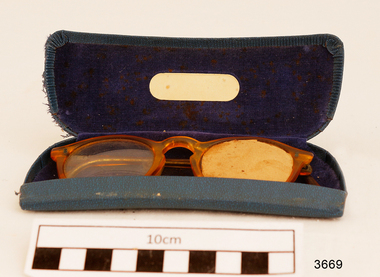
... Twentieth century spectacles Spectacle wearing continued to become more widespread, key developments being the supply of spectacles to troops in the First World War, cheaper spectacles being subsidised through insurance schemes arranged by friendly societies, and the beginning of the National Health Service in 1948, when free spectacles were made available to all who might benefit from them. This normalised spectacle wearing and led to a significant increase in the scale of production. Entirely separate categories of women’s...Twentieth century spectacles Spectacle wearing continued to become more widespread, key developments being the supply of spectacles to troops in the First World War, cheaper spectacles being subsidised through insurance schemes arranged by friendly societies, and the beginning of the National Health Service in 1948, when free spectacles were made available to all who might benefit from them. This normalised spectacle wearing and led to a significant increase in the scale of production. Entirely separate categories of women’s ...The history of spectacles The earliest form of spectacles are generally agreed to have been invented in Northern Italy in the thirteenth century. Over hundreds of years of innovation and refinement, they have been perfected into the stylish and functional designs you see today worn by millions of people to correct their eyesight. Here's a look at the key moments that defined the history of spectacles. Thirteenth century - Rivet spectacles The earliest form of spectacles was simply two mounted lenses riveted together at the handle ends. They had no sides and were secured to the face by clamping the nose between the rims, some of which had notches which may have been intended to improve the grip. Even then the wearer could only keep them in place by remaining relatively still and would normally support them with the hand. These spectacles contained convex lenses for the correction of presbyopic long-sightedness and were generally suited only to those few who lived beyond their forties and had the ability to read. Sixteenth century - Nose spectacles Nose spectacles were in more common use by the early sixteenth century. These often had a bow-shaped continuous bridge, almost of a modern appearance, that was sometimes flexible depending upon the material, for example leather or whalebone. The bridge was as much an area to be gripped as to rest on the nose. Spectacles were still usually held in place with the hand whilst being used temporarily for a brief period of reading or close inspection. By now the lenses could be used to correct both long and short sight. The general design changed little through the seventeenth century, though certain refinements increased the flexibility and comfort for some wearers. In some localised areas, notably in Spain, people experimented with ear loops made of string. This allowed them to walk around with their spectacles on. Eighteenth century - Temple glasses Only in the eighteenth century did the first modern eyewear, or ‘glasses’ as we would understand them, start to appear. The lenses might be glass, rock crystal or any other transparent mineral substance and were prone to smashing if the spectacles fell off, so there was an impetus to develop frames that could be worn continuously and would stay in place. London optician Edward Scarlett is credited with developing the modern style of spectacles which were kept in place with arms, known as ‘temples’. These were made of iron or steel and gripped the side of the head but did not yet hook over the ears because often the ears were concealed beneath a powdered wig, such as was fashionable at the time. As temples developed they were made with wide ring ends through which the wearer could pass a ribbon, thus tying the spectacles securely to the head. As spectacles were no longer primarily for use in sedentary activities, people began to be noticed out and about in their spectacles and might come to be identified as a ‘spectacle wearer’. By the end of the eighteenth century, people who needed correction for both distance and near could choose bifocals. Nineteenth century - Pince-nez Pince-nez were a nineteenth century innovation that literally translates as ‘pinching the nose’. They had a spring clip to retain the item in place under its own tension. Sometimes this clip was too tight and the wearer struggled to breathe. If it was too loose the pince-nez could fall off so, for safety and security, they were often connected to the wearer's clothing by a cord or a chain to avoid them being dropped or lost. Pince-nez were sometimes chosen by people who felt that large spectacles were too prominent and drew attention to a physical defect. They were also suitable for mounting lenses that could correct astigmatism. Twentieth century spectacles Spectacle wearing continued to become more widespread, key developments being the supply of spectacles to troops in the First World War, cheaper spectacles being subsidised through insurance schemes arranged by friendly societies, and the beginning of the National Health Service in 1948, when free spectacles were made available to all who might benefit from them. This normalised spectacle wearing and led to a significant increase in the scale of production. Entirely separate categories of women’s spectacles and sports eyewear both emerged in the 1930s. The latter half of the twentieth century saw spectacles become more fashionable and stylish as frames with different shapes, materials, and colours became available. Plastics frames, in particular, allowed a greater choice of colours and textured finishes. Plastic lenses were more durable and could be made lighter and thinner than glass, spurring a renewed interest in rimless designs. Designer eyewear bearing popular high-street brand names encouraged patients to regard spectacles as a desirable commodity, even as a fashion accessory, not just a disability aid. https://www.college-optometrists.org/the-british-optical-association-museum/the-history-of-spectacles These spectacles and case from F.G. and R.G. Bennett of Warrnambool were used by Dr. Angus to test his patients' eye sight. They were donated to Flagstaff Hill Maritime Village by the family of Doctor William Roy Angus, Surgeon and Oculist. It is part of the “W.R. Angus Collection” that includes historical medical equipment, surgical instruments and material once belonging to Dr Edward Ryan and Dr Thomas Francis Ryan, (both of Nhill, Victoria) as well as Dr Angus’ own belongings. The Collection’s history spans the medical practices of the two Doctors Ryan, from 1885-1926 plus that of Dr Angus, up until 1969. ABOUT THE “W.R.ANGUS COLLECTION” Doctor William Roy Angus M.B., B.S., Adel., 1923, F.R.C.S. Edin.,1928 (also known as Dr Roy Angus) was born in Murrumbeena, Victoria in 1901 and lived until 1970. He qualified as a doctor in 1923 at University of Adelaide, was Resident Medical Officer at the Royal Adelaide Hospital in 1924 and for a period was house surgeon to Sir (then Mr.) Henry Simpson Newland. Dr Angus was briefly an Assistant to Dr Riddell of Kapunda, then commenced private practice at Curramulka, Yorke Peninsula, SA, where he was physician, surgeon and chemist. In 1926, he was appointed as new Medical Assistant to Dr Thomas Francis Ryan (T.F. Ryan, or Tom), in Nhill, Victoria, where his experiences included radiology and pharmacy. In 1927 he was Acting House Surgeon in Dr Tom Ryan’s absence. Dr Angus had become engaged to Gladys Forsyth and they decided he would take time to further his studies overseas in the UK in 1927. He studied at London University College Hospital and at Edinburgh Royal Infirmary and in 1928, was awarded FRCS (Fellow from the Royal College of Surgeons), Edinburgh. He worked his passage back to Australia as a Ship’s Surgeon on the on the Australian Commonwealth Line’s T.S.S. Largs Bay. Dr Angus married Gladys in 1929, in Ballarat. (They went on to have one son (Graham 1932, born in SA) and two daughters (Helen (died 12/07/1996) and Berenice (Berry), both born at Mira, Nhill ) Dr Angus was a ‘flying doctor’ for the A.I.M. (Australian Inland Ministry) Aerial Medical Service in 1928 . The organisation began in South Australia through the Presbyterian Church in that year, with its first station being in the remote town of Oodnadatta, where Dr Angus was stationed. He was locum tenens there on North-South Railway at 21 Mile Camp. He took up this ‘flying doctor’ position in response to a call from Dr John Flynn; the organisation was later known as the Flying Doctor Service, then the Royal Flying Doctor Service. A lot of his work during this time involved dental surgery also. Between 1928-1932 he was surgeon at the Curramulka Hospital, Yorke Peninsula, South Australia. In 1933 Dr Angus returned to Nhill where he’d previously worked as Medical Assistant and purchased a share of the Nelson Street practice and Mira hospital from Dr Les Middleton one of the Middleton Brothers, the current owners of what was once Dr Tom Ryan’s practice. Dr L Middleton was House Surgeon to the Nhill Hospital 1926-1933, when he resigned. [Dr Tom Ryan’s practice had originally belonged to his older brother Dr Edward Ryan, who came to Nhill in 1885. Dr Edward saw patients at his rooms, firstly in Victoria Street and in 1886 in Nelson Street, until 1901. The Nelson Street practice also had a 2 bed ward, called Mira Private Hospital ). Dr Edward Ryan was House Surgeon at the Nhill Hospital 1884-1902 . He also had occasions where he successfully performed veterinary surgery for the local farmers too. Dr Tom Ryan then purchased the practice from his brother in 1901. Both Dr Edward and Dr Tom Ryan work as surgeons included eye surgery. Dr Tom Ryan performed many of his operations in the Mira private hospital on his premises. He too was House Surgeon at the Nhill Hospital 1902-1926. Dr Tom Ryan had one of the only two pieces of radiology equipment in Victoria during his practicing years – The Royal Melbourne Hospital had the other one. Over the years Dr Tom Ryan gradually set up what was effectively a training school for country general-practitioner-surgeons. Each patient was carefully examined, including using the X-ray machine, and any surgery was discussed and planned with Dr Ryan’s assistants several days in advance. Dr Angus gained experience in using the X-ray machine there during his time as assistant to Dr Ryan. Dr Tom Ryan moved from Nhill in 1926. He became a Fellow of the Royal Australasian College of Surgeons in 1927, soon after its formation, a rare accolade for a doctor outside any of the major cities. He remained a bachelor and died suddenly on 7th Dec 1955, aged 91, at his home in Ararat. Scholarships and prizes are still awarded to medical students in the honour of Dr T.F. Ryan and his father, Dr Michael Ryan, and brother, John Patrick Ryan. ] When Dr Angus bought into the Nelson Street premises in Nhill he was also appointed as the Nhill Hospital’s Honorary House Surgeon 1933-1938. His practitioner’s plate from his Nhill surgery states “HOURS Daily, except Tuesdays, Fridays and Saturday afternoons, 9-10am, 2-4pm, 7-8pm. Sundays by appointment”. This plate is now mounted on the doorway to the Port Medical Office at Flagstaff Hill Maritime Village, Warrnambool. Dr Edward Ryan and Dr Tom Ryan had an extensive collection of historical medical equipment and materials spanning 1884-1926 and when Dr Angus took up practice in their old premises he obtained this collection, a large part of which is now on display at the Port Medical Office at Flagstaff Hill Maritime Village in Warrnambool. During his time in Nhill Dr Angus was involved in the merging of the Mira Hospital and Nhill Public Hospital into one public hospital and the property titles passed on to Nhill Hospital in 1939. In 1939 Dr Angus and his family moved to Warrnambool where he purchased “Birchwood,” the 1852 home and medical practice of Dr John Hunter Henderson, at 214 Koroit Street. (This property was sold in1965 to the State Government and is now the site of the Warrnambool Police Station. ). The Angus family was able to afford gardeners, cooks and maids; their home was a popular place for visiting dignitaries to stay whilst visiting Warrnambool. Dr Angus had his own silk worm farm at home in a Mulberry tree. His young daughter used his centrifuge for spinning the silk. Dr Angus was appointed on a part-time basis as Port Medical Officer (Health Officer) in Warrnambool and held this position until the 1940’s when the government no longer required the service of a Port Medical Officer in Warrnambool; he was thus Warrnambool’s last serving Port Medical Officer. (The duties of a Port Medical Officer were outlined by the Colonial Secretary on 21st June, 1839 under the terms of the Quarantine Act. Masters of immigrant ships arriving in port reported incidents of diseases, illness and death and the Port Medical Officer made a decision on whether the ship required Quarantine and for how long, in this way preventing contagious illness from spreading from new immigrants to the residents already in the colony.) Dr Angus was a member of the Australian Medical Association, for 35 years and surgeon at the Warrnambool Base Hospital 1939-1942, He served as a Surgeon Captain during WWII 1941-45, in Ballarat, Victoria, and in Bonegilla, N.S.W., completing his service just before the end of the war due to suffering from a heart attack. During his convalescence he carved an intricate and ‘most artistic’ chess set from the material that dentures were made from. He then studied ophthalmology at the Royal Melbourne Eye and Ear Hospital and created cosmetically superior artificial eyes by pioneering using the intrascleral cartilage. Angus received accolades from the Ophthalmological Society of Australasia for this work. He returned to Warrnambool to commence practice as an ophthalmologist, pioneering in artificial eye improvements. He was Honorary Consultant Ophthalmologist to Warrnambool Base Hospital for 31 years. He made monthly visits to Portland as a visiting surgeon, to perform eye surgery. He represented the Victorian South-West subdivision of the Australian Medical Association as its secretary between 1949 and 1956 and as chairman from 1956 to 1958. In 1968 Dr Angus was elected member of Spain’s Barraquer Institute of Barcelona after his research work in Intrasclearal cartilage grafting, becoming one of the few Australian ophthalmologists to receive this honour, and in the following year presented his final paper on Living Intrasclearal Cartilage Implants at the Inaugural Meeting of the Australian College of Ophthalmologists in Melbourne In his personal life Dr Angus was a Presbyterian and treated Sunday as a Sabbath, a day of rest. He would visit 3 or 4 country patients on a Sunday, taking his children along ‘for the ride’ and to visit with him. Sunday evenings he would play the pianola and sing Scottish songs to his family. One of Dr Angus’ patients was Margaret MacKenzie, author of a book on local shipwrecks that she’d seen as an eye witness from the late 1880’s in Peterborough, Victoria. In the early 1950’s Dr Angus, painted a picture of a shipwreck for the cover jacket of Margaret’s book, Shipwrecks and More Shipwrecks. She was blind in later life and her daughter wrote the actual book for her. Dr Angus and his wife Gladys were very involved in Warrnambool’s society with a strong interest in civic affairs. Their interests included organisations such as Red Cross, Rostrum, Warrnambool and District Historical Society (founding members), Wine and Food Society, Steering Committee for Tertiary Education in Warrnambool, Local National Trust, Good Neighbour Council, Housing Commission Advisory Board, United Services Institute, Legion of Ex-Servicemen, Olympic Pool Committee, Food for Britain Organisation, Warrnambool Hospital, Anti-Cancer Council, Boys’ Club, Charitable Council, National Fitness Council and Air Raid Precautions Group. He was also a member of the Steam Preservation Society and derived much pleasure from a steam traction engine on his farm. He had an interest in people and the community He and his wife Gladys were both involved in the creation of Flagstaff Hill, including the layout of the gardens. After his death (28th March 1970) his family requested his practitioner’s plate, medical instruments and some personal belongings be displayed in the Port Medical Office surgery at Flagstaff Hill Maritime Village, and be called the “W. R. Angus Collection”. The W.R. Angus Collection is significant for still being located at the site it is connected with, Doctor Angus being the last Port Medical Officer in Warrnambool. The collection of medical instruments and other equipment is culturally significant, being an historical example of medicine from late 19th to mid-20th century. Dr Angus assisted Dr Tom Ryan, a pioneer in the use of X-rays and in ocular surgery. Spectacles and case, from the W.R. Angus Collection and used by Dr. Angus testing the sight of his patients. Metal case covered in blue leather, blue velvet lining. Orange/yellow rimmed spectacles, one lens covered with cardboard. White oval label inside case. Inscription on case with maker’s details in gold print.Inscription on case reads “F. G. & R. G. BENNETT / WARRNAMBOOL”. flagstaff hill, warrnambool, shipwrecked coast, flagstaff hill maritime museum, maritime museum, shipwreck coast, flagstaff hill maritime village, great ocean road, dr w r angus, spectacles and case, optical testing, optometrist examination, f.g. and r.g. bennett of warrnambool -
 City of Moorabbin Historical Society (Operating the Box Cottage Museum)
Book - New Testament Bible, World War II, c1939-1945
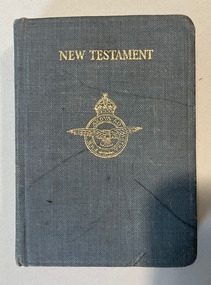
... Active Service Pocket Bible - New Testament National Bible issued by the National Bible Society of Scotland to men and women on active duty during WWII. ...Active Service Pocket Bible - New Testament National Bible issued by the National Bible Society of Scotland to men and women on active duty during WWII. ...Active Service Pocket Bible - New Testament National Bible issued by the National Bible Society of Scotland to men and women on active duty during WWII. A message from George VI is printed on the inside.This bible was issued to men and women on active duty during WWII. It has been bought home by one of the citizens of City of Moorabbin who served in WWII.Small pocket sized New Testament Bible, bound in blue materialNew Testament - Royal Air Force Emblemreligion, world war ii, bible, george vi, national bible society of scotland, active duty, city of moorabbin, returned services league bentleigh, cheltenham -
 Bendigo Military Museum
Certificate - LIFE MEMBERSHIP, RSL WOMENS AUXILIARY 1981
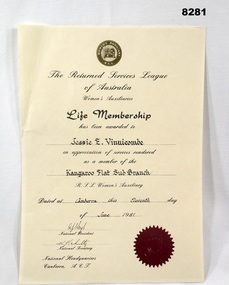
... Womens Auxiliary. Jessie was the twin Sister of Ernie Jackman Life Member of the RSL Australia Bendigo Sub Branch. It was believed at the time they were the only Brother & Sister to be Life Members of the RSL. Refer Cat No 8278 for Ernie's RSL Service history. Brsl Smisl ejackman jvinnicombe "Life Membership - Jessie Vinnicombe - Member of the Kangaroo Flat Women's Auxiliary". "Dated at Canberra - eleventh day of June 1981". Signed "W Keys National ...Life Membership of the RSL Womens Auxiliary of Australia awarded to Jessie Vinnicombe in 1981 Kangaroo Flat RSL Womens Auxiliary. Jessie was the twin Sister of Ernie Jackman Life Member of the RSL Australia Bendigo Sub Branch. It was believed at the time they were the only Brother & Sister to be Life Members of the RSL. Refer Cat No 8278 for Ernie's RSL Service history.Certificate of Life membership, card yellow background, at the top the logo of the RSL Women's Auxiliary followed by the details of the recipient and the Sub Branch, dated, signed by the National President and the Secretary, red seal on the RH side."Life Membership - Jessie Vinnicombe - Member of the Kangaroo Flat Women's Auxiliary". "Dated at Canberra - eleventh day of June 1981". Signed "W Keys National President. - .........? National Secretary"brsl, smisl, ejackman, jvinnicombe -
 Bendigo Military Museum
Certificate - WOMENS AUXILIARY 1994, FRAMED, 1994
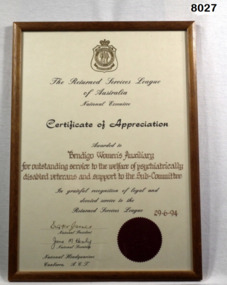
... Main points, “Awarded to Bendigo Women’s Auxiliary for outstanding service to the Welfare of psychiatrically disabled veterans and support to the Sub - Committee” “Digger James - National President” “June M Healy - National Secretary”...Refer Cat No 8021 for more details re Bendigo Women’s Auxiliary. brsl smirsl Auxiliary Wabrsl Main points, “Awarded to Bendigo Women’s Auxiliary for outstanding service to the Welfare of psychiatrically disabled veterans and support to the Sub - Committee” “Digger James - National President” “June M Healy - National Secretary” Certificate of Appreciation from RSL National Executive to Bendigo RSL Women's Auxiliary 29.6.1994, RSL logo at the top followed by details of the certificate, a red seal is on the RH side bottom. ...Refer Cat No 8021 for more details re Bendigo Women’s Auxiliary.Certificate of Appreciation from RSL National Executive to Bendigo RSL Women's Auxiliary 29.6.1994, RSL logo at the top followed by details of the certificate, a red seal is on the RH side bottom.Main points, “Awarded to Bendigo Women’s Auxiliary for outstanding service to the Welfare of psychiatrically disabled veterans and support to the Sub - Committee” “Digger James - National President” “June M Healy - National Secretary”brsl, smirsl, auxiliary, wabrsl -
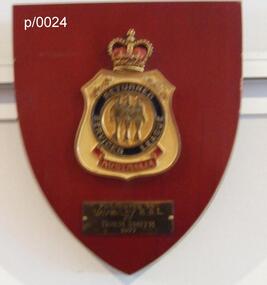 Waverley RSL Sub Branch
Plaque RSL Australia, RSL Australia
... women who have served or are serving in the Australian Defence Force (ADF). It was formed as the Returned Sailors and Soldiers Imperial League of Australia in 1916, became the Returned Sailors', Soldiers' and Airmens Imperial League of Australia in 1940, and became the Returned Services League of Australia in 1965. The change to its current name was made in 1990 to reflect the organisation's concern for current as well as former servicemen and servicewomen. The patron of the RSL is Queen Elizabeth II. The current National...women who have served or are serving in the Australian Defence Force (ADF). It was formed as the Returned Sailors and Soldiers Imperial League of Australia in 1916, became the Returned Sailors', Soldiers' and Airmens Imperial League of Australia in 1940, and became the Returned Services League of Australia in 1965. The change to its current name was made in 1990 to reflect the organisation's concern for current as well as former servicemen and servicewomen. The patron of the RSL is Queen Elizabeth II. The current National ...The Returned and Services League of Australia (often abbreviated to RSL) is a support organisation for men and women who have served or are serving in the Australian Defence Force (ADF). It was formed as the Returned Sailors and Soldiers Imperial League of Australia in 1916, became the Returned Sailors', Soldiers' and Airmens Imperial League of Australia in 1940, and became the Returned Services League of Australia in 1965. The change to its current name was made in 1990 to reflect the organisation's concern for current as well as former servicemen and servicewomen. The patron of the RSL is Queen Elizabeth II. The current National President of the League is Rear Admiral Ken Doolan, AO RAN (rtd).[2] As of 31 December 2009, the League comprised 186,652 members from 1,306 sub-branches and 5,533 members of the League's women's auxiliary from 381 sub-branches. Membership levels have been declining for at least ten years http://en.wikipedia.org/wiki/Returned_and_Services_League_of_AustraliaWooden Plaque 15cm x 13cmRSL Australia -
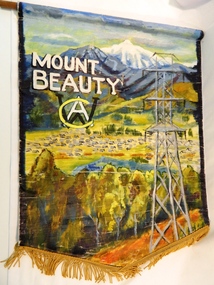 Kiewa Valley Historical Society
Flag C.W.A, Mount Beauty CWA, circa mid to late 1900's
... women in this still relatively isolated rural region and the need to have a place of refuge from the heavy domestic demands that family and business exerted. It was place where the need of a time and space to gain all the mental relaxation and group bonding necessary to balance the sometimes harsh environment that rural life presented existed. The C.W.A. motto "Honour our God, Loyalty to the throne, Service to the country, Through country women, For country women, By country women." cwa flag national ...This flag was used by Country Women's Association (C.W.A) Kiewa Valley Branch circa 1950's. This was in a period when the C.W.A. was the major women's organisation which had the greatest influence amongst rural women (especially in isolated areas). This was a period when broad based communications were mainly by radio,women orientated magazines and the telephone. The CWA was an organisation that catered exclusively to country(rural) women's needs. The atmosphere was one of "sisterhood" and covered nearly all the needs of rural based women. This one organisation incorporated knowledge and learning targeting women who physically may be isolated but not mentally.The Kiewa Valley Group of the C.W.A. was a focal point for women in this still relatively isolated rural region and the need to have a place of refuge from the heavy domestic demands that family and business exerted. It was place where the need of a time and space to gain all the mental relaxation and group bonding necessary to balance the sometimes harsh environment that rural life presented existed. The C.W.A. motto "Honour our God, Loyalty to the throne, Service to the country, Through country women, For country women, By country women."This flag is made from dark green cloth and has the Country Womens Association of Victoria insignia embroidered on it in gold and white lettering.This insignia is contained in a circular motif."C.W.A." (each letter layered over each other) cwa flag, national cwa victoria, country women's association, jan burnett, mt beauty -
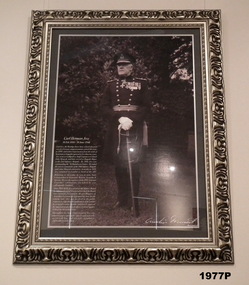 Bendigo Military Museum
Photograph - PHOTOGRAPH, FRAMED, Full length portrait of Carl Herman Jess
... On 3.9.1939 to 31.3.1946 No VP16098 during WW2 he served on the Australian Staff Corps, two of his main appointments being man power Dept Labour and national Service and the Women’s land Army, Awarded CB, he retired due to health reasons with the Rank of Lieut General....On 3.9.1939 to 31.3.1946 No VP16098 during WW2 he served on the Australian Staff Corps, two of his main appointments being man power Dept Labour and national Service and the Women’s land Army, Awarded CB, he retired due to health reasons with the Rank of Lieut General. ...Carl Herman Jess (Sir) CB, CMG, CBE, OBE, DSO had a long distinguished career. This is a very brief summary. Joined the Victorian Volunteer Cadets 1899 to 1906, joined the permanent Military Forces 1906 No 86 age 23 years 4 months and rose through the ranks to Captain when he enlisted in the AIF as a Capt in 4th INF Brigade HQ age 30 years on 23.9.1914, embark for Egypt 22.12.1914, embark for Gallipoli 22.12.1914, promoted to Major 23.5.1915 and transfers to 2nd INF Brigade, awarded MID 12.6.1915, promoted Lt Col and to Command 7th Batt, embark for France 13.4.1916, awarded MID 13.11.1916, awarded Order of the White Eagle (Serbian), he was Gassed but remained on duty at Pozieres, awarded DSO 1.1.1917, appointed Staff Officer HQ 1st Anzac Corps 12.3.1917 then T/Col, T/Brig General through to 7.10.1918, awarded MID and CMG, 1.10.1919 appointed Director General repatriation and demobilisation AIF, resigned appointed in England 21.3.1920. Post WW1 on return to Australia he served in many Military appointments including Honorary Colonel 7th and 38th Battalions.He was made a Knight Batchelor in 1935. On 3.9.1939 to 31.3.1946 No VP16098 during WW2 he served on the Australian Staff Corps, two of his main appointments being man power Dept Labour and national Service and the Women’s land Army, Awarded CB, he retired due to health reasons with the Rank of Lieut General.Framed Photograph. Black & White full length Portrait of Carl Herman Jess, 1884 - 1948. Commander 10th Infantry Brigade, Bendigo born. Frame - Moulded Timber, Painted Silver, glass front. Mount - dark grey cardboard with white inner mount.White print, left bottom corner of photograph "Carl Herman JESS/ 16 Feb 1884 - 16 June 1948" with brief synopsis of career. White print, right bottom corner of photograph, signature "Austin ???"history, photography, army, ww1 -
4th/19th Prince of Wales's Light Horse Regiment Unit History Room
Report: Auditor-General, The Auditor-General, Audit Report No 3, 1990-91, Department of Defence, Australia's Army Reserve, 24/8/1990 (exact)
... service are substantially higher than for a ARA soldier. The report points to difficulties in recruitment and retention and the need to examine the role of women in the ARes. Training was not closely focused on the roles and objectives of the ARes and the subsequent evaluation of training activities could be improved." The Auditor-General, Audit Report No 3, 1990-91, Department of Defence, Australia's Army Reserve Report: Auditor-General Australian National ..."The report highlights significant deficiencies in achieving the major objectives for the ARes that were set out in the Defence White Paper. It also identifies inadequacies in the organisation of the ARes, shortfalls in the level of resources required to maintain its effectiveness. It indicates a need for a major review of the structure and disposition of ARes units and asset holding. The ANAO has developed estimates of the cost of the ARes and these estimates indicate that the cost of training and supporting an ARes member for each day of service are substantially higher than for a ARA soldier. The report points to difficulties in recruitment and retention and the need to examine the role of women in the ARes. Training was not closely focused on the roles and objectives of the ARes and the subsequent evaluation of training activities could be improved."ISBN 0 644 13030 X army reserve, audit reports, auditor general, australian national audit office, defence reviews -
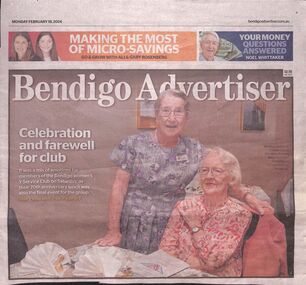 Bendigo Historical Society Inc.
Newsletter - End of era for the Bendigo Y Service Club, 19.02.2024
... Women's Y Service Club. b. A page of photographs taken at the final function that was held at the National Hotel Complex on February 17, 2024. c. ...Service Women's Club decided to disband from March 2024. Bendigo Y's Menettes Y Service Clubs Newspaper articles from the Bendigo Advertiser dated 19.02.2024. a. A photograph from the front page of the Bendigo Advertiser of Brenda Berry and Pam Crammond discussing the 70th anniversary and final event of the Bendigo Women's Y Service Club. b. A page of photographs taken at the final function that was held at the National ...Due to declining membership numbers and increasing age of members the Bendigo Y Service Women's Club decided to disband from March 2024. Newspaper articles from the Bendigo Advertiser dated 19.02.2024. a. A photograph from the front page of the Bendigo Advertiser of Brenda Berry and Pam Crammond discussing the 70th anniversary and final event of the Bendigo Women's Y Service Club. b. A page of photographs taken at the final function that was held at the National Hotel Complex on February 17, 2024. c. Newspaper article outlining the history and memories of the Bendigo Y Service club. The final function coincided with the 70th Anniversary of the club. bendigo y's menettes, y service clubs -
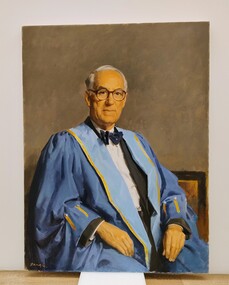 Royal Australian and New Zealand College of Obstetricians & Gynaecologists (RANZCOG)
Painting - Portrait of Dr Lance Townsend, Sir William Dargie CBE, n.d
... During his quarter of a century tenure of the chair, Professor Townsend oversaw tremendous growth in the clinical services, undergraduate and postgraduate education and research in Obstetrics and Gynaecolology at the Royal Women's Hospital and was a major national and international figure in the field over this period. ...During his quarter of a century tenure of the chair, Professor Townsend oversaw tremendous growth in the clinical services, undergraduate and postgraduate education and research in Obstetrics and Gynaecolology at the Royal Women's Hospital and was a major national and international figure in the field over this period. ...Captain Sir William Alexander Dargie CBE (4 June 1912 – 26 July 2003) was a renowned Australian painter, known especially for his portrait paintings. He won the Archibald Prize, Australia's premier award for portrait artists on eight separate occasions; a record held since 1952. (Wikipedia) Dr Sydney Lance Townsend (1913-1983) was appointed the University of Melbourne's first Professor of Obstetrics and Gynaecology in 1951. During his quarter of a century tenure of the chair, Professor Townsend oversaw tremendous growth in the clinical services, undergraduate and postgraduate education and research in Obstetrics and Gynaecolology at the Royal Women's Hospital and was a major national and international figure in the field over this period. In recognition of his contribution, which included the establishment of a second University of Melbourne Department of Obstetrics and Gynaecology and which was located at the Mercy Hospital for Women under the direction of his protégé, Professor Norman Beischer, Professor Townsend was knighted for his services to Obstetrics and Gynaecology. (Melbourne Medical School - History) Oil on canvas painting. Colour portrait of a man seated in a chair. The man is wearing a white shirt, dark suit, and blue bowtie, beneath a dark blue robe. The robe has light blue front panels and gold trim, with decorative buttons and gold stripes at the cuffs. The man has grey receding hair, dark rimmed glasses, and is facing the artist with his body angled towards the bottom right-hand corner. He is pictured against a dark grey background, with the corner of a bench or chair visible next to his left elbow. Signature painted at bottom left corner of portrait reads 'Dargie.' Brass plaque attached to back of painting frame is engraved with the text 'PROFESSOR S.L. TOWNSEND/ President - Chairman/AUSTRALIAN REGIONAL COUNCIL, RCOG/1963-1966'. -
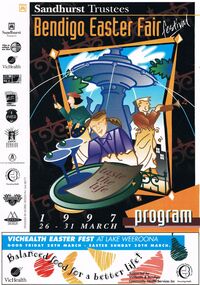 Bendigo Historical Society Inc.
Document - BENDIGO EASTER FAIR FESTIVAL PROGRAM 1997, 26 March 1997
... Women's Vision For The Church, Provincial Council of Mothers Union. Historic Toorak House, Lioness Club of Golden City Bendigo. White Hills Cemetery. Bendigo Cemetery. Festival of Flowers, Craft & Garden, Bendigo Jockey Club. Shannons Corporation Motorfest, City Drive Through, Static Display, Motorkhana, Time Trial. Bendigo Bank Dragon Mile. Volkswagen Car Show, a part of the 28th National Bug-In. Repco Cycles, Australian Veteran Cycling Council Inc. Championships. Under 17 Australian Badminton Championships. Palm Sunday, Bendigo Symphony Orchestra. Way of the Cross, Bendigo's Combined Churches. The Easter Story, Kangfluca Music. Sunrise Church Service...National Trust Bendigo. Arms & Collectables Golden City Collectors Assoc. Art Show. Pottery Exhibition. Women's Vision For The Church Provincial Council of Mothers Union. Historic Toorak House Lioness Club. White Hills Cemetery. Bendigo Cemetery. Festival of Flowers Craft & Garden Bendigo Jockey Club. Motorfest Drive Through Static Display Motorkhana Time Trial. Dragon Mile. Volkswagen Car Show National Bug-In. Repco Cycles Australian Veteran Cycling Council Inc. Championships. Under 17 Australian Badminton Championships. Palm Sunday Bendigo Symphony Orchestra. Way of the Cross Bendigo's Combined Churches. The Easter Story Kangfluca Music. Sunrise Church Service ...Bendigo Easter Fair Festival Program, 26-31 March, 1997. Festival Features, Evening of Art & Classical Music, Rotary Club of Bendigo. VicHealth Easter Fest, Victorian Health Promotion Foundation & Bendigo Community Health Services. Fine Food Fest. Free Stage. Free Evening Concert & Fireworks, Zaire. Torchlight Procession, sponsored by Prime TV & Coca Cola, Bendigo Market Place. Fireworks Spectacular, Sponsored by Bendigo Market Place & Prime TV. Street Fiesta, sponsored by Arts Victoria. Street Extravaganza, Coca Cola Carnival, Sponsored by Coca Cola. Star for a Day, Power Audio Visual & Prime Television. Handcraft Bazaar, Rotary Club of Bendigo Sandhurst Art & Craft Market. Cosmopolitan Street Café, Arts Victoria. Awakening of the Dragon, Bendigo Chinese Association. Gala Parade, Prime Television & Coca Cola. Firewalking by the Australian Skeptics, Discovery Science & Technology Centre. Up In Flames, Discovery Science & Technology Centre. Barry Kenny's Country Roundup, Nadort Promotions. School's Day. Teddy Bear's Picnic, Dragon City Marshals. Fire Brigades Children's Carnival. Family Event, Bendigo Minister's Fellowship. Bendigo Easter Antique Fair. Historic Photographic Exhibition, Burt Sargent Circa 1900. Open Garden at Nanga Gnulle (''nanga nully''). A parade of Quilts, Strathdale Bendigo Quilters Inc. Tasting the Life, Gail Tavener Studio. Snakes Alive Dangerous Australians, BRIT. Y's Men's Club of Bendigo Book Fair, YMCA. Bendigo Camera Club, BRIT. Bendigo Woodcraft Exhibition, Woodturners Bendigo Inc. Autumn Bonsai, Bendigo Bonsai Club. Convocation, National Trust Bendigo. Arms & Collectables, Golden City Collectors Assoc. In. Rotary Art Show. Rotary Pottery Exhibition. Women's Vision For The Church, Provincial Council of Mothers Union. Historic Toorak House, Lioness Club of Golden City Bendigo. White Hills Cemetery. Bendigo Cemetery. Festival of Flowers, Craft & Garden, Bendigo Jockey Club. Shannons Corporation Motorfest, City Drive Through, Static Display, Motorkhana, Time Trial. Bendigo Bank Dragon Mile. Volkswagen Car Show, a part of the 28th National Bug-In. Repco Cycles, Australian Veteran Cycling Council Inc. Championships. Under 17 Australian Badminton Championships. Palm Sunday, Bendigo Symphony Orchestra. Way of the Cross, Bendigo's Combined Churches. The Easter Story, Kangfluca Music. Sunrise Church Service, Bendigo Ministers' Fellowship. Map of CBD Advertisements: Bendigo Easter Antique Fair. Austar. Bendigo Art Gallery. Bendigo Visitor Information Centre. Prime. Golden Dragon Museum Inc. Bendigo Heritage Tours. Discovery Science & Technology Centre Bendigo. Sponsors: Sandhurst Trustees, Prime, Vic Health, ABC Radio, Arts Victoria, Coca Cola, Events Bendigo, City Of Greater Bendigo, Bendigo Community Health Services, Shannons., Morris Design PH 5448 8777Morris Designevent, easter fair, bendigo easter fair, bendigo easter fair festival program, 26-31 march, 1997. festival features, evening of art & classical music, easter fest, . fine food fest. free stage. free evening concert & fireworks. torchlight procession. fireworks spectacular, street fiesta, street extravaganza, coca cola carnival, star for a day, handcraft bazaar, art & craft market. cosmopolitan street café, awakening of the dragon. gala parade, firewalking australian skeptics, discovery science & technology centre. up in flames, barry kenny's country roundup, nadort promotions. school's day. teddy bear's picnic, fire brigades children's carnival. family event, bendigo minister's fellowship. antique fair. photographic exhibition, burt sargent circa 1900. open garden nanga gnulle a parade of quilts, strathdale bendigo quilters inc. tasting the life, gail tavener studio. snakes alive dangerous australians, brit. book fair, ymca. bendigo camera club, brit. bendigo woodcraft exhibition, woodturners bendigo inc. autumn bonsai, bendigo bonsai club. convocation, national trust bendigo. arms & collectables, golden city collectors assoc. art show. pottery exhibition. women's vision for the church, provincial council of mothers union. historic toorak house, lioness club. white hills cemetery. bendigo cemetery. festival of flowers, craft & garden, bendigo jockey club. motorfest, drive through, static display, motorkhana, time trial. dragon mile. volkswagen car show, national bug-in. repco cycles, australian veteran cycling council inc. championships. under 17 australian badminton championships. palm sunday, bendigo symphony orchestra. way of the cross, bendigo's combined churches. the easter story, kangfluca music. sunrise church service, bendigo ministers' fellowship. map of cbd advertisements: antique fair. golden dragon museum inc. bendigo heritage tours. discovery science & technology centre bendigo. sponsors: sandhurst trustees, vic health, abc radio, arts victoria, coca cola, events bendigo, city of greater bendigo, bendigo community health services, shannons., morris design. prime tv. austar. bendigo art gallery. bendigo visitor information centre. prime, victorian health promotion foundation, zaire, sponsored by bendigo market place & prime tv, sponsored by arts victoria, sponsored coca cola, power audio visual, rotary club of bendigo sandhurst, bendigo chinese association, y's men's club of bendigo -
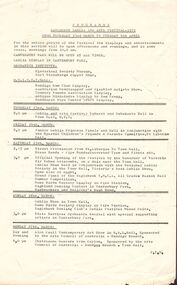 Bendigo Historical Society Inc.
Document - EAGLEHAWK DAHLIA AND ARTS FESTIVAL 1972 PROGRAM
... EVENT Exhibition eaglehawk dahlia & arts festival Eaglehawk Dahlia and Arts Festival 1972 Program Historical Society Museum Karl Steinbergs Puppet Show Bendigo Gem Club Australian Handicapped and Disabled Artists Country Women’s Association Sam Cragg Sandhurst Boys Centre Spastic Children's Friends & Parents Committee Sir Rohan Delacombe National Dahlia Society Eaglehawk Y M C A All Grade Basket Ball Summer Competition Game Birds Society Bushwackers and Bullocky's Bush Band Eaglehawk Bowling Club State Services Orchestra Recital Alan Paull Arts Council of Australia Chitrasana Dancers from Ceylon Eaglehawk Croquet Club Bendigo Music Advancement Society Phillip Miechel Henry Wenig Margaret Schofield Shirley Jacobs The German National Circus Bendigo Clay Target Club Bendigo Photographic Society Eaglehawk Bowling Club Kennel Club Eaglehawk Citizen's Band Society of Organists Bendigo Field Naturalists Typed program for the Eaglehawk Dahlia and Arts Festival from 23rd March to Tuesday 4th April 1972. ...Typed program for the Eaglehawk Dahlia and Arts Festival from 23rd March to Tuesday 4th April 1972. Program lists the displays and entertainment for the duration of the Festival.event, exhibition, eaglehawk dahlia & arts festival, eaglehawk dahlia and arts festival 1972 program, historical society museum, karl steinbergs puppet show, bendigo gem club, australian handicapped and disabled artists, country women’s association, sam cragg, sandhurst boys centre, spastic children's friends & parents committee, sir rohan delacombe, national dahlia society, eaglehawk y m c a all grade basket ball summer competition, game birds society, bushwackers and bullocky's bush band, eaglehawk bowling club, state services orchestra recital, alan paull, arts council of australia, chitrasana dancers from ceylon, eaglehawk croquet club, bendigo music advancement society, phillip miechel, henry wenig, margaret schofield, shirley jacobs, the german national circus, bendigo clay target club, bendigo photographic society, eaglehawk bowling club, kennel club, eaglehawk citizen's band, society of organists, bendigo field naturalists -
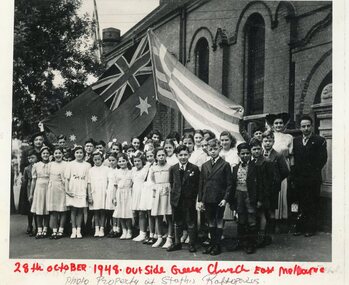 Ithacan Historical Society
Photograph, 28 October Celebration, 28 October 1948
... national day celebration at the Evangelismos Greek Orthodox Church in East Melbourne. The two women, Alexandra Vrachna and Nina Black were teachers at the school. The Evangelismos Church was the first Greek orthodox Church to be established in Melbourne. The foundation stone was laid in December 1900 and church services...national day celebration at the Evangelismos Greek Orthodox Church in East Melbourne. The two women, Alexandra Vrachna and Nina Black were teachers at the school. The Evangelismos Church was the first Greek orthodox Church to be established in Melbourne. The foundation stone was laid in December 1900 and church services ...The children in the picture were students at the Greek language school which was run by the Greek Community of Melbourne and were attending the '28th October' Greek national day celebration at the Evangelismos Greek Orthodox Church in East Melbourne. The two women, Alexandra Vrachna and Nina Black were teachers at the school. The Evangelismos Church was the first Greek orthodox Church to be established in Melbourne. The foundation stone was laid in December 1900 and church services commenced in August 1902. The 28th October is known as 'OHI' DAY', translated meaning NO DAY. It is an important national day celebrated in Greece and the Greek diaspora and commemorates the anniversary when in 1940 the then Prime Minister Ioannis Metaxas said “NO” to an ultimatum made by Italian Prime Minister Benito Mussolini to allow Italian forces to occupy Greece. It marked the beginning of Greece's entry into WW2. The day symbolises values important to the Greek people - freedom, courage and 'filotimo'. The establishment of the Orthodox church in Melbourne in the early years of the twentieth century was was indicative of the number of Greek migrants who came to Australia in those early years of settlement in this country and the desire maintain their religious and cultural traditions. The early Greek migrants were anxious that their Australian born children maintain their language and religion in their adopted country. A black and white photograph of children with three adults standing outside Evangelismos Church in East Melbourne. Three children in the back row are displaying the Greek and Australian flags.Written in red underneath the photograph: 28th OCTOBER 1948. OUTSUDE THE GREEK CHURCH IN EAST MELBOURNE/PHOTO PROPERTY OF STATHI RAFTOPOULOS.wwii -
Eltham District Historical Society Inc
Document - Folder, Nichols, Denise
... Montmorency resident, Denise Nichols awarded an Australia Day honour for 20 years of service to humanitarian aid programs assisting women and refugees including those in Kosovo and Thailand, and organisations including the United National High Commission for Refugees and Oxfam. ...Montmorency resident, Denise Nichols awarded an Australia Day honour for 20 years of service to humanitarian aid programs assisting women and refugees including those in Kosovo and Thailand, and organisations including the United National High Commission for Refugees and Oxfam. ...Montmorency resident, Denise Nichols awarded an Australia Day honour for 20 years of service to humanitarian aid programs assisting women and refugees including those in Kosovo and Thailand, and organisations including the United National High Commission for Refugees and Oxfam. Contents Newspaper article: "Aid: Denise Nichols," Diamond Valley Leader, 27 January 2010. Outlines Denise Nichols work and and her Australia Day honour.Newspaper clippings, A4 photocopies, etcdenise nichols -
Glen Eira Historical Society
Pamphlet - VICTORIA VOLUNTEER AWARD
... Victoria Volunteer Award Awards Voluntary Workers Community Groups Community Services Southwick David MP State Members for Caulfield Parliamentary Representatives Balaclava Road Caulfield North Gladwin Annette B’nai B’rith Anti-Defamation Commission Hertz Harry Armadale Bowls Club Inc Princes Park Caulfield South Kagan Peter AJAX Football Club Bush Jennifer Glen Eira Stonnington Scout Association – 12th Caulfield Scout Group Schmideg Bette National Council of Jewish Women Australia (NCJWA) Samuel Ian (OAM) Zionist Council of Victoria (ZCV) Whitbourn Sandra Caulfield Park Community School Johnson Michael Caulfield South Primary School Hartman Gary Caulfield Park Bowls Club Marshman Natasha Caulfield Primary School Parents and Friends Club Gershman Val Community Information Glen Eira Inc Gaspar Lesley Gaspar Peter B’nai B’rith Victoria Chait Mervyn Jewish Community Council of Victoria (JCCV) Wyner Robert Elsternwick Jewish Community (EJC) Szental Debbie Caulfield Hebrew Congregation Cyprys Ephraim ‘Smiley’ Central Shule Chabad Pamphlet VICTORIA VOLUNTEER AWARD ...This file contains one item: 1/A pamphlet announcing the sixteen winners of the 2013 Victorian Volunteer Award hailing from the Caulfield District. Included are the names of each of the winners and those of the organizations they worked for, a few words of praise for each of the winners, and colour photographs of each of the winners being presented the Award by MP David Southwick. Also included is a brief description of the Award, plus contact details for Southwick for purposes of nominating persons for the 2014 award.victoria volunteer award, awards, voluntary workers, community groups, community services, southwick david mp, state members for caulfield, parliamentary representatives, balaclava road, caulfield north, gladwin annette, b’nai b’rith anti-defamation commission, hertz harry, armadale bowls club inc, princes park, caulfield south, kagan peter, ajax football club, bush jennifer, glen eira stonnington scout association – 12th caulfield scout group, schmideg bette, national council of jewish women australia (ncjwa), samuel ian (oam), zionist council of victoria (zcv), whitbourn sandra, caulfield park community school, johnson michael, caulfield south primary school, hartman gary, caulfield park bowls club, marshman natasha, caulfield primary school parents and friends club, gershman val, community information glen eira inc, gaspar lesley, gaspar peter, b’nai b’rith victoria, chait mervyn, jewish community council of victoria (jccv), wyner robert, elsternwick jewish community (ejc), szental debbie, caulfield hebrew congregation, cyprys ephraim ‘smiley’, central shule chabad -
 Wangaratta RSL Sub Branch
Badge, Unknown
... Women is an ex-service association. Formed in December 1944 from a number of existing organisations, membership of the legion is open to all ex-service personnel, including British Commonwealth and Allied personnel, and former members of the peacetime Australian regular and reserve forces. The legion has branches in each state, and sub-branches in major cities and towns, with its national...Women is an ex-service association. Formed in December 1944 from a number of existing organisations, membership of the legion is open to all ex-service personnel, including British Commonwealth and Allied personnel, and former members of the peacetime Australian regular and reserve forces. The legion has branches in each state, and sub-branches in major cities and towns, with its national ...Australian Legion of Ex-Servicemen and Women Life Member Badge awarded to Private Mervyn HARRIS. The Australian Legion of Ex-Servicemen and Women is an ex-service association. Formed in December 1944 from a number of existing organisations, membership of the legion is open to all ex-service personnel, including British Commonwealth and Allied personnel, and former members of the peacetime Australian regular and reserve forces. The legion has branches in each state, and sub-branches in major cities and towns, with its national headquarters located in Melbourne, Victoria.Gold coloured metal and blue badge with crown on top Australian Legion of Ex-Service Men and Women Life Memberaustralian legion of ex-servicemen and women, private mervyn harris, life membership badge -
 Robin Boyd Foundation
Medal - Member of Order of Australia, Commonwealth of Australia, 1988
... "In 1988, Patricia was appointed a Member of the Order of Australia for her service to opera involving many years of voluntary work on the board of the Australian Opera - work which she greatly enjoyed involving travel, music and meeting many interesting and entertaining people. She was also a life member and former president of the National Gallery of Victoria Women's..."In 1988, Patricia was appointed a Member of the Order of Australia for her service to opera involving many years of voluntary work on the board of the Australian Opera - work which she greatly enjoyed involving travel, music and meeting many interesting and entertaining people. She was also a life member and former president of the National Gallery of Victoria Women's ...Penleigh Boyd wrote this in The Age obituary to Dorothea Patricia Davies AM (3 Jan 1921-5 Nov 2009). "In 1988, Patricia was appointed a Member of the Order of Australia for her service to opera involving many years of voluntary work on the board of the Australian Opera - work which she greatly enjoyed involving travel, music and meeting many interesting and entertaining people. She was also a life member and former president of the National Gallery of Victoria Women's Association." The Walsh Street Archive also holds the Certificate associated with this honour (item D502).awards, honours, robin boyd, walsh st -
 Robin Boyd Foundation
Functional object - Opera Glasses
... "In 1988, Patricia was appointed a Member of the Order of Australia for her service to opera involving many years of voluntary work on the board of the Australian Opera - work which she greatly enjoyed involving travel, music and meeting many interesting and entertaining people. She was also a life member and former president of the National Gallery of Victoria Women's..."In 1988, Patricia was appointed a Member of the Order of Australia for her service to opera involving many years of voluntary work on the board of the Australian Opera - work which she greatly enjoyed involving travel, music and meeting many interesting and entertaining people. She was also a life member and former president of the National Gallery of Victoria Women's ...Patricia Boyd was on the Board of the Australia Opera for several years. The Walsh St house holds a significant collection of opera recordings. Penleigh Boyd wrote this in The Age obituary to Dorothea Patricia Davies AM (3 Jan 1921-5 Nov 2009). "In 1988, Patricia was appointed a Member of the Order of Australia for her service to opera involving many years of voluntary work on the board of the Australian Opera - work which she greatly enjoyed involving travel, music and meeting many interesting and entertaining people. She was also a life member and former president of the National Gallery of Victoria Women's Association." The Walsh Street Archive also holds the Certificate and the medals associated with this honour (items D502 and F126 respectively).opera, patricia boyd, patricia davies, robin boyd -
 Robin Boyd Foundation
Container - Ring-binder
... "In 1988, Patricia was appointed a Member of the Order of Australia for her service to opera involving many years of voluntary work on the board of the Australian Opera - work which she greatly enjoyed involving travel, music and meeting many interesting and entertaining people. She was also a life member and former president of the National Gallery of Victoria Women's..."In 1988, Patricia was appointed a Member of the Order of Australia for her service to opera involving many years of voluntary work on the board of the Australian Opera - work which she greatly enjoyed involving travel, music and meeting many interesting and entertaining people. She was also a life member and former president of the National Gallery of Victoria Women's ...Patricia Boyd was on the Board of the Australia Opera for several years. The Walsh St house holds a significant collection of opera recordings. Penleigh Boyd wrote this in The Age obituary to Dorothea Patricia Davies AM (3 Jan 1921-5 Nov 2009). "In 1988, Patricia was appointed a Member of the Order of Australia for her service to opera involving many years of voluntary work on the board of the Australian Opera - work which she greatly enjoyed involving travel, music and meeting many interesting and entertaining people. She was also a life member and former president of the National Gallery of Victoria Women's Association." The Walsh Street Archive also holds the Certificate and the medals associated with this honour (items D502 and F126 respectively).Black hard plastic 2-ring binderMrs Patricia Davies Board Meeting 12/4/84 The Australian Opera -
 Robin Boyd Foundation
Audio - Recording, Columbia Records. EMI Records Limited
... As Penleigh Boyd wrote in his obituary to his mother: "In 1988, Patricia was appointed a Member of the Order of Australia for her service to opera involving many years of voluntary work on the Board of the Australian Opera - work which she greatly enjoyed involving travel, music and meeting many interesting and entertaining people. She was also a Life Member and former President of the National Gallery of Victoria Women's...As Penleigh Boyd wrote in his obituary to his mother: "In 1988, Patricia was appointed a Member of the Order of Australia for her service to opera involving many years of voluntary work on the Board of the Australian Opera - work which she greatly enjoyed involving travel, music and meeting many interesting and entertaining people. She was also a Life Member and former President of the National Gallery of Victoria Women's ...The Boyds purchased their record player and sound system from Thomas’s in Melbourne. Patricia Boyd (later Davies) was very interested in opera and was later appointed to the Board of the Australian Opera. As Penleigh Boyd wrote in his obituary to his mother: "In 1988, Patricia was appointed a Member of the Order of Australia for her service to opera involving many years of voluntary work on the Board of the Australian Opera - work which she greatly enjoyed involving travel, music and meeting many interesting and entertaining people. She was also a Life Member and former President of the National Gallery of Victoria Women's Association." Maria Callas sings great arias from French operas. LP 33RPM vinyl, Catalogue Number: SAXO-2410, Record cover, Plastic sleeve, 1 vinyl disk. Cover notes, Andrew Porter. Cover photo: Luc Fournol, Jours de France. Maria Callas. Conductor: Georges Petre, Orchestra National de la RTFlp, sound recording, opera, ohm2022, ohm2022_9 -
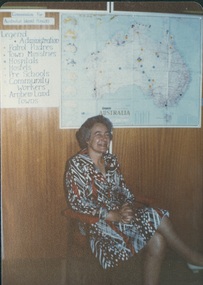 Uniting Church Archives - Synod of Victoria
Colour photo, Prior to 1977
... Women’s Fellowship in the Northern Territory in 1997. She was also involved in setting up the Institute for Aboriginal Development. I believe that Frances should have been recognised nationally for her work with an AM. However, she was the Northern Territory finalist in the Senior Australian of the Year Awards in 2003. In 2004 she was awarded an OBE – not from the Queen but at Old Timers. This is a coveted award which means “Over Bloody Eighty”. Frances was part of it all, in the river, at a bush dance, at a dinner, at a service...Women’s Fellowship in the Northern Territory in 1997. She was also involved in setting up the Institute for Aboriginal Development. I believe that Frances should have been recognised nationally for her work with an AM. However, she was the Northern Territory finalist in the Senior Australian of the Year Awards in 2003. In 2004 she was awarded an OBE – not from the Queen but at Old Timers. This is a coveted award which means “Over Bloody Eighty”. Frances was part of it all, in the river, at a bush dance, at a dinner, at a service ...Everyone seemed to know Frances – it was November 1985 – I met Frances at the Victorian Synod office as she lent me her office to interview staff for St Philip’s which I was taking over in 1986. The interviews completed, she took me to a nearby coffee shop where we had a delightful chat. I came away much the richer, more informed about St Philip’s and feeling I had known Frances forever. And so started our 23 year friendship, with me hearing the first of many stories – for Frances was a wonderfully gifted story teller with a capacity to turn the past into life, and its characters into real people. It seems fitting that a person destined to add to Australia’s history should be born down the beach from Mendonca’s Mahogany ship – Port Fairy on the 28 January 1924. There she went to school – first to primary school then to Camperdown’s Higher Elementary School which went to Year 10. She was the eldest of four children with three brothers, Jock, Norman and Rod. After Year 10, Frances took a job in Camperdown as a dental nurse. She tackled this successfully until deciding to study at Rolland House in Carlton to become a Deaconess. Jock, her brother, recalls asking Frances what made her decide to be a Deaconess. At a Presbyterian Fellowship camp at Warrnambool, Frances and the others were sleeping in the Church Hall on palliases. During the night she awoke and her eye was drawn to a stained glass window, unusually brightly lit. On the window were the words “Follow Me”. Without flinching Frances took the words to heart and decided to serve God as a Deaconess, and during her time with the Australian Inland Mission she became quite a legend. What a patriot Frances was! She loved the stories of pioneers and knew well the history of where she had come from – the Western District. A keen follower of cricket, she would be right up with the last test and the issues of the team. Originally a Melbourne football supporter, she became an avid Geelong supporter and would often score at the annual self destruct St Philip’s vs Flynn Church match. She loved the gladiatorial, albeit often suicidal display. And though an Aussie through and through she loved her Scottish roots. Through her stories, she could easily transport a person in the Centralian landscape onto the heather of the Highlands. In spite of her love for Scotland, the city which was her favourite was New York. Frances – truly a citizen of the world. As a citizen of the world Frances fought for Indigenous and migrant women’s rights and was active in the World Council of Churches, sponsoring local and overseas women to study in Australia and to return to their homes as trained teachers and theologians. Up until recently she was involved in the Spina Bifida and Hydro Cephalis Association of SA. By the time she had taken up with the AIM Frances had a well tuned desire for social justice. To her it was important that the poor and less fortunate were given a go. She felt that the Labor Party provided her best avenue to push her social justice desires. After joining the party in 1956, she quickly became a respected member of the party and worked tirelessly for it, being honoured in the end with life membership. In the party she knew everyone and everyone knew her. She introduced me to Bob Hawke and when I spoke to Gough Whitlam once on a plane, he affirmed to me his friendship with Frances. In her cottage was a picture of her with Kevin Rudd with his arm around her. She is remembered by her party colleagues as someone who had a real compassion for helping people. She believed in the traditional ethic of the Labor Party which is to help those who are less fortunate. Interestingly, she supported St Philip’s moving from solely being a residential college to a school because we had chosen a relatively low fee base to enable maximum access for people and our boarding house continued to, and still does, offer accommodation to any student wishing to attend schools in Alice. Having supported the outback for years from the engine rooms of the mission arm of the church in Victoria, Frances then decided to move to Alice for her retirement. Settling in the little cottage at the far south eastern corner of Old Timers, this became to me, my family and I’m sure to plenty of people, Frances’ Cottage. But moving to Alice was hardly moving into retirement. She quickly became Chaplain at St Philip’s where she clearly showed her love for the children and staff and a real belief in St Philip’s role – to provide access to education for isolated children. She became a stalwart of the Adelaide House Museum, a wonderful member of the congregation, a powerful contributor to the Presbytery and the Annual Synod. Frances was strong, never flinched on a point of principle and discussed things face to face so that you truly knew where you stood with her. She had a great feeling for the pastoralists and knew many of them well. As Chaplain of the College she related well to the children and in addition, knew many of their families. She also felt deeply for the Indigenous people and regularly tackled the issue of how conditions could be improved for them. As we developed the school at St Philip’s, Frances worked with me on so many things. She would visit the College each week for Chapel, run a Sunday school for little kids and the service for all the boarders. When the school was ready to start she wrote the College prayer, said now every week by all students. The prayer says so much about Frances. She pioneered the RE program, teaching RE and in addition to Sunday, visited staff and students every Wednesday. At Presentation Night she presented a homily and provided the blessing – always a strong presence in front of the College community. She was so much part of St Philip’s that when we built the new boarding house in 1990 it seemed so obvious to call it McKechnie House. As a faithful servant of Adelaide House for years and an enthusiastic member of the National Trust, Frances was the first chairperson of the committee, a driving force to redevelop Adelaide House and she worked tirelessly to present John Flynn’s Hospital in the best light. She helped to deliver the stories of Flynn and McKay and the Outback missionaries to so many people and was instrumental in producing meaningful displays. I enjoyed walking around the museum with her intensely, enjoying her detailed stories of the past missionary era and I know many others would have as well. As a loyal and loving member of the Flynn Church, and being such a comrade of Fred McKay’s, Frances understood intricately the symbols which lie within the architecture. Once again, as a story teller, each one had a yarn attached to it. Over her twenty-three years as a member of the Flynn Church she has made a wonderful contribution. As a charismatic personality people were naturally attracted to Frances and were touched and affected by her. Peter Robson, twenty-two years at St Philip’s, remembers her asking him why he had stayed so long at the College. He explained to her that it was her address one day in Chapel in the early times that inspired him to keep going. With great wisdom she had said, “You can’t conquer something, unless you allow it to conquer you.” St Philip’s had conquered him. Wherever she went, whomever she was with, she had a real and lasting impact. Frances brought the reality of the Outback to so many as she addressed congregations around Victoria. She started the Australian Church Women’s Fellowship in the Northern Territory in 1997. She was also involved in setting up the Institute for Aboriginal Development. I believe that Frances should have been recognised nationally for her work with an AM. However, she was the Northern Territory finalist in the Senior Australian of the Year Awards in 2003. In 2004 she was awarded an OBE – not from the Queen but at Old Timers. This is a coveted award which means “Over Bloody Eighty”. Frances was part of it all, in the river, at a bush dance, at a dinner, at a service, at a party, at a meeting, at a footy game, at a cricket game, at Synod, at Presbytery, at Labour meetings, I could go on. Frances McKechnie, what a wonderful Australian. (Eulogy by Chris Tudor) Frances McKechnie died mid-2008. Deaconess Frances McKechnie is seated in front of a map of Australia marked with Australian Inland Mission places identified.At the time the photo was taken, McKechnie was the Victorian Regional Officer for the Australian Inland Mission (Presbyterian). At one stage, she worked for National Mission Frontier Services from 1968 to 1986. See below for the eulogy at her funeral by Chris Tudor. (Frances died May or June 2008.)deaconess frances mckechnie; australian inland mission; presbyterian church -
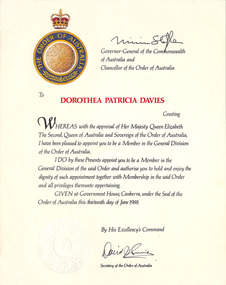 Robin Boyd Foundation
Certificate, Honours and Awards, 1988
... As Penleigh Boyd wrote in his obituary to his mother: "In 1988, Patricia was appointed a Member of the Order of Australia for her service to opera involving many years of voluntary work on the Board of the Australian Opera - work which she greatly enjoyed involving travel, music and meeting many interesting and entertaining people. She was also a Life Member and former President of the National Gallery of Victoria Women's...As Penleigh Boyd wrote in his obituary to his mother: "In 1988, Patricia was appointed a Member of the Order of Australia for her service to opera involving many years of voluntary work on the Board of the Australian Opera - work which she greatly enjoyed involving travel, music and meeting many interesting and entertaining people. She was also a Life Member and former President of the National Gallery of Victoria Women's ...As Penleigh Boyd wrote in his obituary to his mother: "In 1988, Patricia was appointed a Member of the Order of Australia for her service to opera involving many years of voluntary work on the Board of the Australian Opera - work which she greatly enjoyed involving travel, music and meeting many interesting and entertaining people. She was also a Life Member and former President of the National Gallery of Victoria Women's Association." The Walsh Street Archive also holds the medal associated with this honour (item F126).Certificate on a presentation board with 4 corners holding it in place, contained in a envelope with Mrs Dorothea Patricia Davies, AM.The Order of Australia (Signed) Ninian Stephen Governor-General of Commonwealth of Australia and Chancellor of the Order of Australia. To Dorothea Patricia Davies Greeting. Whereas with the approval of Her Majesty Queen Elizabeth The second, Queen of Australia and Sovereign of the Order of Australia, I have been pleased to appoint you to be a Member in the General Division of the Order of Australia. I do by these Presents appoint you to be a Member in the General Division of the said Order and authorise you to hold and enjoy the dignity of such appointment together with Membership in the said Order and all privileges thereunto appertaining. Given at Government House, Canberra, under the seal of the Order of Australia this thirteenth day of June 1988. By His excellency's Command. (Signed) David I Smith Secretary of the Order of Australia.
