
Showing 9 items matching "1000s"
-
 Greensborough Historical Society
Photograph - Photograph - Digital Image, 100s and 1000s, 1970s
... 100s and 1000s...Original item: small clear plastic vial with red lid, containing multi-coloured 100s and 1000s. Photograph only in archive....This small vial dates from the 1970s, today they are sold in larger jars. cake decorating sweets Original item: small clear plastic vial with red lid, containing multi-coloured 100s and 1000s. Photograph only in archive. 100s and 1000s Photograph Photograph - Digital Image ...Sugar hundreds and thousands are used to decorate cakes and biscuits. This small vial dates from the 1970s, today they are sold in larger jars.Original item: small clear plastic vial with red lid, containing multi-coloured 100s and 1000s. Photograph only in archive.cake decorating, sweets -
 St Patrick's Old Collegians Association (SPOCA)
Photograph - SPOCA, Tour of Ireland
... Patrick dies in 461 in nearby Saul and is buried here at Down Cathedral, built/rebuilt in 400s by Christians, in 1000s by Augustinians, in 1183 by Anglo-Normans, destroyed in 1316 by Bruce of Scotland, then rebuilt in 1512. ...Patrick dies in 461 in nearby Saul and is buried here at Down Cathedral, built/rebuilt in 400s by Christians, in 1000s by Augustinians, in 1183 by Anglo-Normans, destroyed in 1316 by Bruce of Scotland, then rebuilt in 1512. ... -
 Mont De Lancey
Document - Research Notes, Wendy Chambers, c.1960-c.2010
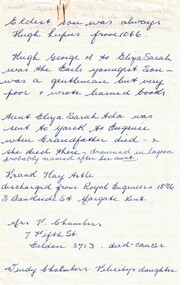
... ...1000s...MDL Researcher notes on the family history of Wendy Chambers, beginning with Eliza and Hugh Baker, based off conversations with Wendy, spanning the time period 1066-1866 Chambers Family Baker Family Wendy Chambers Eliza Baker Hugh Baker 1000s 1800s 1700s Family trees Family History 1 two-sided letter sized paged, handwritten with blue ink Document Research Notes Wendy Chambers ...MDL Researcher notes on the family history of Wendy Chambers, beginning with Eliza and Hugh Baker, based off conversations with Wendy, spanning the time period 1066-18661 two-sided letter sized paged, handwritten with blue inkchambers family, baker family, wendy chambers, eliza baker, hugh baker, 1000s, 1800s, 1700s, family trees, family history -
 National Wool Museum
Tool - The Austral Unit Calculator, Industrial Consultants, c.1960
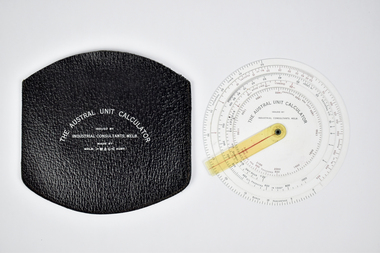
... Discs are labelled (inside – outside) Cost per Thousand Overall Unit Hour U/S [units] produced in 1000s No. of persons Bonus Percentage 9017.2 Black leather case with white block letter printing [9017.3 - 9017.5] Inside case are three notes (one printed, two handwritten) that provide instructions for using the calculator...Discs are labelled (inside – outside) Cost per Thousand Overall Unit Hour U/S [units] produced in 1000s No. of persons Bonus Percentage 9017.2 Black leather case with white block letter printing [9017.3 - 9017.5] Inside case are three notes (one printed, two handwritten) that provide instructions for using the calculator Tool The Austral Unit Calculator Industrial Consultants W&G ...Kathryn Knitwear, founded by Robert Blake, manufactured high quality children’s knitwear in Melbourne from the 1940s – 1980s. Robert Blake began manufacturing children’s knitwear in his bedroom in Strathmore using a hand powered machine in the late 1940s. The operation moved to Ascot Vale and Essendon, before eventually establishing a factory in Moonee Ponds in the early 1950s. The business continued to expand, necessitating a move to a new factory in Broadmeadows. By 1962, the Broadmeadows factory was producing an average of 20,000 garments per month, which increased to 24,000 by 1964. Robert Blake’s Son, Brendan recalls that “The Kathryn brand was famous around Australia, anywhere children needed to keep warm and dress smartly. It also won a number of wool fashion awards”, including the 1969 Wool Awards, which was held by the Australian Wool Bureau and published in Women’s Weekly. The Kathryn range was designed for durability, comfort and care, without sacrificing style. They used patterning techniques that increase stretchiness, comfort and fit, as well as integrating decorative elements into the fabric to prevent them from being bulky, uncomfortable or tight. Making longevity of style a priority, Brendan Blake remembers that “there was one particular garment that was in the range for at least thirty years”. He also recalls “In the past, when women have found out that I was associated with Kathryn Knitwear, they would often relate to me the story of a garment they had purchased or received as a gift and, when their child had grown out of it, they would hand it on to another child. Several ladies have told me of purchasing garments for their daughters’ glory box, or saving a particular garment after their daughter had grown out of it. Brendan Blake: “At the peak of their operation they employed approximately two hundred people, mainly women and girls. A family would often seek to send their daughter to work in this company because they knew they would be looked after and safe. One lady wrote to me telling me that working at the Moonee Ponds Factory prior to getting married was the happiest time of her life.” In 1963, workers at the Kathryn factory earned £13 per week, which was 8 shillings and 8 pence higher than the minimum weekly wage for female workers in the textile manufacturing industry (£12 11s 4d). By 1970, the Kathryn Knitwear brand expanded from children’s knitwear into womenswear under the brand name ‘Lady Kathryn’, and for boys and men under ‘Robert Blake’. Continuing to diversify their distribution, they also began exporting ‘Kathryn’ garments to New Zealand, the Pacific Islands, and Japan. ‘Kathryn Knitwear’ was well-known for their early adoption of modern materials and techniques that had broad appeal to their customer base. This is shown in their early use of the acrylic fibre ‘Orlon’ in the 50s and 60s and ‘Superwash’ wool in the 1970s. Many of Kathryn Knitwear’s styles, particularly those that were long running staples of the brand, were available in both wool and Orlon to suit the consumer’s preference. Far from the humble origins of one man in his bedroom with a hand-cranked machine; at its closure in 1980, the Broadmeadows factory of ‘Kathryn’ housed more than 100 machines, including 53 sewing machines and 45 knitting machines. Robert Blake was “a passionate advocate for wool and Australian Made” throughout his whole life. A strong thread that ties through the lifespan of Robert Blake and Kathryn Knitwear is a balance between adopting new innovations without sacrificing the core values of durability, comfort, care and style that had made the brand so well known. Their legacy forms an integral part of both Australian social and manufacturing history.Measuring instrument with five circular white layers and one long transparent plastic ruler on top. Transparent layer is now yellowed, was likely originally clear. All of the layers connected with a metal rivet at the centre, allowing the discs and line indicator to move in relation to each other. Discs are labelled (inside – outside) Cost per Thousand Overall Unit Hour U/S [units] produced in 1000s No. of persons Bonus Percentage 9017.2 Black leather case with white block letter printing [9017.3 - 9017.5] Inside case are three notes (one printed, two handwritten) that provide instructions for using the calculator[label on obverse of case] THE AUSTRAL UNIT CALCULATOR ISSUED BY INDUSTRIAL CONSULTANTS, MELB MADE BY MELB >W&G< AUST.business, business history, manufacturing history, calculator, textile fibres textile history -
 Parks Victoria - Point Hicks Lightstation
Lamps, kerosene
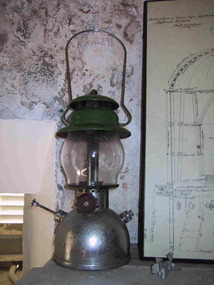
... The Australian company Austramax began manufacturing kerosene pressure lamps in Brunswick in 1946, making the bases and the workings by hand, turning out 1000s of lamps each week. Portable lamps were used worldwide where bright light was needed and they became essential as an emergency back-up source of light for the lightstation as well as the lantern room. ...The Australian company Austramax began manufacturing kerosene pressure lamps in Brunswick in 1946, making the bases and the workings by hand, turning out 1000s of lamps each week. Portable lamps were used worldwide where bright light was needed and they became essential as an emergency back-up source of light for the lightstation as well as the lantern room. ...The two hand-held, portable kerosene lamps each have green enamel caps over the glass. They were used from around the 1930s until 1993, and one is now located on the groundfloor level of the lighthouse and the other is in the assistant lightkeeper’s quarters. The brand name of the Point Hicks lamp, while not stated is probably Coleman, Tilley or Austramax, which were all similarly made, portable pressurised kerosene lamps. Coleman brand pressure lamps and lanterns were first made in about 1905 by American, William Coleman, and their English competitor was the firm, Tilley. The Australian company Austramax began manufacturing kerosene pressure lamps in Brunswick in 1946, making the bases and the workings by hand, turning out 1000s of lamps each week. Portable lamps were used worldwide where bright light was needed and they became essential as an emergency back-up source of light for the lightstation as well as the lantern room. Through the multiplication of light by the lighthouse lenses, they could provide a tower with a 26 nautical mile range. Lamps similar to the two Point Hicks examples can be found at Gabo Island, one of which is a green enamelled Austramax lamp; Cape Nelson (Austramax), and similar lamps are held at Cape Schanck and Cape Otway. The two Point Hicks lamps have first level contributory significance for their historic value and provenance, and as representative examples of lamps that were widely used in Australian lightstations between the 1930s and 1960s.PHLS0008.1 & PHLS0008.2 Pressurised kerosene lamp, cover over glass is made of green enamelled metal. -
 Bendigo Historical Society Inc.
Newspaper - NORM GILLIES COLLECTION: GILLIES NEWSPAPER ARTICLES
... Thur 17061980 The glorious Aussie pie k B.A. thur 17061976 tons of Meat - 1000s of Pies l The Age Mon 29071985 Going Public to make a big crust m The Bendigo Miner Thur 17012008 serving up an iconic pie n B.A. ...Thur 17061980 The glorious Aussie pie k B.A. thur 17061976 tons of Meat - 1000s of Pies l The Age Mon 29071985 Going Public to make a big crust m The Bendigo Miner Thur 17012008 serving up an iconic pie n B.A. ...a B. A. 16081985 Gillies shares the spoils and the pies b B.A. 12051982 Gillies Famous Pies advertisement c B.A. GB The Pies to Buy advertisement d Newspaper article Four'n'Twenty take on the US market e Newspaper article Gillies pies fueled the great Empire Climb f B.A.Bendigo stalwart (Alan Gillies) dies g Second Board launches Bendigo firm into big league h The Gazette Wed 26081981 Humble Beginnings i B.A. Sat. 27091980 GB Pies Keys to the door j B.A. Thur 17061980 The glorious Aussie pie k B.A. thur 17061976 tons of Meat - 1000s of Pies l The Age Mon 29071985 Going Public to make a big crust m The Bendigo Miner Thur 17012008 serving up an iconic pie n B.A. Tues 15092015 Fond Farwell planned for Gillies Pies founder o The Gazette Wed 26081981 Humble Beginnings p The Gazette Wed 26081981 Millions and Millions of pies is the Gillies Bros. Story q Out and About Narrewillock no. 2204 r-s-t-u-v Buy Goodness....It's GilliesVariousnorm gillies collection, bendigo businesses -
 Flagstaff Hill Maritime Museum and Village
Nibs & box, late 19th to early 20th century
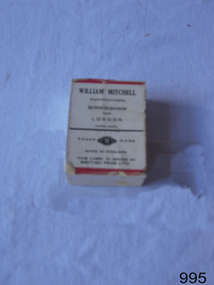
... Birmingham became the centre of the world’s pen trade for many years -, during the 1800’s over 100 factories, employing 1000s of skilled workers, manufactured the ‘Birmingham Pen’. ...Birmingham became the centre of the world’s pen trade for many years -, during the 1800’s over 100 factories, employing 1000s of skilled workers, manufactured the ‘Birmingham Pen’. ...Box of dip pen nibs made by William Mitchell Calligraphy dating back to late 19th or early 20th century when dip pens with steel nibs were the main writing instruments. The pen nibs are shaped to fit into a slot in the base of a wooden or Bakelite pen holder. The hole at the front of the nib is for collecting ink from a well, which is then stored in a reservoir at the back of the nib. The nibs are stamped with their nib size and Pedigree (what type of nib it is) and maker’s details. William Mitchell Calligraphy still makes these nibs today with a slightly difference finish. (ref: Sales and Marketing Director of William Mitchell Calligraphy in 2016). HISTORY of the Ink Pen Quills and ink were common writing tools until the early 19th century when the pen trade began mass producing steel nibs and pens. The steel nibs each have a hole in the middle that acts like a well for the ink. When the nib is dipped into the ink well the writer needs to ensure that it is dipped to only just past that well. India Ink was one of the most popular inks used with the nib pens, notable for its satin-like smooth flow. This ink is composed of a particularly fine carbon mixed with water; it can also be obtained as a dry stick that is then crushed and mixed with water as required. The Jewellery Quarter of Birmingham had the largest concentration of independent jewellers in Europe. Birmingham became the centre of the world’s pen trade for many years -, during the 1800’s over 100 factories, employing 1000s of skilled workers, manufactured the ‘Birmingham Pen’. ABOUT WILLIAM MITCHELL CALLIGRAPHY LTD.* (*The following text is quoted from the William Mitchell Calligraphy website) British based William Mitchell Calligraphy has been designing and manufacturing exceptional pens for almost 200 years. The William Mitchell heritage in making pen nibs began whilst working with his brother John Mitchell in the early 1820s. William Mitchell established his own business in 1825 to become one of the leading nib manufacturers and famous for lettering pens. Almost 100 years later William Mitchell merged with Hinks, Wells & Co, another pen manufacturer, to form British Pens, employing around 1000 people in the Bearwood Road area of Birmingham. During the early 1960s British Pens acquired the pen business of other pen manufacturers Perry & Co and John Mitchell, once again reuniting the two brothers. Joseph Gillott, who were famous for their artist drawing and mapping nibs, amalgamated with British pens in 1969. William Mitchell and Joseph Gillott established in Birmingham during the early part of the nineteenth century and [their products] are still proudly made here. British Pens were subsequently purchased by its current owner Byron Head, the owner of William Mitchell (Sinkers) in 1982, and was subsequently renamed William Mitchell (calligraphy) Ltd. Established in 1827 Joseph Gillott was one of the pioneers of mass steel pen nib manufacturing. The company was particularly strong in the American market, prompting Elihu Burrit, the American consul, to write “In ten thousand school houses across the American continent between two oceans, a million children are as familiarly acquainted with Joseph Gillott as with Noah Webster” (The compiler of the famous American dictionary). The company consequently received visits from many notable Americans, including president Ulysses S Grant. Email on file, from Mike Chappell, Sales and Marketing Manager, William Mitchell Calligraphy, “20161122 - William Mitchell re pen nibs” How to use a dip pen to create modern calligraphy, https://thepostmansknock.com/how-to-use-a-dip-pen-to-create-modern-calligraphy/ India Ink, Wikipedia https://en.wikipedia.org/wiki/India_ink birmingham Pen Trade, Wikipedia, https://en.wikipedia.org/wiki/Birmingham_pen_trade The Pen Museum, http://penmuseum.org.uk/ The early 19th century invention and later mass production of pen nibs such these in our collection had a large impact on education and literacy because the nibs could be produced in great numbers and affordable prices.Box of patent Mitchell nibs containing 48 "Pedigree" nibs. Box depicts picture of William Mitchell on lid, and picture of nib pen on lid and side. Made in Birmingham, England. Nib “0505 Wm MITCHELLS PEDIGREE ENGLAND” Box “PEDIGREE / MAINFOLD SLIP”, “WILLIAM MITCHELL / BIRM - - - - - - LOND” flagstaff hill, warrnambool, shipwrecked-coast, flagstaff-hill, flagstaff-hill-maritime-museum, maritime-museum, shipwreck-coast, flagstaff-hill-maritime-village, william mitchell calligraphy ltd, pen nib, writing implement, writing accessories, dip pen, birmingham manufacturer, communication in writing, mass produced pen nibs -
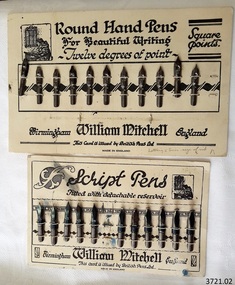 Flagstaff Hill Maritime Museum and Village
Pen Nibs, 1920's
... Birmingham became the centre of the world’s pen trade for many years -, during the 1800’s over 100 factories, employing 1000s of skilled workers, manufactured the ‘Birmingham Pen’. ...Birmingham became the centre of the world’s pen trade for many years -, during the 1800’s over 100 factories, employing 1000s of skilled workers, manufactured the ‘Birmingham Pen’. ...The two cards of nibs are retail display cards of the dip pen nibs that William Mitchell Calligraphy produced, dating back to around the 1920’s, which was the time of the Great Exhibition in the UK. At that time dip pens with steel nibs were the main writing instruments. British Pens Ltd. had recently formed as a company and its subsidiaries included the the company William Mitchell, which is why British Pens Ltd. is named on the cards as well. One card (1) has the Round Hand nib, which is widely used today for calligraphy scripts. The other card (2) has the Script nib that has round upturned points for monocline or unshaded lettering that is also used for calligraphy. The nibs also have a detachable reservoir. The pen nibs are shaped to fit into a slot in the base of a wooden or Bakelite pen holder. The hole at the front of the nib is for collecting ink from a well, which is then stored in a reservoir at the back of the nib. The nibsare stamped with their nib size and Pedigree (what type of nib it is) and maker’s details. William Mitchell Calligraphy still makes these nibs today with a slightly difference finish. (ref: Sales and Marketing Director of William Mitchell Calligraphy in 2016). HISTORY of the Ink Pen Quills and ink were common writing tools until the early 19th century when the pen trade began mass producing steel nibs and pens. The steel nibs each have a hole in the middle that acts like a well for the ink. When the nib is dipped into the ink well the writer needs to ensure that it is dipped to only just past that well. India Ink was one of the most popular inks used with the nib pens, notable for its satin-like smooth flow. This ink is composed of a particularly fine carbon mixed with water; it can also be obtained as a dry stick that is then crushed and mixed with water as required. The Jewellery Quarter of Birmingham had the largest concentration of independent jewellers in Europe. Birmingham became the centre of the world’s pen trade for many years -, during the 1800’s over 100 factories, employing 1000s of skilled workers, manufactured the ‘Birmingham Pen’. ABOUT WILLIAM MITCHELL CALLIGRAPHY LTD.* (*The following text is quoted from the William Mitchell Calligraphy website) British based William Mitchell Calligraphy has been designing and manufacturing exceptional pens for almost 200 years. The William Mitchell heritage in making pen nibs began whilst working with his brother John Mitchell in the early 1820s. William Mitchell established his own business in 1825 to become one of the leading nib manufacturers and famous for lettering pens. Almost 100 years later William Mitchell merged with Hinks, Wells & Co, another pen manufacturer, to form British Pens, employing around 1000 people in the Bearwood Road area of Birmingham. During the early 1960s British Pens acquired the pen business of other pen manufacturers Perry & Co and John Mitchell, once again reuniting the two brothers. Joseph Gillott, who were famous for their artist drawing and mapping nibs, amalgamated with British pens in 1969. William Mitchell and Joseph Gillott established in Birmingham during the early part of the nineteenth century and [their products] are still proudly made here. British Pens were subsequently purchased by its current owner Byron Head, the owner of William Mitchell (Sinkers) in 1982, and was subsequently renamed William Mitchell (calligraphy) Ltd. Established in 1827 Joseph Gillott was one of the pioneers of mass steel pen nib manufacturing. The company was particularly strong in the American market, prompting Elihu Burrit, the American consul, to write “In ten thousand school houses across the American continent between two oceans, a million children are as familiarly acquainted with Joseph Gillott as with Noah Webster” (The compiler of the famous American dictionary). The company consequently received visits from many notable Americans, including president Ulysses S Grant. The early 19th century invention and mass production of pen nibs such these in our collection had a large impact on education and literacy because the nibs could be produced in great numbers and affordable prices.Pen nibs; 2 cards of steel dip pen nibs from the 1920’s. The steel nibs are attached to cards by 2 rows of entwined cotton cord. Reverse sides of cards have some hand written marks. Manufacturer; William Mitchell, Birmingham, England. Card issued by British Pens Ltd. Nibs have shaped ends, a hole in the centre with a well on the underside, and the tops are shaped approximately quarter circle. Inscriptions are pressed into each nib. The script pens have detachable reservoirs made of a metal different to the nib. (Card 1) Round Hand Pens, 11 nibs remain from card of 12. Printed on card “Round Hand Pens for Beautiful Writing, Twelve degrees of point, Square points. William Mitchell, Birmingham, England. This card is issued by British Pens Ltd. MADE IN ENGLAND” Also printed on top left of card is a pen drawing of a person writing at a desk, background of decorative 3-paned window in brick wall. (Card 2) Script Pens; 11 nibs remain from card of 12. “Script pens fitted with detachable reservoir. William Mitchell, Birmingham, England. This card is issued by British Pens Ltd. MADE IN ENGLAND” Also printed on top right of card is a pen drawing of a person writing at a desk, background of decorative 3-paned window in brick wall. On Card 1, - each nib is stamped with its size, and “Wm MITCHELLS / PEDIGREE / ROUND HAND / ENGLAND” - hand written on front bottom of card in ball point pen “Lettering 5 times size of nib” - hand drawn on back of card in red and blue ball point pen are scribbled lines On Card 2 - each nib is stamped with its size, and “WILLIAM / MITCHELLS / SCRIPT PEN / ENGLAND” - a black circle corresponding to the nib is printed on the card above each nib. - hand written on back of card in black felt tip pen are numerals - hand drawn on back, 4 parallel lines in red ball point pen with the numbers “10” between 2 of the lines flagstaff hill, warrnambool, shipwrecked coast, flagstaff hill maritime museum, maritime museum, shipwreck coast, great ocean road, william mitchell calligraphy ltd, british pens ltd., pen nib, writing implement, dip pen, round hand nib, script nib, birmingham manufacturer, communication in writing, mass produced pen nibs -
 Returned Nurses RSL Sub-branch
Book, Clive Johnson, Australians awarded: a concise guide to military and civilian decorations, medals and other awards to Australians from 1772 to 2013 with their valuations, 2014
... All of this is studied and explained, with 1000s of images and extensive historical text. ...This second edition is without question the most comprehensive reference of honours, decorations, awards, medals and official forms of recognition to Australians ever produced. Australians Awarded has been compiled over 15 years to create 800 pages of in-depth detail on Honours, Medals and Decorations to Australians from 1770 to 2013. This edition includes comprehensive ribbon charts incorporating historical and current awards; detailed tables for types of awards; numbers issued, values, font types, medal types, ribbons, clasps, official badges, plaques, scrolls, certificates and detail for entitlement. Australians Awarded II also includes the only comprehensive listing of foreign orders and decorations to Australians between 1850 and 2013, as well as the never before published state-by-state multi-jurisdictional internal forms of recognition and awards. All of this is studied and explained, with 1000s of images and extensive historical text. This book is for anyone with a passion for Australian military history, the enthusiast or specialist, the professional, the amateur, the collector, the dealer or simply anyone who has ever been, an Australian Awarded. [From Trove entry]Black hardcover book with gold writing and an assortment of photos of military and civillian men proudly displaying the medals they have been awarded. non-fictionThis second edition is without question the most comprehensive reference of honours, decorations, awards, medals and official forms of recognition to Australians ever produced. Australians Awarded has been compiled over 15 years to create 800 pages of in-depth detail on Honours, Medals and Decorations to Australians from 1770 to 2013. This edition includes comprehensive ribbon charts incorporating historical and current awards; detailed tables for types of awards; numbers issued, values, font types, medal types, ribbons, clasps, official badges, plaques, scrolls, certificates and detail for entitlement. Australians Awarded II also includes the only comprehensive listing of foreign orders and decorations to Australians between 1850 and 2013, as well as the never before published state-by-state multi-jurisdictional internal forms of recognition and awards. All of this is studied and explained, with 1000s of images and extensive historical text. This book is for anyone with a passion for Australian military history, the enthusiast or specialist, the professional, the amateur, the collector, the dealer or simply anyone who has ever been, an Australian Awarded. [From Trove entry]australian medals, civilian medals, military medals, awards, medals, decorations of honour
