
Showing 69 items matching "12 gauge"
-
 Flagstaff Hill Maritime Museum and Village
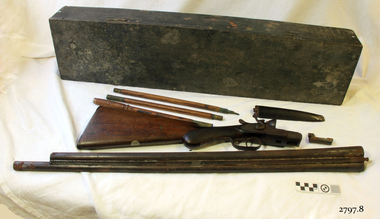
Weapon - Shotgun, Double Barrel, ISAAC HOLLIS & SONS, ca. 1904
... ...12 gauge...This double-barrel shotgun is 12-gauge, complete with a cleaning rod and a wooden storage box. ...This double-barrel shotgun is 12-gauge, complete with a cleaning rod and a wooden storage box. ...The proof marks on the barrels (a crown and letters BV) denote that the shotgun design was made from the year 1904, and that it was nitro-proof tested in Birmingham, England. David Melville Carrison (1895 to 1960) of Port MacDonnell was the previous owner of this Isaac Hollis & Sons double-barrel shotgun. His grandfather, Adam Kerrison Carrison (1833-1903), was an early settler who worked as a fisherman in that once-bustling seaport. His uncle John was a a horse-breaker, a boat hand, and a member of the lifeboat crew, receiving a medal for his part in saving the crew of a French barque. Currently, no connection has been made between the gun, its owner, and the note with the word “Enterprise”: a New Zealand-built, two-masted schooner that was wrecked in Lady Bay, Warrnambool, in 1950. Gun makers, ISAAC HOLLIS & SONS: The Hollis Brothers were first recorded as operating from 11 Weaman Row in 1840, although evidence suggests the business may have commenced before then. Over time, the firm became known as Isaac Hollis & Sons, with claims of its establishment dating back to 1814. This earlier date is supported by records of Richard and William Hollis trading in Bath Street, Birmingham, between 1814 and 1818, which raises the possibility that Isaac and Frederick Hollis were their descendants. The principal brothers involved in the business were Isaac Hollis, born in 1815, and Frederick Hollis, whose birth date remains unknown. Frederick’s life was cut short when he died on 20 December 1839. According to the 1841 census, Isaac Hollis resided in Weaman Row and was listed as a 25-year-old gun and pistol maker. He was married to Emma, who was born in 1821, and together they had two children: Isaac, born in 1837, and Henry, born in 1839. Following Frederick’s death, Isaac continued to operate under the name Hollis Brothers until 1845, after which he renamed the business Hollis Brothers & Co. This entity remained active up to 1848. In 1844, Isaac Hollis entered a brief partnership with William Tranter at 10 & 11 Weaman Row, likely to fulfil a specific contract or to supply parts. This partnership continued until 1849. In 1848, Isaac Hollis formed a partnership with Isaac Brentnall Sheath, establishing the firm of Hollis & Sheath and expanding their operations into 10 Weaman Row. The partnership saw Hollis & Sheath become licensed manufacturers of percussion breech-loading guns, positioning the company as a notable presence in the industry. In 1861, Sheath left the partnership and emigrated to New Zealand, where he conducted several enterprises and was elected as a provincial councillor. He died in Christchurch on 19th May 1897. In 1861, after Isaac Sheath left, the business name became Isaac Hollis & Sons. By approximately 1870, Isaac Hollis and Henry Hollis had assumed responsibility for the daily management of the firm, with Isaac overseeing the overall management and marketing of the company's products, and Henry managing the manufacturing processes. During this period, the company became known for producing large volumes of affordable trade guns and sporting guns, catering to customers in South Africa and the British colonies. In 1870, Isaac Hollis & Sons opened a retail location at 44a Cannon Street in London, and in 1871, it operated at 83 Cheapside Street. Isaac Hollis Jnr passed away in October 1875 in Birmingham at the age of 37, having never married. In 1876/1877, Henry Hollis registered a limited liability company under the name Isaac Hollis & Sons Ltd. However, by 1879, trading resumed under the name Isaac Hollis & Sons, and the London shop moved to 6 Great Winchester Street. From 1932 to 1933, the business operated in London as Hollis, Bentley & Playfair. The final closure of Hollis, Bentley & Playfair occurred in Birmingham in 1953. The shotgun was manufactured by Isaac Hollis & Sons, a firm with a strong reputation for producing firearms. This early 1900s example represents a standard pattern that was produced in large quantities for everyday use. This double-barrel shotgun is 12-gauge, complete with a cleaning rod and a wooden storage box. The firearm has been altered from its original configuration: the right barrel has been cut shorter, resulting in sharp edges at the muzzle, and a metal extension has been fitted to the stock. The cleaning rod consists of three separate segments that screw together for use. The shotgun is housed in a black-painted wooden case with a hinged lid showing inscriptions for the maker and Serial Number. Maker was I. HOLLIS & SONS, Serial Number SN 84245. David Melville Carrison of Port MacDonnell was the previous owner. A handwritten note that had the word 'Enterprise' was with the gun. "I. HOLLIS & SONS". SN on stock “84245”. Badge on both sides “Crown [symbol] / BV”. “Crown [symbol] / NP”, “12G inside Diamond [symbol]”, “NITRO PROOF”, “STEEL 84245” Paper note included with gun, written in felt tip pen “ENTERPRISE”. flagstaff hill, maritime museum, maritime village, warrnambool, great ocean road, shipwreck coast, firearm, gun, double-barrel, shotgun, cleaning rod, gunsmith, smithed, 12 gauge, sn 84245, serial number 84245, david melville carrison, early 1900s, richard and william hillis, herbert & co., herbert & co. london, hollis & sons, isaac hollis & sons, isaac hillis & sons ltd., hollis bentley & playfair., isaac hollis, frederick hollis, isaac brentnall sheath, isaac sheath, william tranter, gun manufacturer, pistol manufacturer, gun and pistol maker, birmingham, military supplies, enterprise, 1904 -
 Running Rabbits Military Museum operated by the Upwey Belgrave RSL Sub Branch
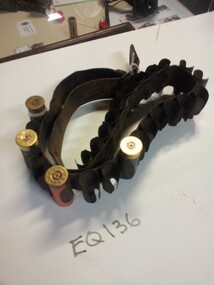
Belt
... Army Belt for 12 gauge Shotgun Cartridges...Equipment Boer War Army Army Belt for 12 gauge Shotgun Cartridges Belt ...Army Belt for 12 gauge Shotgun Cartridgesequipment, boer war, army -
 Warrnambool and District Historical Society Inc.
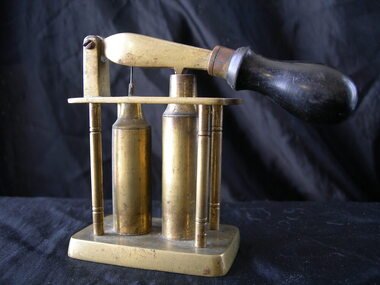
Munitions, Cartridge reloader
... This cartridge re-loader is most likely for loading 12 gauge shotgun shells. It is not known if it was for private or military use. ...This cartridge re-loader is most likely for loading 12 gauge shotgun shells. It is not known if it was for private or military use. ...This cartridge re-loader is most likely for loading 12 gauge shotgun shells. It is not known if it was for private or military use. This cartridge re-loader has been in the collection of the Warrnambool and District Historical Society for many years but it has no known local provenance. It is an interesting relic from times past. This is a brass cartridge re-loader. It has a rectangular brass base with four brass columns supporting a rectangular top with a hollow middle. The columns of the casing are affixed with metal screws. Inside this protective casing are two cartridge-shaped brass pillars, one with a metal spike at the end and one with a small opening at the top. Both of these pillars are fixed to the base of the protective casing. Over-arching these two objects is a brass lever hinged at the end. This has a wooden handle The arm of the lever has a small protusion on the bottom which pushes into the opening of one of the pillars. It also has a small indentation which fits into the spike of the other pillar. ‘12’ history of warrnambool, cartridge re-loader -
 Flagstaff Hill Maritime Museum and Village
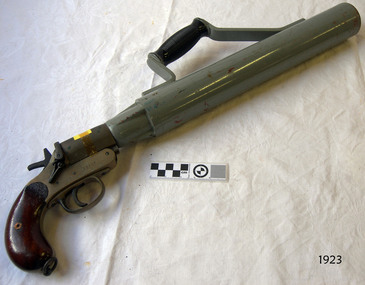
Equipment - Line throwing pistol, 1925-1945
... Accessories for the pistol included: flares, 12 gauge adaptor (to shoot 12 gauge flares), a wood plunger, and boxes of faked line. ...Accessories for the pistol included: flares, 12 gauge adaptor (to shoot 12 gauge flares), a wood plunger, and boxes of faked line. ...This is a SPRA, or Schermuly’s Pistol Rocket Apparatus. The large firearm type pistol would have been used to throw a line between ships, usually in the event of saving lives. The line throwing pistol consists of a long barrel with handle attached, a pistol grip and trigger, which fires a short blank cartridge. Accessories for the pistol included: flares, 12 gauge adaptor (to shoot 12 gauge flares), a wood plunger, and boxes of faked line. The stamp on the handle, Crown over "NP" is a Birmingham Proof House mark that dates the pistol between 1904 and 1954. However Schermuly's line throwing pistol was invented in the 192s and used on British Naval Ships from 1929. The serial number '22507' is only 806 numbers later than one on sale as a British Military WWII issue SRPA '21701'. This pistol appears to be made 125-1945. The apparatus was used as a life saving device for crew and passengers on vessels in distress that were only a few hundred metres from shore, often eliminating the need to launch a boat and risk lives to go out to the vessel in dangerous conditions. It could also be used from ship to ship rescue. The pistol would launch a line from shore to the vessel. The line would be attached to the vessel, then shore crew would send out equipment, including a breeches buoy, in which the stranded people could be pulled to shore. It has saved many lives at sea. The cartridge is loaded into the breech of the pistol and the rocket is inserted into the muzzle. On pulling the trigger, the gases generated by the fired cartridge eject the rocket on its correct line of flight, and at the same time, burst through the waterproof disc and ignite the propellant mixture, which carries the rocket and line on the remainder of the flight. The rocket consists of a weldless steel case filled with propellant mixture sealed in by a waterproof disc. Fixed to the rocket case is a direction bridle, to the end of which a short length of flexible steel wire is attached, this in turn being connected to the end of the line to be thrown. A complete rocket set, or line throwing kit. would include a wood carrying case, two coils of faked line in separate compartments, three rockets and a can of six cartridges. William Schermuly (1857 – 1929) - Founder of the Schermuly business. In 1897 he invented a trough-fired, line throwing apparatus. In 1920 he and his third son, Alfred James Schermuly, invented the pistol rocket apparatus and promoted this overseas during the 1920s. The system was approved by the British Navy in 1929 through an Act of Parliament, which made it compulsory for ships over 500 tons to carry this equipment. The company, Schermuly Pistol Rocket Apparatus Ltd., grew quickly during and after World War II but business eased off during the 1970s before it eventually closed in the 1990s. Saving lives in Warrnambool – The coastline of South West Victoria is the site of over 600 shipwrecks and many lost lives; even in Warrnambool’s Lady Bay there were around 16 known shipwrecks between 1850 and 1905, with eight lives lost. Victoria’s Government responded to the need for lifesaving equipment and, in 1858, the provision of rocket and mortar apparatus was approved for the lifeboat stations. In 1859 the first Government-built lifeboat arrived at Warrnambool Harbour and a shed was soon built for it on the Tramway Jetty, followed by a rocket house in 1864 to safely store the rocket rescue equipment. In 1878 the buildings were moved to the Breakwater (constructed from 1874-1890), and in 1910 the new Lifeboat Warrnambool arrived with its ‘self-righting’ design. For almost a hundred years the lifesaving and rescue crews, mostly local volunteers, trained regularly to rehearse and maintain their rescue skills. They were summoned when needed by alarms, gunshots, ringing bells and foghorns. In July 1873 a brass bell was erected at Flagstaff Hill specifically to call the rescue crew upon news of a shipwreck. Some crew members became local heroes but all served an important role. Rocket apparatus was used as recently as the 1950s. This line-throwing pistol is part of he Rocket Launching Equipment used to perform life-saving rescue at sea from the 1920s. It is significant for its connection with local history, maritime history and marine technology. Lifesaving has been an important part of the services performed from Warrnambool's very early days, supported by State and Local Government, and based on the methods and experience of Great Britain. Hundreds of shipwrecks along the coast are evidence of the rough weather and rugged coastline. Ordinary citizens, the Harbour employees, and the volunteer boat and rescue crew, saved lives in adverse circumstances. Some were recognised as heroes, others went unrecognised. In Lady Bay, Warrnambool, there were around 16 known shipwrecks between 1850 and 1905. Many lives were saved but tragically, eight lives were lost.Pistol, line-throwing, SPRA (Schermuly's Pistol Rocket Apparatus). This line throwing pistol has a wooden pistol grip, brass trigger mechanism, and a long, wide, steel barrel with Bakelite handle attached to the top. Inscriptions are stamped onto the pistol.Stamped on handle: "5" and "[symbol of a Crown] above NP" , "22507", "[within oval] SPRA" Stamped on barrel: "L22507".gun, pistol, flagstaff hill, warrnambool, shipwrecked coast, flagstaff hill maritime museum, maritime museum, flagstaff hill maritime village, great ocean road, line throwing, line throwing pistol, spra, schermuly's pistol rocket apparatus, sea rescue, pyrotechnicks, marine technology, schermuly pistol rocket apparatus ltd., william schermuly, alfred schermuly, pistol line thrower, flagstaff hill maritime museum and village, maritime village, lady bay, warrnambool harbour, port of warrnambool, shipwreck, life-saving, lifesaving, rescue crew, rescue, rocket rescue, rocket crew, beach rescue, line rescue, rescue equipment, rocket firing equipment, rocket rescue equipment, maritime accidents, shipwreck victim, rocket equipment, rescue boat, lifeboat, volunteer lifesavers, volunteer crew, life saving rescue crew, lifesaving rescue crew, rocket apparatus, rocket rescue method, shore to ship, rocket apparatus rescue, stranded vessel, line throwing mortar, rocket rescue apparatus, line thrower, lifeboat warrnambool, rocket machine, rocket head, rocket launcher, rocket line, beach rescue set, rocket set, schermuly, line-firing pistol, line throwing gun, pistol rocket apparatus, line throwing cartridge, line-throwing rocket, firearm, life saving, lsrc -
 Melbourne Tram Museum
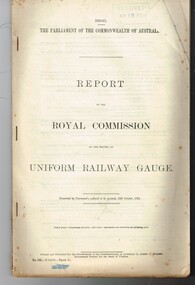
Document - Report, Commonwealth of Australia, "Report of the Royal Commission on the matter of Uniform Railway Gauge", Oct. 1921
... Report - 42 pages, + 6 maps, printed on foolscap and folded map sheets, edge stapled titled "Report of the Royal Commission on the matter of Uniform Railway Gauge" - dated 12/10/1921. Looks at the Australian railway system and makes recommendation for a uniform gauge for the rail system, technical issues, change of gauge, rollingstock, costs and existing system maps....Trams tramways Railways Gauge Has in top right hand corner a stamp "Received Nov. 18, 1921" Report - 42 pages, + 6 maps, printed on foolscap and folded map sheets, edge stapled titled "Report of the Royal Commission on the matter of Uniform Railway Gauge" - dated 12/10/1921. Looks at the Australian railway system and makes recommendation for a uniform gauge for the rail system, technical issues, change of gauge, rollingstock, costs and existing system maps. ...Report - 42 pages, + 6 maps, printed on foolscap and folded map sheets, edge stapled titled "Report of the Royal Commission on the matter of Uniform Railway Gauge" - dated 12/10/1921. Looks at the Australian railway system and makes recommendation for a uniform gauge for the rail system, technical issues, change of gauge, rollingstock, costs and existing system maps.Has in top right hand corner a stamp "Received Nov. 18, 1921"trams, tramways, railways, gauge -
 Flagstaff Hill Maritime Museum and Village
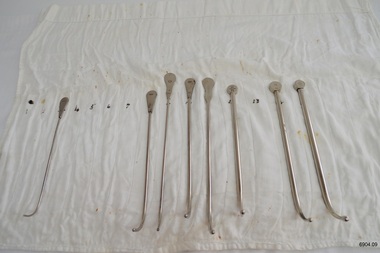
Surgical Kit, Matrick, 1921
... Instruments in kit are 8 male urethral silver sounds, various sizes (3, 8, 9, 10, 11, 12, 14, 15). The 5 smaller gauge sounds have teardrop shaped handle, the 3 larger have thick disc shaped handles. ...Instruments in kit are 8 male urethral silver sounds, various sizes (3, 8, 9, 10, 11, 12, 14, 15). The 5 smaller gauge sounds have teardrop shaped handle, the 3 larger have thick disc shaped handles. ...This surgical kit of urethral silver sounds originally belonged to Dr T.F. Ryan of Nhill, Victoria, dated Dec. 1921. Urethral sounds are used by surgeons in diagnosis and treatment of urethral problems and come in various sizes and designs. This set contains two different designs. The kit was passed on to Dr W.R. Angus when he purchased Dr Ryan’s surgery in 1933, then donated to Flagstaff Hill Maritime Village by the family of Doctor William Roy Angus, Surgeon and Oculist. It is part of the “W.R. Angus Collection” that includes historical medical equipment, surgical instruments and material once belonging to Dr Edward Ryan and Dr Thomas Francis Ryan, (both of Nhill, Victoria) as well as Dr Angus’ own belongings. The Collection’s history spans the medical practices of the two Doctors Ryan, from 1885-1926 plus that of Dr Angus, up until 1969. ABOUT THE “W.R.ANGUS COLLECTION” Doctor William Roy Angus M.B., B.S., Adel., 1923, F.R.C.S. Edin.,1928 (also known as Dr Roy Angus) was born in Murrumbeena, Victoria in 1901 and lived until 1970. He qualified as a doctor in 1923 at University of Adelaide, was Resident Medical Officer at the Royal Adelaide Hospital in 1924 and for a period was house surgeon to Sir (then Mr.) Henry Simpson Newland. Dr Angus was briefly an Assistant to Dr Riddell of Kapunda, then commenced private practice at Curramulka, Yorke Peninsula, SA, where he was physician, surgeon and chemist. In 1926, he was appointed as new Medical Assistant to Dr Thomas Francis Ryan (T.F. Ryan, or Tom), in Nhill, Victoria, where his experiences included radiology and pharmacy. In 1927 he was Acting House Surgeon in Dr Tom Ryan’s absence. Dr Angus had become engaged to Gladys Forsyth and they decided he further his studies overseas in the UK in 1927. He studied at London University College Hospital and at Edinburgh Royal Infirmary and in 1928, was awarded FRCS (Fellow from the Royal College of Surgeons), Edinburgh. He worked his passage back to Australia as a Ship’s Surgeon on the on the Australian Commonwealth Line’s T.S.S. Largs Bay. Dr Angus married Gladys in 1929, in Ballarat. (They went on to have one son (Graham 1932, born in SA) and two daughters (Helen (died 12/07/1996) and Berenice (Berry), both born at Mira, Nhill ) According to Berry, her mother Gladys made a lot of their clothes. She was very talented and did some lovely embroidery including lingerie for her trousseau and beautifully handmade baby clothes. Dr Angus was a ‘flying doctor’ for the A.I.M. (Australian Inland Ministry) Aerial Medical Service in 1928 . Its first station was in the remote town of Oodnadatta, where Dr Angus was stationed. He was locum tenens there on North-South Railway at 21 Mile Camp. He took up this ‘flying doctor’ position in response to a call from Dr John Flynn; the organisation was later known as the Flying Doctor Service, then the Royal Flying Doctor Service. A lot of his work during this time involved dental surgery also. Between 1928-1932 he was surgeon at the Curramulka Hospital, Yorke Peninsula, South Australia. In 1933 Dr Angus returned to Nhill and purchased a share of the Nelson Street practice and Mira hospital (a 2 bed ward at the Nelson Street Practice) from Dr Les Middleton one of the Middleton Brothers, the current owners of what previously once Dr Tom Ryan’s practice. Dr Tom and his brother had worked as surgeons including eye surgery. Dr Tom Ryan performed many of his operations in the Mira private hospital on his premises. He had been House Surgeon at the Nhill Hospital 1902-1926. Dr Tom Ryan had one of the only two pieces of radiology equipment in Victoria during his practicing years – The Royal Melbourne Hospital had the other one. Over the years Dr Tom Ryan had gradually set up what was effectively a training school for country general-practitioner-surgeons. Each patient was carefully examined, including using the X-ray machine, and any surgery was discussed and planned with Dr Ryan’s assistants several days in advance. Dr Angus gained experience in using the X-ray machine there during his time as assistant to Dr Ryan. When Dr Angus bought into the Nelson Street premises in Nhill he was also appointed as the Nhill Hospital’s Honorary House Surgeon 1933-1938. His practitioner’s plate from his Nhill surgery is now mounted on the doorway to the Port Medical Office at Flagstaff Hill Maritime Village, Warrnambool. When Dr Angus took up practice in the Dr Edward and Dr Tom Ryan’s old premises he obtained their extensive collection of historical medical equipment and materials spanning 1884-1926. A large part of this collection is now on display at the Port Medical Office at Flagstaff Hill Maritime Village in Warrnambool. In 1939 Dr Angus and his family moved to Warrnambool where he purchased “Birchwood,” the 1852 home and medical practice of Dr John Hunter Henderson, at 214 Koroit Street. (This property was sold in1965 to the State Government and is now the site of the Warrnambool Police Station. and an ALDI sore is on the land that was once their tennis court). The Angus family was able to afford gardeners, cooks and maids; their home was a popular place for visiting dignitaries to stay whilst visiting Warrnambool. Dr Angus had his own silk worm farm at home in a Mulberry tree. His young daughter used his centrifuge for spinning the silk. Dr Angus was appointed on a part-time basis as Port Medical Officer (Health Officer) in Warrnambool and held this position until the 1940’s when the government no longer required the service of a Port Medical Officer in Warrnambool; he was thus Warrnambool’s last serving Port Medical Officer. (Masters of immigrant ships arriving in port reported incidents of diseases, illness and death and the Port Medical Officer made a decision on whether the ship required Quarantine and for how long, in this way preventing contagious illness from spreading from new immigrants to the residents already in the colony.) Dr Angus was a member of the Australian Medical Association, for 35 years and surgeon at the Warrnambool Base Hospital 1939-1942, He served with the Australian Department of Defence as a Surgeon Captain during WWII 1942-45, in Ballarat, Victoria, and in Bonegilla, N.S.W., completing his service just before the end of the war due to suffering from a heart attack. During his convalescence he carved an intricate and ‘most artistic’ chess set from the material that dentures were made from. He then studied ophthalmology at the Royal Melbourne Eye and Ear Hospital and created cosmetically superior artificial eyes by pioneering using the intrascleral cartilage. Angus received accolades from the Ophthalmological Society of Australasia for this work. He returned to Warrnambool to commence practice as an ophthalmologist, pioneering in artificial eye improvements. He was Honorary Consultant Ophthalmologist to Warrnambool Base Hospital for 31 years. He made monthly visits to Portland as a visiting surgeon, to perform eye surgery. He represented the Victorian South-West subdivision of the Australian Medical Association as its secretary between 1949 and 1956 and as chairman from 1956 to 1958. In 1968 Dr Angus was elected member of Spain’s Barraquer Institute of Barcelona after his research work in Intrasclearal cartilage grafting, becoming one of the few Australian ophthalmologists to receive this honour, and in the following year presented his final paper on Living Intrasclearal Cartilage Implants at the Inaugural Meeting of the Australian College of Ophthalmologists in Melbourne In his personal life Dr Angus was a Presbyterian and treated Sunday as a Sabbath, a day of rest. He would visit 3 or 4 country patients on a Sunday, taking his children along ‘for the ride’ and to visit with him. Sunday evenings he would play the pianola and sing Scottish songs to his family. One of Dr Angus’ patients was Margaret MacKenzie, author of a book on local shipwrecks that she’d seen as an eye witness from the late 1880’s in Peterborough, Victoria. In the early 1950’s Dr Angus, painted a picture of a shipwreck for the cover jacket of Margaret’s book, Shipwrecks and More Shipwrecks. She was blind in later life and her daughter wrote the actual book for her. Dr Angus and his wife Gladys were very involved in Warrnambool’s society with a strong interest in civic affairs. He had an interest in people and the community They were both involved in the creation of Flagstaff Hill, including the layout of the gardens. After his death (28th March 1970) his family requested his practitioner’s plate, medical instruments and some personal belongings be displayed in the Port Medical Office surgery at Flagstaff Hill Maritime Village, and be called the “W. R. Angus Collection”. The W.R. Angus Collection is significant for still being located at the site it is connected with, Doctor Angus being the last Port Medical Officer in Warrnambool. The collection of medical instruments and other equipment is culturally significant, being an historical example of medicine, administration, household equipment and clothing from late 19th to mid-20th century. Dr Angus assisted Dr Tom Ryan, a pioneer in the use of X-rays and in ocular surgery. Surgical kit of Urethral Silver Sounds, comprising white cotton fabric roll with internal pockets for instruments and cotton tape for tying closed. Part of the W.R. Angus Collection, originally belonging to Dr. T.F. Ryan, 1921. Instruments in kit are 8 male urethral silver sounds, various sizes (3, 8, 9, 10, 11, 12, 14, 15). The 5 smaller gauge sounds have teardrop shaped handle, the 3 larger have thick disc shaped handles. Handwritten black ink script "Silver Sounds, Dr. T.F. Ryan, Dec 1921" Inside pockets have numbers in black ink from 1 to 15.Handwritten black ink script "Silver Sounds, Dr. T.F. Ryan, Dec 1921" Inside pockets have numbers in black ink from 1 to 15. 3 - “3”, “WEISS LONDON” 8 - “8”, “WEISS LONDON”, “B” 9 - “9”, “MAYER & MELTZER” 10 - “10”, “WEISS LONDON” 11 - “11” , “MAYER & MELTZER, LONDON & MELBOURNE” 12 - “12 – 15” “MATRICK LONDON” 14 - “11 – 14” 15 - “15 – 18”flagstaff hill, warrnambool, shipwrecked coast, flagstaff hill maritime museum, maritime museum, shipwreck coast, flagstaff hill maritime village, great ocean road, dr w r angus, dr t.f. ryan, surgical instrument, t.s.s. largs bay, warrnambool base hospital, nhill base hospital, mira hospital, flying doctor, medical treatment, medical history, medical education, medical text book, urethral silver sound, urethral sound, urethral treatment, urethral surgery, mayer & meltzer, weiss london, matrick london -
 Flagstaff Hill Maritime Museum and Village
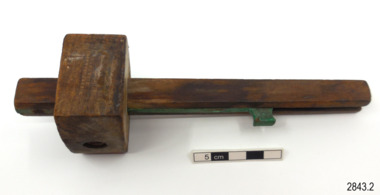
Tool - Marking Gauge
... Gauge, column 2, page 15. W. MARPLES & SONS- William Marples Snr. had a business on the Sheffield Moor in 1773/74. In 1821 his son William Jnr. At 12...Gauge, column 2, page 15. W. MARPLES & SONS- William Marples Snr. had a business on the Sheffield Moor in 1773/74. In 1821 his son William Jnr. At 12 ...This mortice marking gauge has an adjustable sliding arm. The gauge is used for scribing two lines on a flat surface such as timber for measuring and cutting. It is a hand-powered tool that would have been used by a tradesperson such as a cabinet maker, woodworker or carpenter. The hand tool shows signs of much use. The ‘W. Maples & Sons, Hibernia’s catalogue of 1867 had a very similar tool, called a Mortice Gauge, column 2, page 15. W. MARPLES & SONS- William Marples Snr. had a business on the Sheffield Moor in 1773/74. In 1821 his son William Jnr. At 12 years old began in his father’s joinery business. 1833 the firm was known as a tool manufacturer. In 1838 Marples called his business Hibernian Works and moved to 67-69 Spring Lane, Sheffield. When he moved to Westfield Terrace in 1856, he called his business Hibernia Works (no ‘n’ on the end). The business remained at this address for 116 years. In about 1859 the firm began using the Lyre (Irish harp) mark. In 1860 or so the two brothers, Edwin and William Marples, became partners and the firm became William Marples and Sons. The firm introduced the single shamrock symbol in 1860-61. The boys’ brother Albert joins the firm in 1863. In 1875 the company registered both the name ‘Hibernia’ and the trade mark symbol of a Triple Shamrock and the use of these trademarks continued for many decades, into the 1940 and the firm, with many changes, was still in business in the early 21st century. About Shamrock and Hibernia, both are related to Ireland and W. Marples named his products the Shamrock brand.The marking gauge is an example of a hand powered woodworking tool used over the past few centuries. Its maker was well known for his good quality tools and his business grew because of his reputation.Mortice marking gauge: wooden staff with block and green, adjustable sliding arm within the staff. The end of the staff has a facility for holding the scribe marker. The block has a hole into which a peg or wedge would be inserted to hold the sliding arm in place. Inscription with maker's name and almost indecipherable mark is stamped onto one side of the block. Made by W Marples & Sons, Sheffield.Stamped into block “W. MARPLES & SONS / HIBERNIA WORKS” above Logo of ‘Trefoil’ image [three, three-leafed clovers on the same stem]flagstaff hill, warrnambool, maritime museum, maritime village, shipwreck coast, hand tool, woodwork, marking gauge, measuring tool, mortice gauge, mortice marking gauge, william marples, w marples & sons, hibernia, shamrock, trifoil, tripple shamrock, carpenter's tool, cabinet maker, woodworking tool, drawing, planning, tool, wooden scribe, vintage, carpenter, marking tool, antique, marking out, joiner -
 Royal Australian and New Zealand College of Obstetricians & Gynaecologists (RANZCOG)
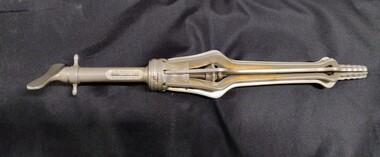
Instrument - Dührssen-style 8 bladed dilator, Unknown
... There is a gauge on the shaft of the instrument which ranges from 0-12, showing the current setting of the instrument. ...There is a gauge on the shaft of the instrument which ranges from 0-12, showing the current setting of the instrument. ...Alfred Dührssen (23 March 1862 – 11 October 1933) was a German gynecologist and obstetrician born in Heide, Schleswig-Holstein, at the time part of Denmark. He studied medicine at the University of Marburg, as well as the Kaiser-Wilhelm-Akademie für das militärärztliche Bildungswesen (Kaiser-Wilhelm-Academy for Military Physicians). In 1886, he became an obstetrical assistant to Adolf Gusserow (1836-1906) in Berlin, and in 1888 he began work as a lecturer at the University of Berlin. In 1892 he opened a private clinic for obstetrics and gynecological diseases. Dührssen was a prominent figure in modern German gynecology, being remembered for his pioneer work in surgical practices such as vaginal Caesarean section (vaginalen Kaiserschnitt). He was an advocate of institutional births for all pregnancies, and proposed that pregnant women undergo screening processes to uncover possible difficulties prior to giving birth. (Wikipedia) Metal uterine dilator consisting of a handle, a short shaft, and eight prongs. The prongs each have a bump/curve in the prong towards the top, to allow them to bend around the shaft of the instrument and meet at their tips. There is a second 'bump' in the prongs just before the tips. The tip of each prong has five ridges to assist with grip. The handle of the device is a flat, rounded handle, which is turned to open the prongs and set them at various degrees of diameter. There is a gauge on the shaft of the instrument which ranges from 0-12, showing the current setting of the instrument. There is also a pin and T-shaped slot arrangement located just above the start of the prongs, which has been engraved '8' on the left hand side, and '1' on the right hand side. Each prong is also engraved with a number at the base of the prong, reading '1' to '8'. gynaecology -
 Otway Districts Historical Society
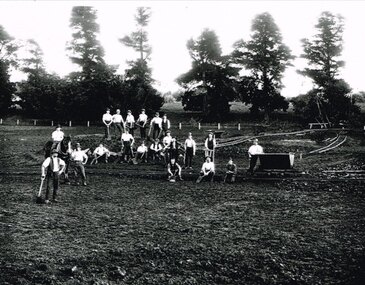
Photograph, Narrow gauge construction camp near Colac, c.1900
... 12 km south, and the remainder spaced at similar distances as the work progressed. The camps were served by butchers and bakers from Colac that visited them as many times each week to satisfy the mens' requirements. Many of the men had their families with them. They all lived in tents that consisted of a wooden floor around which the canvas cover was built. A calico partition divided the eating and sleeping quarters, and all cooking was done in camp ovens or at open fires. construction camp; railways; colac; B/W. 158mm x 203mm. Near Colac, a narrow gauge ...Construction of the Colac-Beech Forest railway line commenced in 1900 and the first activities were the work gangs and their camps. About 100 men were engaged in laying and ballasting the track while others formed the earthworks and the building of culverts and bridges. The first camp was established eight kilometres from Colac, the second 12 km south, and the remainder spaced at similar distances as the work progressed. The camps were served by butchers and bakers from Colac that visited them as many times each week to satisfy the mens' requirements. Many of the men had their families with them. They all lived in tents that consisted of a wooden floor around which the canvas cover was built. A calico partition divided the eating and sleeping quarters, and all cooking was done in camp ovens or at open fires.B/W. 158mm x 203mm. Near Colac, a narrow gauge construction camp comprising 21 workmen, a horse, and two tipping trays.construction camp; railways; colac; -
 Moorabbin Air Museum
Document (item) - Wamira NIA E37 Documents and drawings
... NIA E37 Wamira Engine options for bid Sept 85 CA34-S556-12 Windscreen and canopy finite element model CA34-S556-10 Canopy frame stressing CA34-S556-14 Windscreen transparency stressing CA34-S556-15 Windscreen structure stressing CA34-S556-11 Canopy mechanisms stressing Bid data Estimates (detail and task plans Hawker DH A10B proposal to Dept of Defence Vol 2, Vol 5, Vol 6 Wing static test strain gauge curves Box 1 Wing static testing deflections Wing static test SC curves Box II Wing static test SC Curves Box 3 ATR box installation rear fuselage AFTIS orange boxes in rear cockpit Barry mounts trays and isolators Flight data recorder installation AFTIS equipment in rear cockpit ...NIA E37 Wamira Engine options for bid Sept 85 CA34-S556-12 Windscreen and canopy finite element model CA34-S556-10 Canopy frame stressing CA34-S556-14 Windscreen transparency stressing CA34-S556-15 Windscreen structure stressing CA34-S556-11 Canopy mechanisms stressing Bid data Estimates (detail and task plans Hawker DH A10B proposal to Dept of Defence Vol 2, Vol 5, Vol 6 Wing static test strain gauge curves Box 1 Wing static testing deflections Wing static test SC curves Box II Wing static test SC Curves Box 3 ATR box installation rear fuselage AFTIS orange boxes in rear cockpit Barry mounts trays and isolators Flight data recorder installation AFTIS equipment in rear cockpit Document Wamira NIA E37 Documents and drawings ... -
 Kiewa Valley Historical Society
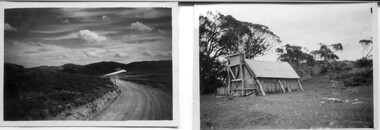
18 small black and white photographs of the Bogong High Plains, 1948
... gauging station October 1948. Photo 10 Rocky Valley River from main road October 1948. Photo 11 View along little Arthur Fire Track October 1948. Photo 12...gauging station October 1948. Photo 10 Rocky Valley River from main road October 1948. Photo 11 View along little Arthur Fire Track October 1948. Photo 12 ...These photos of the Bogong High Plains were all taken by Ronald George Thorn who was a cadet engineer with the State Electricity Commission. He worked on the Kiewa scheme from 1948 to 1950 doing overhead line construction and maintenance plus electrical design and drawing work. They are from his personal collection and a record of his time in the Kiewa area.Pictorial history of personal involvement in the the early days of the Kiewa Scheme.18 small black and white photographs all taken on the Bogong High Plains.Photo 1 Wallace's Hut. Photo 2 Ruined Castle - Looking towards Pretty Valley December 1948. Photo 3 Ruined Castle - Looking towards Pretty Valley December 1948. Photo 4 Ruined Castle - Looking Down Valley December 1948. Photo 5 - Mt. McKay from Ruined Castle October 1948. Photo 6 View from Rocky Valley Camp October 1948. Photo 7 Mt. Feather Top from Ruined Castle October 1948. Photo 8 View from Ruined Castle looking downwards towards Beauty October 1948. Photo 9 Rocky River from gauging station October 1948. Photo 10 Rocky Valley River from main road October 1948. Photo 11 View along little Arthur Fire Track October 1948. Photo 12 View along main road. Looking towards Beauty Valley October 1948. Photo 13 View from Little Arthur Fire Track October 1948. Photo 14 Frying Pan Spur from Rocky Valley Road October 1948. Photo 15 Mt. Bogong from Big Hill Fire Track October 1948. Photo 16 View from Big Hill Fire Track October 1948. Photo 17 Mt. Feathertop from Ruined Castle October 1948. Photo 18 Mt. Fainter from Ruined Castle October 1948. (All of the above is hand written on the back of photos in ink). bogong high plains; r g thorn; secv; kiewa hydro electric scheme; pictorial history -
 Ballarat Tramway Museum
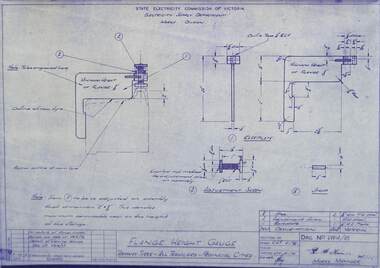
Drawing - VW4/18, State Electricity Commission of Victoria (SECV), Flange Height Gauge. Tramway Typres - All Tramcars - Provincial Cities, 12/01/1954
... Gauge. Tramway Typres - All Tramcars - Provincial Cities.". Drawn 12/01/1954. ...Gauge. Tramway Typres - All Tramcars - Provincial Cities.". Drawn 12/01/1954. ...Produced by the SECV to document the Tram Tyre (wheel) specifications.Yields information regarding the Tramway Tyres Flange Height Gauge.SEC drawing number VW4/18, "Flange Height Gauge. Tramway Typres - All Tramcars - Provincial Cities.". Drawn 12/01/1954. Beige paper copy of original dyeline print. Copy of original.electricity supply department, secv, works division, provincial tramways, tramway tyres, tramways, flanges -
 Ballarat Tramway Museum
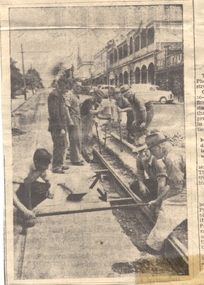
Newspaper, The Courier Ballarat, "Rail Lines link with Old Phoenix Foundry", 1950
... Newspaper Clipping from The Courier, 12/2/1950 titled "Rail Lines link with Old Phoenix Foundry", about the uncovering of the rails left in Sturt St at Armstrong St, part of the former Phoenix Foundry line - uncovered during rail replacement activities. Has a photograph showing the two exposed ends of workers replacing the rail line and gauging...Sturt St Trackwork Phoenix Foundry Newspaper Clipping from The Courier, 12/2/1950 titled "Rail Lines link with Old Phoenix Foundry", about the uncovering of the rails left in Sturt St at Armstrong St, part of the former Phoenix Foundry line - uncovered during rail replacement activities. Has a photograph showing the two exposed ends of workers replacing the rail line and gauging ...Yields information about the Phoenix foundry and tramway crossing in Sturt St in 1950.Newspaper Clipping from The Courier, 12/2/1950 titled "Rail Lines link with Old Phoenix Foundry", about the uncovering of the rails left in Sturt St at Armstrong St, part of the former Phoenix Foundry line - uncovered during rail replacement activities. Has a photograph showing the two exposed ends of workers replacing the rail line and gauging the track. Gives a short history of the Phoenix Foundry. Contained within Reg Item 5507 - Foolscap binder with green covers, black binding edge and metal clips. sturt st, trackwork, phoenix foundry -
 Puffing Billy Railway
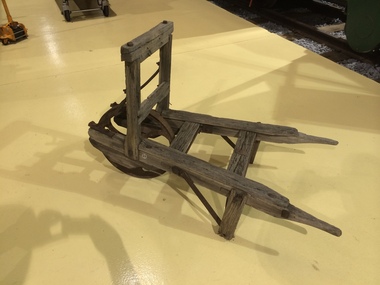
Wheelbarrow - Fritsch, Holzer & Company Brickworks
... Info from Victorian Heritage Bricks, Brick Makers and Brick Works http://rameking2.blogspot.com.au/2013/12/fritsch-holzer.html Historic - Narrow Gauge Industrial Brickworks Equipment - Victoria, Australia puffing billy, pbr, wheelbarrow - fritsch, holzer & company brickworks fritsch, holzer & company Wheelbarrow - Timber frame with Iron bracing and wheel. ...Used at the brickworks of Fritsch, Holzer & Company of Hawthorn to transport bricks and materials around the works. Fritsch Holzer Originally the company was known as the Upper Hawthorn Brick Company Ltd. It was started by brothers Johann, Martin and Anton Holzer and Gustav Augustus Fritsch. Fritsch had previously been a brick maker in Abbotsford, before moving to Hawthorn. Each had a brick works that operated next door to each other and the two works merged in 1883 to form the largest brick making company in Victoria. At its peak, they employed around eighty people and were making over 250,000 bricks per week. The depression of the 1890s caused a drastic downturn in building. Bricks were not being sold and staff laid off. The company nearly collapsed. To stave off the inevitable, in 1896 a brick co-operative was formed with Hoffman Patent Steam Brick Co., Northcote Brick Co. Ltd., New Northcote Brick Co. Ltd., Chas. Butler & Son and Fritsch, Holzer and Company. Bricks were sold throughout Victoria as the company supplied the State Government, more particularly the building of schools. They continued making bricks until the early 1970s when the works closed. The former site is now the “Ftritsch Holzer Park. The local Council purchased the 14 acre site in 1972 for $1,060.000 and used it for landfill. The site became a park in 1995. Info from Victorian Heritage Bricks, Brick Makers and Brick Works http://rameking2.blogspot.com.au/2013/12/fritsch-holzer.htmlHistoric - Narrow Gauge Industrial Brickworks Equipment - Victoria, AustraliaWheelbarrow - Timber frame with Iron bracing and wheel.puffing billy, pbr,, wheelbarrow - fritsch, holzer & company brickworks, fritsch, holzer & company -
 Puffing Billy Railway
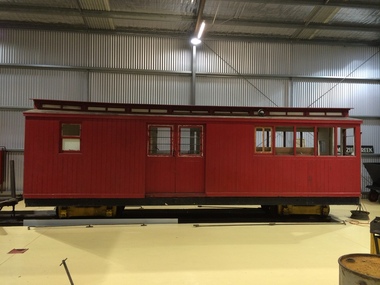
6NBC, Combined Passenger and Guards Van. 2'6" Gauge, 1906
... gauge railways. Withdrawn from service 1951 and used as a workman's hut at Pakenham. Purchased by the Puffing Billy Preservation Society and moved to Menzies Creek in 1959 Utilised as a ticket office and kiosk for the Museum from 1965 to 2010. Service History : NBDBD 6.VA - 26/ 5/1905 NWS Built new - circa 1910 - To NBC 6.VA - *NBC 6.VA - circa 1910 - Reference Photo SL20 p25 /12/1927 - Modified AC Malco BO 19/ 1/1951 - Scrapped ...gauge railways. Withdrawn from service 1951 and used as a workman's hut at Pakenham. Purchased by the Puffing Billy Preservation Society and moved to Menzies Creek in 1959 Utilised as a ticket office and kiosk for the Museum from 1965 to 2010. Service History : NBDBD 6.VA - 26/ 5/1905 NWS Built new - circa 1910 - To NBC 6.VA - *NBC 6.VA - circa 1910 - Reference Photo SL20 p25 /12 ...NBC COMBINED SECOND-CLASS PASSENGER CAR AND GUARD'S VAN. Six cars, numbered 1-6, were built during 1898-1905 and originally classed NBDBD. The repeat of the 'BD' lettering in the classification signified that the vehicle was carried on bogie wheels. At the time the letter D was the letter code for Brakevans / Guard's Vans, but this was changed to C when the double-letter code was simplified in 1910. The letter C now being used to describe that a guards compartment was included in the bogie vehicle. On the narrow gauge, the vehicle numbers were retained. A final NBC numbered 7 was added to the fleet in 1910 Between 1926 and 1929 the cars were converted to autocoupler operation. 6NBC Used on the Upper Ferntree Gully, Wangaratta and Colac narrow gauge railways. Withdrawn from service 1951 and used as a workman's hut at Pakenham. Purchased by the Puffing Billy Preservation Society and moved to Menzies Creek in 1959 Utilised as a ticket office and kiosk for the Museum from 1965 to 2010. Service History : NBDBD 6.VA - 26/ 5/1905 NWS Built new - circa 1910 - To NBC 6.VA - *NBC 6.VA - circa 1910 - Reference Photo SL20 p25 /12/1927 - Modified AC Malco BO 19/ 1/1951 - Scrapped Historic - Victorian Railways - Narrow Gauge Rolling Stock - NBC 2nd Class Passenger Car and Guard's VanTimber body (Painted) Steel Chassis (painted) Brass Fittings (Raw) Steel Fittings (Painted)6NBCpuffing billy railway, pbr, 6nbc - victorian railways nbc class combined passenger and guards van. 2'6" gauge -
 Puffing Billy Railway
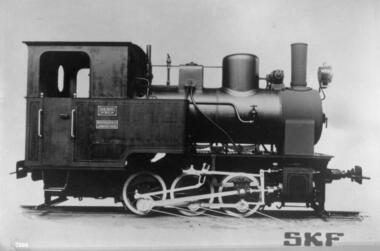
Steam Locomotive, Orenstein & Koppel 0-6-0 Well Tank 2'6" Gauge, 1931
... .: 12331 Empty Weight: 10 tons 7 cwt Weight in working order: 12 I/2 tons Driver Diameter: Unknown Tractive Effort: Unknown Boiler Pressure: 185 lbs Cylinders: Unknown Fuel: Coal Gauge: 2 ft 6 in (760mm) Builders Number 12331 Used to haul gold bearing ore from mine to reduction works at the Sub Nigel Mine at Dunnattar, Transvaal, South Africa. ....: 12331 Empty Weight: 10 tons 7 cwt Weight in working order: 12 I/2 tons Driver Diameter: Unknown Tractive Effort: Unknown Boiler Pressure: 185 lbs Cylinders: Unknown Fuel: Coal Gauge: 2 ft 6 in (760mm) Builders Number 12331 Used to haul gold bearing ore from mine to reduction works at the Sub Nigel Mine at Dunnattar, Transvaal, South Africa. ...Sub Nigel Gold Mines No. 3 Wheels: 0-6-0 WT Builder: Orenstein & Koppel Build Date: June 1931 Construction No.: 12331 Empty Weight: 10 tons 7 cwt Weight in working order: 12 I/2 tons Driver Diameter: Unknown Tractive Effort: Unknown Boiler Pressure: 185 lbs Cylinders: Unknown Fuel: Coal Gauge: 2 ft 6 in (760mm) Builders Number 12331 Used to haul gold bearing ore from mine to reduction works at the Sub Nigel Mine at Dunnattar, Transvaal, South Africa. It was the first locomotive fitted by roller bearings by SKF and featured in the SKF catalogue at the time. This interesting 0-6-0WT locomotive was built by Orenstein & Koppel in 1931 as their builder's number 12331, becoming No.3 in the locomotive fleet at the Sub Nigel Gold Mines Ltd, South Africa. No.3 was obtained by the Puffing Billy Preservation Society and imported to Australia in the early 1970s. It arrived at the museum on 30th Jan 1973. It has since been displayed at the Puffing Billy Museum, Menzies Creek. Details from http://www.australiansteam.com/ok12331.htm Donated by Gold Fields Property Co. Ltd South Africa in 1973.Historic - Industrial Narrow Gauge railway - Steam Locomotive with SKF Roller bearings - used at the Sub Nigel Mine at Dunnattar, Transvaal, South Africa.Steam Locomotive - Steel (Painted)The Sub Nigel Ltd / 12331puffing billy, steam, locomotive, orenstein, koppel, sub nigel mine, skf roller bearings, sub nigel no. 3 -
 Puffing Billy Railway
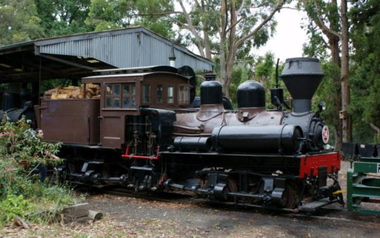
Number 14 - Shay Locomotive (Builder’s Number 2549), 22 June 1912
... (D), Taipei, Formosa (Japan); For: Alishan Forest RY #14, Kirun (Keelung), Formosa, (Japan) (1945) Alishan Forest RY #14, Keelung (Chilung), Taiwan (12 Oct 1971) Puffing Billy RY #14, Belgrave, Victoria, Australia Gauge 30" Status Preserved - In Storage at Museum There is only one original LIMA mark left on any of the Alishan RY Shays and it has no number. ...(D), Taipei, Formosa (Japan); For: Alishan Forest RY #14, Kirun (Keelung), Formosa, (Japan) (1945) Alishan Forest RY #14, Keelung (Chilung), Taiwan (12 Oct 1971) Puffing Billy RY #14, Belgrave, Victoria, Australia Gauge 30" Status Preserved - In Storage at Museum There is only one original LIMA mark left on any of the Alishan RY Shays and it has no number. ...geared steam locomotive Built by the Lima Locomotive Works, USA in 1912 (Builder’s Number 2549). “Class a” 13 Ton (13.3 tonne) . This locomotive hauled freight on the Ali-Shan Forest Railway in Taiwan and is capable of pulling 90 Tons (91.8 tone) loads over steep gradients at low speeds. . This A-type Shay locomotive was built by Lima Locomotive Works, Ohio (builder's number 2549 of 1912) for the Alishan Forest Railway, Taiwan. The Alishan Forest Railway featured a large fleet of Shay locomotives and many still survive, together with a portion of the railway which is now a tourist operation. Alishan Shay No.14 was gifted to the Puffing Billy railway in 1971 by the Alishan Forest Railway - Taiwan Government forest Bureau and arrived on the 12th October 1971 at the Puffing Billy Museum at Menzies Creek. Loco: Shay No.14 ( Shop Number 2549 ) Class: A 18-2 ( 2-cylinders / 2-trucks Class A ) Built for: Alishan Forest Railway Bulit by Lima Locomotive Corporation In service 22 June 1912 Samuels, Samuels & Co., Ltd. (D), Taipei, Formosa (Japan); For: Alishan Forest RY #14, Kirun (Keelung), Formosa, (Japan) (1945) Alishan Forest RY #14, Keelung (Chilung), Taiwan (12 Oct 1971) Puffing Billy RY #14, Belgrave, Victoria, Australia Gauge 30" Status Preserved - In Storage at Museum There is only one original LIMA mark left on any of the Alishan RY Shays and it has no number. All of their Shays have been re-built, changing much of the original Lima product. Most were renumbered for various reasons without regard to Lima Shop Numbers over the years. "Girder Type Frame" details from http://www.shaylocomotives.com/data/lima3354/sn-2549.htm Historic - Industrial Narrow Gauge Railway - Geared Steam Locomotive which worked on the Alishan Forest Railway, Taiwan.geared steam locomotive - Class: A 18-2 ( 2-cylinders / 2-trucks Class A ) - made of wood and iron and wrought iron, Glass14puffing billy, shay, geared locomotive, steam locomotive, industrial narrow gauge railway, 2'6", ali shan forest railway -
 Puffing Billy Railway
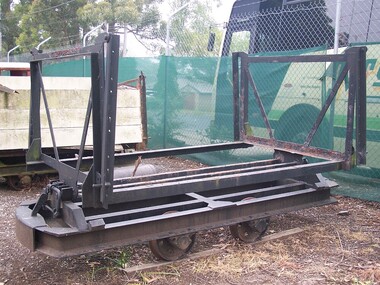
Cheetham Salt Hopper Truck No12
... Historic - Industrial narrow Gauge railway - Cheetham Salt Company at Laverton, Moolap and Geelong. puffing billy industrial narrow gauge railway cheetham salt company gauge 2' 0" salt No. 12 on metal frame of one of the Cheetham Salt Hopper truck A second hopper truck is not numbered. ...Trucks of this type were built to carry salt from the saltpans of Cheetham Salt Company works, at Laverton, Moolap and Geelong. Made from wood and steel, it was found that the wood would not erode as much as steel from the salt and this is the reason these vehicles have metal on the exterior of the wagon. Later new stainless steel hopper trucks were used at the works. Historic - Industrial narrow Gauge railway - Cheetham Salt Company at Laverton, Moolap and Geelong.Two Cheetham Salt Hopper Trucks Gauge 2'0" Made from Wood & Steel No. 12 on metal frame of one of the Cheetham Salt Hopper truck A second hopper truck is not numbered.puffing billy, industrial narrow gauge railway, cheetham salt company, gauge 2' 0", salt -
 Puffing Billy Railway
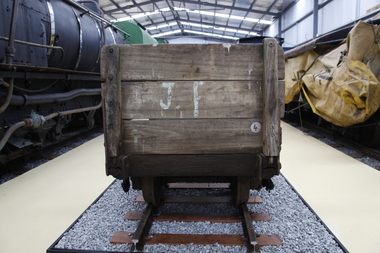
Four Wheel Brick Skip
... Historic - Industrial Narrow gauge railway - Fritsch, Holzer & Company Brick works, Hawthorn, Victoria, Australia puffing billy fritsch, holzer & company brick skip fritsch, holzer & company brickworks pressed red brick "JF 12" & "SB 34" two Wooden skips with steel wheels Four Wheel Brick Skip ...Typical of many small four wheel skips constructed to transport raw bricks from the moulding press to the kilns for firing.Historic - Industrial Narrow gauge railway - Fritsch, Holzer & Company Brick works, Hawthorn, Victoria, Australiatwo Wooden skips with steel wheels "JF 12" & "SB 34"puffing billy, fritsch, holzer & company, brick skip, fritsch, holzer & company brickworks, pressed red brick -
 Puffing Billy Railway
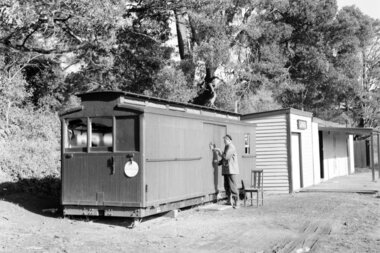
6 NC - Victorian Railways Full Guard's Van, 1919
... 6 NC Brake Van (4 ton capacity) Service History Purchased by the Puffing Billy Preservation Society (Body & underframe only): NC 6 Brake Van (4 ton capacity) - Awaiting restoration *NC 6.VA - 17/12/1919 NWS Built new - /11/1928 - Modified AC Malco BO 5/10/1934 NWS Into Workshops - 9/10/1934 NWS Out of Workshops (5 days) 17/ 3/1955 - Scrapped Historic - Victorian Railways - narrow gauge rolling stock - NC Class Full Guard's Van 6 NC puffing billy nc van narrow gauge victorian railways 6nc guards van narrow gauge rolling stock Timber Guards Van wrought iron frame 6 NC - Victorian Railways Full Guard's Van Victorian Railways - Newport Workshop ...6 NC Brake Van (4 ton capacity) Service History Purchased by the Puffing Billy Preservation Society (Body & underframe only): NC 6 Brake Van (4 ton capacity) - Awaiting restoration *NC 6.VA - 17/12/1919 NWS Built new - /11/1928 - Modified AC Malco BO 5/10/1934 NWS Into Workshops - 9/10/1934 NWS Out of Workshops (5 days) 17/ 3/1955 - Scrapped Historic - Victorian Railways - narrow gauge rolling stock - NC Class Full Guard's Van 6 NCTimber Guards Van wrought iron framepuffing billy, nc van, narrow gauge, victorian railways, 6nc, guards van, narrow gauge rolling stock -
 Puffing Billy Railway
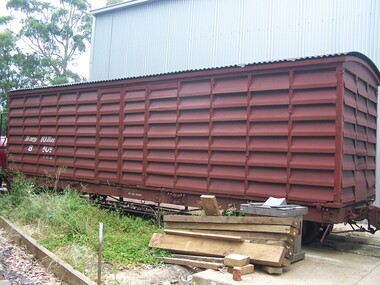
8 NUU - Louvered Van, 20/ 7/1906
... VR Service History : *NUU 8.VA - 20/ 7/1906 NWS Built new - / /1926 - To NU 8.VA - NU 8.VA - / 9/1928 - Modified AC Malco 21/12/1953 - Sold (to) Coulston & Hyder RS54/338 Historic - Victorian Railways Narrow Gauge - Rolling Stock - Louvred Van puffing billy 110 nqr 8 nuu - louvered van victorian railways 2'6" gauge narrow gauge rolling stock 8NUU Wooden Louvered Van on under frame of 110 NQR - Made of Timber on a Wrought iron frame - current condition Untrafficable 8 NUU - Louvered Van Victorian Railways - Newport Workshop ...Van 8 NUU - Louvered Van Louvred Truck (11) (on u/frame of 110 NQR) Untrafficable NUU LOUVRED TRUCK. Seven louvre vans for carrying general goods were built during 1899-1901, with another one in 1906 and a further six in 1911, a total of 14 louvre vans numbered 1-14. The term Louvred Truck describes the sides which consist of fixed louvres for ventilation. The aim was to keep the goods inside cool. VR Service History : *NUU 8.VA - 20/ 7/1906 NWS Built new - / /1926 - To NU 8.VA - NU 8.VA - / 9/1928 - Modified AC Malco 21/12/1953 - Sold (to) Coulston & Hyder RS54/338 Historic - Victorian Railways Narrow Gauge - Rolling Stock - Louvred VanWooden Louvered Van on under frame of 110 NQR - Made of Timber on a Wrought iron frame - current condition Untrafficable8NUUpuffing billy, 110 nqr, 8 nuu - louvered van, victorian railways, 2'6" gauge, narrow gauge rolling stock -
 Puffing Billy Railway
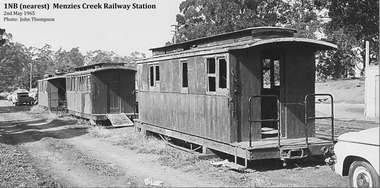
1NB, Saloon carriage, 4/ 2/1899
... VR Service History NBB 1.VA - 4/ 2/1899 NWS Built new - circa 1910 - To NB 1.VA - *NB 1.VA - / 2/1928 - Modified AC Malco BO 21/10/1930 NWS Into Workshops - 5/12/1930 NWS Out of Workshops (46 days) 30/ 1/1951 - Scrapped Historic - Victorian Railways Narrow Gauge - Passenger Rolling Stock: Saloon carriage (No. 1) Victorian Heritage Register (VHR) Number H2187 The Puffing Billy Rolling Stock Collection puffing billy 1nb saloon carriage victorian railways narrow gauge passenger rolling stock 2'6" guage 1NB 1NB Passenger Rolling Stock: Saloon carriage (No. 1) - Made of Timber and steel Saloon carriage 1NB Victorian Railways - Newport Workshop ...1NB - (1st Series) Saloon carriage (24) Body and underframe purchased by Puffing Billy Preservation Society from Pakenham In Active Service NB There were three types:- NB Class - Number Built (1st Series) 6 - Number Built (2nd Series) 17 - Number Built (3rd Series) 4 Nos. 1-6 were Saloon cars having end platforms and a ladies toilet, and were built from 1899-1904. Nos. 7-23 were 5-compartment side loading cars, built from 1906-1915. Nos. 24-27 were the former NAB class cars mentioned previously and were also side loading, having 6 compartments and two ladies toilets. VR Service History NBB 1.VA - 4/ 2/1899 NWS Built new - circa 1910 - To NB 1.VA - *NB 1.VA - / 2/1928 - Modified AC Malco BO 21/10/1930 NWS Into Workshops - 5/12/1930 NWS Out of Workshops (46 days) 30/ 1/1951 - Scrapped Historic - Victorian Railways Narrow Gauge - Passenger Rolling Stock: Saloon carriage (No. 1) Victorian Heritage Register (VHR) Number H2187 The Puffing Billy Rolling Stock Collection1NB Passenger Rolling Stock: Saloon carriage (No. 1) - Made of Timber and steel 1NBpuffing billy, 1nb, saloon carriage, victorian railways, narrow gauge passenger rolling stock, 2'6" guage -
 Puffing Billy Railway
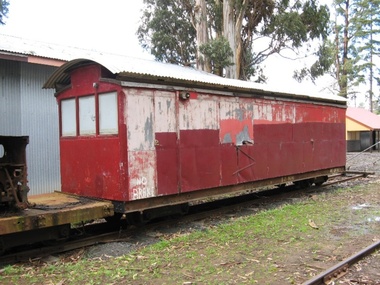
14NB - Compartment Passenger Carriage, 16/12/1912
... VR Service History *NB 14.VA - 16/12/1912 NWS Built new - / 5/1926 - Modified AC Malco 15/ 7/1931 NWS Into Workshops - 20/10/1931 NWS Out of Workshops (98 days) 5/ 8/1936 NWS Into Workshops - 6/11/1936 NWS Out of Workshops (94 days) 26/ 2/1951 - Scrapped - Body and underframe purchased by the Puffing Billy Preservation Society from Pakenham. Historic - Victorian Railways Narrow Gauge ...14NB - Carriage (NB 2nd series) 6 compartments (40) Awaiting restoration NB There were three types: -Nos. 1-6 were Saloon cars having end platforms and a ladies toilet, and were built from 1899-1904. Nos. 7-23 were 5-compartment side loading cars, built from 1906-1915. Nos. 24-27 were the former NAB class cars mentioned previously and were also side loading, having 6 compartments and two ladies toilets. VR Service History *NB 14.VA - 16/12/1912 NWS Built new - / 5/1926 - Modified AC Malco 15/ 7/1931 NWS Into Workshops - 20/10/1931 NWS Out of Workshops (98 days) 5/ 8/1936 NWS Into Workshops - 6/11/1936 NWS Out of Workshops (94 days) 26/ 2/1951 - Scrapped - Body and underframe purchased by the Puffing Billy Preservation Society from Pakenham.Historic - Victorian Railways Narrow Gauge - Passenger Rolling Stock: NB Passenger carriage Victorian Heritage Register (VHR) Number H2187 The Puffing Billy Rolling Stock Collection Passenger Rolling Stock: Passenger carriage 14NB - Carriage (NB 2nd series) 5 compartments - Made of Timber on a Wrought iron frame Awaiting restoration14NBpuffing billy, 14nb, nb passenger carriage, 2'6" guage, victorian railways, narrow gauge passenger rolling stock -
 Puffing Billy Railway
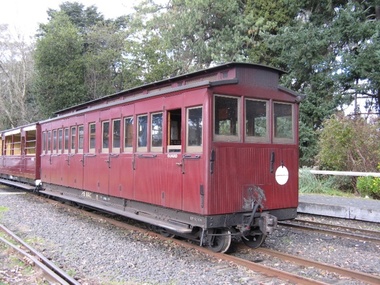
26 NAC - Passenger carriage, 1/ 7/1907
... 12/1954 - Scrapped Body to Eng. Spcl Works, RS55/707 Purchased by the Puffing Billy Preservation Society as a body & underframe. Historic - Victorian Railways Narrow Gauge ...NB Class - Number Built (1st Series) 6 - Number Built (2nd Series) 17 - Number Built (3rd Series) 4 26 NAC - Former NB Class (3rd Series) - Carriage 3 compartments and van (24 pass.) In Active Service - Belgrave Station Yard NAC COMBINED NB PASSENGER CAR AND GUARD'S VAN. A compartment NB which has had a guard's compartment temporarily added in one end. Due to the temporary nature of the guard's compartment, this vehicle retains its number in the NB numbering sequence, but has been classed NAC to differentiate it from the standard NBC. The use of the A is a recognition of the car's original NAB classification. VR Service History NABAB 2.VA - 1/ 7/1907 NWS Built new - circa 1910 - To NAB 2.VA - *NAB 2.VA - circa 1910 - Reference Photo SL20 p20 20/ 8/1923 FTG To NB 26.VA - NB 26.VA - /12/1927 - Modified AC Malco BO 27/ 9/1934 NWS Into Workshops - 30/10/1934 NWS Out of Workshops (34 days) 17/12/1954 - Scrapped Body to Eng. Spcl Works, RS55/707 Purchased by the Puffing Billy Preservation Society as a body & underframe. Historic - Victorian Railways Narrow Gauge - Passenger Rolling Stock: Passsenger carriage Victorian Heritage Register (VHR) Number H2187 The Puffing Billy Rolling Stock Collection Passenger Rolling Stock: 26 NAC - Passenger carriage - Made of Timber on a Wrought iron frame 3 compartments and van (No. 26)26 NAC puffing billy, 26 nac, nac passenger carriage, victorian railways, narrow gauge passenger rolling stock, 2'6" guage -
 Puffing Billy Railway
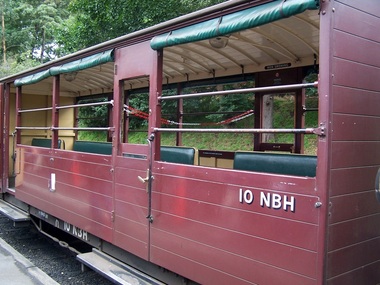
10 NBH - Passenger Carriage - Excursion Car, 8/12/1919
... VR Service History : *NBH 10.VA - 8/12/1919 NWS Built new - /12/1928 - Modified AC Malco BO circa 1955 - Condemned - Historic - Victorian Railways Narrow Gauge - Passenger Rolling Stock: Excursion Car Victorian Heritage Register (VHR) Number H2187 Puffing Billy Locomotives and Rolling Stock Collection puffing billy 10nbh nbh - excursion car victorian railways victorian railways narrow gauge - passenger rolling stock 10NBH 10 NBH Passenger Carriage - Excursion Car made of steel and timber 10 NBH - Passenger Carriage - Excursion Car Victorian Railways - Newport Workshop ...10NBH Carriage - Excursion Car In Active Service - Belgrave Station Yard NBH SECOND-CLASS EXCURSION CAR. The H was recognising their use for "Holiday" traffic. 15 of these cars were built in 1919 and numbered 1-15. Two more were built in 1981, and numbered 16 & 17. Two extended versions for wheelchair passengers were built in 1981 & 1983. These were numbered 51 & 52 - a separate number series due to the different type of vehicle. Six, numbered 18-23, were built in 1997-98. These had steel frames, padded seats, and a wide "window sill". At first glance they look the same as the previous NBHs. There are other minor construction differences due to the use of steel framing. 18NBH entered traffic 19/4/1997; 19NBH on 5/12/1997; 20NBH on 19/12/1997, the others added in 1998. VR Service History : *NBH 10.VA - 8/12/1919 NWS Built new - /12/1928 - Modified AC Malco BO circa 1955 - Condemned -Historic - Victorian Railways Narrow Gauge - Passenger Rolling Stock: Excursion Car Victorian Heritage Register (VHR) Number H2187 Puffing Billy Locomotives and Rolling Stock Collection10 NBH Passenger Carriage - Excursion Car made of steel and timber10NBHpuffing billy, 10nbh, nbh - excursion car, victorian railways, victorian railways narrow gauge - passenger rolling stock -
 Puffing Billy Railway
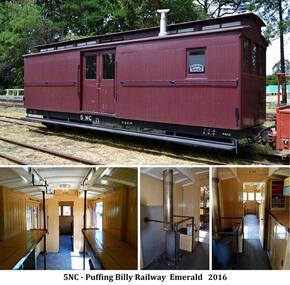
5NC - Brake Van (4 ton capacity), 31/ 7/1914
... Six NC Brake Van / Guards Vans were built by Victorian Railways 1 NC was built in 1909 as NDD and reclassed 1NC in 1910. 2 NC was built and placed into service Nov 1912 3 NC , 4 NC and 5 NC were built and placed into service June / July 1914 6 NC was Built and placed into service in 1919 1 NC, 4 NC and 6 NC were all scrapped by Victorian Railways between 1954 and 1957 Van 5NC - Brake Van (4 ton capacity) In Active Service - Belgrave Station Yard VR Service History: 5 NC *NC 5.VA - 31/ 7/1914 NWS Built new - / 6/1926 - Modified AC Malco 16/11/1932 NWS Into Workshops - 9/12/1932 NWS Out of Workshops (24 days) 23/10/1935 NWS Into Workshops - 19/11/1935 NWS Out of Workshops (28 days) 10/ 8/1939 NWS Into Workshops - 8/ 9/1939 NWS Out of Workshops (30 days) 2/ 6/1944 NWS Into Workshops - 25/ 8/1944 NWS Out of Workshops (85 days) 21/ 4/1949 NWS Into Workshops - 14/10/1949 NWS Out of Workshops (178 days) Dec 2016 - Puffing Billy Register of Rolling Stock NC 5 Brake Van (4 ton capacity) - In traffic Historic - Victorian Railways - Narrow Gauge Rolling Stock - NC Brake Van Victorian Heritage Register (VHR) Number H2187 The Puffing Billy Rolling Stock Collection puffing billy 5nc 2'6" gauge victorian railways 5nc brake van 5NC Brake Van (4 ton capacity) made of Timber and wrought iron 5NC - Brake Van (4 ton capacity) Victorian Railways - Newport Workshop ...NC Van The NC guard's vans were originally classed NDD. In the 1910 reclassification they were classified NC. Apart from the windows and height they were externally the same as the NBC vans. Inside there were benches along both side walls. One end was equipped with a small guard's compartment. This had two corner seats, two desks with ticket selling windows and a letter rack. A novel feature was a folding dog cage under one of the benches. Six NC Brake Van / Guards Vans were built by Victorian Railways 1 NC was built in 1909 as NDD and reclassed 1NC in 1910. 2 NC was built and placed into service Nov 1912 3 NC , 4 NC and 5 NC were built and placed into service June / July 1914 6 NC was Built and placed into service in 1919 1 NC, 4 NC and 6 NC were all scrapped by Victorian Railways between 1954 and 1957 Van 5NC - Brake Van (4 ton capacity) In Active Service - Belgrave Station Yard VR Service History: 5 NC *NC 5.VA - 31/ 7/1914 NWS Built new - / 6/1926 - Modified AC Malco 16/11/1932 NWS Into Workshops - 9/12/1932 NWS Out of Workshops (24 days) 23/10/1935 NWS Into Workshops - 19/11/1935 NWS Out of Workshops (28 days) 10/ 8/1939 NWS Into Workshops - 8/ 9/1939 NWS Out of Workshops (30 days) 2/ 6/1944 NWS Into Workshops - 25/ 8/1944 NWS Out of Workshops (85 days) 21/ 4/1949 NWS Into Workshops - 14/10/1949 NWS Out of Workshops (178 days) Dec 2016 - Puffing Billy Register of Rolling Stock NC 5 Brake Van (4 ton capacity) - In traffic Historic - Victorian Railways - Narrow Gauge Rolling Stock - NC Brake Van Victorian Heritage Register (VHR) Number H2187 The Puffing Billy Rolling Stock CollectionBrake Van (4 ton capacity) made of Timber and wrought iron5NCpuffing billy, 5nc, 2'6" gauge, victorian railways, 5nc brake van -
 Puffing Billy Railway
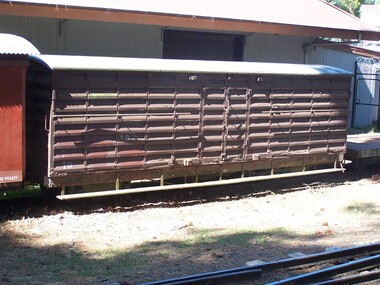
10 NU - Louvred Truck, 30/12/1911
... 12/1911 NWS Built new Victorian Heritage Register (VHR) Number H2187 NW 10 is a 1972 reclassification of NU 10. It is presumed the van was used to store tools and equipment. In 1977, the van was removed from railway records and control handed to the Puffing Billy group. Historic - Victorian Railways Narrow Gauge ...10 NU Louvre Van - Louvred Truck (11) Untrafficable NUU LOUVRED TRUCK. Seven louvre vans for carrying general goods were built during 1899-1901, with another one in 1906 and a further six in 1911, a total of 14 louvre vans numbered 1-14. The term Louvred Truck describes the sides which consist of fixed louvres for ventilation. The aim was to keep the goods inside cool. VR Service History : *NUU 10.VA - 30/12/1911 NWS Built new - / /1926 - To NU 10.VA - NU 10.VA - / 5/1926 - Modified AC Malco /12/1972 BEL To NW 10.VA Sec72/3400, RS72/9371 NW 10.VA - 26/ 8/1976 CLS Photograph #662.2-.4: and end detail 1/10/1977 - Off Register To ETRB Sec76/3630 RS77/4223 Build Date: 30/12/1911 NWS Built new Victorian Heritage Register (VHR) Number H2187 NW 10 is a 1972 reclassification of NU 10. It is presumed the van was used to store tools and equipment. In 1977, the van was removed from railway records and control handed to the Puffing Billy group.Historic - Victorian Railways Narrow Gauge - Rolling Stock - Louvered Van Victorian Heritage Register (VHR) Number H2187 Puffing Billy Locomotives and Rolling Stock CollectionWooden Louvered Van - Made of Timber on a Wrought iron frame - current condition Untrafficable10 NU puffing billy, louvered van, 10nu, victorian railways, 2'6" gauge, narrow gauge rolling stock -
 Puffing Billy Railway
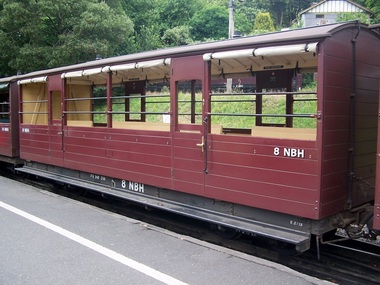
8 NBH - Passenger Carriage - Excursion Car, 8/12/1919
... VR Service History : *NBH 8.VA - 8/12/1919 NWS Built new - / 1/1929 - Modified AC Malco BO circa 1955 - Condemned Historic - Victorian Railways Narrow Gauge - Passenger Rolling Stock: Excursion Car puffing billy victorian railways 8 nbh passenger carriage excursion car narrow gauge 8NBH 8NBH - Passenger Carriage - Excursion Car made of steel and timber 8 NBH - Passenger Carriage - Excursion Car Victorian Railways - Newport Workshop ...8 NBH - Excursion Car (28) In Active Service - Belgrave Station Yard 8NBH - Excursion carriage. This car has been restored to original condition with white canvas weather blinds,Full carriage length side steps, timber tongue and groove boards,coupling centering springs and some pinch gas lighting equipment. NBH SECOND-CLASS EXCURSION CAR. The H was recognising their use for "Holiday" traffic. 15 of these cars were built in 1919 and numbered 1-15. Two more were built in 1981, and numbered 16 & 17. Two extended versions for wheelchair passengers were built in 1981 & 1983. These were numbered 51 & 52 - a separate number series due to the different type of vehicle. Six, numbered 18-23, were built in 1997-98. These had steel frames, padded seats, and a wide "window sill". At first glance they look the same as the previous NBHs. There are other minor construction differences due to the use of steel framing. 18NBH entered traffic 19/4/1997; 19NBH on 5/12/1997; 20NBH on 19/12/1997, the others added in 1998. VR Service History : *NBH 8.VA - 8/12/1919 NWS Built new - / 1/1929 - Modified AC Malco BO circa 1955 - Condemned Historic - Victorian Railways Narrow Gauge - Passenger Rolling Stock: Excursion Car 8NBH - Passenger Carriage - Excursion Car made of steel and timber8NBHpuffing billy, victorian railways, 8 nbh, passenger carriage, excursion car, narrow gauge -
 Puffing Billy Railway
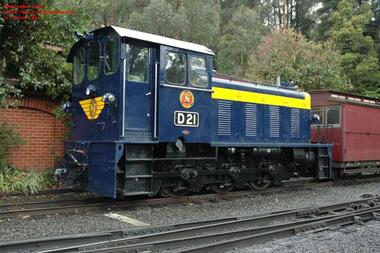
D21 - Diesel Mechanical locomotive, 1968
... D21 - Diesel Mechanical locomotive Date built - 1968 Original owner - TGR Original gauge - 1067mm Withdrawn - 1983 Built to 3'6" gauge in 1968 by the Tasmanian Government Railways and numbered V12, ownership of this Diesel Mechanical locomotive was transferred to Australian National Railways (Tas.) in 1978. It was withdrawn and sold to the E.T.R.B. in 1983 1968 - D21 ex-Tasmanian Government Railways (TGR) V class No.12, built by the TGR Launceston Workshops in 1968 to a design of Vulcan-Drewry (England). ...D21 - Diesel Mechanical locomotive Date built - 1968 Original owner - TGR Original gauge - 1067mm Withdrawn - 1983 Built to 3'6" gauge in 1968 by the Tasmanian Government Railways and numbered V12, ownership of this Diesel Mechanical locomotive was transferred to Australian National Railways (Tas.) in 1978. It was withdrawn and sold to the E.T.R.B. in 1983 1968 - D21 ex-Tasmanian Government Railways (TGR) V class No.12, built by the TGR Launceston Workshops in 1968 to a design of Vulcan-Drewry (England). ...D21 - Diesel Mechanical locomotive Date built - 1968 Original owner - TGR Original gauge - 1067mm Withdrawn - 1983 Built to 3'6" gauge in 1968 by the Tasmanian Government Railways and numbered V12, ownership of this Diesel Mechanical locomotive was transferred to Australian National Railways (Tas.) in 1978. It was withdrawn and sold to the E.T.R.B. in 1983 1968 - D21 ex-Tasmanian Government Railways (TGR) V class No.12, built by the TGR Launceston Workshops in 1968 to a design of Vulcan-Drewry (England). Tasmanian Government Railways V class The V class were the first diesel locomotives operated by the Tasmanian Government Railways (TGR) with four delivered by the Vulcan Foundry in 1948 to a design by the Drewry Car Co. They were a narrow gauge version of the British Rail Class 04. In 1951 a fellow two were delivered followed by another two in 1955. Between 1959 and 1968 the TGR built a further four at its Launceston Workshops. Two identical locomotives were purchased by the Mount Lyell Mining and Railway Company in 1953. When it closed in 1963, 2405 was sold to the Emu Bay Railway as number 22, while 2406 went to the TGR as V13. All the TGR units were withdrawn between 1983 and 1987 while the Emu Bay unit remained in service until 2000. Ten have been preserved: V1 by the Bellarine Peninsula Railway, Victoria V2 by the Don River Railway V4 by the Hotham Valley Railway, Western Australia V5 by the Hotham Valley Railway, Western Australia V7 by the Derwent Valley Railway V8 by the Bellarine Peninsula Railway, Victoria V9 by the West Coast Wilderness Railway V12 by the Puffing Billy Railway, Victoria (regauged to 760 mm gauge and numbered D21) V13 by the Zig Zag Railway, New South Wales, sold to the West Coast Wilderness Railway, renumbered D2 22 by the West Coast Wilderness Railway, renumbered D1 Tasmanian Government Railways V class Manufacturer Vulcan Foundry Tasmanian Government Railways Entered service 1948 Number built 14 Number preserved 10 Fleet numbers TGR: V1-V13 Emu Bay: 22 Power: 152kW (204hp) or 114kW (153hp) Motor: Gardner 8L3 (V) or Gardner 6L3 (VA) Wheel Arrangement: - C - Weight: 25.6t Allowable load on 1:40 grade: 170t Length over headstocks: 6.8m (22ft 6in) Introduced: 1948 Built By: Vulcan Foundry, England; TGR Workshops, Launceston; Using parts supplied by Drewry Car Co (UK) Number Preserved: 10 Number In Service: 0 Total Number Built: 14Historic - Tasmanian Government Railways - Diesel Mechanical locomotive - V12 / Puffing Billy Railway Diesel Mechanical locomotive D21D21 - Diesel Mechanical locomotive made of steel D21diesel mechanical locomotive, puffing billy, d21, v12 diesel mechanical locomotive, d21 diesel mechanical locomotive, tasmanian government railways -
 Puffing Billy Railway
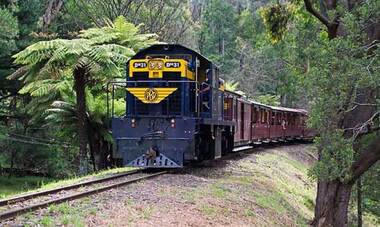
DH59 - Diesel Hydraulic locomotive (formerly DH 31), 1970
... Locomotive's Queensland Railways Service History : Locomotive : DH59 Serial No: 646 In Service : 19/05/1970 With drawn from Service : 20/05/1991 LOCOMOTIVE DETAILS DH class No. originally constructed : 74 No. in service : 2 No. stored : Wheel arrangement : Bo-BoDH Roadworthy weight : 40T Maximum axle load : 10T Tractive effort (85%) Length overall: 33' Height overall : 12' 6 1⁄2" Driving wheel diameter : 36" Date of manufacture :1970 Manufacturer :Walkers Place of manufacture : Maryborough, Queensland Locomotive type : Diesel Hydraulic DH Class Type Diesel-Hydraulic Introduced 1966 Number in class 73 Manufacturer Walkers Gauge Narrow (QR, MIM) 900mm (SECV) Axles B-B Length 11.1 m Mass 37 t Engine Caterpillar D355E Transmission Voith L42U2 Power 347 kW / 465 HP Tractive effort 114 / 82 kN Speed 50 / 10 km/h...Locomotive's Queensland Railways Service History : Locomotive : DH59 Serial No: 646 In Service : 19/05/1970 With drawn from Service : 20/05/1991 LOCOMOTIVE DETAILS DH class No. originally constructed : 74 No. in service : 2 No. stored : Wheel arrangement : Bo-BoDH Roadworthy weight : 40T Maximum axle load : 10T Tractive effort (85%) Length overall: 33' Height overall : 12' 6 1⁄2" Driving wheel diameter : 36" Date of manufacture :1970 Manufacturer :Walkers Place of manufacture : Maryborough, Queensland Locomotive type : Diesel Hydraulic DH Class Type Diesel-Hydraulic Introduced 1966 Number in class 73 Manufacturer Walkers Gauge Narrow (QR, MIM) 900mm (SECV) Axles B-B Length 11.1 m Mass 37 t Engine Caterpillar D355E Transmission Voith L42U2 Power 347 kW / 465 HP Tractive effort 114 / 82 kN Speed 50 / 10 km/h Historic - Queensland Railways - Diesel Hydraulic locomotive DH59 puffing billy diesel-hydraulic locomotive dh59 dh31 walkers diesel hydraulic queensland railways DH59 Diesel Hydraulic locomotive DH59 Diesel Hydraulic locomotive made of steel and metal DH59 - Diesel Hydraulic locomotive (formerly DH 31) ...DH31 - DH59 Diesel Hydraulic locomotive Built to 3'6" gauge in 1970 this Diesel Hydraulic locomotive entered service for the Queensland Railways where it remained until withdrawn in 1994. Purchased by the E.T.R.B. in 1995, it was converted to 2'6" gauge in Queensland and transported to Belgrave in 1996 for overhaul. It re-entered service later in 1996, although instead of receiving a V.R. type classification & number and V.R. style livery, it retained its Q.R. number of DH59 and its Q.R. livery minus the Q.R. logo, but has since been repainted the traditional Blue & Gold of V.R. diesel locomotives and reclassified DH31. It has since been returned to DH 59. The DH class was a class of diesel-hydraulic locomotives built by Walkers Limited, Maryborough for Queensland Railways between 1966 and 1974. In 1966 Queensland Railways tested a Walkers Limited built diesel-hydraulic shunting locomotive. This was later purchased and by 1974 the 73 DH class locomotives had taken over shunting duties in most Queensland yards. They were also used on short distance freight services. With the closure of many freight yards and the move to longer trains withdrawals started in the 1980s. Many were sold for further use on Queensland sugar cane railways. Locomotive's Queensland Railways Service History : Locomotive : DH59 Serial No: 646 In Service : 19/05/1970 With drawn from Service : 20/05/1991 LOCOMOTIVE DETAILS DH class No. originally constructed : 74 No. in service : 2 No. stored : Wheel arrangement : Bo-BoDH Roadworthy weight : 40T Maximum axle load : 10T Tractive effort (85%) Length overall: 33' Height overall : 12' 6 1⁄2" Driving wheel diameter : 36" Date of manufacture :1970 Manufacturer :Walkers Place of manufacture : Maryborough, Queensland Locomotive type : Diesel Hydraulic DH Class Type Diesel-Hydraulic Introduced 1966 Number in class 73 Manufacturer Walkers Gauge Narrow (QR, MIM) 900mm (SECV) Axles B-B Length 11.1 m Mass 37 t Engine Caterpillar D355E Transmission Voith L42U2 Power 347 kW / 465 HP Tractive effort 114 / 82 kN Speed 50 / 10 km/hHistoric - Queensland Railways - Diesel Hydraulic locomotive DH59DH59 Diesel Hydraulic locomotive made of steel and metalDH59 Diesel Hydraulic locomotivepuffing billy, diesel-hydraulic locomotive, dh59, dh31, walkers diesel hydraulic, queensland railways
