
Showing 445 items matching "13 light horse"
-
 RSL Victoria - Anzac House Reference Library and Memorabilia Collection
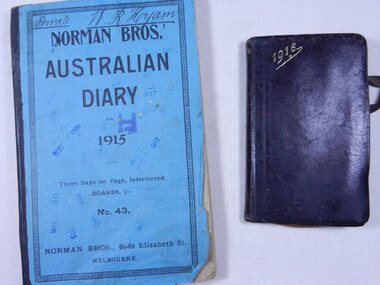
Diary of William Raymond Hyam - (Item held at Monash Memorial Defence Library), William Raymond Hyam, May 1915 to December 1916
... ...13 light horse regiment...Diaries cover the period from embarkation until December 1916. ww1 diaries william raymond hyam 13 light horse regiment One 1916 pocket diary with leaf of tree, and one Norman Bros.1915 diary with photograph of Hyam's Unit and of his dog. ...Hyam embarked from Melbourne 0n 28 May 1915 and was fatally wounded at Gaza in late March 1917. Diaries cover the period from embarkation until December 1916.One 1916 pocket diary with leaf of tree, and one Norman Bros.1915 diary with photograph of Hyam's Unit and of his dog. Diary of William Hyam (3 - 13th Light Horse Regiment, Headquarters and Machine Gun Section).ww1, diaries, william raymond hyam, 13 light horse regiment -
 8th/13th Victorian Mounted Rifles Regimental Collection
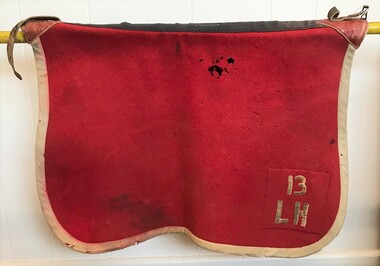
Functional object - Saddle cloth 13th Light Horse
... ...light horse...13...light horse regiments in the period between the wars, 1920-1940. Following WWI (1914-1918) the 13th Light Horse (Gippsland) was raised as a Citizen Forces unit and trained as a cavalry regiment till August 1940, when it converted from horse to mechanised, initially as 13th Motor Regiment then 13th Armoured Regiment. It trained in Victoria and, as the Japanese threat to the mainland declined, was disbanded in October 1943 with men going to other units. Representative of the Light Horse in the period following WWI and the beginning of WWII. military horse saddle light horse 13 ...Saddle blankets matching regimental colour patch were used by light horse regiments in the period between the wars, 1920-1940. Following WWI (1914-1918) the 13th Light Horse (Gippsland) was raised as a Citizen Forces unit and trained as a cavalry regiment till August 1940, when it converted from horse to mechanised, initially as 13th Motor Regiment then 13th Armoured Regiment. It trained in Victoria and, as the Japanese threat to the mainland declined, was disbanded in October 1943 with men going to other units.Representative of the Light Horse in the period following WWI and the beginning of WWII.Red coloured saddle blanket with white piping and embroidered number '13' and letters 'LH' near lower right edge.military, horse, saddle, light horse, 13 light horse -
 8th/13th Victorian Mounted Rifles Regimental Collection
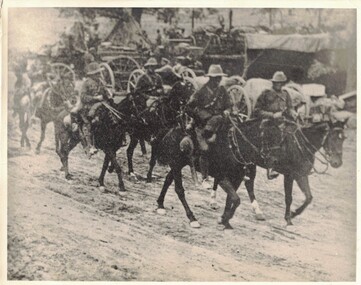
Photograph - 13 LH in France
... Black and white photograph of a section of 13 Light Horse in France....Light Horse Regiment (AIF) was raised at Broadmeadows Victoria in March 1915. Following service at Gallipoli the regiment was broken up with squadrons going to France as Divisional Cavalry Squadrons of 2nd, 4th and 5th Divisions. The regiment was reformed as firstly 1st Anzac Corps Mounted Troops and later Australian Corps Mounted Troops. military wwi world war one light horse france cavalry Black and white photograph of a section of 13 Light Horse in France. ...The 13th Light Horse Regiment (AIF) was raised at Broadmeadows Victoria in March 1915. Following service at Gallipoli the regiment was broken up with squadrons going to France as Divisional Cavalry Squadrons of 2nd, 4th and 5th Divisions. The regiment was reformed as firstly 1st Anzac Corps Mounted Troops and later Australian Corps Mounted Troops.Black and white photograph of a section of 13 Light Horse in France.military, wwi, world war one, light horse, france, cavalry -
 8th/13th Victorian Mounted Rifles Regimental Collection
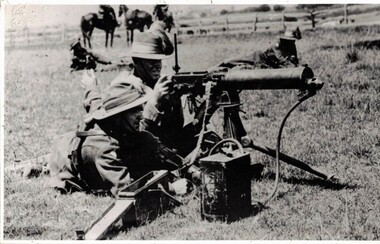
Photograph
... Black aand white photograph of 13 Light Horse Machine Gun crew training c. 1938...military militia machine gun light horse victoria Black aand white photograph of 13 Light Horse Machine Gun crew training c. 1938 Photograph ...Black aand white photograph of 13 Light Horse Machine Gun crew training c. 1938military, militia, machine gun, light horse, victoria -
 8th/13th Victorian Mounted Rifles Regimental Collection
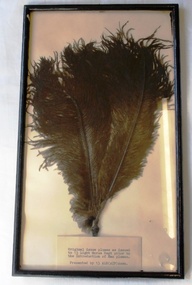
Decorative object - plumes, 1915 circa
... "Original issue plumes as issued to 13 Light Horse Regt prior to the introduction of Emu plumes. ...Light Horse Regiment (AIF) was raised at Broadmeadows Victoria in March 1915. The regiment took pride in their inauspicious number and adopted the nickname 'the Devil's Own' and wore a black ostrich plume in their hats. The regiment also obtained an unofficial badge featuring a dancing devil. A rare example of a plume worn in military headdress in World War One. It is well provenanced. in good condition and complete. 13th light horse military light horse wwi "Original issue plumes as issued to 13 ...The 13th Light Horse Regiment (AIF) was raised at Broadmeadows Victoria in March 1915. The regiment took pride in their inauspicious number and adopted the nickname 'the Devil's Own' and wore a black ostrich plume in their hats. The regiment also obtained an unofficial badge featuring a dancing devil. A rare example of a plume worn in military headdress in World War One. It is well provenanced. in good condition and complete.Framed set of ostrich plumes in light black wooden frame with glass front."Original issue plumes as issued to 13 Light Horse Regt prior to the introduction of Emu plumes. Presented by 13 ALH (AIF) Assn"13th light horse, military, light horse, wwi -
 8th/13th Victorian Mounted Rifles Regimental Collection
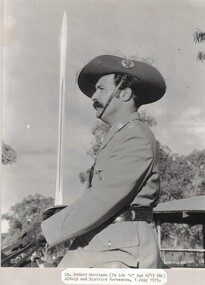
Photograph - Lt Robert Morrison
... 13 VMR...light horse...Photograph of Lieutenant Robert Morrison, Light Horse Heritage Troop A Squadron 8 13 Victorian Mounted Rifles at the Albury and District Horseshow 1 July 1979....Morrison Albury 8/13 VMR light horse Black and white photograph of light horse officer holding sword. ...Photograph of Lieutenant Robert Morrison, Light Horse Heritage Troop A Squadron 8 13 Victorian Mounted Rifles at the Albury and District Horseshow 1 July 1979.Black and white photograph of light horse officer holding sword.morrison, albury, 8/13 vmr, light horse -
 8th/13th Victorian Mounted Rifles Regimental Collection
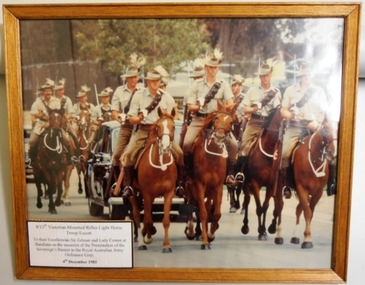
Photograph - Light horse escort for GG Cowan, 1982 circa
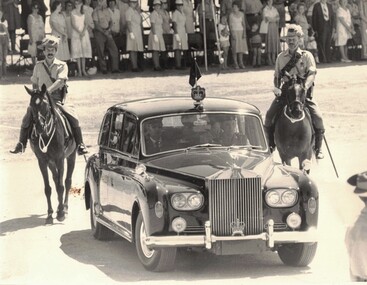
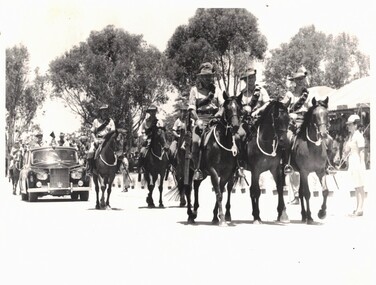
... Sir Zelman Cowan was Governor General of Australia, December 1977-July 1982. The 8/13 VMR Light Horse Heritage Troop was an extra curricular activity of the 8/13th VMR. ...Card panel " 8/13 VMR Light Horse / Troop Escort / to their Excellencies Sir Zelman and Lady Cowan at / Bandiana on the occasion of the / Presentation of the Sovereign's Banner to the Royal Australian Army / Ordnance Corps / 4 Dec 1981"...Sir Zelman Cowan was Governor General of Australia, December 1977-July 1982. The 8/13 VMR Light Horse Heritage Troop was an extra curricular activity of the 8/13th VMR. ...Sir Zelman Cowan was Governor General of Australia, December 1977-July 1982. The 8/13 VMR Light Horse Heritage Troop was an extra curricular activity of the 8/13th VMR. Captain (later Major) Robert Morrison, a keen horseman, was the prime mover in raising the troop. All riders were serving soldiers.Representative example of activities of a Heritage Troop of a serving Royal Australian Armoured Corps regiment providing a vice regal escort at a rare and historic event for the Royal Australian Army Ordnance Corps (RAAOC) and the Australian Army.Framed coloured photograph of mounted troops with drawn sabres being an escort from 8/13th Victorian Mounted Rifles Heritage Troop escorting the Governor General Sir Zelman and Lady Cowan at Bandiana 4 December 1981. Escort is commanded by Captain Robert Morrison riding to the right of the official car..Card panel " 8/13 VMR Light Horse / Troop Escort / to their Excellencies Sir Zelman and Lady Cowan at / Bandiana on the occasion of the / Presentation of the Sovereign's Banner to the Royal Australian Army / Ordnance Corps / 4 Dec 1981"cowan zelman sir, 8/13 vmr, heritage troop, morrison robert captain, royal australian army ordnance corps (raaoc), sovereign's banner, raaoc -
 8th/13th Victorian Mounted Rifles Regimental Collection
Document - Awards 13ALH
... Folder containing individual RAAC Decorations, Awards & Honours For WW1 for 13th Light Horse Regiment, AIF - includes members from 22 Corps M Tpt who were Transferred to 13 Light Horse after 11 November 1918....military WWI World War One awards 13th Folder containing individual RAAC Decorations, Awards & Honours For WW1 for 13th Light Horse Regiment, AIF - includes members from 22 Corps M Tpt who were Transferred to 13 Light Horse after 11 November 1918. ...Folder containing individual RAAC Decorations, Awards & Honours For WW1 for 13th Light Horse Regiment, AIF - includes members from 22 Corps M Tpt who were Transferred to 13 Light Horse after 11 November 1918.military, wwi, world war one, awards, 13th -
 8th/13th Victorian Mounted Rifles Regimental Collection
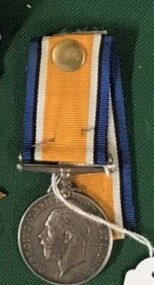
Medal - Potter WWI BWM
... World War One British War Medal awarded to 2129 Trooper J T Potter 13 Australian Light Horse....WWI World War One BWM Potter light horse World War One British War Medal awarded to 2129 Trooper J T Potter 13 Australian Light Horse. ...World War One British War Medal awarded to 2129 Trooper J T Potter 13 Australian Light Horse.wwi, world war one, bwm, potter, light horse -
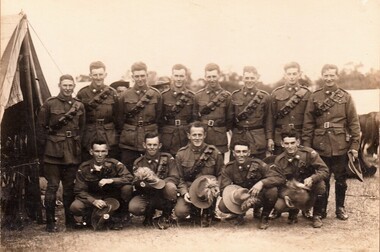 8th/13th Victorian Mounted Rifles Regimental Collection
Photograph
... Black and white photograph of 13 soldiers of 8th Light Horse Regiment photographed at Maribyrnong 1931...Light Horse (Indi) Regiment superseded the 16th Light Horse in 1919. It had its headquarters at Benalla with sub-units throughout the Upper Murray and Northeast Victoria. In December 1941, the regiment converted from horse to mechanised, initially as 8th Reconnaissance Battalion then in July 1942 it became 8th Cavalry Regiment and served in Northern Territory. As Japanese threat to the mainland declined the regiment was disbanded. Part of a series showing aspects of camp life circa 1932 Lower edge of mount " Maribyrnong 1931 " Black and white photograph of 13 ...The 8th Light Horse (Indi) Regiment superseded the 16th Light Horse in 1919. It had its headquarters at Benalla with sub-units throughout the Upper Murray and Northeast Victoria. In December 1941, the regiment converted from horse to mechanised, initially as 8th Reconnaissance Battalion then in July 1942 it became 8th Cavalry Regiment and served in Northern Territory. As Japanese threat to the mainland declined the regiment was disbanded.Part of a series showing aspects of camp life circa 1932Black and white photograph of 13 soldiers of 8th Light Horse Regiment photographed at Maribyrnong 1931Lower edge of mount " Maribyrnong 1931 " -
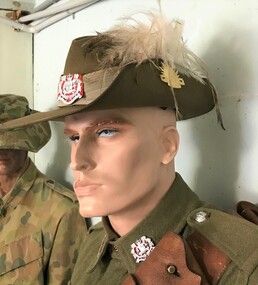 8th/13th Victorian Mounted Rifles Regimental Collection
Uniform - Heritage mannequin
... Mannequin dressed in the uniform of a sergeant of the 8/13 Victorian Mounted Rifles Light Horse Heritage Troop...13 but did include some civilian members. Training and advice came from former light horsemen: Des Martin (8LH), Norm Whitehead (21LH), Bob Fyffe (20LH) and Fred Trickey (Riding Master RMC). military light horse heritage vmr Mannequin dressed in the uniform of a sergeant of the 8/13 Victorian Mounted Rifles Light Horse Heritage Troop Uniform Heritage mannequin ...The Heritage Troop of 8/13 Victorian Mounted Rifles was a very public face of the regiment during the 1980s and early 1990s. It conducted one royal escort, several vice-regal escorts and numerous VIP escorts in the border, north-east and wider Victorian locations. The royal duty was at the opening of Hopkins Barracks, Puckapunyal by HRH Prince Charles accompanied by HRH Princess Diana, 31 October 1985. Major General Kevin Cooke GOC 3rd Division authorised the establishment of the troop in February 1980. Captain (later Major) Robert Morrison was the troop leader and the driving force behind the concept seeing potential where others did not. The troop was made up mainly by serving members of 8/13 but did include some civilian members. Training and advice came from former light horsemen: Des Martin (8LH), Norm Whitehead (21LH), Bob Fyffe (20LH) and Fred Trickey (Riding Master RMC). Mannequin dressed in the uniform of a sergeant of the 8/13 Victorian Mounted Rifles Light Horse Heritage Troopmilitary, light horse, heritage, vmr -
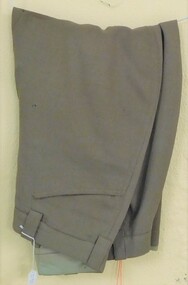 8th/13th Victorian Mounted Rifles Regimental Collection
Uniform - Jodhpurs
... Pair of Jodhpurs of the type most recently worn by 8/13 Victorian Mounted Rifles Light Horse Heritage Troop....The use of the Indian-style, ankle-length Jodhpurs allowed riders to use short, less expensive boots, as their calves were protected by the reinforced design and snug fit. jodhpur uniform light horse Pair of Jodhpurs of the type most recently worn by 8/13 Victorian Mounted Rifles Light Horse Heritage Troop. ...This style of trouser was worn by light horse soldiers. The jodhpurs were adapted from an ancient style of Indian trouser called the Churidar, which is tight around the calf and loose at the hips. It was adopted by British troops serving in India during the 18th century especially for sport. A British version was soon being produced by Savile Row tailors in London. The use of the Indian-style, ankle-length Jodhpurs allowed riders to use short, less expensive boots, as their calves were protected by the reinforced design and snug fit.Pair of Jodhpurs of the type most recently worn by 8/13 Victorian Mounted Rifles Light Horse Heritage Troop.jodhpur, uniform, light horse -
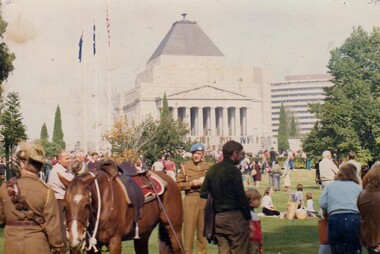 8th/13th Victorian Mounted Rifles Regimental Collection
Photograph
... The Light Horse Troop was formed by serving soldiers of A Squadron 8/13 VMR as an extra curricular activity. ...Two coloured photographs showing soldiers of 8/13 Victorian Mounted Rifles Light Horse Heritage Troop at the Shrine, Melbourne c. 1983....Two coloured photographs showing soldiers of 8/13 Victorian Mounted Rifles Light Horse Heritage Troop at the Shrine, Melbourne c. 1983. ...The Light Horse Troop was formed by serving soldiers of A Squadron 8/13 VMR as an extra curricular activity. The troop performed many ceremonial tasks.Two coloured photographs showing soldiers of 8/13 Victorian Mounted Rifles Light Horse Heritage Troop at the Shrine, Melbourne c. 1983. -
 8th/13th Victorian Mounted Rifles Regimental Collection
Photograph
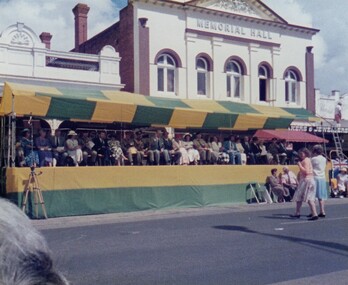
... Neale. 8/13 VMR participated with Light Horse Troop, Historical Vehicle Club and current vehicles....Neale. 8/13 VMR participated with Light Horse Troop, Historical Vehicle Club and current vehicles. ...Collection of 5 colour photographs of saluting dais at Corowa for the Bicentenial Parade 24 January 1988. Official guests included : Governor general Sir Ninian Stephen & Lady Stephen, Lieutenant Colonel A. Powell, Colonel C. Brewer, Lieutenant Colonel J. Boyce, Colonel J.A. Neale. 8/13 VMR participated with Light Horse Troop, Historical Vehicle Club and current vehicles. -
 8th/13th Victorian Mounted Rifles Regimental Collection
Photograph - Governor General's escort Bandiana 4.12.81
... The 8/13 Victorian Mounted Rifles Light Horse Heritage Troop provided a mounted escort for Sir Zelman and Lady Cowan. ...The 8/13 Victorian Mounted Rifles Light Horse Heritage Troop provided a mounted escort for Sir Zelman and Lady Cowan. ...Sir Zelman Cowan, Governor General of Australia, made a visit to Bandiana to present the Sovereign's Banner to the Royal Australian Army Ordnance Corps (RAAOC). The 8/13 Victorian Mounted Rifles Light Horse Heritage Troop provided a mounted escort for Sir Zelman and Lady Cowan. The escort was under the command of Captain (later Major) Robert Morrison, a keen horseman, who had been the prime mover in raising the Heritage Troop. All riders were serving soldiers of A Squadron 8/13 Victorian Mounted Rifles and their horsed activities were additional to their normal training responsibilities. Black and white photograph of Lieutenant R Morrison riding Cherokee (left) and Sergeant S Berg riding Postie (right) either side of a car carrying the Governor General Sir Zelman Cowan at Bandiana 4 December 1981.bandiana, light horse, morrison, berg, sir zelman cowan, governor general -
 8th/13th Victorian Mounted Rifles Regimental Collection
Photograph - Escort to Governor General 1981
... The 8/13 Victorian Mounted Rifles Light Horse Heritage Troop provided a mounted escort for Sir Zelman and Lady Cowan. ...The 8/13 Victorian Mounted Rifles Light Horse Heritage Troop provided a mounted escort for Sir Zelman and Lady Cowan. ...Sir Zelman Cowan, Governor General of Australia, made a visit to Bandiana to present the Sovereign's Banner to the Royal Australian Army Ordnance Corps (RAAOC). The 8/13 Victorian Mounted Rifles Light Horse Heritage Troop provided a mounted escort for Sir Zelman and Lady Cowan. The escort was under the command of Captain (later Major) Robert Morrison, a keen horseman, who had been the prime mover in raising the Heritage Troop. All riders were serving soldiers of A Squadron 8/13 Victorian Mounted Rifles and their horsed activities were additional to their normal training responsibilities. Black and white photograph of light horse escort to Governor General Sir Zelman Cowan at Bandiana 4 December 1981. Riders are Lieutenent R Morrison, Sergeant S Berg, Corporals F Reynolds, A Florient, Lance Corporal Milgate, Troopers C Ellison, K Dudley, Anderson, McDonald.light horse, morrison, bandiana, sir zelman cowan -
 Orbost & District Historical Society
poem, Mallacoota
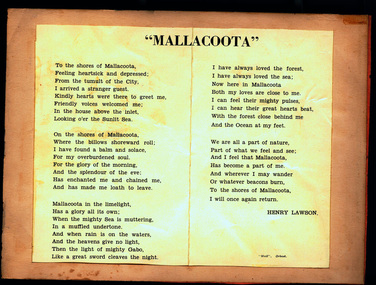
... NOTE: Information provided by David Williams on 13/12/2021 is that "this poem in your collection is by Edward Harrington (indeed not Lawson)". Edward P Harrington (1895-1966) was born in Shepparton, served in Palestine in W W I with the 4th Light Horse Regiment, tried farming, but his lifelong passion was for story-telling through poetry. ...NOTE: Information provided by David Williams on 13/12/2021 is that "this poem in your collection is by Edward Harrington (indeed not Lawson)". Edward P Harrington (1895-1966) was born in Shepparton, served in Palestine in W W I with the 4th Light Horse Regiment, tried farming, but his lifelong passion was for story-telling through poetry. ...The poem, "Mallacoota", as in this copy, does not appear to be noted in any of the lists of poems attributed to Henry Lawson. NOTE: Information provided by David Williams on 13/12/2021 is that "this poem in your collection is by Edward Harrington (indeed not Lawson)". Edward P Harrington (1895-1966) was born in Shepparton, served in Palestine in W W I with the 4th Light Horse Regiment, tried farming, but his lifelong passion was for story-telling through poetry. He is described as the 'last bush balladist' in Australia, and was a close friend of E J Brady and John Shaw Neilson. It was likely that he came to Mallacoota as a guest of E J Brady who had a camp for writers and poets there. He produced 5 collections of verse: Songs of War and Peace; Boundary Bend and Other Ballads; My Old Black Billy and other Songs of the Australian Outback; The Kerrigan Boys and other Australian Verses; and Swagless Swaggie and Other Ballads.His "Mallacoota" poem is printed in the Swagless Swaggie collection (1957). https://adb.anu.edu.au/biography/harrington-edward-philip-10431 Poetry associated with a place in East Gippsland. A copy of a printed poem titled "Mallacoota" with unknown author. It is pasted onto a cardboard backing. Although attributed to Henry Lawson in this printed copy, information is that it is by Edward Harrington.poem - edward harrington - bush balladist - mallacoota -
 Australian Commando Association - Victoria
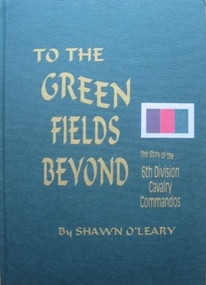
Book - 6th Div, Shawn OLeary, To The Green Fields Beyond:The story of the 6th Division Cavalry Commandos
... 13 and 14 June. C Squadron, meanwhile, was with the 25th Brigade, and advanced along the Rosh Pinna road, engaging strong enemy defences at Fort Khirbe. C Squadron was relieved by B Squadron, which was later attacked by Vichy French tanks that were supported by heavy artillery and machine-gun fire, which forced the Australians to withdrawal. Always willing or needing to improvise during the campaign, A and B Squadrons both operated three captured French R35 Renault light tanks, while C Squadron provided personnel for a horse ...The comprehensive history of the 6th Australian Division Cavalry Commandos – a (now out of print) reprint of one of the rarer Armoured unit history books. This is the story of one of Australia’s most famous fighting regiments during World War II. As an armoured cavalry unit it fought the Italians and Germans in the sands of the African desert and the Vichy French in the mountains of Syria. Later as a dismounted commando unit it fought the Japanese in the terrifying jungles of New Guinea. The heroism of the men in its ranks and the actions in which they engaged are portrayed in a way which makes battle deeds leap realistically from the pages. “To The Green Fields Beyond” is a documented and detailed book which is of value to everyone who is interested in Australia’s story. Seldom before has such a contribution been made to record of our national history. The book has been approved and sponsored by the Australian War Memorial. The 6th Division Cavalry Regiment was formed in November 1939 and, just two months later, was sent overseas to the Middle East in January 1940. Arriving in Egypt, the regiment immediately went to Palestine, where it joined the rest of the 6th Division and trained using machine-gun carriers and, from October, six old Vickers light tanks. At the end of the year the regiment moved into the Western Desert, where it joined British forces ready for the major offensive to commence on 9 December. Two days later the regiment became the first unit of the 2nd Australian Imperial Force (AIF) to go into action when one of its squadron fought a sharp action against the Italians holding Garn el Grein and Fort Maddalina on 11 and 12 December. By 21 December British forces had captured Sidi Barrrani and the desert was now open for the 6th Division’s advance along the Libyan coast. On 3 January 1941 the division attacked and captured the Italian fort of Bardia. The regiment’s A Squadron, under the command of Major Denzil Macarthur-Onslow, who went on to command the 4th Armoured Brigade, supported the attack. Tobruk was the next Italian fort to be captured, with the regiment again in support and covering the 19th Brigade’s advance. The regiment, though, was under-equipped and without its full compliment of vehicles, using only machine gun carriers. To compensate for this, A Squadron was parity re-equipped with captured Italian light tanks, which had large kangaroos painted on the hulls and turrets to distinguish them from enemy vehicles. After Tobruk, the regiment was used as part of the advance guard in the capture of Derna and then Benghazi. In April the unit moved to Helwan, where it was equipped with Vickers light tanks and machine-gun carriers, and operated with British troops in capturing Sollum. Towards the end of May the regiment moved to Palestine, where it came under the command of the 7th Division for the imminent invasion of Syria. The regiment experienced its heaviest fighting during the Syrian campaign, which began on 7 June. A Squadron was attached to the 21st Brigade and advanced along the coast, where the rugged hills made it difficult to manoeuvre the tanks and carriers. The squadron was relieved by one of the 9th Division Cavalry Regiment’s squadrons on 13 and 14 June. C Squadron, meanwhile, was with the 25th Brigade, and advanced along the Rosh Pinna road, engaging strong enemy defences at Fort Khirbe. C Squadron was relieved by B Squadron, which was later attacked by Vichy French tanks that were supported by heavy artillery and machine-gun fire, which forced the Australians to withdrawal. Always willing or needing to improvise during the campaign, A and B Squadrons both operated three captured French R35 Renault light tanks, while C Squadron provided personnel for a horse troop, quickly nicknamed the “Kelly Gang”, to patrol the high, rugged hills near the Mardjayoun–Banis Road. The regiment remained in Syria as part of the occupation force and returned to Australia in March 1942. It was sent to the Adelaide River, in the Northern Territory, and then later to Murgon, in Queensland. In 1943 and 1944 divisional cavalry regiments were reorganised into cavalry (commando) regiments. In January 1944 the 6th Division Cavalry Regiment became the 2/6th Cavalry (Commando) Regiment. The regiment lost its vehicles and became the administrative headquarters for the 2/7th, 2/9th, and 2/10th Commando Squadrons. The regiment remained with the 6th Division and participated in the Aitpae–Wewak campaign, in New Guinea, during 1945. Includes Nominal Rollnon-fictionThe comprehensive history of the 6th Australian Division Cavalry Commandos – a (now out of print) reprint of one of the rarer Armoured unit history books. This is the story of one of Australia’s most famous fighting regiments during World War II. As an armoured cavalry unit it fought the Italians and Germans in the sands of the African desert and the Vichy French in the mountains of Syria. Later as a dismounted commando unit it fought the Japanese in the terrifying jungles of New Guinea. The heroism of the men in its ranks and the actions in which they engaged are portrayed in a way which makes battle deeds leap realistically from the pages. “To The Green Fields Beyond” is a documented and detailed book which is of value to everyone who is interested in Australia’s story. Seldom before has such a contribution been made to record of our national history. The book has been approved and sponsored by the Australian War Memorial. The 6th Division Cavalry Regiment was formed in November 1939 and, just two months later, was sent overseas to the Middle East in January 1940. Arriving in Egypt, the regiment immediately went to Palestine, where it joined the rest of the 6th Division and trained using machine-gun carriers and, from October, six old Vickers light tanks. At the end of the year the regiment moved into the Western Desert, where it joined British forces ready for the major offensive to commence on 9 December. Two days later the regiment became the first unit of the 2nd Australian Imperial Force (AIF) to go into action when one of its squadron fought a sharp action against the Italians holding Garn el Grein and Fort Maddalina on 11 and 12 December. By 21 December British forces had captured Sidi Barrrani and the desert was now open for the 6th Division’s advance along the Libyan coast. On 3 January 1941 the division attacked and captured the Italian fort of Bardia. The regiment’s A Squadron, under the command of Major Denzil Macarthur-Onslow, who went on to command the 4th Armoured Brigade, supported the attack. Tobruk was the next Italian fort to be captured, with the regiment again in support and covering the 19th Brigade’s advance. The regiment, though, was under-equipped and without its full compliment of vehicles, using only machine gun carriers. To compensate for this, A Squadron was parity re-equipped with captured Italian light tanks, which had large kangaroos painted on the hulls and turrets to distinguish them from enemy vehicles. After Tobruk, the regiment was used as part of the advance guard in the capture of Derna and then Benghazi. In April the unit moved to Helwan, where it was equipped with Vickers light tanks and machine-gun carriers, and operated with British troops in capturing Sollum. Towards the end of May the regiment moved to Palestine, where it came under the command of the 7th Division for the imminent invasion of Syria. The regiment experienced its heaviest fighting during the Syrian campaign, which began on 7 June. A Squadron was attached to the 21st Brigade and advanced along the coast, where the rugged hills made it difficult to manoeuvre the tanks and carriers. The squadron was relieved by one of the 9th Division Cavalry Regiment’s squadrons on 13 and 14 June. C Squadron, meanwhile, was with the 25th Brigade, and advanced along the Rosh Pinna road, engaging strong enemy defences at Fort Khirbe. C Squadron was relieved by B Squadron, which was later attacked by Vichy French tanks that were supported by heavy artillery and machine-gun fire, which forced the Australians to withdrawal. Always willing or needing to improvise during the campaign, A and B Squadrons both operated three captured French R35 Renault light tanks, while C Squadron provided personnel for a horse troop, quickly nicknamed the “Kelly Gang”, to patrol the high, rugged hills near the Mardjayoun–Banis Road. The regiment remained in Syria as part of the occupation force and returned to Australia in March 1942. It was sent to the Adelaide River, in the Northern Territory, and then later to Murgon, in Queensland. In 1943 and 1944 divisional cavalry regiments were reorganised into cavalry (commando) regiments. In January 1944 the 6th Division Cavalry Regiment became the 2/6th Cavalry (Commando) Regiment. The regiment lost its vehicles and became the administrative headquarters for the 2/7th, 2/9th, and 2/10th Commando Squadrons. The regiment remained with the 6th Division and participated in the Aitpae–Wewak campaign, in New Guinea, during 1945. Includes Nominal Rollww2, australian commandos, australian special forces, world war 2 -
 Orbost & District Historical Society
certificate, November 1894
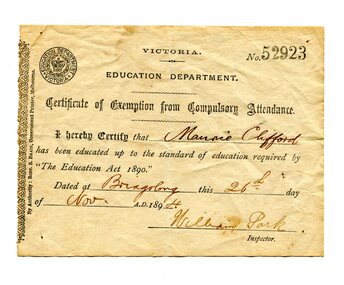
... Having served in the 10th Australian Light Horse, Citizen Military Forces, he enlisted on 22 February 1916 as a private in 37th Battalion D Company. The 1890 Act called for all children in Victoria between the ages of 6 and 13 to attend school forty days in each quarter of a year. ...This is Certificate No. 5293 and certifies that Maurice Clifford has been educated up to the standard of education required by "The Education Act 1890." It is dated at Briagolong on 26th November, 1894. Briagolong Primary School was established in 1875 when the town of Briagolong came into being. Maurice William Clifford was a farmer in Briagolong. He was killed in action at Ypres, Belgium on 4 October, 1917. Having served in the 10th Australian Light Horse, Citizen Military Forces, he enlisted on 22 February 1916 as a private in 37th Battalion D Company.The 1890 Act called for all children in Victoria between the ages of 6 and 13 to attend school forty days in each quarter of a year. Section 13 of the Act states that “Two hours before noon on any two days or two hours after noon on any two days” is deemed to be equal to one day's attendance. One of the reasons for exemption from compulsory attendance was if the child lived more than two miles from a school (or two and a half miles if aged 9 or over). If a student had reached a sufficient level of education an exemption could be granted.A white paper certificate with black print. It is issued by the Victorian Education Department for the exemption from compulsory attendance for Maurice Clifford. The certificate is printed with hand-written details.education clifford-maurice-william -
 Orbost & District Historical Society
Photograph - two black and white photographs, 13th Light Horse Brigade 2 Troop C Squad
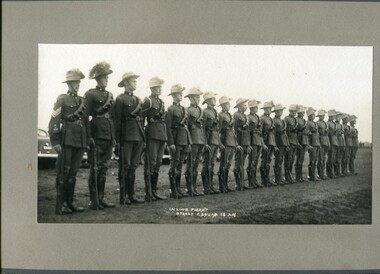
... Light Horse. While at the railway station at Orbost, George had an accident and suffered 2 broken legs which meant that he could no longer work there. During W W II, he worked as a recruiting officer at Sale and Warrnambool. The Troop was disbanded in the c. late 1930s. Shows evidence of military training activities, Orbost district 13th Light Horse Brigade C Squad 2 Troop military training George W Wraight In Line Picket 2 Troop C Squad 13 ...These 2 photos are of Orbost men who were part of the 13th Light Horse volunteer regiment. This military training activity continued on after W W I. These photos were taken at the training camp at Seymour, Victoria. The Orbost troop would journey to other areas for training, sometimes to Bombala, and also practice on the Orbost Rifle Range. Although not identified in these photos, George William Wraight was a leader of the Light Horse Troop in Orbost and it is his daughter Dorothy Hepburn who has donated these photos. George W Wraight was the railway-station master at Orbost from 1935. The Troop often met at the Wraight house in Tarra Street, Orbost for training. George had been in W W I in the Middle East with the Light Horse. While at the railway station at Orbost, George had an accident and suffered 2 broken legs which meant that he could no longer work there. During W W II, he worked as a recruiting officer at Sale and Warrnambool. The Troop was disbanded in the c. late 1930s.Shows evidence of military training activities, Orbost district Two sepia photographs onto grey card. Both photos show a line-up of 20 soldiers standing at attention. Size is H-22cm W-34cmIn Line Picket 2 Troop C Squad 13 LH - written on to both photos13th light horse brigade, c squad 2 troop, military training, george w wraight -
 Bendigo Military Museum
Photograph - CARD & PHOTOGRAPHS, AUST LIGHT HORSE WW1, The Australian Memorial Card Co
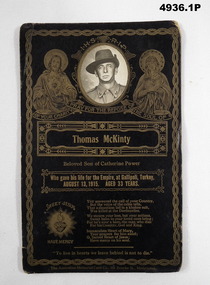
... Light Horse served from the Suez Canal right around through Palestine - Syria. WW1 Middle East Light Horse Thomas McGinty, Beloved son of Catherine Power. "Who gave his life for the Empire. At Gallipoli, Turkey, August 13 ...In WW1 the Australian Light Horse served from the Suez Canal right around through Palestine - Syria.1. Memorial Card. Black cardboard with gold printing. It is a religious article with images and prayers. In the top centre is an oval shaped hole with a B & W portrait of an Aust soldier. Slouch hat with side up. 2. Set of 31 B & W photos depicting scenes of light horse activity. Beaches - Middle East buildings - locals - repairing train lines - daily life - campsites - ships off shore etc.Thomas McGinty, Beloved son of Catherine Power. "Who gave his life for the Empire. At Gallipoli, Turkey, August 13 - 1915. Aged 33 years.ww1, middle east, light horse -
 Bendigo Military Museum
Photograph - PHOTOGRAPHS WW2, Possibly 1945
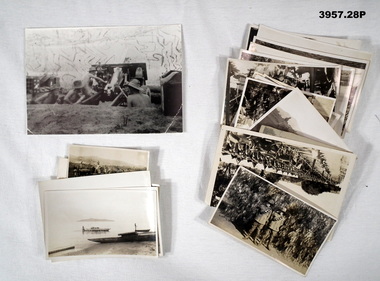
... Handwritten on the back in pen: .1) “Jack Taylor” .2) “Jap Prisoners” .3) “After surrender, jap prisoners on New Britain” .4) “Camp on New Britain” .5) “Jap prisoners of war” .6) Jacks collection of photos New Britain .7) Jack New Britain 1945 .8) Jap Working Party New Britain .9) Camp probably New Britain .10) Wrecked jap planes on New Britain .11) Jack & mates with Jap Sword (Jack centre) .12) More japs .13) Jack & group, probably some of 21st Guard Battalion .14) 21st Light Horse Regt in Camp Wagga? ...Photographs Japs new britain Native Handwritten on the back in pen: .1) “Jack Taylor” .2) “Jap Prisoners” .3) “After surrender, jap prisoners on New Britain” .4) “Camp on New Britain” .5) “Jap prisoners of war” .6) Jacks collection of photos New Britain .7) Jack New Britain 1945 .8) Jap Working Party New Britain .9) Camp probably New Britain .10) Wrecked jap planes on New Britain .11) Jack & mates with Jap Sword (Jack centre) .12) More japs .13) Jack & group, probably some of 21st Guard Battalion .14) 21st Light Horse Regt in Camp Wagga? ...Photos labelled Jack are John Alfred TAYLOR NX102933 21st Guard Battalion. .28) This is Roy TAYLOR NX 94268 21st Field Regiment. Roy is on the left of photos. These men were brothers.Collection of photos, black / white & sepia. Some in Australia re Light Horse pre war. Most are presumably taken in New Britain up to & at wars end in 1945. One photo is in New Guinea. Many have been written on the back in pen. Photos are various sizes. Average noted. .16) Men & Bren gun carriers .17) Men & bulldozer .18) 7 men with machine gun .19) Native boats .20) Soldier & natives with canoe .21) Soldier & natives with canoe .22) 2 soldiers with POW .23) Soldier with plane wreckage .24) 3 soldiers with natives .25) 8 soldiers in group .26) Soldier sitting in plane wreck .27) Soldier in native canoe .28) Artillery unit in position firing, 4 men Handwritten on the back in pen: .1) “Jack Taylor” .2) “Jap Prisoners” .3) “After surrender, jap prisoners on New Britain” .4) “Camp on New Britain” .5) “Jap prisoners of war” .6) Jacks collection of photos New Britain .7) Jack New Britain 1945 .8) Jap Working Party New Britain .9) Camp probably New Britain .10) Wrecked jap planes on New Britain .11) Jack & mates with Jap Sword (Jack centre) .12) More japs .13) Jack & group, probably some of 21st Guard Battalion .14) 21st Light Horse Regt in Camp Wagga? .15) Two Light Horsemen, Jacks matesphotographs, japs, new britain, native -
 Waverley RSL Sub Branch
Photographs, Fredrick Charles Dix
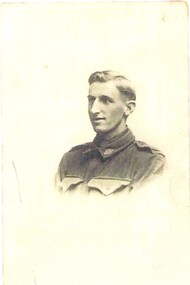
... Light horse and sent to Egypt for further training. Unit embarked from Adelaide, South Australia, on board HMAT A30 Borda on 11 January 1916.He served in France and was wounded by shrapnel in the eye socket but eventually returned to active duty on the front.He returned to Australia 6 September 1919 Sgt. F. C. Dix 1790 9th light horse 13th reinforcement 13 ...Fredrick Charles Dix enlisted 8th July 1915 at Castlemaine (at the time he was living with his Mother and stepfather in Fryers Town) after serving in the Senior Cadets. He was taken on by the 9th Light horse and sent to Egypt for further training. Unit embarked from Adelaide, South Australia, on board HMAT A30 Borda on 11 January 1916.He served in France and was wounded by shrapnel in the eye socket but eventually returned to active duty on the front.He returned to Australia 6 September 1919 Sgt. F. C. Dix 1790 9th light horse 13th reinforcement 13 Field Artillery Brigade where he (several times) attained the rank of Sergeant. He also served during WWII at Nowra as a driver. Photos of Fred. were taken after enlistment, and the photo of ? 13 F.A.B. is thought to have been taken in Egypt 1916 3 Black and white photographs from WWIWritten on reverse of the image of the soldiers in front of tent "Fred's Mates"f dix, fredrick dix, 13th f.a.b., 9th light horse, castlemaine, wwi, egypt, photographs, photos, postcards france wwi -
 Kiewa Valley Historical Society
Book - Non Fiction History, Honour Roll - South Africa 1899 - 1902 Albury-Wodonga and District Residents Who Served In The Boer War, reprinted 03/2008
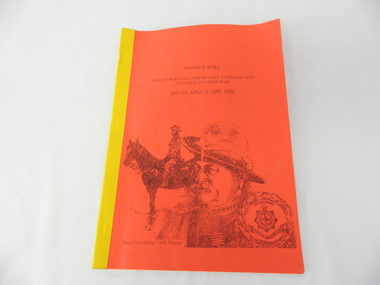
... In 1996 the then curator for the 8/13 VMR Museum, the Hon Colonel John Neale, commissioned the author to research a group of returned servicemen and women from the Boer War and had lived within 100 km radius of the Albury/Wodonga townships.The Boer War was the second war in South Africa and was the result of heavy taxes and non voting rights of the local white Boer population. Colonial forces including the Australian Light Horse...In 1996 the then curator for the 8/13 VMR Museum, the Hon Colonel John Neale, commissioned the author to research a group of returned servicemen and women from the Boer War and had lived within 100 km radius of the Albury/Wodonga townships.The Boer War was the second war in South Africa and was the result of heavy taxes and non voting rights of the local white Boer population. Colonial forces including the Australian Light Horse ...Historical information of soldiers from the Albury-Wodonga district who fought in the Boer War in South Africa 1899 - 1902. In 1996 the then curator for the 8/13 VMR Museum, the Hon Colonel John Neale, commissioned the author to research a group of returned servicemen and women from the Boer War and had lived within 100 km radius of the Albury/Wodonga townships.The Boer War was the second war in South Africa and was the result of heavy taxes and non voting rights of the local white Boer population. Colonial forces including the Australian Light Horse contingent where called upon by England to overthrow the rebellion. This War was the first engagement of Australian troops fighting on foreign soil.This Honour Roll details the pay rates, the battle highlights, weapons used and maps covering the first Australian contingent of soldiers who fought in the Transvaal (Boer War).. Listed are the names of those soldiers who lived within 100klms of Albury and Wodonga.The soldiers are listed by Location, Rank, Initial,Name and Unit. The significance of both the War and those who served in it is two fold. Firstly it demonstrates that the tie between the Colonial outreaches of England's Empire to "the Motherland" were extremely strong at this point in time. This union remained strong up until the middle of World War II when England could not help Australia to defend itself against possible invasion by Japan. The alliance between Australia and the United States of America replaced the British/Australian pact. Secondly the attitude of, and the high degree of horsemanship of those from the Albury and Wodonga area. The degree of adaptability, by these servicemen, to suit the environment in which they fought provided the first real insight into the Australian psyche "of those living and surviving on the harsh Australian outback"This book has a bright red soft cover and is bound with bright yellow tape. There is a drawing of two Australian soldiers on the front, one on horsebackAuthor's complimentary inscription "To Mount Beauty Museum with compliments" signed Ian R Docking history, boer war, ex-servicemen and women, albury and wodonga -
 Bendigo Military Museum
Badge - BADGE COLLECTION, C.WW2
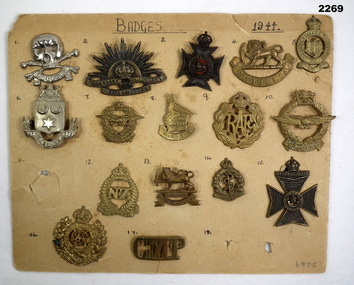
... Light Horse. .7) S.A.A.F. SALM, Crown, Wings. .8) R.A..A.C. with bird .9) R.A.F. Crown and Wreath .10) Rhodesia lion and eagle .11) Missing .12) NZ onward. crown and wreath .13) Southern Rhodesia volunteers. ...Light Horse. .7) S.A.A.F. SALM, Crown, Wings. .8) R.A..A.C. with bird .9) R.A.F. Crown and Wreath .10) Rhodesia lion and eagle .11) Missing .12) NZ onward. crown and wreath .13) Southern Rhodesia volunteers. ...Items in the collection re Ian McLeod RWAFF, refer Cat No 2262.2 for service details. Badges, metal mounted on cardboard from Allied countries16 in total. Main ones are; .1) Skull and cross bones "FOR GLORY". .2) Rising Sun badge Australian .3) Rhodesian Regiment .4) Lion with Rhodesie. .5) North Humberland Fusiliers. .6) Western Light Horse. .7) S.A.A.F. SALM, Crown, Wings. .8) R.A..A.C. with bird .9) R.A.F. Crown and Wreath .10) Rhodesia lion and eagle .11) Missing .12) NZ onward. crown and wreath .13) Southern Rhodesia volunteers. Lion .14) Rhodesia - crown, dagger, snake\ .15) The Kings Royal Rifle Corp - crown and cross .16) Royal Engineers. crown and wreath .17) "CMP" Letter only .18) Missingbadges, allied, collection -
 4th/19th Prince of Wales's Light Horse Regiment Unit History Room
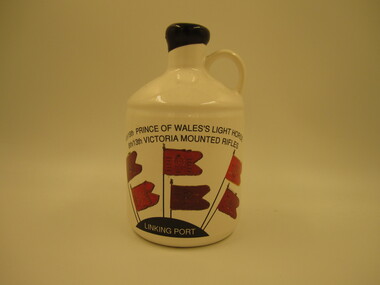
Ceramic - Port Crocks, set of 6, Linking Port, abt 1990
... Ceramic port crocks (750 ml), to mark the linking in 1991 of 4/19 Prince of Wales's Light Horse and 8/13 Victorian Mounted Rifles Regiments...Port commemorative The 6 guidons and battle honours of the two Regiments and their antecedent units Ceramic port crocks (750 ml), to mark the linking in 1991 of 4/19 Prince of Wales's Light Horse and 8/13 Victorian Mounted Rifles Regiments Linking Port Ceramic Port Crocks, set of 6 Mt Aitken Estates ...Ceramic port crocks (750 ml), to mark the linking in 1991 of 4/19 Prince of Wales's Light Horse and 8/13 Victorian Mounted Rifles RegimentsThe 6 guidons and battle honours of the two Regiments and their antecedent unitsport, commemorative -
4th/19th Prince of Wales's Light Horse Regiment Unit History Room
Framed photograph, No 1892 Tpr Alfred Lazarus, 4th Light Horse Regiment, c 1915
... 4th Light Horse Regiment - Machine Gun Squadron No 1892 Tpr Alfred Lazarus 13 R Enlisted 10 Aug 1915 RTA 29 April 1919...4th Light Horse Regiment - Machine Gun Squadron No 1892 Tpr Alfred Lazarus 13 R Enlisted 10 Aug 1915 RTA 29 April 1919 Framed photo of Tpr Alfred Lazarus, 4th Light Horse Regiment No 1892 Tpr Alfred Lazarus, 4th Light Horse Regiment Framed photograph ...Framed photo of Tpr Alfred Lazarus, 4th Light Horse Regiment4th Light Horse Regiment - Machine Gun Squadron No 1892 Tpr Alfred Lazarus 13 R Enlisted 10 Aug 1915 RTA 29 April 1919 -
4th/19th Prince of Wales's Light Horse Regiment Unit History Room
Framed Photograph, Albert Taylor & George Ridgwell 4 Light Horse regiment, c 1915
... 4th Light Horse Regiment Machine Gun Squadron No 352 Albert Taylor Enlisted 19 Aug 1914 RTA 15 Jan 1919 No 749 George Ridgwell Enlisted 13 Nov 1914 RTA 9 Jul 1919...4th Light Horse Regiment Machine Gun Squadron No 352 Albert Taylor Enlisted 19 Aug 1914 RTA 15 Jan 1919 No 749 George Ridgwell Enlisted 13 Nov 1914 RTA 9 Jul 1919 Framed b&w studio photo of Albert Taylor & George Ridgwell, 4th Light Horse Regiment Albert Taylor & George Ridgwell 4 Light Horse regiment Framed Photograph ...Framed b&w studio photo of Albert Taylor & George Ridgwell, 4th Light Horse Regiment4th Light Horse Regiment Machine Gun Squadron No 352 Albert Taylor Enlisted 19 Aug 1914 RTA 15 Jan 1919 No 749 George Ridgwell Enlisted 13 Nov 1914 RTA 9 Jul 1919 -
 4th/19th Prince of Wales's Light Horse Regiment Unit History Room
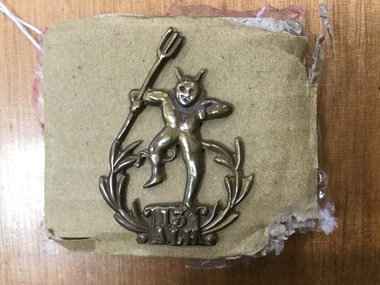
Decorative Object - Hat Badge, 13th LHR Dancing Devil Hat Badge, 1916
... Light Horse Regiment while on operations on the Western Front. An unauthorised hat badge of the 13th LHR used by members of the Regt while on operations on the Western Front. heraldry badges devils AIF Western Front Light Horse Regiment "13 ALH" inscribed on base of wreath Brass Hat Badge, dancing devil with pitch fork above wreath with 13 ALH inscibed. ...Dancing Devil hat badge was originally privately comissioned and purchased by members of 13th LHR circa 1916, in recognition that the 13th LHR was nicknamed "The Devils Own" This hat badge was unauthorised but still worn by members of the 13th Light Horse Regiment while on operations on the Western Front.An unauthorised hat badge of the 13th LHR used by members of the Regt while on operations on the Western Front.Brass Hat Badge, dancing devil with pitch fork above wreath with 13 ALH inscibed. Two lugs on rear."13 ALH" inscribed on base of wreathheraldry, badges, devils, aif, western front, light horse regiment -
 4th/19th Prince of Wales's Light Horse Regiment Unit History Room
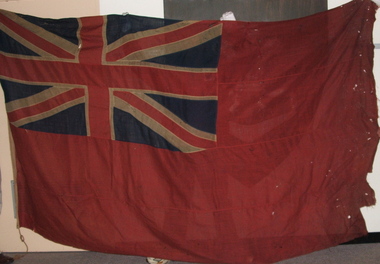
Flag - Red Ensign, Surgeons' Banner, 1850 (estimated)
... Light Horse Regiment. In the binding is the inscription ‘Kyneton Prince of Wales Light Horse’ and three names: Surg-Major S Smith MRSLE, Dr McMillan, and Maj Thirkettle. These surgeons played a significant role in the military and civil affairs of Kyneton. Dr McMillan Dr McMillan was the first surgeon but left KPWLH 2-3 months after its formation and little else is known of him. Surgeon-Major Samuel Smith 1836 Born, Scotland 1857 Surgeon to the Hon. Hudson Bay Company. Ship “Prince Arthur” from London to Moose Fort, Hudson Bay. June 13 ...Red Ensign 1801 design. - The British red ensign was altered in 1801 to include the change to the design of the Union Jack. British legislation required, with a few exceptions, that all merchant shipping throughout the British Empire fly the British Red Ensign, without any defacement or modification. The ensign is sometimes referred to as the red duster. The Royal Navy stopped using the Red Ensign in 1864. This red ensign was used by the Surgeons of the Kyneton District Mounted Rifles to indicate their location. The Banner is a large red ensign mounted on a 10 foot long polished wooden pike. The Banner was used by the Kyneton District Mounted Rifles, later The Royal Volunteer Cavalry Regiment (Prince of Wales Hussars), then Prince of Wales Victorian Light Horse, ancestor units of the modern day 4th /19th Prince of Wales’s Light Horse Regiment. In the binding is the inscription ‘Kyneton Prince of Wales Light Horse’ and three names: Surg-Major S Smith MRSLE, Dr McMillan, and Maj Thirkettle. These surgeons played a significant role in the military and civil affairs of Kyneton. Dr McMillan Dr McMillan was the first surgeon but left KPWLH 2-3 months after its formation and little else is known of him. Surgeon-Major Samuel Smith 1836 Born, Scotland 1857 Surgeon to the Hon. Hudson Bay Company. Ship “Prince Arthur” from London to Moose Fort, Hudson Bay. June 13 – Aug. 24 1857. 1858 Appointed Medical Officer of large immigrant ship to Port Phillip 1859 Appointed Assistant District Coroner, Castlemaine 1859 Appointed to Castlemaine Hospital 1862 Appointed first resident surgeon and manager of Kyneton Hospital Foundation member of Kyneton District Mounted Rifles 1874 Appointed Surgeon-Major Kyneton Volunteer Prince of Wales Light Horse Conducted a private practice in Kyneton. 1909 Died 8 November 1909, aged 73 years Samuel Smith was a Life Governor of Castlemaine Benevolent Asylum, a member of St Andrews Presbyterian Church, a Mark Master Mason of the Edward Coulson Lodge No 17, Kyneton. He also had a notable collection of stuffed native birds and animals of which he had great knowledge. Major Thirkettle 1855 Major Thirkettle arrived in Kyneton Established a timber merchant and ironmongery business in Kyneton with Robert Burton. 1857 By 1857 he was practising as an architect. His house is still standing in Yaldwin St, West Kyneton. 1860 Joined the Prince of Wales Light Horse 1863 Joined Rifle Volunteers and appointed Captain. On their disbandment he was made Honorary Major. 1864 Won Queen’s prize for rifle shooting. Major Thirkettle was noted for his skill with woodwork. He won many prizes and orders of merit for his models of yachts It is believed likely that he made the wooden pike with its metal head (now missing). He was Tyler of the Zetland Lodge, also Secretary of the MUIOOF and Bowling Club. 1904 Died in Kyneton, aged 75 years Protection for medical services The Surgeons’ Banner indicated the location of the Regimental Aid Post. The use of this device in the 1860’s overlapped the adoption of the Red Cross which became the symbol for the protection of sick and wounded soldiers. In 1864 twelve European nations signed a treaty stating that in future wars they would care for all sick and wounded military personnel, regardless of nationality. They would also recognise the neutrality of medical personnel, hospitals and ambulances identified by the emblem of a red cross on a white background. The treaty was called the Geneva Convention. This Convention was concerned only with soldiers wounded on the battlefield. Over the years, however, it has been expanded to cover everyone caught up in conflicts but not actually taking an active part in the fighting. The Surgeons’ Banner complements the Colours of the Kyneton District Mounted Rifles, also held by the Unit History Room, in presenting the colonial period of the Regiment’s history. Provenance It is believed that the Banner was manufactured in Britain and brought to Australia by Samuel Smith. After the disbanding of Colonial units, the Banner was in the care of the Shire of Kyneton until presented to the 4/19 Prince of Wales’s Light Horse Regiment on 14 September 1986 on the occasion of the Regiment exercising its right of freedom of entry to the city. There are many examples of Regimental and King’s/Queen’s Colours held by various organisations. However A Surgeons’ Banner such as this is rare, if not unique, in Australia. A large red ensign, post 1801 design. - The British red ensign was altered in 1801 to include the change to the design of the Union Jack. British legislation required, with a few exceptions, that all merchant shipping throughout the British Empire fly the British Red Ensign, without any defacement or modification. The ensign is sometimes referred to as the red duster. The Royal Navy stopped using the Red Ensign in 1864. On the binding is the inscription: "Kyneton Prince of Wales Light Horse", and three names - Surgeon Major S Smith MRSLE Dr McMillan Major Thirkettleheraldry, red ensign, surgeons banner, kyneton district mounted rifles
