
Showing 90 items matching "14 inch"
-
 Sunshine and District Historical Society Incorporated
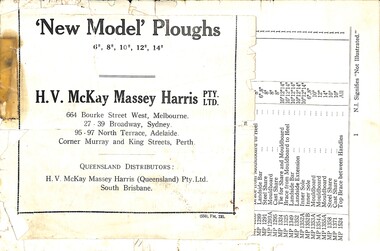
Manual - Sunshine Harvester McKay Massey Harris - List of duplicate parts with illustrations for the New Model Ploughs 6, 8, 10, 12 & 14 Inch
... Sunshine Harvester McKay Massey Harris - List of duplicate parts with illustrations for the New Model Ploughs 6, 8, 10, 12 & 14 Inch...McKay Massey Harris Sunshine Harvester Works Farm Machinery Information Brochure Manual Sunshine Harvester McKay Massey Harris - List of duplicate parts with illustrations for the New Model Ploughs 6, 8, 10, 12 & 14 Inch ...h.v. mckay massey harris, sunshine harvester works, farm machinery -
 Flagstaff Hill Maritime Museum and Village
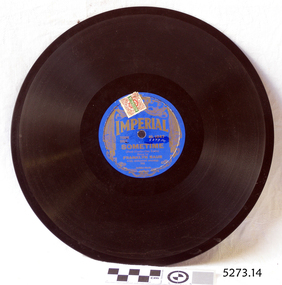
Audio - Gramophone Record, Imperial Records, Sometime, Early-to-mid 20th century
... ...14 inch...Title: Sometime Artist: Franklyn Baur, tenor, solo Publisher: Imperial Records Number:1547 Size: 14 inch...Title: Sometime Artist: Franklyn Baur, tenor, solo Publisher: Imperial Records Number:1547 Size: 14 inch Sometime Audio Gramophone Record Imperial Records ...Thomas Edison (1847–1931), an American, invented the phonograph in 1877, making it possible to record sound waves vertically and reproduce them on a wax cylinder so they could be heard again. Later, the German American, Emile Berliner (1851-1929), improved on Edison’s principles, greatly increasing the quality of the reproduced sounds with his invention of the gramophone in 1887, which recorded the sound waves laterally onto a flat shellac disc, or ‘record’. Records could be mass-produced in a factory where audio recordings were converted to a physical copy of that recording on a plate-sized disc. A gramophone machine reproduced the sound by spinning the record on a turntable at a specified number of rotations per minute (RPM) and using a stylus or needle to transfer the vibration via a membrane to a speaker, which amplified the sound. Berliner helped set up affiliated businesses overseas. One of his representatives was William Barry Owen (1860–1914), who, on 23 February 1889, partnered with Edmund Trevor Lloyd Williams (1859–1946) in England to register The Gramophone Company. His Master’s Voice (HMV) soon became the company’s major recording label, popular worldwide. The business based the label's logo of a dog looking into a gramophone horn for ‘his master’s voice’ was based on a painting by English artist Francis Barraud, which featured a terrier called Nipper beside a gramophone. Early gramophone records were mostly made from a material referred to as shellac, a natural ingredient combined with slate powder, and a filler of manilla copal, wood resin, carnauba wax, and carbon black. Although Bakelite seemed a useful, synthetic product, it was unsuccessful as a product for records. Around the time of World War II, lightweight, flexible synthetic vinyl records began replacing shellac records. Common diameters of records: 7 inch, 10 inch, 12 inch and 16 inch Revolutions Per Minute include: 33 1/3, 45, 78 Minutes per side of record: 3, 5.5, 7, 8, 9, 12, 15 and 22 Labels, in minutes per side: Single Play 3-5 min, Extended Play (EP) 7-12 min, Long Play (LP) 12-22 min This gramophone represents a step in the evolution of recording sound. In the 19th century, the human voice was first recorded on wax cylinders and replayed. It was the beginning of a new era in sound. Then, in the 1880s, voice could be recorded onto flat discs like this record, reliably reproduced and replayed many times, even on portable devices. Later, in the mid-20th century the following generation of electronic audio recording began, and later that century, digital recording gave even better reproduction. The record represents a popular means of entertainment for personal and social activities, as well as in some businesses. Shellac gramophone record with a blue and gold label. Title: Sometime Artist: Franklyn Baur, tenor, solo Publisher: Imperial Records Number:1547 Size: 14 inchWhite paper stamp with gold, red and green printflagstaff hill, warrnambool, maritime village, maritime museum, flagstaff hill maritime museum and village, shipwreck coast, great ocean road, gramophone, phonograph, sound waves, record, reproduction, audio record, music, sound, thomas edison, emile berliner, 1887, shellac, rpm, william barry owen, edmund trevor lloyd williams, the gramophone company, his master’s voice, hmv, francis barraud, nipper, imperial record, 1547, sometime, tenor solo, franklyn baur, 14 inch -
 Coal Creek Community Park & Museum
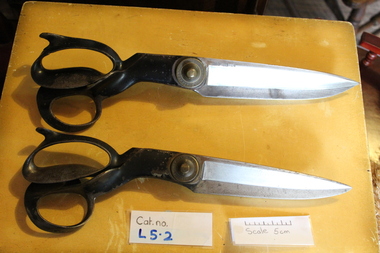
Tailor's Shears, Heinisch
... L5.1 Steel 15 inch Tailor's scissors L5.2 Steel 14 inch Tailor's scissors...Part of Herks Collection Heinisch Inventor, Newark, NJ, USA L5.1 Steel 15 inch Tailor's scissors L5.2 Steel 14 inch Tailor's scissors Tailor's Shears Heinisch ...Part of Herks CollectionL5.1 Steel 15 inch Tailor's scissors L5.2 Steel 14 inch Tailor's scissorsHeinisch Inventor, Newark, NJ, USA -
 City of Moorabbin Historical Society (Operating the Box Cottage Museum)
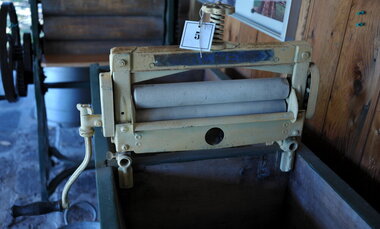
Functional object - Laundry Eqipment , 'ACME' clothes wringer, mid 20thC
... ACME 14 INCH / on hand crank is list of patents for Great Britain, USA, Aust. ...The Exchange Hotel Nepean Highway Cheltenham was a well established meeting place for Moorabbin Shire settlers by 1915 moorabbin bentleigh cheltenham laundry equipment washing washing mangles washing machines ACME 14 INCH / on hand crank is list of patents for Great Britain, USA, Aust. ...This ACME portable clothes wringer could be attached to a wash trough or hand washing machine to remove excess water from the washing. It was much less cumbersome that the earlier Mangles used for this purposeMost homes of 20th C in City of Moorabbin would have had one of these ACME wringers . It greatly eased the washday burden of the women. The Exchange Hotel Nepean Highway Cheltenham was a well established meeting place for Moorabbin Shire settlers by 1915A metal clothes wringer with side hand crank and 2 rollers that could be attached by screw clamps to a wash trough or washing machine for removing excess water from washing. The pressure of 2 rollers was controlled by a screw on the top of machine that could be loosened or tightened according to the material being passed through.ACME 14 INCH / on hand crank is list of patents for Great Britain, USA, Aust. NZ, Germany, Belgium, Sweden moorabbin, bentleigh, cheltenham, laundry equipment, washing, washing mangles, washing machines -
 Federation University Historical Collection
Equipment - Computerphone, Telecom, Telecom Computerphone Executive Series, 1985 (estimated)
... A 14 inch colour monitor, keyboard and phone handset complete with accessories and instruction manuals. ...The computerphone was an advanced telephone, a personal computer with a built-in display and two micro-drives for storage, an information terminal, and electronic messaging terminal and included a printer option. stitchboard computer screen telephone telecommunications A 14 inch colour monitor, keyboard and phone handset complete with accessories and instruction manuals. ...The computerphone was an advanced telephone, a personal computer with a built-in display and two micro-drives for storage, an information terminal, and electronic messaging terminal and included a printer option.A 14 inch colour monitor, keyboard and phone handset complete with accessories and instruction manuals. The Computerphone was known as a 'CP'. See http://www.telephonecollecting.org/telecom.htmstitchboard, computer screen, telephone, telecommunications -
 Kiewa Valley Historical Society
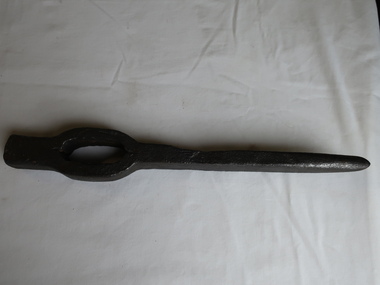
Miners' Pick Axe Head
... Cast steel 14 inches long with a sharp pointed end and a small flat end. ...Used in the Kiewa Valley by miners searching for gold. mining miners' pick axe Cast steel 14 inches long with a sharp pointed end and a small flat end. ...Miners used pickaxes to break up rock and ore, making it easier to extract valuable minerals. The pointed end of the pickaxe was used to chip away at rock. The flat end was used to strike the rock for breaking it apart.Used in the Kiewa Valley by miners searching for gold.Cast steel 14 inches long with a sharp pointed end and a small flat end. There is a space for the handle which is missing and may have been made from wood.mining, miners' pick axe -
 Stawell Historical Society Inc
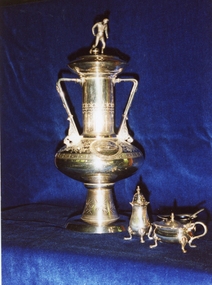
Photograph, Sprague Sporting Trophy inscribed and dated 1889
... Trophy size is about 14 Inches....Trophy size is about 14 Inches. Sprague Sporting Trophy inscribed and dated 1889 Photograph ...Sprague Sporting Trophy inscribed and dated 1889Colour Photogaph of A Trophy along side a small cruet set on a blue background. Trophy has a figure of a footballer on the top and has two handles. Trophy size is about 14 Inches.Inscribed on one Side Sprague Junior Challange Cup Won By The Warriors On the Other Side Presented to J.Carr Capt Stawell 1889 The Trophy is about 14" high ohoto taken alongside small cruet ste give an Idea of size.sport -
 Tennis Australia
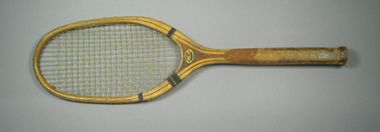
Racquet, 1889
... A wooden racquet with a 14 inch head. Inscription across throat of obverse reads: SPECIAL. ...Tennis A wooden racquet with a 14 inch head. Inscription across throat of obverse reads: SPECIAL. ...A wooden racquet with a 14 inch head. Inscription across throat of obverse reads: SPECIAL. Company trademark across throat of reverse: NARRAGANSETT MACHINE CO./.../"LIVE-WOOD"/PROVIDENCE, R.I. Brown leather butt cap has company monogram 'NMCO STANDARD' stamped in gold. Materials: Wood, Glue, Lacquer, Ink, Leather, Metal, String, Nylontennis -
 Tennis Australia
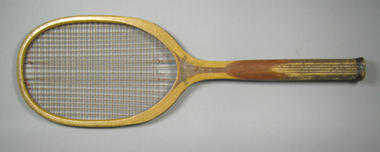
Racquet, Circa 1900
... A wooden, slotted handle racquet with a 14 inch head. Inscription across neck of obverse: DREADNOUGHT/DRIVER/... ...Tennis A wooden, slotted handle racquet with a 14 inch head. Inscription across neck of obverse: DREADNOUGHT/DRIVER/... ...A wooden, slotted handle racquet with a 14 inch head. Inscription across neck of obverse: DREADNOUGHT/DRIVER/... Inscription across neck of reverse: HARRY C. LEE & CO/NEW YORK. Company monogram 'L&C' is stamped on leather butt cap. Manufacturing and patent information along the sides of the handle, with size and production numbers punched in. Materials: Wood, Gut, Leather, Metal, Ink, Glue, Lacquertennis -
 Tennis Australia
Racquet, Circa 1905
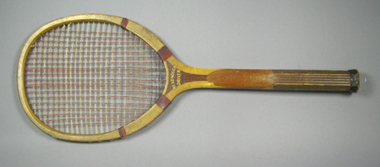
... A wooden, slotted handle racquet with a 14 inch head. Inscription across neck of obverse: DREADNOUGHT/DRIVER/... ...Tennis A wooden, slotted handle racquet with a 14 inch head. Inscription across neck of obverse: DREADNOUGHT/DRIVER/... ...A wooden, slotted handle racquet with a 14 inch head. Inscription across neck of obverse: DREADNOUGHT/DRIVER/... Inscription across neck of reverse: HARRY C. LEE & CO/NEW YORK. Company logo 'LEE' is stamped on leather butt cap. Manufacturing and patent information along the sides of the handle, with size and production numbers punched in. Materials: Wood, Gut, Leather, Metal, Ink, Glue, Lacquer, Stringtennis -
 Tennis Australia
Racquet, Circa 1905
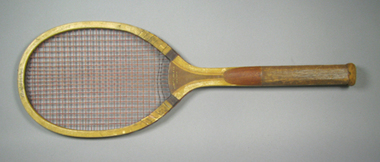
... Wooden, slotted handle racquet with a 14 inch head. 'AUSTRALASIAN' model, as inscribed across top of racquet head on obverse. ...Tennis Wooden, slotted handle racquet with a 14 inch head. 'AUSTRALASIAN' model, as inscribed across top of racquet head on obverse. ...Wooden, slotted handle racquet with a 14 inch head. 'AUSTRALASIAN' model, as inscribed across top of racquet head on obverse. Inscription across neck of obverse: HARRY C. LEE & CO./NEW YORK. Company monogram across neck of reverse, and stamped on leather butt cap: L&C/TRADEMARK. Manufacturing and patent information along the sides of the handle, with the numbers '247' and '14' punched in. Materials: Wood, Gut, Leather, Metal, Ink, Glue, Lacquer, Cloth tapetennis -
 Tennis Australia
Racquet, Circa 1920
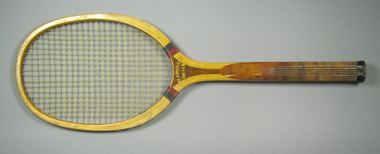
... A wooden, slotted handle racquet with a 14 inch head. Inscription across neck of obverse: DREADNOUGHT/DRIVER/... ...Tennis A wooden, slotted handle racquet with a 14 inch head. Inscription across neck of obverse: DREADNOUGHT/DRIVER/... ...A wooden, slotted handle racquet with a 14 inch head. Inscription across neck of obverse: DREADNOUGHT/DRIVER/... Inscription across neck of reverse: HARRY C. LEE & CO/NEW YORK. Company logo 'LEE' is stamped on leather butt cap. Manufacturing and patent information along the sides of the handle, with size and production numbers punched in. A blue and yellow lozenge shaped sticker below the neck on reverse features information of racquet gut manufacturer. Materials: Wood, Leather, Metal, Gut, Glue, Lacquer, Paper, Ink, Stringtennis -
 Sunshine and District Historical Society Incorporated
Photograph - H.V. McKay Massey Harris Horse Drawn Equipment Photographs
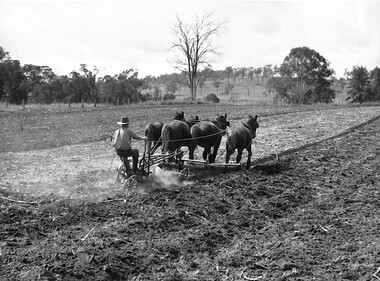
... Of 'Glenlea' Colac, VIC Ploughing For Union Crop Using His 14 Inch New Model Plough 1948 4659.04 - H.V. ...Of 'Glenlea' Colac, VIC Ploughing For Union Crop Using His 14 Inch New Model Plough 1948 4659.04 - H.V. ...Many of these photographs appeared in the Massey Ferguson Review Publication4659.01 - H.V. McKay Massey Harris - Horse Drawn Equipment - Mr. Mollanhower At Harlin QLD, Ploughing Maize Lands With His 2 Furrow Sunnie Disc Plough August 1948 4659.02 - H.V. McKay Massey Harris - Horse Drawn Equipment - Ploughing An Onion Crop At Colac Disctrict, VIC Using A Sungrade 2 Forrow Stump Jump Plough 4659.03 - H.V. McKay Massey Harris - Horse Drawn Equipment - Mr. Russell Jun. Of 'Glenlea' Colac, VIC Ploughing For Union Crop Using His 14 Inch New Model Plough 1948 4659.04 - H.V. McKay Massey Harris - Horse Drawn Equipment - Mr. Russell Jun. Of 'Glenlea' Colac, VIC Ploughing For Union Crop Using His 14 Inch New Model Plough 1948 4659.05 - H.V. McKay Massey Harris - Horse Drawn Equipment - No 89X Satellite Doing Cultivation & Weeding On Property Billinga Bros Property Burwood, VIC 4659.06 - H.V. McKay Massey Harris - Horse Drawn Equipment - Early Massey Drill Cultivator C1920's 4659.07 - H.V. McKay Massey Harris - Horse Drawn Equipmenth.v. mckay massey harris, sunshine harvester works, farm machinery -
 Clunes Museum
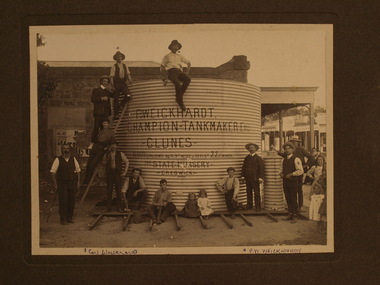
Photograph, WEICKHARDT'S TANK
... TANK MADE FOR THE CRESWICK NURSERY- 10,000 GALLONS - 14 FEET 3 INCHES WIDE X 10 FEET 6 INCHES MADE OF 22 GAUGE GALVANISED IRON....TANK MADE FOR THE CRESWICK NURSERY- 10,000 GALLONS - 14 FEET 3 INCHES WIDE X 10 FEET 6 INCHES MADE OF 22 GAUGE GALVANISED IRON. photography shops -weickhardt's tank factory. weickhardt WEICKHARDT TANK CHAMPION TANKMAKER PHOTOGRAPH OF GROUP OF MEN AND CHILDREN [INCLUDES CARL AND FRITZ WEICKHARDT] WITH A LARGE TANK MADE AT WEICKHARDT'S TANK FACTORY IN FRASER STREET, CLUNES. .1 BLACK AND WHITE PHOTOGRAPH MOUNTED ON MATT BOARD .2 PHOTO PRINT OF BLACK AND WHITE PHOTOGRAPH .3 PRINT OF PHOTOGRAPH WEICKHARDT'S TANK Photograph PHOTOGRAPH HORNBY - CLUNES ...TANK MADE FOR THE CRESWICK NURSERY- 10,000 GALLONS - 14 FEET 3 INCHES WIDE X 10 FEET 6 INCHES MADE OF 22 GAUGE GALVANISED IRON.PHOTOGRAPH OF GROUP OF MEN AND CHILDREN [INCLUDES CARL AND FRITZ WEICKHARDT] WITH A LARGE TANK MADE AT WEICKHARDT'S TANK FACTORY IN FRASER STREET, CLUNES. .1 BLACK AND WHITE PHOTOGRAPH MOUNTED ON MATT BOARD .2 PHOTO PRINT OF BLACK AND WHITE PHOTOGRAPH .3 PRINT OF PHOTOGRAPHphotography, shops -weickhardt's tank factory., weickhardt, weickhardt tank, champion tankmaker -
 Bendigo Historical Society Inc.
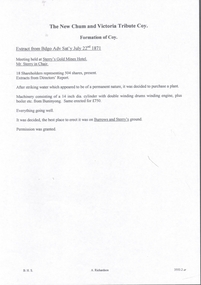
Document - NEW CHUM & VICTORIA TRIBUTE COY - EXTRACT OF MEETING
... Machinery consisting of a 14-inch dia. Cylinder with double winding drums, winding engine, plus boiler etc. from Buningong. ...Machinery consisting of a 14-inch dia. Cylinder with double winding drums, winding engine, plus boiler etc. from Buningong. ...New Chum and Victoria Tribute Coy. Formation of Coy. Extract from Bendigo Advertiser Saturday July 22, 1871. Meeting held at Sterry's Gold Mines Hotel. Mr. Sterry in Chair. 18 shareholders representing 504 shares present. Extracts from Director's Report. After striking water which appeared to be of a permanent nature, it was decided to purchase a plant. Machinery consisting of a 14-inch dia. Cylinder with double winding drums, winding engine, plus boiler etc. from Buningong. Same erected for 750 pounds. Everything going well. It was decided, the best place to erect it was on Burrows and Sterry's ground. Permission was granted.document, gold, new chum & victoria tribute coy, extract of meeting new chum & victoria tribute coy, bendigo advertiser, mr sterry, gold mines hotel, mr burrows -
 Whitehorse Historical Society Inc.
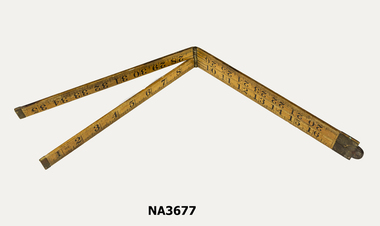
Functional object - Rule, not known
... inch. Metal ends and hinges. Hinge in centre 9inches from each end. Two small nails positioned at 14 and 22 inch marks and 10 and 26 inch marks to keep folded rule in place....inch. Metal ends and hinges. Hinge in centre 9inches from each end. Two small nails positioned at 14 and 22 inch marks and 10 and 26 inch marks to keep folded rule in place. ...not knownThree foot rule, collapsible to nine inch. Metal ends and hinges. Hinge in centre 9inches from each end. Two small nails positioned at 14 and 22 inch marks and 10 and 26 inch marks to keep folded rule in place.school, equipment, instruments, measuring -
 Tennis Australia
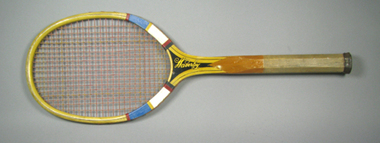
Racquet, Circa 1910
... A wooden, slotted handle racquet with a 14 1/2 inch head. Inscription along neck and stem of obverse: WAVERLEY. ...Tennis A wooden, slotted handle racquet with a 14 1/2 inch head. Inscription along neck and stem of obverse: WAVERLEY. ...A wooden, slotted handle racquet with a 14 1/2 inch head. Inscription along neck and stem of obverse: WAVERLEY. Inscription across neck of reverse: HARRY C. LEE & CO/NEW YORK. Company logo 'LEE' imprinted in gold on leather butt cap. Inscriptions featuring manufacturing and patent details situated along the sides of the stem. Materials: Wood, Glue, Lacquer, Ink, String, Paint, Gut, Leather, Metaltennis -
 Tennis Australia
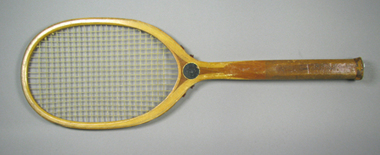
Racquet, Circa 1900
... Wooden, slotted handle racquet with a 14 1/2 inch head. Partial inscription across top of racquet head on obverse: 'LEE SPECIA...', i.e. a 'Lee Special' model racquet. ...Tennis Wooden, slotted handle racquet with a 14 1/2 inch head. Partial inscription across top of racquet head on obverse: 'LEE SPECIA...', i.e. a 'Lee Special' model racquet. ...Wooden, slotted handle racquet with a 14 1/2 inch head. Partial inscription across top of racquet head on obverse: 'LEE SPECIA...', i.e. a 'Lee Special' model racquet. Inscription across neck of obverse: HARRY C. LEE & CO./NEW YORK. Company monogram across neck of reverse, and stamped on leather butt cap: L&C/TRADEMARK. Manufacturing and patent information along the sides of the handle, with the numbers '403' and '14 1/2' punched in. Materials: Wood, Gut, Leather, Metal, Ink, Glue, Lacquertennis -
 City of Moorabbin Historical Society (Operating the Box Cottage Museum)
Tool - Tenon Saw 20thC, 20thC
... This small fine-toothed saw with a strong back, used especially for cutting tenons on hard and soft woods, usually a Tenon saw will have between 10 and 14 teeth per 2.5cm (inch), this allows more control over the depth and direction of the cut. ...This small fine-toothed saw with a strong back, used especially for cutting tenons on hard and soft woods, usually a Tenon saw will have between 10 and 14 teeth per 2.5cm (inch), this allows more control over the depth and direction of the cut. ...This small fine-toothed saw with a strong back, used especially for cutting tenons on hard and soft woods, usually a Tenon saw will have between 10 and 14 teeth per 2.5cm (inch), this allows more control over the depth and direction of the cut. Among the early settlers in Moorabbin Shire were blacksmiths who made tools for the other settlers who were establishing the homes, market gardens, farms, orchards and various businesses. Early settlers were self reliant and repaired their own equipment for kitchen,dairy, farm, horses, carts using various tools . This tenon saw is typical of the type used by early settlers in Moorabbin Shire 20th CA small fine-toothed steel saw with a strong back and wood handle, used esp for cutting tenons - fitted pieces of wood to insert into a cavity.saws, tenon saws, early settlers, market gardeners, blacksmiths, tools, building equipment, hammers, moorabbin shire, bentleigh, mckinnon, highett, cheltenham,mcewan james pty ltd, melbourne, bunnings pty ltd, -
 Tennis Australia
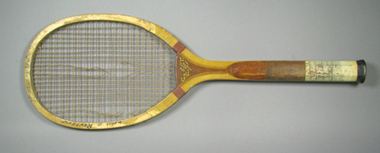
Racquet, Circa 1905
... Wooden, slotted handle racquet with a 14 1/2 inch head. Handwritten inscription across side of racquet head on obverse: LOUIS A. ...Tennis Wooden, slotted handle racquet with a 14 1/2 inch head. Handwritten inscription across side of racquet head on obverse: LOUIS A. ...Wooden, slotted handle racquet with a 14 1/2 inch head. Handwritten inscription across side of racquet head on obverse: LOUIS A. RENFROW. Surname also written across outside of head. Inscription across neck of obverse: HARRY C. LEE & CO/NEW YORK. Company logo 'LEE' on neck of reverse, and stamped on leather butt cap. Butt cap has a red and gold sticker adhered over it, advertising a St.Louis sproting company which originally strung racquet. Manufacturing and patent information along the sides of the handle, with the numbers '500', 'FS78' and '14 1/2' punched in. Materials: Wood, Gut, Leather, Metal, Ink, Glue, Lacquertennis -
 City of Moorabbin Historical Society (Operating the Box Cottage Museum)
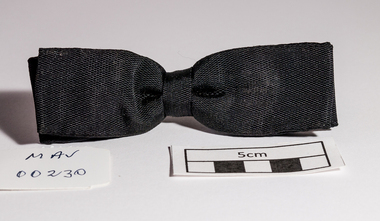
Accessory - Clothing, bow tie, black , spring clip, 20thC
... Sizes can vary between approximately 14 and 20 inches just like a comparable shirt collar. ...Sizes can vary between approximately 14 and 20 inches just like a comparable shirt collar. ...The Bow Tie is a type of men's necktie that consists of a ribbon of fabric tied around the collar in a symmetrical manner such that the two opposite ends form loops. Ready-tied Bow ties are available, in which the distinctive Bow is sewn and a band goes around the neck and clips to secure. Bow ties may be made of any fabric material, but most are made from silk, polyester, cotton, or a mixture of fabrics. The Bow tie originated among Croatian mercenaries during the Prussian wars of the 17th century when the Croat mercenaries used a scarf around the neck to hold together the opening of their shirts. This was soon adopted under the name cravat, derived from the French for "Croat", by the upper classes in France, then a leader in fashion, and flourished in the 18th and 19th centuries. The most traditional Bow ties are usually of a fixed length and are made for a specific size neck. Sizes can vary between approximately 14 and 20 inches just like a comparable shirt collar. Fixed-length Bow ties are preferred when worn with the most formal wing-collar shirts, so as not to expose the buckle or clasp of an adjustable Bow tie. Bow ties are worn by magicians, country doctors, paediatricians, lawyers, professors musicians and by people hoping to look like the above and clowns also wear oversized ones. In the 1980’s fashionable and professional women wore a type of Bow tie. Most men only wear Bow ties with formal dress. A man's pre-tied black bow tie with a metal spring clip to attach to the shirt collar. The 2 spring clips have 'alligator teeth' to grip the collaron spring clip MADE IN AUSTRALIA SPRINGmenswear, clothing, bow ties, cheltenham, moorabbin, bentleigh, early settlers, pioneers, market gardeners, male neckwear -
 City of Moorabbin Historical Society (Operating the Box Cottage Museum)
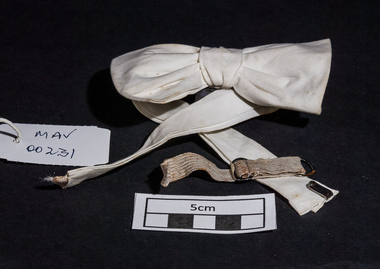
Clothing - Clothing, bow tie, white , elastic clip, 20thC
... Sizes can vary between approximately 14 and 20 inches just like a comparable shirt collar. ...Sizes can vary between approximately 14 and 20 inches just like a comparable shirt collar. ...The Bow Tie is a type of men's necktie that consists of a ribbon of fabric tied around the collar in a symmetrical manner such that the two opposite ends form loops. Ready-tied Bow ties are available, in which the distinctive Bow is sewn and a band goes around the neck and clips to secure. Bow ties may be made of any fabric material, but most are made from silk, polyester, cotton, or a mixture of fabrics. The Bow tie originated among Croatian mercenaries during the Prussian wars of the 17th century when the Croat mercenaries used a scarf around the neck to hold together the opening of their shirts. This was soon adopted under the name cravat, derived from the French for "Croat", by the upper classes in France, then a leader in fashion, and flourished in the 18th and 19th centuries. The most traditional Bow ties are usually of a fixed length and are made for a specific size neck. Sizes can vary between approximately 14 and 20 inches just like a comparable shirt collar. Fixed-length Bow ties are preferred when worn with the most formal wing-collar shirts, so as not to expose the buckle or clasp of an adjustable Bow tie. Bow ties are worn by magicians, country doctors, paediatricians, lawyers, professors musicians and by people hoping to look like the above and clowns also wear oversized ones. In the 1980’s fashionable and professional women wore a type of Bow tie. Most men only wear Bow ties with formal dress. A pre tied white Bow tie sewn on a neckband with an elastic clip fastenermenswear, clothing, bow ties, cheltenham, moorabbin, bentleigh, early settlers, pioneers, market gardeners, male neckwear -
 City of Moorabbin Historical Society (Operating the Box Cottage Museum)
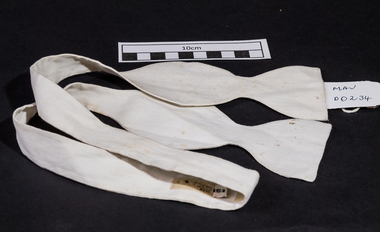
Clothing - Clothing, bow tie white, fixed length, 20thC
... Sizes can vary between approximately 14 and 20 inches just like a comparable shirt collar. ...Sizes can vary between approximately 14 and 20 inches just like a comparable shirt collar. ...The Bow Tie is a type of men's necktie that consists of a ribbon of fabric tied around the collar in a symmetrical manner such that the two opposite ends form loops. Ready-tied bow ties are available, in which the distinctive bow is sewn and a band goes around the neck and clips to secure. Bow ties may be made of any fabric material, but most are made from silk, polyester, cotton, or a mixture of fabrics. The Bow tie originated among Croatian mercenaries during the Prussian wars of the 17th century when the Croat mercenaries used a scarf around the neck to hold together the opening of their shirts. This was soon adopted under the name cravat, derived from the French for "Croat", by the upper classes in France, then a leader in fashion, and flourished in the 18th and 19th centuries. The most traditional Bow ties are usually of a fixed length and are made for a specific size neck. Sizes can vary between approximately 14 and 20 inches just like a comparable shirt collar. Fixed-length Bow ties are preferred when worn with the most formal wing-collar shirts, so as not to expose the buckle or clasp of an adjustable bow tie. Bow ties are worn by magicians, country doctors, lawyers, paediatricians, professors musicians and by people hoping to look like the above and clowns also wear oversized ones. In the 1980’s fashionable and professional women wore a type of Bow tie. Most men only wear Bow ties with formal dress. This white bow tie is a 'fixed length' type that needs to be tied by the person wearing it. MAKO SIZE 15 1/2 menswear, clothing, shirts, collars, early settlers, fashion, cheltenham, moorabbin, dairy farmers, market gardeners, bow ties, mako pty ltd -
 City of Moorabbin Historical Society (Operating the Box Cottage Museum)
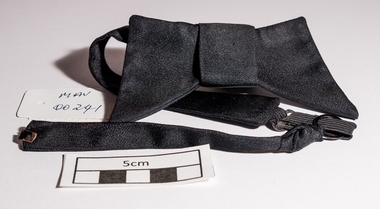
Accessory - Clothing, black bow tie, c1960
... Sizes can vary between approximately 14 and 20 inches just like a comparable shirt collar. ...Sizes can vary between approximately 14 and 20 inches just like a comparable shirt collar. ...The Bow Tie is a type of men's necktie that consists of a ribbon of fabric tied around the collar in a symmetrical manner such that the two opposite ends form loops. Ready-tied bow ties are available, in which the distinctive bow is sewn and a band goes around the neck and clips to secure. Bow ties may be made of any fabric material, but most are made from silk, polyester, cotton, or a mixture of fabrics. The Bow tie originated among Croatian mercenaries during the Prussian wars of the 17th century when the Croat mercenaries used a scarf around the neck to hold together the opening of their shirts. This was soon adopted under the name cravat, derived from the French for "Croat", by the upper classes in France, then a leader in fashion, and flourished in the 18th and 19th centuries. The most traditional Bow ties are usually of a fixed length and are made for a specific size neck. Sizes can vary between approximately 14 and 20 inches just like a comparable shirt collar. Fixed-length Bow ties are preferred when worn with the most formal wing-collar shirts, so as not to expose the buckle or clasp of an adjustable bow tie. Bow ties are worn by magicians, country doctors, lawyers, paediatricians, professors musicians and by people hoping to look like the above and clowns also wear oversized ones. In the 1980’s fashionable and professional women wore a type of Bow tie. Most men only wear Bow ties with formal dress. A man's pre tied black bow tie with an elastic fastening clipmenswear, neckties, bow ties, cheltenham. moorabbin, bentleigh -
 Flagstaff Hill Maritime Museum and Village
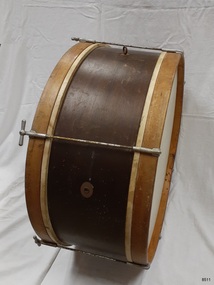
Instrument - Bass Drum, Ludwig & Ludwig, Early 1920's
... This Marching Bass Drum is mid-size at 68 cm; these drums can range from 35 to 81 cm (14 to 32 inches). A Marching Bass Drum is slightly smaller than a Concert Base Drum and larger than a Kit or Drum Set Bass Drum. ...This Marching Bass Drum is mid-size at 68 cm; these drums can range from 35 to 81 cm (14 to 32 inches). A Marching Bass Drum is slightly smaller than a Concert Base Drum and larger than a Kit or Drum Set Bass Drum. ...This Marching Bass Drum is mid-size at 68 cm; these drums can range from 35 to 81 cm (14 to 32 inches). A Marching Bass Drum is slightly smaller than a Concert Base Drum and larger than a Kit or Drum Set Bass Drum. The drum is supported by a shoulder harness with a pin that connects to the eyelet incorporated on the shell of the drum, which keeps the drumheads vertical. The drum is played with one or two felt-covered drum mallets. The six tension rods connected between the drumheads can be screwed tighter or looser to change the tension of the calfskins on the drumheads, which changes their tune. This Marching base drum was made in the early 1920s by the firm Ludwig & Ludwig of Chicago, Illinois, USA. LUDWIG & LUDWIG: - William F. Ludwig was a professional drummer. He and his brother Theobold established the Ludwig & Ludwig drum factory in Chicago in 1909. They became famous for their invention of a bass drum pedal that could play faster beats on the bass drum. Theobald passed away in 1918. By 1923 Ludwig was the biggest drum manufacturer in the world. William continued on when his business was bought by C.O. Conn, but in 1937 he left to begin his own company; the WFL Drum Company. William and his son Bill purchased the Ludwig & Ludwig name back from Conn, and the name William F. Ludwig II continued on. The brand was sold to the Selmer Company and moved to Monroe, North Carolina in 1998, at the time of the 75th anniversary of the Ludwig name. Ludwig drums are still being manufactured over 100 years later. Many famous musicians and bands played the Ludwig bass drum, including Ringo Star who was the drummer in the 1960’s group The Beatles.This marching bass drum is significant for its connection to Ludwig & Ludwig, a famous and popular drum manufacturer established in 1909. The firm was once the largest drum manufacturer in the world. It is known for supplying drummers of fame, such as Ringo Star of The Beatles. This is the only drum in our collection. It is also rare, having only six tension rods, where most have from eight to twelve.Marching Bass Drum; the polished shell around the body is one continuous sheet of timber that has been steamed, shaped into a cylinder and joined together. The drumheads on the sides of the shell are strong timber strips joined into hoops that hold stretched, hand-painted white calfskin. Six Long Tube threaded nickel-plated brass tension rods are evenly spaced around the drumheads between the drumheads. A brass eyelet is fitted into the shell halfway between each drumhead, providing a connection point for the drummer’s shoulder harness. The eyelet has an indecipherable inscription. An oval brass plaque with a central formed hole has a stamped inscription. The imperial size is 27 x 13 inches. The drum was made by Ludwig and Ludwig, Chicago, Illinois, in early 1920's. On brass plaque; “LUDWIG / TRADE MARK / LUDWIG & LUDWIG / CHICAGO”flagstaff hill, warrnambool, maritime village, maritime museum, flagstaff hill maritime museum and village, shipwreck coast, great ocean road, shipwreck artefact, marching drum, bass drum, marching bass drum, pitched drum, band drum, drum mallet, marching band, military band, percussion instrument, calfskin, shoulder harness, ludwig & ludwig, wfl drum company, william f. ludwig, chicago, north carolina, the beatles, tension taps, tension rods, drum pedal, long tube tension rods -
Southern Sherbrooke Historical Society Inc.
Textile - Helen Gibson collection - material, cottons, etc
... -White slub cotton bag, embroidered in white blanket stitch (14 inches wide X 10 1/2 inches high). VSSH0444 - A collection of artificial flowers for hats and dresses. ...-White slub cotton bag, embroidered in white blanket stitch (14 inches wide X 10 1/2 inches high). VSSH0444 - A collection of artificial flowers for hats and dresses. ... -
 Flagstaff Hill Maritime Museum and Village
Theodolite, Troughton & Simms, Mid 19th Century
... inch transit instrument in (1884). While the firm had an excellent reputation for quality the company exasperated many of its customers with delays of years in delivering some instruments. History for Thomas Gaunt: Thomas Ambrose Gaunt (1829 – 1890) was a jeweller, clock maker, and manufacturer of scientific instruments, whose head office and showroom were at 337–339 Bourke Street, Melbourne, Victoria, Australia. Thomas Gaunt established Melbourne's leading watchmaking, optical and jewellery business during the second half of the 19th century. Gaunt arrived in Melbourne in 1852, and by 1858 had established his own business at 14...inch transit instrument in (1884). While the firm had an excellent reputation for quality the company exasperated many of its customers with delays of years in delivering some instruments. History for Thomas Gaunt: Thomas Ambrose Gaunt (1829 – 1890) was a jeweller, clock maker, and manufacturer of scientific instruments, whose head office and showroom were at 337–339 Bourke Street, Melbourne, Victoria, Australia. Thomas Gaunt established Melbourne's leading watchmaking, optical and jewellery business during the second half of the 19th century. Gaunt arrived in Melbourne in 1852, and by 1858 had established his own business at 14 ...The theodolite was sold by T. Gaunt & Co. of Melbourne, a manufacturer, importer and retailer of a wide variety of goods including jewellery, clocks and watches, navigational and measuring instruments, dinnerware, glassware and ornaments. Thomas Gaunt photograph was included in an album of security identity portraits of members of the Victorian Court, Centennial International Exhibition, Melbourne, 1888. (See further details below.) History for Troughton & Simms: Edward Troughton & William Simms established a scientific instrument making business in London in 1826. Edward Troughton (1756-1835) had previously had his own scientific instrument business, inherited from his father. His achievement's included a transit telescope for Greenwich Observatory (1816) and the precision surveying instruments for the Ordnance Survey of Britain, Ireland and India. William Simms (1793-1860) had trained as a goldsmith and began to gain work dividing circles on fine astronomical instruments. When William Simms died in 1860, the business was taken over by his son James and nephew William. Troughton & Simms shop in Fleet Street became the hub of the finest scientific instrument made in London, in a period in which there was an expanding demand for precision instruments, for astronomy, surveying and precision measurement. They made instruments for Greenwich Observatory, for imperial surveys and exploring expeditions. When fire destroyed the Houses of Parliament in 1834, the firm was commissioned to create new standard lengths, this required 10 years of testing against the remaining old measurements. Troughton and Simms made several of the main instruments for Melbourne Observatory, including an 18 inch azimuth used of the Geodetic Survey, portable transit instrument (circa 1850), zenith sector (1860), a 4.5 inch equatorial telescope (1862), an 8 inch equatorial telescope (1874) spectroscope (1877) and an 8 inch transit instrument in (1884). While the firm had an excellent reputation for quality the company exasperated many of its customers with delays of years in delivering some instruments. History for Thomas Gaunt: Thomas Ambrose Gaunt (1829 – 1890) was a jeweller, clock maker, and manufacturer of scientific instruments, whose head office and showroom were at 337–339 Bourke Street, Melbourne, Victoria, Australia. Thomas Gaunt established Melbourne's leading watchmaking, optical and jewellery business during the second half of the 19th century. Gaunt arrived in Melbourne in 1852, and by 1858 had established his own business at 14 Little Bourke Street. Around 1869 he moved to new premises in Bourke Street on the corner of Royal Arcade, Gaunt's shop quickly became a Melbourne institution. Gaunt proudly advertised that he was 'The only watch manufacturer in the Australian colonies'. While many watches and clocks may have had Gaunt's name on the dial, few would have been made locally. Gaunt did make some watches for exhibitions, and perhaps a few expensive watches for wealthy individuals. Gaunt's received a telegraph signal from Melbourne Observatory each day to correct his main clock and used this signal to rate and repair ship's chronometers and good quality watches. Thomas Gaunt also developed a department that focused on scientific instrumentation, making thermometers and barometers (from imported glass tubes), telescopes, surveying instruments and microscopes. Significance: With the rapid urban expansion, one of the most important needs of the new colony was to survey and map the landscape of the Australian Colony’s interior. Theodolites, such as this one, made by Troughton and Simms, who were significant scientific instrument makers of the 19th century were instrumental to the colony's surveyors and would have played an important part in their everyday work. This transit theodolite remains of national significance due to its pioneering role in Australian science and its association with Australia's earliest surveyors and astronomers. It is also significant for its association with nineteenth-century surveying instruments and instrument makers. Theodolite, Vernier repetition theodolite with enclosed horizontal circle (of about 130 mm diameter). Vertical circle exposed and somewhat corroded (diameter about 115 mm). Plate level 20" per division. Altitude bubble 20" per division. Horizontal and vertical circle intervals 20". Original (blue/grey) paint. Altitude bubble setting screw disabled. Tribrach allows movement of theodolite by 15 mm inside tribrach (for centering).Inscribed on the inner mounting plate,“Specially made in England for T Gaunt & Co Melbourne” and inscribed a little lower “Troughton & Simms London”flagstaff hill, warrnambool, shipwrecked-coast, flagstaff-hill, flagstaff-hill-maritime-museum, maritime-museum, shipwreck-coast, flagstaff-hill-maritime-village, theodolite, t. gaunt & co, troughton & simms, scientific instrument, measuring instrument, surveyor's instrument -
 Flagstaff Hill Maritime Museum and Village
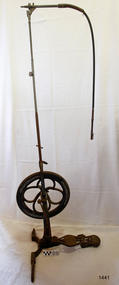
Equipment - Dentist Drill, Late 19th century
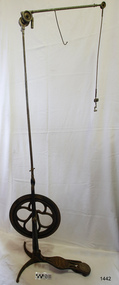
... White Catalogue of Dentist Instruments listed a 12 ½ inch wheel diameter dental engine, with 14 bright steel parts, for sale at US $55 In today’s market, this is the equivalent to US $1200 approx. ...White Catalogue of Dentist Instruments listed a 12 ½ inch wheel diameter dental engine, with 14 bright steel parts, for sale at US $55 In today’s market, this is the equivalent to US $1200 approx. ...The design of this and other similar treadle powered dental engine (or dentist drill) was in common use by dentists from the 1870’s into the 1920's. When electricity became accessible to most communities the electrically powered dental engines began to take over from the treadle power. Over the ages teeth were extracted using picks and scissors and other gouging instruments. Bow drills, hand drills and even a "bur thimble" drill were later used to prepare cavities for filling. Some drills were made bendable by attaching flexible shanks between the metal bur and the handle, giving access to the teeth at the back of the mouth. Other mechanical devices were introduced along the way, such as clockwork drills, but they were hard to handle and inefficient. Over the centuries “dentistry has been performed by priests, monks and other healers. This was followed by barbers; the barber’s chair may well have been the precursor to the dental chair. “(SA Medical Heritage Society Inc.) In 1871 James Morrison patented the first commercially manufactured 'foot treadle dental engine', the first practica dental engine although others had been introduced as early as 1790 (by John Greenwood). Handmade steel burs or drills were introduced for dental handpieces, taking advantage of the significant increase in the speed of the drill. In 1891 the first machine-made steel burs were in use. The treadle drill reduced the time to prepare a cavity from hours to less than ten minutes. In 1876 the Samuel S. White Catalogue of Dentist Instruments listed a 12 ½ inch wheel diameter dental engine, with 14 bright steel parts, for sale at US $55 In today’s market, this is the equivalent to US $1200 approx. The specifications of that dental engine are very similar to the this one in our Flagstaff Hill Maritime Village’s collection. It is interesting to note that workings of a similar treadle dentist drill were used and modified to power a treadle spinning wheel of one of the volunteer spinners at Flagstaff Hill Maritime Village. The foot treadle dental engine was a milestone in dental history. “Historic importance of treadle powered machines; they made use of human power in an optimal way” (Lowtech Magazine “Short history of early pedal powered machines”) The invention of a machine to speed up the process of excavation of a tooth lead to the invention of new burs and drills for the handpieces, improving speed and the surgical process of dentistry. They were the fore-runner of today’s electrically powered dental engines. This treadle-powered dentist drill, or dentist engine, is made of iron and steel and provides power for a mechanical dental hand-piece that would be fitted with a dental tool. The drill has a three footed cast iron base, one foot being longer than the other two. A vertical C shaped frame is joined into the centre of the base, holding an axle that has a driving-wheel (or flywheel) and connecting to a crank. A slender, shoulder height post, made from telescoping pipes, joins into the top of this frame and is height adjusted by a hand tightened screw with a round knob. On the post just above the frame is a short metal, horizontal bar (to hold the hand-piece when it is not in use). A narrow tubular arm is attached to the top of the stand at a right angle and can move up and down. At the end of the arm is a firmly fixed, flexible rubber hose protected for a short distance by a sheath of thin metal. At the end of the hose there is a fitting where the drill’s hand-piece would be attached; a small, silver coloured alligator clip is also at the end. A treadle, or foot pedal, is hinged to the heel to the long foot of the base, and joined at the toe to the crank that turns the driving-wheel. There is a spring under the toe of the treadle. The metal driving-wheel has a wide rim. Touching the inside of the rim are four tubular rings that bulge towards the outside of the driving-wheel, away from the pole, and all meet at the hub of the axle. The axle is bulbous between the inside of the driving-wheel and the frame then passes through the frame and is attached on the other side. The driving-wheel has a groove around which a belt would sit. The belt would also fit around a pulley on the arm, at the top of the post. The pulley is joined to a rod inside the arm and this spins the drill's hand-piece and dental tool holder. The two shorter feet of the base are made from a long metal bar that has been curved outwards, and its centre is bolted to the base of the pole. Under the ends of the curved legs of the base are wedge shaped feet. The driving-wheel is decorated in light coloured paint on both sides, each side having three sets of floral decals evenly spaced around them, and each about a sixth of the wheel's circumference. Similar decoration is along the sides of the frame. The foot pedal has decorative cutout patterns in the centre of the foot and at the toe. On the long foot of the stand is some lettering with a fine, light coloured border around it. The lettering is hard to read, being a dark colour and flaking off. There are also remnants of fine, light coloured flourishes. The foot pedal has lettering of the maker’s trade mark cast into the metal at the ball of the foot. Lettering on the base is peeling and difficult to read. The foot pedal has a trade mark cast into it that looks like a combination of ‘C’ , ‘S’ , ‘A’, ‘R’. flagstaff hill, warrnambool, shipwrecked coast, flagstaff hill maritime museum, maritime museum, shipwreck coast, flagstaff hill maritime village, great ocean road, dentist, teeth, dental drill, dental engine, treadle drill, foot powered drill, treadle engine, orthodontics, dental surgery, james morrison -
 Flagstaff Hill Maritime Museum and Village
Equipment - Dentist Drill, Late 19th century
... White Catalogue of Dentist Instruments listed a 12 ½ inch wheel diameter dental engine, with 14 bright steel parts, for sale at US $55 In today’s market, this is the equivalent to US $1200 approx. ...White Catalogue of Dentist Instruments listed a 12 ½ inch wheel diameter dental engine, with 14 bright steel parts, for sale at US $55 In today’s market, this is the equivalent to US $1200 approx. ...The design of this and other similar treadle powered dental engine (or dentist drill) was in common use by dentists from the 1870’s into the 1920's. When electricity became accessible to most communities the electrically powered dental engines began to take over from the treadle power. Over the ages teeth were extracted using picks and scissors and other gouging instruments. Bow drills, hand drills and even a "bur thimble" drill were later used to prepare cavities for filling. Some drills were made bendable by attaching flexible shanks between the metal bur and the handle, giving access to the teeth at the back of the mouth. Other mechanical devices were introduced along the way, such as clockwork drills, but they were hard to handle and inefficient. Over the centuries “dentistry has been performed by priests, monks and other healers. This was followed by barbers; the barber’s chair may well have been the precursor to the dental chair. “(SA Medical Heritage Society Inc.) In 1871 James Morrison patented the first commercially manufactured 'foot treadle dental engine', the first practica dental engine although others had been introduced as early as 1790 (by John Greenwood). Handmade steel burs or drills were introduced for dental handpieces, taking advantage of the significant increase in the speed of the drill. In 1891 the first machine-made steel burs were in use. The treadle drill reduced the time to prepare a cavity from hours to less than ten minutes. In 1876 the Samuel S. White Catalogue of Dentist Instruments listed a 12 ½ inch wheel diameter dental engine, with 14 bright steel parts, for sale at US $55 In today’s market, this is the equivalent to US $1200 approx. The specifications of that dental engine are very similar to the this one in our Flagstaff Hill Maritime Village’s collection. It is interesting to note that workings of a similar treadle dentist drill were used and modified to power a treadle spinning wheel of one of the volunteer spinners at Flagstaff Hill Maritime Village. The foot treadle dental engine was a milestone in dental history. “Historic importance of treadle powered machines; they made use of human power in an optimal way” (Lowtech Magazine “Short history of early pedal powered machines”) The invention of a machine to speed up the process of excavation of a tooth lead to the invention of new burs and drills for the handpieces, improving speed and the surgical process of dentistry. They were the fore-runner of today’s electrically powered dental engines. This treadle-powered dentist drill, or dentist engine, is made of iron and steel and provides power for a mechanical dental handpiece that would be fitted with a dental tool. On the foot is painted lettering naming it "The Brentfield" and there is a fine line of light coloured paint creating a border around the name. The paint under the lettering is peeling off. The drill has a Y-shaped, three footed cast iron base, one foot being longer than the other two. A vertical frame is joined into the centre of the base, holding an axle that has a driving-wheel (or flywheel) and connecting to a crank. A slender, shoulder height post, made from adjustable telescoping pipes, joins into the top of this frame. On the post just above the frame is a short metal, horizontal bar (to hold the hand-piece when it is not in use). A narrow tubular arm is attached to the top of the stand at a right angle and can move up, down and around. There is a pulley each side of the joint of the arm and a short way along the arm is fitted a short metal pipe. A little further along the arm a frayed-ended cord hangs down from a hole. At the end of the arm is another pulley and a joint from which hangs a long, thin metal pipe with two pulleys and a fitting on the end. A treadle, or foot pedal, is joined to the long foot of the base, and joined at the toe to the crank that turns the driving-wheel. The metal driving-wheel has a wide rim. Touching the inside of the rim are four tubular rings that bulge towards the outside of the driving-wheel, away from the pole, and all meet at the hub of the axle. The axle fits between the inside of the driving-wheel and the frame then passes through the frame and is attached on the other side. The driving-wheel has a groove around which a belt would sit. The belt would also fit around a pulley on the arm, at the top of the post. The pulley is joined to a rod inside the arm and this spins the drill's hand-piece and dental tool holder. The foot pedal has a cross-hatch pattern on the heel and the ball of the foot has tread lines across it. The end of the toe and the instep areas have cut-out pattern in them. "The ____/ Brentfield / __ DE IN L___" (Made in London) painted on the long foot of the base. Marked on the drill connection is “Richter De Trey, Germany”flagstaff hill, warrnambool, shipwrecked coast, flagstaff hill maritime museum, maritime museum, shipwreck coast, flagstaff hill maritime village, great ocean road, dentist, teeth, dental drill, dental engine, treadle drill, foot powered drill, treadle engine, orthodontics, dental surgery, james morrison, the brentfield, richter de trey, german dental fitting, london dental drill -
 Federation University Historical Collection
Instrument, Chance Brothers, Searchlight Mirror, 1915
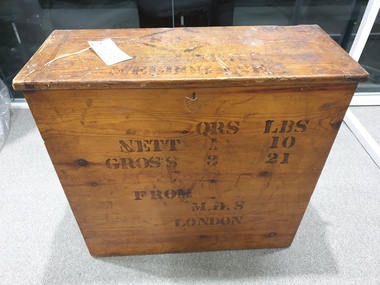
... Richards when teaching. searchlight mirror scientific instrument r.w. richards dick richards Pat. No. 14 24 inch diameter searchlight mirror. A curved circular glass dish surrounded by a brass edge strip, in a wooden crate. ...It is believed this item was used by R.W. Richards when teaching.24 inch diameter searchlight mirror. A curved circular glass dish surrounded by a brass edge strip, in a wooden crate.Pat. No. 14searchlight, mirror, scientific instrument, r.w. richards, dick richards
