
Showing 28 items matching "170 years"
-
 Greensborough Historical Society
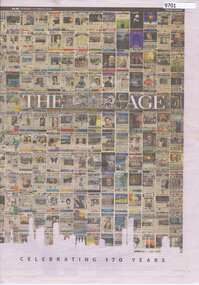
Newspaper - Newspaper supplement, The Age, The Age - celebrating 170 years, 17/10/2024
... The Age - celebrating 170 years......170 years...Celebrating 170 years of The Age newspaper...Celebrating 170 years of The Age newspaper the age melbourne 170 years 16 page newspaper supplement with black and white text, and black & white and coloured photos and images The Age - celebrating 170 years Newspaper Newspaper supplement The Age ...Celebrating 170 years of The Age newspaper16 page newspaper supplement with black and white text, and black & white and coloured photos and imagesthe age, melbourne, 170 years -
 Port Melbourne Historical & Preservation Society
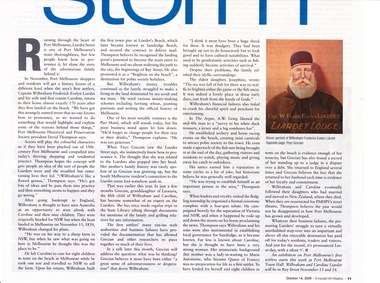
Newspaper - Liardet 170 years Exhibition, Emerald Hill Weekly ; The Leader, 14 Oct 2009
... Liardet 170 years Exhibition...Colour digital copy of a newspaper article from the Emerald Hill Weekly, 14 Oct 2009 promoting the forthcoming PMHPS exhibition marking 170 years since the Liardet family landed in 1839. ...Newspaper Liardet 170 years Exhibition Emerald Hill Weekly ; The Leader ...Colour digital copy of a newspaper article from the Emerald Hill Weekly, 14 Oct 2009 promoting the forthcoming PMHPS exhibition marking 170 years since the Liardet family landed in 1839. The article quotes Liardet descendent Ynys GRECIAN.liardet family, ynys grecian, wfe liardet, wilbraham frederick evelyn liardet, pmhps, port melbourne historical & preservation society, celebrations fetes and exhibitions -
 Melbourne Athenaeum Archives
Video - ABC 7.30 Report: The Athenaeum 's 170th birthday, Australian Broadcasting Corporation, Melbourne, Athenaeum building celebrates 170 years, 11/11/2009
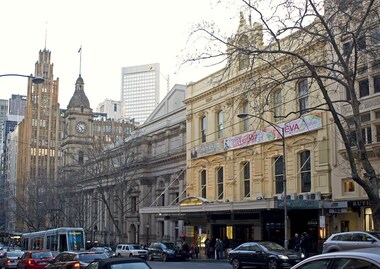
... Athenaeum building celebrates 170 years...Transcript: Athenaeum building celebrates 170 years Australian Broadcasting Corporation Broadcast: 11/11/2009 Reporter: Lisa Whitehead Tomorrow marks the 170th birthday of one of the nation's historic cultural landmarks. ...Transcript: Athenaeum building celebrates 170 years Australian Broadcasting Corporation Broadcast: 11/11/2009 Reporter: Lisa Whitehead Tomorrow marks the 170th birthday of one of the nation's historic cultural landmarks. ...Transcript: Athenaeum building celebrates 170 years Australian Broadcasting Corporation Broadcast: 11/11/2009 Reporter: Lisa Whitehead Tomorrow marks the 170th birthday of one of the nation's historic cultural landmarks. Melbourne’s Athenaeum building has, in one form or other, provided education and entertainment for the Victorian colony as it became a city; and along the way, documented its growth. Transcript KERRY O’BRIEN, PRESENTER: Tomorrow marks the 170th birthday of one of the nation's historic cultural landmarks. Melbourne's Athenaeum building has, in one form or another, provided education and entertainment. For the Victorian colonies it became a city and along the way documented its growth. The building's original library and theatre still draw devotees and as Lisa Whitehead reports, a loyal band of volunteers. KEVIN QUIGLEY, ATHENAEUM PRESIDENT: There's nothing like us that has been here from day one, four years after the boat pushed ashore, here we are. It's a thread that runs through the life of Melbourne. LISA WHITEHEAD, REPORTER: In the heart of Melbourne's CBD, the Athenaeum is a celebrity in disguise, the oldest cultural icon in the city, but barely noticed. MARJORIE DALVEAN, VOLUNTEER HISTORIAN: People of Melbourne walk past this area and they have no idea what it is. RAY LAWLER, PLAYWRIGHT: It seemed to me to be a place that absolutely, or breathes Melbourne, I suppose, culture. LISA WHITEHEAD: Just four years after Melbourne was founded, the colony built a Mechanic's Institution, one of the first in the world, a place where the working class could meet and learn. KEVIN QUIGLEY: People think of it as Wild West sort of place where these hearty types drank and rushed about, but Melbourne was freely settled. It was a city of people who wanted to better themselves - entrepreneurs. And the Mechanic's Institution was that innovative idea that had grown up in Edinburgh and London about providing an opportunity for education for the working people. LISA WHITEHEAD: Mark Twain lectured there. Later, other buildings were added and a theatre to host classic plays. And it adopted its more bourgeois friendly title of the Athenaeum. Crucially from the start there was the library, the first to offer affordable lending to the working man. And it still attracts devotees. Former University lecturer Margaret Bowman, 89, comes in every Wednesday, along with her dog to join an enthusiastic band of volunteers sorting through the archives. MARGARET BOWMAN, FORMER UNIVERSITY LECTURER: Doing research is something that I find actually I enjoy more than anything. Every old lady needs to have a project and now I've got a project. MARJORIE DALVEAN: Margaret, Christine has just found out that Alfred Deakin was a member here from 1874 to 1877. This place is not flashy, we've never been flashy. But book lovers walk in here and they know this is the place for them. ARCHIVAL FOOTAGE: Old times and old names. The Athenaeum theatre in Melbourne for more than 40 years has been one of the city's best known cinemas. LISA WHITEHEAD: In the 20th century, the theatre surrendered to the new craze of talking pictures, and one particular fan was famous Australian playwright Ray Lawler. At 13, he dropped out of school to work in a Footscray factory and two years later his first trip to the glamorous Athenaeum cinema hinted at the education he was missing. RAY LAWLER: It just had a style about it which I responded to, I think. I was looking for something and this seemed to be part of it. Ray Lawler went on to write "Summer of the Seventeenth Doll" and found literary fame overseas. About a century after it had started as an educational place for the working man, Ray Lawler had, in effect, become an Athenaeum graduate. RAL LAWLER: If they had been looking for the sort of person that they were hoping to encourage along the way, I suppose I would have been somebody that might have fitted the mould, you know. LISA WHITEHEAD: In time, the cinema was returned to its theatrical roots. FRANK THRING, 1977: It has a great resemblance to the Theatre Royal in Hobart which Larry Olivier has called the best theatre he's ever worked in. And it's almost identical. It is the true Victorian playhouse. The horseshoe shaped thing: stalls, dress circle and gallery. And you're close to the audience and they're close to you. Marvellous feeling. LISA WHITEHEAD: Today, it's still a theatre. But time has brought compromises. The once vaunted art gallery has now covered its windows and become a comedy club and performance space. TV and suburban life have eaten away at the library membership. It offers an online service now, and a recent federal government grant will pay for the upkeep of its gracious interior, including the 1930s elevator Ray Lawler used to ride. For him, it's money well spent on history quietly made and discreetly observed. RAY LAWLER: It's the lack of awareness, I think, that people don't know what they've got here. They've really got the whole history of Melbourne almost. KEVIN QUIGLEY: It was a similar organisation in Sydney but we are the only one that's got a continual lineage on the same spot. We started here and we're still here and we'll be here for another 100 years. KERRY O'BRIEN: Lisa Whitehead on a great Melbourne landmark. © 2010 ABC | Privacy Policy Beginning as the Melbourne Mechanics' Institution in 1839, the Melbourne Athenaeum has a long history that reflects the cultural and social development of Melbourne. It continues to be managed as a not-for-profit organisation by a volunteer board, with a subscription library (maintained since 1839) and a leased theatre.Video broadcast ABC 7:30 Report for 11/11/2009. "Tomorrow marks the 170th birthday of one of the nation's historic cultural landmarks. Melbourne’s Athenaeum building has, in one form or other, provided education and entertainment for the Victorian colony as it became a city; and along the way, documented its growth."athenaeum, australian broadcasting corporation, kerry o’brien, kevin quigley, lisa whitehead, marjorie dalvean, ray lawler, margaret bowman, frank thring. -
 Clunes Museum
Book - BIOGRAPHY, LES HUGHES, A YOUNG AUSTRALIAN PIONEER HENRY MUNDY, 2003
... HE LIFE STORY OF HENRY MUNDY BORN OVER 170 YEARS AGO. HE ARRIVED IN AUSTRALIA IN 1844, JOINED THE GOLD RUSH. ...HE LIFE STORY OF HENRY MUNDY BORN OVER 170 YEARS AGO. HE ARRIVED IN AUSTRALIA IN 1844, JOINED THE GOLD RUSH. ...THE BIOGRAPHY OF HENRY MUNDY ABOUT HIS LIFE IN AUSTRALIA DURING THE GOLDRUSHDARK BLUE HARDCOVER BOOK WITH GOLD EMBOSSING ON SPINE: "HENRY MUNDY A YOUNG AUSTRALIAN PIONEER". BLUE PAPER DUST COVER WITH SUNSET PICTURE ON FRONT. 279 PAGES non-fictionTHE BIOGRAPHY OF HENRY MUNDY ABOUT HIS LIFE IN AUSTRALIA DURING THE GOLDRUSHhenry mundy, les hughes, historical autobiography -
 Warrnambool and District Historical Society Inc.
Book, Vanda Savill (1913-2005), Tha' she blows, 1980
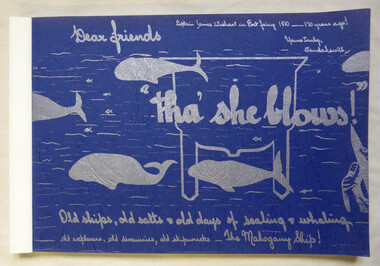
... Front cover: Captain James Wishart in Port Fairy – 170 years ago! Yours Truly, Vanda Savill, Dear friends, ‘Tha’ She Blows’, Old ships, old salts and old days of sealing & whaling, old explorers, old discoveries, old shipwrecks – The Mahogany Ship!...The handwritten material is also of interest as an example of Vanda Savill’s work in compiling local Western District history. whaling port fairy portland shipwrecks Scrapbook style book history of early Port Fairy and Portland Front cover: Captain James Wishart in Port Fairy – 170 years ago! Yours Truly, Vanda Savill, Dear friends, ‘Tha’ She Blows’, Old ships, old salts and old days of sealing & whaling, old explorers, old discoveries, old shipwrecks – The Mahogany Ship! ...Scrapbook style book history of early Port Fairy and PortlandThis is a paper back book of 176 pages. The pages are bound together. The cover is blue card with silver-coloured wording and illustrations of whales. There are 829 photographs and illustrations. The historical material contained in the pages is handwritten and photocopied. non-fictionScrapbook style book history of early Port Fairy and Portlandwhaling, port fairy, portland, shipwrecks -
 City of Greater Bendigo - Civic Collection
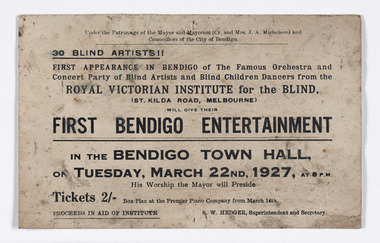
Memorabilia - Ticket, First Bendigo Entertainment
... Travelling entertainment has been one popular way that charities have been able to raise revenue over the past 170 years. The Royal Victorian Institute for the Blind toured regional Victoria regularly to help raise awareness, showcase their talents and fundraise to provide care and education for vision impaired men, women and children. ...Travelling entertainment has been one popular way that charities have been able to raise revenue over the past 170 years. The Royal Victorian Institute for the Blind toured regional Victoria regularly to help raise awareness, showcase their talents and fundraise to provide care and education for vision impaired men, women and children. ...Travelling entertainment has been one popular way that charities have been able to raise revenue over the past 170 years. The Royal Victorian Institute for the Blind toured regional Victoria regularly to help raise awareness, showcase their talents and fundraise to provide care and education for vision impaired men, women and children. Double sided printed ticket for a concert in the Bendigo Town Hall featuring blind artists and dancers from the Royal Institute of the Blind.Obverse; Under the Patronage of the Mayor and Mayoress (Cr, and Mrs J. A. Michelson) and / Councillors of the City of Bendigo / 30 Blind Artists !! / FIRST APPEARANCE IN BENDIGO of The Famous Orchestra and / Concert Party of Blind Artsits and Blind Children Dancers from the / ROYAL VISTORIAN INSTITUTE for the BLIND, / (ST KILDA ROAD MELBOURNE) / WILL GIVE THEIR / FIRST BENDIGO ENTERTAINMENT / IN THE BENDIGO TOWN HALL, / on TUESDAY, MARCH 22nd, 1927, at 8PM / His worship the Mayor will Preside / Tickets 2/- box plan at the Premier Piano Company from March 14th. / PROCEEDS IN AID OF INSTITUTE S.W Hedger, Superintendent and Secretarymayor and mayoress michelson, vision australia, city of bendigo town hall, city of greater bendigo community partnerships, city of greater bendigo events -
Glenelg Shire Council Cultural Collection
Book, Vanda Savill, 'Tha' She Blows -Old ships, Old salts & Old Days of Whaling & Sealing', 1980
... Front: Silver Handwriting; Captain James Wishart in Port Fairy 1810 - 170 years ago! Dear Friends , 'Tha' She Blows -Old ships, Old salts & Old Days of Whaling & Sealing' Old Explorers, old discoveries - The Mahogany Ship! ...Front: Silver Handwriting; Captain James Wishart in Port Fairy 1810 - 170 years ago! Dear Friends , 'Tha' She Blows -Old ships, Old salts & Old Days of Whaling & Sealing' Old Explorers, old discoveries - The Mahogany Ship! ...White plastic bound book, front and back covers made from marine blue card, silver whales and text on front cover, silver seals and text on back cover. Text of book handwritten. -
 Bayside Gallery - Bayside City Council Art & Heritage Collection
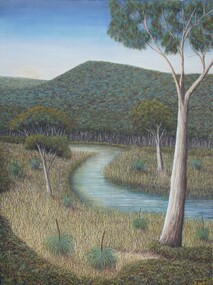
Painting - oil and acrylic on canvas, Robert Kelly, Chinaman's Creek, 2016
... Since settlement over 170 years ago, the creek has been drained, blocked, reconstructed and damaged. ...Since settlement over 170 years ago, the creek has been drained, blocked, reconstructed and damaged. ...Bob Kelly paints landscapes of culturally significant sites along the Mornington Peninsula and depicts these locations as he imagines they originally were before colonisation. Using traditional Western painting techniques, Kelly records the underlying spirit of the Peninsula from a Wathaurong perspective. Chinaman’s Creek in Capel Sound (Rosebud West) was an important watercourse that originally ran from Wonga (Arthur’s Seat) down through Tootgarook Swamp into Port Phillip Bay. It was a great fresh water and food source and home for many Boonwurrung people. Since settlement over 170 years ago, the creek has been drained, blocked, reconstructed and damaged. Kelly depicts a lush green landscape in which the clean creek water winds through the surrounding vegetation of spinifex grasses and gum trees, the background hills are abundant with trees, untouched from man's intervention. Using painstaking detail, Kelly records each blade of grass and ripple on the surface of Chinaman’s Creek. His attention to detail serves to powerfully reimagine this important cultural site, returning it to its former pristine state, and reinvigorating its role as a key place of sustenance for the Indigenous populations of the Peninsula. Chinaman's Creek was a finalist in the 2017 Bayside Acquisitive Art Prize.oil and acrylic on canvaslandscape, creek, trees, chinaman's creek, painting, indigenous, robert kelly, bayside acquisitive art prize, bob kelly, wathaurong, rosebud, arthur's seat, tootgarook swamp, port phillip bay, boonwurrung -
 City of Moorabbin Historical Society (Operating the Box Cottage Museum)
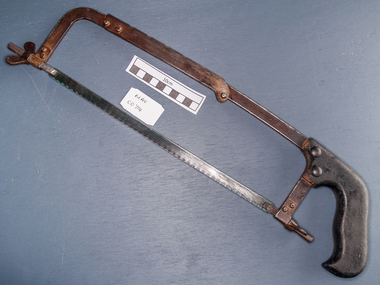
Tools, steel hacksaw 'Marples', 20thC
... The finest quality hand made tools, backed by over 170 years of manufacturing heritage. .In the 1840’s Joseph Marples was one of several ‘Marples’ (most of which were related) in Sheffield manufacturing joiners tools, such as brass inlaid rosewood & ebony braces, boxwood spokeshaves, beech planes, gauges and squares. ...The finest quality hand made tools, backed by over 170 years of manufacturing heritage. .In the 1840’s Joseph Marples was one of several ‘Marples’ (most of which were related) in Sheffield manufacturing joiners tools, such as brass inlaid rosewood & ebony braces, boxwood spokeshaves, beech planes, gauges and squares. ...A hacksaw is a fine-toothed saw, originally and principally for cutting metal. They can also cut various other materials, such as plastic and wood; for example, plumbers and electricians often cut plastic pipe and plastic conduit with them. On hacksaws, as with most frame saws, the blade can be mounted with the teeth facing toward or away from the handle, resulting in cutting action on either the push or pull stroke. In normal use, cutting vertically downwards with work held in a bench vice, hacksaw blades should be set to be facing forwards. Joseph Marples & Son Pty Ltd Traditional Craftsmans Hand Tools made in Sheffield. The finest quality hand made tools, backed by over 170 years of manufacturing heritage. .In the 1840’s Joseph Marples was one of several ‘Marples’ (most of which were related) in Sheffield manufacturing joiners tools, such as brass inlaid rosewood & ebony braces, boxwood spokeshaves, beech planes, gauges and squares. The business has remained within the family to this date, and has been based in Sheffield since those early days. Although modern technology has been used in some instances, many of the traditions of manufacturing fine hand tools has remained the same using selected materials and hand finishing, indeed the same threads are used in the gauges as were used over 100 years ago. A steel hacksaw. 'Marples' with bladeMARPLEStools, woodwork, metalwork, carpentry, pioneers, market gardeners, early settlers, moorabbin, cheltenham, bentleigh, ormond, joseph marples & son pty ltd, sheffield , england, -
 National Wool Museum
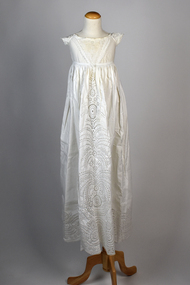
Clothing - Christening Gown, Eliza Lynon, 19th century
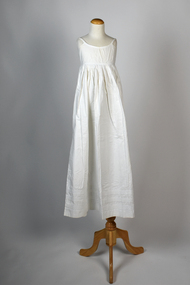
... The Christening gown and petticoat have been in the family for around 170 years, passed to generations. They were sewn by Eliza Lynon in Enniskillen, Northern Ireland. ...The Christening gown and petticoat have been in the family for around 170 years, passed to generations. They were sewn by Eliza Lynon in Enniskillen, Northern Ireland. ...19th century Irish linen Christening gown and matching petticoat donated by Ruth Starkey. The Christening gown and petticoat have been in the family for around 170 years, passed to generations. They were sewn by Eliza Lynon in Enniskillen, Northern Ireland. The following history has been provided by Ruth Starkey: • Town of origin is Enniskillen, Northern Ireland, sewn by Eliza Lynon. • The gown came to Australia with Eliza Lynon on the Red Jacket in 1855. • Eliza married Joseph Dobbyn (who was a member of the Royal Inniskilling Fusiliers Regiment) at Christ Church Geelong. • They built a home at 150 McKillop St, Geelong. Melrose was the name of the home. • Family name Dobbyn - Joseph Wilson Dobbyn b. 07/04/1844 - d 12/10/1892 and Elizabeth (Eliza b 12/03/1847 d 26/08/1934) and passed to Eliza Jane, Jessie Victoria Mary and Lucy Ellen Dobbyn (sisters). • Lucy Ellen nee Dobbyn, married Herbert Blunt, Boatbuilder Geelong at Christ Church Geelong • All lived at 150 McKillop St Geelong over the years • Passed to Marjorie May Fearn born nee Blunt who was baptized at Christ Church Geelong 29/5/1915 • Passed to Ann Rosemary Starkey nee Fearn • Passed to Ruth Norelle Starkey (me) I was baptized at Christ Church Geelong. • I am the great- great granddaughter of Joseph and Eliza and the great granddaughter of Herbert and Lucy.Irish linen Christening gown with cutwork anglais. Cutwork along hem is scalloped with a central motif going down the centre front of the body. Bodice is embroidered in a v shape at the front and has cutwork embroidered sleeves. Skirt is attached to the bodice with cartridge pleats.irish linen, christening, religion, children's clothing, ceremonial, church, geelong, red jacket ship, enniskillen, christ church geelong, northern ireland -
 National Wool Museum
Clothing - Petticoat, Eliza Lynon, 19th century
... The Christening gown and petticoat have been in the family for around 170 years, passed to generations. They were sewn by Eliza Lynon in Enniskillen, Northern Ireland. ...The Christening gown and petticoat have been in the family for around 170 years, passed to generations. They were sewn by Eliza Lynon in Enniskillen, Northern Ireland. ...19th century Irish linen Christening gown and matching petticoat donated by Ruth Starkey. The Christening gown and petticoat have been in the family for around 170 years, passed to generations. They were sewn by Eliza Lynon in Enniskillen, Northern Ireland. The following history has been provided by Ruth Starkey: • Town of origin is Enniskillen, Northern Ireland, sewn by Eliza Lynon. • The gown came to Australia with Eliza Lynon on the Red Jacket in 1855. • Eliza married Joseph Dobbyn (who was a member of the Royal Inniskilling Fusiliers Regiment) at Christ Church Geelong. • They built a home at 150 McKillop St, Geelong. Melrose was the name of the home. • Family name Dobbyn - Joseph Wilson Dobbyn b. 07/04/1844 - d 12/10/1892 and Elizabeth (Eliza b 12/03/1847 d 26/08/1934) and passed to Eliza Jane, Jessie Victoria Mary and Lucy Ellen Dobbyn (sisters). • Lucy Ellen nee Dobbyn, married Herbert Blunt, Boatbuilder Geelong at Christ Church Geelong • All lived at 150 McKillop St Geelong over the years • Passed to Marjorie May Fearn born nee Blunt who was baptized at Christ Church Geelong 29/5/1915 • Passed to Ann Rosemary Starkey nee Fearn • Passed to Ruth Norelle Starkey (me) I was baptized at Christ Church Geelong. • I am the great- great granddaughter of Joseph and Eliza and the great granddaughter of Herbert and Lucy.White Irish linen bodiced petticoat with three sets of three pin tucks at hem. Skirt is attached with cartridge pleating and constructed with French seams. The bodice ties at the back with drawstrings at the neck and waist.irish linen, christening, religion, children's clothing, ceremonial, church, geelong, red jacket ship, enniskillen, christ church geelong, northern ireland -
 Eltham District Historical Society Inc
Document - Folder, Orford family
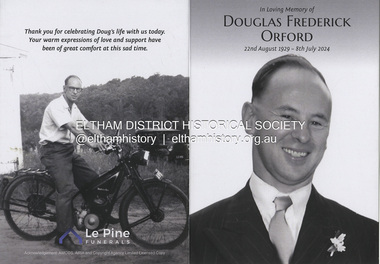
... The Orford family, a pioneer family remained continuously living and working in Eltham for 170 years from 1854 to 2024. James and Sarah Orford arrived in Sydney in 1839 aboard the ship “Orestes”; they had several children there before settling in Eltham in 1854. ...The Orford family, a pioneer family remained continuously living and working in Eltham for 170 years from 1854 to 2024. James and Sarah Orford arrived in Sydney in 1839 aboard the ship “Orestes”; they had several children there before settling in Eltham in 1854. ...The Orford family, a pioneer family remained continuously living and working in Eltham for 170 years from 1854 to 2024. James and Sarah Orford arrived in Sydney in 1839 aboard the ship “Orestes”; they had several children there before settling in Eltham in 1854. Three children, James Mathias, Sarah Amelia and Thomas Henry initially remained in the Eltham area. James eventually moved to Brunswick. Sarah married Arthur Butler Young and finally lived in Bunyip. Thomas who was six years old when the family arrived in 1854 remained in Eltham, married Helen Logan who died, leaving a large family. They lived in a slab hut by the Yarra at Laughing Waters and Thomas managed the Panton Park Estate, a selection owned by Magistrate Thomas Panton. Thomas’s son, Ernest Orford was born 1892 at Pitt Street, Eltham and also lived his entire life in Eltham working as a labourer, orchardist and later as a gardener and grounds keeper for Sir William Irvine, a former Chief Justice and Premier of Victoria. Ernest married Kate Thomas; their two sons Ron and Doug stayed in the area. Another of Thomas' sons, Arthur, also lived in Eltham. Four Orford generations attended Eltham schools. Doug Orford was born on the kitchen table (reference, son Ted Orford) of the family home at the corner of Reynolds Road and Mount Pleasant Road. Doug married Gwen and they established a family however Gwen died at a young age from cancer. Doug eventually remarried another Gwen and they lived for several decades in Napoleon Street, Eltham. Doug was actively involved in EDHS over many years, including serving as a committee member and vice president. Contributions by Doug and Gwen (Treasurer/Membership Secretary), his wife, assisted EDHS to continue to develop as a not-for-profit group intent on promoting and preserving our local history. Both Doug and Gwen were made Life Members of EDHS. They also acted as EDHS delegates to the Eastern Region of Historical Societies. His significant work with assisting to establish our valued Local History Centre helped develop our home base and supported the continued growth of our society. Doug’s local knowledge, suggestions and family connections were highly valued, Until recent times, he continued to regularly attend our Collections Team workshops providing his insights and historical information about photographs and society records. Doug died peacefully July 8, 2024, and represents the last link in the Orford Eltham chain which spanned 170 years. His funeral was held Thursday, July 18, 2024, at Le Pine Funerals, 848 Main Road, Eltham. Contents: Typed notes, no date: Memories of Ernest Orford [taped 1979] about his school days. Handwritten notes, no date: History of Ernie Orford. Typed notes, no date: History of Thomas Henry Orford and family. Photocopy: Shire of Eltham General Rate Receipts. Received from D Orford 7 June 1923 and Received from E F Orford, 4 August 1924. Letter, no date: Nillumbik Shire to Russell Yeoman, Gwen Orford to receive Volunteer Recognition Award. Newsletter article: "The Orford Family, Eltham", Shire of Eltham Historical Society, No.80 September 1991. History of Orford family. Handwritten notes: 21 March 2011, genealogy of George Orford. On reverse Melways map makred with Orford and other land ownerships. Newspaper advertisement, 21 March 2011: "264 Reynolds Road, South Eltham", property for sale [land in ownership of Orford family]. Letter: St Margaret's Anglican Church Eltham to Doug Orford, 17 November 2011, Extracts from church records relative to Orford family. Newspaper article: "Timely facelift at war memorials', Diamond Valley Leader, 30 April 2024, Nillumbik war memorial will have some work and a bronze plaque will be installed at the Eltham Avenue of Honour, Wingrove Park; photograph of Doug Orford. Newsletter item: "Welcome home medal", Eltham District Historical Society newsletter no.216 May 2014, World War I two 'Welcome Home Medals' in ownership of local men, being Harry Gilham and Doug Orford. Order of Service, Le Pine Funerals (Eltham), In Loving Memory of Douglas Frederick Orford 22nd August 1929 - 8th July 2024. Doug Orford Reminiscences (2002) in conjunction with Jock Read and Peter Bassett Smith; 4 pages - 3 typed, 1 handwritten possibly transcribed from an audio tape recording (location unknown). New word file and associated pdf created [\Dropbox\EDHS DATA\DOCUMENTS\COLLECTION CATALOGUE DOCUMENTS AND PDFs\2-2 Family Folders\EDHS_06110-2 Doug Orford reminiscences 2002.docx - 1 April 2025] Doug Orford Eulogy by daughter Kathryn Whiteside 2024 and associated PDF [D:\Dropbox\EDHS DATA\DOCUMENTS\COLLECTION CATALOGUE DOCUMENTS AND PDFs\EDHS_06110 Doug Orford Obituary 2024.docx] Gwen Orford (nee Best) Eulogy 2025 and associated PDF [D:\Dropbox\EDHS DATA\DOCUMENTS\COLLECTION CATALOGUE DOCUMENTS AND PDFs\EDHS_06110 Gwen Orford (nee Best) Eulogy 2025.PDF]Newspaper clippings, A4 photocopies, etcdoug orford, harry gilham, welcome home medal, eltham avenue of honour, nillumbik war memorial, wingrove park, henry dendy, alfred armstrong, james orford, 264 reynolds road south eltham, george orford, george joseph orford, maryanne george joseph, thomas henry orford, ernest orford, e f orford, eltham cemetery, helen orford, joseph panton, panton park, gordon lyon, banyule estate heidelberg, james matthias orford, wurundjeri, constable peter lawlor, george hill, franklin street eltham, ronald orford, eltham primary school, john brown, robert gamble school inspector, sarah orford, mary ann orford, james mathias orford, sarah amelia orford, james peet, arthur butler young, watsons creek victoria, kangaroo ground victoria, helen logan, william orford, jane orford, arthur orford, frederick orford, florrie orford, victor orford, chem orford, sunnymede eltham, panton hill estate, sir william irvine, gordon lyons, kate thomas, north eltham gospel church, harold clapp, eltham cricket club, research primary school, dalton street school eltham, keith banks, betty banks, benjamine boyd, laughing waters road eltham, freddie gilsinen, douglas frederick orford, eltham district historical society, funeral service, le pine funeral home, life member, order of service, 1934 flood, 1939 bushfires, alcock & pierce, ansell, associated schools sports, blacksmith shop, boakes, bridge street, bryce family, bullock track, butcher, catholic church, cliff lester, cliffy green, daisy smith, dave lyon, diamond creek, diana bassett smith, dick tooth, dr. frank may, eltham higher elementary school, ernie andrew, fire station, flower stall, fodder business, fruit shop, furniture store, gahan family, garni burges, greensborough, harold norman, harry hawker, hat factory, hawker & owen, hay and com store, henry hawker, henry street, j .harry butherway, jack burgoyne, jack ryan, jock read, john lyon, junk yard, kevin gahan, kilpatricks, len parsons, lyon family, machine factory, mc leans, memorial, metery road, miss reynolds, monteith 's bus, mr. gadd, mrs. bird, mrs. morrison, napoleon street, peter bassett smith, peter's gahan, plenty river, plumridge, produce store, public hall, rechabite hall, reynolds road, roger bird, rutter family, ryan family, shoe factory., staffs produce store, studley cairn gahan, sweeneys lane, swimming pool, taylor street, tennis court, warren family, wooden bridge, yarra brae road -
 Flagstaff Hill Maritime Museum and Village
Book, Jonathan Cape, Martin Arrowsmith, 1930
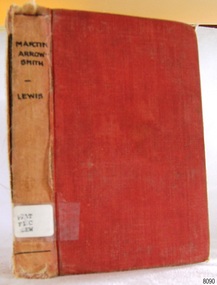
... They continued in business for almost 170 years, sadly going into liquidation in 2014. ...They continued in business for almost 170 years, sadly going into liquidation in 2014. ...This book “Martin Arrowsmith” is a novel written by Sinclair Lewis. It was first published in 1925. Lewis won the 1926 Pulitzer Prize for this book but he declined the Prize. He had been helped in the writing of it by science writer Paul de Kruif, who received 25% of royalties on the sales. However, Lewis is listed as the sole author. About SINCLAIR LEWIS (1885-1951) The author was born as Harry Sinclair Lewis in 1885 in Sauk Centre, Minnesota. He was renowned as an American novelist, playwright and short story writer. His first writings were romantic poems and short stories. Six of his novels were published by the time Lewis was 36. Lewis received the Nobel Prize for Literature in 1930 for his “vigorous and graphic art of description and his ability to create, with wit and humour, new types of characters." He was the first author from the United States to receive this award. Lewis graduated from university in 1907. He worked as a reporter and editor for several publications. He was a prolific writer, publishing dozens of works and numerous articles, and became popular for his satire. Lewis married and divorced twice and died alone from a heart attack due to advanced alcoholism) near Rome on 10th January 1951, aged 66. This book was part of a large group of books referred to as the Pattison Collection, which belonged to the Warrnambool Public Library, part of the Warrnambool Mechanics’ Institute. About RALPH ERIC PATTISON and the ‘PATTISON COLLECTION’ The ‘Pattison Collection’ is a collection of books and records that was originally owned by the Warrnambool Mechanics’ Institute, founded in Warrnambool in 1853. By 1886 the Warrnambool Mechanics’ Institute (WMI) had grown to have a Library, Museum and Fine Arts Gallery, with a collection of “… choice productions of art and valuable specimens in almost every branch and many wonderful national curiosities are now to be seen there, including historic relics of the town and district.” It later included a School of Design. Although it was very well patronised, the WMI was led to ask the City Council to take it over in 1911 due to lack of financial support. In 1935 Ralph Pattison was appointed as City Librarian to establish and organise the Warrnambool Public Library as it was then called. Ralph Eric Pattison was born in Rockhampton, Queensland, in 1891. He married Maude Swan from Warrnambool in 1920 and they set up home in Warrnambool. In 1935 when Pattison accepted the position as City Librarian for the Warrnambool City Council his huge challenge was to make a functional library within two rooms of the Mechanics’ Institute. He tirelessly cleaned, cleared and sorted a disarrayed collection of old books, jars of preserved specimens and other items reserved for exhibition in the city’s museum. He developed and updated the library with a wide variety of books for all tastes, including reference books for students; a difficult task to fulfil during the years following the Depression. He converted all of the lower areas of the building into a library, reference room and reading room for members and the public. The books were sorted and stored using a cataloguing and card index system that he had developed himself. He also prepared the upper floor of the building and established the Art Gallery and later the Museum, a place to exhibit the many old relics that had been stored for years for this purpose. One of the treasures he found was a beautiful ancient clock, which he repaired, restored and enjoyed using in his office during the years of his service there. Ralph Pattison was described as “a meticulous gentleman whose punctuality, floorless courtesy and distinctive neat dress were hallmarks of his character, and ‘his’ clock controlled his daily routine and his opening and closing of the library’s large heavy doors to the minute.” Pattison took leave from 1942 to 1945 to serve in the Royal Australian Navy, Volunteer Reserve as Lieutenant. A few years later he converted one of the Museum’s rooms into a Children’s Library, stocking it with suitable books for the younger generation. This was an instant success. In the 1950’s he had the honour of being appointed to the Victorian Library Board and received more inspiration from the monthly conferences in Melbourne. He was sadly retired in 1959 after over 23 years of service, due to the fact that he had gone over the working age of council officers. However, he continued to take a very keen interest in the continual development of the Library until his death in 1969. THE NEW WARRNAMBOOL LIBRARY When the WMI building was pulled down in 1963 a new civic building was erected on the site and the new Warrnambool Library, on behalf of the City Council, took over all the holdings of the WMI. At this time some of the items were separated and identified as the ‘Pattison Collection’, named after Pattison. Eventually, the components of the WMI were distributed from the Warrnambool Library to various places, including the Art Gallery, Historical Society and Flagstaff Hill. Later some were even distributed to other regional branches of Corangamite Regional Library and passed to and fro. It is difficult now to trace just where all of the items have ended up. The books at Flagstaff Hill Maritime Village generally display stamps and markings from Pattison as well as a variety of other institutions including the Mechanics’ Institute itself. About BUTLER & TANNER LTD, Printers The company Butler & Tanner Ltd, of Great Britain, was established in France in 1845 as W.T. Butler, and in 1857 ran a steam printing works. The company was also known as B&T, and Butler, Tanner and Dennis. They continued in business for almost 170 years, sadly going into liquidation in 2014. The company was Britains ‘oldest and foremost colour printer’. Lewis’s book is significant for its association with the writer, who was the first American to be awarded the Nobel Prize for Literature (1930). This book is significant for its connection with the Pattison Collection which, along with other items at Flagstaff Hill Maritime Village, was originally part of the Warrnambool Mechanics' Institute’s collection. The Warrnambool Mechanics’ Institute collection is primarily significant in its totality, rather than for the individual objects it contains. Its contents are highly representative of the development of Mechanics' Institute libraries across Australia, particularly Victoria. A diversity of publications and themes has been amassed, and these provide clues to our understanding of the nature of and changes in the reading habits of Victorians from the 1850s to the middle of the 20th century. The collection also highlights the Warrnambool community’s commitment to the Mechanics’ Institute, reading, literacy and learning in the regions, and proves that access to knowledge was not impeded by distance. These items help to provide a more complete picture of our community’s ideals and aspirations. The Warrnambool Mechanics Institute book collection has historical and social significance for its strong association with the Mechanics Institute movement and the important role it played in the intellectual, cultural and social development of people throughout the latter part of the nineteenth century and the early twentieth century. The collection of books is a rare example of an early lending library and its significance is enhanced by the survival of an original collection of many volumes. The Warrnambool Mechanics' Institute’s publication collection is of both local and state significance. Title: Martin Arrowsmith Author: Sinclair Lewis Publisher: Jonathan Cape, London Date: 1930 Edition: Hardback board book covered with red linen. Linen on the spine has faded to orange-brown. On the spine is a hand printed title and author, and a white adhesive label with a typed library call number. Inside the front cover is a printed label. On the book’s fly page is an oval stamp impression in purple ink, and handwritten pencilled numbers and letters. The book, a novel, is one of a Collected Edition published in 1929. It also belongs to the Pattison Collection originally belonging to the Warrnambool Mechanics’ Institute, and the Warrnambool Public Library.Adhesive label on the spine - “PAT / FIC / LEW” Hand printed on the spine in black “MARTIN / ARROW - / SMITH” and “LEWIS” Purple stamp on fly page “WARRNAMBOOL / MECHANICS’ / INSTITUTE” Pencil text on fly page “PL (underlined) / W / 14217A” Printed label inside front cover from the Warrnambool Public Libraryflagstaff hill, warrnambool, shipwrecked coast, flagstaff hill maritime museum, maritime museum, shipwreck coast, flagstaff hill maritime village, great ocean road, book, pattison collection, warrnambool library, warrnambool public library, warrnambool mechanics’ institute, ralph eric pattison, warrnambool books and records, corangamite regional library service, warrnambool city librarian, mechanics’ institute library, victorian library board, warrnambool children’s library, american novel, jonathan cape, sinclair lewis, harry sinclair lewis, 1930 nobel prize for literature, pulitzer prize, bitler & tanner ltd, b & t -
 The Beechworth Burke Museum
Photograph, Between 1946 and 1961
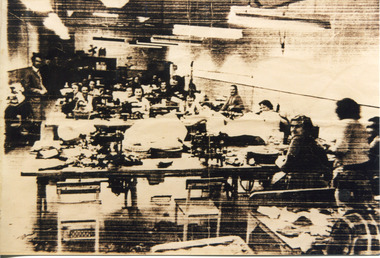
... years of age. At its peak, the shoe factory employed thirty six women and girls, which also included post-war migrants. After the Second World War, Australia admitted increasing numbers of immigrants in order to fulfil labour requirements for a rapidly inflating demand of consumer goods. These migrants were largely from European Countries in line with the ‘White Australia Policy’. In 1954 Beechworth had 170...years of age. At its peak, the shoe factory employed thirty six women and girls, which also included post-war migrants. After the Second World War, Australia admitted increasing numbers of immigrants in order to fulfil labour requirements for a rapidly inflating demand of consumer goods. These migrants were largely from European Countries in line with the ‘White Australia Policy’. In 1954 Beechworth had 170 ...Elgin Shoes Pty., Ltd., established a branch shoe factory in Beechworth in 1946. Managing director, Mr T Nagle Pitman, selected Beechworth as a suitable location for the factory due to the availability of labour in the town, particularly girls under sixteen years of age. At its peak, the shoe factory employed thirty six women and girls, which also included post-war migrants. After the Second World War, Australia admitted increasing numbers of immigrants in order to fulfil labour requirements for a rapidly inflating demand of consumer goods. These migrants were largely from European Countries in line with the ‘White Australia Policy’. In 1954 Beechworth had 170 migrants from the UK, 102 from Hungary, and 63 from Germany. The factory closed in 1961 as increased centralisation of both populations and industry in the larger nearby towns of Wangaratta and Wodonga lead to the closure of many factories in small towns in the 1960s and 1970s. This photograph is historically significant as it shows the working conditions in a factory primarily staffed by women at some point between the late 1940s and early 1960s. Sepia rectangular photograph printed on matte photographic paperReverse: 14 / AFGA / 6982 / pitman shoe factory, elgin shoe company, industry, shoe factory, shoemaking, working women, post-war migration, factory, white australia policy, mid-twentieth century women's working conditions, twentieth-century working conditions, pitman, elgin, shoe, sewing machine, leather, pittman -
 Ringwood and District Historical Society
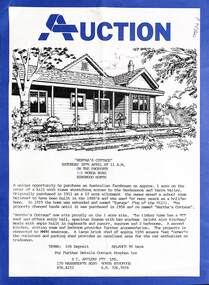
Flyer, Auction - Hertha's Cottage, 110 Wonga Road, Ringwood North, Victoria. (Saturday 30th April, circa 1980s)
... years as a holiday home..In 1919 the home was extended and named "Yurunga" (Top of the Hill). ... A large brick shed of approx 1500 square feet formerly the coolstore and packing shed provides an excellent area for the car enthusiast or tradesman. Agent - Stephen Lye, R.F. Appleby Pty Ltd., 170...years as a holiday home..In 1919 the home was extended and named "Yurunga" (Top of the Hill). ... A large brick shed of approx 1500 square feet formerly the coolstore and packing shed provides an excellent area for the car enthusiast or tradesman. Agent - Stephen Lye, R.F. Appleby Pty Ltd., 170 ...A4 size page with blue border featuring sketch of single storey house and typewritten description.A unique opportunity to purchase an Australian farmhouse on approx. 1 acre on the crest of a hill with views stretching across to the Dandenongs and Yarra Valley. Originally purchased in 1911 as a 10 acre allotment, the owner moved a school room believed to have been built in the 1880s and was used for many years as a holiday home..In 1919 the home was extended and named "Yurunga" (Top of the Hill). ... A large brick shed of approx 1500 square feet formerly the coolstore and packing shed provides an excellent area for the car enthusiast or tradesman. Agent - Stephen Lye, R.F. Appleby Pty Ltd., 170 Warrandyte Road, North Ringwood (Phone) 876.4222 A.H. 726.7028. -
 Bendigo Military Museum
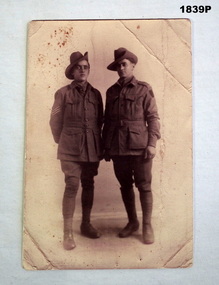
Photograph - PHOTOGRAPH WW1, C.1916
... years 2 months. Embarked for Egypt 7.3.1916, transfers to 58th Batt 19.5.1916, embarks for France 21.6.1916, promoted to Sgt 3.7.1916, transfers to 57th Batt 29.8.1916. During 1918 he attends Musketry and Corps school totalling 5 weeks. WIA 28.9.1918 GSW’s multiple and DOW’s the same day. His name and Heards is remembered on the Soldiers Memorial Institute Roll Bendigo. photographs Postcards Heard “Dear sister, this is a photo of us both, pretty poor photo. If you have time you might call on George’s mother in Queen St, Mrs Henson 170 ...The card relates to Robert Thomas Heard No 5105, KIA (standing on the right) Refer 1893.2P for his service history and other collection items. The other soldier is George Lyonel Henson No 4823 enlisted in the AIF on 8..7.1915 in the 14th reinforcements 6th Batt age 19 years 2 months. Embarked for Egypt 7.3.1916, transfers to 58th Batt 19.5.1916, embarks for France 21.6.1916, promoted to Sgt 3.7.1916, transfers to 57th Batt 29.8.1916. During 1918 he attends Musketry and Corps school totalling 5 weeks. WIA 28.9.1918 GSW’s multiple and DOW’s the same day. His name and Heards is remembered on the Soldiers Memorial Institute Roll Bendigo.Photo postcard, sepia tone showing two soldiers in uniform standing. Writing on rear in purple pencil.“Dear sister, this is a photo of us both, pretty poor photo. If you have time you might call on George’s mother in Queen St, Mrs Henson 170 Queen St Bendigo”. photographs, postcards, heard -
 Warrnambool and District Historical Society Inc.
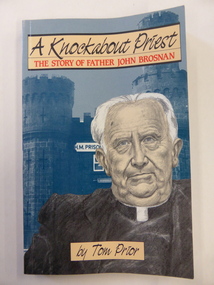
Book, Hargreen Publishing Company, A Knockabout Priest - The story of Father J Brosnan, 1988
... years at Cudgee, 15 kilometres from Warrnambool. Father Brosnan achieved fame as the Catholic Chaplain at Pentridge Prison and as the priest who campaigned to save Ronald Ryan from hanging and who was with Ryan when he was hanged. Cudgee Father Brosnan Pentridge Prison Warrnambool History This is a biography of Father John Brosnan. This is a soft cover book of 170 ...This is a biography of Father John Brosnan.This is a soft cover book of 170 pages. The cover has an image of Father Brosnan in sepia tones set against a background of the front of Pentridge Prison in dark blue tonings. The title of the book is in red, black and yellow tones. The back cover has a photograph of Father Brosnan and the Pope. non-fictionThis is a biography of Father John Brosnan.cudgee, father brosnan, pentridge prison, warrnambool history -
 Warrnambool and District Historical Society Inc.
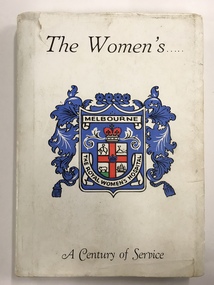
Book, The Women's..... A Century of Service, 1956
... This is a soft-cover book of 170 pages printed in 1976 and giving the history of the first 100 years of the Royal Women’s Hospital, Melbourne. ...years. His name is listed in this book. warrnambool medical staff royal women’s hospital melbourne saltau family warrnambool dr william dixon saltau Statement of Significance Melbourne The Royal Women's Hospital This is a soft-cover book of 170 pages printed in 1976 and giving the history of the first 100 years of the Royal Women’s Hospital, Melbourne. ...This book by C.E. Sayers details the history of the Royal Women's Hospital from the time of its foundation as the Lying In Hospital in 1856.It includes information on doctors and nurses and managerial staff connected with the hospital. Some Warrnambool medical staff in the past have been connected with the Women's Hospital. Apart from its detailing of the history of an important institution in Victoria, this book is of particular interest to the Warrnambool and District Historical Society because William Dixon Saltau (1894-1970), born in Warrnambool, was the Medical Superintendent of the Women’s Hospital from 1924 to 1951. Dr Saltau was the son of Marcus Saltau (M.L.A.) and his wife Jean and the grandson of Henry Saltau who came to Australia in 1860 and who founded in the 1870s the Warrnambool firm of Saltau and Son, general carriers, coal, wood and produce merchants and forwarding agents. Dr Saltau’s father Marcus was Mayor of Warrnambool and a generous benefactor of the Warrnambool Hospital (Marcus Saltau House and Jean Buick Saltau Maternity Ward). Dr Saltau was educated at Warrnambool Academy (Richard Lawson, Headmaster), Scotch College, Melbourne and Melbourne University. He specialized in obstetrics and gynaecology and practised in England, Adelaide and Melbourne. .This book is of general historical interest as it describes the history of the Royal Women’s Hospital in Melbourne and because a Warrnambool identity, Dr William Dixon Saltau, was the Medical Superintendent of this hospital for 25 years. His name is listed in this book. This is a soft-cover book of 170 pages printed in 1976 and giving the history of the first 100 years of the Royal Women’s Hospital, Melbourne. It has a white cover of thick paper with the emblem of the hospital on the front in blue, red, black and white. There is also a dust cover with the same material on it. The book has 26 Chapters and ten Appendices, an Index, a Foreword and an Introduction. It has a black and white sketch of the entrance to the first hospital and portraits of the two medical founders of the hospital. The pages have been bound using glue.Melbourne The Royal Women's Hospitalwarrnambool medical staff, royal women’s hospital, melbourne, saltau family, warrnambool, dr william dixon saltau, statement of significance -
 Kiewa Valley Historical Society
Book - Religious Education, Prayers New and Old, 1972
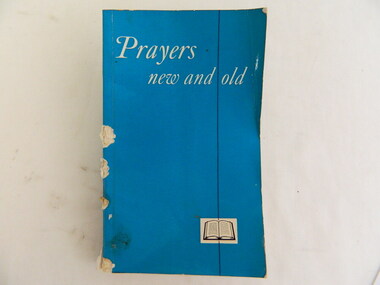
... years old in 2015. Historical: Religious Education: This book was used by students who attended the Sunday School classes at the Kergunyah Presbyterian Church. Religion: Presbyterian Church at Kergunyah, in the Kiewa Valley, celebrates its 125th anniversary in 2015 after being handed over to the uniting Church in the 1970s. religion prayers ewen wallace kergunyah presbyterian church religious education sunday school Pencil inside on cover page "170" "3/MA" Pencil inside on back cover page 15 names listed and $2.40 Warwick, Ken, Debbie, Cameron, Thomas, Anna, Ricki, Glen Simpson, Brett, Mathew, Lorinda, Tracey, Luke, John, Megan Bright shiny aqua small book with vertical black thin line 3 quarters of the way along from the spine. ...Students attended Sunday School classes at the Kergunyah Presbyterian Church. Sunday school was held in a little 16 foot square wooden building which came from Rocky Valley after it was no longer needed there. Ewen Wallace's father initiated and organised the move. C2011 the building was knocked down because of white ants. The Presbyterian Church will be 125 years old in 2015.Historical: Religious Education: This book was used by students who attended the Sunday School classes at the Kergunyah Presbyterian Church. Religion: Presbyterian Church at Kergunyah, in the Kiewa Valley, celebrates its 125th anniversary in 2015 after being handed over to the uniting Church in the 1970s.Bright shiny aqua small book with vertical black thin line 3 quarters of the way along from the spine. This black line goes through the middle of a picture of a book which is drawn in black with a rectangular of white around it. Title is in white and cursive script. Title is written in bold white print along spine. Back of book has ISBN number in blackPencil inside on cover page "170" "3/MA" Pencil inside on back cover page 15 names listed and $2.40 Warwick, Ken, Debbie, Cameron, Thomas, Anna, Ricki, Glen Simpson, Brett, Mathew, Lorinda, Tracey, Luke, John, Meganreligion, prayers, ewen wallace, kergunyah, presbyterian church, religious education, sunday school -
 Sunshine and District Historical Society Incorporated
Magazine - Sunshine Primary School. A Scrap Book of Memories 1957 - 1997, Probably about 1997
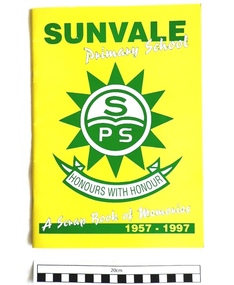
... The acting head teacher and five temporary teachers came from the East Sunshine Primary School from which about 170 students also came. During the later years the school operated as part of a three campus primary school complex formed between Sunvale Primary School, Sunshine East Primary School, and Braybrook Primary School. ...The acting head teacher and five temporary teachers came from the East Sunshine Primary School from which about 170 students also came. During the later years the school operated as part of a three campus primary school complex formed between Sunvale Primary School, Sunshine East Primary School, and Braybrook Primary School. ...The Sunvale Primary School was situated on Neil Street, near Hertford Road, Sunshine, on the former Moons paddock. The school was officially opened on the 9th of October 1957 with an enrolment of 214 students. Most of the students were transferred from the overcrowded Sunshine, and Sunshine East Primary Schools. The acting head teacher and five temporary teachers came from the East Sunshine Primary School from which about 170 students also came. During the later years the school operated as part of a three campus primary school complex formed between Sunvale Primary School, Sunshine East Primary School, and Braybrook Primary School. After the modern Sunshine Harvester Primary School was built on the East Sunshine Primary School site, the students from the Braybrook and Sunvale schools were transferred there. Sunvale Primary School was closed on 9th September 2009.The magazine is a historical record of the initial 40 years of the school and of activities associated with the school. It contains the names of the Principals, from Mr. Bartels in 1957 to Mr. A. Dash in 1997, and also the names of Chairs of the School Council, from Mr. F. Sanford to Mr. T. Cuddy. It also features articles on the history of the school, the mothers club, the parents & friends members, special events & features, class & staff photographs, sport, and has a memories section. The special events & features section includes the school ball, camps, the Governor's visit in 1995, and Sunvale's famous Olympian staff member Pam Kilborn.SUNVALE Primary School S/PS HONOURS WITH HONOUR A Scrap Book of Memories 1957 - 1997sunvale, primary school, school magazine, scrap book of memories, moons paddock, bartels, dash, sanford, kilborn, cuddy -
 Vision Australia
Administrative record - Text, Sydney Industrial Blind Institution: Fifty-Sixth Report 1936, 1937
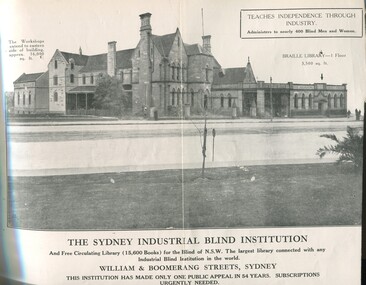
... Articles in the annual report include: 170 workers (130 blind, 20 home workers, 20 sighted) were employed during the year, the passing of Henry Hedger who was superintendent for many years, a personal reflection by Captain Gilbert Nobbs (who was blinded in WW1 and helped by the Institution) and his discussion on talking books, a trial of producing rubber mats in the workshop, 21 students receiving piano or singing lessons, with a male Choir of 21 participants, 320 library readers, the death of A.S.H. ...Articles in the annual report include: 170 workers (130 blind, 20 home workers, 20 sighted) were employed during the year, the passing of Henry Hedger who was superintendent for many years, a personal reflection by Captain Gilbert Nobbs (who was blinded in WW1 and helped by the Institution) and his discussion on talking books, a trial of producing rubber mats in the workshop, 21 students receiving piano or singing lessons, with a male Choir of 21 participants, 320 library readers, the death of A.S.H. ...Articles in the annual report include: 170 workers (130 blind, 20 home workers, 20 sighted) were employed during the year, the passing of Henry Hedger who was superintendent for many years, a personal reflection by Captain Gilbert Nobbs (who was blinded in WW1 and helped by the Institution) and his discussion on talking books, a trial of producing rubber mats in the workshop, 21 students receiving piano or singing lessons, with a male Choir of 21 participants, 320 library readers, the death of A.S.H. Parker who taught Braille with Ethel Campbell and accomplished transcriber, the roster of visiting readers for workers and other attendees, monthly musicales provided by blind and sighted musicians, the Annual Picnic and Sports Day, the 2 Blind Cricket matches against the Victorian team played at Belmore Oval (1-1), and the first White Ball held at the Trocadero with Mrs Eric Sheller as the inaugural President.1 printed booklet with illustrations in bound sydney industrial blind institution, annual report, gilbert nobbs, herbert thompson, jean currie, talking books, ethel campbell, roy kippax, ann sarah hale parker, black and white committee, cricket -
 Wodonga & District Historical Society Inc
Photograph - Bradford Kendall, Wodonga
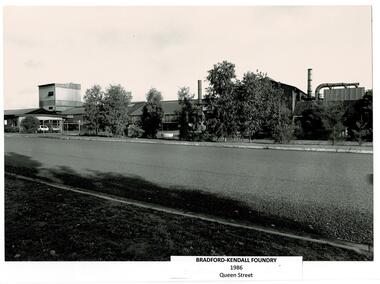
... years later. In the early 1980s, Australian National Industries Ltd bought Bradford Kendall and other heavy engineering companies. The Wodonga foundry with its (then) 170...years later. In the early 1980s, Australian National Industries Ltd bought Bradford Kendall and other heavy engineering companies. The Wodonga foundry with its (then) 170 ...Bradford Kendall was established in 1922 by Lesley Bradford and Jim Kendall, investing their winnings on a race horse. They both previously worked at the BHP Steel Works. They gained contracts with the railways and mining industry. During World War II they also manufactured armaments. During the boom of the 1950s they established several foundries in South Australia, Western Australia, Queensland and Victoria. Bradford Kendall Ltd Wodonga foundry was established in 1954. It melted down old railway wheels, rails and redundant machinery to produce a range of low-alloy steel products, especially for earth-moving vehicles, railways, oil rigs and sugar factories. Wodonga was ideally placed as a change point between the different rail gauges of Victoria and New South Wales, close to the Hume Highway and the Snowy Mountain Scheme. The first sod for the site was turned on 2nd June 1954 and the first melt and pour of molten metal at Wodonga took place on 7th July 1954. Bradford Kendall Plant No.5 in Wodonga became one of the most profitable foundries in the Bradford Kendall group. Bill Black became the first plant Manager, a position he held for 30 years. Another long term employee was Pat Gooding who began work at a 15 year old and retired for the position of Bradken foundry Manufacturing Manager 51 years later. In the early 1980s, Australian National Industries Ltd bought Bradford Kendall and other heavy engineering companies. The Wodonga foundry with its (then) 170 or so staff became part of Bradken Consolidated along with nine other foundries in Australia and New Zealand. In 1989, Kerry Packer’s Consolidated Press Holdings Ltd took control of ANI. In January 1999, Smorgon Steel Group acquired ANI, which included the Bradken business. The company changed hands again in 2001 when Smorgon Steel Group sold Bradken to Castle Harlan Australian Mezzanine Partners (CHAMP). In 2016 negotiations began for Bradken to be taken over by Hitachi Construction for A$689 million. In April 2017 Bradken became a wholly owned subsidiary of Hitachi Construction Machinery Co. Limited.A collection of black and white images and advertising for Bradford Kendall (Bradken) Wodonga.bradford kendall, wodonga industries, wodonga businesses -
 Melbourne Legacy
Journal - Newsletter, Melbourne Legacy Widows' Newsletter 1987-1990, 1987 to 1989
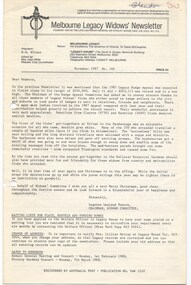
... years. newsletter activities Black typed newsletter x 24 editions from 1987 to 1990, No 161 to 184, each edition 8 or 12 pages. No 161, January 1987 No 162, March 1987 No 163, May 1987 No 164, July 1987 No 165, September 1987 No 166, November 1987 No 167, January 1988 No 168, March 1988 No 169, May 1988 No 170, July 1988 No 171, September 1988 No 172, November 1988 No 173, January 1989 No 174, March 1989 No 175, May 1989 No 176, July 1989 No 177, September 1989 No 178, November 1989 No 179, January 1990 No 180, March 1990 No 181, May 1990 No 182, July 1990 No 183, September 1990 No 184, November 1990 Melbourne Legacy Widows' Newsletter 1987-1990 Journal Newsletter ...Examples of Melbourne Legacy Club newsletters, covering the activities of Melbourne Legacy Widows' Club. Information includes a notice from the Chairman of the Widows' Committee, dates of meetings, possible day trips and theatre outings, and cruises. The ladies were welcome to attend monthly meetings, card afternoons, indoor bowls competitions, outings and tours, plus the annual fete and Christmas concert. The first edition of the newsletter was in 1960, previously there had been a quarterly magazine but the distribution was limited, they changed to a 4 page newsletter format to reach more of the widows. By 1987 and 1988 it was a 8 page publication, by the end of 1989 it was 12 pages long. Editions were edited by Joan Miller, the Widows Club Co-ordinator. Various pages of interest have been added to show different news items. Other editions haven't been scanned.Brings to life the activities provided for the widows and the work of Melbourne Legacy in the early years.Black typed newsletter x 24 editions from 1987 to 1990, No 161 to 184, each edition 8 or 12 pages. No 161, January 1987 No 162, March 1987 No 163, May 1987 No 164, July 1987 No 165, September 1987 No 166, November 1987 No 167, January 1988 No 168, March 1988 No 169, May 1988 No 170, July 1988 No 171, September 1988 No 172, November 1988 No 173, January 1989 No 174, March 1989 No 175, May 1989 No 176, July 1989 No 177, September 1989 No 178, November 1989 No 179, January 1990 No 180, March 1990 No 181, May 1990 No 182, July 1990 No 183, September 1990 No 184, November 1990newsletter, activities -
 Victorian Railway History Library
Book, Wilson, John, The Break Of Gauge: A Social History, 2024
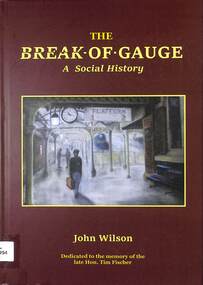
... This book, generously supported with photographs, timelines, and insights from seasoned rail industry experts, covers a span of 170 years. It examines the political and social attitudes of the time and highlights the missed opportunities to resolve the rail gauge problem dating back to the 1880s." ...Tells the story of the gauge problem in Australia, how it happened, why it happened and why there has been faliure to fix the problem and the consequences of the ongoing problem. "From the early days of Australia’s rail networks in the 1850s, different colonies adopted various rail gauges for their own reasons. Even after the Federation on January 1, 1901, the new nation’s leaders missed the chance to create a unified national policy for rail gauges and chose to avoid addressing the issue. This book, generously supported with photographs, timelines, and insights from seasoned rail industry experts, covers a span of 170 years. It examines the political and social attitudes of the time and highlights the missed opportunities to resolve the rail gauge problem dating back to the 1880s."--Publisher's blurb.index, ill, maps, p227.non-fictionTells the story of the gauge problem in Australia, how it happened, why it happened and why there has been faliure to fix the problem and the consequences of the ongoing problem. "From the early days of Australia’s rail networks in the 1850s, different colonies adopted various rail gauges for their own reasons. Even after the Federation on January 1, 1901, the new nation’s leaders missed the chance to create a unified national policy for rail gauges and chose to avoid addressing the issue. This book, generously supported with photographs, timelines, and insights from seasoned rail industry experts, covers a span of 170 years. It examines the political and social attitudes of the time and highlights the missed opportunities to resolve the rail gauge problem dating back to the 1880s."--Publisher's blurb.railroad gauges -- social aspects -- australia -- history, railroad gauges -- australia -- history. -
 Greensborough Historical Society
Newspaper - Newspaper Clipping (copy), Evelyn Observer and South East Bourke Record, The Garden of Victoria; in and around the valley of the Diamond Creek, 1890, 28/02/1890
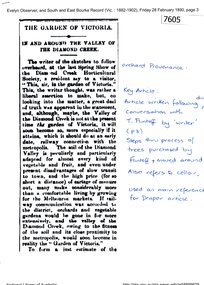
... The Batman Apple tree is said to be over 170 years old, being brought to Greensborough in the 1840s from the Melbourne orchard of John Batman, following Batman's death in 1839. batman apple tree robert whatmough plenty river trail flintoff family Handwritten notes by Anne Paul. 5 page copy of newspaper article, text. ...An historical article on the Batman Apple Tree written in 1890. The Batman Apple tree is said to be over 170 years old, being brought to Greensborough in the 1840s from the Melbourne orchard of John Batman, following Batman's death in 1839. 5 page copy of newspaper article, text.Handwritten notes by Anne Paul.batman apple tree, robert whatmough, plenty river trail, flintoff family -
 Greensborough Historical Society
Document - Report, Samantha Westbrooke et al, Batman Apple Tree, & Pioneer Children's Cemetery, Greensborough, 2012, 2012_07
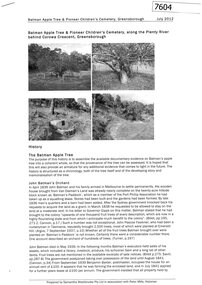
... The Batman Apple tree is said to be over 170 years old, being brought to Greensborough in the 1840s from the Melbourne orchard of John Batman, following Batman's death in 1839. ...A history of the Batman Apple Tree and Pioneer Children's Cemetery along the Plenty River. Prepared by Samantha Westbrooke Pty Ltd in association with Peter Mills, historian. The Batman Apple tree is said to be over 170 years old, being brought to Greensborough in the 1840s from the Melbourne orchard of John Batman, following Batman's death in 1839. The Pioneer Children's Cemetery is the burial place of 7 children from the Whatmough and Partington families who dies between 1845 and 1858.11 page photocopy, text and black and white illustrations.batman apple tree, robert whatmough, plenty river trail, pioneer childrens cemetery -
 Greensborough Historical Society
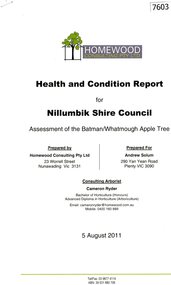
Document - Report, Homewood Consulting Pty Ltd, Assessment of the Batman / Whatmough Apple Tree, 2011, 05/08/2011
... Prepared by Homewood Consulting in 2011 The Batman Apple tree is said to be over 170 years old, being brought to Greensborough in the 1840s from the Melbourne orchard of John Batman, following Batman's death in 1839. batman apple tree robert whatmough nillumbik council plenty river trail 9 page photocopy, text and colour illustrations. ...A health and condition report for Nillumbik Shire Council on the Batman / Whatmough Apple Tree. Prepared by Homewood Consulting in 2011The Batman Apple tree is said to be over 170 years old, being brought to Greensborough in the 1840s from the Melbourne orchard of John Batman, following Batman's death in 1839.9 page photocopy, text and colour illustrations.batman apple tree, robert whatmough, nillumbik council, plenty river trail -
 Greensborough Historical Society
Document - Report, Franz Kreinecker, Tree advice on introduced flora "Batman's Apple Tree", 2002, 2002_07
... The Batman Apple tree is said to be over 170 years old, being brought to Greensborough in the 1840s from the Melbourne orchard of John Batman, following Batman's death in 1839. batman apple tree plenty river trail 8 pages of text. ...A report on the Batman Apple Tree written in 2002 by Franz Kreinecker, arborist for Nillumbik Shire Council.The Batman Apple tree is said to be over 170 years old, being brought to Greensborough in the 1840s from the Melbourne orchard of John Batman, following Batman's death in 1839. 8 pages of text. No photographs accompany this copy, but a photo list is included in text.batman apple tree, plenty river trail
